A Principled Eclectic Approach to Teaching EFL
Writing in Taiwan
Hui- Tzu Min
Abstract
For years non-native English 品 Foreign Language (EFT) writing instructors have turned to scholars and researchers in English-speaking countries such as the United States
,
British,
and Australia for appropriate approaches to teaching writing Yet from language-based,
product-based,
to process-based,
and genre-based approaches,
mainstream writing approaches appear to address only part of the issues facing by EFL writers. According to the three parameters of Kumaravadivelu's macrostrategic framework of post-method pedagogy - particularity,
practicality,
and possibility (Kumaravadive恤, 2006: 69), the author proposed a principled eclectic approach to teaching EFL writing. The features of this new method are adapting mainstream writing pedagogies to local needs,
creating local pedagogies to address students' di宜iculti血, and critically examining and evaluating extant mains位 earn writing practices. Evidence is provided to illustrate this principled eclectic approachKeywords: EFL Writing Approach,Principled Eclectic Approach,Taiwan
Hui-Tzu Min
,
Professor,
Department of Foreign Language and Literature,
National Cheng Kung UniversityE-mail:mi出u血@mail.ncku.edu.tw
教育研究集刊 第五十五輯第期 2009年3 月頁的 95
兼容並蓄之英語寫作教學方式
閔慧慈
摘要 長久以來,本地教師在英文寫作教學法上,均師法美、英、澳等英語系國家 學者。但不論是「語言導向」、「成果導向」、「過程等向」或「文體導向」等英文 寫作教學法,只能解決本地學生英文寫作的部分問題。筆者根據主張「後教學法」 學者 Kumaravadivelu I 宏觀策略架構 J 'I'的三大原則,地域特殊性、教師實用性 及啟發學生潛能性 (Kumaravadivelu,2006: 69) ,提卅一兼容並舊之英語寫作教學 方式。此一教學方式,不僅批判檢視主流寫作教學法所隱含之西方文化觀點,並 修正適應臺灣大學生英語寫作之需要,更強調授課教師依學生及寫作情境需求門 創寫作教學法。筆者除闡述此一教學方式之理論架構外,亦J扎實例簡介此一教學 方式。 關鍵詞:英語寫作教學法、原則性之兼容並蓄方式、臺灣 閔慧匙,圈立成功大學外國語文學章教授 電子郵件為 [email protected] 投稿日期 2008年9 月 16 日,修正日期 2009年 1 月 9 日;採用日期 2009 年2 月 16 日Introduction
There has been a surge in interest in Engli晶晶 Foreignlanguage (EFL) writing recently
,
given the ever-incre品mgp自ssnreto publish int個rationallyamong graduate students and academics aswell 品 theuniversal desire to participate in commerce in the globalized world (Leki,
2002). In 自sponse to this growing demand on writi月 m Engli曲, both academically andprofi自由onally, EFL writing instructors have embarked on a search for the moste伍 cientand effective approach to enhancing student writing Although few still employed a single approach (Liu,
2008),
most proposed a balanced or integrated EFL writing pedagogy,
combining the proce品 and genre approaches to 品nnprocess g叩re approach (Deng,
2007; Gao,
2007; Kim& Kim,
2005). Although the synthesis of process and geme approaches reflects EFL writing instructo血, careful reflection on the inadequacy of current writing pedagogies in local contexts,
it lacks a critical examination of Western literacy practices thatunde中inthe mainstream writing pedagogies. In addition,
it fails to fo自groundlocal writing practice and pedagogies by only inc。中orating ideas :from the English center countries into local contexts. Given the foregoing critique,
the author proposes a principled eclectic approach to EFL writing pedagogy that not only adapts imported mainstream instructional approaches to local needs but also highlights creations of local practices. Moreover,
it features a critical reflection on and evaluation of mainstream writing practices and pedagogies This principled eclectic approach to EFL writing is premised on the threeparamet叮s of Kumaravadivelu's ruacrostrategic framework of post-method pedagogy particularity and practicality (Kumaravadivelu,
2006: 69). In what follows,
the author first briefly outlined the current development ofpostme也odera in English language teaching (ELT) andthe 可ost-processmovement"(Atkin田咒 2003)in second language writing instruction Then,
she discussed the theoretical framework of the proposed principled eclectic approach to teaching EFL writing. Finally,
she illustrated how she used this principledeclectic approach to teaching essay writing to a group of sophomores of Foreign Languages and LiteratureDepa的nentat a comprehensive university in Taiwan
Literature Review
Principled Eclecticism in Post-method Pedagogy
In arecent 自view article on TESOL methods
,
Kumaravadivelu (2006: 60) aptly pointed out three major changes in English language teaching to non-native speakers,
two of which are
“
from method-based pedagogy to post-method pedagogy,
and from systemic discovery to critical discourse". Underlying these shifts is a general recognition among non-native ELT teachers thatsubscribi月 toany single centered-based method or approach fails to completely address local exigencies. A call 品rpluralistic and principled eclectic approach (Larsen-Freeman,
2000) is in needPrinciple eclecticism is tl曰“desirable , coherent
,
and pluralistic" approach which entails diverse learning activ自由 dependingon learner needs (Mellow,
2002). !t h品 been used interchangeably with“
disciplined eclecticism" (Rodgers,
200!: 4),“
informed eclecticism" (Larsen-Freeman,
2000),“個 light叩ed eclecticism' (Brown,
!994: 74),
among other names. Rodgers (200!: 4) predicted 也 at this synergistic approach is "likely to shape the teaching of second languages in the next decades of the new millenni帥" Reid (200!) also echoed this viewpoint when discussing L2 writing pedagogy. Given that most L2 writing instructional approaches address only a certain 品pectof L2/EFL writing (e.g.
,
language,
text,
composing skills,
reader expectations),
COlllllll位nent to any single approach can lead to a skewed perspective on the issues encountered by ESLlEFL students (Silva,
!990). Since“
one sizedo臼 notfit all, ...
the use of a variety of approaches that pennits teachers to extend their repertoire" becomes essential (Reid,
200!: 32)Debate over Current ESL Writing Approaches
Although Reid has pointed out that principled eclecticism is essential to teaching second/foreign language writing to speakers of other lang間ges, recent literature on second language writing approaches does not appear to uniformly reflect this conceptualization. As revealed in a recent publication of a special issue of Journal of Second Language Writing
,
scholarly opinions diverge in the interpretation of an upcoming post-process approach. Somecons仕uedthis as a herald of geme approach,
a social tmu from the process approach (Hyland,
2003a,
2003b); others deemed this emerging paradigm as a refusal of“
the dominance of process at the expense of other aspects of writing and writing instruction" 削atsu由, Canagraraj尬, Harklau,
Hyland,
& Warschauer,
2003: 78-79). Still others (Casanave,
2004; Leki,
2003) considered it an optimal time to critique themains位 earnsecond language writing pedagogyWhile there are still debates andcontrov間iesover the realmeani月 ofpost-process approach in the post-process movement
,
many non-native EFL writing instructors in Asian cOlU1tries have followed Reid's advice by advocating an eclectic approach. Mostcombined practices:from process and genre approaches to fonn process genre approach (Gao
,
2007; Kim& Kim,
2005) or“
process-based approach imbued with product and genre based fealmes" (Deng,
2007: 16). Although this synergistic approach reflects EFL writinginstructo血 'a吐emptto best support effective EFL student writing,
it lacks a scrutiny of the underlying assumptions ofWest個1 wr1吐en communication and their accompanying practices. Neither does this“
principled eclectic" approach reflect genuine local practices. At its best,
it is a combination or adaptation ofmains位 eamL2 writing approaches,
which fails to include any contingent responsive approach when those prefabricated combinations anda也_ptationselude our students in classMethodology
Drawing on the three gniding principles-partie叫an旬., practicali句, possibility of Macrostrategic Framework (Kurnaravadivelu
,
2006: 69),
the author proposed a principled eclectic approach to EFL writing ins仕uction to help local EFL writing scholars and teachers“
develop a capacity to generate varied situation-specific ideas within a general framework 也 at makes sense in tenus of current pedagogical and theo自ticalknowledge" (Kumaravadivelu,
1992: 41). This principled eclectic approach not only strikes a balance among various mainstream L2 "Writing approaches (e.g.,
product
,
process,
genre,
critical) but also between imported mainstream pedagogies and local modifications“
based on a true understanding of local linguistic,
social,
cultural,
and political particularities" (Kumaravadivelu
,
2006: 69). It also seeks to fo月round local practices,
enco盯agmg “a personal theory of practice" (Kumaravadivelu,
2003 544) among local EFL writing instructors whose theorized practices can not only validate but also infonn mainstream writing teaching theory. In other words,
the principle of“practicality" 副illSto challenge the stereotypical role relationship between mainstream knowledge-transmittingtheoriz目sand localknowledge-自celvmgpractItIoners Finally,
this principled eclectic EFL writing approach seeks to cultivate among EFL students both a critical and pr嗯matic perspective on Western and their Ll writing practices and conventions so that they can make infonned choices in their writing that reflect who they are,
and who they want to be (the principle of possibility)In the remainder of this paper
,
the author showcased and discussed how she applied this principled eclectic approach to teaching essay writing in an EFL writing class in Taiwan. Readers should bear in mind that the three principles of this principled eclectic writing approach interweave and interact with each other in a synergic relationship,
with the first principle (particularity) laying the foundation for various pedagogical techniques combined to assist students in grappling with individualwriting problems (practicality)
,
which,
in tnrn,
help prepare them to become reflective m恥。。回ibility).The separate!rea恤entof each principle isill的lyfor the convenience of discussionThe writing class taught by the author was composed of 18 sophomores
,
16 females and 2 males,
with an age average 19. All were native speakers of Mandarin Chinese and had passed the Intermediate Level English Test of the General English Proficiency Test (GEPT) administered by the Language Traini月& Testi月 Centerin Taiwan before being a也nittedto the Department of Foreign Languages and Literature at the university. Their English proficiency was approximately between 523-550 on the Test ofEnglish 品 aForeign Language (TOEFL) exam. Theda旭 so盯C臼 discussed in the following sections were:froms個d間站,compositions,
journal 凹阻es ,and teacher-student conferencesDiscussion
Particularity: Emphasizing Understanding of Local Context
Many mainstream ESL writing instructors are unaware of their students' writing needs due to a lack of understanding of their students' cultural background and their previous training in writing. As a result
,
they advocate an approach that may satisfy more ofthe ESL program needs than their students'. The principled eclectic approach starts with the writing instructor's genuine understanding of local exigencies,
including institutional and student needs. This pedagogy is responsive to and responsible 宜。r local individual,
institutional,
social and cultural contexts in which learning and teaching take place(Kumaravadivelu,
2003: 544). Suchresponsiv叩G扭扭dresponsibility underscores the principle of particularityLocαI Context
were to Englishm呵。rs at Department of Foreign Languages and Literature (FLLD) at the second largest comprehensive university in Taiwan. Students ofFLLD are required to take 3 hours of writing each semester for three consecutive years. Upon entering FLLD
,
they are assigned to one of the fo盯 concurrentwriting sessions of Writing I,
with each class size less than 20 students. At the beginning of their second school year
,
they can choose a writing session ofWriting III taught by an instructor they like Unlike its counte中arts in most NorthAmerican and Emopean universities
,
FLLD did not have explicit departmental C1盯lC叫ar reqmrem叩ts for the writing co盯ses, which giv臼 whomever 也 atteaches writing (音omI to VI) absolute freedom to design their own syllabus. Facing such a constraint-free teaching environment,
the current author did not feelmuch 自liefbut more responsibility when she was first assigned to teach writing III and IV As she embarked on outlining the course objectiv血, she principally considered two criteria: what students want to learn and what she knows about L2 writing. With regard to the first criterion,
she followed Hyland's advice by per宜。nmng some “p自sent situation analysis" (Hyland,
2007: ISS). She conducted an informal survey during the first class,
asking students to tell me what they learned during the previous semester and what they expected to learn in my class. The following four exce叩Its demonstrated the varied writing experiences her students had during the previous semesterStudent A: The professor taught us how to write a procedure paragraph. We had to explain how to do something
Student B: The professor taught us to write letters to ask for application materials for graduate programs. She also asked us top自sentwhat we received :from the university once we got their replies
Student C: Theprofi臼 sor taught us how to write beautiful sentences in English She said that
“
diction" is very important. She also taught us how to combine short sentences into long onesSlndent D: The teacher asked us to keep journals
,
and she always encouraged me with compliments. But I want to improve my grammar.Researchers
,
when comparing ESL with EFLwrite血,tend to perceive EFL writers as a homogeneous group because they share the same culture and receive the same kind of writing instruction. Yet the previous slndent responses revealed very little homogeneity,if notheterogenei旬.,with respect to their"Writing experiencesRegarding their expectations of the writing class
,
most aspired to improve their writing ability and some desired to better their grammarMy grammar is very bad. I want to better grammar in my writing I want to learn how to think in English like I do in Chinese
I want to learn more vocabulary and expressions in English so that I can exp扭扭 myselffreely inwriti月
As shownprevious旬, few had specific ide品 ofwhat they really wanted to learn,
which is not surprising due to their much less experience in writing than in other skills Their responses to the question of future career
,
,
however~~~.._._~,,
gave the author moreb directions on designing the course. Most replied that they would continue further slndies in graduate school or become English teachers at the secondary level (“I want to become an English teacher,"
or“
I want to go to graduate school."). Given this infonnation,
the current author decided to introduce essay writing to them in writing III and academic writing in writing IV While this decision on essay writing was made mostly on pragmatic and instrumental grounds due to student career aspirations,
it is also a reflection of her previous training and subjective preconceptions of the importance of academic essay writing in higher educational context. She believed that by teaching slndents academic writing and providing with them opportnnities to practice it in class can both meet the immediate needs ofthese English majors,
who are required to write tenn papers for their linguistics and literature courses in theirthird-year study and better prepare them for their further studies and future career (a 個rget SlIT叫ionanalysis)
Teαcher Beliefαnd TrαInlng
In addition to addressing student needs
,
the current author also followed Casanave's advice (2004: 10-21) by examining her belief and former academic training when planning course objectives and deciding on the principled eclectic approach to teaching writing. Having learned to write in English for more than two decades,
she deeply believes that learning to write in English is a developmental process,
requiring mastery of the English language,
given her constant wrestling with appropriate expressions and correctgra:虹}fiarto convey my thought. Her academic training,
on the oth叮 hand,helps her understand that learning to writing in English entails knowledge of and skills in cognitive strategies and sociocultural conventions. She learned that wnte自由nploy certain cognitive strategies that transcend language (e.g.,
planning,
revising
,
editing) during the composing proce品 to discover,
construct and share meanings (Flower & Haynes,
1981). She also realized the distinctive features in the 啊iting of ESL writers (Silva,
1993) and possible co帥ibutory sources,
including developmental factors,
L2 proficiency (Mohan & Lo,
1985),
and rhetoric conventions illS阻den帖 'Ll writi月 (Connor, 1996; Hinds,
1987,
1990)The foregoing writing experience and academic training cement her belief that writing in English is a linguistic
,
cognitive,
social,
cultural,
and developmental process,
n自由sitatinga muldimensional approach (Kucer& Silva,
2006) to achieve the following fo盯 objectiv自Students can understand that
1) effective written communication takes various lengths of time
,
depending on their current level ofEnglish language proficiency (linguistic,
developmental);2) writing is a recursive process wherein they would plan
,
compose,
and revise constantly (cognitive); Students will3) compose 自ader-based prose to meet the expectation of certain discourse commnnity (sociocultnral);
4) compose an academic 臼say and write about their reflections on this learning process in j oumais
Practicality: Personal Theory of Practice
The foregoing objectiv臼 obviously defy the employment of any single
mamstream wntmg IllS阻止tionapproach. Although Silva(1990: 18) cautioned against staunch support and premature abandonment of any mainstream approach without critical evaluation and deliberation
,
many EFL writing teachers,
like their ESL count叮parts, still subscribe to and practice centered-based pedagogy in their writing classes without exercising their“
sense of plausibility" (prabhu,
1990: 172) to devise a writing pedagogy that fits local exigencies. In contrast,
the author chose to employ a "pluralistic"p叮spective (La扭曲-F閻明肥, 2000: 182) on L2 writing pedagogy. Relying on her own“
sense of plausibility" and“
personal conceptualization ofhowteachi月 leads to desi自d learning" (Prabl血, 1990: 172),
the author selected and adapted teaching teclmiques from available mainstream writing approaches in the proactive s阻ge(before students s阻rt to compose their drafts) and devised a proceduralized instruction to accommodate student needs in the reactive s阻ge (d盯ing their composing proce品), practIcmg“
principled eclecticism" to achieve the foregoing clUTiculum goals立Iebasicprl個riseof utilizingtechniq阻s:from various mainstream"Writing approaches is to equip students with thep自requisiteknowledge of the sociocultural conventions of the academic discourse commnnity in English-speaking conntries in North Am叮lca, Britain
,
and Australia. These techniques involve a wide array of reading and writing activities from interactive reading approach such as reading like an observant writer,
and "Writing like a reflective reader; clUTent-traditional approach such as introducing
rhetorical moves in genre approach. The creation of proceduralized instruction
,
on the other hand,
is to acconnnodate student needs by offering them explicit instruction on how to inc。中orate their newly acquired knowledge into their own writing. This tailor-made instruction is drawn on an understanding of the underlying cal自由 of stndent difficulty revealed in their journalsTo some
,
such an instructional practice appears to pe中ett也te established power hierarchies of the dominant culture of the academic discourse community. As a foreign language writer and writing teacher,
the current author views this practice as“
a hegemonic diffusion of the communication style judged desirable in the globalized world,
rather than a direct imposition of someone else's language" (Cameron,
2002; Kubota& Shi,
2005: 102). Like the Japanese teacher in Cununing's stndy (2003: 87),
the current author considers learning and teaching the written communicative practices in the academic discourse community mainly from a
“
pragmatic" perspective,品 away to get herstnd叩ts to the wider world. The current author wishes that her own writing instructors had explicitly taught her the rhetorical conventions in her undergraduate stndy so that she could have spent less time struggling with them and more time exploiting and critiquing them. She concurred with Williams (2005: 15) that part of a writing teacher's responsibility is to“
introduce stndents to the practical reality of the discourse community" they aspired to join,
to initiate them into the academic discourse community so that they do not spend an unduly lengthy period of time a吐emptmgto approximate prestigious forms without success(Johns,
1997)Although the current author is of the opinion that EFL writing teachers should explicitly apprentice their students into the discourse commlU1ity
,
she does not suggestthat EFL writers and students need to conform to pa社ems of communication of the academic discourse community after they have mastered the conventionalized modes After obtaining desirable proficiency in academic discourse
,
they can judiciously incorporate their L 1 writing strategies into their L2 writing to create a‘
'third discursive discourse"(Kramsh,
2002; Li,
1999; Matsuda et aI.,
2003). But such a“
transposition"159) must be premised on knowledge and mastery of the literacy practices of the academic discourse community. Like Bakhtin's apt argl盯lent, EFL writers need to
“
command the g叩r臼 they use before they can exploit them" (Hyland,
2003b: 25) Until then,
few readers in the acad個lie discolITse community would heed a criticalEFL outsider這 linguistically unsophisticated and rhetorically unconventional
messages
In what follows
,
the current author highlighted some modified teaching techniques of the mainstream writing pedagogies in the proactive s阻ge and exemplified the proceduralized instruction with discussion on the rhetorical structure of thesis statement in the reactive stage. She also discussed stud叩妞, initial challenge to this rhetorical s虹ucture, evaluation of its pragmatic function,
and subsequent conditional acceptance to illustrate how students decide to accommodate it in the process of learning to become part of the academic community.The Writing CIα55
As previously stated
,
the writing class is for second-year English majors,
the focus of which is on academic essay writing. The自 were18 students in the writing class,
16 females and 2 males with an age average 19. All were native speakers of Mandarin Chinese and had passed the Intermediate Level English Test of the General English Proficiency Test (GEPT) administered by the Language Traini月& Testing Center in Taiwan before being a也nittedto the Department of Foreign Languages and Literature at the university. Their English proficiency was approximately between 523-550 on the Test ofEngli晶晶 aForeign Language (TOEFL) examThe author used
“
Mosaic One: AContent-Based Writing Book"(El品s& Pike-Baky,
2000) given its balanced coverage ofbetween reading andwriti月, proce扭扭dproduct,
ideas and language
,
writers and readers,
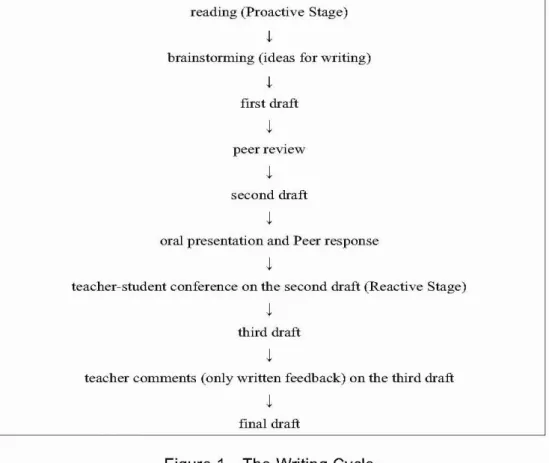
which perfectly matches the curriculum goals and my pluralistic view of writing approaches 立lroUgh the past few years,
she has adopted a modified“
writing cycle" (Tsui & Ng,
2000) in class. The whole cycle is shown inFig盯e IProαctive Stαge
Each writing class started with reading. The fo盯 m句 or pnrposes of reading assIgnments一-language learning
,
reading comprehension,
idea generation,
and rhetorical analysis-were explicitly explained to stndents before they began to compose 很roll, 1993). Close reading for language learning and general reading comprehension may seem unnecessary for and irrelevant to native speakers,
but is necessary for most ESLlEFL stndent writers who are in the process of acquiring the linguistic and content schema which experienced native writers expect them to havereading (Proactive Stage)
•
brainstorming (ideas for writing)
•
first draft
peerreVlew
second draft
oralpresentation 祖dPeer response
teacher-student conferenceon 吐Iesecond draft (Reactive Stage)
•
third 也 aft
•
teacher comments (only written feedback)on 吐Iethird draft
•
final draft
Without first knowing the kind of language experienced writers use to convey ide蹈, it is less likely 也 atEFL students can 臼llycomprehend the author's messages or express similar ideas in their own writing
,
given the close relationship between reading and writing (Kroll,
1993). Despite the importance of reading for acquiring language and apprehending content,
these two purposes are only means to the latter twoends-idea generation and rhetorical analysis. The CI盯ent author always
contextualized the purpose of closing reading in the writing task students are going to perfonn. The following instruction is an illustration of this contextualization
You are to write about certain 呻ects of a new c叫lurethat are challenging/
interesting to you and explain why (or some aspects of Taiwanese culture that might be challenging/interesting to 五oreigners). The reading assignment will give you some ideas. You are supposed to talk about what you have learned from this readi月 in class. Then we will discuss and analyze how the writer informed his friend ofhis new challenges
When the current author and her stud叩ts met the following week
,
she led the students to read rhetorically by drawing their a社叩honto“
particular stylistic ch。眩目, grammatical fea阻r血,methods of development" (Kroll,
1991: 254) to help themgr品p the author's plan and purpose. Anillustration is provided as follows. The notes at the bottoma自 thequestions that she raised in classA Letter to Alex
Dear Alex
,
September 30Thanks for your card. Sorry I haven 't written sooner.I've spent all my free time wandering around Tokyo and learning about Japanese customs. It is very
interesting here because everything is sodi血erent.1
You asked me to"Write about some of the things I've noticed that are new to me. The most striking thing is the huge crowds. There are many
,
many people everywhere,
bur everyone is v目-y orderly and polite. People at home would not be soord叮ly in such crowds. Another new thing for me is the way restaurants display food in restaurant windows. They a叮ange it beautifully on lacquer trays in simple,
clean designs. The Japanese seem to3 value theappear祖ce of 品odmore than the taste. In my opinion,
the sushi here is more delicious than at home.(But the wasabi was so strong I couldn't eat it!)There4 are a few problems that I've had since I arrived. Everything is wn吐en in Japanese
,
and even though your mother taught me a few Japanese characters before I left,
I can't read a thing. Since I can't read signs,
it is d伍 cultto travel around. Most people are 立iendly,but they can't help me much because they don't speak English. Another problem is the Japanese publicH訕。oms. Nobody warned me that the toilets are not like our Western
凹1es-That has been very hard to a共Just to15
Well
,
that's about all for now. I hope I'll understand more Japanese when I write you next time. I think things will get easier when I start teaching. Please[Anticipate: Read like awrit凹, individualcomposi月]Wliatdo youexμctto read in the
品。 llowingparagraplia? Is Davidgoingωtalkabout positive or negative differences?
2 [Coh闊的n]Why did David use
“
but" here? What assumptions did he have about huge crowds?What made him think tliat way?3 [Hedges]Was he very sure about this interpretation?Why not? What did he use to ex-pr且shisunc帥 inty?\\That other words can he use to express the sameme品ling?
4 [Uni秒]What is this paragraph about? Can differences subsume problems? Is this
para-graph connected to the previous one?
5 [Audience]Do you understand what Davidis 個世ng about here? Wliat infonnation lias he left unmentioned? Were David to talk about 也e same problemwi也 another West erner who has not been to Japan
,
what infOlmation would he need to include here?give my regards to your family. Write back soon
Take care
,
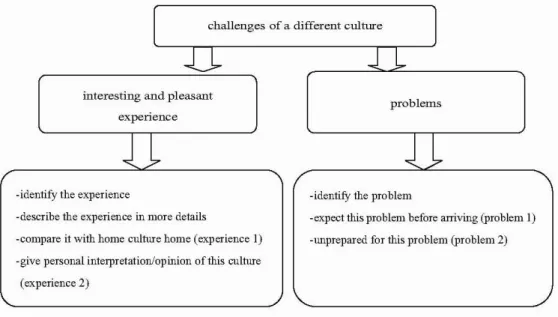
。仰的J After discussing the rhetorical questions,
she outlined the developm叩t and organization of the author's ideas in Fig盯e 2. This infonnation becomes the basis for writing,
discussion,
and follow-up questions. For example,
they discussed aspects other than people's manner,
food,
languages and toilets that can become interesti月 tOpICSto readers such as transportation and weather. In the meantime,
she also reviewed notions students had learned in the previous year such as topic sentence,
paragraph,
and demonstrated how to turn a simple paragraph into an essaychallenges of adiffer目前culture
工 J
n
interesting andpIe品 ant
problems expenence
]工
J
L
/
-identify the experience -identify 也eproblem
-describe 也e expenen 臼 inmore details -expect 血的 problem before 訂Tiving(problem1)
-compare it with home culhrre home(exp 臼ience 1) -lUlpreparedfor 血的 problem (problem2)
-give personalinte中retatio n/opinion of 甘lisculhrre (experience2)
\ /
Figure 2 Analysis of Idea Development
The p自VIOl旭 analysis is similar to the 2nd stage ofFeez這(1 998: 28) teaching-learning cycle-modeling and deconstructing the text
,
the purpose of which is to modelto students how to become observant 自aderswho
“
read like a writer in order to write like a writer (Smith,
1983: 562). As pointed out by proponents of genre researchers (Feez,
1998; Hyland,
2007),
writing teachers need to engage their students in this kind of conscious reading to prompt them to notice ways of reading that they might not oth叮wise engage in so that they can deliberately practice this skill on their own whenever they compose and ultimately turn this explicit knowledge into implicit one and be able to draw on it automaticallyStudents found such an approach to reading novel
,
which visually helps them understand that ideas in a paragraph should be organized and required them to consider their audience when explaining their ideas. The following is a student's 自flection on this approach in her first journal entry (grammar and word choice are original)Well
,
1 neverknow 也 ata paragraph can be analyzed in such way.In the p訓,1 always writed [sic] down what 1 thought immediately and almost never thought about to arrange a paragraph. For me
,
writed [sic] down a paragraph is simple. But after taking this course,
1 knew that a paragraphwo叫d contain manyide蹈, but this [sic] ide品 mustbe organized! Now this is hard to me for 1 didn't used [sic] to organize a paragraph well although 1 have learn [sic] it in my first year.. .." Through a semester's practice,
she gradually adapted to the idea of organization,
as disclosed in her lastjournal 凹的,“in this class,
I have learned about how to organize a [sic] article. 1 am getting used to focus on the topic and what 1 am going to say.Ofcourse
,“
learning" and“
getting used to" the idea of paragraph organization do not guarantee flawless writing becausepo品e品ingrhetorical knowledge (knowing what) and using that knowledge (knowing how) are different things. Students may have the declar甜veknowledge butlack 也e procedural one. 1brough 呻eatedteacherdernonstr,油on and explanation,
most students understood the importance of presenting a thesis statement but experienced di伍 cully wh個 applying this knowledge to their ownwriting
,
as revealed in most students' verbal response“
Oh" to the author's enquiry about the whereabouts of their thesis statement. In nowhere is the lack of procedural knowledge more evident than in Miguel's confession during a student-teacher conference,
“
I knew that you would ask me about it but I did not know how to come up with one."Reαctive Stαge
The fact that moststud叩tsfound stating their main ideas in the fann of a sentence is di伍 cult is understandable given that they are not accustomed to therequ眩目nentof putting their main points in a "preview statement that forecasts the content and organization of the supporting de阻ils"(Kubota& Shi
,
2005: 97),
although they know that they are supposed to express a central idea clearly and in an organized way. The realization ofstudent芯, lack of procedural knowledge prompted me to take reactive actionsby 目nployinga proceduralized instruction involving three interventiontechnique全 checking students' declarative knowled詐, asking students to reread their essays and identify main ideas,
and providing templates,
if necessaryWhen students experienced problems with generating a thesis statement
,
the author first ensured that they had the declarative knowledge by asking them the essential components of a thesis statement,
to which most would reply“
topic and main ide崗" After 品 certainingtheir declarative knowledge,
she would ask th個1 to reread their essays and ifpo品 ible, identify the main ide品 in their own writing. Take the previous topic a New Culture for instance,
a student named Dennis discussed why tra伍c in the city where the University is located (Tainan) is worse than that in his hometown (Taipei). His th臼 is statement does not clearly indicate his purpose and the 2nd main idea is vague. During the individual teacher-student conference,
the author askedhim to扭扭adhis essay and discuss with me his intention2nd drαft
Thetra伍 cin Tainan is worse than that in Taipei. I came to Tainan last summer and I found the intersections in Tainan aremo自 confusingthan those in Taipei
Most of the drivers and riders don't obey the traffic rules. For example
,
they m間lly run through the red light,
drive or ride after driving,
and so on. What stroke me most was thatI've once seen a drunken driver lost his life when he drove through a red light and collide with a bus. Actually,
the traffic accident in Tainan is more usual than that in Taipei because there are too many law-breakers here. Maybe the police shouldper五armthe tra伍 c rules more strictly Maybe the government should improve the problem of routing vehiculartra伍C into and out of Tainan. And more importantly,
we should remind ourselves of obeying thetra伍 crules everywhereAft叮 rereading his own writing
,
Dennis expressed that his topic was tra伍 em Tainan,
and the main idea was“
worse." When the author probed whether his pu中 ose was mainly to describe the worse traffic situation in Tainan,
explain why Tainan's traffic was worse,
or provide solutions to thetra伍 csituation in Tainan,
he realized that his intention was the middle ("I want to give reasons whytra伍cis worse in Tainan") Then they discussed possible ways to make his intention more explicit by using a more precise thesis statementDuring their discussion
,
the author also asked him to reflect on the main ideas Dennis exp扭扭ed 也 atthe third(underline刮目ntencewas the first main idea because he had a lot to talk about it,
including a terrifying personal experience of witnessing a car accident(“I want to point out that there a自 mo自 peoplewho do not obey tra伍c rules in Tainan"). But when she asked him what he meant by‘
'the intersections in Tainan are more confusing those in Taipei" in this draft and the problem about the incurableness“
of routing vehicular tra伍 c into and out of any large city" he had mentioned in his 1st draft,
he explained in Mandarin how the roundabouts and complicated traffic signs confused him (“Wo gangdao Tainan de shihou wanquan gaobudung yua凶uandehunglude峙," (“I had no idea of how the tra伍c lights of the roundabouts worked when I first came to Tainan"). The author enco盯aged him toexpand discussion on this idea because it could be another contributing factor to the worse traffic situation in Tainan. The 宜。llowing is the 3rd draft he tumed in a week later.
3rd drαft.
TheIra宜icin Tainan is worse than that in Taipei because of its road design and drivers who do not obeyIra伍 claws. When I cam to Tainan first time
,
I found that the intersections here are more confusing than that in Taipei. One of the reasons is that there are many roads intercrossed in one intersection. Oppositely,
there are only fa盯 roadsatmost in Taipei. Inadditi凹, what con臼.sedme most was I can hardly be sure whichIra伍 clight in the intersection I should abide by
Another reason is that most of the drivers and riders don 't obey thetra伍 crules F or example
,
they us間lly n江1 through the red light,
like speeding and drive after drinking. However,
the drivers and riders in Taipei pay more attention on following Ira伍 crules. It seems that faulty Ira伍 c routing design and incorrect drivinga社itudeare theIra伍 ckillers in TainanThe author did not provide Dennis with any template to form his thesis statement because his language command is good. For less proficient writers who haddi宜iculty in putting the topic and main ideas together in a thesis statement
,
the author would offer them some templates. Two templates for the topic of“
New Culture" are as品llows
I.There a間 (number) 呻 ects about this culture 也 at (verb)
me: its (noun)
,
(noun),
and (noun)2
“
(number of things) that made me (吋 ective) a自 Its(noun) and (noun)."
statements 自spectively 1
deli比Cl凹O凹>u阻1站S 晶品D叩od也S, andint記er間es且tingcustoms." 2
tra宜ic."
The provision of these templates to some students but not to others is another examnle of addressinY~--~~~~-~~~~~b2:various student needs. which is not to limit weaker students but•~~~-~~ ~~~~-~~~~~--~,
to provide them with interim scaffold. Once these students become more experienced with producing thesis statements
,
they can dispense with the templates and have greater autonomy for generating their own. The foregoing procedure---ehecking students' declarative knowledge,
asking students to reread/reexamine their nwn writing,
and providing templates/answers,
if necessary---ean also serve as a guiding principle to cope with diverse student problems in a heterogeneous classPossibility: Cultivating Reflective Student Writers
Finally,
this principled eclectic EFL writing approach seeks to cultivate among EFL students both a critical and pragmatic perspective on Western and theirLl writing practices and conventions so that they can make infonned choices in their writing that reflect who they are,
and who they want to be (the principle of possibility). This principle is somewhatdi宜erentfrom Benesch's(1996: 733) critical writing curriculum 也 at contains intentionally built-in critical agenda such 品 activities challenging“
the requirements,
and those which worked outside the requirements to create possibilities for social awareness and action." The current author did not intentionally include anycritical agenda in her writing curriculmn but provided students with an
opinion-exchange platfonn-the reflection journal-to encourage them to reflect on the rhetorical di宜erences between English and Chinese and the di伍 culty they
encounter III meetmg "WTItmg reqUIrements 品 well as voice any concern they had in
and outside the"Writing class-be it personal
,
curricular,
scholastic,
or pedagogical One critical reflection made by most students in their jOlITl1al entries is on therhetorical convention-thesis stat目nent. This slndent challenge is not premised on sociopolitical ideology as often seen in critical pedagogy but on pragmatics. They complained about thecons阻 ctioneffect of this rhetorical convention on their ideas and thus challenged its necessity in an academic essay in an indirect way.(“Is there always a th臼 is statement in an academ眩目say?") They thought that a th臼 IS statement IS prescriptive
,
stifli月 theircreativity both in ideas and fonns. (“The more I think about howtophr品 emy ideas in ath自 isstatement,
the fewer ideas I have.") To them,
ath自IS statement is redundant. They did not understand why they need to pre-tell readers in a sentence about what follows in subsequent paragraphs where they will reveal their intentions in evolving examples. ("I explained my main ideas in the body paragraphs Why do I still need to repeat them in ath自 IS S阻tement?")Wi位lessing this reaction in variousjournal 叩tries,the author felt it an opportnue time to hold a class discussion and examination of the merits and demerits of a thesis statement. She started the discussion by referring to the qu臼tions raised in student journal entries. She also brought up the notion of audience and asked slndents to reflect on who read their Ll writing. To this question
,
the unanimous answer was‘
'the Chinese writing teacher". Then she asked them to pictnre a di宜erent audience that expected a th臼 isto guide him/her through the text. Such an expectation,
she told them,
is derived :from a cultural literacy practice that places more responsibilities on the writer in written communication (Hinds,
1987,
1990)The mentioning of audience in the discussion prompted some students to think about the functions of a thesis statement:from the reader's perspective. Somewe自 able to see that such a rhetorical device is reader :friendly,品sistingreaders in identifying wrIte血,ideas so that they can start to evaluate subsequent infonnation
,
explanation and arguments in the essay. (“The th臼 isstatement is useful to me when I dope叮 review.Iknowat once what my classmate's composition is about and can go on reading.") In
addition to reader-friendliness
,
one student writer also mentioned that she used the thesis statement to check the appropriateness and relevancy of her explanations and arguments in the間 ay. ("I think the thesis statement is v叮 useful tome 品 a "WTIterSometimes I write down something that is not related to the main idea. I'd check my writing against the thesis statement to see if my ide品 are side-tracked.") Afterlisti月 the enabling and limiting functions on the white board
,
the author asked students to weigh the pros and cons on the necessity of a thesis statement in an essay. The students reached a consensus that a thesis statement is necessary in this stage given theirdeveloping language proficiency
,
occasionally underdeveloped ideas,
anddevelopmental organizing skills.They decided that an early and explicit introduction of one's thesis imposes a less cognitive burden on the reader's part than an evolving point embedded in examples andme阻phorsand thus is more strategically appropriate. (“The earlier the writer introduceshis/h叮 thesis.Pthe e品ierit is for reader to know the writer's mtentIons 可
The other critical reflection is similar to what Benesch tenned
“
challenging the requirements" (Ben臼 ch, 1996: 733),
despite a lack of intention on the part of the author. One student named Catharine challenged the same grade she received on her 2nd and 3rd revisions (B) despite her effort at minimizing grammar mistakes and producing precise expressions. She used two of the more proficient speakers in the author's"Writing class to express their concerted positionI've talked to Elisa and Lily and they also wondered why they could not get a higher grade a立er they followed your advice [by co叮ecting the grammar mistakes and usingp白白se expre品 ions]
We are disappointed [with the grades] because we do not think that our efforts paid off.
grumble. All three exp扭扭edthe frustration of not being able to receive a much higher grade compa自dwith their less able classmates whose oral English proficiency is not on a par with theirs but whose compositions received a B. They also pointed out that their conversation teachers gave them much higher scores such 品 A-to match their excellent oral perfonnance in class. (“Ourconyers甜onteachers gave us much higher scores and we felt our efforts have been recognized. ")
After understanding the source of their fiustration
,
the author espoused to them her grading practice and re-explained the grading criteria of that particular composition (AdvantageslDisadvantages of a Modem Technological Device),
which 品 cusedmore on persuasiveness and thoroughness of their arguments and their ability to paraphrase ideas from source materials. Then she took one step further by showing them a concrete example from another student's composition that met the requirements and received an A- (Appendix I). The visible contrast between that student's rich content and underdeveloped paragraphs common to the three's compositions (see Catherine's composition in Appendix II) cleared their doubts about the author's score range and criteria. Italso clarified their misconceptions about the relatively more weighting of nu叮o issues at the sentence level (i.e.,
linguistic accuracy) than macro on臼 (i.e., content and unity) in overallwriti月The foregoing critical examination and thoughtful adoption of a thesis statement in their essay signal studentwrite血, active understanding of this rhetorical convention rather than an unavoidable cultural "tipping to the opposite that results from excesses
,
regardless of human intention" (Li
,
2008: 17). This activeunderstandi月 is a result of collective critical analysis rather than an imposition of the teachers' selιinitiated agenda 品 reported in Benesch's critical writing classroom (2001). Similarly,
the challenge of classroom requirem叩ts was initiated by stud叩ts th個lselvesrather than by the current author. Like their native-speaking and ESL counte中arts, some EFL students "qu臼tionthe status quo"(Ben臼ch,2001: 167) but others do not. The current author concurred with Santos (2001) 也 at students should not be prompted byactivist-minded teachers to practice the latter's personal political agenda in a writing classroom. The writinb2: instructor's task. in the~~~~U~~~~~ ~ ~~~~L , ~~~ ~~~_ author法。IDllllOn. IS~~U~_~ ~ -t' ~~u_~~ , ~~ to nfomote an~- t'
egalitarian atmosphere in the class
,
equip students with necessary knowledge and skills they need in their academic settings,
provide them with pragmatic analytical tools to question and challenge academic standards and approaches,
and establish an avenue for them to raise their questions and challenges,
in case they wish to do soConclusion
The author has briefly outlined and demonstrated a principled eclectic approach to teaching writing in English as a foreign language. This principled eclectic approach is premised on the three guiding principles-particulari句, practicali旬, and possibility of Kumaravadivelu's (2006) ruacrostrategic framework ofpost-me也odpedagogy. The principle of particularity emphasizes an active lU1derstanding of local exigencies
,
anarea in which non-native writing instructors of English assume more authority than native speakers of English. The principle of practicality enco盯ages EFL writing instructors to rely on their understanding of local studen妞, needs to create and tailor their own pedagogy to remedy the situation where ruainstream approaches fail. In this case
,
it is the explicit and procedmalized instruction. The principle of possibility is to give students guidance on making infonned choices in theirwriti月(間, confonni月 to or challenging extant academic nonns and focusing more attention on global issu臼) that reflect who they are,
and who they want to beIt is a known fact that a single writing approach is inadeql也te to cope with the diversified needs of EFL students in the writing class
,
be it linguistic,
rhetorical,
cognitive
,
social,
cultural,
and political. A principled eclectic approach appears a feasible solution,
and the one proposed here is an example:from the author's partie叫ar class. EFL writing instructors need to take themselves,
the writer,
the reader,
the text,
principled eclectic approach. Given the space constraints, this author limited her discussion to only topic sentences. More writi月 issues such as plagiarism and summary writing should be approached :from a local practitioner's perspective under the proposed framework
References
Atkinson,D. (2003). L2 writingin 也e post-proc帥的 Introduction. Journal ofSecondLα咿咿
Writi嗯.12(1), 3-15
Benesch,
s.
(1996). Needs analysis and curriculum development in EAP: An ex血nple of a critical approach. TESOLQUal 此U鈔'. 30,
723-738Benesch, S. (2001). Critical pragmatism: A politics of L2 comp的 ition. In T. Silva & P. K M甜uda (Eds.), One sι ond i,仰伊αge writing (pp. 161-172). Mahwah, NJ: Lawrence Erlbaum
Blass, L., & Pike-B此y,M. (2000). Mosaic one: A content-based 、 ritingbook. New York:The McGraw-Hill
Brown,H. D. (1994). Teaching by principle: An interactive 中)proach to langu,α'gepedagogy
Englewood Cliffs,NJ: Prentice Hall Regents
Cameron,D. (2002).Globalizationand 也eteaching of 'communication skills.' In D. Block& D 已ameron(Eds.),Globalization andlangω~ge tea正 hing(pp. 67-82). London: Routledge Casanave,C. P. (2004). Controversi臼 in secondIan伊αgewriting: Dilemmas and decisions in
research 叫d ir,的佇立Jction.AnnArbor
,
MI: The University of Michigan PressConnor,U. (1996). Contrastive rhetoric: Crοss-ω1的ralaspects ofsecond-langL的~ge writing C缸nbridge, UK: Cambridge University Press
Cummin臣, A. (2003). Exp叮 ienced ESL/EFL writing instructors' conceptualizations of their teaching: Curriculum options andimpli閃lions.hi B.Kroll (Ed.),Expioringthe 再'ynami口 of
secondL仰伊的'gewriting(pp. 71-92).Cambrid阱, UK 巳ambridge Universi可 Press Den臣,X. (2007). A pedagogicalresponse 抽出edifferentapproach自 tothe teaching ofESL!EFL
自S呵 writing.STETSLa咿咿 &CommunicationRe 叫叫 6(1), 15-20
Fe血,S.(1998). "fl叫t-based syllαbusm臼ign.Sydney,Australia: McQuarieUniversity/A瓦拉S Flower,L 日,& Hayes, 1.R. (1981). Aco伊lt1ve process 加oryof writing. College Co的position
andComm肌 ieation. 32(4),365-387
EFL Journal: Professional Teaching Articles
,
20,
A-2. Retrieved March 21,2008,from http://asi血l-efl-joumal. comlpta-孔1ay-07-jg.phpHinds, 1. (1987). Reader ve凹的啊iterresponsibility: A new typology. In U. Connor & R Kaplan (Eds.),Writing acrossL仰伊αrge: Ana似的 oj立即xt(pp. 141-152). MenloP缸k, CA
Addison-Wesley
Hin缸, 1.(1990).1nducti間, deducti間, qu剖i-inductive: Exp的 itorywriting in Japanese,Kor聞工1, Chinese,and Thai. In U. Connor & A. M. Johns (Eds.), Coherence in writing: R臼削rch
andpetit.α'gogicalpelψectives(pp. 87-109). Alexandria,VA: TESOL
Hyl阻止 K.(2003a).Second language writing. Cambridge
,
UK: Cambridge University Press Hyland,K. (2003b). Genre-based pedagogies: A social response to process.Journal of SecondLanguage Writing. 12
,
1-29Hyla叫 K. (2007). Genre pedagogy: Language,I阻 acyand L2 writi月 instruction. .It.ωmaiof SecondLangt的'geWriting
,
16,148-164Jo恤,A. M. (1997). Text
,
role and context: Developing academic literacies. Cambrid阱, UK Cambridge University PressKi阻止&Kim,1.(2005). Teaching Korean university writing class:Balancin臣也eprocess and
也e genre approach. Asian EFL J/山4月叫 7(2), A-5. Retrieved M缸·ch 21
,
2008, from http://asiar凹fl-joumal. co叫June 的 yk&jk.pdfKramsch, C. (2000, M缸d呼 Linguistic identiti目前也e boundaries. Paper PI自 ented at 也e
缸mualconvention ofAmericanAssoci訕。nfor Applied Linguisties,Vancouver,Canada Kroll,B. (1991). Teaching writi月 m 也e ESL context. In M. Celce-Murcia (Ed.), TIωching
English as a second orfo陀ign ianguα'ge(2nd ed.) (pp. 243-263). New York: Newbury House
Kroll, B. (1993). Teachin臣、vntm臣的 teaching reading: Trainin臣也e new teacher of ESL composition. In 1. Carson & I. Leki (Eds.),Rωding in the composition classroom (pp 61-81). Boston: Heinle and HeinlePubl凶lers
Kub呦,R.
,
& Shi,L. (2005). Instruction and readi月 samplesfor opinionwriti月 inLl junior high school textbooks in China and Japan.Journal ofAs的nPacific communic.αtion, 15(1),97-127
Ku臼r, S. B.,& Silva,C. (2006). TI的chingthe dimensions of literacy.Mahw拙, NJ:La啊en臼 ErlbaumAssoci刮目
Kumaravadivelu, B. (1992). Mαas仕 ategies for the second/forei伊 language teacher. Modern LanguageJournai
,
76,41-49Kumaravadivelu,B. (2003). Criticallanguage pedagogy: Apostme也odperspective onE時lish
Kumaravadivelu, B. (2006). TESOL methods: Changing tracks, CI叫lenging 虹 ends. TESOL
Quarter鈔, 40(1), 59-81
L明凹-Freeman,D. (2000). Techniqu臼 andprinciples in languαge teaching 巳ambrid阱, UK Oxford University Press
Leki, 1. (2002). T,間ching L2 writing at the tum of the centurγandnew p叮sp配tives. In R Manchon (Ed.), Writing in the L2 ci,αssroom: Issu臼 in research andpedago紗,學ec的l
Issue ofIn的71叫'ionaiJoumai of Engiish Studies(pp. 197-209).M叮cia, Spain:Universi可
ofM叮Cia
Leki,1. (2003). Coda: PushingL2 、.vritingresearch. Journal of secondLαnguα~ge Writing,12,
103-105
Li, X. (1999). Writing 仕om 也e vantage point of an outsider/insider. In G. Braine (Ed.), Non-native educators in English language teaching(pp. 43-56).Mahw拙, NJ:E山 aum Li,X. (2008). Fromcontr阻tiverhetoric to intercultural rhetoric: A search for collectiveident句
In U. Connor,E. N agelhout & W. V. Rozycki (Eds.), Con身。stiverhetoric: R的ching to intercultural rhetoric(pp. 1-24). Philadelphia: John Benjamins
Liu,Y.(2008). Taiwanesesluden阻,negotiationswi也 academicwriting:Becoming ‘ playwrigh旭
and film directors".Journal ofSecondLanguα'ge Writi嗯. 'i佇7, 86-101 Ma抽站肌ud由a, P.K., C咀a嗯gam可J州a迎h,A. S.,Ha祉r此kl岫a叩LU,L.,H時yl岫a缸祖工nd, K., &Wa阻I且3吋cl咖t
C叩u盯叮rren帥旭!u s間e叩n吋d la祖工ng伊ua嗯ge w啊n址ting research: A 叩 lloq伊uium. Jou叫F丹?η叫2叫αaiofSecωOωn吋ld Languα'ge 呵riting.'i2,151-179
Mellow, 1. D. (2002). Towards principled eclecticism in language teaching: The
two-dimensior叫 model and the centering principle. TESL-EJ,5刊), A-I.R.由 ieved M叫 20,
2008,fromh句/此teslj .org!Technique州 oonan-noticing.html
Mohan,B. A.,& Lo,W. A. Y. (1985). Academic writing and Chinese students: Transfer and development factors. TESOLQu,αrter趴'i 9(3), 515-533
Prabhu,N. S. (1990). There is no best method.Why?TESOLQuarter鈔, 24, 161-176 回
Reid,1. (2001). Writing. hi R. Carter & D. Nunan (Eds.), The Cambri 中eguide to t的ching
Engiish to speakers of other ianguages(pp. 28-34). Cambridge,UK: CambridgeUnivers吋 Press
Rodg帥, T. (2001). Lan伊α'ge teaching methodoiogy (ERIC Issue Paper). W剖hington, DC ERIC Clearinghouse onL副19ua耳目 andLinguistics
Santos,士 (2001).The place ofpolitics in second language writing. InT. Silva & P. K. Matsuda (Eds.),On secondiangu,αgewriting(pp. 173-190). Mahwah,NJ: Lawrence Erlbaum Silva,T. (1990). Second language composition instruction:Developments,因U間,and divections
(pp.11-2月 Cambridge,UK: Cambridge University Press
Sil珊,士(1 993).Toward an understanding of the distinct nature ofL2 writing: The ESL research andi旭 implications. TESOLQuarter,鈔, 27(4), 657-675
Smith,F. (1983). Reading like a writer.Languα'geA 巾, 60,558-567
TsuiA. B.M心 Ng,M. (2000). Dosecond 叮 L2writers benefit from peer comments?Journal ofSecond LanguageWritinι9(2), 147-170
Williams
,
J. (2005). Teaching writing in secondand戶reign fa時間~geclassrooms. BurrRidge,
1L:The 孔1cGraw-Hill
Appendix I
The Benefits of Genetically Modified Food
Atpr臼 ent th叮e a:自 6billion people living on earth
,
some already facing a crisis of food shortage in some of the third world countries. Imagine that the population continues increasing rapidly,
at the time nature will not supply su伍 cientfood. What can we do about it? In the hope of solving this potential problem,
the scientists have been working on the crops with genetic manipulation approaches that insert beneficial genetic characteristics of other organisms into the agricultural plants to meet our need Through genetic transference ofDNA,
the crops couId be improved to benefit both the fanners and the consumersAft叮 genetic modification
,
he crops are improved on their viability,
which can lead to an increase in harvest and reduction in prime cost,
thus benefiting the fanners Accordi月 to the Website Science Controversies On-line,“
Genetically modified food increases yields from agriculture and become mo自 powerful control of pests and weeds to reduce use of some agrochemicals." The statistics has proven that after two thirds of the rice grown in the United States had been changed into genetically modified crops that have stronger resistance over the pests,
the annual yield had increased one thousand tones than the traditional breed. This kind of improvement in the resistance over pest and weeds can prevent or reduce the use ofagroch目nicals,andthus may also help the fanners save various costs. Besides the strengthened resistance
,
genetIc mamp叫ation mak臼 plants adapt to severe environments more easily. Even
situated in an unfavorable condition like drought
,
barrenness or bitter cold,
plants can still survive and reproduce. The farmers do not have to spend extra money buying fertilizers for the crops,
and neither do they need to worry if a cold front could frost the plants. They can benefit from high cost effectiveness because they can reap their harvest under anydi伍 cultconditionAs to consumers
,
the benefits of genetic transference would be buying better-looking foods with enhanced nutritional values and tastes at a lower price. Take vitamin C for example: if the scientists want to add vitamin C in a kind of crop,
they would first select another plant that contains the genes ofvitamin C such as kiwi fruit They take out this gene from the kiwi fruit and insert it into the desired crop. In this simple way of genetic transference,
the nutritious ingredients could have a wide range :from protein to vitamin,
iodine and other kinds of substances that could be modified in the plants' DNA. Such reinforcement ofthe nutrition values can solve theprobl目TIS of malnutrition all around the world and diminish the possibility ofsu血ering:from disease like cancer. In addition to the nutrition benefits,
genetically modified food can have a better taste compared to traditions crops. The genetically modified tomatoes,
for example,
look redder and taste sweeter than before. Some tomatoes' maturation period can be even lengthened for the sake of transportation so that they would still be freshaft叮 long-distance travel and look good in the produce section at supermarkets
Moreover
,
due to the fact that geneticallymodified 宜。odcan increase the harvest,
the price ofthose crops could be lower,
which benefits the consumers as wellThrough the biotechnology human beings have successfully found solutions to 品od shortage problems. Based on the statistic analysis conducted by Food and Agriculture Organization ofthe United Nations
,
in the year of2030,
thepop叫 ationwill jump to 8.1 billion,
and 815 million people will be starving ifpeople do not find any way out. With the help of genetic manip叫ation,people not only satisfy their needs forfood
,
but also elevate the quality of food to a better standard. Though genetically modified food has been under a hot debate for many years among many parties,
th叮e IS still no proof that it would do harm on human beings. I believe tat fro the benefits it has brought on both consumers and fanners,
such as cheaper price,
stronger resistance,
better nu阻tionand tastes as well as looks. the maninulation of the nlants makeuD is
,
U~_ ~~~~~u t'~~~~~_~~ _~ U~_ t'~~~~~~ ~~~~~L_~t'still a workable way to ease the food shortage crisis as well as themod個1health issues going on nowadays
Appendix II (Catherine's composition)
GM Foods? Good Matter Foods!
Inrecent days
,
discussion about GM Foods (genetically modified foods) becomes controversial. Why do these kinds of 品 ods appear于 Actually, human beings try to change living things from the original. In the past,
people conjugated good genes to make them better. The big problem is that people can only use similar or even the same genes to achieve the goal. The skills of genetic modification solve this problem Unfortunately,
the other question comes: Do these kinds of artificial foods hurt us?There are lots of benefits of GM foods. The first acceptable GM foods was beginning in 1994. New FLAVER SAVR tomato was produced. This tomato are not soft as before
,
meaning that it can be stored for a longer period more easily. Scientists also move tl曰“anti-freezeprotein" in artie fish into some plants to improve their ability against cold. So GM foods a宜era way to quickly improve crop and so on out of traditional methods. Ithelps to decrease the shortage of foods in the worldThis is a new technology but no evidence showed that this is harmful for human beings. An associate professor in the Department of Plant Agriculture
,
E. Ann Clark,
pointed out that there is not too much information for GM foods which caused people sick.Actually
,
GM foods were studied for long continuing tests and indeed,
this is thesuccess of high technology. Scientists also claimed that they can add other matters to strengthen thenu阻 tiousvalueof 品 odsor things anti-cancer
Latest technology always arouses discussions. Of co盯se GM foods are no exceptions