Characteristics of the Domain Wall Structure and Domain Wall Damping
Huei Li Huang
Department of Physics, National Taiwan University, Taipei, Taiwan 106, R. O.C.
(Received March 13, 1997)
The coordinate and transverse field dependence of the domain wall (DW) mag-netization structure across the wall proper and the corresponding dependence of the effective DW width of both the polar and azimuthal angle distribution has been in-vestigated. The effective width of the azimuthal angle distribution is found to vary with the orientation and strength of the transverse field and is much broader than the conventional wall width due to the polar angle distribution. On dynamics, the analysis of the DW motion in the presence of the transverse field normal to the anisotropy axis taking into account the nonconservation of the magnetization modulus has uncovered two types of the magnetization damping parameters. One is that of the Landau-Lifihitz damping constant, XPMR, which characterizes the homogeneous magnetization mani-fested in the ferromagnetic resonance line width. The other, X,, is associated with the inhomogeneous magnetization such as the DW which gives rise to an extra vis-cous damping. Numerically, X, can be of the same order or several factors greater than XPMR. Our formulation establishes the existence of two distinctly different damp-ing processes associated with a ferromagnet sample which the Landau-Lifshitz-Gilbert equation fails inherently..
PACS. 75.60.Ch - Domain walls and domain structure. PACS. 75.70.K~ - Domain structure.
PACS. 76.60.E~ - Relaxation effects. I. Introduction
The structure of 180” DW in a uniaxial ferromagnet under the influence of an external field normal to the anisotropy axis (the transverse field) has already been analyzed in a number of papers [l-6]. As a rule, one describes the structure of the one-dimensional DW based on the assumption that the azimuthal angle of the magnetization does not depend on the coordinate normal to the DW plane [2]. The only successful attempt which has taken into account the coordinate dependence of the azimuthal angle of magnetization was given in Ref. [7]. The latter treated the case of the one-dimensional DW moving at a low velocity.
Recently it was shown that a new one-dimensional solution to the system of equations for the polar and azimuthal angles of the magnetization M = M{sin 19 cos ‘p, sin 19 sin p, cos 19} which describes the distribution of magnetic moment inside the DW can be obtained in the case when the transverse field is arbitrarily oriented with respect to the DW plane [6]. This 4 8 0 @ 1997 THE PHYSICAL SOCIETY OF THE REPUBLIC OF CHINA
VOL. 35 HUEILIHUANG 481
new solution for the magnetization azimuthal angle p is a function of both the transverse field and the coordinate normal to the DW plane. The solution yields a lower value of the DW energy in comparison with the one in which 9 is assumed to maintain constant across the DW [6].
Our purpose is to analyze the coordinate dependence of the solution of both the polar and azimuthal angle of the magnetization across the one-dimensional DW. The transverse field dependence of the Bloch to N’eel wall transition, and the DW energy variation versus the transverse field normal to the anisotropy axis arbitrarily oriented with respect to the DW plane will also be expounded.
II. Method of solution
Consider a uniaxial ferromagnet with the anisotropy axis oriented along the z axis of the coordinate frame. For convenience the DW is assumed to be pinned throughout the investigation and the .wall plane is chosen to coincide with the z - z plane. The orientation of the external field normal to the anisotropy axis is described by the azimuthal angle $H of the field with respect to the x axis H = H(cos +H,sin +H, 0). In the frames of the uniaxial ferromagnet model we shall consider the so called uncharged domain walls. The last means that the demagnetization part of the DW energy density can be written as follows [2]
Wm - 27rM2A~ (sin 13 sin v - /.L)~- . (1)
Here 47rlM is the saturation magnetization; AB = m is the Bloch wall width parameter; K is the uniaxial anisotropy constant, A is the exchange stiffness constant, the parameter p in (1) is determined by the value of the normal component of the magnetization which exists inside domains in the presence of the transverse field, that is, /.J = sin 19u sin +H, where 190 is the magnetization polar angIe inside the domain.
The dimensionless energy density for the DW in a uniaxial ferromagnet may be written as follows [1,2]:
WDW
wow=--&a?-
J
dJ{tif2 + v/2 sin 229 + sin 29fs(sin 19 sin 9 - p)2 - 2h sin d cos(p - $H)}
w h e r e [ = yfA~; ti’ EE dlS/dJ, C,CJ’ 3 dp/dt; E = Q-l; the material quality factor Q = H~/47rM (HK = 2KfM); h = H/Hx is the reduced transverse field.
The system of equations from which the distribution of the magnetization inside the DW may be obtained has the form [l-3]
ti” - S i n ti C O S ti( 1 -j- p’2 i- & S i n 2p) f &p COS ti S i n 9 + S i n &I COS ti COS(q - ‘$H) = 0, ( 3 )
(sin 219v’)’ - E(sin 19 sin v - j.~) sin r9 cos p - sin 60 sin 19 sin(y - $H) = 0. (4) The polar angle of the magnetization inside domain is determined by the relation sin 790 = h, a condition which has been properly taken care of in writing down Eqs. (3) and (4). The boundary conditions for the solutions describing the variation of the angles inside the DW have been chosen as follows
The system of Eqs. (3) and (4) along with the boundary conditions (5) have been solved numerically using the adaptive Runge-Kutta-Fehlberg method [9]. The interval of vari-ation of the coordinate t was chosen to be equal to -15 5 t 5 15. The step of the [ variation was adjusted automatically. We have obtained the set of dependences for %!) and q(t) for several orientation values of the azimuthal angle of the external field $J’H = 30”, 35’, 40”, 45”, 50”, 60”, 70”, 80”, and 90” and for several values of the reduced transverse field h = 0.01,0.05,0.1,0,2, and 0.25. The characteristic value of the material quality factor Q was chosen to be equal be Q = 2.0 for easy convenience of making compar-ison with the results obtained in Ref. [6,7] where a slightly different method of numerical solution of the system of Eqs. (3) and (4) has been used.
III. The domain wall structure
The dependence of the azimuthal angle of magnetization upon the coordinate normal to the DW, I, has the following form : p(t; h, $H) = ‘$ff - $(t; h, ‘$H), where $([; h, $H) -+ 0 at [ + fco. Such fa orm of dependence may be understood as follows. The external magnetic field applied at an angle +H with respect to the DW plane produces a deviation in the orientation of the magnetization inside the DW which in turn leads to an increase of the demagnetization energy. The type of solution for the azimuthal angle p(<; h, $JH) =
+H - 5%; h, +H) P rovides, first, the fulfillment of the condition that the DW is uncharged and, second, it reduces the increase of the DW energy. This is the reason why the DW energy with the coordinate dependent azimuthal angle is always lower than when the azimuthal angle is held constant at 9 = ‘$H [6]. The dependence of y([; h, +H) for the case of $H = 30” for several values of transverse field h is given in Fig. 1. Clearly, the maximum deviation of the magnetization inside the DW from the orientation of the transverse field decreases with increasing transverse field. The dependences of p(E) for other orientations of the transverse field ‘$H are similar to the ones given in Fig. 1. The only difference is that at $H = 90” the function $I([; h, $H) becomes identically equal to zero at h = 0.225 [6]. This is a reflection of the fact that a phase transition from the quasi-Bloch wall to the Nkel one has taken place at the value of the reduced field h = 0.225 when the latter is oriented along the normal to the DW [2,6].
Using the definition of the effective DW width of the distribution of the magnetization angle inside the DW as given in Ref. [lo], we analyzed the transverse field dependences of the effective DW width of the distributions of both the polar and azimuthal angles of the magnetization for our solutions to the system of Eqs. (3) and (4). The effective DW width (in unit of AB) of the distribution of the azimuthal angle of the magnetization, A,( h, $J,H), was found to decrease with increasing transverse field in the region of the reduced fields 0 < h < 0.4 G 0.5 and then it increases, tending to infinity as h -+ 1 when the sample becomes homogeneously remagnetized. The transverse field dependence of the effective DW width of the azimuthal angle of magnetization distribution, A,(h,$H), for several orientations of the transverse field are given in Fig. 2. Note that the curve for $!IH = 90” is
VOL. 35 HUEILIHUANG 483
FIG. 1. Dependence of the azimuthal angle of magnetization cp({; h, $H) upon the coordinate < normal to the DW plane
for $J,H = 7r/4 a n d f o r s e v e r a l v a l u e s of the transverse field
0.0 0.2 0.4 0.6 0.8 1.0
Reduced Field h
FIG. 2. The transverse field dependence of the effective DW width of the az-imuthal angle of the magnetiza-tion distribumagnetiza-tion A,(h) for several orientations of the transverse field $H = 45’, 60”, and 90”.
truncated at h = 0.225 as remarked above.
Traditionally, the effective DW width is defined in term of the polar angle of magne-tization distribution As(h). It is of interest to compare the behavior of Ad(h) versus that of A+& +H). Analy sis of As(h) distributions inside the DW for different orientations of the transverse field showed that this distribution is insensitive to the variation in the transverse field orientation [7]. Furthermore, the numerical solutions of the system of Eqs. (3) and (4) for the polar magnetization angle do not deviate much from the dependence of
sin 19(r) = sin 60 + cos
2790
cash u + sin 190 ’Note that the above expression represents the analytical solution of the system obtained under the approximation v = $H inside the DW [2]. In this expression u = [cos29uJl+ &sin2$H. According to Ref. [lo], the effective DW width Ati of the polar angle of the magnetization distribution can be expressed as
As(h) = nAB[costiO JYLZ+? (6)
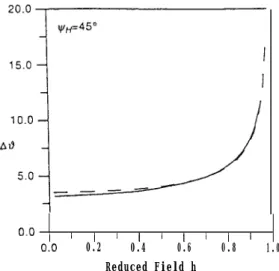
It is easy to see from (6) that As(h) increases monotonically with increasing transverse field and tends to infinity as h approaches unity. Figure 3 shows comparison of the transverse field dependence of the numerically obtained effective width Ad(h) versus that obtained directly from (6). Clearly, the difference between the two sets of curves are practically negligible except when the values of the transverse field is small.
0.0 , , , , , , , , , ,
0.0 0.2 0.4 0.6 0.8 1.0
Reduced Field h
FIG. 3. Comparison of the dependence of thk
effective widths of the distribution of
the polar angles, Ad(h), on the trans-v e r s e f i e l d h at $H = 45’. S o l i d line: numerical result. obtained from solving the system of Eqs. (3) and (4); dashed line: analytical result ob-tained directly from (6).
h=Ht’Hk
FIG. 4. The variation of the azimuthal angle of magnetization at the mid-point of the DW, G(o), for several values of the transverse field orientations $H. A Bloch wall makes an abrupt phase transition to a N’eel wall at h=0.‘225 when $H = 90’.
From the transveres field dependence shown in Figs. 2, and 3, it is clear that the
effective DW width due to the azimuthal angle distribution A,(h) is significantly different from that of polar angle As(h), and that the absolute value of the effective width A,(h) is always greater than that of the polar angle.
Armed with the fomulation described above it becomes relatively easy to investigate the Bloch-to-N’eel wall transition as a function of (h, $H). Figure 4 shows the variation of the azimuthal angle at the mid-point of the DW, $(o), fo r several values of the transverse field orientations $!JH. Clearly, a Bloch wall will make an abrupt phase transition to the N’eel wall at some value of h (I~0.225) provided if the transverse field is oriented normal to the anisotropy axis with $H = 90’.
IV. On dynamics
The motion of the magnetization vector in spin waves and domain wall dynamics
is largely characterized by the relaxation processes, hence by the corresponding relaxation (damping) constant. However, the functional dependence of the relaxation constants for either the spin waves or domain wall (DW) dynamics is completely unclear up to the present
time. Two empirical ways of measuring the relaxation constants (in garnets) are known. First is by means of measurements of the ferromagnetic resonance (FMR) line width to
VOL. 35 HUEILIHUANG 485
obtain XFMR. Secondly, one may deduce from linear mobility of the domain wall motion to obtain X,. It has long been an intriguing and well known fact that the numerical value of the damping constant measured by FMR could be substantially different from the one obtained from the DW mobility measurements. The ratio between these two constants X, and XFMR may range from < 10-r to > 10’ (e.g. in pure YIG) [3,12]. Another open question is that the presence of a transverse field may increase the DW mobility substantially [la] while the FMR line width is practically insensitive to it. All of these questions have not neen properly addressed up to the present date.
More often than not the Landau-Lifshits-Gilbert (L-L-G) equation is used to analyze the relaxation constant related to both the FMR line width and DW mobolity. However, the L-L-G equation is known to conserve the value of magnetization modulus. On the other hand, it was shown [2] that the presence of the static DW may cause the change in the magnetization modulus. It follows that the L-L-G equation is inherently incapable of delineating the distinction between these two constants since two distinctly different relaxation processes or mechanisms were involved.
Recently, a generalized dynamic equation taking into account the nonconservation of magnetization modulus has been introduced into the Landau-Lifshits (L-L) Eq. [13] to study the domain wall dynamics [14]. Numerical analysis based on this generalized L-L equation indicates that the two constants AP and XFMR, that is the relaxation constant related to the DW mobility and the original L-L damping constant, are two distinctly different constants [15]. Furthermore, X, is shown manifestly field dependent.
Hereunder we report the use of this generalized L-L equation to derive the new Slonzewski-like equation for the DW dynamics [3] and to deduce from it a field-dependent linear DW mobility and the important relation between the two constants X, and XFMR. Based on this relation the value of longitudinal susceptibility xl1 compatible with spin wave theory can also be suscessfully estimated.
V. The analysis
The generalized L-L equation for magnetization dynamics can be expressed as [13] ti = -y[M x F] + yMliF - yMX,V2F,
where the tensor A is determined by crystal symmetry: A = XFMRbij for a cubic crystal, A = XFMR[~;~ - n;nj] [n is the unit vector along the anisotropy axis] for a uniaxial one; X, is the spatial dispersion of relaxation constant; F= Sa/GM. (In the present context the L-L damping constant X, is being identified as equal to XFMR). Eenergy density w of a uniaxial ferromagnet with a Bloch wall is
a = +VM)2 + (M2 - M,2)2
M,2 8XIIM,2 +2rQM2{Ai29’ +(1+&sin2v)sinfl}
Linear mobility of the DW is frequently used to characterize magnetic thin films [3] and is defined by the relation
Pmv(Ht) =
limwq,
Ht)
In steady-state the DW velocity can be expressed as [15,16]
Jqq, a) =
YABf$/GJ
AFMRa (6 $> R (00, +)
(8)
which is obtained by means of the consideration of the dissipative function
where FM is the longitudinal component of effective field. Detail of the derivation can be found in Ref. [16].
Substituting Eq. (8) into Eq. (7) yields
TAB
4
PLDW(Ht) = XFMR cos 00 [v?T(&J) + 4Rrn(Bo)]’ where v, = X~~~/47rQxll and
2 17
-3 cos B. sin 60 -3- sin 00 cos 80
+;(n - 200)(2 + ~0~280) +6sinOuln ,
in the absence of the transverse field, it becomes /mW(& = 0) = 7AB AFMR[l + $$. *
(9)
(10)
(11)
Expression (11) is compatible with that obtained in the original Landau-Lifshitz’s paper in the case when the modulus of the magnetization was considered to be conserved. The transverse-field dependent relaxation parameter A,, (Ht) deduced from the DW mobility data in the linear regime becomes
A,@&) = AFMRc’=eO [@o) + $RIo(~o)] . (12)
3
In the absence of Ht we have A,(& = 6) = AFMR I+
[
w47;QXjj)2
3x2
1
-WI
F M R
Note that the v, term in Eq. (12) is due to the nonconservation of magnetization modulus. It is to be noted that, to our knowledge, Eq. (13) is first such relation by which A, and XFMR are related. In the absence of transverse field and for the materials with large value of v,, i.e. vz > 16/3, the two damping constants may be treated as identical.
VOL. 35 HUE1 LI HUANG 487
VI. Discussions
Let us first survey the relevant experimental data available. The longitudinal sus-ceptibility xl1 data for typical iron garnets are rather skimpy. One theoretical estimate based on spin-wave theory [18,19], gives, xl1 = 3 7 . 7 5 x 10e4.
T
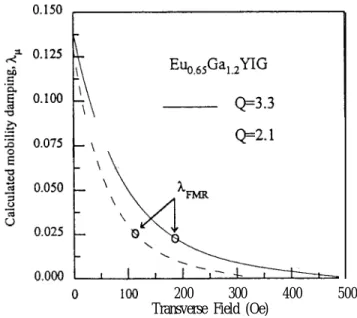
WO sets of experimen-tal data [20,21] ( see also Table 2 in Ref. [13]) for (Euu.ssGai.2)YIG are available. They are (A,, XFMR,Q) = (0.14,0.023,3.3) and (0.13,0.025,2.1) [21]. Substituting these data into Eq. (13) yields xl1 = 5.4 x 10m4 and xl1 = 8.2 x 10e4 respectively. These numerical values are fairly close to the ones estimated by spin-wave theory. Data obtained in the presence of transverse field Ht = 1OOOe gives: (XP,X~~~,Q) = (0.022,0.03,8.9) [20]. On the other hand we may use Eq. (13) to estimate the DW mobility damping. For example let xl1 21 5 X 10 -4 we have A, = 0.031 which is comparable to the data.Since the values of xl1 deduced from Eq. (13) is consistent with that estimated by spin-wave theory, this put our equations on a sound basis to be further applied to iron garnet films. In Fig. 5 we show the variation of the transverse-field dependent DW mobility damping constants. The material parameters used in the calculation are taken directly from Ref. [20,21]. Solid (dashed) curve corresponds to the sample with material parameters [x11, AFMR,
Q, ffh-(Oe)] = [5.4x lo- 4,
0.023, 3.3, 5171 ([8.2~10-~, 0.025, 2.1,337]), (HH. =2K/1M, is anisotropy field, K : anisotropy constant, n/r, : saturation of magnetization). We see from Fig. 5 that: (1) in the absence of transverse field, A, is always larger than XFMR; (2) if transverse field Ht is large enough, one finds that A, < XFMR; (3) when Ht approaches to HK, A, becomes vanishingly small. The latter situation is understandable since the DW broaden rapidly into homogeneous magnetization.
Q=2.1
100 200 300 400 500 Transverse Field (Oe)
FIG. 5. Variation of the calculated DW damping constant X, versus the transverse field. The inset x FIMR values are taken from Ref. [11,12].
For a sample homogeneously magnetized, one sees that precessional motion of the
spins inside such a sample may suffer from ferromagnetic relaxation characterized by a constant XFMR. For an inhomogeneous sample with domain structures one sees the damping characterized not only by XFMR but also the drag force due to inhomogeneous magnetization and nonconservation of magnetization modulus characterized by X, which hinders the DW from moving any faster. Consequently, the experimental value in the absence of a transverse field observed for the DW mobility damping X, is larger than XFMR. Almost all empirical data exhibit this common characteristic feature.
A planar DW may exhibit a fairly high DW mobility in the presence of a transverse field. For example, the damping constant observed for XFMR and X, in EuGaYIG sample is nearly identical [12]. Our analysis shows that this is the case as exemplified in Fig. 5 in which X, N XFMR for the solid (dashed) curve when the transverse field is Ht N 185 Oe (& N 115 Oe). Since the mechanism responsible for the DW damping differs distinctly from that for XFMR it appears that there is no basis for anyone to believe that a sample may exhibit X, N XFMR. It turns out that there is no ambiguity answer to this question. As described by Eq. (12) and by the fact that a DW may broaden into a homogeneous magnetization in the presence of a strong transverse field, as remarked above [3,22], cases for X, N AFMR and that for X, < XFMR may happen and have actually been observed as compiled in table 2 in Ref. [12].
When the strength of transverse field approaches that of anisotropy field Ht + HK the magnetization inside the DW structure will be forced to rotate toward the direction of the field. As a consequence, the DW becomes only faintly detectable. The DW mobility damping becomes vanishingly small and meaningless.
The formulation described above is based on the assumption that quality factor Q of the sample concerned being Q > 1. We are however greatly encouraged to note that Eq. (13) works properly for pure YIG [13]. For example, according to Table III in Ref. [12], for pure YIG, it gives X,M,/y = 0.52 x 10m7 and XFMRM~/Y = 0.006 x 10v7 0e2.sec.rad-i. If the material parameters of for pure YIG 7 = 1.8 x 10⁷secV10e-r, 4rM, = 1750G, A, N 8 x 10m6cm, and A = 4.15 x 10m7erg/cm [13] etc., are used, we then obtain the quality factor of YIG being Q = 0.0532. Substituting the above parameters into Eq. (13), one obtains xl1 21 4.65 x 10m4 which is well within the bound estimated using spin-wave theory. Consistency of our calculation with the spin-wave theory indeed throws strong support to our formulation, in particular, in support of our claim that the disagreement between X, and XFMR is due to nonconservation of magnetization modulus which in turn is induced by the inhomogeneous magnetization structure of the sample..
VII. Conclusions
New characteristics of the coordinate and transverse field dependence of the do-main wall (DW) magnetization structure and the corresponding dependence of the effective DW width of both the polar and azimuthal angles of magnetization distribution has been obtained. The effective width due to the azimuthal angle distribution is found to vary sensitively with the orientation and strength of the transverse field and is much broader than the conventional wall width due to the polar angle distribution.
VOL.35 HUEILIHUANG 489
Gilbert equation taking into account the nonconsevation of magnetization modulus has led us to two types of the magnetization damping parameters. One is ascribed to the homo-geneous magnetization manifested in the ferromagnetic resonance line width characterized by the Landau-Lifshitz damping constant XF,MR. The other is associated with the inhomo-geneous magnetization localized within the DW proper characterized by the DW mobility damping constant X,. Our formulation points out that the two constants are distinctly dif-ferent but interrelated. In the absence of transverse field X, is always greater than XFMR. In the presence of transverse field, however, the ratio between the two constants X, and XFMR varies, ranging from < 10-r to > lo2 as has been observed. Our formulation also allows us to estimate correctly the longitudinal susceptibility. The calculated results are consistent with the available data found in garnet samples.
A c k n o w l e d g m e n t s
The author is benifited from his previous colaboration with Prof. Sobolev, Dr. S. C. Chen and Mr. C. T. Teh. This research is supported in part by National Science Council through a contract #NSC-86-2216-E02-037.
References
[ l] G. A. Jones and B.K. Middelton, Int. J. Magnetism, 6, 1 (1974).
[ 21 A. Hubert, Theorie der domannenwande in Geordneten Medien (Sringer, Berlin, 1974) (in German).
[ 3 ] A. Molozemoff and J. Slonczewski, Magnetic Domain Walls in Bubble Materials (Acad. Press., N. Y., 1979).
[ 41 Chai Tak Teh, H. L. Huang, and V. L. Sobolev, J. Appl. Phys. 75, 7003 (1994).
[ 5 ] Yu A. Dimashko, Sov. Phys.-Solid State, 27, 1274 (1985).
[ 6 ] Chai Tak Teh, V. L. S o o ev, and H. L. Huang, J. Magn. Magn. Mats. 145, b 1 382 (1995). [ 7 ] J. Morkowski, H. Dotsch, P. E. Wigen, and R. Y. Yeh, J. Magn. Magn. Mats. 25, 39 (1981). [ 81 Chai Tak Teh, H. L. Huang, and V. L. Sobolev, J. Magn. Magn. Mats (1995), in press. [ 9 ] J. Morkowski, H. Dotsch, P. E. Wigen, and R. Y. Yeh, J. Magn. Magn. Mats. 25, 39 (1981). [lo] D. Kincaid and W. Cheney, Numerical analysis (Brooks/Cole Publ. Co., California, 1990). [ll] B. A. Liley, Phil. Mag. 41, 792 (1950).
[12] F. H. de L eeuw, R. van der Doel, U. Enz, Rep. Prog. Phys. 43, 690 (1980).
[13] V. G. Bar’yakhtar, Sov. Phys. JETP, 60, 863 (1984); also V. G. Bar’yakhtar, V. A. Brodovoi, B. A. Ivanov, I. V. Krutsenko, and K. A. Safaryan, Phys. Solid State, 32, 502 (1990). [14] S. C. Chen, V. L. Sobolev, H. L. Huang, J. Magn. Magn. Mats. (1997), accepted. [15] H. L. Huang, S. C. Chen, and V. L. Sobolev, J. Appl. Phys. (1997) accepted.
[16] Shoan Chung Chen, Ph.D. dissertation, National Tsing Hua University, HsinChu, Taiwan, ROC (1996).
1171 B. A. Ivanov and K. A. Safaryan, Sov. Phys. Solid State, 32, 2034 (1990). [18] T. Holstein and H. Primakoff, Phys. Rev. 58, 1098 (1940).
[19] B. E. Argyle, S. H. Charap, and E. W. Pugh, Phys. Rev. 132, 2051 (1963). [20] J. C. DeLuca and A. P. Malozemoff, AIP Conf. Proc. 34, 151 (1976).
[21] J. C. DeLuca, A. P. Malozemoff, J. L. Su, and E. B. iMoore, J. Appl. Phys. 48, 1701 (1977). [22] C. T. Teh, H. L. Huang, and V. L. Sobolev, J. Appl. Phys. 79, 6060 (1996).