行政院國家科學委員會專題研究計畫 期中進度報告
斑馬魚胚胎早期轉錄因子 Mfy-5 之生物特性:以繼代遺傳轉
殖品系作為研究模式(1/2)
計畫類別: 個別型計畫 計畫編號: NSC91-2313-B-002-331- 執行期間: 91 年 08 月 01 日至 92 年 07 月 31 日 執行單位: 國立臺灣大學漁業科學研究所 計畫主持人: 蔡懷楨 計畫參與人員: 蔡懷楨 陳曜鴻 報告類型: 精簡報告 處理方式: 本計畫可公開查詢中 華 民 國 92 年 6 月 2 日
行政院國家科學委員會補助專題研究計畫期中報告
斑馬魚胚胎早期轉錄因子 Myf-5 之生物特性:以繼代
遺傳轉殖品系作為研究模式(1/2)
計畫類別:■ 個別型計畫 □ 整合型計畫
計畫編號:NSC
91-2313-B-002-331
執行期間: 91 年 08 月 01 日至 92 年 07 月 31 日
計畫主持人:蔡懷楨
共同主持人:
計畫參與人員:蔡懷楨、陳曜鴻
成果報告類型(依經費核定清單規定繳交):■精簡報告 □完整
報告
本成果報告包括以下應繳交之附件:
□赴國外出差或研習心得報告一份
□赴大陸地區出差或研習心得報告一份
□出席國際學術會議心得報告及發表之論文各一份
□國際合作研究計畫國外研究報告書一份
執行單位:台 灣 大 學 漁 業 科 學 研 究 所
中 華 民 國 92 年 5 月 29 日
Abstract
Myf-5, a transcription factor that controls muscle differentiation, is expressed in somites during early embryogenesis. However, gene regulation of myf-5 is poorly understood and detailed functional analysis of the regulatory cis-elements is needed. In zebrafish, the myf-5 upstream sequence from -82 to -62 (-82/-62) was fused with a basal promoter and transferred to fertilized zebrafish eggs. The -82/-62 cassette drove GFP reporter gene expression specifically in the somites. Moreover, GFP signals were detected exclusively in the somites of 28-hpf embryos derived from eggs injected with pCMV-5×(-82/-62), which contained 5 copies of the -82/-62 cassette inserted within CMV promoter/enhancer. Thus, the -82/-62 cassette, conserved in mouse myf-5, functions to drive somite-specific expression and to repress non-specific expression during the early development of zebrafish embryos. Mutated sequence analysis of -82/-62 cassette showed that the -70/-62 sequence was the key element for controlling myf-5 specificity. The putative CCAAT-like box, located at -66/-62, could not direct somite-specific expression. A DNA-protein complex was specifically formed between the –70/-62 probe and embryonic nuclear extracts. We conclude that the -70/-62 motif is essential for controlling somite-specific expression and the CCAAT-like box is essential for activating gene transcription. Moreover, comparing the GFP-expression patterns shown from 4 transgenic lines derived from injecting with the fragment of -9977/-1, -6212/-1, -2937/-1, and -290/-1, we conclude a) the -9977/-6213 segment contained several repressor-rich regions and a somite-specific enhancer; b) the -6212/-2938 segment contained a stage-specific repressor, tissue-specific elements (fin muscle-, jaw muscle-, and neural crest cells) as well as an eye-specific enhancer; and c) the -2937/-291 segment contained notochord- and eye-specific elements, while the -290/-1 segment was responsible for basal transcription and somite-specific expression.
Introduction
Transcription factors in the basic-helix-loop-helix (bHLH) family are essential for skeletal muscle determination and differentiation (Lorenzo-Puri, et al., 2000). These myogenic regulatory factors (MRFs) activate muscle-specific transcription by binding to a DNA consensus sequence, an E-box, present in the promoter of numerous muscle-specific genes (Rescan et al., 2001). Four MRF, MyoD, Myogenin, Myf-5 and MRF4, have been characterized in humans (Pearson-White, 1991), mice (Pinney et al., 1995), birds (Saitoh et al., 1993), frogs (Hopwood et al., 1991) and zebrafish (Chen et al., 2000, 2001).
Each MRF may play a different role during myogenesis. For example, the primary MRF, MyoD and Myf-5, are involved in myoblast specification, while the secondary MRF, Myogenin and MRF4, are involved in myotube formation (Rudnicki
and Jaenisch, 1995). Gene knockout experiments in mice demonstrated that normal muscle development still occurred when the myf-5 or myoD gene was inactivated. However, skeletal muscle did not form in transgenic mice in which both myf-5 and myoD were disrupted (Rudnicki et al., 1993). Thus, myf-5 and myoD are able to compensate for each other to regulate skeletal muscle development. In zebrafish, myf-5 morphants displayed defects not only in somite patterning, but also in brain formation and epiblast migration, indicating that Myf-5 protein has multiple biological functions during early embryonic development (Chen and Tsai, 2002).
Zebrafish myf-5 transcripts are detectable 7.5 hours post-fertilization (hpf), increase substantially until 16 hpf, and then gradually decline to undetectable levels by 26 hpf (Chen et al., 2001; Coutelle et al., 2001). During somitogenesis, zebrafish myf-5 transcripts are found primarily in the somites and segmental plates (Chen et al., 2001; Coutelle et al., 2001). Prominent signals occurred transiently in adaxial cells, in two parallel rows, but did not extend beyond the positive-signal somites. Thus, the expression pattern of zebrafish myf-5 is dynamic and somite-specific.
In mice, it has been shown that myf-5 activation depends on signals from tissues surrounding the somite (Cossu and Borello, 1999). Wnt1, which is present in the dorsal neural tube, activated myf-5 in explant experiments (Tajbakhsh et al., 1998). Sonic hedgehog (shh), produced by the notochord, is also required for myogenesis, but only in the epaxial domain. In mice lacking shh, myf-5 is not expressed in the epaxial myotome, but hypaxial activation proceeds normally (Borycki et al., 1999). By crossing shh knockout mice strain with germ-line transmission mice, Gustafsson et al., (2002) demonstrated that myf-5 is the direct target for shh signal transduction. These studies demonstrate that signal integration for myf-5 activation is complex.
In mice, myf-5 promoter analysis has focused on the long-range or distal fragment of modulation. Hadchouel et al., (2000) cloned a 200 kb regulatory fragment from a YAC library and reported that all essential sequences were located at approximately within 96 kb upstream of the transcriptional start site. BAC transgenic analysis of the Mrf4/ Myf5 locus revealed that interdigitated elements control activation and maintenance of gene expression during muscle development (Carvajal et al., 2001). However, the actual relationship between cis-acting elements and trans-acting factors on the distal or proximal regulatory regions in the mouse myf-5 gene are still unclear. In Xenopus myf-5, an interferon regulatory factor-binding element within the Xenopus myf-5 promoter is responsible for the elimination of myf-5 transcription in the mature somitic mesoderm of Xenopus embryos (Mei et al., 2001). Recently, Lin et al (2003) found that a T-box binding site was able to mediate the dorsal activation of myf-5 in Xenopus gastrula embryos. However, the mechanism regulating zebrafish myf-5, particularly the interaction
between transcription factors and proximal regulatory elements, is completely unknown.
In zebrafish myf-5, the upstream sequence from nucleotide -82 to -1 (-82/-1) was able to direct the reporter gene expressed specifically in the somites, whereas the -62/-1 segment was not (Chen et al., 2001). In this study, we performed in vitro mutagenesis, transgenic experiments and an electrophoretic mobility shift assay to further study the functional roles of the zebrafish myf-5, proximal regulatory cis-element -82/-62. Interestingly, this short regulatory cassette drove somite-specific expression and repressed non-specific expression during the early development of zebrafish embryos.
Results
Cassette -82/-62 is an important cis-element controlling somite-specific expression of myf-5
We injected DNA fragments containing -290/-1 (pZMYP-290E), -82/-1(-82E), -62/-1(-62E) or -22/-1(-22E) into one-celled zebrafish embryos. Embryos injected with -290/-1 and -82/-1 displayed GFP-positive signals in their somites at 28 hpf, but embryos injected with -62/-1 or -22/-1 did not (Fig. 1). A DNA fragment in which -82/-62 was deleted from myf-5 -290/-1 (pZMYP-290E-Δ(-82/-62)) was injected into one-celled embryos. None of these embryos were GFP-positive (Fig. 1).
To determine whether cassette -82/-62 was able to direct somite-specific
expression of the GFP reporter gene, firstly, plasmid pEGFPmTATA was constructed, which contained a CMV mini-promoter (TATA box only), fused with GFP and be used as a backbone plasmid for the following three constructs [pEGFPm-1×(-82/-62), pEGFPm-6×(-82/-62) and pEGFPm-Non30fr]. Then, two plasmids, pEGFPm-1×(-82/-62) and pEGFPm-6×(-82/-62), were constructed, which contained one and six copies of -82/-62 cassette, fused with pEGFPmTATA, respectively. Finally, a negative control plasmid, pEGFPm-Non30fr, was constructed, which contained a non-specific cassette (Non30fr), fused with pEGFPmTATA. Only 5.9% of the 197 embryos injected with pEGFPmTATA-injected were GFP-positive and none were somite-specific (Fig. 2A, 2B-a, -b). In the non-specific control group, only 2.9% of the embryos injected with pEGFPm-Non30fr expressed faint, deep green signals in their somites (Fig. 2A, 2B-c, -d). However, somite-specific expression rates in transgenic embryos injected with pEGFPm-1×(-82/-62) or pEGFPm-6×(-82/-62) were 16.7% and 24.4%, respectively (Fig. 2A, 2B-e, -f, -g, -h). Thus, cassette -82/-62 was able to direct somite-specific expression of zebrafish myf-5.
Cassette -82/-62 represses the ubiquitous expression of CMV promoter/enhancer
injected three linearized expression plasmids that used GFP as a reporter gene. pCMVm, pCMVm-4×(Non30fr) and pCMVm-5×(-82/-62), contained CMV promoter/enhancer, CMV promoter/enhancer with 4 inserted copies of Non30fr, and CMV promoter/enhancer with 5 inserted copies of cassette -82/-62, respectively. In zebrafish embryos injected with pCMVm, GFP was expressed ubiquitously at 28 hpf (Fig. 3, bottom). The pattern of GFP-fluorescence in embryos injected with the pCMVm-4×(Non30fr) was similar to that of embryos injected with pCMVm. Thus, the non-specific sequence, Non30fr, inserted within the CMV promoter/enhancer did not affect transcription controlled by the CMV promoter/enhancer (Fig. 3, middle). In contrast, green fluorescent signals were detected exclusively in the somites of embryos injected with pCMVm-5×(-82/-62), (Fig. 3, top). Thus, the zebrafish myf-5 cassette -82/-62 suppressed non-somite-specific expression of the GFP reporter gene driven by the CMV promoter/enhancer.
The -70/-62 motif within -82/-62 is the key element for somite-specificity
PCR-based in vitro mutagenesis and transgenic assays were conducted to dissect cassette -82/-62. GFP expression plasmids were constructed with sequentially mutated sequences within -82/-62. Plasmid pZMYP290E-M1 was mutated at -82/-79. The other plasmids were mutated at -78/-75 (-M2), -74/-71 (-M3), -70/-67 (-M4) and -66/-62 (-M5)(Fig. 4A, left panel). The somite-specific expression rates in transgenic embryos injected with pZMYP290E, pZMYP290E-M1, -M2 and -M3, were 68.8%, 71.4%, 71% and 65.4%, respectively (Fig. 4A, right panel; 4B-a-d). The somite-specific expression rates in pZMYP290E-M4- and -M5-injected embryos were only 43.2% and 25.3%, respectively (Figs. 4A, right panel; 3B-e, -f). Moreover, the myocyte-specific expression rates in embryos injected with pZMYP290E-M4- and -M5 were only 37.5% and 7.7%, respectively (Figs. 4A, right panel). Thus, -70/-62 has an important role in the regulation of zebrafish myf-5. To determine whether the short, -70/-62 motif had the same biological functions as the cassette -82/-62, we constructed plasmid pZMYP-70E, which contains one -70/-1 upstream element of zebrafish myf-5.
Based on transgenic analysis, the somite-specific expression rate was 41.9% in pZMYP-70E-injected embryos (Fig. 5). The -64/-60 sequence of zebrafish myf-5 is CCAAT (Chen et al., 2001), indicating that the -66/-62 motif contains part of the CCAAT-like box core sequence. To study the regulation of the CCAAT-like box in detail, we mutated the core sequence of the CCAAT-like box in pZMYP-290E from CAAT to AACC. The resulting plasmid, pZMYP-mcat, was microinjected into zebrafish embryos. In pZMYP-mcat-injected embryos, the total expression rate, somite-specific expression rate, and somite-specificity expression and translocation rates were 15.7%, 5.5% and 4.3%, respectively (Fig. 4A, 4B-g). Then, we constructed plasmid pZMYP-64E,
which contains the CCAAT-like box core sequence. No somite-specific GFP signals were detected in the pZMYP-64E-injected embryos, indicating that the CCAAT-like box was not able to drive somite-specific expression of zebrafish myf-5 (Fig. 5). Finally, to determine whether the motifs -66/-62 and -70/-62 could direct somite-specific expression of the GFP reporter gene, the GFP expression plasmids pEGFPm-4×(-66/-62) and pEGFPm-3×(-70/-62) were constructed and injected. In pEGFPm-4×(-66/-62)-injected embryos, the total expression rate was 43.6%, but the somite-specific expression rate was only 1.1% (Fig. 6A, 6B-a, -b). However, in pEGFPm-3×(-70/-62)-injected embryos, the total expression rate and somite-specific expression rates were 47% and 41.8%, respectively (Fig. 6A, 6B-c). Therefore, -66/-62 sequence directs ubiquitous expression and -70/-62 sequence is necessary for somite-specific expression. The short motif -70/-62 is the key element within the zebrafish myf-5 cassette -82/-62.
Embryonic nuclear extract specifically interacted with cassette -82/-62
EMSA experiments were conducted to determine whether a protein in the
embryonic nuclear extract specifically interacted with cassette -82/-62. As expected, adding a non-specific (Non30fr) probe did not cause the formation of a shifted band (Fig. 7, lanes 1-3). However, a complex did form between embryonic nuclear extract and the -82/-62 probe, producing the shifted band shown on the gel (Fig. 7, lane 5). The intensity of the shifted complex increased with the amount of extract (Fig. 7, lane 6), but the shifted complex became very faint when excess amounts of cold -82/-62 oligonucleotide were added (Fig. 7, lanes 7 and 8). However, addition of excess amounts of cold, non-specific Non30fr oligonucleotide did not change the intensity of the shifted band (Fig. 7, lanes 9 and 10). Thus, a specific complex formed between embryonic nuclear extract and the -82/-62 probe.
Excess amounts of mutated DNA segments were added, including oligonucleotides M1 (mutation at -82/-79), M2 (mutation at -78/-75), M3 (mutation at -74/-71), M4 (mutation at -70/-67) and M5 (mutation at -66/-62). Only cold M1, M2 and M3 oligonucleotides were able to compete the formation of the shifted complex (Fig. 7, lanes 11-16), indicating the -82/-71 segment was not involved in forming the specific complex between the extract and the -82/-62 probe. However, addition of unlabeled M4 oligonucleotides partially blocked complex formation, and addition of unlabeled M5 failed to block it (Fig. 7, lanes 17-20). Therefore, the -70/-62 element is bound by protein(s) in the embryonic nuclear extract, and the -66/-62 motif is the key element for the formation of the complex between embryonic nuclear extract and cassette -82/-62.
Mouse and zebrafish myf-5 gene sequence homology and conservation of cassette -82/-62 functions
In addition, the short, mouse myf-5 motif -151/-144 (CCTGGCCA) is identical to the zebrafish myf-5 motif -69/-62 (CCTGGCCA) (Fig. 4A). To study the conservation of cassette function, we constructed plasmid pZMYP290E-m-82/-62m, in which the zebrafish cassette -82/-62 was replaced by the mouse cassette -151/-144. This new plasmid was microinjected into zebrafish embryos. The somite-specific expression rate was 67.7%, and the myocyte-specific expression rate was 64.5%. These rates were not significantly different than they those for pZMYP-290E-injected embryos (Fig. 4A, 4B-h). Thus, the functions of zebrafish -82/-62 and mouse -161/-144 cassettes have been conserved.
GFP-Expression Patterns of Transgenic Lines Carrying the –10 kb Segment
The green fluorescent signal was first detected in the segmental plates at 12-hpf (Fig. 8a) and in the somites at 14-hpf (Figs. 8b-c) embryos derived from two transgenic lines (9977-2 and 9977-13). The whole-mount in situ hybridization, endogenous myf-5 transcripts were expressed in the segmental plates and expanded to 4 or 8 somite pairs in 12- and 16-hpf embryos, indicating that the -9977/-1 transgene was capable of recapitulating the endogenous myf-5 expression patterns. At 24 hpf, the green signals were down-regulated in embryonic somites (Fig. 8e), but were still detectable at the notochords until 3 dpf (Figs. 8f-g). No green signals were observed in embryos derived from the -9977/-1 transgenic line after 7 dpf (Fig. 8h).
GFP-Expression Patterns of Transgenic Lines Carrying the –6 kb Segments
Our attempt to further dissect the -9977/-1 regulatory sequence included the generation of the -6212/-1, -2937/-1, and -290/-1 germ-line transmitted zebrafish. The deletion of the -9977/-6213 segment from -9977/-1 led to a broad expansion of expression domains in the transgenic line. GFP signals were first detected at 7.5 hpf (data not shown), with increasing intensity in all parts of the embryos (especially in the head and somites) between 14 and 24 hpf (Figs. 9a-b). We also noted that GFP signals were gradually down-regulated after 30 hpf (Fig. 9c), and that no green signals were found during the stages of 32 and 44 hpf (data not shown). However, GFP signals appeared again at the axial and dorsal-medial lips of embryonic somites at 2-dpf (Fig. 9d), then migrated along the axial from the rostral to caudal regions (Figs. 9e-f). From a cryosection we found GFP-expression cells in the spinal cord (Fig. 9g); GFP signals were also broadly expressed in jaw and fin muscles, gills, bones, eyes, and other domains (Figs. 9h-l). We also observed that transgenic lines carrying the -6212/-1 segment (lines 6212-9, -10, -11, and -16) displayed green signals in zebrafish bones at 21 dpf (Fig. 9k), but that transgenic lines carrying the -9977/-1 segment (lines 9977-2 and 9977-13) did not. These results indicate shared characteristics
between GFP-expression and neural crest cells--i.e., migration capability, neuron-ectoderm origin, and pluripotency. We therefore believe that the -6212/-1 transgene may be activated in some neural crest cells.
GFP-Expression Patterns of Transgenic Lines Carrying the –3 kb and –0.3 kb Segments
After removing the -9977/-2938 segment from the -9977/-1 myf-5 regulatory region, GFP signals were detected at 9-hpf (data not shown) and expressed more specifically in the embryonic notochord and somites at 12-hpf (Fig. 10b) and 14-hpf (Fig. 10c), respectively; from 16 to 24 hpf, green signals were detected in the head mesoderm (Figs. 10d-e). GFP-expression domains in zebrafish somites were down-regulated after 26-hpf (Fig. 10f), but persisted in the head and notochord (Fig. 10g-j), indicating the deletion of a silencer. We also observed that the green signals in the head were concentrated at the eye primordium (Figs. 10g-h, k-l) and olfactory primordium (Figs 10i-j), suggesting that eye- and olfactory-enhancers are located within the -2937/-291 region. Finally, after removing the -9977/-291 segment from the -9977/-1 myf-5 regulatory region, green fluorescence was detected at weak levels throughout entire embryos, and at a slightly stronger level in the somites (Fig. 10a). We therefore believe that the -290/-1 segment is responsible for basic transcription initiation.
Discussion
Myf-5 is a key MRF during vertebrate myogenesis. The mechanism regulating the myf-5 gene is extremely complicated and little known. In mice, promoter analysis of myf-5 has focused on the long-range or distal fragment of modulation (~200 kb). Discrete and dispersed enhancers specific to particular populations of skeletal muscle precursors have been found to control expression of myf-5 (Hadchouel et al., 2000; Summerbell et al., 2000; Carvajal et al., 2001). In Xenopus, the proximal regulatory elements of myf-5 from -1869 to -30 bp have been characterized, and an interferon regulatory factor-binding element was found to eliminate myf-5 transcription (Mei et al., 2001). In fish, the -82 bp sequence upstream from the transcription initiation site of zebrafish myf-5 acts as a basal promoter (Chen et al., 2001). Here, we provide new insights about the proximal regulation of zebrafish myf-5. In regards to the results of deletion, replacement, mutagenesis and regulatory cassette analysis, we suggest that cassette -82/-62 is essential for directing somite-specific expression of the zebrafish myf-5 gene and is capable of repressing ubiquitous expression of CMV promoter/enhancer (Fig. 3). A similar concept is proposed for Xenopus myf-5 by Polli and Amaya (2002), who identified HBX2, a 1.2-kb proximal upstream element of Xenopus myf-5, which is necessary for both activation and repression of Xenopus myf-5 expression. Lin et al (2003) identified a 42-bp T-box binding site containing DNA segment, which is able to mediate dorsal
activation. However, this study is the first report to prove that a cassette as small as 21-bp has unique functions, especially in the repression of CMV promoter/enhancer.
Interestingly, we found that the zebrafish myf-5 cassette -82/-62 (CTCTTAGCTCTGTCCTGGCCA) shared 62% nucleic acid identity with the mouse myf-5 cassette -161/-144 (CACTGACCGACCCTGGCCA). Transgenic analysis with plasmid pZMYP290E-m-82/-62m, in which the zebrafish cassette -82/-62 was replaced by the mouse cassette -151/-144, demonstrated the mouse cassette was able to direct somite-specific expression in zebrafish embryos. The biological functions of zebrafish -82/-62 and mouse -161/-143 myf-5 cassettes are worth further study.
Nuclear protein complexes specifically interacted with cassette -82/-62; the motif -70/-62 was the key element (Fig. 7). The sequence of zebrafish myf-5 -64/-60 is CCAAT (Chen et al., 2001), indicating that the motif -66/-62 contains part of the CCAAT-like box core sequence. The CCAAT-like box sequence is conserved in zebrafish and mouse myf-5 genes. Typically, the trans-acting factor bound to the CCAAT-box is CCAAT-box binding factor (CBF) or Nuclear Factor Y (NF-Y) (Lindahl et al., 2002). CBF and NF-Y function as ubiquitous transcription activators at the proximal promoter. Because neither CBF nor NF-Y is known to repress non-specific expression or direct somite-specific expression, it is highly unlikely that protein from the nuclear extract interacted with cassette -82/-62 or that the overlapped CCAAT-like box is either CBF or NF-Y alone.
To investigate the functions of cassette -70/-62 further, we constructed and injected plasmid pEGFPm-3×(-70/-62). Cassette -66/-62 was not able to drive somite-specific expression and no myocyte-specific GFP signals were detected. Therefore, cassette -66/-60 of zebrafish myf-5 (CCAAT-like box) is functional. It directs the transcriptional initiation of zebrafish myf-5. The function of cassette -70/-62 is to recruit a factor to drive somite-specific expression. Several studies have found that a ubiquitous transcription factor interacts with a cofactor to drive tissue-specific expression. In neuron-specific expression, a neuron-restricted transcription factor, MASH1, interacted with CBF to drive tissue-specific expression (Mandolesi et al., 2002). Cardiac-specific expression was directed by the interaction of a heart-specific factor, myocardin, with a ubiquitous serum response factor bound to a CArG box (Wang et al., 2001). We hypothesize that a somite-specific transcription factor(s) interacts with cassette -70/-67, or with CBF/NF-Y, to control the unique functions of cassette -82/-62. This hypothesis merits further investigation.
Experimental Procedures Fish
h dark photoperiod. After fertilization, eggs were collected and cultured in a fish tank. Embryonic cleavage number and somite formation were observed with a light microscope to determine the developmental stage (Kimmel et al., 1995).
Plasmid construction and PCR-based in vitro mutagenesis
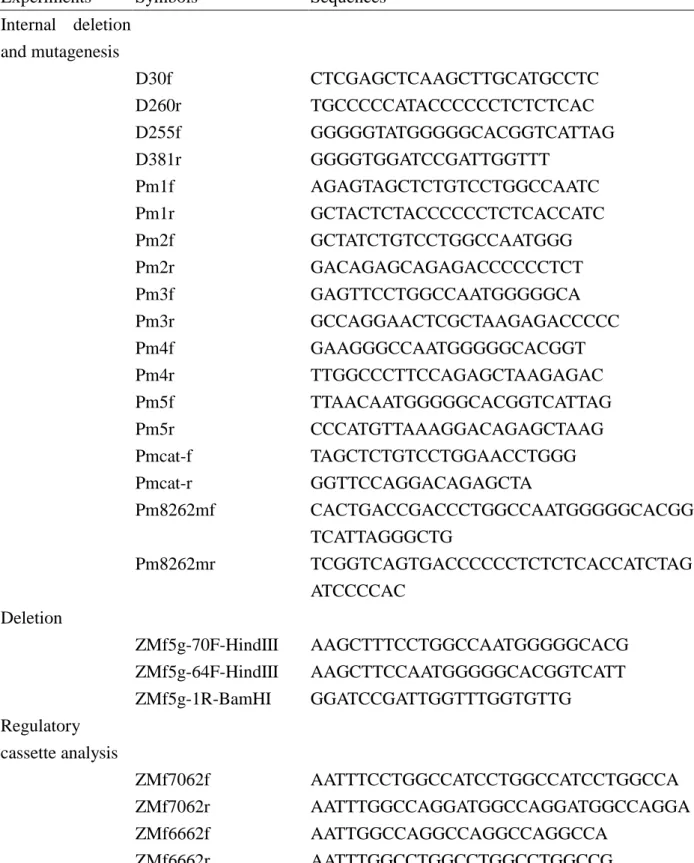
For deletion experiments, pZMYP-290E (Chen et al., 2001) was used as a template for PCR reactions. All oligonucleotide sequences used in this study are shown in Table 1. Primers ZMfg-64F-HindIII (or ZMfg-70F-HindIII) and ZMfg-1R-BamHI were used to produce -64/-1 (or -70/-1) fragments with HindIII and BamHI restriction enzyme sites on both ends. Then, the HindIII-BamHI-digested -64/-1 and -70/-1 fragments were ligated to HindIII-BamHI-digested pEGFP-1 (Clontech) vector to produce pZMYP-64E and pZMYP-70E, in which the GFP reporter gene was fused with -64/-1 and -70/-1, respectively.
For internal deletion, replacement and mutation experiments, pZMYP-290E was used as a template for three combination-PCR reactions to generate mutation and deletion constructs. Constructs were generated using a modified, PCR-based, in vitro mutagenesis method (Swaminathan et al., 2001). The first PCR product (240 bp) was produced using a forward (D30f) and a reverse primer (D260r). Then, another PCR product (117 bp) was produced with primers D255f and D381r. Equal amounts of the 240- and 117-bp PCR products were mixed together, denaturated for 5 min at 94°C and annealed at 37°C for 2 h. Then, 5 U of klenow fragments were added and the mixture was incubated at 37°C for 1 h. The resultant product was ligated to SmaI-digested pEGFP-1 (Clonetech) vectors to generate pZMYP-290E-Δ(-82/-62), in which the -82/-62 element was deleted from the -290/-1 zebrafish myf-5 gene upstream fragment. Using the procedures described above, two pairs of single-stranded oligonucleotides (D30f and Pmcat-r, Pmcat-f and D381r; D30f and Pm8262mr, Pm8262mf and D381r) were used to construct pZMY-290E-mcat (mutated at -64/-61) and pZMYP-290E-m-82/62m (to replace zebrafish -82/-62 with mouse -161/-144), respectively. For mutagenesis analysis, using the same procedures, two pairs of single-stranded oligonucleotides (D30f and Pm1r, Pm1f and D381r; D30f and Pm2r, Pm2f and D381r; D30f and Pm3r, Pm3f and D381r; D30f and Pm4r, Pm4f and D381r; and D30f and Pm5r, Pm5f and D381r) were used to construct pZMYP290E-M1, -M2, -M3, -M4 and -M5, respectively. The five constructs contained four sequentially mutated sequences in the -82/-62 region.
For regulatory cassette analysis, forward (ZMF-82F) and reverse (ZMF-62R) primers, were synthesized and annealed at 50°C for 30 min to generate double-stranded DNA fragments of cassette -82/-62. EcoRI-cut pEGFPmTATA, which contained a minimal TATA-box derived from a cytomegalovirus (CMV) promoter fused with EGFP gene (Ma et al., 2001; Wang et al., 2002), was blunted.
Then, cassette -82/-62 was added to generate pEGFPm-1×(-82/-62), which contained one copy of cassette -82/-62, and pEGFPm-6×(-82/-62), which contained six copies of cassette -82/-62. Using the same procedures, plasmid pEGFPm-4×(-66/-62), with four copies of cassette -66/-62, and plasmid pEGFPm-3×(-70/-62), with three copies of cassette -70/-62, were constructed. A control plasmid, pEGFPm-Non30fr, which contained a minimal TATA-box fused with a non-specific DNA fragment, Non-30fr, was constructed using primers Non-30f and Non-30r (Chen et al., 2002).
For non-specific repression experiments, cassette -82/-62 or a non-specific DNA fragment, Non-30fr, were ligated to a ScaI-digested pCMVm fragment. In pCMVm-5×(-82/-62) the CMV promoter/enhancer sequences were fused with 5 copies of cassette -82/-62. In pCMVm-4×(Non30fr), CMV was fused with 4 copies of non-specific DNA fragments.
Microinjection and green fluorescence detection
EGFP cDNA was fused with different mutated sequences of the zebrafish myf-5 upstream region, linearized, recovered from gel, quantified, and diluted to appropriate concentrations with 0.1% phenol red in phosphate-buffered saline. Fertilized eggs, collected prior to their first cleavage, received cytoplasmic microinjections of EGFP cDNA constructs (Wang et al., 2002). The eggs were incubated at 28.5C.
Transgenic embryos were observed hourly, especially from 9 to 96 hpf, under a stereo dissecting microscope (MZ12, Leica) equipped with a fluorescent module having an enhanced GFP filter cube (Kramer Scientific). Photographs were taken with a MPS 60 camera (Leica) and FUJI 400 ASA film when embryos developed at 28 hpf. Four different EGFP expression rates were calculated as described before (Chen et al., 2001). The total expression rate is the proportion of surviving embryos that expressed EGFP in any cell. The somite-specific expression rate is the proportion of surviving embryos that expressed EGFP exclusively in the somites. The myocyte-specific expression rate is the proportion of surviving embryos that expressed EGFP exclusively in the somites and exhibited green signals in the rod-like cells (myocyte). The non-specific expression rate is the proportion of surviving embryos in which EGFP was expressed in the somites and in other cells.
Embryonic nuclear extracts
Nuclear proteins were extracted using the procedures described by Dignam et al.,
(1983) with some modifications. Approximately 200, 28 hpf embryos were collected and 1 ml buffer A (10 mM HEPES pH 7.9, 1.5 mM MgCl2, 10 mM KCl, 0.5
mM DTT and 0.1 mM PMSF) was added. After homogenization, samples were centrifuged at 16,100×g 4°C for 30 min. The pellet was resuspended with 300 μl buffer C (20 mM HEPES pH 7.9, 25% glycerol, 1.5 mM MgCl2, 0.42M NaCl, 0.2
mM EDTA, 0.5 mM DTT and 0.5 mM PMSF), shaken gently at 4°C for 30 min, and centrifuged at 16,100×g 4°C for 30 min. The supernatant was dialyzed against 1 liter of buffer D (20 mM HEPES pH 7.9, 20% glycerol, 0.1 M KCl, 0.2 mM EDTA, 0.5 mM DTT and 0.5 mM PMSF) at 4°C for 5 h. Finally, all samples were centrifuged again at 16,100×g at 4°C for 30 min. The supernatants were stored at -70°C.
Electrophoretic mobility shift assay (EMSA)
Two, double-stranded oligonucleotides, cassette -82/-62 and non-specific Non-30fr, were used as probes for the binding assay with embryonic nuclear extracts. All probes were labeled with γ-[32P]ATP (3000 μCi/ml), using T4 polynucleotide kinase (NEB) according to the supplier’s protocols. Embryonic nuclear extract (5 or 20 μg) and 1μg of poly(dIdC) were added to the reaction buffer (10 mM Tris at pH 7.5, 50 mM NaCl, 0.5 mM EDTA pH 8.0, 0.5 mM DTT, 5% glycerol). For competitive inhibition, 5 pairs of single-stranded oligonucleotides, ZMF-M1F and -M1R; -M2F and -M2R; -M3F and -M3R; -M4F and -M4R; or -M5F and -M5R were annealed to form five, double-stranded oligonucleotides, which contained four sequentially mutated sequences in the -82/-62 region. The mixtures were placed on ice for 10 min. After adding 1 μl of probe with a specific radioactivity of 106 cpm/μg, each mixture was incubated at 30C for 30 min, and analyzed by 6% acrylamide gel electrophoresis (79:1 acrylamide:bisacrylamide). Then, the gel was dried and exposed to X-ray film for 14 days.
References
Borycki AG, Brunk B, Tajbakhsh S, Buckingham M, Chiang C, Emerson Jr CP. 1999. Sonic hedgehog controls epaxial muscle determination through Myf5 activation. Development 126: 4953-4063.
Carvajal JJ, Cox D, Summerbell D, Rigby PWJ. 2001. A BAC transgenic analysis of the Mrf4/ Myf5 locus reveals interdigitated elements that control activation and maintenance of gene expression during muscle development. Development 128: 1857-1868.
Chen YH, Lee WC, Cheng CH, Tsai HJ. 2000. Muscle regulatory factor gene: Zebrafish (Danio rerio) myogenin cDNA. Comp Biochem Physiol 127B: 97-103.
Chen YH, Lee WC, Liu CF, Tsai HJ. 2001. Molecular structure, dynamic expression and promoter analysis of zebrafish (Danio rerio) myf-5 gene. Genesis 29: 22-35. Chen YH, Liang CT, Tsai HJ. 2002. Expression, purification and DNA-binding
activity of tilapia muscle-specific transcription factor, MyoD, produced in Escherichia coli. Comp. Biochem. Physiol. 131B: 795-805.
patterning and brain formation defects in zebrafish. Differentiation 70: 447-456. Cossu G, Borello U. 1999. Wnt signaling and the activation of myogenesis in
mammals. EMBO J 18: 6867-6872.
Coutelle O, Blagden CS, Hampson R, Halai C, Rigby PWJ, Hughes SM. 2001. Hedgehog signaling is required for maintenance of myf5 and myoD expression and timely terminal differentiation in zebrafish adaxial myogenesis. Dev Biol 236: 136-150.
Dignam JD, Lebovitz RM, Roeder RG. 1983. Accurate transcription initiation by RNA polymerase II in a soluble extract from isolate mammalian nuclei. Nucleic Acids Res 11: 1475-1489.
Gustafsson MK, Pan H, Pinney DF, Liu Y, Lewandowski A, Epstein DJ, Emerson Jr CP. 2002. Myf5 is a direct target of long-range Shh signaling and Gli regulation for muscle specification. Genes Dev 16: 114-126.
Hadchouel J, Tajbakhsh S, Primig M, Chang THT, Daubas P, Rocancourt D, Buckingham M. 2000. Modular long-range regulation of Myf5 reveals unexpected heterogeneity between skeletal muscles in the mouse embryo. Development 127: 4455-4467.
Hopwood ND, Pluck A, Gurdon JB. 1991. Xenopus Myf-5 marks early muscle cells and can activate muscle genes ectopically in early embryos. Development 111: 551-560.
Kimmel CB, Ballard WW, Kimmel SR, Ullmann B, Schilling TF. 1995. Stages of embryonic development of the zebrafish. Dev Dyn 203: 253-310.
Lin GF, Geng X, Chen Y, Qu B, Wang F, Hu R, Ding X. 2003. T-box binding site mediates the dorsal activation of myf-5 in Xenopus gastrula embryos. Dev Dyn 226: 51-58.
Lindahl GE, Chambers RC, Papakrivopoulou J, Dawson SJ, Jacobsen MC, Bishop JE, Laurent GJ. 2002. Activation of fibroblast procollagen alpha 1 (I) transcription by mechanical strain is transforming growth factor-beta-dependent and involves increased binding of CCAAT-binding factor (CBF/NF-Y) at the proximal promoter. J Biol Chem 277: 6153-6161.
Lorenzo-Puri P, Sartorelli V. 2000. Regulation of muscle regulatory factors by DNA-binding, interacting proteins, and post-transcriptional modifications. J Cell Physiol 185: 155-173.
Ma GC, Wang TM, Su CY, Wang YL, Chen S., Tsai HJ. 2001. Retina-specific cis-elements and binding nuclear proteins of carp rhodopsin gene. FEBS Lett. 508: 265-271.
Mandolesi G., Gargano S, Pennuto M, Illi B, Molfetta R, Soucek L, Mosca L, Levi A, Jucker R, Nasi S. 2002. NGF-dependent and tissue-specific transcription of vgf
is regulated by a CREB-p300 and bHLH factor interaction. FEBS Lett 510: 50-56.
Mei W, Yang J, Tao Q, Geng X, Rupp RAW, Ding X. 2001. An interferon regulatory factor-like binding element restricts Xmyf-5 expression in the posterior somites during Xenopus myogenesis. FEBS Lett 505: 47-52.
Pearson-White SH. 1991. Human MyoD: cDNA and deduced amino acid sequence. Nucleic Acids Res 19: 1148-1148.
Pinney DF, de la Brousse FC, Faerman A, Shani M, Maruyama K, Emerson Jr. CP. 1995. Quail myoD is regulated by a complex array of cis-acting control sequences. Dev Biol 170: 21-38.
Polli M, Amaya E. 2002. A study of mesoderm patterning through the analysis of the regulation of Xmyf-5 expression. Development 129: 2917-2927.
Rescan PY. 2001. Regulation and functions of of myogenic regulatory factors in lower vertebrates. Comp Biochem Physiol 130B: 1-12.
Rudnicki MA, Schnegelsberg PN, Stead RH, Braun T, Arnold HH, Jaenisch R. 1993. MyoD or Myf-5 is required for the formation of skeletal muscle. Cell 75: 1351-1359.
Rudnicki MA, Jaenisch R. 1995. The MyoD family of transcription factors and skeletal myogenesis. Bioessays 17: 203-209.
Saitoh O, Fujisawa-Sehara A, Nabeshima Y, Periasamy M. 1993. Expression of myogenic factors in denervated chicken breast muscle: isolation of the chicken Myf5 gene. Nucleic Acids Res 21: 2503-2509.
Summerbell D, Ashby PR, Coutelle O, Cox D, Yee SP, Rigby PWJ. 2000. The expression of Myf5 in the developing mouse embryo is controlled by discrete and dispersed enhancers specific for particular populations of skeletal muscle precursors. Development 127: 3745-3757.
Swaminathan S, Ellis HM, Waters LS, Yu D, Lee EC, Court DL, Sharan SK. 2001. Rapid engineering of bacteria artificial chromosomes using oligonucleotides. Genesis 29: 14-21.
Tajbakhsh S, Borello U, Vivarelli E, Kelly R, Papkoff J, Duprez D, Buckingham M, Cossu G. 1998. Differential activation of Myf5 and MyoD by different Wnts in explants of mouse paraxial mesoderm and the later activation of myogenesis in the absence of Myf5. Development 125: 4155-4162.
Wang DZ, Chang PS, Wang Z, Sutherland L, Richardson JA, Small E, Krieg PA, Olson EN. 2001. Activation of cardiac gene expression by myocardian, a transcriptional cofactor for serum response factor. Cell 105: 851-862.
Wang TM, Chen YH, Liu CF, Tsai HJ. 2002. Functional analysis of the proximal promoter regions of fish rhodopsin and myf-5 genes using transgenesis. Mar.
Biotechnol. 4: 247-255.
Legends
Fig. 1. Cassette -82/-62 is essential for zebrafish myf-5 gene expression.
Microinjected plasmids are illustrated on the left. Plasmids pZMYP-290E, -82E, -62E and -22E contain the upstream regions of zebrafish myf-5 from -1 to -290 (-290/-1), -1 to -82 (-82/-1), -1 to -62 (-62/-1) and -1 to -22 (-22/-1), respectively. Plasmid pZMYP-290E-Δ(-82/-62) contains cassette -82/-62, which was deleted from the -290/-1 segment. The linearized plasmids (25 ng/l) were microinjected into fertilized zebrafish eggs. The total expression rate (solid bars), somite-specific expression rate (empty bars), somite-specificity and translocation expression rate (crossed bars), and non-specific rate (hatched bars) are described in the Experimental Procedures. For each construct, the total number of embryos that survived microinjection is shown above each bar (n).
Figure 2. Cassette -82/-62 is able to direct somite-specific expression of CMV basal-promoter. Microinjected plasmids are illustrated on the left. Plasmids
pEGFPmTATA, pEGFPm-Non30fr, pEGFPm-1×(-82/-62) and pEGFPm-6×(-82/-62), include a minimal TATA-box derived from a cytomegalovirus (CMV) promoter fused with EGFP gene, a non-specific DNA fragment, Non-30fr, fused with pEGFPmTATA, one copy of cassette -82/-62 fused with pEGFPmTATA, and six copies of cassette -82/-62 fused with pEGFPmTATA, respectively. (A) Calculation of total expression (solid bars) and somite-specific expression rates (empty bars) are described in the Experimental Procedures. For each construct, the total number of embryos that survived microinjection is shown above each bar (n). (B) Embryos were photographed under bright field illumination (a, c, e and g) and blue light (b, d, f and h). In pEGFPm-1×(-82/-62)- (f) and pEGFPm-5×(-82/-62)-injected zebrafish, EGFP signals appeared as bars with sharp edges (h).
Figure 3. Repression of non-specific GFP expression in embryos microinjected with CMV promoter fused with cassette -82/-62. Plasmids pCMVm-,
pCMVm-4×(Non30fr)- and pCMVm-5×(-82/-62) contained CMV promoter/enhancer, CMV promoter/enhancer with 4, inserted copies of Non30fr and CMV promoter/enhancer with 5, inserted copies of cassette -82/-62, respectively. Each one-celled, fertilized zebrafish egg was microinjected with one type of linearized plasmid. GFP-positive signals were observed throughout the body of pCMVm- (bottom) and pCMVm-4×(Non30fr)-injected embryos (middle), but only in the somites of pCMVm-5×(-82/-62)-injected embryos (top).
Figure 4. Somite-specific expression rates of embryos microinjected with mutated sequences of cassette -82/-62. (A) A schematic of plasmid pZMYP290E
reporter gene. Fertilized eggs were microinjected with linearized plasmids 290E, 290E-M1 (mutation at -82/-79), 290E-M2 (-78/-75), 290E-M3 (-74/-71), 290E-M4 (-70/-67), 290E-M5 (-66/-62), -mcat (-64/-61) or -m-82/62m (in which zebrafish -82/-62 was replaced with mouse -161/-144). Dots indicate nucleotides identical to those of 290E. Dashes represent gaps created to maximize the identity among the plasmid sequences. The total expression rate (solid bars), somite-specific expression rate (empty bars), somite-specificity and translocation expression rate (crossed bars), and non-specific rate (hatched bars) are described in the Experimental Procedures. For each construct, the total number of embryos that survived microinjection is shown above each bar (n). (B) Embryos were photographed with fluorescence microscopy (a-h).
Figure 5. The short motif -70/-62 in cassette -82/-62 directs GFP expression specifically in the somites. Plasmids pZMYP-82E, -70E, -64E and -62E contain the
upstream regions -82 (-82/-1), -1 to -70 (-70/-1), -1 to -64 (-64/-1) and -1 to -62 (-62/-1), respectively. The linearized plasmids (25 ng/l) were microinjected into fertilized zebrafish eggs. Total expression rate (solid bars), somite-specific expression rate (empty bars), somite-specificity and translocation expression rate (crossed bars), and non-specific rate (hatched bars). For each construct, the total number of embryos that survived microinjection is shown above each bar (n).
Figure 6. Cassettes -66/-62 and -70/-62 direct ubiquitous and somite-specific expression, respectively. Plasmid pEGFPm-4×(-66/-62) included four copies of
cassette -66/-62 fused with pEGFPmTATA, and pEGFPm-3×(-70/-62) contained three copies of cassette -70/-62 fused with pEGFPmTATA. (A) Total expression rate (solid bars) and somite-specific expression rate (empty bars). For each construct, the total number of embryos that survived microinjection is shown above each bar (n). (B) Embryos were photographed with fluorescence microscopy (a-c). In pEGFPm-4×(-66/-62)- (a and b) and pEGFPm-3×(-70/-62)-injected embryos zebrafish EGFP signals appeared as bars with sharp edges (c).
Figure 7. Cassette -82/-62 and embryonic nuclear extract complex formation were studied with EMSA and competitive EMSA. Nuclear extract isolated from
24-hpf-embryos (5 μg, lanes 2 and 5, indicated with a +; or 20 μg, lanes 3, 6-20, ++) was reacted with 32P-radiolabeled oligonucleotide probes (cassette -82/-62 and non-specific DNA, Non-30fr). Radiolabeled probes (non-specific DNA, Non-30fr and cassette -82/-62) without added nuclear extract served as negative controls (lanes 1, 4). The arrow indicates shifted bands formed by double-stranded oligonucleotides and extract proteins. Competitors -82/-62, non-specific DNA (Non30fr), mutated DNA M1, M2, M3, M4 and M5 were prepared as described in the Experimental Procedures.
Figure 8. Dynamic Expression Patterns of GFP in Transgenic Lines Carrying the Upstream –10 kb Region. Green fluorescent signals appearing in embryos from two
transgenic lines (9977-2 and 9977-13), which derived from injecting –9977/-1 segment, were observed at 12.5-hpf (a): GFP was initiated to be expressed weakly in segmental plates (arrow); at 14-hfp (b) and 16-hpf (c): strong GFP-expression signals were extended to the somites (arrows); at 20-hpf (d), 24-hpf (e), and 2-dpf (f): GFP signals were detected only in notochord; at 3-dpf (g): GFP signals were gradually down-regulated in notochord; and at 7-dpf (h): no GFP-positive signal was observed.
Figure 9. Dynamic Expression Patterns of GFP in Transgenic Lines Carrying the upstream –6 kb Region. Green fluorescent signals appearing in embryos from 4
transgenic lines (6212-9, -10, -11 and -16), which were having –6212/-1 segment, were observed at 14-hpf (a) and 24-hpf (b): GFP-expression was presented strongly throughout entire embryo, particularly in the head and somites; at 30-hpf (c): GFP expression was gradually down-regulated; at 2-dpf (d): green signals appeared again, especially along dorsal-medial lips; at 3-dpf (e): green signals at dorsal-medial lips extended to brain (red arrow) and further extended to caudal region (f). Cross-section of 3-dpf embryos (g) showed that the green signals were located in the dorsal-medial lips, which was part of the spinal cord (SC). GFP expressions were observed in jaw muscles (arrows) at 4-dpf (h), 7-dpf (i), and 21-dpf (j); in bone at 21-dpf (k); and, in eyes and jaw muscles at 60-dpf (l).
Figure 10. Dynamic Expression Patterns of GFP in Transgenic Lines Carrying the Upstream –3 kb and –0.3 kb Segments. Green fluorescent signals appearing in
embryos from transgenic lines [(2937-18 and –92), and (290-14)], which having -2937/-1 and -290/-1 segments, respectively, were observed. at (a) Line 290-14: weak GFP expression at 24 hpf. At 12-hpf (b), 14-hpf (c), and 16-hpf (d): GFP was expressed strongly both in somites and notochord; at 24-hpf (e) and 26-hpf (f): GFP was detected in eye’s primordium, down-regulated in somites, but still expressed in notochord; at 28-hpf (g): GFP was expressed in eyes and olfactory primordiums, a higher magnification was shown in (h); at 32-hpf (i): GFP was presented in olfactory organ (arrow); at 2-dpf (j) and 3-dpf (k): green signals were gradually down-regulated in all expressional domains except in eyes; at 7-dpf (l): GFP signals were only observed in eyes.
20
23
Table 1. A list of oligonucleotides sequences that were used for mutagenesis, internal deletion, deletion, regulatory cassette analysis and EMSA.
Experiments Symbols Sequences Internal deletion and mutagenesis D30f CTCGAGCTCAAGCTTGCATGCCTC D260r TGCCCCCATACCCCCCTCTCTCAC D255f GGGGGTATGGGGGCACGGTCATTAG D381r GGGGTGGATCCGATTGGTTT Pm1f AGAGTAGCTCTGTCCTGGCCAATC Pm1r GCTACTCTACCCCCCTCTCACCATC Pm2f GCTATCTGTCCTGGCCAATGGG Pm2r GACAGAGCAGAGACCCCCCTCT Pm3f GAGTTCCTGGCCAATGGGGGCA Pm3r GCCAGGAACTCGCTAAGAGACCCCC Pm4f GAAGGGCCAATGGGGGCACGGT Pm4r TTGGCCCTTCCAGAGCTAAGAGAC Pm5f TTAACAATGGGGGCACGGTCATTAG Pm5r CCCATGTTAAAGGACAGAGCTAAG Pmcat-f TAGCTCTGTCCTGGAACCTGGG Pmcat-r GGTTCCAGGACAGAGCTA Pm8262mf CACTGACCGACCCTGGCCAATGGGGGCACGG TCATTAGGGCTG Pm8262mr TCGGTCAGTGACCCCCCTCTCTCACCATCTAG ATCCCCAC Deletion ZMf5g-70F-HindIII AAGCTTTCCTGGCCAATGGGGGCACG ZMf5g-64F-HindIII AAGCTTCCAATGGGGGCACGGTCATT ZMf5g-1R-BamHI GGATCCGATTGGTTTGGTGTTG Regulatory cassette analysis ZMf7062f AATTTCCTGGCCATCCTGGCCATCCTGGCCA ZMf7062r AATTTGGCCAGGATGGCCAGGATGGCCAGGA ZMf6662f AATTGGCCAGGCCAGGCCAGGCCA ZMf6662r AATTTGGCCTGGCCTGGCCTGGCCG
24 Table 1. (Continued)
Experiments Symbols Sequences EMSA ZMF-82F CTCTTAGCTCTGTCCTGGCCA ZMF-62R TGGCCAGGACAGAGCTAAGAG Non-30f CACGTCACGAGCTATCGGTGATCATCTCTG Non-30r GTGCAGTGCTCGATAGCCACTAGTAGAGAC ZMF-M1F AGAGTAGCTCTGTCCTGGCCA ZMF-M1R TGGCCAGGACAGAGCTACTCT ZMF-M2F CTCTGCTATCTGTCCTGGCCA ZMF-M2R TGGCCAGGACAGAATGCAGAG ZMF-M3F CTCTTAGCGAGTTCCTGGCCA ZMF-M3R TGGCCAGGAACTCGCTAAGAG ZMF-M4F CTCTTAGCTCTGGAAGGGCCA ZMF-M4R TGGCCCTTCCAGAGCTAAGAG ZMF-M5F CTCTTAGCTCTGTCCTTTAAC ZMF-M5R GTTAAAGGACAGAGCTAAGAG