Distribution of porous colloidal particles in an energy field
Jyh-Ping Hsu
a,), Ming-Tsan Tseng
a, Shiojenn Tseng
ba
Department of Chemical Engineering, National Taiwan UniÕersity, Taipei, 10617, Taiwan, ROC
b
Department of Mathematics, Tamkang UniÕersity, Tamsui, Taipei, 25137, Taiwan, ROC
Received 28 July 1998
Abstract
The spatial distribution of colloidal particles in an energy field is evaluated theoretically. The field may be established by a relatively large object such as a rigid wall, a closed boundary, and a particle. The set of nonlinear hypernetted chain equations describing the variations of the correlation functions for particle–particle and particle–object interactions is solved. A numerical scheme based on the discrete Fourier transform is proposed for the former, and a Newton–Raphson iterative method for the latter. Three cases are examined to illustrate the method proposed, namely, particles in a planar slit, cylindrical pore, and square duct. The qualitative behavior of the spatial variation of the concentration of colloidal particles
w
predicted by the present study is consistent with that observed experimentally by D.H. Van Winkle and C.A. Murray J.
Ž . x
Chem. Phys. 89 1988 3885 . q 1999 Elsevier Science B.V. All rights reserved.
1. Introduction
If a suspension of colloidal particles is placed in an energy field, the dispersed particles will follow a certain distribution as a response to the applied field. The energy field can be generated, for instance, by a rigid wall, or by relatively large nearby entities
w1–4 . The phenomenon under consideration has po-x
tential applications in various problems in practice. For example, knowing the distribution of colloidal particles in an electrolyte solution is essential to the estimation of the long-range depletion force between
w x
two relatively large particles 5–8 . The distribution coefficient, which is a function of the distribution of colloidal particles, plays a significant role in
exclu-w x
sion chromatography 9,10 .
)
Corresponding author. E-mail: [email protected]
Relevant studies are ample in the literature. Van
w x
Winkle and Murray 1 , for example, observed exper-imentally the spatial distribution of the concentration of monodispersed latex particles under the influence of a smooth repulsive glass wall. It was found that the concentration of particles decreases oscillatory
w x
away from the surface. Gonzalez-Mozuelos et al. 2 considered the distribution of colloidal particles in a planar slit. The one-dimensional problem was solved by applying a rescaled mean spherical approximation to calculate the direct correlation function between two particles, and a hypernetted chain approximation to evaluate the radial distribution function between particle and wall. The result derived was found to be similar to that obtained through a Monte Carlo
simu-w x
lation. In a subsequent study 3 , they also used a rescaled mean spherical approximation to estimate the radial distribution function, and concluded that the result obtained is close to that based on the
0301-0104r99r$ - see front matter q 1999 Elsevier Science B.V. All rights reserved.
Ž .
hypernetted chain approximation. The analysis was extended to the problem of the adsorption of
parti-w x
cles to a planar slit 4 . It was proposed that if the concentration of colloidal particles is low, their dis-tribution can be approximated by the Boltzmann
w x
distribution 5,6 . However, since the volume of a colloidal particle is neglected, this assumption may lead to some deviation in the prediction of the
w x
behavior of a colloidal dispersion. Ise et al. 11 and
w x
Ito et al. 12 , for instance, concluded that, if the volume of a colloidal particle is considered, the Coulombic force between two particles having the same electrical property can be attractive. In a study of the attractive interaction between similarly charged
w x
colloidal particles, Chu and Wasan 13 found that, if the concentration of colloidal particles is high, and the amount of charges on the surface of a particle is large, the variation of the effective pair interaction energy as a function of the center-to-center distance between two particles can be oscillatory. At an ele-vated particle concentration, the distribution coeffi-cient of colloidal particles can be estimated by
adopt-w x
ing a Virial expansion technique 5,6,9,10,14 . In this approach, the distribution coefficient is expanded in an infinite power series of the bulk concentration of colloidal particles. The coefficients of the series are calculated through integrating the Mayer function
w x
associated with the cluster diagrams 9,14 . If some of these diagrams are neglected, the resultant integra-tion leads to either the Percus–Yevick approxima-tion, or the hypernetted chain approximation. In practice, since the coefficients of higher-order terms involve a complicated multiple integration, the corre-sponding terms are usually dropped for simplicity. One of the possible approaches to avoid this diffi-culty is to solve simultaneous integral equations based on the hypernetted chain approximation. This approach is often adopted to determine the distribu-tion of ions in an electrical double layer.
Lozada-w x
Cassou 15 , for example, used the hypernetted chain approximation associated with a mean spherical ap-proximation to calculate the distribution of ions near a cylindrical electrode. It was shown that, if the linear size of an ion is infinitely small, and the radius of the electrode approaches infinity, the result re-duces to that predicted by the Gouy–Chapman
the-w x w x
ory 16 . Zaini et al. 17 used the same approach to evaluate the distribution of ions in a cylindrical pore.
A bridge function was proposed to correct the devia-tion arises from the negligence of some of the graphs
w x
in the cluster diagram. Yeomans et al. 18 discussed the distance of ions within and surrounding a charged cylindrical pore by adopting a hypernetted chainr mean spherical approximation approach. It was con-cluded that the result obtained differs both quantita-tively and qualitaquantita-tively from that based on the Pois-son–Boltzmann theory, especially for small pores.
w x
Greathouse and McQuarrie 19,20 discussed the
electrical interaction force between two charged pla-nar surfaces. A variational method was adopted to solve the hypernetted chain equations. In a study of the electrical interaction between two charged
sur-w x
faces, Patey 21 solved a set of three hypernetted chain equations. Lozada-Cassou and co-workers
w22–24 suggested using a three-point extension hy-x
pernetted chain method to improve the performance
w x
of the method proposed by Patey 21 .
Reported theoretical analyses in the literature are mainly of one-dimensional nature. While the result derived in this limited domain provides valuable information, a systematic analysis in a higher-dimen-sional space is highly desirable for practical
consid-w x
erations 1 . This is done in the present work. One of the key problems which needs to be solved in this case is the treatment of the set of equations govern-ing the spatial variation of particle concentration. The analysis is based on a hypernetted chain approx-imation, and an efficient solution procedure pro-posed. Three representative examples, namely, parti-cles in a planar slit, a cylindrical pore, and a square duct, are discussed.
2. Modeling
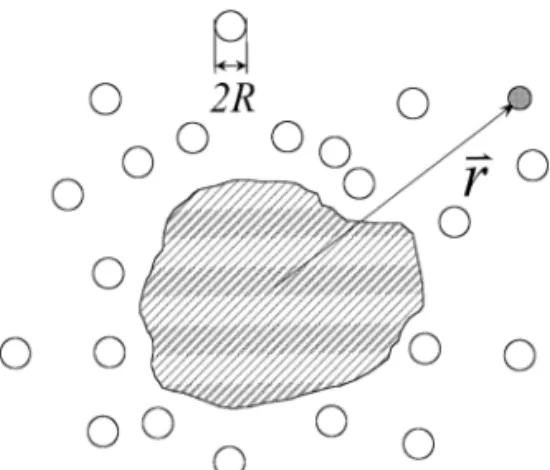
The system under consideration is illustrated in Fig. 1 where monodispersed colloidal particles with scaled radius R, represented by open circles, are dispersed in an electrolyte solution, and the shaded area denotes a rigid object. The concentration of colloidal particles follows some distribution as a response to the presence of the object. The object can be a rigid wall, a closed boundary, or a relatively large particle having a concentration much dilute than that of the colloidal particles. The density
distri-Fig. 1. Schematic representation of the system under consideration where the open circles represent the colloidal particles and the shaded area a relatively large object. R is the radius of a colloidal
©
particle, and r the scaled vector from the gravity center of the object to that of a particle.
©
Ž .
bution of colloidal particles, r r , can be expressed
w x as 25 : © © r r s r g
Ž .
` wcŽ .
r ,Ž .
1 © Ž .where r` and gwc r are, respectively, the bulk
number concentration and the radial distribution of colloidal particles. The subscripts w and c denote the rigid object and the colloidal particle, respectively,
©
and r the scaled vector from the gravity center of the former to that of the latter which is scaled by the factor ry1 r3, i.e.,
` © 1r3
r s rr` ,
Ž
1a.
r being the center-to-center vector connecting object and colloidal particle. For the system shown in Fig.
Ž .
1, gwc r can be determined by the Ornstein–
w x Zernicke equations 25 : X X X hcc
Ž .
r s cccŽ .
r qH
hccŽ
r c.
ccŽ
r y r.
d r ,Ž
2a.
V X X X hwcŽ .
r s cwcŽ .
r qH
hwcŽ
r c.
ccŽ
r y r.
d r , V 2bŽ
.
with g s 1 q h ,i j i j i , j s w, c .Ž
2c.
Ž . Ž .The integrations in Eqs. 2a and 2b are conducted
Ž . Ž .
over the space, and ci j r and hi j r are,
respec-tively, the direct and indirect correlation functions
between entities i and j, i, j s w, c. The derivations
Ž . Ž .
of Eqs. 2a and 2b are based on the assumption that the concentration of w is low. Employing the
w x
hypernettted-chain approximation 25 , we have ci j
Ž .
r s hi jŽ .
r y ln 1 q hi jŽ .
r yui jŽ .
r ,i , j s w, c ,
Ž .
3Ž .
where ui j r is the scaled, paired potential energy
Ž . Ž . Ž .
between entities i and j. Eqs. 2a , 2b and 3 lead
to two independent problems. First, given rcc and
u , we have to solve the following equations for hcc cc
and c :cc
hcc
Ž .
r s cccŽ .
r q hccŽ .
r ) cccŽ .
r ,Ž
4a.
cŽ .
r s hŽ .
r y ln 1 q hŽ .
r yuŽ .
r ,Ž
4b.
cc cc cc cc
where the asterisk symbol denotes the convolution
operator. Second, given ccc and uwc, we have to
solve the following equations for hwc and cwc:
hwc
Ž .
r s cwcŽ .
r q hwcŽ .
r ) cccŽ .
r ,Ž
5a.
cwcŽ .
r s hwcŽ .
r y ln 1 q hwcŽ .
r yuwcŽ .
r .5b
Ž
.
For convenience, we assume that colloidal particlesare spherical. In this case, both hcc and ccc are
functions of the distance between two particles only, and the vector r can be replaced by its magnitude r.
w x
The method proposed by Broyles et al. 26 is
Ž . Ž .
adopted to solve Eqs. 4a and 4b . The first step is
w .
to extend the domain of hcc and ccc from 0, ` to
Žy`, ` by defining.
x
hccŽ .
r s hccŽ
yr ,.
r g y `, 0 ,Ž
Ž
6a.
x
cŽ .
r s cŽ
yr ,.
r g y `, 0 .Ž
Ž
6b.
cc cc Also, we define H s r h y cccŽ
cc cc.
,Ž
7a.
G s yrhcc cc,Ž
7b.
I s yrc s H y rhcc cc cc cc,Ž
7c.
r J s yccH
I s d s .Ž .
Ž
7d.
y` Ž . Ž .Therefore, Eqs. 4a and 4b can be rewritten as
` X X X Hcc
Ž .
r s 2 pH
IccŽ
r.
JccŽ
r y r.
d r y` ` X X X yH
HccŽ
r.
JccŽ
r y r.
d r ,Ž
8a.
y` h s y1 q exp H rr y uccŽ
cc cc.
.Ž
8b.
For a simpler numerical treatment, these expressions are transformed to the corresponding discrete forms as N X X H s2 pd
Ý
I J Ž . cc , n cc , n cc , nyn X n syN N X yÝ
H J ,Ž
9a.
Ž . cc , n cc , nyn X n syN h s y1 q exp HŽ
rnd y u.
,Ž
9b.
cc , n cc , n cc , nwhere d is a discretizing interval, N an integer
< <
sufficiently large such that Hcc, Nf0 for n ) N,
Ž .
and F the corresponding discrete form of F r i.e.,n
Ž .
F s F nd . The following iterative procedure isn
Ž . Ž .
used to solve Eqs. 9a and 9b :
Step 1. Guess an initial Hcc, n and substitute it into
Ž .
Eq. 9b to evaluate hcc, n.
Ž .
Step 2. Substitute hcc, n into Eq. 7c , and the
Ž .
resultant expression into Eq. 7d to obtain Icc, n
and Jcc, n.
Ž .
Step 3. Substitute Icc, nand Jcc, n into Eq. 9a , and
take a discrete Fourier transform to obtain
ˆ
ˆ
2 p Icc , kJcc , kˆ
H s , y` - k - ` ,Ž
10.
cc , kˆ
1 q 2 p Jcc , kˆ
where F is the Fourier transform coefficient ofk
F .n
Step 4. Take the inverse Fourier transform on
ˆ
Hcc, k to obtain Hcc, n, and substitute the resultant
Ž .
expression into Eq. 9b to obtain the corrected hcc, n. The procedure is repeated until Hcc, n con-verges.
Ž .
F n can be recovered from Fn by choosing an
appropriate interpolation method. A linear interpola-tion approximainterpola-tion is used in the present study. It
Ž . Ž . Ž . Ž .
can be shown that Hcc t , Icc r , Jcc r , Gcc r are
< <
negligible for r G L. Typically, L is on the order of six radii of a colloidal particle.
Ž . Ž .
Note that in Eqs. 5a and 5b , hwc and cwc are
functions of vector r, and not functions of scalar r.
For a two-dimensional problem, we expand hwc and
cwc as hwc
Ž .
r sÝ
hwc , nN r , rnŽ
n.
, n s 1, 2, . . . ,Ž
11.
n cwcŽ .
r sÝ
cwc , nN r , rnŽ
n.
, n s 1, 2, . . . ,Ž
12.
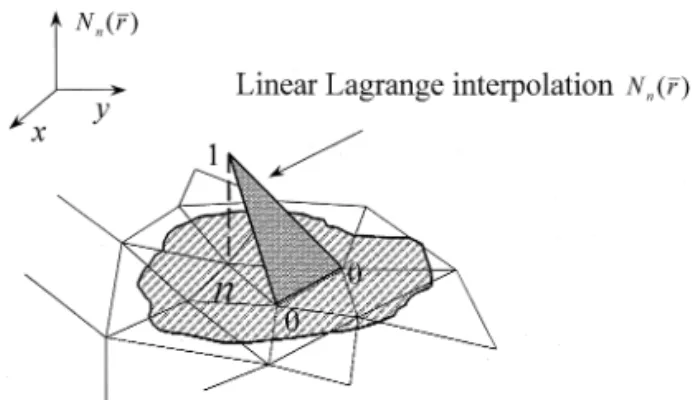
n Ž .Fig. 2. Meshes used in the linear Lagrange interpolation of N r .n
where n is a mesh node shown in Fig. 2, hwc, n the
Ž . Ž .
value of hwc r at n, and N r, rn n an interpolation
function, r being the vector pointing to node n. Onen
of the interpolation functions often adopted is the linear Lagrange interpolation function, the property of which is shown in Fig. 2. This approach was used in a finite-element method to solve a variational
w x w x
problem 27 . It was also used by Zaini et al. 17 in the discussion of the double layer profile in a charged
Ž . Ž .
cylindrical pore. Substituting Eqs. 11 and 12 into
Ž . Ž .
Eqs. 5a and 5b and letting the residuals vanish at the nodes, we obtain
< < X X X h sc q
Ý
w h c˜
Ž
r y r.
, wc , n wc , n n wc , n cc n n X n n s 1, 2, . . . ,Ž
13a.
c sh yln 1 q hŽ
.
yu , wc , n wc , n wc , n wc , n n s 1, 2, . . . ,Ž
13b.
where w is a weighting factor, which reflects then
integral of interpolation functions over the area occu-pied by node n by all mesh elements enclosing node n, and c
˜
cc is defined as ` 2 2'
c˜
ccŽ .
r sH
cccŽ
r q z.
d z .Ž
14.
y` Ž . Ž .Note that Eq. 13a is linear and Eq. 13b nonlinear algebraic equations. The former can be rewritten as
Ž . Ž <
where the i, j element of matrix M is w cj
˜
cc r yi<. r , andj hwc , 1 hwc , 2 h s ,
Ž
15a.
wc h wc , 3 . . . cwc , 1 cwc , 2 cwcs .Ž
15b.
cwc , 3 . . . Ž . Ž .Substituting Eq. 15 into Eq. 13b gives
h s y1 q EXP Mh yu ,
Ž
16.
wcž
wc/
where uwc , 1 uwc , 2 uwcs ,Ž
16a.
uwc , 3 . . . exp xŽ
1.
exp xŽ
2.
EXP x sŽ
.
.Ž
16b.
exp xŽ
3.
. .. Ž .Eq. 16 is solved by the Newton–Raphson method through using the iterative expression
´ ´ ´ h sh yS y1 q EXP ´ Mh yu wc Ž kq1. wc Ž k .
ž
wc Ž k . wc/
´ yh ,Ž
17.
wc Ž k . ´where hwcŽ k . is the k th iterative solution with
param-eter ´ , 0 - ´ F 1, and S s M m EXP ´ Mh
ž
yu/
Ž . wc k wcž
= y1w
111 PPP 1x
yI/
.Ž
18.
The operator m has the property
w
ax
m b sw
cx
, c s a b .Ž
18a.
i j i j i j i j i j i j
The parameter ´ is designed to improve the perfor-mance of the present numerical scheme, which con-sists of the following steps:
Step 1. Assign a small value, say 0.1, to ´ , and assume the initial guess
´
hwc Ž0.sEXP yu
Ž
wc.
y1 .Ž
19.
Ž .Step 2. Substitute this expression into Eq. 17 ,
and evaluate h´wcŽ1.. Repeat this step until a
con-´
vergent expression, hwcŽ`., is obtained.
Step 3. Increase the value of ´ , use h´wcŽ`. as the
initial guess, and return to step 1. This is repeated until ´ reaches unity.
3. Results
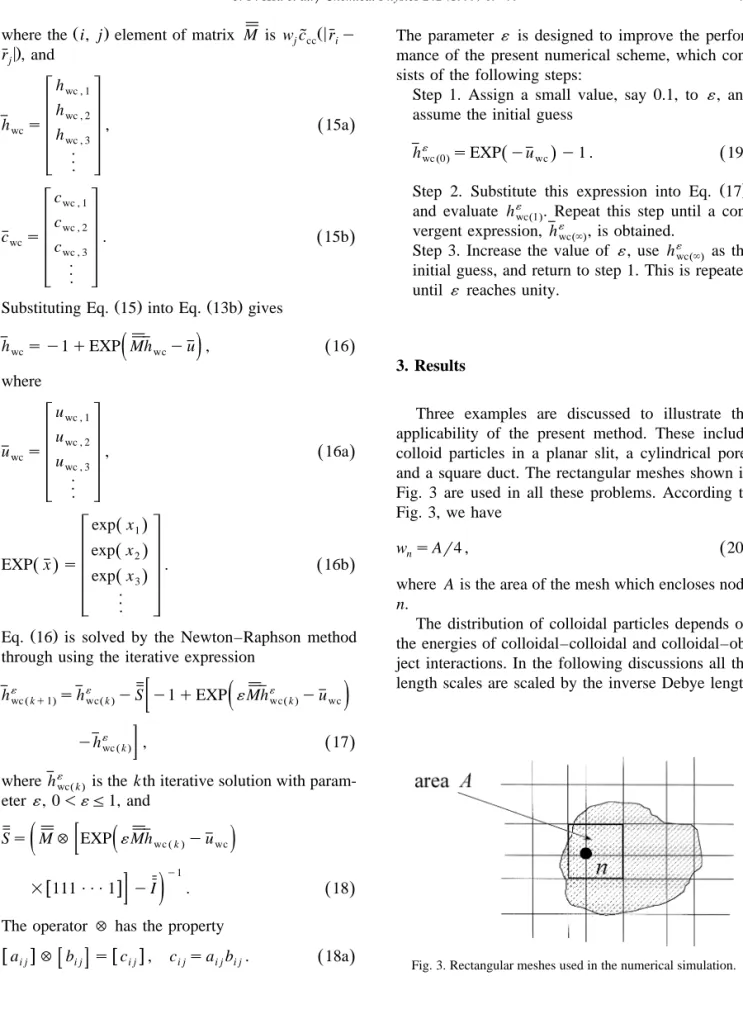
Three examples are discussed to illustrate the applicability of the present method. These include colloid particles in a planar slit, a cylindrical pore, and a square duct. The rectangular meshes shown in Fig. 3 are used in all these problems. According to Fig. 3, we have
w s Ar4 ,n
Ž
20.
where A is the area of the mesh which encloses node n.
The distribution of colloidal particles depends on the energies of colloidal–colloidal and colloidal–ob-ject interactions. In the following discussions all the length scales are scaled by the inverse Debye length
k . A general expression for the colloidal–colloidal Ž . w x interaction energy, ucc r , is 5,6 ucc
Ž .
r exp y r y R y RŽ
1 2.
y1 s4 p´ ´ kr 0 R R Y Y1 2 1 2 , r 21Ž
.
where subscripts 1 and 2 denote the properties ofparticles 1 and 2, respectively, ´ and ´r 0 are the
relative permittivity of the liquid phase and the permittivity of a vacuum, respectively, r is the scaled
center-to-center distance between two particles, R isi
the scaled radius of particle i, and Y is the scaledi
surface potential of particle i. Here we assume that the permittivity of the solid phase is much smaller than that of the liquid phase, as is usually the case in practice.
The interaction energy between colloidal particle and wall depends on their shapes and surface condi-tions. Suppose that it can be estimated through the linear superposition. Then, for the case of constant charge density, the interaction energy can be evalu-ated by
1 0 1 0
uwc
Ž .
r s W r HC2 c w d S q W r HC2 w c d S ,Ž
22.
where W s ´ ´ k Trk er 0 B 2, kB and T are,
respec-tively, the Boltzmann constant and the absolute
tem-perature, e is the elementary charge, r and rc w are,
respectively, the scaled surface charge densities of a
particle and the wall, Cw0 and Cc0 are the scaled
surface potentials of an isolated wall and an isolated particle, respectively.
Ž
As an example, we consider porous
ion-penetra-.
ble particles, which simulate a wide class of col-loidal particles, such as biological cells and particles
covered by an artificial membrane. In this case, Y ,i
Ž .
i s 1, 2, in Eq. 21 should be replaced by the scaled
potential at particle–liquid interface, and r in Eq.c
Ž22 denotes the scaled volume charge density. It can.
be shown that for an ion-penetrable particle,
0
Cc
Ž .
r s r exp y r y RcŽ
.
R y 1qexp y2 R
Ž
. Ž
R q 1.
r2 r , r G R ,23
Ž
.
where R is the radius of the particle, and the interac-tion energy between two ion-penetrable spheres is
2 ucc
Ž .
r s W prc exp RŽ
. Ž
R y 1.
2 qexp yRŽ
. Ž
R q 1.
exp yr rr .Ž
.
24Ž
.
3.1. Planar slitConsider a planar slit with a scaled width 2 L. Let R be the scaled radius of a particle. The origin of the
Ž .
coordinates x, y is located on the center line of the slit. For the case of a planar surface and an ion-pene-trable sphere, the energy contributed by the latter is uc
Ž .
r s W pr rc w exp RŽ
. Ž
R y 1.
qexp yR
Ž
. Ž
R q 1.
exp yr ,Ž
.
Ž
25a.
and that by the former is W pr rc w
uw
Ž .
r s exp RŽ
. Ž
R y 1.
2
qexp yR
Ž
. Ž
R q 1.
exp yr .Ž
.
Ž
25b.
In this case, the electrical potential energy can be
w x
calculated by an image method 28 . We obtain uwc
Ž
x s W pr r exp R.
w cŽ
. Ž
R y 1 q exp yR.
Ž
.
=Ž
R q 1.
3 exp yLŽ
.
exp yxŽ
.
1 y exp y2 LŽ
.
2 qexp xŽ
.
qW pr exp RŽ
. Ž
R y 1.
c 2 qexp yRŽ
. Ž
R q 1.
= ` exp y 2 L q 2 x q 4 kLŽ
.
Ý
½
ks0 2 L q 2 x q 4 kL exp y 2 L y 2 x q 4 kLŽ
.
q 2 L y 2 x q 4 kL ` 2 exp y4 kLŽ
.
qÝ
.Ž
26.
5
4 kL ks1 3.2. Cylindrical poreLet us consider a cylindrical pore with scaled diameter D. Let r be the scaled radial distance. It can be shown that
r Iw 0
Ž .
r0
Cw
Ž .
r s ,Ž
27.
Fig. 4. Variation of c˜cc as a function of the radial distance r. The interaction energy between two colloidal particles is calculated by
Ž .
Eq. 24 . Key: the liquid phase is a 0.01 M 1:1 electrolyte solution, T s 298 K, ´ s 78, r s6, r s 2, r s6=1023
r c w `
no.rm3, and Rs 5=10y9 m.
where I and I are the modified Bessel functions of0 1
first kind of orders zero and one, respectively, r and D are, respectively, the radial distance and the
diam-Ž .
eter of the pore. uwc r can be calculated by
substi-Ž . Ž . Ž .
tuting Eqs. 23 and 27 into Eq. 22 . 3.3. Square duct
Consider a square duct with scaled width 2 L. The
Ž .
origin of the coordinates x, y is located at the
center of the duct. We assume that the electrical
energy between wall and particle, uwc, can be
esti-mated through linear superposition, and the square duct simulated by the combination of two perpendic-ular planar slits. Therefore, after neglecting some higher-order images, we have
uwc
Ž
x , y s u.
wcŽ
x q u.
wcŽ
y.
2 2 < < < <(
qu 2Ž
L y x.
qŽ
L y y.
r2 cc 2 2 < < < <(
qu 2Ž
L y x.
qŽ
L q y.
r2 cc 2 2 < < < <(
qucc 2Ž
L q x.
qŽ
L y y.
r2 2 2 < < < <(
qucc 2Ž
L q x.
qŽ
L q y.
r2 qo exp y2 L r2 L .Ž
.
Ž
28.
Ž . Here, u r is scaled by u r s u rry1 r3k . 29Ž .
Ž
`.
Ž
.
The simulated variation in the modified direct
Ž .
correlation function c
˜
cc defined in Eq. 14 as afunction of the distance x for the case of planar slit
is shown in Fig. 4. This figure reveals that c
˜
ccbecomes negligible if x is R 2. This means that the
Ž .
integration limits in Eq. 14 can be narrowed down, and the computational efficiency improved
signifi-cantly. The effective range of c
˜
cc also has aninflu-ence on the computational domain.
By referring to Fig. 5, in the estimation of hwc
Ž . Ž .
through Eqs. 13a and 13b , its value is assumed to be negligible for a point outside the computational
< < Ž .
domain V , which is defined by x F L q E1 and
<y F E . To avoid the deviation caused by this as-< 2
sumption, E and E need to be chosen adequately.1 2
Apparently, the effective range of c
˜
cc should betaken into account. Fig. 6 shows the variation of hwc
as a function of x at y for various E . As can be1
seen from this figure, the result for E s 3 is close to1
that for E s 2, the effective range of c . In other1
˜
ccwords, the range of x in V should cover at least the
effective range of c . Fig. 7 shows the magnitude of
˜
ccE on the variation of h2 wc as a function of x in a
slit. As can be seen from this figure, an E greater2
than 6 should be chosen.
Fig. 8 shows the variation of hwc as a function of
x at various widths of a planar slit, measured by RrL. For the present case, the average concentration of colloidal particles for RrL s 0.1, 0.3, and 0.5,
< < Ž .
Fig. 5. The computational domain, defined by x F Lq E1 and
<y F E , for the case of a planar slit.<
Fig. 6. Variation of hwc as a function of position variable x for the case of a planar slit at various E . Parameters used are:1
R r L s 0.3, and E s 6. — — —:2 E s 0.5; - - -:1 E s1;1 : E s 2; q q q: E s 3. Key: same as Fig. 4.1 1
are, respectively, 6.09 = 1023, 6.31 = 1023, and 6.83
= 1023
no.rm3. That is, under the conditions
as-sumed, the narrower the slit, the higher the concen-tration of colloidal particles. Therefore, narrowing the width of a slit has the effect of increasing the mean concentration of particles inside. The same conclusion can be drawn for the cases examined by
w x w x
Anderson and Brannon 9 and Glandt 10 .
The effect of electrical interaction between parti-cle and wall on the distribution of the former in a
Fig. 7. Variation of hwc as a function of position variable x for the case of a planar slit at various E . Parameters used are2
R r L s 0.3, and E s 2. — — —:1 E s1.5; - - -:2 E s 3;2 : E s6; q q q: E s8. Key: same as Fig. 4.2 2
Fig. 8. Variation of hwc as a function of x at various width of a planar slit, measured by R r L. R r Ls 0.1: — — —; R r Ls 0.3: - - -; R r Ls 0.5: . Key: same as Fig. 4.
planar slit is presented in Fig. 9. As can be seen from this figure, increasing the electrical repulsive interac-tion between particle and wall has the effect of decreasing the mean particle concentration in the slit. This is expected, since the greater the repulsive interaction between particle and wall, the less favor-able for particles to enter the slit. The average
con-centration in the slit for u ru) s
0.5, 1, and 2 are,
wc wc
Fig. 9. Variation of hwc as a function of x at various inter-action energy between wall and particle uwc for the case where
)
Ž .
R r Ls 0.3. The interaction energy uwcis calculated by Eq. 26 .
) )
— — —: uwcruwcs0.5; : uwcruwcs1; - - -:
u ru) s
2, u)
being the value of u evaluated under the
wc wc wc wc
respectively, 7.30 = 1023, 6.31 = 1023, and 5.34 =
1023 no.rm3, where u)
is the value of u under
wc wc
the conditions of Fig. 4. On the other hand, the greater the electrical repulsive interaction between two particles, the higher the average concentration of particles in a slit, as can be seen from Fig. 10. For example, the average concentration of colloidal
parti-cles in the slit for u ru)s
0.5, 1, and 2, are,
cc cc
respectively, 4.98 = 1023, 6.31 = 1023, and 6.78 =
1023 no.rm3, where u)
is the value of u under the
cc cc
conditions of Fig. 4. As can be seem in Fig. 11, the higher the bulk concentration of colloidal particles, the higher the average particle concentration in a slit. The average concentration of colloidal particles in
the slit for r s 6 = 10` 23, 4 = 1023, and 2 = 1023
no.rm3 are, respectively, 6.31 = 1023, 3.73 = 1023,
23 3 Ž
and 1.37 = 10 no.rm . Note that the ratio average
.
particle concentration in slitrr` decreases
nonlin-early with r .`
The variation of hwc as a function of the radial
distance r at various radius of a cylindrical pore is
presented in Fig. 12. The value of ucc is obtained
Ž . Ž .
from Eq. 24 , and uwc from Eq. 22 . This figure
suggests that the larger the cylindrical pore, the closer the result to that for a planar slit. This is expected since the larger the pore, the less significant the curvature effect, and the closer the pore to a
Fig. 10. Variation of hwc as a function of x at various interaction energy between two colloidal particles ucc for the case where
)
Ž .
R r Ls 0.3. The interaction energy uwcis calculated by Eq. 24 .
) )
— — —: uccruccs0.5; : uccruccs1; - - -:
u ru)s2, u) being the value of u evaluated under the
cc cc cc cc
conditions of Fig. 4. Key: same as Fig. 4.
Fig. 11. Variation of hwcas a function of x at various r for the`
23 3
case where R r Ls 0.3. : r s6=10` no.rm ; - - -:
r s 4=1023
no.rm3; — — —: r s 2=1023norm3. Key same
` `
as Fig. 4.
planar surface. The average particle concentration for 2 RrD s 0.1, 0.3, and 0.5, are, respectively, 6.77 =
1023, 7.64 = 1023, and 13.3 = 1023 no.rm3.
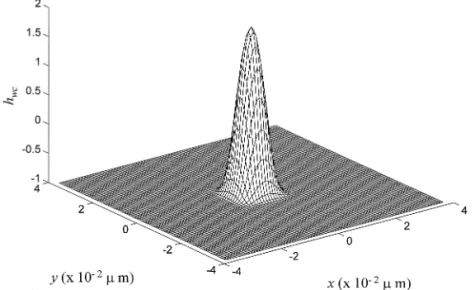
Fig. 13 shows the variation of hwc for the case of
a square duct with RrL s 0.3. Similar to the case of
Fig. 8, the spatial variation of hwc has a maximum at
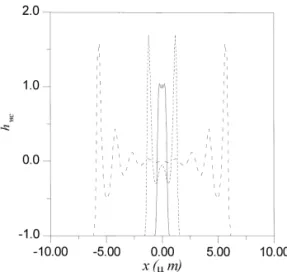
a distance about R from the wall, and decreases oscillatory with the distance away from the wall. This implies that a layer of colloidal particles is
Fig. 12. Variation of hwc as a function of r at various radius of cylindrical pore. — — —: 2 R r Ds 0.1; - - -: 2 R r Ds 0.3;
Ž .
: 2 R r Ds 0.5. ucc is calculated by Eq. 24 , and uwc
Ž .
Fig. 13. Variation of h as a function of x and y for a square duct with RrL s 0.3 and r s 6 = 1023no.rm3. Key: same as Fig. 4.
wc `
formed near the wall. The qualitative behavior of the spatial variation of the concentration of colloidal particles predicted by the present study is consistent
w x
with that observed experimentally 1 . The maximum and the oscillatory behavior of the spatial variation
of hwc disappear, however, if the bulk particle
con-centration r` is low, as can be seen from Fig. 14.
This is because that as r` decreases, the available
space for particles increases. The average particle concentration for RrL s 0.1, 0.3, and 0.5, are,
re-spectively, 6.15 = 1023, 6.37 = 1023, and 6.74 = 1023
no.rm3 under the conditions of Fig. 4.
In summary, the hypernetted chain approximation is applied to evaluate the direct correlation functions of particle–particle and particle–object interactions. These functions are readily applicable to the determi-nation of the spatial distribution of colloidal particles in the presence of an energy filed. Since the direct correlation functions are described by two indepen-dent equations, the present analysis is also applicable
Fig. 14. Variation of h as a function of x and y for a square duct with RrL s 0.3, and r s 2 = 1023no.rm3. Key: same as Fig. 4.
if the hypernetted chain approximation for the direct correlation function of particle–particle interaction is
w x
replaced by the mean spherical approximation 2–4 , andror that for the direct correlation function of particle–wall interaction replaced by the Percus– Yevick approximation. Although only three special cases are examined in the numerical simulation, i.e., planar slit, cylindrical pore, and square duct, the present method can be extended directly to an arbi-trary two-dimensional problem.
Acknowledgements
This work is supported by the National Science Council of the Republic of China.
References
w x1 D.H. Van Winkle, C.A. Murray, J. Chem. Phys. 89 1988Ž .
3885.
w x2 P. Gonzalez-Mozuelos, J. Alejandre, M. Medina-Noyola, J.
Ž .
Chem. Phys. 95 1991 8337.
w x3 P. Gonzalez-Mozuelos, J. Alejandre, M. Medina-Noyola, J.
Ž .
Chem. Phys. 97 1991 8712.
w x4 P. Gonzalez-Mozuelos, J. Chem. Phys. 98 1993 5747.Ž . w x5 J.Y. Walz, A. Sharma, J. Colloid Interface Sci. 168 1994Ž .
485.
w x6 J.Y. Walz, J. Colloid Interface Sci. 178 1996 505.Ž . w x7 R.I. Feigin, D.H. Napper, J. Colloid Interface Sci. 75 1980Ž .
525.
w x8 X.L. Chu, A.D. Nikolov, D.T. Wasan, Langmuir 12 1996Ž .
5004.
w x9 J.L. Anderson, J.H. Brannon, J. Polym. Sci., Polym. Phys.
Ž .
Ed. 19 1981 405.
w10 E.D. Glandt, J. Colloid Interface Sci. 77 1980 513.x Ž . w11 N. Ise, T. Okubo, M. Sugimura, K. Ito, H.J. Bolte, J. Chem.x
Ž .
Phys. 78 1982 536.
w12 K. Ito, H. Nakamura, N. Ise, J. Chem. Phys. 85 1986 6236.x Ž . w13 X. Chu, D.T. Wasan, J. Colloid Interface Sci. 184 1996x Ž .
268.
w14 D.C. Carley, F. Lado, Phys. Rev. 137 1965 A42.x Ž . w15 M. Lozada-Cassou, J. Phys. Chem. 87 1983 3729.x Ž . w16 R.J. Hunter, Foundations of Colloid Science, vols. 1 and 2,x
Oxford University Press, London, 1989.
w17 P. Zaini, H. Modarress, G.A. Mansoori, J. Chem. Phys. 104x Ž1996 3832..
w18 L. Yeomans, S.E. Feller, E. Sanchez, M. Lozade-Cassou, J.x
Ž .
Chem. Phys. 98 1993 1436.
w19 J.A. Greathouse, D.A. McQuarrie, J. Phys. Chem. 100 1996x Ž .
1847.
w20 J.A. Greathouse, D.A. McQuarrie, J. Colloid Interface Sci.x
Ž .
100 1996 1847.
w21 G.N. Patey, J. Chem. Phys. 72 1980 5763.x Ž . w22 M. Lozada-Cassou, J. Chem. Phys. 80 1984 3344.x Ž . w23 M. Lozada-Cassou, E. Diaz-Herrera, J. Chem. Phys. 93x
Ž1990 1386..
w24 M. Lozada-Cassou, E. Diaz-Herrera, J. Chem. Phys. 93x Ž1990 1194..
w25 D.A. McQuarrie, Statistical Mechanics, Harper and Row,x
New York, 1976.
w26 A.A. Broyles, S.U. Chung, H.L. Sahlin, J. Chem. Phys. 37x Ž1962 2462..
w27 K.H. Huebner, The Finite Element Method for Engineers,x
Wiley, New York, 1982.
w28 S.L. Carnie, D.Y.C. Chan, J.S. Gunning, Langmuir 10 1994x Ž .