
中國醫藥大學機構典藏 China Medical University Repository, Taiwan:Item 310903500/23824
11
0
0
全文
(2) 10. Studies have reported that nurses were more content and happier with their work if they were committed to the beliefs, values, and practices in the organization [1,7]. It is urgent that these contributing factors be addressed. Beneficial and cost affect measures for increasing nurses' organizational commitment include creating a positive organizational climate, improving working relationships, and recognizing the professional autonomy of nurses in their daily work life [1,9]. Most studies of nurse' organizational commitment in Taiwan were designed to explore levels of nurses' organizational commitment in particular areas in Taiwan [2,10-12]. Few studies have focused on the organizational aspects affecting nurses' organizational commitment. The purpose of this study was to establish an instrument to explore the organizational factors associated with nurses' organizational commitment (FNOC) in hospitals in Taiwan. Once the factors have been clearly identified, effective strategies can be implemented to better orient, educate, satisfy, motivate, and retain quality-nursing staff. The findings of this study present factors that enhance nurses' organizational commitment, thereby reducing the turnover rate and increasing the quality of health care in hospitals in Taiwan. Organizational commitment. Previous research in both Western countries and Taiwan has found that members of organizations who had high levels of commitment showed better job performance, job satisfaction and productivity, and lower levels of absenteeism and tardiness [1,13-15]. Commitment is a strong belief in and acceptance of goals and values of the organization they are working for, a willingness to exert considerable effort on behalf of the organization, and a definite desire to maintain organizational membership [3,13]. Commitment of an employee to an organization has received increased attention from practitioners. This interest has been made. Nurses' Organizational Commitment. apparent by numerous studies that have examined the relationships between organizational commitment and its antecedents [3,14]. Studies of predictors of organizational commitment in various careers identified the following antecedent predictors: personal characteristics (age, education, gender, and various personality traits), job characteristics, and role-related variables [3,13,14]. After a systematic review of the literature, we concluded that there are ten major factors related to organizational commitment. These factors are explained in detail as follows. Organizational recognition. Organizational recognition was a strong predictor of an employee's commitment to the organization [15]. This concept refers to employees' cognitive stage of understanding the organization. Individuals must clearly understand the goals, values, and needs of the organization and the organization must also clearly understand the goals, values, and needs of the individual. Furthermore, organizations should focus on clarifying an employee's responsibilities and accountability, and provide an employee with meaningful experiences to increase attachment and commitment to the organization [15]. Training programs. Supporting professional development has been suggested as an important strategy in fostering employee commitment. The development of work site recruitment and retention plans have been recommended by many scholars [15,16]. It has been suggested that professional development including a personal growth plan and development of an individual's needs promote retention of employees [1,2,14,17]. Group cohesiveness. Group cohesiveness, one of the strongest forces in the socialization process within an organization is the interactive dynamic between the individual and co-workers [14]. Such interaction can provide the support and reinforcement necessary for adjustment and attachment to the work environment. This strong.
(3) Lichi Huang, et al.. positive relationship between gratification with co-worker relationships and the propensity to remain was found in many nursing settings [1]. Communication. Communication is a dominant theme because accessibility of the supervisor for listening and guidance, effective communication, and clear expectations and feed back is needed for better work performance [16]. Providing plenty of opportunities for two-way communication has been recommended for building an effective environment that increases an employee's commitment to an organization [8]. Shared decision making. Shared decisionmaking includes an open distribution of information, group problem solving, and giving out of power to create a desired future [18]. A researcher from Taiwan stated, "nurses who experience higher levels of participation in decision making show higher levels of commitment to the organization and display lower degrees of intention to leave" [17]. Employees were willing to work for the benefit of the organization when they felt they were an integral part of the organization. Work schedules. In Strachota's qualitative study of reasons nurses left employment, over half of the respondents suggested that the hours worked were their main problem [8]. Nurses having flexible working schedule have being a factor contributing to their organizational commitment, and reducing turnover that was declared by the studies in the United States and Taiwan [2,8]. Autonomy. Autonomy is defined in terms of the characteristics of the position that allowed or encouraged individual decision making of daily operational activities. The level of nurses' autonomy to control their practice and work schedules was found to be an important factor which increased both organizational commitment and retention [8,18]. Environmental security. The security afforded by a safe and healthy working environment is the deciding factor in a nurse's. 11. choice to remain at her current job. The International Council of Nurses promoted the application of policies and instruments that would safeguard the nurses' right to a safe work environment, including continuing education, immunization, and protective clothing and equipment [19]. Job security. Job security, feelings of being secure about not losing a job, was important for commitment [1]. Most people believe that job security is automatically provided by their organizations. Moreover, increasing competition and performance requirements in the work world today require managers to focus on providing relevant value everyday to secure nurses and their positions [20]. Demographic variables have also been reported to have great influence on nurses' turnover in various studies in the United States and Taiwan [5,7,16,21] and to be a predictor of commitment to an organization [3,15]. Demographics consist of variables that define the participants' personal data. In this study, those data include age, gender, education, work experience, kinship responsibility, job status, clinical service unit, and salary. Developing an instrument. The reliability of an instrument is an important criterion for assessing its quality. Reliability refers to the consistency with which an instrument measures a characteristic. It has been suggested that measuring an instrument's stability, internal consistency, and equivalence are necessary for measuring an instrument's reliability [22]. Validity is the degree of confidence that the measure being used adequately captures the intended phenomenon of interest. Validity has many aspects and assessment approaches such as face validity, content validity, criterion related validity, and construct validity. Generally, content validity is established primarily by reviews of the literature and expert judgment about the facets that constitute the domain of interest. Criterion.
(4) 12. Nurses' Organizational Commitment. validity establishes the degree to which the instrument being used correlates with other known and validated measures [23]. Construct validity is usually measured by factor analysis. Factor analysis is the most commonly used analytic technique for data reduction and refining constructs. Retaining factors with an eigenvalue greater than one is the most commonly used criteria for retention of factors. It has been reported that item loadings above 0.30 is a criterion for retaining items [22]. Scholars have recommended a sample size of at least 150 observations to obtain accurate results in exploratory factor analysis and 200 observations for confirmatory factor analysis [24]. This study will follow those procedures and criteriea to develop an instrument to measure the factors related to nurses' organizational commitment. MATERIALS AND METHODS. Research design. In order to develop an instrument for assessing organizational factors related to nurses' organizational commitment, relevant parameters were identified and tested in a two stages process. In the first stage, the scale was developed from item development and pilot study. In the second stage, the authors evaluated the reliability and validity of the instrument by psychometric methods. Stage 1: Developing the scale. Item development. We developed an instrument for measuring the factors that nurses believe are related to commitment to an organization. In the first phase, we reviewed the literature and conducted an audit of the questions. Item formation was synthesized from organizational factors reported in the literature. This synthesis indicated that ten areas need to be studied: a) organizational recognition [15], b) promotional opportunity [6], c) training programs [15], d) communication [16], e) shared decision-making [18], f) group cohesiveness [21], g) autonomy [21], h) work schedules [15], i) environmental. security [25], and j) job security [1]. A total of 32 questions with a Likert scale were scored from 1 (strongly disagree) to 7 (strongly agree). The survey consisted of a) demographic data, b) factors related to nurse's organizational commitment (FNOC), and c) an organizational commitment questionnaire (OCQ) developed by Porter et al [13]. The OCQ was selected because it had been used previously in Taiwan, had been translated into Chinese and included cultural aspects of the Taiwanese [10,28]. The OCQ had shown good reliability and validity. Internal consistency of the OCQ was determined to have a Cronbach's Alpha reliability of 0.86 to 0.92 [9], and 0.88 [13,28] in the studies. Participants were asked to mark their responses to the 15 items with a seven-point Likert scale from 1 (strongly disagree) to 7 (strongly agree). The higher the score, the more committed to the organization an individual was judged to be. Content validity. An audit of the questions was conducted to validate the content. Content validity of the FNOC was documented using an expert panel, including one educational administrator, one statistician, one nursing supervisor, one professor proficient in leadership and fellowship, and one professor of organizational behavior. Each expert reviewed the initial items independently followed by a panel discussion made up of all experts. The initial instrument consisted of 32 questions of factors related to nurses' organizational commitment; however, it increased to 33 questions based on the experts' suggestions. Pilot test. After the content was validated, a pilot test was conducted on 41 nurses from multiple hospitals. The participants did not participate in the formal survey, and had to be full-time nurses with at least six months of work experience in their current hospitals. The pilot instrument contained two major parts: a) factors related to nurse organizational commitment, and b) the organizational commitment questionnaire. The Cronbach's alpha coefficient of internal.
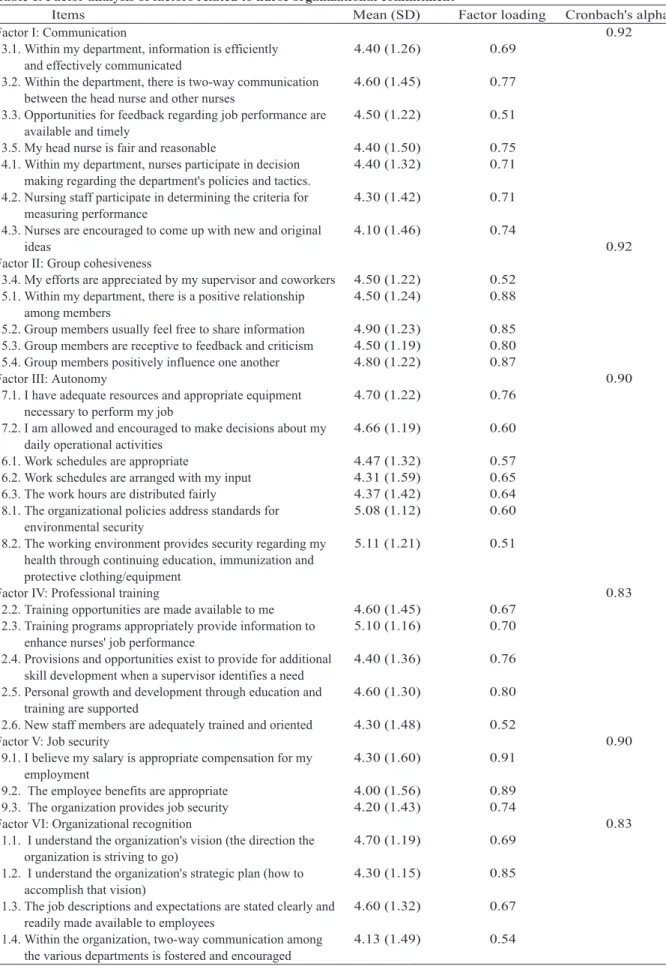
(5) Lichi Huang, et al.. consistency of reliability for factors related to nurses' organizational commitment was 0.91. The Cronbach's alpha coefficient of reliability for nurses' organizational commitment was 0.92, a level similar to the 0.88 alpha coefficient reported previously [13]. Stage 2: Psychometric testing of the instrument. Subjects. We randomly selected 200 nurses from one hospital in Taiwan. All of the participants had to have been full-time nurses at that institution for at least six months. The reason for this six-months criterion was that organizational commitment has been reported to develop and become consistent overtime as individuals thought about their relationship with the organization [13]. A total of 167 respondents out of the 200 nurses surveyed returned surveys (84%). The recommended sample size to obtain accurate results in exploratory factor is 150 respondents [24]. Confidentiality was maintained. Permission to conduct the study was received from the Institutional Research Board of the hospital. Informed consent forms, along with the instruments were sent to the randomly selected nurses by the hospital mail system. A return sealed envelope was included in the packet. Item analysis. Items were excluded based on item analysis. Item to total analysis was conducted by a corrected item to total correlation < 0.30 as a priori criterion [26]. Construct validity. Factor analysis is the most commonly used analytic technique for data reduction and refining constructs. Principal components analysis with orthogonal rotation is the most frequently reported factoring method. Criteria for extraction included a) eigenvalues greater than 1.0, b) scree test, c) factors which accounted for at least 5% of the variance, d) factor loading at 0.30, and e) the presence of theoretical rationale to support the result of cross loadings [22]. Criterion validity. Criterion validity correlates other known with validated measurements.. 13. According to the theoretical and practical rationale, the more organizational factors hospitals provide, the higher nurses' organizational commitment will be. Thus, the organizational commitment questionnaire was proposed as concurrent validity of factors related to nurse organizational commitment. Pearson correlation coefficient was used to understand the relationship between OCQ and FNOC. Reliability. Cronbach alpha coefficients calculated for each of the domain scores, measured the homogeneity of the scales. They reflect how well the different questions compliment each other in their measurement of different aspects of the same concept. Cronbach alpha levels greater than 0.70 indicated internal consistency. RESULTS. Demographic profile. The respondents ranged in age from 21 years to 56 years of age (mean age, 32.8 years). All respondents were females. Nearly half of the respondents, 47% (79), held bachelor degrees while 53% (88) of the respondents held associate degrees. Forty-eight percent of the respondents (80) were single and 52% (87) were married. Among the 167 respondents, 58% (97) had no children living with them. In total, 38% (63) of the respondents had held their current positions for less than two years, while 18% (30) had held their current positions for more than 10 years. The mean number of years an employee had held one's current job was 5.3 years. Nursing experience ranged from 6 months to 24 years (N = 167) (mean, 11.25 years). The average monthly salary of the respondents was NT$ 42,200. The scale consisted of 33 items with scores ranging from 77 to 201 on a Likert scale of one (strongly disagree) to seven (strongly agree). The overall mean score of the questionnaire was 148.9 (SD = 27.03). The mean and standard distributions of each question are shown in Table 1..
(6) 14. Nurses' Organizational Commitment. Table 1. Factor analysis of factors related to nurse organizational commitment Items Mean (SD) Factor loading Factor I: Communication 0.69 4.40 (1.26) 3.1. Within my department, information is efficiently and effectively communicated 0.77 4.60 (1.45) 3.2. Within the department, there is two-way communication between the head nurse and other nurses 0.51 4.50 (1.22) 3.3. Opportunities for feedback regarding job performance are available and timely 0.75 4.40 (1.50) 3.5. My head nurse is fair and reasonable 0.71 4.40 (1.32) 4.1. Within my department, nurses participate in decision making regarding the department's policies and tactics. 0.71 4.30 (1.42) 4.2. Nursing staff participate in determining the criteria for measuring performance 0.74 4.10 (1.46) 4.3. Nurses are encouraged to come up with new and original ideas Factor II: Group cohesiveness 0.52 3.4. My efforts are appreciated by my supervisor and coworkers 4.50 (1.22) 0.88 4.50 (1.24) 5.1. Within my department, there is a positive relationship among members 0.85 4.90 (1.23) 5.2. Group members usually feel free to share information 0.80 4.50 (1.19) 5.3. Group members are receptive to feedback and criticism 0.87 4.80 (1.22) 5.4. Group members positively influence one another Factor III: Autonomy 0.76 4.70 (1.22) 7.1. I have adequate resources and appropriate equipment necessary to perform my job 0.60 4.66 (1.19) 7.2. I am allowed and encouraged to make decisions about my daily operational activities 0.57 4.47 (1.32) 6.1. Work schedules are appropriate 0.65 4.31 (1.59) 6.2. Work schedules are arranged with my input 0.64 4.37 (1.42) 6.3. The work hours are distributed fairly 0.60 5.08 (1.12) 8.1. The organizational policies address standards for environmental security 0.51 5.11 (1.21) 8.2. The working environment provides security regarding my health through continuing education, immunization and protective clothing/equipment Factor IV: Professional training 0.67 4.60 (1.45) 2.2. Training opportunities are made available to me 0.70 5.10 (1.16) 2.3. Training programs appropriately provide information to enhance nurses' job performance 0.76 4.40 (1.36) 2.4. Provisions and opportunities exist to provide for additional skill development when a supervisor identifies a need 0.80 4.60 (1.30) 2.5. Personal growth and development through education and training are supported 0.52 4.30 (1.48) 2.6. New staff members are adequately trained and oriented Factor V: Job security 0.91 4.30 (1.60) 9.1. I believe my salary is appropriate compensation for my employment 0.89 4.00 (1.56) 9.2. The employee benefits are appropriate 0.74 4.20 (1.43) 9.3. The organization provides job security Factor VI: Organizational recognition 0.69 4.70 (1.19) 1.1. I understand the organization's vision (the direction the organization is striving to go) 0.85 4.30 (1.15) 1.2. I understand the organization's strategic plan (how to accomplish that vision) 0.67 1.3. The job descriptions and expectations are stated clearly and 4.60 (1.32) readily made available to employees 0.54 4.13 (1.49) 1.4. Within the organization, two-way communication among the various departments is fostered and encouraged. Cronbach's alpha 0.92. 0.92. 0.90. 0.83. 0.90. 0.83.
(7) Lichi Huang, et al.. 15. Table 2. Relationship between factors related to nurses' organizational commitment (FNOC) and nurse organizational commitment guestionaire (OCQ). FNOC (N = 157) OCQ (N = 153) **p < 0.01.. FNOC 1.000 0.505*. OCQ 0.505* 1.000. Item analysis. The item to total correlation coefficient ranged from 0.40 to 0.73, which met a priori > 0.3 indicating good correlation within the scale. However, there were two items with coefficients below 0.30, which indicated that they weakly correlated with other items in the scale. Question 2.1, "I believe I have been given appropriate consideration for promotional opportunities within the organization" had a coefficient of 0.28. Question 5.5 "Group members negatively influence one another" had a coefficient of 0.05. Question 5.5 was a reverse question similar to Question 5.4, designed to ensure the participant's response. However, no correlation between Question 5.5 and Question 5.4 was found by the Pearson's correlation test (p = 0.864). Therefore, Questions 2.1 and 5.5 were deleted because of low correlation. The final instrument consisted of 31 items. Construct validity. To verify the data for factor analysis, the communality of variances was assessed by the Bartlett test of sphericity (3828.9, p = 0.000); the test indicated high correlation between the items. The Kaiser-Meyer-Olkin value (KMO) was 0.91, indicating an adequate sample for factor analysis. Thus, exploratory factor analysis was executed for retaining and structuring the factors followed by a Principal Components Analysis (PCA). Principal Components Analysis was performed with Varimax (orthogonal rotation). Six factors were extracted, accounting for 71.7% of the total variance. Each factor accounted for least 5% of variance: Factor I, 16.7%; Factor II,. 12.7%; Factor III, 12.5%; Factor IV, 11.9%; Factor V, 9.4%; and Factor VI, 8.6%. The majority of factor loading was between 0.51 to 0.91 (Table 1). Factor I was titled communication and included 4 items that initially purported to measure communication and 3 items from the decision-making factor. Factor II was labeled group cohesiveness; 4 items were categorized from the group cohesiveness factor and 1 item from the communication factor. Factor III was referred to as autonomy and consisted of 2 items initially purported to measure autonomy, 3 items from the environment security factor, and 2 items from the work schedule factor. Factor IV was consistent with the original measurement of 5 items of professional training. Factor V was termed job security, and consisted of 3 items primarily assessed job security. Factor VI remained unchanged and was composed of 4 items which originally assessed organizational recognition (Table 1). Criterion validity. The nurses' OCQ was chosen for criterion validity of FNOC to understand the relationships between the two measurement tools. Pearson correlation indicated that assessing factors related to nurse organizational commitment is associated with nurses' organizational commitment level (r = 0.505, p < 0.01) (Table 2). That is higher scores within the nurses' percired organizational factor the higher nurses' organizational commitment achieved. Criteria validity showed that the instrument correlated well with other related organizational commitment measurements. Reliability. A total of 167 participants responded to the FNOC. Cronbach's alpha was used to analyze the internal consistency of the instrument of. The Cronbach's alpha coefficient for the total scale of 31 items was 0.94, indicating that the instrument was congruent internally and consistently structured. The Cronbach's Alpha for the six subscales ranged from 0.83 to 0.92 (Table 1)..
(8) 16. Nurses' Organizational Commitment. DISCUSSION. Almost all organizations are concerned about work productivity, employee performance, and customer satisfaction. A large number of studies have tried to develop an accurate tool for measuring employees' commitment to their organization. We developed an instrument which could assess the relationship between the organizational factors and nurses' commitment to the organization. The final version contains 31valid and reliable items. After analysis of the items, two were removed from the original scale. Question 2.1 was deleted because its coefficient was below 0.30. Although opportunities for promotion had been identified as one reason for nurse turnover and organizational commitment in a previous study [16], this item did not prove the effect in this study. One possible reason for this finding is that a single question cannot contain sufficient information representative for a domain. It has been suggested that a total number of items within 1 domain cannot be less than 3 [27]. More questions regarding opportunities for promotion will be included in a future study. Another possible reason why the coefficient was below 0.30 was because the sample was drawn from one hospital. A large and different sample is suggested for further investigation. Another item, Question 5.5 was removed because it was regarded as being redundant. In the initial development of the scale, we developed an instrument with ten areas of organizational factors. Psychometric methods of data analysis revealed six factors: communication, group cohesiveness, autonomy, professional training, job security and organizational recognition in this instrument. The majority of items within one factor were extracted from the original domain. Only Factors I, II, and III resulted in differences from the original domains. In Factor I, the items of communication and decision-making were combined in one factor. Actually, shared decision-making requires. an open distribution of information, good communication, and group problem solving [18]. Therefore, the factor that involved the domain of decision-making was called communication. A strong and supportive network of coworkers has been found in many nursing settings to reinforce the positive relationship in team building [15]. Therefore, Factor II, Question 3.4: "My efforts are appreciated by my supervisor and coworkers" was grouped in the factor of communication initially but was later included in the group cohesiveness factor after the factor analysis. Being appreciated by co-workers promotes group cohesiveness (Factor II). Factor III (Autonomy) contained three different domains: autonomy, environmental security, and work schedule. Strachota (2003) mentioned that a sense of autonomy enables nurses to control their practice and control their schedules, thereby increasing job satisfaction [8]. Thus, being able to manage their work schedule would be one of the facilitated factors in nurses' autonomy in their job. Environmental security includes sufficient work safety policies, information, and appropriate equipment to offer a safe and healthy environment for employees [25]. Employees have more confidence to handle their job once they know what and how much they can have and do in their job. Therefore, work schedule and the level of environment security would fit in the factor of autonomy for the purpose of promoting organizational commitment. There are several limitations in this study. First, the instrument was only tested in one hospital and data were only obtained from a convenience sample of 167 nurses, which would be a bias for application and interpretation of this instrument. The instrument needs to be tested in further studies which will include a larger sample size, a diversity of health institutes, a variety of areas, and in different countries for cultural proposition. Second, we were unable to discuss the domain of promotional opportunity because it.
(9) Lichi Huang, et al.. was inadequately developed in the primary tool; this domain needs further exploration. In conclusion, the instrument was developed and tested from a series of psychometric measurements. As a result, the instrument is a valid and reliable instrument for assessing the organizational factors associated with nurses' organizational commitment. The authors recommend that this instrument be used to recognize employees' perception of organizational factors in health institutions. Through an understanding of employees' needs and perception, administrators can maximize their employees' commitment to the organization. ACKNOWLEDGMENT. The authors would like to thank the China Medical University, Taiwan, for financially supporting this research (Contract No. CMC90NS-06). REFERENCES. 1. McNeese-Smith DK. A nursing shortage: building organizational commitment among nurses. J Healthc Manag 2001;46:173-87. 2. Hsiao Y, Lou M. A study on the organizational c o m m i t m e n t, o rg a n iza tio n a l rete n tio n, a nd professional retention of clinical nurses. Nurs Res 1996;4:137-50. 3. Porter LW, Steers RM, Mowday RT, et al. Organizational commitment, job satisfaction, and turnover among psychiatric technicians. J Appl Psycholo 1974;59:603-9. 4. Chen Y, Chiu T, Chen D. Nursing management associated with job satisfaction and organizational commitment by head nurses. Veter Nurs 1994;11:1428. (In Chinese; English abstract) 5. Wong C, Lin E, Lee P. A study of reasons nurse turnover on one public hospital in Taipei. Nurs New Vis 1997;7:85-100. (In Chinese) 6. Gauci Borda R, Norman IJ. Factors influencing turnover and absence of nurses: a research review. [Review] Int J Nurs Stud 1997;34:385-94. 7. Tai TW, Bame SI, Robinson CD. Review of nursing turnover research, 1977-1996. [Review] Soc Sci Med 1998;47:1905-24. 8. Strachota E, Normandin P, O'Brien N, et al. Reasons. 17. registered nurses leave or change employment status. J Nurs Adm 2003;33:111-7. 9. McCloskey JC, McCain BE. Satisfaction, commitment and professionalism of newly employed nurses. Image J Nurs Sch 1987;19:20-4. 10. Hu TC. A study of organization commitment and professional career commitment of nurses. Hung Kuang News 1999;33:115-32. (In Chinese; English abstract) 11. Chen M, Lin L. A study of the effect of organizational commitment related to personal characteristics and work quality. Chi Ban J 1996;24:63-77. (In Chinese) 12. Lin C. The relationship of culture center's directors' leadership style and the member's organizational commitment. Soc Edu J 1994;24:215-33. (In Chinese; English abstract) 13. Mowday RT, Steers RM, Porter LW. The measurement of organization commitment. J Vocat Behav 1979;14: 224-47. 14. Zangaro A. Organizational commitment: a concept analysis. Nurs Forum 2001;36:1-14. 15. Ingersoll GL, Olsan T, Drew-Cates J, et al. Nurses' job satisfaction, organizational commitment, and career intent. J Nurs Adm 2002;32:250-63. 16. Shader K, Broome ME, Broome CD, et al. Factors influencing satisfaction and anticipated turnover for nurses in an academic medical center. J Nurs Adm 2001;31:210-6. 17. Su HF. The relationships among management style, participation in decision-making, organizational commitment, and intention to leave for staff nurses working in Taiwan. PHD dissertation. The University of Taxes at Austin. 1998. 18.Janney MA, Horstman PL, Bane D. Promoting registered nurse retention thought shared decision making. J Nurs Adm 2001;31:483-8. 19. International Council of Nurses (ICN). Occupational Health and Safety for Nurses 2000. Retrieved January 11, 2004, from http://www.icn.ch/pshealthsafety00. htm. 20. Broscio M, Scherer J. Building job security: strategies for becoming a highly valued contributor. J Healthc Manag 2003;48:147-51. 21. Lucas MD, Atwood JR, Hagaman R. Replication and validation of anticipated turnover model for urban registered nurses. Nurs Res 1993;42:29-35. 22.Dixon JK. Factor analysis. In: Munro BH, ed. Statistical Method for Health Care Research. Lippincott: New York, 2001;303-29..
(10) 18. 23. Plit DF, Hungler BP. "Assessing Data Quality", In Nursing Research: Principle and Method. Lippincott: New York, 1999. 24. Hinkin T. A review of scale development practices in the study of originations. J Manag 1995;21:967-88. 25. Newman MA, Kachuba JB. Nurse recruitment: strong health and safety programs make a difference. Health Care Superv 1992;11:62-6. 26. Nunnally JC, Bernstrin IH. Psychometric Theory. New. Nurses' Organizational Commitment. York: McGaw-Hill, 1994. 27. Astedt-Kurki P, Tarkka MT, Paavilainen E, et al. Development and testing of a family nursing scale. West J Nurs Res 2002;24:567-79. 28. Lee M, Mo L. The study of organizational commitment and professional commitment of social worker in Taiwan. J Chinese Med Soci Wor 1994;4: 141-68. (In Chinese).
(11) 19. 1. 1. 167 Cronbach's alpha 31 71.7%. 2006;11:9-19. 404. 91. 2005. 8. 31. 2005. 12. 8. 2005. 10. 7. 0.91.
(12)
數據

相關文件
These include new curriculum and standards frameworks, a range of professional development programmes, autonomy for schools to select and manage staff, flexibility in the use
mathematical statistics, statistical methods, regression, survival data analysis, categorical data analysis, multivariate statistical methods, experimental design.
Education and Training 2020 thematic working group 'Professional development of teachers': Literature review quality in teachers' continuing professional development. Retrieved from
北京中醫藥大學 天津中醫藥大學 上海中醫藥大學 遼寧中醫藥大學 南京中醫藥大學 浙江中醫藥大學 廈門大學 福建中醫藥大學 江西中醫藥大學 暨南大學
BhaktiYoga Counseling and Training Centre Limited.. Kinesics and Context: Essays on Body Motion Communication. Philadelphia: University of Pennsylvania Press. Photo
The aims of this study are: (1) to provide a repository for collecting ECG files, (2) to decode SCP-ECG files and store the results in a database for data management and further
Based on the tourism and recreational resources and lodging industry in Taiwan, this paper conducts the correlation analysis on spatial distribution of Taiwan
The main objective of this article is to investigate market concentration ratio and performance influencing factors analysis of Taiwan international tourism hotel industry.. We use
