國立政治大學亞太研究英語碩士學位學程
International Master’s Program in Asia-Pacific Studies
College of Social Sciences
National Chengchi University
碩士論文
Master’s Thesis
The comparative analysis of Price Undertakings under
the U.S., the EU, and Taiwan’s Anti-Dumping law
Student: Jui Wen Chang
Advisor: Prof. Dr. Yih-chyi Chuang
The comparative analysis of Price Undertakings under
the U.S., the EU and Taiwan’s Anti-Dumping law
研究生:張瑞紋 Student: Jui Wen Chang
指導教授:莊奕琦 Advisor: Prof. Dr. Yih-chyi Chuang
國立政治大學
亞太研究英語碩士學位學程
碩士論文
A Thesis
Submitted to International Master’s Program in Asia-Pacific Studies
National Chengchi University
In partial fulfillment of the Requirement
For the degree of Master in Taiwan Studies
中華民國 104 年 7 月
July 2015
i
Abstract
Currently, there are 3 anti-dumping cases settled by using price undertakings including
the subject products of towel, certain footwear and cold-rolled stainless steel
originating in China or Korea. Among which, Taiwan’s investigating authorities even
accepted price undertakings offered by 82 Chinese exporters of certain footwear. Such
measure has already caused the considerable administrative burden in monitoring
respect. After examining the practices of Taiwan's price undertaking cases, some
procedural and substantive aspects seem inconsistent with Anti-Dumping Agreement
or international customary practices.
Price undertakings were frequently used by the EU during the period from 1981 to
2001, but the frequency has declined sharply since 2006. The U.S. has taken many
voluntary export restrictions, but rarely used price undertakings to settle anti-dumping
cases.
This paper will explore the law and practice of the EU and the U.S. regarding
price undertakings. It will also illustrate the reasons for decreasing use of price
undertakings, and the grounds for accepting or rejecting price undertakings in the EU
anti-dumping proceedings. In addition, this paper will use the relevant literatures to
elaborate the economic welfare of price undertakings. Finally, it will offer suggestion
as the reference for Taiwan's investigating authorities.
ii
TABLE OF CONTENTS
Chapter 1: Introduction ... 1
1.1 Research Background ... 5
1.2 Research Motivation ... 12
Chapter 2: Price Undertakings in the GATT System ... 15
2.1 Article 8 of GATT Anti-Dumping Agreement ... 16
2.2 Related Literatures of Price Undertakings ... 18
2.2.1 Economic Effects of Anti-Dumping Duties and Price Undertakings ... 19
2.2.2 Voluntary Export Restraints (VERs) and Price Undertakings ... 20
2.2.3 The Effects of Price Undertakings on Foreign Direct Investment (FDI) ... 21
2.2.4 Price Undertakings vs. Product Quality ... 22
Chapter 3: Suspension Agreements under the U.S. Anti-Dumping Law ... 23
3.1 The U.S. Anti-Dumping Proceedings ... 23
3.2 Suspension Agreements in the U.S. Anti-Dumping Proceedings ... 28
3.3 Types of Suspension Agreements ... 31
3.3.1 Cessation of Exports ... 31
3.3.2 Elimination of Sales at Less Than Fair Value ... 32
3.3.3 Elimination of Injurious Effect ... 32
3.3.4 Special Rule for NME Suspension Agreements ... 34
3.4 Investigation Procedures and Effects of Suspension Investigation ... 35
3.4.1 Time Frame and Requirements for Acceptance of Undertakings ... 35
3.4.2 Liquidation of Entries ... 37
3.4.3 Continuations of Investigations ... 38
3.4.4 Violations of the Agreements ... 39
3.4.5 Five-Year (“Sunset”) Review of Suspended Investigation ... 41
3.5 Suspension Agreements and Antitrust ... 41
Chapter 4: Price Undertakings under the EU Anti-Dumping Law ... 43
4.1 The EU Anti-Dumping Proceedings ... 43
4.2 The European Community Authorities of Anti-Dumping Proceedings ... 47
4.3 Price Undertakings in the EU Anti-Dumping Proceedings ... 50
4.4 Investigation Procedures and Effects of Price Undertakings ... 51
4.4.1 Exemption from Imposition Provisional or Definitive Anti-Dumping Duties ... 51
4.4.2 Time Limit of Seeking or Accepting Undertakings ... 52
4.4.3 Discretion of the European Commission ... 53
4.4.4 Termination of Investigation ... 53
4.4.5 Continuations of Investigations ... 54
iii
4.5 Reasons for the Decrease of Price Undertakings in the EU ... 58
4.6 Lesser Duty Rule Applied to Price Undertakings ... 65
4.7 Contents of Undertakings ... 70
4.8 Grounds for Accepting or Rejecting Undertakings ... 77
4.9 Antitrust Aspects of Price Undertakings ... 82
Chapter 5: Price Undertaking under Taiwan’s Anti-Dumping Law ... 84
5.1 Taiwan’s Anti-Dumping Proceedings... 84
5.2 Price Undertakings in the Taiwan’s Anti-Dumping Proceedings ... 89
5.2.1 before the Amendment of Implementation Regulations ... 89
5.2.2 after the Amendment of Implementation Regulations ... 90
5.3 The Anti-Dumping Measures of Chinese Certain Footwear ... 92
5.4 An Examination of Taiwan’s Price Undertaking Measures ... 95
5.5 Acceptances of Undertakings ... 99
5.6 Contents of Undertakings ... 100
5.7 Withdrawal, Expiry or Violation of Undertaking ... 100
5.8 The Comparative Analysis of Undertakings in the U.S., the EU and Taiwan ... 102
Conclusion and Suggestion ... 105
References ... 107 Appendix 1 ...110 Appendix 2 ...115 Appendix 3...120 Appendix 4 ...130 Appendix 5 ...136
iv
INDEX OF TABLES
Table 1. Overview of an Anti-Dumping Investigation ... 4
Table 2. Anti-dumping Measures : By Reporting Member 01/01/1995 - 31/12/2014... 6
Table 3. The U.S. Suspension Agreements ... 6
Table 4. Use Price Undertakings to Settle Anti-dumping Cases in the EU ... 8
Table 5. Use Price Undertakings to Settle Anti-dumping Cases in the EU, the US and Taiwan ... 8
Table 6. Anti-Dumping Cases of Using Price Undertaking Measures, from 1989 to 2014 ... 9
Table 7. Cases of Imposing Anti-Dumping Duties and Taking Undertaking Measures ... 10
Figure 8. Target Countries/Regions of Imposing Definitive Anti-Dumping Duty, 1995- 2014 ... 23
Table 9. Flow Chart of the US’ Anti-Dumping Proceedings ... 26
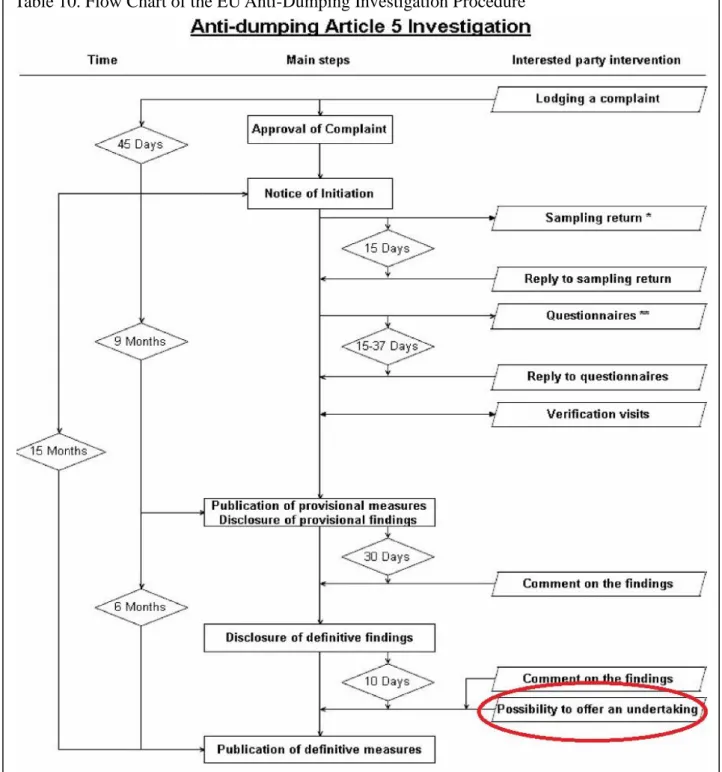
Table 10. Flow Chart of the EU Anti-Dumping Investigation Procedure ... 46
Figure 11. Target Countries/Regions of Imposing Definitive Anti-Dumping Duty, 2002-2014 ... 60
Figure 12. Target Countries/Regions of Using Undertaking Measures, 2002-2014 ... 60
Figure 13. Target Sectors of Imposing Definitive Anti-Dumping Duty, 2002-2014 ... 64
Figure 14. Target Sectors of Using Undertaking Measures, 2002-2014 ... 64
Figure 15. How to Establish A Non Injurious Price for the EU Domestic Industry ... 68
Figure 16. The Lesser Duty Rule ... 68
Table 17. The Proposed Rates of the Provisional Anti-Dumping Duties on Chinese Solar Panels .... 69
Figure 18. Target Countries of Imposing Definitive Anti-Dumping Duty, 1995- 2014 ... 84
Table 19. Flow Chart of Disposition Procedures for Anti-Dumping and Countervailing Cases ... 88
Figure 20. the Trend Changes of Import Volume and Price of Imposing Duties, 2007-2014 ... 93
Figure 21. the Trend Changes of Import Volume and Price of Price Undertakings, 2007-2014 ... 93
Table 22-1. the Comparative Analysis of Price Undertakings in the U.S., the EU and Taiwan ... 103
Chapter 1: Introduction
A product is to be considered as being dumped, i.e. introduced into the commerce of another country at less than its normal value, if the export price of the product exported from one country to another is less than the comparable price, in the ordinary course of trade, for the like product when destined for consumption in the exporting country.1 The Agreement on Implementation of Article VI of The General Agreement on Tariffs and Trade (GATT) 1994, commonly known as the Anti-Dumping Agreement, provides further elaboration on the basic principles set forth in Article VI itself. In addition to substantive rules governing the determination of dumping, injury, and causal link, the Agreement sets forth detailed procedural rules for the initiation and conduct of investigations, the imposition of measures, and the duration and review of measures.2 An anti-dumping measure shall be applied only under the circumstances provided for in Article VI of GATT 1994 and pursuant to investigations initiated and conducted in accordance with the provisions of Anti-Dumping Agreement.3
Under Article VI of GATT 1994, and the Anti-Dumping Agreement, World Trade Origination (WTO, created in 1995 at the end of the Uruguay Round, replacing GATT) Members can impose anti-dumping measures, if, after investigation in accordance with the Agreement, a determination is made (a) that dumping is occurring, (b) that the domestic industry producing the like product in the importing country is suffering from the material injury, a threat of material injury, or that the establishment of a domestic industry is materially retarded, and (c) that there is a causal link between the dumping and the injury.4 The measures allowed by the Anti-Dumping Agreement are (1) provisional measures, (2) definitive anti-dumping duties, and (3) price undertakings.
1 Article 2.1 of Anti-Dumping Agreement
2 WTO Technical Information on anti-dumping: https://www.wto.org/english/tratop_e/adp_e/adp_info_e.htm 3
Article 1 of Anti-Dumping Agreement
Since the imposition of anti-dumping duty is not mandatory, the investigating authorities of importing countries have the discretion to decide whether or not to impose anti-dumping duty in cases where all requirements for the imposition have been met.5 They may take price undertaking measures instead of imposing anti-dumping duty. The former is that individual exporters agree to revise their export prices, or cease exports at dumped prices, so that the injurious effect of the dumping is eliminated.6
Actually, from the point of view of exporters, they prefer offering the price undertaking to paying the anti-dumping duty, because they will obtain the additional income resulting from the price increase. Whereas the revenue of anti-dumping duty imposed from the importers belongs to the importing countries. In addition, undertakings can be terminated on a short notice in the event of significant changes in the marketplace, whereas duties remain in force for at least five years unless the circumstance of dumping or the injury caused thereby has no longer existed through the Sunset Review. Nevertheless, price undertaking is not favorable for exporters in some aspects. As the implementation of the price undertakings, the prices of the subject products must be increased in accordance with the condition of undertaking. Compared to the prices of domestic products, the consequences of prices increase will make the subject products less competitive. In the case of imposing anti-dumping duties, exporters are left free to charge a lower price for their merchandises, while importers must pay the anti-dumping duties which are not absorbed by exporters.7
From the perspective of importing countries, they prefer to impose the anti-dumping duties rather than take the price undertaking measures, because the imposed tax revenue will accrue to them whereas the monitoring of price undertakings will bring them burdensome task.
5 Article 9.1 of Anti-Dumping Agreement 6
Article 8.1 of Anti-Dumping Agreement
The domestic industry is normally opposed to using price undertaking measures because of possible circumvention practices. Nevertheless, it might agree that the investigating authorities to accept price undertaking in some certain situation. For instance, the production volume of domestic industry is insufficient to supply to the domestic consumers. In such case, a price undertaking containing restricted quantities would be allowed.
With regard to the provisional and definitive anti-dumping duties, they may be imposed at a level equal to, but not higher than the dumping margin.8 According to the Article 9.1 of the Anti-Dumping Agreement, commonly known as “lesser duty rule”, it is desirable that … the duty be less than the margin of dumping if such lesser duty would be adequate to remove the injury to the domestic industry. In other words, if the injury margin is lower than the dumping margin, the level of the anti-dumping duty will be based on the injury margin. Lesser duty rule is not mandatory and the Anti-dumping Agreement does not mention how these “lesser duties” should be calculated. Thus, there are only a few countries to take this rule. The European Union (EU) has the practice of calculating the dumping margin and injury margin. The lower one is then used as the punitive duty. Most of the WTO members, like the U.S., Canada or Taiwan, do not calculate the injury margin. They use the dumping margin to determine the dumping duty.9
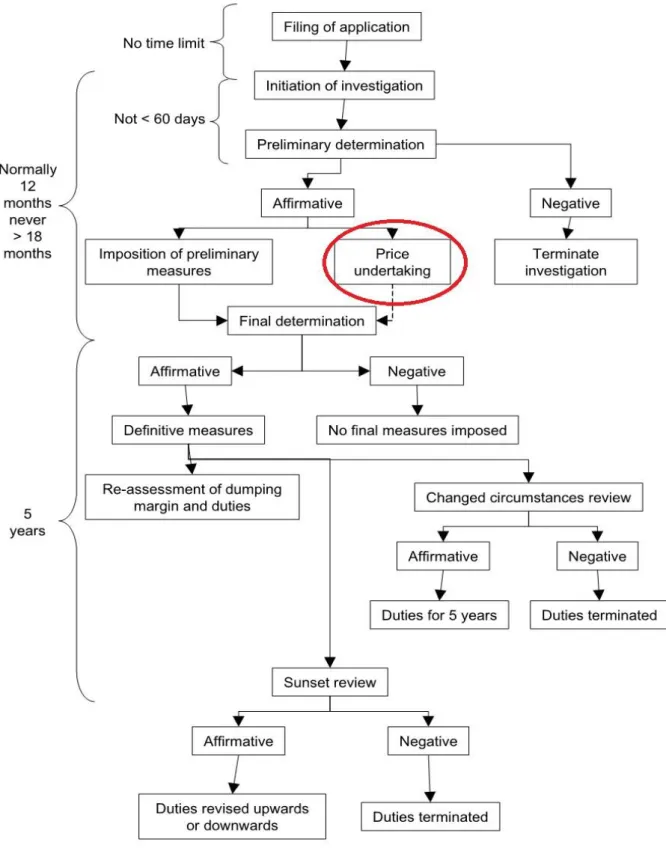
Price undertakings are also subject to the aforementioned provisions. Thus, price increases under such undertakings shall not be higher than necessary to eliminate the dumping margin. In addition, it is desirable that the price increases be less than the margin of dumping if such increases would be adequate to remove the injury to the domestic industry.10 Table 1 offers an overview of a typical anti-dumping investigation, and of the review as well as assessment procedures.
8
Article 9.3 of Anti-Dumping Agreement
9 Bibek Debroy, Debashis Chakraborty (2007). Page 76 10 Article 8.1 of Anti-Dumping Agreement
Table 1. Overview of an Anti-Dumping Investigation
1.1 Research Background
In addition to the imposition of duties, the WTO agreements permit the investigating authorities to suspend an anti-dumping investigation by accepting an undertaking (referred to in US Tariff Act of 1930 as a “Suspension Agreement”). Briefly, in the undertakings (a Suspension Agreement), the exporters and producers or the foreign government agree to revise their prices so as to eliminate dumping or the injury caused thereby. If the investigating authorities accept undertakings (a Suspension Agreement), they will “suspend” the investigation and thereafter will monitor in compliance with the undertakings (agreements).
(1) Overview of the U.S. Anti-Dumping Investigation
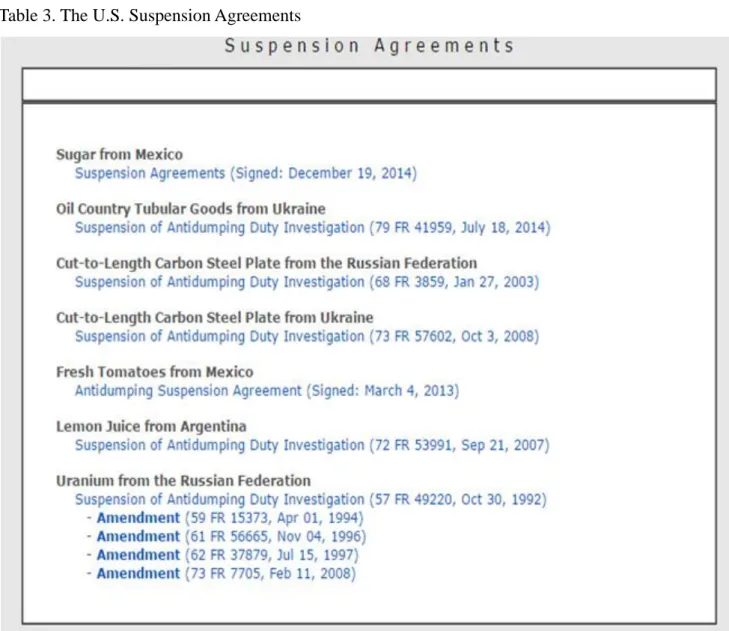
From 1995 to 2014, there were 345 cases imposed definitive anti-dumping duties by the U.S. investigating authorities (See Table 2). In addition, there were 7 Suspension Agreements in force from 4 countries covering 6 products (See Table 3). “Suspension Agreement” is the American term for undertaking. Zanardi (2004) shows that between 1981 and 2001 about 4.92 percent of the U.S. anti-dumping cases were ended in price undertaking measures. From 2002 to 2014, the percentage of using price undertaking measures is 3.83 and the overall percentage of Year 1981 to 2014 is 4.63 (See Table 5). The frequency of taking price undertaking measures has remained around 4%.
Actually, the U.S. used voluntary export restraint (VER), a trade instrument for quantitative restriction, extensively in the 1980s and early 1990s to settle anti-dumping cases. Prusa (1992) notes that over one-third of U.S. anti-dumping cases between 1980 and 1985 were withdrawn by the petitioners, most of which were settled by using VER. Only a few cases were solved by the suspension agreements. The regulations of suspension agreements in the U.S. were laid down at 19 C.F.R. 351.208 describing the whole procedures of suspending anti-dumping investigation.
Table 2. Anti-dumping Measures : By Reporting Member 01/01/1995 - 31/12/2014 Reporting Member 1995 1996 1997 1998 1999 2000 2001 2002 2003 2004 2005 2006 2007 2008 2009 2010 2011 2012 2013 2014 Total United States 33 12 20 16 24 31 33 27 12 14 18 5 5 23 15 17 4 7 7 22 345 European Union 15 23 23 28 18 41 13 25 2 10 20 12 12 15 9 5 11 3 12 1 298 Taiwan 1 5 1 1 2 1 1 2 1 2 17
Source: WTO Statistics on anti-dumping
Table 3. The U.S. Suspension Agreements
(2) Overview of the EU Anti-Dumping Investigation
Price undertaking plays an important role in the EU anti-dumping proceedings. In a certain period of time, price undertakings were frequently used to replace the imposition of anti-dumping duties. However, its role as an instrument to resolve anti-dumping cases in the EU practice has changed over time. The frequency of using price undertakings has decreased since 2005.
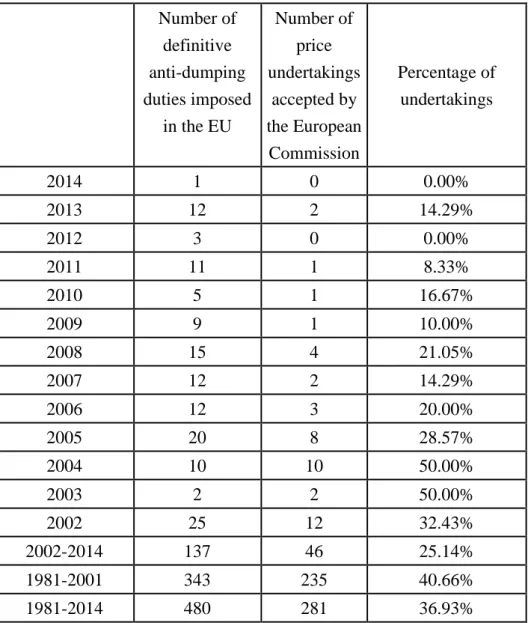
Zanardi (2004) indicates that between 1981 and 2001 approximately 40 percent of the EU anti-dumping cases were settled by taking price undertaking measures.11 Table 4 illustrates the percentage of using price undertaking measures in the EU from 1981 to 2014. The percentage has fallen from an average of 40.66% between 1981 and 2001 to 25.14% during the period from 2002 to 2014. Year 2003 and 2004, price undertakings were still performed relatively frequent comparing with the overall percentage of Year 1981 to 2014 (average of 36.93%). Since 2005, price undertakings have been used less frequently and have declined sharply in recent years. In 2012 and 2014, there is no any anti-dumping case ended in price undertakings measures. Apparently, the recent decline would likely to be a more strict restriction regarding price undertakings by the European Commission.12 Nevertheless, the EU is still the WTO member of using price undertaking most frequently. Thus, the EU has much more experience than any other WTO members.
Due to the absence of clear-cut rules for the possible acceptance or rejection of price undertakings, the EU administration has considerable discretion in this regard. The discretion held by the European Commission and the Council of Ministers makes it reasonable that a number of political economy considerations could play a role in the decisions.13
11 Zanardi (2004), Page 425, Table 5 12
Armin Steinbach (2014). Page 168,169
Table 5. Use Price Undertakings to Settle Anti-dumping Cases in the EU, the US and Taiwan Number of definitive anti-dumping duties imposed by the US Number of price undertakings accepted by the US DOC Percentage of undertakings in the US Number of definitive anti-dumping duties imposed by the EU Number of price undertakings accepted by the European Commission Percentage of undertakings in the EU Number of definitive anti-dumping duties imposed by Taiwan Number of price undertakings accepted by Taiwan Percentage of undertakings in Taiwan 2002-2014 176 7 3.83% 137 46 25.14% 9 3 25.00% 1981-2001 483 25 4.92% 343 235 40.66% 14 5 26.32% 1981-2014 659 32 4.63% 480 281 36.93% 23 8 25.81%
Source: Figures of 2002-2014 are from the respective Statistics data of the US, the EU and Taiwan; Figures for 1981-2001 are based on Table 5 of Zanardi (2004);
Table 4. Use Price Undertakings to Settle Anti-dumping Cases in the EU
Number of definitive anti-dumping duties imposed in the EU Number of price undertakings accepted by the European Commission Percentage of undertakings 2014 1 0 0.00% 2013 12 2 14.29% 2012 3 0 0.00% 2011 11 1 8.33% 2010 5 1 16.67% 2009 9 1 10.00% 2008 15 4 21.05% 2007 12 2 14.29% 2006 12 3 20.00% 2005 20 8 28.57% 2004 10 10 50.00% 2003 2 2 50.00% 2002 25 12 32.43% 2002-2014 137 46 25.14% 1981-2001 343 235 40.66% 1981-2014 480 281 36.93%
Source: Figures for 2002-2014 are based on EU Statistic Covering Full Year 2002-2014 and WTO Statistics on anti-dumping
Figures for 1981-2001 are based on Table 5 of Zanardi (2004); Armin Steinbach (2014). Page 169
(3) Overview of Taiwan’s Anti-Dumping Investigation
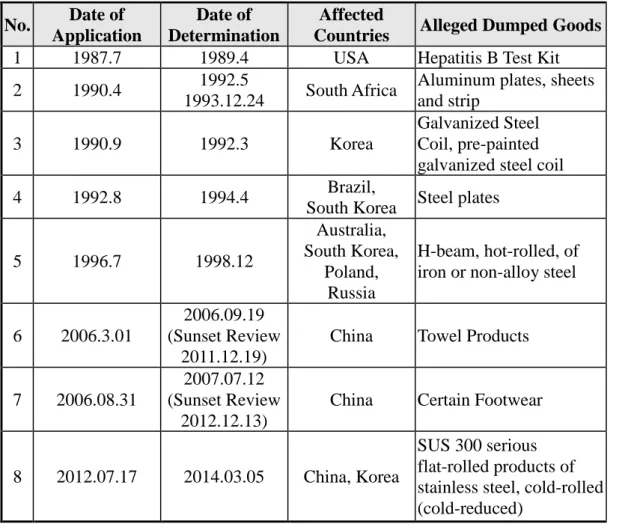
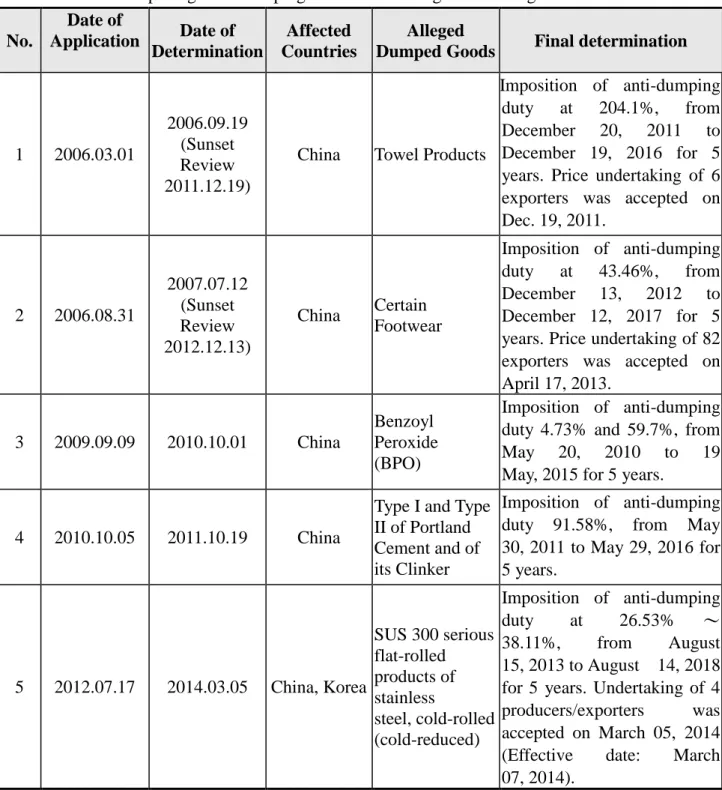
From 1981 to 2014, 23 cases were imposed definitive anti-dumping duties by Taiwan’s investigating authorities. Among which, 8 cases were taken price undertaking measures simultaneously (See Table 6). Table 5 shows that around 26.32 percent of Taiwan’s anti-dumping cases were settled by price undertaking measures between 1981 and 2001 (Zanardi 2004). From 2002 to 2014, the percentage of using price undertaking measure is 25.00 and the overall percentage of Year 1981 to 2014 is 25.81. Currently, Taiwan’s investigating authorities have been imposing the definitive anti-dumping duties on imports of towel, certain footwear, cement, cold–rolled stainless steel and one chemical product, originating in China or Korea. Among which, the subject products of towel, certain footwear and cold-rolled stainless steel have also been taken the price undertaking measures (See Table 7).
Table 6. Anti-Dumping Cases of Using Price Undertaking Measures, from 1989 to 2014
No. Date of
Application
Date of Determination
Affected
Countries Alleged Dumped Goods
1 1987.7 1989.4 USA Hepatitis B Test Kit
2 1990.4 1992.5
1993.12.24 South Africa
Aluminum plates, sheets and strip
3 1990.9 1992.3 Korea
Galvanized Steel Coil, pre-painted galvanized steel coil
4 1992.8 1994.4 Brazil,
South Korea Steel plates
5 1996.7 1998.12 Australia, South Korea, Poland, Russia H-beam, hot-rolled, of iron or non-alloy steel
6 2006.3.01
2006.09.19 (Sunset Review
2011.12.19)
China Towel Products
7 2006.08.31
2007.07.12 (Sunset Review
2012.12.13)
China Certain Footwear
8 2012.07.17 2014.03.05 China, Korea
SUS 300 serious flat-rolled products of stainless steel, cold-rolled (cold-reduced)
From Table 5, we could find the fact that no matter the U.S., the EU or Taiwan, the frequency of using price undertaking measures has declined in recent years. The U.S. declined from 4.92% to 3.83%, the EU decreased from 40.66% to 25.14%, and Taiwan fell from 26.32% to 25.00%. Since the EU is the frequent user of price undertakings, this paper will explore the reasons for the decrease of price undertakings in the EU.
Table 7. Cases of Imposing Anti-Dumping Duties and Taking Undertaking Measures
No. Date of Application Date of Determination Affected Countries Alleged
Dumped Goods Final determination
1 2006.03.01
2006.09.19 (Sunset Review 2011.12.19)
China Towel Products
Imposition of anti-dumping duty at 204.1%, from December 20, 2011 to December 19, 2016 for 5 years. Price undertaking of 6 exporters was accepted on Dec. 19, 2011. 2 2006.08.31 2007.07.12 (Sunset Review 2012.12.13) China Certain Footwear Imposition of anti-dumping duty at 43.46%, from December 13, 2012 to December 12, 2017 for 5 years. Price undertaking of 82 exporters was accepted on April 17, 2013. 3 2009.09.09 2010.10.01 China Benzoyl Peroxide (BPO) Imposition of anti-dumping duty 4.73% and 59.7%, from
May 20, 2010 to 19
May, 2015 for 5 years.
4 2010.10.05 2011.10.19 China
Type I and Type II of Portland Cement and of its Clinker
Imposition of anti-dumping duty 91.58%, from May 30, 2011 to May 29, 2016 for 5 years. 5 2012.07.17 2014.03.05 China, Korea SUS 300 serious flat-rolled products of stainless steel, cold-rolled (cold-reduced) Imposition of anti-dumping duty at 26.53% ~ 38.11%, from August 15, 2013 to August 14, 2018 for 5 years. Undertaking of 4 producers/exporters was accepted on March 05, 2014 (Effective date: March 07, 2014).
(4) Legal Basis of Price Undertakings for each jurisdiction
The U.S. anti-dumping law is addressed in Title 7 of the Tariff Act of 1930 (hereinafter “the Tariff Act”), as amended by the Trade Agreements Act of 1979, the Trade and Tariff Act of
1984, the Omnibus Trade and Competitiveness Act of 1988, and the Uruguay Round Agreements Act of 1995.14 The types of Suspension Agreements can be found in Section 734 of the Tariff Act. Definitions, procedures, and special rules can be found in the regulation of Department of Commerce (hereinafter “DOC”) under 19 CFR 351.208.
The European Commission’s approach towards offers of price undertakings is determined by the legal framework governing price undertakings. The rules are laid down in two distinct legal sources: The EU Basic Regulation15 and the WTO Anti-Dumping Agreement. The analytical basis for the Commission’s evaluation of a price undertaking is provided in Article 8 of the
Basic Regulation, including procedures, continuation of investigation, submission of non-confidential version, breach or withdrawal, etc. The Basic Regulation is required to be in conformity with the WTO Anti-Dumping Agreement.
Taiwan’s anti-dumping rules are prescribed in “The Regulations Governing the Implementation
of the Imposition of Countervailing and Anti-Dumping Duties” (hereinafter “Implementation Regulations”).16 The Implementation Regulations were promulgated in 1984 and prescribed in accordance with paragraph 4 of Article 69 of the Customs Act. The provisions of undertakings were regulated in Article 23 to Article 25 and Article 44 of the Implementation Regulations, prescribing the acceptance of undertakings, periodically providing information
14
Tariff Act of 1930, Sections 731-781, codified as amended at 19 U.S.C. 1673-1677 (1993).
15
Council Regulation (EC) No 1225/2009 of 30 November 2009 on protection against dumped imports from countries not members of the European Community.
16
regarding undertakings (Article 23), suspending investigation and the provisional measures (Article 24), the continuous investigation when violating undertaking measures, the continuous investigation ex officio or at the request of the government of the exporting country or the foreign exporters (Article 25), and the procedures of Sunset Review regarding undertakings (Article 44).
1.2 Research Motivation
Currently, the price undertakings measures implemented by Taiwan's investigating authority including the subject merchandise of towel, certain footwear and cold-rolled stainless steels originating in China or Korea. With regard to the anti-dumping case on certain footwear, 82 Chinese producers or exporters offer the price undertakings and these requests are accepted by Taiwan’s investigating authorities. Conversely, in the anti-dumping case against Chinese certain footwear, the EU rejects the price undertakings offered by Chinese producers or exporters. The main reasons stated by the EU authorities for the rejection are as follows:
(1) A product like shoes which is continuously changing due to fashion, it would be practically impossible to set a non-discriminatory price level that equally eliminates injurious dumping for a huge variety of entirely different models.
(2) A combined duty would have led to an unjustified burden on cheap shoes against the favor of more expensive shoes. It would practically be impossible to identify adequate price categories for a product as diverse as the one under investigation to avoid such unjustified burden.17
The European Commission rejected the offer of price undertakings and imposed anti-dumping duty on imports of certain footwear originating in China, but Taiwan implemented price undertaking
measure on the similar product concerned. Even though the product concerned is alike, the different settlements are applied. Accordingly, this paper will examine Taiwan’s price undertaking measures through the anti-dumping case on certain footwear product originating in China.
Studies on the economic effects of price undertakings include the contributions by Vandenbuscche and Wauthy (2001), Wilfried Pauwels and Linda Springael (2002), Belderbos, Vandenbussche, and Veugelers (2004), Michael O. Moore (2005), Ishikawa and Miyagiwa (2007). Vandenbuscche and Wauthy (2001) show that price undertakings lead to low product quality in the domestic industries of the importing country. Wilfried Pauwels and Linda Springael (2002) note that from a welfare perspective, anti-dumping duties are always better than price-undertaking measures. Belderbos, Vandenbussche, and Veugelers (2004) indicate that the investigating authorities of importing countries select price undertakings rather than anti-dumping duties for the sake of lowering the incentives of international firms in Foreign Direct Investment (FDI). Michael O. Moore (2005) suggests that the implementation of price undertakings can result in higher domestic prices and profits than that of VERs. Ishikawa and Miyagiwa (2007) further express the differences between price undertakings and VERs in affecting the incentives of FDI by foreign firms. Those studies are conducive to understand the welfare effects of price undertaking on different economic issues. It can be as the considerations in economic welfare regard when Taiwan’s investigating authorities decide whether or not to take the price undertaking measures.
The lesser duty rule is a “WTO-plus” requirement that goes beyond the WTO rules, and is something the EU, traditionally, has taken great pride in. The lesser duty rule has often been highlighted by the EU, in WTO negotiations as well as in various free trade agreements, as a positive element that is reducing trade distortions.18 Since the lesser duty rule is applied to price undertaking, this paper will study the rule and its impact on price undertaking measures through the practices of the EU.
The U.S. and the EU have respectively 32 and 281 anti-dumping cases whereas Taiwan has 8 cases settled by price undertakings measures. Comparing with the U.S. and the EU, Taiwan has less experience in dealing with price undertakings cases. Furthermore, the current provisions regarding undertakings in the Implementation Regulations are the general rules, there are still lacking of the concrete rules of the procedural and substantive respects.
In accordance with the GATT Anti-Dumping Agreement, the anti-dumping laws of the U.S. and the EU include provisions permitting foreign producers or exporters to offer undertakings in anti-dumping proceedings. However, the application of such provisions in the U.S. and the EU are significantly different. Most of anti-dumping cases are settled by using price undertaking measures in the EU, whereas the undertakings are rarely used by the U.S. investigating authorities. This paper focuses on the law and practice of the U.S. and the EU concerning price undertakings. No matter the procedural and substantive aspects, or the implementation of practices will be examined in detail, so as to provide a comprehensive review of the undertaking measures within the U.S. and the EU anti-dumping systems.19 The relevant analysis will be used as the reference for Taiwan’s investigating authorities to amend its Implementation Regulations and impose price undertaking measures.
The thesis is divided into six chapters. The first chapter is the introduction, including research background and motivation. The second chapter will provide background information on the GATT rules concerning price undertakings and the introduction of studies on the economic effects of price undertakings. The third, fourth and fifth chapters will elaborate respectively the undertaking provisions, practices of the U.S., the EU and Taiwan anti-dumping laws or regulations. The fifth chapter also offers a comparative analysis of the three jurisdictions as well. Finally, the paper will propose the conclusion and suggestion for the reference for Taiwan’s investigating authorities.
Chapter 2: Price Undertakings in the GATT System
Before the completion of the Uruguay Round, member countries mainly used two trade policy instruments to restrict imports. The US used VERs, a quantity restriction, to solve the antidumping cases. The EU often took price undertaking measures, a minimum import price restriction, in the anti-dumping proceedings. At the conclusion of the Uruguay Round, VER was prohibited while price undertaking remained in the WTO anti-dumping system.20
Since the EU and the U.S. are members of the GATT (created in 1947), their respective anti-dumping legislations are based on the GATT structure. Thus, this chapter will illustrate the GATT provisions regarding price undertakings. The undertaking provision was introduced in the GATT system in 1968 after the completion of the Kennedy Round negotiations (1962-1967). One of the achievements of the Kennedy Round was the conclusion of GATT Anti-Dumping Code. The Anti-Dumping Code of 1968 was revised after the Tokyo Round negotiations (1975-1979). The 1979 Code further illustrates the substantive and procedural provisions with regard to price undertakings. Subsequently, the Code has been amended in 1994 after the completion of the Uruguay Round negotiations, commonly known as the Anti-Dumping Agreement.21
The Anti-Dumping Agreement may be incorporated into domestic law by means of enabling legislation. It was incorporated into domestic law by taking a set of provisions in the form of regulations which set out more detailed provisions with respect to both the procedural and substantive aspects of anti-dumping investigations. Thus, before initiating any anti-dumping investigation, the domestic legal basis for such measures has to exist.22
20 Michael O. Moore (2005). Page 28 21
Francesco Perone (1995), Page 4,6,8
2.1 Article 8 of GATT Anti-Dumping Agreement
With regard to procedural and substantive aspect of undertakings, Article 8 of Anti-Dumping Agreement provided as follows:
(1) Anti-dumping proceedings may be terminated or suspended:
Proceedings may23 be suspended or terminated without the imposition of provisional measures or definitive anti-dumping duties upon receipt of satisfactory voluntary undertakings from any exporter to revise its prices or to cease exports to the area in question at dumped prices so that the authorities are satisfied that the injurious effect of the dumping is eliminated.
According to Article 9.3 of Anti-Dumping Agreement, price increases under such undertakings shall not be higher than necessary to eliminate the margin of dumping. Besides, based on the lesser duty rule, it is desirable that the price increases be less than the margin of dumping if such increases would be adequate to remove the injury to the domestic industry. 24
(2) The application time frame of price undertaking:
Pursuant to Article 8.2 of Anti-Dumping Agreement, price undertakings shall not be sought or accepted from exporters unless the authorities of the importing Member have made a preliminary affirmative determination of dumping and injury caused by such dumping.
(3) The discretion of investigating authority:
Undertakings offered need not be accepted if the authorities consider their acceptance impractical, for example, if the number of actual or potential exporters is too great, or for other reasons, including reasons of general policy. The authorities shall provide to the exporter the
23 The word “may” shall not be interpreted to allow the simultaneous continuation of proceedings with the
implementation of price undertakings except as provided in paragraph 4.
reasons which have led them to consider acceptance of an undertaking as inappropriate, to the extent possible, and shall give the exporter an opportunity to make comments thereon.25
(4) Whether or not to continue to investigate:
If an undertaking is accepted, the investigation of dumping and injury shall nevertheless be completed if the exporter so desires or the authorities so decide. In such a case, if a negative determination of dumping or injury is made, the undertaking shall automatically lapse, except in cases where such a determination is due in large part to the existence of a price undertaking. In such cases, the authorities may require that an undertaking be maintained for a reasonable period consistent with the provisions of Anti-Dumping Agreement. In the event that an affirmative determination of dumping and injury is made, the undertaking shall continue consistent with its terms and the provisions of Anti-Dumping Agreement.26
(5) Price undertaking is voluntary not mandatory:
Price undertakings may be suggested by the authorities of the importing Member, but no exporter shall be forced to enter into such undertakings. The fact that exporters do not offer such undertakings, or do not accept an invitation to do so, shall in no way prejudice the consideration of the case. 27
(6) Provide periodically information regarding the fulfillment of undertaking and to permit verification of relevant data:
Authorities of an importing Member may require any exporter from whom an undertaking has been accepted to provide periodically information relevant to the fulfillment of such an undertaking and to permit verification of pertinent data. In case of violation of an
25 Article 8.3 of Anti-Dumping Agreement 26
Article 8.4 of Anti-Dumping Agreement
undertaking, the authorities of the importing Member may take, under this Agreement in conformity with its provisions, expeditious actions which may constitute immediate application of provisional measures using the best information available. In such cases, definitive duties may be levied in accordance with Anti-Dumping Agreement on products entered for consumption not more than 90 days before the application of such provisional measures, except that any such retroactive assessment shall not apply to imports entered before the violation of the undertaking.28
Anti-Dumping Agreement only establishes very general procedural rules, so WTO Members often have different interpretations in related to detail implementation. The U.S. and the EU undertaking provisions generally consistent with its framework, but some provisions and implementing policies still have considerable differences. Chapter 3 and Chapter 4 will respectively elaborate the law and practice of the U.S. and the EU concerning price undertakings.
2.2 Related Literatures of Price Undertakings
Anti-dumping agreement allows the use of price undertaking instead of imposing duties. However, economists regard price undertakings as a means of government-sanctioned collusive pricing. Such collusive pricing is a practice which several companies allow to raise prices at the same time and keep them high. It hurts consumers.29
Studies on the economic effects of price undertakings include the contributions by Veugelers and Vandenbussche (1999), Vandenbuscche and Wauthy (2001), Wilfried Pauwels and Linda Springael (2002), Belderbos, Vandenbussche, and Veugelers (2004), Michael O. Moore (2005), Ishikawa and Miyagiwa (2007). The following part will briefly elaborate the key points of those studies.
28
Article 8.6 of Anti-Dumping Agreement
2.2.1 Economic Effects of Anti-Dumping Duties and Price Undertakings
Veugelers and Vandenbussche (1999) analyze the welfare effect of anti-dumping measures on the market structure which originally is a European cartel and no foreign entry, and then analyze how anti-dumping laws offer incentives for domestic and foreign companies to engage in a full cartel after foreign entry. They indicate that the use of anti-dumping measures can both have a pro-competitive or an anti-competitive effect, depending on the government objective function, cost asymmetries and product heterogeneity.
The welfare analysis reveals that the imposition of duties in the equilibrium market structure increases domestic welfare. The rent shifting from foreign producers more than compensates domestic consumer losses. If anti-dumping cases were settled by using price undertaking measure, the welfare effects tend to be negative. The loss in consumer welfare is larger than the benefits to domestic producers, while such losses are caused by an anti-competitive effect of anti-dumping. They suggest an increasing importance of consumer interests in the government welfare function leads to an increasing number of anti-dumping duties. When consumer surplus has increasing importance in the government’s welfare function the number of undertakings decreases, in
the presence of national and international cartels.30
Wilfried Pauwels and Linda Springael (2002) indicate that, from a welfare point of view, an anti-dumping duty is always better than a price-undertaking. This result holds under both Bertrand and Cournot competition, and irrespective of the timing of the firms’ decisions. EU’s high prevalence of price-undertakings is obviously in contrast with what theory predicts. Due to the unfavorable effect on EU welfare, a rational policy maker shall prefer duties rather than price undertakings. Then why so many cases were settled by price-undertakings in EU anti-dumping proceedings?
One possible hypothesis could be that companies are more effective in lobbying at the European Commission than the consumers organizations. The European Commission might feel that using price undertakings instead of anti-dumping duties, the resulting increase in domestic profits is more important than the resulting decrease in consumer surplus.It is doubtful whether the assumption that the European government acting in the interest for the Community is a realistic one, because such interest is generally regarded as corresponding to the economist's notion of domestic welfare.
Another hypothesis is offered by Tharakan (1991). From the perspective of politics, the European Commission may considers that a price-undertaking is a softer measure than a duty, and thus it will less likely lead to foreign retaliations.Tariff-jumping foreign direct investment (FDI) is a form of retaliation, i.e. the foreign firms set up production facilities in the EU to avoid the anti-dumping duties.31
2.2.2 Voluntary Export Restraints (VERs) and Price Undertakings
Michael O. Moore (2005) notes that governments are allowed to negotiate price undertakings in accordance with Anti-Dumping Agreement, but prohibited from negotiating VERs according to Article 11 of the Agreements on Safeguards. The former are agreements between exporters and the government of the importing country, while the latter are government to government agreements. VERs is a trade protection instrument of quantitative restrictions, while price undertakings are an instrument of minimum price regime (some involved simple quantitative restrictions).
The author indicated that the asymmetric treatment of these two measures overseen by the WTO seems nonsensical in a model of perfect competition wherein price undertakings and VER could have similar effects. They can result in identically higher prices, lower imports, increased domestic profits and production compared to free trade. A VER can be more damaging than a price
undertaking in the model of a domestic monopoly with homogeneous goods. A VER can result in higher prices paid by consumers, higher domestic profits, and higher rents transferred abroad to foreign firms than a price undertaking. This result would explain why the WTO forbids VERs but permits price undertakings. Under the model of Bertrand duopoly competition, however, a price undertaking can result in higher domestic prices and profits but lower consumer welfare than a VER. Both would allow foreign firms to obtain identical quota rents in the domestic market. He suggests that price undertakings should also be prohibited under the WTO.32
2.2.3 The Effects of Price Undertakings on Foreign Direct Investment (FDI)
Belderbos, Vandenbussche, and Veugelers (2002) analyze the incentives for foreign firms to engage in FDI under anti-dumping duties and price undertakings. They show that an importing country's government selects price undertakings rather than anti-dumping duties for the sake of reducing the incentives of international firms in FDI. They further indicate that the determination to accept an undertaking will depend on the objective function of the EU administration that may range from protecting only domestic industry interests to including the interest of consumers and other users.
When consider the possibility of FDI, if the EU administration focuses on the producers’ surplus only, it would more likely to use price undertakings instead of imposing duties. Price undertakings are price fixing agreements with effects similar to VERs, it makes exporting more attractive for the foreign producers. Due to the cost advantage of foreign producers, FDI will increase price competition in the EU market. As a result, the EU administration will select undertakings measures to persuade the foreign firm not to engage in FDI. In addition, they note that it is less likely to take price undertaking measures if the EU values the positive effect of inward foreign investment on employment and wages.33
32
Michael O. Moore (2005). Page 1-3,28
Ishikawa and Miyagiwa (2007) compare foreign firms’ incentive to engage in FDI under a VER and a price undertaking, with special emphasis on foreign rivalry as a determinant of FDI. They indicate that a price undertaking offers a greater incentive to engage in FDI than a VER. Since a VER is less likely to induce FDI than anti-dumping duties and a price undertaking, the importing country can negotiate a more protectionist outcome without triggering FDI by using a VER agreement. Thus, this analysis implies that the GATT ban on VERs was a sensible decision to stop the spread of protectionism.34
2.2.4 Price Undertakings vs. Product Quality
Vandenbussche and Wauthy (2001) analyze the effects of price undertakings on price competition and quality choices when vertically differentiated products might be considered “similar” in an antidumping investigation. They use a two-stage model where quality choice is determined before price competition takes place. When the foreign companies are low-quality producers under free trade, price undertaking measures will turn them into quality leaders in the market. They will be constrained in the price competition stage. Whatever the prices set by the domestic companies, the foreign companies have to comply with the price undertakings to meet the European prices. Since they sell lower quality products at the same price as the domestic companies, all consumers will prefer the high quality products.
As a result of the price undertakings, the foreign companies cannot survive with lower quality. The only way out is to be more aggressive at the quality stage. Assuming that quality is costless, the domestic companies would always choose the high quality under free trade, but choose low quality by taking price undertaking measures. Thus, price undertakings lead to lower product quality in domestic protected industries. Long-run foreign quality is upgraded, and domestic quality is downgraded compared to free trade.35
34
Ishikawa and Miyagiwa (2007). Page 14
Chapter 3: Suspension Agreements under the U.S. Anti-Dumping Law
3.1 The U.S. Anti-Dumping Proceedings
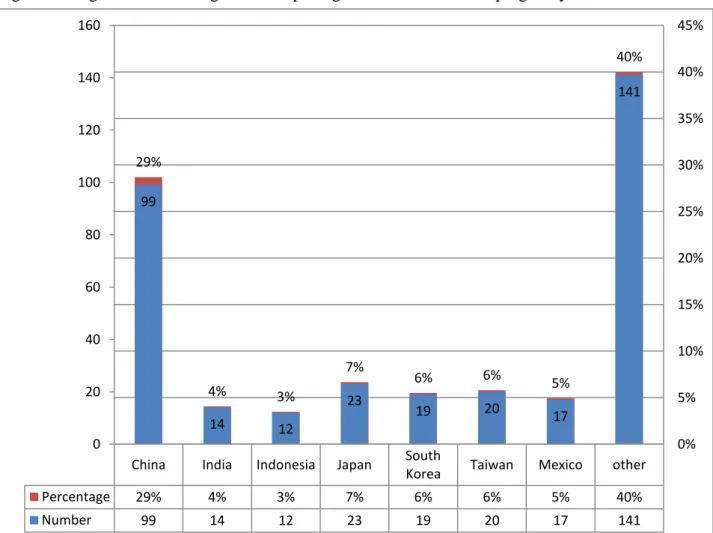
From 1995 to 2014, there were 345 cases imposed definitive anti-dumping duties by the U.S. investigating authorities (See Table 2). From Figure 8, we could find that the target countries are mainly from Asia and account for 55% of All Anti-Dumping Orders. China is the first target and accounts for 29% (99 cases) of all Anti-Dumping Orders between 1995 and 2014, whereas Japan, South Korea and Taiwan account for 7% (23 cases), 6% (19 cases) and 6% (20 cases) respectively. There are 7 Suspension Agreements in force from 4 countries covering 6 products (See Table 3), but none is from Asian Countries.
Figure 8. Target Countries/Regions of Imposing Definitive Anti-Dumping Duty, 1995- 2014
Source: WTO Statistics on anti-dumping measures
China India Indonesia Japan South
Korea Taiwan Mexico other
Percentage 29% 4% 3% 7% 6% 6% 5% 40% Number 99 14 12 23 19 20 17 141 29% 4% 3% 7% 6% 6% 5% 40% 99 14 12 23 19 20 17 141 0 20 40 60 80 100 120 140 160 0% 5% 10% 15% 20% 25% 30% 35% 40% 45%
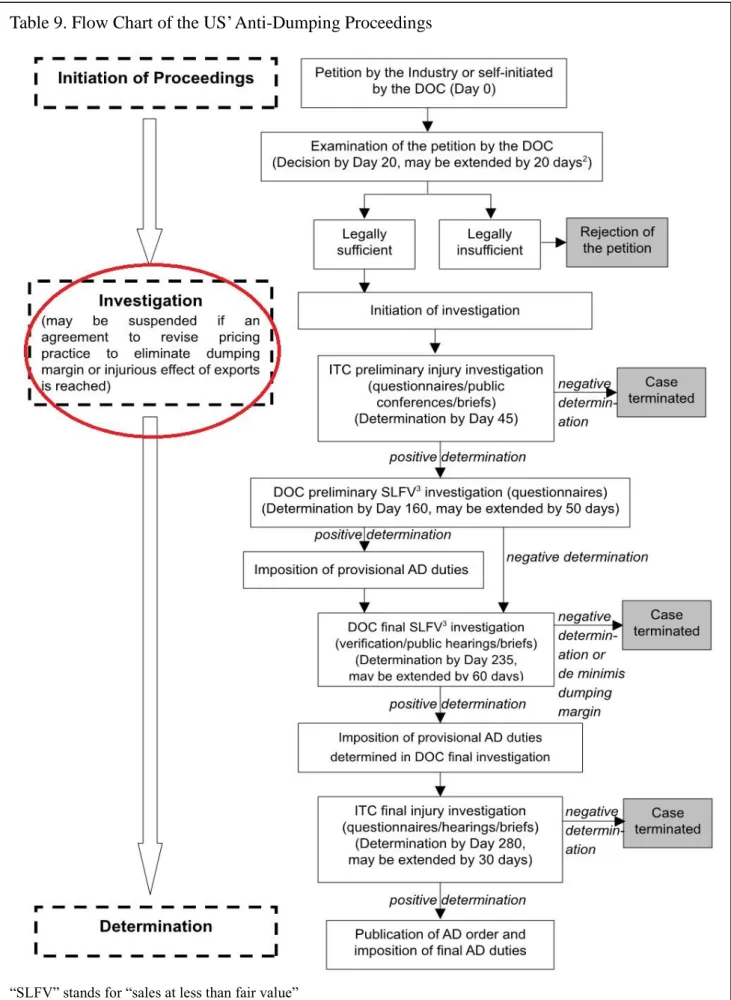
As mentioned in the Chapter 1.1, the U.S. anti-dumping law is addressed in Sections 731-781 of the Tariff Act and codified as amended at 19 U.S.C.1673-1677 (1993), as amended by the Trade Agreements Act of 1979, the Trade and Tariff Act of 1984, the Omnibus Trade and Competitiveness Act of 1988, and the Uruguay Round Agreements Act of 1995.36 Anti-dumping proceedings in the U.S. involve separate, but simultaneous, investigations by the Department of Commerce (DOC) and the International Trade Commission (ITC).37 The DOC is responsible for dumping investigation and the ITC is in charge of injury investigation.
An antidumping proceeding begins with simultaneous filing of a petition with the DOC and the ITC by a U.S. domestic industry producing a like product. The DOC will examine the prima facie evidence of dumping and injury in a petition within 20 days (to up to 40 days) to decide whether or not to initiate an investigation. A petition must be filed on behalf of an industry, if (1) the domestic producers or workers who support the petition account for at least 25 percent of the total production of the domestic like product, and (2) the domestic producers or workers who support the petition account for more than 50 percent of the production of the domestic like product produced by that portion of the industry expressing support for or opposition to the petition.38
Upon initiation of the investigation by DOC, the ITC must investigate whether there is a reasonable indication that the U.S. domestic industry has been materially injured or is threatened with material injury by the allegedly dumped imports. If the preliminary injury determination of ITC is affirmative, the DOC begins its dumping investigation; otherwise the investigation will be terminated. In the case of the affirmative injury preliminary determination, the DOC will send the questionnaires to foreign producers or exporters then calculate the dumping margins according to the information provided in questionnaires and publish the result of calculation in a preliminary
36 Francesco Perone (1995), Page 64 37
An overview of antidumping proceeding. Retrieved from : http://www.adduci.com/node/111
determination. No matter the preliminary determination of dumping is affirmative or negative, the investigation will continue. If both preliminary determination of dumping and injury are affirmative, the provisional measures will be implemented.
Before making a final determination of dumping, the investigative staff of the DOC will conduct onsite verifications at the facilities of foreign manufacturers in order to verify the accuracy of the information provided to DOC. If final determination of dumping is negative or the dumping margin is de minimis, the investigation is terminated. Otherwise the ITC must, within a prescribed statutory time, make a final determination of whether a domestic industry is being materially injured or threatened with material injury. If the final determination of ITC is affirmative, then an antidumping order will be issued and the definitive anti-dumping duty will be imposed.39 With regard to US Anti-Dumping proceedings and the time frame of each phase please see Table 9.
With regard to the review of anti-dumping proceedings, it can be categorized as follows: (1) Administrative Reviews:
One year after publication of an antidumping order, as well as during each subsequent year, any exporter of the product concerned which is subject to that order may request that the DOC conduct a review of the previous year's imports. During the review process, the DOC recalculates the dumping margin for the exporter, thus the Anti-Dumping duties assessed on the subject product may be raised or lowered depending on the price of sales transactions.40 The Department may also conduct administrative reviews to determine whether a suspension agreement has been violated or should be terminated. Administrative review procedures and practices for AD orders, AD findings, and suspension agreements are generally the same as those employed for investigations.
39 An overview of antidumping proceeding. Retrieved from : http://www.adduci.com/node/111 40
The relevant regulation please see § 351.213 Administrative review of orders and Suspension Agreements under Section 751(a) (1) of the Tariff Act.
Table 9. Flow Chart of the US’ Anti-Dumping Proceedings
“SLFV” stands for “sales at less than fair value”
(2) New Shipper Reviews:
Under U.S. antidumping law, anti-dumping orders apply on a national-wide basis and contain products from new shippers that were not involved in the original investigation. Exporters or producers may request a new shipper review if they have exported subject merchandise to the United States. They can obtain their own individual dumping margin on an expedited basis through the new shippers view.41
(3) Changed Circumstances Reviews:
In addition to an administrative review, interested parties may request a changed circumstances review of an Anti-Dumping Order or Suspension Agreement at any time while the DOC will determine whether there is sufficient cause to conduct the review. A changed circumstances review addresses questions about the applicability of the Anti-Dumping Order (for example, the change for scope of product concerned).42
(4) Five Year (“Sunset”) Reviews:
The Uruguay Round Agreements Act revised the Tariff Act of 1930, as amended, by requiring that Anti-Dumping Orders be revoked, and suspended investigations be terminated, after five years, unless revocation or termination would be likely to lead to a continuation or recurrence of (1) dumping, and (2) material injury to the domestic industry. Section 751(c) (1) of the Tariff Act requires the DOC and the ITC to conduct a review no later than five years after the issuance of an Anti-Dumping Order, the suspension of an investigation, or a prior five-year review.
The DOC is responsible for determining whether revocation of an Anti-Dumping Order, or termination of a suspended investigation, would be likely to lead to a continuation or recurrence
41 The relevant regulation please see § 351.214 New shipper reviews under Section 751(a) (2) (B) of the Tariff Act. 42 The relevant regulation please see 19 CFR 351.216 – changed circumstances review under Section 751(b) of the Act
of dumping; the ITC is in charge of determining whether revocation or termination would be likely lead to continued or recurring material injury to the domestic industry. If the determinations of both the DOC and the ITC are affirmative, the order (or suspended investigation) will continue (i.e., remain in place). If either the DOC’s determination or the ITC’s determination is negative, the order will be revoked (or the suspended investigation will be
terminated). “Five Year Reviews” are commonly referred to as “Sunset Reviews”.43
3.2 Suspension Agreements in the U.S. Anti-Dumping Proceedings
Prusa (1992) calculates that between 1980 and 1985, about 38% of anti-dumping cases were solved by a withdrawal of the petition. Among which, most of the cases were settled by VER-type arrangements especially in the steel industry. However, this type of arrangements has been prohibited according to Article 11 of the Agreements on Safeguards. Relatively, price undertakings are rarely used in US antidumping proceedings. Until 1 January 2000, only 16 suspension agreements took effect. Of these, 8 cases relate to price-based negotiated settlements while the remaining 8 cases were negotiated by using VER-type arrangements. These cases all involved in non-WTO members and thus the forbidden of VERs is not applicable.44
The suspension agreement provision has been introduced in the U.S. anti-dumping system by the Trade Agreements Act of 1979 to implement the undertaking provision of the GATT Anti-Dumping Code negotiated in the Tokyo Round.45 The U.S. government sometimes negotiates a suspension agreement with the foreign country or countries involved in anti-dumping dispute, because such agreement allows more flexibility to respond to economic or diplomatic concerns than imposition of duties. Suspension agreements usually take the form of negotiated quantity restrictions on imports or
43 The relevant regulation please see 19 CFR 351.218 – Five Year review under Section 751(c) of the Act 44
Moore, Michael O. (2005). Page7-8
an agreed minimum import price. Normally, these agreements are negotiated in cases where the economic effect of a duty is potentially large, the trading partners involved is large or faces special problems, or the problem is unusual in some respect. The alleged exporters agree to sign the suspension agreements because they grant some market access, which a high duty might block entirely.46
With regard to the suspension agreement (referred to in the WTO Agreements as an “undertaking”), the Sections 734 of Tariff Act and 19 CFR Section 351.208 of DOC’s regulations
allow the DOC to suspend an anti-dumping investigation instead of imposing anti-dumping duty. In a suspension agreement, the foreign exporters and producers or the foreign government agree to modify their behavior so as to eliminate dumping or the injury caused thereby. In accordance with Sections 734(a) (2) and 734(d) of the Tariff Act, such a suspension is in the public interest and effective monitoring of the agreement is practicable. In addition, the DOC may accept a suspension agreement at any time before the final determination with market economy foreign exporters or producers that account for 85 percent or greater of the imports of subject merchandise. The 85 percent is a continuing requirement during the effective period of the agreement.
In cases involving a Non-Market Economy (NME), the DOC may accept a Suspension Agreement with the NME country which restricts the volume of imports. The term “Non-Market Economy Country” means any foreign country that the administering authority determines does not operate on market principles of cost or pricing structures, so that sales of merchandise in such country do not reflect the fair value of the merchandise.47 Whether a country should be treated as an NME, the DOC take into account six factors: (1) the extent to which the currency of the foreign country is convertible into the currency of other countries; (2) the extent to which wage rates in the foreign
46 Greg Mastel (1998). Page 13-14. 47
country are determined by free bargaining between labor and management; (3) the extent to which joint ventures or other investments by firms of other foreign countries are permitted in the foreign country; (4) the extent of government ownership or control of the means of production; (5) the extent of government control over the allocation of resources and over the price and output decisions of enterprises; and (6) such other factors as the administering authority considers appropriate. Under the U.S. Anti-Dumping law, countries that the DOC has designated as NME countries are subject to an alternative methodology for the calculation of normal value in antidumping proceedings. The DOC uses prices in a surrogate market economy country to value respondents’ factors of production.48
Once the DOC accepts an agreement, it will “suspend” the investigation and thereafter will monitor compliance with the agreement. The exporters who account for substantially all (i.e., 85 percent or greater) of the imports of the subject merchandise do not need to pay anti-dumping duty as long as they comply with the provisions of the agreement. As to the exporters who account for 15 percent or less, they neither need to sign the agreement nor to pay the anti-dumping duty (No “all other rate” in such situation). If the DOC does not accept an agreement, it shall provide the exporters with the reasons for not accepting the agreement. In addition, to the extent possible, provide an opportunity to submit comments thereon. The existing law provides for the suspension of anti-dumping investigation according to the conclusion of suspension agreements, but early experience showed that such agreements were not always effective in providing trade remedy. Hence, the DOC deems such agreements the exception rather than the rule.49 The DOC could re-negotiate suspension agreement through Five-Year (“Sunset”) Reviews.
48
U.S. Antidumping Manual Chapter 10, Page 2.
3.3 Types of Suspension Agreements
According to Section 734 of the Tariff Act, there are four scenarios under which the DOC may suspend an investigation:
3.3.1 Cessation of Exports
According to Section 734(b) (1) of the Tariff Act, the exporters who are signatories to the agreement, and account for substantially all (i.e., 85 percent or greater) of the imports of the subject merchandise, agree to cease exports of the product concerned to the United States within 6 months after the date on which the investigation is suspended. From the perspective of the exporters, it is impossible that a complete cessation of exports is preferable to a price revision agreement or even to the imposition of duties upon completion of the investigation.50
Urea Ammonium Nitrate Solutions (UANS) from the Russian Federation, an example of a Suspension Agreement of cease exports, the signatory exporters (85 percent or greater) have agreed to cease exports of UANS to the U.S. from March 3, 2003 to June 30, 2003. Since the DOC has determined that extraordinary circumstances are present in this case in accordance with section 734(c) (l) of the Tariff Act, following the Moratorium Period ( i.e., beginning July 1, 2003), each signatory agrees that each entry of UANS from Russia, the amount by which the estimated normal value exceeds the export price (or constructed export price) will not exceed 15 percent of the weighted-average amount by which the estimated normal value exceeded the export price (or constructed export price) for all less-than-fair-value entries of the producer/exporter examined during the course of the investigation in accordance with Section 734(c)(1)(B) of Tariff Act.51
50 Francesco Perone (1995), Page 68 51
Suspension of Investigation, Urea Ammonium Nitrate Solutions from the Russian Federation, 68 FR 9980- 9984 (March 3, 2003), please see appendix 1.
3.3.2 Elimination of Sales at Less Than Fair Value
In accordance with Section 734(b) (2) of the Tariff Act and 19 CFR 351.208(a), the exporter(s) who account for substantially all (i.e., 85 percent or greater) of the imports of the subject merchandise must agree to revise their prices to completely eliminate any amount by which the normal value of the merchandise which is the subject of the agreement exceeds the export price (EP) or constructed export price (CEP) of that merchandise.
Certain Cut-to-Length Carbon Steel Plate (CTL Plate) from the Russian Federation is an example of a Suspension Agreement of elimination of sales at less than fair value. The DOC has determined that the agreement will eliminate completely sales at less than fair value of imported subject merchandise. Moreover, it is in the public interest, and that the agreement can be monitored effectively. The criteria for suspension of an investigation pursuant to Sections 734(b) and (d) of the Act have been met.52
3.3.3 Elimination of Injurious Effect
According to Section 734(c) of the Tariff Act and 19 CFR 351.208(c), if the DOC determines that “extraordinary circumstances” are present, it may suspend an investigation based on an agreement by
exporters who account for substantially all (i.e., 85 percent or greater) of the imports of the subject merchandise to eliminate the injurious effect of imports by revising prices if it is satisfied that the agreement will completely eliminate the injurious effect and if:
(1) the suppression or undercutting of price levels of domestic products by imports of the subject merchandise will be prevented; and
(2) for each entry of each exporter, the dumping margin will not exceed 15 percent of the weighted-average dumping margin for that exporter during the investigation.
52
Suspension of Antidumping Investigation of Certain Cut-to-Length Carbon Steel Plate from the Russian Federation, 68 FR 3859 (January 27, 2003), please see appendix 2.
In accordance with Section 734(c) (2) (A) of the Tariff Act, “extraordinary circumstances” means circumstances in which (1) suspension of an investigation will be more beneficial to the domestic industry than continuation of the investigation, and (2) the investigation is complex. According to Section 734 (c) (2) (b), “complex” means (1) there are a large number of transactions to be investigated or adjustments to be considered, (2) the issues raised are novel, or (3) the number of firms involved is large.
The Tariff Act does not provide any guidance in determining whether the injurious effects are completely eliminated. The discretion enjoyed by the DOC in making this determination. Since the DOC is responsible for dumping investigation and the ITC is in charge of injury investigation, the DOC's decision to accept an agreement of eliminating the injurious effects is still subject to ITC's review as to whether the agreement actually eliminates the injury. The DOC is expected to base its injury analysis on the injury determination made by the ITC, or its decision might eventually be reversed by the Commission itself.
Fresh Tomatoes from Mexico is an example of a Suspension Agreement of elimination of injurious effect. The 2002 U.S. and Mexican Suspension Agreement provides that the subject merchandise will be sold at or above the established reference price and, for each entry of each exporter, the amount by which the estimated normal value exceeds the export price will not exceed 15 percent of the weighted-average amount by which the estimated normal value exceeded the export price for all Less Than Fair Value entries of the producer/exporter. The DOC determined that the 2002 Suspension Agreement will eliminate completely the injurious effect of exports to the United States of the subject merchandise and prevent the suppression or undercutting of price levels of domestic fresh tomatoes by imports of that merchandise from Mexico.53
53 Suspension of Antidumping Investigation: Fresh Tomatoes from Mexico. Federal Register / Vol. 67, No. 241 Dec.