Ce 3 + Eu 2 + codoped Ba 2 Zn S 3 : A blue radiation-converting phosphor for white
light-emitting diodes
Woan-Jen Yang and Teng-Ming Chen
Citation: Applied Physics Letters 90, 171908 (2007); doi: 10.1063/1.2731685
View online: http://dx.doi.org/10.1063/1.2731685
View Table of Contents: http://scitation.aip.org/content/aip/journal/apl/90/17?ver=pdfcov Published by the AIP Publishing
Articles you may be interested in
Effects of additional Ce 3 + doping on the luminescence of Li 2 SrSiO 4 : Eu 2 + yellow phosphor Appl. Phys. Lett. 96, 061904 (2010); 10.1063/1.3308486
Sr 3 Al 2 O 5 Cl 2 : Ce 3 + , Eu 2 + : A potential tunable yellow-to-white-emitting phosphor for ultraviolet light emitting diodes
Appl. Phys. Lett. 94, 091902 (2009); 10.1063/1.3094753
Vacuum ultraviolet spectroscopic properties of rare earth ( RE = Ce , Tb , Eu , Tm , Sm ) -doped hexagonal K Ca Gd ( P O 4 ) 2 phosphate
J. Appl. Phys. 102, 093514 (2007); 10.1063/1.2800172
Sr 3 B 2 O 6 : Ce 3 + , Eu 2 + : A potential single-phased white-emitting borate phosphor for ultraviolet light-emitting diodes
Appl. Phys. Lett. 91, 081902 (2007); 10.1063/1.2772195
Enhanced luminescence of Sr Si 2 O 2 N 2 : Eu 2 + phosphors by codoping with Ce 3 + , Mn 2 + , and Dy 3 + ions
Appl. Phys. Lett. 91, 061119 (2007); 10.1063/1.2768916
This article is copyrighted as indicated in the article. Reuse of AIP content is subject to the terms at: http://scitation.aip.org/termsconditions. Downloaded to IP: 140.113.38.11 On: Thu, 01 May 2014 00:31:27
Ce
3+/ Eu
2+codoped Ba
2ZnS
3: A blue radiation-converting phosphor
for white light-emitting diodes
Woan-Jen Yang and Teng-Ming Chena兲
Department of Applied Chemistry, National Chiao Tung University, Hsinchu, Taiwan 30050, Republic of China
共Received 1 February 2007; accepted 27 March 2007; published online 24 April 2007兲 The Ce3+/ Eu2+codoped Ba
2ZnS3phosphor shows intense blue absorption and tunable green-to-red
emission. The energy transfer from Ce3+ to Eu2+ in this phosphor has been demonstrated to be a
resonant type via an electric dipole-dipole mechanism. The Ba2ZnS3: Ce3+, Eu2+phosphor would be
the great potential application as a blue radiation-converting phosphor for white light-emitting diodes. © 2007 American Institute of Physics. 关DOI:10.1063/1.2731685兴
White light-emitting diodes 共LEDs兲 could be produced by blue chip-pumped yellow Y3Al5O12: Ce3+ 共YAG:Ce兲,1
whereas color rendering index共CRI兲 of white light made by the complementary blue and yellow emission is deficient due to the lack of red light contribution. Hence, several red phos-phors were developed to add into the above-mentioned sys-tem in order to improve CRI.2–6 Unfortunately, the extreme difference in degradation between different host phosphors will produce color aberration. Accordingly, it is important to investigate a single-host phosphor with green-to-red emis-sion bands for blue LEDs. A phosphor could emit a couple of radiation by codoping activators with f-d or d-d electron configurations,7such as Eu2+/ Mn2+,8–11
Ce3+/ Mn2+,12,13
and Ce3+/ Eu2+;13–16 the energy transfer 共ET兲 would occur be-tween activator/coactivator couples by effective resonant type via a multipolar interaction and the ET to Mn2+ can be
of exchange interaction.8–16 Nevertheless, in the past few years, coactivated single-host phosphors with blue absorp-tion or for blue LEDs were rarely investigated. In this work, we have explored and discovered a single-host phosphor, Ce3+/ Eu2+ codoped Ba
2ZnS3, which shows
ultraviolet-to-blue absorption and green-to-red emission, exhibiting great potential application in white LEDs while a blue chip is coupled.
Ba2ZnS3was prepared and reported in 1959 by Hoppe;17
until 1961, its crystal structure was determined by Schnerung et al.;18the luminescence of Ba2ZnS3: Ce3+was reported by
Lin et al.19 Nonetheless, the luminescence properties of Ce3+/ Eu2+codoped Ba
2ZnS3were not reported in literatures.
Therefore, we report herein the investigation of the lumines-cence properties and ET phenomenon between activators and demonstrate that white light emission can be achieved in Ba2ZnS3: Ce3+, Eu2+ 共BZS:Ce,Eu兲.
Ba2ZnS3has two crystallographically independent cation
sites in a unit cell: a seven-coordinated Ba2+site and a
four-coordinated Zn2+site.18We could propose that Ce3+and Eu2+ are both expected to occupy the Ba2+ sites preferably
be-cause the ionic radii of Ce3+共1.07 Å兲 and Eu2+共1.20 Å兲 are
close to that of Ba2+ 共1.38 Å兲.20
However, the Zn2+ sites
共0.60 Å兲 are too small for Ce3+ and Eu2+to occupy.20
The absorption spectrum of Ba2ZnS3 host reveals a di-rect band gap of about 3.3 eV, as shown in Fig.1; the
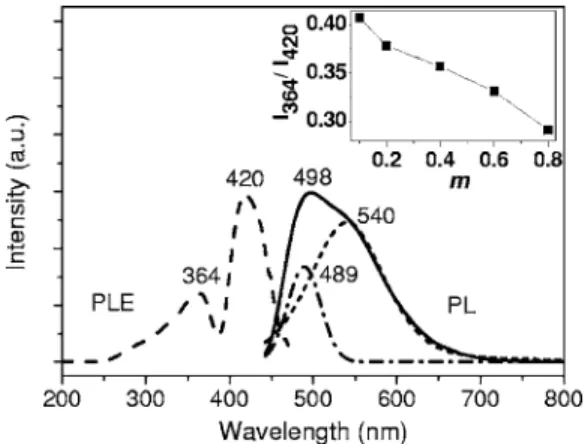
pho-toluminescence 共PL兲 spectrum of that shows an emission band centered at 623 nm. As presented in Fig.2, the photo-luminescence excitation 共PLE兲 spectrum of Ba2ZnS3: Ce3+
shows two excitation bands centered at 364 and 420 nm, assigned to host-lattice absorption and 4f1→5d1transition of Ce3+, respectively. In addition, as expected the PLE intensity
ratio共I364 nm/ I420 nm兲 of that is found to decrease as the Ce3+
concentration increases, indicating that Ce3+ ions
undoubt-edly substitute for Ba2+ sites. The PL spectrum of Ba2ZnS3: Ce3+ shows an asymmetric band emission
de-convoluted into two peaks centered at 489 and 540 nm, at-tributed to the transitions from 5d1to2F
5/2and 2F
7/2,
respec-tively. The spin-orbit splitting of ground state共2FJ兲 for Ce3+ was estimated at about 1900 cm−1, approximating to that
re-ported in Ref.7. As depicted in Fig.3, the PLE spectrum of Ba2ZnS3: Eu2+ shows a host-lattice absorption centered at
357 nm and an unresolved band from 375 to 570 nm as-signed to the 4f65d1multiplets of Eu2+excited states; the PL spectrum of that displays a broad band deconvoluted into two peaks centered at 623 and 671 nm, attributed to host-lattice emission and 4f65d1→4f7共8S7/2兲 transition of Eu2+, respectively. Moreover, the host-lattice emission still retains under 420 nm excitation because the conduction band edge of host lattice is close to the lowest energy level of Eu2+
excited state; at higher Eu2+ concentrations, the emission
band does not show obvious change because the emission intensity of host lattice and Eu2+ decreases simultaneously under the influence of substitution of Eu2+for Ba2+and
con-a兲Author to whom correspondence should be addressed; electronic mail:
FIG. 1. Absorption spectrum of Ba2ZnS3 host; the inset for PLE and PL
spectra of Ba2ZnS3 host 共PLE monitored at 623 nm and PL excited at
352 nm兲.
APPLIED PHYSICS LETTERS 90, 171908共2007兲
0003-6951/2007/90共17兲/171908/3/$23.00 90, 171908-1 © 2007 American Institute of Physics
This article is copyrighted as indicated in the article. Reuse of AIP content is subject to the terms at: http://scitation.aip.org/termsconditions. Downloaded to IP: 140.113.38.11 On: Thu, 01 May 2014 00:31:27
centration quenching, respectively. In fact, the red emission of Eu2+ is the effect of the larger crystal-field splitting and the lower energy of the center of gravity of 5d level. The Stokes shift of Eu2+ was roughly calculated to be about
7800 cm−1, and the large shift might be the result of the
lower lattice stiffness.7Besides, a significant spectral overlap was observed between the emission band of Ce3+ and the excitation band of Eu2+exhibited in Fig.4共a兲, with the result that the effective resonance-type ET from Ce3+ to Eu2+ is
expected. Consequently, Ce3+ and Eu2+ are regarded as
en-ergy donor and enen-ergy acceptor, respectively.
The ET evidence from Ce3+to Eu2+excited at 420 nm is shown in Fig.4共b兲; the red-emission intensity of Ce3+/ Eu2+
codoped Ba2ZnS3 is higher than that of Eu2+ doped one.
Furthermore, with increasing Eu2+ concentration, the PL
in-tensity of Ce3+as well as the total intensity of BZS:Ce,Eu are found to decrease gradually as displayed in Fig.5. The ET efficiency共T兲 from Ce3+ to Eu2+ can be expressed by12
T= 1 − IS
IS0, 共1兲
where IS0and ISare the luminescence intensity of Ce3+in the absence and presence of Eu2+, respectively. As Eu2+ content
increases, the T is found to increase and finally saturate. Based on Dexter’s ET formula of multipolar interaction and Reisfeld’s approximation, the following relation can be obtained:21
IS0 IS
⬀ C␣/3, 共2兲
where C is the content of Eu2+and␣= 6 and 8 corresponding
to electric dipole-dipole and dipole-quadrupole interactions, respectively. The plots represented in Figs. 6共a兲 and 6共b兲 both exhibit linear relationships; moreover, electric dipole interaction usually accompanies electric dipole-quadrupole interaction because the Coulombic effect of the former is larger than that of the latter. Therefore, the electric dipole-dipole interaction is dominant in the ET mechanism from Ce3+ to Eu2+ in BZS:Ce,Eu, which is similar to that
observed in several references.13–16
For electric dipole-dipole mechanism, the critical dis-tance共Rc兲 of ET from Ce3+ to Eu2+ can be expressed by22
Rc6= 0.63⫻ 1028 QA
E4
冕
FS共E兲FA共E兲dE, 共3兲 where QA= 4.8⫻10−16fd is the absorption cross section of Eu2+, fd⬇0.02 is the electric dipole oscillator strength for Eu2+, 兰F
S共E兲FA共E兲dE represents the spectral overlap be-tween the normalized shapes of Ce3+ emission F
S共E兲 and Eu2+ excitation F
A共E兲, estimated at about 0.96 eV−1, and E 共in eV兲 is the maximum energy of spectral overlap. There-fore, the Rcof ET was calculated to be about 32.7 Å, which is longer than that共25 Å兲 reported in BaLiF3: Ce, Eu because
the spectral overlap共0.96 eV−1兲 in BZS:Ce,Eu is larger than
FIG. 2. PLE and PL spectra of Ba2ZnS3: 0.1% Ce3+ 共PLE monitored at
498 nm and PL excited at 420 nm兲; the inset for dependence of intensity ratio I364 nm/ I420 nmin Ba2ZnS3: m % Ce3+on m.
FIG. 3. PLE and PL spectra of Ba2ZnS3: 0.8% Eu2+ 共PLE monitored at
655 nm and PL excited at 357 nm兲; the inset for PL spectra of Ba2ZnS3: n % Eu2+excited at 420 nm.
FIG. 4. 共a兲 Spectral overlap between PLE spectrum of Ba2ZnS3: Eu2+
共dashed line兲 and the PL spectrum of Ba2ZnS3: Ce3+共solid line兲; 共b兲 PL
spectra for Ba2ZnS3: 0.8% Eu2+and Ba2ZnS3: 0.1% Ce3+, 0.8% Eu2+excited
at 420 nm.
FIG. 5. PL spectra for Ba2ZnS3: 0.1% Ce3+, n % Eu2+excited at 420 nm; the
inset showing dependence of T and total intensity in
Ba2ZnS3: 0.1% Ce3+, n % Eu2+on n.
171908-2 W.-J. Yang and T.-M. Chen Appl. Phys. Lett. 90, 171908共2007兲
This article is copyrighted as indicated in the article. Reuse of AIP content is subject to the terms at: http://scitation.aip.org/termsconditions. Downloaded to IP: 140.113.38.11 On: Thu, 01 May 2014 00:31:27
that共0.77 eV−1兲 in BaLiF
3: Ce, Eu.14 When Ce3+– Eu2+ was
supposed to form a close pair at a distance of 4.210 Å, the shortest distribution length between Ce3+and Eu2+, the R
cof ET was approximated about eight lattice sites.
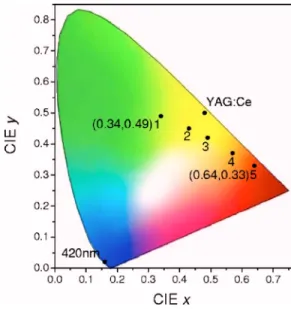
Because a commercial blue chip providing 420 nm was unavailable, the samples for blue LED application were simulated by measuring with a Xe light source with the same excitation wavelength. The Commission International de I’Eclairage 共CIE兲 chromaticity coordinates for BZS:Ce,Eu excited at 420 nm were also measured, and the results are shown in Fig.7. The CIE chromaticity coordinates of Ce3+
-and Eu2+-activated Ba
2ZnS3are共0.34, 0.49兲 and 共0.64, 0.33兲,
respectively, corresponding to hues of green-yellow and red. Furthermore, with increasing Eu2+ content, we have ob-served that the hues of BZS:Ce,Eu locate in the yellow to
orange range. As a consequence, the tunable emission of BZS:Ce,Eu coupled with blue LEDs could generate various white lights, which are more numerous than single-emitting YAG:Ce coupled with ones. In addition, the CRI of white light generated by BZS:Ce,Eu would be higher than that pro-duced by YAG:Ce because the former contains the red light component. Indeed, BZS:Ce,Eu has the promising applica-tion for white LEDs.
In conclusion, the unprecedented Ba2ZnS3: Ce3+, Eu2+
shows intense blue absorption and two emission bands: the one at 498 nm is attributed to Ce3+, and the other at 655 nm is assigned to host lattice and Eu2+. We have demonstrated
that the energy transfer from Ce3+ to Eu2+ is of a resonant
type via an electric dipole-dipole mechanism. All in all, Ba2ZnS3: Ce3+, Eu2+has been proven to be potentially useful
as a blue radiation-converting phosphor for white light-emitting diodes.
The authors acknowledge the generous financial support from the National Science Council of Taiwan, R.O.C. under Contract No. NSC95-2113-M-009-024-MY3.
1Y. Shimizu, K. Sakano, Y. Noguchi, and T. Moriguchi, Japan Patent No.
10-56208共24, February 1998兲.
2R.-J. Xie, N. Hirosaki, M. Nitomo, Y. Yamamoto, T. Suehiro, and K.
Sakuma, J. Phys. Chem. B 108, 12027共2004兲.
3T. Suehiro, N. Hirosaki, R.-J. Xie, and M. Mitimo, Chem. Mater. 17, 308
共2005兲.
4X. Piao, T. Horikawa, H. Hanzawa, and K.-I. Machida, Chem. Lett. 35,
334共2006兲.
5X. Piao, T. Horikawa, H. Hanzawa, and K.-I. Machida, Appl. Phys. Lett.
88, 161908共2006兲.
6Y. Q. Li, J. E. J. Van Steen, J. W. H. Van Krevel, G. Botty, A. C. A.
Delsing, F. J. DiSalvo, G. de With, and H. T. Hintzen, J. Alloys Compd. 417, 273共2006兲.
7G. Blasse and B. C. Grabmaier, Luminescent Materials共Springer, Berlin,
Germany, 1994兲, p. 46.
8J. S. Kim, P. E. Jeon, J. C. Choi, H. L. Park, S. I. Mho, and G. C. Kim,
Appl. Phys. Lett. 84, 2931共2004兲.
9J. S. Kim, P. E. Jeon, Y. H. Park, J. C. Choi, H. L. Park, G. C. Kim, and
T. W. Kim, Appl. Phys. Lett. 85, 3696共2004兲.
10W.-J. Yang, L. Luo, T.-M. Chen, and N.-S. Wang, Chem. Mater. 17, 3883
共2005兲.
11W.-J. Yang and T.-M. Chen, Appl. Phys. Lett. 88, 101903共2006兲. 12P. I. Paulose, G. Jose, V. Thomas, N. V. Unnikrishnan, and M. K. R.
Warrier, J. Phys. Chem. Solids 64, 841共2003兲.
13U. G. Caldino, J. Phys.: Condens. Matter 15, 7127共2003兲. 14Y. Tan and C. Shi, J. Phys. Chem. Solids 60, 1805共1999兲.
15H. Lin, X. R. Liu, and E. Y. B. Pun, Opt. Mater.共Amsterdam, Neth.兲 18,
397共2002兲.
16H. Najafov, A. Kato, H. Toyota, K. Iwai, A. Bayramov, and S. Iida,
Jpn. J. Appl. Phys., Part 1 41, 1424共2002兲.
17R. Hoppe, Angew. Chem. 71, 457共1959兲.
18H. G. Schnerung and R. Hoppe, Z. Anorg. Allg. Chem. 312, 99共1961兲. 19Y.-F. Lin, Y.-H. Chang, and B.-S. Tsai, J. Alloys Compd. 377, 277共2004兲. 20R. D. Shannon, Acta Crystallogr., Sect. A: Cryst. Phys., Diffr., Theor. Gen.
Crystallogr. A32, 751共1976兲.
21H. Jiao, F. Liao, S. Tian, and X. J. Jing, J. Electrochem. Soc. 150, H220
共2003兲.
22G. Blasse, Philips Res. Rep. 24, 131共1969兲.
FIG. 6. Dependence of IS0/ ISof Ce3+on共a兲 C6/3and共b兲 C8/3.
FIG. 7. CIE chromaticity diagram for Ba2ZnS3: m % Ce3+, n % Eu2+exited at
420 nm.共1兲 m=0.1, n=0; 共2兲 m=0.1, n=0.2; 共3兲 m=0.1, n=0.4; 共4兲 m = 0.1, n = 0.6; and共5兲 m=0, n=0.8.
171908-3 W.-J. Yang and T.-M. Chen Appl. Phys. Lett. 90, 171908共2007兲
This article is copyrighted as indicated in the article. Reuse of AIP content is subject to the terms at: http://scitation.aip.org/termsconditions. Downloaded to IP: 140.113.38.11 On: Thu, 01 May 2014 00:31:27