High-Speed Phosphor-LED Wireless Communication System Utilizing
No Blue Filter
C. H. Yeh*
a,b, C. W. Chow
c, H. Y. Chen
a,c, J. Chen
c, Y. L. Liu
a, and Y. F. Wu
ca
Information and Communications Research Laboratories, Industrial Technology Research Institute
(ITRI), Hsinchu 31040, Taiwan
b
Graduate Institute of Applied Science and Engineering, Fu Jen Catholic University, New Taipei
24205, Taiwan
c
Department of Photonics and Institute of Electro-Optical Engineering, National Chiao Tung
University, Hsinchu 30010, Taiwan
ABSTRACTIn this paper, we propose and investigate an adaptively 84.44 to 190 Mb/s phosphor-LED visible light communication (VLC) system at a practical transmission distance. Here, we utilize the orthogonal-frequency-division-multiplexing quadrature-amplitude-modulation (OFDM-QAM) modulation with power/bit-loading algorithm in proposed VLC system. In the experiment, the optimal analogy pre-equalization design is also performed at LED-Tx side and no blue filter is used at the Rx side for extending the modulation bandwidth from 1 MHz to 30 MHz. In addition, the corresponding free space transmission lengths are between 75 cm and 2 m under various data rates of proposed VLC. And the measured bit error rates (BERs) of < 3.8×10⁻³ [forward error correction (FEC) limit] at different transmission
lengths and measured data rates can be also obtained. Finally, we believe that our proposed scheme could be another alternative VLC implementation in practical distance, supporting > 100 Mb/s, using commercially available LED and PD (without optical blue filtering) and compact size.
Keywords: Phosphor-LED, Visible Light Communication (VLC), OFDM-QAM, Blue Filter 1. INTRODUCTION
Recently, white-light phosphor light-emitting diode (LED) is a major device for the future solid-state lighting market 1.
Besides, using LED for visible light communications (VLC) provides many attractive benefits, such as no electromagnetic interference (EMI), integration with indoor lighting, network security, worldwide available and unlicensed bandwidth, and non-interference with radio bands etc. Due to the ubiquitous lighting and signaling infrastructure, LED VLC could offer an additional service at comparably low extra cost. Moreover, an overview of the technical restrictions and challenges for VLC can be found in ref. 2.
The commercially available white-light LED used for lighting is mainly based on a blue LED covered by a phosphor layer. However, the slow response of phosphorescent component would restrict the modulation bandwidth of phosphor-LED to around 1 MHz range 3. To overcome the bandwidth limitation of phosphor effect, several technologies
of LED VLC system have been proposed, such as using analogy equalization at the transmitter (Tx) and receiver (Rx) sides, and utilizing a blue filter at client side to increase the modulation bandwidth. In previous works, their experimental demonstrations showed the 40 Mb/s on-off-keying (OOK) and 100 Mb/s discrete multi-tone (DMT) phosphor-LED VLC systems 4,5. Furthermore the most recent demonstrations using OOK modulation employed a combination of
“blue-filtering” and analogue equalization at the Rx to achieve transmission data rates of 100 Mbit/s 6, 125 Mb/s 7 and even
230 Mb/s 8. However, they could only achieve the free space transmission length of < 0.45 m utilizing an avalanche
photodiode (APD)-Rx. As a result, if the traffic rate of phosphor-LED VLC is >100 Mb/s with blue filtering, the longest transmission length would drop to 10~30 cm long as the blue filter introduces high signal attenuation. Gigabit VLC using wavelength-division-multiplexing (WDM) red-green-blue (RGB) LED has been reported recently 9; however, it
requires RGB LED Tx and WDM Rx. The free space transmission distance is only 30 cm.
In this work, we first propose and investigate an 84.44 to 190 Mbit/s phosphor-LED VLC system under practical transmission distance. It uses orthogonal-frequency-division-multiplexing quadrature-amplitude-modulation
(OFDM-Novel Optical Systems Design and Optimization XVII, edited by G. Groot Gregory, Arthur J. Davis, Proc. of SPIE Vol. 9193, 91931A · © 2014 SPIE · CCC code: 0277-786X/14/$18
doi: 10.1117/12.2060653
Proc. of SPIE Vol. 9193 91931A-1
QAM) modulation with power/bit-loading algorithm. Here, the optimal analogy pre-equalization design is performed at Tx side and no blue filter is used at the Rx side. The corresponding free space transmission lengths are between 0.75 and 2 m. In addition, the measured bit error rates (BERs) of < 3.8×10⁻³ [forward error correction (FEC) limit] at different
measured data rates can be achieved.
2. EXPERIMENT AND RESULS
Figure 1 shows the experimental setup of proposed phosphor-LED VLC system without using blue filter at Rx side. In the experiment, a single white-light phosphor-LED (Edison, EDEW 3LS5) is used in the VLC system to act as the Tx. The LED is driven at ~310 mA (~3.3V) with nearly 168 lm output, and it is modulated by an arbitrary waveform generator (AWG) to generate OFMD-QAM signal. In Fig. 1, the white-light emitted from the LED is received by a silicon-based PIN Rx (Hamamatsu, S6968). The Rx has the detection wavelength range from 350 to 1100 nm with responsivity of 0.63 A/W and active area of 150 mm2. It has a bandwidth of 50 MHz and the root mean square (rms) noise of 530 μV. A pair of lens is used in front of the Tx and Rx respectively, as illustrated in Fig. 1. Then, the received OFDM signal is amplified by a wideband coaxial amplifier and detected by a real-time oscilloscope.
Real-Time
Oscilloscope
Rx (PIN)
Lens
Phosphor-LED
Lens
AWG
S/P
CP Insertion
IFFT
Complex Data
Generation
Bit Stream
CP Removal
Synchronization
FFT
Equalizer
P/S
Constellation
Receiver
Decision
Amp
Free Space
Figure 1. Experimental setup of proposed phosphor-LED VLC system without blue filter at Rx side.
R
L
C
Modulation
Signal
3.3 V
L
seriesLED
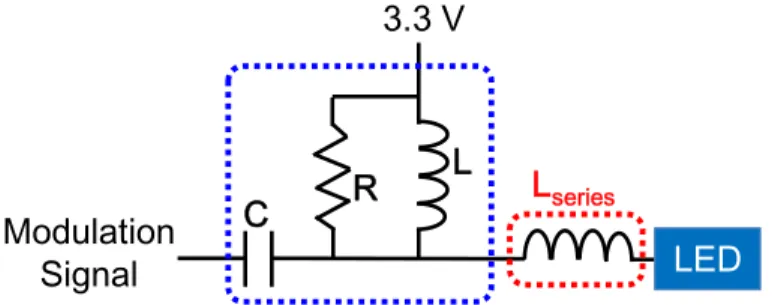
Figure 2. The RLC circuit (bias-tee) with analog pre-equalization to compensate the impedance matching of phosphor-LED.
Proc. of SPIE Vol. 9193 91931A-2
Here, we first estimate the direct modulation speed of the phosphor-LED by using a similar experimental setup in Figure 1 with back-to-back (B2B) transmission distance. By sweeping the driving frequencies from 1 kHz to 10 MHz, the frequency response spectrum of the LED is measured. Hence, we can obtain the 3 dB modulation bandwidth of phosphor-LED without any equalization method is around 1 MHz. The original modulation bandwidth would limit the traffic rate of LED VLC transmission. Here, in the LED Tx side, we design the optimal RLC circuit for the analog pre-equalization to compensate the impedance matching of phosphor-LED, as illustrated in Figure 2. The pre-pre-equalization technique could enhance the modulation bandwidth and reduce the distortion. Moreover, according to the different impedances of different types of LEDs, we need to adjust the resistance (R) and capacitance (C) to achieve the optimal pre-equalization characteristic. Here, the analog pre-equalization method is also named “series peaking”. In the PIN Rx side, we also utilize the automatic gain control (AGC) circuit to increase the signal sensitivity to maintain and enhance the linearity of OFDM signal.
10 MHz
30 MHz
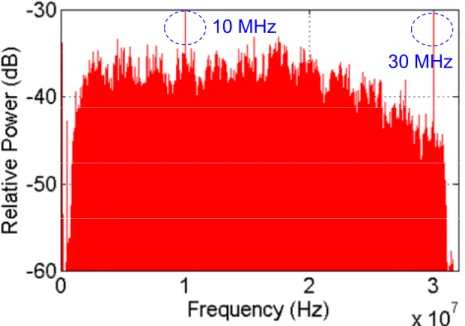
Figure 3. Measured electrical power spectrum of 30.625 MHz bandwidth at a transmission length of 1.5 m.
Then, we measure the effective modulation bandwidth of the LED with the proposed analog pre-equalization by using different OFDM-QAM modulation signals. Here, the baseband electrical OFDM signal is generated by using Matlab® programs, and the signal processing of the OFDM Tx is constructed by serial-to-parallel conversion, QAM symbol encoding, inverse fast Fourier transform (IFFT), cyclic prefix (CP) insertion, and digital-to-analog conversion (DAC). Then, the OFDM signal could be applied to LED for directly modulation. The visible-light wireless signal is directly detected by a PIN Rx. The received downstream OFDM signal is captured by using Matlab® programs for signal demodulation. To demodulate the vector signal, the off-line DSP program is employed. The demodulation process includes the synchronization, FFT, one-tap equalization, and QAM symbol decoding. The BER could be calculated according to the observed signal-to-noise ratio (SNR) of each OFDM subcarrier.
We use the 16-QAM OFDM signal with 48 subcarriers to measure the modulation bandwidth of phosphor-LED. Figure 3 shows the electrical power spectrum of 30.625 MHz bandwidth at a free space transmission length of 1.5 m. There are two peak noises observing at the frequency of 10 and 30 MHz, as shown in Figure 3, due to the received noise of PIN-based Rx. Besides, the RF power would drop gradually from 20 MHz. Hence, to avoid the two noise interferences, we would ignore these two frequencies in the OFDM demodulation.
Here, Figure 4 presents the obtained SNR of each subcarrier under the bandwidth of 1.250 to 30.625 MHz when the 16-QAM OFDM modulation signal is applied on phosphor-LED under the different transmission lengths of 0.75, 1, 1.25, 1.5, 1.75 and 2 m, respectively. Furthermore, while the transmission length is 1.25 m, the entire SNRs could be larger than 14.8 dB. When the transmission length is increased gradually, the corresponding measured SNR would drop. As a
Proc. of SPIE Vol. 9193 91931A-3
result, we observe that the effectively modulation bandwidth of phosphor-LED with pre-equalization can achieve ~30 MHz under practical free space transmission length, as also seen in Figure 4.
0 5 10 15 20 25 30 6 8 10 12 14 16 18 20 22 24 26 SNR (dB) Frequency (MHz) 0.75m 1m 1.25m 1.5m 1.75m 2m
Figure 4. Observed SNR of each subcarrier under the bandwidth of 30 MHz by utilizing 16-QAM OFDM modulations at the transmission lengths of 0.75, 1, 1.25, 1.5, 1.75 and 2 m, respectively.
0 5 10 15 20 25 30 6 8 10 12 14 16 18 20 22 24 26 SN R (d B ) Frequency (MHz) 0.75m 1.00m 1.25m 1.50m 1.75m 2.00m
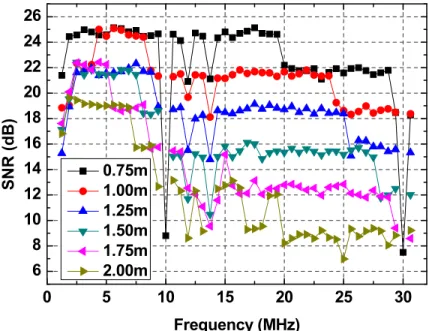
Figure 5. Measured SNR of each subcarrier with power/bit-loading algorithm under the modulation bandwidth of 1.25 to 30.625 MHz.
According to the measured result of Figure 5, we employ the power/bit-loading algorithm to obtain the optimal SNR of each OFDM subcarrier utilizing the same modulation conditions. According to the proposed modulation technique, we can get optimal SNR distribution in the effectively modulation bandwidth. Therefore, Figure 5 presents
Proc. of SPIE Vol. 9193 91931A-4
the measured SNR of each subcarrier within the bandwidth of 30.625 MHz by using OFDM-QAM format with power/bit-loading algorithm at the different transmission lengths of 0.75, 1, 1.25, 1.5, 1.75 and 2 m, respectively. Moreover, according to the measured results of Figure 5, we also can obtain the corresponding bit number of each subcarrier under the modulation bandwidth, as shown in Fig. 6. As a result, the minimum SNRs of 18.4, 18.4, 15.3, 10.5, 8.6 and 8.2 dB were retrieved within the modulation bandwidth at the transmission distances of 0.75, 1, 1.25, 1.5, 1.75 and 2 m, respectively, when the two frequencies of 10 and 30 MHz were ignored, as also shown in Figure 6.
0 5 10 15 20 25 30 1 2 3 4 5 6 7 0.75m 1.00m 1.25m 1.50m 1.75m 2.00m Number of Bit Frequency (MHz)
Figure 6. Measured bit number with bit-loading algorithm under the modulation bandwidth of 1.25 to 30.625 MHz.
0.75 1.00 1.25 1.50 1.75 2.00 40 60 80 100 120 140 160 180 200 Da ta Ra te (M b/s ) Distance (m) Data Rate 0.75 1.00 1.25 1.50 1.75 2.00 2.5x10⁻³ 3x10⁻³ 3.5x10⁻³ 4x10⁻³ BE R Distance (m) BER
FEC limit, BER=3.8x10⁻³
(a)
(b)
Figure 7. (a) Measured traffic data rate and (b) its corresponding BER of proposed phosphor-LED VLC with bit-loading algorithm under different transmission lengths of 0.75, 1, 1.25, 1.5, 1.75, and 2 m, respectively.
Finally, Fig. 7(a) shows the traffic data rate of proposed phosphor-LED VLC system using OFDM-QAM format with bit-loading algorithm at the different transmission lengths of 0.75, 1, 1.25, 1.5, 1.75, and 2 m, respectively; and their corresponding traffic rates are 190, 168.13, 143.75, 125, 105.63, and 84.44 Mbit/s, respectively. In addition, Fig. 7(b)
Proc. of SPIE Vol. 9193 91931A-5
also presents their corresponding BER under the different transmission lengths. The entire measured BER values are below the forward error correction (FEC) threshold (BER = 3.8×10⁻³), as seen in Fig. 7(b). As a result, the maximum and
minimum traffic rates of 190 and 84.44 Mbit/s can be obtained at the transmission lengths of 0.75 and 2 m, respectively.
3. CONCLUSION
In conclusion, we have proposed and investigated a white-light phosphor-LED VLC system with the adaptive traffic rate of 84.44 to 190 Mbit/s by using OFDM-QAM modulation format with bit-loading method under the free space transmission lengths of 0.75 to 2 m. Here, we also designed an optimal analogy pre-equalization circuit design at LED-Tx side and employed no blue filter at Rx side to increase the modulation bandwidth of phosphor-LED from 1 MHz to 30 MHz. In addition, the whole obtained BERs could be less than the FEC threshold at the different transmission lengths of 0.75, 1, 1.25, 1.5, 1.75, and 2 m, respectively. In addition, we could adjust the traffic data rate of proposed VLC system adaptively, according to the different transmission lengths and received sensitivities at the Rx side.
REFERENCES
[1] Lee, S.W.R., Guo, X., Niu, D. and Lo, J. C. C., “Phosphors for LED-based solid-state Lighting,” Proc. of IEEE ECTC, 563-567 (2013).
[2] O’Brien, D. et al. [Visible Light Communications, in Short-range wireless communications], M. Kraemer and M.D. Katz (Eds.), J. Wiley and Sons Ltd. (2009).
[3] Yeh, C. H., Liu, Y. F., Chow, C. W., Liu, Y., Huang, P. Y. and Tsang, H. K., “Investigation of 4-ASK modulation with digital filtering to increase 20 times of direct modulation speed of white-light LED visible light communication system,” Opt. Express 20(15), 16218-16223 (2012).
[4] Le-Minh, H., O'Brien, D., Faulkner, G., Zeng, L., Lee, K., Jung, D. and Oh, Y., “High-speed visible light communications using multiple-resonant equalization,” IEEE Photon. Technol. Lett. 20(14), 1243-1245 (2008). [5] Grubor, J., Lee, S. C. J., Langer, K. D., Koonen, T. and Walewski, J. W., “Wireless high-speed data
transmission with phosphorescent white-light LEDs,” Proc. of ECOC, Paper PD3.6 (2007).
[6] Le-Minh, H., O’Brien, D., Faulkner, G., Zeng, L., Lee, K., Jung, D., and Oh, Y., “100-Mb/s NRZ visible light communications using a post-equalized white LED,” IEEE Photon. Technol. Lett. 21, 1063-1065 (2009). [7] Vucic, J., Kottke, C., Nerreter, S., Habel, K., Buttner, A., Langer, K.-D. and Walewski, J. W., “125 Mbit/s over
5 m wireless distance by use of OOK-modulated phosphorescent white LEDs,” Proc. of ECOC, Paper 9.6.4 (2009).
[8] J Vucic, J., Kottke, C., Nerreter, S., Habel, K., Buttner, A., Langer, K.-D. and Walewski, J. W., “230 Mbit/s via a wireless visible-light link based on OOK modulation of phosphorescent white LEDs,” Proc. of OFC, Paper OThH3 (2010).
[9] Cossu, G., Khalid, A. M., Choudhury, P., Corsini, R. and Ciaramella, E., “3.4 Gbit/s visible optical wireless transmission based on RGB LED,” Opt. Exp.20, B501-B506 (2012).
Proc. of SPIE Vol. 9193 91931A-6