
以TRIZ為架構的創意之策略推展於台灣高科技公司 - 政大學術集成
62
0
0
全文
(2) . 以TRIZ為架構的創意之策略推展於台灣高科技公司 Strategy in Deployment of TRIZ_Based Innovation for Taiwan High-Tech Company. 研究生:劉依雯. Student: I-WEN Liu. 指導教授:吳文傑. 立. Advisor: Jack Wu 治 政 大. ‧ 國. 學 國立政治大學. ‧. 商學院國際經營管理英語碩士學位學程. y. A Thesis. n. a. er. io. sit. Nat. 碩士論文. v. i l to Submitted C International MBAnProgram. i U. h. e n g c hUniversity National Chengchi. in partial fulfillment of the Requirements for the degree of Master in Business Administration. 中華民國一〇三年五月 May 2014.
(3) . Acknowledgements To Professor Jack Wu, my thesis advisor, thank you for having put in a lot of your precious time to guide me in conducting this research. Without your assistance and your encouragements, I would have certainly given up before the completion of this paper. To the chief of Cubic Creativity Corp, Dr. Xiao Yongjin , thank for your great help to introduce the VP of Epistar to me for depth of interview, without your kindly support, I can’t complete this thesis.. 政 治 大 gave me support to overcome difficult moment & finish the scholarship. 立. 學. ‧ 國. To my friend, Rick, and my parents for waiting all these years, thank you stayed with me and. And last, but not least, thank you, my dearest husband, for being there for me and providing the love and support to help me get through it all! I love you!. ‧. n. er. io. sit. y. Nat. al. Ch. engchi. i. i n U. v.
(4) . Abstract Strategy in Deployment of TRIZ_Based Innovation for Taiwan High-Tech Company By I-WEN Liu High-tech industry in Taiwan is the mainstream of economic growth. In recent years, international patent litigation news often hear, business at the same time against opponents in. 政 治 大. the competition through patent to protect themselves, and then rely on patents for high added value. Using innovative methods to solve problems faced by enterprise innovation process is. 立. commonly used in the practice of foreign companies. Technology companies encourage. ‧ 國. 學. employees to obtain patents; however, although engineering also hope to increase patent contribution, but often do not know how to proceed efficiently.. ‧. TRIZ theory provides an innovative management system that lets innovation becomes simple,. y. Nat. no longer out of reach. Currently the Western developed countries such as the United States,. sit. Germany, Britain, France, Sweden and Russia, Japan and other countries, no matter theoretical. er. io. and application research or technical research of TRIZ are at the forefront of the world. Due to. al. n. v i n C his rarely been widely learning TRIZ. In Taiwan, TRIZ e n g c h i U introduced in the country and in. geographical proximity relations with Russia, South Korea and China are also very positive. enterprise.. TRIZ so good, why not spread in the Taiwan? Paper discusses the cost of imported TRIZ, the implementation procedure, and the expected results through literature and actual interviews. Based on these introduction to manager understand the perspective of the feasibility of local enterprises import TRIZ and proposed how to make TRIZ popularity in domestic.. Keywords: High-tech, TRIZ, Creativity, Innovation. ii.
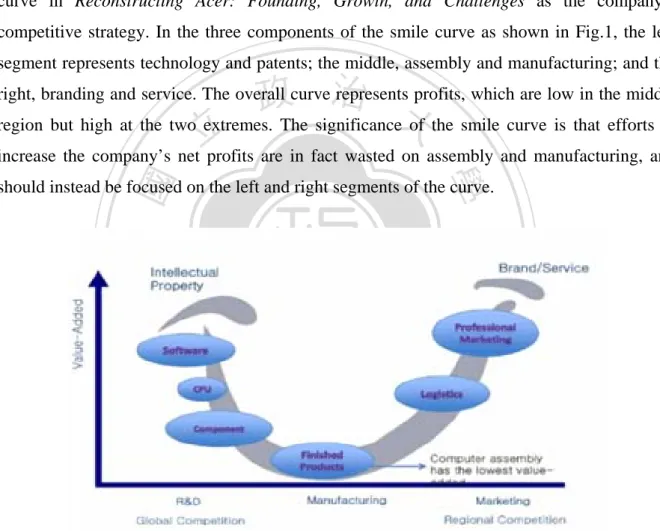
(5) . TABLE OF CONTENTS. 1.1.. Background................................................................................................................. 1. 1.2.. Research Motivation ................................................................................................... 4. 1.3.. Purpose of Research ................................................................................................... 5. 政 治 大 Literature Review ............................................................................................................. 8 立 Research Structure ...................................................................................................... 7. 2.1.. Technical Innovation .................................................................................................. 8. 學. 1.4.. ‧. 2.1.1. Definition of Technological Innovation.................................................................. 8. sit. y. Nat. 2.1.2. Definitions of Creativity and Innovation .............................................................. 10. io. 2.1.3. Type of Innovation................................................................................................ 12. n. al. er. 2.. Introduction ...................................................................................................................... 1. ‧ 國. 1.. i n U. v. 2.1.4. Methods of Creative Thinking .............................................................................. 14. Ch. engchi. 2.1.5. Results of Technological Innovation .................................................................... 15 2.2.. What is TRIZ ............................................................................................................ 17. 2.2.1. Introduction .......................................................................................................... 17 2.2.2. The TRIZ Framework and Procedure for Solving Inventive Problems ............... 19 2.2.3. TRIZ Strength & Weakness .................................................................................. 20 2.2.4. TRIZ Relative Research ....................................................................................... 24. iii.
(6) . 2.3.. TRIZ Worldwide Development Status ..................................................................... 29. 2.3.1. How did SamSung apply TRIZ ............................................................................ 30 2.3.2. Problem Introducing TRIZ to Taiwan .................................................................. 33 3.. Research Design & Case Study ..................................................................................... 35 3.1.. Depth of Interview: Interview Scope ....................................................................... 35. 3.1.1. EPISTAR Company Profile .................................................................................. 35 3.2.. 政 治 大 Collating Interview Contents .................................................................................... 38 立. ‧ 國. 學. 3.2.1. Summarized Interview Content of Epistar ........................................................... 38 3.2.2. Summarized Interview Content of PC Brand Company ...................................... 41. ‧. 3.2.3. Summarized Interview Content of PC ODM/OEM Company ............................. 41. sit. n. al. er. Conclusion & Suggestion ............................................................................................... 42. io. 5.. y. Nat. 4.. i n U. v. 4.1.. Conclusion ................................................................................................................ 42. 4.2.. Suggestion ................................................................................................................ 44. Ch. engchi. Future Research .............................................................................................................. 46. Appendix ................................................................................................................................. 47 Reference ................................................................................................................................. 53 . . iv.
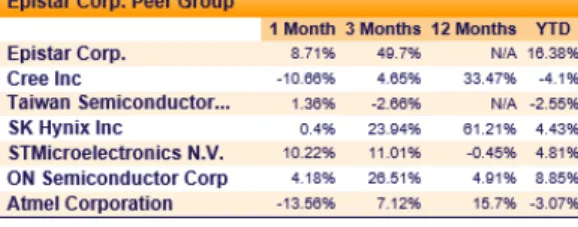
(7) . List of Figures and Tables Figure 1: The Smiling Curve, Stan Shih Proposed in 1992........................................................ 1 Figure 2: Technical Evolution S-curve ..................................................................................... 13 Figure 3 TRIZ System Framework........................................................................................... 19 Figure 4: Comparison of U.S. Patent Applications Obtained by Samsung and IBM ............... 31 Figure 5: Epistar Corp. Stock Performance Benchmark .......................................................... 37. 政 治 大 Figure 7: Level One Courses立 .................................................................................................... 39 Figure 6: Epistar Global Patent Inquired over the Year............................................................ 37. ‧ 國. 學. Table 1: Definition of Innovation compiled by Sounder (1987) .............................................. 11. ‧. Table 2: Summarized Methods of Creative Thinking (Huang Dedan, 1995) ........................... 14. y. Nat. io. sit. Table 3: Comparative Indices for Scientific Innovation Results .............................................. 16. n. al. er. Table 4: Alshuller’s Levels of Invention .................................................................................. 17. Ch. i n U. v. Table 5: Collated by the Author ................................................................................................ 21. engchi. Table 6: TRIZ activities at Samsung ........................................................................................ 31 Table 7: Interviewee Information ............................................................................................. 35 . v.
(8) . 1. Introduction 1.1.. Background. Competition under globalization is fierce. As competing companies constantly release similar technologies or products, they are forced to lower prices to retain their market shares. This always leads to price wars. In 1992, Acer’s then-chairman, Shi Zhenrong, proposed the smile curve in Reconstructing Acer: Founding, Growth, and Challenges as the company’s competitive strategy. In the three components of the smile curve as shown in Fig.1, the left segment represents technology and patents; the middle, assembly and manufacturing; and the. 政 治 大 region but high at the two extremes. The significance of the smile curve is that efforts to 立 increase the company’s net profits are in fact wasted on assembly and manufacturing, and right, branding and service. The overall curve represents profits, which are low in the middle. ‧ 國. 學. should instead be focused on the left and right segments of the curve.. ‧. n. er. io. sit. y. Nat. al. Ch. engchi. i n U. v. Figure 1: The Smiling Curve, Stan Shih Proposed in 1992 Since the introduction of Apple’s first iPhone model in June 2007, the world has been swept away by a succession of innovative electronic products, bringing considerable profits to companies. By 2013, Apple held USD 147 billion in cash, with a debt ratio of zero. Richer than the U.S. government and in possession of 10% of the total cash holdings of all U.S. businesses,. 1.
(9) . Apple became the most valuable technology company on the planet. The success of Apple is attributable to its complete implementation of the smile curve strategy. It was previously assumed that a company should use resources to establish its core competitiveness, and then extend that position to different areas to establish a competitive advantage in the market. However, experts observing various companies have recently found that this strategy lacks one important link: deployment. When it comes to similar products, two or more companies may have comparable levels of core competitiveness, but differences in their respective deployment strategies may lead to vastly different results.. 政 治 大 will go to great lengths to avoid being sued in an American court, not because of the high legal 立. In recent years, news related to patent lawsuits has become commonplace. Many companies. cost but, rather, because being found guilty of a patent rights violation may lead to a loss of. ‧ 國. 學. market competitiveness through: (i) a product being removed from the market, (ii) products being banned from import or export, (iii) the defendant company or downstream customers. ‧. having to pay huge compensation fees, or (iv) customers changing their purchase orders.. y. Nat. Previously, companies typically assumed that the only purpose of acquiring patents was to. sit. protect one’s own products, technology, and R&D findings. However, the value of patents is not. er. io. only in acquisition for defense but also in attack. This requires the adoption of a new concept. al. n. v i n a superb patent defense system toCsafeguard h e n ganceffective i Uhold on technology, thereby resisting h the attacks of their competitors and allowing the company to reap the greatest profits. Along for today’s world: a strategic program of legal patent deployment that allows companies to use. with global competition and deployment in the technology industry, patents have always had an important link with commercial strategy. Many companies frequently use patent lawsuits to ease product entry into a new market, eliminate competitors, or defend an existing market. Although innovation is not everything, it is an important element for corporate success. However, companies have always approached problems based on past experience, knowledge, and inertial thinking methods, progressing through repeated trial and error in pursuit of a path leading to the answer. Often resorting to conventional solutions, companies believed that invention is something for geniuses or resulting from sudden inspiration. Invention and patents seem to be so problematic that most people do not believe it is possible for them to invent 2.
(10) . anything. Thus, the saying goes: Genius is one percent inspiration combined with ninety-nine percent perspiration. People believed that this is a random process that is not systematically replicable and relies solely on individual talent – an approach limited by personal knowledge, expertise, inspiration, and luck. Engineers spend many years learning the facts and technical details of their discipline, yet there is generally no specific training provided for creative thinking skills. Creative thinking is a critical skill required by engineers and inventors, yet it is generally done by trial and error, which is basically guessing. Not only is the process of trial and error hampered by the limited extent personal knowledge, it can also require many tries and a significant amount of time, sometimes years, to identify a good idea, and thinking is. 政 治 大. constrained by what is known as psychological inertia.. 立. However, in this era of rapid change, an important product based on a new technology appears. ‧ 國. 學. every few years (Peter F. Drucker, 1960). No company can rely exclusively on reduction in development time, production costs, and product prices as its strategy for sustainable. ‧. development. In a post-PC era, companies must transform their operational methods and ways of thinking. Creativity and innovation are increasingly important. Having long been schooled. sit. y. Nat. under the “recite education” approach (sometimes described as the force-feed style of education), the Taiwanese people are not adept at creative thinking. Moving beyond such past. io. er. thinking habits to achieve breakthrough innovative thinking is not easy.. al. n. v i n C h seem to be rather Further, traditional methods of innovation e n g c h i U inefficient. Are there, then, other. methods and tools to allow technology companies to innovate, acquire patents, and even make progress in technology forecasting and patent deployment more quickly and efficiently and, at the same time, achieve sustainable profits and survival? As demonstrated in numerous studies, the theory of inventive problem solving (TRIZ) algorithm is being used to solve technology innovation and engineering problems. Altshuller, who developed the TRIZ algorithm, believed that the application extended beyond the innovation and engineering fields (Altshuller, 2000). Taiwan’s high-tech industry must independently innovate in R&D. Only after raising its R&D level will it be able to sustain international competitiveness and proceed toward new milestones. An “independent innovation, methods first” innovation method is the basic source of independent innovation. TRIZ can help companies transform their R&D methods and minimize 3.
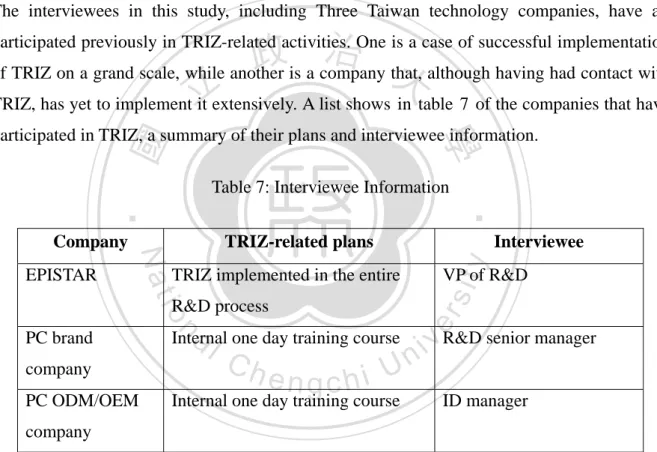
(11) . the scale of imitation. As Chinese people say, “tools are very important to a project’s success,” and “to do a good job, a craftsman needs the right tool.” TRIZ is precisely the right tool for superb innovation.. 1.2.. Research Motivation. In September 2011, Microsoft announced it would develop the Windows 8 operating system (OS) in partnership with Samsung. Shi Zhenrong, the founder of Acer, suggested that Microsoft passed over Taiwan and instead chose to partner with Samsung primarily because Samsung is both a brand and possesses R&D capabilities. Microsoft needed a partner with which it could. 政 治 大 consists of subcontracting; as 立Acer currently lacks comparable R&D capabilities, it has yet to develop its next-generation OS. Unfortunately, the electronics industry in Taiwan primarily. ‧ 國. 學. become a priority partner for Microsoft. In the face of Taiwan PC giant Acer’s market share slipping from second to fourth place, Shi Zhenrong stated, “Trends in technology are subject to constant innovation. With micro-profits changing the computer industry, Hewlett Packard has. ‧. carved out their computer division. However, what HP is not doing is exactly what is being. io. er. within 20 years, Asia will be a leader in operating systems.”. sit. y. Nat. done in Asia. When all of the world’s computers are being produced in Asia, there is hope that. al. v i n C hthe past ten years, Acer be a short-term phenomenon.” For has focused on the right side of the U i e h n g c to be a successful second in terms of market smile curve by developing its brand and service n. Stan Shih went on, “Acer must now recover its R&D capability. Loss of market share will only. position. At a time when Acer requires urgent transformation, the company has become inclined to the left side of the smile curve, that of fostering technology and patents, which it had ignored for the past ten years. The company is therefore revising its R&D organization and attempting to recover its associated capabilities. At this critical turning point, I began to study how Acer’s competitor Samsung had in a short time become Microsoft’s primary partner for developing Windows 8, its next generation OS. I learned of TRIZ while participating in a 2011 TRIZ training program provided by Acer for its employees. I also learned that Samsung had deeply integrated TRIZ into its R&D and manufacturing processes.. 4.
(12) . Samsung is a Korean company that was on the verge of bankruptcy during the 1997 Asian financial crisis, but whose market value exceeded a hundred billion dollars by 2006; by 2011, it had surpassed even Intel. What were the key elements of this miracle? The most important element of Samsung’s massive success came from its concentration on and almost obsessive pursuit of innovation. In 2005, when Samsung’s chairman Li Zhenglong first announced to the world, “What was it that saved Samsung? It was TRIZ,” it was discovered that TRIZ was Samsung’s secret weapon for transforming from a subcontractor to an independent R&D powerhouse. Because of this, I conducted a systematic analysis of the history and experience of Samsung’s successful application of innovation methods, drawing upon a large volume of. 治 政 大 research and thereby improve the research experience to improve the implementation of TRIZ 立 core competitiveness of Taiwanese technology through promoting invention among Taiwan theory as a basis to understand TRIZ. My goal was to take advantage of Samsung’s front-line. ‧ 國. 學. technology companies.. ‧. After reading many theses and periodicals, I found that although TRIZ as a tool of systematic thought may be able to help companies in terms of the efficiency of their innovation and patent. sit. y. Nat. deployment, it seemed that very few companies in the Taiwan high-tech industry had implemented TRIZ on a large scale. Additionally, why had Acer, my employer, not yet. io. n. al. er. implemented TRIZ? Was it suitable for the implementation of TRIZ? These questions were the motivation that spurred my research.. 1.3.. Ch. Purpose of Research. engchi. i n U. v. There are reported successful TRIZ implementations in countries across the globe. While TRIZ has been popularized since 1998 in Japan, Korea, and mainland China, Taiwan has yet to see positive results. The large volume of foreign TRIZ research may be divided into three important categories: (i) introductions to TRIZ, (ii) improvements to TRIZ methods and tools, and (iii) applications and development of TRIZ. Taiwanese research has concentrated on the applications of TRIZ, with almost no discussion of the problems encountered in promoting the use of TRIZ in Taiwan or of possible solutions—and almost no analytical studies evaluating the implementation of TRIZ in Taiwan companies. There was only Xiao Yongjin’s 2009 published. 5.
(13) . article, which proposed a program for solving difficulties during the implementation of TRIZ in Taiwan. Today, because TRIZ has yet to be widely practiced in Taiwan, the majority of companies do not know how to implement TRIZ, the costs of implementing it, or its key success factors. Therefore, this study uses a case-by-case method to (i) understand the experiences of those Taiwanese high-tech companies that have successfully implemented TRIZ; (ii) understand the reasons for PC assembly and branding firms in Taiwan why not implement TRIZ; (iii) provide Taiwanese high-tech firms with an assessment of approaches to strategically implement. 政 治 大. TRIZ-based innovation in their internal R&D processes; and (iv) revise and propose a suggested program. The research method was to conduct interviews to study and discuss the. 立. following three issues:. ‧ 國. 學. a) Analyze the primary factors for a successful application of TRIZ by a high-tech firm. b) Analyze difficulties encountered by Taiwan high-tech companies implementing TRIZ and. ‧. discuss possible solutions.. y. Nat. c) Assess from a management perspective the feasibility of implementing TRIZ in PC. al. n. This study makes the following important contributions:. Ch. engchi. er. io. sit. assembly company.. i n U. v. a) Addresses difficulties encountered while developing TRIZ both in Taiwan and abroad through discussing the relevant literature and using company interviews to collect and analyze the most common problems experienced by Taiwan companies when implementing TRIZ. b) Discusses the costs of implementing TRIZ, of developing a method, of forecasting results, and of establishing a model of pre-implementation assessment for company executives to refer to when making strategic decisions.. 6.
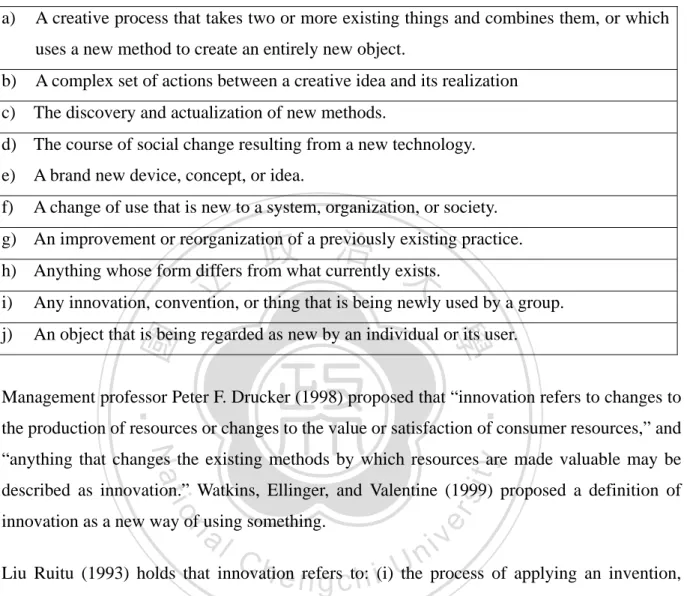
(14) . 1.4.. Research Structure. This study is divided into five chapters, sequentially explained as follows: Chapter One explains the purpose and motivation behind this study, conducts a review of studies related to the field, and gives a simple introduction to the framework of this study. Chapter Two investigates relevant literature to introduce the developmental background of the TRIZ innovation design method; analyzes the advantages of TRIZ in comparison with traditional innovation methods, its applications for companies, and the present state of its development around the world; and selects successful case studies and describes their difficulties when and. 治 政 And also consisted with reviews of Taiwanese companies 大who have implemented TRIZ; it uses 立 the process and efficiency of Taiwanese technology firms a case-by-case method to understand implementing TRIZ in Taiwan. Chapter Three consists of research methods and limitations.. ‧ 國. 學. implementing TRIZ and the reasons for firms not fully implementing TRIZ. And we also interview two companies who just join one day training instead of implement TRIZ widely.. ‧. Through the interview, we tried to dig out why they not phase in TRIZ in their company.. y. Nat. Chapter Four comprises conclusions and suggestions. When TRIZ was applied to actual cases. io. sit. of Taiwanese companies, a critical bottleneck was discovered. A recommendation is made that. er. involves a strategy allowing TRIZ to be easily implemented in the local high-tech industry,. n. al. i n C Finally, some suggestions for futureh research e n garec proposed. hi U. v. thereby helping Taiwanese companies improve their core and international competitiveness.. 7.
(15) . 2. Literature Review In the age of the knowledge economy, innovation is the most important driver of economic development and is an important basis for the high-tech industry and future economic development in Taiwan. Knowledge and intangible assets (for example, patent management) ensure industry competitiveness. Taiwan’s advantage in the high-tech industry is especially reliant on uninterrupted innovation. Only by strategically deploying patents in one’s industry can a company maintain its industry position or lead. However, how does one actualize efficient innovation? Some ideas from various studies related to TRIZ, the thought-tool for. 政 治 大. technological and systematic innovation, have been collated in this paper.. Definition of Technological Innovation. 學. 2.1.1.. 立. Technical Innovation. ‧ 國. 2.1.. Science and technology generally refer to scientific research and technological development, as. ‧. well as the relationship between the two, with the former being the basis for the latter.. sit. y. Nat. Commonly, scientific discovery leads to technological innovation; however, technological. io. discovered.. er. innovation sometimes appears first, and through its use, the underlying scientific principles are. al. n. v i n Schon (1967) defines technologyC ash any tool, skill, product, e n g c h i U process, equipment, or method by. which humanity extends its abilities. Erdilerk (1986) defined it as the accumulation of knowledge and specialized skills that are invested in final products or their production. In practice, a majority of scientific research requires a large quantity of technological equipment; therefore, vigorous progress in technological development is a major driving force behind scientific progress. For example, without the technology for high-speed computer calculations, scientists would have no means of sorting the one billion nucleases involved in the complete human genome. We thus observe the great contribution of technological progress to scientific discovery.. 8.
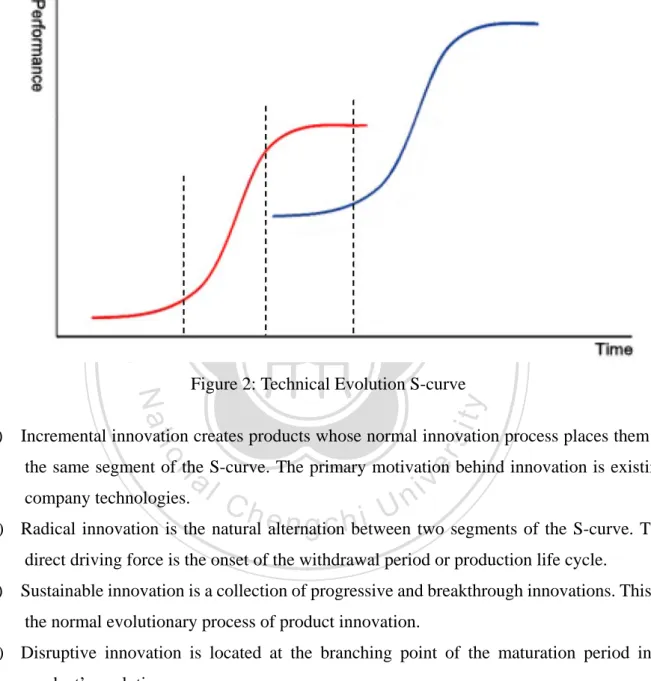
(16) . Technological development is primarily founded on the results of scientific research. However, the findings of scientific research must undergo a period of technological R&D and application prior to producing economic benefits. Technological R&D, in turn, must rely on existing scientific knowledge, using the range, sequence, principles, and tools of science and engineering to translate research findings into products. Similarly, scientific research also needs the support of industry resources and equipment. Therefore, the connection between scientific research and technological development grows ever closer, with the boundary between the two sometimes being blurred.. 政 治 大. The evolution of human civilization has been strongly driven by technological progress. The various ages – stone, bronze, iron, industrial, and information – are all examples of new. 立. technology leading to the emergence of a new civilization. Hacker and Barden, renowned. ‧ 國. 學. scholars of education in science and technology, proposed the following definitions of technology in 1987:. ‧. The total knowledge used to transform resources to fulfill the needs of humanity.. b). A type of strategy used for human existence.. c). Means and methods by which humans control and transform the natural environment.. d). The practical application of a theory (such as science).. e). The application of knowledge and the knowledge of applicability.. f). The primary force behind changes in society.. g). The primary tool by which humanity adapts to the environment.. h). The process of using science, information, and human resources to achieve the goals of. n. Ch. engchi. er. io. al. sit. y. Nat. a). i n U. v. humanity. i). The use of human knowledge, tools, resources, skills, and processes to solve practical problems and extend the capabilities of humanity.. j). The production of new forms of civilization.. Simply put, technology consists of the various tools, materials, resources, and other means by which humanity solves its problems or needs, that is, the solutions thus imagined. The essence of technology is the solution of problems.. 9.
(17) . 2.1.2.. Definitions of Creativity and Innovation. Creativity is generally described by local and international scholars in various ways, such as creative thinking, problem-solving ability, thinking ability, and imagination. The Dictionary of the Zhang School of Psychology provides this explanation of creativity: when facing problematic conditions, it is the process of going beyond one’s existing experience and breaking through the limitations of custom practices to form new concepts (Zhang Chunyu, 1989). Creativity is the ability to engage in creation through the concentration of one’s will and the. 政 治 大 unexpected, such as a new technology, service, or product function. In other words, creativity 立 taking of risks, resulting in the transformation of inertia and the production of something. ‧ 國. 學. requires that we use our mental abilities to solve a problem situation. Rhodes (1961) compiled more than 50 definitions of creativity, which were summarized as the. ‧. 4P factors of creation: person, process, product, and place. Here, creativity is seen as a complete system containing the creator’s personality characteristics, cognitive and psychological. y. Nat. sit. processes, manifestation of the creative product, and interactions between the creator and the. al. n. 1998; Torrance, 1972).. er. io. environment (Chen Zhenming, 2005; Rhodes, 1961). Creativity can be taught (Chen Longan,. Ch. engchi. i n U. v. Creativity can appear in various forms at different times. Cai Lixing, Ph.D., former CEO of Taiwan Semiconductor Manufacturing Co., Ltd., stated that “a good idea that gets put into practice is called innovation; otherwise, it is just creativity. Innovation brings with it implementation, that is, how to actualize a good idea.” The Latin root of the word “innovation” is “innovare,” which means “the process of commodifying the results of one’s studies.” Therefore, we can say that technological commodification is the core content of innovation. The common definitions of innovation, as compiled by Sounder (1987), are listed in table 1.. 10.
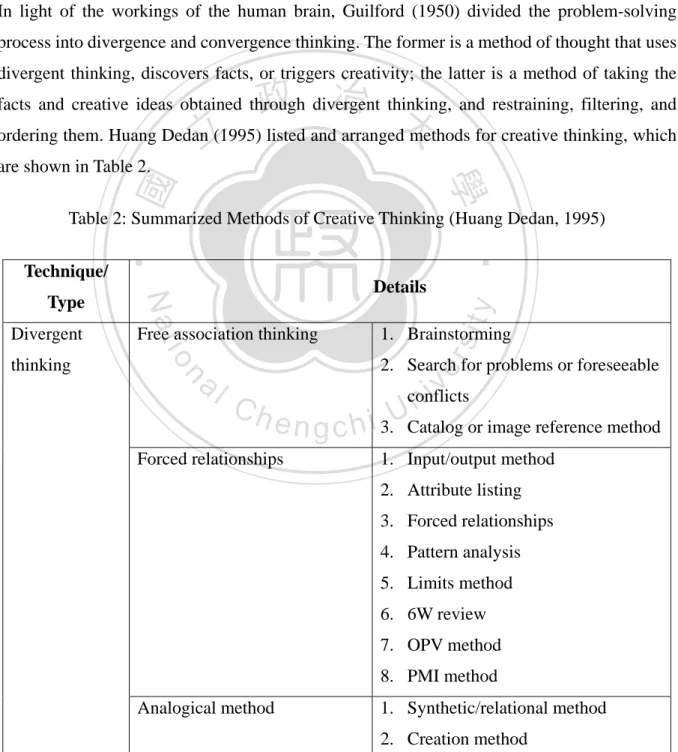
(18) . Table 1: Definition of Innovation compiled by Sounder (1987) a). A creative process that takes two or more existing things and combines them, or which uses a new method to create an entirely new object.. b). A complex set of actions between a creative idea and its realization. c) The discovery and actualization of new methods. d) The course of social change resulting from a new technology. e) A brand new device, concept, or idea. f). A change of use that is new to a system, organization, or society.. i). 治 政 Anything whose form differs from what currently exists. 大 立 or thing that is being newly used by a group. Any innovation, convention,. j). An object that is being regarded as new by an individual or its user.. g) An improvement or reorganization of a previously existing practice.. 學. ‧ 國. h). ‧. Management professor Peter F. Drucker (1998) proposed that “innovation refers to changes to the production of resources or changes to the value or satisfaction of consumer resources,” and. Nat. sit. y. “anything that changes the existing methods by which resources are made valuable may be. io. er. described as innovation.” Watkins, Ellinger, and Valentine (1999) proposed a definition of innovation as a new way of using something.. n. al. Ch. engchi. i n U. v. Liu Ruitu (1993) holds that innovation refers to: (i) the process of applying an invention, concept, or service to reality; (ii) an expansion of the style, function, or use of an existing technology or product; or (iii) the conversion of technology into economic value and the development of useful products. In a broad sense, innovation is of two types: technical and non-technical. A technical innovation refers to an innovation or improvement upon a product or manufacturing process, whereas a non-technical innovation refers to changes to concepts related to management techniques and knowledge management. In summary, technological innovation not only covers production and manufacturing but also includes aspects of management. 11.
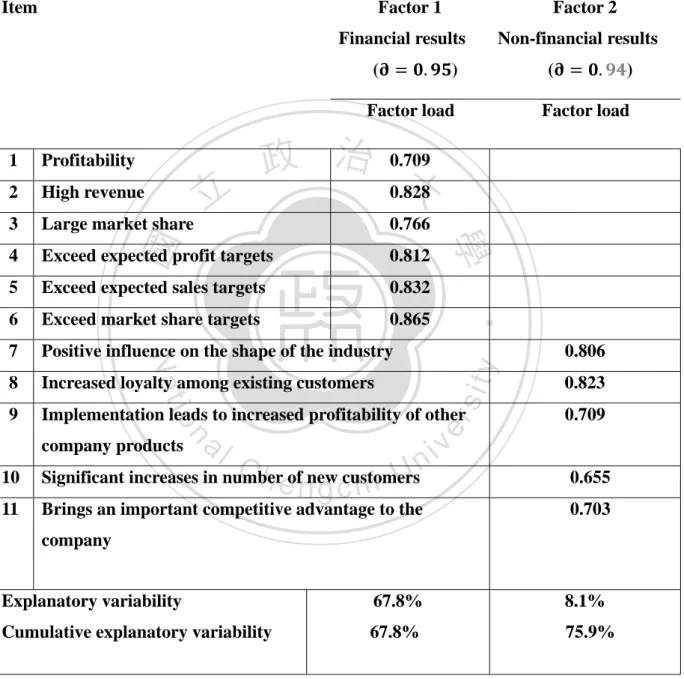
(19) . 2.1.3.. Type of Innovation. Abernathy (1978) distinguishes between major product and process improvement technological innovations. The former is oriented toward the maximization of product performance, while the latter is oriented toward improving the product manufacturing process. Both aim at minimizing costs, raising productivity, and improving product standards. Christensen (1997) proposed a theory of sustainable and disruptive innovations. Sustainable innovation uses methods that are well recognized by a mainstream market clientele as providing a superior product or service. Conversely, disruptive innovation uses a new product or service to create a completely new. 政 治 大 According to Betz (1998), there 立 are four methods of innovation: market.. ‧ 國. 學. a). Incremental innovation improves the functionality of present technology, thereby improving its performance and security or lowering its price; incremental innovation can. ‧. preserve an industry’s competitiveness.. b) Radical innovation provides the opportunity for new commercial risks and industries.. y. Nat. sit. Therefore, radical innovation is able to create new industries.. al. er. io. c) System innovation provides a new function based on the reconstruction of existing. n. technologies. An industry can be revolutionized through innovations in its system technology.. Ch. engchi. i n U. v. d) Next-generation technological innovation occasionally results from the growth of innovation in a system. This type of innovation is both a system innovation and an innovation in a system. Some call this next-generation technology (NGT), which transforms the advantages of existing industries. Evolution in stages is a macro-level methodology aimed at mapping the maturity of an existing technical system. S-curve characterizes the whole system life cycles. There are four stages: infancy, rapid growth, maturity and decline– Figure 2.1. TRIZ introduces four indicators in determining where a product or system is in its evolutionary S-curve In addition, each stage has its own features. For the system in different stages, TRIZ also gives some. 12.
(20) . advices for its development. To summarized the above in terms of technical evolution in S-curve -Fig.2.. 立. 政 治 大. ‧. ‧ 國. 學 sit. y. Nat. Figure 2: Technical Evolution S-curve. al. er. io. a) Incremental innovation creates products whose normal innovation process places them at. n. the same segment of the S-curve. The primary motivation behind innovation is existing company technologies.. Ch. engchi. i n U. v. b) Radical innovation is the natural alternation between two segments of the S-curve. The direct driving force is the onset of the withdrawal period or production life cycle. c) Sustainable innovation is a collection of progressive and breakthrough innovations. This is the normal evolutionary process of product innovation. d) Disruptive innovation is located at the branching point of the maturation period in a product’s evolutionary process.. 13.
(21) . 2.1.4.. Methods of Creative Thinking. Creativity is a basic element and the starting point of innovation. This is why so many companies have paid great attention to the production and generation of better ideas (Stamm, 2006). Though the production of creativity is not easy, if we can find the right method for doing so, we will never again be left scratching our heads searching for inspiration. In light of the workings of the human brain, Guilford (1950) divided the problem-solving process into divergence and convergence thinking. The former is a method of thought that uses divergent thinking, discovers facts, or triggers creativity; the latter is a method of taking the. 政 治 大 ordering them. Huang Dedan 立(1995) listed and arranged methods for creative thinking, which facts and creative ideas obtained through divergent thinking, and restraining, filtering, and. ‧ 國. 學. are shown in Table 2.. Table 2: Summarized Methods of Creative Thinking (Huang Dedan, 1995). y. sit. io. al. 1. Brainstorming 2. Search for problems or foreseeable. n. thinking. Free association thinking. er. Divergent. Details. Nat. Type. ‧. Technique/. Ch. i n U. e n g c h i 3.. Forced relationships. v. conflicts Catalog or image reference method. 1. Input/output method 2. Attribute listing 3. Forced relationships 4. Pattern analysis 5. Limits method 6. 6W review 7. OPV method 8. PMI method. Analogical method. 1. Synthetic/relational method 2. Creation method 14.
(22) . Transformative 1. Concept matrix thinking. 2. Concept development schematic 3. Interaction matrix 4. Interaction network 5. Pattern analysis 6. Trial and error 7. Image mapping 8. Knowledge absorption 9. Pursuit of popular trends. 政 治 大 APC method 立 Checklist method. Convergent. 1. KJ method (Kawakita Jiro method). thinking. 2.. Results of Technological Innovation. 學. 2.1.5.. ‧ 國. 3.. ‧. Freeman (1982) and Roberts (1988) provided a concise definition of innovation, where. y. Nat. Innovation = Invention + Commercialization. This means that innovation must simultaneously. sit. consider the implementation and market value of technological invention. Drucker (1987) held. er. io. that innovation is an organizational and systematic joint effort, and requires systematic control. al. n. v i n goal and a process. To achieve C thehgoal of innovation, e n g c h i U one first needs a creative person to produce ideas. Innovation is truly realized after follow-up discussions and development, to smoothly grow and transmit or create value for customers. Therefore, innovation is both a. successful implementation, and market verification. Bharadwaj et al. (1993) held that innovation in terms of products, processes, and management can bring advantages to a company’s competitiveness, and can create monopolies in technological innovation activities. Therefore, when companies invest in technological innovation activities, they can expect returns in terms of the results achieved. To balance a company’s innovation results, with reference to Cooper et al. (1994)’s research findings on 173 innovative financial services companies, Avlonitis, Papastathopoulou, and Gounaris (2001) held that companies must simultaneously consider financial and non-financial results. The classification and burdens of these two factors are shown in Table 3. It is clear that when 15.
(23) . investigating a company’s technological innovation performance, we can use these two factors to evaluate the results. Table 3: Comparative Indices for Scientific Innovation Results Item. Factor 1. Factor 2. Financial results .. (. Non-financial results. ). (. Factor load Profitability. 2. High revenue. 3. Large market share. 4. Exceed expected profit targets. 0.812. 5. Exceed expected sales targets. 0.832. 6. Exceed market share targets. 0.865. 7. Positive influence on the shape of the industry. 8. Increased loyalty among existing customers. 9. Implementation leads to increased profitability of other. ‧ y. sit. er. io. al. n. 11. 0.806. Nat. 10. 學. ‧ 國. 0.766. i n C Significant increases in number h eofnnew hi U g ccustomers. company products. 0.823 0.709. v. Brings an important competitive advantage to the. 0.655 0.703. company Explanatory variability. 67.8%. 8.1%. Cumulative explanatory variability. 67.8%. 75.9%. Information source: Avlonitis et al. (2001). 16. ). Factor load. 政 治 0.709 大 0.828. 1. 立. ..
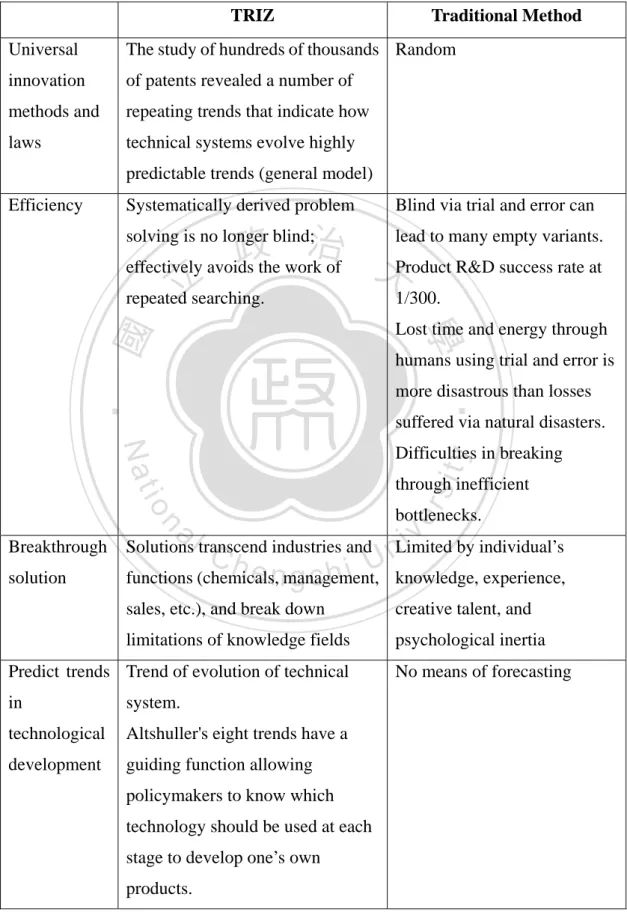
(24) . 2.2.. What is TRIZ. TRIZ is a way of thinking. TRIZ was designed for problem solving and provides a logical way of thinking for development of needed technical systems through overcoming contradiction and toward the increase of ideality in utilizing resources. (Valery Krasnoslobodtsev, 2006) A further benefit is that the use of TRIZ affects neural networks in the brain, allowing people to become more creative and approach problems from different angles (Kaplan 1996). TRIZ theory is a modern tool for scientific and technological innovation, and is an important weapon to enhance the national capacity for independent innovation.. 2.2.1.. Introduction. 立. 政 治 大. TRIZ is a Russian acronym for “The Theory of Inventive Problem Solving,” which was. ‧ 國. 學. originally developed by Genrich Altshuller. Altshuller’s (1988) early work on patents resulted in his classifying inventive solutions into five levels as displayed in Table 4. He found that only. ‧. sit. io. Table 4: Alshuller’s Levels of Invention. er. Nat. concept.. y. 1% of the patterns are pioneering inventions; the remainder use previously known ideas or. 1. Solution by methods well known within. n Levels of Invention. al. Standardization. Ch. Description. engchi. i n U. v. Percentage of Invention 32%. specialty 2. Improvement. Improvement of an existing system in the. 45%. same field 3. 4. 5. Invention inside. Improvement in existing system, usually. Technology. from other fields. Invention outside. New generation of a system, using science. Technology. not technology. Discovery. New system usually based on major discovery. 17. 18%. 4%. 1%.
(25) . Under the direction of Altshuller, research institutions, universities, and companies in the former Soviet Union assembled a TRIZ research team, which analyzed nearly 2.5 million high-quality invention patents from across the globe. They created the TRIZ theoretical system through drawing up laws for the evolution of technological development, resolving principles of innovation and laws in various types of technological and physics-based conflicts, and establishing various methods for using their solutions to actualize innovative development, calculation methods for a comprehensive theoretical system, and the principles and laws of a comprehensive interdisciplinary field. Therefore, it may be said that TRIZ is based on patterns in the patterns database.. 政 治 大. TRIZ is estimated to have been taught to about 50,000 Russian engineers. In the early 1990s,. 立. the work started to be acknowledged in the West. Engineering schools in North America are. ‧ 國. 學. beginning to embrace TRIZ, given its ability to provide innovative solutions to technical problems in design, research and development, manufacturing, safety, reliability, and quality. ‧. control (Ideation/TRIZ Methodology 2001). In the foreseeable future, every Western engineering program will incorporate TRIZ into its curriculum. Business schools will likely. sit. y. Nat. follow engineering schools as the application of TRIZ expands into the area of solving non-technical problems. Moreover, the science of TRIZ includes the evolution of future. io. n. al. er. generations of systems. This knowledge is invaluable for developing business strategy, developing new products, and erecting patent fences.. Ch. engchi. 18. i n U. v.
(26) . 2.2.2.. The TRIZ Framework and Procedure for Solving Inventive Problems. The overall system framework of TRIZ is as shown in Fig. 3 (Altshuller, 1996; Terninko, 1998; Savransky, 2000).. 立. 政 治 大. ‧. ‧ 國. 學 er. io. sit. y. Nat. . n. a Figure iv l C 3 TRIZ System Framework n hengchi U. The core concept of TRIZ holds that innovation is not a flash of insight or random investigation, but rather, is due to the existence of a general law of problem solving. These laws and principles can tell us what methods and processes may be used for innovation and provide results with a degree of predictability and controllability. The TRIZ procedure for solving inventive problems is as follows: a) Confirm and explain problems: Filter the original engineering problem, search out the crux of the issue and items needing improvement, and attempt to confirm the issues in need of b) Formulate the problem: Search out technological conflicts; transform a number of technological conflicts without solutions into physical conflicts.. 19.
(27) . c) Summarize the problem: Create an S-Field model to implement an ideal solution for system problems; conduct engineering calculations and product tests on the system. d) Determine the final ideal results. e) List the resources available; search innovation databases for examples to get a sense of system evolution. f). Increase dynamism and controllability.. g) Increase the flexibility, usability, efficiency, and control of the system.. 2.2.3.. TRIZ Strength & Weakness. 政 治 大 capitalize on future trends立 and create products or services whose applications better suit In this era of the pursuit of change and novelty, if developers or R&D personnel are able to. ‧ 國. 學. consumers, they will bring great business opportunities and advantages to their companies. However, R&D personnel consistently lack a systematic method of forecasting trends. In the three hundred years since the industrial revolution, experts of all types have proposed nearly. ‧. 306 methods for technological innovation, of which 10 are in wide use.. y. Nat. sit. Traditional methods of innovation such as brainstorming, trial-and-error, the synaptic method,. er. io. mind mapping, lateral thinking, transplantation, association, exhaustion, simple deduction and. al. invention, comprehensive application, information integration, analogical innovation, or other. n. v i n psychological techniques cannot C create a sufficient volume of ideas within a desired period. hengchi U. A TRIZ-based computer aid application tool, however, can provide a sustainable and controllable method for stimulating the rapid production of high-quality ideas, and simultaneously integrate knowledge bases of innovation principles, system evolution laws, and principles of scientific technology to guide the production of high-level innovation. It also strengthens the powerful weapon of independent innovation efficiency. Table 5 comprises a comparative list of traditional innovation methods versus TRIZ.. 20.
(28) . Table 5: Collated by the Author TRIZ. Traditional Method. Universal. The study of hundreds of thousands Random. innovation. of patents revealed a number of. methods and. repeating trends that indicate how. laws. technical systems evolve highly predictable trends (general model). Efficiency. Systematically derived problem. Blind via trial and error can. 治 lead to many empty variants. 政 effectively avoids the work of 大Product R&D success rate at 立searching. repeated 1/300. solving is no longer blind;. ‧ 國. 學. Lost time and energy through humans using trial and error is. ‧. more disastrous than losses suffered via natural disasters.. Nat. through inefficient bottlenecks.. n. al. er. io. sit. y. Difficulties in breaking. Ch. i v by individual’s Limited n U. Breakthrough. Solutions transcend industries and. solution. functions (chemicals, management, knowledge, experience,. engchi. sales, etc.), and break down. creative talent, and. limitations of knowledge fields. psychological inertia. Predict trends Trend of evolution of technical in. system.. technological. Altshuller's eight trends have a. development. guiding function allowing policymakers to know which technology should be used at each stage to develop one’s own products. 21. No means of forecasting.
(29) . TRIZ. Traditional Method. Can be. a. Can codify the implicit process. Only suited for specific people. extended and. of invention. with some experience or. universalized. b. Teachable. specific expertise. c. Similar contradiction and problem-solving principles that repeat in different field can be referenced. d. 4. Make invention available to. 政 治 大 of intelligence 立 anyone with a reasonable amount. ‧ 國. 學. Previous methods for innovation consist merely of integration of scattered experiences of innovation from human life, with a very low rate of converting innovative thinking into. ‧. innovative problem-solving methods. Traditional methods of innovation, such as trial and error, brainstorming, and the synectics method, are easily susceptible to limitations based on the. y. Nat. sit. background, knowledge, and ability of the designers themselves. In terms of application, these. er. io. methods lack efficiency and are not systematic. The TRIZ methodology, a set of technological. al. v i n C h development butUalso can create product models for capable of forecasting technological e n g c hofi final products and design development, forecasting results, can aid in the improvement n. innovation theories produced via the analysis of a large volume of global patents, is not only. possesses uses for guiding product innovation, and can help developers or researchers to improve product technology or develop new applications. The principles of TRIZ form a system that can effectively guide personnel through sequential rule-based innovation activities and foster creative thinking to produce a more integrated and meaningful program of innovative problem solving. One of the unique properties of TRIZ is its integration of technical knowledge and design concepts: “When you encounter a problem, you can go to the patent knowledge base to find a possible solution, and don’t need to wrack your brains” (Marry, 2008, p.43).. 22.
(30) . A further benefit is that the use of TRIZ affects the neural networks in the brain, allowing people to become more creative and approach problems from different angles (Kaplan 1996). The main benefits that can be realized by using TRIZ are: a) Improves the initial definition of problems – thus allowing for better solutions. b) The generation of creative and innovative solutions in a very efficient manner. c) It reveals how product design and technologies will evolve in time. d) TRIZ can be used to improve on current designs. e) Helps create a culture of innovative thinking – enhancing current practices. f). 政 治 大. Gives awareness of access to knowledge bases (i.e., patent databases).. g) Improves quality, reliability, and safety (e.g., by getting it “right-first-time”).. 立. h) Greater customer satisfaction.. j). Cost savings.. ‧. ‧ 國. Time saving.. 學. i). Other benefits include: 1) TRIZ delivers systematic, guaranteed innovation and creativity, 2). y. Nat. TRIZ helps to understand the problem and all its solutions, 3) TRIZ simplifies systems to. n. al. er. io. psychological inertia.. sit. maximize benefits and minimize cost and harm, and 4) TRIZ helps us overcome. Ch. i n U. v. While TRIZ as a method for innovative design has received a great deal of attention from. engchi. design engineers, there is no theoretical method to date that can be said to be flawless and without shortcomings – and TRIZ is no exception. How can designers properly find conflicting parameters in engineering technology problems and use a contradiction matrix to solve innovation issues? It is rare to see people using a matter-field method to solve innovation problems – what are its suitable opportunities? Relatively experienced users may find that a contradiction matrix has several blank array elements, that is, rules that lack suggestions. Furthermore, the tools of TRIZ are numerous. It is not an easy task to help users to understand well the tools and use them fully and intuitively. Moreover, engineer managers cannot allow R&D personnel to take leave from their work to receive one to two months of specialized training, and engineers have no way of mastering the. 23.
(31) . tools of TRIZ in very short training courses. Despite this, the invention principles of TRIZ have been successfully used by expert researchers to produce innovative results in a number of fields. These cases have demonstrated the general significance of these tools and their important reference value for guiding innovation in various fields.. 2.2.4.. TRIZ Relative Research. TRIZ has become “a system for creative thought which has grown to include applications in management sciences, education, business, marketing, social and political issues, pure science, biology, etc.” (Kaplan 1996, p. 26). TRIZ is primarily used in the initial phase of research and. 政 治 大 However, during actual production, 立 they suffer from conditional limitations and are unable to design. Many designers and researchers commonly generate great ideas when doing their work.. ‧ 國. 學. achieve their design goals. Using TRIZ allows one to first eliminate these limiting circumstances and avoid a great deal of unnecessary experimentation.. ‧. The great number of foreign and Taiwanese studies of TRIZ includes the continued improvement of TRIZ utilization methods consist of interdisciplinary applications for product. y. Nat. sit. innovative design, patent evasion, development and deployment, improvements to the. er. io. manufacturing process and product quality, the service industry, and strategies for business. al. operations. There are already numerous TRIZ applications and case studies to be found in this. n. v i n body of research. These have identified tools and industries to which these C h valuable TRIZ U i e h ngc applications may be expanded: 1.. Research applications for R&D personnel to use TRIZ in patent deployment:. The theory and tools of TRIZ have benefits for patent avoidance, patent innovation, and patent deployment. The path of technological evolution provides accurate forecasting of trends in the development of future technological systems. TRIZ benefits companies through combining the laws of the S-curve system, achieving a reasonable deployment of technological patents, and strengthening the prevention and evasion of the risks of patent infringement. Through its optimization of patent use and strengthening of patent protection, the benefit to companies is maximized.. 24.
(32) . With reference to the 37 trends of evolution proposed by TRIZ theory scholar Darrell Mann, Cai Yuanhao (2012) used an experimental phase to verify the efficiency of various evolutionary patent systems. Results confirmed the utility of classification standards in these systems. Zhuo Beixun (2012) used an S-curve analysis and engineering system evolution in an integrated patent mapping analysis with TRIZ to discuss the present and future development of solar power semipermeable membrane technology. By collecting products in other fields with applications for solar power semipermeable membranes and applying a TRIZ method, the goal of product innovation was achieved. Gu Shaoting (2010) used an S-curve analysis with a 3 × 3 matrix to assist in patent trend analysis, and conducted a patent technology mapping analysis. 治 政 大 analysis were used to bolster the depth and breadth of technological deployment, and integrate 立 principles of numerical applications into its model of patent deployment. The universality of using evolution and science/effect. In addition, a TRIZ function property analysis and conflict. ‧ 國. 學. patent evasion methods and TRIZ invention principles were compared to establish a comprehensive patent deployment strategy. Finally, a complete deployment procedure was. ‧. created. By providing companies with a new technique for R&D, this procedure was able to deliver a systematic method of conducting patent deployment.. sit. y. Nat. Optimal applications of TRIZ in the management process :. io. er. 2.. al. n. v i n C hYao Zhengsong (2008) analytical tools also suit other fields. e n g c h i U used TRIZ and its procedures to provide case studies of possible future evolutionary directions or programs of innovation for Although TRIZ is based on the integration of technology and patents, its basic thinking and. human resource manager activities, which serve as a reference for company policymakers. 3.. TRIZ in commercial operations and company strategic management. Atsuko Ishida (2003) changed a TRIZ mechanical concept into a business concept via the use of 40 inventive principles and a contradiction matrix to create innovative business models and products. As a result, he found that TRIZ could be effective for systematic business solution development.. 25.
(33) . Darrell Mann (2004) proposed 32 types of business evolution trends for management, applied these to business operations, and provided them as a reference for policymakers. As companies encounter difficulties in operations or market competition, managers must think hard about their business path to pursue breakthroughs and transformation, and consider the Taiwanese industry environment and Chinese investment. They must also consider necessary strategies in terms of organizational operations (production), to correspond to the company’s deployment and improve its related operations issues. Wang Guoxing (2012) used TRIZ as a basis with tools such as a contradiction matrix and ideal assessment, employed the 39 TRIZ engineering parameters and 40 TRIZ innovation principles to transform TRIZ management parameters, and. 政 治 大. applied these to his business environment and assessment of business operations strategies.. 立. Innovative product design:. 學. ‧ 國. 4.. The TRIZ method contains 40 Inventive Principles, 13 of which are suited for product model design, providing a complete tool for thinking through product form. Therefore, several large. Nat. y. ‧. consumer products companies have made investments in TRIZ.. sit. The TRIZ process model for the development of concepts in product design and development. al. er. io. can provide company decision makers with a means for selecting an optimal design program for. n. their substantive benefit. For example, in the PC industry, the problem of heat dissipation for. Ch. i n U. v. NB products is very critical. Xiao Wanjin (2012) used the innovation R&D mechanisms of. engchi. QFD, DFMEA, and TRIZ to comprehensively address the main problems in heat sink systems, confirm the direction of R&D innovation, and provide future researchers with a directional and theoretical data-based evaluation method. The results included the cutting down of product development time, strengthening of product competitive ability, and avoiding unnecessary waste. Liu Shengming (2012) combined QFD with TRIZ for R&D innovation in cell phone mechanisms. In addition, Cai Zhenyu (2012) conducted an evolutionary analysis for computer mouse devices and their market trends, and used TRIZ innovation theory and analytic network process (ANP) to create a concept-evaluation procedure model for product design and concept development. For client-end product specifications, convergence and transformation parameters were used as. 26.
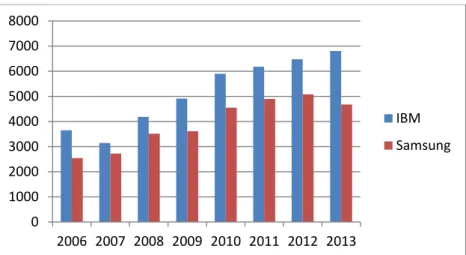
(34) . design parameters; then the theory of inventive problem solving was used as a tool for examining conflicts in product design, and the resultant innovation concepts were used for network infrastructure. Finally, an ANP method was used to compare the desired weight for evaluating and determining product concepts (Cai Zhenyu, 2012). 5.. Applications for improving product and manufacturing quality:. Using a contradiction matrix to confirm and discover conflicting technological bottlenecks of a product, when it does not result in the system being more complex, produces minimal changes while resolving a technological conflict. In Taiwan, in addition to its primary PC assembly. 政 治 大 the results of a case study of conflicts in the manufacturing process of semiconductor wafers to 立 industry, another important high-tech industry is semiconductors. Zeng Chaoquan (2008) used. demonstrate the feasibility of TRIZ innovation results. Guo Yuzhi (2008) used TRIZ tools,. ‧ 國. 學. followed by Taguchi or design optimization, to obtain a set of optimal parameters, and then used product optimization to improve the quality of the manufacturing process, solving a. ‧. delamination problem in lead frame components.. y. Nat. Process and method of integrating TRIZ with other methods :. io. sit. 6.. n. al. er. No single tool is capable by itself of solving all problems in the product design process.. i n U. v. Therefore, study and analysis of the pros and cons of various tools (such as Six Sigma, lean. Ch. engchi. production, QFD, TOC, Taguchi method) and their interrelationships are needed to develop a method that integrates two or more types of theory, and provides a cautious and detailed design procedure (Terninko, 1998). Samsung has proposed the Samsung Design for Six Sigma (DFSS), that is, the traditional Six Sigma paired with 3T (technical roadmap, technical tree, and TRIZ). Using a technology mapping application, Samsung and its customers together plan the future direction of product development and determine the product strategy. Using a technology tree application, Samsung derives several core technologies that will be needed by future technology, and uses a TRIZ application to solve quickly the various problems encountered in the process of developing these technologies. This is the difference between Samsung’s R&D innovation and traditional DFSS, and is the reason why Samsung calls this process method Samsung DFSS. 27.
(35) . 7.. Applications for lowering costs:. Samsung used TRIZ to reduce components in DVD readers by 38% and reduced the cost of each component by USD 3.7, leading to an annual savings of USD 26 million and great economic benefits. 8.. Product technology forecasting:. The point of the S-curve of product evolution is to get us to think about the next step in the lifecycle. Based on analysis results, we arrived at a corresponding decision: to improve the. 治 政 大created reference cases for modeling method for technology forecasting. Zhou Junhong (2011) 立 the technological evolution of cell phones to aid designers with specific cases and to inspire. existing system or develop a new one. The strong functionality of TRIZ makes it an effective. ‧ 國. 學. new design concepts by tapping innovation principles and technology evolution models. By combining the concepts of innovation principles and technology evolution modeling with TRIZ. ‧. tools, a systematic method for product innovative design is created. Using systematic problem. er. io. 9.. sit. Nat. effectively suggesting design and improvement programs.. y. analysis, this aided designers when developing products and product improvements by. Brand strategic development:. al. n. v i n Xu Minzhi used the positive andCnegative of a TRIZ 39 contradiction matrix, its h e n parameters hi U c g corresponding 40 principle solutions, and ARIZ to infer problems in the four steps of the brand value chain and discover a branding strategy that meets the needs of Taiwan. In the past, technical applied research materials have been more numerous than those that are non-technical. However, as can be seen from the database of doctoral theses in the National Library, there have been more and more theses on non-engineering TRIZ applications in recent years. The focus has been on management and services, such as Wen Junjie’s (2012) Analysis of Patent Management Strategy using TRIZ, Liu Yuzuo’s (2012) The Application of TRIZ 40 Innovation Principles for Automotive Industry Reservation Service, Lin Ruchen’s (2012) Using Kano and TRIZ to Investigate the Mobile Dining Car Service Quality Strategy, and Chen. 28.
(36) . Shiping’s (2012) Using Kano and TRIZ to Investigate the Mobile Dining Car Service Quality Strategy. After more than 60 years of research and practical application, TRIZ has proved to be a highly efficient and reliable systematic approach to creative thinking and innovative design. TRIZ can be used individually to solve specific problems but also has delivered good results when used with other tools such as Six Sigma, lean production, QFD, TOC, and the Taguchi method.. 2.3.. TRIZ Worldwide Development Status. 政 治 大 research with TRIZ training, and some universities have integrated TRIZ engineering 立 education into their curriculums. There are more than sixty worldwide TRIZ associations or Currently, the United States, Britain, France, Japan, and other 25 countries have carried out. ‧ 國. 學. institutions. According to TRIZ Journal’s survey, more than one hundred of the world's well-known companies are using TRIZ, including Dupont, 3M, HP, Honeywell, Ford, Toyota,. ‧. BMW, Samsung, Intel, LG, Motorola, GE, and NASA. Intel has been utilizing TRIZ for manufacturing process innovation since 2003. Intel realizes the advantage of TRIZ as one tool. y. Nat. sit. to pursue the applied science of innovation and expand their industry leadership beyond. er. io. product innovation and into manufacturing improvement. Intel even produced an internal. al. v i n the execution of TRIZ. This C paper describes the U h e n g c h i TRIZ Expert Field Guide’s content, methodology, and utilization within Intel. Samsung uses technical roadmap, technical tree, and n. 80-page Intel TRIZ Expert Field Guide intended to improve standardization and efficiency in. TRIZ to create the second largest number of U.S. patent applications. South Korea is currently the most successful country in terms of importing TRIZ. Benefitting from positive geopolitical relations with the Soviet Union, South Korea was exposed to TRIZ very early. Samsung, LG, Hyundai-Kia, and the Korean traditional industry leading steel company, POSCO, educated and encouraged employees to learn and apply TRIZ. POSCO created an international institute of TRIZ to educate employees, because after POSCO phased in TRIZ, its R&D spending decreased more than 10 billion U.S. dollars, and its patent application volume increased 2.4 times in 2010 compared to 2009. KIPO (Korean Intellectual. 29.
(37) . Property Office) and POSCO signed a memorandum to use POSCO’s international TRIZ organization to establish TRIZ schools.. 2.3.1.. How did SamSung apply TRIZ. Since Samsung implemented TRIZ, its volume of patent applications has been continuously increasing, as shown in Fig.4. It ranked second on the list of ten largest U.S. patent applicants between 2006 and 2013. In the U.S., an inventor may apply for a patent on any human-made object. In Europe, however,. 政 治 大 Samsung’s European patent applications reached a record-breaking 2800. This not only 立 entailed it reaching the number one spot in Europe, but the company’s total of 638 patent. only technological innovation that has engineering significance can apply for a patent. In 2013,. ‧ 國. 學. applications in the field of computer technology in 2013 was five times that of Apple, with total patent applications reaching 10 times that of Apple.. ‧. For two years in a row, Samsung has been the company with the largest number of European. Nat. sit. y. patent applications. The company stated, “Our patent applications are based on our investment. io. er. in R&D, and our untiring pursuit of innovation. We will continue contributing to the development of the industry, and continue bringing more benefit to customers.” The large. n. al. i n U. v. discrepancy in the number of European patent applications between Samsung and Apple. Ch. engchi. originates to a certain degree in Samsung’s product line matrix being more extensive, but also shows that Samsung is actively employing a defensive strategy.. 30.
(38) . 8000 7000 6000 5000 4000. IBM. 3000. Samsung. 2000 1000 0 2006 2007 2008 2009 2010 2011 2012 2013. 政 治 大 Samsung phased in TRIZ in 1997. By using TRIZ for technical development, Samsung saved 立 approximately $1.5 billion and successfully applied for 52 patents in 2003. (3) Samsung Figure 4: Comparison of U.S. Patent Applications Obtained by Samsung and IBM. ‧ 國. 學. continued to promote the application of TRIZ in 2007, gaining approval of 60 U.S. patents. Samsung has been ranked second in the world on patent approvals. It has rapidly increased its. ‧. number of patents and reduced its development lead-time gap, improving its time-to-market. y. Nat. compared to other technology leaders in its field, in some areas rating close to or above the. sit. world's other advanced-level companies. Samsung's president, Zheng long Li, said that TRIZ. n. al. er. io. saved Samsung in 2005.. Ch. i n U. v. Samsung Electronics Corp is one of the most successful companies in implementing TRIZ. engchi. methodology in high-tech projects. Samsung Electronics Corp. uses TRIZ in many different industry product lines: semiconductor, LCD, mobile phone, telecommunication network, digital media (SDI), home appliance, and its R&D institute of technology (SAIT), which supports all corporation groups. Table 6: TRIZ activities at Samsung Year 1997. Activity Six Sigma was started at Samsung SDI by CEO Sun Wook. Samsung invited TRIZ experts for internal training. 1998. Samsung Electronics (SEC) invited Royzen for TRIZ seminar & test. 31.
(39) . Year. Activity problem. 1999. Samsung SDI contracted with Russian expert Vasil Leniachine. It also contracted with Chechurine for translation from Russian to English. 2000. Samsung SAIT (Samsung Advanced Institute of Technology) contracted with Nikolai Khomenko & Nikolai Shpakovsky. Starting in June, Khomenko visits 2-3 times per year for education. Shpakovsky works full time.. 2002. 政 治 大 for TRIZ立 online engineering. Worked with Russian expert & SAIT TRIZ expert to develop software. 1. SEC (Samsung Electronics) invited four more Russians. This was decided directly by the CEO. 學. ‧ 國. 2001. 2. SEC Started innovation master program. ‧. 2003. Samsung Electronics Mechanics (SEM) contracted with Russian. y. Nat. expert Kini. 2006. 20,000 people complete online training course. er. al. v i n C h bigger result andUTRIZ education for all engineers Samsung; basis for engchi n. 2007. sit. Phased in real case & program study. io. 2004. TRIZ introduced education for all directors in the R&D department of. Samsung internal sets up TRIZ department to solve engineering design problem and also be a TRIZ training department 2008. Interest in Business TRIZ, Online Non-Technical course. Good results at LG, LS Cable, Hyundai Auto & medium-sized companies. 2009. More TRIZ results & TRIZ experts at international TRIZ conferences. From the above table 6, we can see that Samsung phased in TRIZ in three stages & missions. In the first step, TRIZ experts consulted on solving a breakthrough problem. Although a field engineer can have more than 10 years’ experience in his field, mental inertia may exist. Therefore, cooperation with a TRIZ expert can reduce the time to solve a problem. The second. 32.
(40) . step is educating field engineers in solving difficult problems. Although a TRIZ expert’s ability is superior, without deep understanding of an engineering system, there will not be good or practical results. On the other hand, if field engineer can use TRIZ effectively, the result should be superior. Samsung made TRIZ-1, 2, 3, 4, and 5 courses. TRIZ-1 is only a one-day short course to help engineers acquire on-line education. TRIZ-4’s total education time is two months, and does not interfere with an engineer’s daily job. The basic course, comprising TRIZ-1, 2, 3, and 5, is 120 hours. The third step involves research based on a practical TRIZ experience for the company. TRIZ theory must develop continuously. The best battlefield is engineering. TRIZ research will be done naturally and automatically if the company can use TRIZ efficiently.. 2.3.2.. 政 治 大. Problem Introducing TRIZ to Taiwan. 立. ‧ 國. 學. There are reported cases of companies’ successful implementation of TRIZ worldwide. TRIZ was introduced to Taiwan at roughly the same time as it was to Japan and South Korea, but its popularization in Taiwan has not matched the levels in the other two countries. Xiao Yongjin. ‧. (2009) held that this was primarily due to the benefits of TRIZ being non-obvious, and that the. y. Nat. fundamental reason may be examined in terms of the nature of company employees,. er. io. sit. environment, and culture together with TRIZ issues and education methods.. al. First, employee character can be investigated in terms of employees’ studying capabilities,. n. v i n degree of proactivity, and educational the educational background, the C h history. The greater U i e h n environment, gc better. Second, in terms of culture and if a company makes no progress integrating TRIZ into their current design process, then TRIZ has no way of achieving implementation goals. Third, in terms of TRIZ consulting, Taiwan lacks a sufficient population to attract serious TRIZ instructors able to lead companies in drills; thus, it is not easy for companies to implement TRIZ and achieve results. Fourth is also a primary reason for general difficulties in spreading TRIZ, namely, TRIZ teaching methods and materials. TRIZ teaching methods and materials are a subject discussed by global TRIZ scholars; both form a huge impediment to the spread of TRIZ. The TRIZ Journal, TRIZCON, and TRIZFUTURE have twenty to thirty articles discussing these types of issues. Global TRIZ experts each have their own TRIZ teaching materials,. 33.
(41) . despite there being little or no difference between them. However, this results in many people not knowing where to start. Furthermore, compared with English language TRIZ instructional materials, Chinese language materials appear to be rare. Xiao believes that successful TRIZ implementation factors include company executives actively deciding to invest a large amount of resources. In addition to TRIZ training courses, software, and books, it is important to change the company’s environment and culture. At the same time, TRIZ consultants must constantly improve teaching materials, teaching methods or, more effectively, help companies carry out TRIZ projects.. 立. 政 治 大. ‧. ‧ 國. 學. n. er. io. sit. y. Nat. al. Ch. engchi. 34. i n U. v.
數據
+7

相關文件
Reading Task 6: Genre Structure and Language Features. • Now let’s look at how language features (e.g. sentence patterns) are connected to the structure
FMEA, fail mode and effective analysis, which is one of a common method to analysis and find out the fail mode of the product is to dig out the unobservable problem or hidden
This research is based on the TRIZ theory, try to enhance the function of pencils and personalize the design1. TRIZ theory includes contradiction matrix, physical contradictions, and
Abstract - The main purpose of this study is applying TRIZ theory to construct the Green Supply Chain management (GSCM) strategies for the international tourist hotel.. Based on
The main purpose of this study is applying TRIZ theory to construct the Green Supply Chain management (GSCM) strategies for the international tourist hotel1. Based on the
謝函亘﹝32﹞以衣夾為研究對象,採用 TRIZ 創新之方法,結合綠色設計(Green
Keywords: : : :Rolling Door, Insulation, TRIZ, Goldfire Innovator.. In the present, most of the rolling door products in the market are made of steel or
TRIZ 理論便因應而生,TRIZ 理論早期被前蘇聯視為機密,前蘇聯解體後有許多研究 TRIZ 的專家陸續移民到西方,TRIZ
