Microstructure and magnetic properties of nanocomposite FePtCr–SiN
thin films
P. C. Kuo and S. C. Chen
Institute of Materials Science and Engineering, National Taiwan University, Taipei 106, Taiwan
Y. D. Yao
Institute of Physics, Academia Sinica, Taipei 115, Taiwan
A. C. Sun and C. C. Chiang
Institute of Materials Science and Engineering, National Taiwan University, Taipei 106, Taiwan
关共FePt兲100⫺xCrx兴100–␦–关SiN兴␦ nanocomposite thin films with x⫽0 – 25 at. %, and ␦ ⫽0 – 30 vol. % were fabricated on a natural-oxidized Si共100兲 substrate by dc and rf magnetron cosputtering of FePt, Cr, and Si3N4 targets. The thickness of the films was kept at 10 nm in order to examine the possibility for applying in high-density magnetic recording media. Transmission electron microscopy共TEM兲 and electron diffraction analyses indicated that the face-centered-cubic 共fcc兲 ␥-phase FePt, body-centered-cubic 共bcc兲 Cr, and amorphous SiN coexisted in as-deposited films. The as-deposited films were annealed in vacuum between 350 and 750 °C for 30 min, and then ice-water quench cooling, in order to transform the soft magnetic fcc␥-FePt phase to the hard magnetic face-centered-tetragonal共fct兲␥1phase. Cr was added to inhibit the FePt grain growth, and was observed by TEM and energy disperse spectrum analysis in the grain surface area of FePt grains. The TEM observation indicated that the structure of the film was an amorphous SiN matrix with FePtCr particles dispersed in it. The particle size of FePtCr in annealed film was increased with the annealing temperature but decreased with the increase of SiN and Cr contents. Magnetization measurements indicated that the optimum condition for high-density magnetic recording purpose of the film was found with x⫽10 at. % and␦⫽15 vol. %, annealing at 600 °C for 30 min. The average grain size of the FePtCr in this film is about 9.5 nm, the saturation magnetization is 450 emu/cm3, in-plane coercivity is 3.7 kOe, and in-plane squareness is about 0.75. © 2002 American Institute of Physics. 关DOI: 10.1063/1.1453352兴
I. INTRODUCTION
FePt related magnetic thin films with their high coerciv-ity Hc, relative good remnant magnetization Mr, high mag-netocrystalline anisotropy Ku, small grain size, good corro-sion resistance, and large energy products (BH)max are attractive media for extremely high-density magnetic record-ing applications.1– 4To these metallic films, the most signifi-cant problem for magnetic recording media application is the noise that results from magnetic exchange coupling between the grains.5The key issue to reducing its noise is the reduc-tion of the intergrain magnetostatic and exchange interac-tions. Therefore, composite granular films with isolated mag-netic grains dispersed in a nonmagmag-netic matrix are expected to become more suitable for extremely high-density record-ing media.
Previous investigations have shown that the magnetic properties of the FePt films are sensitive to process parameters,6the media noise can be improved by dispersing magnetic FePt grains into a nonmagnetic SiN matrix,7 and the grain size can be reduced by the addition of Cr into FePt film.8 In this work, the effects of Cr content, SiN volume fraction, and annealing temperature on the magnetic proper-ties and particle size of the nanocomposite FePtCr-SiN thin films are reported.
II. EXPERIMENT
关共FePt兲100⫺xCrx兴100⫺␦–关SiN兴␦nanocomposite thin films with x⫽0 – 25 at. %, and ␦⫽0 – 30 vol. % were fabricated on a natural-oxidized Si共100兲 substrate by dc and rf magne-tron cosputtering of FePt, Cr, and Si3N4 targets. The sub-strate is rotated at 75 rpm in order to attain uniform compo-sition of the film with a thickness of 10 nm. The magnetic films were covered by a thin Si3N4 layer to protect its oxidation.
The chamber base pressure was approximately 3 ⫻10⫺7 Torr and films were deposited under an argon pres-sure of 7 mTorr. The deposition rate was about 0.3 nm/s. The as-deposited film was sealed in quartz capsules and then postannealed in vacuum at various temperatures for 30 min, and the film was quenched in ice water after annealing.
The film microstructure was observed by transmission electron microscopy共TEM兲 and the average grain size of the film was measured by the TEM bright field image. Magnetic properties at room temperature were measured by a vibrating sample magnetometer and a superconducting quantum inter-ference device, with maximum applied fields of 13 and 50 kOe, respectively. Composition and homogeneity of the films were determined by energy disperse spectrum 共EDS兲. The film thickness was measured by an atomic force microscope.
JOURNAL OF APPLIED PHYSICS VOLUME 91, NUMBER 10 15 MAY 2002
8638
0021-8979/2002/91(10)/8638/3/$19.00 © 2002 American Institute of Physics
III. RESULTS AND DISCUSSION
Figure 1 shows the TEM bright field images and the electron diffraction pattern of 共a兲 the as-deposited 关共FePt兲90Cr10兴85–关SiN兴15 film and共b兲 the film after anneal-ing at 600 °C for 30 min. The FePt grains in deeper colors are dispersed in the SiN matrix in lighter or approaching white colors. The size of the FePt grains is about 2 nm in共a兲 and 9.5 nm in 共b兲. The electron diffraction pattern on Fig. 1共a兲 shows that the crystal structure of fcc␥FePt and bcc Cr phases have developed in the as-deposited film, and they transform to ␥1-FePt, FeCr, CrPt, and Cr phases after an-nealing, as shown in Fig. 1共b兲. The SiN diffraction rings are not observed in both cases, this means that the SiN is in an amorphous state.
From the TEM-EDS analyses of the different areas of the enlarged grain of the film, which annealed at higher tem-perature and longer times, we observed that Cr existed mainly in the FePt grain surface area and grain boundary.9As shown in Ref. 8, the grain size of FePt in FePt metal film will grow up after annealing, and it can be reduced by the addi-tion of Cr. In the FePt–Cr-SiN system, the grain size de-creases with increasing Cr content and inde-creases with in-creasing annealing temperature. Figure 2 shows the average grain size as a function of annealing temperature Tan for various 关共FePt兲90Cr10兴100⫺␦–关SiN兴␦ films with ␦ up to 20 vol. %. It shows that the SiN can also restrain the growth of FePt grains.
Figure 3 shows the variations of in-plane coercivity Hc储
with annealing temperature of the 关共FePt兲100⫺xCrx兴85– 关SiN兴15 thin films with different Cr contents. When Tan ⬎400 °C, the Hc储 value of the (FePt)85-关SiN兴15 thin film (Cr⫽0 at. %) will step up rapidly as Tan is increased. Hc储 value reaches its maximum value of about 10 kOe at
Tan⬃700 °C, and then steps down quickly as Tankeeps go-ing up. When Tan⬍700 °C, Hc储 increases as Tanis increased because the soft magnetic ␥-FePt phase transforms to the hard magnetic ␥1-FePt phase, which has an extremely high magnetocrystalline anisotropy constant. When Tan⬎700 °C, the growth of␥1-FePt grains and the reaction of FePt with Si substrate will cause Hc储 to decrease as Tan is increased.7 At Tan⫽600 °C, the Hc储 value is 8 kOe for the
(FePt)85–关SiN兴15 film (Cr⫽0 at. %) but it will drop to 3.7 kOe as Cr content increases to 10 at. %, because increase of Cr content inhibits the growth of FePt grains during anneal-ing and makes the grain size deviate considerably from the single domain size关which is about 90 nm 共Ref. 6兲兴 and some grains become superparamagnetic particles. Moreover, the diffusion of Cr into the FePt grain surface area and lowering the degree of the ordering ␥1-FePt phase will also decrease the crystal anisotropy constant of FePt. As shown in FIG. 1. TEM bright field images and the electron diffraction pattern of共a兲
the as-deposited关(FePt)90Cr10兴85–关SiN兴15film and共b兲 the film after
anneal-ing at 600 °C for 30 min.
FIG. 2. Variation of the average grain size with annealing temperature of the various关(FePt)90Cr10兴100–␦–关SiN兴␦ films; SiN contents of the films are 0,
10, 15, and 20 vol.%, respectively.
FIG. 3. Variations of Hc储 with annealing temperature of various
关(FePt)100⫺xCrx兴85–关SiN兴15films; Cr contents of the films are 0, 3, 6, 10,
15, 25, and 30 at. %, respectively.
8639
J. Appl. Phys., Vol. 91, No. 10, 15 May 2002 Kuoet al.
Fig. 1共a兲, we can see that only the␥-FePt and Cr phases were found in the as-deposited film, but they transform to
␥1-FePt, FeCr, CrPt, and Cr phases after annealing at 600 °C for 30 min, as shown in Fig. 1共b兲. This indicates that some Cr are diffused into FePt grains.
Figure 4 shows the relations between saturation magne-tization Msand Tanof the关共FePt兲100⫺xCrx兴85–关SiN兴15 films with different Cr contents. We find the Ms value of (FePt)85-关SiN兴15 film (Cr⫽0 at. %) decreases as Tan is in-creased because of the reaction of the magnetic layer with the Si substrate at higher Tan.7On the other hand, Cr is an antiferromagnetic substance, and the increase of Cr will di-lute the Ms values of the film. The Ms value of the (FePt)85–关SiN兴15 film (Cr⫽0 at. %) which annealed at 600 °C, is about 490 emu/cm3, but it will decrease to 450 emu/cm3as Cr content increases to 10 at. %.
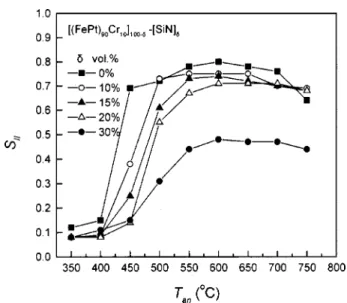
Figure 5 shows the relationships between in-plane squareness S储 and Tan of the 关共FePt兲90Cr10兴100⫺␦–关SiN兴␦ thin films with different SiN contents; they have the same tendency as that of Hc储 vs Tan. The maximum S储 occurs at Tan⬃600 °C. The S储 at Tan⫽600 °C are about 0.8 and 0.75 for the (FePt)90Cr10 film (SiN⫽0 vol. %) and 关共FePt兲90Cr10兴85–关SiN兴15 film, respectively, but it decreases as SiN content is increased. It will drop to about 0.5 as SiN content increases to 30 vol. %. This indicates that the mag-netic easy direction of FePtCr particles is changed from the parallel film plane to random and the interparticle interac-tions are reduced as SiN content is increased. The S储 value
for randomly oriented noninteracting Stoner-Wohlfarth par-ticles is 0.5.10 This suggests that the magnetic FePtCr par-ticles in this film are almost randomly oriented and isolated by the SiN.
IV. CONCLUSION
FePtCr–SiN granular films consisting of the ordered fct FePtCr particles embedded in an amorphous SiN matrix have been successfully prepared. The particle size of FePtCr in annealed film was increased with annealing temperature but decreased with increasing SiN and Cr contents. A granular 关共FePt兲90Cr10兴85–关SiN兴15film with an Hc储 value of 3.7 kOe
and the magnetic particle size about 9.5 nm was obtained after annealing at 600 °C for 30 min. Its in-plane squareness is about 0.75. This FePtCr–SiN nanocomposite film can be a promising candidate for extremely high-density recording media.
ACKNOWLEDGMENT
This work was supported by the National Science Coun-cil of the Republic of China through Grant No. NSC 89-2216-E-002-053.
1M. H. Hong, K. Hono, and M. Watanabe, J. Appl. Phys. 84, 4403共1998兲. 2
T. Suzuki, N. Honda, and K. Ouchi, J. Appl. Phys. 85, 4301共1999兲.
3
J. A. Christodoulides, Y. Zhang, G. C. Hadjipanayis, and C. Fountzoulas, IEEE Trans. Magn. 36, 2333共2000兲.
4Y. N. Hsu, S. Jeong, D. E. Laughlin, and D. N. Lambeth, J. Appl. Phys. 89, 7068共2001兲.
5
J. G. Zhu, IEEE Trans. Magn. 29, 195共1993兲.
6C. M. Kuo, P. C. Kuo, and H. C. Wu, J. Appl. Phys. 85, 2264共1999兲. 7C. M. Kuo and P. C. Kuo, J. Appl. Phys. 87, 419共2000兲.
8P. C. Kuo, Y. D. Yao, C. M. Kuo, and H. C. Wu, J. Appl. Phys. 87, 6146 共2000兲.
9
S. C. Chen, P. C. Kuo, A. C. Sun, and C. C. Chiang共unpublished兲.
10C. P. Luo, S. H. Liou, and D. J. Sellmyer, J. Appl. Phys. 87, 6941共2000兲.
FIG. 4. Variations of Ms with annealing temperature of various
关(FePt)100⫺xCrx兴85–关SiN兴15films; Cr contents of the films are 0, 3, 6, 10,
15, 25, and 30 at. %, respectively.
FIG. 5. Variations of S储 with annealing temperature of various
关(FePt)90Cr10兴100⫺␦–关SiN兴␦films; SiN contents of the films are 0, 10, 15,
20, and 30 vol. %, respectively.
8640 J. Appl. Phys., Vol. 91, No. 10, 15 May 2002 Kuoet al.