
2005年和2019年史坦福大學畢業演講說服性修辭研究
167
0
0
全文
(2)
(3)
(4) ACKNOWLEDGEMENTS. Without the support and guidance of so many others, seeing this thesis as a milestone in my academic career would never have been a possibility. My appreciation extends to those who have been so kind as to assist in my research process. First and foremost, my heartfelt gratitude reaches to Dr. Schams, my adviser. During the period of my basic research, he not only imparted his wisdom and knowledge to my study, but also exhibited great patience with the blind spots that appeared during the development of my thesis; both in an effort to aid me in producing a more successful essay. In all gratefulness and humbleness, I would like to express my gratitude to all those who made it all possible for me to bring these ideas into something more solid, far above the level of brevity. I would like to convey my special thanks to Dr. Mei-Chen Chen, whose generosity of spirit presented me with unique insights that rendered the level of this research project more complete. Finally, I would also like to articulate my deepest gratitude to the other member of my Committee, Dr. David Goodman, who provided invaluable advice on my research work. My heartfelt thanks.. i.
(5) 摘 要 作為人類共有的智慧,文化和遺產的文物,語言自身存在的目的-不僅僅只為將語 言中的詞彙傳達給他人.其功能遠遠超出了詞彙,句法或文法規則所侷限的功能之外. 相反地,它可以給予激勵,啟蒙和培養他人使之其意願、心力投入到他們認為有真正 價值的作為中. 有關影響說服性修辭組成因素,本文的研究結果顯示,這些因素與喻詞,語態和人 稱指示詞的使用相關.就其相關性研究而言,它們因此對說服性修辭上的運用上具有 更進一步的影響,並突顯其語言學和修辭學間關連性上的特徵,尤其是在對比分析史 蒂夫·賈伯斯和蒂姆·庫克研究的相關語言成份中呈現出. 以“Stay hungry, stay foolish‖作為史丹佛大學畢業典禮演講致詞題目的短片,在 YouTube頻道類似性質的影片中,該其影片評論及點閱率高居第二. 當其它學者將 其研究價值置於非語言特質的商業魅力領導行為時.本文將其研究目標置於分析該 演講行為中的所傳遞說服性效果,並對比分析史蒂夫·賈伯斯和蒂姆·庫克中的演講 中所運用修辭手法與策略. 在此方面,籍由亞里士多德的修辭理論以及肯尼思.伯克提出的認同理論和戲劇 五要素架構,使我們能夠更好地理解和深入了解史蒂夫·賈伯斯的語言建構,特別是 與蒂姆·庫克的相關演講做一對比,以此反映其相關特徵.並期該分析研究之成果於 第二語學習者英文閱讀能力有所回饋,同時對於若在譯者、讀者而言更能深入了解演 講者與聽眾間的互動,透過訊息傳遞提升其溝通效果.. 關鍵詞:亞里斯多德修辭學三要素,認同理論,戲劇五要素.. ii.
(6) ABSTRACT Language, as an artifact of mankind-owned wisdom, culture and heritage, does not serve only one purpose- to convey lexical significance to others. Its functions go much further, beyond just a patchwork collocation of vocabulary, syntax and rules of grammar. Instead, it can inspire, motivate, and cultivate individuals to put forth their best effort into the work that they truly believe in and that they think is worthwhile. The factors concerned in this study involve the constituents of persuasive rhetoric, in which the findings of this study indicate that these factors pertain to the use of metaphors, modality and personal deixis. So far as the relevant research has shown, they therefore have a further impact on the deployment of persuasive rhetoric, underlining the correlation between linguistic and rhetorical features, in particular the contrast analysis of both Steve Jobs‘ and Tim Cook‘s discourse.. The video of Steve Jobs‘ speech entitled ―Stay Hungry, Stay Foolish‖ which he delivered at the 2005 commencement ceremony of Stanford University, is the second-most viewed college commencement speech on YouTube. While most other research studies may shift their focus to the discussion of linguistic properties, such as Steve Jobs‘ charismatic leadership in business management, the aim of this paper is to analyze the classic discourse which dedicates itself to the convincing power of language. iii.
(7) as a rhetorical act, as well as to determine which devices and tactics were embedded in both Steve Jobs‘ and Tim Cook‘s speeches. In this regard, the rhetorical triangle of Aristotle and the framework proposed by Kenneth Burke‘s Identification and Dramatic Pentad, when applied to this research, enables us to better understand and to gain in-depth insight into the way the features are used in Steve Jobs‘ speech and discourse constructs, particularly in comparison to Tim Cook‘s speech. This in turn can enhance second language learners‘ English reading comprehension ability. Not only can the results of this study benefit potential interpreters and translators but readers as well. Thus, it can help improve the quality of communication between the speaker and the recipient(s) as we understand and process the context.. Keywords: Aristotelian Rhetoric Triangle, Identification Theory and Dramatic Pentad.. iv.
(8) TABLE OF CONTENTS ACKNOWLEDGEMENTS ........................................................................................... i CHINESE ABSTRACT ................................................................................................ ii ENGLISH ABSTRACT ............................................................................................... iii TABLE OF CONTENTS .............................................................................................. v LIST OF TABLES ...................................................................................................... vii LIST OF FIGURES ..................................................................................................... ix CHAPTER ONE: INTRODUCTION ......................................................................... 1 Background and Motivation for the Study ................................................................. 1 Purpose of the Study................................................................................................... 4 Research Questions .................................................................................................... 6 Significance of the Study ........................................................................................... 8 Definition of Terms .................................................................................................... 9 CHAPTER TWO: LITERATURE REVIEW .......................................................... 14 The Reflection of Philosophy in Rhetoric ................................................................ 14 The Rhetorical Triangle-Modes of Persuasion ....................................................... 20 Modes of Persuasion-Ethos ..................................................................................... 23 Modes of Persuasion-Logos .................................................................................... 24 Modes of Persuasion-Pathos..................................................................................... 26 Summary ............................................................................................................................. 29 CHAPTER THREE: METHDOLOGY .................................................................... 31 Research Design ....................................................................................................... 31 Participants ............................................................................................................... 73 Instruments ............................................................................................................... 74 Data Analysis............................................................................................................ 75 CHAPTER FOUR: RESULTS AND DISCUSSION ............................................... 78 Results of Identified Prepositions and Image Schemas ............................................ 78 Results and Discussion of Modality ......................................................................... 82 v.
(9) Results and Discussion of Deixis ............................................................................. 86 Results and Discussion of Speaker Ethos ................................................................. 88 Results and Discussion of Identification .................................................................. 90 Results and Discussion of Dramatic Pentad ............................................................. 92 Results and Discussion of Rule of the Three............................................................ 93 CHAPTER FIVE: CONCLUSION ........................................................................... 95 Summary of the Study .............................................................................................. 95 Pedagogical Implications.......................................................................................... 99 Limitations and Reflections .................................................................................... 101 REFERENCES .......................................................................................................... 102 APPENDICES ........................................................................................................... 110 Appendix A 2005 Stanford Commencement Address by Steve Jobs ......................... 110 Appendix B 2019 Stanford Commencement Address by Tim Cook .......................... 116 Appendix C Deconstruction of the Nouns in Steve Jobs‘ Speech .............................. 122 Appendix D Deconstruction of the Verbs in Steve Jobs‘ Speech ............................... 124 Appendix E Deconstruction of the Adjectives and Adverbs in Steve Jobs‘ Speech .. 126 Appendix F Deconstruction of the Prepositions in Steve Jobs‘ Speech ..................... 127 Appendix G Deconstruction of the Pronouns in Steve Jobs‘ Speech ......................... 128 Appendix H Deconstruction of the Auxiliaries Verbs in Steve Jobs‘ Speech ............ 129 Appendix I Deconstruction of the Nouns in Tim Cook‘s Speech ............................... 130 Appendix J Deconstruction of the Verbs in Tim Cook‘s Speech ............................... 132 Appendix K Deconstruction of the Adjectives and Adverbs in Tim Cook‘s .............. 134 Appendix L Deconstruction of the Prepositions in Tim Cook‘s Speech .................... 135 Appendix M Deconstruction of the Pronouns in Tim Cook‘s Speech ........................ 136 Appendix N Deconstruction of the Auxiliaries Verbs in Tim Cook‘s Speech ........... 137 Appendix O The Image Schemas Recognition of Steve Jobs‘ Speech ....................... 138 Appendix P The Image Schemas Recognition of Tim Cook‘s Speech ....................... 148. vi.
(10) LIST OF TABLES Table 1 Rhetorical Devices with Four Dimensions ...................................................... 32 Table 2 The Objective and Breadth of This Research with the Relevant Fields .......... 33 Table 3 Descriptive Statistics in the Linguistic Components of Speech Contents....... 35 Table 4 Descriptive Statistic on Further Deconstruction of Nouns Used .................... 35 Table 5 Descriptive Statistics on the Use of Prepositions by Steve Jobs ..................... 37 Table 6 Descriptive Statistics on the Use of Prepositions by Tim Cook...................... 37 Table 7 Types of Image Schemas ................................................................................. 40 Table 8 Descriptive Statistics on Image Schemas in Steve Job‘s Speech .................... 41 Table 9 Descriptive Statistic on Image Schemas in Tim Cook‘s Speech..................... 42 Table 10 Types, Functions of Speech Modalities ........................................................ 44 Table 11 Descriptive Statistics on the Use of Modal Auxiliaries in Steve Jobs‘ Work .............................................................................................................. 46 Table 12 Descriptive Statistics on the Use of Semi-modal Verbs and ‗If‘ Conditions by Steve Jobs ................................................................................................. 46 Table 13 Descriptive Statistics on the Use of Modal Auxiliaries in Tim Cook‘ Work .............................................................................................................. 47 Table 14 Descriptive Statistics on the Use of Semi-modal Verbs and ‗If‘ Conditions by Tim Cook ...................................................................................................... 47 Table 15 Descriptive Statistics on Personal Deixis Used by Steve Jobs ...................... 50 Table 16 Descriptive Statistics on Personal Deixis Used by Tim Cook ...................... 51 Table 17 Descriptive Statistics on Verb Types of Steve Jobs and Tim Cook .............. 55 Table 18 Type, Kind and Individuality of Text: Decision-making in Translation ....... 62 Table 19 Pentad Model with Five Key Terms Outlined by Burk................................. 63 Table 20 Comparative Result of Prepositions Identified in Both Speech Contents ..... 79 Table 21 Comparative Result of Recognized Image Schemas ..................................... 80 Table 22 Comparative Result of Root Metaphor Identified in Both Speeches ............ 81 Table 23 Comparative Result of Modal Auxiliary Verbs in Both Speeches ................ 83 vii.
(11) Table 24 Comparative Result of Semi-modal Verbs and ‗If‘ Conditionals ................. 84 Table 25 Comparative Result of Personal Deixis Used by Steve Jobs and Tim Cook 86 Table 26 Comparative Result of Verbs Used by Steve Jobs and Tim Cook ................ 89 Table 27 Comparative Result of Identification Strategies by Steve Jobs and Tim Cook ………………………………………………………………………………90 Table 28 Illustrating the Dramatic Pentad with Five Key Terms for Contextual Analysis ......................................................................................................... 92 Table 29 Comparative Result for the Use of Rule of the Three in Both Speeches ...... 94. viii.
(12) LIST OF FIGURES Figure 1. Philosophy and Rhetoric in Argumentation................................................ 15. Figure 2. The Argumentation For the Good Reasons ................................................ 20. Figure 3. A Cross-Domain Mapping .......................................................................... 39. Figure 4. The Body in the Mind ................................................................................. 40. Figure 5. A Rhetorical Triangle Model ...................................................................... 56. Figure 6. The Dramatic Pentad of Five Key Terms ................................................... 65. Figure 7. Maslow‘s Hierarchy of Needs .................................................................... 68. Figure 8. Forms of Proofs Aristotle Rhetoric ............................................................. 70. Figure 9. The DIKW Model ....................................................................................... 76. ix.
(13) Chapter One Introduction Background and Motivation for the Study Historically speaking, great speeches such as ―I Have A Dream‖ and ―A Father‘s Prayer‖ by Martin Luther King and General MacArthur, respectively, were thought to be examples of great and inspiring speeches, in part because of the delivery of the speakers‘ own philosophical perspectives within the speeches expressed through the use of the speaker‘s rhetorical devices but also the strategies used by the speakers in adopting speeches connected either to ethical appeals or emotional resonance and logical coherence. These features employed in speeches engender a motivational response in potential audiences. The 2005 graduation speech delivered at Stanford University by Steve Jobs also reflects some significant features of those great speeches in history. The expression of Jobs‘ philosophical interest, through the usage of his style of rhetorical discourse, was also believed to have a significant effect on the mentality of an audience, particularly in relation to the motivational aspects. To signify these characteristics, a contrast analysis of the 2019 graduation speech delivered by Tim Cook at Stanford University will be provided.. 1.
(14) Such rhetorical devices as we see employed in Jobs‘ graduation speech represent invaluable wisdom and knowledge for the non-native English speaker. As we continue to carry out research through scientific methods of observing, understanding and analyzing these linguistic properties in relation to the specific construct of persuasive rhetoric, besides gaining the benefits of wisdom and knowledge gleaned from this study we can further enhance our comprehension of the interaction between the speaker and audience engaged in speech so as to develop our communication skills, particularly with regard to the use of English. Because of their real essence and the relevance of themes and crafts, the interaction between the audience and the style of the speaker empowers hearers to remember the content of speeches longer. Not that every speech delivered by various speakers becomes popular and influential (Kumar & Kumar, 2016). An imposing edifice of the stylistic speech delivered by Steve Jobs to graduates at Stanford University‘s 2005 commencement, which rendered quite an inspiring and epigrammatic parlance to the audience, was certainly a distinct watershed of an all-time difference in compliance with his previous comments made during presentations launching new Apple products. Opening with a compliment to the graduates (i.e., ―I am honored to be with you today from one of the finest universities in the world‖), Jobs infuses his utterance with humility by admitting that he failed to graduate from college. With just a few punch lines, he immediately captivates. 2.
(15) his audience and makes them more receptive to his message. Such a chemical change, brought about by its linguistic catalysis, can reach the great level of wonder that every elocutionist aims to reach. In this case, Steve Jobs is undoubtedly the perfect example. It is the characteristics of his utterances in the speech that can be construed in such a manner as to serve the functions of compliments, to provide support, to express gratitude (Wolfson, 1983, 1989) and to build positive feedback (Herbert, 1990; Manes, 1983). This was possible through an effect hatched by the ingenuity of what Jobs successfully conjured within his speeches through the use of humor, humility, and so on, to unravel the secrets to his philosophy when facing all sorts of life challenges, which was in essence his purpose in demonstrating the lesson that anyone can benefit in life. James Kirk once said, ―The more complex the mind, the greater the need for the simplicity of play.‖ Jobs simply shares three stories from his life which comprise the primary thrust of his message. The theme of the speech, accompanied by his rhetorical devices, enables Jobs to reach out and connect with the audience on a much deeper level. The ideas embedded in his philosophy towards life, which are structured in his speeches and in these lines underlying the theme as well as their connotations, are worth investigating more deeply. The present paper aims to analyze the body of Jobs‘ three life stories and the use of persuasive rhetoric to somehow make his speech comprehensible to everyone. In order to highlight the. 3.
(16) persuasive features found in Steve Jobs‘ speech (2005), this study will compare it to a speech by Tim Cooks delivered at Stanford University (2019).. Purpose of the Study Broadly acknowledged as a business behemoth and role model for many, Steve Jobs is a person whose vision and perspective often carry a huge weight that affects many other high-tech companies in all relevant manufacturing fields. Such effects are not only on portable product designs, mobile devices or all the other products used today, but also on humanity and culture, particularly the constructs of social significance and philosophical value to others. Steve Jobs, somewhat by nature, embraces the philosophy of simplicity and spares no effort in putting this into practice from the way he designs Apple products to his very own personal dress code and even to the delivery of his message. In contrast to Steve Jobs‘ former remarks advocating for Apple products at launch presentations, the delivery of his speech to the 2005 graduating class of Stanford University was filled with numerous persuasive features that give us keen perception of the dramatic difference between this speech and his previous presentations. This study will investigate the effects underlying quite a few of Jobs‘ distinctive and delicate linguistic elements evidenced through his use of rhetorical devices.. 4.
(17) In addition to personal authority, one of the significant features in which potential leaders wield their influence on others is through their eloquent approach, reflected in their particular use of tailor-made rhetoric which fuels tremendous debates in many related fields. While the link between charismatic leadership and rhetorical competence appears evident and elucidated, empirical and analytical studies of this link in the fields of business and management remain sporadic and scarce. Therefore, any such idea of charismatic leadership associated with rhetorical competence has often been characterized and portrayed as a Midas touch. Steve Jobs, a recognized charismatic leader, is credited both in academic literature and worldwide media as a great communicator. The effectiveness or persuasiveness of one‘s statements is based on the speaker‘s perceived ethos, and the resulting impact thus further contributes to the deployment of rhetoric dynamics in a scenario (Heracleous & Klaering, 2014). In addition, the evaluation of three distinct forms of Jobs‘ statements which were analyzed in the empirical study by Heracleous and Klaering (2014) revealed an interesting result (i.e., SEC Deposition, CNBC Interviews, and D8 Conference). The use of pathos occurs at a lower intensity level when it comes to the use of both ethos and logos within a text. On the other hand, once the use of ethos appears to be at a low intensity level, pathos is used more frequently, thus increasing its intensity, while the use of logos remains at a low intensity level as well. 5.
(18) (Heracleous & Klaering, 2014). From this it can be hypothesized that the speaker‘s ethos impacts the receptivity of audiences across a wide range of situations. As an extension of the aforementioned research on Jobs‘ 2005 Stanford graduation speech, this research study also examines whether the apparent ethos of Jobs, both as CEO of Apple and as an icon of Silicon Valley, impacts his rhetorical strategies (i.e. central themes, image-schemas, root metaphors, etc.), specifically the method of social construction of meaning as identified during his address at Stanford University. Tim Cooks, Steve Jobs‘ successor as CEO of Apple, also delivered a speech at Stanford University where he also tried to motivate the graduates in a speech, just as Steve Jobs did over a decade earlier. This is a golden opportunity to compare the use of language in both speeches and the differences between them.. Research Questions Any fame that has ever been perceived to be the greatest accomplishment in all of human history, whether achieved by individuals or as a consequence of collaborative action, was simply a work achieved through persuasive rhetoric. There are several instances in which the use of persuasive rhetoric could lead to better communication in both spoken and written forms. Thus, the role of its use is also extremely crucial to the implementation of. 6.
(19) effective natural communication between humans. That much of the great work achieved by the use of linguistic strategies has been established all across the world is indeed a great phenomenon. The reflection of rhetoric, particularly in persuasive settings, was verified on the significance of the communication task, as McCann (2014) referred to Adolf Hitler‘s quote that ‗All significant advances on this planet were credited to outstanding speakers, not great authors‘. Even though the overall impact of persuasive appeal is rather obvious in all kinds of public debate, the approach to effective argumentation and the ability to engage an audience remains a relatively labyrinth-like crypt. Therefore, the research questions in the present study are as follows: 1. What factors characterize a persuasive speech? 2. What features of these factors are related to the aspects of linguistics and rhetoric? 3. Which features in the delivery of Steve Jobs‘ 2005 graduation speech differ from that of Tim Cook‘s 2019 speech? 4. What metaphors related to the use of preposition and image schema are evident in the two speeches?. 7.
(20) Significance of the Study As has been reported, the number of clicks on the online video of the Stanford Commencement Speech from all over the world is still increasing. Although it has been nearly a decade since Steve Jobs died on October 5, 2011, millions of people around the world continue to be affected and inspired by this particular speech. So, it is with due reason that this present study will attempt to deal with the two main aspects of this highly significant speech. First of all, the practice of persuasive rhetoric closely correlates with the basic concepts of The Rhetoric Triangle, a treatise introduced more than 2000 years ago by Aristotle. The effect of this linguistic strategy indicates that the use of persuasive rhetorical devices still works best irregardless of the speech setting involved. The philosophic interests behind the efficacy of motivation, inspiration or emotional appeal to the audience, are in need of clear interpretation. Second, pedagogically-speaking, specific instructions in relevant knowledge based on rhetoric would certainly benefit the modern student in many respects with regard to academic performance, for instance, in how to present an interesting subject in speeches or statements so as to effectively convince the audience. An understanding of how the structures of arguments develop allows students to even further evaluate information in context. It naturally follows that students will gain more intrinsic value from the given discourse. An evaluation and investigation of Steve Jobs‘ speech in. 8.
(21) which the established practices are reversed is comparatively new and innovative from the standpoint of the learner (Kumar & Kumar, 2006).. Definition of Terms Persuasive Speech Persuasive speech refers specifically to an act of speech, most of which conveys one‘s metaphysical beliefs, as well as discourse regarding one‘s moral concerns, which often seeks to bring motivational benefits to audiences (Martin Gonzalez, 2014/2015). Rhetorical devices, as suggested by Aristotle, particularly in the context of persuasive settings, are indeed useful because they allow speakers to present their ideas in a manner that is more relevant to practical situations.. Philosophy Readers or reviewers of this research paper who encounter the term ‗philosophy‘ may find it useful as explained here. In general, it refers to the study of natural events and the significance of both the universe and of human life in a broader sense. The concept, as illustrated in this paper, however, rather represents a set of personal beliefs or attitudes and experiences towards life that are part of an attempt to guide another person‘s beliefs and thoughts. In the spirit of philosophy, one must engage others with their position, by 9.
(22) speaking in their words, so that they can then be gradually guided into a semblance of identical perspectives (Critchley, 2013).. Rhetoric To those who speak in public, the term ‗rhetoric‘ or the notion of one‘s ability to speak/write both logically and cogently may be familiar, as it is commonly seen both in debate as well as argumentation. Anyone who specializes in rhetoric employs every available technique and method to convince the general public. Rhetoric, therefore, is the academic cultivation and practice aimed at strengthening one‘s persuasive language involving reasonable debate, public expression and participation in society (Druschke & McGreavy, 2016). Rhetorical Device Rhetorical devices comprise a class of rhetorical expressions where either sentences or pictures express or deduce rhetorical ideas. Rhetorical devices are most often employed to establish such a rhetorical structure or to create and explain thoughts and beliefs in a collection of methods. In many other instances, rhetorical concepts formed by rhetorical devices are deliberately appropriated by the speaker as an explanation or an analogy that relies on or is developed from the perception or experience of one‘s worldview.. 10.
(23) Rhetorical devices could include one of a variety of techniques, such as metaphors, logical arrangements, analogical drawings, narratives, semantic tactics, allegorical expressions, and so on. One of the advantages of using rhetorical devices is the ease whereby one can understand how they are used effectively in a wide variety of scenarios (Haferkorn, 2016).. Image Schemas An image schema is comprised of intrinsic images corresponding to our concepts which are embedded in our cerebral hemispheres. A schema provides basic stimulation and information on how our concepts interrelate. A good model of this concept can assist in determining our behavior and thus interpret how our attitudes and thoughts contribute to a broad range of actual and envisioned statements (Johnson, 1987). Affected by physical visual systems, the constant feedback of our practical understandings and perceptions that we create in conceptual expression is a significant factor in the formation of image schemas stored in human minds. As a matter of fact, image schemas allow us to tailor our use of language and connect with the forms of our expression as ways of subliminal guidance. This enables us to further incarnate our internal instincts as ideas and beliefs in an effort to establish a conceptual framework for reasoning and to explain the experience of embodiment. These experiences of body and mind are the two building blocks that sustain. 11.
(24) the development of language (Maslo, 2011). Root Metaphor A root metaphor reflects a cultural epitome that prevails in an objective sense, while also aiming to provide conceptual articulation. According to Merriam-Webster‘s online dictionary, a root metaphor is referred to as ―a fundamental perspective or viewpoint based on a supposition of similarity of form between mental concepts and external objects which, though not factually supportable, determines the manner in which an individual structures his knowledge‖ (https://www.merriam-webster.com/dictionary/root%20metaphor). Root metaphors are the embodiment of cultural perspectives, are reflected in the terms used, and have also been closely attributed to features that continually evolve with the process of cultural and social assimilation and thus further influence the development of one‘s own philosophical values, particularly in the style of delivery. All of these potential effects are deeply entrenched in individual ideologies. Root metaphors are as effective as other rhetorical devices. An empirical study done by Heracleous and Klaering (2014) analyzed a CNBC interview in which Steve Jobs was being questioned about Apple turning its back on IBM and welcoming Intel. The interview was viewed as less than desirable. The host, through the use of derogatory connotations, basically insinuated that Jobs was a traitor due to the intense and adverse circumstances between IBM and Intel.. 12.
(25) However, Jobs skillfully customized his rhetorical devices with the underlying root metaphor that ―business is a journey‖ rather than ―business is war.‖ In so doing, Jobs reversed the interviewer‘s rather aggressive stance. While using root metaphors, Jobs had not only rendered his primary messages more receptive and justifiable for the audience, but also bailed himself out of the predicament in which his partnership with IBM was severely questioned.. 13.
(26) Chapter Two Literature Review This chapter provides an overview of the interrelationship between rhetoric and philosophy, introducing its impact on the aspect of constructed social significance. Furthermore, extensive research on rhetoric includes ethos, logos, and pathos, which form part of the primary frameworks, all of which, given their distinct features, are assumed to be the basis for creating persuasive rhetoric. Ethos is concerned with the credibility of the speaker, logos is a rational appeal, and pathos refers to the emotions of the audience. These are the three variables discussed further in the following section.. The Reflection of Philosophy in Rhetoric The use of special features in rhetoric shows a clear connection between philosophy and rhetoric while revealing universal truths. The form of the episteme, as a means to illustrate or communicate an idea, is prevalent in all contexts. It is shaped by the cultural or historical context and becomes the overarching guideline when expressing one‘s own thoughts and behavior whereby one develops one‘s own rhetorical manipulation of the language. Rhetoric is normally used in formal situations. On the other hand, philosophy is seen both as episteme and as rational knowledge, while proving real, actual content. 14.
(27) (Grassi & Azodi, 1976). The interworking between philosophy and rhetoric is demonstrated in Figure 1, as outlined by Delaplante (2010).. Figure 1 Philosophy and Rhetoric in Argumentation (Delaplante, 2010). Descriptions of what philosophy does, and how it affects society through the use of rhetoric as a contributing factor in the coherence of body and mind, can further be illustrated as subsumed comparatively from just two points of view. In a broad sense, while discussing the four cardinal virtues, Hurley-Hanson and Giannantonio (2013) argued that approximately half of what distinguishes entrepreneurs with a measure of success from those who are unsuccessful is total persistence. The outlook for core values and principles of conduct is the most practical understanding of philosophy and is typically reflected in rhetoric. It dynamically meshes perfectly with one‘s biophysical context, such as that of one‘s own nation, the absorption of cultures and the infrastructure of society, or even of political preference. The overall extent of its impact on this concern tends to focus on the 15.
(28) broader exterior in terms of the conditions described above. As such, the ideas of what philosophy entails and how it affects the way we perceive the world through the use of rhetoric are found in commonly-seen slogans, proverbs, maxims and even run-on political campaigns on TV. Plebel and De La Cruz (2015) asserted that the notion that language shapes people‘s ability to think has historically been viewed favorably at different levels in the fields of linguistics and philosophy. In education, language features are used to emphasize a certain value, such as the virtue of integrity. In business, the sovereignty of consumers is a concept that successful business enterprises put on a pedestal, and more than anything else, it becomes the universal motto of directness embraced by entrepreneurs. Of course, a person who seeks a way out of an emotional predicament or turmoil and takes comfort in religion would find philosophical benefit in the inspiration found in sacred texts, such as the Bible or the Koran, since these texts are also an assemblage of ancient wisdom manifested by means of proverbs, dictums, and so on. As Jobs (2005) put it, ―You have to trust in something—your gut, destiny, life, karma, whatever.‖ These terms are also very closely connected to religion and thus reveal something of Jobs‘ religious influences. In a rather specific or narrow sense, the effect of philosophy on mentality, as attributed to the use of rhetoric, emphatically urges that the exclusive and internal assimilation of life experiences (i.e., needs, desires, and wants) associated with some. 16.
(29) ideology (i.e., a synthesis of certain ideas) could conceivably contribute to some certain type of persona, ethical perspective and rule-based assessment aligned with behavioral models. This was supported by Scott, who stated that ―rhetoric is not far removed from but naturally runs deep in human experiences‖ (Scott, 1973, cited in Druschke & McGreavy, 2016). These examples of language use reflect personal traits and ideologies that correspond to a particular pattern of behavior. These features are typically perceived and distinguished in the assessments of behavioral models that depict egocentrism, altruism, entrepreneurship, and so on, thereby reflecting the identities of the subjects, signifying that each person assumes a unique external nature and identity. The entrepreneurialism of Steve Jobs should not be seen as a mere invention. The best way to comprehend Steve Jobs is through philosophical practices, such as existentialism embodied in the spirit of close your eyes, hold your breath and jump in (Wolcott, 2015).On a more practical level, the guiding wisdom that underpins the mind of philosophy through the craft of rhetoric reveals that ‗the rhetoric captures the public‘s attention by focusing on context and establishing approaches enhances the participants‘ ability to create ‗words that work‘ by connecting with audiences through a true understanding and respect for their values‘ (Druschke & McGreavy, 2016). Of the same factors above, some become the True North, leading the way as a moral. 17.
(30) compass, or an epigrammatic convincer, as in the example of the proverb ‗never judge a book by its cover‘, which reminds us to get to know a person before making a character judgment. Others become the Canon or rule, so that if the purpose calls for an absolute belief, then despite any confusion or chaotic circumstances the action must run its course to the bitter end. This can be seen in the use of the old adage ‗honesty is the best policy,‘ which can have disastrous effects when extenuating circumstances have not been taken into consideration. The rational process of leading, guiding and governing, as depicted in the meaning of arche and its verb archomai, is essential to keep in mind (Grassi & Azodi, 1976). This syllogism is needed in deducting the truth and stems from epagein (―knowledge‖ in Latin). Furthermore, since chaos inadvertently repeats itself, from time to time, even with the assistance of our knowledge, chaos cannot be completely resolved, and its common occurrence leads to another question- ‗What then, was the status of mankind before the Muses came along?‘, as indicated by Grassi and Azodi (1976). That is, ―As Plato spoke of it, what the Muses had brought men and why those who devoted themselves to them forgot everything in favor of musical activities; the chaos was overcome, order was created, a cosmos appeared‖ (cited in Grassi & Azodi 1976, p. 213). Simply put, great ideas without a touch of rhetoric are nothing more than sketching ‗a. 18.
(31) pie in the sky‘ so that the craft of rhetoric without philosophy is much more than an empty vessel devoid of meaning. Ideas are full of power; however, without words, they are manacled. It follows, then, that ideas are to the philosopher what feet are to the runner. That is, what use are they if they are incapable of running, or as it were, spreading, as Jarod Kintz put it (McCann, 2014). Great ideas, like philosophy, from different eras, make their way across multicultural boundaries; they stand as an epic heritage full of human wisdom for thousands of years. So also does the art of rhetoric. Rhetoric provides a formal function, while philosophy, whether episteme or rational knowledge, gives natural, accurate content (Grassi & Azodi, 1976). That unique collaboration between philosophy and rhetoric could be as effective as a way to reflect the aim, specifically if it is used either to persuade or to motivate and encourage. As Aristotle states, the construct of rhetorical power refers to the ability to see the possible means of persuasion, which is accessible in every circumstance. Rhetoric is thus somewhat similar to the conditions in which we exist (Druschke & McGreavy, 2016). What matters most of all is its delivery of philosophy, in which the art of rhetoric provides the very basis for better communication with each other. What follows from this also explains how rhetoric is the manner in which we construct an understanding of one another in our lives (Bender & Wellbery, 1990, cited in Druschke & McGreavy, 2016). Figure 2. 19.
(32) displays ―The Argumentation for Good Reasons‖ outlined by Delaplante (2010).. Figure 2 the Argumentation for Good Reasons (Delaplante, 2010). The Rhetorical Triangle-Modes of Persuasion. Hardly anyone lives their whole life completely off the social network grid. We need speeches to express ourselves, to voice our thoughts, just as philosophy entails rhetoric to deliver good ideas in order to affect others. Interpersonal skills affect one‘s behavior for using language appropriately to express one‘s thoughts and perspectives in an attempt to foster and enhance relationships with others (Nan & Liu, 2013). The Oxford English dictionary defines rhetoric as ―The art of persuasive speaking/writing.‖ (https://www.oxfordlearnersdictionaries.com/definition/english/rhetoric?q=rhetoric) The Cambridge English dictionary defines rhetoric as ―speech or writing intended to be effective in influencing the general public.‖ 20.
(33) (https://dictionary.cambridge.org/dictionary/english/rhetoric). The conceptual linkage between these two points clearly leads to the theoretical model of Aristotle‘s ―The Rhetorical Triangle.‖ This theoretical work combines the three primal elements: ethos, logos and pathos. These elements are used to construct the meaning of contexts and the substantial body of The Rhetorical Triangle/Modes of Persuasion. Each of them accounts for ethical appeals, and concerns a few synchronized responses between the speaker/writer and the audience, if they are considered in these three respects, respectively, and with each other. While designating them as a theoretical structure, its primary aim is to make the distribution of information more appealing and accessible to audiences if it is adroitly exploited as a tactic. All of The Rhetorical Triangle‘s directions and suggestions help organize one‘s own thoughts so that one can then clearly present himself/herself in a persuasive manner. In making the best use of this device, or tactics as the case may be, it empowers one‘s personal opinions to be clearly recognized and broadly accepted by the audience at the time of the delivery of one‘s discussion or statements. Despite realizing all of the merits it provides, considering it to provide one with the capacity to be truly and completely sophisticated in one‘s persuasive abilities seems to be a little far-fetched. However, understanding the Rhetorical Triangle creates a whole new outlook for extending another‘s horizons from. 21.
(34) those who seek to speak/write effectively and cogently, whereas experienced wordsmiths are truly versed in every accessible means of persuasiveness. The guidelines or instructions of the Rhetorical Triangle are clearly followed by three primary objectives. These congenial indications are, as they are to be understood by the one who is to converse, to define the theme to be articulated and the expression of one‘s alternative as adaptable and preferable. Historically speaking, speeches and the power of words have revolutionized the world. This is evident in Aristotle‘s three modes of persuasion: logos, pathos and ethos (Fritsch, 2012, cited in Mueller, 2013). The examples provided below are historical comparisons of Aristotle and Cicero‘s definition of persuasive rhetoric, as stated in Rubinelli (2009). ―Aristotle on Modes of Persuasion Of the modes of persuasion furnished by the spoken word there are three kinds. The first kind depends on the personal character of the speaker [ethos]; the second on putting the audience into a certain frame of mind [pathos]; the third on the proof, or apparent proof, provided by the words of the speech itself [logos].(Aristotle, Rhetoric, 4th century BC)‖ ―Cicero on Modes of Persuasion Cicero explains that the art of speaking relies wholly on three means of persuasion: to be able to prove opinions, to win the audiences‟ favor, and finally to rouse their feelings according to the motivation which the case requires: The method employed in the art of oratory, then, relies entirely upon three means of persuasion: proving that our contentions are true…, winning over our audience…, and inducing their minds to feel any emotion the case may demand. (De Oratore 2, 115)‖ The Aristotelian fatherhood of the proportion Cicero aims to address here is again evident. 22.
(35) Cicero‘s rendition reflects the artistic proofs of Aristotle (Rubinelli, 2009 cited in Nordquist, 2019).. Modes of Persuasion – Ethos. Ethos concerns the credibility and authority of the speakers who, in discussions or arguments, both deal with the subject. For example, your professor‘s ethos stems from the years of academic preparation needed to become a lecturer. As a result of the professor‘s expertise, one is thus able to acknowledge the professor‘s perspective on a specific topic or recommendation depending on the scholarly field of expertise. Knowledge-based statements contain a rational component; they reside in the realm of episteme and theoretical thoughts (Grassi & Azodi, 1976). This type of persuasion broadened its impact and evolved into a sense of identification as a consequence of its knowledge gained on a particular area of research during the years of practice, which forms the credibility and authority of the orator‘s character. Ethos comprises two critical elements that concern the moral practice of the public speaker‘s craft; these two elements are a legitimate basis and a laudable influence (Hyde, 2008). Typically, it brings to light someone as a pundit or specialist who becomes engaged in the exercise of speech, both in his/her profession and through years of experience in certain fields of vocation, and then acquires credibility as a. 23.
(36) speaker and authority as a writer, which has since been acquired in turn. They can range on a large scale from those whose professions were termed ―Orthopedist,‖ ―Pediatrician,‖ and ―Cardiologist‖ to ―Scientist,‖ ―Novelist,‖ ―Mathematician,‖ and so on. Modes of Persuasion – Logos In Greek, consistency is seen as a consequence of the efforts of reasoning and organizing in all that accounts for the term ―logos‖ on a basis of which it accentuates one‘s thoughts required to correspond with what one articulates in one‘s statements. Logos is also a concept that portrays the quest for celestial comprehension and the pursuit of physical world knowledge, as generally advocated by ancient Greeks. In a religious sense, logos has been used in both in the Old Testament (as demonstrated in Jewish thought) and in the New Testament (Christian thought) to mean the Word, or the Words of God. These concepts are manifested in biblical texts, such as ―The Word was at the beginning, and the Word was with God, and the Word was God‖ (John1:1) (http://www.o-bible.com/cgibin/ob.cgi? version=hb5&version=kjv&version=bbe&cv=kjv&book=John&chapter=1). In these religious traditions, logos or the Word, has power. Chen (n. d.) further argues that logos refers to the leading source or essence of all that necessarily emanates from that source and is the channel of communication between humans and God. Aristotle describes logos as central to the idea of syllogism. Syllogism is defined as. 24.
(37) a means of critical thought in which the conclusion of certain perspectives is approached, or directly caused, by two recognized or alleged propositions (prerequisites) that have been claimed or generally thought to be true and valid. The Aristotelian definition of a syllogistic form that extrapolates a conclusion necessitates a combination of a general statement that works as a major structure of premises and two other specific statements. For example, knowing that all dogs are animals and that all animals come with four legs, therefore, all dogs possess four legs. We could thus simply draw the conclusion that all dogs with four legs are assumed to be animals. A syllogistic argument is typically laid out in three-line forms. The first statement introduced is based on facts, evidence or statistics; the second and the third statements create a syllogistic effect in which both of them appeal to logos. Some of the oldest-written syllogistic techniques are thought to have been established by Hinduism in India; one that has been commonly respected by the Nyaya School of Philosophy as one of the six conventional Hindu schools. Please refer to the Wikipedia Website: (https://en.wikipedia.org/wiki/Nyaya). Logos is the scaffolding of the main body of the argument and is designed by appealing to reason. Arguing from the logos perspective requires one‘s intelligence and knowledge of how to use the facts along with supporting evidence in order to strengthen the effect of persuasion in regard to one‘s standing. Graphics can be used together with the facts to present a logos style of argument.. 25.
(38) However, one needs to be conscious of the fact that simply presenting tons of graphics without promoting proof or facts could be anything but an appeal to logos. When one is making an appeal to logos, that person firmly believes that there is an argument that requires articulation, while acknowledging that it is somewhat difficult to believe or support any statement that does not make any significant logical contribution. With due reason, to include appeals to logos in one‘s argument becomes pivotal. If the purpose of the argument aims at convincing someone of something, then logos is a strategy that helps to achieve the goal. The three rhetorical discourse modes—logos, ethos and pathos— correspond to all three forms of persuasive speech (i.e., forensic, epideictic and deliberative). Even though they go beyond their scope in persuasive oratory, they supplement one another. For instance, logos puts emphasis on speech per se, ethos outlines the speaker, and pathos acts on the audience (Steinberg, 2006).. Modes of Persuasion-Pathos The final argument of Aristotle‘s modes of persuasion is pathos, which mostly refers either to the emotional pulse or the heartstrings of the audience. Its full commitment is therefore to create an effective sentimental scenario that enables the audience, as expected, to associate itself with the given discourse, such as through the use of. 26.
(39) compliments and humor, particularly during the opening parts of the speech. However, the essence of pathos functions as more than just a basic appeal to the emotions; it needs to set forth common values, shared perspectives and interests that encourage the audience to connect further with the delivery of the message, as well as to help communicate trustworthiness and to present a logical argument. It is typically believed that securing only an emotional response from the audience to the text lacks a sense of bonding with the speech. Admittedly, one of the aims of the speaker is to encourage the audience to identify the subjects and then to consent to the perspectives and beliefs that are being communicated. In other words, the cogency of one‘s arguments, when relating to pathos, lies in the development of audience identification; which must be articulated in order to touch deeper feelings, perceptions and values. The motivation of one‘s emotional appeal can be fully satisfied by using narrative approaches, which would, in fact, be the most pertinent in expressing one‘s emotions, and by the choice of rhetorical devices, such as metaphors and metonymies, in which the use of tropes and philosophical concerns are unequivocally incorporated and effectively distributed to the audience through imagination (Leggett, 2012). In other words, audiences have indeed been subjected to certain potential effects precipitated by a number of rhetorical devices, such as those of metaphors, whereby the mental impact could give rise to a response, whether or not it is thought to be an emotional. 27.
(40) raise or a negative variable. In the absence of pathos, however, this could potentially be detrimental to the persuasive power of one‘s speech. Therefore, Gallo (2010) affirmed in the Passion Statement, that Aristotle, the architect of public speaking, concluded that in order for one to be a successful speaker, one must have pathos, which is seen as a passion for the subject on which one speaks. He mentions an example of some conservationists who have shown great excitement in their topic. Another example to note of a comparable consequence is that a group of individuals scarcely prefers what the specialist prescribes, but is enthusiastic about what a capable rhetorician presents (Grassi & Azodi, 1976). When presented to the audience, a sprinkle of passion would assuredly spice up the potency of persuasiveness in one‘s rational arguments. Because of the rendering of pathos throughout the real culture of human society, one may necessarily associate the concept of pathos as anything that reflects the dramatic or unfortunate, but pathos seizes an interpretation of its own that is rather more complex and subtle. Pathos can also refer to any emotional bond of sympathy, patriotism, humor, love, and so on. The gist of pathos is to figure out what makes a crowd tick. For example, if the attempt is to invoke a sense of sympathy or anger regarding the way humans have plundered and almost eradicated the wild animals of Africa, any response prior to one‘s presumption might deviate greatly from that of those involved in or supporting the business of poaching and smuggling.. 28.
(41) Ultimately, the speaker, whose desire is to create a strong argument along the lines of these three persuasion strategies, would find himself more in the position of beneficiary if he were not caught thinking of these strategies in a linear manner but rather in the full sense of the interconnectedness that exists between these three rhetorical functions. The following is a comprehensive illustration of these three integrated rhetorical functions, as stated by Leith (2012). ― One blunt way I‟ve chosen to encapsulate in the past is as follows: Ethos: Buy my old car because I‟m Jeremy Clarkson, Logos: Buy my old car because yours is broken and mine is the only one on sale, Pathos: Buy my old car or this cute little kitten, afflicted with a rare degenerative disease, will expire in agony, for my car is the last asset I have in the world, and I am selling it to pay for kitty‟s medical treatment‖ (Leith, 2012 as cited in Nordquist, 2019).. Summary Philosophy typically refers to a study that presents a model of understanding problems, defining their causes, and proposing solutions to those problems, as well as facilitating the process of conceptual reasoning of an individual in a more confluent manner. On the other hand, the art of oratory as a strategy creates motivational effects in the argument. Understanding the correlation between these two fields of study is of great benefit in many aspects, specifically to those who wish to promote effective communication. Our critical thinking, in our perceptions of ourselves and the world, could therefore be sublimated to a broader level as we continue to explore such research studies 29.
(42) as Grassi and Azodi‘s (1976) Philosophy and Rhetoric and Druschke and McGreavy‘s (2016) Why Rhetoric Matters for Ecology. In addition to its lexical and syntactic senses, the use of language also symbolizes our particular ideology and identity, which has been studied at length in interdisciplinary studies involving both psychology and linguistics (Plebel & De La Cruz, 2015). Aristotle is indeed a philosopher, but most significantly, he is the founder of the Rhetoric Triangle, in which his works have been enshrined as the most valuable assets of human beings. This is because either the instruction or the strategy that he provided for the expression of philosophical concerns is particularly dedicated to the convincing power of language in use. In his speech delivered at Stanford University in 2005, Steve Jobs‘ utterance of metaphysical faith was thought to be a typical example of Aristotle‘s Modes of Persuasion, and this has been reviewed in accordance with Martin Gonzalez‘ research (2014/2015).. 30.
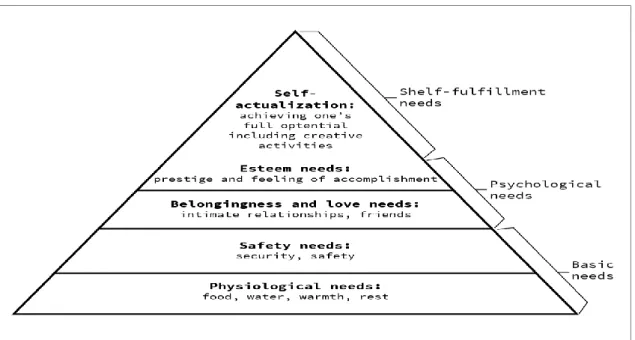
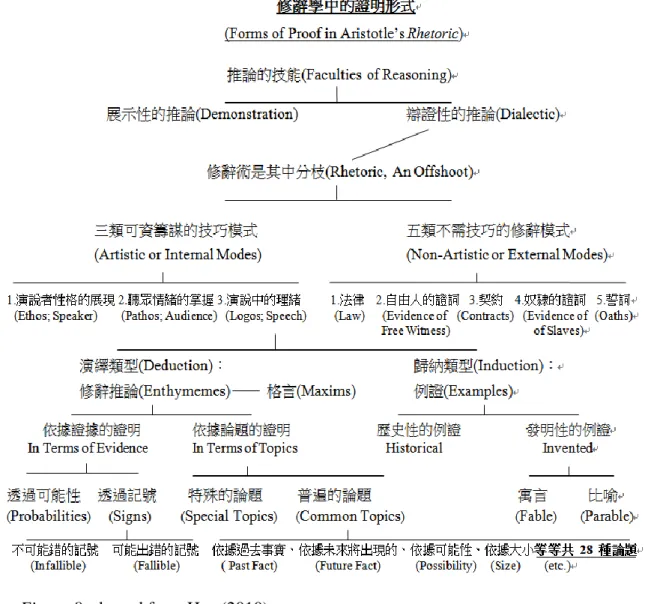
(43) Chapter Three Methodology The aim of this study is to investigate the distinctive features of rhetorical use by contrasting the Stanford commencement speeches delivered by Steve Jobs in 2005 and Tim Cook in 2019. The research design contains the first introduction of qualitative and quantitative methods. The linguistic features analyzed by quantitative methods were identified in sequence as metaphorical construction, modality, personal deixis and speaker ethos. The construction of the sociolinguistic model was studied by presenting qualitative research and includes: Identification theory, the rule of three and Maslow‘s hierarchy of needs. The last section discusses the instruments, participants, reliability and trustworthiness.. Research Design The research design explained in this section seeks to evaluate the construct of social significance by contrasting the use of both Steve Jobs and Tim Cook‘s rhetorical devices, their connection with linguistic features, and which of the methods that they employ have the greatest motivational and inspirational effects. Linguistics and rhetoric are the two major concepts that constitute the theoretical framework and the foundation of this research.. 31.
(44) Rhetoric is commonly recognized as the classical and scholarly discipline of persuasive oratory through linguistic application, while linguistics is the social science that provides knowledge of language use by exploring the relationship between the structure and the semantics construct through language practice. What rhetoric is to linguistics is what our minds are to our fingers. This symbolizes a transposition of the connotative language to the denotative language. The significant difference between the two methods highlights the fact that at the core of linguistic implementation is the impact of comparatively small components and frameworks rather than rhetoric in several different forms of semantics. The linguistic application option is more restrictive in the breadth of the sentences and syntaxes used, whereas the agility and multiplicity of rhetorical figures or rhetorical devices when using contextual structures could be more generalized and therefore have an equal impact on many significant levels (Enkvist, 1985, cited in Martin Gonzalez, 2014/15). As reported by Haferkorn (2016), thirty-three types of rhetorical devices were the most commonly used rhetorical figures in McGuigan‘s (2017) study. Table 1 illustrates the impact and breadth the use of a rhetorical device creates in the four aspects of strategy, organization, style, and reading analysis. Table 1 Rhetorical Devices with Four Dimensions Dimension. Rhetorical Devices. 32.
(45) Hyperbole, Litotes, Hyperphora, Procatalepsis, Simile, Analogy, 1.Strategy. Eponym, Exemplum, Understatement, Antithesis, Rhetorical Question, Distinctio, Metaphor, Allusion, Sententia.. 2.Organization. Climax, Metabasis, Apostrophe, Antanagoge, Parallelism, Parenthesis, Enumeratio, Anadiplosis, Conduplicatio.. 3.Style. Epithet, Zeugma, Hyperbation, Asyndeton, Polysyndeton, Synecdoche, Metonymy. 4.Analysis of reading. Aporia, Amplification, Anaphora, Epistrophe, Paratasis, Personification, Symploce.. Illustrated by McGuigan (2007) In an effort to assess heterogeneity in the use of the rhetorical devices by Steve Jobs, contrastive analysis was conducted with the speech by Tim Cook. Both approaches will be included in this analytical framework, as all the works of rhetoric operate primarily and closely on their linguistic construction. As for analyzing the linguistic devices used, the emphasis is mostly on the metaphorical construction, modality, and functions of deixis. In terms of rhetoric, the emphasis is on Aristotle‘s modes of persuasion and Kenneth Burke‘s new rhetorical theory of identification and dramatism, including how the structure of the speeches are implemented within their theoretical modules, as well as the manner in which rhetoric and linguistics coincide with one another. Table 2 The Objective and Breadth of This Research with the Relevant Fields Field. Focus. Subcategory. Rhetoric. Rhetorical devices. Metaphors. 1.Content words. (a)Noun (b)Verb. Linguistic. (c)Adj. 33. (d)Adv.
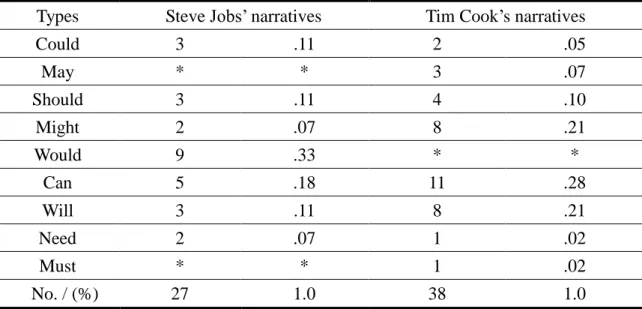
(46) 2.Function words. (a)Prep (b)Aux (c)Pron. Note. Adj=Adjective, Adv=Adverbial, Prep=Preposition, Pron=Pronoun.. Analysis of Linguistic Constituents This analysis work begins with linguistic features that reflect the act of mentality or action of the mind in relation to its systems of cognitive assessment of the audience caused by the use of natural language. We have come to recognize that many such characteristics, which mostly appear in our established cognitive pattern, are of a metaphorical essence in terms of what we see reflected in the linguistic constituents (Lakoff & Johnson, 2003). The linguistic features concerned are the creation of metaphors, modalities and the use of personal deixis, which are essential to the effectiveness of a discourse act. A further linguistic feature is the way in which polysemous effects are often triggered in a speech and which sometimes become complex and elusive, making it more difficult for the effects to be sensed and thus exacerbating the intricacy of speech delivery. The deconstruction of linguistic components for the analysis of both speech materials comprises of two main pillars: 1) content words (CW), which are comprised of nouns, verbs, adjectives and adverbs; and 2) function words (FW), which are comprised of prepositions, personal pronouns and modal auxiliaries. The employment of total linguistic components (LC) by Steve Jobs in his speech reveals 59% (N=1414, Mean=14.5, 34.
(47) SD=9.58), whereas the speech by Tim Cook indicates a linguistic component usage of 56% (N=1181, Mean=14.2, SD=10.79). Table 3 Descriptive Statistics in the Linguistic Components of Speech Contents Author. Noun C. Verb C. Prep F. Adj C. Adv C. Pron F. Aux F. Mean %. SD %. 1.SJ. 29.42. 23.05. 17.68. 9.68. 6.57. 13.57. 1.90. 14.5. 9.58. N. 416. 326. 250. 137. 93. 192. 27. 2.TC. 32.43. 24.21. 16.59. 8.97. 4.40. 10.16. 3.21. 14.2. 10.79. N. 383. 286. 196. 106. 52. 120. 38. Note.SJ=Steve Jobs, TC=Tim Cook. C= Content words; F= Function words. Further deconstruction of linguistic elements in both speeches, as pertains to the use of nouns, was done by searching for elements, such as people, issues, time, location and objects. This study reveals that the total number of nouns used is 29.42% in Jobs‘ speech and 32.43% in Cook‘s. Table 4 Descriptive Statistic on Further Deconstruction of Nouns Used Author. People. Issues. Time. Location. Object. Total%. 1.SJ. 9.85. 18.75. 11.29. 15.38. 44.71. 29.42. N. 41. 78. 47. 64. 186. 2.TC. 16.97. 42.81. 7.83. 13.05. 19.32. N. 65. 164. 30. 50. 74. 32.43. Note. Number of nouns in Steve Jobs =416 and the number of nouns in Tim Cook=383. Further results of LC deconstruction work can also be seen in the appendices.. 35.
(48) Metaphorical Construction Root metaphors and image schemas are the two primary cornerstones of a metaphor. Root metaphors are typically expressed in conceptual approaches, such as central themes derived from the concrete domain of participation in the social activities that human beings create. Image schemas are cognitive models that usually instruct one‘s own language formation and are often articulated with spatial domain significance, such as the use of prepositions in English. However, metaphors can be observed and analyzed by the use of prepositions in a person‘s speech. Prepositions have a significant function to perform in language. While there are few English prepositions, the manner in which they affect the use of language is of essential importance and therefore arises continuously (Song, 2013). Metaphor is what lies beneath prepositions. An analytical instance of the construction of a metaphor depends on the use of the English prepositions suggested by cognitive linguistics (Maslo, 2011). The use of the preposition is an essential component of LC systems. The findings in this study show that Steve Jobs‘ use of prepositions in his Stanford speech was 17.6% (N=250, Types=20, Mean=12.68, SD=15.06). Five types of prepositions, however, were discovered not to be identical with those used by Tim Cook in his speech, including ―off,‖ ―around,‖ ―across,‖ ―throughout‖ and ―under.‖ Table 5 below shows a comparison of the use of prepositions in both presentations.. 36.
(49) Table 5 Descriptive Statistics on the Use of Prepositions by Steve Jobs Types. 1.With. 2.At. 3.From. N. 18. 10. %. .072. .04. Types. 6.Out. 7.To. N. 20. 58. 9. 11. 1. %. .08. .23. .036. .04. .004. Types. 11.For. 12.Up. 13.By. 14.Down. 6. 3. 2. .012. .008. N. 16. 3. %. .064. .012. Types. 16.Around*. N. 1. %. .004. Types=20. 17.Away. 4.Of. 5.In. 12. 38. 29. .048. .15. 8.About. 9.On. .02 18.Through-out*. .11 10.Off*. 15.Over. 19.Acros*. 20.Unde*. 3. 1. 1. 1. .012. .004. .004. .004. Total=250. Mean=12.68. SD=15.06. Note. *This preposition is different from that of Tim Cook. Research on the use of prepositions by Tim Cook also suggests that the overall LC system for the use of prepositions is 16.59 % (N=196, Types=19, Mean=10.31, SD=13.34). Four types of prepositions were identified to be distinct from Steve Jobs‘ speech contents, including ―against,‖ ―into,‖ ―without‖ and ―through,‖ four of the different types recognized in this study. Table 6 Descriptive Statistics on the Use of Prepositions by Tim Cook Types. 1.Of. 2.For. 3.To. 4.From. 5.On. N. 33. 18. 52. 7. 13. %. .16. .09. .26. .03. .06. Types. 6.At. 7.In. 8.With. N. 5. 25. %. .029. Types. 11.Up. 9.By. 10.Out. 8. 9. 2. .12. .04. .04. .010. 12.Down. 13.About 37. 14.Aainst*. 15.Over.
(50) N. 3. 1. 5. 1. 1. %. .015. .005. .025. .005. .005. 16.Away. 17.Into*. 18.Without*. N. 5. 2. 5. 1. %. .02. .010. .025. .005. Types. Types=19. Total=196. 19.Through*. Mean=10.31. SD=13.34. Note. *This preposition is different from that of Steve Jobs.. Metaphors that mold our society and culture‘s normal cognitive schemes are mirrored in our daily speech. Metaphors are rarely perceived as being short on imagination and creativity. These metaphors offer us a fresh insight into our experience. Hence, our past, our activities of daily living, and what we understand and believe can be given new meaning (Lakoff & Johnson, 2003). This suggests that many of the feelings and thoughts we possess are not just subjective experiences but instead are reflected in reality, in an objective sense, and that we are affected by a process of constant feedback correlated with our perceptions. We have some mental capacity through cognitive processes to define and modify the meaning of reality. It is that capacity which can alter our perceptions and reflect our ideas and feelings. Metaphors act as vehicles of understanding and feeling by creating links between two distinct entities and encouraging individuals to understand one concept in relation to another (Steen, 2008). The concept of metaphor pertains to a linguistic expression that incorporates two main features beyond its scope in an attempt to describe a concept associated with another. This linguistic expression also operates under the alias. 38.
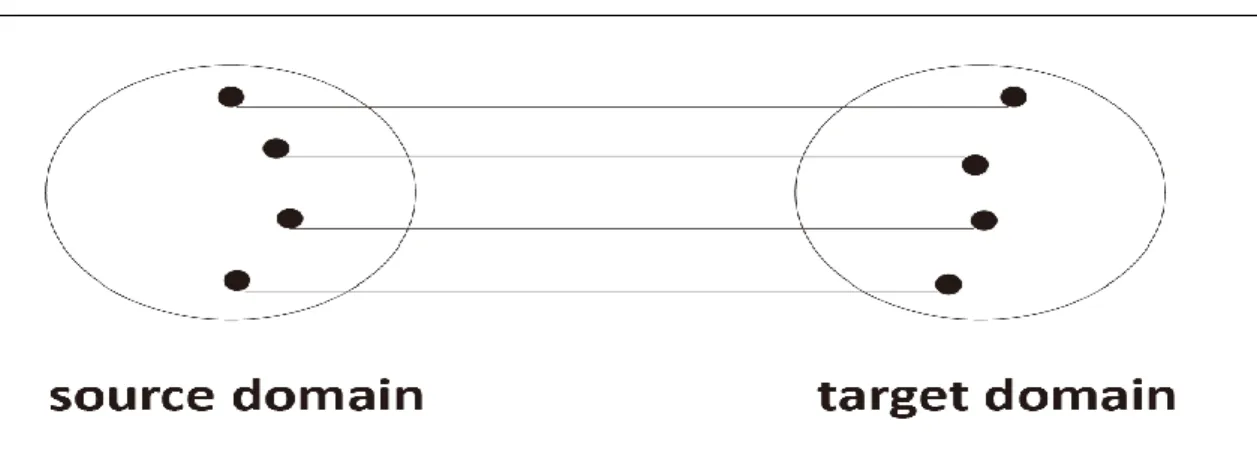
(51) of conceptualization, which consists of two focal conceptual domains: the source domain and the target domain. That meaning is created and recognized as the conceptualization correlates with linguistic expression. Only with an adequate perspective of linguistic understanding can the meaningfulness of the grammatical construct become clear and evident (Langacker, 1987). Metaphorical expressions are more of an artifact drawing on the source domain that generally refers to concrete phenomena or the embodiment of experiences identified and viewed through physical surroundings in order to evaluate the target domain, specifically when addressing the abstract domain (Evans & Green, 2006). Source domain and target domain interact by echoing one another through the corresponding entities between the two. This is reflected in the cognitive approach term ―mappings‖ (see Figure 3) as outlined by Evans (2007).. Figure 3 A Cross-Domain Mapping (Evans, 2007) Therefore, everything we recognize or sense through our embodied experiences in the physical environment can act as an important agency from the source domain that. 39.
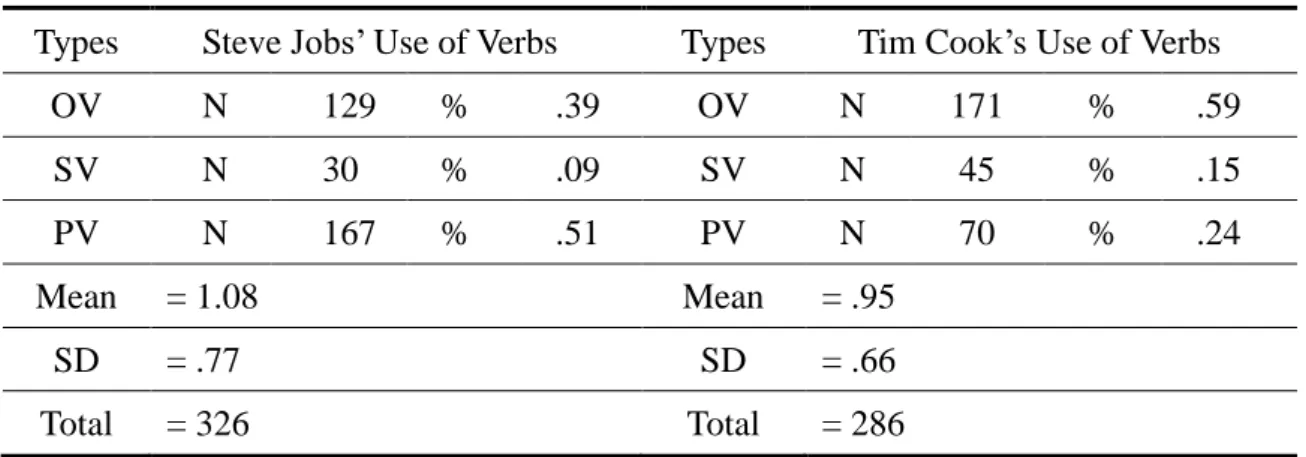
(52) contributes to the understanding and description of the target domain, as illustrated in Figure 4 by Johnson (1987) ―The Body in the Mind‖.. Figure 4 adopted from Maslo (2011) An image schema is a conceptual pattern that provides recurrent organized knowledge of multiple perceptions and can be used as a source domain for metaphors to provide an interpretation of other incarnated experiences (Lingua Links, 2003 cited in Amant, Morrison, Chang, Cohen, Beal, 2014). Table 7 below is a depiction of image schemas in which Johnson (1987) summarized the 27 patterns that were proposed for both the reasoning of lexical semantics and the basis of semantic cores. Table 7 Types of Image Schemas 1.CONTAINER. 2.BALANCE. 3.COMPULSION. 4.BLOCKAGE. 5.COUNTERFORCE. 6.RESTRAINT REMOVAL. 7.ENABLEMENT. 8.ATTRACTION. 9.MASS-COUNT. 10.PATH. 11.LINK. 12.CENTER-PERIPHERY. 13.CYCLE. 14.NEAR-FAR. 15.SCALE. 16.PART-WHOLE. 17.MERGING. 18.SPLITTING. 19.FULL-EMPTY. 20.MATCHING. 21.SUPERIMPOSITION. 22.ITERATION. 23.CONTACT. 24.PROCESS. 25.SURFACE. 26.OBJECT. 27.COLLECTION. The image schemas, as outlined by Johnson (1987) 40.
(53) In extensive research on image schemas in both speeches, two native English-speaking teachers, who participated in this pilot project, revealed that the use of prepositions encapsulated the types of image schemas, as indicated in Table 8. Table 8 Descriptive Statistics on Image Schemas in Steve Job‟s Speech 1.ENABLEMENT. 6. 2.MERGING. 4. .028 4.LINK. 14. .018 5.PART-WHOLE. 14. .06 7.OBJECT. 18. 8.COMPULSION. 12 1. FORCE. .004. 16.CONTACT. 7. 11.SPLITTING. 2. 14.MATCHING. 10. 5. 10. 20.CYCLE. 3. 2 .009. 25.SUPERIMPOSITION. 7 .03. 12.FULL-EMPTY. 26.CENTERPERIPHERY. 6 .02. 15.COLLECTION. 5 .02. 18.MASS-COUNT. 3 .01. 21.SCALE. .01 23.BLOCKAGE. 4 .18. .04. .02 22.NEAR-FAR. 9.ITERATION. .04 17.PATH. 36 .16. .009. .03 19.ATTRACTION. 6.CONTAINER. .03. .05 13.COUNTER-. 7. 14 .06. .06. .08 10.PROCESS. 3.SURFACE. 7 .03. 4. 24.RESTRAIN-. .01. REMOVAL. 8 .03. 3. Mean = 8.1. 212. .01. SD = 7.1. 1.0. In this result a pilot analysis of the image schema recognition in Steve Jobs‘ speech by one of the participants reveals that the amount of understood image schemas indicates 212, Mean=8.1% and SD=7.1%. The overall number of categories of image schemas identified in the speech material was 26. The type of ―balance‖ image schema, however, is. 41.
(54) not discovered in this study, as can be seen in Table 9. Table 9 Descriptive Statistic on Image Schemas in Tim Cook‟s Speech 1.CONTAINER. 18. 2.BLOCKAGE. 4. .11 4.PATH. 10. .02. 5.CYCLE. 0. .06 7.FULL-EMPTY. 3. 8.ITERATION. 3. FORCE. 13.NEAR-FAR. 3 .01 3 9. 14.MERGING. 7. 2. REMOVAL. .01. 22.SCALE. 5. 17.OBJECT. 5. 20.MASS-COUNT. 11. 1 .006. 23. SPLITTING. 7. 26.COLLECTION. .07. 7 .04. 12.LINK. 8 .05. 15.MATCHING. 5 .03. 18.COMPULSION. .03. .03. 25. PROCESS. 9.SURFACE. .04. .05. 19.RESTRAINT-. 2. 17 .11. .01. .01. 16.CONTACT. 6.PART-WHOLE. .01. 11.ATTRACTION. 3 .01. 0. .01 10.COUNTER-. 3.ENABLEMENT. 2 .01. 21.CENTER-PERIPH ERY. 3 .01. 24.SUPER-IMPOSITI. 7. .04. ON. 12. Mean = 6.0. 154. .07. SD = 4.5. 1.0. .04. The identified image schemas in Tim Cook‘s speech, in which the pilot analysis was completed by the other participant, was N= 154, Mean=6.0% and SD=4.5%. Meanwhile, the types of ―cycle‖ and ―balance‖ were not found. The basis of the metaphor is the identical culture and community that makes the process of mutual understanding feasible, allowing the process of information between the speaker and the recipient to be less complicated. Therefore, if the ideas expressed or. 42.
(55) retrieved have the same variables as a basis, then there is also a good understanding of the conceptual metaphors between the interlocutors. Charteris-Black (2005) claimed that the rhetorical metaphor enables perceived facts to be objective and linked, and allows leading figures to be persuasive and to influence the assessment of the audience. Metaphor effectively binds the audience and conveys inward impulses as it creates reminiscent portrayals of speakers and their remarks through mental or emotional stimuli, thus restoring the perceptions of the audience to a fresher, more relevant and more oriented sense (as cited in Martin Gonzalez, 2014/15). Additionally, effective rhetoric, as suggested by Aristotelian tradition, includes an equal balance between ethos, logos and pathos, establishing one‘s identity and reliability as a speaker/writer, which in turn encourages the audience‘s logical thinking and stimulates its emotional responses to the speaker/writer‘s persuasive strength (Negretti, 2011). The metaphor is therefore the determinant of linguistic manipulation, which enables speakers to create a comprehensive use of pathos, ethos and logos throughout much of the framework. A metaphor also seeks to express philosophical values, whether the values concerned be adverse or beneficial, and invites the audience to respond to them through the linguistic construction of potential speakers (Charteris- Black, 2005, cited in Martin Gonzalez, 2014/15). When accompanied by philosophical values, metaphors (as found in maxims, proverbs and parables) convey universal truths. These. 43.
數據


+4
相關文件
Formação bruta de capital fixo, segundo o ramo de actividade económica Gross fixed capital formation by
Asia, and the History of Philosophy: Racism in the Formation of the Philosophical Canon, 1780–1830, New York: State University of New York Press, 2013) 等人 的 研 究。Garfield
6 《中論·觀因緣品》,《佛藏要籍選刊》第 9 冊,上海古籍出版社 1994 年版,第 1
The first row shows the eyespot with white inner ring, black middle ring, and yellow outer ring in Bicyclus anynana.. The second row provides the eyespot with black inner ring
Looking for a recurring theme in the CareerCast.com Jobs Rated report’s best jobs of 2019.. One
Apart from European civilisation, the Islamic civilisation has also made significant contributions to the history of civilisation. Though communication
• Kenneth Pomeranz, The Great Divergence: China, Europe and the Making of the Modern World Economy (Princeton, N.J.: Princeton University Press, 2000). • Cowen, Noel , Global History:
Salas, Hille, Etgen Calculus: One and Several Variables Copyright 2007 © John Wiley & Sons, Inc.. All
