Universal Periodic
Review: The Status of Children's Rights
An Analysis of trends / Review of NGO Participation
Published by
Child Rights Information Network (CRIN) East Studio
2 Pontypool Place London
SE1 8QF United Kingdom +44 20 7401 2257 www.crin.org
First published 2010
© Child Rights Information Network, 2010
The Child Rights Information Network (CRIN) is a Company Limited by Guarantee, no. 6653398 and a charity registered in England and Wales (1125925).
CRIN encourages personal and educational use of this publication and grants permission for its
reproduction in this capacity where proper credit is given in good faith. For resale or commercial
distribution in any other manner, prior permission must be obtained in writing from the publisher.
Acknowledgements
This report was written by Ed Renshaw, Child Rights Officer at CRIN.
A number of people have provided invaluable assistance to CRIN's research into the UPR, including Katherine Weston, Philippe Seidel, Victor Sande Aneiros, Sarah Pugh, Tengku Nadiahtul Zahraa Tengku Adnan and Sophie Macmillan.
An initial evaluation of children's rights and the UPR was undertaken in 2008 by members of the Working Group for the Human Rights Council of the NGO Group for the Convention on the Rights of the Child, they included: Cecile Trochu-Grasso, World Organisation Against Torture, Alan Kikuchi- White, SOS Children's Villages International and Simon Flacks, CRIN. This report builds on this important work.
Finally, the report was edited by Veronica Yates, Director of CRIN.
Table of Contents
Executive Summary...1
1 Introduction ...3
The report's two main objectives...3
Why CRIN is writing this report...3
Why this report is important...4
2 About the Universal Periodic Review...5
Notable characteristics of the UPR...5
State Reviews completed to date...5
A guide to the UPR process...6
3 CRIN's Children's Rights References Reports...9
Structure of reports...9
Report Sources...10
4 Methodology for Selecting Criteria for Analysis...11
What constitutes a reference to children's rights in the UPR reports...11
Monitoring selected children's rights for the analysis...12
Criteria selected for recommendations ...13
5 Overall Analysis of Children's Rights in the UPR...15
To what extent are children's rights addressed in the UPR...15
Which children's rights issues feature most prominently and which are most neglected...16
6 Analysis of Children's Rights in the Recommendations...19
Recommendations received by States under Review...19
Recommendations issued by UN Member States...26
7 NGO Survey Findings...30
Background to research...30
A stage by stage guide to NGO participation ...31
Summary of NGO responses...33
8 Conclusion ...54
Drawing conclusions on the report's two main objectives...54
Areas for further research and analysis...55
The UPR in the Human Rights Council Review 2011...56
9 Appendices...57
Appendix 1: Children's rights recommendations received by States and their responses...58
Appendix 2: All recommendations received by States and their responses...61
Appendix 3: Rejected children's rights recommendations...64
Appendix 4: Number of children's rights recommendations made by UN Member States...71
Appendix 5: Number of times States raise particular issues in the recommendations...75
Appendix 6: Children's rights organisations who have submitted reports...79
Appendix 7: Index of website links...90
Chapter Guide
Chapter One: Introduction Chapter Two: About the UPR
Chapter Three: CRIN's children's rights references reports
The chapter outlines the structure of CRIN's reports on the UPR , together with a guide illustrating the way in which the reports can be most effectively utilised.
Chapter Four: Methodology for selecting criteria for analysis
Chapter Five : Overall analysis of children's rights in the UPR
This chapter presents findings on the extent to which children's rights are addressed throughout the UPR process by looking at all reports submitted for all Review sessions (sessions 1 - 7), but also by looking at which particular children's rights issues are addressed.
Chapter Six: An analysis of children's rights in the recommendations
This section focuses on the final recommendations made by UN Member States to the States under Review, including a look at the number of recommendations received, and States' responses. It also includes a section on which issues States make
recommendations on.
Chapter Seven: NGO Survey findings
This section presents the findings of the survey and interviews conducted with a host of
children's rights organisations (including international NGOs, national NGOs, Ombudspersons and academic bodies).
Each individual section of analysis includes:
-A TABLEPRESENTINGTHEFINDINGSOFTHEANALYSIS -A GUIDETOUNDERSTANDINGTHEDATA
-A CRIN COMMENTSBOX, HIGHLIGHTINGTHEPRACTICALIMPLICATIONSOFTHEFINDINGSFOR
NGOS
Chapter Eight: Conclusion
In our concluding chapter we have identified further areas of research and present an overview of discussions on the UPR in the review of the Human Rights Council. This section also includes practical tips for those working on children's rights when engaging in the UPR process.
For each question asked in the survey, the following will be presented:
-A SUMMARYOFRESPONSESBYSURVEYPARTICIPANTS
-EXAMPLESOFDIFFERENTAPPROACHESTAKENBYORGANISATIONS
-A CRIN COMMENTSBOX, HIGHLIGHTINGTHEFACTORSTHATNEEDTOBECONSIDEREDBY ORGANISATIONSWHENENGAGINGWITHEACHSECTIONOFTHE UPR. THISISSPECIFICALLY DESIGNEDTOASSISTDIFFERENTTYPESOFORGANISATIONSINDECIDINGWHATSUITSTHEIRNEEDS,
ACCORDINGTOCAPACITYANDINDIVIDUALSITUATIONS.
Executive Summary
The Universal Periodic Review (UPR) has attracted a great deal of attention since it was established in 2008, in part due to its emphasis on States questioning fellow States on their human rights records. With the mechanism yet to complete its first cycle of reviews (48 countries still have to undergo a review at the Human Rights Council), it is too early to fully evaluate its effectiveness, however some notable trends have already emerged.
This report assesses the status of children's rights in the first seven sessions of the UPR (112 countries reviewed), examining the extent to which they are addressed, and which children's rights issues receive prominence and which are neglected. The report also looks into experiences NGOs have had in using the UPR, drawing on successes achieved and challenges faced by a broad range of children's rights organisations.
Key findings include:
The status of children's rights in the UPR
• One in five mentions focus on children's rights: Approximately one fifth of all points made across the UPR process are children's rights focused, but is this really satisfactory given children cut across all human rights clusters? Furthermore, the findings highlighted below raise concerns over which issues are being addressed adequately and which ones are not.
• States are avoiding more controversial issues: States tend to focus on, and accept, mostly recommendations on 'softer' issues, such as education and health, and neglect, or reject recommendations on more controversial issues, such as corporal punishment or juvenile justice.
• NGOs have an important role to play: NGOs lag behind UN bodies and UN Member States in the extent to which they address children's rights in the UPR. Indeed, with States shown to avoid the more controversial issues, NGOs have an important role to play to address the full spectrum of children's rights issues and ensure neglected issues are brought to the forefront of the agenda.
NGOs' experiences of using the UPR
CRIN interviewed a number of children's rights focused organisations, including international NGOs, national NGOs, Ombudspersons and academic bodies, to get their experiences in engaging with all stages of the UPR process, from pre- review report submission and lobbying activities, through to post-review follow up strategies.
Key findings to emerge from the Survey were:
Child Rights Information Network (CRIN) Executive Summary
• NGOs are still learning about the UPR: As the UPR differs from existing UN mechanisms in a number of ways, NGOs are, to an extent, still finding their feet.
• Two different perspectives: A clear distinction exists between those who engage at the Geneva level (primarily international NGOs) and those far from Geneva (national NGOs amongst others). Having a
representative based in Geneva enables organisations to combine report submission with lobbying. For obvious reasons, this is often not an option for national NGOs.
• The UPR as an additional advocacy tool: A number of organisations alluded to the need to treat the UPR as an additional advocacy tool that complements their existing day to day work. The UPR was often seen as an 'enforcer' of existing advocacy work done in relation to the CRC, for instance.
• Wider benefits of engaging with the UPR: A number of internal and external benefits emerged from the survey, particularly national NGOs reporting how the UPR helps them build alliances with the wider human rights community.
This practically orientated report provides organisations, both those who have already submitted reports to the UPR and those exploring opportunities to engage with the mechanism for the first time, with a presentation of trends in the reviews to date and a series of practical tips to consider when using the UPR.
The report also draws attention to CRIN's country by country reports, based on data extracted from the UPR process, and indeed several areas of further research which could be useful for organisations in the children's rights community, whether or not they are looking to use the mechanism.
A crucial point to emerge from this research is the need for the children's rights community to work together and share
information on their experiences with the UPR. Many organisations have been developing their own strategies, toolkits
and evaluations, and have collected a certain amount of 'learning' that could benefit many smaller, less experienced
organisations around the world. This is CRIN's rallying call to all its members and partners!
1 Introduction
The Universal Periodic Review (UPR) is a new mechanism of the United Nations (UN) under which the Human Rights Council (HRC) will examine the human rights situation in every Member State of the UN. Each State will be examined once every four years and by other States. The UPR was created by the UN General Assembly on 15th March 2006 with
resolution 60/2511.
With its first hearing in 2008, the UPR is the first UN mechanism to examine the full range of human rights. One hundred and forty four countries have completed their initial reviews under this new mechanism, with a further 48 countries due to be examined by the end of October 2011
2.
But to what extent are children's rights addressed? And how can children's rights organisations most effectively use this new mechanism? This report will aim to answer some of these questions.
The report's two main objectives
1. To determine the extent to which children's rights are addressed in the UPR
2. To assess ways in which civil society organisations can engage most effectively with the mechanism
Why CRIN is writing this report
With the introduction of the UPR to the UN mechanisms portfolio, there is a potential opportunity to advance children's rights. Indeed, with an increasing number of children's rights NGOs and other organisations starting to engage with this new mechanism, there is a need for a closer look at how the UPR may contribute to the advancement of children's rights.
The intention of this report is not to make a case for or against the effectiveness of the UPR as a mechanism, but to identify trends in the UPR and provide organisations with a platform to further understand what the UPR is, how it operates, and how they can engage with it.
The report provides the following:
• A guide to engaging with the Universal Periodic Review
• An analysis of how children's rights were addressed in the mechanism
• A look at which States make recommendations on which children's rights issues
• A comprehensive account of reporting on, and advocacy approaches to the UPR by a range of organisations
1 See Appendix 7 for a link to the resolution2 With the exception of those excused on account of domestic emergencies
Child Rights Information Network (CRIN) Introduction
• A guide to the 144 country reports detailing children's rights references in the UPR
Why this report is important
The UPR is a new mechanism
The UPR is a new mechanism with the potential to advance children's rights and mainstream them into the human rights system. The mechanism is still widely unknown around the world, particularly amongst national and local NGOs.
Focus on children's rights
Whilst some research and analysis has been conducted into the UPR, few studies have focused on the UPR from a children's rights perspective. This report concentrates exclusively on children's rights.
Opportunity to share successful reporting and advocacy strategies
Examining the range of approaches adopted by organisations provides an opportunity to share effective ways of engaging with the UPR with others in the global children's rights community.
A practical guide for NGOs / wider civil society
This report has been designed to be as practical as possible, presenting organisations with the opportunity to utilise the findings and incorporate them into their day to day advocacy work, and broader work on children's rights.
The UPR process provides a rich source of information for the children's rights community
The UPR is an important source of information for organisations seeking to ascertain the positions adopted by States on
particular issues, regardless of whether they have, or intend to work with the UPR specifically.
2 About the Universal Periodic Review
Notable characteristics of the UPR
• State participation obligatory
All 192 UN Member States are obliged to participate in the review process. This is in contrast to other UN treaties for instance, which States first have to ratify.
• State-driven process
Under the UN treaty body system, such as the Committee on the Rights of the Child, States are questioned by established independent experts in the field of human rights. Whereas under the UPR, States are questioned by fellow States on their human rights records.
• All human rights issues examined
The UPR is the first mechanism to assess the full range of human rights in one review.
• Final Recommendations
States under review must outline their position on each recommendation issued to them by UN Member States, by accepting or rejecting the recommendation, or indeed leaving the recommendation pending.
• NGO participation / Advocacy opportunities
In addition to submitting a report to the UPR, NGOs are able to register to make a statement in the Plenary Session where the final outcome report is released. NGOs are not however permitted to speak during the main review.
State Reviews completed to date
Nine sessions have now been completed in the UPR, with a total of 144 countries completing their initial review at the Human Rights Council in Geneva. The Council meets three times a year to conduct the UPR, with 16 countries reviewed in each session. By the end of 2011, all 192 UN Member States will have been reviewed. See Appendix 7 for a link to the full timetable for first cycle reviews.
State adherence to the UPR:
So far, no State has failed to attend their review (with the exception of those excused as a result of national
emergencies), which could be seen as a positive sign that States are somewhat committed to this process, or at least respect its existence.
The following sources provide additional useful information on the UPR:
www.crin.org : Includes children's rights references reports for all completed reviews.Child Rights Information Network (CRIN) About the Universal Periodic Review
www.ohchr.org : Includes all reports submitted on the UPR by all stakeholders.
www. upr -info.org : A website dedicated to providing information on the UPR.
www.ishr.ch : Provides both information on the UPR and analytical coverage of State reviews.A guide to the UPR process
This section illustrates how the UPR process works, including the pre-review report submissions, the review itself, the post-review process, until the second review four years later.
Pre-review
Prior to the review itself, the following reports are submitted to the UN Office of the High Commissioner for Human Rights (OHCHR):
• A report by the State under review, referred to as the “National Report”; This report is 20 pages long and generally due three to four months prior to the review. Appendix 7 includes a link to the guidelines for the
State report.• A report summarising information by UN bodies: This includes information from independent human rights experts and groups, known as the Special Procedures, human rights treaty bodies, and other UN entities; The report is 10 pages long.
• A report containing information from other stakeholders, including NGOs and National Human Rights Institutions; this report is summarised by OHCHR into one 10-page report. Appendix 7 includes a link to the
guidelines for submitting NGO reports.The State is then reviewed based on the three official documents outlined above.
The Review
Each review lasts for three hours and is carried out by a Working Group (WG), composed of the 47 UN Member States of the Human Rights Council. Three rapporteurs, called 'troikas'
3, are assigned to facilitate the review process. The review takes the form of an interactive discussion between the State under review and the UN Member States.
The Format:
• Presentation of the National Report by the State under review;
• Comments, questions, recommendations by the Working Group and Observer States;
The troikas may group issues or questions to be shared with the State under review to ensure that the interactive
Child Rights Information Network (CRIN) About the Universal Periodic Review
dialogue takes place in a smooth and orderly manner.
• Response by the State under review;
• Adoption of report by the Working Group, including recommendations.
Review Outcome
The troika is responsible for preparing the report, which includes:
• A summary of the proceedings of the review process;
• The list of recommendations and / or conclusions;
• Voluntary commitments made by the State.
However, before the report is finalised, States may decide which recommendations they are in agreement with and which ones they are not. Recommendations that enjoy the support of the State will be identified as such. Other recommendations, together with the comments of the State concerned, will be noted. Both will be included in the outcome report to be adopted by the Council.
Post-review
Approximately four months after the State review, a final report is adopted during the Plenary Session of the Human Rights Council (HRC). States are presented with the opportunity to inform the Working Group of changes in their responses to recommendations issued in the Working Group's report. The Plenary Session of the HRC will spend half an hour adopting the final report.
Follow-up Stage
• The States are then supposed to implement the recommendations that arise from the review
• Under Item 6, States have the opportunity to voluntarily update the Human Rights Council on their progress implementing the recommendations during a two hour slot as part of the Plenary Session.
• Some States have started to produce voluntary mid-term reports updating the HRC on the measures they are taking to implement the recommendations put to them.
Next UPR review
Each State's second review will take place four years after the initial review. States will be questioned on the progress they have made in the four years since the first review, and measures taken to implement the recommendations and outcomes from the first UPR.
Take a look at the time-frame for the United States review to assess how the process works:
7
Child Rights Information Network (CRIN) About the Universal Periodic Review
DEADLINEFOR NGO REPORTS APRIL 19TH 2010 SUBMITTEDTO OHCHR DEADLINEFOR US STATE REPORT AUGUST 23RD 2010 SUBMITTEDTO OHCHR
DATEOF UNITED STATES UPR NOVEMBER 5TH 2010 HELDAT HUMAN RIGHTS COUNCIL, GENEVA
INFORMAL ADOPTIONOF OUTCOME DOCUMENT
NOVEMBER 9TH 2010 HELDAT HUMAN RIGHTS COUNCIL, GENEVA
FORMAL ADOPTIONOF OUTCOME
DOCUMENT
MARCH 2011 DURINGREGULAR HUMAN RIGHTS
COUNCIL SESSION, GENEVA
3 CRIN's Children's Rights References Reports
CRIN has compiled a report on every State reviewed in the UPR up to the 9
thsession
4, extracting references to children's rights throughout the UPR process for each country. This chapter outlines the structure of these reports.
Examples of CRIN's reports and a link to all reports for Sessions 1 – 9 of the UPR, can be found at the end of this section.
Structure of reports
Children's rights references have been extracted from the following sections:
Reports submitted to OHCHR prior to the review:
• State under Review
• UN Compilation
• NGO Compilation
Reports compiled by OHCHR detailing the outcomes of the review:
• Interactive Dialogue (between UN Member States and the State under Review)
• Final Recommendations (made by fellow States to the State under Review)
As explained in the introduction, a key aspect of the UPR lies in the requirement of States to inform the Council of their position on the recommendations made to them. In the final recommendations section of CRIN's reports, sub-headings clearly indicate the State under Review's response to the recommendations.
The three sections include:
• 'Accepted' Recommendations
• 'Pending' / 'No clear position taken' Recommendations
• 'Rejected' Recommendations
4 The outcome reports (including the responses to recommendations) for the 9th Session will be released by OHCHR in due course and added to the CRIN site.
Child Rights Information Network (CRIN) CRIN's Children's Rights References Reports
Report Sources
CRIN's Iran Report
CRIN's Norway Report
CRIN's 144 Children's Rights References Reports
Original Reports on OHCHR's WebsiteSee Appendix 7 for links to the above sources
1. A closer look at each section: By breaking down these categories, it is possible to identify the extent to which each of these different groups (UN bodies, NGOs, etc.) are addressing children's rights, and hence observing where children's rights are being neglected in the process. Identifying which recommendations have been accepted, rejected and are pending, provides NGOs with the information they need to press States in the follow-up process. These reports will be extremely useful for your day to day advocacy work on individual States.
2. Useful referencing: CRIN's individual reports include the paragraph reference numbers, taken
from the original reports available on the OHCHR website. The purpose of this is to enable
organisations to easily access the comment from the original reports.
4 Methodology for Selecting Criteria for Analysis
This chapter outlines the criteria adopted for CRIN's analysis of children's rights in the UPR. The methodology is divided into three stages:
What constitutes a reference to children's rights in the UPR reports
A) Different types of references can be classified under children's rights
Examples:
• A reference to particular children's rights issues, such as child labour, juvenile justice or children in armed conflict.
• A reference to a government's National Plan of Action for children.
• A reference to independent bodies monitoring children's rights, such as a Children's Ombudsperson or Commissioner
B) The reference must have a clear focus on children
Examples:
Included in the analysis:
“In 2000, CRC was concerned that child labour was widespread and that children might be working long hours at young ages”
Comment made by the UN Committee on the Rights of the Child
5“Reinforce concrete measures aimed at combating trafficking in women and young girls, and assistance to victims”
Recommendation by Belgium
6Not included in the analysis:
“Take further steps to address discrimination against vulnerable groups”
Recommendation made by the United Kingdom
5 Source: CRIN's child rights reference report on Central African Republic's review 6 Source: CRIN's child rights reference report on Costa Rica's review
Child Rights Information Network (CRIN) Methodology for Selecting Criteria for Analysis
Monitoring selected children's rights for the analysis
Whilst this report examines the full spectrum of children's rights, we focused our research on those nine issues that feature most regularly, namely:
HEALTH EDUCATION JUVENILE JUSTICE
CHILD LABOUR CORPORAL PUNISHMENT VIOLENCE
ETHNIC MINORITY GROUPS CHILD TRAFFICKING CHILDRENIN ARMED CONFLICT
It is important to note that we are in no way implying that those nine issues are the most important ones, rather, these are the ones that are most frequently brought up in the UPR. We will, hopefully be able to demonstrate why this might be through our findings.
Tackling the overlaps between the selected issues
Due to the interconnectedness of children's rights issues and human rights issues in general, overlaps naturally exist. For example, when a recommendation refers to two particular issues in one point.
The following example illustrates CRIN's approach. The recommendation below would be included in both the 'ethnic minority groups' category and the 'education' category:
“To take all steps necessary to remove ethnic segregation from schools, in order to encourage greater understanding among young people of different ethnicities”
Multiple issues included in one point
Where recommendations by States, or points made by UN bodies or NGOs, include two or more issues, each is assigned its own category. For example, the recommendation by Azerbaijan below includes three separate children's rights issues (street children, child labour and ethnic minority groups). Each category would be assigned one mention each.
“Further tackle the problem of street children and child labour, as well as discrimination against indigenous children”
Further explanation of the selected nine issues
This section clarifies what comes under each of the nine children's rights issue:
ISSUE 1 - Children in armed conflict: All references to children affected by armed conflict, including recruitment of children into armed forces by States or non-State groups, rehabilitation and re-integration.
ISSUE 2 - Corporal punishment: Includes corporal punishment in all settings, including in the home, in education
settings, in institutions, etc.
Child Rights Information Network (CRIN) Methodology for Selecting Criteria for Analysis
imprisoned with adults and measures of pre-trial detention.
ISSUE 4 - Violence against children: All references to domestic and sexual violence, child abuse, unspecified violence, violence at the hands of the State and harmful traditional practices (such as female genital mutilation).
Corporal punishment, whilst a form of violence, is not included in this category as it appears so often as a stand alone category.
ISSUE 5 - Health: Specific references to child health, including children and HIV and AIDS, infant mortality, malnutrition, access to health-care, immunisation, health-care facilities, sexual and reproductive health, discrimination in health-care according to race, religion and gender. Only health issues relating to children are included. The issue of female genital mutilation and other harmful traditional practices has been included in the violence against children category.
ISSUE 6 - Education: All references to education for children, including access, facilities, primary and secondary schooling, enrolment and drop out rates, human rights education in schools and discrimination.
ISSUE 7 - Child labour: All references to child labour including legislation, prevention, prosecution and victim services.
ISSUE 8 - Child trafficking: All direct references to children being trafficked either within or between countries.
References have to specifically state child trafficking, not just trafficking in persons.
ISSUE 9 - Ethnic minority groups: All references to children discriminated against because of their ethnic minority status, including indigenous children, Roma children, amongst others.
Criteria selected for recommendations
A) Particular children's rights recommendations must be action-oriented
As a result of the political nature of this inter-State mechanism (UPR), some States tend to simply praise other States on various human rights issues or produce vague recommendations which could be seen as a way of compromising or bargaining. Taking this into account, only action-oriented recommendations are recorded. Any more general
recommendations will still be noted down as a children's rights recommendation and included in the overall trends, but in the 'other' category.
The following is an example of an action-oriented recommendation:
“Take actions to avoid the further recruitment of child soldiers, and ensure the reintegration of all ex- child soldiers to avoid future re-recruitment”
Recommendation made by Argentina
7The following recommendation made by the United Arab Emirates to Kuwait
8would not be included:
7 Source: CRIN's children's rights reference report on the Democratic Republic of Congo's review 8 Source: CRIN's children's rights reference report on Kuwait's review
13
Child Rights Information Network (CRIN) Methodology for Selecting Criteria for Analysis
“Continue its remarkable efforts to promote the rights of the child and to ensure adequate protection to women, children and victims of human rights violations”
B) What constitutes an 'accepted', 'rejected' or 'pending' recommendation
Using the above strategy, CRIN extracted children's rights references from UPR-Info.org's completed list of recommendations, documented for each State in Sessions 1 – 7. UPR-Info.org
9conducted their own methodology to establish the response status of each recommendation by the State under Review and filtered the responses into the three categories: 'Accepted Recommendations', 'Rejected Recommendations' and a third category which included 'Pending Recommendations' and recommendations where the States under Review has taken 'No clear position'. For the purpose of this report, CRIN has grouped 'pending' and 'no clear position' recommendations into one category.
Appendix 7 includes a link to UPR -Info.org's recommendation criteria documen t and disclaimer
Focused lobbying information: The purpose of this approach is to enable NGOs to clearly see which States are genuinely pressing fellow States on selected issues, rather than providing
information on States who are just playing the political game. All children's rights recommendations
(providing they meet the criteria set out in points 1 and 2 above) will be included in the overall
figures so that an accurate picture of the broad trends is displayed, but the selected issues will focus
on action-oriented recommendations made, to provide NGOs with information that can be used
practically in their day to day lobbying activities.
5 Overall Analysis of Children's Rights in the UPR
To what extent are children's rights addressed in the UPR
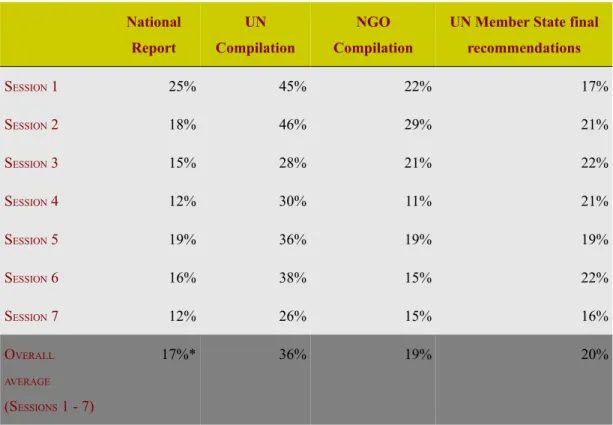
Table 1 – Children's Rights in the UPR
National Report
UN Compilation
NGO Compilation
UN Member State final recommendations
SESSION 1
25% 45% 22% 17%
SESSION 2
18% 46% 29% 21%
SESSION 3
15% 28% 21% 22%
SESSION 4
12% 30% 11% 21%
SESSION 5
19% 36% 19% 19%
SESSION 6
16% 38% 15% 22%
SESSION 7
12% 26% 15% 16%
OVERALL AVERAGE
(SESSIONS 1 - 7)
17%* 36% 19% 20%
Overall average across UPR - 23%
Table Explanation:
-The figures in Table 1 represent the percentage of mentions
10of children's rights in the UPR, compared to all mentions.
* For example: 17% implies that on average, 17% of all mentions in the National Reports for Sessions 1-7, focus on children's rights.
- Table 1 shows the breakdown for the different groups (States under Review, NGOs, etc.), and the averages for each Session.
10 In structuring their national reports, States tend to assign a separate paragraph for each point (issue) they are looking to make.
The analysis, therefore, is based on these individual paragraphs. Where one or more issues are raised within a paragraph, this is reflected in the overall figures. Likewise, in the NGO and UN compilations, each paragraph is generally assigned a given issue.
Child Rights Information Network (CRIN) Overall Analysis of Children's Rights in the UPR
Findings and Analysis
1) Twenty three per cent of all points in the UPR are children's rights focused
Table 1 shows that, on average, one in five points made throughout the UPR process (across the pre-review reports submitted to OHCHR and the final outcome report documenting the final recommendations) are children's rights focused.
2) NGOs lag behind UN bodies in addressing children's rights in the UPR
Table 1 shows that children's rights are raised most in the UN Compilation, with 36 per cent of all points made across UN Compilation reports being children's rights focused. National Reports submitted by States address children's rights the least, with NGOs only raising children's rights marginally more, but less so than UN Member States and UN bodies.
Which children's rights issues feature most prominently and which are most neglected
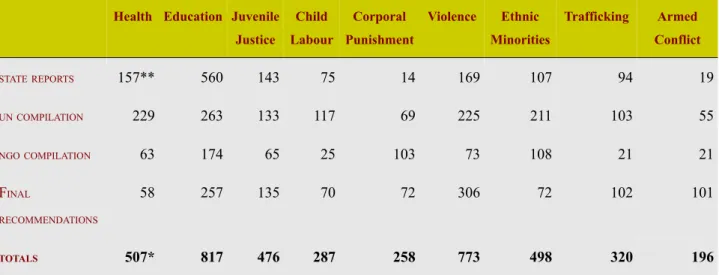
Table 2: References to particular children's rights issues compared to all mentions of children's rights
Health Education Juvenile Justice
Child Labour
Corporal Punishment
Violence Ethnic Minorities
Trafficking Armed Conflict
STATEREPORTS
157** 560 143 75 14 169 107 94 19
UNCOMPILATION
229 263 133 117 69 225 211 103 55
NGOCOMPILATION
63 174 65 25 103 73 108 21 21
FINAL
RECOMMENDATIONS
58 257 135 70 72 306 72 102 101
TOTALS
507* 817 476 287 258 773 498 320 196
Which children's rights issues though? As the analysis shows, approximately one in five points
made in the UPR are children's rights focused. However, is this figure really that high given the
prominence of children across all human rights clusters. It is also important to refrain from drawing
conclusions before assessing which particular children's rights are being addressed. Table 2 below
examines which issues are being addressed most. Table 1 also illustrates that NGOs fall behind in
the extent to which they address children's rights in the UPR, a rallying call for NGOs to engage
with the mechanism.
Child Rights Information Network (CRIN) Overall Analysis of Children's Rights in the UPR
Table Explanation:
-The figures in Table 2 illustrate the total number of mentions in Sessions 1-7.
* For example: 507 refers to the total number of mentions on the issue of child health for the first seven sessions.
** For example: 157 refers to the total number of mentions on the issue of child health in the National Reports.
Findings and Analysis
1) Education the most prominent issue in the UPR
Table 2 shows that education is the most prominent children's rights issue in the UPR, with 817 mentions in the first seven sessions of the UPR. Violence against children is the next most prominent issue, on 773 mentions, and then there is a big gap to health in third place.
2) States given prominence to 'safer' issues, UN bodies and NGOs address a broader range of issues
Table 2 shows how the different groups prioritise particular children's rights issues in their reports. The two issues, education and corporal punishment, illustrate the different approaches adopted towards the UPR by States under Review and NGOs. The National Reports (submitted by States under Review) are dominated by the 'safer' issue of education, with corporal punishment only mentioned 14 times in National Reports throughout the first seven Sessions.
In contrast, Table 2 shows how the number of mentions made by NGOs on all issues is far more balanced, with 174 mentions on education and 103 mentions on corporal punishment. Interestingly, whilst the final recommendations column (UN Member States mentions), shows a high number of references to education, the figure for corporal punishment is far higher than that of the States under Review, perhaps a sign of the influence of NGOs and UN bodies on the UN Member States when considering which particular recommendations to issue in the UPR.
3) Other findings beyond the nine selected issues highlighted in Table 2
As has been explained, when looking beyond general trends in children's rights, CRIN has focused on the nine selected issues to look at which children's rights are found to be most prominent in the UPR and which most neglected. The UPR, however, includes a host of children's rights issues across its reports and review stages:
a) Other rights: Other children's rights issues that do appear (but not as much as the nine most prominent) include:
children with disabilities, street children, birth registration, adoption and the minimum age of marriage.
b) Status of Ratifications: States under review are also regularly questioned on the status of ratification of UN and other Conventions and treaties, most notably the Optional Protocols to the CRC, but also other Conventions which have a focus on children's rights, such as the The Hague Convention No. 33 of 1993 on Protection of Children and
Cooperation in Respect of Inter-country Adoption or the ILO Convention No. 182 concerning the Prohibition and Immediate Action for the Elimination of the Worst Forms of Child Labour. The majority of States make some reference to the current status of UN mechanism ratifications in their National Reports.
c) Independent monitoring bodies: The issue of Children's Ombudspersons or National Human Rights Institutions is
17
Child Rights Information Network (CRIN) Overall Analysis of Children's Rights in the UPR
often mentioned, notably by UN Member States in the final recommendations. States under review are often quizzed on why they have not got an Ombudsperson or what they are doing to ensure its independence and so on.
4) Neglected issues
a) Child participation
The issue of child participation is largely ignored throughout the various reports in the UPR, a point highlighted in the responses to the NGO survey seen in Chapter 7, which illustrates how NGOs see child participation as the next step.
However, a few references to child participation do appear in State reports. Iraq refer to the establishment of a children's parliament in their report, whilst Slovenia refer to their launch of a pilot project “Child Advocate – Voice of the Child”
in 2006.
b) Other neglected issues
Other notable issues neglected in the UPR process could probably in a general way be grouped into children's civil and political rights. Further research into this area could be useful for those organisations working in these areas.
Less controversial issues appear the most: Following on from the previous CRIN comment, Table
2 clearly reveals that it is the less controversial issues, notably education, that are raised the most,
with more controversial issues neglected by the majority of States in their National Reports. This
raises concerns over the extent to which children's rights are fully addressed. Perhaps, States merely
raise children's rights issues as a way of avoiding other difficult ones? Point 4 above also highlights
further issues neglected or excluded completely, demonstrating the need for the UPR to address
issues such as child participation among others.
6 Analysis of Children's Rights in the Recommendations
This chapter examines trends in the recommendations made to States by Members of the Human Rights Council (fellow States). The first section looks at trends in the recommendations States receive, and their responses (the extent to which they are accepted, rejected, or left pending). The second section looks at the recommendations proposed by UN Member States throughout the UPR sessions, to ascertain which States raise which issues.
Recommendations received by States under Review
Table 3 – Summary of Received Recommendations (Children's Rights Only)
AVERAGENO. OFCHILDREN'SRIGHTSRECOMMENDATIONS RECEIVEDPERCOUNTRYREVIEW (ACCEPTED, REJECTED
ANDPENDINGRECOMMENDATIONS)
13.75%
AVERAGENO. OFRECOMMENDATIONSACCEPTED
(ACROSSREVIEWS – ASA % OFTOTAL)
77.60%
AVERAGE % OFRECOMMENDATIONSREJECTED
6.80%
AVERAGE % OFRECOMMENDATIONSPENDING
15.30%
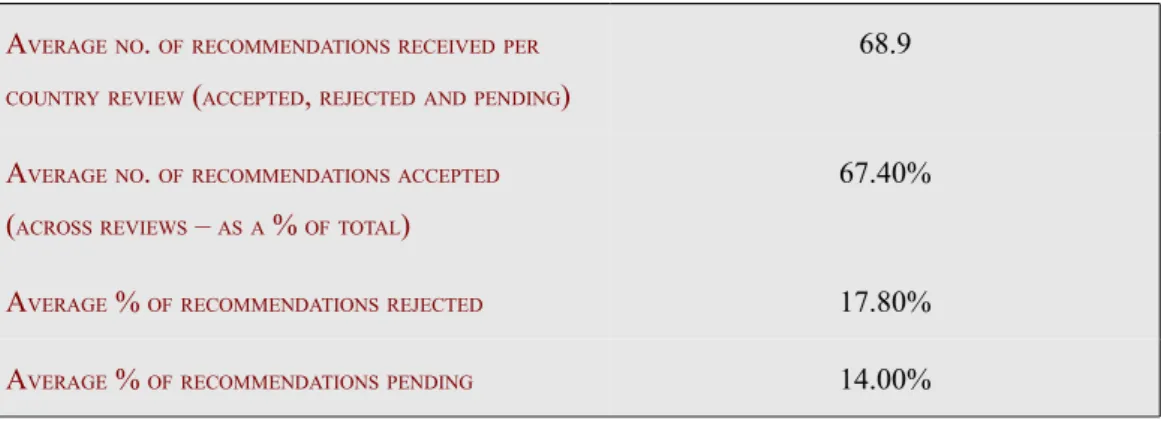
Table 4 – Summary of Received Recommendations (All Human Rights Recommendations)
AVERAGENO. OFRECOMMENDATIONSRECEIVEDPER COUNTRYREVIEW (ACCEPTED, REJECTEDANDPENDING)
68.9
AVERAGENO. OFRECOMMENDATIONSACCEPTED
(ACROSSREVIEWS – ASA % OFTOTAL)
67.40%
AVERAGE % OFRECOMMENDATIONSREJECTED
17.80%
AVERAGE % OFRECOMMENDATIONSPENDING
14.00%
Child Rights Information Network (CRIN) Analysis of Children's Rights in the Recommendations
Findings and Analysis
1) States receive on average just over 13 recommendations on children's rights
As tables 3 and 4 above indicate, the average number of recommendations per country review for all human rights issues is around 69 and for specific children's rights issues, just over 13.
2) States reject more children's rights recommendations comparatively than broader recommendations
Although similarities exist in the share of accepted recommendations between specific children's rights
recommendations and all human rights recommendations, a disparity exists in the percentages of recommendations rejected in the children's rights table and separately in the overall human rights table (6.8 per cent of children's rights recommendations are rejected out of an overall total of 17.80 per cent of all rights rejected recommendations), so just about a third of those are children's rights. Hence, if children's rights recommendations make up approximately 20% of the total recommendations made in the UPR, but a third are rejected, then comparatively speaking, they are rejected much more than general human rights.
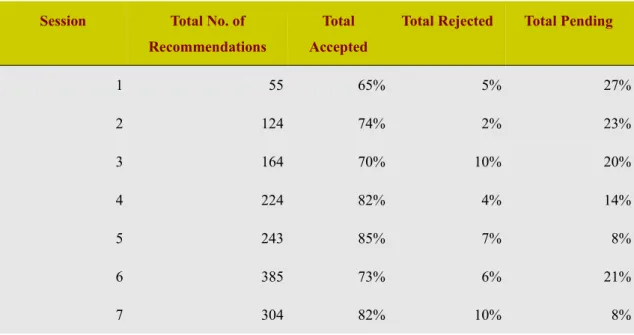
Now let's take a look at how the number of recommendations has increased from Session 1 - 7
Table 5 – Trends in Recommendations over the 7 sessions (Children's Rights Only)
Session Total No. of Recommendations
Total Accepted
Total Rejected Total Pending
1 55 65% 5% 27%
2 124 74% 2% 23%
3 164 70% 10% 20%
4 224 82% 4% 14%
5 243 85% 7% 8%
6 385 73% 6% 21%
7 304 82% 10% 8%
Which issues are rejected? Later in the analysis we will look at which particular issues are raised
in the recommendations by UN Member States and which of these are rejected most and least.
Child Rights Information Network (CRIN) Analysis of Children's Rights in the Recommendations
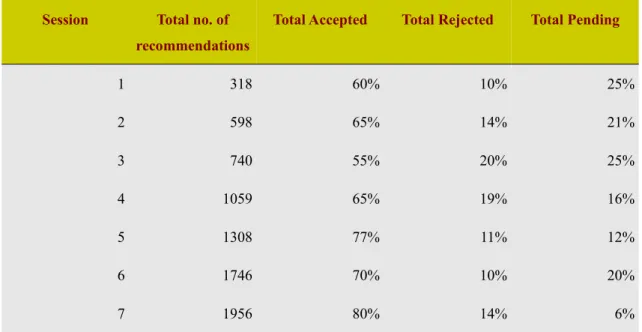
Table 6 – Trends in Recommendations over the 7 sessions (All Human Rights Recommendations)
Session Total no. of recommendations
Total Accepted Total Rejected Total Pending
1 318 60% 10% 25%
2 598 65% 14% 21%
3 740 55% 20% 25%
4 1059 65% 19% 16%
5 1308 77% 11% 12%
6 1746 70% 10% 20%
7 1956 80% 14% 6%
Findings and Analysis
1) A dramatic rise in the number of recommendations from Session 1 to Session 7
The tables above show a dramatic rise in the number of recommendations issued from the initial Session 1 back in 2008, to Session 7 in 2010. In Session 1, 318 recommendations were made concerning all human rights issues, this is for the whole session (16 countries). By Session 7, a total of 1956 recommendations were made by Member States. This is not necessarily surprising as States become more used to the new mechanism and used to drafting recommendations for other States.
2) Proportion of children's rights recommendations remains consistent
The final column in Table 1 (on page 15) shows there is no real rise or fall in the percentage of children's rights against all human rights issues as the sessions progress.
21
Child Rights Information Network (CRIN) Analysis of Children's Rights in the Recommendations
Now let’s look at individual States and the recommendations they receive
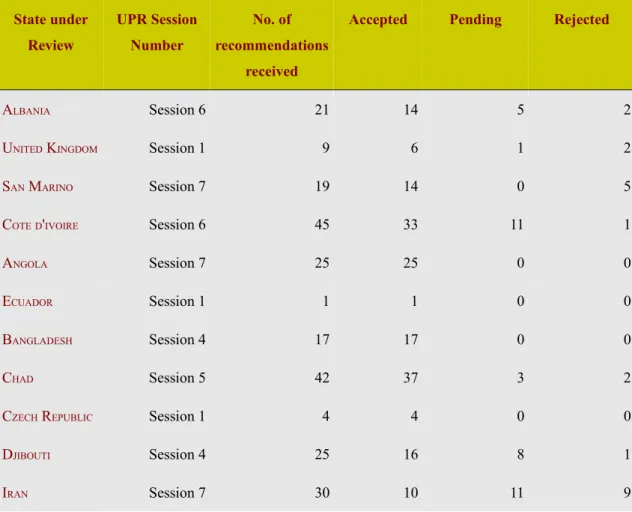
Table 7 below lists a select group of countries, detailing the number of children's rights recommendations received and their responses to the recommendations from Member States.
Table 7 – Children's Rights Recommendations received by States
State under Review
UPR Session Number
No. of recommendations
received
Accepted Pending Rejected
ALBANIA
Session 6 21 14 5 2
UNITED KINGDOM
Session 1 9 6 1 2
SAN MARINO
Session 7 19 14 0 5
COTED'IVOIRE
Session 6 45 33 11 1
ANGOLA
Session 7 25 25 0 0
ECUADOR
Session 1 1 1 0 0
BANGLADESH
Session 4 17 17 0 0
CHAD
Session 5 42 37 3 2
CZECH REPUBLIC
Session 1 4 4 0 0
DJIBOUTI
Session 4 25 16 8 1
IRAN
Session 7 30 10 11 9
Appendix 1: A full list of children's rights recommendations received by States and their responses
Appendix 2: A full list of all recommendations (all human rights issues) received by States and their responses
Child Rights Information Network (CRIN) Analysis of Children's Rights in the Recommendations
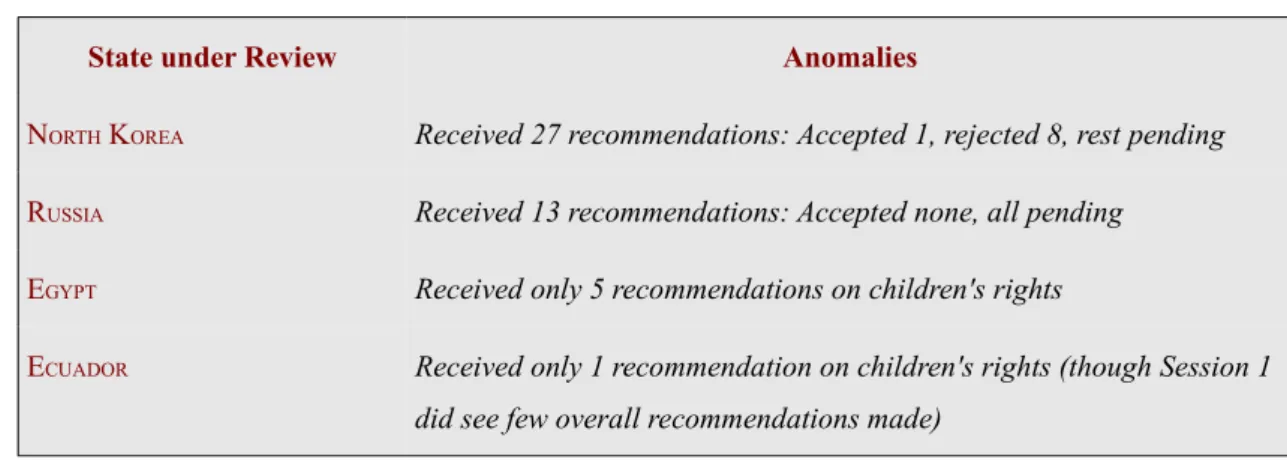
Now look at some of the more significant findings in Table 8 below:
Table 8 – Examples of anomalies
State under Review Anomalies
NORTH KOREA
Received 27 recommendations: Accepted 1, rejected 8, rest pending
RUSSIAReceived 13 recommendations: Accepted none, all pending
EGYPT
Received only 5 recommendations on children's rights
ECUADOR
Received only 1 recommendation on children's rights (though Session 1 did see few overall recommendations made)
Findings and Analysis
1) Large disparities exist from State to State in the number of recommendations received
As table 7 illustrates, some States receive many recommendations on children's rights and others receive only a few. For example, Cote d'Ivoire received 45 children's rights recommendations. However, in the same Session (Six), Portugal received only 13 recommendations on children's rights. Table 8 also shows a strange anomaly in the case of Egypt, who received only 5 children's rights recommendations.
2) Politics at play
Table 8 shows some interesting anomalies and there certainly appears to be an element of politics in action. Both Russia and North Korea, for example, failed to accept any recommendations on children's rights. However, they were not the only States who failed to accept any children's rights recommendations put to them. The following States also failed to accept any:
Belarus Luxembourg South Africa Peru Israel
Cyprus Malawi France Malta Gabon
Poland North Korea Russia
23
Child Rights Information Network (CRIN) Analysis of Children's Rights in the Recommendations
Rejected Recommendations
CRIN has compiled a document detailing children's rights recommendations rejected by each State reviewed in Sessions 1 – 7. The full list can be found in Appendix 3.
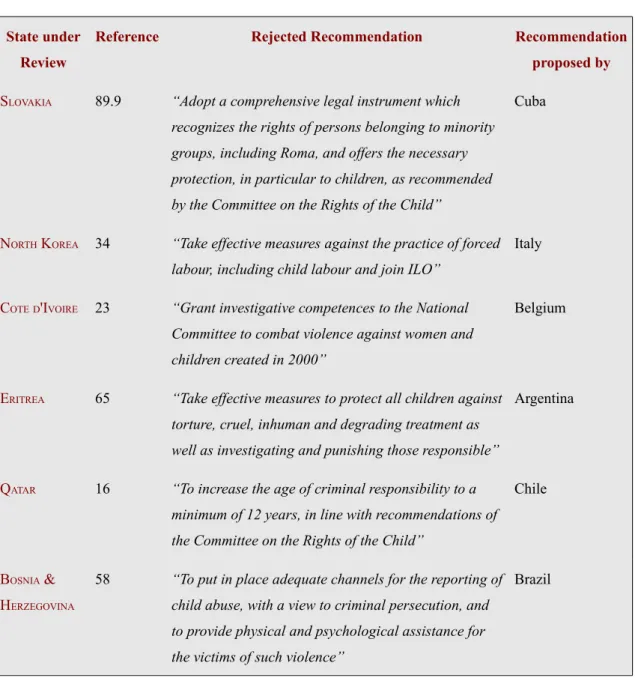
Table 9 highlights a few rejected recommendations:
Table 9: List of rejected recommendations by States
State under Review
Reference Rejected Recommendation Recommendation proposed by
SLOVAKIA
89.9 “Adopt a comprehensive legal instrument which recognizes the rights of persons belonging to minority groups, including Roma, and offers the necessary protection, in particular to children, as recommended by the Committee on the Rights of the Child”
Cuba
NORTH KOREA
34 “Take effective measures against the practice of forced labour, including child labour and join ILO”
Italy
COTED'IVOIRE
23 “Grant investigative competences to the National Committee to combat violence against women and children created in 2000”
Belgium
ERITREA
65 “Take effective measures to protect all children against torture, cruel, inhuman and degrading treatment as well as investigating and punishing those responsible”
Argentina
QATAR
16 “To increase the age of criminal responsibility to a minimum of 12 years, in line with recommendations of the Committee on the Rights of the Child”
Chile
BOSNIA &
HERZEGOVINA
58 “To put in place adequate channels for the reporting of child abuse, with a view to criminal persecution, and to provide physical and psychological assistance for the victims of such violence”
Brazil
Reasons for States rejecting recommendations
REASON 1: They disagree with the recommendation. As we will see further on in the section about which issues are
Child Rights Information Network (CRIN) Analysis of Children's Rights in the Recommendations
left pending. Those two are often considered 'controversial' issues for States. Find out which other issues are most rejected or accepted on page 29.
REASON 2 - The State may already have taken action, or is currently taking action, to address the issue proposed (or, they may just say they are taking action!)
Example: San Marino's reason for rejecting a recommendation from Israel
Rejected recommendation: “To clarify the status of the relationship between San Marino's international obligations and its domestic legislation, to ensure that those international obligations are given effect by domestic courts, and to carry out a comprehensive review of its ius commune in order to identify provisions of domestic legislation that contradict principles and provisions of the Conventions, as recommended by the Human Rights Committee, the Committee on Economic, Social and Cultural Rights and the Committee on the Rights of the Child, respectively.”
San Marino's response: “As indicated in the national report and during the interactive dialogue, international instruments concerning human rights and freedoms, once ratified, prevail over domestic legislation and are directly applied by judges. Should a previous domestic norm be in conflict with an international instrument, the latter always prevails.”
REASON 3 - The State may have their reasons for rejecting the recommendation, which they believe are in the best interests of the child.
Example: Norway's reason for rejecting a recommendation on juvenile justice from Algeria Rejected recommendation: “Take necessary measures to separate incarcerated minors from adults.”
Norway's response: “The imprisonment of juvenile offenders is used only as a last resort. As stated in Norway’s UPR report, a guiding principle of Norwegian penal policy is that convicted persons should serve their sentences in close proximity to their homes. Due to Norway’s geography and demography, the very few juveniles who are imprisoned would be placed in almost total isolation if the principle of separating juveniles from the adult population were to be adhered to, along with the principle of proximity. It is the view of the Government that total isolation is not in the child's best interest; cf. CRC Article 37 (c). Hence, the reservations are being upheld. Norway is currently establishing separate prison units for young offenders with multidisciplinary staff and close follow-up on release with a view to further limiting the number of juvenile offenders serving together with adults.”
REASON 4 – A major issue which needs addressing in the UPR is the phrasing of recommendations. On many occasions, UN Member States issue recommendations which are unclear, too general or contain more than one issue simultaneously, making it difficult for the State under Review to be in a position to accept or reject the
recommendation.
25
Child Rights Information Network (CRIN) Analysis of Children's Rights in the Recommendations
Recommendations issued by UN Member States
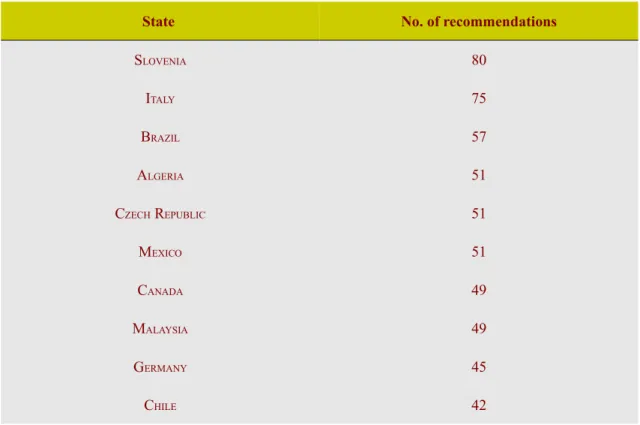
The second part of this chapter examines which UN Member States are most active in making recommendations to States under Review, and significantly which children's rights issues States are raising. This should be a useful tool for knowing which States to lobby on which issue.
Table 10 - States issuing the most children's rights recommendations overall (Figures include recommendations from Session 1 – 7 inclusive)
State No. of recommendations
SLOVENIA 80
ITALY 75
BRAZIL 57
ALGERIA 51
CZECH REPUBLIC 51
MEXICO 51
CANADA 49
MALAYSIA 49
GERMANY 45
CHILE 42
1. Further concerns: There have been cases where a State rejected a recommendation that was in effect the same as a recommendation issued by the UN Committee on the Rights of the Child in their Concluding Observations. This has been highlighted by NGOs as being a major issue of concern. Surely States should not be allowed to reject a recommendation issued by a Treaty Body.
2. Action point for the children's rights community: The issue of recommendation reform has
been taken up in the Human Rights Council Review Working Groups, as detailed in the conclusion
to this report. With the recommendations being a focal point of the UPR process, it is important
NGOs play a role in this reform.
Child Rights Information Network (CRIN) Analysis of Children's Rights in the Recommendations
Findings
In selecting a couple of other notable findings, the United Kingdom made 26 children's rights focused recommendations in the first seven sessions of the UPR, the United States made 18 and Iran made 24.
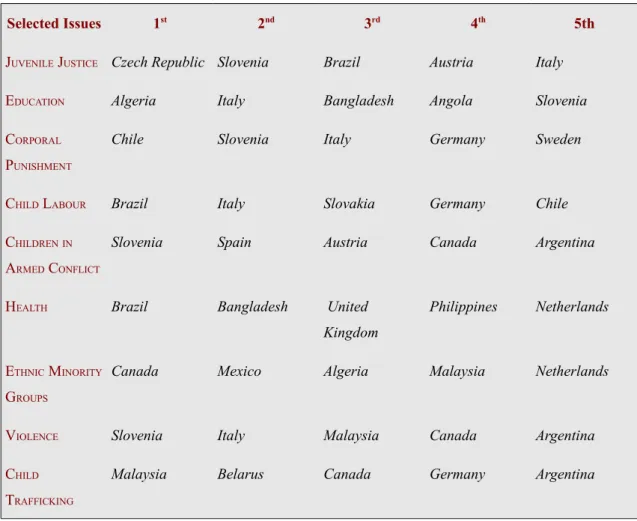
Who is pushing what issue in the final recommendations
Table 11: States raising each of the nine particular issues the most
Selected Issues 1
st2
nd3
rd4
th5th
JUVENILE JUSTICE
Czech Republic Slovenia Brazil Austria Italy
EDUCATION
Algeria Italy Bangladesh Angola Slovenia
CORPORAL PUNISHMENT
Chile Slovenia Italy Germany Sweden
CHILD LABOUR
Brazil Italy Slovakia Germany Chile
CHILDRENIN
ARMED CONFLICT
Slovenia Spain Austria Canada Argentina
HEALTH
Brazil Bangladesh United
Kingdom
Philippines Netherlands
ETHNIC MINORITY
GROUPS
Canada Mexico Algeria Malaysia Netherlands
VIOLENCE
Slovenia Italy Malaysia Canada Argentina
CHILD
TRAFFICKING
Malaysia Belarus Canada Germany Argentina
Table key: 1
strefers to the State issuing the particular issue the most, 2
ndrefers to the State issuing the particular issue the second most, and so on.
Appendix 5 lists the number of recommendations made by all States on each of the above issues.
27
Child Rights Information Network (CRIN) Analysis of Children's Rights in the Recommendations
Findings and Analysis
1) Czech Republic top proponents of juvenile justice, Algeria for education, Chile for corporal punishment
Table 11 indicates which States raise which issues the most during the final recommendations of the UPR. The findings reveal that some States pay a great deal of attention to specific issues. For example, Table 12 below illustrates how 17 of the 51 children's rights recommendations made by the Czech Republic, focus on the issue of juvenile justice.
TABLE 12: One Approach to making Recommendations
State Total no. of recommendations made (Sessions 1 - 7)
Issue raised most
Issue raised second most
CZECH REPUBLIC
51 Juvenile Justice
(17)
Education (4)
BANGLADESH
25 Education
(13)
Health (4)
2) Strange Outcomes: Chile raise corporal punishment most despite failure to fully ban at home
Table 11 shows that Chile raises the issue of corporal punishment more than any other UN Member State, a strange finding considering Chile has not banned corporal punishment in the home and in schools, and has not even made a commitment to doing so!
111. Lobbying States on key issues: If, as an organisation, you are focusing on a particular children's rights issue, then you should find out which State(s) has raised this issue.
2. Note of caution: The reason States focus on particular children's rights issues may be as a result of an individual's personal interest within the government. It is worth being mindful of this, as governments change and individuals are replaced, potentially altering the focus.
3. Examples of lobbying strategies: In Chapter 7, we will examine various national and
international lobbying approaches adopted by a range of NGOs in the UPR.
Child Rights Information Network (CRIN) Analysis of Children's Rights in the Recommendations
Which particular issues are accepted and rejected most In the final recommendations?
Earlier in the chapter, Tables 3 and 4 (page 19) illustrated the extent to which children's rights as a whole are accepted and rejected in the UPR, highlighting the fact that children's rights are more likely to be rejected than general human rights issues. Table 14 below reveals which particular children's rights issues are accepted and rejected the most.
Table 14: States responses to particular recommendations
Children's rights issue % Accepted % Rejected % Pending
VIOLENCE
83% 4% 14%
EDUCATION
85% 4% 11%
JUVENILE JUSTICE
56% 13% 30%
CHILD TRAFFICKING
92% 5% 3%
CHILDRENINARMEDCONFLICT
68% 10% 22%
ETHNICMINORITYGROUPS
67% 13% 20%
CORPORAL PUNISHMENT
50% 31% 19%
CHILD LABOUR
80% 4% 16%
HEALTH
95% 0% 5%
Findings and Analysis
Corporal punishment the most rejected issue
Table 14 clearly illustrates the range of responses given by States under Review to the selected issues. Corporal punishment is rejected the most by States of the nine issues selected. Of the 72 recommendations made on the issue of corporal punishment, only 50 per cent were accepted and 30 per cent were rejected. On the other hand, of the 257 recommendations proposed on education, only four per cent were rejected by States under Review.
29