Magnetic Multilayers II David J. Larson, Chairman
Structure and magnetism in Co Õ Pt multilayers
J. C. A. Huanga)
Physics Department, National Cheng-Kung University, Tainan, 70101, Taiwan C. H. Lee and K. L. Yu
Department of Engineering and System Science, National Tsing-Hua University, Hsinchu, 30043, Taiwan The structure of
关Co(t
Co)/Pt(10 Å)兴
30 multilayers has been studied by x-ray absorption spectroscopy and x-ray diffraction using in-plane and out- of-plane polarized synchrotron radiation.The x-ray absorption near-edge spectroscopy shows that the Co layer is like a fcc pseudomorphic structure for tColess than 4 Å. For tCo
⫽10 Å, the spectra in both directions are separated and look
closer to the bulk hcp Co. The extended x-ray absorption fine structure studies reveal that the Co–Pt interface of the multilayers fitted with a sharp boundary better than an interdiffusion model. The in-plane x-ray diffraction shows that the Pt layer in the multilayer possesses a 2%–3.5%compressible strain. Although the saturation magnetization Msdoes not depend on tCoor interfacial roughness in any simple form, the Ms values scale quite linearly with the in-plane Pt strain. We conclude that the interfacial strain is important for the perpendicular magnetization in the Co/Pt multilayers. © 2001 American Institute of Physics.
关DOI: 10.1063/1.1354580兴
The structure and magnetism of magnetic multilayers
共MLs兲 composed of modulated ferromagnetic-nonferro-
magnetic共FNF兲 layers have attracted much attention in re-
cent years. For instance, Co/Pt MLs with large perpendicular magnetic anisotropy共PMA兲 and Kerr rotations have received
considerable interest for basic research and application for high density data storage.1–5The PMA effect can exist in the magnetic multilayer as a consequence of symmetry breaking at the FNF interface. Therefore understanding of the interfa- cial structure is crucial for the PMA effect. Co/Pt films have been studied by the MCD effect, where a fcc pseudomorphic layer and PMA effect was found for Co less than 5 monolayers.6,7 Previously we also reported the epitaxial growth and the magnetic and magneto-optical properties of the Co/Pt MLs.8,9 We found that the magnetization of the Co/Pt MLs was perpendicular to the film surface for a Co layer thickness (tCo) less than about 6 Å. In addition, it has also been predicted10 that the PMA for the multilayer might be strain and interfacial roughness related. We were thus motivated to probe the structure difference of Co/Pt MLs with distinct ultrathin Co layer thickness. The共111兲 oriented 关Co(t
Co)/Pt(10 Å)兴
30 (tCo⫽1.6– 10 Å) MLs studied here
were synthesized by the molecular beam epitaxy共MBE兲
technique. The details of the MBE system and sample prepa- ration procedures have been described elsewhere.8,9To probe the local structure of the ultrathin Co layer, both the in-plane and out-of-plane x-ray absorption spectros- copy were performed in a Wiggler beamline of Taiwan Light Source
共TLS兲. The absorption spectra were performed using
the fluorescence mode with sample surfaces rotated at an angle either parallel to or nearly perpendicular to the polar-ization of the synchrotron light. For comparison, the refer- encing spectra of hcp-Co foil, and CoPt and CoPt3 alloys were also taken. The energy resolution is about 1 eV in the x-ray absorption near edge spectroscopy
共XANES兲 region
and 3 eV in the extended x-ray absorption fine structure共EX-
AFS兲 region. The crystal orientation, strain, and interfacial
roughness of the Co/Pt MLs were also measured using x-ray diffraction共XRD兲 and x-ray reflectivity. The magnetization
values and hysteresis loops of the Co/Pt MLs were measured by a vibrating sample magnetometer共VSM兲.
Figure 1 shows the derivative spectra of Co K-edge XANES for the Co/Pt MLs and the referencing samples.
Note that the XANES spectra of the in- plane and out-of- plane directions are quite similar for samples with tCo less than 4 Å. This result suggests that the Co layer is more like a fcc pseudomorphic structure at a thickness of less than 4 Å because the symmetries along the in-plane and out-of-plane directions are much the same. For tCo increased to 10 Å, in contrast, the XANES spectra in both directions are separated and look very similar to the bulk hcp Co. It is possible that a fcc to hcp structural transition occurs at tCoof about 3 to 4 Å.
Note that the x-ray absorption spectroscopy data of the Co/Pt multilayer with Co layer thickness of about 1 monolayer is quite similar to the ordered CoPt alloy.11 Both cases reveal good PMA effect.
Table I summarizes the EXAFS fitting parameters in- cluding the calculated neighboring distance, coordination number of surrounding Pt atoms, and the Debye–Waller fac- tor. These parameters are obtained by the fitting procedure where the number of Co neighbors has been fixed
共to 12兲.
For a tColayer of 10 Å, the bonding distance of the first shell is 2.5 Å, which is very close to the Co–Co distance in the bulk hcp Co. On the other hand, for a Co layer of less than 3 Å, the in-plane first shell distance of Co is expanded by
a兲Electronic mail: [email protected]
JOURNAL OF APPLIED PHYSICS VOLUME 89, NUMBER 11 1 JUNE 2001
7059
0021-8979/2001/89(11)/7059/3/$18.00 © 2001 American Institute of Physics
Downloaded 27 Aug 2008 to 140.116.208.24. Redistribution subject to AIP license or copyright; see http://jap.aip.org/jap/copyright.jsp
about 3% to 4%. To understand the interfacial morphology in the Co/Pt MLs, we compare the EXAFS results with two models, a sharp boundary model and a total interdiffusion model. Figure 2 plots the EXAFS fitting parameter of Pt coordination numbers around the Co atom for the Co/Pt MLs and alloys as well as those predicted by the two models. It appears that both in-plane and perpendicular data from the Co/Pt MLs fits the sharp boundary model much better than the interdiffusion model. Note that the interfacial roughness determined from the x-ray reflectivity is about 3–5 Å for all the Co/Pt MLs. The relatively large interfacial roughness de- duced from the x-ray reflectivity does not contradict the sharp boundary model because distinct length scales are probed between the x-ray reflectivity and the EXAFS mea- surements. The x-ray reflectivity takes a lateral average over a length scale of several microns, but the EXAFS probes only local environment on the angstrom scale. So the sharp boundary indicates that the Co/Pt interface is a jagged one instead of an interdiffused one. The result suggests that sig- nificant interdiffusion in the Co/Pt interface did not occur
FIG. 1. The derivative spectra of Co K near-edge x-ray absorption for Co/Pt multilayers and alloys with the synchrotron light polarization perpendicular
共solid curves兲 or parallel 共dashed curves兲 to the film surface.
FIG. 2. The Pt coordination numbers around the Co atom for the Co/Pt MLs and alloys obtained from experiments
共circle and square, respectively兲 and
EXAFS fitting. The prediction from sharp boundary and interdiffusion mod- els共triangle兲 are also plotted for comparison.
TABLE I. The EXAFS fitting parameters for the out-of-plane
共upper兲 and
in-plane共bottom兲 polarization for Co/Pt multilayers and alloys. Here R is
the first shell bonding distance,2is the Debye–Waller factor, and nPtis the Pt coordination numbers around the Co atom.Sample R
共Å兲
2(10⫺3Å2) nPtOut-of-plane
Cohcp 2.50
⫾0.025
4.9⫾2 0关Co/Pt兴
30tCo
⫽1.63
2.64⫾0.026
11.7⫾2 7.3⫾2tCo
⫽1.8
2.62⫾0.026 12.2⫾2
5.9⫾2
tCo
⫽1.9
2.64⫾0.026
11.0⫾2 7.6⫾2tCo
⫽4.0
2.56⫾0.026
11.4⫾2
3.8⫾2
tCo
⫽4.3
2.56⫾0.025
11.0⫾2 2.1⫾2tCo
⫽10.7
2.53⫾0.025
9.9⫾2
0.3⫾2
Alloy
Co3Pt1 2.55⫾0.025 7.9
⫾2
2.3⫾2
Co1Pt1 2.62
⫾0.026
9.3⫾2 6.7⫾2In-plane
Cohcp 2.50
⫾0.025
5.9⫾2 0关Co/Pt兴
30tCo
⫽1.6
2.61⫾0.026
9.5⫾2 7.7⫾2tCo
⫽1.8
2.60⫾0.026 8.6⫾2
5.6⫾2
tCo
⫽1.9
2.61⫾0.026
9.3⫾2 7.4⫾2tCo
⫽4.0
2.55⫾0.025 9.7⫾2
4.3⫾2
tCo
⫽4.3
2.57⫾0.025
7.5⫾2 6.2⫾2tCo
⫽10.7
2.52⫾0.025
8.2⫾2
0.3⫾2
Alloy
Co3Pt1 2.53
⫾0.025
7.5⫾2 2.3⫾2Co1Pt1 2.62⫾0.026 9.1
⫾2
7.0⫾2
7060 J. Appl. Phys., Vol. 89, No. 11, 1 June 2001 Huang, Lee, and Yu
Downloaded 27 Aug 2008 to 140.116.208.24. Redistribution subject to AIP license or copyright; see http://jap.aip.org/jap/copyright.jsp
even at a growth temperature of 200 °C. This is in good agreement with the recent Auger experiments12,13where the interdiffusion of Co on Pt was found to be significant only at temperatures higher than about 280 °C.
The nearest atom distances follow the same trend for both in-plane and out-of-plane directions. This implies that the Co/Pt multilayers might not be Poisson materials in which the typical Poisson ratio for the bulk material is appli- cable. The Debye–Waller factors fitted from the EXAFS data taken are also shown in Table I. The results indicate that the Debye–Waller factors obtained from the out-of-plane is larger than that from in-plane direction
共and larger than that
of CoPt alloys兲, even though the nearest neighbor distances
along the plane normal are slightly larger than that along the in-plane direction. This might suggest that the crystal growth along the plane normal consists of more defects or stacking faults than the in-plane direction. However, in contrast to the in-plane strain of the Pt layer, the Co near shell distance is not correlated with the in-plane strain of Pt共see Tables I and
II兲. Indeed, a maximum strain occurs at a structural phase
transition thickness for Co layer thickness of about 4 Å.The XRD results indicate that the Pt layer in the multilayer possesses a compressible strain of about 2%–
3.5% along the Pt
关1-10兴 direction. Samples with large in-
plane mosaic共about 2° – 10°) and small coherence length 共about 20–28 Å兲 were measured, indicating a plastic de-
formed of the Pt layer resulting from the lattice misfit
共10%兲
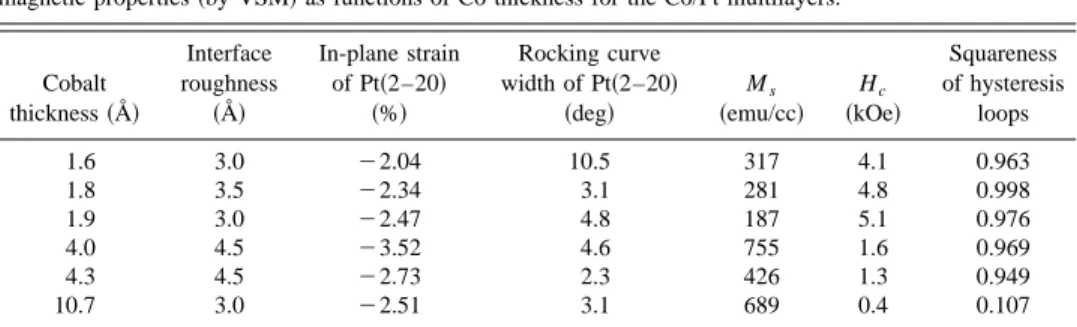
between the Co and Pt layer. The structural parameters ob- tained from the x-ray diffraction and x-ray reflectivity for the Co/Pt MLs are summarized in Table II. Table II also lists the共VSM measured兲 magnetic parameters, the saturation mag-
netization Ms, polar coercivity Hc, and loop squareness.Note that the change of Hc and squareness reveals a transi- tion of the PMA effect at a Co thickness of about 4 to 5 Å.
Interestingly enough, although the saturation magnetization Ms does not depend on tCo or interfacial roughness in any simple form, the Ms values scale quite linearly with the in- plane Pt strain
共except for the non-PMA sample with t
Co⫽10 Å), as illustrated in Fig. 3. This result leads to a specu-
lation that a larger strain of the Pt layer might imply a less strained Co layer, which in turn might give rise to a higher value toward the bulk Co value共1420 emu/cc兲. On the other
hand, the polar coercivity does not scale in any simple rela- tion with the Pt strain or any other structural parameters, indicating that the coercivity is more likely a magnetic do- main related parameter. We conclude that the interfacial strain is important for the perpendicular magnetization in the Co/Pt multilayers.The authors are grateful for the financial support by the ROC NSC under Grant Nos. NSC 89-2112-M-006-037
共J.C.A.H.兲 and 88-2112-M-007-035 共C.H.L.兲.
1P. F. Carcia, J. Appl. Phys. 63, 5066
共1988兲.
2W. B. Zeper, F. J. A. M. Greidanus, P. F. Carcia, and C. R. Fincher, J.
Appl. Phys. 65, 4971
共1989兲.
3C. H. Lee, R. F. C. Farrow, C. J. Lin, E. E. Marinero, and C. J. Chien, Phys. Rev. B 42, 11384
共1990兲.
4K. Babcook, V. B. Elings, J. Shi, D. D. Awschalom, and M. Dugas, Appl.
Phys. Lett. 69, 705
共1966兲.
5C. L. Canedy, X. W. Li, and G. Xiao, J. Appl. Phys. 81, 5367
共1997兲.
6N. Nakajima, T. Koide, T. Shidara, H. Miyauchi, H. Fukutani, A. Fuji- mori, K. Iio, T. Katayama, M. Nyvlt, and Y. Suzuki, Phys. Rev. Lett. 81, 5229
共1998兲.
7J. Thiele, C. Boeglin, K. Hricovini, and F. Chevrier, Phys. Rev. B 53, 11934
共1996兲.
8J. C. A. Huang, L. C. Wu, A. C. Hsu, Y. M. Hu, T. H. Wu, and C. H. Lee, Phys. Rev. B 59, 1209
共1998兲.
9J. C. A. Huang, L. C. Wu, J. C. Wu, T. H. Wu, and C. H. Lee, J. Magn.
Magn. Mater. 209, 90
共2000兲.
10A. Yamaguchi, S. Ogu, W. H. Soe, and R. Yamamoto, Appl. Phys. Lett.
62, 1020
共1993兲.
11J. C. A. Huang, A. C. Hsu, Y. H. Lee, T. H. Wu, and C. H. Lee, J. Appl.
Phys. 85, 5977
共1999兲.
12M. T. Lin, H. Y. Her, Y. E. Wu, C. S. Shern, J. W. Ho, C. C. Kuo, and H.
L. Huang, J. Magn. Magn. Mater. 209, 211
共2000兲.
13J. S. Tsay, Y. E. Wu, and C. S. Shern, Chin. J. Phys.
共Taipei兲 35, 610 共1997兲.
FIG. 3. The saturation magnetization Msof the Co/Pt multilayers plotted as a function of the in-plane Pt strain. The Ms values for PMA samples
共square兲 scale quite linearly with the in-plane Pt strain except for the non-
PMA sample共circle兲 with t
Co⫽10 Å.
TABLE II. The determined structural parameters
共by x-ray diffraction and reflectivity兲 together with the
magnetic properties共by VSM兲 as functions of Co thickness for the Co/Pt multilayers.
Cobalt thickness
共Å兲
Interface roughness
共Å兲
In-plane strain of Pt
共2–20兲
共%兲
Rocking curve width of Pt
共2–20兲
共deg兲
Ms
共emu/cc兲
Hc共kOe兲
Squareness of hysteresis
loops
1.6 3.0
⫺2.04
10.5 317 4.1 0.9631.8 3.5
⫺2.34
3.1 281 4.8 0.9981.9 3.0
⫺2.47
4.8 187 5.1 0.9764.0 4.5
⫺3.52
4.6 755 1.6 0.9694.3 4.5
⫺2.73
2.3 426 1.3 0.94910.7 3.0
⫺2.51
3.1 689 0.4 0.1077061
J. Appl. Phys., Vol. 89, No. 11, 1 June 2001 Huang, Lee, and Yu
Downloaded 27 Aug 2008 to 140.116.208.24. Redistribution subject to AIP license or copyright; see http://jap.aip.org/jap/copyright.jsp