鄭松益(2001)。台灣地區高中排球教練領導行為與選手滿意度關係之研究。未出版之碩士 論文,臺北市,臺北市立師範學院國民教育研究所。 鄭俊傑、葉逸欣(2007)。大專院校棒球教練領導行爲與選手滿意度之研究。運動知識學報, 4,202-212。 鄭敏雄(1991)。大專院校教練領導行為與運動員滿足感關係之研究。未出版之碩士論文, 臺北市,國立臺灣師範大學體育研究所。 盧俊宏(1998)。運動心理學。台北:師大書苑。 蕭嘉惠(2003)。大專排球運動教練領導行為比較研究。花蓮師範學院學報,12,211-240。 蕭嘉惠、黃明玉(1998)。多元領導模式驗證研究-以花蓮地區大專院校為例。體育學報,25, 71-80。
Chelladurai, P., & Carron, A. V. (1983). Athletic maturity and preferred leadership. Journal of Psychology, 5, 371-380.
Chelladurai, P. (1993). Leadership. In R. N. Singer, M. Murphey & L. K. Tennant (Eds.),
Handbook of research on sport psychology (pp. 648-671). NY: Macmillan Publishing
Company.Kwak, C. G. (2002). A study on the influence of Taekwondo coach types on the
performance of male and female players. Unpublished master's thesis, Korean National
University of Physical Education, Seoul, South Korea.
Horner, T., & Carron, A. V. (1985). Compatibility in coach-athlete Relationships. Journal of Psychology, 7, 137-149.
Kwak, C. G. (2002). A study on the influence of Taekwondo coach types on the
performance of male and female players. Unpublished master's thesis, Korean
National University of Physical Education, Seoul, South Korea.
Stevens, J. (2001). Applied multivariate statistics for the social sciences. Hillsdale, NJ: Lawrence Erlbaum.
Serpa, S., Pataco, V., & Santos, F. (1991).Leadership patterns in Handball International
Perceived coaches' leadership behaviors and players’
satisfactions from collegial volleyball athletes
Shih-Fam Li Yuan Ze University
abstract
Purposes of this study were to explore and predict coaches’ leadership behaviors and
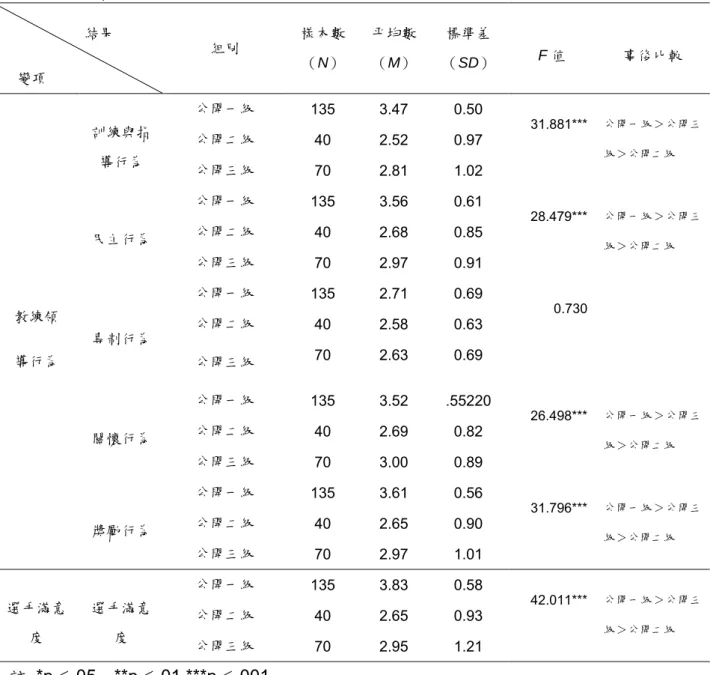
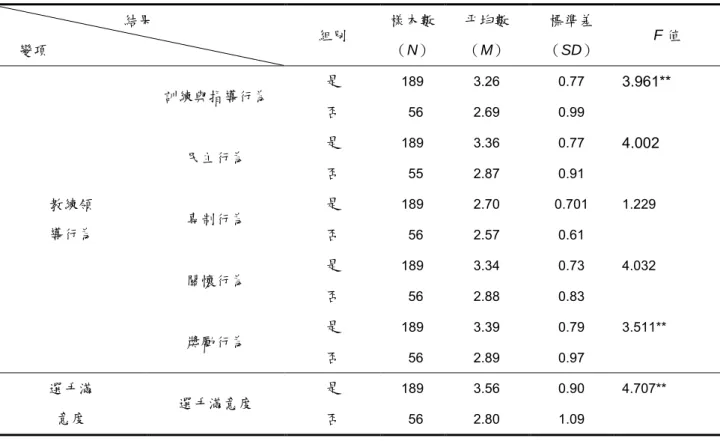
players’ satisfactions from collegial volleyball athletes. The method was the questionnaire. Subjects were 245 athletes from level-1 to level-3 of final collegial volleyball competitions. Those data were collected and analyzed by item analysis, factor analysis, descriptive statistic, t-test, one-way ANOVA, and multiple regressions. The results were as follows: a) the highest score of perceived coaches' leadership behaviors was Rewarding Behavior, and other scores were Democratic Behavior, Social Behavior, Training and Instruction, and Autocratic Behavior. In addition, the score of players’ satisfaction was higher than it of perceived coaches’ leadership behaviors. b)the scores of perceived coaches’ leadership behavior and players’ satisfactions were affected by gender, university, level, the highest level, and players of senior high schools. c) Players satisfactions were predicted by
Training and Instruction, Autocratic Behavior, Social Behavior, and Democratic Behavior of perceived coaches’ leadership behaviors. In conclusion, coaches needed to spend more time to consult players of universities, and to improve trusts of each other. Furthermore, coaches also used those behaviors, such as Training and Instruction, Rewarding Behavior, Democratic Behavior, and Social Behavior, to improve relationships and satisfactions between coaches and players.