Research Express@NCKU - Articles Digest
1 of 2
Research Express@NCKU Volume 29 Issue 7 - September 4, 2015
[ http://research.ncku.edu.tw/re/articles/e/20150904/2.html ]The activation of CEBPD in M2 macrophages
contributes to the progression of tumorigenesis
Yu-Wei Hsiao
1, Chien-Feng Li
6, Jhih-Ying Chi
5, Joseph T. Tseng
1,2,3, Yao Chang
7, Li-Jin Hsu
4,
Chien-Hsun Lee
7, Tsung-Hao Chang
4, Shao-Ming Wang
5, Dennis Ding Hwa Wang
9, Hung-Chi
Cheng
5, Ju-Ming Wang
1,2,3,9,*1 Institute of Bioinformatics and Biosignal Transduction, National Cheng Kung University 2 Infectious Disease and Signaling Research Center, National Cheng Kung University 3 Center of molecular inflammation, National Cheng Kung University
4 Department of Medical Laboratory Science and Biotechnology, National Cheng Kung University 5 Institute of Basic Medical Science, National Cheng Kung University
6 Department of Pathology, Chi-Mei Medical Center
7 Division of Infectious Diseases, National Health Research Institutes, Tainan 8 Institute of Medical Sciences, Taipei Medical University, Taipei, Taiwan ROC 9 Department of Biological Chemistry, UC Irvine, School of Medicine, CA, USA [email protected]
CCAAT/Enhancer Binding Protein delta in Macrophages Contributes to Immunosuppression and Inhibits Phagocytosis in Nasopharyngeal Carcinoma. Science Signaling 2013, 6(284): ra59.
R
ecent studies showed that chronic inflammation increases the risk of normal cells tobecome tumorigenic and enhances cancer cell metastasis and invasion. Tumor-associated macrophages (TAM) are the most abundant immune cells within the tumor stroma and are required for a number of functions important for tumor progression, such as promoting tumor cell proliferation, angiogenesis, incessant matrix turnover and repressing the adaptive immunity. The tumor-promoting properties of macrophages are further enhanced by their ability to synthesize and secrete inhibitory factors that suppression of host’s antitumor
effectors. Clinical investigations have shown that high levels of macrophage infiltration into tumors are associated with a poor prognosis, but the underlying mechanisms governing the interactions of these two cellular processes remain elusive, particularly in the involvement of post-transcriptional regulation.
Nasopharyngeal carcinoma (NPC) represents a unique tumor microenvironment in which the epithelial tumor cells are surrounded by abundant infiltrating immune cells. High COX-2 expression and increased prostaglandin E2 (PGE2) production were observed in NPC cells. HuR, a ubiquitously expressed member of the Hu family, selectively binds and stabilizes AU-rich element (ARE)-containing mRNAs encoding proto-oncogenes (e.g.,
c-Myc and c-Fos), cytokines (e.g., TNFα and IL-2) and growth factors (GM-CSF), which are overexpressed in cancer
or inflammation. HuR is mainly localized within the cell nucleus, and nucleocytoplasmic shuttling of HuR is generally assumed to be the initial and critical step of its stabilizing effects. HuR correlates with tumor frequency and is overexpressed in solid tumors, such as breast cancer, hepatocellular carcinoma (HCC) and colon cancer. However, the functional significance and downstream effectors of HuR in macrophages, especially in cancer microenvironment, remain less understood.
CEBPD belongs to the CCAAT/enhancer-binding protein (C/EBP) family and is expressed at a relatively low level under normal physiological conditions. CEBPD is up-regulated by a variety of extracellular stimuli and activates COX-2 and MCP1. Moreover, overexpression of CEBPD induces growth arrest and apoptosis in cancer cells; therefore, it is suggested to be a tumor suppressor. Recent studies have shown that CEBPD expression is attenuated in many cancers including cervical cancer and HCC. Previously, we demonstrated that Yin-Yang 1/polycomb group (PcG) complex/DNA methyltransferase-mediated CEBPD promoter hypermethylation contributes to the silencing of CEBPD in cancer cells. Interestingly, several recent evidences showed that CEBPD
Research Express@NCKU - Articles Digest
2 of 2
also plays a protumor role under hypoxic or chronic inflammatory conditions. A recent report demonstrated that an
increase in mammary tumor multiplicity is associated with a decrease of lung metastasis in Cebpd-/-/HER2/Neu
transgenic mice. This result is not only consistent with the conjecture that CEBPD acts as a tumor suppressor in cancer cells but also increased the likelihood that CEBPD may influence other cells, such as those of the immune system, contributing to the growth, survival and migration of cancer cells.
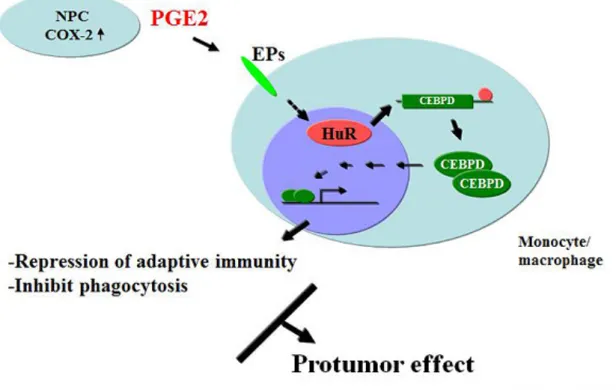
In our recent study published in 2013 Science Signaling, we first demonstrated that PGE2 activates CEBPD transcription by nucleocytoplasmic shuttling of HuR, which plays a direct role in stabilizing CEBPD mRNA in macrophages. Next, the conditioned medium of CEBPD-expressing macrophages showed an immunosuppressive effect to attenuate phagocytosis of cancer cells by macrophages, suggesting an autocrine mode of regulation. We next identified the downstream effectors in response to CEBPD activation in M2 macrophages. An increase in CEBPD resulted in elevated expression of IL-10, which is a well-studied immunosuppressor, and Pentraxin 3 (PTX3), which contributes to the suppression of phagocytosis of cancer cells by macrophages. Immunohistochemistry studies demonstrated that the cytosolic level of HuR protein correlated with increased CEBPD in TAM and malignant nasopharyngeal carcinoma. These observations suggest that CEBPD may act as a double-edged sword in promoting or suppressing cancer progression.
Collectively, we provide new evidence that the inflammatory PGE2/HuR/CEBPD axis in PGE2-treated macrophages plays protumor roles in controlling immunosuppression and attenuating phagocytosis of cancer cells by macrophages (Fig.1).
Fig. 1 The protumor effect of CEBPD activation in response to PGE2 in TAM. PGE2 induces nuclear HuR shuttles to cytoplasm and the cytosolic HuR binds to and stabilizes CEBPD mRNA. The increase of CEBPD abundance further activates IL-10 and PTX3 to suppress the immune effect and promote tumorigenesis.