• 沒有找到結果。

Chapter 3 Methodology

N/A
N/A
Protected

Academic year: 2021

Share "Chapter 3 Methodology "

Copied!
20
0
0

加載中.... (立即查看全文)

全文

(1)

Chapter 3 Methodology

To achieve the objectives of this research, both primary and secondary research is carried out. This chapter is divided into five sections to present the research framework, research subjects, collection of data, description of the sample and data analysis procedures.

3.1 Research focus

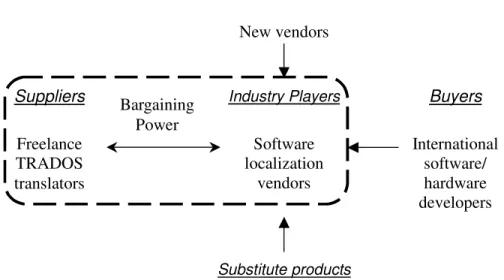
The context of this research is placed in the software localization industry in Taiwan. By using Porter's Five Forces Model framework, the software localization industry in Taiwan can also be analyzed from five aspects. The industry players refer to the software localization vendors in Taiwan while the suppliers are the freelance TRADOS translators. The buyers of the industry can be the large international software or hardware developers. The substitute products mean the products that can offer the same services of the software localization vendors, which remain unknown.

The new entrants of the software localization industry refer to the new comers who want to engage in the software localization business. The Five Forces Model of the software localization industry in Taiwan can be shown in Figure 2.4.

The focal point of the research is marked with an oblong in Figure 2.4, limited to

the relationship between freelance TRADOS translators and software localization

vendors. In this research, buyers refer to the software localization vendors and

suppliers refer to the freelance TRADOS translators.

(2)

Figure 3.1 Software localization industry in Taiwan and the focus of this research

3.2 Research framework

The scope of the research is limited to the relationships between the software localization vendors (buyers) and freelance TRADOS translators (suppliers) in Taiwan's software localization industry. It is the aim of this research to examine the bargaining power of buyers and suppliers as well as the buyer-supplier relationship altogether in Taiwan's software localization industry. The researcher would like to examine the bargaining power of the software localization vendors, the bargaining power of the freelance TRADOS translators, and the current buyer-supplier relationship as a whole between the software localization vendors and freelance TRADOS translators. The researcher expects to answer the following research questions.

New Entrants New vendors

Buyers International

software/

hardware developers

Substitute products

Not available

Industry Players

Software localization

vendors Suppliers

Freelance TRADOS translators

Bargaining

Power

(3)

1. Is the bargaining power of the software localization vendors high, medium or low?

2. Is the bargaining power of the freelance TRADOS translators high, medium or low?

3. What is the current buyer-supplier relationship between the software localization vendors and freelance TRADOS translators in Taiwan's software localization industry?

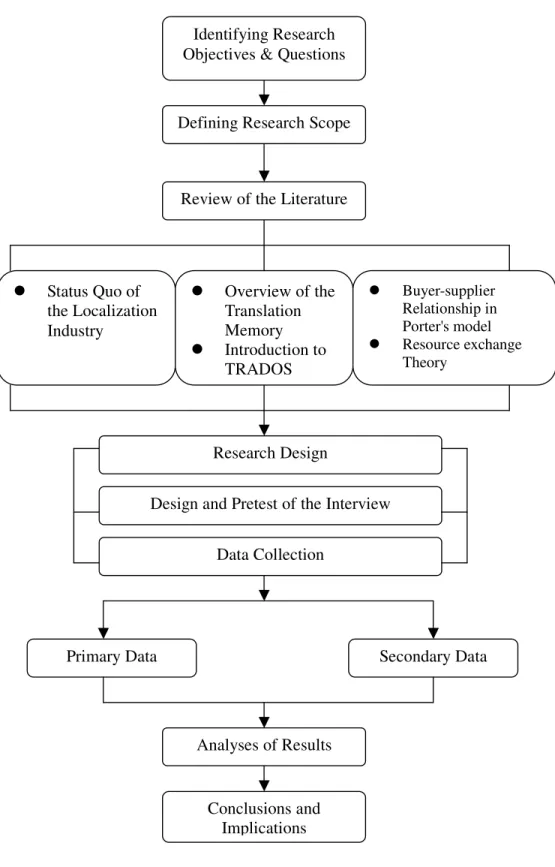
The research process of this study is presented in Figure 3.1

(4)

Figure 3.2 Research Process Flowchart

Identifying Research Objectives & Questions

Defining Research Scope

Review of the Literature

Research Design

Primary Data Secondary Data

Analyses of Results

Conclusions and Implications

Design and Pretest of the Interview

Data Collection Status Quo of

the Localization Industry

Overview of the Translation Memory Introduction to TRADOS

Buyer-supplier Relationship in Porter's model Resource exchange Theory

(5)

Porter's (1980) Five Forces Model and Ramsay's (1995) resource exchange

theory are partly adopted in this research to examine the bargaining power of the

software localization vendors and freelance TRADOS translators in Taiwan's software

localization industry. Based on the Five Forces Model and resource exchange theory

in the literature review, the data to be collected include the concentration of the

players in the industry, competition from any substitute products, transaction volume,

differentiation of products/services, importance of the products/services as a business

input, switching costs, threat of vertical integration, industry profit, perceived amount

of payment, dependence on the other party, total cost of products/services, urgency of

delivery, and full information of the market. A brief introduction of the data to be

collected is presented in Table 3.1.

(6)

Table 3.1 Data to be collected and their details Data to be collected Details

Concentration of the players

in the industry

Is the software localization vendor group dominated by a few companies and more concentrated relative to freelance TRADOS translator group?

Is the freelance TRADOS translator group dominated by a few translators and more concentrated relative to the software localization vendor group?

Competition from any

substitute product

Is there any substitute product in the software localization industry?

Is there any competition from the substitute product?

Transaction volume

Does the software localization vendor group purchase large volumes relative to the sales of the freelance TRADOS translator group?

Differentiation of

products/services

Is the translation service in the software localization industry differentiated or standard?

Importance of the products/services as a business input

How important is the translation service to the software localization vendors as a business input?

Switching costs

What are the switching costs that the software localization vendors face when they switch to new freelance TRADOS translators?

What are the switching costs that the freelance TRADOS translators face when they switch to new software localization vendors?

Threat of vertical integration

Do the software localization vendors pose a credible threat of backward integration to offer translation service on their own instead of outsourcing?

Do the freelance TRADOS translators pose a credible threat of forward integration to offer other products and services of the software localization vendors?

Industry profit

What is the profit level of the software localization industry?

Perceived amount of

payment

How do freelance TRADOS translators perceive the amount of payment they receive from the software localization vendors?

Dependence on the other

party

How much do the software localization vendors depend on the freelance TRADOS translators?

How much do the freelance TRADOS translators depend on the software localization vendors?

Total cost of

products/services

What is the total cost of translation service perceived by the freelance TRADOS translators?

Is the total cost high or low as perceived by both the software localization vendors and freelance TRADOS translators?
Urgency of delivery

Is urgent delivery of translation service by freelance TRADOS translators more appealing to the software localization vendors?

Full information of the

market

Do the software localization vendors possess full information of the market?

(7)

In addition to the secondary data collection, a survey was designed to measure the perceptions of software localization vendors (buyers) and freelance TRADOS translators (suppliers) of whether TRADOS affects their respective bargaining power.

3.3 Research subjects

This research chose two subjects of research – the software localization vendors and freelance TRADOS translators in Taiwan's software localization industry.

3.3.1 Software localization vendors in Taiwan

According to the Survey of the Translation and Interpretation Industry in Taiwan published by the Government Information Office in 2004, there are eight major software localization vendors in Taiwan. However, only seven vendors are confirmed to be in operation, including Wistron Information Technology & Services Corp.

(Wistron ITS), Symbio Group, International Integrated Systems, Inc. (IISI),

Shinewave International Inc., TargeTek Co. Ltd., Syzygy Information Services Co., Ltd. and Topinfo Service Co. Ltd. Apart from these vendors, some translation agencies have localization departments. The Survey of the Translation and

Interpretation Industry in Taiwan (Government Information Office, 2004) pointed out

that most of the software localization companies highly rely on translation memory

tools such as TRADOS. The researcher then assumed that the seven remaining

vendors are using TRADOS and attempted to contact them for confirmation as well as

interviews.

(8)

This research positions the software localization vendors as buyers as opposite to the freelance TRADOS translators. In order to obtain a more comprehensive result of the bargaining power of the buyers, all of the seven software localization vendors in Taiwan are to be surveyed. It is more appropriate for the interview respondents who have an understanding of the localization projects which require the use of TRADOS or are involved in the projects themselves to answer the interview questions on behalf of the localization companies. Therefore, appropriate personnel who have knowledge of the software localization projects using TRADOS as a supportive tool and are currently working in the software localization companies or are involved in the software localization projects in the translation agencies are qualified to be surveyed.

3.3.2 Freelance translators using TRADOS

It is reported in the Survey of the Translation and Interpretation Industry in Taiwan (Government Information Office, 2004) that freelance translators are responsible for 83.75% of the translation projects in the software localization companies in Taiwan. The Survey (2004) that the translation activity in Taiwan is dominated by freelance translators.

As the suppliers who offer translation services to the software localization

vendors, freelance translators, limited to those who used or are using TRADOS, were

chosen to be the second subject of the research. Any freelance translators who used or

are using TRADOS are qualified to be surveyed regardless of the duration of using

the tool.

(9)

3.4 Collection of data

Both primary and secondary research was carried out to collect data for this research. The secondary data was obtained mainly from the Survey of the Translation and Interpretation Industry in Taiwan published by the Government Information Office in 2004.

In terms of the primary data collection, a survey was designed based on the Five Forces Model and resource exchange theory in the literature review as survey is the most appropriate tool to study the attitudes, perceptions, and opinions of the research subjects (Neuman, 2000). Among various techniques of survey, the semistructured interview was adopted in this research as it allows the respondents to answer the questions without much limitation and enables other aspects of the issue to be brought up in interview, leading to possible new findings (Tutty, Rothery, & Grinnell, 1996).

3.4.1 Survey design

In the Five Forces Model, a buyer group or supplier group is considered powerful when certain conditions are met. The resource exchange theory also

proposed the determinant factors which influence the buyer-supplier relationship. The

survey questions were then developed based on those conditions and determinant

factors to measure the perceptions of the respondents. More specifically, the

conditions and factors to be examined include concentration of the players in the

industry, competition from any substitute products, transaction volume, differentiation

(10)

of products/services, importance of the products/services as a business input, switching costs, threat of vertical integration, industry profit, perceived amount and form of payment, total cost of products/services, urgency of delivery, and full

information of the market. As the nature of the different factors to be examined varies, the survey questions included open-ended questions, multiple-choice questions, and rank ordering questions. Usually one or more follow-up questions were asked during the interview for clarifications.

3.4.2 Survey questions for software localization vendors

Survey questions are formulated in Chinese and consist of two parts. The first part is to obtain the factual background information of the respondents. The second part is the semistructured survey questions.

The questions in the first part include gender, translation training, translation experience, years of using TRADOS, and still using TRADOS or not.

As outlined in the literature review, when eight conditions are met, a buyer group

is powerful. The power of software localization vendors can then be examined by

whether the eight conditions are present. Table 3.1 and table 3.2 illustrate the eight

conditions and the factors to be examined in each condition.

(11)

Table 3.2 Powerful buyer group's determinants factors and factors to be examined for buyers

Powerful buyer group's determinant

factors Factors to be examined for buyers

1. It is concentrated or purchases large volumes relative to seller sales. (Buyer concentration and large purchase volume)

concentration of the buyers

purchase volume of buyers relative to seller sales

2. The products it purchases from the industry represent a significant fraction of the buyer’s costs or purchases. (Significant costs or purchases)

percentage of the transaction volume in the buyer's costs or purchases

3. The products it purchases from the industry are standard or

undifferentiated. (Product differentiation)

differentiation of the product existence of any substitute products competition from any substitute products

4. It faces few switching costs.

(Switching costs) switching costs of the buyers 5. It earns low profits. (Industry profits) profits of the buyers

6. Buyers pose a credible threat of backward integration. (Backward integration)

threat of backward integration posed by buyers

7. The industry’s product is unimportant to the quality of the buyers’ products or services. (Quality influence)

importance of the supplier's product to the buyers' products or services 8. The buyer has full information. (Full

information) information possessed by buyers

about the market

In addition, the resource attractiveness of money to the suppliers and of products to the buyers determines the buyer-supplier relationships. For the buyers, the

determinants of attractiveness for products are as follows.

(12)

Table 3.3 Determinants of attractiveness and attractiveness factors to be examined for products

Products – determinants of attractiveness Attractiveness factors to be examined for products

1. Total cost supplier's total cost of offering the product

2. Urgency the attractiveness of fast delivery of products/services to meet the urgent need of buyers

3. Information buyer's possession of enough

information to correctly evaluate supplier's performance

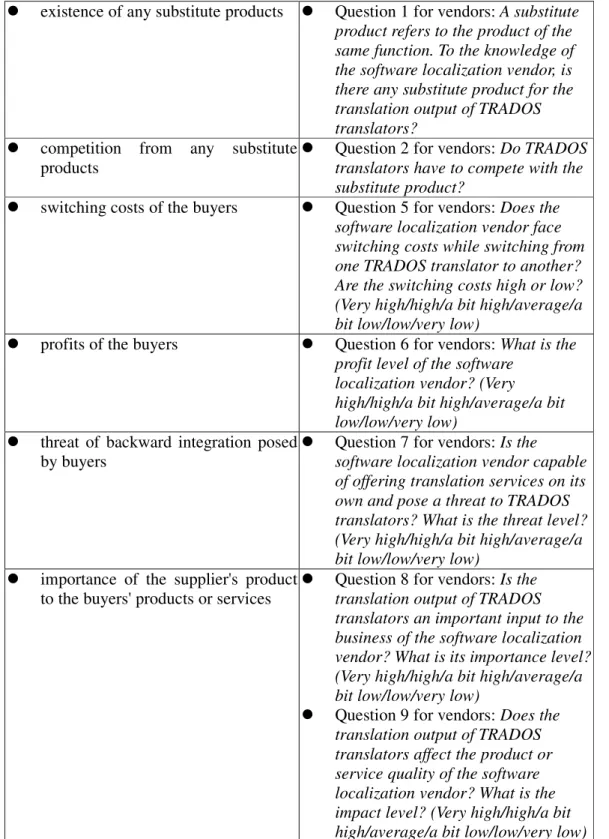
Eventually, seventeen questions were formulated to be asked in the

semistructured interview. Table 3.3 shows the factors and the questions formulated.

Table 3.4 Factors to be examined for buyers and survey questions Factors to be examined for buyers Survey questions

concentration of the buyers Secondary research purchase volume of buyers relative to

seller sales Question 9 for translators :Do you

use TRADOS to work on translation of other types of cases apart from software localization cases? Among all the cases that you translate via the help of TRADOS, what are the respective percentages of software localization cases and other types of cases?

percentage of the transaction volume

in the buyer's costs or purchases Question 3 for vendors: What is the percentage of TRADOS translators' output in the total cost or purchases of software localization vendors?

_____% (Very high/high/a bit

high/average/a bit low/low/very low) differentiation of the product Question 4 for vendors: Are the

translation outputs of TRADOS translators purchased by the software localization vendor similar or

differentiated? (Very similar/similar/a bit similar/a bit

dissimilar/dissimilar/very dissimilar)

(13)

Table 3.4 Factors to be examined for buyers and survey questions (continued) existence of any substitute products Question 1 for vendors: A substitute

product refers to the product of the same function. To the knowledge of the software localization vendor, is there any substitute product for the translation output of TRADOS translators?

competition from any substitute

products Question 2 for vendors: Do TRADOS

translators have to compete with the substitute product?

switching costs of the buyers Question 5 for vendors: Does the software localization vendor face switching costs while switching from one TRADOS translator to another?

Are the switching costs high or low?

(Very high/high/a bit high/average/a bit low/low/very low)

profits of the buyers Question 6 for vendors: What is the profit level of the software

localization vendor? (Very high/high/a bit high/average/a bit low/low/very low)

threat of backward integration posed

by buyers Question 7 for vendors: Is the

software localization vendor capable of offering translation services on its own and pose a threat to TRADOS translators? What is the threat level?

(Very high/high/a bit high/average/a bit low/low/very low)

importance of the supplier's product

to the buyers' products or services Question 8 for vendors: Is the translation output of TRADOS translators an important input to the business of the software localization vendor? What is its importance level?

(Very high/high/a bit high/average/a bit low/low/very low)

Question 9 for vendors: Does the

translation output of TRADOS

translators affect the product or

service quality of the software

localization vendor? What is the

impact level? (Very high/high/a bit

high/average/a bit low/low/very low)

(14)

Table 3.4 Factors to be examined for buyers and survey questions (continued) information possessed by buyers

about the market Question 12 for vendors: Does the software localization vendor have full information of the market demand, actual market price and the cost of translators? What is the level of information possessed? (Very high/high/a bit high/average/a bit low/low/very low)

Attractiveness factors to be examined for

products Question 14 for translators: Is your

translation output attractive to the software localization vendors? What is the attractiveness level? (Very high/high/a bit high/average/a bit low/low/very low)

supplier's total cost of offering the

product Question 13 for vendors: To the

knowledge of the software

localization vendor, what is the cost of equipment for translators when TRADOS is used in the process of translation? Is the cost of equipment high or low? (Very high/high/a bit high/average/a bit low/low/very low) Question 14 for vendors: To the knowledge of the software

localization vendor, what is the labor cost of translators when TRADOS is used in the process of translation? Is the labor cost high or low? (Very high/high/a bit high/average/a bit low/low/very low)

Question 11 for translators: What is your cost of equipment of using TRADOS in the process of

translation? Is the cost of equipment

high or low? (Very high/high/a bit

high/average/a bit low/low/very low)

Question 12 for translators: What is

your labor cost of using TRADOS in

the process of translation? Is the

labor cost high or low? (Very

high/high/a bit high/average/a bit

low/low/very low)

(15)

Table 3.4 Factors to be examined for buyers and survey questions (continued) the attractiveness of fast delivery of

products/services to meet the urgent need of buyers

Question 16 for vendors: Does the software localization vendor like to work with freelance TRADOS

translators with fast turnaround? Are the TRADOS translators with fast turnaround more attractive to the software localization vendors?

buyer's possession of enough information to correctly evaluate supplier's performance

Question 10 for vendors: What criteria are used by the software localization vendors to evaluate the translation quality of TRADOS translators?

Question 11 for vendors: Does the software localization vendor has an appropriate system to collect

information of, analyse, and correctly evaluate TRADOS translators' performance without misjudging the attractiveness of their translation output?

other factors of product attractiveness Question 17 for vendors: As TRADOS has taken care of the issue of

terminology, the consistency of translation is no longer a major issue of translation. Then, what are the characteristics of a translation output that the software localization vendor looks for while purchasing

translation services? For example, accuracy, fluency, turnaround speed, format……

Question 13 for translators: As TRADOS has taken care of the issue of terminology, the consistency of translation is no longer a major issue of translation. Then, what are the characteristics of your translation services that attract the software localization vendor? For example, accuracy, fluency, turnaround speed, format……

Both Chinese and English versions of questions for the software localization

vendors are provided in Appendix A and B. In general, the questions can be divided

(16)

3.4.3 Survey questions for freelance TRADOS translators

Survey questions for freelance TRADOS translators share the same principle of those for software localization vendors with the first part to obtain the factual background data of the respondents and the second part as the semistructured survey questions.

The questions in the first part included gender, translation training, translation experience, years of using TRADOS, still using TRADOS or not, and the average amount of source words that can be translated per day.

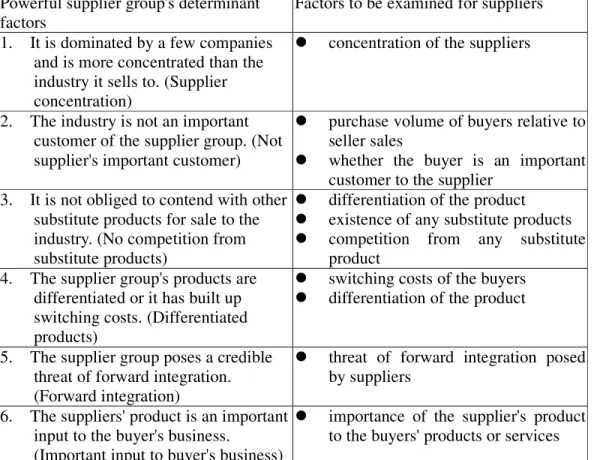
The literature review indicated six conditions to determine the power of a buyer

group. The power of freelance TRADOS translators can then be examined by whether

the six conditions are present. The following table illustrates the six conditions and

the factors to be examined in each condition.

(17)

Table 3.5 Powerful supplier group's determinant factors and factors to be examined for suppliers

Powerful supplier group's determinant

factors Factors to be examined for suppliers

1. It is dominated by a few companies and is more concentrated than the industry it sells to. (Supplier concentration)

concentration of the suppliers

2. The industry is not an important customer of the supplier group. (Not supplier's important customer)

purchase volume of buyers relative to seller sales

whether the buyer is an important customer to the supplier

3. It is not obliged to contend with other substitute products for sale to the industry. (No competition from substitute products)

differentiation of the product existence of any substitute products competition from any substitute product

4. The supplier group's products are differentiated or it has built up switching costs. (Differentiated products)

switching costs of the buyers differentiation of the product

5. The supplier group poses a credible threat of forward integration.

(Forward integration)

threat of forward integration posed by suppliers

6. The suppliers' product is an important input to the buyer's business.

(Important input to buyer's business)

importance of the supplier's product to the buyers' products or services

For the suppliers, the determinants of attractiveness for money are as follows.

Table 3.6 Determinants of attractiveness for money and Attractiveness factors to be examined for money

Money – determinants of attractiveness Attractiveness factors to be examined for money

1. Amount attractiveness of the perceived

amount of payment to the suppliers 2. Supplier's financial state of health financial state of the suppliers

Eventually, sixteen questions were formulated to be asked in the semistructured

interview. Table 3.6 illustrates the factors to be examined for suppliers and related

survey questions.

(18)

Table 3.7 Factors to be examined for suppliers and survey questions Factors to be examined for suppliers Survey questions

concentration of the suppliers Secondary research purchase volume of buyers relative to

seller sales Question 9 for translators: Do you

use TRADOS to work on translation of other types of cases apart from software localization cases? Among all the cases that you translate via the help of TRADOS, what are the respective percentages of software localization cases and other types of cases?

whether the buyer is an important

customer to the supplier Question 3 for translators: Are the software localization vendors your important customers? What is their importance level? (Very high/high/a bit high/average/a bit low/low/very low)

differentiation of the product Question 4 for translators: Is your translation output produced via the help of TRADOS an important input to the business of the software localization vendors? What is its importance level? (Very high/high/a bit high/average/a bit low/low/very low)

existence of any substitute products Question 1 for translators: A substitute product refers to the product of the same function. As far as you know, is there any substitute product for your translation output produced via the help of TRADOS?

competition from any substitute

product Question 2 for translators: Do you

have to compete with the substitute product?

switching costs of the buyers Question 7 for translators: Does your TRADOS capability increase the switching costs of the software localization vendors when they switch TRADOS translators? Do you consider their switching costs high or low? (Very high/high/a bit

high/average/a bit low/low/very low)

Question 10 for translators: Do you

face high or low switching costs

when you have to switch software

localization vendors? (Very

high/high/a bit high/average/a bit

(19)

Table 3.7 Factors to be examined for suppliers and survey questions (continued) differentiation of the product Question 6 for translators: Is your translation output produced via the help of TRADOS similar to or different from the translation outputs of other freelance translators who use TRADOS? (Very similar/similar/a bit similar/a bit

dissimilar/dissimilar/very dissimilar) threat of forward integration posed by

suppliers Question 8 for translators: Are you

capable of offering other products and services of the software localization vendors and pose a threat to them? What is the threat level? (Very high/high/a bit high/average/a bit low/low/very low/not a threat)

the importance of the supplier's product to the buyers' products or services

Question 5 for translators: Does your translation output produced via the help of TRADOS affect the product or service quality of the software

localization vendors? What is the impact level? (Very high/high/a bit high/average/a bit low/low/very low) Attractiveness factors to be examined for

money Question 15 for vendors: Is the

translation price offered by the software localization vendor attractive to freelance TRADOS translators? What is its attractiveness level? (Very high/high/a bit
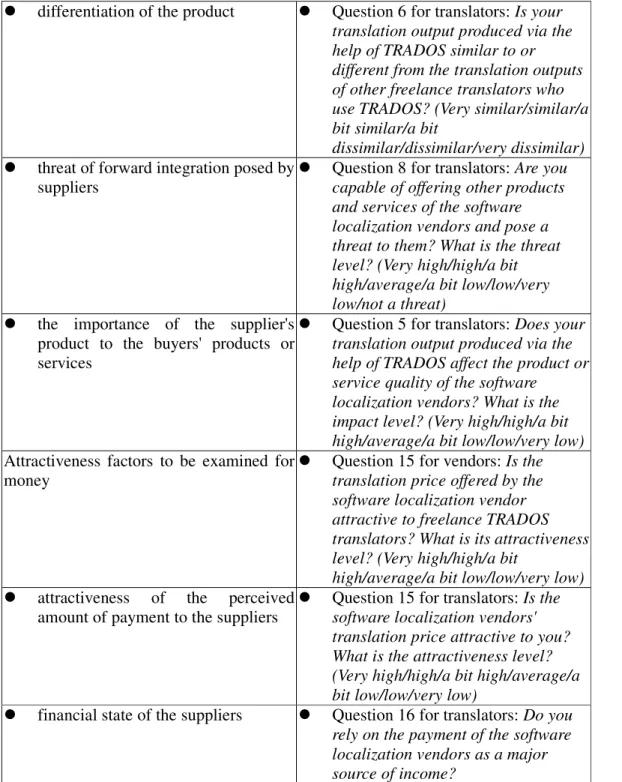
high/average/a bit low/low/very low) attractiveness of the perceived

amount of payment to the suppliers Question 15 for translators: Is the software localization vendors' translation price attractive to you?

What is the attractiveness level?

(Very high/high/a bit high/average/a bit low/low/very low)

financial state of the suppliers Question 16 for translators: Do you rely on the payment of the software localization vendors as a major source of income?

Both Chinese and English versions of questions for the freelance TRADOS

translators are provided in Appendix C and D. All the questions are categorized into

cost-related, product-related, buyer-related, and other questions.

(20)

3.5 Data analysis procedures

Miles and Huber man (1994) state four components in qualitative data analysis which is an interactive process involving data collection, data reduction, data display, and conclusion drawing and verification. The major and relevant answers of all recorded interviews are transcribed and compiled for analysis while the email replies are also kept in their original form.

All the answers are translated by the researcher and are examined to see whether

they answer the survey questions appropriately. This approach can be used to analyze

data more easily when a prior knowledge is available to provide a guide for analysis

(Richie and Spencer, 1994). The answers are then checked against the literature

review to see whether the determinant conditions for a power buyer group or a

supplier group are present. Following that, the implications of all answers are

assembled to map out the broader analysis of the power of the buyer group and

supplier group respectively.

數據

Figure 3.1    Software localization industry in Taiwan and the focus of this research
Figure 3.2    Research Process Flowchart
Table  3.2    Powerful  buyer  group's determinants  factors and factors to be examined  for buyers
Table 3.4    Factors to be examined for buyers and survey questions  Factors to be examined for buyers  Survey questions
+7

參考文獻

相關文件

Al atoms are larger than N atoms because as you trace the path between N and Al on the periodic table, you move down a column (atomic size increases) and then to the left across

You are given the wavelength and total energy of a light pulse and asked to find the number of photons it

Reading Task 6: Genre Structure and Language Features. • Now let’s look at how language features (e.g. sentence patterns) are connected to the structure

When providing accommodation for business travellers to stay during the MICE event, the hotel needs to provide the following services for the delegates or attendees, the

◦ 金屬介電層 (inter-metal dielectric, IMD) 是介於兩 個金屬層中間,就像兩個導電的金屬或是兩條鄰 近的金屬線之間的絕緣薄膜,並以階梯覆蓋 (step

volume suppressed mass: (TeV) 2 /M P ∼ 10 −4 eV → mm range can be experimentally tested for any number of extra dimensions - Light U(1) gauge bosons: no derivative couplings. =>

incapable to extract any quantities from QCD, nor to tackle the most interesting physics, namely, the spontaneously chiral symmetry breaking and the color confinement.. 

• Formation of massive primordial stars as origin of objects in the early universe. • Supernova explosions might be visible to the most