e–culture linkages, conflict, and climate change impacts on natural heritage in the Arab region
INTERNATIONAL UNION FOR CONSERVATION OF NATURE WORLD HEADQUARTERS Rue Mauverney 28 1196 Gland, Switzerland Tel +41 22 999 0000 Fax +41 22 999 0002 www.iucn.org
www.iucn.org/resources/publications
ARAB REGIONAL CENTRE FOR WORLD HERITAGE P.O Box 75553
Manama, Kingdom of Bahrain www.arcwh.org
Tabe’a III
Nature–culture linkages, conflict, and climate change impacts on natural heritage in the Arab region
Tarek Abulhawa, Tricia Cummings and Selma Kassem
INTERNATIONAL UNION FOR CONSERVATION OF NATURE
Created in 1948, IUCN is now the world’s largest and most diverse environmental network, harnessing the knowledge, resources and reach of more than 1,400 Member organisations and some 18,000 experts. It is a leading provider of conservation data, assessments and analysis. Its broad membership enables IUCN to fill the role of incubator and trusted repository of best practices, tools and international standards.
IUCN provides a neutral space in which diverse stakeholders including governments, NGOs, scientists, businesses, local communities, indigenous peoples organisations and others can work together to forge and implement solutions to environmental challenges and achieve sustainable development.
Working with many partners and supporters, IUCN implements a large and diverse portfolio of conservation projects worldwide.
Combining the latest science with the traditional knowledge of local communities, these projects work to reverse habitat loss, restore ecosystems and improve people’s well-being.
www.iucn.org
About the IUCN World Heritage Programme
IUCN is the official advisory body on nature to the UNESCO World Heritage Committee. Working closely with IUCN’s Commissions, especially the World Commission on Protected Areas (IUCN-WCPA) and the Species Survival Commission (IUCN-SSC), IUCN Members and a range of partners, IUCN’s World Heritage Programme evaluates new sites nominated to the World Heritage List, monitors the conservation of listed sites, and promotes the World Heritage Convention as a leading global instrument for conservation. The IUCN World Heritage Programme provides support, advice and training to site managers, governments, scientists and local communities.
The IUCN World Heritage Programme also initiates innovative ways to enhance the role of the World Heritage Convention in protecting the planet’s biodiversity and natural heritage, and in positioning the world’s most iconic places as exemplars of nature-based solutions to global challenges.
www.iucn.org/worldheritage About ARC-WH
The Arab Regional Centre for World Heritage (ARC-WH) is a Category 2 Centre under the auspices of the United Nations Educational, Scientific and Cultural Organization (UNESCO), and an autonomous, independent institution based in Manama, Bahrain. The ARC-WH was established by an agreement signed on 5 February 2010 between the Government of the Kingdom of Bahrain and UNESCO. The Centre’s mission is to strengthen implementation of the 1972 World Heritage Convention in the Arab States Region, by strengthening application of the decisions and Recommendations of the World Heritage Committee for the benefit of World Heritage properties in the region.
www.arcwh.org
Tabe’a III
Nature–culture linkages, conflict, and climate change impacts on natural heritage in the Arab region
Tarek Abulhawa, Tricia Cummings and Selma Kassem
IUCN is pleased to acknowledge the support of its Framework Partners who provide core funding: Ministry of Foreign Affairs of Denmark; Ministry for Foreign Affairs of Finland; Government of France and the French Development Agency (AFD); the Ministry of Environment, Republic of Korea; the Norwegian Agency for Development Cooperation (Norad); the Swedish International Development Cooperation Agency (Sida); the Swiss Agency for Development and Cooperation (SDC) and the United States Department of State.
This publication has been made possible by funding from the Arab Regional Centre for World Heritage.
Published by: IUCN, Gland, Switzerland in collaboration with the Arab Regional Centre for World Heritage (ARC-WH), Manama, Bahrain
Produced by: IUCN World Heritage Programme and the Arab Regional Centre for World Heritage (ARC-WH) Copyright: © 2021 IUCN, International Union for Conservation of Nature and Natural Resources
Reproduction of this publication for educational or other non-commercial purposes is authorised without prior written permission from the copyright holder provided the source is fully acknowledged.
Reproduction of this publication for resale or other commercial purposes is prohibited without prior written permission of the copyright holder.
Recommended Abulhawa, T., Cummings, T. and Kassem, S. (2021). Tabe’a III: Nature‒culture linkages, conflict, and climate citation: change impacts on natural heritage in the Arab region. Gland, Switzerland: IUCN; Manama, Bahrain: ARC-WH.
ISBN: 978-2-8317-2142-2 (PDF)
978-2-8317-2143-9 (print)
DOI: https://doi.org/10.2305/IUCN.CH.2021.13.en
Cover photo: Devastating impacts on the local biodiversity caused by hurricanes in Socotra, Yemen © Selma Kassem Layout by: Guilder Design, www.guilderdesign.com
Printed by: www.arabianimpressions.net
Table of contents
Preface ...iv
Executive summary ...v
Acknowledgements ...ix
List of acronyms ... x
1. Introduction ... 1
2. Nature–culture linkages ... 4
2.1 General context ... 4
2.2 A global perspective ... 5
Global initiatives ... 6
Global case studies ... 9
2.3 Nature–culture linkages in the Arab States ... 10
Regional initiatives ... 11
Regional case studies ... 13
3. Conflict and World Heritage ... 18
3.1 General context ... 18
3.2 A global perspective ... 19
Global initiatives ... 21
3.3 Conflict and natural World Heritage in the Arab States ... 23
Regional initiatives ... 24
Regional case studies ... 25
4. Extreme weather conditions and natural World Heritage... 29
4.1 General context ... 29
4.2 A global perspective ... 30
Global initiatives ... 30
4.3 Extreme weather conditions in the Arab States ... 32
Regional initaitive ... 32
Regional case studies ... 32
5. Regional update ... 35
5.1 General activity by ARC-WH: Tabe’a Programme since Tabe’a II ... 35
5.2 Update on World Heritage sites in the Arab region ... 40
Sanganeb Marine National Park and Dungonab Bay – Mukkawar Island Marine National Park, Sudan ... 41
Ahwar of Southern Iraq: Refuge of Biodiverstiy and the Relict Landscape of the Mesopotamian Cities ... 46
Wadi Rum Protected Area, Jordan ... 55
Socotra Archipelago, Yemen ... 57
Wadi Al-Hitan (Whale Valley), Egypt ... 59
Banc d’arguin National Park, Mauritania ... 61
Tassili n’ajjer, Algeria ... 63
Ichkeul National Park, Tunisia ... 65
5.3 Tentative Lists update ... 67
Successful World Heritage Nominations ... 67
Developments on National Tentative Lists since Tabe’a II ... 68
Bibliography ... 73
Websites ... 81
Preface
Tabe’a III is the third report of its kind since 2015 and stems from the Tabe’a Programme, a collaborative initiative between IUCN and the Arab Regional Centre for World Heritage (ARC-WH). Associated with the IUCN World Heritage Outlook, it is the only publication documenting progress, challenges and opportunities for protecting outstanding natural areas in the Arab States through the World Heritage Convention.
This knowledge is key to identify conservation priorities for the region and seize the power of the Convention as a unique international conservation instrument.
The Arab region is rich in striking natural landscapes, from deserts where rare species withstand extreme conditions, to wetlands providing refuge to migratory birds and seascapes hosting an abundant diversity of marine life. Today, it boasts eight World Heritage sites inscribed for their natural values. Further areas of exceptional value could gain World Heritage status, through adequate nomination processes for which States Parties can seek IUCN’s and ARC-WH’s support.
Natural World Heritage sites are not only globally significant protected areas, they also provide resources that are critical to the livelihoods of local communities. In fact, the relationship between people and their natural surroundings is indivisible and many World Heritage sites demonstrate the complex interactions between nature and culture. This is nowhere more evident than in the Arab region, which boasts an unusually high percentage of mixed World Heritage sites. This report addresses the increasing recognition of these interlinkages in the conservation of heritage sites in the Arab States.
Tabe’a III also delves into the complex socio-economic and environmental challenges brought on by conflict and instability in the region.
Compared to cultural sites, a lot less is known about impacts on natural World Heritage. Yet natural areas including World Heritage sites have underpinned many peace-building priorities, showing their remarkable protective and restorative potential.
The successful conservation of World Heritage sites contributes in many ways to human well-being as well as nature, and that is a good reason to increase our investment in better protecting and managing them. Worryingly, the IUCN World Heritage Outlook 3 launched in December 2020 (after the time of writing of this report) indicates the situation is not improving and much more is needed to safeguard the planet’s most iconic natural places – at the regional and global levels.
In 2017, the conservation outlook for natural World Heritage in the Arab States was positive for two-thirds of the sites. The 2020 update of this assessment is that conservation prospects are now of significant concern for half of the sites. Only one site stands out with effective protection and management: Wadi Al-Hitan (Whale Valley) in Egypt. The site’s management acquired certification from the IUCN Green List of Protected and Conserved Areas in 2018, showing the remarkable commitment of site managers towards best practice. Its success shines as a beacon on what other sites can aspire to achieve.
This report also examines the key challenges that sites face due to extreme weather events in the Arab region. The IUCN World Heritage Outlook 3 has revealed that, at the global level, climate change is now the number-one threat to natural World Heritage. Climate change was already the Arab region’s most prevalent threat in 2017 and it continues to be so in 2020. As one of the planet’s most water-scarce regions with flood-prone coastal areas and sensitive marine ecosystems, the Arab region is particularly vulnerable to climate change. At the same time, it is a rich well of traditional and institutional knowledge, with enormous potential to make an important contribution to global efforts.
Lastly, Tabe’a III is the material demonstration of a fruitful partnership between IUCN and ARC-WH. Our respective institutions remain committed to working together at both the regional and global policy levels, combining expertise from ARC-WH as a centre focused on strategic priorities for World Heritage in the region, and from IUCN’s wide network of experts mobilised through the IUCN World Heritage Programme as well as four regional offices serving the Arab States. This continued collaboration ensures durable support to regional stakeholders of the World Heritage Convention and to the conservation of outstanding natural areas in the Arab States.
Tim Badman Ebrahim Al Khalifa
Director, IUCN Global World Heritage Programme Acting Director, Arab Regional Centre for World Heritage
Executive summary
This third edition of the Tabe’a report on natural and mixed World Heritage in the Arab States has been prepared by the Tabe’a Programme for Natural World Heritage which represents a cooperative programme between the International Union for Conservation of Nature (IUCN) and the Arab Regional Centre for World Heritage (ARC-WH). Addressed in the report are the status and trends in the implementation of the World Heritage Convention in the Arab region during the period from 2015 to 2019. This review was conducted in the context of emerging global trends and priorities associated with the World Heritage Convention, as well as other related global natural heritage platforms and programmes.
Tabe’a III follows the same framework as Tabe’a I (2012) and Tabe’a II (2015), documenting progress made in the conservation of natural and mixed World Heritage sites in the Arab region, as well as providing an update on the state of conservation of natural sites. Additionally, special themes address key priorities which have emerged from heritage protection, conservation challenges and opportunities arising in the region.
These three new thematic areas are: 1) addressing nature–culture linkages in World Heritage from a regional perspective, responding to a growing global interest to better integrate the two World Heritage themes, 2) analysing national and regional challenges associated with the impact of conflict on sites and countries, and 3) documenting impacts related to extreme weather conditions on natural World Heritage in the region.
Finally, there is a summary update on the Arab States’ lists of possible candidate sites, known as Tentative Lists, with notes on their development since Tabe’a II. This summary focuses on national, sub-regional and regional initiatives addressing the harmonisation of Tentative Lists and lessons learned from these processes.
Regarding Nature–culture linkages, Tabe’a III introduces the emerging trend to more explicitly recognise the concept of nature–
culture linkages and its application worldwide, presents a select number of past and current global initiatives and case studies that embrace this concept, reviews a select number of past and current initiatives and case studies that illustrate the concept in practice within the Arab region, and summarises the overall status of the concept and its application in the Arab region.
Key findings under this theme include:
■ It recognises that relationships between people and the natural environment have worked to shape both our physical environment and belief systems.
■ It embraces the complexity of our heritage, which includes biological resources, genes, landscapes, geological diversity, cultural places and practices, and traditional knowledge systems.
■ It is based on a growing understanding that heritage sites are not made up of isolated natural or cultural attributes that are split into separate realities but rather, are intertwined and connected.
There are indeed efforts within UNESCO and other discourses and programmes to link culture and nature, largely thanks to the Millennium Development Goals Achievement Fund, but much is needed to achieve more adequate levels of integration. A global initiative which has addressed the concept during recent years is the ground-breaking ‘Connecting Practice’ project between IUCN and ICOMOS which aims to explore, learn and create new methods of recognition and support for the interconnected character of the natural, cultural and social values of highly significant land and seascapes and their affiliated bio-cultural practices. An example of an important tool used by the project is the Enhancing our Heritage toolkit, designed to help those responsible for World Heritage conservation piece together the elements of a comprehensive and adaptive management framework.
In the Arab region, nature–culture linkages, especially those related to traditional practices, are threatened by modern unsustainable practices, often exacerbated by the expansion of oil-based economies or increasing levels of poverty. Nevertheless, lessons learnt from past initiatives show that local populations in the Arab region can be instrumental in achieving successful heritage conservation and sustainability outcomes. Good examples include efforts to prevent the extinction of threatened mammals in the Gulf region, to foster traditional fishing practices on the western coast of north Africa, to ensure the maintenance of traditional water management systems in many parts of the Arabian Peninsula, Iraq and the Mediterranean, and to promote the revival of traditional land management practices known as Al Hima in the Levant and the Arabian Peninsula.
Regarding Conflict and World Heritage, Tabe’a III introduces the development and history of the impact of conflict on natural World Heritage, presents a selection of global initiatives and case studies addressing the issue of conflict on natural World Heritage, and presents a selection of regional initiatives and case studies addressing the issue in the Arab region.
Key findings under this theme include:
■ Much more is known and documented world-wide regarding the impacts of conflict on cultural heritage as compared to natural heritage.
■ The main impacts of conflict on natural heritage include habitat destruction, pollution (water-air-soil), flight of refugees to natural areas, increasing risk of invasive species, the collapse of infrastructure and management capacity, increased production and utilisation of conflict related resources, uncontrolled development and increased wildlife hunting and poaching.
■ Impacts of conflict on natural World Heritage are usually addressed in the wider scope of the general environment, with less focus on the natural World Heritage sites themselves.
It is understood that natural heritage and the natural environment hold tremendous protective, peace-building and restorative potential, and have underpinned many peace-building priorities. Often, in areas where strong traditional practices are upheld and local communities’ ownership of resources is high, less damage is likely to incur during periods of conflict. On the other hand, the way that natural heritage is managed and governed post-conflict can either fundamentally support or undermine peace-building initiatives.
Global initiatives that have been implemented to address impacts of conflict on heritage include several policy frameworks of the World Heritage Convention, UN, and other organisations (such as IUCN and Birdlife International), and programmes for post-conflict management including scientific research, remediation initiatives, capacity building projects, and integrated development planning.
The Arab region is one of the world regions most affected by conflict, which in turn, affects World Heritage. This can be illustrated by the fact that globally, there are currently 53 sites on the List of World Heritage in Danger, but almost 40% of these (21 sites) are in Arab States. Numerous regional initiatives have been implemented to address conflict and environment, several of which were organised and facilitated by ARC-WH in cooperation with other UN and non-UN regional and national organisations. Important regional case studies that address conflict and natural heritage include initiatives addressing capacity building needs, pollution related remediation (including oil spills and depleted uranium), depletion of water resources, habitat destruction and soil erosion, waste management, unsustainable development practices in agriculture, industry and infrastructure development, destruction of protected areas and destruction of traditional agricultural practices.
Regarding Extreme weather conditions and World Heritage, Tabe’a III discusses the effect of climate change factors on natural World Heritage, presents a selection of global initiatives and case studies addressing the issue of extreme weather on natural World Heritage, and presents a selection of regional initiatives and case studies addressing the issue in the Arab region.
The Arab region is particularly vulnerable to climate change, as it is one of the world’s most water-scarce regions, with flood-prone coastal areas. However, societies in this region have been under pressure to adapt to water scarcity and heat for thousands of years and have developed various techniques to deal with these environmental constraints. As such, the Arab region is a valuable repository of traditional and institutional knowledge which, if preserved and made accessible, could prove an important contribution, globally, to efforts addressing climate change. Several regional initiatives have attempted to address the topic of extreme weather: in the Socotra Archipelago (Yemen), the impact of cyclones on terrestrial and marine ecosystems was examined, and in Banc d’Arguin National Park (Mauritania), the impact of flooding in coastal areas was studied.
Key findings under this theme include:
■ Climate change globally is one of the biggest potential threats to natural World Heritage sites; the number of sites where climate change is a high or very high threat has nearly doubled in the space of a few years.
■ Climate change is expected to bring about major changes in freshwater availability, the productive capacity of soils and patterns of human settlement.
■ Extreme weather conditions which threaten natural heritage are hard to foresee or control, and as such, disaster risk reduction can help anticipate, cope with and respond to impacts of hazards.
■ Many World Heritage sites have no established policy, plan or process for managing or reducing risks associated with disasters, and most existing national and local disaster preparedness and response mechanisms do not include heritage expertise in their operations.
■ Natural World Heritage sites can be part of the pre and post solution of the impacts of extreme weather conditions; healthy ecosystems make critical contributions to climate change mitigation by being resilient to unusual natural conditions, absorbing and storing carbon as well as adaptation in terms of speed of recovery and ease of restoration.
■ World Heritage sites can serve as climate change/extreme weather conditions observatories; as early warning systems and to gather and share information on monitoring, mitigation and adaptation practices.
There are many global efforts helping to address the impacts of extreme weather on natural World Heritage, including the Disaster Risk Reduction Programme of UNESCO and the WH Climate Change Policy and review process, in addition to many other policy, management and monitoring frameworks adopted by UN and non-UN organisations.
Regional update
1This section includes regional updates on the conservation and management of World Heritage in the Arab region up to mid-2019, under three main headings: a general update on activities undertaken by ARC-WH, specific updates for each of the World Heritage sites inscribed up to 2018 – particularly focusing on sites that have been added since Tabe’a II, and an update on the Tentative Lists for individual Arab States parties.
Key findings under this theme include:
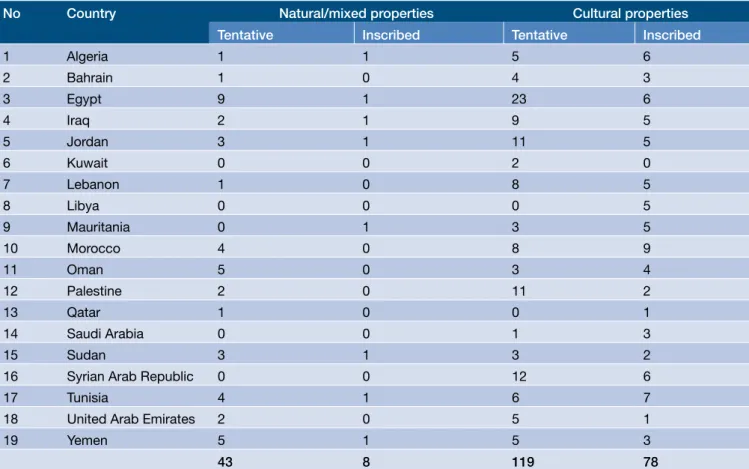
■ Little progress was made on the number and representation of natural and mixed sites from the Arab region to the global list, calling for a stronger regional approach to address achieving the anticipated balance on the regional list compared to global numbers (only 8 of the 18 States Parties in the region have inscribed natural and/or mixed sites, with no sites yet inscribed from the Gulf Region for example).
■ The update from the IUCN World Heritage Outlook on the State of Conservation of sites inscribed on the World Heritage List reflects a notable negative variation – generally speaking – in the status of Arab sites over time.
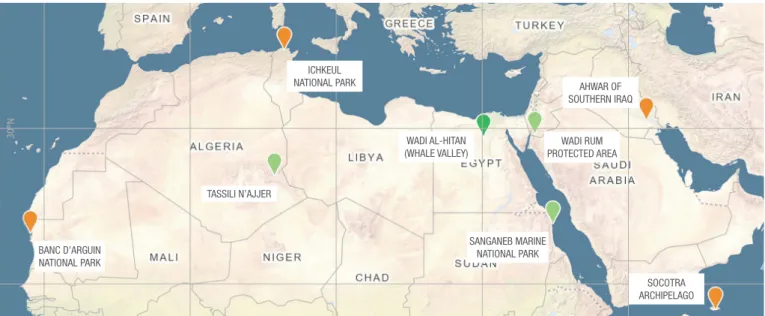
■ The Conservation Outlook of Sanganeb Marine National Park and Dungonab Bay, Wadi Rum Protected Area, Wadi Al Hitan (Whale Valley), Tassili n’Ajjer, and Ichkeul National Park were assessed in 2017 as 'Good with some concerns', while the Ahwar of Southern Iraq, Socotra Archipelago and Banc d’Arguin National Park were reported to be of 'Significant Concern'. See table below.
■ The State of Conservation has stayed the same with no improvement or deteriorated for all sites except for the case of Ichkeul when compared with the three Tabe’a report benchmarks.
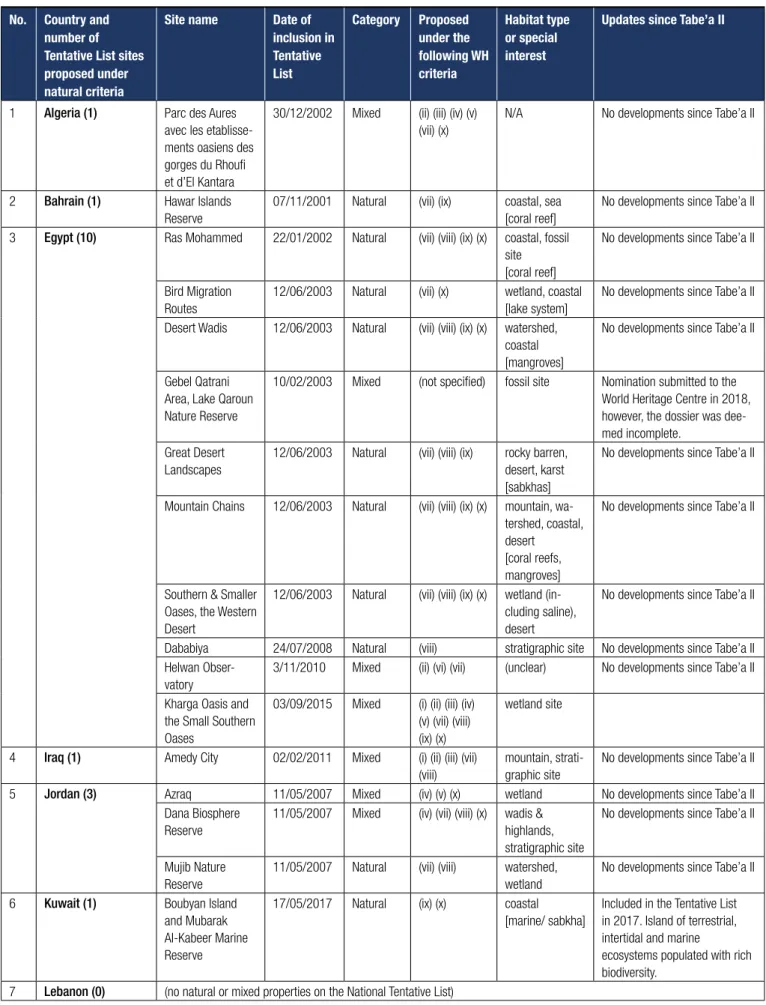
■ Some development has taken place in regard to National Tentative Lists since Tabe’a II, however, it is limited to only a few States Parties thus reflecting the region’s relatively low focus and lack of a systematic approach on adopting an upstream process which would lead to enhancing the regional network of natural and mixed World Heritage sites in the mid and long terms.
Country World Heritage site Conservation Outlook 2014 Conservation Outlook 2017
Algeria Tassili n’Ajjer Good with some concerns Good with some concerns
Egypt Wadi Al-Hitan Good Good with some concerns
Iraq The Ahwar of Southern Iraq: refuge of biodiversity and the relict landscape of the Mesopotamian Cities
None, inscribed in 2016 Significant concern
Jordan Wadi Rum Good with some concerns Good with some concerns
Mauritania Banc d’Arguin National Park Significant concern Significant concern Sudan Sanganeb Marine National Park and Dun-
gonab Bay – Mukkawar Island Marine National Park
None, inscribed in 2016 Good with some concerns
Tunisia Ichkeul National Park Significant concern Good with some concerns
Yemen Socotra Archipelago Significant concern Significant concern
1 Important note: all updates included in this report cover the period up to mid-2019. This includes information collected through official documentation under the World Heritage Convention, such as State of Conservation reports, the World Heritage List and National Tentative Lists. It also includes information from
Results of the IUCN World Heritage Outlook 2 show that, of all natural and mixed (both natural and cultural) World Heritage sites in the Arab States, for 62% the Conservation Outlook is 'Good with some concerns' and for 38% it is of 'Significant concern', noting that this region’s eight sites represent a small dataset (Osipova et al., 2017). The report identified climate change, tourism impacts and fishing as the most widespread current threats to natural sites in the Arab States region. None of the natural sites in the Arab States were assessed as having effective protection and management. For the majority of sites, protection and management were defined to be of some concern, and in one site as being of serious concern.
Based on the above, it is concluded that a collective regional approach to natural World Heritage would benefit from encouraging more regional and sub-regional cooperation on the update and harmonisation of National Tentative Lists. This could be done through promoting the preparation of region-specific thematic study which could identify priority themes and areas within the region as the basis for nominating new natural and mixed World Heritage sites which fill global gaps and priority areas using a robust process through which proper identification and configuration of priority sites can be achieved. Further, a regional effort to support States Parties individually – also in light of the results of the regional thematic review – on the revision and update of their respective Tentative Lists using a science-based approach.
As for the management effectiveness of existing natural and mixed World Heritage sites, the regional approach would attempt to encourage States Parties to 1) improve the governance systems of World Heritage sites with a focus on improved local communities’
and other stakeholders’ (e.g. tourism private sector) consultation and involvement in decision-making processes, traditional knowledge documentation and utilisation in management practices, 2) strengthen the capacity of site management units and teams through well designed and needs based training programmes and learning approaches, 3) improve local financing for the protection, maintenance and development of World Heritage sites through the adoption of adequate policy and legal frameworks which ensure more government spending and investment in the sites’ conservation and management, while promoting other sources of income and investment through ecotourism and other sustainable resource utilisation activities (traditional grazing, artisanal fishing, subsistence farming), and 4) raise the awareness of decision makers and the general public of the importance of the sites and their national and global values in the long term.
The above strategy indicates that the region’s need to enhance the management effectiveness of the existing natural and mixed World Heritage sites is as important as the need to improve its representativeness on the global list. As a result, an effective regional approach or strategy for natural World Heritage would balance the two anticipated outcomes. Whereby the successful listing of sites on the World Heritage List would only represent the start of a long-term commitment towards the conservation and sustainability of the region’s Outstanding Universal Values and their associated attributes.
It is important to note that further update of the IUCN World Heritage Outlook has been issued in December 2020.
Acknowledgements
The report team would like to extend their gratitude to all those who contributed to the preparation of Tabe’a III directly or indirectly.
Our gratitude to Dr Shadia Touqan, Sh Ebrahim Al Khalifa and the rest of the respected team at the Arab Regional Centre for World Heritage for their leadership, guidance and support in the report preparation.
The team also extends its highest appreciation to the IUCN World Heritage Programme for their technical support and inputs, notably Peter Shadie and Tim Badman, who have provided expertise as editors of this report. Special thanks to Ms Elena Osipova, Senior Monitoring Officer – World Heritage Outlook, Ms Célia Zwahlen, World Heritage Communications Officer, and Ms Katherine Zischka, World Heritage Conservation Officer, Ms Ulrika Åberg, World Heritage Officer, as well as Ms Sarina van der Ploeg, Publications Officer at the Science & Knowledge Unit, for their invaluable support in the review and technical backstopping during the report planning and preparation.
Also, special thanks go to Ms Haifaa Abdulhalim, who led the two previous editions of the Tabe’a report and was instrumental in pulling together the groundwork for this third report.
Finally, the team is grateful to the Arab States Parties representatives, experts and practitioners for their cooperation and participation in the regional assessments, through formal and informal communication.
The report team
Mr Tarek M. Abulhawa – Lead Author, Independent Consultant Ms Tricia Cummings – Data Analysis, Independent Consultant
Ms Selma Kassem – Programme Specialist for Cultural & Natural Heritage, ARC-WH
List of acronyms
ARC-WH Arab Regional Centre for World Heritage CBD Convention on Biological Diversity
CBWNCL Capacity Building Workshops on Nature–Culture Linkages in Asia and the Pacific
CC Climate change
CER Cultural Emergency Response
COM World Heritage Committee
COMPACT Community Management of Protected Areas for Conservation
COP Conference of Parties
CPET Collaborative Programme Euphrates and Tigris
DMNP Dungonab Bay – Mukkawar Island Marine National Park, Sudan DRR disaster risk reduction
EoH Enhancing our Heritage
EPA Environment Protection Authority ESD Education for Sustainable Development
FAO Food and Agriculture Organization of the United Nations FAONE FAO Regional Office for Near East and North Africa
FoS Friends of Soqotra
GCED Global Citizenship Education
GDP Gross domestic product
GEF-SGP Global Environment Facility – Small Grant Programme GIS Geographic Information System
HEF Heritage Emergency Fund
HIA/EIA Heritage/Environmental Impact Assessment
ICCROM International Centre for the Study of the Preservation and Restoration of Cultural Property ICOMOS International Council on Monuments and Sites
IPBES Intergovernmental Science-Policy Platform on Biodiversity and Ecosystem Services IPSI International Partnership for the Satoyama Initiative
IUCN International Union for Conservation of Nature IUCN-Med IUCN Centre for Mediterranean Cooperation IUCN-ROWA IUCN Regional Office for West Asia
LCIPP Local Communities and Indigenous Peoples Platform LINKS Local and Indigenous Knowledge Systems
LMMA Locally Managed Marine Areas
MAB Man and Biosphere
MAVA Fondation Pour La Nature
MDG-F Millennium Development Goals Achievement Fund MINUSMA Multidimensional Integrated Stabilization Mission in Mali
MoE Ministry of Environment
NGO Non-governmental organisation
OCHA Office for the Coordination of Humanitarian Affairs OUV Outstanding Universal Value
PA Protected area
PCA People-Centred Approaches
PCEAs post-conflict environmental assessments
RAMSAR Ramsar Convention on Wetlands of International Importance
RBAs Rights-Based Approaches
RRF Rapid Response Facility
RSIS Ramsar Sites Information Service SDGs Sustainable Development Goals SMNP Sanganeb Marine National Park
SOC state of conservation
SOIMA Sound and Image Collections Conservation
SP State Party
UAE United Arab Emirates
UN United Nations
UNDP United Nations Development Programme UNEP United Nations Environment Programme UNEP-WCMC UNEP World Conservation Monitoring Centre
UNESCO United Nations Educational, Scientific and Cultural Organization UNHCR United Nations High Commissioner for Refugees
UNF United Nations Foundation
UNFCCC United Nations Framework Convention on Climate Change
WH World Heritage
1. Introduction
Tabe’a III is the third report of the Tabe’a report sequence, prepared by the Arab Regional Centre for World Heritage (ARC-WH) in cooperation with the IUCN World Heritage Programme. The report addresses the status and trends in the implementation of the World Heritage Convention in the Arab region in the period from 2015 to 2019.
Tabe’a III follows the main framework adopted in Tabe’a I (2012) and Tabe’a II (2015) in regard to documenting progress made in the conservation of natural and mixed World Heritage sites in the Arab region. It also adds – as done in Tabe’a II – a set of new special themes reflecting the key regional priorities emerging from the main challenges facing heritage protection and conservation, and in light of emerging global trends and priorities associated with the World Heritage Convention, as well as other related global natural heritage platforms and programmes.
In 2012, Tabe’a I focused on establishing the baselines of natural World Heritage in the Arab region in terms of priorities for potential new listings and State of Conservation of existing sites.
In 2015, Tabe’a II provided an update on Tabe’a I and addressed the theme of regional capacity building. It focused on establishing a credible and representative network of natural World Heritage sites in the Arab region for effective conservation and management.
Tabe’a III adopts three new thematic areas emerging in the region and their associated challenges and opportunities at the site, national and regional levels. These are: 1) addressing nature–culture linkages in World Heritage from a regional perspective, responding to a growing interest globally to better integrate the two themes into the implementation of the World Heritage Convention, 2) analysing national and regional challenges associated with impacts of conflict on sites and countries and 3) documenting impacts related to extreme weather conditions on natural World Heritage in the region.
Rock art depicting prehistoric hunting practice in Tassili n’Ajjer, Algeria © Office National du Parc Culturel de Tassili n’Ajjer
Nature–culture linkages in World Heritage in the Arab region
Tabe’a III focuses on linkages between natural and cultural heritage. The rationale for examining this theme is that, in many cases, both these components of heritage are organically interconnected. This is particularly the case in the Arab region, one of the world’s oldest centres of human civilisation, where very strong interactions between people and their surrounding environment have been taking place over millennia.
The nature–culture theme is also relevant because of the growing need for improved collaboration and coordination between organisations involved in heritage conservation – both natural and cultural (Garstecki et al., 2011). The Tabe’a Programme, representing a technical cooperation between ARC-WH and IUCN, is an excellent example of institutional partnership. As advisory bodies to the World Heritage Convention on nature and culture respectively, IUCN and ICOMOS are also demonstrating greater coordinated efforts in monitoring and evaluating mixed World Heritage sites and cultural landscapes, and in addressing cross-linkages in managing cultural and natural values and attributes in all heritage sites.
The nature–culture linkages are also relevant to the global trend associated with the implementation of the Sustainable Development Goals (SDGs) which, while focusing on human and natural global priorities, emphasise the vitality of integrated approaches to heritage planning and management.
Based on the above, Tabe’a III includes a main section on the nature–culture linkages at the Arab regional level and, in doing so, adopts a three-dimensional approach in addressing these linkages, as follows:
Firstly, the report examines the benefits foreseen from fostering linkages between natural and cultural heritage programmes and sites.
It identifies barriers and constraints to establishing linkages, then analyses implications – both positive and negative. Finally, it devises a set of responses to address the enhancement of the linkages with adequate platforms, mechanisms and tools.
Secondly, the report addresses these different elements at the site level, the national level and at a regional level, with respective recommendations and proposed actions tailored to each level.
Thirdly, nature–culture linkages are considered according to different categories of World Heritage sites, be they natural, cultural or mixed or cultural landscape. The specific mechanisms, tools and recommendations reflect each type of site and its specificities.
Impacts of conflict on natural World Heritage
The second important theme covered in Tabe’a III is the impacts on natural World Heritage of conflict resulting from the rapid socio- political transformations taking place in the Arab region.
Armed conflict causes direct damage to natural World Heritage, as well as many direct and indirect impacts including the weakened governance systems of natural resources that ensues.
Impacts of extreme weather conditions on natural World Heritage
The third important theme covered in Tabe’a III addresses the impacts of extreme weather conditions mainly caused by the increasing impacts of climate change and coinciding anthropogenic factors.
Climate change-induced extreme weather conditions are an additional threat to sites, as are the deteriorating human and financial resources allocated and available for heritage protection and conservation.
For both emerging challenges above (armed conflict and extreme weather conditions), Tabe’a III attempts to identify the constraints, challenges and possible opportunities arising from the socio-economic, political and environmental changes taking place in the Arab region.
The aim is to document the current and potential impacts of such changes on the status and future prospects of natural World Heritage sites, and share lessons learned on how such impacts have been addressed at the site and national levels.
The report also aims to provide clear recommendations to World Heritage stakeholders on priorities and required action at the site, national, sub-regional and regional levels, thus promoting institutional collaboration, including technical support and funding opportunities.
Regional update
In addition to the three themes introduced above, Tabe’a III provides an elaborated update on the state of conservation of natural World Heritage sites in the Arab region. To do so, it draws information from a range of sources, including: the IUCN World Heritage Outlook, which assesses and tracks the conservation prospects of all natural World Heritage sites; the State of Conservation reporting, the World Heritage Convention’s reactive monitoring system for sites facing threats; and periodic reporting, carried out every six years as a self-assessment by States Parties. Any other site-specific, national or regional reporting processes and initiatives have also been used.
Further, the report includes a summary update on the Arab States’ lists of possible candidate sites, known as Tentative Lists, and on their developments since Tabe’a II. This summary focuses on national, sub-regional and regional initiatives addressing the harmonisation of Tentative Lists and lessons learned from their processes.
Report preparation process
Tabe’a III has been developed following three consecutive stages:
1. Desk-based review: including all available information and updates related to the various sections of the report, with a focus on nature–culture linkages and the impact of conflict and extreme weather conditions on natural World Heritage in the Arab region.
2. Case studies: including the identification and documentation of case studies and lessons learned addressing the various elements of the report themes, with particular focus on the three main themes addressed in the report, namely, the nature–culture linkages, conflict, and extreme weather conditions.
3. Report drafting and partners’ consultation: the report structure and drafts were shared with key partners and interest groups associated with the ARC-WH under the Nature Programme for further contributions, fact checking and recommendations. This included a peer review process in accordance with the IUCN policy on publication development.
2. Nature–culture linkages
Report approach
This section of the Tabe’a III report addresses nature–culture linkages and their association with World Heritage in the Arab States through the following rationale:
■ Introducing the history of the concept of nature–culture linkages and its application worldwide, starting with the general concept then focusing on its World Heritage context.
■ Presenting a select number of past and current global initiatives and case studies addressing the concept.
■ Reviewing a select number of past and current initiatives and case studies addressing the concept in the Arab region.
■ Summarising the overall status of the concept and its application in the Arab region.
2.1 General context
Culture–nature, or nature–culture, is an approach to heritage that has emerged based on the understanding that relationships between people and the natural environment have worked to shape both our physical environment and belief systems.
For millennia, people have interacted with their natural surroundings, as participants in the functioning of ecosystems, or protectors of sacred natural sites, or shaping landscapes. Traditions and belief systems of indigenous cultures often mean that they regard nature with deep respect and have a strong sense of place and belonging. This fosters knowledge and ways of life that match well with modern notions of heritage conservation and the sustainable use of natural resources (UNEP, 2017). As such, spiritual values, cultural conservation practices, traditional ecological management knowledge, and stewardship practices are just some examples of nature–
culture inter-linkages, not only valuable in themselves, but equally critical to ensure the wholeness and integrity of a site.
Traditional fish drying by local Imraguen community in Banc d’Arguin, Mauritania © Editions Gelbart
Therefore, the nature–culture approach embraces the complexity of our heritage, which includes biological resources, genes, landscapes, geological diversity, cultural places and practices, and traditional knowledge systems.
Until recently, nature and culture were generally dealt with separately. For instance, in the past, during the period of European exploration and colonisation, Europeans saw only ‘wilderness’, ‘primitive places’, and the world ‘in a state of nature’. Few Europeans recognised the hand of humankind in the ‘landscapes’ which they colonised. Such notions came to influence the conceptual basis for
‘protected areas’ which aimed to ‘protect’ nature from human influence (Cave & Negussie, 2017). Unsurprisingly, indigenous peoples have generally been stout opponents of such developments imposed from beyond their communities. They defend their lands against illegal encroachments and destructive exploitation, from dams across their rivers to logging and mining in their forests, and even from
‘protected areas’ and ‘nature reserves’ if they feel that these are infringing on their rights to their land.
A specific example can be seen in the 1971 Ramsar Convention on Wetlands of International Importance, which took a strict approach to preventing change to the ecological character of wetlands, but was later understood to have failed to take account of the importance of traditional human activities (such as subsistence fishing or reed cutting) in the development and continued health of wetlands.
As a consequence, this preservationist approach was replaced in 1990 by the ‘wise use’ approach that is closer to sustainable conservation (Blake, 2015). This is a perfect example to illustrate how conservation success requires an integrated nature/culture approach that addresses the wide range of social, economic and cultural issues affecting how people interact with the environment.
Another example is the World Heritage Convention, which originally was hailed for linking the conservation of nature and culture in a single instrument but has since been increasingly under attack for sustaining the divide (Cave & Negussie, 2017). The nature–culture dichotomy evolved into separate heritage fields and domains of expertise, but there is a growing understanding that heritage sites are not made up of isolated natural or cultural attributes split into separate realities but are intertwined and connected. Heritage thinking has thus matured in its appreciation of the complex interconnections between values both cultural and natural, regardless of whether they manifest Outstanding Universal Value (OUV) only (Larsen & Wijesuriya, 2017).
Yet another example is that of UNESCO, where, although work on culture and sustainable development is, by definition, inter-sectoral, the reality is that cooperation between culture and other sectors is rare, both in policy and implementation. Working in an inter- sectoral manner with UNESCO has always been a challenge due to budgeting and the hierarchical structure of different sectors, and while several attempts have been made in the past to find solutions to this problem, examples of successful sustained inter-sectoral work that go beyond cooperation in the context of an event or publication are still rare. This lack of integration between culture and sustainable development considerably weakens UNESCO’s advocacy efforts. However, culture and sustainable development linkages do exist – in work undertaken by sectors, at headquarters, and in the field. In fact, UNESCO and its partners, largely thanks to the Millennium Development Goals Achievement Fund (MDG-F) and its ‘culture and sustainable development window’ (UNESCO, 2015a), are succeeding in raising people’s awareness about the fact that development, if not sustainable, can negatively affect culture.
UN Sustainable Development Goals (SDGs), the urgent sustainability objectives to guide humanity’s path, recognise that integrated nature–culture approaches can advance the SDGs by improving conservation outcomes, fostering biological and cultural diversity, and supporting the well-being of contemporary societies in both urban and rural areas (Potts, 2017).
Nature–culture linkages are part of the very fabric and continuation of living heritage across the majority of World Heritage sites. As such, the effective and lasting conservation of places certainly will depend on ‘bridging the divide’ that is often observed between nature and culture; indeed, they have traditionally been seen as interconnected. Just as the conservation of natural heritage depends on indigenous knowledge, inputs and cooperation, so too indigenous cultures depend on natural heritage.
2.2 A global perspective
The World Heritage system has become challenged by a deepening gap between nature and culture. The defining articles of the World Heritage Convention keep natural and cultural heritage as separate domains by situating humanity, history and construction in the cultural field, and contrasting these with natural features. However, the idea of nature–culture linkages is increasingly deliberated. At the conceptual level, there is a growing need to rethink natural and cultural heritage as an interrelated and interdependent concept, rather than as separate domains. At the management level, there is a need to rethink current approaches, where nature and culture management remain separate.
It is becoming obvious that questions of inter-linkages are critical to the integrity, authenticity and management of both natural and cultural sites.
Spiritual values, cultural conservation practices, traditional ecological management knowledge and stewardship practices are just some examples of nature–culture inter-linkages not only valuable in themselves, but equally critical to ensure the wholeness and
integrity of the site as such. They may not meet any World Heritage criterion but nonetheless form inseparable entities for management (Larsen & Wijesuriya, 2017).
A breakthrough in nature–culture linkages came in 1992 with the introduction of the concept of cultural landscapes to the World Heritage Convention, where human interaction with the natural system has formed the landscape. There are three categories recognised in the Convention: created landscapes, organically evolved landscapes, and associative cultural landscapes. However, the categories of cultural landscape actually led to further separation: whereas the introduction of cultural landscapes focused explicit attention to nature–culture linkages, other changes made in the wording of the World Heritage criteria during the same year removed phrases on the integration from the natural criteria. Recognition of what had been worded as “Man’s interaction with his natural environment” was removed from former natural criterion (ii) (currently criterion viii) leaving “ecological and biological processes” as defining elements. In similar terms, exceptional combinations of natural and cultural elements disappeared from former natural criterion (iii) (current criterion ix). Furthermore, cultural landscapes as a category of heritage are recognised only under cultural criteria (i–vi) of the Operational Guidelines, and these criteria are evaluated only by ICOMOS, whereas natural criteria (vii–x) are evaluated only by IUCN.
In many cases, this dichotomy has caused reflection on inter-linkages to disappear from nomination files in attempts to fit local realities within global categories. As one site manager explained, “We initially presented both natural and cultural values, but experts advised us to rework our dossier and only concentrate on natural values” (Larsen & Wijesuriya, 2017).
The World Heritage community has long been aware of this trend; however, the fact remains that many nomination processes are urged to downplay inter-linkages in order to portray global significance except where inter-linkages are seen as ‘added value’.
Sites have the option to seek inscription as ‘mixed sites’, but this is a difficult task. Nominations are required to demonstrate the OUV for both natural and cultural values, thus limiting the potential application. Further, mixed sites do not necessarily address inter- linkages, but merely the presence of both criteria in one site.
Ultimately, there are limited incentives to nominate mixed sites because they are considered too complex – cultural and natural values within one site often have separate management plans, management of the values may be undertaken separately, and the values are assessed by separate teams.
The fact is that only a minority of sites are listed as mixed sites or cultural landscapes, and in practice, inter-linkages are repeatedly under-represented compared with their actual significance.
World Heritage practitioners are attempting to address the nature–culture divide. This may involve new categories and language, questioning the way in which approaches to natural and cultural heritage are being implemented independently of one another, and recognising the variety of inter-linkages found in all World Heritage sites. Efforts have ranged from capacity building to integrative research and practice.
Regarding the World Heritage Convention, a major drive is underway to rethink the boundaries between nature and culture as:
embedded and connected rather than isolated qualities, constituted relationally rather than unique and distinct properties, a dynamic web of processes rather than fixed elements, and a field for experience sharing and mutual-learning.
In the end, it is about bringing World Heritage out of a Eurocentric legacy and reconciling OUV with local values and connections. This means encouraging and accommodating perspectives on heritage and its management which treat nature and culture holistically as indivisibly inter-related aspects of the world in which people live.
Global initiatives
The following are summaries of a number of important past and ongoing global initiatives on nature–culture linkages with priority given to those associated with World Heritage.
The ‘Connecting Practice’ Project is a joint effort of IUCN and ICOMOS working with a range of partners which aims to explore, learn and create new methods of recognition and support for the interconnected character of the natural, cultural and social value of highly significant land and seascapes and their affiliated bio-cultural practices. Objectives of the project include adapting management effectiveness methodologies that apply to both cultural and natural sites, and strengthening policy and management frameworks to protect areas while integrating natural and cultural heritage.
Lessons learned from the Second Phase of Connecting Practice (Leitão et al., 2017) include: governance as a concept is continually evolving and should be incorporated into World Heritage initiatives in a timely manner, it is crucial to address institutional barriers to
deliver integrated approaches of natural and cultural heritage under the World Heritage Convention, and professional and institutional capacity is required to achieve a holistic consideration of the natural and cultural heritage of a site.
The Enhancing our Heritage (EoH) Toolkit is a natural heritage management effectiveness methodology which was developed with a focus on natural properties but was adapted to various uses at cultural heritage sites during the Connecting Practice project (IUCN, 2015b). The EoH Toolkit contains twelve practical tools designed to help those responsible for World Heritage site conservation piece together the elements of a comprehensive management framework.
The toolkit takes into consideration that “in viewing cultural and natural heritage as interrelated, it can be a significant task to break down disciplinary divisions. A possible first step would be to use the available ‘toolboxes’ of other disciplines to learn from other fields and methodologies in order to move closer to a synthesis of different approaches” (Cave & Negussie, 2017).
The Nature–Culture Journey, a subtheme co-sponsored by IUCN and ICOMOS at the IUCN World Conservation Congress Hawai’i, United States in 2016, featured over forty sessions focused on sharing experiences from all over the world on how professionals and organisations are working towards defining new methods for a connected approach between natural and cultural heritage. A statement issued from the Journey pledges to recognise that cultural and natural diversity and heritage are seriously threatened around the world by challenges including climate change and that integrated nature–culture approaches improve conservation outcomes, foster cultural diversity and support human well-being. It was discussed that the integration of nature and culture in conservation approaches has hopeful potential outcomes (Potts, 2017), such as ending hunger, mitigating and adapting to the effects of climate change, and creating sustainable urban environments.
Culture–Nature Items: the 20th Session of the World Heritage General Assembly (2015) In the Policy Document on World Heritage and Sustainable Development (UNESCO, 2015b):
■ Item 15 “Protecting biological and cultural diversity and ecosystem services and benefits” states that biological and cultural diversity, as well as ecosystem services and benefits for people that contribute to environmental sustainability, should be protected and enhanced within World Heritage properties.
■ Item 21 “Respecting, consulting and involving indigenous peoples and local communities” states that the World Heritage Convention includes, as one of its strategic objectives (the fifth ‘C’) “to enhance the role of communities in (its) implementation” (Decision 31 COM 13B). The World Heritage Committee specifically encourages the effective and equitable involvement and participation of indigenous peoples and local communities in decision-making, monitoring and evaluation of World Heritage properties and the respect of indigenous peoples’ rights in nominating, managing and reporting on World Heritage properties in their own territories (Decision 35 COM 12E). Recognising rights and fully involving indigenous peoples and local communities, in line with international standards is at the heart of sustainable development.
■ Item 22, also under “Respecting, consulting and involving indigenous peoples and local communities” states that to fulfil this strategic objective of the Convention and ensure policy coherence for sustainable development, States Parties should develop mechanisms for indigenous peoples’ involvement in World Heritage processes, ensure consent and participation of indigenous peoples where World Heritage processes would affect their lives, actively promote indigenous and local initiatives, and support activities which contribute to a sense of shared responsibility for heritage among indigenous people and local communities.
■ Item 27 “Strengthening capacity-building, innovation and local entrepreneurship” states that States Parties should recognise that inclusive economic development is a long-term commitment based on a holistic approach to World Heritage properties and their associated cultural and creative industries and intangible heritage.
The Scientific Symposium that took place during the 19th ICOMOS General Assembly, in Delhi, India, in December 2017, also included a Culture–Nature Journey as one of its subthemes. Some highlights were the proposal of a new resource manual to join the existing ICCROM Managing Cultural World Heritage manual and the IUCN Managing Natural World Heritage manual, a workshop on how Rights-Based Approaches can use a nature–culture approach to improve management in partnership with indigenous communities, and workshops examining the challenging issue of agriculture and forming alliances among traditional stewards of these landscapes and conservation organisations.
People-Centred Approaches (PCA) to the conservation of nature and culture link the cultural heritage sector to the natural heritage sector. These nature–culture linkages are recognised by ICCROM, IUCN and others; and ICCROM’s People and Heritage Programme focuses on building capacities in both the natural and cultural sectors. The programme focuses on respect for diversity and the inclusion of people’s voices in the conservation and management of heritage, and the recognition of the influence of heritage on people’s lives and the custodianship of people and their traditional knowledge systems in the long-term care of heritage (ICCROM, 2018).
Intergovernmental Science-Policy Platform on Biodiversity and Ecosystem Services recognises that indigenous peoples and local communities possess detailed knowledge on biodiversity and ecosystem trends. This knowledge is formed through their direct dependence on their local ecosystems, and observations and interpretations of change generated and passed down over many generations, and yet adapted and enriched over time. Indigenous peoples are often better placed than scientists to provide detailed information on local biodiversity and environmental change and are important contributors to the governance of biodiversity from local to global levels. IPBES established an Indigenous and Local Knowledge Task Force to guide activities related to conservation and sustainable use of ecosystems.
The International Partnership for the Satoyama Initiative (IPSI) is dedicated to working together to realise societies in harmony with nature. Based on knowledge and practices locally accumulated in human–nature interactions over a long time, production activities, and their management mechanisms, people have created elaborate systems that have continued to support local communities by providing foods, fuels and other materials, nurturing traditions and culture, and maintaining ecosystems and biodiversity. However, they have been increasingly threatened by rapid socio-economic changes in recent years. Therefore, it is important to explore ways and means for using and managing natural resources sustainably that benefit current and future generations.
Resolutions of ICOMOS General Assemblies related to nature–culture linkages 19th General Assembly (India 2017)
■ 19GA 2017/16 “Principles concerning Rural landscapes as Heritage” adopts the ICOMOS-IFLA “Principles concerning Rural Landscapes as Heritage” as an ICOMOS doctrinal text.
■ 19GA 2017/25 “Incorporating the interconnectedness of Nature and Culture into Heritage Conservation” recognises that in heritage conservation contexts, nature and culture are not separate domains, and that adverse outcomes can occur when heritage processes do not adequately reflect the interrelated character of nature and culture; and highlights the importance of enhanced recognition of the interconnectedness of nature and culture for the successful localisation of the SDGs.
18th General Assembly (Italy 2014)
■ 18GA 2014/37 Ensuring that culture and cultural heritage are acknowledged in the proposed Goals and Targets on Sustainable Development for the Post-2015 United Nations Development Agenda recalls that culture and cultural heritage, its conservation, and enrichment should be declared a major vehicle (the fourth pillar) for sustainable development.
RAMSAR: The Ramsar Sites Information Service (RSIS) provides data that shows that nearly all Ramsar sites provide cultural ecosystems services, and over half have spiritual and inspirational values. Therefore, integrating nature and culture in the management of wetlands can play a powerful role in their conservation and wise use.
The MAVA project, ‘Conservation of the natural and cultural heritage in wetlands’ (Ramsar Convention, 2017), has resulted in ‘Rapid Cultural Inventories for Wetlands’ underway in several regions of the world, including a collaborative project with the Arab Regional Centre for World Heritage; a project documenting lessons learned from ‘success stories’ in situations where wetland areas are designated under both the Ramsar Convention and the World Heritage Convention; a new Ramsar Handbook on culture and wetlands; and an analysis of culture-related information in Ramsar’s national and site-level information and reporting systems.
World Heritage Leadership Programme is a new capacity building programme of ICCROM and IUCN (2016), which aims to improve the conservation and management practices for culture and nature through the work of the World Heritage Convention, as an integral component of the contribution of World Heritage sites to sustainable development. The programme takes a new and transformative approach, in that it will not focus exclusively on work within the World Heritage Convention, but take a wider view of the totality of conservation practice, and how working through World Heritage sites and the communities and specialists that support them, World Heritage can provide new and better leadership to achieve innovation, performance and excellence that will inspire wider practice. It will take a fully integrated approach to nature and culture from the outset, and will focus on the most pressing challenges where working through World Heritage has the most compelling possibility to make a difference.
Local Communities and Indigenous Peoples Platform (LCIPP), established to strengthen the knowledge, technologies, practices and efforts of local communities and indigenous peoples related to addressing and responding to climate change (see more on this below under ‘Extreme weather conditions and natural World Heritage’: ‘Global initiatives’ in section 4.2).
UNESCO programmes that link culture and sustainable development include the Man and the Biosphere (MAB) Programme which aims to establish a scientific basis for the improvement of relationships between people and their environments; the Local and Indigenous Knowledge Systems (LINKS) which aims to secure an active and equitable role for local communities in resource management in addition to strengthening knowledge transmission across and within generations; Global Citizenship Education (GCED)
which aims to foster values, knowledge and skills that promote respect for human rights, social justice, diversity, gender equality and intercultural understanding ultimately empowering learners to be responsible global citizens; and Education for Sustainable Development (ESD) which aims to empower learners to take informed decisions and responsible actions for environmental integrity, economic viability and a just society.
Of the above UNESCO programmes, special focus is given here to the UNESCO Man and Biosphere Programme, as it is actively applied in the Arab region.
The MAB Programme is a UNESCO intergovernmental scientific programme that combines the natural and social sciences with a view to improving human livelihoods and safeguarding natural and managed ecosystems, thus promoting innovative approaches to economic development that are socially and culturally appropriate and environmentally sustainable.
Biosphere Reserves represent the prime flagship product of the UNESCO MAB Programme. They are sites for testing interdisciplinary approaches to understanding and managing changes and interactions between social and ecological systems, including conflict prevention and management of biodiversity. They are places that provide local solutions to global challenges, and each site promotes solutions reconciling the conservation of biodiversity with its sustainable use. Biosphere Reserves involve local communities and all interested stakeholders in planning and management.
As an international designation instrument, the Man and the Biosphere Programme could be utilised as a preparatory phase paving the way for a successful World Heritage Nomination. It could also serve as a tool to better integrate the sites’ natural values and attributes to their associated cultural significance.
This is evident in the case of Socotra Archipelago where the MAB process was instrumental in the successful inclusion of the site on the World Heritage List. This was achieved by adopting the Biosphere Reserves zoning approach to delineate the boundaries between the core area, purely designated for biodiversity protection (including the Outstanding Universal Value), and areas designated for sustainable and intensive resource use. Being listed only as a natural property, the biosphere designation helped integrate the cultural aspects of the site into the nomination dossier. This was done as part of the extensive assessments and inventories prepared on cultural attributes – both tangible and intangible – in the biosphere designation process. As a result, a stronger cultural component was included in the World Heritage nomination file.
Global case studies2
Presented below, are a selected number of global case studies addressing nature–culture linkages.
Case studies were selected based on their relevance to the nature–culture linkage themes as well as the relevance to issues and priorities identified for the Arab States region such as good governance, integrated management, local communities’ involvement and traditional knowledge.
Each of the case studies listed below includes a brief description of its selection rationale, geographic locality, thematic scope, objectives, main findings and conclusions derived by the report author.
It is important to note that content detail under each case study was limited by the information available from the source.
The Budj Bim Cultural Landscape in Australia
The Budj Bim Cultural Landscape in Australia case study was selected to demonstrate the importance of adopting a landscape-based approach to heritage management, including both natural and cultural aspects which are derived from indigenous and traditional knowledge, with particular focus on sustainable traditional resource utilisation and management systems and practices.
The case study includes evidence of one of the world’s oldest known aquaculture systems. Gunditjmara Aboriginal people constructed an extensive and technologically sophisticated aquaculture system on the Budj Bim lava flow. Gunditjmara people were able to harvest and farm large quantities of the migrating Short-finned eel (Anguilla australis) while maintaining a sustainable eel population by manipulating seasonal flooding through the creation of stone channels. Archaeological excavations at the Budj Bim Cultural Landscape found evidence of channel construction at least 6,600 years ago, and two recent phases of channel construction within the past 600–800 years. The age of the aquaculture system, its degree of preservation and completeness, and the continuity of Gunditjmara traditional practices make the Budj Bim Cultural Landscape an exceptional, organically evolving heritage site and continuing cultural landscape. It shows that cultural and environmental systems are entangled, as expressed in the idea of ‘Country’. Country is an Aboriginal-English word that refers to a knowledge system that encompasses the whole landscape. For example, ‘caring for Country’ is an aboriginal concept that includes