Research Express@NCKU - Articles Digest
1 of 2
Research Express@NCKU Volume 27 Issue 10 - November 21, 2014
[ http://research.ncku.edu.tw/re/articles/e/20141121/2.html ]Increased Aortic Stiffness and Attenuated Lysyl
Oxidase Activity in Obesity
Ju-Yi Chen
1,2, Haw-Chih Tai
1, Ruei-Lan Tsai
1,2, Yu-Tzu Chang
1, Mei-Chung Wang
1,2, Yu-Wei
Chiou
3, Ming-Long Yeh
3, Wei-Chuan Tsai
2, Chang-Hua Chou
4, Yau-Sheng Tsai
1,*1Institute of Clinical Medicine, National Cheng Kung University, Tainan
2 Department of Internal Medicine, National Cheng Kung University Hospital, Tainan 3 Institute of Biomedical Engineering, National Cheng Kung University, Tainan
4 Division of Gastroenterology, Department of Internal Medicine, Sinlau Hospital, Tainan [email protected]
Arterioscler Thromb Vasc Biol. 2013 Apr;33(4):839-46.
O
besity increases the risk for stroke, cardiovascular diseases, cardiovascular mortality, and all-cause mortality in humans. One potential mechanism through which obesity exerts adverse effects on the vascular system is by increasing aortic stiffness, a change known to be predictive of increased cardiovascular mortality. The aim of this study was to investigate the pathophysiology that links obesity to aortic stiffening. Obese (ob/ob) mice were used to examine physical, morphological, and molecular changes in the aorta in response to obesity. Many biomechanical factors contribute to vascular stiffness, such as elastin and collagen.Increased arterial stiffness is associated with destabilized elastin fibers and increased elastin breaking down. Lysyl oxidase (LOX) is an enzyme that initiates intra- and intermolecular covalent cross-linking of elastin and collagen, and further assures extracellular matrix integrity. We found that obese mice had increased aortic pulse wave velocity (PWV) and stiffness. We also observed that the expression of LOX was normal in the adventitia and perivascular adipose tissue (PVAT) of control mice, but attenuated in ob/ob mice (Fig.1A). Obese aorta exhibited decreases of LOX activity and cross-linked elastin, and increases of elastin fragmentation (Fig.1B, arrows indicate
breaks in the elastin) and elastolytic activity. The aortas of obese mice were surrounded by a significant amount of
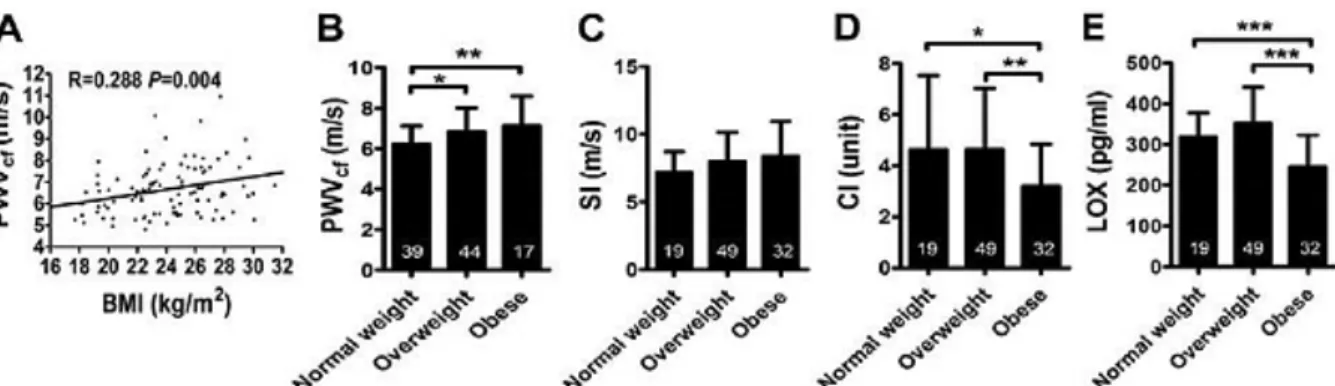
pro-inflammatory and pro-oxidative perivascular adipose tissue (PVAT) (Fig.1C-D). In vitro studies revealed that the conditioned medium from differentiated adipocytes or the PVAT of ob/ob mice attenuated LOX activity. Furthermore, inhibition of LOX in wild-type lean mice caused elastin fragmentation and induced a significant increase in pulse-wave velocity (PWV). Finally, we found that obese humans had stiffer arteries and lower serum LOX levels than do normal-weight humans (Fig.2A-E). In conclusion, our results demonstrated that obesity resulted in aortic stiffening in both humans and mice, and established a causal relationship between LOX downregulation and aortic stiffening in obesity.
Research Express@NCKU - Articles Digest
2 of 2
Figure 1. Structural proteins in ob/ob aorta and pro-oxidative perivascular adipose tissue (PVAT) in ob/ob mice. (A) LOX expression in aorta and PVAT. (B) Elastin fragmentation in aorta. (C) Gross appearance and (D) reactive oxygen species expression in PVAT.
Figure 2. Arterial stiffness indices and serum lysyl oxidase (LOX) levels in humans. (A) the correlation between pulse wave velocity (PWV)cf and body mass index (BMI). (B) PWVcf in 3 groups using clinical definitions of obesity. (C) stiffness index, (D) compliance index, and (E) serum LOX levels.