• 沒有找到結果。

大學生英語溝通策略之使用及教學研究

N/A
N/A
Protected

Academic year: 2021

Share "大學生英語溝通策略之使用及教學研究"

Copied!
20
0
0

加載中.... (立即查看全文)

全文

(1)

INTRODUCTION

Since no individual’s linguistic repertoire is perfect, most people have the experiences of struggling to find the appropriate expression or grammatical construction when attempting to communicate their meaning. The steps taken by language learners in order to enhance the effectiveness of their communication are known as communication strategies (Littlemore, 2003). Although there still is not a consensus among researchers, communication strategies (CS) have been generally defined as the means that speakers use to solve their communicative problems. According to Dörnyei and Scott (1997), the notion of second language (L2)

communication strategies was raised with the recognition that the mismatch between L2 speakers’ linguistic resources and communicative intentions leads to systematic language phenomena whose main function is to handle difficulties or breakdowns in communication.

The purpose of the present study is to examine the communication strategy use of EFL college students. The major research questions explored in the study include: (1) What are the communication strategies more often used by EFL college students? (2) Are there differences in communication strategies used by proficient and less proficient EFL learners? (3) Are there differences in communication strategies used by female and male EFL learners? (4) How do EFL college students perceive their use of communication strategies? By providing empirical evidences and descriptions, the current study will seek to facilitate our understanding of L2 communication strategy use and the effects of strategy instruction, and further to assist Taiwanese college students to become more effective EFL speakers.

LITERATURE REVIEW

For the past decades, there have been a number of studies conducted to examine the

various aspects of communication strategies. Three main fields have been identified in

(2)

terms of the focus of the current research, including definition and taxonomy of communication strategies, use of communication strategies, and instruction of

communication strategies. A review of the CS literature reveals that there are two main approaches for defining communication strategies. According to the psycholinguistic definition proposed by Færch and Kasper (1980), communication strategies are

“potentially conscious plans for solving what to an individual presents itself as a problem in reaching a particular communicative goal”(p.81). This definition distinguishes

communication strategies from other verbal plans by two criteria, i.e.,

problem-orientedness, potential consciousness. Besides, as suggested by the interactional definition (Tarone,1980), a communication strategy is “a mutual attempt of two

interlocutors to agree on a meaning in situations where requisite meaning structures do not seem to be shared”(p.419). This definition implies that the negotiation of meaning as a joint effort between the interlocutors is central to the concept of communication

strategies.

The conceptual differences among CS researchers have been reflected most explicitly in the language devices considered to be communication strategies. Table 1 contains a summary of the 11 CS taxonomies presented in previous research. As Bialystok (1990) indicated that the variety of taxonomies in the literature differs primarily in

terminology rather in the substance of the specific strategies, the corresponding parts of

most taxonomies in Table 1 show many similarities. In addition, some of the taxonomies

recognize the achievement-reduction duality in strategy use, whereas the rest cover only

achievement strategies.

(3)

Table1 Taxonomies of Communication Strategies

Researcher Taxonomy Tarone (1977, 1981) Avoidance, Paraphrase, Borrowing, Appeal for assistance, Mime Færch & Kasper (1983) Formal reduction, Functional reduction, Achievement strategies Bialystok (1983) L1-based strategies, L2-based strategies, Non-linguistic strategies Paribakht (1985) Linguistic approach, Contextual approach, Conceptual approach,

Mime Pattison (1987)

Willems (1987)

Paraphrase, Borrowing, Gesture, Asking for feedback, Reduction Reduction strategies, Achievement strategies

Bialystok (1990) Analysis-based strategies, Control-based strategies Kellerman (1991) Conceptual strategies, Linguistic/code strategies Poulisse (1993) Substitution strategies, Substitution plus strategies,

Reconceptualization strategies

Dörnyei & Scott (1995a, b) Direct strategies, Interactional strategies, Indirect strategies Ruler (2004) Information, Persuasion, Consensus-building, Dialogue Nakatani (2006) Social Affective, Fluency-oriented, Negotiation for meaning

while speaking, Accuracy-oriented, Message reduction and alteration, Nonverbal strategies while speaking, Message abandonment, Attempt to think in English

As for the research on the use of communication strategies, a number of studies have investigated the relationship between various factors and communication strategies. With regard to task type, Yarmohammadi and Seif (1992) found that Iranian EFL learners’

preference for the use of achievement strategies remains independent of the task type although the nature of the task may affect the type and proportion of some individual strategies used. Nakahama, Tyler and Lier (2001) investigated how meaning is negotiated in two different types of interaction between native speakers and nonnative speakers.

Results show that the conversational activity provides learners with more chanllenging language practice than the information-gap activity. Moreover, the study by

Poulisse and Schils (1989) examined the effects of profieciency and task-related factors on the compensatory strategies used by Dutch learners of English. Findings indicated that the most advanced students used fewer compensatory strategeis than did the least

proficient ones. Whereas the subjects predominantly used analytic strategies in the picture

(4)

naming/description task, they frequently adopted holistic strategies and transfer strategies in the story retell task and the oral interview. In addition, Rost and Ross (1991) found that the use of certain strategies is correlated with L2 proficiency. Paribakht (1985) studied the relationship between strategic competence and language proficiency, and suggested a directionality of transition in the learners’ use of CS toward that of the native speakers.

That is, the advanced learners are in the mid-position between the native speakers and the low-proficiency learners. The results of Magogwe and Oliver’s study (2007) revealed a dynamic relationship between use of language learning strategies and proficiency level, level of schooling, and self-efficacy beliefs for English learners in Botswana.

Recently, several researchers have examined the communication strategies employed by Chinese EFL learners. For instance, Huang and Naerssen (1987) and Chen (1990) investigated the communication strategies used by EFL learners in China. Some studies have also been conducted with EFL students in Taiwan. For example, Liao and Bresnahan (1996) designed a contrastive study of refusal strategies between Mandarin Chinese and American English. Hsieh (1998) examined the relationship between anxiety and the use of communication strategies. Tuan (2001) studied the relationship between

extroversion-introversion tendency and the choice of communication strategies. Zhang (2005) investigated the use of communication strategy in dyad talks and the function of proficiency level in strategy selection. Furthermore, Jackson (2002) investigated the reticence of EFL students in Hong Kong in their case discussions. Besides, Derwing and Rossiter (2002) found that the most common used strategies when ESL learners are faced with communication breakdown were paraphrase and self-repetition. Other researchers have also examined the L2 learners’ use of communication strategies (e.g., Smith, 2003;

Skantze, 2005; Bataineh & Bataineh, 2006).

(5)

METHODS Participants

Participants in the current study (see Table 1) were 318 students at a university in northern Taiwan. There were 118 students who majored in English and 200 students with other majors. The participants included 175 females and 143 males. They ranged in age from 18 to 23 years old. They were uniform in first language background and had relatively homogeneous cultural background. All of them have completed at least six years of EFL study prior to entering the university.

Table 2 Information of Participants English Major Non-Major Total

Female 92 83 175

Male 26 117 143

Total 118 200 318

Instruments

The instruments used in the present study consist of a role-play task, a communication strategy questionnaire and an interview guide. With the task of role play, each student found a partner and engaged in a simulated conversation derived from a situation described on a card.

Each pair was given five minutes to prepare the role play in which one student assumed the

role of a customer and the other was a clerk. Moreover, the study adopted a questionnaire of

communication strategies (see Appendix A) which was based on the Oral Communication

Strategy Inventory (OCSI) (see Appendix B) designed by Nakatani (2006). The questionnaire

mainly consisted of 32 items for coping with speaking problems and 26 items for coping with

listening problems experienced during the communicative task. On a five-point scale ranging

from “never” to “always”, participants circled the response which indicates how often they

use the strategy described. Besides, a background survey covering gender and academic

major was also included in the questionnaire. Finally, an interview guide (see Appendix C)

(6)

was developed to further explore participants’ perceptions of their use of EFL communication strategies during the role-play task. There were mainly three questions on communication problems and strategy use. To elicit more valid information from the participants, the questionnaires and the interview were asked and answered in Chinese. Besides, all the instruments were tested and revised following a pilot study with ten students at the same institution.

Procedures

The present study was conducted during the class hours of courses related to EFL learning. At the beginning of the experiment, students were told in detail what they were required to do in the study. They were informed that the study was designed to obtain empirical information about the strategies they adopted for EFL communication tasks. The simulated conversation was individually administered in class. No assessment was carried out during the role play. Immediately following the completion of the task, participants reported their task behaviors by filling out the questionnaire of communication strategies. Finally, a follow-up interview were held with ten participants to probe their perceptions of

communication strategy use.

Data Analysis

There were two parts in the data analysis of the current study, including the strategy questionnaire and the interview. For the scoring of questionnaires, the scale range for each item is 1~5. Frequency counting were conducted to analyze participants’ responses to the CS questionnaire. T-tests were conducted to analyze participants’ scores on the questionnaire. As for participants’ answers to the interview, they were transcribed and categorized according to the three main questions in the interview guide.

(7)

RESULTS

Analysis of Participants’ Use of EFL Communication Strategies

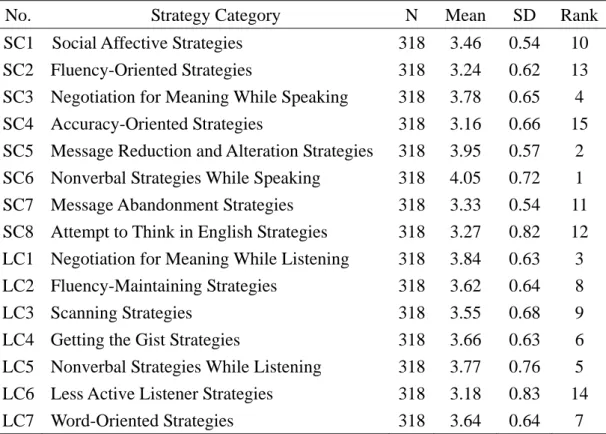
The main purpose of the current study is to systematically investigate the EFL communication strategies used by Taiwanese college students. Based on the frequency counting of each item, the results of the strategy questionnaire completed by participants are described below. First, Table 3 shows the descriptive statistics of the 15 strategy categories used by participants. Among the 15 strategy categories, ‘nonverbal strategies while speaking’

has the highest average frequency, followed by ‘message reduction and alteration strategies’,

‘negotiation for meaning while listening’, and ‘negotiation for meaning while speaking’.

‘Accuracy-oriented strategies’ has the lowest average frequency, and next is ‘less active listener strategies.’

Table 3 Descriptive Statistics of Communication Strategy Categories

No. Strategy Category N Mean SD Rank

SC1 Social Affective Strategies 318 3.46 0.54 10 SC2 Fluency-Oriented Strategies 318 3.24 0.62 13 SC3 Negotiation for Meaning While Speaking 318 3.78 0.65 4 SC4 Accuracy-Oriented Strategies 318 3.16 0.66 15 SC5 Message Reduction and Alteration Strategies 318 3.95 0.57 2 SC6 Nonverbal Strategies While Speaking 318 4.05 0.72 1 SC7 Message Abandonment Strategies 318 3.33 0.54 11 SC8 Attempt to Think in English Strategies 318 3.27 0.82 12 LC1 Negotiation for Meaning While Listening 318 3.84 0.63 3 LC2 Fluency-Maintaining Strategies 318 3.62 0.64 8

LC3 Scanning Strategies 318 3.55 0.68 9

LC4 Getting the Gist Strategies 318 3.66 0.63 6

LC5 Nonverbal Strategies While Listening 318 3.77 0.76 5

LC6 Less Active Listener Strategies 318 3.18 0.83 14

LC7 Word-Oriented Strategies 318 3.64 0.64 7

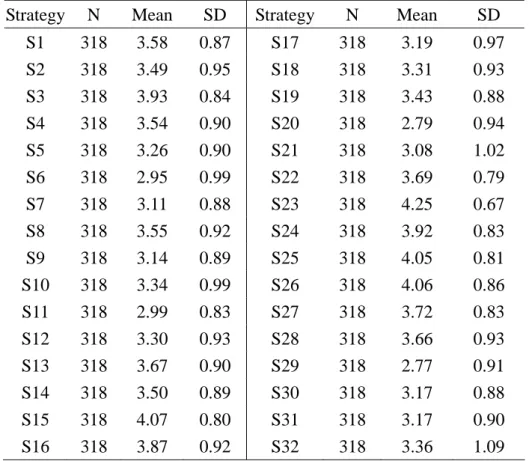
In addition, Table 4 shows the descriptive statistics of individual strategies for coping

with EFL speaking problems. Results indicate that among the 32 speaking strategies, the

strategy ‘I use words which are familiar to me’ has the highest average frequency. Then,

following the order are ‘While speaking, I pay attention to the listener’s reaction to my

(8)

speech’, ‘I use gesture and facial expression if I can’t communicate how to express myself’, ‘I try to make eye contact when I am talking’, and ‘I try to give a good impression to the

listener’. The strategy ‘I give up when I can’t make myself understood’ has the lowest average frequency.

Table 4 Descriptive Statistics of Speaking Strategies

Strategy N Mean SD Strategy N Mean SD S1 318 3.58 0.87 S17 318 3.19 0.97 S2 318 3.49 0.95 S18 318 3.31 0.93 S3 318 3.93 0.84 S19 318 3.43 0.88 S4 318 3.54 0.90 S20 318 2.79 0.94 S5 318 3.26 0.90 S21 318 3.08 1.02 S6 318 2.95 0.99 S22 318 3.69 0.79 S7 318 3.11 0.88 S23 318 4.25 0.67 S8 318 3.55 0.92 S24 318 3.92 0.83 S9 318 3.14 0.89 S25 318 4.05 0.81

S10 318 3.34 0.99 S26 318 4.06 0.86

S11 318 2.99 0.83 S27 318 3.72 0.83

S12 318 3.30 0.93 S28 318 3.66 0.93

S13 318 3.67 0.90 S29 318 2.77 0.91

S14 318 3.50 0.89 S30 318 3.17 0.88

S15 318 4.07 0.80 S31 318 3.17 0.90

S16 318 3.87 0.92 S32 318 3.36 1.09

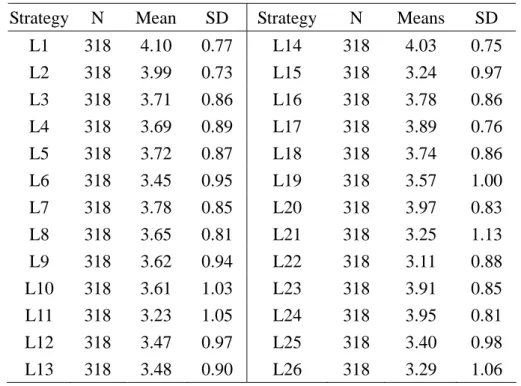
Besides, Table 5 shows the descriptive statistics of individual strategies for coping with

EFL listening problems. Results indicate that among the 26 listening strategies, the strategy ‘I

ask for repetition when I can’t understand what the speaker has said’ has the highest average

frequency. Then, following the order are ‘I try to catch the speaker’s main point.’, and ‘I make

a clarification request when I am not sure what the speaker has said’. The strategy ‘I only

focus on familiar expressions’ has the lowest average frequency.

(9)

Table 5 Descriptive Statistics of Listening Strategies

Strategy N Mean SD Strategy N Means SD L1 318 4.10 0.77 L14 318 4.03 0.75 L2 318 3.99 0.73 L15 318 3.24 0.97 L3 318 3.71 0.86 L16 318 3.78 0.86 L4 318 3.69 0.89 L17 318 3.89 0.76 L5 318 3.72 0.87 L18 318 3.74 0.86 L6 318 3.45 0.95 L19 318 3.57 1.00 L7 318 3.78 0.85 L20 318 3.97 0.83 L8 318 3.65 0.81 L21 318 3.25 1.13 L9 318 3.62 0.94 L22 318 3.11 0.88 L10 318 3.61 1.03 L23 318 3.91 0.85 L11 318 3.23 1.05 L24 318 3.95 0.81 L12 318 3.47 0.97 L25 318 3.40 0.98 L13 318 3.48 0.90 L26 318 3.29 1.06

Furthermore, Table 6 lists the ten strategies most often used by the participants among 58 communication strategies. Results show that ‘I use words which are familiar to me’ is the most frequently used strategy, and next is ‘I ask for repetition when I can’t understand what the speaker has said’, followed by ‘While speaking, I pay attention to the listener’s reaction to my speech’.

Table 6 Ten Communication Strategies Most Often Used by Participants

No. Communication Strategies Rank

S23 I use words which are familiar to me. 1

L1 I ask for repetition when I can’t understand what the speaker has said. 2 S15 While speaking, I pay attention to the listener’s reaction to my speech. 3 S26 I use gesture and facial expression if I can’t communicate how to express myself. 4 S25 I try to make eye contact when I am talking. 5

L14 I try to catch the speaker’s main point. 6

L2 I make a clarification request when I am not sure what the speaker has said. 7

L20 I pay attention to the speaker’s eye contact, facial expression and gestures. 8

L24 I guess the speaker’s intention by picking up familiar words. 9

S3 I try to give a good impression to the listener. 10

(10)

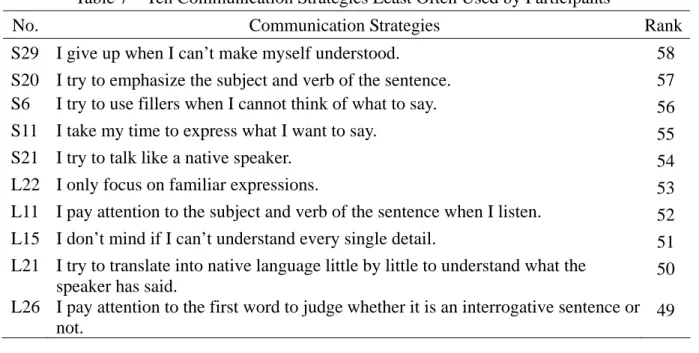
Table 7 Ten Communication Strategies Least Often Used by Participants

No. Communication Strategies Rank

S29 I give up when I can’t make myself understood. 58 S20 I try to emphasize the subject and verb of the sentence. 57 S6 I try to use fillers when I cannot think of what to say. 56 S11 I take my time to express what I want to say. 55

S21 I try to talk like a native speaker. 54

L22 I only focus on familiar expressions. 53

L11 I pay attention to the subject and verb of the sentence when I listen. 52 L15 I don’t mind if I can’t understand every single detail. 51 L21 I try to translate into native language little by little to understand what the

speaker has said.

50 L26 I pay attention to the first word to judge whether it is an interrogative sentence or

not.

49

Finally, Table 7 lists the ten strategies least often used by the participants among 58 communication strategies. Results indicates that ‘I give up when I can’t make myself

understood’ has the lowest average frequency, and next is ‘I try to emphasize the subject and verb of the sentence’, followed by ‘I try to use fillers when I cannot think of what to say’.

Differences in EFL Communication Strategies between Proficient and Less Proficient Learners

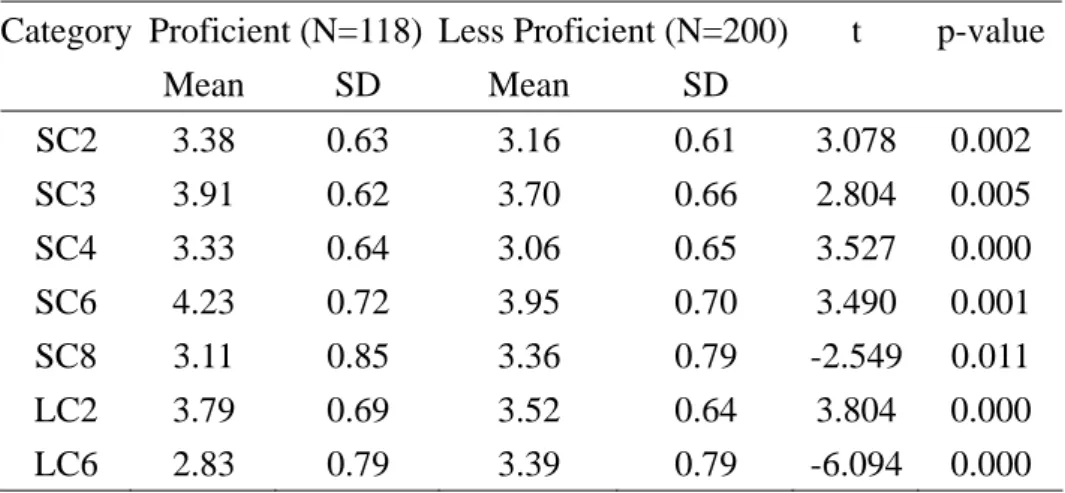
One of the purposes of the study is to examine the differences between proficient and less proficient EFL learners in the use of communication strategies. Table 8 indicates that there are significant differences in seven strategy categories between proficient and less proficient learners. Among them, the average frequencies of five categories used by proficient learners are significantly higher than those by less proficient learners. They are

‘fluency-oriented strategies’, ‘negotiation for meaning while speaking’, ‘accuracy-oriented strategies’, ‘nonverbal strategies while speaking’, and ‘fluency-maintaining strategies’. On the other hand, there are two categories adopted significantly more often by less proficient

learners than by proficient learners, including ‘attempt to think in English strategies’ and ‘less

active listener strategies’.

(11)

Table 8 t-test for Communication Strategy Categories of Proficient and Less Proficient Participants

Category Proficient (N=118) Less Proficient (N=200) t p-value Mean SD Mean SD SC2 3.38 0.63 3.16 0.61 3.078 0.002

SC3 3.91 0.62 3.70 0.66 2.804 0.005

SC4 3.33 0.64 3.06 0.65 3.527 0.000

SC6 4.23 0.72 3.95 0.70 3.490 0.001

SC8 3.11 0.85 3.36 0.79 -2.549 0.011

LC2 3.79 0.69 3.52 0.64 3.804 0.000

LC6 2.83 0.79 3.39 0.79 -6.094 0.000

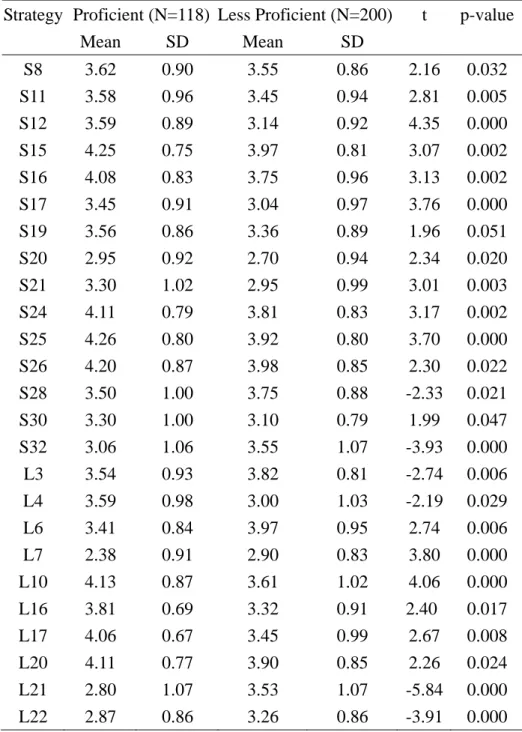
Moreover, Table 9 indicates that there are significant differences in 25 communication strategies between proficient and less proficient learners. Among them, the average

frequencies of 19 strategies used by proficient learners are significantly higher than those by

less proficient learners, such as ‘I try to speak clearly and loudly to make myself heard’, ‘I

correct myself when I notice that I have made a mistake’, ‘I try to give a good impression to

the listener’, ‘I guess the speaker’s intention based on what he/she has said far’, and ‘I ask the

speaker to give an example when I am not sure what he/she said’. On the other hand, there are

six strategies adopted significantly more often by less proficient learners than by proficient

learners, including ‘I try to relax when I feel anxious’, ‘I give up when I can’t make myself

understood’, ‘I guess the speaker’s intention by picking up familiar words’, ‘I pay attention to

the words which the speaker slows down or emphasizes’, ‘I make a clarification request when

I am not sure what the speaker has said’, and ‘I ask for repetition when I can’t understand

what the speaker has said’.

(12)

Table 9 t-test for Communication Strategies of Proficient and Less Proficient Participants

Strategy Proficient (N=118) Less Proficient (N=200) t p-value Mean SD Mean SD

S8 3.62 0.90 3.55 0.86 2.16 0.032

S11 3.58 0.96 3.45 0.94 2.81 0.005

S12 3.59 0.89 3.14 0.92 4.35 0.000

S15 4.25 0.75 3.97 0.81 3.07 0.002

S16 4.08 0.83 3.75 0.96 3.13 0.002

S17 3.45 0.91 3.04 0.97 3.76 0.000

S19 3.56 0.86 3.36 0.89 1.96 0.051

S20 2.95 0.92 2.70 0.94 2.34 0.020

S21 3.30 1.02 2.95 0.99 3.01 0.003

S24 4.11 0.79 3.81 0.83 3.17 0.002

S25 4.26 0.80 3.92 0.80 3.70 0.000

S26 4.20 0.87 3.98 0.85 2.30 0.022

S28 3.50 1.00 3.75 0.88 -2.33 0.021

S30 3.30 1.00 3.10 0.79 1.99 0.047

S32 3.06 1.06 3.55 1.07 -3.93 0.000

L3 3.54 0.93 3.82 0.81 -2.74 0.006

L4 3.59 0.98 3.00 1.03 -2.19 0.029

L6 3.41 0.84 3.97 0.95 2.74 0.006

L7 2.38 0.91 2.90 0.83 3.80 0.000

L10 4.13 0.87 3.61 1.02 4.06 0.000

L16 3.81 0.69 3.32 0.91 2.40 0.017

L17 4.06 0.67 3.45 0.99 2.67 0.008

L20 4.11 0.77 3.90 0.85 2.26 0.024

L21 2.80 1.07 3.53 1.07 -5.84 0.000

L22 2.87 0.86 3.26 0.86 -3.91 0.000

Differences in EFL Communication Strategies between Female and Male Learners One of the purposes of the study is to examine the differences between female and male EFL learners in the use of communication strategies. Table 10 shows that there are significant differences in six strategy categories between female and male learners. Among them, the average frequencies of four categories used by female learners are significantly higher than those by males. They are ‘negotiation for meaning while speaking’, ‘accuracy-oriented

strategies’, ‘nonverbal strategies while speaking’, and ‘fluency-maintaining strategies’. On the

(13)

other hand, there are two categories adopted significantly more often by male learners than by females, including ‘attempt to think in English strategies’ and ‘less active listener strategies’.

Table 10 t-test for Communication Strategy Categories of Female and Male Participants

Category Female (N=175) Male (N=143) t p-value Mean SD Mean SD

SC3 3.89 0.60 3.64 0.68 3.479 0.001

SC4 3.23 0.65 3.08 0.66 2.017 0.045

SC6 4.17 0.70 3.91 0.72 3.212 0.001

SC8 3.18 0.84 3.37 0.78 -2.072 0.039 LC2 3.73 0.64 3.49 0.62 3.32 0.001 LC6 3.05 0.81 3.35 0.84 -3.279 0.001

Table 11 t-test for Communication Strategies of Female and Male Participants

Strategy Female (N=175) Male (N=143) t p-value Mean SD Mean SD

S12 3.41 0.92 3.17 0.94 2.266 0.024

S13 3.82 0.82 3.49 0.96 3.34 0.001

S15 3.18 0.69 3.94 0.90 2.69 0.008

S17 3.30 0.92 3.05 01.01 2.35 0.020

S21 3.19 1.04 2.94 0.98 2.21 0.028

S25 4.21 0.79 3.85 0.80 3.93 0.000

S32 3.20 1.11 3.57 1.03 -3.02 0.003

L6 3.57 0.91 3.30 0.99 2.48 0.014

L7 3.93 0.83 3.59 0.85 3.64 0.000

L10 3.74 1.00 3.45 1.03 2.58 0.010

L21 3.07 1.10 3.48 1.13 -3.30 0.001

Moreover, Table 11 indicates that there are significant differences in 11 communication strategies between female and male learners. Among them, the average frequencies of nine strategies used by female learners are significantly higher than those by males. They are ‘I try to speak clearly and loudly to make myself heard’, ‘I pay attention to my rhythm and

intonation’, ‘I pay attention to the conversation flow’, ‘I try to make eye-contact when I am

talking’, ‘I correct myself when I notice that I have made a mistake’, ‘I repeat what I want to

say until the listener understands’, ‘I try to give a good impression to the listener’, ‘I try to

(14)

respond to the speaker even when I don’t understand him/her perfectly’, ‘I guess the speaker’s intention based on what he/she has said far’, and ‘I ask the speaker to give an example when I am not sure what he/she said’. On the other hand, there are two strategies adopted

significantly more often by male learners than by females, including ‘I give up when I can’t make myself understood’ and ‘I make a clarification request when I am not sure what the speaker has said’.

REFERENCES

Bataineh, R. F., & Bataineh, R. F. (2006). Apology strategies of Jordanian EFL university students. Journal of Pragmatics, 38, 1901-1927.

Bialystok, E. (1990). Communication strategies. Oxford: Blackwell.

Chen, S. (1990). A study of communication strategies in interlanguage production by Chinese EFL learners. Language Learning, 40(2), 155-187.

Derwing, T. M., & Rossiter, M. J. (2002). ESL learners’ perceptions of their pronunciation needs and strategies. System, 30, 155-166.

Dörnyei, Z., & Scott, M. L. (1997). Communication strategies in a second language:

Definitions and taxonomies. Language Learning, 47, 173-210.

Færch, C., & Kasper, G. (1980). Process and strategies in foreign language learning and communication. Interlanguage Studies Bulletin Utrecht, 5, 47-118.

Hsieh, C. (1998). The relationship between anxiety and the use of communication strategies in L2 context. Master Thesis, National Normal Taiwan University.

Huang, X., & Naerssen, V. M. (1987). Learning strategies for oral communication. Applied Linguistics, 8, 287-307.

Jackson, J. (2002). Reticence in second language case discussions: Anxiety and aspirations.

System, 30, 65-84.

Liao, C., & Bresnahan, M. I. (1996). A contrastive pragmatics study on American English and Mandarin refusal strategies. Language Sciences, 18, 703-727.

Littlemore, J. (2003). The communicative effectiveness of different types of communication strategy. System, 31, 331-347.

Magogwe, J. M. & Oliver, R. (2007). The relationship between language learning strategies, proficiency, age and self-efficacy beliefs: A study of language learners in Botswana.

System, 35, 338-352.

Nakahama, Y., Tyler, A., & Lier, V. L. (2001). Negotiation of meaning in conversational and

information gap activities: A comparative discourse analysis. TESOL Quarterly, 35,

(15)

377-405.

Nakatani, Y. (2006). Developing an oral communication strategy inventory. Modern Language Journal, 90, 151-168.

Paribahkt, T. (1985). Strategic competence and language proficiency. Applied Linguistics, 6, 132-146.

Poulisse, N., Schils, E. (1989). The influence of task- and proficiency-related factors on the use of compensatory strategies: A quantitative analysis. Language Learning, 39, 16-48.

Rost, M., & Ross, S. (1991). Learner use of strategies in interaction: Typology and teachability. Language Learning, 41, 235-273.

Skantze, G. (2005). Exploring human error recovery strategies: Implications for spoken dialogue systems. Speech Communication, 45, 325-341.

Smith, B. (2003). The use of communication strategies in computer-mediated communication.

System, 31, 29-53.

Tarone, E. (1980). Communication strategies, foreigner talk and repair in interlanguage.

Language Learning, 30, 417-431.

Tuan, H. (2001). Is extroversion-introversion tendency a variable in the choice of strategies in communication? Proceedings of the Eighteenth Conference on English Teaching and Learning in the Republic of China, 306-324.

Yarmohammadi, L., & Seif, S. (1992). More on communication strategies: Classification, resources, frequency and underlying processes. International Review of Applied Linguistics, 30, 223-232.

Zhang, W. (2005). The selection of communication strategies by Taiwanese EFL elementary school students with different English proficiency levels in information gap activities.

Master Thesis, National Taipei University of Education.

Appendix A. Questionnaire of EFL Communication Strategies 英語溝通策略問卷

請在讀完下列各項敘述後,依據您使用英文口語溝通策略的經驗及習慣,選出一個合適 的頻率項目,然後把答案寫在各條敘述的空白處

1. 從不

2. 很少

3. 有時

4. 經常

(16)

5. 總是 口語問題應對策略

1. 我先用中文想好要表達的訊息,然後再建構英文句子。

2. 我先想知道的英文句子,然後再修改句子內容以符合對話情境。

3. 我會用熟悉的字詞。

4. 我將訊息內容簡化,使用簡單的詞句表達。

5. 當我無法使用原來的訊息表達原意時,我會用其他的訊息取代。

6. 在我不知道要怎麼表達時,我會放棄預先想好的內容而隨口說。

7. 在對話中我會留意文法和字詞順序。

8. 我說話時會強調句子的主詞和動詞。

9. 我會根據語境而改變說話方式。

10. 我從容說出自己想要表達的訊息。

11. 我會注意自己的發音。

12. 為了讓聽者明白,我說話時會儘量講大聲點、清楚點。

13. 我會注意我說話的節奏和語調。

14. 我會注意對話的流程。

15. 當我說話時,我會看對方。

16. 不知如何表達時,我會使用手勢和臉部表情。

17. 發現犯錯時,我會自己糾正。

18. 我注意到我會使用學過的對話句型。

19. 說話時,我會注意聽者的反應。

20. 如果對方聽不懂時,我會舉例說明。

21. 我會重複傳達訊息,直到對方聽懂為止。

22. 我會確認聽者是否了解我要傳達的訊息。

23. 當我想不到要說什麼時,我會用一些無意義的字詞來填塞時間。

24. 碰到語言困難時,我會表達內容不完整的訊息。

25. 我試著在聽者心中留下好印象。

26. 即使可能會犯錯,我還是勇於嘗試表達。

27. 我嘗試喜歡與人對話。

28. 當我感到緊張時,我會試著放鬆。

(17)

29. 我勇於鼓勵自己說出想說的話。

30. 我試著讓自己說的話聽起來和本國人一樣。

31. 與人溝通有困難時,我會請別人幫忙。

32. 當別人聽不懂我要表達的意思時,我會選擇結束交談。

聽力問題應對策略

1. 我會注意第一個字來判定此句子是否為問句。

2. 我嘗試了解講者所用的每一個字。

3. 我找出熟悉的字詞,來猜測講者的用意。

4. 我會注意說話者放慢或強調的字。

5. 我會注意句子的前半段,來猜測說話者的用意。

6. 即使無法完全了解對方所說的話,我還是會嘗試作回應。

7. 我借助對方已經說出的話來推斷他的用意。

8. 我不會太在意無法了解對話所有的細節。

9. 我會根據前後文來預測對方將要說的話。

10. 如果不確定對方所說的話,我會請他舉例。

11. 我會把對方所說的話逐步翻成中文,幫助自己理解。

12. 我會嘗試了解說話者對話的重點。

13. 我會注意對方說話的節奏和語調。

14. 為避免溝通落差,我會示意說話者我了解他的意思。

15. 當無法理解說話者的用意時,我會婉轉地做出回應。

16. 我會注意說話者的發音。

17. 當聽不懂對方的話時,我會用手勢表達。

18. 我會注意說話者的眼神,表情和手勢。

19. 當聽不懂對方在說什麼時,我會請他放慢說話速度。

20. 如果有理解上的困難,我會請說話者使用簡單的字詞。

21. 當不確定說話者所要傳達的訊息時,我會請他解釋。

22. 當不了解對方所說的話時,我會請他重講一次。

23. 我會向說話者說明我聽不懂之處。

24. 我只注意熟聽悉的詞句。

25. 當聽到問句時,我會特別注意所使用的疑問詞。

(18)

26.我會注意聽句子的主詞和動詞。

Appendix B

Oral Communication Strategy Inventory (OCSI)

Please read the following items, choose a response, and write it in the space after each item 1. Never or almost never true of me

2. Generally not true of me

3. Somewhat true of me

4. Generally true of me

5. Always or almost true of me

Strategies for Coping with Speaking Problems

S1. I think first of what I want to say in my native language and then construct the English sentence.

S2. I think first of a sentence I already know in English and then try to change it to fit the situation.

S3. I use words which are familiar to me.

S4. I reduce the message and use simple expressions.

S5. I replace the original message with another message because of feeling incapable of executing my original intent.

S6. I abandon the execution of a verbal plan and just say some words when I don’t know what to say.

S7. I pay attention to grammar and word order during conversation.

S8. I try to emphasize the subject and verb of the sentence.

S9. I change my way of saying things according to the context.

S10. I take my time to express what I want to say.

S11. I pay attention to my pronunciation.

S12. I try to speak clearly and loudly to make myself heard.

S13. I pay attention to my rhythm and intonation S14. I pay attention to the conversation flow.

S15. I try to make eye-contact when I am talking.

S16. I use gestures and facial expressions if I can’t communicate how to express myself.

S17. I correct myself when I notice that I have made a mistake.

S18. I notice myself using an expression which fits a rule that I have learned.

(19)

S19. While speaking, I pay attention to the listener’s reaction to my speech S20. I give examples if the listener doesn’t understand.

S21. I repeat what I want to say until the listener understands.

S22. I make comprehension checks to ensure the listener understands what I want to say.

S23. I try to use fillers when I cannot think of what to say.

S24. I leave a message unfinished because of some language difficulty.

S25. I try to give a good impression to the listener.

S26. I don’t mind taking risks even though I might make mistakes.

S27. I try to enjoy the conversation.

S28. I try to relax when I feel anxious.

S29. I actively encourage myself to express what I want to say.

S30. I try to talk like a native speaker.

S31. I ask other people to help when I can’t communicate well.

S32. I give up when I can’t make myself understood.

Strategies for Coping with Listening Problems

L1. I pay attention to the first word to judge whether it is an interrogative sentence or not.

L2. I try to catch every word that the speaker uses.

L3. I guess the speaker’s intention by picking up familiar words.

L4. I pay attention to the words which the speaker slows down or emphasizes.

L5. I pay attention to the first part of the sentence and guess the speaker’s intention.

L6. I try to respond to the speaker even when I don’t understand him/her perfectly.

L7. I guess the speaker’s intention based on what he/she has said far.

L8. I don’t mind if I can’t understand every single detail.

L9. I anticipate what the speaker is going to say based on the context.

L10. I ask the speaker to give an example when I am not sure what he/she said.

L11. I try to translate into native language little by little to understand what the speaker has said.

L12. I try to catch the speaker’s main point.

L13. I pay attention to the speaker’s rhythm and intonation

L14. I send continuation signals to show my understanding in order to avoid communication gaps.

L15. I use circumlocution to react the speaker’s utterances when I don’s understand his/her

intention well.

(20)

L16. I pay attention to the speaker’s pronunciation.

L17. I use gestures when I have difficulties understanding.

L18. I pay attention to the speaker’s eye contact, facial expression and gestures

L19. I ask the speaker to slow down when I can’t understand what the speaker has said.

L20. I ask the speaker to use easy words when I have difficulties in comprehension.

L21. I make a clarification request when I am not sure what the speaker has said.

L22. I ask for repetition when I can’t understand what the speaker has said.

L23. I make clear to the speaker what I haven’t been able to understand L24. I only focus on familiar expressions

L25. I especially pay attention to the interrogative when I listen to WH-questions.

L26. I pay attention to the subject and verb of the sentence when I listen.

Appendix C. Interview Guide of Communication Strategies

1. What EFL communication problems did you encounter when you took the role-play task?

2. Do you think EFL communication strategies are useful? Why or why not?

3. Do you have any particular EFL communication strategies that you find especially helpful?

What are they?

數據

Table 3    Descriptive Statistics of Communication Strategy Categories
Table 4  Descriptive Statistics of Speaking Strategies
Table 5  Descriptive Statistics of Listening Strategies
Table 7    Ten Communication Strategies Least Often Used by Participants
+4

參考文獻

相關文件

 Students are introduced to the writing task - a short story which includes the sentence “I feel rich.” They are provided with the opportunity to connect their learning

 The teacher explains to learners their duties: to present their ideas and findings on the questions on their role sheet, and lead the other group members to discuss the

• If there are many challenges and few supports, the text is probably best for storytelling or reading aloud.. • If there are more challenges than supports, the text is probably

Conscious learning and explicit, systematic teaching of different text‐types, including the features they involve, enable learners to become more proficient language

二、 學 與教: 第二語言學習理論、學習難點及學與教策略 三、 教材:.  運用第二語言學習架構的教學單元系列

Rebecca Oxford (1990) 將語言學習策略分為兩大類:直接性 學習策略 (directed language learning strategies) 及間接性學 習策略 (in-directed

電子學習 教學 教學 教學 教學 聲情教學 聲情教學 聲情教學 聲情教學.. 策略 策略

She has to face all these life choices by herself, makes her own decisions and face the consequences...I was told the other day that I could not even make an appointment for