
以新穎的觀點分析晶板自組裝:從單晶到多晶和具有週期性結構的高分子球晶
44
0
0
全文
(2) 中 文 摘 要 : 針對PLLA/PEO/aPMMA、PBSu/PEA、PA/PEO與PA/TA四種混摻系統,結 晶形成的三維球晶形貌,分別觀察其表面與內部晶板的排列,探討 不同系統所形成之週期性環帶狀球晶與樹枝狀球晶。主要利用偏光 顯微鏡(POM)初步觀察光學特性,進一步利用原子力顯微鏡(AFM)觀 察上表面晶板排列特性,以及掃描式電子顯微鏡(SEM)觀察內部晶板 排列特性,建構出完整的三維結構。透過加入PEO與aPMMA,使 PLLA結晶更容易被觀察,此PLLA/PEO/aPMMA(80/10/10)系統中,藉 由改變結晶溫度,觀察不同形貌球晶的成長方式:環帶狀球晶以同 心圓和螺旋兩方式生長,樹枝狀球晶則以sheaf-like晶板向外生長 ,由主幹及枝幹組成球晶主體。結合晶板排列與結晶動力學上的分 析,分別推測環帶狀及樹枝狀球晶的生長機制,比較兩者相異處 ,並證明環帶狀球晶並非連續晶版扭轉所造成;在PBSu/PEA系統中 ,分別探討crystalline/amorphous和 crystalline/crystalline,此兩種不同情況下的結晶行為。首先 ,crystalline/amorphous情況下改變組成比例與結晶溫度,隨 PEA含量增加,球晶形貌會從環帶狀轉變為sector-face球晶(被扇形 分割區隔出環帶狀與樹枝狀的雙型態球晶),再形成樹枝狀球晶。另 一方面,於crystalline/crystalline狀況下探討兩高分子間相互結 晶對形貌的影響。經過分析此三種不同結晶型貌,可以了解球晶晶 板排列方式不論是在單一形貌的球晶或複合球晶中,相同形貌之間 ,晶板也會有相似的排列方式與生長機制;有機小分子鄰苯二甲酸 (PA)分別與半結晶性高分子聚氧化乙烯(PEO)或具有多個酚基的天然 高分子單寧酸(TA)混摻結晶。在PA/PEO混摻系統中,當PEO組成比例 大於20 wt.%時,首次觀察到新穎的分形環帶狀球晶,且隨著PEO含 量提升,其環帶間距亦趨增大。推測添加稀釋劑PEO是使晶體形態從 緊密帶狀圖案轉變為分形環帶狀圖案的主因。去除PEO後分析其晶板 排列,發現不同於傳統高分子系統的環帶狀球晶,分形環帶狀球晶 是由許多重複單位向外不斷形成分枝所組成,每個分形單元包含沿 徑向排列的晶體聚集體組成的主幹,以及沿切線方向排列的離散晶 體所組成的蕨狀枝晶,晶體聚集體的周期性垂直交叉形成帶狀球晶 的對比雙折射帶。在 PA/TA 混摻系統中,固定組成比例為PA/TA (80/20),透過改變揮發溫度誘導出多樣化的結晶形貌。隨著蒸發速 率增加,PA結晶形貌從環狀球晶系統性地變為柵狀圖案。令人驚訝 的是,在中等蒸發速率下可以發現具有對比雙折射帶的獨特周期性 分形-分支帶狀圖案,這在其他帶狀球晶中從未發現過。藉由本研究 中分析分形-分支組裝在帶狀圖案中的詳細生長機制,可以更加了解 分枝結構與週期性帶狀圖案有密不可分的關聯性。 中 文 關 鍵 詞 : 球晶、高分子、小化合物、三維晶板排列 英 文 摘 要 : Three-dimensional structures of crystal aggregations into spherulites derived from several polymers or mixtures of polymers including PLLA/PEO/aPMMA, PBSu/PEA, PA/PEO, PA/TA blend system have been examined in detail to perceive the interior lamellar arrangements in correlation with topsurface relief morphlogies. Optical characterization using polarized optical microscopy, top-surface lamellar assembly characterization using atomic-force microscopy and inner.
(3) lamellae assembly characterization using scanning electron microscopy have been performed to give complete images of the 3-D structures. Three phases of accomplishment are listed: In PLLA/PEO/aPMMA (80/10/10) blend, the morphology varies as crystallization temperature changes. The concentric and spiral morphology appear in ring-banded spherulites. The fiber-like lamellae growing upwards and downwards periodically to form the dendritic spherulites. Furthermore, by WAXD and in-situ POM observation results, the difference between ring-banded and dendritic spherulite has something to do with crystallization kinetics. Lastly, the possible mechanisms have been discussed for these two kinds of spherulites. The results show that lamellar assembly in ring-banded sphrulites is not arranged in continuous twisting lamellae. In PBSu/PEA systems, the crystalline behavior of crystalline/amorphous system and crystalline/crystalline system are investigated respectively. For crystalline/amorphous systems, as crystallization temperature and PEA content increase, the morphology of PBSu changes from ring-banded to sector-face pattern, and finally becomes dendritic morphology. Sector-face spherulites means a single spherulite sectored into two distinct patterns. On the other hand, the effect of crystallization between PBSu/PEA on the morphology is investigated in crystalline/crystalline system. For both faces of the sector-face PBSu spherulites, lamellar assembly mechanism differs, but the growth is similar by repeating with periodic multiplication of fractal branches in the next cycle. A small-molecular compound, phthalic acid, was crystallized in the presence of poly(ethylene oxide) or tannic acid with various compositions to investigate the morphology and crystal assembly of periodically ordered structures of PA banded spherulites. A novel banded spherulite with fractalshape lamellar structures could be found in PA/PEO blend when the composition of PEO is above 20%. The addition of diluent PEO was regarded as the main factor to transform crystalline morphology from compact banded pattern to fractal-shape banded pattern. After etching off PEO, detailed crystal assembly was analyzed to reveal the mechanisms of the formation of the fractal-shape banded spherulites. The fractal-shape banded spherulites are composed of numerous of fractal structures periodically branching out. Every fractal unit contains two portions: main stalk (ridge) where discrete crystalline aggregations are arranged along the radial direction, and fernlike.
(4) dendrite (valley) where crystals are arranged along tangential direction. The periodically perpendicular intersection of discrete crystals results in the contrasted birefringent bands of banded spherulites. In PA/TA blend system, PA was crystallized in the presence of strongly interacting tannic acid to investigate crystal assembly and the correlation between banded pattern and branching structure. With increasing evaporation rate, the morphology of PA crystals systematically changes from ring-banded spherulites to highly ordered grating patterns. A unique periodic fractal-branch banded pattern with contrasted birefringent bands can be found at intermediate evaporation rate. The detailed growth mechanisms of the novel fractalbranching assembly into banded patterns are analyzed in this work. 英 文 關 鍵 詞 : spherulites, polymer, small compound, 3D lamellar assembly..
(5) 科技部補助專題研究計畫成果報告 ˇ 期末報告) (□期中進度報告/□. 以新穎的觀點分析晶板自組裝:從單晶到多晶和具有週期性結構的 高分子球晶(1/3-3/3). ˇ 個別型計畫 計畫類別:□ □整合型計畫 計畫編號:MOST 105-2221-E-006-246-MY3 執行期間:105 年 08 月 01 日 至 108 年 07 月 31 日 [三年]. 執行機構及系所:國立成功大學化學工程學系(所) 計畫主持人:吳逸謨 共同主持人: 計畫參與人員:陳子育、李奕臻、曾雅羚、黃昱哲、黃冠瑛、廖于萱 葉玉婷 陳崇皓 李明軒 [每年三位 共三年]. 本計畫除繳交成果報告外,另含下列出國報告,共 □執行國際合作與移地研究心得報告 ˇ 出席國際學術會議心得報告 □ □出國參訪及考察心得報告. 中. 華. 民. 1. 份:. 國 108 年 10 月 17 日.
(6) 目錄 中英文摘要及關鍵詞................................................I 報告內容..........................................................1 參考文獻.........................................................10 計畫成果自評.....................................................11 附錄.............................................................12 中文摘要 針對 PLLA/PEO/aPMMA、PBSu/PEA、PA/PEO 與 PA/TA 四種混摻系統,結晶形成的三維球晶形 貌,分別觀察其表面與內部晶板的排列,探討不同系統所形成之週期性環帶狀球晶與樹枝狀球晶。主 要利用偏光顯微鏡(POM)初步觀察光學特性,進一步利用原子力顯微鏡(AFM)觀察上表面晶板排列特性, 以及掃描式電子顯微鏡(SEM)觀察內部晶板排列特性,建構出完整的三維結構。透過加入 PEO 與 aPMMA,使 PLLA 結晶更容易被觀察,此 PLLA/PEO/aPMMA(80/10/10)系統中,藉由改變結晶溫度, 觀察不同形貌球晶的成長方式:環帶狀球晶以同心圓和螺旋兩方式生長,樹枝狀球晶則以 sheaf-like 晶 板向外生長,由主幹及枝幹組成球晶主體。結合晶板排列與結晶動力學上的分析,分別推測環帶狀及 樹枝狀球晶的生長機制,比較兩者相異處,並證明環帶狀球晶並非連續晶版扭轉所造成;在 PBSu/PEA 系統中,分別探討 crystalline/amorphous 和 crystalline/crystalline,此兩種不同情況下的結晶行為。首先, crystalline/amorphous 情況下改變組成比例與結晶溫度,隨 PEA 含量增加,球晶形貌會從環帶狀轉變為 sector-face 球晶(被扇形分割區隔出環帶狀與樹枝狀的雙型態球晶),再形成樹枝狀球晶。另一方面,於 crystalline/crystalline 狀況下探討兩高分子間相互結晶對形貌的影響。經過分析此三種不同結晶型貌, 可以了解球晶晶板排列方式不論是在單一形貌的球晶或複合球晶中,相同形貌之間,晶板也會有相似 的排列方式與生長機制;有機小分子鄰苯二甲酸(phthalic acid, PA)分別與半結晶性高分子聚氧化乙烯 (poly(ethylene oxide), PEO)或具有多個酚基的天然高分子單寧酸(tannic acid, TA)混摻結晶。在 PA/PEO 混摻系統中,當 PEO 組成比例大於 20 wt.%時,首次觀察到新穎的分形環帶狀球晶(fractal-shape banded spherulite),且隨著 PEO 含量提升,其環帶間距亦趨增大。推測添加稀釋劑 PEO 是使晶體形態從緊密 帶狀圖案轉變為分形環帶狀圖案的主因。去除 PEO 後分析其晶板排列,發現不同於傳統高分子系統的 環帶狀球晶,分形環帶狀球晶是由許多重複單位向外不斷形成分枝所組成,每個分形單元包含沿徑向 排列的晶體聚集體組成的主幹,以及沿切線方向排列的離散晶體所組成的蕨狀枝晶,晶體聚集體的周 期性垂直交叉形成帶狀球晶的對比雙折射帶。在 PA/TA 混摻系統中,固定組成比例為 PA/TA (80/20), 透過改變揮發溫度誘導出多樣化的結晶形貌。隨著蒸發速率增加,PA 結晶形貌從環狀球晶系統性地變 為柵狀圖案。令人驚訝的是,在中等蒸發速率下可以發現具有對比雙折射帶的獨特周期性分形-分支帶 狀圖案,這在其他帶狀球晶中從未發現過。藉由本研究中分析分形-分支組裝在帶狀圖案中的詳細生長 機制,可以更加了解分枝結構與週期性帶狀圖案有密不可分的關聯性。 關鍵字:球晶、高分子、小化合物、三維晶板排列. I.
(7) Abstract Three-dimensional structures of crystal aggregations into spherulites derived from several polymers or mixtures of polymers including PLLA/PEO/aPMMA, PBSu/PEA, PA/PEO, PA/TA blend system have been examined in detail to perceive the interior lamellar arrangements in correlation with top-surface relief morphlogies. Optical characterization using polarized optical microscopy (POM), top-surface lamellar assembly characterization using atomic-force microscopy (AFM) and inner lamellae assembly characterization using scanning electron microscopy (SEM) have been performed to give complete images of the 3-D structures. Three phases of accomplishment are listed: (I) In PLLA/PEO/aPMMA (80/10/10) blend, the morphology varies as crystallization temperature changes. The concentric and spiral morphology appear in ring-banded spherulites. The fiber-like lamellae growing upwards and downwards periodically to form the dendritic spherulites. Furthermore, by WAXD and in-situ POM observation results, the difference between ring-banded and dendritic spherulite has something to do with crystallization kinetics. Lastly, the possible mechanisms have been discussed for these two kinds of spherulites. The results show that lamellar assembly in ring-banded sphrulites is not arranged in continuous twisting lamellae. (II) In PBSu/PEA systems, the crystalline behavior of crystalline/amorphous system and crystalline/crystalline system are investigated respectively. For crystalline/amorphous systems, as crystallization temperature (Tc) and PEA content increase, the morphology of PBSu changes from ringbanded to sector-face pattern, and finally becomes dendritic morphology. Sector-face spherulites means a single spherulite sectored into two distinct patterns. On the other hand, the effect of crystallization between PBSu/PEA on the morphology is investigated in crystalline/crystalline system. For both faces. (III). (ring-banded vs. dendritic) of the sector-face PBSu spherulites, lamellar assembly mechanism differs, but the growth is similar by repeating with periodic multiplication of fractal branches in the next cycle. A small-molecular compound, phthalic acid (PA), was crystallized in the presence of poly(ethylene oxide) (PEO) or tannic acid with various compositions to investigate the morphology and crystal assembly of periodically ordered structures of PA banded spherulites. A novel banded spherulite with fractal-shape lamellar structures could be found in PA/PEO blend when the composition of PEO is above 20%. The addition of diluent PEO was regarded as the main factor to transform crystalline morphology from compact banded pattern to fractal-shape banded pattern. After etching off PEO, detailed crystal assembly was analyzed to reveal the mechanisms of the formation of the fractal-shape banded spherulites. The fractal-shape banded spherulites are composed of numerous of fractal structures periodically branching out. Every fractal unit contains two portions: main stalk (ridge) where discrete crystalline aggregations are arranged along the radial direction, and fernlike dendrite (valley) where crystals are arranged along tangential direction. The periodically perpendicular intersection of discrete crystals results in the contrasted birefringent bands of banded spherulites. In PA/TA blend system, PA was crystallized in the presence of strongly interacting tannic acid (TA) to investigate crystal assembly and the correlation between banded pattern and branching structure. With increasing evaporation rate, the morphology of PA crystals systematically changes from ring-banded spherulites to highly ordered grating patterns. A unique periodic fractal-branch banded pattern with contrasted birefringent bands can be found at intermediate evaporation rate, which has never been found in other banded spherulites. The detailed growth mechanisms of the novel fractal-branching assembly into banded patterns are analyzed II.
(8) in this work. Keywords: spherulites, polymer, small compound, 3D lamellar assembly.. III.
(9) Introduction Crystal morphology has been the most basic and also most important research in the field of polymer physics. The morphology of crystalline spherulites is influenced by various parameters, such as crystallization temperature, film thickness, evaporation rate and composition of diluent[1-4]. These factors govern the driving force of crystallization and the transport of atom, ions, molecules, and heat[5,6]. Among various crystalline morphologies, dendritic growth with hierarchical structure has attracted much attention for the effect on the corresponding physicochemical properties[7,8]. Ring-banded pattern with periodic assembly in the crystallization of polycrystals is another hierarchical structure[9,10], which also has been investigated extensively. Both dendritic pattern (grating structure) and ring-banded pattern are highly ordered self-organization in crystallization. However, the correlation between these two kinds of hierarchical structures does not have an adequate understanding yet. In this present work, several crystalline materials, including biodegradable polyesterspoly(L-lactic acid) (PLLA) and poly(butylene succinate) (PBSu) as well as small molecular weight organic compound-phthalic acid (PA), were utilized to investigate the crystal assembly of dendritic and ring-banded morphology respectively, and eventually establish a justifiable model to illustrate the correlation the correlation between dendritic and ring-banded patterns. Experiment PLLA/PEO/aPMMA blend Poly(L-lactic acid)(PLLA) was obtained from Polyscience, Inc.(USA), with different molecular weight (Mw) 11,000 and 5,670 g mol-1, polydispersity index (PDI) 1.11 and 1.19, glass transition temperature (Tg) 45.3 and 13.2 °C, and melting temperature (Tm) 155 and 140 °C, respectively. Poly(ethylene oxide) (PEO) was obtained from Aldrich Chemical Company, Inc (USA), with Mw = 200,000 g mol-1, PDI = 1.16, Tg = -60 °C, Tm = 64 °C. Poly(methyl methacrylate) (PMMA) was obtained from Aldrich Chemical Company, Inc (USA), with MW = 240,000 g mol-1, PDI = 1.49, Tg = 122 °C. Ternary blend was prepared by dissolving PLLA, PEO, and PMMA in chloroform as 4 wt % solution which is well stirred. Thin films were drop-casting on the glass slides. The thin film on the glass slides were moved to vacuum oven for drying out the solvent. Samples were heated on a hot stage at Tmax =190 °C for 2 minutes and rapidly quenched to crystallization temperature (Tc) on a hot stage. PBSu/PEA blend Poly(butylene succinate) (PBSu) and poly(ethylene adipate) (PEA) were dissolved into CHCl3 (chloroform) and made into 2 wt% polymer solution. PBSu was supplied by Showa Denko K.K. (TYO), with weight-average Mw = 59,800 g mol-1, Tg = -40.1 °C and Tm = 114 °C. PEA was obtained from Aldrich Chemical Company, Inc. (USA), with Mw = 10,000 g mol-1, Tg = -52.7 °C and Tm = 45.4 °C. The solution cast on the glass slide then executed at 45 °C in a vacuum oven for 24 h. Samples were heated to maximum melting temperature (Tmax = 190 °C) for 2 minutes on top of hotplate for erasing the thermal history, then removed it quickly from hotplate to hotstage being preset at designates isothermal crystallization temperatures for fully crystallized. Additionally, p-dioxane is further used for etching under specific thermal condition to wash out PEA crystal and acquire clearer crystal assembly. PA/PEO and PA/TA blends Phthalic acid (PA), a small-molecule organic compound with di-acids on meta-position of benzene ring, was 1.
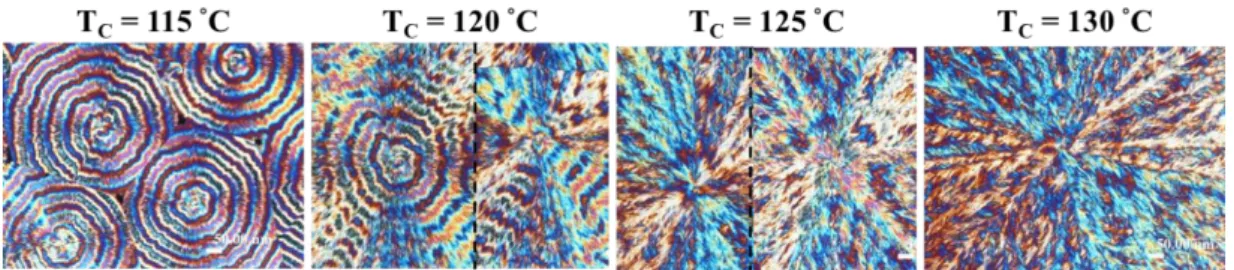
(10) purchased from Alfa Aesar, Inc. (USA), with molecular weight (Mw) = 166.13 g mol−1, Tm = 205 °C. Tannic acid (TA), a multi-phenol compound, was purchased from Aldrich Chem. Co. (USA), with Mw =1,720 g mol-1. Poly(ethylene oxide) (PEO) was purchased from Aldrich (USA), with Mw = 200,000 g mol-1, Tg = -60 °C and Tm = 64 °C. Binary blends of PA and PEO or TA of different composition were first dissolved in ethanol/water (20/80) solution with concentration of 0.12 M, in accordance with previous investigations[11]. Film samples were prepared by direct casting one drop of blend solution on a glass slide placed on a hot stage at a specific temperature until the solvent was completely evaporated and PA was fully crystallized. Chloroform was used as an etching agent to remove the PEO constituent in the crystallized specimen. Results and discussion PLLA/PEO/aPMMA blend Crystallization temperature was viewed as an important factor to induce different morphologies in the ternary blend system. Various crystalline morphologies of PLLA/PEO/aPMMA (80/10/10) blend crystallized at different temperatures were examined, as shown in Figure 1. At Tc = 115 °C, the spherulite showed ring-banded morphology. At Tc = 130 °C, the morphology changed into dendrite. At the transition phase, which is Tc = 120 and 125 °C, ring-banded and dendritic morphologies existed within one spherulite. Comparing morphology at Tc = 120 °C and 125 °C, ring-banded part in one spherulite decreased with increasing Tc. Additionally, hexagonshape spherulites were discovered in transition phase with rare opportunity.. Figure 1. POM images of PLLA/PEO/aPMMA (80/10/10) crystallized at different crystallization temperatures: 115 °C, 120 °C, 125 °C, and 130 °C. As shown earlier, the PLLA crystalline morphology goes through a systematic transition with respect to increasing crystallization temperature. Thus, PLLA/PEO/aPMMA (80/10/10) blends crystallized at Tc = 115 and 130 °C are chosen to investigate the crystal assembly of ring-banded and dendritic pattern, respectively. Figure 2 shows the interior lamellar assembly of PLLA/PEO/aPMMA (80/10/10) crystallized at 115 °C. In the valley region, lamellae grow upward and tilt with an angle form the substrate. Subsequently, the orientation of lamellae gradually changes and eventually parallel to the substrate to form the ridge region. As the development of the spherulite, prior ring grows downward and imping on the following ring which was growing upward, resulting in the formation of interfaces between neighboring cycles. Additionally, the fractured surface reveals that the banded spherulites are composed of fiber-like lamellae arranged into layered and grafting assembly, instead of monotonously twisting from the center.. 2.
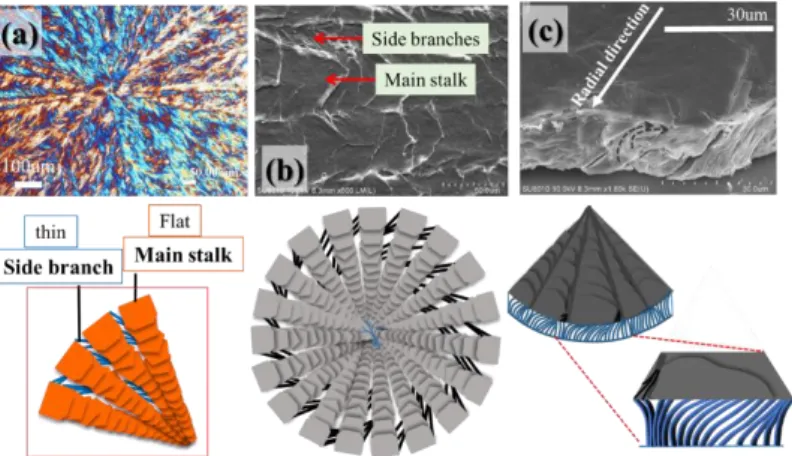
(11) Figure 2. SEM micrographs (a, b) and corresponding schemes (a’, b’) for interior dissection of PLLA/PEO/aPMMA (80/10/10) crystallized at 115 °C. At Tc = 130 °C, the morphology of the ternary blend turned into dendritic spherulite composed of main stalks and side branches revealing contrasted birefringences, as shown in Figure 3(a). Figure 3(b) and (c) show SEM micrographs of the top surface and interior dissection of PLLA/PEO/aPMMA (80/10/10) blend crystallized at 130 °C after etching. The top surface observation clearly reveals that main stalks are composed of flat lamellae, and side branches are arranged loosely between main stalks with thin lamellae. The fractured surface shows that lamellae grow upward with a tilting angle from the substrate and bend parallel to the substrate when reaching the top surface with closely packing to form the main stalks. Because of space limitation between neighboring main stalks, lamellae grow almost vertically to the substrate and bend to the left when reaching top surface with loosely packing to form the side branches. The different orientations of lamellar assembly lead to the formation of contrasted birefringent colors of the main stalk and side branch. It is worthy to point out that despite the different morphologies between ring-banded and dendritic spherulites, the lamellar assembly indeed reveals similar packing.. Figure 3. (a) POM graph and SEM micrographs for (b) top surface and (c) interior dissection of PLLA/PEO/aPMMA (80/10/10) blend cryatllized at 130 °C. PBSu/PEA blend PBSu/PEA blend system with various compositions have multiple types of crystalline morphology at Tc = 60 °C, as shown in Figure 4(A). Neat PBSu appears ring-banded spherulites. When the composition of PEA reaches to 20% to 30%, the ring-banded PBSu morphology simultaneously co-exists with ringless morphology in sectors neighboring each other. PBSu develops fully dendritic spherulites when PBSu is highly diluted by 3.
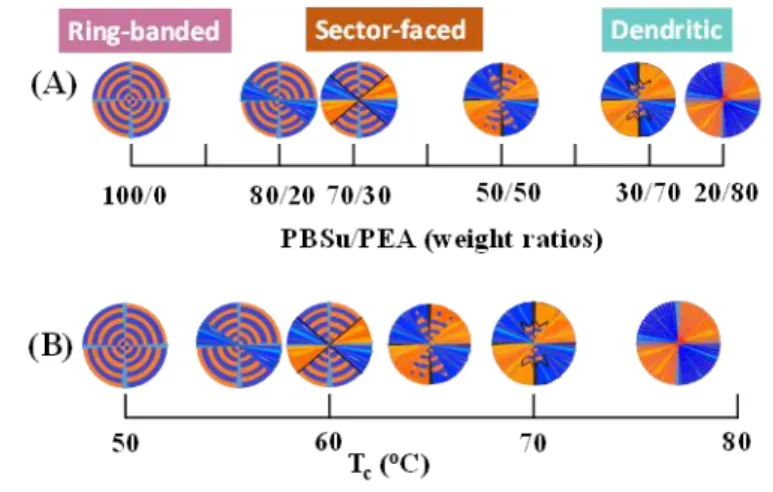
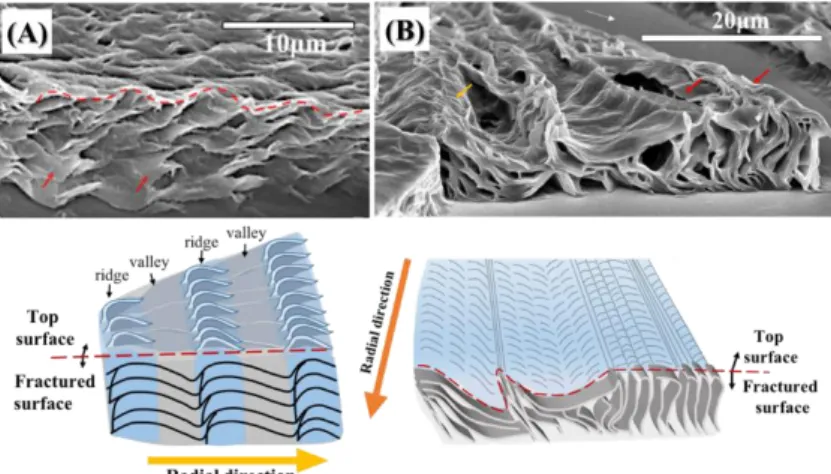
(12) PEA (e.g., 80 wt.% in mixtures). It is worth noting that, owing to lower melting temperature than PBSu, PEA acts as an isomeric diluent for PBSu during PBSu’s crystallization in PBSu/PEA blend system. Figure 4(B) illustrates such a transitional trend of PBSu (in PBSu/PEA = 70/30 mixture) from a fully ring-banded to sectorface (ring-banded and dendritic faces in different sectors) morphology, then to fully dendritic morphology as Tc is increased from 50 to 80 °C. Thus, it is clear that with increasing the composition of diluent PEA or increasing crystallization temperature, the morphology of PBSu crystals gradually changes form ring-banded to sectorface and eventually to dendritic patterns.. . Figure 4. Schemes of POM morphology with respect to PBSu/PEA composition or Tc: (A) PBSu/PEA mixtures of various wt. ratios crystallized at a fixed Tc = 60 °C (scale-bar omitted), (B) PBSu/PEA of a fixed wt. ratio (80/20) at various Tc’s (50~80 °C). Figure 5(A) shows SEM micrographs and corresponding schematic illustration of PBSu/PEA (30/70) mixture crystallized at 35 °C, where PBSu develops a fully ring-banded spherulite, whose top-surface banding is packed of fractal-growth branches. Note that the lamellae on the ridge band may randomly twist and taper to form a thin needle-like tail, which then submerge into the wide valley band. One would not say that the lamellae continuously “helix-twist” like a long helicoid screw from the central nucleus to periphery, as these lamellae actually do not, according to the experimental SEM evidence on the interior morphology. Besides, there is not just a single layer, but actually there are 4-5 lamellar bundles. Figure 5(B) shows SEM micrographs and corresponding schematic illustration of PBSu/PEA (20/80) mixture crystallized at 60 °C, where PBSu develops a fully dendritic spherulite. The lamellae are arranged perpendicular to the substrate underneath the main stalks, while the parallel (or ca. 45o slanted) lamellae are located underneath the inter-stalk region. In general, the main stalk arrange close; however, as a PBSu’s crystal grow from nucleus to dendritic spherulite, the space where the lamellae can crystalize become wider. Because of the wider space for crystallization, some stalk display inverted “U”-shape.. 4.
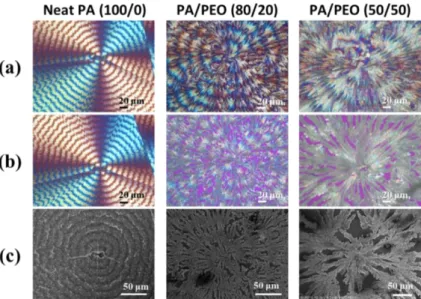
(13) Figure 5. SEM graphs of the fractured surface of (A) PBSu/PEA (30/70) blends crystallized at 35 °C with Tmax = 150 °C and (B) PBSu/PEA (20/80) blends crystallized at 60 °C with Tmax = 150 °C. PBSu/PEA (20/80) blend crystallized at 50 °C reveals dual-face morphology where two distinct patterns including ring-banded and dendritic face can be observed in a single spherulite. Figure 6 shows SEM micrographs for interior dissection in the sector-face PBSu spherulite. For the lower regions (concave down) of either the ring-banded or dendritic sectors, the lamellae are always oriented parallel (or slanted at some angles) to the substrate, while the higher regions (convex up) are always packed with lamellae oriented perpendicular (or almost) to the substrate. That is, the mechanism of assemblies in either of the two different sectors is actually similar.. Figure 6. SEM micrographs and scheme for interior dissection of dendritic vs. ring-banded faces in sector-face PBSu/PEA (20/80) (Tc = 50 °C) spherulite. PA/PEO and PA/TA blends First, PA/PEO blend system with various compositions crystallized at 70 °C, and a novel banded spherulite with fractal-shape lamellar structures could be found in PA/PEO blend when the composition of PEO is above 20%, as shown in Figure 7(a). Fractal-shape banded spherulites crystallized from PA/PEO (80/20) and (50/50) blends show more voids with chloroform-etching comparing to without ones, which reveal that the addition of diluent PEO was the main factor to transform crystalline morphology from compact banded pattern to fractal-shape banded pattern. Figure 7(b)(c) show that the ordered pattern with fractal branching can be easily observed after etching off PEO. 5.
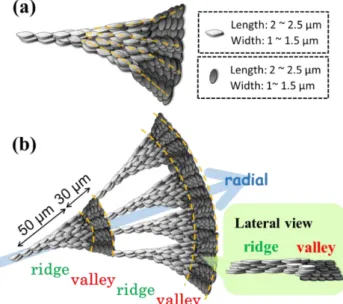
(14) Figure 7. POM graphs of PA/PEO blend of various compositions crystallized at 70 ℃ (a) before and (b) after chloroform etching treatment, and (c) SEM micrographs of chloroform-etched PA/PEO blend of various compositions crystallized at 70 ℃. The detail crystal assembly of the fractal-shape banded spherulites were observed by using SEM. Figure 8 shows SEM micrographs of the fractal-branching region and nucleus region of PA/PEO (50/50) blend crystallized at 70℃ after chloroform etching, respectively. Figure 8(a) shows a clear fractal-branching skeleton of the banded spherulite, which is composed of crystals propagating from nuclei then followed by intermittent branching along the radial direction. Every fractal unit contains two portions: main stalk (ridge) where discrete crystalline aggregations are arranged along the radial direction, and fernlike dendrite (valley) where crystals are arranged along tangential direction. The detailed crystal assembly of central nucleus region can be clearly observed in Figure 8(b). The nucleus center shows a sheaf-like structure, and as the crystals progress, the crystal bundles of the sheaf-like structure gradually bend to form two hollow regions, which are also as known as an eye-like region, perpendicular to the initial growth direction of the nucleus.. Figure 8. SEM micrographs of (a) peripheral fractal-branching pattern and (b) central nuclei region of PA/PEO (50/50) blend crystallized at Tc = 70 ℃ after chloroform etching treatment. Corresponding schematic of crystal assembly of one periodic fractal of the banded PA spherulite is shown in Figure 9(a). When the main stalks grow in radial direction completely, crystalline arrangement transforms into the tangential direction and forms plenty of tangential-oriented fernlike dendrites. Based on the deeper analysis, a scheme is shown in Figure 9(b) to illustrate the key characteristics of the crystal packing of the fractal-branching pattern in PA/PEO (50/50) blend. The periodically fractal branching and intermittent changes 6.
(15) in crystal orientation from radial to tangential direction, collectively, lead to the formation of the circular-grating banded PA spherulites.. Figure 9. Scheme for crystal assembly of (a) one periodic band and (b) fractal-shape banded spherulites, revealing fractal-branching structure composed of discrete crystal assembly of two alternating directions. [Yellow lines indicate interfaces between the ridge and valley bands In summary, a novel periodically fractal branching leads to such a novel pattern of banded PA spherulite, which cannot be attributed to the classical models of continuous twist lamellae as the small-molecules PA does not chain-fold in lamellae at all. In PA/TA blend system, PA was crystallized in the presence of strongly interacting tannic acid (TA) to investigate crystal assembly and the correlation between banded pattern and branching structure. The morphological evolution of PA/TA (80/20) blend with increasing the evaporation rate is schematically summarized in Figure 10. With increasing the evaporation rate, the morphology of PA crystals systematically changes from ring-banded spherulites to highly ordered grating patterns. Surprisingly, a unique periodic fractalbranch banded pattern with contrasted birefringent bands can be found at intermediate evaporation rate, which has never been found in other banded spherulites.. Figure 10. Morphological evolution of solvent-evaporated PA/TA (80/20) crystals from circular-ring banded to grating-like at a fixed Tc but with increase in the evaporation rate (by adjusting the ratios of water/ethanol solvents).. 7.
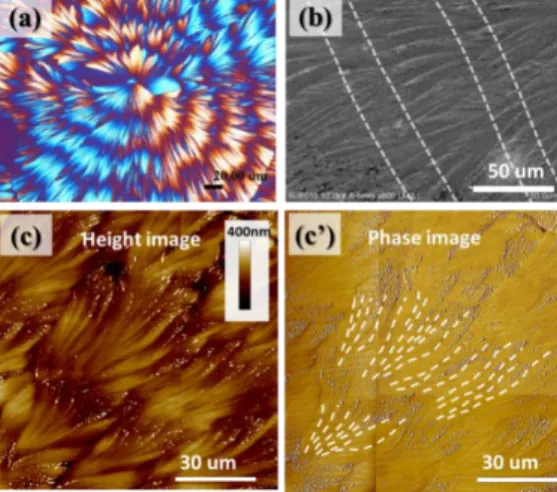
(16) The ring-banded spherulites crystallized at low evaporation temperature. Figure 11 shows (a) POM graph, (b) SEM micrograph, (c) AFM height image and (c’) AFM phase image for the top surface of ring-banded pattern of PA/TA (80/20) crystallized at 50℃. These images provide clear evidence for numerous crystal branches periodically developing and dividing along the radial direction of the spherulites. Branches gradually fan out and eventually turn into the sharp needle-like end and are submerged and hidden underneath the end of ridges. In addition, some branches bend away from the radial direction due to the impingement with neighboring branches, leading to some irregularity of branching patterns thus forming the optical zigzag bands.. Figure 11. (a) POM graph of PA/TA (80/20) dissolved in ethanol/water (20/80) crystallized at 50 °C, (b) SEM micrograph, (c) AFM height image and (c’) AFM phase image for the top surface of circular ring-banded pattern of PA/TA (80/20) crystallized at 50 °C. The fractal-branch banded spherulites crystallized at intermediate evaporation temperature (Tc higher than 50 °C). The PA/TA (80/20) blend can be crystallized into unique periodic fractal-branch banded patterns, which have never been reported in ordinary banded spherulites. Therefore, it is worthy to explore this highly ordered hierarchical structure to reach a more comprehensive understanding of the formation mechanisms of periodic bands. Figure 12 shows that these unique fractal-branch banded structures develop in a parallel direction instead of radiating out from the center to periphery. (a). 50 um. (c) Growth direction. (b). (d). Figure 12. (a) POM, (b) AFM micrographs, and (c) schematic illustration representing the main characteristic corresponding to birefringence of the periodic fractal-branch banded pattern, (d) single main stalk of PA/TA (80/20) dissolved in ethanol/water (20/80) crystallized at 53 °C [POM scale bar = 50 μm]. 8.
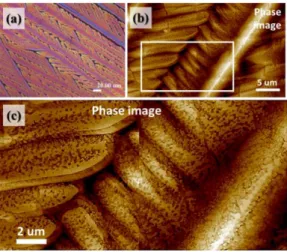
(17) The grating patterns crystallized at high evaporation temperature (Tc higher than 60 °C). Figure 13 shows POM and AFM images of grating patterns of PA/TA (80/20) crystallized at Tc = 60 °C. All of the main stalks grow continually forward along the same direction instead of forming a spherulite, which is similar to the fractal-branch banded patterns crystallized at 53 °C. Nevertheless, different from the periodic fractal-branch banded patterns, grating patterns show highly ordered branches evolving consistently from their main branch. The fact indicates that the evaporation temperature is the main governing factor to manipulate the grating structure.. Figure 13. (a) POM image, and (b) AFM phase image, (c) zoom-in to square in Graph-(b) of grating pattern of PA/TA (80/20) dissolved in ethanol/water (20/80) crystallized at 60 ℃. Conclusion 1. There are two distinct morphologies of spherulites in the PLLA/PEO/aPMMA ternary blend system, including ring-banded and dendritic spherulites. By periodically growing ridge and valley, ring-banded spherulites are formed. Each band is formed from valley with fiber-like lamellae growing upward to the ridge with an angle to the substrate. Dendritic spherulites are composed of main stalks and side branches with sheaf-like nuclei. One of the key factor that affect how spherulites grow is crystallization kinetics. Faster growth rate results in ring-banded spherulites while slower growth rate results in dendritic spherulites. By 3-D observation, the difference and reason between these two kinds of spherulites in the ternary blend system could be revealed. 2. In PBSu/PEA blend system, PBSu exhibits ring-banded, sector-face, and dendritic patterns with Tc and composition as the main modulating factor. The changes of Tc and composition induces similar effect on modulating the morphology. For either the dendritic or ring-banded faces in the sector-face PBSu spherulites, the lamellae obviously do not continuously “helix-twist” as along single-screw-like slab from central nucleus to periphery according to the experimental evidence on the interior morphology. 3. In PA/PEO and PA/TA blend systems, type of diluents in the PA mixture constitutes one of main influential factors on modulating the PA crystal assembly into specific types of periodic bands. TA, with multi-phenol groups, is strongly interacting with PA; by comparison, poly(ethylene oxide) (PEO), with –O- ether group, interacts with PA molecules only moderately. Despite diluted with different interacting additives, all of the banded patterns of PA crystals reveal periodic branching structures. That is to say, periodic branching with 9.
(18) a grating structure is common in periodic bands and fractal branching is essential to fill the growing space. This work provides innovative insight into the crystal self-assembly and the formation of banded spherulites, which may offer a new path for the interpretation of ring-banded spherulites in either polymers or small molecules. References [1] Yeh, Y. T.; Woo, E. M. Macromolecules 2018, 51(19), 7722-7733. [2] Yen, K. C.; Woo, E. M. Polym. Bull. 2009, 62, 225−235. [3] Nurkhamidah, S.; Woo, E. M. Macromol. Chem. Phys. 2013, 214, 673−680. [4] Zhao, L.; Kong, J.; Tian, X.; Zhang, J.; Qin, S. Polym. J. 2014, 46, 323–329. [5] Oaki, Y.; Imai, H. Crystal growth & design 2003, 3(5), 711-716. [6] Imai, H. In Biomineralization I 2006 (pp. 43-72). Springer, Berlin, Heidelberg. [7] Chen, H. P.; Woo, E. M. CrystEngComm 2017, 19(40), 6002-6007. [8] Siti, N.; Woo, E.; Yeh, Y. T.; Luo, F.; Katiyar, V. Polymers 2018, 10(5), 545. [9] Lugito, G.; Woo, E. M.; Hsieh, Y. T. Macromolecules 2015, 48(21), 7953-7967. [10] Woo, E. M.; Lugito, G.; Chang, S. M. CrystEngComm 2018, 20(14), 1935-1944. [11] Woo, E. M.; Lugito, G.; Yang, C. E. CrystEngComm 2016, 18(6), 977-985.. 10.
(19) 科技部補助專題研究計畫成果自評表 請就研究內容與原計畫相符程度、達成預期目標情況、研究成果之學術或應用價 值(簡要敘述成果所代表之意義、價值、影響或進一步發展之可能性) 、是否適 合在學術期刊發表或申請專利、主要發現(簡要敘述成果是否具有政策應用參考 價值及具影響公共利益之重大發現)或其他有關價值等,作一綜合評估。 1. 請就研究內容與原計畫相符程度、達成預期目標情況作一綜合評估 ▓達成目標 □ 未達成目標(請說明,以 100 字為限) □ 實驗失敗 □ 因故實驗中斷 □ 其他原因 說明: 2. 研究成果在學術期刊發表或申請專利等情形(請於其他欄註明專利及技轉之 證號、合約、申請及洽談等詳細資訊) 論文:▓已發表[如附清單所列] □未發表之文稿 ▓撰寫中[第三年] □無 專利:□已獲得□申請中 □無 技轉:□已技轉□洽談中 □無 其他:(以 200 字為限) 3. 請依學術成就、技術創新、社會影響等方面,評估研究成果之學術或應用價 值(簡要敘述成果所代表之意義、價值、影響或進一步發展之可能性,以 500 字為限)。 自從 1950 年高分子研究僅於分析高分子薄膜或高分子上表面的形貌,提出環 帶狀球晶形成的機制為連續扭轉單一模板,在過去五十年並無法提出確切的 科學根據。 我們新穎的觀點:結晶高分子(PEA、PLLA、PHB...等)上表面的雙折射環帶相對 應於內部晶板組裝,晶板呈現不連續且互相垂直的排列方向,層厚= 6-7 μm. 如限制於較薄層環境及較高溫度時,其環帶是由平躺式的晶板所組成. 提出明確的證據以解決半個世紀以來對球晶高分子的疑惑. 4. 主要發現 本研究具有政策應用參考價值: ▓否 □是,建議提供機關_______ (勾選「是」者,請列舉建議可提供施政參考之業務主管機關) 本研究具影響公共利益之重大發現:□否 ▓是 說明:(以 150 字為限) 拓展本國之學術實力 及國際學術知名度 11.
(20) Appendix Publications related to this project {three years from 2016/08/01 – 2019/07/30} 2018 1. Y. -T. Yeh and E. M. Woo*, “Anatomy into Interior Lamellar Assembly in Nuclei-Dependent Diversified Morphologies of Poly(L-lactic acid)”, Macromolecules, 51 (19), 7722-7733 (2018). DOI: 10.1021/acs.macromol.8b01726.SCI/i.f.: 5.554. 2. K. Tashiro*, T. Yoshioka, H. Yamamoto, H. Wang, E. M. Woo, K. Funaki, H. Murase, “Relationship between twisting phenomenon and structural discontinuity of stacked lamellae in the spherulite of poly(ethylene adipate) as studied by the synchrotron X-ray microbeam technique”, Polym. J., 51, 131-141 (2019). https://doi.org/10.1038/s41428-018-0122-y 3. E. M. Woo* and M. S. Lee, “Crystallization in Arylate Polyesters to Periodically Ringed Assembly”, Review article in Polymer Crystallization (2018). DOI: 10.1002/pcr2.10018. First published: 12 September 2018.. https://doi.org/10.1002/pcr2.10018. 4. E. M. Woo*, K. C. Yen, Y.-T. Yeh, and L.-Y. Wang, “Bio-mimetically Structured Lamellae Assembly in Periodic Banding of Poly(ethylene adipate) Crystals”, Macromolecules, 51, 3845-3854 (2018). DOI: 10.1021/acs.macromol.8b00549. SCI/i.f.: 5.554. 5. S. Nurkhamidah, E. M. Woo*, Y. -T. Yeh, F. Luo, and V. Katiyar, “Lamellae Assembly in Dendritic Spherulites of Poly(L-lactic acid) Crystallized with Poly(p-vinyl phenol)”, 10, 545, Polymers (2018). doi:10.3390/polym10050545. SCI/i.f.: 3.681. 6. A. Gupta, A. K. Pal, E. M. Woo, and V. Katiyar*, “Effects of Amphiphilic Chitosan on Stereocomplexation and Properties of Poly(lactic acid) Nanobiocomposite”, Sci. Rpt., 8, 4351 (2018). SCI/i.f.: 4.259 7. E. M. Woo*, G. Lugito, and S. M. Chang, “Three-Dimensional Interior Analyses on Periodically Banded Spherulites of Poly(dodecamethylene terephthalate)”, featured on cover page, Cryst. Eng. Comm., 20, 1935 - 1944 (2018). SCI/i.f.: 3.849 2017 8. C. H. Tu, E. M. Woo,* and G. Lugito, “Structured Growth from Sheaf-like Nuclei to Highly Asymmetric Morphology in Poly(nonamethylene terephthalate)” RSC Adv., 7, 47614 (2017). 9. H. -P. Chen and E. M. Woo*, “Dendritic Lamellar Assembly in Solution-Cast Poly(L-lactic acid) Spherulites”, Cryst. Eng. Commun. 19(40), 6002-6007 (2017). DOI: 10.1039/c7ce01378g SCI/i.f.: 3.849 10. G. Lugito and E. M. Woo*, “Asymmetric Growth of Co-Crystallized Nano- and Micrometer-Sized Lamellae to Janus-Faced Spherulites in Poly(L‑lactic acid) with Amorphous Poly(methyl methacrylate)”, ACS Crystal Growth&Design, 17, 5034−5037 (2017). 11. G. Lugito and E. M. Woo*, “Multi-shell Oblate Spheroid Growth in Poly(trimethylene terephthalate) Banded Spherulites”, Macromolecules, 50, 5898-5904 (2017). SCI/i.f.: 5.554. 12. G. Lugito, C. C. Su, Y.-H. Wang, and E. M. Woo*, “Nano-Assembly of Intertwining Lamellae of Opposite Bending Senses in Poly(ethylene oxide) Co-crystallizing with Poly(p-vinyl phenol)., J. Polym. 12.
(21) Res., 24: 166 (2017). DOI 10.1007/s10965-017-1327-z 13. G. Lugito, E. M. Woo*, S. -M. Chang, “Periodic Extinction Bands Composed of All Flat-on Lamellae in Poly(dodecamethylene terephthalate) Thin Films Crystallized at High Temperatures”, J. Polym. Sci., Polym. Phys., B, 55(7), 601-611 (2017). SCI/i.f.: 3.318. 14. E. M. Woo*, G. Lugito, C. –E. Yang, and S. -M. Chang, “Atomic-Force Microscopy Analyses on Dislocated Lamellae in Extinction Bands of Poly(dodecamethylene terephthalate) Spherulites Solely Packed of Single Crystals”, Crystals, 7, 274 (2017). doi:10.3390/cryst7090274 15. G. Lugito, E. M. Woo,* and W.-T. Chuang, “Interior Lamellar Assembly and Optical Birefringence in Poly(trimethylene terephthalate) Spherulites: Mechanisms from Past to Present,” Crystals, 7(2), 56 (2017). [Review article] 16. E. M. Woo*, W. -T. Tsai, and G. Lugito, “Interior Dissection on Domain-Dependent Birefringence Types of Poly(3-hydroxybutyrate) Spherulites in Blends, Macromolecules, 50(1), 283-295 (2017). SCI/i.f.: 5.554. 2016 17. E. M. Woo*, G. Lugito, J.-H. Tsai, and A. J. Muller*, “Hierarchically Diminishing Chirality Effects on Lamellar Assembly in Spherulites Comprising Chiral Polymers”, Macromolecules, 49, 2698−2708 (2016). SCI/i.f.: 5.554. 18. E. M. Woo*, G Lugito, and S Nurkhamidah, “Shapes and Origins of Cracks and Correlations with Lamellae Assembly in Poly(L-lactic acid)”, Macromolecular Symposia, 369(1):87-91 (2016). 19. G. Lugito, and E. M. Woo*, Three types of banded structures in highly birefringent poly(trimethylene terephthalate) spherulites”, J. Polym. Sci., Polym. Phys., B, 54, 1207–1216 (2016). SCI/i.f.: 3.318. 20. G. Lugito and E M. Woo*, “Novel approaches to study the crystal assembly in banded spherulites of poly(trimethylene terephthalate)”, Cryst. Eng. Comm., 18, 6158-6165 (2016). SCI/i.f.: 3.849. [Featured on journal cover page]. 21. E. M. Woo* and G. Lugito, “Cracks in Polymer Spherulites: Phenomenological Mechanisms in Correlation with Ring Bands”, Polymers, 8(9), 329 (2016). Review Article. SCI/i.f.: 3.681. doi:10.3390/polym8090329. 22. E. M. Woo*, G. Lugito and C. -E. Yang, “Analysis of Crystal Assembly in Banded Spherulites of Phthalic Acid upon Solvent Evaporation”, Cryst. Eng. Comm., 18, 977-985 (2016). DOI: 10.1039/C5CE02043C. SCI/i.f.: 3.849.. (B) CONFERENCE Presentations/Proceeding Papers 2019 1. E. M. Woo* and M.-S. LEE, “Structured Lamellar Assembly in Correlation with Cooling-Induced Cracking Tracks in Crystallized Polyesters”, Invited Speech, PCM-2019, Bangkok, Thailand, July 8-12 (2019). 2. E. M. Woo* and M.-S. LEE, “MECHANSIMS OF LAMELLAR ASSEMBLY BY TRACKING WITH CRACKS IN CRYSTALLIED POLYESTERS”, Keynote Speech, 15th IUPAC International Conference on Novel Materials and their Synthesis (NMS-XV), Shengyang, China, Sept. 6-11 (2019). 3. S. Nagarajan and E. M. Woo*, “Ring-banded high-density polyethylene spherulites re-investigated”, The 6th Federation of Asian Polymer Societies International Polymer Congress (FAPS 2019), Taipei, Taiwan, 13.
(22) Oct. 27-30, 2019. 4. S. Nagarajan and E. M. Woo*, “Exploration of Lamella Self-assembly in Poly(ɛ-caprolactone) Crystallized with Poly(phenyl methacrylate)”, Annual Meeting of the Polymer Society (AMPS-2019), Tainan, Taiwan, Jan. 18-19 (2019). 5. T.-Y. Chen and E. M. Woo*, “Single-Crystalline Aggregation into Periodically Banded Spherulites in Phthalic Acid Modulated by Molten Poly(ethylene oxide) via Non-Twist Assembly,” Annual Meeting of the Polymer Society (AMPS-2019), Tainan, Taiwan, Jan. 18-19 (2019). 6. Y.-J. Lee and E. M. Woo*, “Crystal Assembly in Ring-Banded Spherulites of PLLA/PEO/PMMA Ternary Blend System”, Annual Meeting of the Polymer Society (AMPS-2019), Tainan, Taiwan, Jan. 18-19 (2019). 7. Y.-L. Tseng, and E. M. Woo*, “Lamellar Assembly in Janus-Face Poly(butylene succinate) Spherulites Crystallized with Poly(ethylene oxide) as Diluent,” Annual Meeting of the Polymer Society (AMPS2019), Tainan, Taiwan, Jan. 18-19 (2019). 2018 8. E. M. Woo, “Polymer Crystallization: Essence of Polymer Crystallization with Periodic Grating Assembly Mimicking Bio-iridescence Structures”, Invited speech, Japan-Taiwan Bilateral Symposium on Tough Polymers, in MRS-J Annual Meeting, Kitakyushu, Japan, Dec. 19-20 (2018). 9. E. M. Woo, “Arylate Polyesters Crystallized with Periodically Ringed Assembly”, Invited Seminar Speech at Kyushu University, Fukuoka, Kyushu, Japan, Dec. 21 (2018). 10. E. M. Woo, “Anatomy into Lamellar Assembly of Polymers Crystallized with Periodic Surface-Relief and Optical Birefringent Patterns”, Invited Seminar Speech at Nat’l Taiwan University of Science and Technology, Taipei, Taiwan, Oct. 31 (2018). 11. E.M. Woo*, G. Lugito, Y. T. Hsieh, “Discontinuous Positive- and Negative-Birefringence Lamellae Assembly into Artificial Periodic Bands in Polymer Spherulites”, Plenary speech, HTPM-X, Beijing, China, Oct. 22-25 (2018). 12. E. M. Woo, “Polymer Crystallization with Periodic Assembly into Biomimetic Grating Structures”, Invited speech, Japan-Taiwan Bilateral Symposium, Chiayi, Taiwan, Oct. 1-3 (2018). 13. E. M. Woo, “Polymer Crystallization to Periodic Lamellar Patterns with Biomimetic Grating Structures”, Keynote speech, Japan-Taiwan Bilateral Workshop on Nano-Science-2018” , Osaka, Japan, July. 2124 (2018). 14. M. -S. Lee and E. M. Woo*, “Correlation Between Cracks and Periodic Lamellar Assembly in Polyesters”, Japan-Taiwan Bilateral Workshop on Nano-Science-2018” , Osaka, Japan, July. 21-24 (2018). (Student poster contest award to Lee, MH). 15. T. -Y. Chen and E. M. Woo*, “Crystal Assembly in Banded Spherulites of Phthalic Acid with Poly(ethylene oxide)”, Japan-Taiwan Bilateral Workshop on Nano-Science-2018” , Osaka, Japan, July. 21-24 (2018). (Student poster by T. Y. Chen). 16. E.M. Woo, “Interior Anatomy of Polymers or Blends Crystallized with Periodic Surface-Relief and Birefringent Patterns”, Keynote Speech, PPS-34, Taipei, Taiwan, May 21-25 (2018). 17. E. M. Woo, “Periodically Optical Patterns Analyzed with Interior Crystal Assembly in Polymer Spherulites”, Keynote Speech, International Conference on Advancement and Challenges in Chemical Sciences, Chennai, India, February 2-3, 2018. 14.
(23) 18. E. M. Woo, “Properties in Correlation with Hierarchical Crystalline Morphologies in Biodegradable Polymers”, Special Invited Seminar at SABIC Corporate Technical Center, Bangalore, India, Feb. 5, 2018. 19. C. H. Chen and E. M. Woo*, “Gradient Banding in Poly(3-hydroxybutyric acid-co-3- hydroxyvaleric acid) Spherulites Non-isothermally and Isothermally Crystallized,” Annual Polymer Soc. Conf., Taipei, Taiwan, Jan. 12-13 (2018). Student English Oral presentation by C. H. Chen. [Student contest award] 20. Y. –T. Yeh and E. M. Woo* “Nuclei-Dependent Morphologies in Biodegradable Polymers”, Annual Polymer Soc. Conf., Taipei, Taiwan, Jan. 12-13 (2018). Student poster by Yeh, YT. 21. M.-S. Lee and E. M. Woo*, Correlation Between Cracks and periodic lamellar assembly in Polyesters, Annual Polymer Soc. Conf., Taipei, Taiwan, Jan. 12-13 (2018). Student poster by Lee, MH. 22. C. -H. Chen and E. M. Woo*, “Novel Approaches to Analyze Interior Lamellae and Assembly in Spherulitic Morphology of Poly(3-hydroxybutyric acid-co-3-hydroxyvaleric acid) Crystallized with Poly(vinyl methyl ether)”, , 4th Edition of International conference on Polymer Science and Technology, London, UK, June 5 (2018). [oral presentation by Master’s student Chen, CH] 2017 23. E. M. Woo* and G. Lugito, ”Periodic Surface-Relief Patterns in Correlation with Interior Lamellar Assembly in Polymers Crystallized with Various Kinetic Confinements”, Keynote Speech, Taiwan-Japan Bilateral Symposium-2017, Tainan Taiwan, Sept. 3-6 (2017). 24. E. M. Woo*, C. -H. Tsai, and G. Lugito, “Diminishing Chirality Effects on Lamellar Bending in Spherulitic Morphology: Cases of Bio-based Chiral Poly(L-lactic acid) or Poly(D-lactic acid) Crystallized with Poly(ethylene oxide)’, Keynote Speech, 6th Int. Conf. on Bio-based Polymers-2017 (ICBP-2017), ChungLi, Taiwan, May 15-17 (2017). 25. E. M. Woo as co-organizers for “2017 ImPACT Symposium of Polymeric Materials for Future Vehicles”, Tainan, Taiwan (Nov. 20-21, 2017). 26. M. H. Lee and E. M. Woo*, “Correlation Between Cracks and Banded Morphology in Poly(3hydroxybutyrate)”, Taiwan-Japan Bilateral Symposium-2017, Poster by LeeMH (MS student), Tainan, Taiwan, Sept. 3-6 (2017). 27. C. H. Chen and E. M. Woo*, “Gradient Banding in Poly(3-hydroxybutyric acid-co-3-hydroxyvaleric acid) Spherulites Non-isothermally Crystallized”, Taiwan-Japan Bilateral Symposium-2017, Poster by ChenCH (MS student), Tainan, Taiwan, Sept. 3-6 (2017). 28. G. Lugito and E. M. Woo*, “Dual-morphological spherulite formation in Poly(l-lactic acid) / poly(methyl methacrylate) blend”, 6th Int. Conf. on Bio-based Polymers-2017 (ICBP-2017), ChungLi (Yuan-ze Univ), Taiwan, May 14-17 (2017). Oral Speech by G. Lugito. 29. G. Lugito and E. M. Woo*, “Mechanisms of Dual Spherulitic Morphology in Poly(L-Lactic acid) Induced by Amorphous Polymers”, Europe-Africa Conference 2017 of the Polymer Processing Society (PPS), Dresden, Germany, 26-29 June 2017. Oral by G. Lugito. 30. C.-H. Chen and E. M. Woo*, “Lamellar Assembly of Poly(3-hydroxybutyric acid-co-3-hydroxyvaleric acid) Spherulites Crystallized with Poly(vinyl methyl ether)”, Europe Africa Conference 2017 of the Polymer Processing Society (PPS), Dresden, Germany, 26-29 June 2017. Oral by C-H Chen (MS student). 31. C. H. Tu, E. M. Woo*, “Interior Analyses on Lamellar Assembly in Dual types of Ring-banded Spherulites of Poly(nonamethylene terephthalate),” Annual Polymer Soc. Conf., Taichung, Taiwan, Jan. 15.
(24) 13-14 (2017). Student English Oral presentation by C. H. Tu. [Student contest award] 32. H. P. Chen, E. M. Woo*, “Observation to Crystalline Morphology in Nonequimolar Mixtures of Poly(Llactic acid ) and Poly(D-lactic acid)”, Annual Polymer Soc. Conf., Taichung, Taiwan, Jan. 13-14 (2017). Student English Oral presentation by H. P. Chen. [Student contest award]. 33. G. Lugito, E. M. Woo*, “Mechanisms of dual spherulitic morphology in poly(l-lactic acid) induced by amorphous polymer”, Annual Polymer Soc. Conf., Taichung, Taiwan, Jan. 13-14 (2017). [English Oral Presentation by G. Lugito] 34. E. M. Woo*, “Artificial Ring-Banded Spherulites Packed with Discontinuous Positive- and NegativeBirefringence Lamellae Constructed by Temperature Cycling”, International Conference on Polymer Science and Technology, MACRO-2017, Thiruvananthapuram, India, January 8-11, 2017.. 16.
(25) 國立成功大學. 科技部計畫出國案報告書 出席會議報告 (2019 Global Conference on Polymer and Composite Materials, PCM-2019) 應邀國際會議 (PCM-2019)做邀請演講(Invited Speech) At Bangkok,Thailand Date of conference: July 8- 11, 2019. ---------------------------------------------------------單位:化 工 系 職稱: 教授 姓名:吳 逸 謨 國立成功大學 化學工程系. 701 台南市大學路 1 號. Phone : +886 (06) 275-7575 Ext.62670 [email protected]>. 中華民國. 108 年 8 月 30 日. 1. Fax: +886 6 234-4496 <.
(26) 行政院國家科學委員會補助國內專家學者出席國際學術會議報告 108 年 8 月 20 日 報告人姓名. 吳 逸 謨. 時間 會議地點. 108 年 7 月 8 日至 11 日 July 8-11, 2019, Bangkok, Thailand. 服務機關 及職稱. 本會核定 三年期 第三年 補助文號. MOST-105-2221-E006-246-MY3. (實際參會 4 天, including reception on first night) Two days conf., and final departure day.. 會議 名稱 發表論 文題目. 成功大學化學工程學系 教授. (註: 本國際會議經費, 不含順道參. 訪 King Mongkut University North Bangkok 大學做學術交流 [另外報 支本人結餘經費 - 成大控管(已獲 核准)]. 2019 Global Conference on Polymer and Composite Materials (PCM 2019), Bangkok, Thailand Speech (Invited): Structured Lamellar Assembly in Correlation with Cooling-Induced Cracking Tracks in Crystallized Polyesters [PCM2798]. 報告內容應包括下列各項: 一、參加會議心得 二、與會心得 三、考察參觀活動(無是項活動者省略) 四、建議 五、攜回資料名稱及內容 六、其他. 2.
(27) 中文及英文摘要 一、中文摘要 成大化工系 吳逸謨 教授,應邀出席國際會議 2019 Global Conference on Polymer and Composite Materials, PCM-2019 (Chulalongkorm University協辦),做邀請演講 (Invited Speech): 會議在 泰國曼谷 Chulalongkorn University旁的 Pathumwan Princess Hotel, 444 MBK Center, Phayathai Road, Wangmai, Pathumwan, Bangkok 舉行. 會議期間: 108/07/08-108/07/11。講題:。並做Session chair主持會議. 此會議屬中小型 高分子材 料及複材主題式,涵蓋有機 無機 與陶瓷金屬材料複材。領域內諸多國際學者,均來參加 聽講,併討論交流,獲得最研究曝光度,也獲益於各場發表之學習。詳細資料列於本文中。 國際會議,共四天 (MOST經費、報告呈科技部)。 本主要出國目地是參與 PCM-19 國際會議(共 4 天) 又因己身長期研究成果之傑出國際知名 度與影響力之彰顯,有幸順道受邀為訪問學者在 King Mongkut University of Technology Norther Bangkok 大學與教授討論,討論合作研究可能性。[另外申請順道參訪大學共一天 (同一城市: 曼谷):做學術交流訪問,並討論跨國(台泰)合作研究可能性。. 註: PCM-2019 國際會議經費,報支科技部計劃。順道參訪 King Mongkut 大學(只支一天生活費), 報支成大管控之本人科技部計劃”結餘款”。均已事先申請核准,並依法規分攤費用. 3.
(28) Abstract (English) Professor Eamor M. Woo, Ch.E. Dept. of National Cheng Kung University, was invited by International Conference organizing committees (PCM-19) to give an Invited Speech (speech title attached at the end).. Conference is co-organized with Chulalongkorm University.. Conference site is next to Chulalongkorn University, at Pathumwan Princess Hotel, 444 MBK Center, Phayathai Road, Wangmai, Pathumwan, Bangkok. Trough listening and discussions with conf. delegates from polymers and composites communities from all over the world, the experiences and learning were phenomenal. By giving a lecture on one of our recent research subjects, I could enhance the publicity and influence of National Cheng Kung Univeristy. Dates for the conference: 108/07/08-108/07/11. Details of speeches, attendance, and activities are listed in the main texts of this report. As en-route academic activity, I also visited upon invitation of the President of King Mongkut University (Bangkok,Thailand) (also located at Bangkok city) (host: Prof. Jyotishikuma– Research. Professor). I paid a visit and exchanged gifts with President of the university, and discussion lasted 1 hr.. Afterward, Prof. Jyotishkuma showed me the facilities in. his department and laboratories, facilities of research and teaching.. After meeting and. discussion with the President, I was showed around the campus by the host, with the day ended with a dinner gathering with seven faculty members from the department. The discussions were thrilling and mind-opening for both parties.. 4.
(29) 本文(包含目的、過程、心得及建議事項,其文字部分須佔三頁以上) 國際會議 演講 行程 如下: 07 月 07 日(2019). 出發. 由高雄(KHH)高雄國際機場, 同日晚上 抵達曼谷入住飯店. 7/8 (Mon)– PCM-19 國際會議 – 註冊 及參加下午之接待會。 會議在Chulalongkorn University旁的 Pathumwan Princess Hotel, 444 MBK Center, Phayathai Road, Wangmai, Pathumwan, Bangkok 舉行. 7/9 (Tue)– 國際會議 聆聽Plenary speeches演講至中午. 下午是壁報,本人是評審之 一 評鑑壁報之品質與科技內容. 7/10 (Wed)- PCM-19 國際會議 -本人之Invited Speech。並做Session chair 主持四場 口頭報告.其餘時間 聆聽演講至下午 7/11 (Thurs) PCM-16 國際會議 聆聽演講至下午,與參會學者交流 討論。 (結束離開會議) 108/07/12 (Fri) 一整天 順道赴 King Mongkut University North Bangkok,Bangkok 學 術參訪交流.. 本人的口頭報告 及主持的 session 如下附掃描檔. 5.
(30) 6.
(31) 四、心得及建議事項: 本報告主要是參加國際會議(PCM-19),並做演講、主持、及評鑑壁報。其餘時間 與 7.
(32) 全會議參與者,討論交流,並細節敘述我研究創新,與諸多國際知名學者之研究成果,所 具有之新穎之重點。我的演講 有許多參 會者均來聽講, 併討論交流,獲得最大之研究 曝光度。 在這個曼谷舉行的國際會議,可以感受到,這個城市,以及這裡的大學學術環 境,因最近經濟提升, 有政府資源強力補助。具有強烈企圖心;要於短期內不但與國際接 軌,且展示其現代化之硬體已然成形。並於 coffee break and lunch 有極多參與聆聽知 名國際學者,讚譽本人之演講內容,並熱烈討論。 經費核准一天,赴 King Mongkut University of Technology North Bangkok 大學演 講參訪。本行程,屬於參加國際會議 [PCM-2019 at Bangkok] 之”順道參訪”。 除了參 訪,更由接待方邀請與該校校長(Prof. Dr.-Ing. Habil Suchart Siengchin)拜訪見面, 討論交流可行性。早上共兩小時,另外,下午與該系數位老師進行個別交流討論。亦經由 Dr. Jyotishkumar 教授帶領,參訪其實驗室;約三小時。對於提升本校國際聲譽,校際交 流,有正面且立即之效果。King Mongkut University of Technology North Bangkok 大 學大學 是目前泰國排名前十之高校之一 (排名第一是 Chulalongkorn University)。全泰 國約二百高校大學 人口約六千萬, 較無我國大學數目繁多,人口土地少,而稀釋高等教育 資源之問題。我國大學要國際化,與學術競爭,積極且集中投注適宜資源培養人才,拓展 高等教育資源,準備國際化之潛力,提供我國政府 觀察他山之石。 [註:除PCM-19國際會議之外,順道參訪King Mongkut University of Technology North Bangkok心得併承於此,是為了報告完整性,及學術活動之關聯性。訪問 King Mongkut University之經費(一日生活費)與參加國際會議,是分開報支、也無重覆、且事先申請核 准。]. 五、攜回資料名稱及內容 conference proceeding (hardcopy) 8.
(33) 以下是附件 供參考: 摘要、 圖片、 學術活動、參訪. Attachment: Invitation to give Invited Speech by Organizing committee:. 9.
(34) 合照 [本人第二排座位, 左起第五位]:. 壁報討論交流:. 10.
(35) Abstract- Speech Structured Lamellar Assembly in Correlation with Cooling-Induced Cracking Tracks in Crystallized Polyesters [PCM2798] Eamor M. WOO* and Ming-Syuan LEE Department of Chemical Engineering, National Cheng Kung University, No. 1, University Road, Tainan, 701-01, Taiwan *corresponding author to e-mail: [email protected] Aims: Updated views via interior lamellae dissection and analysis on biodegradable poly(3-hydroxybutyrate)(PHB)’s or other petro-based polymers’ banded spherulites provide avenues for cracks to develop upon cooling contraction. Propagation of the cracks follows the spiral or circular lamellae assembly into similarly spiral or circular concentric ring-banded patterns. The mechanism of lamellar assembly in inducing formation of spiral/circular cracks’ is well proven in this work, which is related to the inner arrangement/assembly of the periodic spiral lamellae into banded types. Methods: Poly(3-hydroxybutyrate) (PHB) of two molecular weights (Low-MW and High-MW) was obtained from Polysciences, Inc. (USA), with Mw = 10,000 and 500,000 g mol−1, polydispersity index (PDI) 1.29 and 1.45, glass transition temperature (Tg) 1.5 and 0.7°C, and melting temperature (Tm) 172 and 174°C, respectively. Instrument: polarized-light optical microscopy (POM); differential scanning calorimeter (Perkin-Elmer, Diamond DSC); atomic-force microscopy (AFM) (diCaliber, Veeco Corp., USA); high-resolution field-emission scanning electron microscopy (Hitachi-SU8010, HR-FESEM). Results: Cracks in ring-banded or ringless (non-banded) PHB or other polymer spherulites tend to follow the patterns of “brittle discontinuity” in the spherulites, where the interior lamellae are assembled into various specific orders leading to corresponding optical birefringence patterns. Such updated views via interior lamellae dissection and analysis on PHB’s or other polymers’ banded spherulites provide vital avenues for cracks to develop upon cooling contraction. Conclusions: Extensive analysis on the inter-crack regions further proves that the cracks occur at the interface between the valley and ridge bands of the ringed PHB spherulites, where interfaces with discontinuous lamellae exist with either impingement or intersection. The mechanism of spiral/circular cracks’ formation is well proven in this work, disclosing the mechanisms of inner arrangement/assembly of the periodic spiral lamellae into banded types; by contrast, without such lamellae periodicity, cracks tends to be randomly irregular. Acknowledgments: This work has been financially supported by a basic research grant (MOST-105-2221-E-006-246-MY3) for three consecutive years from Taiwan’s Ministry of Science and Technology (MOST). 11.
(36) 105年度專題研究計畫成果彙整表 計畫主持人:吳逸謨. 計畫編號:105-2221-E-006-246-MY3. 計畫名稱:以新穎的觀點分析晶板自組裝:從單晶到多晶和具有週期性結構的高分子球晶 成果項目 期刊論文. 國 學術性論文 內 研討會論文. 質化 (說明:各成果項目請附佐證資料或細 單位 項說明,如期刊名稱、年份、卷期、起 訖頁數、證號...等) . 量化 0. 1.S. Nagarajan and E. M. Woo*, “Ring-banded high-density polyethylene spherulites reinvestigated”, The 6th Federation of Asian Polymer Societies International Polymer Congress, Taipei, Taiwan, Oct. 27-30, 2019. 2.S. Nagarajan and E. M. Woo*, “Exploration of Lamella Selfassembly in Poly(-caprolactone) Crystallized with Poly(phenyl methacrylate)”, Annual Meeting of the Polymer Society, Tainan, Taiwan, Jan. 18-19 (2019). 3.T.-Y. Chen and E. M. Woo*, “Single-Crystalline Aggregation into Periodically Banded Spherulites in Phthalic Acid Modulated by Molten Poly(ethylene oxide) via Non-Twist Assembly,” 篇 Annual Meeting of the Polymer 19 Society, Tainan, Taiwan, Jan. 18-19 (2019). 4.Y.-J. Lee and E. M. Woo*, “Crystal Assembly in Ring-Banded Spherulites of PLLA/PEO/PMMA Ternary Blend System”, Annual Meeting of the Polymer Society, Tainan, Taiwan, Jan. 18-19 (2019). 5.Y.-L. Tseng, and E. M. Woo*, “Lamellar Assembly in Janus-Face Poly(butylene succinate) Spherulites Crystallized with Poly(ethylene oxide) as Diluent,” Annual Meeting of the Polymer Society, Tainan, Taiwan, Jan. 18-19 (2019). 6.E. M. Woo, “Anatomy into Lamellar Assembly of Polymers Crystallized with Periodic SurfaceRelief and Optical Birefringent Patterns”, Invited Seminar Speech.
(37) at Nat’l Taiwan University of Science and Technology, Taipei, Taiwan, Oct. 31 (2018). 7.E.M. Woo, “Interior Anatomy of Polymers or Blends Crystallized with Periodic Surface-Relief and Birefringent Patterns”, Keynote Speech, PPS-34, Taipei, Taiwan, May 21-25 (2018). 8.C. H. Chen and E. M. Woo*, “Gradient Banding in Poly(3hydroxybutyric acid-co-3hydroxyvaleric acid) Spherulites Non-isothermally and Isothermally Crystallized,” Annual Polymer Soc. Conf., Taipei, Taiwan, Jan. 12-13 (2018). 9.Y. –T. Yeh and E. M. Woo* “Nuclei-Dependent Morphologies in Biodegradable Polymers”, Annual Polymer Soc. Conf., Taipei, Taiwan, Jan. 12-13 (2018). 10.M.-S. Lee and E. M. Woo*, Correlation Between Cracks and periodic lamellar assembly in Polyesters, Annual Polymer Soc. Conf., Taipei, Taiwan, Jan. 12-13 (2018). 11. E. M. Woo* and G. Lugito, ”Periodic Surface-Relief Patterns in Correlation with Interior Lamellar Assembly in Polymers Crystallized with Various Kinetic Confinements”, Keynote Speech, Taiwan-Japan Bilateral Symposium2017, Tainan Taiwan, Sept. 3-6. 12.E. M. Woo*, C. -H. Tsai, and G. Lugito, “Diminishing Chirality Effects on Lamellar Bending in Spherulitic Morphology: Cases of Bio-based Chiral Poly(L-lactic acid) or Poly(D-lactic acid) Crystallized with Poly(ethylene oxide)’, Keynote Speech, 6th Int. Conf. on Bio-based Polymers-2017, ChungLi, Taiwan, May 15-17 (2017). 13.E. M. Woo as co-organizers for “2017 ImPACT Symposium of Polymeric Materials for Future Vehicles”, Tainan, Taiwan (Nov. 20-21). 14.M. H. Lee and E. M. Woo*,.
(38) “Correlation Between Cracks and Banded Morphology in Poly(3hydroxybutyrate)”, Taiwan-Japan Bilateral Symposium-2017, Tainan, Taiwan, Sept. 3-6 (2017). 15.C. H. Chen and E. M. Woo*, “Gradient Banding in Poly(3hydroxybutyric acid-co-3hydroxyvaleric acid) Spherulites Non-isothermally Crystallized”, Taiwan-Japan Bilateral Symposium2017, Tainan, Taiwan, Sept. 3-6. 16.G. Lugito and E. M. Woo*, “Dual-morphological spherulite formation in Poly(l-lactic acid) / poly(methyl methacrylate) blend”, 6th Int. Conf. on Bio-based Polymers-2017, ChungLi, Taiwan, May 14-17. 17.C. H. Tu, E. M. Woo*, “Interior Analyses on Lamellar Assembly in Dual types of Ring-banded Spherulites of Poly(nonamethylene terephthalate),” Annual Polymer Soc. Conf., Taichung, Taiwan, Jan. 13-14 (2017). 18.H. P. Chen, E. M. Woo*, “Observation to Crystalline Morphology in Nonequimolar Mixtures of Poly(L-lactic acid ) and Poly(Dlactic acid)”, Annual Polymer Soc. Conf., Taichung, Taiwan, Jan. 13-14 (2017). 19.G. Lugito, E. M. Woo*, “Mechanisms of dual spherulitic morphology in poly(l-lactic acid) induced by amorphous polymer”, Annual Polymer Soc. Conf., Taichung, Taiwan, Jan. 13-14 (2017). 專書. 0 本. 專書論文. 0 章. 技術報告. 0 篇. 其他. 0 篇. 專利權 智慧財產權 及成果. 發明專利. 申請中. 0. 已獲得. 0. 新型/設計專利 商標權. 0 件 0. 營業秘密. 0.
(39) 技術移轉. 積體電路電路布局權. 0. 著作權. 0. 品種權. 0. 其他. 0. 件數. 0 件. 收入. 0 千元. 國 學術性論文 期刊論文 外. 1. Macromolecules, 51 (19), 77227733 (2018). DOI: 10.1021/acs.macromol.8b01726. 2. Polym. J., 51, 131-141 (2019). https://doi.org/10.1038/s41428-0180122-y 3. Review article in Polymer Crystallization (2018). DOI: 10.1002/pcr2.10018. First published: 12 September 2018. https://doi.org/10.1002/pcr2.10018 4. Macromolecules, 51, 3845-3854 (2018). DOI: 10.1021/acs.macromol.8b00549. 5. 10, 545, Polymers (2018). doi:10.3390/polym10050545. 6. Sci. Rpt., 8, 4351 (2018). 7. Cryst. Eng. Comm., 20, 1935 1944 (2018). 8. RSC Adv., 7, 47614 (2017). 9. Cryst. Eng. Commun. 19(40), 6002-6007 (2017). DOI: 22 篇 10.1039/c7ce01378gSCI/i.f.: 3.849 10. ACS Crystal Growth&Design, 17, 50345037 (2017). 11. Macromolecules, 50, 5898-5904 (2017). SCI/i.f.: 5.554. 12. J. Polym. Res., 24: 166 (2017). DOI 10.1007/s10965-017-1327-z 13. J. Polym. Sci., Polym. Phys., B, 55(7), 601-611 (2017). 14. Crystals, 7, 274 (2017). doi:10.3390/cryst7090274 15. Crystals, 7(2), 56 (2017). [Review article] 16. Macromolecules, 50(1), 283-295 (2017). 17. Macromolecules, 49, 26982708 (2016). 18. Macromolecular Symposia, 369(1):87-91 (2016). 19. J. Polym. Sci., Polym. Phys., B, 54, 1207–1216 (2016). 20. Cryst. Eng. Comm., 18, 6158-.
(40) 6165 (2016). 21. Polymers, 8(9), 329 (2016). Review Article. doi:10.3390/polym8090329. 22. Cryst. Eng. Comm., 18, 977-985 (2016). DOI: 10.1039/C5CE02043C.. 研討會論文. 15. 1.E. M. Woo* and M.-S. LEE, “Structured Lamellar Assembly in Correlation with Cooling-Induced Cracking Tracks in Crystallized Polyesters”, Invited Speech, PCM2019, Bangkok, Thailand, July 8-12 (2019). 2.E. M. Woo* and M.-S. LEE, “MECHANSIMS OF LAMELLAR ASSEMBLY BY TRACKING WITH CRACKS IN CRYSTALLIED POLYESTERS”, Keynote Speech, 15th IUPAC International Conference on Novel Materials and their Synthesis (NMS-XV), Shengyang, China, Sept. 6-11 (2019). 3.E. M. Woo, “Polymer Crystallization: Essence of Polymer Crystallization with Periodic Grating Assembly Mimicking Bioiridescence Structures”, Invited speech, Japan-Taiwan Bilateral Symposium on Tough Polymers, in MRS-J Annual Meeting, Kitakyushu, Japan, Dec. 19-20 (2018). 4.E. M. Woo, “Arylate Polyesters Crystallized with Periodically Ringed Assembly”, Invited Seminar Speech at Kyushu University, Fukuoka, Kyushu, Japan, Dec. 21 (2018). 5.E.M. Woo*, G. Lugito, Y. T. Hsieh, “Discontinuous Positiveand Negative-Birefringence Lamellae Assembly into Artificial Periodic Bands in Polymer Spherulites”, Plenary speech, HTPM-X, Beijing, China, Oct. 22-25 (2018). 6.E. M. Woo, “Polymer Crystallization with Periodic Assembly into Biomimetic Grating Structures”, Invited speech, Japan-Taiwan Bilateral Symposium, Chiayi, Taiwan, Oct. 1-3 (2018). 7.E. M. Woo, “Polymer Crystallization to Periodic.
(41) Lamellar Patterns with Biomimetic Grating Structures”, Keynote speech, Japan-Taiwan Bilateral Workshop on Nano-Science-2018” , Osaka, Japan, July. 21-24 (2018). 8.M. -S. Lee and E. M. Woo*, “Correlation Between Cracks and Periodic Lamellar Assembly in Polyesters”, Japan-Taiwan Bilateral Workshop on Nano-Science2018” , Osaka, Japan, July. 21-24 (2018). (Student poster contest award to Lee, MH). 9.T. -Y. Chen and E. M. Woo*, “Crystal Assembly in Banded Spherulites of Phthalic Acid with Poly(ethylene oxide)”, JapanTaiwan Bilateral Workshop on NanoScience-2018” , Osaka, Japan, July. 21-24 (2018). (Student poster by T. Y. Chen). 10.E. M. Woo, “Periodically Optical Patterns Analyzed with Interior Crystal Assembly in Polymer Spherulites”, Keynote Speech, International Conference on Advancement and Challenges in Chemical Sciences, Chennai, India, February 2-3, 2018. 11.E. M. Woo, “Properties in Correlation with Hierarchical Crystalline Morphologies in Biodegradable Polymers”, Special Invited Seminar at SABIC Corporate Technical Center, Bangalore, India, Feb. 5, 2018. 12.C. -H. Chen and E. M. Woo*, “Novel Approaches to Analyze Interior Lamellae and Assembly in Spherulitic Morphology of Poly(3hydroxybutyric acid-co-3hydroxyvaleric acid) Crystallized with Poly(vinyl methyl ether)”, , 4th Edition of International conference on Polymer Science and Technology, London, UK, June 5 (2018). 13.G. Lugito and E. M. Woo*, “Mechanisms of Dual Spherulitic Morphology in Poly(L-Lactic acid) Induced by Amorphous Polymers”, Europe-Africa Conference 2017 of.
(42) the Polymer Processing Society (PPS), Dresden, Germany, 26-29 June 2017. Oral by G. Lugito. 14.C.-H. Chen and E. M. Woo*, “Lamellar Assembly of Poly(3hydroxybutyric acid-co-3hydroxyvaleric acid) Spherulites Crystallized with Poly(vinyl methyl ether)”, Europe Africa Conference 2017 of the Polymer Processing Society (PPS), Dresden, Germany, 26-29 June 2017. Oral by C-H Chen (MS student). 15.E. M. Woo*, “Artificial RingBanded Spherulites Packed with Discontinuous Positive- and Negative-Birefringence Lamellae Constructed by Temperature Cycling”, International Conference on Polymer Science and Technology, MACRO-2017, Thiruvananthapuram, India, January 8-11, 2017. 專書. 2 本. 專書論文. 0 章. 技術報告. 0 篇. 其他. 0 篇. 專利權. 發明專利. 申請中. 0. 已獲得. 0. 新型/設計專利 商標權 智慧財產權 營業秘密 及成果 積體電路電路布局權. 技術移轉. 參 與 計 本國籍 畫 人 力. Handbook of Epoxy Blends, SpringerNature(vol.1+2). 0 0 0 件 0. 著作權. 0. 品種權. 0. 其他. 0. 件數. 0 件. 收入. 0 千元. 大專生. 0. 碩士生. 陳子育、李奕臻、曾雅羚、黃昱哲、黃 冠瑛、廖于萱 9 葉玉婷 陳崇皓 李明軒 [每年三位 共三 人次 年]. 博士生. 0. 博士級研究人員. 0.
(43) 非本國籍. 專任人員. 0. 大專生. 0. 碩士生. 0. 博士生. 0. 博士級研究人員. 0. 專任人員. 0. 其他成果 (無法以量化表達之成果如辦理學術活動 、獲得獎項、重要國際合作、研究成果國 際影響力及其他協助產業技術發展之具體 效益事項等,請以文字敘述填列。) .
數據
+5
Outline
相關文件
圖三 104 年度數學學門研究單位計畫件數分佈.. 民國 104 年 11 月 自然科學簡訊第二十七卷第四期 統計. 統計學門 104 年度大批申請專題研究計畫 共核定通過 118
IRB 編號 SC19232B#9 【CIRB 副審】 計畫主持人 楊宗穎 計畫名稱.
編號 主持人 計畫名稱 審查 結果 Prednisone 以及安慰劑併用 Prednisone
• 後段工程是從由矽晶圓切割成一個一個的晶片 入手,進行裝片、固定、接合連接、注模成 形、引出接腳、按印檢查等工序,完成作為元
單晶片電路接受到 A/D 轉換器的信號後,即將此數位信號由顥示器 顯示。此時單晶片 IC 並將此一 A/D 轉換器與指撥設定開關做比較,A/D 轉換器的信號高於設定值時,即由 OUT CONTROL
基因晶片簡單來說即把DNA整齊的排列 在晶片上,用以和具有互補序列的DNA 片段產生雜交結合,藉此進行樣品檢驗 或環境檢測等,好處為一次可以觀察到
• 雙極性電晶體 (bipolar junction transistor , BJ T) 依結構區分,有 npn 型及 pnp 型兩種. Base
X-ray diffractograms of liquid crystalline polymers.... TGA results of polymers
