國立臺灣大學文學院翻譯碩士學位學程 碩士論文
Graduate Program in Translation and Interpretation College of Liberal Arts
National Taiwan University Master Thesis
英文圖畫故事書中譯本的明朗化與文圖關係:
以五個系列圖畫故事書為例
Explicitation and the Verbal-Visual Interplay in the Chinese Translation of English Picture Storybooks:
A Case Study of Five Series
汪冠岐 Kuan-chi Wang
指導教授:石岱崙 博士 Advisor: Darryl Sterk, Ph.D.
中華民國 106 年 7 月 July 2017
Chinese Abstract
在台灣,圖畫故事書(picture storybook)中文譯本的研究,多著眼於「文字」
本身的翻譯,較少深入研究圖畫故事書的文圖關係。有研究提及圖畫故事書的文圖 關係,但也僅限於檢視文圖訊息是否相符。再者,因為圖畫故事書中譯本的圖片並 沒有改變,一般多認為原文版和譯本版的文圖關係並不會改變。
本研究認為,譯本的文圖關係會隨著文字翻譯而改變。本研究挑選了五個系列 的圖畫故事書,比較其英文原版及中文譯本的文圖關係。五系列圖畫故事書包括:
莫里斯˙桑達克三部曲、可愛哈利系列、小熊看世界系列、小熊向前走系列,以及 可愛小豬奧莉薇系列。
本研究比較各圖畫故事書的原文版與中譯版,找出文圖關係改變之處,整理、
歸納每一處改變,並逐一分析每一處改變的可能原因及可能造成的影響。本研究證 實文圖關係會因為文字經過翻譯而有所改變,並發現「明朗化(explicitation)」會 改變文圖關係。「明朗化」在本研究特指譯者將圖畫訊息明顯呈現於譯文中。本研 究進一步從原文版裡的兩種文圖關係中,找到明朗化的例子。這兩種文圖關係分別 為:(一)圖畫澄清(clarify)文字、(二)圖畫補充說明(elaborate)文字。此外,
出現在後面頁數的圖畫訊息,譯者也會提前呈現於前面頁數的譯文中。圖畫資訊經 過明朗化後,相較原文版本,譯本讀者較容易省去仔細觀察圖畫獲得訊息的過程、
過度依賴文字理解故事;中譯本文字也因為明朗化而比英文原版直白,因此縮限讀 者詮釋圖畫的空間。另外,有時譯文的明朗化會提早揭露後續劇情發展的伏筆,破 壞原文設計的驚喜效果。最後,針對譯者採用明朗化策略的原因,本研究整理過往 研究提出的解釋,並且爬梳台灣圖畫故事書的發展歷史,從歷史的角度提供另一個 解釋。
關鍵字:圖畫故事書、翻譯、文圖關係、兒童文學、明朗化
English Abstract
In Taiwan, research on the Chinese translation of picture storybooks primarily focuses on the translation of “text” in a traditional sense – that is, printed words.
Scholars have examined the word-picture relationship, but have focused narrowly on whether the information in the translated text matches the pictures. In addition, it is often thought that the word-picture relationship remains unchanged in translation, since the pictures stay the same.
Arguing that the word-picture relationship changes in translation, I conduct a comparative and textual analysis of five picture storybooks series translated into Chinese and their original English versions. The five series of picture storybooks are:
Maurice Sendak’s trilogy, Harry the Dog series written by Gene Zion and illustrated by Margaret Bloy Graham, Little Bear series written by Else Holmelund Minarik and illustrated by Maurice Sendak, Anthony Browne’s White Bear with a Magic Pencil series, and Ian Falconer’s Olivia the Pig series.
The research reviewed existing taxonomies of word-picture relationship for picture storybooks, identified their strengths and weaknesses, and utilized their strengths in terms of how they name and describe various word-picture interplay to examine the word-picture interaction in the five picture storybooks series. Secondly, the research documented the changes in the verbal-visual relationship detected in the Chinese translations of picture storybooks, and observed the features of each change.
Changes with similar features were categorized into different groups, and were analyzed in terms of possible causes and effects.
The thesis claims that the word-picture relationship is likely to change in the translation of picture storybooks, and the translating approach that changes the
relationship can be characterized as explicitation. Specifically, translators tend to make visual information explicit in the verbal text, filling in the gaps between words and pictures in the original text. Moreover, explicitation in the verbal translation is found when the word-picture relationships in the corresponding source texts are: (1) pictures clarifying words and (2) pictures elaborating words. Besides, visual information shown later in the source text is moved forward to the previous page and presented earlier in the verbal translation. Since the visual information is explicitated, readers of the
translation are no longer required to “read” pictures carefully and might heavily rely on words to understand the story. Due to the explicitation, Chinese translations of picture storybooks are more explicit and direct, and thus leave less room for interpreting the corresponding pictures. In addition, the explicitation sometimes turns out be a spoiler, giving away important details beforehand. Finally, the thesis provides an integrated explanation for the causes of the explicitation, by drawing on previous research, but also proposing a possible historical account of the development of picture storybooks in Taiwan.
Keywords: picture storybooks, translation, word-picture relationship, children’s literature, explicitation
Table of Contents
Chinese Abstract ... i
English Abstract ... ii
Table of Contents ... v
List of Figures ... vii
List of Tables ... x
Chapter 1. Introduction ... 1
1.1. Motives ... 1
1.2. Research Questions, Method and General Findings and Analysis ... 3
1.3. Thesis Structure ... 5
Chapter 2. Literature Review... 7
2.1. Defining Picture Storybooks ... 7
2.2. Features of Picture Storybooks ... 10
2.3. Translating Picture Storybooks: General Principles ... 12
2.4. Examining the Word-picture Relationship in Picture Storybooks ... 13
2.4.1. Classifications of word-picture relationships ... 15
2.4.2. Examining Word-Picture Relationships from an Ecological Perspective ... 22
2.5. Case Studies of the Word-picture Interplay in the Translation of Picture Storybooks ... 24
2.5.1. Case study by O’Sullivan (1998): Papa Vroum and Granpa... 24
2.5.2. Case study by Oittinen (2003): Where the Wild Things Are ... 26
2.5.3. Case study by Rankin (2006): Princess Smartypants and Prince Cinders ... 27
2.5.4. Case study in Taiwan (1): Jumanji (2008) ... 28
2.5.5. Case study in Taiwan (2): Maurice Sendak’s trilogy (2011) ... 31
2.5.6. Concluding remarks on the case studies ... 36
Chapter 3. Methodology ... 39
3.1. Theoretical Framework ... 39
3.2. The Model of Word-picture Relationship Applied in the Present Research ... 40
3.3. Data Analysis Procedures ... 43
3.4. Unit of Analysis ... 43
3.5. Rationale for the Selection of Picture Storybooks for Analysis ... 46
3.6. Describe the General Findings as Explicitation: Rationale and Definition ... 51
Chapter 4. Results & Discussion ... 55
4.1. The Explicitated Visual Information and the Translation are on the Same Page ... 56
4.1.1. Word-picture relationship type 1: clarification ... 56
4.1.2. Word-picture relationship type 2: elaboration ... 81
4.2. The Explicitated Visual Information and the Translation are not on the Same Page .... 103
4.3. An Integrated Explanation of Explicitation in the Chinese Translation ... 117
4.4. Concluding Remarks ... 125
Chapter 5. Conclusion ... 127
5.1. Concluding the Present Research Based on the Research Objectives ... 127
5.2. Research Limitations ... 129
5.3. Suggestions for Future Research ... 129
References ... 133
English Picture Storybooks ... 133
Chinese Picture Storybooks ... 134
English References ... 135
Chinese References ... 139
List of Figures
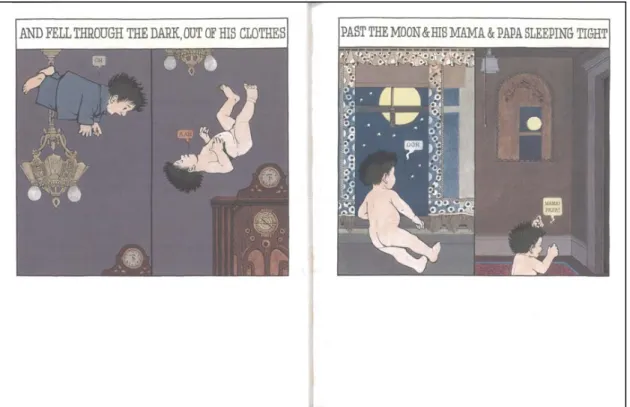
Figure 1. Mickey fell through the dark. ... 33
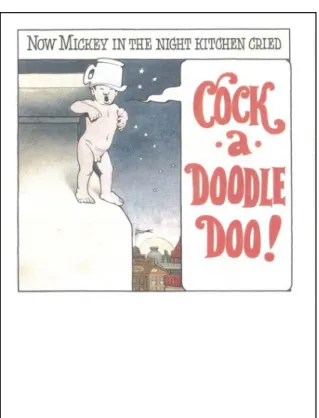
Figure 2. Mickey stood on a milk bottle and shouted. ... 34
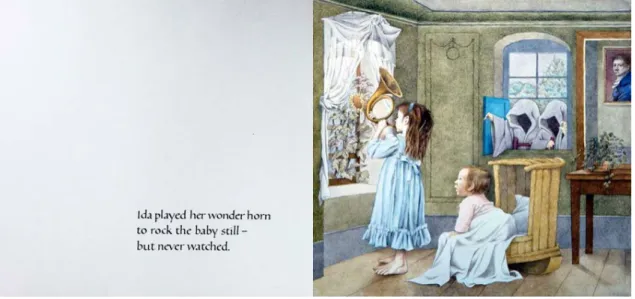
Figure 3. Ida played the horn while the goblins sneaked in. ... 35
Figure 4. The word-picture relationship model applied in the present research. ... 42
Figure 5. On this page-opening, the picture and the two columns of words together are regarded as one unit of analysis. ... 45
Figure 6. The two panels only account for one unit of analysis. ... 46
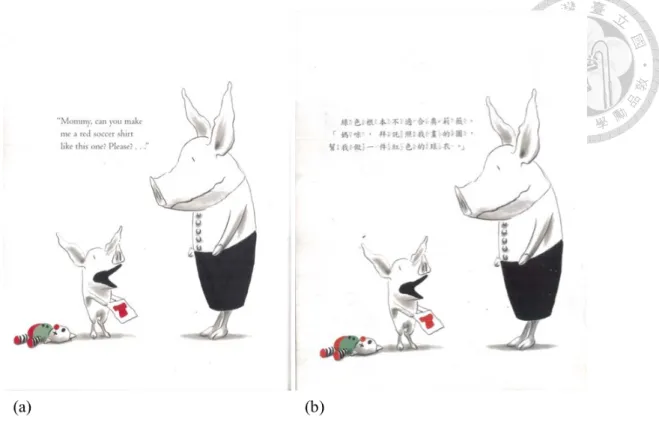
Figure 7. Olivia asked her mother to make a red shirt like what she drew; (a): English source text, and (b): Chinese target text. ... 58
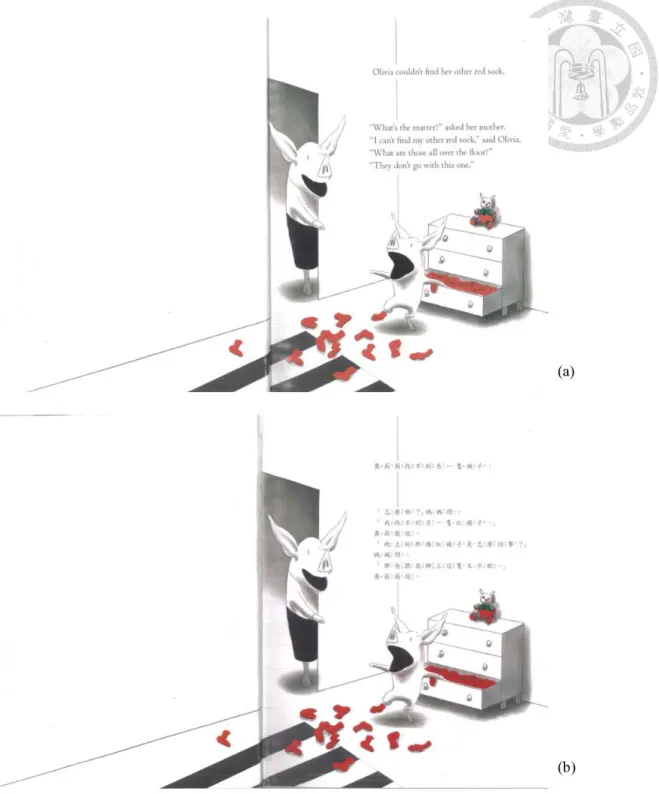
Figure 8. Olivia tried to find her the other sock; (a): English source text, and (b): Chinese target text. ... 60
Figure 9. Bear met Witch and was drawing something for her; (a): English source text, and (b): Chinese target text. ... 62
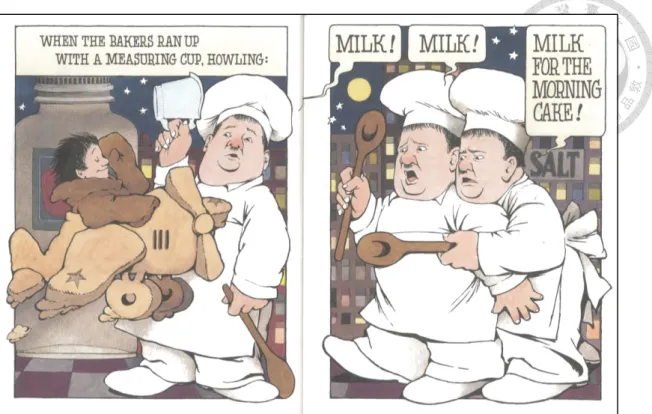
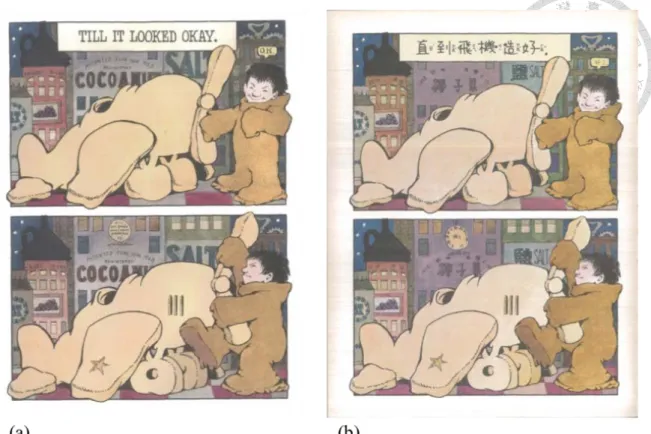
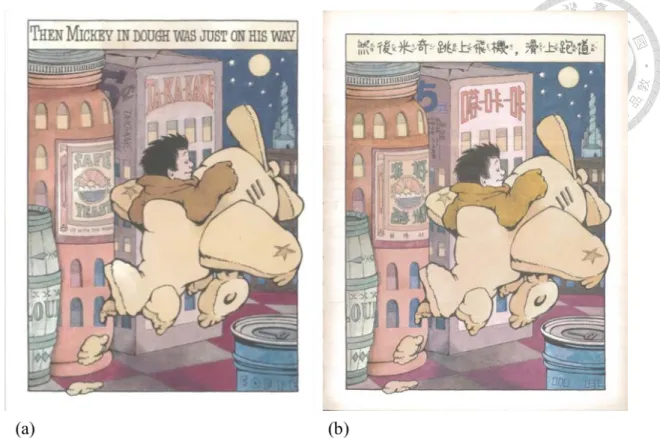
Figure 10. Mickey made plane out of dough and took off; (a): English source text, and (b): Chinese target text. ... 64
Figure 11. Mickey made a dough plane and took off; (a): English source text, and (b): Chinese target text. ... 67
Figure 12. After Grandmother received the painting from Little Bear, she kissed Hen; (a): English source text, and (b): Chinese target text. ... 68
Figure 13. Little Bear drew a painting and asked Hen to give the painting to Grandmother. ... 70
Figure 14. On page 14, Bear stood on the ladder and drew a saw; (a): English source text, and (b): Chinese target text. ... 72
Figure 15. On page 13, Bear was drawing a ladder. ... 73 Figure 16. Olivia takes a sun bath; (a): English source text, and (b): Chinese target text.
... 75 Figure 17. Olivia played a warthog in the Halloween party; (a): English source text, and (b): Chinese target text. ... 77 Figure 18. On page 13, the hunter pointed a gun at Bear. ... 79 Figure 19. Bear drew something at the hunter’s gun; (a): English source text, and (b):
Chinese target text. ... 79 Figure 20. Little Bear fished; (a): English source text, and (b): Chinese target text. ... 82 Figure 21. Father Bear was reading; (a): English source text, and (b): Chinese target text. ... 85 Figure 22. Max found his upper on the table; (a): English source text, and (b): Chinese target text. ... 87 Figure 23. Bear drew a pair of roller skates and ran after the van; (a): English source text, and (b): Chinese target text. ... 89 Figure 24. Bear drew a saw; (a): English source text, and (b): Chinese target text. ... 91 Figure 25. All the animals left the shed except Sheep; (a): English source text, and (b):
Chinese target text. ... 93 Figure 26. Olivia heads home; (a): English source text, and (b): Chinese target text. ... 95 Figure 27. Harry played where workers were fixing the street; (a): English source text, and (b): Chinese target text. ... 97 Figure 28. Harry played at the railroad; (a): English source text, and (b): Chinese target text. ... 98 Figure 29. Harry slid down a coal chute; (a): English source text, and (b): Chinese target text. ... 99
Figure 30. Bear was drawing something for Lion; (a): English source text, and (b):
Chinese target text. ... 104
Figure 31. Lion was wearing a crown drawn by Bear. ... 105
Figure 32. Olivia and her mother have a good-night conversation. ... 107
Figure 33. Olivia jumped on the bed. ... 108
Figure 34. On page 13, Bear was drawing a ladder; (a): English source text, and (b): Chinese target text. ... 110
Figure 35. On page 14, Bear stood on the ladder and drew a saw. ... 110
Figure 36. Mickey jumped into a lump of dough; (a): English source text, and (b): Chinese target text. ... 112
Figure 37. From page 14 to 16, Mickey made a plane out of the dough and took off.. 113
List of Tables
Table 1. The five series of picture storybooks analyzed in the research. ... 47
Chapter 1. Introduction
This chapter gives a general introduction of the thesis. Accordingly, this chapter presents the research motives and the research questions, briefly provides a framework of how the research will be conducted, and summarizes the analyses,
findings, and argument of the research. Finally, the structure of the thesis is presented in the last section.
1.1. Motives
Over 90% of the picture storybooks published in Taiwan in recent years have been translated texts. According to the Dandelion Reading Promotion Foundation (2015), only 82 pictures storybooks published in 2015 were by Taiwan illustrators and writers. Of these 82 works, eight were republications. 82 is the highest annual number of such publications since 2011. However, this number of publications still occupies less than 10% of all the published picture storybooks; in other words, 90% of picture storybooks are translations. With so many translated picture storybooks on the market, young readers – and the typical reader of a picture storybook is young – are likely to read translated picture storybook. The quality of the translation might well have an impact on them. Therefore, the translation of picture storybooks deserves attention.
The translation of picture storybooks does not only deal with words; the pictures should be carefully considered as well. Since picture storybooks tell stories through the collaboration between pictures and words, this verbal-visual interplay makes the translation process more complex (O’Sullivan, 1998). Translating a picture storybook is translating the totality created by the pictures and the words, although the pictures
remain unchanged in the translation (Oittinen, 2003). Therefore, how a translator understands and deals with the verbal-visual interaction in a picture storybook greatly influences the quality of the translation, and the reader’s understanding and
interpretation of the translated picture storybook.
Moreover, since pictures do not change in translated picture storybooks, people might think that the word-picture relationship in the translation remains the same as in the source text (Oittinen, 2003). However, researchers, for example, O’Sullivan (1998), Oittinen (2003), Rankin (2006), and Van Meerbergen (2009), who have conducted case studies of picture storybooks originally written in European languages and translated into English or vice versa, or other combinations of European languages, have found that the word-picture relationship does change in translated picture
storybooks. Compared with the research mentioned above, the study of the word- picture dynamics in picture storybooks translated into Chinese in Taiwan is sparse at best and deserves more attention.
In Taiwan, research on picture storybooks translated into Chinese mainly concerns the translation of “text” in a traditional sense – namely, printed words, and focuses on analyzing translation strategy, stylistic differences in different translation versions, cultural issues and so forth (Lin, 2008; Ho, 2009; Lin, 2010; Chai, 2015).
Scholars have examined the word-picture relationship, but have concentrated narrowly on whether the information in the translated text matches what is shown in the pictures (Lu, 2000; Chen, 2003; Ku, 2008; Liu, 2012). There are few studies concern the change in the word-picture relationship in Chinese translation of picture storybooks in Taiwan ( Yang, 2008; Yang & Yang, 2011), but how those studies were conducted and how their conclusions were drawn leave much to be desired. In a word, word-picture relationship in Chinese translated picture storybook is a particular area of research that
remains relatively uninvestigated and has ample avenues for research. The present thesis is therefore conceived to further investigate the word-picture relationship in picture storybooks translated from English to Chinese, and endeavors to uncover further insights into the Chinese translation of picture storybooks and understanding of the word-picture relationship in picture storybooks, and to bring the issue to academic attention and inspire more research on this area.
1.2. Research Questions, Method and General Findings and Analysis The research addresses the following three research questions:
(1) How does the translation change the word-picture relationship?
(2) What are the effects caused by the change in the word-picture relationship?
(3) What are the possible reasons for the translators to translate the verbal text in these ways that cause the change in the word-picture relationship?
To answer these questions, the thesis conducted a comparative and textual analysis of the Chinese translations of five award-winning and popular picture storybook series and their original English texts that remain popular to date. They include: Maurice Sendak’s trilogy, Where the Wild Things Are, In the Night Kitchen, and Outside Over There; Harry the Dog series written by Gene Zion and illustrated by Margaret Bloy Graham, Harry the Dirty Dog, Harry by the Sea, and No Roses for Harry, Little Bear series written by Else Holmelund Minarik and illustrated by Maurice Sendak, containing Little Bear, Father Bear Comes Home, Little Bear's Friend, Little Bear's Visit, and A Kiss for Little Bear, Anthony Browne’s White Bear with a Magic Pencil series, Bear Hunt, Bear Goes to Town, The Little Bear Book, and A Bear-y Tale, and Ian Falconer’s Olivia the Pig series, Olivia, Olivia Saves the Circus, Olivia...and the Missing Toy, Olivia Forms a Band, and Olivia and the Fairy Princesses.
The research reviewed existing taxonomies of word-picture relationships for picture storybooks, identified their strengths and weaknesses, and utilized their strengths in terms of how they name and describe various word-picture interplay, to examine the word-picture interaction in the five picture storybooks series. Secondly, the research documented the changes in the verbal-visual relationship detected in the Chinese translations of picture storybooks, and observed the features of each change.
Changes with similar features were categorized into different groups, and were analyzed in terms of possible causes and effects. The research found that the verbal-visual relationship changes when translators make visual information explicit in the translation, and the translation approach is described as explicitation. Moreover, explicitation in the verbal translation is found when the word-picture relationships in the corresponding source texts are: (1) pictures clarifying words and (2) pictures elaborating words. The notion of clarifying and elaborating relationship are adopted from existing classifications of the word-picture relationship with slight revision, which will be explained in more detail in the chapter of literature review and methodology. Besides, the research also found that visual information shown later in the source text is moved forward to the previous page and presented earlier in the verbal translation.
As for possible causes of explicitation, the thesis provided an integrated explanation by discussing and commenting on possible explanations proposed by previous scholars, including the assumptions about children and explicitation as a translation universal, and by offering a possible explanation from a historical
perspective. Until the early 21st century, picture storybooks were still a new type of book in Taiwan’s publishing industry, so the notion that words and pictures collaborate to tell a story was new or even unfamiliar to the industry. Since most of the five picture storybooks series examined in the thesis were translated and first published from
the 1980s to the 2000s, it might be possible that translators then were unfamiliar with the unique characteristic of picture storybooks as well and were not fully aware of the complex verbal-visual interplay in the translating process, and thus focused rather on whether the translated words are articulate and fluent. The thesis suggests that it is better to keep the word-picture relationship in target text the same as in the source text because by doing so, the importance of visual text and the uniqueness of word-picture interplay in picture storybooks might become more obvious for readers who can only access Chinese translation of picture storybooks.
1.3. Thesis Structure
This thesis contains five chapters: Introduction, Literature Review, Methodology, Results & Discussion, and Conclusion. The following chapter is dedicated to presenting and analyzing the existing literature directly related to the present research, and the methodology chapter elaborates on the analytical method utilized in this research, with a focus on textual and comparative techniques. The fourth chapter, Results & Discussion, presents the research findings together with analysis after the word-picture relationships in the original English texts and in the Chinese translated texts were compared. In the final chapter, the results in the previous section are summarized and concluded based on the research questions described in Section 1.2, and the limitations encountered in this research and suggestions for future research are reviewed and discussed.
Chapter 2. Literature Review
This chapter presents the literature found to have a direct bearing on the present research. It addresses the following issues. First, the term ‘picture storybook’ is defined. Second, textual features of picture storybooks pertinent to the translation of picture storybooks and the present study are reviewed. Third, the general principles of translating picture storybooks are covered. Fourth, the word-picture relationship in picture storybooks is introduced separately, since it is the unique feature of picture storybooks and the focus of the thesis, and it will take up a great proportion when reviewed. Fifth, case studies of the word-picture relationship in the translation of picture storybooks are discussed and commented on.
2.1. Defining Picture Storybooks
The present research focuses on the translations of five popular picture
storybooks series. “Picture storybook” is the term used in this thesis. No other terms such as “picture book,” or “illustrated book” are used interchangeably to refer to the translation texts under study (as in Nikolajeva, 2003). The definition of these terms is crucially related to the selection of the translation texts examined in the present research and consistency of usage; therefore, it is necessary to distinguish “picture storybooks”
from “picture books” and “illustrated books” in the first place. This section will first discuss picture storybooks and picture books, and then compare picture storybooks and illustrated books.
In order to proceed with the definition of picture storybooks, it is necessary to clarify what picture books are and what the relation between picture books and picture storybooks is. The definition of picture books, and the relation between picture books
and picture storybooks vary among scholars. According to Lin (2004), scholars look at the relation between picture books and picture storybooks in three main ways. First of all, “picture book” is a general term for a type of book that includes picture
storybooks. Secondly, picture books and picture storybooks are two different types of books. Thirdly, picture books are picture storybooks, which means the two terms refer to the same thing. These three kinds of relation define picture books and picture storybooks differently to some degree. In the following paragraphs in this section, the three kinds of relation and their definitions of picture books and picture storybooks will be explained respectively. The term the present research chooses and the reason for selection will be stated as well.
In terms of the first kind of relation between picture storybooks and picture books, several scholars such as Burke (1990), Kiefer (1995), Sutherland (1997), and Norton (2007), define picture books as books that communicate information through visual and verbal narratives. In picture books, the visual and verbal narratives join to form a unique whole. The visual narratives, namely pictures, are just as, if not more important than, the verbal narrative, namely written words. Sometimes, a picture book may comprise pictures with few words or no words at all. Picture books therefore cover a wide variety of subgenres, such as alphabet books, concept books, toy books, nursery rhymes, counting books, and picture storybooks, the text type examined in the present study. Picture storybooks are a subgenre of picture books, and uses words and pictures to tell a story. This means that words and pictures both bear the burden of narration and thus they are equally important in forming the narrative of a picture storybook. When reading a picture storybook, readers cannot grasp the whole story with text or pictures alone (Chen, 2003; Huck et al., 2007; Norton, 2007). In other
words, the reader has to take both the illustrations and text into account when reading a picture storybook.
In addition to the scholars who consider “picture book” a general term that includes picture storybooks, several other scholars regard picture books and picture storybooks two separate types. Scholars such as Stewig (1995) and Silvey (2002) separate picture storybooks from picture books. In their view, picture books only include concept books, alphabet books, and counting books. The verbal and visual texts in those books do not necessarily have a story line. By contrast, picture storybooks tell stories through pictures and words. From this perspective, the definition of picture storybooks is similar to the previous one. The difference is that picture books and picture storybooks are at the same level in the classification.
As for the third kind of perspective on the relation between picture storybooks and picture books, several scholars, such as Cianciolo (1973), Nodelman (1988), Hunt (1991), Nikolajeva and Scott (2001), Lewis (2001), regard picture books as picture storybooks. They use “picture books” to refer to the subjects they discuss, and emphasize the characteristic of the subjects that words and pictures cooperate to tell a story together. They do not differentiate picture books from picture storybooks, and the starting point of their discussion is the premise that picture books are books telling stories through words and pictures together. Apparently, what they study are picture storybooks if we view from the previous two perspectives.
The present thesis adopts the first kind of perspective to define picture books and picture storybooks, and to clarify the relation between the two. That is, “picture book” is a more general term, while “picture storybooks” fall into one of the subgenres of picture books. Not using the term “picture book” is to avoid giving the impression that counting books, alphabet books, concept books and other books containing pictures
and words but lacking a story line are included in the study. Moreover, picture
storybook is more precise. By using the term “picture storybook” with the word story embedded, the present thesis pays much attention to how the change in the word-picture relationship influences the storytelling of a picture storybook. The texts examined in the present thesis are picture storybooks, which the verbal and the visual both bear the burden of narration and tell stories together. This feature distinguishes a picture storybook from an illustrated book. The illustrations in an illustrated book are only used to depict a scene in the story instead of proceeding the storyline (Stewig, 1995;
Huck et al., 2007). Also, an illustrated book has much longer text in relation to the pictures. In an illustrated book, not all the scenes are portrayed in the pictures, and most of the text is not accompanied with corresponding pictures (Northrup, 2012).
2.2. Features of Picture Storybooks
This section points out certain features of picture storybooks related to this research, including the physical format, the use of language, the orality of picture storybooks, and the traits of picture storybook narrative. The word-picture dynamics will be introduced separately in Section 2.4, since it is the unique feature of picture storybooks and the focus of the thesis, and it will take up a great proportion when reviewed.
In terms of physical format, according to Northrup (2012), a picture storybook is a short book, with a small number of pages and a few words or pictures on each page.
A picture storybook usually contains around 32 pages, though it can be longer or shorter. With this small number of pages and so few words to tell a story, every picture and word in a picture storybook count. Since every word in a picture
storybook matters a lot, its author has to select every word carefully. In terms of the
language use of picture storybooks, rhythm is very much emphasized. Rhythm can catch the attention of children, who are usually regarded as the target reader of picture storybooks, and drum up their interest (Chen, 2003; Norton, 2007). To create rhythm, authors of picture storybooks frequently rhyme the words, and repeat single words or phrases to create stronger effects and impressions. Besides rhythm, authors also use words that contribute to vivid images to attract children (Wu, 1965; Oittinen, 2000;
Chen, 2003; Huck et al., 2007; Norton, 2007). In addition to rhythm and vivid description, the language in picture storybooks is rather easy to read by children, and should avoid complicated sentences or difficult words, because it is commonly assumed that the linguistic ability of children is not mature and is still developing (Wu, 1965;
Chen, 2003; Hu, 2003).
The use of language mentioned above is closely related to the orality of picture storybooks. Oittinen (2000) points out that preliterate children listen to adults’ reading of picture storybooks, as their listening comprehension develops earlier than their reading comprehension. Since picture storybooks are frequently read to children rather than read by them, the language used in picture storybooks should be easy to speak aloud (Oittinen, 2000; Chen, 2003; Huck et al., 2007; Norton 2007; Alvstad, 2010).
Therefore, rhythm, rhyme, repetition, and vivid description are ways to achieve a better read-aloud effect.
Besides the physical format, the use of language, the orality of picture
storybooks, the traits of picture storybook narrative are crucially important when picture storybooks are analyzed. The traits of picture storybook narrative taken into
consideration in the present thesis includes the sequential nature, and ‘page turn.’
Firstly, picture storybooks are a kind of sequential art, which arranges pictures and words to tell a story or express and idea ( Kelley, 2010, p. 3). Nikolajeva (2010)
regards the sequential nature as the essential code in reading a picture storybook. She argues that if we examine each picture separately without regarding all the pictures and words as a unified artistic whole, the overall understanding of the picture storybook is diminished (Nikolajeva, 2010, p.29). Individual pictures should not be taken out of the context and should be considered with their relationship with the narrative text.
Another important trait of narrative progression of picture storybooks is the page turn, or page breaks. A picture storybook “is arranged carefully as a series of facing pages,” which are also called double-spreads or page-openings, and the narrative of the picture storybook is meticulously “broken into a series of these facing pages” (Sipe &
Brightman, 2009, p.73). Unlike the page turn in most of other books which is arbitrary and meaningless (Steiner, 1985, p.142), page breaks in picture storybooks are carefully and artfully designed, and thus possess “a complex semiotic significance” (Sipe, 2001, p.38). Page breaks function as a storytelling devise that can signify the change in perspective, psychological states, or emotions of characters, or create suspense and drama; it can also represent gaps in the narrative that require readers to bridge and thus
“redirect our feelings or attention” (Sipe, 2001, p.38). In sum, since it is necessary to take the narrative progression into consideration when we examine the word-picture relationship in a picture storybook, the sequential nature and the page turn of picture storybook cannot be ignored.
2.3. Translating Picture Storybooks: General Principles
Scholars point out that the translation of picture storybooks is closely related to the features of picture storybooks mentioned in the previous section. The translator should pay attention to the sound (Oittinen, 2000; Chen, 2003), taking the read-aloud situation into account and “make the translation roll on the aloud-reader’s tongue”
(Oittinen, 2008, p. 76). That is, the translator should try to create rhythm in the
translation through various literary devices such as rhyme and repetition. Furthermore, the translator has to carefully handle the interaction between pictures and words,
because the two works in joint efforts to contribute to a complete story, and should make sure that the words correspond to the pictures (Oittinen, 2000; Chen, 2003).
Additionally, the translator should use vivid description to attract children, and select simple words when translating, so that the children can understand without difficulties (Chen, 2003). Besides these features, since picture storybooks are often regarded as part of the children’s literature, some general principles of translating children’s literary apply to picture storybooks. Many scholars (Wu, 1965; Shavit, 1986; Oittinen, 2000;
Chen, 2003; Hu, 2003; Alvstad, 2010) argue that the translator should consider children’s feelings and experiences when translating. All these principles reviewed above will be included in the analysis on the translation texts in the present study.
2.4. Examining the Word-picture Relationship in Picture Storybooks
Besides the physical format, the use of language, the orality of picture storybooks, and the traits of picture storybook narrative covered in Section 2.2, the word-picture interplay is another important feature of picture storybooks, and many scholars and picture storybook artists have made an attempt to examine this feature.
Some scholars and picture storybook artists draw metaphors and analogies to view the relationship between words and pictures. Metaphors from music are borrowed to express the word-picture relationship, such as rhythmic syncopation, antiphonal, fugue, counterpoint, and duet (Sipe, 1998). In addition, analogies from other arts like drama and film, textiles metaphors, and analogies from science and technology are drawn to refer to the word-picture relationship (Lewis, 2001; Sipe, 2012). For example, Lewis
(2001) borrows the concept of ecology from biology to views word-picture relationship, which will be elaborated in Section 2.4.2 since his ecological perspective helps
construct the research framework in the present study. Overall, these metaphors and analogies all contribute to express the interdependence and cooperation between words and pictures in picture storybooks. However, Sipe reminds us that “the nature of metaphorical thinking is analogical,” and the thinking inevitably ignores “the many ways in which the metaphor is not at all like the phenomenon we are trying to describe”
(2012, p. 9).
There is another way to discuss on the word-picture relationship, through theoretical constructs (Sipe, 2012, p. 9-12). For example, Kümmerling-Meibauer (1999) use the concept of irony to partially explain the word-picture relationship. She defines irony as “a contrast between a spoken meaning and an implied, unspoken meaning” (p. 160), and argues that the visual might supply important information missing from the verbal, or the two media contrast each other in artistic style or provide different perspectives. Another example of theoretical construct is Nodelman’s (1988) idea of limiting. The visual limits the meaning of the verbal by depicting one possible image out of various other images that might be formed in our mind. Meanwhile, the verbal limits the meaning of visual as well by informing readers of what is important or worthy of attention in the pictures, and providing interpretation of the pictures. Sipe comments that such theoretical constructs as irony enable us to describe the word- picture relationship in a more precise way, compared with the first perspective.
However, the constructs mentioned above only provide one “generalized description”
(Sipe, 2012, p. 12), but do not consider the diverse ways words and pictures can interact with each other. To differentiate and describe the diverse word-picture interactions, several classifications of word-picture relationships are proposed by scholars.
Typologies of word-picture relationships are essential to the present thesis, and thus discussed separately in a more detailed manner in the next section.
2.4.1. Classifications of word-picture relationships
This section reviews three major classifications of word-picture relationships in picture storybooks (Schwarcz, 1982; Golden, 1990; Nikolajeva & Scott, 2000 and 2001) pertinent to the present research, and their strengths and weaknesses are assessed.
Schwarcz’s typology (1982).
Schwarcz (1982) might be the first scholar to establish an organized classification of word-picture relationships in picture storybooks. His typology concerns the functions of illustrations when they relate to the words in picture
storybooks. There are two main categories in his typology: congruency and deviation.
Congruency means that pictures double or parallel the information presented in the verbal text. However, he points out that there is never absolute and complete redundancy in the information shown by the two media, since the essence of the two is different. The picture unavoidably simplifies or elaborates the word. For example, the verbal text reads “Yesterday the girl drew a white fence” (p. 14), while the
accompanying illustration depicts the activity. The illustration inevitably omits
“yesterday,” and elaborates the details of the girl’s appearance. This omission is termed “reduction.” Under the category of congruency, there are subdivisions including reduction, elaboration, and alternate progress. Reduction refers to pictures cutting out information in words, while elaboration indicates that illustrations amplify, extend, or complement the meaning of words. As for alternate progress, the verbal and the visual take turns proceeding the story, with parts of the story shown by either of the two, but basically, the two media tell the same story.
Opposite to congruency, deviation is another category proposed by Schwarcz, which refers to the visual veering away from the verbal. Under the category of deviation, subdivisions include opposition / alienation and counterpoint. Opposition / alienation refers to the visual text deviating from the verbal text and contracting it. He gives an example: a song praises the hunter’s joys in words while the corresponding picture depicts a terrified hunter chased by a boar. When opposition/alienation goes further, the verbal-visual relationship becomes counterpoint. That is, pictures and words tell two completely separate stories. Schwarcz considers Pat Hutchins’ Rosie’s Walk a perfect example. The verbal text tells a story, in a peaceful and uneventful way, about Rosie the hen innocently taking a stroll across the yard. However, the visual text simultaneously presents another storyline, depicting a fox indefatigably trying to catch Rosie but failing over and over again. In Schwarcz’s view, the pictures and the words are telling two completely different stories.
Sipe (2012) comments that Schwarcz makes use of the musical metaphor counterpoint. He cites the definition of counterpoint from The American Heritage Dictionary: “The technique of combining two or more melodic lines in such a way that they establish a harmonic relationship while retaining their linear individuality,” and points out that Schwarcz focuses on the “linear individuality” of words and pictures since Schwarcz emphasizes that the two media tell two separate stories. However, Sipe argues that using Rosie’s Walk as an example of counterpoint inevitably proves the definition of counterpoint to be “slippery” (p. 4). If we follow Schwarcz’s
interpretation, the words and the pictures two separate stories; however, it is also sensible to think that the two media tell the same story but from two different
perspectives. Therefore, he argues that the use of counterpoint in typology should be explicated.
Golden’s typology (1990).
Unlike the structure of the previous classification, Golden (1990) advances and exemplifies fives types of word-picture relationships: (1) Text and Picture are
Symmetrical; (2) Text Depends on Picture for Clarification; (3) Illustration Enhances, Elaborates Text; (4) Text Carries Primary Narrative, Illustration is Selective; and (5) Illustration Carries Primary Narrative, Text is Selective (p. 105-19). The text in her typology refers to printed words. In the following two paragraphs, each type is reviewed.
Golden’s type (1) indicates that pictures “provide redundant information”
(p.105) to words, and convey what the words conveys. In other words, the reader can understand the narrative in the words, and the pictures function to reinforce the meaning of the narrative. In this type, words and pictures both provide the principal
information of the story. The information streams are similar, but Golden states that
“there is a never one-to-one correspondence” (p. 107), which is the same argument proposed by Schwarcz (1982). The second type “Text Depends on Picture for
Clarification” means that it is necessary to read the picture to understand the verbal text.
One of the examples she selects to exemplify the type is Era Jack Keats’ The Snowy Day. The verbal text reads “he made angels,” and the reader needs to see the picture to know that the character lies in the snow and moves his arms up and down and his legs from side to side to form a shape of an angel. In this type of relationship, pictures help to clarify words and readers can hardly understand the words without the pictures (p.
108).
As for Type (3), the essential narrative is presented in the verbal text, while the visual text extends and elaborates the verbal by depicting further details. That is, pictures provide connotations for the verbal text or a concrete representation of an
abstract concept. In the fourth type, the verbal text conveys the primary narrative elements while the visual text reflects one event or detail mentioned in the verbal. The last type is the opposite to the fourth type: the visual text, rather than the verbal text, carries the main narrative flow and tells the story (Golden, 1990, p. 105-19).
Sipe (2012) considers Golden’s typology problematic. He points out that the scheme is based merely on “the relative amounts of power” words and pictures have, and seems to ignore the interaction between the verbal and the visual. Moreover, he thinks that the categories in the typology are too easily confused. For example, since Golden states that there is no true redundancy between words and pictures, then there is no difference between type (3), pictures enhancing or elaborating words, and type (1), pictures and words being symmetrical. We cannot distinguish type (2), pictures clarifying words, from type (3), pictures enhancing or elaborating words, either.
Lewis (2001), too, is critical of Golden. He claims type (5), pictures carrying primary narrative, is untrue because the pictures as part of a picture storybook possess meaning only because they are informed by the words. In addition, he also opposes the use of term “symmetry” and the term’s indication. He claims that symmetrical relationship is illusory, since it is the words that direct the reader to focus on certain parts of the pictures. Furthermore, using symmetry to describe the word-picture relationship inevitably sidesteps the interaction between the two media, because if words and pictures tell the same thing, there is no interaction.
Apart from these criticisms, Lewis, opposite to Sipe, considers Golden’s scheme helpful in terms of type (2), pictures clarifying words, since it points out that the words alone sometimes are insufficient to develop the narrative (Lewis, 2001). The author of the present thesis thinks that Sipe actually fails to get the point of type (2). The central idea of type (2), clarification, is that without looking at the pictures, the reader may not
understand the verbal narrative; or important information is only presented in the visual text such that the reader has to combine it with the verbal text to complete the meaning.
The author of the present thesis would like to complement Sipe’s comment on Golden’s typology being merely about “the relative amounts of power” words and pictures have: the categories are not constructed on a same basis. The rationale of Golden’s type (1) to (3) is describing how words and pictures interact, so there are symmetrical, clarifying and elaborating relationships. However, the rationale of type (4) and (5) shifts into the relative amount of power the two media have. Since the two sets are constructed on different bases, a verbal-visual unit in a picture storybook may belong to two types at the same time. Take Chris Van Allsburg’s Jumanji (1981) for example. After the story commences, each page-opening contains words on the verso page with one picture on the recto page. Each page-opening fits the definition of Golden’s type (4): the words carry the primary narrative, while the picture depicts a certain scene in the verbal text, and the verbal text makes sense on its own. However, if we examine each picture with its corresponding sentences that are part of the words, it is obvious that pictures elaborate more details of the scene mentioned in the verbal text.
As Golden elaborates her typology, she alerts us to a very important point. She states that, as we examine picture storybooks with her typology, a given picture
storybook may reflect more than one type of relationship. According to Lewis (2001), what this suggests is that if we use the typology to examine individual books, the unit of analysis is too large. The categories proposed by Golden, Schwarcz and other scholars are not helpful for characterizing individual books, but more useful to describe the word-picture relationships within a given picture storybook (Lewis, 2001).
Nikolajeva & Scott’s typology (2000, 2001).
Besides the taxonomies of Schwarcz and Golden, the last classification reviewed is created by Nikolajeva & Scott (2000, 2001). Different from previous scholars, they
“wisely discuss their typology as a continuum of word-picture relationships, and emphasize that some of the categories may blur or slide into each other” (Sipe, 2012, p.
17). They identify several characteristic verbal-visual dynamics in narrative picture books, that is, picture storybooks. Their main categories include symmetry,
enhancement, complement, counterpoint and contradiction.
When the verbal-visual interaction is considered symmetrical, words and pictures tell the same story and repeat information in different forms. As for
enhancing interaction, the verbal expands the visual or vice versa. They support each other by offering additional information that the other lacks. Within enhancement, there are minimal enhancement and significant enhancement. The latter is also called complement. In minimal enhancement, little difference can be found between words and pictures. By contrast, in significant enhancement, what words and pictures present rarely overlap, but the part of information each text carries will enlarge upon the
information the other text bears. They are intertwined and work together to affect the overall meaning. Nikolajeva and Scott consider the opening double-spread in Beatrix Potter’s The Tale of Peter Rabbits a good example of complementary interaction. The verbal text presents basic information about the Potter’s family, their names and where they live, while the visual text shows Potter’s relationship with his family, which is not mentioned in the verbal text.
As for counterpointing dynamics, words and pictures provide alternative information, and convey meanings beyond the scope of each other. There are ironic counterpoint, perspectival counterpoint, and counterpoint in characterization. The reader has to make efforts to establish the connection between words and pictures.
The last category is contradiction, the extreme form of counterpoint. The verbal and the visual seem to tell completely different things.
Lewis (2001) and Sipe (2012) also comment on the classification proposed by Nikolajeva and Scott. As for the weaknesses of the typology, Lewis criticizes the word choice of “symmetry” in Nikolajeva and Scott’s typology as in Golden’s, since symmetry means there is no interaction between words and pictures. The diction and its definition contradict the premise that the two media affect each other. Besides the diction of symmetry, Sipe questions the distinction between the relationship of
complement and enhancement. As for the strength of the typology, Lewis and Sipe both think that the typology explores how the word-picture relationship interacts with narrative features like character, point of view and setting.
Overall assessment on the typologies of word-picture relationships.
The three typologies reviewed above clearly reflect how diverse the word- picture interplay in picture storybooks can be. The strengths and weaknesses of each type were discussed respectively in the previous three sections, so this section focuses on the overall assessment of the typologies. As a whole, some word-picture
relationships identified by each typology are similar or the same in essence with terminological variation only, such as symmetry / congruency, elaboration /
enhancement / extension / complement / amplification, and contradiction / counterpoint / opposition / deviation. The major difference among each typology is the way each typology is structured.
Furthermore, within one typology, the difference between similar word-picture relationships is ambiguous and only lies in varying degrees. Take opposition and counterpoint in Schwarcz’s classification for example. Schwarcz only differentiates them according to the relative degrees to which words and pictures veer away from each
other. That is, when opposition gets to a certain point, it becomes counterpoint. The difference between enhancement and complement in Nikolajeva and Scott’s is exactly the same: when enhancement is significant, the word-picture relationship becomes complementary. The vague difference between similar word-picture relationships makes these typologies less useful when they are applied to examine picture storybooks.
Moreover, all typologies propose the relationship “symmetry”: Schwarcz uses congruency to indicate that pictures tell the same things as words; Golden and
Nikolajeva and Scott directly use symmetrical to describe a category in their
classifications. However, as Scharwcz and Golden both mentioned that there is no true redundancy or repetition between words and pictures, symmetrical relationship actually does not exist in reality. The pictures inevitably omit some information conveyed through the words, and vice versa, since words and pictures are totally different forms of media. Therefore, if we consider a word-picture relationship as symmetrical, the relationship is in fact close to symmetrical, and will never be symmetrical.
Due to the vague difference between similar word-picture relationships, and no true symmetry in word-picture relationship, these typologies are less helpful in terms of applying to analyze picture storybook texts. Based on the existing typologies, the present research therefore developed a refined word-picture relationship model that is more applicable for examining the five picture storybook series. The model will be explained in the Methodology chapter, Section 3.2.
2.4.2. Examining Word-Picture Relationships from an Ecological Perspective Apart from the scholars in the previous section who attempt to categorize the word-picture relationship, Lewis (2001) refuses to classify picture storybooks. He thinks that picture storybooks are too flexible and complex to categorize. Instead of
establishing categories, he applies the concept of ecology to examine picture
storybooks. He argues that each picture storybook possesses an internal ecology. In claiming so, he highlights the interdependence of words and pictures. That is, the words are brought to life in the environment of the images; on the other hand, the images live and thrive within the environment of the words.
Furthermore, he emphasizes that from an ecological perspective, we are able to recognize the flexibility and complexity in picture storybooks. Flexibility means that the word-picture relationship varies and does not stay the same from page to page, and from book to book. Complexity means that words and pictures can be presented in a formally complex way that is difficult to categorize. In Lewis’ view, only by
acknowledging the fact that the ecosystem of picture storybooks is complex and flexible can we appreciate the heterogeneity in picture storybooks.
As a whole, Lewis contends that, since picture storybooks are flexible and complex, it is better to scrutinize picture storybooks via what he calls a
“phenomenological approach” (p. 59). That is, he proposes that we should “patiently and carefully [describe] individual examples” (p. 59). His notion is important when we have to explore the potentials of picture storybooks in a sensitive way. The ecological perspective, serving as a reminder, is helpful as well when we analyze a certain picture storybook in detail to discover the uniqueness of the work.
However, the ecological view can only serve as a reminder. Although the approach recognizes that words and pictures interact with each other in various ways, the perspective does not differentiate these ways (Sipe, 2012). His perspective complements rather than conflicts with word-picture typology. Lewis’ ecological perspective requires us to treat each picture storybook as unique entity, and look into each of them in detail. On the contrary, typology can systematically describe and
differentiate various word-picture interactions. When we examine many picture storybooks at the same time, typology helps us to find patterns and trends among them.
Therefore, the point is how we use the typology. The present research combines
typology with Lewis’ ecological perspective to analyze the five picture storybook series.
Lewis’ ecological perspective which examines each example of word-picture interplay in detail is first applied to scrutinize the translations and their original texts, and then the terminology and definition proposed by typologies are refined and utilized to describe how words and pictures interact with each other. Finally, similarities and patterns are sorted out, grouped together and explained with selected examples.
2.5. Case Studies of the Word-picture Interplay in the Translation of Picture Storybooks
Section 2.3 briefly reviewed the principles of translating picture storybooks, and Section 2.4 presented various ways proposed by scholars to examine the word-picture interplay in picture storybooks. This section focuses on the case studies that are closely related to the present thesis. The case studies all concerns the word-picture relationship in the translation of specific picture storybooks. Rather than providing an overall summary at the beginning, the author will proceed case study by case study, with discussion. Case studies of picture storybooks in European languages and English will be presented first, and followed by case studies of English picture storybooks translated into Chinese.
2.5.1. Case study by O’Sullivan (1998): Papa Vroum and Granpa
O’Sullivan (1998) argues that the verbal-visual interaction in picture storybooks makes the translation process more complex and challenging, and an ideal translation of a genre combining words and pictures should reflect an awareness of the verbal-visual
interaction. She investigated how translation changes the word-picture relationship in two picture storybooks: Michel Gay’s Papa Vroum (French into English) and John Burningham’s Granpa (English into German). In the French source text of Papa Vroum, a present tense narrative, primarily consisting of direct speech and constructed as dialogue, is used to present the viewpoints, feelings, and thoughts of the protagonist, a little boy named Gabriel. Meanwhile, the pictures reveal what really happened from a third person point of view, which are sometimes different from the protagonist’s viewpoint. For example, direct speech in verbal text shows that Gabriel thinks he is driving a van since he feels the vehicle moving, while the picture shows that he is just in the van and is not the agent of the action.
However, in the English target text, the verbal text eliminates the direct speech and substitutes past tense for present tense. The protagonist’s perception and reactions are described from an omniscient point of view rather than indicated in the protagonist’s own words. Since both the point of view and tense are changed, the immediacy the source text creates is reduced and the contrast between the word and the picture no longer exists. Similarly, in the German translation of Granpa, the dialogue in present tense between the grandfather and the granddaughter is altered into text narrated in the past tense. Not only the simultaneity of the conversation in the source text is removed, but the past tense also foreshadows the grandfather’s death that is only disclosed in the final pages of the original text. Moreover, the German translation adds description and thus creates interpretations of some pictures since there is no detailed description of the pictures but the conversation between the two characters in the verbal text of the original version. The gap between the pictures and the words in the source text that allows various interpretations is filled by the German translation.
O’Sullivan suggests that explicating and explaining the pictures in the
translation reflects the translator’s understanding of the reader. In the cases of Papa Vroum and Granpa, the translator obviously does not think that the younger reader of the German version can read between the lines – and the pictures – and decode the complex verbal-visual interplay. Overall, this case study points out that a translator’s understanding of the original text is inevitably influenced by the pictures, and a
translator, whose reading is affected by the pictures, would very likely to make elements explicit in the verbal translation where these elements originally exist in the pictures.
2.5.2. Case study by Oittinen (2003): Where the Wild Things Are
Another case study focusing on the verbal-visual relationship in picture storybooks was conducted by Oittinen (2003). She examined Maurice Sendak’s Where the Wild Things Are in three translations, the German, Swedish and Finnish versions. The “visual text” in Oittinen’s definition refers to all the visual appearance of the book, including typography, the use of punctuation, the design of the book, the sentence length and so forth, how the text looks and not just the illustrations. She focuses on the sentence length of the three translations, and concludes that although the three translations are easy to read aloud, their different sentence lengths bring
rhythmical differences. Furthermore, she points out that adjusting the order of written information from one page to another changes the word-picture relationship. She further claims that translators of picture storybook should be able to read the visual elements in a professional way. Although the study focuses on the visual appearance of the verbal text, particularly the sentence length, not directly on the word-picture interaction, the researcher describes the characteristic of the word-picture relationship as indexical. That is, the pictures refer to the words and vice versa, back and forth, and
she considers this relationship the key to understand a picture storybook and its narration.
2.5.3. Case study by Rankin (2006): Princess Smartypants and Prince Cinders Rankin (2006), a graduate student of University of the Witwatersrand, Johannesburg, conducted a case study of two picture storybooks by Babette Cole:
Princess Smartypants and Prince Cinders. Rankin compared the English source texts and their French translations in terms of: (1) the textual translation, such as the
translation of characters’ names, book title, and wordplay, and (2) the verbal-visual interplay in the translation. The case study shows that many changes of word-picture relationship are found in the translation. Some changes do not alter the effect created by the original English texts, but others create additional irony or humor and sometimes even enhance the read-aloud and rhythmic quality of picture storybooks. Rankin’s case study adopts an eclectic approach to examine the case study subjects, and unlike the previous two case studies, the approach is explicitly considered. Various
theoretical approaches, in the plural, in fact, are used to analyze the text.
Hermeneutics, dialogics, reader-response theory, applications of theatre and film translation, semiotics, and picture theory are consciously applied by Rankin in the research. As for examining the word-picture relationship, the research specifically applies the ecosystem concept proposed by Lewis (2001). The ecosystem perspective requires the researcher to view picture storybooks in a dynamic, complex and flexible structure, and acknowledge the fact that the words provide an environment for the pictures to thrive in a picture storybook and vice versa. The study analyzed the two picture storybooks in detail, and the analysis is comprehensive: the wide range of elements in the two picture storybooks, from book title, characters’ names, to the
overall layout of the book, were examined. However, some analysis is too specific to the context of the book and the results cannot be applied to other picture storybooks.
2.5.4. Case study in Taiwan (1): Jumanji (2008)
In Taiwan, a large amount of research on the verbal-visual relationship in picture storybooks has been conducted from pedagogical, artistic, and literary perspectives.
However, research on the verbal-visual relationship in the Chinese translation of picture storybooks is relatively sparse. Most studies of the word-picture interplay in the Chinese translated picture storybooks to date have narrowly discussed whether the verbal translation corresponds to the information presented in the pictures (Lu, 2000;
Chen, 2003; Ku, 2008; Liu, 2012), but didn’t further touch upon the change in the word- picture relationship in the Chinese translation. Yet, there are two studies noticed the change in the word-picture relationship in the translation process.
A case study concerns the two Chinese translations of Chris Van Allsburg’s Jumanji. Yang (2008) noticed that pictures are integral to a picture storybook as a greater whole, and wondered whether translators should “translate” the visual into the verbal, and how it can be done. She compared two Chinese translations of Jumanji:
the earlier version Tian Ling Ling (天靈靈), published in 1995, and the later version in 2007, Ye Man You Xi (野蠻遊戲). Among her several conclusions on the differences between the two translations, there is only one finding related to the word-picture relationship. She thinks that the later version attempts to present the atmosphere of the pictures through more vivid description in the words, while the earlier version does not.
However, the author of the present thesis does not consider her analysis and conclusion reasonable or convincing. She only uses two examples to illustrate her finding.
In the story, when Peter and Judy, the protagonists, started to play Jumanji, Peter tossed a 7 and faced a lion attack. The picture on the recto shows that the boy is
shocked, with his mouth wide open, on one side of the bed, while the lion, with its head under the bed, is on the other side of the bed. The words on the verso page describe how the scene in the picture happened: Peter was chased by the lion from the living room to the bedroom, and the lion got stuck under the bed when it tried to catch Peter under the bed. The translation of the earlier version Tian Ling Ling (天靈靈) reads:
那隻獅子大吼一聲,震得彼德從椅子上頭摔了下來。獅子跳到地上,彼德 站起來就跑。獅子緊緊地跟在後面,眼看就快追上他了。彼德跑上樓,鑽 到了床底下,獅子也想鑽進去,可是,他的頭被床卡住了。彼德趕緊爬了 出來,跑出臥房,「砰!」的一聲關上了門。他跟裘娣站在門外,直喘 氣。
By contrast, the translation of the later version Ye Man You Xi (野蠻遊戲) reads:
獅子突然大吼一聲,彼得嚇得從椅子上跌下來。接著獅子一躍而下,彼得 拔腿就跑,獅子咻咻的呼吸聲好像就在耳邊。他跑上樓,躲到床底下,獅 子也跟著爬進去,可是被自己的大頭卡在床邊。彼得趁機逃出臥房,將門 砰的一聲關上。他在走道上撞到茱蒂,兩人都嚇壞了。
Yang thinks that the later version uses more concrete and vivid words to describe that Peter was frighten by the lion’s roar and fell from the chair (嚇得), Peter and Judy were terribly frightened (嚇壞), and Peter ran as fast as he could (拔腿就跑) as the lion was chasing behind, and she concludes that by doing so, the translation shows an attempt to express the bizarre atmosphere in the picture (p. 42). The conclusion does not seem tenable. First of all, the connection between vivid description in words and the atmosphere of the picture is not clearly explained.
Secondly, the fundamental problem of the conclusion is that Yang does not consider the possibility that the vivid description can also be inferred from the verbal text itself.
Just as Yang points out, the pictures in Jumanji are like snapshots of certain scenes of the story, and it is mainly the verbal that carries the narrative, unfolds the story and depicts the change in characters’ emotions. The vivid description may result from the translator’s interpretation and understanding of the words. In addition to the first example that loosely supports the finding, the other example in the paper is not logical or clearly explained. Yang chose a paragraph that describes Peter’s reaction after he knew that they had no other alternatives but to continue the board game. The
translation of the earlier version reads:
彼德看看棋盤,要是裘娣也擲一個七點,會怎麼樣呢?那家裡就會有兩隻 獅子!彼德想著,都快哭了。他坐下來,坐定之後,說:「我們來玩 吧!」
while the translation of the later version Ye Man You Xi goes as follows:
彼得低頭看著遊戲板,心想如果茱蒂也擲出了七點,那該怎麼辦?到時家 裡就會有兩隻獅子!彼得光是想到這裡就快哭出來了。但是他鎮定下來,
在椅子上坐好,對茱蒂說:「我們繼續玩。」
The words above do not have a corresponding picture. Instead, what accompanies this paragraph on the recto page is a picture illustrating what happened after Peter decided to keep on playing: Judy tossed an 8, which resulted in monkeys breaking things in the kitchen. The picture depicts monkeys destroying the kitchen with Judy standing at the door witnessing the event. Yang thinks that the earlier version does not consider the picture’s information, and does not pay more attention to describe Peter’s emotion. On the other hand, she thinks that in the later version the translator obviously notices the picture on the recto, and intends to express the change in Peter’s emotion. She does not further explain why the picture affects how the