Level of hospital medical records of key factors:
secondary data analysis Li Yichang Xing Jin
Department of Information Management, National Chung Cheng University
[email protected] [email protected]
Summary
The main purpose of this study was to explore the impact of the level of hospital medical records of key factors, data sources provided by the Department of Health 92 in the Republic of China launched the "National health care institutions the status of the investigation of electronic medical records operations," the survey data, the original survey sample response rate was 82.7% (N = 607). The
study of innovation diffusion theory as the theoretical basis, based on the literature and compared the results of the original questionnaire, variables are classified as "organizational characteristics", "industry competition" and
"government influence" and three dimensions, according to medical history variables was electronic level. Multiple regression analysis found that "scale", "IT investment", "Hospital support the policy level" that affect the level of the
hospital medical records of key factors, namely, the larger the hospital, the more investment in information technology, health care institutions on policy The higher the degree of support, the higher the degree of electronic medical records.
Hospital director of research can provide the decision-making during the development of electronic medical records suggested that the Department of Health also provide health care institutions in charge when the unit of reference for counseling.
Key words: electronic medical records, electronic medical record levels, influencing factors, secondary data analysis
I. Introduction
Development of electronic medical records use of information technology major is to solve the medical registry, access, custody and other issues (Dick & Steen,
1991). Electronic medical record system can improve the efficiency of medical diagnosis, to provide medical personnel with more timely and accurate
information. In addition, medical history, medical services, the records generated in the process is the basis of medical costs, health care electronic medical record system can improve the reporting and accounting management of the efficiency of the hospital. The exchange and sharing of electronic medical records, but also promote the sharing of medical resources, inter-hospital integration, such as hospitals or clinics may be co-established between the electronic referral
networks (Chien-Tsai, China 90; Chia-Hsien Wen, China 90), or medical records data center ( Yu-Chuan Li, China 90; Tang big tin, China 90). For the government agencies concerned, to develop electronic medical records can provide
information needed for health care policy for the promotion of community care, disease prevention and other health care measures based on (Dick & Steen, 1991).
As people's expectations on the quality of medical care increasing, hospitals are becoming increasingly competitive business environment, hospitals have
electronic medical records system executives expect to upgrade their competitive advantage, the inclusion of the Department of Health will also be an important policy. Therefore, hospitals are investing large amounts of manpower and funding, how to develop electronic medical records system has become an important issue in health industry. However, most previous studies emphasize the electronic medical record system development (eg, IC card, data
warehousing, decision support systems, etc.), or the application of electronic medical records (such as clinical support, e-referral, medical centers, etc.), the import system or other management issues are more a lack of empirical research.
How to measure the tissue levels of development in the information system of an important research topic, because the evaluation results can Zuowei information system for enterprises planning and implementation of Jueceshenkao, such as software project's Mubiao settings or Shishijinduo the tracking control (McNurlin &
Sprague, 1998). Electronic medical records can be considered is the process of computerization of medical records-based, electronic medical records system as an increasingly important trend in the hospital, the hospital, the "how to evaluate the hospital outcome of the current development of electronic medical records?"
Would become a hospital administrator existing or the future will inevitably face.
In addition, the development of electronic medical records not only in computer hardware and software for the development or deployment, organizations must also deal with the existing system because, practices, and personnel habits caused by the impact of industry competition, conditions or government policies
may also be affected by Act (Danskey, Gamm & Barsukiewicz, 1999; Chyna JT, 2000;
Kleaveland, 2001). Therefore, in addition to considering electronic medical records system characteristics, but also must consider the hospital organization and external environment influence. In particular, the medical industry and other industries with many different characteristics: for example, the knowledge of employees so highly professional and autonomy (Lorenzi & Riley 1995). Health
care industry is relatively strict restrictions by the government decree, especially after the implementation of national health insurance, the operation of medical institutions and medical laws and closer relationship between health insurance policy. Associated with hospital operations and human life, new things into even more cautious than other industries and conservative. Therefore, in the process of developing the system may be affected by these factors (Xing Jin, China 91).
In summary, the first purpose of this study is to propose a suitable measure of
"level of electronic medical records" in scale and, secondly, to explore the impact of the degree of internal hospital records electronic key factors. Study Secondary data analysis, courtesy of the Department of Health agreed to provide under the
"national electronic medical records medical institutions operating status of the investigation," the information. During the project by the Republic of China on 1 June 91until 91 December 31 the Republic of China only purpose is to understand the domestic hospitals and clinics in the promotion of electronic medical records system status, experience and advice. As a result of survey methods, response rate as high as 97.2%, respondents had most of the actual charge or participate in hospital IT executives or senior officer of, so majority of the sample highly
representative of the opinions, inferences can get a more realistic . The results can provide hospital managers to formulate appropriate development programs, also available as electronic medical records related to the Department of Health to develop policies in Taiwan.
II, Materials and Methods
2.1 The measure of the degree of electronic medical records
Waegemann (1996) Electronic medical records have to be divided into five stages of the process, but does not subsequently put forward to quantify the stage of the method, and various hospitals, whether domestic electronic medical records system and then complete a further powerful features, but had limited by the Act, is still necessary to keep paper records, so if Waegemann (1996)five stages of
division, the domestic hospital electronic medical records the extent of most fall in the first phase or second phase, which can not faithfully reflect the electronic medical records system the actual level of development. In this study, functional surfaces and unconformities from two angles to measure the degree of electronic medical records. Mining respondents self-assessment approach. Related items, please ask Canzhuo Appendix. View from the functional side, the process of electronic medical records to computerized medical records can be seen as replacing the original paper records (CPRI, 1995), are therefore required to assess the current number of species records have been computerized medical records in general can be divided into text-based and two types of image-type information, so respondents were requested to complete the computerized self-assessment has been part of the ratio of total amount of all medical records. View from the integration side, because the information contained in electronic medical records from various departments, including the examination room, hospitalization, testing, inspection, etc., including information from various medical devices, if the departmental computer systems and medical devices are not integrated ,
information and processes are not smooth, electronic medical record system can also play a limited efficacy (Carter, 2001), therefore the degree of integration should be included in the measurement of electronic medical records, this study respondents were self-evaluation of medical devices to connect and hospital-wide integration of complete computer systems to measure the proportion of degree of integration.
2.2 Methodology and structure
In this study, Rogers (1983) Innovation diffusion theory (Innovation Diffusion Theory) as the theoretical basis of this theory often cited to explain the organization of information technology diffusion in the phenomenon of personal time to time. In
general, the impact of information technology diffusion in the organization of factors can be categorized into four dimensions: innovation characteristics, personal characteristics, organizational characteristics, environmental characteristics.
In this study, a "secondary analysis", sources from the Department of Health to provide "medical institutions nationwide electronic medical records the status of the investigation work" data. The source of data limitations, this study only from the two levels of organization and environment. Since the original investigation had not asked the key personal characteristics, although the innovative features
of the respondents had asked about the cost, efficiency, compatibility and other views, but did not refer to the questionnaire used by previous researchers, and have adopted a single question for the design, possible impact on the reliability (Nunnally, 1978; Cooper & Schindler, 1998), so do not be adopted. On the other hand, since hospitals with different organizational characteristics and Yi Ban
organizations, such as personnel Taiduojuyou Gao qualifications or expertise, Yi Shi high sense of independence in the management of upper management levels even than Ying Xiang Li higher, probably Dao Zhi Ji Zhonghua Chengdu and information systems Daorujuece different relationship. In addition, most of the hospital business at stake patient, even a minor mistake may cause irreparable defects, and even rise to the dispute, therefore attaches great importance to system operation and specifications. Furthermore, the trend in recent years, large hospitals, health care payment system changes have led to the intense competition of the medical industry, and the population is aging, medical
equipment and medicine to increase the cost of purchasing medical supplies such as making a substantial increase in operating costs, so operators must more attention than ever before, cost, efficiency and performance management issues and so on. In addition, the domestic hospital information technology has been driven by past laws and policies affect health, such as with the National Health Insurance Bureau to promote the media report, the domestic medical institutions to accelerate the pace of information technology, e-signature law and medical law through amendments to the development of electronic medical records and even more opportunity for the Department of Health is actively promoting electronic medical records, hoping to provide appropriate assistance to counseling hospitals into electronic medical records system. For these reasons, the study of
organizational characteristics, industry competition and the impact of three levels of government to find factors.
Research framework shown in Figure 1. Since the variable through the literature on the results than the question items were classified to "organizational
characteristics", "industrial competition", "government influence" and the three dimensions of "organizational characteristics" includes the scale of investment in information technology capacity, degree of centralization and formalization,
"Competitive" is mainly the pressure of competition, "government influence,"
including support for the policy level, policy implications, level of government assistance, etc., dependent variable is the degree of electronic medical records, ask each variable item, please Canzhuo appendix. Were made according to the literature the latter hypothesis.
Figure 1 Research framework
H 1: Hospital size affects the degree of hospital medical records
Larger organizations, resources (manpower or budgets) are usually more abundant than the small organizations, more conducive to the use or spread of information technology (Dewar & Dutton 1986; Levin et al. 1987; Rocha et al. 1990). In addition, the domestic is usually only in larger hospitals dedicated IT department, for
information systems evaluation and development of a much clearer picture.
H 2: IT in the volume of investment will affect the degree of hospital medical records
Information systems development usually are accompanied by appropriate information infrastructure, including hardware, software and personnel, etc. (Cash, McFarlan, & McKenny, 1992). As electronic medical records system than the
traditional hospital information system more complex and require hardware and software technology is more difficult, such as image processing, high capacity and high processing power of databases, and system security maintenance and so on, if not invested enough in IT lack of funds or equipment can not develop smoothly.
H 3: concentration can affect the level of the hospital medical records
Past studies have shown that degree of centralization of information technology diffusion will have a negative impact (Moch & Morse, 1977; Grover & Goslar, 1993), as members of the participation will increase the discussion and sharing of ideas an opportunity for new understanding of technology to increase will enable
organizations the more likely positive. However, if members early in the
decision-making benefits of new technology often does not fully understand each other well be differences among organizations in decentralized decision-making are often unable to reach a consensus, may also tend to import.
H 4: a formal degree can affect the level of the hospital medical records
Generally speaking, the higher the formalization process become more
standardized, and therefore new ideas or technologies but the spread of a barrier (Zmud, 1982). However, the higher the official, also on behalf of the majority of services have established norms, as processes become more standardized, more
conducive to the development of information systems, and therefore may affect the diffusion of innovations.
H 5: the pressure of competition will affect the level of the hospital medical records
As the rival's strategy and IT use on each other's competitive advantages influential, which could affect the organization to decide whether to adopt new technology (Grover & Goslar, 1993), Kimberly & Evanisko (1981) also found that the hospital because of competitive pressure affected by the new management technology. As electronic medical record system can improve efficiency even further improve the efficiency or reduce health care decision-making errors, so gradually as to improve the quality of health care services, or a tool for reducing medical costs. In particular, the intensity of domestic hospitals make patients increased choice, service quality health care may affect the patient's choice, may encourage hospital managers to consider further development of electronic medical records.
H 6: support policies can affect the level of the hospital medical records
Department of Health hopes the "national health care institutions the status of the investigation of electronic medical records operations," the hospital director to understand the views of government policies and the opportunity to see whether the existing policies need to be adjusted. In general, a positive and supportive attitude toward the policy of the hospital director, may be more willing to adopt electronic medical records system.
H 7: the policy will affect the level of the hospital medical records
The medical-related laws and policy has been driven by the hospital information technology a critical impact, for example, to meet the National Health Insurance Bureau of media reporting, the domestic medical institutions to accelerate the pace of information technology. The adoption of electronic signature law and medical law amendment also provides an opportunity for the development of electronic medical records: for example, the original medical law stipulates the 48th hospital medical records shall be kept on paper must be at least ten years, so even though use of computerized medical records of medical institutions, still Print out the necessary medical records by physician diagnosis and treatment of personally signed or stamped on the adhesive to the paper medical records, on
the import of electronic medical records system will cause obstruction. At present
the Department has improved towards the direction of amending the law, like other management certificate issued under the production of paper medical records to remove duplication of resources. Furthermore, Article XII of the original physicians Act provisions relating to physician signature, electronic signature law is also beginning to develop after the adoption of amendments in the future will be able to replace the existing electronic signature, handwritten signature. In
addition, the NHIICcard is mainly aimed at medical data connection through reduced waste of medical resources, the future will gradually move towards the exchange of security control as a medical certificate, and therefore the Promotion of electronic medical records have an impact. As the medical institutions
operating lower than the general policy of the Act by the more stringent
restrictions on the Department of Health also wanted to know the current policy on the promotion of electronic medical records. On the contrary, if the policy is too slow to amend the Act, or is not considered perfect, the electronic medical records but may adversely affect driving. For example, the legislators to 18 health care still in the discussion, already into the hospital electronic medical records system caused many of manpower, costs and process the waste.
Although the electronic signature law has been passed amendments to the law, but physicians are still ongoing, so doctors have to meet the provisions of
signature printed on paper medical records. As the NHIICcard issuer is not a long time, many hospital IT staff is not familiar with hardware and software, and how the health insuranceICcard and the integration of existing hospital computer systems is still troubled by many hospitals. These problems can cause electronic medical records to promote the troubles
H 8: government assistance can affect the level of the hospital medical records
Government assistance will help the promotion of electronic medical records.
As domestic hospitals generally had the problem of insufficient manpower, the existing human will meet most of the time spent on the maintenance of existing programs, can not follow the trend of information technology and timely import of new technology. In addition, most hospitals charge of the health care sectors, are more familiar with the information technology, new systems can not fully assess the costs and benefits into. On the other hand, investment in electronic medical records system as a high cost, relatively small hospitals unable to cope.
Parameters, results
Department of Health, "National health care institutions the status of the
investigation of electronic medical records operations to" take the survey method, the object for the Health Department logged a total of 616 hospitals nationwide, less can not be contacted, had to clinics at the hospital, leaving only 607. The
original total of 590 questionnaires back, the recovery rate was 97.2%. As the
original data did not contain many of Respondents (Unknown) of information, it is invalid under the filter after the sample, a total of 502valid samples, and the valid response rate was 82.7%. Among those who have been imported for the 277 electronic medical records, electronic medical records were not imported for the 225, this research has been into the 277 for the study.
National hospital electronic medical records system into the current situation.
According to system development and integration of electronic medical records degree phase will be divided into three stages, namely the "automated medical record" (phase 1), "computerized medical record" (stage 2), "a provision of patient medical records integration platform "(Stage 3). In stage 1, 2, 3 representing the ratio of imported hospitals in Taiwan were 13.3%, 38.6%, 37.5%, meaning that most of the imported electronic medical records system hospitals have computer
database system to handle medical records (A total of 76.1%), only a small portion (13. / 3%) still scanning paper records into electronic files stored in this way to deal with. On the level, the status of the medical center uses the most common (100%), regional hospitals, second place (72.7%), district hospitals, only to nearly half (48.7%). Had to import the hospitals, the medical center's systems have all reached stage 2or more, but only about 42% of thecomplete system integration, can be seen medical center's main task should be to try to improve the system integration level, including the departments of between systems integration and connection with the integration of medical devices and so on. Stage of the regional hospitals and medical centers into a similar situation, only a minority (5%) still scanning approach to medical records, but most (89.3%) has entered phase two or more, while the proportion of complete integration, while only 37.5%.
District hospitals into phase needed to be improved, 16.6% still scanning approach to medical records, 69.7% had entered stage 2, but the complete integration of only 36.4%. Have electronic patient records of the medical records of completed projects to the highest percentage of all the imported electronic medical records system in hospitals in 87.7%, followed by the order of drug use record (82.3%), test / inspection record (65.7%)and inpatient Abstract (59.2%), the lowest proportion of
the three is the nursing record (21.6%), course record (32.1%)and emergency disease Abstract (32.4%).
Construct validity (Construct Validity) with principal component analysis, maximum variation (Varimax) rotated factor loading obtained to measure (Table 1 lists the order items according to Q), according to Hair, Anderson, Tatham, & Black (1998 ) recommendations, sample over 350 above factor loading of 0.3can be retained as a factor in whether or not the lower limit, so in addition to the formal level there is a question within the item does not meet (only 0.06)to be deleted, other items have high Q at minimum level. As the factor analysis showed that policy implications can be further divided into two factors, according to academics in related fields with the two discussions, named "policy influence" and "policy adversely affected." Reliability, due to adopt the questionnaire ask for the design, so as to measure the Q value of Cronbach internal consistency between items. Table I shows the degree of centralization and formalization of the Cronbach
low, 0.41 and 0.44, respectively. Although Hair et al. (1998) proposed value of0.7 or more preferably, exploratory study over at least 0.6, but the Tung-Ching Lin &
Xu Mengxiang (1997) have proposed the field of Information Management exploratory study, value of 0.35 should refuse to use the following , then consider the two factors refer to the question items in the past studies have confirmed a considerable reliability, it sought the views of two academics in related fields after the decision to retain.
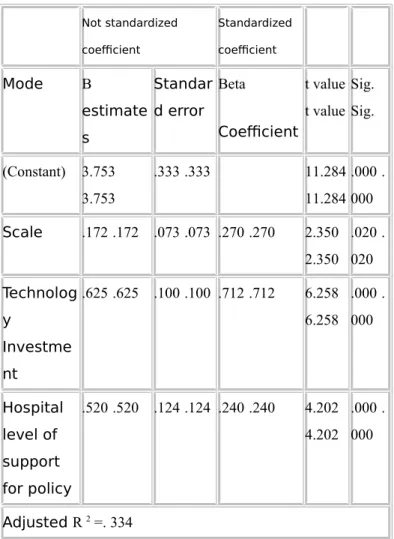
Using multiple regression analysis of electronic medical records system maturity and the correlation between factors. The main purpose of multiple regression analysis is to analyze the number of variables and a linear relationship between the dependent variable (Hair, 1998).Good model fit, regression models could explain the significant variations in the natural error is too high, F a value of 37.207, significant 0.000. Table II showed that "scale", "IT investment" and
"hospital level of support for policies" may affect the degree of electronic medical records (Adjusted R 2 = 0.334), and larger hospitals, information technology The greater the investment, health care institutions on policy higher the level of support, the higher the degree of electronic medical records. Caused the low R 2 value possible causes, suggesting that there should be more explanatory power of other variables not included in the pattern, but limited sources of information, and therefore suggested that to further in-depth study.
Table 1 affect the reliability of the questionnaires / validity analysis
Dimension Variable name
Factor loading Cronbach
Cronbach
Dependent variable
Maturity 0.60,0.80,0.66,0.76,0.73 0.60,0.80,0.66,0.76,0.73
0.730.73
Independent variables
Organizational characteristics
Hospital size 0.90, 0.86, 0.940.90, 0.86, 0.94
.82.82
Investment in
information technology
0.83, 0.99, 0.920.83, 0.99, 0.92
.68.68
Concentratio n level
0.52, 0.33, 0.41, 0.55 0.52, 0.33, 0.41, 0.55
.41.41
Formalizatio n
0.73, 0.34, 0.72, 0.06 0.73, 0.34, 0.72, 0.06
.44.44
Business environment
Competitive pressures
0.85, 0.850.85, 0.85 .61.61
Government influence
Support the policy level
0.58, 0.52, 0.790.58, 0.52, 0.79
.52.52
Policy implications
0.58, 0.54, 0.65,0.58, 0.54, 0.65,
0.81, 0.83 0.81, 0.83
.78.78
Adverse effects of policy
0.62, 0.73, 0.610.62, 0.73, 0.61
.49.49
Degree of government assistance
0.58, 0.74, 0.89, 0.90 0.58, 0.74, 0.89, 0.90
.84.84
Table 2 Factors affecting the degree of electronic medical records the regression model
Not standardized coefficient
Standardized coefficient
Mode B
estimate s
Standar d error
Beta Coefficient
t value t value
Sig.
Sig.
(Constant) 3.753 3.753
.333.333 11.284
11.284 .000. 000
Scale .172.172 .073.073 .270.270 2.350 2.350
.020. 020
Technolog y
Investme nt
.625.625 .100.100 .712.712 6.258 6.258
.000. 000
Hospital level of support for policy
.520.520 .124.124 .240.240 4.202 4.202
.000. 000
AdjustedR 2 =. 334
Wantonly, to discuss
Found that the size and impact of information technology investment is the degree of electronic medical records a key factor. As electronic medical records system than the traditional hospital information system more complex and technology more difficult, such as image processing, high capacity and high processing power of databases, and system security maintenance and so on. In addition, system developers need a more in-depth medical knowledge, system complexity is relatively high ... so they need more funds are available. Therefore, larger than the hospital has sufficient financial capacity to pay these costs, while those who are willing to invest more funds and also had the capability to develop electronic medical records system. However, for smaller or less than the hospital IT investment, how to provide incentives, such as law changes, financial aid, and joint development of standards for electronic medical records platform in order to
reduce duplication of investment by individual hospitals, which may help to improve the Import of small hospitals will.
How to support the policy for the hospital electronic medical records system is to promote an important subject. From year to year increase in financial support for research projects and the Department of Health has known the development of electronic medical records system as an important goal, but also towards the law is conducive to electronic changes. However, if hospitals do not understand the policy of the charge, you can not successfully win enough support, for example, the survey found that 75.2% ofrespondents had considered the policy is not clear obstacle to the development of electronic medical records. Therefore, the
proposal to amend the relevant authorities should speed up the law, such as abolition of paper medical records to reduce the information systems and paper- saving double spending, to determine the relevant standards (eg HL7) to reduce the hospital or manufacturers to develop systems of uncertainty. In addition, the competent authority must also be more understanding of the needs of hospitals, to provide the necessary support, and increase communication to promote mutual understanding. The above measures have helped improve the health care
institutions on the policies.
Data, whether those who have been imported (mean = 3.407) or to import those (mean = 3.376) felt more intense competitive pressure, this means that competitive pressures on the part of the hospital did not stimulate the use of motivation.
Although, in recent years, the population is aging, the patient's expectations to improve the quality of care, purchasing medical equipment costs, material procurement costs of drug development Health and medical expenses caused by factors such disputes, medical and hospital operating costs increase significantly.
In addition, large-scale trend of the hospital and health care payment system reform and other factors, has led to increasingly fierce competition in the medical industry, hospital operators are required to pay more attention than ever before, cost, efficiency and performance management issues and so on. However, the operating environment of the past, most of the domestic hospital market are oligopolistic pattern of competition in an oligopolistic market less, and between hospitals in the past more emphasis on how to update the device or to attract doctors to form a competitive advantage, how to use information technology to enhance the competitiveness of the relatively unfamiliar topic. Therefore, how to improve hospital executives understand the trend of information technology to
develop more appropriate information technology strategy, electronic medical records system into a major help.
In addition, regardless of those who have been imported (mean = 3.352) or to import those (mean = 3.310) have expressed the need for higher government assistance. District hospitals in particular, since small hospitals generally lack the dilemma faced by IT
professionals and IT staff in response to the current continue to introduce new reporting requirements are often exhausted and health insurance, coupled with increasingly fierce competition in the medical environment, leading to units of the proposed new Demand has also highlighted the shortage of IT manpower difficulties.In addition, most hospitals in Taiwan came from the competent medical class, in general, for electronic medical records and
information management to understand more limits are difficult to clearly assess the costs or benefits related technologies. Therefore, the proposed Department of Health should seek to provide more assistance.
V. Conclusion
According to the results of data analysis can be found in "scale", "IT investment", "support the policy level" that affect the degree of electronic medical records the hospital a key factor, has to import those features is the larger, higher levels of investment in
information technology of government policies are more in favor of electronic medical records.
Some items, low reliability and validity of the main limitations of this study. In general, reliability or validity of the questionnaire design may be inadequate or investigators conducted a questionnaire survey mode effects such as questionnaire design statement can not reflect the true concept to measure, or investigators when respondents Respondents may inadvertently give the wrong
guidance.However, limited sources of information, this research can not improve this problem, the proposed Department of Health to track future research should pay attention.
Thanks
Information Centre courtesy of the Department of Health to provide raw data for research have been completed successfully, grateful.
References
Seminar space is limited submission of limitations 6 must be omitted, as readers are interested in this article, please obtain a letter.
Appendix: Questionnaire items asked
Maturity of electronic medical records system
The text-based data processing (that is, type the text for general medical information processing) computerized completion rates The video, and multimedia medical record (medical imaging systems that integrate PACS, to provide multimedia medical information) the completion rate of the computerized
Has completed the electronic medical care record project
Automation of the apparatus (ie, medical equipment data can be integrated with electronic medical records system) in the completion rates
The hospital-wide integrated electronic medical records job completion rates
Hospital size
Number of doctors
The total number of beds
Average daily outpatient services IT investment
Information related to the budget over the past year Mainframe The number of hospital-wide Mainframe The number of hospital-wide PC
Concentration level
IT department staff to encourage participation and decision making related to their duties
Information related to policy implementation issues, usually related departments jointly by the IT decision
Higher business-related information has not been established decision-making related to personnel will not take too much action By the IT department does not encourage individual employees to make decisions
Formalization
Staff have the right to establish its own working standards IT director (or authorized others) always check whether the information officers to follow relevant norms
IT department staff have the right to arrange for the content of their work
Hospital information related to the business standard operating procedures have to follow guidelines and work
Competitive pressures
Improve the quality of health care services to enhance the competitiveness of the basis for the Court
Court costs on the business environment competitive pressure Hospital level of support for policies
Government should lead the development of hospital electronic medical records
Hospital electronic medical records is not the top priority of information technology (reverse)
Overall, you are quite supportive of the Government to promote the hospital electronic medical records
Current government policy on the development of electronic patient records
The previous policy will help the development of hospital electronic medical records
Electronic Signature Law enacted to accelerate the development of hospital electronic medical records
Electronic Signature Law enacted to improve the level of hospital
information
The implementation of NHI IC card will increase the hospital on the demand for electronic medical records
The implementation of NHI IC card will increase the level of hospital information
Inadequate government policies on the development of electronic medical records
Still lack adequate sources of law to implement electronic medical records, likely to cause hospital manpower, cost and process the waste
Although the electronic signature law enacted, they still could not push as the basis for electronic medical records
NHI IC card at this stage of planning the content is not integrated with electronic medical records, may be unable to make full use of Government assistance to medical institutions
Government should strengthen the assistance of the hospital electronic medical records
Government subsidies would help the hospital electronic medical records
Government job training electronic medical records will help the development of hospital electronic medical records
Government to provide technical support for electronic medical records or consulting, will contribute to the development of hospital electronic medical records