行政院國家科學委員會補助專題研究計畫
□
成 果 報 告
■
期中進度報告
含雜環取代基的萘醌化合物的合成
計畫類別:
■
個別型計畫 □ 整合型計畫
計畫編號:NSC 98-2113-M-006-003-MY2
執行期間:98 年 08 月 01 日至 100 年 07 月 31 日
計畫主持人:莊治平
共同主持人:
計畫參與人員:陳光伯, 林真宇,蘇文祥,蔣昆林,陳政良,邱琬如,林福珍
成果報告類型(依經費核定清單規定繳交):
■
精簡報告 □完整報告
處理方式:除產學合作研究計畫、提升產業技術及人才培育研究計畫、列管計畫及
下列情形者外,得立即公開查詢
□涉及專利或其他智慧財產權,□一年□二年後可公開查詢
執行單位:成功大學
中 華 民 國 99 年 5 月 31 日
中文摘要自由基反應近二十年來成為有機合成上重要的反應。碳自由基能有效地接到不飽和鍵上而生成碳-碳鍵, 並且表現出特別的位向和立體選擇性。由文獻中發現,錳(III)、鈰(IV)、銀(I)、鐵(III)等金屬離子能氧化 1,3-雙羰基化合物而生成碳自由基。此碳自由基能經由分子內或分子間的自由基反應而生成碳-碳鍵。在 這些金屬離子中以錳(III)與鈰(IV)最為有效地被運用在此反應上。銀(II)能由硝酸銀(I)與 K2S2O8的反應生 成,經由此銀(II)的氧化羰酸化合物會生成碳自由基。值得注意的是此反應只需要催化劑量的硝酸銀(I)。 本研究計劃擬:
I、 利用硝酸銀(I)與 K2S2O8所生成的銀(II)來進行銀(II)啟始的 1,4-萘醌化合物氧化性自由基反應。
II、 利用金屬氧化劑來進行 2-(1-胺基-苯甲基)-1,4-萘醌的氧化性自由基反應。 英文摘要
Free radical reactions have been become increasingly important in organic synthesis in the last two decades. The carbon-carbon bond formation can be achieved efficiently by the attack of carbon radicals onto the unsaturated bond. These reactions exhibit interesting regio- and stereo- selectivities. Metal ions (Mn+3, Ce+4, Ag+, Fe+3 ) based oxidative free reactions of 1,3-dicarbonyl compounds have been studied by several groups. The oxidative addition of an electrophilic carbon-centered radical to alkenes has received considerable attention in organic synthesis for the construction of carbon-carbon bonds. Among these, Manganese(III) and Cerium(IV) have been used most efficiently. Silver(II) generated from the reaction between silver(I) nitrate and potassium persulfate and carbon radical can be produced from the decarboxylation of carboxylic acid by the oxidation of silver(II)。
In this proposal, we wish to study-
1. The Ag(II) mediated oxidative free radical reactions of 1,4-naphthoquionones 2. The oxidative free radical reaction of 2-(amino-benzyl)-1,4-naphthoquinones
Introduction
There has been a growing interest in the application of free radical reactions and many new methods via radical reaction designed for organic synthesis have been developed.[1,2] The addition of carbon-centered radical produced by the metal salt oxidation of 1,3-dicarbonyl compounds to alkenes has received considerable attention in the organic synthesis for the construction of carbon–carbon bonds. Among these, manganese(III) acetate and cerium(IV) ammonium nitrate have been used most efficiently.[2-5] Carbon radicals can be produced effectively by silver ion catalyzed oxidative decarboxylation of carboxylic acids with persulfate[6] and they undergo homolytic alkylation with heteroaromatics[7] and 1,4-quinones.[8] Compounds containing the quinone group represent an important class of biologically active molecules that are widespread in nature[9,10].
Previously, we found that the manganese(III) acetate mediated oxidative free radical reaction of
2-benzoyl-(3-ethoxycarbonylmethyl)-1,4-naphthoquinones, in addition to the expected
6-hydroxy-naphthacene-5,12-diones, produced the novel naphtho[2,3-c]furan-4,9-diones as the major products.
[5g]
These naphtho[2,3-c]furan-4,9-diones can also be generated directly from the intermolecular
oxidative free radical reaction of 2-benzoyl-1,4-naphthoquinones with 1,3-dicarbonyl compounds.[5h]
Naphtho[2,3-c]furan-4,9-diones form the largest subset of natural products containing a c-fused furan ring.[10] Methods for their synthesis have been reviewed.[9c] The corresponding isofuran derivatives have served as a quinodimethane synthetic analogues in Diels-Alder reaction and are widely used in the preparation of complex molecules.[12] Benzo[f]isoindole-4,9-dione skeleton has also attracted considerable attention in the literature and several pathways have been developed for their synthesis.[13] Acyl radicals were produced by the oxidative
decarboxylation of α-keto acids with silver(I) ion and persulfate and they were then utilized for the acylation of 1,4-quinones.[14] As part of our study on the development of new route to heterocyclic systems via metal salts mediated radical reactions,[5,11]
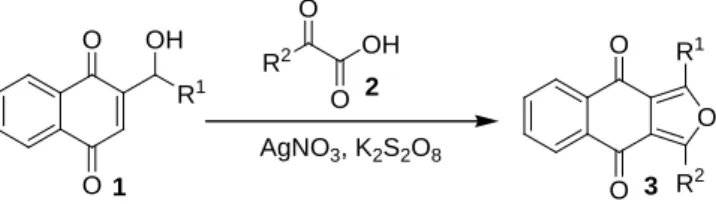
O O R1 OH O O O R1 R2 R2 O OH O AgNO3, K2S2O8 1 2 3
we now report a new method for the synthesis of naphtho[c]furan-4,9-dione and benzo[f]isoindole-4,9-dione derivatives from 2-substituted-1,4-naphthoquinones.
Scheme 1. Reaction between 2-(1-hydroxyalkyl)-1,4-naphthoquinones 1 and α-keto acids 2.
Results and Discussion
We began our studies of the silver(I) catalyzed reaction with 2-(1-hydroxyalkyl)-1,4-naphthoquinones 1 and
α-keto acids 2 (Scheme 1). When 2-(1-hydroxybenzyl)-1,4-naphthoquinone (1a, R1
= Ph) was treated with 2-oxopropionic acid (2a, R2 = Me), silver(I) nitrate and potassium persulfate in acetonitrile/H2O at 70 oC,
naphtho[c]furan-4,9-dione 3a was obtained in 57% yield (Table 1, entry 1). The structure of 3a is clearly assigned by 1H NMR and 13C NMR. Although the mechanistic details of this reaction are unclear, 3a may be formed via the reaction route presented in Scheme 2. Silver(II) mediated decarboxylation of 6a produces acyl radical 4a. Intermolecular addition of this acyl radical intermediate 4a to the quinone ring followed by oxidation produces 5a. This acylation product 5a is then converted to 3a by the intramolecular condensation reaction. The generalities of this reaction were examined with other α-keto acids 2 and the results are summarized in Table 1 (entries 1–5). In all cases, 2-(1-hydroxybenzyl)-1,4-naphthoquinone 1a was converted to the corresponding isofuran products 3 effectively. We also applied the Ag(I)/S2O8-2 reaction condition to
2-(1-hydroxyethyl)-1,4-naphthoquinone (1b, R1 = Me). The reaction worked well and isofurans 3f–h were formed in 74-56% yields (entries 6-8). This reaction provides an efficient method for the formation of naphtho[2,3-c]furan-4,9-diones.
Table 1. Reaction between 2-(1-hydroxyalkyl)-1,4-naphthoquinones 1 and α-keto acids 2. Entry Quinone Acid Product (yield (%))
1 1a: R1 = Ph 2a: R2 = Me 3a (57) 2 1a: R1 = Ph 2b: R2 = Et 3b (54) 3 1a: R1 = Ph 2c: R2 = Pr 3c (54) 4 1a: R1 = Ph 2d: R2 = i-Bu 3d (54) 5 1a: R1 = Ph 2e: R2 = Ph 3e (75) 6 1b: R1 = Me 2a: R2 = Me 3f (61) 7 1b: R1 = Me 2b: R2 = Et 3g (56) 8 1b: R1 = Me 2e: R2 = Ph 3a (74)
O O R1 OH O O O R1 R2 R2 O 1 6 O O O R1 R2 3 O O OH R1 5 R2 O OH
.
4 R2 O.
4 R2 O OH O 2 Ag(II)Scheme 2. Probable mechanism for the reaction between 1 and 2.
In view of the good results on the formation of naphtho[2,3-c]furan-4,9-diones 3, we reasoned that it might be possible to produce benzo[f]isoindole-4,9-diones 8 via the condensation reaction of 9, which were formed by the the acyl radical addition of 2-(1-amidoalkyl)-1,4-naphthoquinones 7. We next investigated the silver(II) mediated reaction between 2-(1-amidoalkyl)-1,4-naphthoquinones 11 and α-keto acids 2 for the synthesis of benzo[f]isoindole-4,9-diones 8 (Scheme 3). Treatment of 2-[N-acetyl-(1-aminobenzyl)]-1,4-naphthoquinone (7a, R1 = Ph, R3 = Ac) with 2-oxopropionic acid (2a, R2 = Me), silver(I) nitrate and potassium persulfate in acetonitrile/H2O at 70 oC generated benzo[f]isoindole-4,9-dione 8a in 64% yield (entry 1). The structure of 8a
is revealed by 1H NMR and 13C NMR analyses.
O O R1 NHR3 O O NR3 R1 R2 R2 O OH O AgNO3, K2S2O8 7 2 8 O O NHR3 R1 9 R2 O
Scheme 3. Reaction between 2-(1-amidoalkyl)-1,4-naphthoquinones 7 and α-keto acids 2.
The results of the reaction between [N-acetyl-(1-aminobenzyl)]-1,4-naphthoquinone (7a) and other α-keto
acids 2 are also summarized in Table 2 (entries 2–5). In all cases,
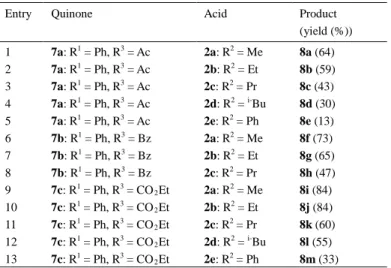
[N-acetyl-(1-aminobenzyl)]-1,4-naphthoquinone (7a) was converted to the corresponding isoindole products 8 effectively. The reaction yield decreases as the size of substituent (R2) increases. This can be attributed to the steric effect exerted by R2 group – the condensation rate of 9 is retarded by the larger R2 group. This reaction provides a straightforward method for the synthesis of benzo[f]isoindole-4,9-diones 8. Other N-protecting groups were also employed to examine the scope of this reaction. As shown in Table 2 (entries 6–13),
isoindoles 8 were obtained in moderate–good yields. With R3 = CO2Et, isoindoles 8 were obtained with best
results. This is presumably due to the higher nucleophilicity of the ethoxycarbonylamino group.
Table 2. Reaction between 2-(1-amidoalkyl)-1,4-naphthoquinones 7 and α-keto acids 2. Entry Quinone Acid Product
(yield (%)) 1 7a: R1 = Ph, R3 = Ac 2a: R2 = Me 8a (64) 2 7a: R1 = Ph, R3 = Ac 2b: R2 = Et 8b (59) 3 7a: R1 = Ph, R3 = Ac 2c: R2 = Pr 8c (43) 4 7a: R1 = Ph, R3 = Ac 2d: R2 = i-Bu 8d (30) 5 7a: R1 = Ph, R3 = Ac 2e: R2 = Ph 8e (13) 6 7b: R1 = Ph, R3 = Bz 2a: R2 = Me 8f (73) 7 7b: R1 = Ph, R3 = Bz 2b: R2 = Et 8g (65) 8 7b: R1 = Ph, R3 = Bz 2c: R2 = Pr 8h (47) 9 7c: R1 = Ph, R3 = CO 2Et 2a: R2 = Me 8i (84) 10 7c: R1 = Ph, R3 = CO 2Et 2b: R2 = Et 8j (84) 11 7c: R1 = Ph, R3 = CO 2Et 2c: R2 = Pr 8k (60) 12 7c: R1 = Ph, R3 = CO 2Et 2d: R2 = i-Bu 8l (55) 13 7c: R1 = Ph, R3 = CO 2Et 2e: R2 = Ph 8m (33)
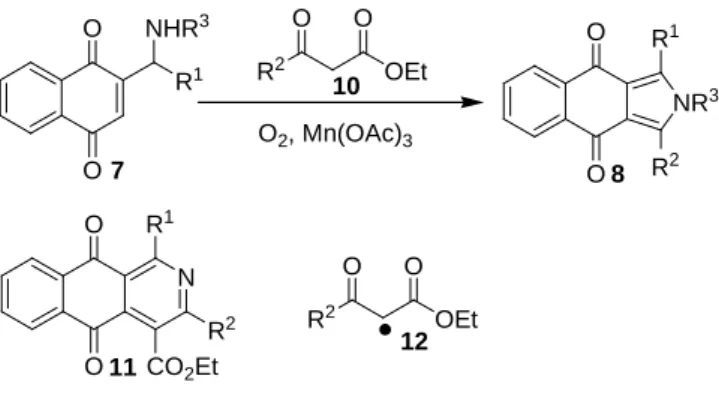
Previously, we found that oxidative free radical reactions of 2-alkylamino-1,4-naphthoquinones with β-keto esters produced benzo[f]indole-4,9-diones and benzo[f]indole-2,4,9-triones.[5a,f] In acidic solvent, the condensation products – benzo[f]indole-4,9-diones are the major product. Naturally occurring 2-azaanthraquinones are of special interest due to their important physiological properties.[9b,10b,15] We believe that radical reaction between 2-(1-amidoalkyl)-1,4-naphthoquinones 7 and β-keto esters 10 would generate 2-azaanthraquinones 11 via the intermolecular addition of radical 12 to the quinone ring followed by intramolecular condensation reaction. We have continued to examine the manganese(III) mediated oxidative free radical reaction between 2-(1-amidoalkyl)-1,4-naphthoquinones 7 and β- keto esters 10 (Scheme 4). When [N-benzoyl-(1-aminobenzyl)-1,4- naphthoquinone (7b, R1 = Ph, R3 = Bz) was treated with ethyl acetoacetate (10a, R2 = Me) and manganese(III) acetate in acetic acid at 80 oC for 14 h, no desired product 11a can be found and instead benzo[f]isoindole-4,9-dione 8f is obtained in 34% yield (Table 3, entry 1). Isoindole product 8f was formed via a similar acyl radical addition mechanism shown in Scheme 2 and this acyl radical
4a was presumably formed via a reaction mechanism outlined in Scheme 5. Manganese(III) acetate oxidation of 10a produces radical 12a. This radical intermediate 12a undergoes oxygen trapping to give hydroperoxide 14a.[16] Thermal fragmentation of 14a produces acyl radical 4a.[17] This unusual acyl radical formation can be attributed to the steric effect exerted by the 1-amidobenzyl group – the addition of radical 12a to the quinone ring of 7 is retarded by this large 1-amidobenzyl group and the formation of acyl radical 4a via the oxygen trapping of radical 12a becomes the major route. Although the expected reaction did not occur, the formation of
8a prompted us to examine the applicability of this reaction. With the reasonable assumption that oxygen takes
part in the reaction leading to the formation of acyl radical 4a, the reaction between 7b and 10a was repeated in an atmosphere of oxygen. In this case, the yield of 8f increased to 60% and the reaction time was shorten to 30 min (entry 2). Other β-keto esters 10 were also subjected to the manganese(III) acetate reaction with 7b under oxygenated conditions. As shown in Table 4, isoindole products 8 were obtained effectively and the reaction yields of 8 decrease as the size of R2 increases (entries 2–4). Other N-protecting groups were also employed to
examine the scope of this reaction. In all cases, isoindole products 8 were obtained with moderate yields (entries 5–10). O O R1 NHR3 O O NR3 R1 R2 R2 O 7 10 8 O OEt O2, Mn(OAc)3 O O N R1 CO2Et R2 11 R2 O 12 O OEt
.
Scheme 4. Reaction between 2-(1-amidoalkyl)-1,4-naphthoquinones 7 and β-keto esters 10. R2 O 10 O OEt Mn(III) R2 O 12 O OEt R2 O 13 O OEt O O R2 O O OEt O OH R2 O O OEt O O OEt O H R2 O
.
O2 +.
.
.
14 15 16 4Scheme 5. Probable mechanism for the formation of acyl radical 4.
Table 3. Reaction between 2-(1-amidoalkyl)-1,4-naphthoquinones 7 and β-keto esters 10. Entry Quinone β-keto ester Product
(yield (%)) 1[a] 7b: R1 = Ph, R3 = Bz 10a: R2 = Me 8f (34) 2[b] 7b: R1 = Ph, R3 = Bz 10a: R2 = Me 8f (60) 3[b] 7b: R1 = Ph, R3 = Bz 10b: R2 = Et 8g (37) 4[b] 7b: R1 = Ph, R3 = Bz 10c: R2 = Pr 8h (39) 5[b] 7c: R1 = Ph, R3 = CO 2Et 10a: R2 = Me 8i (56) 6[b] 7c: R1 = Ph, R3 = CO 2Et 10b: R2 = Et 8j (43) 7[b] 7c: R1 = Ph, R3 = CO 2Et 10c: R2 = Pr 8k (41) 8[b] 7a: R1 = Ph, R3 = Ac 10a: R2 = Me 8a (50) 9[b] 7a: R1 = Ph, R3 = Ac 10b: R2 = Et 8b (34) 10[b] 7a: R1 = Ph, R3 = Ac 10c: R2 = Pr 8c (29)
[a] The reaction was performed under N2 for 14 h. [b] The reaction was performed under O2
Conclusions
for 30 min.
The silver–catalyzed decarboxylation of α-keto acids by persulfate leads to acyl radicals, which can undergo efficient radical addition to the C–C double bond of 2-(1-hydroxyalkyl)-1,4-naphthoquinones and
2-(1-amidoalkyl)-1,4-naphthoquinones. This reaction provides an effective method for the synthesis of naphtho[c]furan-4,7-diones and benzo[f]isoindole-4,9-diones. In the presence of O2
[1] a) W. P. Neumann, Synthesis 1987, 665–682. b) D. P. Curran, Synthesis 1988, 417–439 and 489–513. c) B. Giese, B. Kopping, T. Gobel, J. Dickhaut, G. Thoma, K. J. Kulicke, F. Trach, in Organic Reactions, John Wiely & Sons, New York, 1996, vol. 48, Chapter 2, pp 301–855. d) W. R. Bowman, C. F. Bridge, P. Brookes, J. Chem. Soc., Perkin Trans. 1 2000, 1–14. e) W. Zheng, Tetrahedron 2001, 57, 7237–7262.
, manganese(III) acetate oxidation of β-keto esters can also generate acyl radicals via hydroperoxide which then undergo a similar radical addition reaction to 2-(1-amidoalkyl-1,4-naphthoquinones and subsequently
benzo[f]isoindole-4,9-diones are produced.
[2] a) G. G. Melikyan, Synthesis 1993, 833–850. b) J. Iqbal, B. Bhatia, N. K. Nayyar, Chem. Rev. 1994, 94, 519–564. c) B. B. Snider, Chem. Rev. 1996, 96, 339–363. d) V. Nair, S. B. Panicker, L. G. Nair, T. G. George, A. Augustine, Synlett 2003, 156–165. e) V. Nair, L. Balagopal, R. Rajan, J. Mathew, Acc. Chem.
Rev. 2004, 37, 21–30.
[3] a) H. Oumar-Mahamat, C. Moustrou, J.-M. Surzur, M. P. Berstrand, J. Org. Chem. 1989, 54, 5684–5688. b) B. B. Snider, B. Y. F. Wan, B. O. Buckman, B. M. Foxman, J. Org. Chem. 1991, 56, 328–334.
[4] a) A. Citterio, R. Sebastiano, A. Marion, J. Org. Chem. 1991, 56, 5328–5335. b) A. Citterio, R. Sebastiano, M. Nicolini, Tetrahedron 1993, 49, 7743–7760. c) Y.-L. Wu, C.-P. Chuang, P.-Y. Lin, Tetrahedron 2000, 56, 6209–6217. d) Y.-J. Liao, Y.-L. Wu, C.-P. Chuang, Tetrahedron 2003, 59, 3511–3520.
[5] a) M.-C. Jiang, C.-P. Chuang, J. Org. Chem. 2000, 65, 5409–5412. b) Y.-L. Wu, C.-P. Chuang, Tetrahedron Lett. 2001, 42, 1717–1719. c) Y.-L. Wu, C.-P. Chuang, P.-Y. Lin, Tetrahedron, 2001, 57, 5543–5549. d) A.-I. Tsai, Y.-L. Wu, C.-P. Chuang, Tetrahedron 2001, 57, 7829–7837. e) C.-C. Tseng, Y.-L. Wu, C.-P. Chuang, Tetrahedron 2002, 58, 7625–7633. f) C.-M. Tseng, Y.-L. Wu C.-P. Chuang, Tetrahedron 2004, 60, 12249–12260. g) H.-L. Chen, C.-Y. Lin, Y.-C. Cheng, A.-I. Tsai, C.-P. Chuang, Synthesis 2005, 977–985. h) C.-Y. Lin, Y.-C. Cheng, A.-I. Tsai, C.-P. Chuang, Org. Biomol. Chem. 2006, 4, 1097–1103. [6] J. M. Anderson, J. K. Kochi, J. Am. Chem. Soc. 1970, 92, 1651–1659.
[7] a) N. Kanomata, H. Nagahara, M. Tada, J. Heterocyclic Chem. 1992, 29, 1567–1571. b) R. Jain, L. A. Cohen, N. A. El-Kadi, M. M. King, Tetrahedron 1997, 53, 2365–2370. c) K. B. Hansen, S. A. Springfield, R. Desmond, P. N. Devine, E. J. J. Grabowski, P. J. Reider, Tetrahedron Lett. 2001, 42, 7353–7355.
[8] a) N. Jacobsen, K. Torsell, Acta Chem. Scand. 1973, 27, 3211–3216. b) P. M. Brown, R. H. Thomson, J. Chem. Soc., Perkin Trans. 1 1976, 997–1000. c) B. Kesteleyn, N. De Kimpe, L. Van Puyvelde, J. Org. Chem. 1999, 64, 1173–1179. d) G. A. Kraus, P. K. Choudhury, Tetrahedron Lett. 2001, 42, 6649–6650. [9] a) R. H. Thomson, Natural Occurring Quinones IV: Recent Advances; Chapman and Hall: London, 1997. b) A. P. Krapcho, D. J. Waterhouse, Heterocycles
1999, 51, 737–750. c) M. J. Piggott, Tetrahedron 2005, 61, 9929–9954.
[10] a) T. Hanumaiah, G. S. R. Rao, C. P. Rao, K. V. J. Rao, H. J. Cowe, P. J. Cox, R. A. Howie, D. S. Marshall, R. H. Thomson, Tetrahedron 1985, 41, 635–642. b) A. Miljkovic, P. G. Mantle, D. J. Williams, B. Rassing, J. Nat. Prod. 2001, 64, 1251–1253. c) Y. Yamamoto, Y. Kinoshita, G. R. Thor, M. Hasumi, K. Kinoshita, K. Koyama, K. Takahashi, I. Yoshimura, Phytochemistry 2002, 60, 741–745. d) R. D. Stipanovic, J. Zhang, B. D. Bruton, M. H. Wheeler, J. Agric. Food Chem.
2004, 52, 4109–4112.
[11] a) Y.-L. Wu, C.-P. Chuang, Tetrahedron 2004, 60, 1841–1847. b) A.-I. Tsai, C.-P. Chuang, Tetrahedron 2006, 62, 2235–2239.
[12] a) W. C. Christopfel, L. L. Miller, Tetrahedron 1987, 43, 3681–3688. b) P. Magnus, S. A. Eisenbeis, N. A. Magnus, J. Chem. Soc., Chem. Commun. 1994, 1545–1546. c) A. R. Wartini, H. A. Staab, F. A. Neugebauer, Eur. J. Org. Chem. 1998, 1161–1170. d) X.-P. Yang, D.-M. Du, Q. Li, T. C. W. Mak, H. N. C. Wong, J. Chem. Commun. 1999, 1607–1608. e) H. S. Sutherland, F. E. S. Souza, R. G. A. Rodrigo, J. Org. Chem. 2001, 66, 3639–3641. f) S. Chakrabarti, M. Liu, D. H. Waldeck, A. M. Oliver, M. N. Paddon-Row, J. Am. Chem. Soc. 2007, 129, 3247–3256.
[13] a) D. V. Nightinggale, J. A. Gallagher, J. Org. Chem. 1959, 24, 501–504. b) J. A. Myers, L. D. Moore, Jr., W. L. Whitter, S. L. Council, R. M. Waldo, J. L. Lanier, B. U. Omoji, J. Org. Chem. 1980, 45, 1202–1206. c) M. Schubert-Zsilavecz, W. Likussar, D. Gusterhuber, A. Michelitsch, Monatsh. Chem. 1991, 122, 383–387. d) R. Di Santo, R. Costi, S. Massa, M. Artico, Synth. Commun. 1996, 26, 1839–1847. e) M. Chakraborty, D. B. McConville, G. F. Koser, C. A. Tessier, T. Saito, P. L. Rinaldi, W. J. Youngs, J. Org. Chem. 1997, 62, 8193–8197. f) M. S. Shvartsberg, I. D. Ivanchikova, N. I. Lebedeva, Tetrahedron Lett. 2000, 41, 5757–5760.
[14] a) F. Fontana, F. Minisci, M. C. N. Barbosa, E. Vismara, J. Org. Chem. 1991, 56, 2866–2869. b) C. J. Rao, W. C. Agota, Tetrahedron Lett. 1992, 33, 4133–4136. c) N. Sato, H. Kadota, J. Heterocyclic Chem. 1992, 29, 1685–1688. d) G. A. Kraus, A. Melekhov, Tetrahedron Lett. 1998, 39, 3957–3960. e) M. K.-H. Doll, J. Org. Chem. 1999, 64, 1372–1374.
[15] a) B. S. Davidson, Tetrahedron Lett. 1992, 33, 3721–3724. b) Y. Moriyasu, H. Miyagawa, N. Hamada, H. Miyawaki, T. Ueno, Phytochemistry 2001, 58, 239–241.
[16] Similar oxygen trapping of α,α-dicarbonyl radicals has been reported: a) T. Ohshima, M. Sodeoka, M. Shibasaki, Tetrahedron Lett. 1993, 34, 8509–8512. b) V. Nair, L. G. Nair, J. Mathew, Tetrahedron Lett. 1998, 39, 2801–2804. c) V. Nair, V. Sheeba, J. Org. Chem. 1999, 64, 6898–6900. d) J.-H. Ye, J. Xue, K.-Q. Ling, J.-H. Xu, Tetrahedron Lett. 1999, 40, 1365–1368.
[17] For similar cleavage of α-oxycarbonyl radical, see: a) A. L. Nussbaum, E. P. Yuan, C. H. Robinson, A. Mitchell, E. P. Oliveto, J. M. Beaton, D. H. R. Barton, J.