
The Influence of Age and Genre on Types of EFL Adult Learners’ Written Errors
17
0
0
全文
(2) INTRODUCTION Under the influence of interlanguage which is defined as a shared language pool during the stage of L2 learning, language errors made by native and non-native speakers have shown to be distinctively different (Nemser, 1961). Due to the possible factors such as insufficient language exposure in the EFL settings and the starting age of learning an L2, interlanguage errors are significantly deeply-planted among adults who are under the state of fossilization. EFL adult learners are found to be fossilized in both productive and perceptive language abilities (Selinker and Lakshammanan, 1992). Present study mainly focuses on the written errors which involve not only the age-related factor but also the different writing systems between languages. Previous studies have categorized types of written errors, such as weak link and grammatical errors made by EFL writers whose first language is Chinese (Horney, 1979; Sliva, 1993). Participants in present study were asked to write two different genres, namely argumentative and narrative writings to detect types of written errors they would make. Since the majority of the research has focused on the EFL learners of the same age level, mostly college students (Liu, 1999), four different age levels of participants are selected in this study to investigate whether age level is one of the factors which result in different types of written errors. The results on written errors which are made by different age levels of EFL writers could serve as an instructional priority in the English writing class. LITERATURE REVIEW Fossilization vs. Adult Learners Fossilization referred to the state of permanent failure or the plateau learners seemed to reach in the process of the target language development. It indicated the “recurrence” of errors which was not only “deviant” from the correct target language form, but also believed to be tragically “unchangeable” to the correct form, regardless of the degree of exposure of the target language (Nakuma, 1998). Nemser’s (1961) indicated that fossilization was expressed through explorations and researchers should take learners’ interlanguage into account. Learners’ “interlanguage” was a stage during L2 learning at which the acquired target language was neither exactly native L2 nor native L1 but would have some shared features of both. This view focused on the differential differences between the native-speaker system and all the other adult L2 language learners (Nemser, 1961). As to the latest proposal, Selinker and Selinker in 1992 stated their “multiple effects principle” as follows: “When two or more second language acquisition factors work in tandem, there is greater chance of stabilization of interlanguage forms leading to possible fossilization” (p.207). The role of “transfer” became a necessary co-factor of fossilization and this account creates an association between fossilization and adulthood based on the fact that children had little L1 knowledge to transfer into L2. Adult L2 learners, as opposed to children, were believed to be both cognitively and linguistically mature. “Age” factor was to the fact that adult L2 learners already had the experience of going through the process of learning their L1 and it explained the inability to achieve the native competence because adults were most likely to learn an L2 using previous learning strategies which were not specifically suitable for the acquisition of another language (Jordens, 2001). Under such assumption, participants in present study were all EFL adult writers with the age level ranging from twenty to sixty. Types of Written Errors Silva (1993) indicated that L2 writing was strategically, rhetorically, and 112.
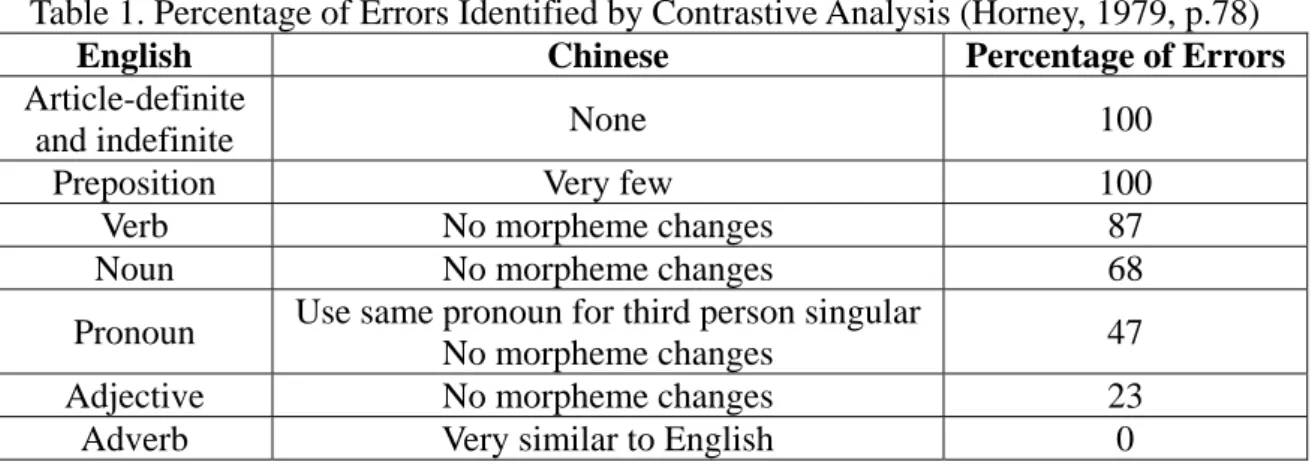
(3) linguistically different from L1 writing and emphasis should be put on the unique nature of L2 writing (such as cognitive, developmental, social, cultural, educational and linguistic uniqueness) with variables hidden behind. The writing structure was found to differ as well between native English speakers and non-native English speakers. A different language storage pool was required to manipulate when writing in L2 and that language pool was proved to be separated from that of L1. The extent of the interlanguage influence would be determined by the individual’s ability on how well one could bridge the gap between these two languages. Horney (1979) examined EFL learners’ writings with error categorized into local errors, global errors, and other types of errors. In his study, eighty Taiwanese students’ compositional errors were analyzed with grades of at least 500 on the TOEFL test. Among the local errors, the highest error percentage (11%) was found in the use of articles which was due to the lack of exact equivalent to the article in Chinese. The second highest fell into the category of prepositions which were used to show the relationships between the object of the preposition and the noun to which the phrase was related in English. However, prepositions were considered to be co-verbs in the Chinese language and errors could be due to the interlanguage difference. The errors of misused verb forms served as a significant evidence of negative transfer because in Chinese, the verb form did not have to change with the subjects or tenses. The errors of noun including the mismarking of singular and plural forms, the use of improper nouns, the omitting and the using of the incorrect form of the possessive, signified the negative transfer between English and Chinese. The global errors found in Horney were sentence fragments and conjunctions while spelling and clarity of thought were classified into other errors. Horney’s study aimed to investigate the differences between Chinese and English and the data indicated a need of adopting Contrastive Analysis in classroom instruction which emphasized on the differences in basic sentence structures between these two languages. Table 1 shows the percentage of errors identified by Contrastive Analysis (Horney, 1979, p.78). Table 1. Percentage of Errors Identified by Contrastive Analysis (Horney, 1979, p.78) English Chinese Percentage of Errors Article-definite None 100 and indefinite Preposition Very few 100 Verb No morpheme changes 87 Noun No morpheme changes 68 Use same pronoun for third person singular Pronoun 47 No morpheme changes Adjective No morpheme changes 23 Adverb Very similar to English 0 As to Liu’s study in 1999, a much larger sample was selected: 127 copies of compositions written by university students. The errors were classified into fourteen types of lexical and grammatical errors based on a category system established by Benson et al. (1986). The finding indicated that the majority of the errors were attributed to negative interlingual transfer and intralingual transfer (such as overgeneralization, ignorance of rule restrictions and the false concepts). Both belonged to cognitive strategies while errors referring to the communication strategies (the errors related with word coinage and approximation) were less than ten percent. Such findings revealed the importance of L1 interference which could be a reminder for teachers on the commonly shared errors made by EFL learners of a particular first language background. However, participants in both studies are of the same age level while four age groups were involved in this study to investigate 113.
(4) whether age levels would be one of the factors that resulted in different written error types. Narrative Narrative discourse is language-specific. Berman and Slobin (1994) indicated that narrators were limited by the resources of the language they used and thus selected and arranged the narrated event in terms of their “abilities to convey just those analyses…of event[s] that are most compatible with the linguistic means provided by their languages” (p.12). In other words, narrators were governed and limited by the availability of linguistic forms and rules in the target language in producing an extended narrative discourse. Written narrative discourse is a useful tool that indexes writer’s competence in the target language and it can reflect problems as well as strengths the writers may have. For example, Halliday and Hasan (1976) measured writer’s competence by looking at the cohesiveness of the text which involved appropriate use of references. Narrators therefore had to continuously assess the status of the characters to make on-going decisions about which reference forms to use to refer to certain characters throughout the whole narrative. In that case, researchers are able highlight linguistic properties by analyzing the L2 writers’ narrative discourse which provides a more complete picture of L2 writing processes and challenges. Narrative writing may reflect L2 learners’ best performance and may be a more accurate measure of their discourse skills as well as linguistic knowledge in L2. As for interlinguage differences, Lin (1989) reported that when Chinese writers wrote English narratives, their writings contained fewer complete episodes and fewer mentions of entities in episodes than their L1 versions. This study would like to evaluate whether genre difference would result in different written error types. Argumentative Effective argument means making judgments about one’s context and readers, and it involves arguing clearly for a position, projecting appropriate conviction and displaying a command of the material (Hyland, 2005). Among researches related to Chinese-English contrastive rhetoric on argumentative writing, the main theme is rhetorical patterns/ structure or organizational structures. Kaplan’s (1966) first article on contrastive rhetoric is the pioneer of this field. His linear-spiral diagrams attempted to capture the different patterns of reasoning in paragraphs. He further claimed that it was quite likely that an educated Chinese might instinctively write in the literary form when s/he was asked to create an essay in English. By presenting the essays wrote by his four ESL Chinese students, he remarked that although these ESL essays did include an introduction, a body, and a conclusion, “along the way” there was a lot of seemingly unnecessary wandering around the topic (Kaplan, 1966). Such pioneering project has inspired the inquiry for rhetoric patterns demonstrated in Chinese students’ writing. Matalene (1985) found that most of her Chinese students’ EFL persuasive essays, as well as the argumentative in the Chinese-English newspaper China Daily, tended to offer assertions rather than proofs and they all followed a standard pattern: “an opening description of a specific incident, a look back at the usually unfortunate history of the issue or practice, an explanation of the current much improved state of affairs and a concluding moral exhortation” (Matalene, 1985, p.800). Moving on to the 1990s, researchers’ focus on the territory of student writing has shifted to organizational traits. Liu in 1990 analyzed the texts of one piece of Chinese literary criticism from a Chinese newspaper. He described the basic organizational structure in Chinese writing, the qi (beginning), cheng (transition), zhuan (turning), and he (synthesis) and identified them in the selected text (Liu, 1990). He suggested that the zhuan was the feature culturally preferred in Chinese writing as 114.
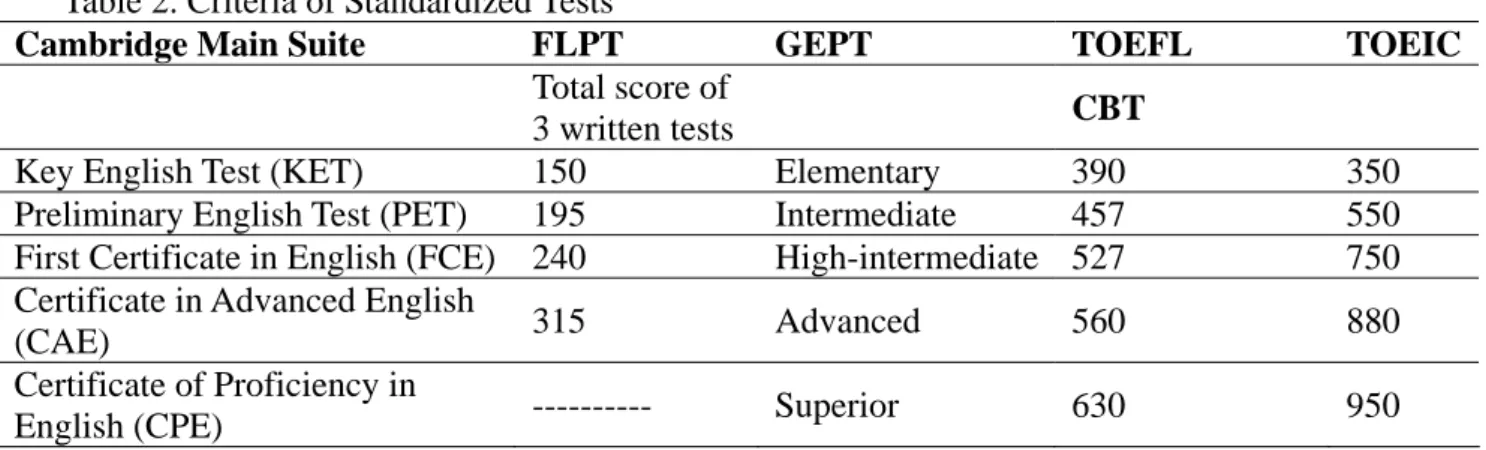
(5) the writer developed an argument, such as the emphasis on the ups and downs, twists and turns (Liu, 1990). Cahill (2003) argued that the “turn” actually “served as the occasion to develop an essay further by alternative means, contrary to the common assumption that it was a circular or digressive rhetorical move” (p.170) after his analysis on Chinese and Japanese scholarship on the indirect structure is essays (including argumentative essays). For implications, he pointed out “the possibility that the school essay has universal characteristics presents a theoretical challenge to the founding premise of contrastive rhetoric that writing across language necessarily contrasts” (Cahill, 2003, p.187). The present study tends to find out types of written error made in argumentative text as well as the narrative when writing in L2 and investigate the influence of age and genre on the types of written errors. METHOD Participants This study used stratified sampling and selected thirty-one participants in total based on age groups (eight participants from age 21-30, fifteen of age 31-40, five of age 41-50, and three of age 51-60.) Among these thirty-one participants, five of them took the TOEFL with the general grade above 550. Four passed the elementary level of GEPT (General English Proficiency Test,) four passed the intermediate and three for high-intermediate level. Fifteen of them took the TOEIC and the average grade was above 750. One took the FLPT (Foreign Language Proficiency Test) with the grade of 250. The rest four took the Cambridge Main Suite: two passed the KET (Key English Test,) one passed the PET (Preliminary English Test,) and one passed the FCE (First Certificate in English). Table2 shows the corresponding criteria of each standardized test. Table 2. Criteria of Standardized Tests Cambridge Main Suite FLPT Total score of 3 written tests Key English Test (KET) 150 Preliminary English Test (PET) 195 First Certificate in English (FCE) 240 Certificate in Advanced English 315 (CAE) Certificate of Proficiency in ---------English (CPE). GEPT. TOEFL. TOEIC. CBT Elementary 390 Intermediate 457 High-intermediate 527. 350 550 750. Advanced. 560. 880. Superior. 630. 950. Procedure All participants wrote two compositions: one narrative and one argumentative writings without the time limit. The length of each composition should be at least 250 words and the topics along with the instructions were showed in Chinese and English. The two narrative topics were adopted from Wang and Wen (2002) whose research was conducted on Chinese EFL writers. As their findings suggested, such text was able to elicit participants’ idea-generating and idea-organizing activities. The argumentative prompt was about participants’ point of view on cell phones. Both tasks along with the Chinese version were verified by one professor served in the English department of one national university and one EFL teacher in junior high school. Participants were informed to have no time limit and they could feel free to use dictionaries to look words up or ask others for writing advice. Questions 115.
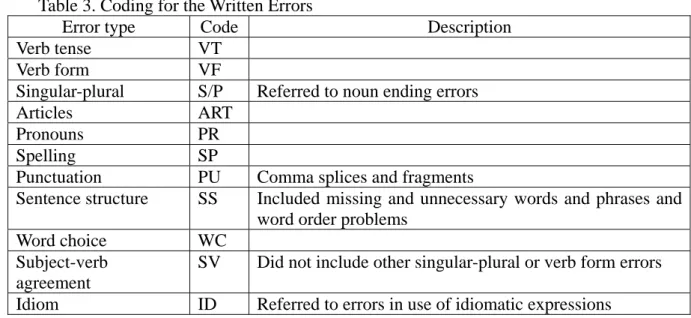
(6) asking for their self-perceived opinions toward both genres were followed after the compositions. Participants were asked to rank the difficulties they faced during the writing, namely content, grammar, spelling, expression, paragraph and punctuation (see Appendix A). Data Analysis There were sixty-one writings in total for researcher to analyze (one participant in the age group 31-40 failed to complete the narrative). Participants’ written errors were analyzed based on Ferris’s (2006) category system with the calculation of times and percentage of errors. Tenses and forms were the two major focuses on verb errors while errors on nouns were divided into singular-plural error and pronouns. The overall errors on spelling and punctuation were the other two categories. As to errors on other parts of speech such as adjectives, adverbs and prepositions, researcher found these errors failed to stand a significant portion of the overall percentage. Therefore, these errors were excluded from the error coding system. Therefore, the written error in the example sentence such as “they play very happy,” would be categorized as making one spelling error. Table 3 is the coding system for written errors in present study. Table 3. Coding for the Written Errors Error type Code Description Verb tense VT Verb form VF Singular-plural S/P Referred to noun ending errors Articles ART Pronouns PR Spelling SP Punctuation PU Comma splices and fragments Sentence structure SS Included missing and unnecessary words and phrases and word order problems Word choice WC Subject-verb SV Did not include other singular-plural or verb form errors agreement Idiom ID Referred to errors in use of idiomatic expressions RESULTS Age Groups and Narrative Appendix B shows the overall percentage and times of written errors made by participants of all age levels in both genres. For the narrative task, the common error shared by these four age groups was the sentence structure which ranged from 18.1% (51-60) up to 26.9% (41-50.) The possible reason for sentence structure error to be of this high percentage might be the general definition of this error category. As researcher mentioned above, all the missing and unnecessary words (including parts of speech such as adjective, adverb and prepositions) and phrases and word order problems were categorized into sentence structure. Though sentence structure was not the number one occurred error in the age groups of 51-60 and 21-30, it was still the top two frequently made errors among the four. On the opposite side of the scale, another shared error among the four age groups with the lowest percentage was the pronoun error which ranged only from 1.1% (21-30) to 3.6% (51-60). The possible reason could be that participants in the present study tended to 116.
(7) use the noun throughout the whole narrative writing. They were able to identify the gender of grandfather/grandson and the photographer which were main characters in the narrative task using the pronouns “he,” “his,” and “him.” But for the elephants in the pictures, participants had individual interpretations. Therefore, in order to make as little mistakes as possible, these adult writers used the noun repeatedly instead of taking risk of indentifying the wrong sex of animals. Among the four age groups, verb tense troubled less for the group 31-40 with a percentage of only 5.1%. But it was the number one made error for the 21-30 and 51-60 groups and the percentages were high up to 30.3% and 21.8% respectively. Both groups tended to make errors of verb inconsistency between the present and past tense along with subject-verb agreement problems, especially when the subjects they referred to were the third person singular. For the age 41-50 participants, the subject-verb agreement was not that a big issue because only two errors of this category were identified among five narrative writings. The age 21-30 participants made mistakes on verb forms such as “the photographer gets the paint brush and start to painting on it hardly.” The correct usage of collocation would be that the photographer “takes out” the “painting brush” and then he “starts” to “paint” on the photo. Most of them would use verbs they considered to be right based on the direct translation from Chinese to English. The majority failed to follow grammatical rules such as using the indefinite phrase after the preposition “to” to formulate their expressions. From a brighter point of view, these young adults are more willing to take a risk of trying out different verbs and making longer sentences with clauses and phrases comparing to the rest three groups. As to the misuse of singular and plural forms of nouns, only the age 31-40 had a higher percentage which was nearly 10%. Examples such as “two elephant,” “the two man,” “there are two person,” “we are good friend,” and “they are taking a photos’ were identified among these fourteen narrative writings. The young adults, the 21-30 group, had the least problem of using the correct singular and plural forms of noun compared with the rest of the three. The three participants in the 51-60 group had the highest percentage of 7.2% of making article errors. All the made errors were referred to the misuse of “the” which was missing among these three narratives. With nine narratives in total of the age 21-30 group, only one written error referring to the misuse of article was identified. Findings indicated that the percentage of the article errors had a tendency of becoming higher as the age grew. Also for the 21-30 group, spelling seemed to be relatively easy with only one spelling mistake was found with a percentage of 1.1% only. For the rest three age groups, the spelling errors were either the top two or the top three among all the errors. For the 31-40 and 41-50 groups, the percentages skyrocketed high up to 20%. Mistakes such as “san” for “son,” “wath” for “with,” “somll” for “small,” “noise” for “nose,” and “adoult” for “adult” were shared by both groups. For the eldest, since these were only three narratives in total, there was one participant in particular mistook the use of “mami elephant” for “mommy elephant” throughout the writing. The possible reason could be that these 50s have a relatively limited word bank comparing to the rest of the three groups and therefore, all they could do is to use what hey have in mind to express and play safe throughout the whole narrative writing. As for the 20s group, though they are willing to take the risk of using different words to express their ideas, they have a much larger and richer vocabulary in hand and as long as they are careful enough, the chance of making spelling errors is much smaller than the rest of the three. Another possible reason is that all participants are informed to have no time limit and they are free to use dictionaries of all kinds as well as to ask help from others. For the 40s, punctuations didn’t seem to bother them as much as the rest of the three. The 50s and the 30s groups shared the percentage of punctuation errors which was higher 117.
(8) than 10%. The comma and period was still confusing for the eldest while it was the hyphen and semicolon that troubled the 30s. They would use commas to connect two clauses and hyphens are missing when the characters in the narrative task are speaking. The 20s shared the same problems with hyphen and semicolon with a small percentage of 5.6% only. The error of word choice was the top three for the 20s, 30s and 40s. The 50s tended to play safe with a smaller word bank to use for writing while the 20s have the highest percentages of making word choice errors. They made errors on misusing nouns such as “the content of the developed picture” and misused prepositions for wrong collocations such as “the picture is different with what they thought” in their narrative writing. Age groups and Argumentative The overall percentage of errors was smaller in the argumentative than the narrative. Possible reason would be that the average number of words in one argumentative was found to be less than that in the narrative. Also instructions in English were provided before the argumentative writing. Therefore, some participants were observed to copy those sentences and used them in their writing. The top two errors shared by four groups were sentence structure and word choice. The 20s tended to make word choice errors related to the wrong preposition (“stay in home”) and the improper parts of speech (“cell phone becomes the necessary in my daily life,” and “I possessed a cell phone.”) The problem with the preposition is understandable because in Chinese there are fewer varieties of prepositions compared with English. The 30s group shared the same error pattern as well. Examples such as “cell phone is very great invent,” “through that time, we could forget the people we miss,” “yes, I agreement” and “so it so convenience” showed that these 30s shared problems on making the right choice of proper words. The only difference between 20s and 30s was that the sentences made by the 30s were even more difficult for the researcher to figure out their exact meanings. Writings collected from the 40s and 50s were mostly observed the use of direct translation from Chinese to English. Sentences such as “there are some people talking cell phones loudly,” “because every things must use to cell phones,” “use cell phone call help,” “they pull near the distances,” and ”it will do hurt to us“ were categorized as Chinese English. The percentage of making sentence structure errors was found to decrease with the age level. So it is reasonable to consider the sentence structure error as one predictor of the tendency of fossilization which is influenced by the contrastive rhetoric between L1 and L2. The percentage of making errors of the verb form in argumentative writing was lower than that of the narrative. The possible reason is that context requirement. Since narrative required a description of a series of action made by the characters, these adult writers would choose and use the most proper verbs from their word bank. While the argumentative aimed to elicit writers’ personal statement and opinions, fewer verbs were needed to reach the topic requirement. The 20s, 30s and 40s groups made the average 6% of errors in punctuation while none was observed among these three 50s. While two of the 50s failed to meet the topic requirement by composing only thirty-five words in average for their argumentative, they tended to use short sentences and glued them together simply with commas and period. Similar findings were discovered in the narrative task. Instead of using semicolon or period to separate sentences or meaningful segments, the 50s tended to use commas to connect clauses. Moving on to the spelling error, the 20s group made the least spelling errors in the narrative writing than the rest of the three. The average percentage of spelling errors for the 30s, 40s and 50s groups was up to 12% while it was almost the half for the 20s. The 20s made spelling errors such as “convince” for “convenience,” “us” for “use,” and “contect” for 118.
(9) “contact” which were identified from the text and the errors were related to the vowels. On the other hand, spelling errors like “outsine” for “outside,” “precnl” for “person,” “accendent” for “accident,” “beissness” for “business,” “supper” for “super,” “strange proof’ for “strong proof,’ and “thought’ for “though’ were made among the other three older age groups. These errors involved more than the shift of vowels and that made the overall argumentative writing much more difficult to be comprehended. The following example sentence was the written error related to pronouns: ‘If we die for cell phones, who needs it.” What the writer tried to express here was that if people got hurt and died because of cell phones, then we should stop using them. The inconsistency of referred pronouns stood in the way of the coherence of EFL writings. As for the mix up of “he” and “she,” it could be due to the contrastive rhetoric between Chinese and English in which the Chinese shares the same pronunciation for both male and female third singular. Article errors, on the contrary, bothered the 20s most in the argumentative writing. Since the 20s composed a much longer writing than the rest, they tended to forget to add articles before the singular or the mentioned nouns. The percentage of making article errors was up to 10%. Based on the literature review, the contrastive analysis indicates that English uses definite and indefinite articles before nouns while there are none for the Chinese. Singular and plural forms of nouns puzzled the 50s with the highest percentage of 14.8% among the four. Since there are no morpheme changes of nouns in Chinese, examples of errors such as “the two side” would be observed in the 50s’ argumentative. The rest three shared the average error percentage of 8.5% on this category while it was the 40s that surprisingly had the lowest percentage of 8.1% only. Possible reasons are the collected data are only five argumentative of this 40s group and they compose relatively short writings (two of them only write about sixty words in average). For these five 40s, verb tense was not an issue, either. When the percentages for the 50s, 30s and 20s were respectively 11.1%, 9,9% and 8.6%, the 40s had the lowest as to 4% only. Though for the 50s, the possible reason for such a high percentage is that they probably make spelling errors such as mistaking “became” for “become” and “hid” for “hide.” But still, based on the contrastive analysis, no morpheme changes of verbs is required in Chinese and that could be one reason for fossilization if the EFL learners fail to identify the differences between the native language and the target language. The 30s group used past tense to share self experiences which was one of the argumentative topic requirements and errors were made when they accidentally mixed up the use of the present and the past tenses together. As for the 20s, their misuse of verb tense was far more complicated than the rest of the three. The use of present perfect, past progressive tenses along with the passive voice could be observed in these 20s’ argumentative writings. Taking the risk for enriching the variety, the 20s group had a higher percentage of making errors on verb tenses. DISCUSSION This study aims to investigate the types of written errors made by different age groups in both narrative and argumentative writings. Stratified sampling was used to select thirty-one participants in total: eight in the age 21-30group, fifteen in the 31-40, five in the 41-50, and three in the 51-60. The written errors were categorized into eleven categories and differences on the types of written errors were found among four age groups and between genres. Among these four age groups, the age 21-30 group made much fewer spelling errors than the rest of the three. Few errors on the use of punctuations and articles were observed in their writings as well. They used varieties of vocabulary which were much richer than the rest. However, that also resulted in a much higher percentage of making word choice error as well as the verb tense errors. The possible explanation is that these participants in the age 21-30 119.
(10) group are equipped with a bigger vocabulary size and tend to take risk on trying out expressions using new vocabulary in different sentence structures. Overall, the age 21-30 group composes longer and readable writings than the rest of the three. The age 51-60 group made the most errors on the singular and plural forms of nouns. The possible reason is that such morpheme change is not needed in their L1, Chinese. They also made errors on the use of articles, pronouns, and punctuations which could due to the contrastive analysis between Chinese and English as well. In Chinese, no definite articles are required to add before singular nouns while it’s not the same case in English. Furthermore, Chinese share the same pronunciation of the third person singular pronouns regardless of the gender. Punctuation symbols are different between both languages as well. The analysis of the age 51-60 group writings showed that the participants failed to detect the correct timing of using the comma and period and therefore they tended to end sentences in the inappropriate meaning segments which leaded to difficulties on reading comprehensibility. However, different from the age 21-30 group, they had the lowest percentage of making word choice errors. From the analysis of their writings, it is assumed that due to their limited vocabulary size, they tend to play safe during the writing process. Their writings were mostly composed in short sentences with simple grammatical sentence structures. The average length of their writings was the shortest among the four. As for the age 41-50 group, they shared the same top three errors in both narrative and argumentative writings: sentence structure, word choice and spelling. However, they had the lowest percentage of making the subject-verb agreement errors. The age 31-40 group, on the other hand, made the most errors on the subject-verb agreement. From the analysis of their writings, the age 31-40 group also made errors on the form of singular/plural nouns. Since there are fifteen participants in this age group, the individual differences are significantly obvious. Two of them have doctoral degrees while five with the highest degree of senior high school only. Though all of them have taken standardized English tests, the diversity among participants’ background makes the generalizability lower than the rest of the three age groups. Of the overall percentages of error made in both genres, participants tended to make much more errors on word choice and sentence structure in argumentative than in narrative writings. Participants were asked to generate their own ideas from self experiences in argumentative wiring without any visual aids, such as the pictures in the narrative task. In that case, the argumentative writing is considered to be a more difficult task because participants have to think of ideas and search for proper words in their mind at the same time. In argumentative writing, words are missing and misusing in sentences with more grammatical errors than the narrative writing. The possible reason would be the cognitive burden and it’s shared among four age groups. The tendency of composing a longer writing is shown in the narrative writing. With visual hints from the comic strips, participants find it easier to have clues to write about. However, it’s also possible that the more a learner writes, the more errors s/he might make. Verb tense is the shared written errors among these adult writers, particularly the use of third person singular present tense verb and the past tenses as well, whether it’s regular or irregular. The errors in the narrative writing reveal that participants would mix up verb tenses by using incorrect verb forms which causes the inconsistency of the whole story timeline. Similar written errors could be applied to the subject-verb agreement. The most frequently made error is the third person singular present tense which adult writers are required to add the “s” or “es” at the end of the verbs when writing in English. With no such morpheme changes in Chinese, participants fail to come up with the correct verb forms. The article is another frequently made error in narrative writing than in argumentative. Articles are needed to add in front of the singular nouns in English which is not the common practice in participants’ L1. 120.
(11) The reason for less errors of the article in argumentative writing is that participants tend to use the plural form, such as the “cell phones” throughout the whole writing. PEDAGOGICAL IMPLICATIONS Participants of the age 51-60 in the present study claimed that they had been out of the school setting for quite a few years and they didn’t benefit much from previous English learning experiences. Some stated that they wanted to learn English for the purpose of going sightseeing abroad. In that case, the lesson design could be of practical usage such as tourism English. Instead of teaching isolated vocabulary and grammatical rules, the text in conversational form might motivate these EFL adult learners. The use of visual aids and the L1-based learning strategies might help enlarge their vocabulary size. As for their spelling error which is of high frequency in this age level, EFL teachers may want to introduce words which are useful during the tour such as words used in completing the application form. The age 41-50 participants tended to make written errors on spelling and word choices. The pedagogical suggestion for teaching writing would be “read to write.” Collocation could be learned through reading authentic materials. Participants of this age level claimed that their English teachers used to isolate the English vocabulary out of the context with explanations for grammatical rules. Participants expressed their doubts on such instruction and their feelings toward previous learning experiences were mostly negative. EFL teachers might want to adopt topic-based materials with ample language input related to one grammatical concept. Since participants are in the EFL setting, teachers might need to provide ample language input to familiarize students with the language use by introducing related readings. Topics could be motivating and the topic-related vocabulary would be shown in sentences with the use of collocation. Making errors on the subject-verb agreement and the word marking of singular and plural nouns, the age 31-40 group might need the knowledge on the contrastive rhetoric between Chinese and English with example sentences. Teachers could design the lessons based on the concepts of linguistic differences along with the analysis of genres between L1 and the target language. The awareness of the target audience and writing purposes should be introduced to these EFL writers and the written forms in the target language should as well be put into practice. . Collocation of nouns and verbs is one of the frequently made errors among the age 21-30 participants in this study. In average, they have shown a larger vocabulary bank than the rest of the three and teachers could make good use of such advantage by introducing types of extracurricular readings. Teachers might need to consider English writing as a dynamic and socio-cognitive activity. In that case, the project of making foreign pen pals might be one of the activities that enhance students’ cultural awareness and the use of collocation. As to the written structural errors, paragraph writing could be put into practice. The way of training can be in the form of writing academic research articles, research reports or proposals. Explicit forms of formal writing could be introduced and students are asked to follow such writing pattern to compose on assigned topics. Writing for professional purposes, such as business, could be practical for this age group which helps them meet the professional requirement. LIMITATIONS Since the present study aims to investigate types of errors different age groups would make, the coding system of written errors is crucial for the validity of this study. The used coding system, the Ferris’s in 2006, could be divided into more specific subcategories with detailed descriptions. Other aspects of speech could be put into discussion and such coding 121.
(12) system is suggested to be developed based on individual cases, such as different L1s and participants’ proficiency levels. As for the process of sampling, the response rate of questionnaires is not quite satisfying. The recruited target participants in this study are asked to pass standardized English tests first before composing narrative and argumentative writings. Researchers of the future study are suggested to cooperate with the testing institutions and data could be gathered from a larger sample pool. The low response rate in this study might be due to the way of data collection. The assigned topic, the cell phone issue for the argumentative writing, is rather difficult for some of the adult writers because they claim for having little knowledge and less interest toward such technology. The result turns out to be that some of the participants fail to meet the topic requirement of writing at least two hundred words per genre. For the future study, topics could be designed to be more attractive, interesting and easier to help motivate the adults to write more. Triangulation such as recording the verbal protocol could be added as well to get a clearer picture of how these adults actually write during the process. And since written errors is the main focus of this study, future research might want to detect what kinds of spoken errors EFL adult learners would make and what might be the causes of the fossilized errors.. 122.
(13) References Benson, M., Benson, E. & Ilson, R. (1986). The BBI Combinatory Dictionary of English. Amsterdam: Benjamins. Berman, R. & Slobin, D. (1994). Relating events in narrative: a crosslinguistic development study. Mahwah, NJ: Lawrence Erlbaum. Cahill, D. (2003). The myth of the “turn” in contrastive rhetoric. Written Communication, 20, 170-194. Ferris, D. (2006). Does error feedback help student writers? New evidence on the short- and long-term effects of written error correction. In Hyland, K. Feedback in Second Language Writing. Cambridge University Press. Halliday, M. A. K., & Ruqaiya Hasan. (1976).Cohesion in English. London: Longman. Horney, J. E. (1979). An error analysis of English composition written by Chinese students in Taiwan. Doctoral Dissertation, University of Texas, Austin. Hyland, K. (2005).Metadiscourse: Exploring interaction in writing. Continuum International Publishing Group Ltd. Jordens, P. (2001). Constraints on the shape of second language learner varieties. International Review of Applied Linguistics, 39, 51-74. Kaplan, R. (1966). Cultural thought patterns in intercultural education. Language Learning, 16(1), 1-20. Lin, C. (1989). The structures of English and Chinese narratives written by college students in Taiwan. Dissertation Abstracts International, 50(7), 2036A. Liu, C. P. (1999b). An analysis of collocational errors in EFL writings. Proceedings of the Eighth International Symposium on English Teaching, Taipei, 483-94. Matalene, C. (1985) Contrastive rhetoric: an American writing teacher in China. College English, 47(8), 789-808. Nakuma, C. K. (1998). A new theoretical account of “fossilization”: implications for L2 attrition research. International Review of Applied Linguistics, 36(3), 247-56. Nemser, W. (1961). Hungarian phonetic experiments: American council of learned societies. Research and Studies in Uralic and Altaic Languages. Project 32. Selinker, L. and U. Lakshammanan. (1992). Language transfer and fossilization: The multiple effects principle. Second Language Acquisition (pp. 197-206). Cambridge: Cambridge University Press. Silva, T. (1993). Toward an understanding of the distinct nature of L1 writing: The ESL research and its implications. TESOL Quarterly, 27(4), 657-677. Wang, W. & Wen, Q. (2002). L1 use in the L2 composing process: An exploratory study of 16 Chinese EFL writers. Journal of Second Language Writing, 11(3), 225-246.. 123.
(14) Appendix A. 您好,首先感謝您的參與,本研究為比較不同文體的英文寫作,請您寫兩篇作文,每篇 字數至少 250 字,沒有時間限制,可查字典,您的作文純為研究使用,無所謂好壞,請 就個人經驗能力書寫即可。謝謝。 作文一:請從以下兩張圖片中擇一書寫敘述文。. 124.
(15) 作文二:請就以下題目書寫一篇議論文。 “Nowadays cell phones are becoming more and more popular in our life. Some people think they bring us much convenience while others argue they make more trouble. Which view do you agree with? Express your ideas with your own knowledge or experience to support your argument.” 現在大哥大在我們生活中扮演重要角色。有些人認為大哥大帶來方便,有些則持相反的 意見。你的看法為何?用你所知以及親身經驗來支持你的論點。. 請問您覺得第一篇敘述文:()太難 ()有一點難 ()還好 ()蠻好寫的 ()太簡 單 就本篇敘述文,請將以下敘述用 1(你覺得最困擾的)到 6(你覺得最不困擾的)排序: ()內容不知道要寫什麼 ()文法不會用 ()單字拼錯 ()想表達的單字知道中文卻不知道英文 ()不知何時該分段落 ()標點符號不會用 請問您覺得第二篇議論文:()太難 ()有一點難 ()還好 ()蠻好寫的 ()太簡 單 就本篇議論文,請將以下敘述用 1(你覺得最困擾的)到 6(你覺得最不困擾的)排序: ()內容不知道要寫什麼 ()文法不會用 ()單字拼錯 ()想表達的單字知道中文卻不知道英文 ()不知何時該分段落 ()標點符號不會用. 125.
(16) Appendix B. Times and percentages of written errors made among age groups and between genres. Narrative. Argumentative. Age level. Written errors. Times. Percentage. Written errors. Times. Percentage. 51-60. Verb Tense Verb Form Singular/Plural Article Pronoun Spelling Punctuation Sentence Structure Word Choice Subject-Verb Idiom. 12 3 3 4 2 7 7 10 2 5 0. 21.8% 5.4% 5.4% 7.2% 3.6% 12.7% 12.7% 18.1% 3.6% 9% 0%. Verb Tense Verb Form Singular/Plural Article Pronoun Spelling Punctuation Sentence Structure Word Choice Subject-Verb Idiom. 3 0 4 0 2 3 0 11 4 0 0. 11.1% 0% 14.8% 0% 7.4% 11.1% 0% 40.7% 14.8% 0% 0%. Total. 55. 100%. Total. 27. 100%. Verb Tense Verb Form Singular/Plural Article Pronoun Spelling Punctuation Sentence Structure Word Choice Subject-Verb Idiom. 5 3 3 3 2 13 3 17 11 2 1. 7.9% 4.7% 4.7% 4.7% 3.1% 20.6% 4.7% 26.9% 17.4% 3.1% 1.5%. Verb Tense Verb Form Singular/Plural Article Pronoun Spelling Punctuation Sentence Structure Word Choice Subject-Verb Idiom. 2 2 4 0 2 6 3 18 12 0 0. 4% 4% 8.1% 0% 4% 12.2% 6.1% 36.7% 24.4% 0% 0%. Total. 63. 100%. Total. 49. 100%. Verb Tense Verb Form Singular/Plural Article Pronoun Spelling Punctuation. 8 7 14 7 2 30 17. 5.1% 4.5% 9% 4.5% 1.2% 19.3% 10.9%. Verb Tense Verb Form Singular/Plural Article Pronoun Spelling Punctuation. 14 6 14 2 1 18 8. 9.9% 4.2% 9.9% 1.4% 0.7% 12.7% 5.6%. 41-50. 31-40. 126.
(17) 21-30. Sentence Structure Word Choice Subject-Verb Idiom. 33 19 18 0. 21.2% 12.2% 11.6% 0%. Sentence Structure Word Choice Subject-Verb Idiom. 47 27 4 0. 33.3% 19.1% 2.8% 0%. Total. 155. 100%. Total. 141. 100%. Verb Tense Verb Form Singular/Plural Article Pronoun Spelling Punctuation Sentence Structure Word Choice Subject-Verb Idiom. 27 6 4 1 1 1 5 19 18 7 0. 30.3% 6.7% 4.4% 1.1% 1.1% 1.1% 5.6% 21.3% 20.2% 7.8% 0%. Verb Tense Verb Form Singular/Plural Article Pronoun Spelling Punctuation Sentence Structure Word Choice Subject-Verb Idiom. 8 2 8 9 3 6 7 23 24 3 0. 8.6% 2.1% 8.6% 9.6% 3.2% 6.4% 7.5% 24.7% 25.8% 3.2% 0%. Total. 89. 100%. Total. 93. 100%. 127.
(18)
數據
相關文件
Table 12 : Sampling errors of per-capita shopping spending of interviewed visitors, by place of residence and type of expense. Table 13 : Interviewed visitors’ comments on
Table 12 : Sampling errors of per-capita shopping spending of interviewed visitors, by place of residence and type of expense. Table 13 : Interviewed visitors’ comments on
For the assessment of Reading, Writing (Part 2: Correcting and Explaining Errors/Problems in a Student’s Composition) and Listening, which does not involve the use
In the following we prove some important inequalities of vector norms and matrix norms... We define backward and forward errors in
To improve the convergence of difference methods, one way is selected difference-equations in such that their local truncation errors are O(h p ) for as large a value of p as
Each unit in hidden layer receives only a portion of total errors and these errors then feedback to the input layer.. Go to step 4 until the error is
Time constrain - separation from the presentation Focus on students’ application and integration of their knowledge. (Set of questions for written report is used to subsidize
Microphone and 600 ohm line conduits shall be mechanically and electrically connected to receptacle boxes and electrically grounded to the audio system ground point.. Lines in
