國立臺灣大學文學院語言學研究所 碩士論文
Graduate Institute of Linguistics College of Liberal Arts National Taiwan University
Master Thesis
從認知語意學觀點探討中文「婊」一字的語意變遷 A Cognitive Semantic Perspective on the Semantic
Change of 婊 biǎo in Mandarin Chinese
林育珊 Yu-Shan Lin
指導教授:呂佳蓉 博士 Advisor: Chiarung Lu, Ph.D.
中華民國 109 年 3 月
March 2020
Acknowledgements
完成這篇論文的當下,心中滿是激動與感謝。寫論文的過程中真的受到了許 多人的幫助與關心。致謝詞雖短,但包含無限謝意。
謝謝指導教授呂佳蓉老師。老師總是很有耐心的傾聽我的想法與我討論,並 總能提點我、鼓勵我,給予許多很棒建議。謝謝我的口試委員賴惠玲老師以及鍾 曉芳老師。兩位老師提供了研究方法、論述、寫作上的建議,讓我得以將論文撰 寫得更加完整有邏輯。也謝謝謝舒凱老師,願意借我參考文獻替我解惑。
再來,要感謝呂老師團隊的夥伴們: Thomas、Alex、阿良、阿陞、Craig、
Nick、Andrew 幾位學長們、清華學姐、祖寧學姐、穎昌,感謝大家在討論課時提
供諸多的建議,每一次討論都讓我的論文更加豐富細膩。謝謝 R05 的夥伴們,很
高興能認識大家,一起舉辦活動、一起修課。特別感謝大成在 python 程式運用上 的幫助,讓我在分析資料更加順利。此外,Joy、Sally、Taco、葉遲、Ivy、Chester 學長、殷罄,在 302 拼論文的時候,因為有你們的陪伴總能消除心中的煩躁不安,
謝謝你們!
謝謝我的父母,讓我無後顧之憂完成學業、一步一步達成理想,我愛你們!
謝謝我的妹妹和弟弟給我的愛的鼓勵,陪我突破關卡。謝祐萱和榆萱,總在我低 潮的時候激勵我。謝謝你們一直以來的陪伴與包容!
求學路程漫長,一路走來要感謝的人太多,無法一一列舉,實感抱歉。但真 心感謝生命中遇見的所有人,沒有你們就沒有今天的我,謝謝大家!
論文未臻完美,尚有不足之處皆為我的責任。希望未來有機會使其更加完整。
最後期勉自己勿忘初衷,繼續朝下一旅程邁進。
摘要
本研究旨在探討中文中「婊」一字的語意變遷以及語意發展──「婊」一字 原來為詈罵語,作名詞使用,但在現代用法中也可以當作謂語。應用 Evans (2005) 提出的「原則性多意模型理論」以及 Traugott 與 Dasher (2002) 所提出的「語意變
遷的導引推論理論」,我們不僅分析、說明「婊」一字在現代用法中衍伸出的多個
語意,也整合繪出此字的語意網絡圖,並藉由追朔此字字源、歷時性的語意變遷,
結合導引推論理論的鐘形圖示,闡釋了此字在變遷的過程中所牽涉的隱喻、轉喻 等認知機制以及文化與社會因素。此外,我們也比對分析「婊」一字在「PTT 實 業坊」以及「新聞報紙」兩個不同語域中的使用情形,例如該字在兩個語域中的 詞類分布以及語意韻等等,藉此讓我們更了解次文化對於主流文化的影響。總結 來說,本研究藉由深入探討「婊」一字的語意變遷以及發展,除了闡釋語言與文 化錯綜複雜的關係,同時也一探認知機制在語意變遷的過程中的運作,並增加多 義詞研究的豐富度。
關鍵詞:認知語意學、多義詞、詈罵語、髒話、空間隱喻、文化研究、語意變遷、
語意韻
Abstract
This study focuses on the semantic change and development of the word 婊 biǎo, which is once used as an expletive, and then has developed a predicate usage in the modern era. We apply not only the model of Principled Polysemy (Evans 2005) to illustrate the semantic network of 婊 biǎo, but the Invited Inferencing Theory (Traugott and Dasher 2002) for its semantic change as well as some possible cultural and social factors. In addition, we compare and contrast how the word is used (e.g., the semantic prosody, the distribution of syntactic categories) in two registers—PTT forum and newspapers, enables us to understand more about the influence of the subculture on the main culture. Through the analysis, we illustrate not only the relation between language and culture but how cognitive mechanisms function during semantic change. Moreover, we provide a complete description and semantic network for the word 婊 biǎo, which complements the research gap of Chinese study on this word.
Keywords: Cognitive Semantics; polysemy; expletives; spatial metaphor; cultural meaning; semantic change; semantic prosody
Table of Contents
摘要 ii
Abstract i
Table of Contents ... iv
List of Figures ... vi
List of Tables ... viii
Chapter 1 Introduction ... 1
1.1 Motivation and the Issue ... 1
1.2 Research Questions ... 3
1.3 Organization of the Thesis ... 4
Chapter 2 Literature Review ... 5
2.1 Theoretical Framework ... 5
2.1.1. A Cognitive perspective on Word Meaning and the Model of Principled Polysemy ... 5
2.1.2. Metaphor and Metonymy ... 9
2.1.3. The Invited Inferencing Theory of Semantic Change ... 15
2.1.4. A Cognitive Semantic Perspective on Conversion ... 18
2.1.5 Semantic Prosody ... 19
2.1.6 Image Schemas in Cognitive Grammar ... 21
2.2 Relative Studies on the Expletive 婊 biǎo ‘bitch’ in English and Chinese ... 23
2.2.1 The English Expletive bitch ... 23
2.2.2 The Chinese Expletive 婊 biǎo ... 25
2.3 Spatial Metaphor and Human Relationships in Chinese Culture... 27
2.4 Interim Summary ... 30
Chapter 3 Methodology ... 31
3.1 Database ... 31
3.2 Categorization of Data ... 33
3.2.1 Data Tagging ... 33
3.2.2 Senses ... 34
3.2.3 Semantic Prosody ... 34
Chapter 4 Semantic development of the polysemy 婊 biǎo ... 39
4.1 Modern Usage of Newly-emerging 婊 biǎo ... 39
4.1.1 Nominal 婊 biǎo ... 39
4.1.2 Verbal 婊 biǎo ... 42
4.2 Mechanisms for the Semantic Change of Modern 婊 biǎo ... 52
4.2.1 The Semantic Change of Nominal 婊 biǎo ... 52
4.2.2 The Semantic change of Verbal 婊 biǎo ... 55
4.3 Diachronic Analysis on 婊 biǎo ... 65
4.3.1 From Entity-denoting 表 biǎo to Space-denoting 表 biǎo ... 66
4.3.2 From Space-denoting 表 biǎo to Relationship-denoting 表 biǎo . 69 4.4 Interim Summary ... 74
Chapter 5 The Semantic Prosody of 婊 biǎo ... 78
5.1 Synchronic Perspective ... 78
5.1.1 Collocates of Different Syntactic Categories ... 78
5.1.2 Context Tendency for Different Syntactic Categories ... 84
5.2 Comparison and Contrast of Semantic Prosody between Two Registers 87 Chapter 6 Conclusion ... 94
6.1 Summary of the study ... 94
6.2 Implications and Future study ... 96
Reference 98 Online Reference Resource ... 104
List of Figures
Figure 2.1 The Semantic Network for time (Evans, 2005: 52) ... 9
Figure 2.2 Typical Conceptual Integration Network (Fauconnier and Turner, 1998: 13) ... 14
Figure 2.3 The Figure-ground Effect between Two Elements of a Frame (Koch 2012: 267) ... 15
Figure 2.4 Model of the Invited Inferencing Theory of Semantic Change ... 17
Figure 2.5 Different Profile of Expressions Related to wheel (Langacker, 2008: 67) ... 21
Figure 2.6 Image Schemas for the Two Propositions (Langacker, 2008: 71) ... 22
Figure 2.7 Icons of Image Schemas in Cognitive Grammar ... 22
Figure 2.8 Image Schema for the Verb enter (Langacker, 2008: 117) ... 23
Figure 3.1 An Example for the Tagging Process of the Data ... 33
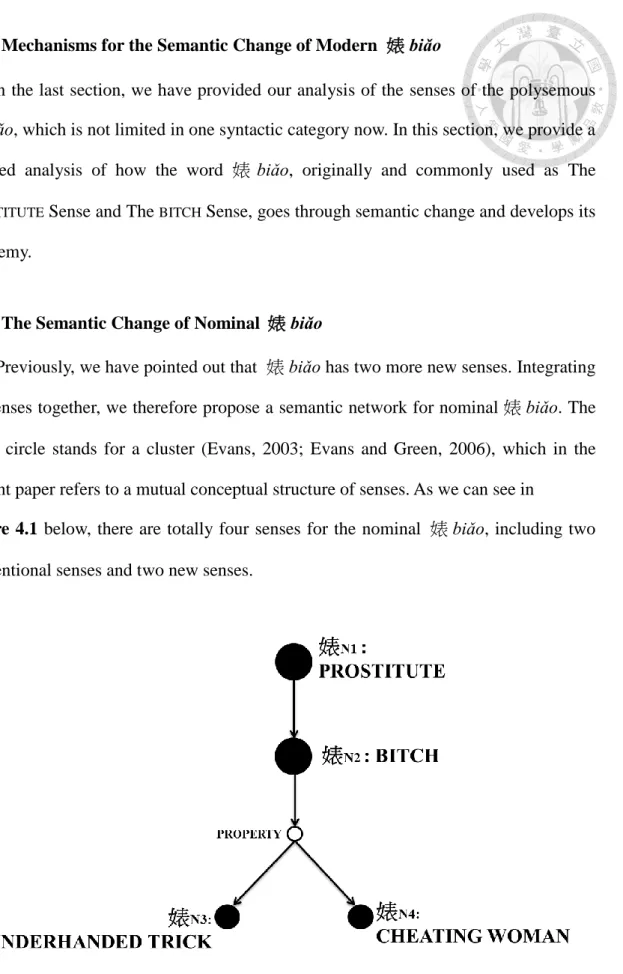
Figure 4.1 Semantic Network for Nominal 婊 biǎo ... 52
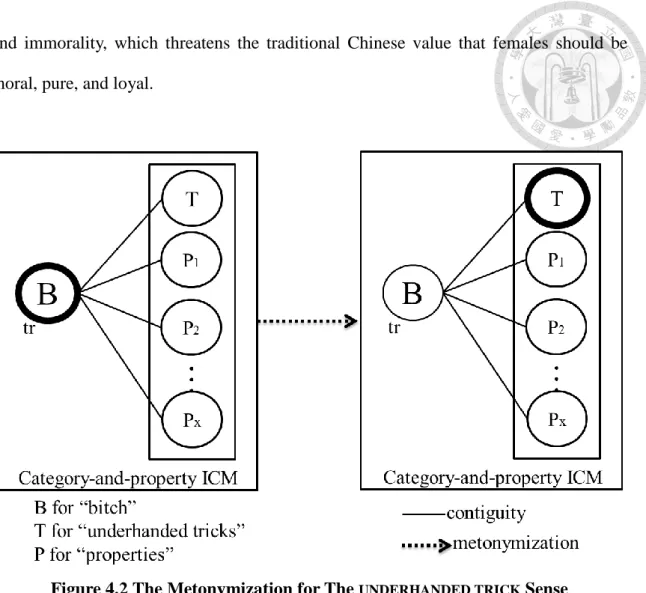
Figure 4.2 The Metonymization for The UNDERHANDED TRICK Sense ... 54
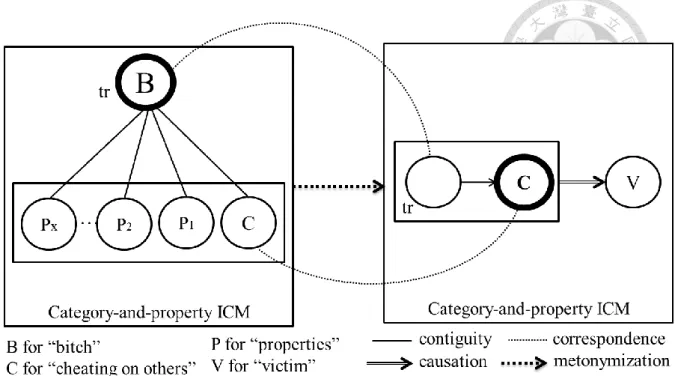
Figure 4.3 The Metonymization for The CHEATING WOMAN Sense ... 55
Figure 4.4 Semantic Network for Activity Verb 婊 biǎo ... 56
Figure 4.5 The metonymiztion of senses related to EXPRESSING DISSATISFACTION ... 57
Figure 4.6 The Metonymization of The TROUBLING Sense ... 58
Figure 4.7 The metonymization of The TRICKING Sense ... 58
Figure 4.8 The Metonymization of The DISCLOSING Sense ... 59
Figure 4.9 The Semantic Network for State Verb 婊 biǎo ... 60
Figure 4.10 The Metonymization of The DESPICABLE Sense ... 61
Figure 4.11 The Metonymization of The ANNOYED Sense ... 62
Figure 4.12 The Metonymization of The IRONIC Sense... 64
Figure 4.13 Semantic Change from The OUTER GARMENT Sense to The OUTER Sense ... 68
Figure 4.14 The Conceptual Integration Network for 內子 nèizǐ and 表子 biǎozi ... 71
Figure 4.15 The Semantic Network for 表 biǎo ... 73
Figure 4.16 The semantic network for 表 biǎo and 婊 biǎo ... 75
Figure 4.17 Model of the IITSC for 表 biǎo ... 76
Figure 4.18 Model of the IITSC for 婊 biǎo ... 77
Figure 5.1 Context Tendency of each Syntactic Category ... 84
Figure 5.2 Context Tendency of Nominal 婊 biǎo in the Two Registers ... 89
Figure 5.3 Context Tendency of Activity Verb 婊 biǎo in the Two Registers ... 90
Figure 5.4 Sense Distribution of Activity Verb 婊 biǎo in the Two Registers ... 91 Figure 5.5 Context Tendency of State Verb 婊 biǎo in the Two Registers ... 93
List of Tables
Table 2.1 Mappings for LOVE IS A JOURNEY metaphor ... 12
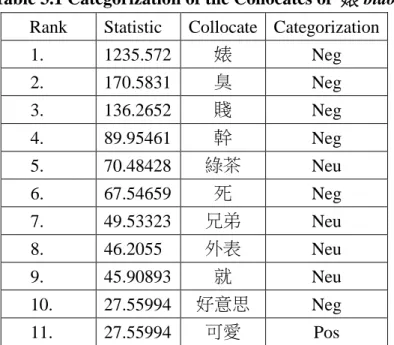
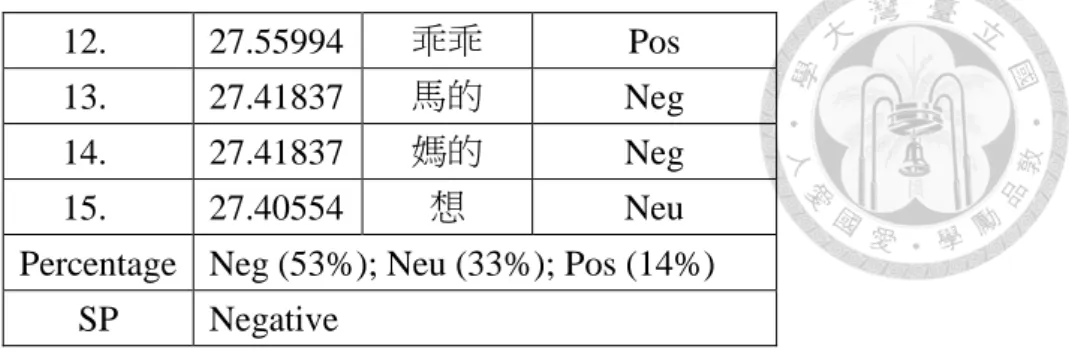
Table 3.1 Categorization of the Collocates of 婊 biǎo ... 35
Table 3.2 An example for Positive semantic prosody ... 36
Table 3.3 An example for Negative semantic prosody ... 37
Table 5.1 Top Twenty-five Collocates of the Nominal 婊 biǎo ... 78
Table 5.2 Top Twenty-five Collocates of the Activity verb 婊 biǎo ... 81
Table 5.3 Top Twenty-five Collocates of the State Verb 婊 biǎo ... 83
Table 5.4 Collocates of Nominal 婊 biǎo in the Two Registers ... 87
Table 5.5 Collocates of Activity Verb 婊 biǎo in the Two Registers ... 89
Table 5.6 Comparison of Collocates of the State Verb 婊 biǎo in the Two Registers ... 91
Chapter 1 Introduction
1.1 Motivation and the Issue
Expletives play an important role in a culture. How these words come into existence can inform us about the social and historical backgrounds of a culture. In addition, as a part of the language, these words may inevitably go through linguistic changes (e.g., amelioration), which usually involve various social and cultural factors as well. For instance, English expletive bitch, according to Collin (1984), has had a colorful and busy past. The main meaning of this word is “female animal, particularly a canine.” It became applicable to a human female, which highlights the similarity in sexual behavior of human and nonhuman beings, with the underlying cultural value of Christian morality.
Similar to English bitch, in Chinese, we also have an expletive for degrading females, which is called 婊子 biǎozi, an expression highlighting the sexual behavior of an immoral female and showing the similar value that women should be moral. What is different from English, however, is that the semantic development of 婊子 biǎozi involves a more complex spatial metaphor and culture-specific value in terms of human relationships in Chinese culture. According to Xu (2011), the expression 婊子 biǎozi is originally written as 表子 biǎozi, which refers to “a concubine or a secret lover.” This phenomenon arouses our interests since the word 表 biǎo, which is commonly used as a spatial term denoting “outer, outside, or surface,” is used in the domain of human relationships. On the other hand, Hu (2016) provides a detailed diachronic linguistic study. He indicates how the expression goes through reanalysis and gradually changes from a neutral term 表子 biǎozi ‘a concubine or a secret lover’ to a degrading term.
However, neither Xu (2011) nor Hu (2016) provides further explanations for how and why people use 表子 biǎozi to refer to ‘a concubine or a secret lover’. Therefore, we
found a research gap in investigating the semantic development and semantic change from the word 表 biǎo to the expletive 婊 biǎo, which involves culture-specific value as well as a series of steps of semantic change.
The semantic change, however, does not reach an end. When we look up the expletive 婊 biǎo in the Online Dictionary from the Ministry of Education (henceforth ODMOE), we can find two definitions, as shown in (1). The first definition is “a prostitute,” in (1a) and the second one is “an expletive to female” in (1b).
(1) a. 俗稱 以 性交易 為業 的 女子。
súchēng yǐ xìngjiāoyì wéiyè de nǚzǐ
‘Usually refers to a prostitute’
b. 俗 以為 辱罵 女人 的 粗話,
sú yǐwéi rǔmà nǚrén de cūhuà
含 貶義。
hán biǎnyì
‘An expletive to females, with a degrading sense’
Nonetheless, it will be anomalous if we use the two definitions above to interpret (2) and (3) below, which are found in an online forum called PTT.
(2) 每到 夜深人靜 的 此時 正是 每個
měidào yèshēnrénjìng de cǐshí zhèngshì měigè
公主 嗷嗷待哺 的 時候 (自婊 無誤 XDD)
gōngzhǔ áoáodàibǔ de shíhòu zìbiǎo wúwù
‘Every night at this moment, every princess is waiting for someone to buy late-night supper for them. (I’ m just teasing at myself XDD)’ (from PTT corpus)
(3) 整天 住 別人 家 整天 發勞騷
zhěngtiān zhù biérén jiā zhěngtiān fāláosāo
整天 耍 婊
zhěngtiān shuǎ biǎo
‘…lives in other people’ s houses, keeps complaining about everything, and plays underhanded tricks all day long…’ (from PTT corpus)
These two examples indicate that 婊 biǎo has gone through a semantic change and develops as a polysemous word, whose senses should be inferred from different contexts. Moreover, 婊 biǎo in today’s usage serves as different syntactic categories.
For instance, apart from (2) and (3), we can find expressions such as 婊人 biǎorén, 自 婊zìbiǎo, and 很婊 hěnbiǎo in the Internet forum. In addition, it seems that 婊 biǎo as a verb form is less negative than 婊 biǎo as a nominal form, especially when speakers want to tease at themselves, as (2) shows.
The linguistic phenomena mentioned above have not been discussed in previous studies, nor have dictionaries and Chinese Wordnet recorded the newly emerging meanings and expressions of 婊 biǎo. Therefore, the present paper aims to provide a detailed analysis of the semantic development of the expletive 婊 biǎo, within the perspective of Cognitive Linguistics.
1.2 Research Questions
We have pointed out several important points in previous sections about the semantic change and the issue of the newly-emerging polysemous 婊 biǎo. To explore the linguistic phenomena, we will focus on the following three research questions.
(i) How many senses does the newly-emerging polysemous 婊 biǎo have?
(ii) What mechanisms are involved during the semantic change of the word?
(iii) What can we infer from the semantic prosody of the word during the semantic change?
1.3 Organization of the Thesis
The thesis consists of six chapters. Chapter 1 provides an overview of the thesis. In Chapter 2, we introduce the theoretical frameworks and three studies on semantic change of expletives—the English one bitch and the Chinese one 婊子 biǎozi. Chapter 3 introduces the methodology, including how we collect and categorize our data.
Chapter 4 presents the analysis on the senses of the newly-emerging 婊 biǎo as well as the diachronic and synchronic semantic change of 婊 biǎo, where we also provide explanations for semantic change and the semantic networks of the word. Chapter 5 discusses some implications from the semantic change of the word, including cultural issues, semantic prosody of the word, and how it is used in two different registers—the online forum PPT and newspapers. Finally, Chapter 6 provides a conclusion and suggestions for future studies.
Chapter 2 Literature Review
2.1 Theoretical Framework
In this section, we introduce theories and theoretical terms that are applied in the present study, including the cognitive perspective to polysemy and the model of Principled Polysemy (Evans, 2004, 2005; Evans and Tyler, 2004a, 2004b; Evans and Green, 2006; Tyler and Evans, 2001b, 2003), the concept of metaphor and metonymy, the Invited Inferencing Theory of Semantic change (Traugott and Dasher, 2002), the cognitive semantic approach to conversion (Martsa, 2013), and finally the concept of semantic prosody.
2.1.1. A Cognitive perspective on Word Meaning and the Model of Principled Polysemy
Cruse (2011: 53) points out that “…all meaning, whether conventionally associated with a linguistic expression or expressions, or whether it arises by pragmatic construal, is conceptual in nature.” A concept is a “mental construct” that represents the correspondence to “a coherent category” of things in a world, and is therefore vital to human activities such as communication, learning, and so on. Concepts result from categorization, which helps to organize the concepts within the network of encyclopaedic knowledge, and which is therefore central to the human conceptual system in terms of knowledge representation as well as linguistic meaning (Evans and Green, 2006).
Categorization is essential to cognition so that Cognitive Linguistics takes a specific perspective in the study of polysemy, which is to analyze polysemy as a form of categorization (Lewandowska-Tomaszczyk, 2007). In the 1970s, cognitive psychologist Eleanor Rosch proposed in her early research (e.g., Rosch, 1978; Rosch and Mervis,
1975) that humans categorize “with reference to a prototype” instead of the necessary and sufficient conditions by the classical theory. Briefly speaking, the prototype theory indicates that (i) there are central and peripheral members in a category, and a particular member of the category occupies a focal position since it exhibits the most salient features of the category; (ii) members in a category exhibit “a family resemblance structure.” This prototype-based conception of categorization influences the development of a cognitive approach to lexical semantics, characterized by the following assumptions (summarized from Evans and Green, 2006):
(i) Similar to non-linguistic conceptual categories, “words and their senses represent conceptual categories.” Consequently, linguistic categories have prototype structure.
(ii) Word meanings are typically polysemous, and are organized relative to a prototype or prototypes. Therefore, lexical categories form radial categories, which are modeled in terms of a radiating lattice configuration.
(iii) Radial categories, especially meanings extended from the prototype, are motivated by general cognitive mechanisms—conceptual metaphor and image schema transformations.
(iv) Distinct senses constituting radial categories are stored in long-term semantic memory rather than being generated.
The application of prototype theory can be seen in Brugman (1981), Brugman and Lakoff (1988) and Lakoff (1987) for their analysis on the English preposition over.
However, Lakoff’s approach (also called the full-specification approach) does not provide principled criteria for determining distinct senses and consequently results in proliferation of senses (see Sandra and Rice, 1995; Sandra, 1998; Evans and Green, 2006). Therefore, to make semantic network analyses more objective, Evans and Tyler
proposed the Principled Polysemy approach (Evans, 2004, 2005; Evans and Tyler, 2004a, 2004b; Tyler and Evans, 2001, 2003), in which a set of criteria is specified to distinguish each distinct sense. Originally for analyzing prepositions, the approach can also be applied to analysis on other syntactic categories (Evans and Green, 2006). In Evans (2005), he deals with the issue of polysemy of the lexeme time within the framework of cognitive linguistics (i.e., the assumptions that we have mentioned above).
He considers how the range of senses associated with this form can be accounted for in a principled and systematic manner by applying the Principled Polysemy Model.
The range of distinct senses constitutes a motivated semantic network that is organized with respect to a central Sanctioning Sense (i.e., the prototypical sense as a center of a semantic network), which is determined as follows:
(i) historically earliest attested meaning
(ii) predominance in the semantic network, in the sense of type-frequency (iii) predictability regarding other senses
(iv) a sense which relates to lived human experience of time (i.e., experience at the phenomenological level)
Centering on this Sanctioning Sense, other distinct senses represents a radial-like structure and constitute a word’s semantic network. For determining each distinct sense, Evans proposes the following three criteria as principles (Evans 2005: 41):
(i) Meaning Criterion: If a sense is counted as distinct, it must contain additional meaning which is not apparent in any other senses. For instance, time in “The time for a decision has arrived” denotes the Moment Sense, while time in “They bought the cashmere scarves at £50 a time” denotes the Instance Sense.
(ii) Concept Elaboration Criterion: This criterion is related to “semantic selection restrictions.”A distinct lexical concept is characteristic of unique or highly
distinct patterns of concept elaboration. Namely, certain lexical items appear in syntagmatic or collocational relationship with each distinct lexical concept. For instance, the expression “The time sped by” indicates the Agentive Sense of time.
(iii) Grammatical Criterion: If a sense is counted as distinct, it may manifest unique or highly distinct structural dependencies. For instance, time as a nominal can be a count noun, a mass noun, or a proper noun.
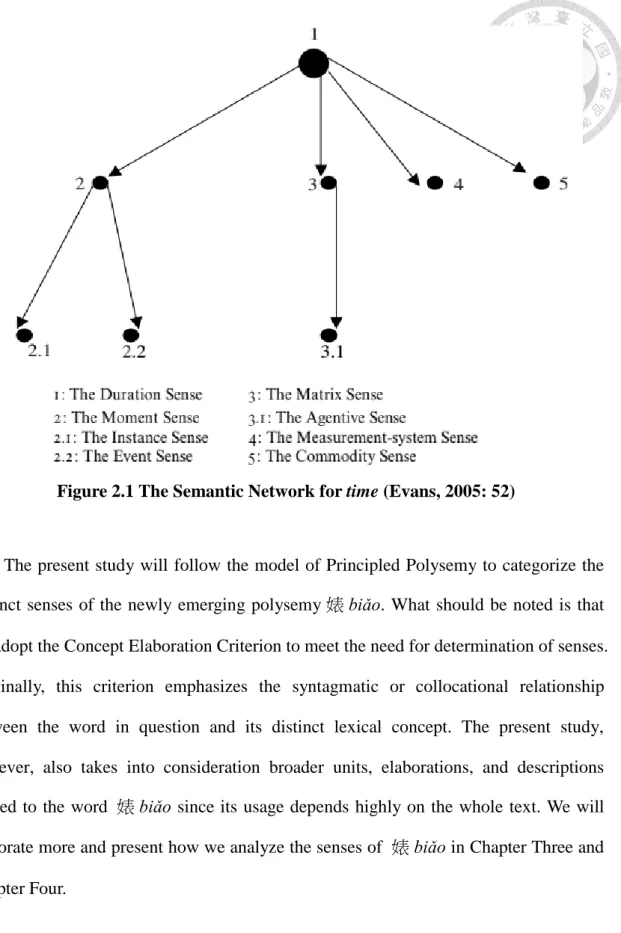
By applying the above-mentioned criteria, Evans (2005) provides a semantic network for time, with eight distinct senses in total, as shown in Figure 2.1 below. Here we only take the Duration Sense as an example to illustrate how Evans applies the above principles and criteria. He considers the Duration Sense as the Sanctioning Sense in that it is the earliest attested meaning associated with the lexeme time according to The Oxford English dictionary. In addition, it is regarded as a distinct sense since (i) in terms of the Concept Elaboration Criterion, it appears to be felt as if it is “passing”
wither “quickly” or “slowly,” as (1) shows; (ii) it can only be used as a mass noun, exemplified by (2).
(1) The time has sneaked/tiptoed by/past.
(2) *A time drags when you’re bored.
Figure 2.1 The Semantic Network for time (Evans, 2005: 52)
The present study will follow the model of Principled Polysemy to categorize the distinct senses of the newly emerging polysemy 婊 biǎo. What should be noted is that we adopt the Concept Elaboration Criterion to meet the need for determination of senses.
Originally, this criterion emphasizes the syntagmatic or collocational relationship between the word in question and its distinct lexical concept. The present study, however, also takes into consideration broader units, elaborations, and descriptions related to the word 婊 biǎo since its usage depends highly on the whole text. We will elaborate more and present how we analyze the senses of 婊 biǎo in Chapter Three and Chapter Four.
2.1.2. Metaphor and Metonymy
In this section, we briefly introduce the notion of metaphor and metonymy.
However, we need first to introduce three terms used in the following paragraphs—frames, domains, and Idealized Cognitive Model (henceforth ICMs), all of which presenting how human beings characterize the structured encyclopedic knowledge connected with linguistic knowledge. The term “frame” is used as a linguistic term by Charles J. Fillmore, who develops Frame semantics, relating linguistic semantics to encyclopedic knowledge. For instance, to understand the word
“sell,” we need to know first the situation of commercial transfer that involves elements such as a seller, a buyer, goods, money, and the various relations between each element, and so on. Namely, the word “sell” activates a frame of semantic knowledge relating to specific concepts highlighted by the word (in this case, the COMMERCIAL EVENT frame).
A more explicit treatment of “domains” can be found in Langacker (1987: 488), in which a domain is “a coherent area of conceptualization relative to which semantic units may be characterized.” Particularly, any mental experience, representational space, concept or conceptual complexes, as well as any elaborate knowledge system, can be a domain.
Finally, ICMs, according to Lakoff (1987), are relatively stable mental representations or structures that enable human beings to organize knowledge about the world, which also account for category structures and prototype effects. Each ICM is a complex structured whole, or a gestalt, and their role is to provide the background knowledge that can be recruited to structure mental spaces. For instance, the category
MOTHER is structured by a cluster model consisting of a number of converging ICMs.
Namely, there are a number of different MOTHER subcategories such as the birth model, the genetic model, and so on, all of which may categorize a real mother. In addition, the composition of ICMs depends on five sorts of structuring principles, and consequently results in five kinds of ICMs: (i) image schematic ICMs; (ii) propositional ICMs; (iii)
metaphoric ICMs; (iv) metonymic ICMs; (v) symbolic ICMs. Here we explain (i), (ii), (v), and retain (iii) and (iv) to the following sections.
(i) Image schematic ICMs: Image schemas serve as the foundation for our conceptual structure. For instance, image schemas such as CONTAINER and
UP-DOWN structure our ICM forconcepts of SPACE.
(ii) Propositional ICMs: Propositional ICMs consists of propositional or factual knowledge. For instance, our knowledge of classifying biological systems such as plants and animals emerges from a propositional ICM.
(v) Symbolic ICMs: This kind of ICM represents the knowledge structures similar to Fillmore’s semantic frames, illustrated by the example sell in COMMERCIAL EVENT frame above. It is described as symbolic in that it is explicitly structured by language, which means its structure contains symbolic units.
From the above studies, we can see that scholars use such different terms as frames, domains, and ICMs. According to Cienki (2007), however, each of the terms “frame,”
“domain” and “ICM” refer to a kind of knowledge structure that serves as a background for interpreting the meaning of linguistic forms though they seem to find their best functional home within one or two specific theoretical frameworks. To reach consistency, the present study uses the term ICM proposed by Lakoff (1987) instead of the other two terms1 since ICMs have been used as analytic tools in research on lexical and morphological semantics, polysemy, and the syntax and semantics of grammatical constructions, which caters to the core analysis of the present study.
1 Still, we follow Lakoff and Johnson’s use of the two terms “source domain” and “target domain” in the following review of metaphor.
2.1.2.1 Metaphor
Lakoff and Johnson, in their book Metaphors we live by (1980), propose the Conceptual Metaphor Theory (henceforth CMT). They point out that metaphor should be considered not as a matter of poetic expression but as a matter of human thought processes, which shows the first proposition of CMT that “the human conceptual system is metaphorically structured and defined” (ibid.: 6). Based on this claim, the second proposition of CMT is that conceptual structures are organized according to mappings or correspondences (in the form of alignment) between conceptual domains—target domains and source domains. Take the common metaphor LOVE IS A JOURNEY, for instance. The correspondence is shown in the following Table 2.1 (adapted from Kövecses, 2002 by Geeraerts, 2010), which illustrates how people conceptualize the concept LOVE in terms of the concept JOURNEY, exemplified by expressions such as
“This relationship is a dead-end street.”
Table 2.1 Mappings for LOVE IS A JOURNEY metaphor
SOURCE: JOURNEY TARGET: LOVE
the travelers the lovers
the means of transport the relationship itself the journey the evolution of the relationship the obstacles encountered the difficulties experienced decisions about which way to go choices about what to do
the destination of the journey the goals of the relationship
Last but not least, conceptual metaphors are grounded in experience—the notion of embodiment, specified by Johnson (1987) through identifying “image schemas,” which are defined as “recurring dynamic patterns of our perceptual interactions and motor programmes that give coherence and structure to our experience” (ibid.: xiv). For instance, the expression enters into a depression elucidates how the image schema
CONTAINMENT is utilized in that people regard the abstract emotional condition as a container that restricts a person’s behavior.
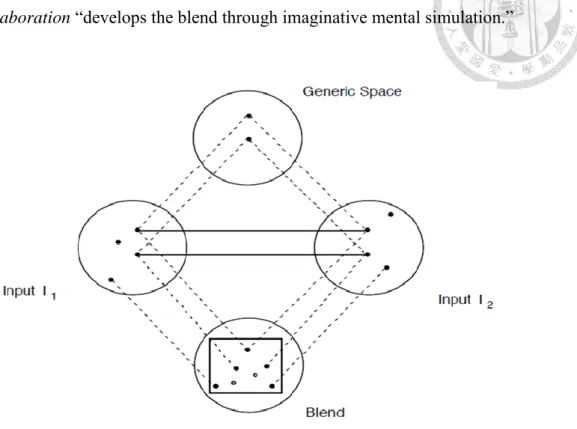
CMT attracts a tremendous amount of research and has been expanded in numerous directions. One influential theoretical extension of CMT is Conceptual Integration Network, also called blending theory, proposed in Fauconnier (1994, 1997), Fauconnier and Turner (1994, 1997, 1998, 2002). According to their proposal, blending is “a general cognitive operation that includes analogy, recursion, mental modeling, conceptual categorization, and framing” (Fauconnier and Turner, 1998: 1). Serving a variety of cognitive purposes, therefore, it represents a “dynamic, supple, and active”
process in the moment of thinking. With blending, conceptual relations between different mental spaces often undergo compression, which enables human beings to create effective and powerful structure in the blend. Figure 2.2 represents the typical conceptual network of this theoretical framework. In this model, four mental spaces are presented—the input structures, generic structure, and blend structure—all of which are used generally to model dynamical mappings in thought and language.
Each input space is a partial structure representing the different frames or domains.
The cross-space mapping connects the counterparts between the two inputs. The generic space contains what the two input spaces have in common. The concepts and materials in the two inputs partially and selectively projected onto a new space called the blend space, which contains an emergent structure that does not appear in the inputs. Note that three operations are involved in deriving the emergent structure.
(i) Composition of elements provides relations that do not exist in the separate inputs, gives rise to the blend space.
(ii) Completion refers to the operation that a great range of background conceptual structure and knowledge are activated, though we are unconscious of the
process.
(iii) Elaboration “develops the blend through imaginative mental simulation.”
Figure 2.2 Typical Conceptual Integration Network(Fauconnier and Turner, 1998: 13)
2.1.2.2 Metonymy
Kövecses, from the cognitive linguistic viewpoint, defines metonymy as follows:
Metonymy is a cognitive process in which one conceptual entity, the vehicle, provides mental access to another conceptual entity, the target, within the same domain, or idealized cognitive model (ICM).(Kövecses, 2002: 145).
The basis of metonymy lies in the notion of contiguity (Kövecses and Radden, 1998;
Peirsman and Geeraerts, 2006), which, according to Koch (2012), means the ideas, memories, and experiences are linked when one is frequently experienced with the other.
For instance, we can say that the two words nurse and doctor are in a contiguous relation in that they belong to the same knowledge structure called HOSPITAL. In addition to contiguity, the concepts of “figure and ground” as well as “profiling” also
play a crucial role in metonymy, which is characteristic of “a shift in profile”
(Langacker, 2008: 69). For instance, when a customer says I’m the tiramisu (in the restaurant context), the profile shifts from the dessert to the person who ordered it.
Koch (2012) demonstrates the importance of the cognitive relation of contiguity in semantic and lexical change. In the process of metonymic lexical change, there is always a shift of profiling between not only elements themselves but elements and their background knowledge structure, as Figure 2.3 illustrates.
Figure 2.3 The Figure-ground Effect between Two Elements of a Frame (Koch 2012: 267)
In addition, Kövecses and Radden (1998), by appyling the notion of ICM, specify a variety of metonymic tpyes that exist under different ICMs. For instance, Thing-and-part ICM leads to two variants of metonymy: (1) WHOLE THING FOR A PART OF THE THING:America stands for the United States. (2) PART OF THE THING FOR THE WHOLE THING: England stands for Great Britain.In addition, there are also Scale ICM (e.g., How old are you?), Constitution ICM (e.g., wood for “the forest”), Catetory-and-property ICM (e.g., blacks for “black people”), and so on.
2.1.3. The Invited Inferencing Theory of Semantic Change
Traugott and Dasher (2002), in their book Regularity in Semantic Change, show the predictable paths for semantic change. Their primary goal is to elucidate by examining a range of semantic fields the general tendencies in semantic change
resulting from “the interaction of language use with linguistic structure.” Taking into consideration both cognitive and functional issues (i.e., semantic and pragmatic perspectives), they propose the Invited Inferencing Theory of Semantic Change (henceforth IITSC). They state that the chief driving force that regulates semantic change is pragmatics in that the basic function of language is to convey meaning, which is both cognitive and communicative. Namely, “the context-dependency of abstract structural meaning allows for a change in the situations of use.” In addition, what is important in the process of semantic change is the interaction between speakers/writers (SP/Ws) and addressees/readers (AD/Rs), which encompasses the concept of subjectivity and intersubjectivity2. The role of SP/Ws is particularly influential in strategizing the dynamic use of meanings.
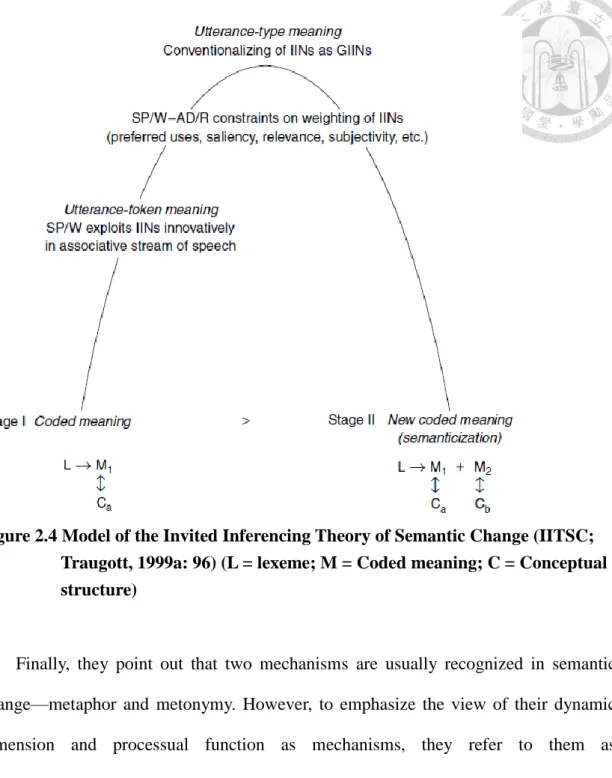
Figure 2.4 below illustrates the model of IITSC. At the very beginning, SP/Ws initiate the new use of an extant lexeme, which has only an utterance-token meaning in that it arises in context and is not crystallized into commonly used implicatures.
Secondly, the new use spread to AD/Rs and are reproduced by them in the role of SP/Ws, which results in the conventionalization of its meaning, which consequently becomes an utterance-type meaning, and finally a coded meaning. What should be noted as well is that semantic change ir related to polysemy in that it is not mere replacement of one item by another (i.e., A > B) but is “layering,” as “A > A ~ B (> B),” as the final stage in Figure 2.4 illustrates—the lexeme L has two coded meanings M1 and M2.
2 Subjectivity “involves the expressionof self and the representation of a speaker’s … perspective or point of view in discourse—what has been called a speaker’s imprint” (Finegan 1995:1). Intersubjectivity, according to Traugott and Dasher (2002), is that in communication, both SP/W and AD/R are speaking subject who are aware of each other as speaking subjects.
Figure 2.4 Model of the Invited Inferencing Theory of Semantic Change (IITSC;
Traugott, 1999a: 96) (L = lexeme; M = Coded meaning; C = Conceptual structure)
Finally, they point out that two mechanisms are usually recognized in semantic change—metaphor and metonymy. However, to emphasize the view of their dynamic dimension and processual function as mechanisms, they refer to them as metaphorization and metonymization. For instance, the semantic change of the word while from the temporal meaning “during the time that” to the concessive one “although”
involves metaphorization. Metonymization can be exemplified by the noun concern, which changes from “interest in some matter” to “the matter that concerns.” Through mechanisms such as metaphorization and metonymization (which also include invited inferencing) in the context of spoken and written discourses, SP/Ws innovate a
metaphoric use of a lexeme. This new use may often spread across the community gradually, which is then acquired by each individual.
2.1.4. A Cognitive Semantic Perspective on Conversion
The semantic change of 婊 biǎo also involves the concept of conversion. Martsa (2013), defines conversion within a cognitive perspective as “a morphologically unmarked category-shifting word-formation process motivated by metonymic and / or metaphoric mappings3,” after a detailed examination on conversion in English with morphological interpretations (i.e., conversion as a zero-derivational process seen in Marchand, 1969; Kastovsky, 1982; Halle, 1973; Kiparsky, 1982:7, etc. cited by Martsa, 2013), syntactic and lexical-semantic interpretations (i.e., conversion as a category changing operation seen in Crocco-Galeas, 1990:28; Myers, 1984; Leech, 1981:
207-230, etc. cited by Martsa 2013), and finally a cognitive semantic interpretation.
Conversion is an unmarked process since the word form of a converted word is the same as its parent word (the original word). Martsa lists different kinds of conversion verbs, conversion nouns and conversion adjectives in English and provides a cognitive semantic analysis on these words by applying the two mechanisms, which finally result in semantic extension. The sentence “She foxed him into giving her all his money”
exemplifies metaphoric mapping (Martsa, 2001). To understand the expression, hearers need to first understand that the word fox converts from a noun to a verb, with the underlying metaphor A PERSON DECEIVING ANOTHER PERSON IS A FOX. On the other hand, the metonymic mapping is illustrated by the expression author a book. The word author is converted to a verb through the AGENT FOR ACTION metonymy within an Action ICM.
For the categorization of conversion words, although there seems to be no specific
3 In the present study, we regard the two terms—metaphoric and metonymic mappings—by Martsa (2013) as metaphorization and metonymization by Traugott and Dasher (2002). We therefore use the latter two terms to emphasize the view of their dynamic dimension and processual function as mechanisms.
categorization for conversion nouns and adjectives, we can refer to Clark and Clark (1979) for the classification of conversion verbs, which are shown as follows:
(i) LOCATUM VERBS: He blanketed the bed.
(ii) LOCATION and DURATION VERBS: He kenneled the dog.
(iii) AGENT and EXPERIENCE VERBS: The customers boycotted the store.
(iv) GOAL and SOURCE VERBS: Edward powdered the aspirin.
(v) INSTRUMENT VERBS: John bicycled into town.
(vi) MISCELLANEOUS VERBS: Jack launched on a hotdog and a coke.
2.1.5 Semantic Prosody
Firth (1957b) states that “You shall know the meaning of a word by the company it keeps.” Namely, the co-occurrence of a word with another one enables us to identify the properties of the word in question. For instance, he points out that the meaning of cows can be elucidated by collocation4 such as They are milking the cows, Cows give milk.
The present paper follows this idea and examines semantic prosody—a feature of a word related to the concept of collocation—to understand more about the usage of 婊 biǎo.
The idea of semantic prosody is originally from Sinclair (1987) and later recapitulated in Sinclair (1991). He observes the lexicogrammatical environment of the phrase set in, and finds out that its grammatical subjects are usually unpleasant states of affairs such as decay, despair, ill-will, and so on. He consequently concludes that “many uses of words and phrases show a tendency to occur in a certain semantic environment”
(Sinclair, 1991: 112). The phenomenon observed by Sinclair is then introduced by Louw
4 Collocation can be defined broadly as “a lexical relation between two or more words which have a tendency to co-occur within a few words of each other in running text” (Stubbs 2001a: 24).
(1993) as the term “semantic prosody,”5 which is defined as “consistent aura of meaning with which a form is imbued by its collocates” (ibid.: 30). Since the habitual collocates of set in are capable of coloring it, it is no longer isolated from the semantic consistency of its subjects. A notion relative to semantic prosody is “semantic preference,” which is “the relation … between a lemma or word form and a set of semantically related words” (Stubbs, 2001a: 65). In other words, semantic prosody is a feature of the node word (i.e., the word under scrutiny), while semantic preference is a feature of the collocates (Partington, 2004a). Examples can be seen from set in above—since the phrase shows a “semantic preference” for unpleasant conditions, it therefore carries with a negative semantic prosody.
Bublitz (1996: 6) also points out that “words can have a specific halo or profile, which may be positive, pleasant and good, or else negative, unpleasant and bad….”
What is noteworthy, however, is that Bublitz takes into consideration the phenomenon of polysemy and points out that semantic prosodies of a given word vary depending on its different basic meanings. For instance, the word happen has an unfavorable semantic prosody in its “occurring-meaning,” yet not in its “by-chance-meaning” in I happen to know his work. Furthermore, he holds a diachronic perspective and states that a word adopts semantic features from its adjacent item if it is constantly used in that certain kind of context. In addition to indicating the phenomenon of polysemy, semantic prosodies have a pragmatic function (e.g., Sinclair, 1996; Stubbs, 2001a; Hunston 2002, 2007) in that they are “evaluative or attitudinal,” which can be used to express the speaker’s approval or disapproval for the topic of discourse, and therefore is also called
“discourse prosody” (Stubbs, 2001a: 65).
Finally, semantic prosody, which indicates the connotative meanings of words and
5 Louw (1993) follows Firth’s discussions of prosody in phonological terms that sounds are influenced by their neighbor sounds, a phenomenon called “phonological colouring.”
phrases, enables us to make an intensive study of not only in semantics but also other fileds. For instance, Begagić (2013), studying on the phrase make sense, points out that this phrase is usually used in uncertain situations and difficult situations, and suggests that these features should be added to complement its definition in the dictionary.
2.1.6 Image Schemas in Cognitive Grammar
In the thesis, we use image schemas to illustrate the process of semantic change.
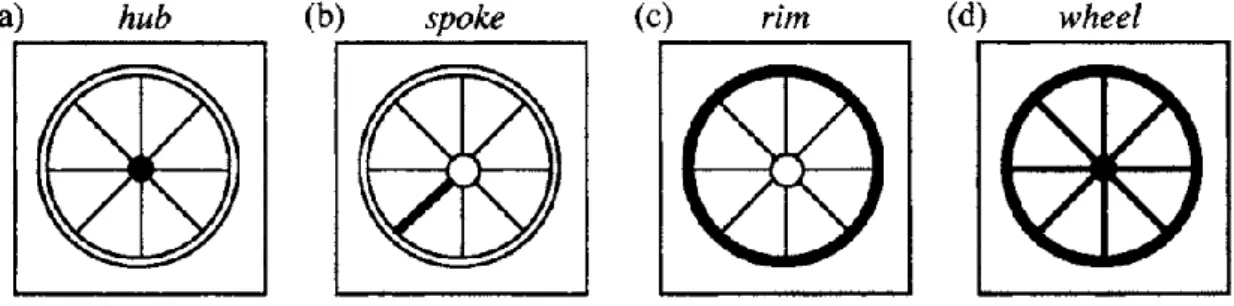
The way of illustration and the technical terms are based on Langacker’s Cognitive Grammar (Langacker, 2008). Take Figure 2.5, for instance. The expressions differ in meaning and therefore present a different profile, which is highlighted with heavy lines to indicate the focus of attention and what the expression is conceived. The expression hub in (a) designates and thus profiles the center of the wheel, which is highlighted with heavy lines. On the other hand, the expression rim in (c) profiles the outer circle part of a wheel, which is illustrated with heavy lines.
Figure 2.5 Different Profile of Expressions Related to wheel (Langacker, 2008: 67)
Another important notion is the trajector/landmark alignment. An expression can profile a thing or a relationship. When a relationship is profiled, the most prominent participant, also the primary focus within the profiled relationship, is called the trajector (tr), while the secondary focus is called the landmark (lm). Consider Figure 2.6 below.
The two prepositions above and below, for instance, differ in choices of trajectory and landmark even though the two words have the same content, and profile the same relationship.
Figure 2.6 Image Schemas for the Two Propositions (Langacker, 2008: 71)
Image schemas are also used to indicate an expression’s grammatical category, which is illustrated in Figure 2.7 below. The square in (2.7a) indicates entity, which is anything that might be referred to in describing conceptual structure such as things, sensations, locations, and so on. A noun is defined schematically as an expression which profiles a thing (not limited to physical objects), as (2.7b) indicates. A verb profiles a process, which can be a complex relationship developing through time indicated by a time axis, as (2.7c) shows.
Figure 2.7 Icons of Image Schemas in Cognitive Grammar
Integrating the above illustrations, we can use image schema to illustrate, for instance, the word enter, as Figure 2.8 shows. The word indicates that the trajector (tr) moves
(a) (b) (c)
toward the landmark (lm), and finally get into it. The dotted correspondence lines indicate the spatial path, and a time axis is required since the word enter is a verb that denotes a process.
Figure 2.8 Image Schema for the Verb enter (Langacker, 2008: 117)
2.2 Relative Studies on the Expletive 婊 biǎo ‘bitch’ in English and Chinese 2.2.1 The English Expletive bitch
Collins (1984) studies the historical development of the English expletive bitch and elucidates how the semantic mechanism such as metaphors, and other extralinguistic factors such as cultural norms and social values functions during the semantic development of bitch. In addition, he provides us with common usages of bitch. The main meaning of bitch is “the female of the species, especially dogs.” The semantic change first occurred around 1400 B.C., when this word became applicable to a female human being, specifically meaning “a prostitute.” The cause of the semantic change is a metaphorical association, which highlights the similarity in sexual behaviors of human and nonhuman beings, and which indicates the cultural value of Christian morality that gratification (especially the sexual one) is improper and should be ceased. In addition, he points out that due to functional factors (e.g., to condemn others), the word shifts to different syntactic categories and is used in numerous combinations such as “bitchy.”
Apart from the first metaphorical derivation, the word bitch also develops other
meanings through metaphorization. For instance, it means “to nag, complain, be sour, carp, be negative” or refers to a person having these qualities. The image of a protective female dog always barking to keep people away is metaphorically mapped to female human beings having similar features.
In the modern era, the word bitch, which is a negative word, seems to deviate from its original meaning. Vinter (2017) discusses the contemporary usage of bitch. By applying a corpus linguistics approach (with COCA as the database), Vinter calculates and categorizes collocations of bitch, which include not only words related to sexuality (i.e., a negative trait of a bitch) such as dirty, sexy, and nasty, but also words related to
“independence,” a much more positive decription including features such as rich, tough, and inner, as Example (a) below shows.
(a) Once a woman embraces her inner bitch, Coffey says, it shifts power in her favor.
She feels a lot more confident and better about herself. # Strong women can't be put off by people who complain they are intimidating. (ibid.: 27)
In addition, Vinter collects contemporary music lyrics and analyzes the data, which further supports the corpus findings regarding the present-day use of bitch, as well as the indicated semantic change and reappropriation of the word. Traditionally considered an insult when applied to a woman, bitch has recently started being used as a self-imposed label rather than an applied one. Namely, the term bitch is undergoing a reappropriation and is currently used not only as a derogatory but a self-empowering term due to social and extra-linguistic factors such as the rise of the popular culture.
2.2.2 The Chinese Expletive 婊 biǎo
Hu (2016) studies 婊子 biǎozǐ based on Riemer's (2010) “conventionalization of implicature theory of semantic change” within a diachronic perspective. The semantic change of 婊子 biǎozǐ can be separated into three phases. The expression 婊子 biǎozǐ is originally written as 表子 biǎozǐ, which means “a concubine or a secret lover,” and is a neutral term opposite to “the legitimate wife” written as 內子 nèizǐ (表 biǎo means
“outside” and 內 nèi means “inside”). Consider (4) (cited from Hu, 2016: 178).
(4) [趙令史 云] 你 那裡 是 我
Zhào Lìng-shǐ yún nǐ nǎlǐ shì wǒ
搭識 的 表子, 祇 當是 我
dāshí de biǎozi zhǐ dāngshì wǒ
的 娘。
de niáng
‘You are not my concubine but my wife.’ (元/李行道《包侍制智赚灰闌記》第一折) (Hu, 2016: 178)
In Song Dynasty, 表 biǎo is added with the radical 女 nǚ ‘female’, but is still used as a neutral term, and it seems that 表子, the one without the radical 女 nǚ ‘female’, is still used more commonly than 婊子 biǎozi. In Ming Dynasty, however, 表子 biǎozǐ gradually changes its meaning from “a concubine or a secret lover” to “a courtesan” in that a courtesan usually becomes a concubine of a male. Therefore, it changes its referent and sense, as (5) illustrates (cited from Hu, 2016: 179).
(5) (宋江) 出 得 李師師 門 來,
Sòng-jiāng chū dé Lǐ Shī-shī mén lái
與 柴進 道: 「今 上 兩個
yǔ Chái-jìn dào jīn shàng liǎnggè
表子, 一個 李師師, 一個 趙元奴。」
biǎozi yīgè Lǐ Shī-shī yīgè Zhào Yuán-nú
‘Sòng-jiāng comes out from Lǐ Shī-shī’s place and tells Chái-jìn that they will be accompanied by two courtesans, one is Lǐ Shī-shī and the other one is Zhào Yuán-nú.’
(明/施耐庵、羅貫中《水滸全傳》第七十二回) (Hu, 2016: 179)
Later, in Ming and Qing Dynasty, 表子 biǎozi, usually in the form 婊子 biǎozi, gradually develops a degrading meaning “a prostitute” (a process also called
“pejoration”), and it is usually used in negative semantic environments, as shown in (6) (cited from Hu, 2016: 182). It shows that the one who has affairs with prostitutes will be punished severely with 一頓馬鞭子 yīdùn mǎbiānzǐ ‘thrushing’.
(6) 現 包 著 個 婊子 李翠兒,
xiàn bāo zhe ge biǎozi Lǐ Cuì-ér
一兩夜 不 回家 來。 渾家 知道
yīliǎngyè bù huíjiā lái húnjiā zhīdào
就是 一頓 馬鞭子, 打 得 望
jiùshì yīdùn mǎbiānzi dǎ de wàng
影 也 怕。
yǐng yě pà
‘Now (he) has the other woman Lǐ Cuì-ér (a prostitute). If his wife knows, he will be thrushed fiercely, which will make him fear to death.’
(清/丁耀元《績金瓶梅》第四十一回) (Hu, 2016: 182)
Finally, in Contemporary Mandarin, 婊子 biǎozǐ goes through semantic expansion and becomes an expletive, which refers to “all females that the speakers despise.” As (7) illustrates (cited from Hu, 2016: 183), we can see that the speaker curses and degrades the blamed person by calling his mother “a prostitute,” and the blamed person “the son of a prostitute.”
(7) 他 要 這樣 起來, 我 就
tā yào zhèyàng qǐlái wǒ jiù
罵 這 婊子 養 的
mà zhè biǎozi yǎng de
‘If he does so, I will call him ‘son of bitch’.’ (清/陳森編《品花寶鑒》第二十七回) (Hu 2016: 183)
To briefly conclude Section 2.2, we have reviewed that studies on the English word bitch have shown not only the etymology of this word but also its contemporary usage, which illustrates its change from a negative word to a relatively positive one. The semantic change and development of bitch involve both the linguistic and non-linguistic factors—its common meaning originates from the metaphorical association as well as the religious norm of morality, and its contemporary usage is affected by popular cultures. For the Chinese studies on the expletive, the other hand, we can see from Hu’ s study on the semantic change of the expressions 表子 biǎozi and 婊子 biǎozi. However, he focuses only on the two expressions, without further discussion on the reason why the space-denoting word 表 biǎo can be used as 表子 biǎozi. On the other hand, the modern usage of 婊 biǎo has developed other senses and its negative connotation seems to go through some changes, as the case of bitch shown in Vinter (2017). Therefore, the present study will complement this research gap, aiming to provide a complete analysis of this word.
2.3 Spatial Metaphor and Human Relationships in Chinese Culture
Levinson (2003: xvii) states that “spatial cognition is at the heart of our thinking,”
which “provides us with analogies and tools for understanding other domains” such as utilizing diagrams and evoking the memory of certain places. More importantly, it is the source of spatial metaphors across many other domains—not only “time (where spatial
expressions like before quite normally double up for temporal specification),” but also
“kinship (as in ‘close’ and ‘distant kin’, or the vertical metaphor of ‘descent’ in kinship)”, and so on (ibid.: 16). How are these spatial metaphors applied to other domains? As scholars such as Lakoff and Johnson (1980) and Kövecses (2003, 2005) have pointed out, “metaphors are an inherent part of culture” (Kövecses 2005: 2) With an anthropological point of view, culture is regarded by some scholars (e.g., D’ Andrade, 1995; Shore, 1996; Strauss and Quinn, 1997) as “a set of shared understandings that characterize smaller or larger groups of people,” which echoes with Lakoff and Johnson’s (1980: 8) statement that “our ordinary conceptual system, in terms of which we both think and act, is fundamentally metaphorical in nature.” Namely, metaphors enable us to understand concepts (such as time, emotions, moral values, and so on) as we experience these concepts in a culture.
In Chinese culture, spatial metaphors are often used as a basis for human relationships, implicitly indicating the intimacy, alienation, and even power structure between human beings, and are widely studied by many scholars (e.g., Yuan, 2006; Li and Zhu, 2011; Lu and Shao, 2012; Tan and Xu, 2018). Here we focus on Lu and Shao (2012) in that they provide a more systematic analysis of the spatial metaphor in Chinese human relationships. They categorize five major spatial metaphors, which are shown as follows. In (8), 上 shàng ‘up’ and 下 xià ‘down’ illustrate the vertical spatial metaphors that indicate the social status of individuals or different groups. Namely, 上 shàng ‘up’ is for 君 jūn ‘the emperor’ who is “superior to” 臣 chén ‘the courtiers’
indicated by 下 xià ‘down’. Example (9) illustrates the horizontal spatial metaphors of human relationships. In (9a), 遠 yuǎn ‘far’ and 近 jìn ‘near’ illustrate the horizontal spatial metaphors that indicate intimacy of individuals. Namely, 遠 yuǎn ‘far’ stands for alienation, while 近 jìn ‘near’ stands for intimacy. As for (9b), 左 zuǒ ‘left’ refers to
lower social status, while 右 yòu ‘right’ for the higher one. 內 nèi ‘inside’ and 外 wài
‘outside’ in (10) exemplify the inner-outer spatial metaphors that indicate whether an individual belongs to a social group. Finally, 前 qián ‘front’ and 後 hòu ‘back’ in (11) exemplify the in-front-of-after spatial metaphors that indicate the age and experience of an individual. Namely, 前 qián in 前人 qiánrén stands for “predecessors,” while 後 hòu in 後人 hòurén for “people in later generations.”
(8) 君 臣 上 下 親 疏
jūn chén shàng xià qīn shū
之 所 由起 也。
zhī suǒ yóuqǐ yě
‘This is the reason why the emperor and his courtiers have to follow the feudal hierarchy.’ (Lu and Shao 2012: 32)
(9) a. 不 失 疏遠, 不 違 親近, 故
bù shī shūyuǎn bù wéi qīnjìn gù
臣 不 蔽 主, 而 下 不
chén bù bì zhǔ ér xià bù
欺 上。
qī shàng
‘The feudal hierarchy makes the courtiers obey their masters with sincerity, never deceiving them.’ (Lu and Shao 2012: 33)
b. 強 宗 右 姓, 各 擁 眾
qiáng zōng yòu xìng gè yōng zhòng
保 營, 莫 肯 先 附。
bǎo yíng mò kěn xiān fù
‘The nobilities have their own force, unwilling to be subject to others.’
(Lu and Shao 2012: 34)
(10) 劉詩雯 備受 莫斯科 失利 刺激, 不
Liú Shī-Wén bèishòu Mòsīkē shīlì cìjī bù
排斥 和 圈內人 戀愛。
páichì hé quānnèirén liànài
‘Liú Shī-Wén was frustrated after her failure in Moscow and therefore was not
against to in-group love.’ (Lu and Shao 2012: 34)
2.4 Interim Summary
To briefly conclude this Chaper, we have reviewed studies on the English word bitch and Chinese 表 biǎo that include both its etymology and contemporary usage, yet there is a research gap in terms of the contemporary usage of the Chinese word 婊 biǎo that is initially an expletive. Therefore, by applying theories of Cognitive Linguistics such as the model of Principled Polysemy, metaphorization and metonymization, the Invited Inferencing Theory, and the concept of semantic prosody, the present paper aims to provide a complete analysis of the word 婊 biǎo. In the next Chapter, we will move on to the methodology part and introduce how we collect and analyze the data.
(11) 前人 種樹, 後人 乘涼。
qiánrén zhòngshù hòurén chéngliáng
‘The predecessors work so hard that their successors can enjoy what they’ve achieved and built.’ (Lu and Shao 2012: 34)
Chapter 3 Methodology
3.1 Database
Cognitive linguistics is characteristic of having a usage-based model (e.g., Langacker, 1987). Namely, a speaker’s linguistic system is fundamentally grounded in
“usage events,” which are “instances of a speaker’s producing and understanding language” (Barlow and Kemmer, 2000: iix, cited in Shindo, 2009). Glynn and Robinson, while introducing corpus methods for semantics, also emphasize that “…linguistic research, whether Functional or Cognitive, must adopt an inductive, sample-based, methodology” (Glynn and Robinson, 2014: 8) Following these ideas, therefore, the present paper takes an empirical method—a corpus-based approach, in which three corpora are utilized.
First of all, since the newly emerging 婊 biǎo is usually used in online communities and can be consequently seen as an Internet slang, we choose PTT6 Corpus (Liu, 2014) as our data resource, designed by LOPE Lab of the Graduate Institute of Linguistics, National Taiwan University. The present paper chooses four bulletin boards for analysis, including Stupid Clown (笨版), Joke (就可版), Hate (黑特版) and Gossiping (八卦版).
Stupid Clown is a bulletin board where people share funny things happening in their life, which means the atmosphere is relatively relaxing and enables us to find possible usage other than an expletive one. Joke, as its name suggests, is a bulletin board for sharing jokes. It is one of important bulletin boards in the early stage of the foundation of PTT, which is the cradle of punch lines and slang words. Hate is a bulletin board for blaming,
6 PTT Bulletin Board System, 批踢踢實業坊 in Chinese, is the largest terminal-based bulletin board system (BBS) based in Taiwan. It is an online community that includes more than 1.5 million registered users, with over 150,000 users online during peak hours. The BBS has over 20,000 boards covering copious topics. It is estimated that more than 20,000 articles and 500,000 comments are posted every day.
(Wikipedia: https://en.wikipedia.org/wiki/PTT_Bulletin_Board_System#PTT_Boards accessed 24.3.2020)
scolding, or complaining about people and things, which is a good choice for examining the usage of expletive 婊 biǎo. Gossiping is the most popular bulletin board in PTT, which includes a wide variety of topics, which enables us to find different usage of 婊 biǎo.
We have found 621 tokens of 婊 biǎo in total from 2003 to 2017: 101 tokens from Stupid Clown, 60 tokens from Joke, 341 tokens from Hate and 119 tokens from Gossiping. Here we have to point out one of the features of PTT, which is related to our data collection—the deletion of posts. For better management and maintenance of PTT, the system autonomously deletes out-of-date posts when the number of posts reaches the limit. In addition, not only can netizens delete their own posts, but the managers of each PTT bulletin board are allowed to delete forum spams and negative posts.
Moreover, administers can also “mark” noticeable and worth-keeping posts (i.e., m 文).
Although the deletion of posts implies that the tokens we have collected do not necessarily represent the actual tokens and the amount of PTT real data, they do indicate the potential tendency of the usage of the word since the remaining posts are the most representative ones in terms of each bulletin board.
Finally, while PTT, as an online platform, is taken as an informal register, newspapers can be regarded as formal ones. To compare and contrast the usage of 婊 biǎo in two different registers, we utilize two news corora: Udndata.com (聯合知識庫) and Liberty Times Net (自由新聞網). There are totally 662 tokens in total: 162 tokens in Udndata.com (from 2003 to 2017) and 500 tokens (from 20057 to 2017) in Liberty Times database.
7 The time range of Liberty Times Net starts from 2005, while the Udndata.com starts from 2003.
3.2 Categorization of Data 3.2.1 Data Tagging
We use CKIP CoreNLP8, an online tagging system, to tokenize the data. (12) and (13) below show how the data was processed.
(12) 臨走前她就這麼婊了我一句…「我這公主還不是 edward4904 你養出來的。」
‘Before she left, she criticized me that “It is because of you that I got princess
syndrome!”’ (STUPID 79)
(13) 臨(D) 走(VA) 前(Ng) 他(Nh) 就(D) 這麼(D) 婊(VC) 了(Di) 我(Nh) 一(Neu) 句(Nf) 我(Nh) 這(Nep) 公主(Na) 還不是(D) edward(FW)
4904(Neu) 你(Nh) 養出來(VB) 的(DE)
The tagging process is shown in Figure 3.1 below.
Figure 3.1 An Example for the Tagging Process of the Data
8 https://ckip.iis.sinica.edu.tw/service/corenlp/