- 1 -
國立臺灣大學管理學院商學研究所 博士論文
Graduate Institute of Business Administration College of Management
National Taiwan University Doctoral Dissertation
創業導向與公司績效之關聯:
資源特性之中介效應與環境動態性之調節效應 Relationship between Entrepreneurial Orientation and Firm Performance: The Mediating and Moderating Effects of
Resources Attributes and Environmental Dynamism
李庭閣 Tingko Lee
指導教授:朱文儀 博士 Advisor: Wenyi Chu, Ph.D.
中華民國 101 年 9 月
September, 2012
I
誌謝
九月中旬,當鳳凰花仍火紅嬌豔地綻開在臺大管理學院前的鳳凰枝頭時,博士論 文的撰寫終於付梓,並順利通過最後的學位口試。回首在臺大求學的近二千個日子裡,
蒙受恩露,點滴心頭,其中最要感謝的恩師,也是我的指導教授 朱文儀老師。在朱 老師學術與專業涵養雙全的帶領下,讓我一步步走進學術的浩瀚領域,老師治學嚴謹 態度,落實在我博士班求學的生涯中。在研究上,老師總給予嚴格的挑戰與評論,斟 酌文稿中每句話的用詞遣字;透過老師的指導促使我能在繁瑣的文獻中穿針引線地結 合理論發展出研究架構;也縱然我在英文撰寫上癟腳又毫無章法,但老師仍費盡心思 指導我撰寫出學術生涯中第一篇可以投稿的文章。今日我能順利畢業,衷心感謝恩師 的督促與鞭策,讓我跨出人生重要的階段。
在論文口試期間,承蒙輔仁大學副校長吳秉恩教授、政治大學黃國峯教授、淡江 大學葉金成教授與元智大學王維康教授的細心指導和精闢建議,讓我得以從各種角度 檢視論文,由此,讓這本論文能以更好的品質呈現。其次感謝國防部前主計局局長王 中將與長官能提供全時進修師資培訓的名額,讓我有深造機會,尤其在學期間赴澳門
參加 AAOM 國際學術研討會時,感謝現任局長陳中將的奉准,前財務中心周副財務
長於人次室的大力協助,讓我得以順利赴行。回校屢職後,感謝國防管理學院的長官 能包容我於繁忙的公餘下持續完成博士論文,更感謝葉金成與張石柱老師在報考博士 班時給我的指導與協助,以及在學期間的鼓勵,點點滴滴,庭閣永銘於心。
五年前初進臺大商研所的那年夏天,從筆直的椰林大道轉進綠草如蔭的管理學 院,進入學術的殿堂接受師長在課堂上的知識傳授,讓我這個從國防教育體系培育出 來的軍官受到很大的衝擊與考驗。在這段艱辛歲月,感謝同為策略組的同門師兄建男、
豪臣與詮竤學長給予我在修課上的建議與研究上的鼓勵;還有305 研究室的同窗同學
志興、均揚、榮華、蕙菱、宇倩、怡君,我們共同參與經歷台大80 的豐華年代,尤其
志興,我們共同修課寫報告,分享彼此的知識與研究,堅持理想相互打氣,燃燒鬥志 衝破瓶頸與低潮。
最後,我要感謝的是我親愛的父母,謝謝您們給我和弟弟從小有個完整和諧的家 庭,並嚴格地端正我的行為與品格,這樣的庭訓讓我終生受用。也感謝我的弟弟庭臺,
我們一起在攻讀博士學位這條路上互相加油與勉勵。當然,還要感謝我一生的牽手- 美蓉,您放棄自己進修深造的機會只為成就我的理想,無怨無悔照顧兩個兒子,霖耕
II
與貫培,讓我無後顧之憂的完成學業。
五年多的臺大求學讓我收穫良多,當年的我就像站在山腳下,懷著遙不可及的夢 想仰望著一座高不可攀的山峯,而今日的我仍然是站在山腳下等著挑戰另一座山峯,
不同的是現在的我滿負行囊以著更謹慎的心情面對未來嚴峻的考驗。
李庭閣 謹誌于 國立臺灣大學商研所 中華民國一○一年十月
III
中文摘要
自 1980 年代,創業導向已經成為創業精神的主要概念與核心,並將其視為公司績 效的重要來源之一。本論文主要是依據由外而內與由內而外的策略邏輯,探討創業導 向與公司績效之關聯性,進而提出並檢測下列兩個主要的議題。
第一,本論文探討並檢測創業導向、資源特性與公司績效之關聯。資源特性區分 為資源與能力的價值性和稀有性,這兩種特性也被提出對創業導向與公司績效有其中 介效果存在。第二,本論文進一步提出當公司面臨環境高動態時,公司若擁有創業導 向是否會影響其利用或培養價值性和稀有性的資源與能力。
本論文以台灣經濟新報公布上市櫃公司為樣本,最後回收 201 份有效問卷進行統 計分析。統計結果顯示:(1)公司擁有較強的創業導向真能促使其擁有與利用價值性和稀
有性的資源與能力;(2)雖然創業導向無法藉由價值性和稀有性來提升公司的客觀績效
(ROA 與 Tobin’s q),但是創業導向可透過價值性和稀有性來提升公司的主觀績效(滿意 度與競爭優勢),如此,支持創業家神的資源基礎觀點;(3)此外,環境動態的情境會對 創業導向與績效的關聯有干擾效果;換言之,當公司座落在環境高動態情境時,公司 若擁有強而有力的創業導向,就能提升其擁有與利用價值性和稀有性的資源與能力。
關鍵字: 創業導向、資源、價值性、稀有性、環境動態、公司績效
IV
Abstract
Since 1980, EO (entrepreneurial orientation) that has been a central concept in entrepreneurship theory is viewed as being a critical source of firm performance. This dissertation focuses on the relationship between EO and firm performance from outside-in and inside-out views in the field of strategic management. Therefore, two central issues are proposed and tested in this dissertation as follows.
First, this dissertation examines how entrepreneurial orientation, resource attributes, and firm performance are related. Resource attributes refer to the value and rareness of resource–capability combinations (value and rareness), and are proposed to mediate the relationship between EO and firm performance. Second, this dissertation further proposes whether EO is positively associated with resource attributes when firms face a certain contingency, specifically, the dynamism of external environment.
Based on data collected from 201 public firms in Taiwan, the statistical results show that firms with strong EO are likely to exploit valuable and rare. Although the value and rareness don’t mediate the relationship between EO and firm performance (ROA and Tobin’s q), they positively mediate the association between EO and firm performance (competitive advantage and satisfaction), supporting the resource-based perspective of entrepreneurship. Moreover, it is found that the EO-resource attributes relationship is further moderated by environmental dynamism. That is, when firms are located in environmental dynamism, EO is likely to exploit valuable and rare resources and capabilities to respond external opportunities.
Key words: EO, resource, value, rareness, environmental dynamism, firm performance.
V
Contents
Acknowledgements...I 中文摘要………...………...…III
Abstract...IV Contents………...…….V List of Tables……….……….VIII List of Figures……….……….…...X
Chapter 1: Introduction…...1
1.1 Background and Motivations………..……….…. 1
1.2 Research Questions……….………….……..5
1.3 Research Procedure….……….….……….……7
1.4 Overview of the Dissertation………10
1.5 Definition of Academic Terms...…...12
1.5.1 Entrepreneurial Orientation……….………...12
1.5.2 Resource Attributes………13
1.5.3 Environmental Dynamism...…...14
1.5.4 Firm performance………...14
Chapter 2: Literature Review and Hypotheses...15
2.1 Definition of Entrepreneurship……….………...……15
2.2 Dimensions of Entrepreneurial Orientation……….…….…...….22
2.2.1 Innovation………....23
VI
2.2.2 Proavtiveness...25
2.2.3 Risk-Taking…...26
2.3 Resource Attributes…...29
2.4 Internal Resources, Capabilities, and Performance………...33
2.5 External Approach: Environmental Dynamism………...37
2.5.1 Environmental Dynamism from Industrial Organization………...……37
2.5.2 Environmental Dynamism and Resource Attributes………...40
2.6 Entrepreneurial Orientation, External Environment, Internal Resources, and Firm Performance………...44
2.7 Development of Hypotheses……….……...……….……51
2.7.1 EO and Resource Attributes………...54
2.7.2 EO and the Value of Resource-Capability Combinations……….………...…57
2.7.3 EO and the Rareness of Resource-Capability Combinations…….………….60
2.7.4 Resource Attributes and Firm Performance……….……….…………...62
2.7.4.1 Value and Firm Performance………...62
2.7.4.2 Rareness and Firm Performance………...64
2.7.5 EO, Resource-Capability Combinations, and Firm Performance………..65
2.7.6 Moderating Effect by Environmental Dynamism………...68
Chapter 3: Methodology……….…...74
3.1 Research Framework………...75
3.2 Sample and Data………..76
3.3 Measures ……….79
VII
3.3.1 Independent Variables...………..79
3.3.2 Dependent variables………....81
3.3.3 Control Variables….………...83
3.4 Analytical Methods……….……….…………85
Chapter 4: Research Results………..………88
4.1 Descriptive Statistics………....88
4.2 Measurement Assessment Procedures...92
4.3 Comparison for EO Measurement Model………...98
4.4 Assessment of Model Fit and Path Significance………101
4.5 High and Low Levels of Environmental Dynamism Models………105
4.6 Multi-Group Analysis for the Moderating Effect of Environmental Dynamism….110 4.7 Comparison of Alternative Models……….……...113
4.8 Regression Model for Mediating Effect………118
4.9 Regression Model for Moderating Effect………..127
4.10 Bivariate Analysis……...……….129
Chapter 5: Conclusions……….………...……….131
5.1 Major Findings………..……….133
5.2 Implications...…...136
5.3 Research Limitations and Directions………...142
Reference………...146
Appendix A: Questionnaire…..………165
Appendix B: Case Study...170
VIII
List of Tables
Chapter 2
Table 2-1: Definitions of Entrepreneurship
Table 2-2: A Comparison of the Analysis Level of Entrepreneurship Table 2-3: Some Empirical Studies of RBV
Table 2-4: The Comparison of Traditional IO and Modified IO
Chapter 3
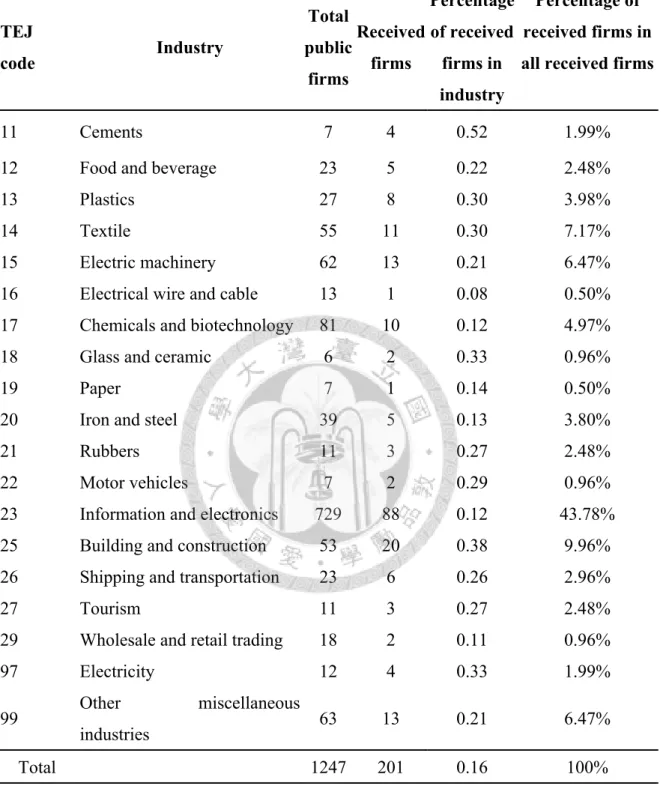
Table 3-1: Number and Percent of Public Firms by TSE Industry Code
Chapter 4
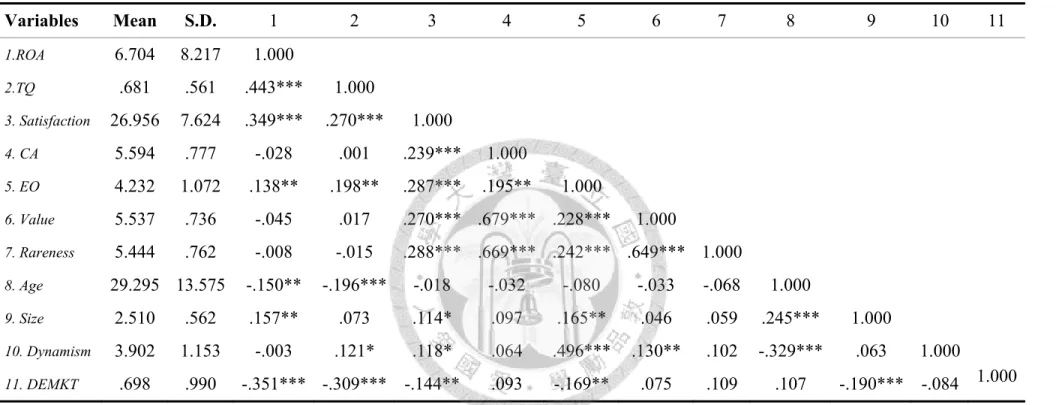
Table 4-1: Descriptive Statistics and Correlation Coefficients of Variables Table 4-2: Parameters of Measurement Model
Table 4-3: Analysis of Discriminant Validity Table 4-4: Analysis of Measurement Model Table 4-5: Alternative EO Measurement Models Table 4-6: Multi-Group Difference Test
Table 4-7: Parameter Estimates, Low Versus High Environmental Dynamism Table 4-8: Comparison of Competing Models with Full Sample
Table 4-9: Comparison of Competing Models with High Degrees of Environmental Dynamism
Table 4-10: Comparison of Competing Models with Low Degrees of Environmental Dynamism
Table 4-11: Results of OLS Regression Model with Competitive Advantage
IX
Table 4-12: Results of OLS Regression Model with Satisfaction Table 4-13: Results of OLS Regression Model with ROA
Table 4-14: Results of OLS Regression Model with Tobin’s q Table 4-15: Mediating Effect of Value and Rareness
Table 4-16: Results of Hierarchical Regression
Chapter 5
Table 5-1: Summary of Research Findings
X
List of Figures
Chapter 1
Figure 1-1: Research Procedure of the Dissertation
Chapter 2
Figure 2-1: Relationship between Resource Heterogeneity, Immobility, Value, Rareness, Imitability, Substitutability, and Sustained Competitive Advantage
Figure 2-2: Desired Characteristics of a Firm’s Resources and Capabilities Figure 2-3: Conceptual Model of RBV
Figure 2-4: The Traditional Industry Organization Paradigm Figure 2-5: The Modified Industry Organization Paradigm
Figure 2-6: Conceptual Model of Entrepreneurship as a Firm Behavior Figure 2-7: Conceptual Framework of an Entrepreneurial Orientation
Figure 2-8: Revised Conceptual Framework of Firm-Level Entrepreneurship Figure 2-9: Conceptual Framework of Strategic Orientation
Chapter 3
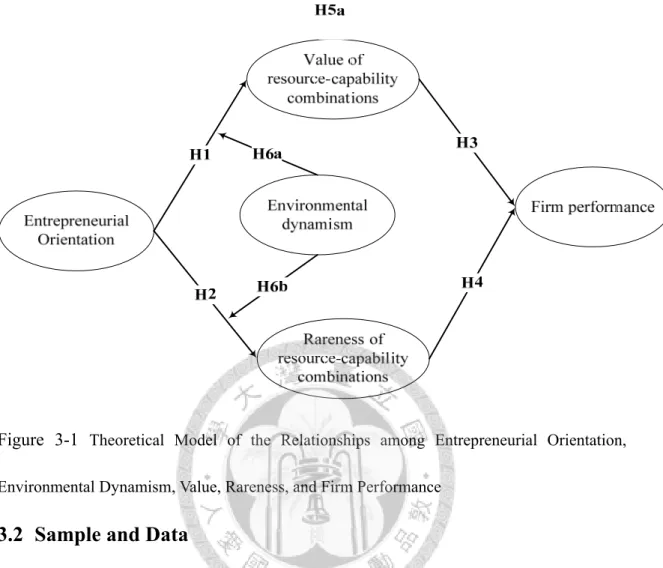
Figure 3-1: Theoretical Model of the Relationships among Entrepreneurial Orientation, Environmental dynamism, Value, Rareness, and Firm performance
Chapter 4
Figure 4-1: Full Measurement Model in a CFA Figure 4-2: Alternative EO Models in CFAs
Figure 4-3: Structural Model: Results of the SEM Model with CA
Figure 4-4: Structural Model: Results of the SEM Model with ROA and TQ
XI
Figure 4-5: Structural Model: Results of the SEM Model with Satisfaction
Figure 4-6: Structural Model: Results of the SEM Model with CA in High Levels of Environmental Dynamism o
Figure 4-7: Structural Model: Results of the SEM Model with CA in Low Levels of Environmental Dynamism
Figure 4-8: Structural Model: Results of the SEM Model with ROA and TQ in High Levels of Environmental Dynamism
Figure 4-9: Structural Model: Results of the SEM Model with ROA and TQ in Low Levels of Environmental Dynamism
Figure 4-10: Structural Model: Results of the SEM Model with Satisfaction in High Levels of Environmental Dynamism
Figure 4-11: Structural Model: Results of the SEM Model with Satisfaction in Low Levels of Environmental Dynamism
Figure 4-12: Association between EO and Value: Bivariate Analysis Figure 4-13: Association between EO and Rareness: Bivariate Analysis
- 1 -
Chapter 1
Introduction
1.1 Background and Motivations
There is a widely-held view in academic literature that a firm’s competitive advantage and abnormal returns stem from its entrepreneurship, which is a factor of production. Implicit in this notion is a prediction that entrepreneurship is positively associated with firm performance. Recently, EO has increasingly become a central concept in the domain of entrepreneurship (Covin, Green, & Slevin, 2006), and especially, in today’s highly competitive business environment, an entrepreneurial orientation (EO) is viewed as being a critical source of firm performance. Particularly within enormously complex environments, firms must develop innovative capabilities and exploit market opportunities with aggressiveness, ambition, and a willingness to take risks to sustain their survival (Sadler-Smith, Hampson, Chaston, & Badger, 2003).
In other words, firms with EO may be better equipped to face the variations of firm performance.
Prior researchers have adopted several perspectives when studying entrepreneurship, including economics, psychology, and sociology. Although the study
- 2 -
of entrepreneurship has focused on entrepreneurial behavior for more than a century, only a few studies have modified and examined conceptual models of EO. However, over the past two decades, EO has emerged as a construct in strategic management, organization and entrepreneurship literature (Lumpkin and Dess, 1996). Some studies demonstrate that an EO is increasingly important to the economic returns of firms.
Although most prior studies have pointed to a positive relationship between EO and firm performance, there have been inconsistencies. These inconsistencies encourage the question of whether the relationship between EO and firm performance is advantageous or more complex.
In the field of strategic management, firm performance is derived from the organization’s internal and external environment. In terms of the internal factors, the resource-based view (RBV) highlights the importance of internal factors for firm effects (Barney, 1991; Hansen & Wernerfelt, 1989; McGahan & Porter, 1997; Rumelt, 1991).
RBV scholars argue that a firm which possesses and exploits valuable, rare, imitable, and non-substitutable resources can sustain its competitive advantage (Amit &
Schoemaker, 1993; Barney, 1991; Newbert, 2007, 2008). EO has become a central concept in the domain of entrepreneurship (Covin, Green, & Slevin, 2006), and entrepreneurship is an intrinsic feature of the resource-based framework (Conner, 1991).
Therefore, some scholars argue that EO can be viewed as a type of resource/capability.
This means that EO and resources/capabilities are viewed as the same construct (Conner, 1991; Foss, Klein, Kor, & Mahoney, 2008; Lee, Lee, & Pennings, 2001; Stevenson, &
- 3 -
Gumpert, 1985). In contrast, according to Schumpeter (1934), entrepreneurship facilitates unique resource-capability combinations in dynamic and high-risk environments in a manner that distinguishes one firm from another by reducing costs or differentiating products and services. Thus, EO and resources/capabilities represent completely different constructs (Alvarez & Busenitz, 2001; Barney & Arikan, 2001;
Ireland, Hitt, & Sirmon, 2003; Lumpkin & Dess, 1996). Recently, some studies claim that the resources and capabilities of firms could act as a bridge or a contingency factor in the relationship between EO and firm performance. However, prior studies may over-simplify the relationship between the role of a specific resource/capability and firm performance, and neglect the conceptual-level approach of the RBV, such as the attributes of value and rareness(Deephouse, 2000; Newbert, 2007). Therefore, this dissertation examines whether or not the relationship between EO and firm performance can be mediated by the value and rareness of resources.
As to the external environment, environmental factors include environmental dynamism, munificence, complexity, and industry characteristics, all of which can influence the performance of firms with EO. Some scholars argue that the profits of firms are derived from the industry and external environment (Bain, 1956; Mason, 1939;
Porter, 1980); in other words, the industry effects matters (Schmalensee, 1985). Because environmental dynamism is associated with the unpredictability of customer tests, competitor actions, product/service shifts, and high rates of change in market and industry innovations, the product or business model lifecycle has been manifestly
- 4 -
shortened in today’s competitive environment (Miller, 1983). In such a dynamic environment, firms must continuously introduce products or services no matter they are in developing or developed economies. According to the structure-conduct-performance (S-C-P) model, firms that face high levels of industrial rivalry would be forced to improve their performance above the averaged levels (Porter, 1980). Although Lumpkin and Dess (1996) propose environmental dynamism as a contingency factor that influences the EO-performance relationship, most prior studies seldom include a model that simultaneously considers EO, environmental dynamism, and resource attributes.
Therefore, this dissertation examines whether the EO successfully promotes the value or rareness of a resource−capability combination in environmental dynamism.
One contribution of this dissertation may be the development of a theoretical and empirical link between EO, resource attributes, and firm performance. This dissertation challenges the conventional wisdom of the resource heterogeneity approach, which might over-emphasize the relationship between the role of a specific resource/capability and firm performance (Deephouse, 2000). This dissertation argues that EO and resources/capabilities attributes represent different constructs (Ireland et al., 2003;
Lumpkin & Dess, 1996). A firm’s EO stems from its innovation, proactiveness and risk-taking, which in turn determine the value and rareness of resource-capability combinations. Firms with EO are likely to enhance their performance by reducing costs or differentiating products/services via the combinations of resources and capabilities.
Through the analysis of the competing models, this study also clarifies the causal
- 5 -
relationship between EO, resource attributes, and firm performance (Covin & Slevin, 1991; Foss et al., 2008). When value or rareness serves as a mediator of the relationship between EO and firm performance, its model fit satisfactory. Second, contribution of this dissertation may integrate the three main theories, including RBV, entrepreneurship, and external approach: environmental dynamism, and focus on the relationship between EO, environmental dynamism, and resource attributes from outside-in to inside-out.
A review of relevant literature and the theoretical background from an entrepreneurship perspective and resource-based theory provides a foundation for developing specific hypotheses. Although existing studies indicate the relationship between EO and firm performance, previous studies seldom expand this association by examining the possible mediators (such as resource attributes) and moderators (such as environmental dynamism) of EO. Therefore, this dissertation conducts an empirical study to investigate the relationship between EO, resource attributes, external environments, and firm performance in Taiwanese public firms.
1.2 Research Questions
This thesis is based on EO studies with multidimensional perspectives.
Research on the EO-firm performance relationship has revealed some critical factors. This study integrates the areas of entrepreneurship and resource-based theory, and aims to examine the association between EO, attributes of resources
- 6 -
and capabilities, environmental dynamism, and firm performance. Although EO that has been viewed as an independent effect creates firm performance (Covin &
Slevin, 1991; Lumpkin & Dess, 1996), previous empirical studies report both a positive and negative impact of an EO on firm performance. Therefore, some factors may influence the relationship between EO and firm performance. Thus, the research questions that this research aims to answer are as follows:
1. Does a firm with EO provide impetus to possess the value of resource-capability combinations? Or, does a firm with EO provide impetus to possess the rareness of resource-capability combinations?
2. Does a firm with the value of resource-capability combinations promote firm performance? Does a firm with the rareness of resource-capability combinations promote firm performance?
3. How does an EO influence firm performance? What factors may mediate the relationship between EO and firm performance? Specifically, is the relationship between EO and firm performance mediated by the resource attributes of firms?
4. What factors may moderate the association between EO and resource attributes?
How do internal and external factors exist in this association? More specifically, are the relationships between EO and resource attributes moderated by environmental dynamism?
- 7 -
1.3 Research Procedure
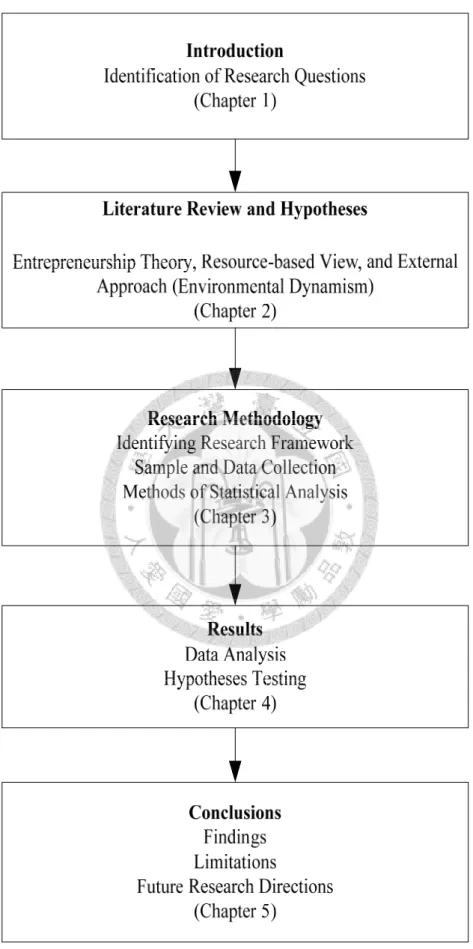
This dissertation contains five chapters that can be summarized as follows (see Figure 1-1).
Chapter 1 explains the research background, research motivation, research questions, research procedure, the definition of academic terms, and an overview of this dissertation.
Chapter 2 reviews the literature of entrepreneurship theory, resource-based theory, and environmental dynamism. The relevant literature with an emphasis on the performance/competitive advantage of firms with an EO is reviewed and presented.
The main effect of EO on firm performance is discussed. Based on the EO-performance relationship, this dissertation introduces the mediating role of resource attributes and the moderating role of environmental dynamism. Hypotheses are also developed regarding the relationships discussed in the literature review and pilot case study. To develop research hypotheses, this dissertation integrates the primary theories and pilot case to form propositions (see Appendix B).
Chapter 3 proposes a conceptual research framework for this dissertation. The development of this research framework is based on the prior literature review, research purpose, and pilot case (see Appendix B). Moreover, this chapter provides the research methodology, including sample and data collection, several statistical analyses methodology, and the measurements of all variables.
- 8 -
Chapter 4 shows the statistical results of this dissertation. A variety of statistical methods are used, including descriptive statistics, correlation analysis, confirmatory factor analysis (CFA), OLS regression, structural equation modeling (SEM), convergent and discriminant validity, and Sobel tests. All the results are summarized in this chapter.
Finally, Chapter 5 provides the conclusion of the dissertation, including discussions, research limitations, and some recommendations for future research directions.
- 9 -
Figure 1-1: Research Procedure of the Dissertation
- 10 -
1.4 Overview of the Dissertation
Past studies have generally found that firms with EO lead to the improved performance. However, the findings on the influence of EO on firm performance have been largely contradictory (Covin & Slevin, 1988, 1989; Smart & Conant, 1994; Stam
& Elfring, 2008). This dissertation examines the factors that can influence the EO-firm performance link by answering prior research questions. The traditional model of EO that is proposed by Lumpkin and Dess (1996) is expanded in this dissertation as follows:
First, this research argues that firms with EO can have different insights into valuable and rare resource-capability combinations as compared to their competitors.
Such arguments further suggest that EO and resources/capabilities represent different constructs. Therefore, this study examines whether the relationship between an EO and firm performance is mediated by resource/capability attributes.
Second, according to the literature of Lumpkin and Dess (1996) and Hitt et al.
(2011), environmental factors can explain the effect of EO on firm performance.
Moreover, the influence of EO on enhancing value resource-capability combinations is moderated by high rather than low environmental dynamism.
Therefore, this dissertation concerns the linkage between EO and firm performance by investigating resources attributes and environmental dynamism. Following paragraph briefly describes main variables measurements and the findings of this research.
This study includes four main constructs as follows: (1) EO presents the
- 11 -
integration of multi-dimensions innovation, proactiveness, and risk-taking. (2) Resource attributes refer to the value and rareness of resource-capability combinations and potentially mediate the relationship between EO and firm performance. (3) Environmental dynamism is viewed as a moderating variable that influences the relationship between EO and resource attributes. (4) Firm performance comprises two criteria: subjective and accounting performance. Subjective performance includes competitive advantage and self-reporting performance (performance), and accounting performance includes ROA and Tobin’s q. Data on EO, environmental dynamism, resource attributes, competitive advantage, and performance is obtained from a questionnaire survey conducted with members of top management as the respondents. ROA and Tobin’s are collected from a secondary database maintained by the Taiwan Economic Journal (TEJ).
Based on data collected from public firms in Taiwan, the statistical results show that firms with a strong EO are likely to exploit valuable and rare resource-capability combinations, improving their subjective performance rather than their accounting performance. The value and rareness of the resource-capability combinations further positively mediate the association between EO and subjective performance, supporting the resource-based perspective of entrepreneurship. Finally, EO has a significant and positive impact on the value or rareness of resource-capability combinations at a high level rather than a low level of environmental dynamism.
- 12 -
1.5 Definition of Academic Terms
1.5.1 Entrepreneurial Orientation
Entrepreneurial Orientation (EO): An EO refers to the processes, practices, and decision-making activities that lead to new entry (Lumpkin & Dess, 1996). EO consists of three dimensions, including innovation, proactiveness, and risk-taking (Covin &
Slevin, 1989).
Innovation: Innovation is defined as the new ideas, novel experimentation, and creative processes supported by firms, which result in new products, services, or technological processes (Covin & Slevin, 1989; Lumpkin & Dess, 1996).
Proactiveness: Proactiveness is also defined as the manner in which enterprises attempt to recognize and seize new opportunities, implying a forward-looking perspective that might or might not be related to current operations (Lumpkin & Dess, 1996; 2001;
Miller & Friesen, 1982). Proactiveness also involves tracking changes in customer tastes, new products, and innovative technologies (Lumpkin & Dess, 2001).
Risk-taking: Risk-taking is considered to be the degree to which managers are willing to make large and risky resource commitments (Miller & Friesen, 1978). For example, when confronted with decision-making situations involving uncertainty, it is necessary that the firm adopts a bold and wide-ranging act to achieve abnormal profitability by exploiting potential opportunities.
- 13 -
1.5.2 Resource Attributes
Resource attributes
Value of resource-capability combinations (Value): Value of resource or capability enables a firm to reduce costs or respond to environmental opportunities and threats, such resources or capability is valuable (Barney, 1991). However, firms may create economic rents not only by owning better resources than other competing firms, but also by exploiting them more effectively with the appropriate capabilities. Therefore, the value of resource-capability combinations is defined as follows. A resource (or capability) may have tremendous potential value and its value can be realized when it is combined with a corresponding capability (or resource) (Newbert, 2008).
Rareness of resource-capability combinations (Rareness): If the number of firms which possess a resource (or capability) is sufficiently small to prohibit perfect competition in the industry, such a resource (or capability) is rare (Barney, 1991). Thus, the rareness of resource-capability combinations refers to a valuable resource (or capability) that can be possessed by many firms but such resource is paired with the appropriate capability (a resource) by only a few firms (Newbert, 2008). This means that, if a firm possesses some resources and capabilities which are only owned by a few companies in the industry, these resources and capabilities are rare.
- 14 -
1.5.3 Environmental Dynamism
Environmental dynamism is a main factor that can influence EO and internal resources (Lumpkin & Dess, 1996). Environmental dynamism is characterized by the rate of change, innovation in the industry as well as unpredicted actions of competitors and customers (Miller & Friesen, 1983). In general, entrepreneurial firms are often found in environmental dynamism because their top managers usually prefer rapidly growing and changing, which may have high risks and high rewards (Miller & Friesen, 1982).
1.5.4 Firm Performance
Firm performance is a multidimensional concept and the relationship between EO and firm performance may depend upon several indicators used to assess performance.
Because businesses with EO may invest heavily in long-term growth and profits, this dissertation examines the conceptual argument of the EO–performance relationship by focusing on following several aspects of firm performance, including subjective (such as competitive advantage and satisfaction) and accounting measures (such as ROA and Tobin’s q).
- 15 -
Chapter 2
Literature Review and Hypotheses
This chapter reviews the existing literature on entrepreneurship, resource-based view, and external approach: environmental dynamism. Definition of entrepreneurship and EO are first discussed. Next, the related literature on the main two aspects:
resource attributes and environmental dynamism. Finally, the existing research on the relationships between EO, external environment, internal resources, and firm performance is reviewed, thereby developing the strategic logic from inside-out and outside-in.
2.1 Definition of Entrepreneurship
The topic of entrepreneurship has been examined, studied, and developed for more than two hundred years. The term “entrepreneur” itself is derived from the French word and was first used in 1755 by Richard Cantillon, who regarded entrepreneurs as specialists in taking risk. Popular notions of entrepreneurship are based on the view of Schumpeter (1934), who viewed entrepreneurs as innovators who create new industries and pursue a change of the industrial structure. The term
- 16 -
“entrepreneurship” has been variously explained by different scholars (see Table 2-1), and is described below.
There are many definitions of entrepreneurship in the literature. According to Schumpeter (1934), firms with entrepreneurship combine production factors and facilitate unique resource-capability combinations in dynamic and high-risk environments in manners that distinguish them from other firms by reducing costs or differentiating their products and services. Entrepreneurship is perceived as introducing new combinations (including resource-capability combinations, new goods, and new methods of production) or as exploiting new markets. Schumpeter (1951;
1976) defined entrepreneurship as involving the conducting of operations not routinely conducted in the operation of a business, a phenomenon that falls under the concept of leadership.
Contemporary definitions of entrepreneurship tend to focus on the pursuit of opportunities. The opportunities-based concept of entrepreneurship originates from Stevenson (1986) and focuses on entrepreneurship as the pursuit and exploitation of opportunity without regard for resource controls. Shane and Venkataraman (2000) also define the domain of entrepreneurship in terms of the recognition and exploitation of opportunities. Recently, Kuratko and Hoggetts (2004) have explained entrepreneurship by identifying four key areas that need to be proposed simultaneously: (1) Unique markets—entrepreneurs identify new market segments. (2) Unique people—entrepreneurial ventures are built on the special talents of one or more
- 17 -
individuals. (3) Unique products—entrepreneurial ventures innovate and create new products or services that capture new or existing markets. (4) Unique resources—entrepreneurs have the ability to exploit resources over long periods of time.
Based on the above-mentioned areas, Curator and Hoggetts (2004) define entrepreneurship as involving entrepreneurs who are capable of recognizing and seizing opportunities and of converting those opportunities into marketable ideas requiring effort to implement, thereby resulting in potential rewards.
During the last decade, management researchers have extended the scope of their interests to encompass entrepreneurship issues. Although Schumpeter (1934) established a link between the entrepreneurial initiatives of individuals and the creation and destruction of industries, organizations are more often able to exploit resources pursuing innovation than individuals are. Entrepreneurship research thus has increasingly transformed the individual level into the organizational level (Brown et al., 2001; Covin & Slevin, 1991; Davidsson & Wiklund, 2001; Stevenson & Jarillo, 1990;
Stopford & Baden-Fuller, 1994).
Studies of entrepreneurship are generally classified into three main categories (Stevenson & Jarillo, 1990). First, there are studies that focus on the results of actions taken by entrepreneurs. Second, there are studies that take a psychological/sociological approach and view entrepreneurship as deriving from individuals, where their
- 18 -
backgrounds, environments, goals, and motivations are the objects of analysis. Finally, there is research concerned with the characteristics of entrepreneurial management, analyzing how entrepreneurs are able to achieve their objectives. This view of entrepreneurship can subsequently be applied to the firm-level, and proponents propose that entrepreneurial firms pursue opportunities regardless of the resources they control.
For example, Covin and Slevin (1991) outline a model of entrepreneurship as a firm-level phenomenon, which stems from two causes. First, entrepreneurial effectiveness is derived from firm-level operations, which means that entrepreneurial effectiveness can be measured in terms of firm performance. Second, individual-level behavior can impact organizational performance; however, the fact remains that organizational-level behavior is a predictor of entrepreneurial effectiveness.
Indeed, over the past decade, some researchers have changed the level of their analyses of entrepreneurship. Davidsson and Wiklund (2001) review the literature related to entrepreneurship and divide it into five levels: (1) individual-level, (2) firm-level, (3) industry-level, (4) regional-level, and (5) national-level. Table 2-2 shows an increase in the number of firm-level studies, while the number of individual-level studies has gradually declined. Therefore, the apparent trend is towards examining the firm as the level of analysis, including just the firm-level. Compared with 28% of 1988/89 articles, firm-level and individual- and firm-level analysis is conducted in more than 47% of the 1998 articles.
Zahra, Nielsen, & Bogner (1999) suggest that many studies use inconsistent terms
- 19 -
to refer to various aspects or types of entrepreneurship. Previous scholars have used diverse terms, including entrepreneurship, corporate entrepreneurship, entrepreneurial posture, strategic posture, and entrepreneurial orientation.
In summary, definitions of entrepreneurship in the literature are originated from different scholars. In general, most studies on the related issues of entrepreneurship, entrepreneurial posture, or EO usually regard the firm as the level of analysis. Based on the studies of Schumpeter (1934), Stevenson (1986), and Kuratko and Hoggetts (2004), this study mainly follows the definition of entrepreneurship and employs EO that has been a concept in the domain of entrepreneurship. According to prior studies, this dissertation will develop following argument: a firm with entrepreneurship usually facilitates to combine the resource with the capability in rapidly changing environment.
Table 2-1 Definitions of Entrepreneurship Author Definition
Schumpeter (1934)
Entrepreneurship is seen as the implementation of new combinations, including (1) the introduction of new goods, (2) the introduction of new methods of production, (3) the exploitation of new markets, (4) the exploitation of new sources of supplies, and (5) the creation of new organizations.
Kizner (1973) Entrepreneurship is the ability to perceive new opportunities.
Drucker (1985) Entrepreneurship refers to acts of innovation that involve combining existing resources with new capabilities.
Rumelt (1987) Entrepreneurship is the creation of new businesses; a new business means that existing businesses are not exactly duplicated; there is an element of novelty.
Low & MacMillan Entrepreneurship is defined as the "creation of new enterprises."
- 20 -
(1988)
Gartner (1988) Entrepreneurship is the creation of organizations and the process by which new organizations come into existence.
Stopford &
Baden-Fuller (1994)
Entrepreneurship is classified into three stages: (1) Individual entrepreneurship: New businesses are usually associated with individual entrepreneurship. (2) Organizational renewal:
Individuals or teams in an organization alter the pattern of resources to respond to threats or opportunities for achieving stronger economic performance. (3) Frame-breaking: Firms change the rules of their competition.
Roberts (2007) Entrepreneurship is the pursuit of opportunities without considering current resources and capabilities.
Morris (1998) Entrepreneurship is the process through which individuals and teams create value by bringing together unique packages of resource inputs to exploit opportunities in the environment.
Ireland et al.
(2001)
Entrepreneurship is defined as having two orientations: (1) A context-dependent social process: Individuals or teams create wealth by gaining access to a variety of resources, enabling them to exploit market opportunities. (2) A business-related phenomenon: An entrepreneurial firm can improve performance by concentrating on innovation, proactiveness, and risk-taking.
Source: Summary of this study
- 21 -
Table 2-2 A Comparison of the Analysis Level of Entrepreneurship
Level 1988/1989 1998
Micro levels 59.5 % (38) 77.7 % (49)
Individual 26.6 % (17) 20.6 % (13)
Firm 26.6 % (17) 36.5 % (23)
Other (single) micro-level 1.60 % (1) 1.60 % (1)
Individual and firm 1.60 % (1) 11.1 % (7)
Multiple micro-level units 3.10 % (2) 7.90 % (5)
Aggregate levels 21.8 % (14) 11.2 % (7)
Industry 7.80 % (5) 3.20 % (2)
Region 6.20 % (4) 3.20 % (2)
Other single- or multiple-aggregate levels
7.80 % (5) 4.80 % (3)
Micro/aggregate mix 12.5 % (8) 11.1 % (7)
Other/unclassifiable 6.20 % (4) 0.00 % (0)
Total 100 % (63) 100 % (63)
Source: Davidsson and Wiklund (2001)
- 22 -
2.2 Dimensions of Entrepreneurial Orientation
Although some scholars have defined entrepreneurship based on the individual characteristics of entrepreneurs (Shook, Priem, & McGee, 2003), most studies follow the concept of classic economics, which considers EO to be a firm-level factor.
Lumpking and Dess (1996) make a distinction between the concept of entrepreneurship and EO. Lumpking and Dess suggest that entrepreneurship represents a new entry or business venture and corresponds with strategic content; that is, an entrepreneurial firm poses the question, “What business shall we enter?” The answer to this question determines a firm’s domain or product-market. EO, however, refers to the processes, practices, and decision-making activities that improve the new entry. In other words, entrepreneurship refers to what the factors consist of, while EO indicates how those factors are undertaken. Therefore, EO can be viewed as manipulating the process of entrepreneurship. In summary, entrepreneurship is defined as a new venture entered by a firm, and EO describes how the new venture is undertaken and accomplished.
Dess and Lumpkin (2005) assert that corporate entrepreneurship has two aims: the creation of new ventures and strategic renewal. Although firms can grow through mergers and acquisitions as well as through joint ventures and strategic alliances, corporate entrepreneurship is typically focused on developing internal ventures.
Corporate entrepreneurship yields above-average returns and contributes to sustainable advantages. However, the strategic leaders and the culture of a corporation together
- 23 -
generate a strong impetus to innovate, take risks, and aggressively pursue new venture opportunities (proactiveness); this concept is referred to as “entrepreneurial orientation”
(Dess & Lumpkin, 2005; Miller, 1983). Covin, Green, and Slevin (2006) assert that EO has increasingly become a central concept in the domain of entrepreneurship and has received a substantial amount of theoretical and empirical attention.
With regard to the dimensions of EO, Lumpkin and Dess (1996) assert that the primary dimensions of EO are proposed by Miller (1983), who suggests that a firm with EO will be capable of engaging in product innovation, undertaking risky ventures (risk-taking), and exercising superiority over other competitors (proactiveness).
2.2.1
InnovationThe first dimension that characterizes a firm with EO is innovation. Schumpeter
(1934) is the first to highlight the role of innovation in the entrepreneurial process and to view innovation as the most critical factor in entrepreneurship. In addition, the
“creative destruction” proposed by Schumpeter refers to the notion that the existing market structures are destroyed by new products or services when firms exploit existing resources and capabilities to create novel products or services; the new market structure then causes these firms to grow.
Innovation is defined as new ideas, novel experimentation, and creative processes supported by firms, which result in new products, services, or technological processes (Covin & Slevin, 1989; Lumpkin & Dess, 1996). Zahra (1996) argues that innovation
- 24 -
is the commitment of a firm to create and introduce products, processes of production, and organizational systems. In today’s highly competitive business environment, innovation is recognized as the critical source of competitive advantage. Roberts (1999) suggests that a successful firm repeatedly introduces innovations and thus achieves a sustained competitive advantage. Lumpkin and Dess (1996) classify innovation into two categories: product-market innovation and technological innovation.
Product-market innovation refers to product design, market research, and advertising and promotion (Lumpkin & Dess, 1996; Miller, 1983; Miller & Friesen, 1982).
Technological innovation achieves shifts in the competencies surrounding the latest technologies, production methods, and the development of manufacturing processes (Lumpkin & Dess, 1996; Miller & Friesen, 1982).
Miller (1983) focuses on innovation in the technological and product-market, and associates innovation with entrepreneurship. More specifically, Drucker (1985) suggests that innovation is regarded as the specific tool of an entrepreneurial firm, and is the means by which such a firm can exploit change as an opportunity to establish a different business or a different service.
As mentioned above, innovation is the specific function of an entrepreneurial orientation, and innovation in this study refers to the process of engaging in creativity by introducing new products or services and technological leadership in manufacturing processes. Therefore, innovation is an important determinant of an entrepreneurial orientation.
- 25 -
2.2.2
ProactivenessThe second dimension that characterizes a firm with EO is proactiveness. Penrose (1959) emphasizes that entrepreneurial firms are capable of seeing and imagining future opportunities to promote their growth. Lieberman and Montgomery (1988) argue that the first-mover advantage, which capitalizes upon market opportunities, is the best strategy for firms. By exploiting a first-mover advantage strategy, firms usually obtain abnormal returns from markets and build brand recognition within their customer bases. Thus, firms that take initiative can anticipate new opportunities in emerging markets.
Proactiveness refers to shaping a new business environment that derives profits from new products, technologies, and administrative techniques rather than by following the business practices of competitors (Miller & Friesen, 1978). Proactiveness is also defined as the manner of enterprises that attempt to recognize and seize new opportunities (Lumpkin & Dess, 1996; Miller & Friesen, 1982), implying a forward-looking perspective that might or might not be related to current operations (Lumpkin & Dess, 1996; 2001). Proactiveness also involves tracking changes in customer tastes, new products, and innovative technology (Lumpkin & Dess, 2001).
Based on such manners and information, proactive firms create ideas for novel products that are superior to those of their competitors (Miller, 1983).
Venkatraman (1989) defines the term “proactiveness” as referring to the search
- 26 -
for market opportunities and an experimental response to environmental changes.
Proactiveness is manifested in the following three ways:
(1) Seeking new opportunities that might or might not relate to the present line of operations.
(2) Introducing new products and brands ahead of the competition.
(3) Strategically eliminating operations that are in the mature or declining stages of the life cycle.
Miller (1983) links the association between entrepreneurship and proactiveness through an empirical study, and refers to proactiveness as a characteristic of an entrepreneurial orientation (Lumpkin & Dess, 1996). Although there is a correlation between proactiveness and innovation, proactiveness emphasizes action and initiative more than innovation (Lumpkin & Dess, 1996). Thus, proactiveness is an important determinant of an entrepreneurial orientation.
2.2.3
Risk-TakingThe third dimension of an entrepreneurial orientation is risk-taking. Miller and Friesen (1978) refer to risk-taking as the degree to which managers are willing to make large and risky resource commitments. More specifically, risk-taking involves a willingness to exploit opportunities that have a probability of failure or poor performance as part of business operations (Morris et al., 2008). Baird and Thomas
- 27 -
(1985) define three types of risk, as follows:
(1) Venturing into the unknown: a sense of uncertainty, such as personal risk, social risk, or psychological risk.
(2) Committing a relatively large portion of assets: the significant commitment of resources into a venture that carries the possibility of failure.
(3) Borrowing heavily: high leverage as a result of borrowing, such as incurring heavy debt, investment in unexplored technologies, or the bringing of new products into new markets.
However, Druck (1985) argues that a firm with EO does not make decisions recklessly. These firms have a reasonable awareness of risk, including financial, technical, and market risk and they expect that their CEOs and top management will attempt to manage these risks. Successful enterprises do not represent high risk because successful entrepreneurs know how to exploit the opportunities of innovation in relatively low risk business environments.
Based on the above, it follows that firms with EO are often typified by risk-taking behavior (Lumpkin & Dess, 1996). Based on a sample of 52 firms ranging in size from small to large, Miller (1983) finds that there is a significant relationship between entrepreneurship and risk-taking. Thus, risk-taking is not only regarded as an organization-level concept but is also viewed as a determinant of EO.
- 28 -
In summary, EO has been a central concept in domain of entrepreneurship and viewed as the indication of a firm’s strategic posture. In addition, Miller (1983) regards entrepreneurship as firm-level activities and identifies three main dimensions of EO, including innovation, proactiveness, and risk-taking. Measures for the three dimensions are further developed by Covin and Slevin (1986, 1988, 1989, 1991), and are used in this dissertation.
- 29 -
2.3 Resource Attributes
Internal analyses of specific organizational strengths and weaknesses have long received great attention in the management literature (Andrews, 1971; Penrose, 1959;
Ricardo, 1817; Selznick, 1957). A century ago, Ricardo (1817) addressed the theory of comparative advantage, which states that each country has a comparative advantage in certain products, which are derived from the specific abundant and idiosyncratic resources within it. For example, when farmers have more distinctive resources or capabilities than their competitors, such as the ability to cultivate new technology or low-cost fertilizer, abnormal returns can be achieved.
Edith Penrose (1959) was one of the first scholars to recognize the importance of resources to a firm’s competitive position. In 1959, she published a book entitled “The
Theory of the Growth of the Firm.” She argues that a firm’s growth is due to the manner
in which its resources are employed, emphasizing that the influence of resources on the degree of competitiveness is important for firms. Penrose makes following contributions to the study of a firm’s advantage: (1) She argues that a firm consists of a collection of productive resources. Different firms may be in the same industry, but each of them still has heterogeneous attributes. (2) She argues that entrepreneurs are more versatile than others; for example, entrepreneurs are more flexible in fundraising than others, and they tend to exercise better judgment.After the mid-1980s, strategic analyses focused on the “inside-out” analytical model, which primarily emphasized internal resources and was subsequently able to fit
- 30 -
the external environment. Some scholars argue that a firm can make a profit if it can control its heterogeneous resources or capabilities (Grant, 1991; Penrose, 1959;
Wernerfelt, 1984). The first publication espousing the resource-based view in the field of strategic management was by Wernerfelt (1984), who asserts that firms can be viewed as collections of resources, and emphasizes that resources enable an effective product market strategy.
During the 1990s, the resource-based view was formed by ideas pertaining to the role of resources and capabilities as the principal basis of a firm’s strategy and its primary source of profitability, and an attempt was made to identify standouts in the field of strategic management. Barney (1991) and other scholars (Amit & Schoemaker, 1993; Collis & Montgomery, 1995; Peteraf, 1993) later develop specific criteria for resources which enabled firms to cultivate strategies, thus generating competitive advantage. Barney (1991) provides a framework of RBV which is based upon two fundamental assumptions: resources (capabilities) are heterogeneous among firms and are imperfectly mobile. Based on these assumptions, RBV scholars argue that (1) if a firm possesses resources and capabilities that are both valuable and rare, the competitive advantage will be promoted, (2) if these resources and capabilities are also both inimitable and non-substitutable, the competitive advantage will be sustained (Figure 2-1). These resources can usually be classified into several categories: financial, physical, human, organizational, and intelligent resources, and a firm must know how to deploy them.
- 31 -
Figure 2-1: Relationship between Resource Heterogeneity, Immobility, Value, Rareness,
Imitability, Substitutability, and Sustained Competitive Advantage.
Source: Barney (1991), “Firm Resources and Sustained Competitive Advantage.”
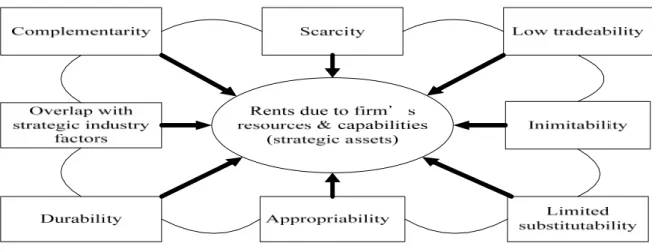
According to RBV, scholars insist that short-term economic rents are possible (Schoemaker, 1990). A firm’s rents can be achieved by possessing rare and valuable resources and capabilities (Mahoney, 1995). Amit and Schoemaker (1993) also argue that economic rents are derived from asymmetry in the initial resource endowment, resource scarcity, the limited transferability of resources, and imperfect substitutability (see Figure 2-2). Furthermore, they propose that firms must be able to develop selected resources and capabilities when facing exogenous changes, including high uncertainty, complexity, and intra-firm conflict; by doing so, firm profits can be achieved. Collis and Montgomery (1995) similarly suggest that a firm’s competitive advantage is not only derived from the value, inimitability, and non-substitutability of its resources and capabilities, but also from the durability, appropriability, and superiority of those same resources and capabilities.
- 32 -
Figure 2-2: Desired Characteristics of a Firm’s Resources and Capabilities
Source: Amit and Schoemaker (1993), “Strategic Assets and Organizational Rent.”
In summary, in order to assess the resource attributes, this study reviews the literature of internal organization related to a resource-based view. The concept of the strategic resources of a firm stems from Penrose (1959), who views a firm as a collection of productive resources and explains how resource stocks, which are deployed along with opportunities, limit the direction and speed of a firm’s growth.
However, the term “resource-based view” is proposed by Wernerfelt (1984), who suggests that resources enable firms to promote product market strategies. Barney (1991) and other scholars (such as Amit & Schoemaker, 1993; Collis & Montgomery, 1995; Peteraf, 1993) develop criteria to evaluate the strategic resources that help firms to cultivate effective strategies and generate a competitive advantage or economic rents.
Thus, these strategic resources usually have following attributes: value, rareness, imperfect limitability, and substitutability (Barney & Arikan, 2001), which can lead to firm performance.
- 33 -
2.4 Internal Resources, Capabilities, and Performance
As shown in the above conceptual literature review, the influence of resource attributes on firm performance has been identified by prior scholars (Amit &
Schoemaker, 1993; Barney, 1991; Collis & Montgomery, 1995; Peteraf, 1993). In addition, most empirical research pertaining to the resource-based view also concentrates on large or high-growth firms (Chaterjee & Wernerfelt, 1991; Harrison, Hall, & Nargund-Kar, 1993) and focuses on new venture performance (Chandler &
Hanks, 1994; Lerner & Almor, 2002). The researchers find that a variety of resources in organizations (such as tangible or intangible resources) and broader varieties of resource-based capabilities are significantly and positively related to their profits or growth. Thus, these studies support the resource-based argument that business performance is primarily the result of a firm’s ability to exploit its resources.
Some long-term differences in firm profitability cannot be attributed to differences in industry conditions. Indeed, most studies show that these differences originate from firm effects rather than the industrial environment (Hansen &
Wernerfelt, 1989; Mueller, 1986; Rumelt, 1991; Wernerfelt & Montgomery, 1988). A list of some empirical studies on the relationship between resources and firm performance is presented in Table 2-3.
Table 2-3 Some Empirical Studies of RBV Authors Firm vs. Industry Effects Wernerfelt and
Montgomery, 1988
The attractiveness of an industry is not a universal dimension; instead, what is attractive depends on a firm’s relative advantage.
- 34 -
Rumelt, 1991 Business-specific factors explain more variance in firm performance than industry factors.
McGahan and Porter, 1997
An examination of the importance of the year, industry, corporate parent, and business-specific effects on the profitability of U.S. public corporations within 4-digit SIC categories demonstrates that year, industry, corporate parent, and business-specific effects account for 2%, 19%, 4%, and 32%, respectively, of the aggregate variance in profitability.
Mauri and Michaels, 1998
A variance component analysis of 264 single-business companies from 69 industries using 5- and 15-year periods suggests that firm effects are more important on firm performance than industry effects.
Hall, 1992 Based on a survey conducted in the U.K., intangible resources (such as patents, licenses, reputations, and employee know-how in operations) lead to a firm’s sustainable competitive advantage and create capability differentials. An analysis of intangible resources should play a major role in the strategic management process.
Hall, 1993 The intangible resources most commonly identified as being sources of sustainable competitive advantage are as follows: (1) company reputation, (2) product reputation, (3) employee know-how, (4) perception of quality standards, and (5) the ability to manage change.
Glunk and Wilderom, 1998
Top management capital (i.e., inspiration, competence, and communication) and organizational capital (i.e., employee orientation and networking, financial management, and market focus) are the major predictors of organizational performance in small and medium-sized professional service firms.
Carolis, 2003 Based upon an empirical study on a sample of pharmaceutical companies in the U.S., technological competencies that are valuable, rare, and inimitable have a great impact on firm performance.
Markman, Espina, and Phan, 2004
By definition, patents are valuable and rare. Moreover, patent citations and claims capture inimitability and non-substitutability, respectively.
Focusing on 85 pharmaceutical firms, the study finds that inimitability is positively and significantly related to firm performance, and
- 35 -
non-substitutability is positively related to the introduction of new productions.
Sher and Yang, 2005 The empirical results indicate that innovative capabilities are usually positively related to firm performance. Specifically, higher R&D intensity and higher R&D manpower are found to be predictors of improved firm performance in the Taiwanese integrated circuit (IC) industry.
Galbreath and Galvin, 2006
This study finds that intangible resources can sustain firm profits, but tangible resources cannot explain a significant share of the variation in firm performance (Galbreath & Galvin, 2006).
Crook et al., 2008 Based on a meta-analysis of 125 studies using the RBV, the resources-performance link is stronger when resources meet the following criteria: valuable, rare, imperfectly imitable, and imperfectly substitutable.
Newbert, 2008 A study of micro-technology and nanotechnology firms examines the relationship between value, rareness, competitive advantage, and performance. The results suggest that value and rareness are related to competitive advantage.
Source: Summary of this study
The resource-based view of strategic management is adopted to highlight the importance of resources and capabilities. Newbert (2007) conducts a systematic assessment of previous empirical research using four frameworks: the resource heterogeneity approach, the organizing approach, the conceptual-level approach, and the dynamic capabilities approach. Then, he further categorizes empirical studies using a variety of dependent and independent variables. Based upon the analysis of Newbert (2007), the resource heterogeneity approach is the most widely utilized, and is commonly operationalized by resources (such as human capital, knowledge, experience,
- 36 -
and social capital) and capabilities (such as human resourcefulness, innovativeness, and information technology). However, few empirical studies focus on the conceptual level and examine value and rareness.
In response to a gap in terms of the conceptual-level approach in testing the RBV hypotheses, Newbert (2008) examines how the exploitation of valuable, rare resources and capabilities contributes to a firm’s competitive advantage, and how this, in turn, contributes to its performance (see Figure 2-3). The results show that value and rareness are positively related to competitive advantage, that competitive advantage is positively related to firm performance, and that competitive advantage significantly mediates the rareness-performance relationship.
Figure 2-3: Conceptual Model of RBV
Source: Newbert (2008), “Value, Rareness, Competitive Advantage, and Performance:
A Conceptual-Level Empirical Investigation of the Resource-based View of the Firm.”
In summary, as shown in the above literature, existing empirical studies support business-specific effects on the profitability of firms. That is, value/rareness resources and
capabilities, organizational, intellectual, financial, human, and physical resources and
capabilities, can improve firm performance.
- 37 -
2.5 External Approach: Environmental Dynamism
As mentioned in the Introduction section, in addition organization’s internal force, external environment, industry or needs of customers, has also been regarded as other force that can facilitate firm performance (Hitt et al., 2006; Porter, 1980). Each organization prefer to stable and munificent environment in which it can easily manage relevant questions and satisfy its stakeholders. However, the probability of facing an uncertainness of external environment (i.e. environmental dynamism, munificence, complexity) increase so that firms must attempt to explore and exploit resources and capabilities more effectively by grasping external opportunities and avoiding external threats (Jones, 2007). External analyses from opportunities and threats have long received attention in the literature of industrial organization (Bain, 1968; Demsetz, 1973; Mason, 1953; Porter, 1980; Schmalensee, 1985).
2.5.1 Environmental Dynamism from Industrial Organization
The traditional paradigm of industrial organization has provided a model in the field of strategic management for assessing competitive environment in industry.
According to this paradigm of Bain (1968) and Mason (1939), the decision-making behavior or conduct of firms derived from industry structure that is influenced by several factors, including industry requirements, customer needs, technologies changes, and government policies. The conduct of firms is to construct market power, and various industries achieve different levels of averaged profitability. That is, the
- 38 -
industry structure determines what strategy can be conducted, thereby determining firm performance. This is the fundamental and famous argument of the structure–conduct–performance (S-C-P) paradigm that is defined as follows (Bain, 1972; Porter, 1981). According to Bain (1972), performance refers to profitability, technical efficiency (cost minimization), and innovation. Conduct refers to the activities of decision-making and strategies that includes price, advertising, capability, quality, collusion, and expanding market. Finally, industry structure is defined as a stable or dynamic economic and technical dimension of an industry that provides the context in which competition occurred. The elements of structure are identified as barriers to entry, the numbers of competitors in an industry, and product differentiation.
According to this paradigm, firms can effectively form the strategy in industrial environment. This S-C-P framework is shown in Figure 2-4.
Figure 2-4: The Traditional Industry Organization Paradigm Source: The Study of Bain (1968) and Mason (1953)
During the 1970s, IO has been enriched by addressing several of dimensions, which result in new developments IO. Therefore, IO has moved from being a useful tool to considering a strategy formulation. Porter (1981) provides an overview in terms of the new promise of industrial organization. Based on the comparison of both
- 39 -
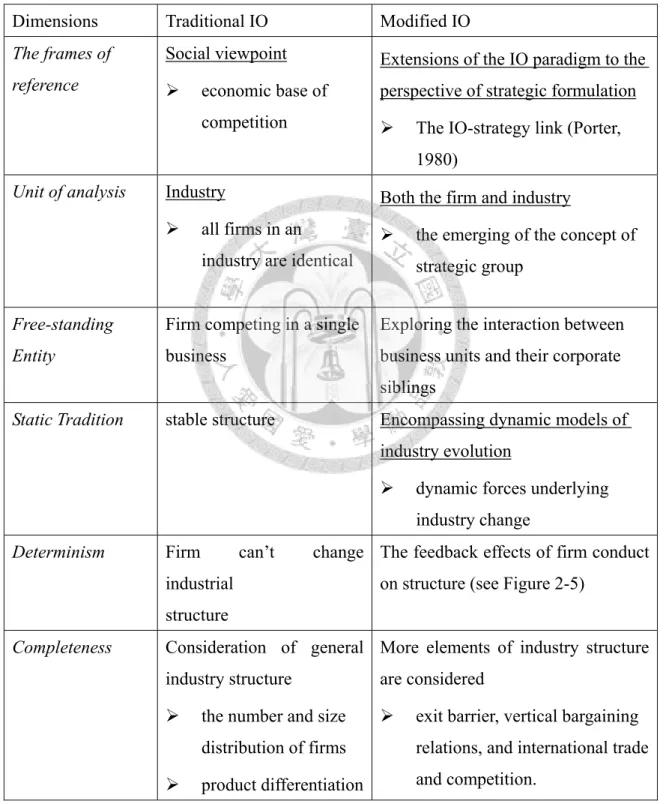
traditional IO and modified IO (Porter, 1981), this study sorts and illustrates the difference between traditional IO and modified IO, which is shown in Table 2-4.
Table 2-4: The Comparison of Traditional IO and Modified IO Dimensions Traditional IO Modified IO
The frames of
reference
Social viewpoint
¾ economic base of competition
Extensions of the IO paradigm to the perspective of strategic formulation
¾ The IO-strategy link (Porter, 1980)
Unit of analysis
Industry¾ all firms in an
industry are identical
Both the firm and industry
¾ the emerging of the concept of strategic group
Free-standing Entity
Firm competing in a single business
Exploring the interaction between business units and their corporate siblings
Static Tradition
stable structure Encompassing dynamic models of industry evolution¾ dynamic forces underlying industry change
Determinism
Firm can’t changeindustrial structure
The feedback effects of firm conduct on structure (see Figure 2-5)
Completeness
Consideration of general industry structure¾ the number and size distribution of firms
¾ product differentiation
More elements of industry structure are considered
¾ exit barrier, vertical bargaining relations, and international trade and competition.
Source: Summary of this study