行政院國家科學委員會專題研究計畫 成果報告
裂縫與直線或橢圓形界面之熱黏彈性交互作用之研究(第 3 年)
研究成果報告(完整版)
計 畫 類 別 : 個別型
計 畫 編 號 : NSC 97-2221-E-011-037-MY3
執 行 期 間 : 99 年 08 月 01 日至 100 年 07 月 31 日 執 行 單 位 : 國立臺灣科技大學機械工程系
計 畫 主 持 人 : 趙振綱
計畫參與人員: 碩士班研究生-兼任助理人員:徐梓斌 碩士班研究生-兼任助理人員:施宏錡 碩士班研究生-兼任助理人員:張家豪 碩士班研究生-兼任助理人員:郭鳳如 碩士班研究生-兼任助理人員:曾姿綺 碩士班研究生-兼任助理人員:郭瑋旻
報 告 附 件 : 出席國際會議研究心得報告及發表論文
處 理 方 式 : 本計畫可公開查詢
中 華 民 國 100 年 08 月 02 日
裂縫與直線或橢圓形界面之熱黏彈性交互作用之研究
(3/3)
計畫類別:
個別型計畫 □ 整合型計畫計畫編號:計畫編號:NSC 97-2221-E-011-037-MY3 執行期間: 99 年 08 月 01 日至 100 年 07 月 31 日
計畫主持人:趙振綱 共同主持人:
計畫參與人員:
成果報告類型(依經費核定清單規定繳交):□精簡報告
完整報告本成果報告包括以下應繳交之附件:
□赴國外出差或研習心得報告一份
□赴大陸地區出差或研習心得報告一份
■出席國際學術會議心得報告及發表之論文各一份
□國際合作研究計畫國外研究報告書一份
處理方式:除產學合作研究計畫、提升產業技術及人才培育研究計畫、列 管計畫及下列情形者外,得立即公開查詢
□涉及專利或其他智慧財產權,□一年□二年後可公開查詢
執行單位:國立台灣科技大學
中 華 民 國 100 年 7 月 20 日
Interaction of a crack with bonded layered media having elliptical or straight boundaries in plane thermoviscoelasticity
C. K. Chao
Department of Mechanical Engineering
National Taiwan University of Science and Technology 43 Keelung Road, Section 4, Taipei, 106, Taiwan
E-mail: [email protected]
Abstract
: Interaction of an elliptically cylindrical layered media with an arbitrarily oriented crack embedded in an infinite matrix, intermediate layer, or inner inclusion under a remote uniform load is considered in this paper. Based on the technique of conformal mapping and the method of analytical continuation in conjunction with the alternating technique, the solution for a screw dislocation located in an infinite matrix, intermediate layer or inner inclusion is first derived in an explicit form. By applying the existing complex potential solutions for a dislocation density function, the logarithmic singular integral equations for a line crack are formulated and mode-III stress intensity factors are obtained numerically. The effects of material property combinations and geometric parameters on mode-III stress intensity factors are discussed in detail and shown in graphic form. Based on a correspondence principle, the real-time stress intensity factors for the corresponding viscoelastic problem can be obtained by taking the inverse Laplace transform. The result shows that the stress intensity factor decreases with time at begin then converges to a constant for long time.Keywords: elliptically cylindrical layered media, arbitrarily oriented crack, conformal mapping, mode-III stress intensity factors.
1. Introduction
The interaction between dislocations and inhomogeneities has received appreciable attention in order to evaluate the degree of failure of composite structures. The solution of a screw dislocation interacting with the inhomogeneity was first provided by Head (1953), who investigated the screw dislocation in the vicinity of a planar bimaterial interface.
Smith (1968) studied a screw dislocation interacting with a circular inhomogeneity. He also extended the problem of a dislocation interacting with an elliptic hole in antiplane elastostatics. Gong and Meguid (1994) presented the solution for a screw dislocation interacting with an elastic elliptical inhomogeneity. Xiao and Chen (2000) and Liu et al. (2003)
solved the problem for a screw dislocation interacting with a coated circular inclusion. Jiang et al. (2003) obtained the solution of interaction of a screw dislocation in the interphase layer with the inclusion and matrix. Honein et al. (2006) studied the interaction of a screw dislocation with a multi-layered interphase between a circularly cylindrical inclusion and matrix. Shen et al. (2006) derived an analytical solution for singularity problems in confocally elliptical inhomogeneity using an alternating technique.
Problems of the interaction effect of an edge dislocation with an inhomogeneity have also been discussed extensively. Early work by Dundurs and Mura (1964) and Dundurs and Sendeckyj (1965) studied an edge dislocation located outside and inside the single circular inclusion. Stagni and Lizzio (1983) and Santare and Keer (1986) gave the solution for an edge dislocation, which is located outside the inclusion, interacting with elliptic inclusion. Warren (1983) obtained an analytical solution for an edge dislocation inside the elliptic inclusion. Luo and Chen (1991) presented an analytical solution for the interaction of edge dislocation in a three phase composite cylinder model.
Qaissaunee and Santare (1995) solved the case where the edge dislocation is located inside or outside of a three phase elliptic cylinder model.
In order to solve the crack problem, a dislocation density function is widely used to treat as a Green’s function. In the derivation of singular integral equations, the selection of the auxiliary function determines whether the kernels have weak or strong singularities. Applying the Kernel with Cauchy type singularity, the interaction of cracks with inhomogeneities has been solved by several researchers such as Atkinson (1972) and Erdogan et al. (1974) who obtained the solution for a crack outside circular inclusion, and Erdogan and Gupta (1975) who presented the problems of a crack inside circular inclusion. Patton and Santare (1990) and Gong (1994) provided a straight crack interacting with a rigid elliptical inclusion. Wu and Chen (1990) and Anlas and Santare (1993) studied the case where the crack is located inside an elliptical inclusion.
An alternative method for solving crack problems may be formulated in terms of singular integral equation with logarithmic singular kernel. Chen and Cheung (1990) gave an elementary solution for the crack problem in elastic half plane by using log-type singular integral equation. Chao and Shen (1995) and Chao and Lee (1996) solved the thermoelastic crack problems in bonded dissimilar media and interacting with a circular elastic inclusion. Chen and Chen (1997) proposed a fundamental solution for interaction between a curved crack and an elastic inclusion in an infinite plate.
To date, most papers mainly focused on the crack interacting with a single inhomogenity, such as circular or elliptical inclusion. On the other hand, there are many multiphase systems that are commonly encountered in engineering application. Recently, Chao et al. (2010) presented the solution for antiplane interaction of a crack and a reinforced elliptical hole. They analyzed the problem based on the method of analytical continuation in conjunction with the alternating technique. This method has been successfully applied to reinforced elliptical hole problems under a particular loading condition, such as uniform heat flow (Chen and Chao, 2008) and uniform load (Chao et al. 2009).
However, no solution has been derived to study the more general forms of interaction between a crack and a multi-phase elliptical inclusion.
The focus of this present study is to derive the solution of an elliptically cylindrical layered media interacting with a crack under a remote uniform shear load. One of the major difficulties for solving a multilayered elliptic medium is that there is nonconformal inside the elliptic inclusion when we apply the mapping function from an elliptic boundary onto a unit circle. To overcome this difficulty, a restricted condition (Stagni and Lizzio, 1983) is applied to remedy the discontinuity problem which occurs when the transformation is required to be single-valued and conformal in the entire domain including the matrix and inclusion. Ru (1998), Ru et al. (1999), and Shen et al. (2006) applied this technique to solve the three-phase elliptical inclusion problem.
In this article, an arbitrarily oriented crack embedded in an infinite matrix, intermediate layer, and inner inclusion is considered. The proposed method is based on the technique of analytical continuation that is alternately applied across two different interfaces. To analyze the interaction between a crack and an elliptically cylindrical media, the existing solutions for dislocation functions are used to formulate the logarithmic singular integral equations for a line crack, and mode-III stress intensity factors are obtained numerically. The layout of the present paper is as follows. The general formulation for antiplane elasticity and the method of conformal mapping are introduced in Section 2. The series form solutions for the complex potentials function are given in Section 3. Integral representation for a line crack is established in Section 4. Some numerical examples are solved in Section 5. Finally, Section 6 concludes the article.
2. Problem Statement and Conformal Mapping
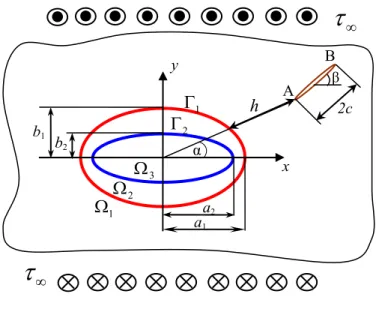
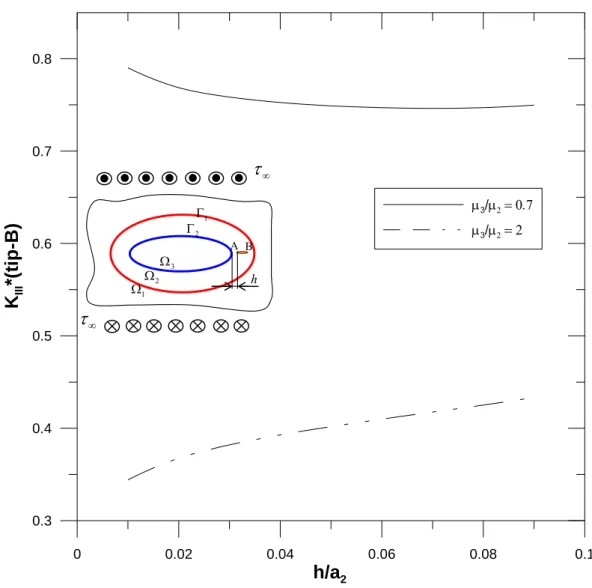
Consider a cross section of three-phase confocally elliptical composite in an unbounded matrix with an arbitrarily oriented crack subjected to a remote uniform load as shown in Figure 1. Let Ω1 denote the matrix, Ω2 denote the intermediate layer, and Ω3 denote the inner inclusion, respectively. The boundaries of intermediate layer are two confocal ellipses Γ1, Γ2 with a1, a2, and b1, b2, being the major and minor semi-axes for each, respectively. Let the medium contain a line crack with length 2c and angle β with respect to the x axis. A line joining Tip-A and the origin makes an angle α with respect to the x axis and the distance h is measured from Tip-A to the intersection between that line and the elliptic boundary.
The geometry of the problem is transformed by mapping the confocal ellipse Γ1, Γ2 in the z-plane onto the concentric circles L1, L2 in the ζ-plane with radii ρ1, ρ2 as shown in Figure 2. The conformal mapping functions is expressed as
R R m l
z 1
) 2
( (1)
2 / 2 1
1 2
1 l
l
R z (2)
Where
2 2
2 2
b a
b R a
2
2 2
2 b
a
l 1,2
2 2
i
b a
b ai i
i
It also transforms the segment from -l to l in the z-plane onto the circle L3 of radius 1/R in the ζ-plane.
Based on the complex variable theory for a two-dimensional antiplane elasticity, the resultant force P, displacement ω, and stress component σxt & σyt can be written in terms of a single complex potential θ (ζ) as follows
Im
dy dx
P xt yt (3)
Re (4)
xti yt ' (5)
nti tt ei (6)
where Re and Im denote the real part and imaginary part of the bracketed expression, respectively. The quantities σxt, σyt
are the components of shear stresses in x and y direction, respectively, t is the unit tangent of σ, n is the outward unit normal at the interface which in complex form is equal to eiγ (where γ is the angle between the normal direction n and the positive axis x). (‘) is designated as the derivative with respect to the associated argument and μ stands for the shear modulus. Once the antiplane problem is solved, the complex potential θ (ζ) is determined.
3. Complex Potential Formulation
3.1 Homogeneous Solution
The complex potential for an infinite homogeneous medium subjected to a remote uniform shear load τ∞ directed at an angle 90°from x-axis is given by the simple expression
z i z
0( ) (7)
With the aid of the mapping function (1), the homogeneous solution in the ζ-plane can be rewritten as
i l R R1
) 2
0( (8)
In order to solve crack problems, the complex potentials for infinite homogeneous medium corresponding to a screw dislocation with Burgers vector bz located at z = zt are introduced as
ibz z zt
z log
0 2
(9)
Similarly, with the aid of mapping function (1), the homogeneous solution in the ζ–plane can be written as
ibz z zt
z log
0 2
(10)
Eqs. (8) and (10) can be rewritten as
0 0a 0b (11)
where the function θ0a(ζ) is holomorphic in the region |ζ| ≤ 1 and the function θ0b(ζ) is holomorphic in the region |ζ| ≥ 1 respectively.
3.2 Screw Dislocation in Matrix
In this section, we will derive the stress field for a three-phase elliptical composite subjected to a screw dislocation in matrix. The complex potential functions can be assumed as
3 1
3 1
3
2 1
2 1
2
1 0
0 1
1
S S S
n bn n
an n
bn n
an
b a n
bn
(12)
where bn1 and an2 are respectively holomorphic in the regions |ζ| ≥ ρ1 and |ζ| ≤ ρ1, bn2 and an3 are respectively holomorphic in the regions |ζ| ≥ ρ2 and |ζ| ≤ ρ2, and bn3 is holomorphic in the region |ζ| ≥ 1/R, which can be expressed in terms of θ0a(ζ) and θ0b(ζ). In order to determine the complex potential functions θ(ζ) the alternating technique is applied by the following procedure.
Step 1: Analytical continuation across the L1 interface
First, we introduce two complex functions b11 and a21 respectively holomorphic in |ζ| ≥ ρ1 and |ζ| ≤ ρ1 to satisfy the continuity conditions of the displacement and resultant force across the interface L1 that
2 1 1 1 2
1 1 0 1 0 1 1
1 1 0 1 0 1 1
1t at bt b t at bt a t a t
b
(13)
2 1
1 1 2
1 2 1 0 1 0 1 1
1 1 0 1 0 1 1
1
1b t at bt b t at bt a t a t
(14)
where t1 = ρ1eiη
By the standard analytical continuation argument and applying Liouville’s theorem, we have
1 2
1 2
1 0 2 1 0 1
1
1 2
1 2 1 1
1 2 0 1 0
0
0
a b a
b
a b
b a
(15)
1 2
1 2
1 2 1
1 1 0 1 2 1 0 1
1 2
1 2 2 1 1
1 1 2 0 1 1 0 1
0
0
a b
b a
a b
b a
(16)
Solve Eqs. (15) and (16) to obtain
a21 U21 0a (17)
b V a 0b
2 1 0 21 1
1
(18)
where
j i
j
Uij
2
j i
i j
Vij
i,j1,2,3
Since the result of a21 is valid for the region |ζ| ≤ ρ1, it can not satisfy the continuity condition at the interface L2.
Step 2: Analytical continuation across the L2 interface
Next, we introduce two functions a31 and b21 respectively holomorphic in |ζ| ≤ ρ2 and |ζ| ≥ ρ2 to satisfy the continuity conditions of the displacement and resultant force across the interface L2 that
2 21 2 21 2 21 2 31 2 31 2
2
1t b t a t b t a t a t
a
(19)
21 2 21 2 21 2 21 2 2 31 2 31 2
1 a t b t a t b t a t a t
(20)
where t2 = ρ2eiη
By the analytical continuation method, the solution is found to be
3 32 21
1 a
a U (21)
2 32 21 22
1 a
b V (22)
But the result of a31 is valid for the region |ζ| ≤ ρ2, it can not satisfy the continuity conditions across L3. Additional term will be introduced in the third step.
Step 3: Analytical continuation across the L3 interface
Since the points t3 = (1/R)eiη and t3 = (1/R)e-iη correspond to the same points of the segment from -l to l in the z-plane. The following condition must be satisfied (Stagni and Lizzio, 1983)
3 3 3
3t t
(23)
The function b31 holomorphic in |ζ| ≥ 1/R is introduced to satisfy this condition by letting
31
3 1 3
b
a
(24)
Substitution of Eq. (24) into Eq. (23) yields
3 3 1 3 3
1 3 3
1 3 3
1t b t a t b t
a
(25)
By the analytical continuation method, the solution is found to be
31 2
3 1
1
a R
b (26)
Step 4: Analytical continuation across the L1 interface
Two additional functions 1b2 and a22 respectively holomorphic in |ζ| ≥ ρ1 and ζ| ≤ ρ1 are introduced to satisfy the continuity conditions across the interface L1 that
2 1 2 1 2 1 1 2
2 1 2
1 1 1
2 1 1
2t b t b t a t b t a t
b
(27)
2 1
2 1 2
1 1 2
2 1 2 1 2 1 1
2 1 1
2
1 b t b t b t a t b t a t
(28)
where t1 = ρ1eiη
By the same method, we have
2 12 21 12
2 b
a V (29)
12 21
1
2 b
b U (30)
Step 5: Repetitions of steps 2, 3 and 4
The method of analytical continuation is repeatedly performed across each interface to achieve the unknown functions a32 , b32 , 1bn , an2 , bn2 , an3 , and bn3 (n = 3,4,5,…). Consequently, one can express all the functions in terms of 0a and 0b as follows
0 2 21 32 3
1
0 21 32 3
1
2 2 0 21 32 2
1
0 21 2
1
0 2 0 1 21 1
1
1 U R U
U U
U V U V
a b
a a
a b
a a
b a
b
(31a)
and
2 2 1
) 1 ( 12 2 32
2 2 3
) 1 ( 23 3
2 1 2
) 1 ( 12 2
2 1 2 2
) 1 ( 12 2 32
2 4 3
) 1 ( 23 3
2 3
) 1 ( 2 23
2 2 1 2
) 1 ( 12 32 2
2 ) 1 ( 12 1
1 1
1
n b n
a an
n b an
n b n
a bn
n a n
b bn
n b bn
V R U
V V
R V R U
V
U R V
V U
(31b)
for n ≥ 2
The complete solution for three-phase elliptical composite subjected to screw dislocation in matrix can be obtained by substituting Eqs. (9), (10) and (31) into Eq. (12)
3.3 Screw Dislocation in Intermediate Layer
When a screw dislocation is located in S2, the problem becomes more difficult to solve. To satisfy the single-valued conditions of displacements and resultant force, the complex potential function should have the form
3 1
3 1
3
2 1
2 1
2 0
0
1 1
1 1 1
2 log
S S b S
i
n bn n
an
n bn n
an b
a
n bn z
(32)
By the same arguments as in case of screw dislocation in matrix, the alternating technique is applied to solve the current problem.
Step 1: Analytical continuation across the L1 interface
First, we introduce two complex functions b11 and a21 respectively holomorphic in |ζ| ≥ ρ1 and |ζ| ≤ ρ1 to satisfy the continuity conditions of the displacement and resultant force across the interface L1 that
1 2
1 1 2
1 00 00 1 1
1 1 1
1t b t a t a t
b
(33)
11 1 11 1 2 00 00 21 1 21 1
1b t b t a t a t
(34)
where t1 = ρ1eiη and
t t
z
R b
i
00 2 2
1 1 1 2 log
By the analytical continuation method, we have
1 12 00
1 U
b (35)
2 12 00 12
1 V
a (36)