國立臺灣大學理學院數學系 碩士論文
Department of Mathematics College of Science
National Taiwan University Master Thesis
表現理論初探
A Glimpse of Representation Theory
許乃珩
Nai-Heng Sheu
指導教授:余家富 博士 Advisor: Chia-Fu Yu, Ph.D.
中華民國 107 年 1 月
January, 2018
謝
感謝余家富老師,溫和且有耐心的指導,同時給予了很多數學上的幫助,並為了此篇 論文的完整性而撰寫了第五章,以及對於論文內容給了很多洞見,有老師的幫忙,我 才能夠完成這篇論文。感謝康明昌老師、謝銘倫老師以及林惠雯老師,撥時間來當口 試委員,並給予珍貴的建議。感謝郭家瑋學長,常常讓我問問題。感謝系上的同學陳 奎佑、黃子豪及王國鑫的幫忙,讓脫線的我足以使口試順利進行。感謝台大數學系和 那架鋼琴給予了舒適且自由的環境,讓人待在裡面感到舒服自在。也感謝系上的同學,
認真且開放的討論風氣讓人收穫良多。感謝玩味咖啡的美味餐點及飲料,讓一天的開 始是如此的令人期待。最後感謝賴奕甫給予的陪伴與各種支持。
要
在這篇論文中,我們趁著這次機會整理了一些關於有限群表現理論基本而重要的結 果,例如:判定給定的群他的不可分解 (indecomposable) 表現及不可分解的整數表現 (integral representations),是否只有有限多種。因為分裂的代數圓圈 (split algebraic tori) 會與有限群的整數表現產生對應,所以在此論文的最後一章,我們也介紹了代 數圓圈的可分離分裂體 (separable splitting fields) 定理。在第二章中,我們探討模表 現 (modular representations),尤其是體 (field) 的特徵值 (characteristic ) 整除群的元 素總個數時。我們介紹了格林對應 (Green’s correspondence),在格林對應之後,我們 有了相對投射性 (relative projectivity) 的概念,進而能夠判斷給定的群的不可分解的 表現是否有無限多種,同時在模系統 (modular system) 下我們介紹了格羅滕迪克群 (Grothendieck group) 及 cde 三角形。第三章簡單的介紹了整數表現理論以及判斷不 可分解的整數表現的有限性的方式。在第四章,我們整理了一些特定有限群的不可分 解整數表現,例如元素個數為質數 p 的循環群,以及元素個數為 2p 的二面體群。在 最後一章,我們整理了很多代數圓圈會在他的有限可分離體擴張 (finite separable field extension) 分裂的不同證明,並且推廣了 Chow 的定理,最後則是給了對於一個代數圓 圈,他的分裂體的上限。
關 :模表現、整數表現、有限表現 、代數圓圈、分裂體
Abstract
In the present thesis, we take the opportunity to discuss several basic and important re- sults in representation theory. More precisely we mainly investigate the criterion of finite groups G that are of finite representation type for both kG-modules or for ZG-lattices, as well as separable splitting fields of algebraic tori.
In Chapter 2, we consider the theory of representations of finite groups over a field k. We focus mainly on the case where the characteristic of k divides the order of the group G.
This chapter include Green’s correspondence and its the connection to the criterion of kG that is of finite representation. We also discuss the structure and relation of Grothendieck groups RkG and RKG in a modular system setting, namely the cde triangle.
In Chapter 3, we give an overview of integral representations based on classical results of Heller and Reiner, which would be useful for further studies. In Chapter 4, we give a description of classification of indecomposable integral representations of cyclic groups of prime order p and dihedral groups of order 2p, based on works of Reiner and of Lee.
In the last chapter, we give a connection between algebraic tori and integral representa- tions of finite groups. We give several different proofs of the theorem that any algebraic tori over a field splits over a finite field extension. Besides, we also generalize Chow’s the- orem to semi-abelian varieties, and give a sharp bound for the splitting fields of algebraic tori.
Keywords: modular representations, integral representations, finite representation type, algebraic tori, splitting fields
Contents
謝 i
要 ii
Abstract iii
Lists of Tables vi
1 Introduction 1
2 The group ring kG 3
2.1 Green’s correspondence . . . 4
2.2 Infinitely many indecomposable representations . . . 11
2.3 Another example of infinitely many indecomposable modules . . . 15
2.4 General results of kG . . . 16
2.5 The example G = S3 . . . 20
3 Integral representations 24 3.1 Introduction . . . 24
3.2 An example and reduction mod p . . . 27
3.3 Finiteness of the group ring ZG . . . 29
3.4 Infinitely many indecomposable lattices . . . 36
4 Integral representations of specific finite groups 42
4.1 Cyclic groups of prime order . . . 42
4.2 Dihedral groups of order 2p . . . 46
4.3 An example . . . 55
5 Chow’s theorem for semi-abelian varieties and bounds for splitting fields for algebraic tori 58 5.1 Introduction . . . 58
5.2 Characters and diagonalizable groups . . . 62
5.3 Derivations, connections and inseparable descent. . . 65
5.4 Three more proofs of Theorem 94 . . . 77
5.5 Chow’s theorem for semi-abelian varieties. . . 78
5.6 Bounds for splitting fields of tori . . . 83
Bibliography 88
List of Tables
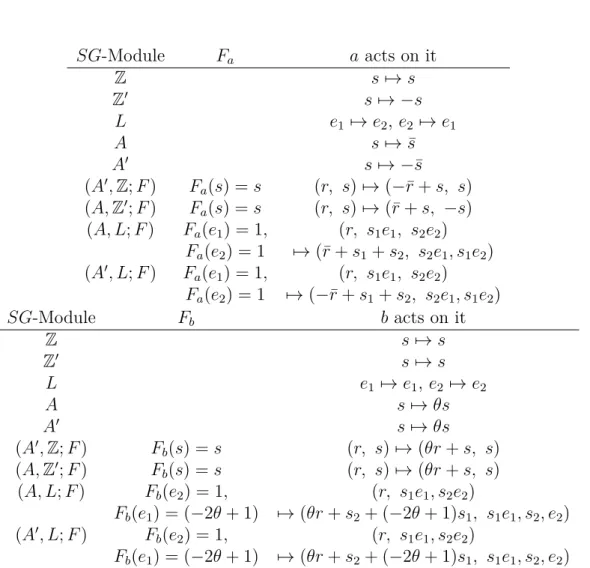
4.1 Decompositions of Z(2p)Dp modules with coefficients Z(p) and Z(2) . . . . 55 4.2 Actions of S3 on indecomposable ZS3-lattices andZ(6)S3-lattices . . . 57
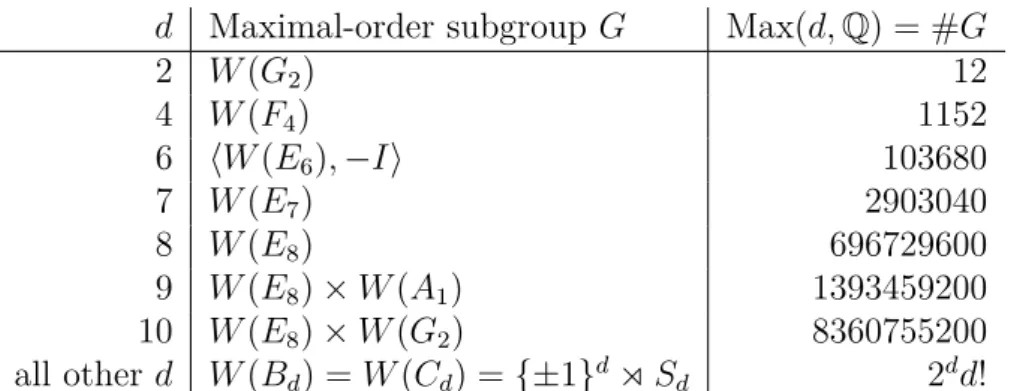
5.1 Maximal-order finite subgroups of GLd(Q) . . . 85
Chapter 1
Introduction
This paper is the author’s attempt to organize some well-known and important results in representation theory. It includes topics on representations of finite groups over fields of characteristic p ̸= 0, integral representations of finite groups, as well as some results on algebraic tori which are connected to integral representations.
In Chapter 2, we deal with representations of finite groups over a field k of charac- teristic p ̸= 0. The content of this chapter is mainly followed from [36] and [43]. We exhibit some notions and general results concerning kG-modules. For example, we dis- cuss Green’s correspondence, numbers of irreducible representations up to isomorphism, properties of projective covers, the cde triangle, and a criteria of groups that are of fi- nite representation type. We include the adorable construction in [43] of infinitely many indecomposable non-isomorphic representations of the group Cp× Cp. Based on general results we learned, we make a detailed study on indecomposable representations of the symmetric group S3. This finite group S3 will also appear as an example in successive chapters.
In the next two chapters, we introduce integral representations of finite groups. Chap- ter 3 concerns mainly the finiteness criteria for finite groups. For definitions and basic theorems, we follow mainly the exposition of Curtis and Reiner [10]. Then we are de-
voted to discussing results toward the main theorems of Heller and Reiner ([17] and [18]) on a criterion of G which is of finite representation type. Chapter 4 deals with the classification problem of indecomposable integral representations of special finite groups, namely G = Cp a cyclic group of prime order p, and G = Dp a dihedral group of order 2p. The examples in this chapter illustrate an interesting connection between integral representations and algebraic number theory.
The last chapter, Chapter 5, deals with separable splitting fields of algebraic tori.
We explain how integral representations of finite groups are related to classification of algebraic tori. This is based on a well-known theorem that any algebraic torus splits over a finite separable field extension. The main part of this chapter provides several different proofs of this well-known theorem from different points of view. We also establish Chow’s theorem for semi-abelian varieties and give a sharp bound for the degrees of the splitting fields. The latter uses a classical theorem of Chevalley on invariants of finite reflection groups, results on finite subgroups of GLd(Q) and Hilbert’s irreducibility.
Chapter 2
The group ring kG
In this chapter, our group G is a finite group. Let A be a complete discrete valuation ring with quotient field K. Assume that K is of characteristic 0 and the residue field k is of characteristic p > 0. Assume that k sufficiently large i.e. k contains a |G|-th root of unity. Let kG denote the group ring of G over k. All kG-modules M considered are finitely generated, unless specifically stated otherwise.
The ring structure of the group ring kG and its representations are known when char k ∤ |G| and k is sufficiently large. In the following, we shall focus on the situation where char k = p | |G|. We try to understand kG in three ways: studying indecomposable kG-modules through Green’s correspondence, the (modular) character theory and ring structure of kG itself.
We will first introduce relative projectiveness, vertices and sources. Using these no- tions, we can describe Green’s Correspondence, and obtain information on the number of isomorphism classes of indecomposable kG-modules under suitable conditions of G.
Later, we will give an example of G for which there are infinitely many isomorphism classes indecomposable kG-modules. After that, we will give a criterion for G that there are only finitely many indecomposable kG-modules up to isomorphism, i.e. kG is of finite representation type.
For the second approach, we exhibit some general results like the cde triangle, pro- jective covers, numbers of irreducible representations over k.
At the end, we use results we have discussed about, and obtain more explicit infor- mation in the case G = S3 and p = 2 or 3.
2.1 Green’s correspondence
For the moment, let k be a field of any arbitrary field. Suppose U is a kG-module, H a subgroup of G and V is a kH-module. In the following, let V ↑GH denote the induced representation of V from H to G. Let U ↓GH denote the restriction of U to kH-module.
If U′ is a direct summand of U , then we write U′ | U.
We first state different definitions of H-projectiveness. These three definitions are actually equivalent by [43] Corollary 11.3.4.
Definition 1. A kG-module U is said to be H-projective if U is a direct summand of
T ↑GH for some kH-module T .
Definition 2. We say a kG-module U H-projective if for a given exact sequence 0 −→f E1 −→ Eg 2 → U → 0 of kG-modules, it splits if and only if it splits as kH-modules.
Definition 3. We say a kG-module U H-projective if U|U ↓GH↑GH. Example 4. Every kG-module U is G-projective.
Example 5. Since every projective kG-module is a direct summand of (kG)n, a kG- module P is projective if and only if it is 1G-projective.
Proposition 6. Suppose U is a Q-projective kG-module with Q a minimal subgroup satisfying this condition. Then this minimal subgroup Q is unique up to conjugacy.
Proof. Suppose there exists a minimal subgroup Q′ of G such that U is Q′-projective.
Since U is both Q- and Q′-projective, we have U|U ↓GQ↑GQ↓GQ′↑GQ′. From Mackay’s formula
(ref. [36] Proposition 22),
U ↓GQ↑GQ↓GQ′↑GQ′= (U ↓GQ↑GQ↓GQ′)↑GQ′ = ( ⊕
s∈Q′\G/Q
((U ↓GQ)s ↓ssQQ∩Q′)↑QsQ′∩Q′)↑GQ′
= ⊕
s∈Q′\G/Q
((U ↓GQ)s ↓ssQQ∩Q′)↑GsQ∩Q′, where sQ = sQs−1
Since U is indecomposable, U must be a direct summand of ((U ↓GQ)s ↓ssQQ∩Q′)↑GsQ∩Q′ for some s. Since Q′ is minimal, we have sQ∩ Q′ = Q′. This means that Q′ is conjugate to a subgroup of Q. Similarly, Q is conjugate to a subgroup of Q′. Hence Q is conjugate to Q′
Definition 7. Let U be a kG-module, and Q a subgroup of G as in Proposition 6. We
say Q is a vertex of U .
Proposition 8. Suppose H is a subgroup of G such that |G/H| is invertible in k. Then every kG-module M is H-projective.
Proof. See [43] Proposition 11.3.5.
Corollary 9. Suppose U is an indecomposable kG-module, chark = p, with a vertex Q.
This Q must be a p-subgroup of G.
Proof. Let H be a Sylow p-subgroup P of G, then by Proposition8, M is P -projective.
Hence a vertex of M is a p-group.
Proposition 10. Let U be an indecomposable kG-module. Suppose U has a vertex Q, and
one has U|T ↑GQ for some kQ-module T . If we choose such kQ-module T indecomposable, then T is unique up to conjugacy by an element belongs to NG(Q).
Proof. At first, we choose our T specifically. Observe that since U|U ↓GQ↑GQ and U is indecomposable, we can choose some indecomposable kQ-module T with T|U ↓GQ such
that U|T ↑GQ. Now suppose there exists an indecomposable kQ-module T′ such that U|T′ ↑GQ. Since U|T ↑GQ, we have
T|U ↓GQ|T′ ↑GQ↓GQ, and T′ ↑GQ↓GQ= ⊕
s∈Q\G/Q
(T′ ↓QsQ∩Q)s↑QsQ∩Q .
Hence T|(T′ ↓Qs′Q∩Q)s′ ↑Qs′Q∩Q) for some s′. Since Q is a vertex, it is minimal. Therefore,
s′Q = Q. We must have s′ ∈ NG(Q).
Definition 11. Let Q, T, U be as in Proposition 10, we say T is a source of U .
The following proposition is not directly related to the content of this section. How- ever, this property looks similar to Definition 3, and will be used later.
Proposition 12. For any kH-module V , we have V|V ↑GH↓GH. Proof. From Mackay’s formula, we have
V ↑GH↓GH= ⊕
s∈H\G/H
(V ↓HsH∩H)s↑HsH∩H .
When s∈ [e], we have V = (V ↓HsH∩H)s ↑HsH∩H. Therefore, V|V ↑GH↓GH.
Theorem 13 (Krull-Schmidt-Azumaya). Let R be a complete discrete valuation ring
or a field. If Λ is an R-algebra and finitely generated as R-module, then every finitely generated Λ-module M can be written as ⊕n
i=1Mi with Mi indecomposable R-modules, and the set counting with the multiplicity {Mi} is uniquely determined by M.
Proof. See [10] Theorem 6.12.
Theorem 14 (Green’s Correspondence). Let k be a field of characteristic p. Let Q be a
p-subgroup of G and L a subgroup of G containing the normalizer of Q in G.
(1). Suppose U is an indecomposable kG-module with vertex Q, then there exists a unique indecomposable kL-module f (U ) with vertex Q, such that f (U )|U ↓GL. Also if X|U ↓GL and X ̸∼= f (U ), then X is H-projective, for some H =xQ∩ L and x ∈ G ∖ L.
(2). Suppose V is an indecomposable kL-module with vertex Q, then there exists a unique indecomposable kG-module g(V ) with vertex Q, such that g(V )|V ↑GL.And if Y|V ↑GL andY ̸∼= g(V ), then Y is H-projective for some H =yQ∩ Q, and y ∈ G ∖ L.
(3). Moreover, we have gf (U ) ∼= U, and f g(V ) ∼= V .
Proof. Step 0 : At first, suppose H is the subgroup in (2), then |H| is strictly smaller than |Q|. This is because if |H| is equals to |Q|, we have H = yQ∩ Q = Q for some y ∈ G ∖ L. Therefore, we have y ∈ NG(Q) ⊂ L, which can not happen. Also, the subgroup H in (1) can not be conjugate to Q under L. If so, we have yQ ∩ L = xQ for some x ∈ L. Consequently, yx−1Q equals to Q, hence yx−1 ∈ NG(Q). Therefore, y belongs to xNG(Q)⊂ L, and we get a contradiction.
Now we prove (2) first.
Step 1 : Suppose V has source T , then we write T ↑LQ= V ⊕ Z. By Proposition 12, we have
V ↑GL↓GL= V ⊕ V′, Z ↑GL↓GL= Z⊕ Z′.
Now, we look at T more carefully to understand V . We have
T ↑GQ↓GL= ⊕
s∈L\G/Q
Ts ↓sLQ∩sQ↑LsL∩Q= V ⊕ V′ ⊕ Z ⊕ Z′.
Since V has a vertex Q, we have
V ⊕ Z = T ↑LQ= Ts↓sLQ∩sQ↑LsL∩Q, s∈ L.
For indecomposable summands of V′, Z′, they must be sL∩ Q-projective, s ̸∈ L. How- ever, L∩sQ is not conjugate to Q under L by the first paragraph. Hence V ↑GL↓GL has the unique summand V with vertex Q.
Step 2 : (Existence) Now consider V ↑GL, write V ↑GL as direct sum of indecomposable
kG-modules. We can pick an indecomposable one, say U , such that U ↓GL contains V and such U must have a vertex Q. We have that U is Q-projective. Suppose it has a vertex Q′ proper subgroup of Q and a source T′. V|U ↓GL |T′ ↑GQ′↓GL, similar to step 1, V must has a vertex strictly smaller than Q, contradiction to the minimality of the vertex Q.
Step 3 : (Uniqueness) Suppose U′|V ↑GL, and U′ has a vertex Q′ < Q < L. Since U′|U′ ↓GL↑GL, one of indecomposable summands of U′ ↓GL must contain a source of U′, when we restrict this summand to Q′. We denote this indecomposable summand by X. This X must has vertex a Q′, otherwise it will contradict with U′ has a vertex Q′. Also X|U′ ↓GL |V ↑GL↓GL, by step 1, we have that X is L∩sQ-projective. But since X is an indecomposable kL-module, we have that Q′ must be L-conjugate to a subgroup of L∩sQ for some s ̸∈ L. Also lQ′ < L∩sQ implies Q′ < L∩sl−1Q. Since Q′ < Q, we have Q′ < Q∩s′Q for s′ ̸∈ L, since s ̸∈ L, and we have Q′ < Q. By step 0, we have that
|Q′| ̸= |Q|, hence Q′ is a proper subgroup of Q.
For proof of (1): Now suppose U is an indecomposable kG-module with a vertex Q.
Since U is also L-projective, U|U ↓GL↑GL. Hence U ↓GL contains an indecomposable kL- module V such that U|V ↑GL. And such a kL-module V must have a vertex Q and source T since U has. Now suppose V′ ̸∼= V is another indecomposable summand of U ↓GL | T ↑GQ↓GL. By Step 1 of proof (2), V′ must be xQ∩ L-projective for some x ∈ L − Q. By Step 0, we know thatxQ∩L is not L-conjugate to Q, hence V′ is not an indecomposable kL-module with a vertex Q.
For proof of (3): This follows from
U|U ↓GL↑GL, V|V ↑GL↓GL,
and the uniqueness of (1), (2).
Theorem 15 (Schur–Zassenhaus). Suppose G is a finite group, and N is a normal
subgroup of G such that the order of G/N is coprime to the order of N . Then G is a semidirect product of N and G/N .
Proof. See [11] Theorem 17.4.39.
Definition 16. We let Sk(G) denote the set of all non-isomorphic simple kG-modules.
Proposition 17. Suppose G is a finite group with the (unique) normal Sylow p-subgroup
P cyclic of order pn. Hence G is a semi-direct product of P and a subgroup K with |K|
coprime to p. Then the number of isomorphism classes of indecomposable kG-modules is pn· |Sk(K)|.
Proof. See [43], Corollary 11.2.2.
Corollary 18. Suppose G has a Sylow p-group P of order p, then there are
(p− 1) · |Sk(NG(P ))| + |Sk(G)|
indecomposable kG-modules.
Proof. By the Schur-Zassenhaus Theorem, we have NG(P ) = P ⋊ K. And we have |Sk(NG(P ))| = |Sk(K))|(cf. [43], Corollary 6.2.2). By Proposition 17, there are p·
|Sk(NG(P ))| non-isomorphic classes of kNG(P )-modules. Since there are|Sk(NG(P ))| in- decomposable projective kG-modules (up to isomorphism), i.e. 1-projective, p·|Sk(NG(P ))|−
|Sk(NG(P ))| of them must be P -projective. By Green’s correspondence, there are p|Sk(NG(P ))|−
|Sk(NG(P ))| indecomposable and not projective kG-modules with a vertex P , and |Sk(G)| indecomposable projective kG-modules.
Definition 19. A ring R is said to be of finite representation type, if there are only
finitely many isomorphism classes of indecomposable R-modules.
Proposition 20. Let k be a field of characteristic p and P be a Sylow p-subgroup of G.
Then kG is of finite representation type if and only if kP is of finite representation type.
Proof. (⇒): For an indecomposable kP -module V , we have V |V ↑GP↓GP. Since V is kP -indecomposable, V| U ↓GP for some indecomposable kG-summand U of V ↑GP. Since kG is of finite representation type and by Theorem13for any indecomposable kG-module U , we have that U ↓GP has only finitely many indecomposable kP -summands. Our kP can only be of finite representation type.
(⇐): By Proposition 8, we know that every indecomposable kG-module U must be P -projective, and U|V ↑GP for some indecomposable kP -module V . Again, by Theorem 13and finiteness of kP , kG can only be of finite representation type.
If we assume the following Example in Section 2.2 and using the proposition above, we get a criterion of G that kG is of finite representation type.
Proposition 21. Let P be a cyclic p-group of order q = pn, k be a field of characteristic p, then kP is of finite representation type.
Proof. Suppose M is an indecomposable kP -module with the representation ρ : P → GL(M ), and P is generated by g. Clearly, ρ(g)q = id. Since characteristic of k = p, (ρ(g)− id)q = 0. Since M is indecomposable, there are only one Jordan block of ρ(g), and the size of Jordan block is not bigger than q. Particularly, dimkM ≤ q. Hence there are only finitely many indecomposable kP -modules up to isomorphism.
Theorem 22. Let k be a field of characteristic p. Then kG is of finite representation type if and only if any of its Sylow p-subgroup is cyclic.
Proof. By Proposition 20, it is equivalent to prove that kP has finite representation type if and only if it is cyclic. By Proposition 21, we know that if P is cyclic then kP is of finite representation type. Now suppose P is not cyclic. Considering the Frattini subgroup Φ(P ) of P (cf. [11] p. 199), we have that P /Φ(P ) ∼= Cpd. Since P is not cyclic, we have d ≥ 2. Therefore, Cp × Cp is a homomorphic image of P . In Section 2.2 we will show that kCp × Cp is not of finite representation type. Since any indecomposable
kCp×Cp-module can be also viewed as an indecomposable kP -module, kP is not of finite representation type.
2.2 Infinitely many indecomposable representations
Suppose our G is Cp× Cp =⟨a⟩ × ⟨b⟩ and k is a field of characteristic p. Consider M2n+1
a kG-module of dimension 2n + 1 with basis {un, un−1,· · · , u1, v0, v1,· · · , vn}, and define the action of G on M2n+1 by
(a− 1) · ui = vi−1, (b− 1) · ui = vi,
(a− 1) · vi = 0, (b− 1) · vi = 0.
Here 1 above is the identity element (1, 1) of G.
u1 u2 un
v0 v1 v2 vn−1 vn
0 0 0 0 0
a− 1b− 1
a− 1b− 1
a− 1b− 1 . . .
a− 1b− 1
a− 1b− 1
a− 1 b− 1
a− 1b− 1 . . .
. . . .
To see this is really an action of G on M2n+1, we need to check s(t· x) = (st) · x. So we need to check that (a− 1)(b − 1)x = (b − 1)(a − 1)x = 0 = (ab − b − a + 1)x and 0x = (ap − 1p)x = (a− 1)px = (b− 1)px = 0x = 0. These can be computed directly.
Since n is arbitrary, once we prove that each M2n+1 is indecomposable, we have infinitely many indecomposable kG-modules. We prove this in two ways.
The first one is to prove that the endomorphism ring E = EndkG(M2n+1) is a local ring, then by [10] Proposition 6.10, M2n+1 is indecomposable kG-module. We can use the
similar argument to prove that Z[X]/(p2, X2, pX) is a ring not of finite representation type. In the second proof, we use the relation of dimensions of kG-submodules to get a contradiction.
Proposition 23. The kG-module M2n+1 is indecomposable.
Proof. First, we choose an ordered basis B = {v0, v1, . . . , vn, u1, . . . , un} and let S = a− 1 and R = b − 1. Suppose T ∈ E, T (vj) = ∑n
i=0ai,jvi +∑n
i=1bi,jui and T (uj) = ∑n
i=0a′i,jvi+∑n
i=1b′i,jui. Since
ST (vj) = S(
∑n i=0
ai,jvi+
∑n i=1
bi,jui) =
∑n i=1
bi,jvi−1
T S(vj) = T (0),
we have bi,j = 0 for 0≤ j ≤ n, 1 ≤ i ≤ n.
Since
ST (uj) = S(
∑n i=0
a′i,jvi+
∑n i=1
b′i,jui) =
∑n i=1
b′i,jvi−1
T S(uj) = T (vj−1) =
∑n i=0
ai,j−1vi,
we have
an,j = 0, 0≤ j ≤ n − 1,
and
b′i,j = ai−1,j−1, 1 ≤ i, j ≤ n.
Using T R(uj) = RT (uj), we have
T R(uj) = T (vj) =
∑n i=0
ai,jvi
RT (uj) = R(
∑n i=0
a′i,jvi+
∑n i=1
b′i,jui) =
∑n i=1
b′i,jvi,
hence we have
a0,j = 0, 1≤ j ≤ n
and
ai,j = b′i,j = ai−1,j−1, 1≤ i, j ≤ n.
Using these equations, we have:
[ T
]
B
=
a0,0 0 · · · 0 0 . .. ... ... ... . .. ... 0 0 · · · 0 a0,0
*
0
n,n+1a0,0 0 · · · 0 0 . .. ... ... ... . .. ... 0 0 · · · 0 a0,0
, the left upper block is of size n + 1× n + 1.
If the diagonal entries of [
T ]
B
are zero, then T is nilpotent, hence T belongs to Rad(E). Also cI ̸∈ Rad(E), for c ̸= 0, and hence we have E/ Rad(E) ∼= k. Therefore, E is a local ring and by [10] Proposition 6.10, M2n+1 is an indecomposable kG-module.
Now we give the second proof. We have M2n+1 = U ⊕ V as k-modules, where U =
⟨u0,· · · , un⟩k and V =⟨v1,· · · , vn⟩k. Suppose that M2n+1 is a decomposable kG-module.
Then M2n+1 = M1 ⊕ M2. We have V = RM2n+1 + SM2n+1 = V1 ⊕ V2, where V1 :=
RM1+ SM1 ⊂ M1 and V2 := RM2+ SM2 ⊂ M2. We have M1/V1 −→ U∼ 1 := M1∩ U and M2/V2 −→ U∼ 2 := M2∩ U. Since M = M1⊕ M2 and M /V −→ U, we have U = U∼ 1⊕ U2. Then we have a decomposition M2n+1 = U1 ⊕ U2 ⊕ V1 ⊕ V2 of vector spaces, and the dimension of V1⊕ V2 is n + 1.
Suppose we can prove that
dim(Vi) = dim(S(Ui) + R(Ui)) > dim(Ui),
then we have dim(V1+ V2) = n + 1≥ dim(U1+ U2) + 2 = n + 2, which can not happen.
Then we have done.
Note that for a vector space V and any two arbitrary subspaces W1, W2, we have dim(W1) + dim(W2)− dim(W1∩ W2) = dim(W1+ W2).
Let W = U1, W1 = S(W ) and W2 = R(W ). Since the maps S and R are injective from U → V , we have dim(W ) = dim(W1) = dim(W2). Since dim(W1+ W2) = dim(V1) and dim(U1) = dim(W ), it is easy to show that the condition dim(V1) > dim(U1) ⇔ dim(W ) > dim(W1∩ W2). The latter is equivalent to W1 ̸= W2.
Suppose that W is contained in a subspace⟨ui, ui+1, . . . , uj⟩, where [i, j] is the minimal internal with this condition; that is possible since M2n+1 is finite-dimensional. Then
W1 := S(W )⊂ ⟨vi−1, . . . , vj−1⟩, W2 := T (W )⊂ ⟨vi, . . . , vj⟩.
Suppose W1 = W2, we have
W1 = W2 = W1∩ W2 ⊂ ⟨vi, . . . , vj−1⟩, W ⊂ ⟨ui+1, . . . , uj⟩.
However, the result that W ⊂ ⟨ui+1, . . . , vj⟩ contradicts with the minimality of [i, j].
Therefore, we prove that dim(V1) > dim(U1), and similarly that dim(V2) > dim(U2).
This follows that M2n+1 is an indecomposable kG-module.
Since M2n+1 is indecomposable and n can be chosen arbitrary, the ring kG = kCp×Cp
is not of finite representation type.
2.3 Another example of infinitely many indecompos- able modules
In this section, the algebra we consider is not a group ring. Let B := Z/(p2) and R := B[X]/(pX, X2) = Z[X]/(p2, pX, X2). Consider a free B-module F of rank 2n + 1 with basis B = {v0, v1, . . . , vn, u1, . . . un}. Let M2n+1 be the R-module which is the quotient of F by the following relations:
pui = vi, Xui = vi−1, pvi = 0, Xvi = 0.
Suppose T ∈ EndR(M2n+1), similar to the first proof of Proposition 23, we have
[ T
]
B
=
a0,0 0 · · · 0 0 . .. ... ... ... . .. ... 0 0 · · · 0 a0,0
*
0
n,n+1a0,0 0 · · · 0 0 . .. ... ... ... . .. ... 0 0 · · · 0 a0,0
.
Since viis annihilated by p, we have a0,0 ∈ Fp. Therefore, we have EndR(M2n+1)/ Rad(EndR(M2n+1)) ∼= Fp. Consequently, M2n+1 is R-indecomposable. This shows that the Artinian ring
R =Z[X]/(p2, pX, X2) is not of finite representation type.
2.4 General results of kG
In this section, we study the cde triangle and projective covers for kG-modules. Our reference is [36]. Recall that we assume A is a complete discrete valuation ring with quotient field K. The characteristic of residue field k is p dividing the order of G, and the characteristic of K is 0. Let Fk(G) be a free abelian group generated by all isomorphism classes of kG-modules, and Fk+(G) be the subset of Fk(G) generated by all isomorphism classes of kG-modules with coefficients in Z≥0. Let Qk(G) be the subgroup of Fk(G), generated by E − E′ − E′′ if there is a kG-exact sequence 0 → E′ → E → E′′ → 0. Let Rk(G) denote the Grothendieck group of finitely generated kG-modules, i.e. Rk(G) := Fk(G)/Qk(G). We denote by [E] the image of an element E ∈ Fk(G) in Rk(G). Let Rk+(G) be the image of Fk+(G) in Rk(G), i.e. the element of Fk+(G) is [E] for some kG-module E.
Example 24. Let G be C2 = ⟨a⟩, and k = F2. Consider the regular representation F2G, the trivial representation U is inside F2G. The trivial representation is the only one representation of dimension 1. If U is a direct summand of F2G, then we can decompose F2G as U⊕V , and V = Span{a}, or Span{e} by observing the elements of F2G. However, either case contains U , which is impossible. We have that 0 → U → F2G→ U → 0, so [F2G] = 2[U ], however F2G̸∼= U⊕ U.
We use the similar way to define RK(G) for a field K of characteristic zero. Since KG is semisimple, any short KG-exact sequence 0 → E′ → E → E′′ → 0 splits. This means that [E] = [E′] + [E′′] if and only if E = E′⊕ E′′. Hence the Grothendieck group RK(G) is isomorphic to the free abelian group generated by characters defined over K.
Denote the image of all finitely generated KG-modules in RK(G) by R+K(G).
For Pk(G), we use the same way but only consider projective kG-modules. Using the projectivity, any projective kG-module is a direct sum of indecomposable ones. Thus the subgroup Pk(G) is just the free abelian group generated by isomorphism classes of inde- composable projective kG-modules. Let Pk+(G) be the semi-subgroup of Pk(G) generated by isomorphism classes of indecomposable projective kG-modules with coefficients inZ≥0.
Once we have defined the abelian groups Rk(G), RK(G), Pk(G), we can draw a trian- gle, which is described as follows.
For any element of Pk+(G), we can consider its image in R+k(G). Hence we get an ad- ditive map from Pk+(G)→ R+k(G), and extend it to a homomorphism c : Pk(G)→ Rk(G).
Here is a way to obtain a kG-module from a KG-module. Suppose V is a KG-module.
Choose an arbitrary lattice L1 of V , i.e. L1 is finitely generated A-module in V , and L1
spans V with K coefficient. We can get an AG-module L2 = ∑
g∈GgL1. Consider the
quotient module L2/mL2 = ¯L2, and then it is a kG-module we get from V , called the reduction mod m of L2.
Proposition 25. For all kG-modules of reduction from the same KG-module, their im- ages in Rk(G) are the same.
Proof. See [36], Theorem 32.
Therefore, we have an additive map from R+K(G)→ R+k(G) and extend it to a homo- morphism d : RK(G)→ Rk(G).
The assumption at the beginning of this chapter that A is a complete discrete valuation ring with residue field k leads to the following proposition.
Proposition 26. For any projective kG-module E, there is a unique projective AG-
module such that its reduction is isomorphic to E. Moreover, for any projective AG- module, its reduction is a projective kG-module.
Proof. See [36], Proposition 42.
By this proposition, we can identify Pk(G) and PA(G). Given a projective AG-module, after tensoring K over A, we get a KG-module. After identifying Pk(G) and PA(G), we have the last homomorphism e : Pk(G)→ RK(G).
At the end, we have a cde triangle with homomorphisms c, d, e. Further, this diagram commutes by the definition of d.
Pk(G) Rk(G)
RK(G)
c
e d .
Definition 27. Let M be a kG-module and P be a projective kG-module. We call P a projective cover (envelope) of M if there exists a surjective homomorphism ϕ : P → M such that for any proper submodule Q of P , ϕ(Q)̸= M.
Proposition 28. (1) Every kG-module M has a projective cover unique up to isomor-
phism.
(2) Suppose Pi is the projective cover of Ei, then⊕
Pi is the projective cover of ⊕ Ei. (3) Every projective kG-module P is the projective cover of its maximal semisimple quotient E, i.e. every semisimple quotient of P will factor thrugh E.
Proof. See [36], Proposition 41.
Remark 29. Proposition28says that for every M , it has a unique projective cover, but the converse is not true. More precisely, non isomorphic kG-modules may have the isomorphic projective covers. For example, given a non semisimple kG-module M , by (3), we know its projective cover P can also be the projective cover of the maximal semisimple quotient of P .
Remark 30. Let r be the radical of kG, the maximal semisimple quotient in (3) is P /rP . By (3) and (2) of Proposition 28, every indecomposable projective module is the projective cover of a simple module. Conversely, the projective cover of a simple module is an indecomposable projective module by (3) and the definition of projective covers.
Suppose E, and E′ are two non-isomorphic simple kG-modules, and we denote their projective covers by PE, and PE′, respectively. By Remark 30, PE, and PE′ are not isomorphic.
From the discussion above, we have a one-one correspondence between indecomposable projective kG-modules and simple kG-modules. As mentioned before, Pk(G) is a free abelian group with basis of indecomposable projective kG-modules. Combining these two results, we have the following proposition.
Proposition 31. The set {[PE]}, for E ∈ Sk(G), forms a basis of Pk(G).
Definition 32. Let p be a prime number. An element g∈ G is said to be p-regular if its order is prime to p. Conjugacy classes of p-regular elements are called p-regular conjugacy classes.
Recall that if K is a field of characteristic 0 and it is sufficiently large, then the number of irreducible representations of G over K is the number of conjugacy classes of G (cf. [36], Theorem 7). Now, we also have a description of the number of irreducible representations of G over k of characteristic p.
Theorem 33. If k is a sufficiently large field and of characteristic p, then the number of
irreducible representations of G over k is the same as the number of p-regular conjugacy classes of G.
Proof. See [36], Theorem 42.
2.5 The example G = S
3Now we use what we have known to look at the modular representations of symmetric group S3 more closely.
Case k =F2:
There are two 2-regular conjugacy classes of S3. By Theorem33, we know that there are at most two simple-F2S3-modules up to isomorphism. We denote the trivial representation by U and denote by V the 2 dimensional representation over F2 generated by {e1 − e2, e2− e3} in the standard representation, i.e. S3 permutes the basis{e1, e2, e3} of the standard representation. We know U is the only representation of S3 over F2 of degree 1. Also we can compute directly that there does not exist a subrepresentation M of V such that M ∼= U . Therefore, V is an irreducible representation of S3.
Since indecomposable projective modules are direct summands of F2S3, we can find all indecomposable projective kG-modules by finding the idempotents of F2S3.
We know that the Sylow 2-subgroup of S3 is cyclic , hence by Theorem 22, F2S3 is of finite representation type. By Corollary 18, we can know that there are (2 −
1)|Sk(NG(P ))| + |Sk(S3)| = (2 − 1)|Sk(C2)| + |Sk(S3)| = 1 + 2 = 3 isomorphism classes of indecomposableF2S3 modules. It might be weird that there are two simpleF2S3-modules and two indecomposable projective F2S3-modules, but only three indecomposable F2S3- modules. Actually, one of the simple modules is projective.
Suppose τ, σ ∈ S3, τ = (123), σ = (12). Let e1 = 1 + σ + τ + σ2τ ∈ F2S3. We have e21 = e1, hence it is an idempotent of F2S3. Let W be the F2S3-module F2S3e1. We have
v1 := 1e1 = τ e1, v2 := σ2e1 = τ σe1, v3 := σe1 = τ σ2e1 = v1+ v2,
and then we find out W ∼= V as F2S3-modules. Since W is projective and simple, W is the projective cover of itself.
Let e2 = 1+τ +τ2. It is easy to compute that e22 = e2and e2is a primitive idempotent.
We have thatF2S3e2 is a projective indecomposable F2S3-module. Since e2+ σe2 is fixed by S3, the module F2S3e2 has a submodule isomorphic to U , and the quotient by U is isomorphic to U . Therefore, F2S3e2 is the projective cover of U .
Case k =F3:
There are two 3-regular conjugacy classes. The trivial representation and sign represen- tation are irreducible representations of S3 over F3, because they are of degree 1 and non-isomorphic. We still denote the subrepresentation generated by {e1− e2, e2− e3} in the standard representation by V . Since e1+ e2+ e3 = (e1− e2)− (e2− e3)∈ V and it is fixed by S3, V is not an irreducible representation.
The Sylow 3-subgroup of S3 is cyclic, and it is a normal subgroup of S3. Therefore, we know that F3S3 is of finite representation type. By Corollary18, there are
(3− 1)|Sk(NS3(C3))| + |Sk(C3)| = 2 × 2 + 2 = 6
isomorphism classes of indecomposable F3S3-modules.
Proposition 34. Let N be a nilpotent ideal of any ring A, and ε an idempotent in A/N .
Then there exists an idempotent e of A mapping to ε. Moreover, if ε is primitive, then so is any lift e.
Proof. See [43], Theorem 7.3.5.
To compute the idempotents of F3S3, we first consider a map f : F3S3 → F3C2, by σ 7→ 1. Then the kernel of f is RadF3S3 = (σ− 1). By Proposition 34, we compute the idempotents of F3C2 first. Since
(¯1 + ¯τ )2 = (¯1 + 2¯τ + ¯τ2) = 2(¯1 + ¯τ ),
we have ¯e1 := 12(¯1 + ¯τ ) = 2(¯1 + ¯τ ) is a primitive idempotent of F3[C2]. Similarly, we get another primitive element ¯e2 := 2(¯1− ¯τ), and they are all. Therefore, the candidates of the primitive idempotents ofF3S3 are known. Fortunately, their liftings are 2 + 2τ, 2− 2τ and we denote them as e1, e2, respectively.
Definition 35. Let R be a commutative ring and G a finite group acting on R with ρ : G→ Autring(R). The twisted group ring of G over R relative to ρ is defined by
R◦ G = {∑
g∈G
agg : ag ∈ R},
agg· ahh = ag(ρ(g)ah)gh.
We will omit ρ and write r1ρ(g1)(r2)g1g2 as r1g1(r2)g1g2 for short.
If we let t = σ − 1, then we have t3 = 0 and τ tτ−1 = τ στ−1 − 1 = σ2 − 1 = (σ + 1)(σ− 1) = (t + 2)t. Consider a twisted group ring F3[t]/(t3)◦ C2, where C2 =⟨τ⟩
of order 2 and τ acts on t by τ (t) = (t + 2)t. We have 1τ · t1 = 1τ(t)(τ1) = (t + 2)tτ.