利用多媒體個案調查台灣高中英語教師 對因材施教之信念
摘 要
本項研究提供八名於台灣教授英語之國中教師一個多媒體個案。案例 的內容,在闡述一名教師在面對提升學生學習興趣的同時,卻又必須兼顧學 生將來在標準考試上的表現之兩難。八名受測教師在觀看個案後,各填寫一 份內含十五題申論題的問卷,來進行個案分析。在進行個案分析之前,受測 者先觀看由研究者及受測學校之校長所進行的個案分析。本研究藉助內容分 析法,而八名受測者所撰寫之申論題目,為本項研究資料的主要來源。除此 之外,本研究亦藉助複現邏輯(replication logic),來反覆檢驗受測者的個案 分析中,是否有反應類似的主題。
本研究結果顯示,教師對於因材施教的教學信念,完全符合文獻中建 議教師在課堂上有效地實行因材施教法,所應注意之六項原則。然而,本 項研究結果亦指出,在實行因材施教時,教師較著重以學生的學習程度來作 區隔。由於台灣注重升學教育所衍生的標準考試,教師不得不以提升學生分 數為教學首要之務。此外,本項研究的第二個研究題目的研究結果,無法解 釋閱讀其他教師或專家學者所進行的個案分析,是否能對教師因材施教的理 念,造成影響。
關鍵詞:因材施教教學法、多媒體個案、複現邏輯、師資教育 李多耕
華梵大學外國語文學系助理教授
Abstract
The goals of this research aims to report the advantages of using a multimedia case to help Taiwanese EFL teachers reflect upon their beliefs about best practices of differentiated instructions through employing a multimedia. Numerous studies indicate that multimedia cases can be powerful platform to promote teacher self-reflection, foster faculty development, and demonstrate model. A total of eight EFL middle school teachers in Taiwan were presented with a multimedia case, featuring a teacher’s struggle with students’
performances on standardized tests. Each teacher participant was invited to answer a 15- item questionnaire by writing a short essay. Using the content analysis method, teacher essay responses were analyzed to explore Taiwanese teachers’ thoughts about case-method teaching and learning—the primary mechanism to generate data collection in this study.
In addition, replication logic was used to see whether there were common salient issues represented in participants’ answers. The results showed that multimedia case study can be a valuable medium for EFL teachers to reflect upon their effectiveness in the classroom.
Since language learning and language teaching are dynamic processes, the results of the study expect to provide teachers, administers, and policymakers with another perspective to understand teachers’ beliefs and thus reinforce teachers’ effectiveness in the classroom.
Keywords: teacher development, multimedia case study, differentiated instruction, replication logic, qualitative study
To-ken Lee
Assistant Professor, Department of Foreign Language and Literature, Hua Fan University
Employing Multimedia Case Studies to Investigate
Taiwanese EFL Teachers’ Beliefs about Differentiated
Instruction
1. INTRODUCTION
Alongside the task of addressing various student needs, efficient teachers are inclined to reflect not on how they teach but on how students learn—a practice that has been well documented (Tomlinson et al., 2003). The growing advancements in instructional technology allow teachers to vitalize their instruction and review the decisions they make in the classroom. Teachers today no longer function in an isolated context. Emergent technology, such as Web 2.0, has expanded the academic's ability to cultivate social and professional connections, and build and maintain larger networks for catalyzing interdisciplinary collaborations, multisite research, and interinstitutional partnership. Teachers are granted access to the challenges that other teachers encounter in a variety of educational contexts. This paper looks into how academics model their teaching and share scholarship with a wider audience through multimedia technology.
In teacher education, case studies help teachers improve their decision- making ability, apply theoretical principles, and enhance their cultural awareness.
Educators and researchers are putting more emphasis on case studies in teacher education because there is no single established formula for solving the problems that teachers encounter in the classroom. Grossman (1992) stressed the value of case studies, which carry the potential “to represent the messy world of practice, to stimulate problem solving in a realm in which neither the problem nor the solution is clear”(p. 237). Teachers are encouraged to seek solutions and contemplate the consequences of their actions (McNergney, Herbert, & Ford, 1994). Case studies are based on real-life classroom dilemmas regarding instructional, curricular, and managerial issues. Prospective teachers get a better idea of the problems that they could encounter and are thus able to address theoretical questions by reading, analyzing, and discussing the cases with their peers.
Research reveals that using case studies for instruction provides teacher educators with many opportunities to strengthen their teaching skills, problem-
solving abilities, and grasp of contemporary issues (Sudzina, 1999). Available in written, oral, audiovisual, or computerized versions, cases offer teachers an interactive environment for learning. Case discussions create channels through which preservice and inservice teachers and teacher educators share their experiences, opinions, perceptions, or misconceptions of educational dilemmas.
Cases can also be viewed as pedagogical puzzles, which become more complex as they are reread and analyzed (Kapustka, 1997). Teachers constantly face problems that require new perspectives and procedures. Using cases in teacher education encourages prospective teachers to develop strategies for dealing with different situations and recognize the components of the instructional strategy used (Grossman, 1992).
Cases are often described as stories, vignettes, or “slices of real life,” since they represent reality in its intricate complexity and contain significant contextual evidence (Kilbane, 2000). According to Merseth (1996), a case opens opportunities for readers to assume the cognitive roles associated with the daily task of being a teacher (Bronack, 1998). Many researchers point out that reading and analyzing cases strengthen prospective teachers’ decision-making and reasoning abilities, and even increase their moral development (Kessler, 2005). Darling-Hammond (2002), Hammerness (2002), and Shulman (1992) concluded that case writing and reading orient prospective teachers toward more expert-like thinking (Clark
& Lampert, 1986). Goodwin (2002) and Roeser (2002) argued that case studies allowed teachers to examine their own assumptions about child development.
Souza, Carey, McMartina, Ambrosino, and Grimes (2010) found that multimedia cases usually combine storytelling with related course artifacts and interactive resources to demonstrate exemplary instructional or curricular issues.
Multimedia technologies are harnessed to showcase various disciplinary lenses for teaching and learning issues, pedagogical innovation, relevant teaching contexts, and unique designs or assessment methods (Souza el al., 2010). As Freidus and
Hlubinka (2002) argued, sharing teachers’ experiences through digital storytelling (i.e., case stories and supporting documents), in accordance with innovative teaching and learning approaches, enhances and accelerates the adoption of exemplary teaching practices. Viewing a changed classroom strategy through the lens of a multimedia case story exemplifies how different teachers implement new pedagogical strategies and redesign courses to promote significant learning (Fink, 2003).
Research also suggests that case stories can greatly improve faculty learning by addressing context and relevance (Lowenthal, 2008). Hutchings (1992) contends that cases are a powerful tool for faculty development, introducing them to a productive way of improving teaching and learning. In particular, multimedia case stories present new ways of demonstrating teaching and learning innovations (Mitchem, Koury, Fitzgerald, Hollingsead, Miller, Tsai, & Zha, 2009).
Although there is ample literature stating that letting teachers analyze cases can decrease the discrepancy between theory and practice (Schön, 1983, 1987; Shulman, 1992; Keller & McNergney, 1999), minimal research has been conducted on teachers’ beliefs about differentiated instruction, especially in the context of English as a Foreign Language (EFL). Differentiated instruction, along with the flexible and strategic implementation of pedagogies, underpins student learning based on diverse learning interests, readiness levels, and learning styles.
However, there are few studies which have investigated EFL teachers’ opinions about differentiated instruction in Taiwanese high schools. In addition, teachers are rarely invited to tackle the issues tackled in teacher education cases as a team and allowed to build on each other’s thoughts. Therefore, this study attempts to investigate two questions:
1.How do the beliefs of Taiwanese high school EFL teachers about differentiated instruction compare with Tomlinson’s six principles of differentiated instruction (2003)?
2.How are the beliefs of Taiwanese high school EFL teachers about differentiated instruction influenced by their colleagues and experts in a case- based exercise?
To answer the two research questions above, a case was designed to invite teachers to reflect upon their practice if they were put a similar instructional dilemma. The case involved a Taiwanese ESL teacher who, under time pressure to improve students’ test performances, struggled between standardized tests and adopting differentiated instruction. Eight middle school teachers in Taiwan were presented with a multimedia case featuring a teacher’s struggle with the performances of students in standardized tests. Levin (1995) proposed that problem-solving dilemmas improve the ability of prospective teachers to be open-minded, responsible, and empathetic. Cases used in this manner present the participants with “problematic situations that require analysis, problem solving, decision making, and action definition” (Merseth, 1991). The cases are based on real classroom scenarios, with components of actual situations as prompts for the decision-making process to take place (Bronack, 1998). Each participant was asked to answer a 15-item questionnaire by writing a short essay. Using the content analysis method, the essays were analyzed to explore Taiwanese teachers’
thoughts about case-method teaching and learning—the primary mechanism to generate data collection in this study. In addition, replication logic (Yin, 2003) was used to check if there were common salient issues in participants’ answers.
The significance of this study is its implications for teachers’ professional development. Teachers learn best when they have opportunities to imitate their colleagues’ methods (Keller & McNergney, 1999). Kelly and McNergney believe that teachers fine-tune their skills with the information they acquire from educational models and their observation of other teachers. Issues on modelling instruction, class management, instruction and curriculum, and communication between teachers and students, teachers and parents, or administrators and
teachers, including experiments on new instructional strategies or technology, can be used to develop cases. Through such cases, teachers can learn and practice problem solving in realistic but safe educational settings (Kilbane, 2000). The replication logic underlying the case study methodology can also help teachers capture their knowledge “blind spot” using the analyses of other teachers. They learn about different perspectives and are able to locate deficits deep within their knowledge. A multimedia case story allows teachers to share their experiences in using and implementing an innovative teaching strategy—both the why and the how of change (Souze et al., 2008).
2. PERSPECTIVES
This section presents research findings in four areas: (a) teachers’ reflections, (b) differentiated instruction, (c) directions in the use of cases in teacher education, and (d) replication logic. A review of the literature on teacher’s reflective processes provides a theoretical background on how teachers reach decisions in solving classroom problems. The review of research on differentiated instruction provides the fundamental idea of differentiation and the current research on how to satisfy students’ various needs systematically and consistently. Finally, the review of studies on replication logic explains the sampling strategy employed in the study.
2.1 Teachers’ Reflections
Teachers’ reflection is a process of self-evaluation in which teachers examine their professional development and improve their knowledge and practice so as to better respond to students’ needs. Dewey (1933) defined reflective thinking as
“active, persistent, and careful consideration of any belief or supposed form of knowledge in the light of the grounds that support it, and the further conclusions to which it tends” (McAnich, 1993, p. 108). Reflection, according to Dewey, refers
to a process which one experiences from framing a question—usually an uncertain situation, in terms of personal knowledge and experience, before taking action—
to generating a solution. Dewey stressed that effective learning takes place when a person is confronted by an authentic problem. Authentic education should provide students with opportunities to examine the gap between their knowledge and their goals, fostering their ability to solve problematic situations that they may encounter in their careers.
According to Schön’s (1983) definition of a reflective practitioner, the best professionals should know more than what they can put into words. His description of competent professionals (Schön, 1987) matches the five goals of case analysis:
Skilful practitioners learn to conduct frame experiments in which they impose a kind of coherence on messy situations and thereby discover consequences and implications of their chosen frames. From time to time, their efforts to give order to a situation provoke unexpected outcomes—“back talk” that gives the situation a new meaning. They listen and reframe the problem. It is this ensemble of problem framing, detection of consequences and implications, back talk and response to back talk, that constitute a reflective conversation with the materials of a situation—the design, like artistry of professional practice. (pp. 157- 158)
To improve their effectiveness, professional practitioners depend on more lessons and experiences, not fixed and rigorous formulas. Therefore, Schön expected teachers to reflect on their tacit knowledge and role when confronted with incompatible or inconsistent demands. Reflection is initiated by professional practitioners whenever they review and reflect upon the way they have set their
problems or the method by which they frame their roles. By reflecting on their behaviors, professional practitioners become more and more capable of fulfilling demands and forecasting the possible consequences of adopting certain strategies.
To apply reflective thinking in teaching, McNergney and McNergney (2007) argued that reflection is a process that induces the making thoughtful decisions, understanding and articulating value structures, acting from knowledge, evaluating actions and their effects, and sharing reflections with colleagues.
However, Schön (1983) contended that contemporary professional practitioners become ineffective due to the lack of opportunity for self-assessment.
To minimize unexpected conflict in their careers, professional practitioners are trained to repetitively follow a set of disciplines and adhere to certain theories.
Schön cautioned that practitioners can overlook important occasions to think about their behaviors if practices become repetitive and routine. Such a situation will also prevent them from criticizing their own initial understanding of the phenomenon—framing the problem and generating solutions while encountering an unexpected problem.
Several researchers have noted the problem that Schön (1983) cited. People who operate within ill-structured domains, such as teaching, law, and medicine, are usually unaware of what they do not know, and such a lack of self recognition prevents them from proposing a plan of action to address the void (Chi, Bassok, Lewis, Reimann, & Glaser, 1989). To get a better sense of ill-structured domain, McAnich (1993) quoted Gatens-Robinson’s explanation:
In such circumstances, neither the presenting problem nor the goal of
the reasoning process is defined in advance. That definition constitutes
part of the task itself. This domain of the ill-structured problem seems
to describe the epistemological terrain of much of clinical judgment. It
is the situation that the physician faces with each new patient. (p.14)
McAnich pointed out that teaching is nonstop action, and teachers need to constantly pick up cues and read students’ facial expressions to interpret what is going on in the classroom. There are uncertainty and ambiguity both in the nature of the classroom setting and in the process of generating solutions. Therefore, teachers are under the continuous pressure of having to know how to act, and usually, the problems they face become “ill structured.” In such a situation, teachers tend to reduce complicated phenomena and perspectives into more simplified constructs, which hinder a clear understanding of the current domain (Bronack, 1998).
Classes are considered ill-structured because both teaching and learning are in a diverse and complicated context. Teachers need to make many decisions to respond to numerous unpredictable and sudden situations occurring in classrooms, such as answering students’ questions or managing the class. For this reason, Shulman (1992) and Keller and McNergney (1999) urged teachers to reflect on their thinking all the time. Instead of merely applying general rules and strategies that cover all situations, teaching consists of a variety of acts in response to complex events (Wassermann, 1993). Accordingly, prospective teachers cannot understand the dilemmas of teaching by simply reading about techniques and methods (Harrington, 1995). Keller and McNergney contended that teachers need to be reflective to maximize their own problem-solving ability. McNergney quoted Dewey to explain that “possibilities for reflection began with some type of cognitive or attitudinal dissonance experienced when encountering a problem. This feeling of discord is brought forth by real-life situations, where the recognition of trouble in one’s surroundings stimulates action toward bringing about a situation that is clear, coherent, settled, and harmonious” (pp. 100-101). A reflective teacher conducts experimental research instead of merely relying on a repertoire of
explanations. This teacher would treat the student’s learning difficulty as a unique situation. Accordingly, he or she will be prepared to devise a new method and devote time in developing the ability to discover the problem (Schön, 1983).
Since numerous researchers have pointed out that teachers’ reflection is the key to effective instruction, several studies attempt to explore ways to trigger teachers’ reflection (Keller & McNergney, 1999; McNergney, Ducharme,
& Ducharme, 1999). Schön (1983) asked practitioners to reconsider the role of technical knowledge versus “artistry” in developing their professional excellence. Technical knowledge, according to Schön, means that “practitioners are instrumental problem solvers who select the technical means best suited to particular purposes” (p. 3). Practitioners with this knowledge follow rigorous disciplines and apply theory and technique to solve well-formed instrumental problems (Schön, 1983). Schön believed that “professional” refers to “the kinds of competence practitioners sometimes display in unique, uncertain, and conflicted situations of practice” (p. 22). Practitioners can achieve professional excellence by finding the balance between technical knowledge in their fields and professional artistry; if they practice self-reflection throughout their career, such professional balance possible. The self-reflection process enables practitioners to repeatedly and constantly check their established knowledge, welcome any change in their working environment, and improve practices by making adjustments. Through self-evaluation, practitioners will be able to improve their problem-solving ability.
In summary, reflective teaching means helping students recognize their existing knowledge and take responsibility for their own learning (Schön, 1987).
Schön developed Dewey’s (1933) idea of a learning process into his reflective practice. Educators and administrators should invite teachers to make the learning process a reflective practicum—the modification of changing, and continuous reconstruction. Accordingly, case-based instruction can better shape teacher candidates’ problem-solving abilities in multifaceted classes. The following
section introduces the fundamental principles and applications of differentiating instruction.
2.2 Differentiated Instruction
Differentiation, according to Tomlinson, Brighton, Hertberg, Callahan, Moon, Brimijoin, Conover, and Reynold (2003), “can be defined as an approach to teaching in which teachers proactively modify curricula, teaching methods, resources, learning activities, and student products to address the diverse needs of individual students and small groups of students to maximize the learning opportunity for each student in a classroom” (Tomlinson et al., p. 121). To address student variance in each class, Tomlinson et al. suggested that students be grouped flexibly in terms of their readiness levels and interests to better achieve effective learning.
Related studies by the National Research Council (NRC) and Gifted and Talented (GT) also show that, in all stages of their careers, teachers may receive very little encouragement to conduct differentiated instruction. They are also inclined to see no need to address student variance in the classroom (Tomlinson et al., 2003). Researchers further reveal that teachers tend to view student variance as problematic instead of an “inevitable phenomenon” (Tomlinson et al.). For example, Paine (1989) said that teachers who see differences in students as deficits are more likely to relinquish their responsibilities of academic achievement for each learner.
It appears that differentiated teaching rarely occurs even in bilingual classes, where teachers are assumed to have the sensitivity to attend to each learner’s academic needs and cultural variance. Researchers find that students in these classes receive the same materials and assignments, and are taught by whole-group instruction. They interact less in class, exhibit more confusion and frustration, and ask for help more frequently than those students who speak
English as mother language. Though being aware of the students’ different needs and readiness levels, the teachers fail to differentiate instruction and class materials, except for the quality criteria of assignments (Fletcher, Bos, & Johnson, 1999; Paine, 1989). Therefore, this study considered differentiation an interesting theme in examining Taiwanese ESL teachers’ beliefs, and presented them with a case that had a conflicting situation.
The reason for choosing differentiation as the theme is the compelling interest in addressing the variance in students’ readiness, interests, and learning profiles (Tomlinson et al., 2003). Classes today are primarily made up of students with four different backgrounds: (a) students’ whose academic levels are far above average, (b) students who struggle to fulfill the same expectations as the first group, (c) students from different cultural backgrounds, and (d) students with special learning difficulties. As Tomlinson et al. (2003) cautioned, “If, indeed, it is the goal of the teacher to ensure that every student learns effectively and with a sense of satisfaction, this mosaic of students presents teachers with complex and difficult pedagogical dilemmas” (p. 139).
2.3 Uses of Cases in Teacher Education
It would be good to understand why cases in teacher education focus on demonstrating different dilemmas in classrooms before the uses of said cases are discussed. Firstly, cases can bridge theory and practice in teacher education (Shulman, 1992). Because teachers rarely have a chance to examine their own thinking and share their insights with their colleagues (McAnich, 1993;
Shulman, 1992), stage development, personnel evaluation, and discussion about school improvement always center on modifying teachers’ actions; they rarely contemplate on how their teaching concepts are connected to what they do in the classroom (Shulman, 1997). The use of case studies has been introduced to assist teachers in linking their concepts with their performance, and promoting a more
professional understanding of instruction among teacher candidates (Sudzina, 1999; Darling-Hammond & Hammerness, 2002; Goodwin, 2002). Sudzina and Kilbane (2000) supported this assertion, saying that the case study methodology helps teachers fill the gap between theory and practice. Shulman (1992) recommended that cases be taught about theory, precedents of practices, and strategies to eventually enhance problem-solving abilities. The following section explains the development of multimedia cases and the dominant directions of their application in teacher education.
Gartland (2003) supported Merseth and ERIC research (1996), noting that cases can often be classified into three categories of usage: exemplars, opportunities to practice analysis and contemplate action, and stimulants to personal reflection. Exemplars are “best practice” cases that aim to provide student teachers with models of solutions. This type of case is designed to prescribe to candidate teachers generalized and theoretical solutions in handling certain classroom situations. Cases as exemplars equip student teachers with examples of model teaching to improve their practice.
Cases can also be used to create situations wherein student teachers can practice their analytical skills. Advocates of this type of case hold that teachers can hone their decision-making skills without having to be responsible for the consequences. They can learn to contemplate the appropriate and effective action for a given scenario, which they may encounter in their future careers. As Merseth indicated, these types of cases “present problematic situations that require analysis, problem solving, decision-making and action definition” (1991, p. 33).
Secondly, as Schön (1983; 1987) pointed out, cases can assist teachers in examining and reviewing their practices on reflection-on-action. Doyle (1990) found that cases develop student teachers’ thinking and expand teacher education from mere coping skills and behaviors to critical thinking (problem-solving).
Shulman (1992) argued that complex cases heighten the awareness of both teacher
educators and teachers that teaching is a complicated domain which demands subtle and careful judgments.
Case studies can help student teachers recognize the gap between their current knowledge and real practices (Shulman, 1992). A large volume of research shows that teacher candidates’ abilities to solve problems can be improved through case studies (Kleinfeld, 1991; Harrington, 1995; Kilbane, 2000; Gartland, 2003;
Kessler, 2005). Kleinfeld examined the effectiveness of case study instruction for teacher candidates, and her conclusion supported Gartland’s findings. Kleinfeld discovered that teacher candidates did “think like teachers” after they received instruction based on case studies. All of the teacher candidates’ decision-making and reasoning abilities achieved the level required by their programs. Research shows that case studies do not provide solutions to problems, but instead present dilemmas that teachers will likely encounter in the classroom (Gartland; Kessler).
Kessler pointed out that in the research of McNergney, Herbert, and Ford (1994), case studies provide students with snapshots of life in classrooms, which allow them to apply theories, take multiple perspectives, propose solutions to questions, and predict the likely consequences of their proposed actions.
Thirdly, case-based methodology, through multimedia implementation, can make cultural knowledge explicit and learning from other cultures, possible (Lin,
& Kinzer, 2003). Gartland (2003) argued that text-based cases can be an efficient medium for presenting complex classroom scenarios, but they do not sufficiently reflect the many facets and depth of real classrooms. Kilbane (2000) supported Gartland’s (2003) views, claiming that verisimilitude can be strengthened by multimedia cases. Multimedia cases ensure that the information to be introduced closely approximates what teachers can learn in a real classroom (Kilbane).
Multimedia technology allows the cases to appear in visual form while retaining the traditional text format. Equipped with text, graphics, and audio, case studies navigate student teachers through different classroom settings. In addition, the
combination of website technology and videotape enhance the depth of case studies and their capacity to convey the different facets of the classroom.
Research suggests that case studies can greatly improve faculty learning by addressing context and relevance (Lowenthal, 2008). Hutchings (1992) contended that cases are a powerful tool for faculty development and offer a productive way for faculty to improve teaching and learning. Multimedia cases, in particular, provide new methods of demonstrating innovative teaching and learning improvements (Mitchem, Koury, Fitzgerald, Hollingsead, Miller, Tsai, &
Zha, 2009). Instead of simply talking about first day of class goals, for example, faculty members can actually see a first day of class goal enacted and described by the faculty member in the process of achieving that goal (Desrochers & Grimes, 2007).
Furthermore, multimedia cases provide students with rich and multiple sources of information from which to construct their solutions (McNergney, Ducharme, & Ducharme, 1999). Classrooms are complicated and multifaceted social environments (Erickson, 1986); thus, before making a decision, teachers should not only consider their own perspectives but those of students, parents, and administrators as well. Students, parents, teachers, and administrators often hold different values and purposes when they approach education issues. To facilitate and maximize learning, teachers should think of the other perspectives and attempt to integrate them. As Gartland (2003) pointed out in her research, one of the main objectives of using multimedia cases is to help educators “learn to respect the legitimacy of these different opinions and recognize the effect their personal perspectives have on the information of their beliefs and attitudes”
(p. 18). In presenting different perspectives of learning, multimedia cases walk student teachers through various ancillary materials, such as samples of students’
assignments, video clips of teachers in action, and teachers’ lesson plans, to help them understand issues. Multimedia cases also assist student teachers in
generating solutions by providing an online forum and resource library. With the aide of modern technology, multimedia cases offer a more comprehensive and dynamic learning option than text-based cases (1999).
2.4 Replication Logic
For multiple-case studies, replication logic instead of sampling logic is usually applied to support the findings. Successfully generating replication logic in multiple-case studies is similar to conducting multiple experiments. In other words, once we have significant research findings, we expect to gain the same result by conducting the second, third, and fourth experiments, or replications (Yin, 2003a, 2003b). The research findings are only considered reliable and worthy of continuous investigation if all succeeding replications produce the same results (Yin, 2003b).
Sampling logic is entirely different from replication logic for research purposes. Researchers who rely on sampling logic expect their investigation to represent a larger universe. For this reason, they would choose their samples according to certain pre-identified representation criteria. Yin (2003b) asserted that sampling logic is not feasible for case studies. If sampling logic is significant to the research, survey design should be used, as it would help researchers explain certain phenomena and draw generalizations. Nevertheless, if we select eight samples, they are all assumed to represent the attributes of interest. Researchers who use case studies predict that similar processes behind these eight cases would be found to explain all the outcomes. If the same replication can be found in several cases, we are confident of the overall results.
Replication logic can also be used to conduct case studies for educational purposes. Lin (2001) quoted from Cobb, who said that the theory derived from studies is generalizable even if the experiments are often based on a small number of classes. The insights and understanding drawn from case studies can predict and interpret activities in a wide range of settings. As Yin (2003a) pointed out,
case studies can be generalizable to theoretical positions, instead of populations.
Researchers can use replication logic to make theoretical predictions based on the outcome of just a couple of cases. Using direct replication logic, researchers predict two or more cases by following a course or pattern which is sufficiently similar, so that the cases will repeat or replicate each other’s experience in a conceptual sense (Yin, 2003a). If only three cases can be accessed in a rare and clinical environment, such as psychology or medical science, an inquiry must be designed to investigate whether the same results can be predicted for each case.
If all three cases have the same outcome, the replication logic is supported (Yin, 2003b) because each case involves the same attribute. Yin stated that replication logic “is the same whether one is repeating certain critical experiments, is limited to a few cases due to the expense or difficulty in performing surgery in animals, or is limited by the variety of occurrences of a clinical syndrome” (p. 117).
To ensure that replication logic can be used, Yin (2003b) told case study researchers to select each case carefully so that it either predicts similar results (a literal replication) or produces contrary results but for predicable reasons (a theoretical replication) (p. 47). Yin suggested that researchers design a few cases that pursue liberal replication and a few others that pursue theoretical replication.
If all of the cases turn in the same outcome as predicted, it can be claimed that the researchers’ initial set of propositions gained support. If the outcome is contradictory, the researchers will have to revise their initial propositions and examine another set of cases. Replication logic allows researchers to use a limited number of cases to predict a universal relationship and commonly held situation (p.
49).
3. METHODOLOGY
3.1 Participants and Setting
Eight EFL teachers working in Taiwanese schools were selected for this study. This research assumed that the teachers were sensitive to student learning needs because English was not the students’ first language. The reason for the assumption is that students who speak English fluently may have problems reading, and some who are capable of writing may have problems with listening comprehension. In English classes, four skills—speaking, writing, listening, and reading comprehension—are interwoven, and teachers are supposed to group students according to their language proficiency level and learning profile.
Of the eight participants, five were serving in the target site and the others, in other schools. Teachers in Taiwan tend to prefer working in public schools because these offer more stable working conditions and environments. On the other hand, private school teachers are hardly inclined to establish long-term commitments with their schools. This study recruited three first-year teachers and three who had been teaching for more than two years. The reason for the sample selection is that many researchers have examined the degree to which novice and expert teachers differ with regard to decision making. Researchers found that novice teachers tend to think less of instruction from a student’s point of view and are rarely capable of delivering substantive descriptions of the complexities and depth of the problem they have in the classroom (Calderhead, 1983; Gage & Berliner, 1984; Gagné &
Gagné, 1985).
This study’s target was a private high school in Kaohsiung City, Taiwan. The researcher chose this school because, compared to other schools, the principal and the teachers expressed the strongest support for this project. Their offer of support was most welcome, considering their heavy workload: Teachers were assigned administrative work and other projects, such as school promotions, on top of their teaching duties. Upon reading the research plan, the principal declared his interest in the project; he believed that differentiated instruction would encourage teachers to think about their students’ learning and learn from each other’s case analyses.
He thus called for five teachers to volunteer for the project. Meanwhile, the researcher invited three teachers who were not from this school to add different perspectives to the study and provide a point of comparison with the five teachers from the site.
The chosen school has a 33-year history, starting out as a vocational school that trained and developed professional technicians for private industries. Later on, kindergarten and middle schools were added. The school is located in an urban area and most of its students come from the middle class or economically challenged families. It is not a prestigious school, though, and its annual test scores are ranked below average in Taiwan. Yet, it is precisely the average- and lower-ranked schools that try innovation to improve teaching and learning (Lin, 2001).
To ensure confidentiality and avert potential harm, the school principal and teacher participants signed informed consent forms. To protect the identities of the participants, their names and those of their schools were replaced by pseudonyms.
The principal and teachers were informed that they had the right to leave the project whenever they wished.
3.2 Instrument
The multimedia case used in this study, presented in Powerpoint slides, combined storytelling with course artifacts and interactive resources to illustrate exemplary pedagogical issues. Such case stories highlight the different disciplinary approaches to pedagogical innovation, relevant teaching contexts, unique design or assessment methods, and student-centered teaching approaches.
Freidus and Hlubinka (2002) note that combining the faculty’s experience with innovative teaching and learning approaches through digital storytelling (i.e., case stories and supporting documents) enhances and accelerates the adoption of exemplary teaching practices.
Before diving into a story, the participants went through the instructions on how to analyze case. The instructions gave the participants an understanding of the five steps proposed by McNergney, Herbert, and Ford (1994) prior to case analysis:
1.Identifying issues, problems, dilemmas, and opportunities 2.Recognizing multiple perspectives
3.Calling up available knowledge 4.Proposing actions
5.Forecasting consequences of such actions (McNergney, Herbert, & Ford, 1994; McNergney & Medley, 1984)
The case story described a mixed-ability classroom, in which a teacher encounters a variety of learning competencies and struggles to find ways to improve students’ performance in standardized exams. The story outlines, in video and text, why the practice was adopted, the resulting changes, how students responded to the changes in teaching, and evidence that the changes made a difference in student learning. The case story was presented in dialogue form so that participants could relate to the way the practice enhanced their strengths as teachers, the context for their students, and other variables. Also included were the analyses of the researcher and the principal from the target site. The reflections, likewise in video and text, offered the participants personal accounts about how to resolve the instructional dilemma in the case.
Reflections on this Story is the section where participants tried to solve the dilemma presented the case, in terms of their own experience and expertise.
The participants were asked to use the five-step case analysis procedure. To facilitate the case analyses, the questions were divided into five categories, in the following sequence: (a) issues, (b) knowledge, (c) perspectives, (d) action, and (e) consequences (see Table 2).
The participants completed all questions under one category (usually two or three questions) before proceeding to the next. The five categories helped teacher participants analyze the case step by step. To give them a better idea of the five steps, participants were asked to read the analyses of the researcher and the principal before they started to analyze the case.
Before the participants received the case, the researcher asked the principal of the target school to analyze it. The first participant received the case and the researcher’s and principal’s analyses. After the first participant finished analyzing
Issues 1. What are the instructional issues in this case?
2. Is there a problem with the curriculum in this case? If so, please describe it.
Perspective
1. Please describe the principal’s primary concern in this case.
2. From the perspective of Huang’s students, how can their needs and inter ests best be satisfied?
3. What might students’ parents think about the problems and how they might be used?
Knowledge
1. What do you know about differentiated instruction and how it might be used to help improve student learning?
2. What more would you like to know about differentiated instruction?
Action 1. What can Huang do to improve students’ learning, and how?
2. What might you do to improve students’ learning?
Consequences
1. How would you know if your actions were successful? (Describe how you would assess or evaluate your teaching beyond the students’ test scores.) 2. What are the possible consequences of conducting differentiated instruc tion in Huang’s classroom?
3. What might others (parents, students, government officials) accept as evi dence of success?
Table 2
Questions for Participants
the case, the second participant was given the case and three analyses: the principal’s, researcher’s, and the first participant’s. Following this sequence, the last participant was given the case and nine analyses: the principal’s, researcher’s, and previous seven participants’. For each participant to have as many ideas of differentiated instruction as possible, he or she was asked to read all of the preceding case analyses before they started to analyze the case.
The compact disc delivered to each participant contained the case in Powerpoint format, the five-step case analysis tutorial, and the reflections of the researcher and the principal of the target school, which were included as models of case analyses. After they finished reading the case, the participants needed to write down their analyses and answer questions related to the case. All questions were open-ended. The participants were given three hours to complete their analyses, which they later submitted to the researcher by e-mail, with MS Word document attachments.
The study was guided by two research questions, and the methods used to answer them are described below.
Q1: How do the beliefs of Taiwanese high school EFL teachers about differentiated instruction compare with Tomlinson’s six principles of differentiated instruction (2003)?
Tomlinson et al. (2003) proposed six characteristics of effective differentiation. Using replication logic (Yin, 2003b), the six theoretical propositions about effective differentiated instruction (Tomlinson et al., 2003) served as “criteria” for conducting the case analyses.
1. Proactive, rather than reactive, curriculum and instruction 2. Flexible use of small teaching-learning groups in the classroom
3. Variable materials used by individuals and small groups of students in the classroom
4. Variable pacing as a means of addressing learner needs
5. Knowledge centeredness
6. Learner centeredness (p. 131-133).
Because the theme of the case describes a classroom dilemma about differentiated instruction, the theoretical propositions used to filter data were borrowed from the review of the literature of differentiation in the Journal for the Education of the Gifted (Tomlinson et al., 2003). Tomlinson et al. held that adaptations to curriculum and instruction should be evident enough to identify and address a wide range of students’ readiness levels, interests, and learning profiles.
For this reason, Tomlinson et al., proposed the six characteristics of effective differentiation.
The six theoretical propositions not only play a role in guiding data analysis, but also serve as a measurement for the upcoming pattern-matching. To answer the first question, the researcher conducted content analysis for each participant’s responses related to the differentiated instruction. The researcher looked for saliency and fluency in each of the eight content analyses. When searching for saliency, the recurrent constructs that appear in all participants’ analyses are recorded. Fluency represents the number of times each construct is mentioned in participants’ responses. Searching for and recording saliency and fluency enabled the researcher to summarize Taiwanese teachers’ beliefs about differentiated instructions. The results of the eight participants were compared with the six theoretical propositions about effective differentiated instruction, as identified in the literature.
Q2: How are the beliefs of Taiwanese high school EFL teachers about differentiated instruction influenced by their colleagues and experts in a case- based exercise?
The questionnaires invited teachers to comment on the design, theme, trustworthiness, and associated supplementary materials of the case. Content analysis was used to evaluate the teachers’ responses to the questionnaires: Each
of their responses was examined; then the themes they reflected in the response were coded. The findings of the analysis are summarized in sections 4.7 and 4.8.
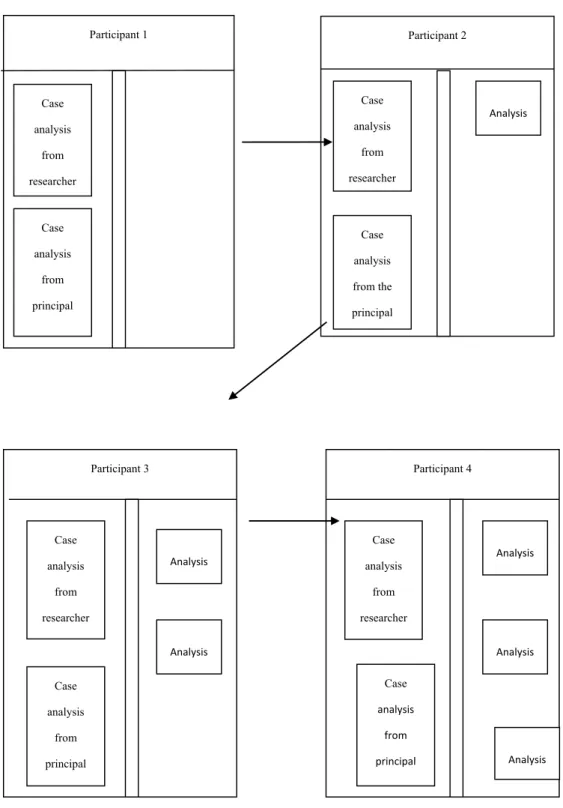
After completing the analysis of the eight teachers’ questionnaire responses, the researcher conducted two comparisons to find out how teachers’ beliefs about differentiated instruction were influenced by the critical perspectives and other teachers’ analyses that they read. The first involved comparing the analysis of teacher #1 with that of teacher #8. Since teacher #8 would read the preceding seven case analyses, plus two critical perspectives, the expectation was that the analysis of teacher #8 would provide rich and in-depth data. The way the participants worked together is shown in Figure 1:
The second compared the case analyses of teachers #1 and #2 with those of teachers #5 to #8. With successive replication (Yin, 2003), the analyses of teachers #5 to #8 were more comprehensive and deeper than those of the first four teachers. When conducting the comparisons, special attention was given to whether the four teachers (#5, #6, #7, and #8) would provide richer answers or different perspectives from those of teachers #1 to #4. The researcher assumed that, since teachers #5 to #8 had read the analyses of the experts and teachers #1 to #4, they would either scaffold their thoughts on said analyses or think from another perspective.
Participant 4 Participant 1
Case analysis
from principal
Participant 2
Participant 3
Case analysis
from principal
Case analysis
from researcher
Case analysis
from researcher
Case analysis from the principal Case
analysis from researcher
Case analysis
from principal
Analysis Analysis
Analysis
Analysis Case
analysis from researcher Analysis
Analysis
Figure 1. How the participants worked together
4. RESULTS
This section presents the results of comparing Taiwanese ESL teachers’
beliefs about differentiated instruction and the six principles of effective differentiation from the literature, and how these participants’ beliefs about differentiated instruction are influenced by reading the analyses of other teachers in the case exercise. This section begins with a description of the findings of the first research question, followed by that of the second question’s findings.
Q1: How do the beliefs of Taiwanese high school EFL teachers about differentiated instruction compare with Tomlinson’s six principles of differentiated instruction (2003)?
This question was answered through each principle of effective differentiation, followed by a brief description of the principle.
Principle 1:The effective differentiation of curriculum and instruction is proactive, rather than reactive.
The results revealed four saliencies: overemphasis on test scores, test-driven curriculum, low motivation, and satisfying students’ needs.
4.1 Overemphasis on test scores
The results appeared to indicate that teachers in Taiwan align their instruction and curriculum with students’ scores on each mock exam. Teacher #6 commented,
“It turns out to be not fast enough to meet my students’ expectations about grades on the coming Joint High School Entrance Examination (J.H.E.E).” Teacher
#8 also stated, “Under J.H.E.E, students’ scores become the only indicator of their learning.” It can be inferred from these two comments that the participants prioritized raising student scores on standardized testing when they planned their lessons and designed classroom activities. Whereas the principle states that effective differentiation requires a proactive curriculum and instruction, this salient theme shows that the participants merely react to students’ scores on
standardized tests when they plan their curriculum and instruction. When schools focus on standardized tests only, teachers would have limited flexibility to design their own instruction and curriculum.
4.2 Test-Driven Curriculum
The second saliency shows that curriculum and instruction in Taiwan are test-oriented. Two participants suggested that teachers should be able to make their teaching effective by aligning their instruction with students’ various needs even though teachers and students use a test-oriented curriculum and instruction.
Teacher #1 said, “The curriculum is fixed but teachers are flexible to give instruction according to various students’ levels.” In contrast, two participants said that the curriculum is not designed to satisfy students’ needs in the first place. One of them lamented, “The curriculum is not layered or differentiated in a systematic way suited to her students’ interests, needs, and abilities—this may result in students’ ineffective and inefficient learning.” Another participant further pointed out that teachers should be able to differentiate curriculum and instruction even if students’ performance on standardized testing is the priority of schools.
4.3 Low Motivation
The third saliency, low motivation, shows the possible influence that test- driven curriculum and instruction can have on students. In response to this issue, participants reflected that the test-driven curriculum and instruction could diminish students’ motivation. As one participant explained, “Students’ lack of motivation might be an implication of their poor performance.” Another participant echoed the sentiment, saying, “Such a curriculum might add to the load of students and make them lose interest in their study.” Furthermore, several participants believed that a test-driven curriculum would increase students’ workload and thus discourage them from active learning. One participant pointed out that students could lose their motivation if they fail to see the connection between the purpose
of a test-driven curriculum and their lives.
4.4 Satisfying Students’ Needs
The fourth saliency, satisfying students’ needs, is one of the most crucial factors that the ideal curriculum and instruction should cover for teachers and students. For instance, one participant wrote, “A wide variety in the students’
English proficiency made Mrs. Huang’s instruction difficult.” Another participant added that students’ various readiness levels make teaching harder. Moreover, several participants pointed out the difficulty of employing differentiated instruction in Taiwan. One said, “The issue is whether differentiated instruciton. is appropriate for students with wide a difference in standards.” It is unlikely that the teachers will be able to satisfy each student’s need with the current “one-size-fits- all” instruction and curriculum. Nevertheless, most participants still emphasized that satisfying various learning needs is the primary issue.
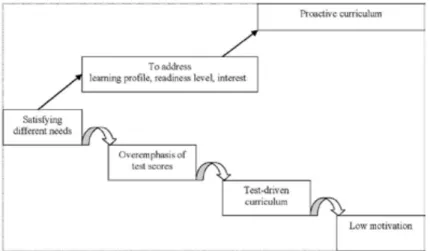
The analysis of the teachers’ responses shows that Taiwanese ESL teachers acknowledged the importance of attending to students’ needs in the curriculum and instruction, in accordance with the first principle. However, the results also reveal that both curriculum and instruction in Taiwan are test-driven, concentrating heavily on students’ academic performance in J.H.E.E. The relationship between
Figure 2. Relationship between issue categories and the push for a proactive curriculum
categories and the first principle urging proactive curriculum is shown in Figure 2.
Figure 2 shows that curriculum planning starts from the notion of satisfying each student’s learning need. However, overemphasizing the importance of test scores may deflect curriculum planning away from designing a proactive curriculum. The curriculum thus becomes test-driven to help students perform better on standardized tests. As a consequence, students’ motivation drops because they only study for tests. Furthermore, teachers worry that learning outcomes are given more weight than the learning process in Taiwan, ignoring the students’
varying paces in the acquisition of knowledge.
Principle 2:Effective differentiation employs the flexible use of small teaching-learning groups in the classroom.
This principle states that using flexible grouping enables teachers to address variances among students. Tomlinson et al. (2003) stressed that flexible grouping does not merely mean small groups; it looks for ways of encouraging students to digest and learn at their own pace.
The results show six salient constructs from the teachers’ responses:
identifying and satisfying students’ needs, addressing students’ interests, providing students with more mock exams to practice on, showing encouraging and positive attitudes in the classroom, using pre-assessment, and ability grouping.
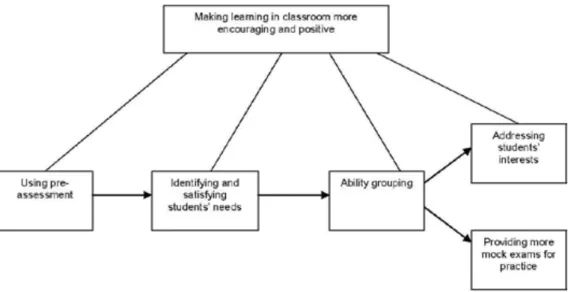
Although only one of the six salient issues can be connected to the second principle, they are mutually inclusive. The relationship between the six categories
can be seen in Figure 3.
Figure 3 shows that the participants believed that flexible grouping and the process which makes it work are critical. To group students effectively, teachers need to conduct pre-assessments. By interpreting outcomes from pre-assessment, teachers would be more confident in determining students’ needs and how to meet them. The teachers’ interpretation of pre-assessment outcomes can be their guideline in grouping students, planning activities, and choosing the appropriate materials for the groups. Furthermore, this process should take place in an encouraging and positive environment. Therefore, it appears that participants’
beliefs match the second principle of effective differentiation: grouping students flexibly to better serve their various needs.
Principle 3:Effective differentiation varies the materials used by individuals and small groups of students in the classroom.
This principle states that teachers can maximize students’ learning by using various instructional materials for different groups. If teachers assign the same instructional materials to all groups of students in the classroom, they may fail to
Figure 3. The relationship between the six categories from the Action section
match the materials to the specific instructional needs of individuals. According to Tomlinson et al. (2003), this principle is particularly crucial when the purpose of grouping is to address different readiness levels.
The data produced six saliencies: identifying and satisfying students’ needs, addressing students’ interests, providing students with more mock exams for practice, making learning in the classroom more encouraging and positive, using assessment, and grouping according to ability. However, the participants did not reflect the third principle in their responses. The saliencies in the responses suggest that they care more about how to teach than how the students learn.
Principle 4:Effective differentiation uses variable pacing as a means of addressing learner needs.
This principle requires that teachers adapt the pace of their instruction to better help students digest learning in the classroom. If the level of instruction is designed for medium- or high-achieving students while the pace of instruction is set for low-achieving students, students having other readiness levels will feel frustrated or bored. Effective differentiation encourages teachers to always be cautious of students’ absorption capacity and be prepared to align the pace of their instruction to ensure that the different needs are addressed.
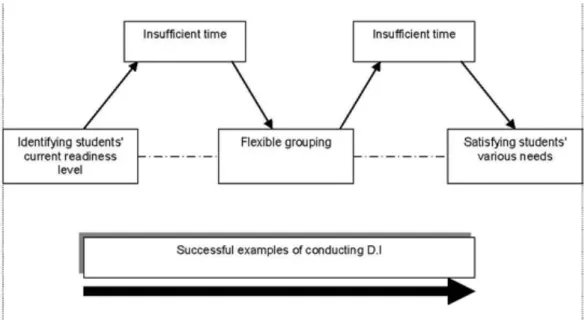
Five saliencies were obtained from participants’ responses: satisfying students’ varying needs, identifying students’ current readiness levels, needing successful examples of differentiated instruction, flexible grouping, and insufficient time. However, the researcher was unable to determine whether the idea of matching the pace to learner needs, as recommended by principle 4, was reflected in the responses of the three teachers. The lack of evidence may be
explained by the saliency of insufficient time, as seen in Figure 3.
Figure 4. The relationship between categories in the knowledge section
Figure 4 shows that the teachers’ over-arching goals are to satisfy each student’s individual need. For this reason, participants revealed the need to identify the students’ current readiness levels in the first place. Once they knew the students’ readiness levels, the teachers were able to practice different grouping strategies that would allow each student to grow at his or her own pace. However, the lack of time could prevent teachers from maximizing learning through differentiated instruction. The participants believed that pinpointing readiness levels could be time-consuming, and using appropriate grouping strategies could use up even more time. Therefore, they wanted to see some successful examples of differentiated instruction to understand the way it was done, thus helping them address the students’ needs more efficiently and economically.
Principle 5:Effective differentiation is knowledge centered.
Knowledge-centered differentiation, according to Tomlinson et al. (2003), stands for teachers’ sound knowledge of their discipline of organizing principles,
clarifying concepts, and refining essential skills. Effective differentiation requires teachers to demonstrate, using materials and activities, their ability to ensure that students understand essential the concepts and are able to apply them in their lives.
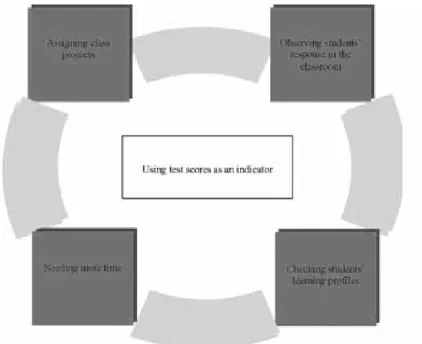
After analyzing the participants’ responses, five saliencies were obtained:
checking students’ learning profiles, observing students’ responses in the classroom, assigning class projects, using test scores as an indicator of learning, and needing more time.
In general, the participants agreed that effective differentiation was knowledge-centered, requiring teachers to use a variety of ways to ensure student assimilation. They demonstrated several methods by which they could make sure that the students were learning. Moreover, the methods proposed by the participants echoed the principles of effective differentiation: integrating students’
interests, learning profiles, and readiness levels in evaluation. Furthermore, the participants also emphasized the need for using test scores to measure teachers’
Figure 5. The relationship between the categories in the Action section
effectiveness. The relationship between these saliencies is illustrated in Figure 5.
In Figure 5, it can be seen that, using test scores as an indicator, the category is in the center of the other categories. Although teachers use multiple ways to ensure that students assimilate class content, their ultimate goal is to raise the students’ test scores. When teachers try to use various ways to ensure student understanding, they are also concerned about the time issue. This is why the category, “needing more time,” is part of the recycling loop. The teachers’
comments appear to reflect their concern that making changes for differentiated instruction would further decrease their already limited time. They reported that they needed more time to design different activities, set different learning objectives for each student, and prepare different class materials.
Principle 6:Effective differentiation is learner centered.
This principle states that teachers should use a variety of instructional approaches and materials to scaffold learning. Teachers should ensure that the cognitive frameworks they build in the classroom address each student’s needs.
To better illustrate this principle, Tomlinson et al. (2003) listed several traits of a learner-centered classroom:
1. The knowledge students bring to the task
2. An ongoing assessment of learning, understanding, and skill, so that t eachers can teach and individual students, learn, more effectively 3. Focusing on students digestion
4. Helping students see relevance and utility in what they are learning 5. Student choice within teacher frameworks
6. Shared management of learning
7. Students’ playing an active role in learning (Tomlinson et al., p.133)
To compare Taiwanese teachers’ beliefs with this principle, participants’
responses to one of the questions from the Perspective section were analyzed. The
question is:
From the perspective of Huang’s students, how can their needs and interests best be satisfied?
The participants’ responses were coded and labeled, and two salient themes emerged: over-emphasizing test scores diminishes motivation and needing more mock exams. Below are discussions and explanations of the two salient themes.
4.5 Over-Emphasizing Test Scores Diminishes Motivation
In the first salient theme, over-emphasizing test scores diminishes motivation;
the participants said that the focus on J.H.E.E prevented them from connecting classroom knowledge with students’ lives. One participant commented, “When I designed a layered curriculum suited to their (students’) needs, they (students) just told me that they didn’t even want to come to school because they didn’t find meaning in taking the J.H.E.E.” Another participant added, “This is like training to be a test machine instead of really helping them (students) raise their interest in study.” Several participants also iterated that one of the functions of a learner- centered classroom is to help students see relevance and utility in the lessons.
In addition, the participants agreed that students should not study for exams only, but to be able to apply their knowledge to problem solving as well. For instance, one participant commented, “Besides, it would be difficult to motivate students if they only study for the exam.” According to Tomlinson et al. (2003), the role assessment in a learner-centered classroom is to help students learn more effectively and efficiently. However, from the comments of the three participants, it can be seen that the trend of over-emphasizing test scores in Taiwan may not only diminish students’ motivation but also obscure the role that assessment ought to play.
4.6 Needing More J.H.E.E Mock Exams
With regard to the second salient theme, needing more J.H.E.E mock exams, the participants asserted that providing students with more mock exams would help them perform better on J.H.E.E and gain confidence. The participants’
responses represent a contradictory phenomenon: On one hand, they argued that test-driven instruction and curriculum diminish students’ motivation, but on the other, they believed that providing students with more practice exams would improve their learning. As one participant said, “I recommend that Mrs.
Huang give more mock exam questions. This way, students will understand that knowledge is not only the ability to memorize but also the ability to make a connection and practice it.” Participants with this saliency treated test scores as a priority, encouraging teachers to give students more practice to familiarize them with the exams. However, there were several participants who did not use assessment to determine their effectiveness and diagnose students’ problems. They believed that the more practice exams students had, the better their performances would be.
For the participants, the purpose of using more assessment was different from the goals of assessment in the sixth principle. They use assessment to familiarize students with standardized exams, rather than to ensure students’
digestion of information. The data suggests that giving scores too much weight dampens the students’ motivation and downplays the importance of assessment.
Reduced to a number, learning triggers no further conversation between teachers and students.
Q2: How are the beliefs of Taiwanese high school EFL teachers about differentiated instruction influenced by their colleagues and experts in a case- based exercise?
To understand how the participants’ beliefs about differentiated instruction were influenced by reading the analyses of others, their responses to the two
survey questions were evaluated. After all responses were coded, two salient themes were obtained: learning different solutions from others and learning different perspectives from others.
4.7 Learning Different Solutions from Others
Five participants (#3, #5, #6, #7, and #8) gave their opinions on the first salient issue, learning different solutions from others. The teachers indicated that reading other teachers’ analyses could be helpful for their own instruction.
Reading other participants’ analyses enabled teacher #3 to compare her instruction with other teachers. Teacher #5 felt that case analysis can induce teachers to work together, contributing various strategies toward solving a problem. He said,
“Case analysis let me understand how other people face and solve a problem. It is helpful.” For teacher #6, reading others’ analyses supplied new ideas in solving classroom problems—a chance to develop her problem-solving ability. She said,
“In addition, reading other teachers’ analyses helped me learn different solutions and get inspiration.” Teacher #7 said pretty much the same thing: “I can learn how different people deal with the same issue through their analyses, and this improves my problem-solving ability.” Finally, teacher #8 believed that the use of successive replication in this case-exercise would not only enhance the teachers’
problem-solving ability but also develop their creativity.
Although most participants averred that reading other teachers’ analyses helped them learn different solutions to classroom problems, none of them explained how it did so. Thus, the researcher was unable to determine the way by which reading other teachers’ analyses influenced their points of view on differentiated instruction.
4.8 Learning Different Perspectives from Others’ Analyses
For the second salient issue, learning different perspectives from others’
analyses, six participants (#1, #3, #5, #6, #7, and #8) claimed that the case-based