Chapter 3 Pronominal System
Besides nouns, another means to manifest participants in events is through pronominal systems. The pronominal systems can be classified into three categories:
personal pronouns, demonstrative pronouns and interrogative pronouns. Personal pronouns will be the focus in this study and the other two will be discussed along with relevant issues.
Like other Formosan languages, the pronominal forms in Tona Rukai are differentiated in person, number and case to manifest the semantic properties and grammatical relations of participants in events.
This chapter is organized as follows. First, the previous studies on pronominal systems in Tona Ruaki will be reviewed. Second, the usage of each set of pronouns will be demonstrated. Third, some idiosyncratic features will be discussed.
3.1 Literature Review
The pronominal system in Tona Rukai has been discussed in Li (1977, 1996b, 1997a, 1997b), Zeitoun (1995, 2003) and Huang et al. (1999b). Although there have been seven relevant studies in the literature, six of them (except for Li 1997a) belong to cross-linguistic/cross-dialectal studies, which investigate eight to ten other
Formosan languages or five other Rukai dialects at the same time. Although they contribute to providing a general picture of Tona Rukai, there is still much room left to be investigated. Besides, several disagreements exist among different studies.
Therefore, this section will first review these studies. As mentioned above, most of
the studies investigate cross-linguistic issues. This literature review will present
only those related to Tona Rukai although some other dialects or Formosan languages
or reconstruction may be also discussed in these papers.
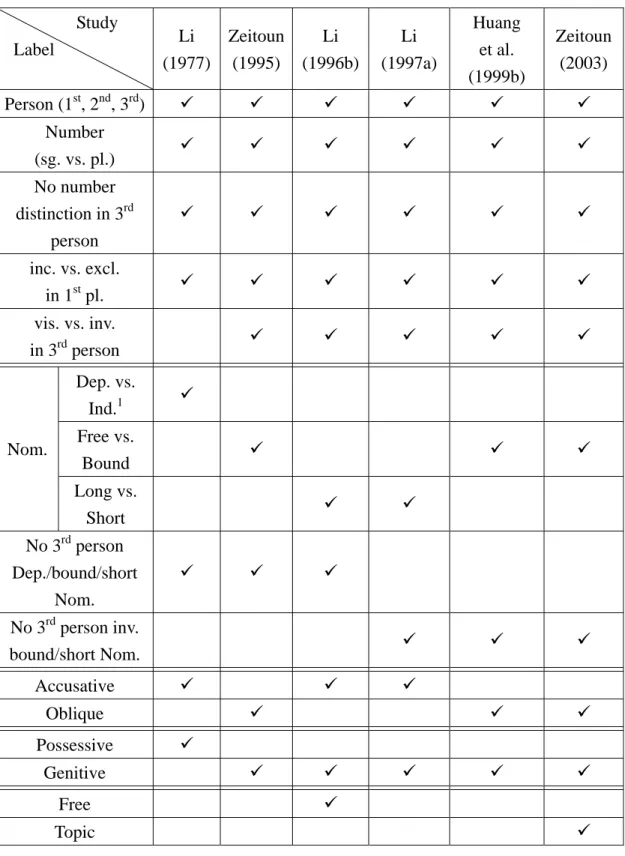
Table 3.1 Personal pronouns of Tona Rukai in the previous studies Study
Label Li
(1977)
Zeitoun (1995)
Li (1996b)
Li (1997a)
Huang et al.
(1999b)
Zeitoun (2003)
Person (1
st, 2
nd, 3
rd) 9 9 9 9 9 9
Number
(sg. vs. pl.) 9 9 9 9 9 9
No number distinction in 3
rdperson
9 9 9 9 9 9
inc. vs. excl.
in 1
stpl. 9 9 9 9 9 9
vis. vs. inv.
in 3
rdperson 9 9 9 9 9
Dep. vs.
Ind.
19
Free vs.
Bound 9 9 9
Nom.
Long vs.
Short 9 9
No 3
rdperson Dep./bound/short
Nom.
9 9 9
No 3
rdperson inv.
bound/short Nom. 9 9 9
Accusative 9 9 9
Oblique 9 9 9
Possessive 9
Genitive 9 9 9 9 9
Free 9
Topic 9
1 Abbreviations: Dep: dependent; Ind: independent.
Table 3.1 summarizes the sets of personal pronouns in Tona Rukai reported in previous studies. The exact sets of personal pronouns are listed in Appendix B, in which the differences between successive studies in each table are marked in boldface to show the development of the analysis in the pronominal system of Tona (Rukai).
Among these studies, the pronominal system presented in Li (1977) is listed in an appendix for comparison of personal pronouns in five Rukai dialects. The goals of this paper are to identify cognates and reconstruct a phonological system of
Proto-Rukai and then to determine its internal relationships. The personal pronouns are merely listed for comparison without further discussion. Li (1997b) is a
typological study of the case marking in Formosan languages. The sets of pronouns in Rukai dialects are not listed; readers may refer to Li (1996b) for details. Except for these two papers, the others briefly present the main characteristics of personal pronouns in Tona Rukai. The following will review these relevant issues.
3.1.1 Phonological Attrition
Zeitoun (1995) reports that -an and -a in oblique pronouns indicate a
phonological change, n- > Ø/ a__ #. Compared with the other Rukai dialects, Budai marks the oblique case only with -an and Maga and Tanan with only -a while Tona allow both -an and -a. Such variations in Tona reveal one of the past phonological changes in Rukai.
3.1.2 Morphological Shapes
Zeitoun (1995) indicates that Tona Rukai resembles other Formosan languages
in the distinction between visibility and invisibility, between inclusive and exclusive
first person pronouns, and in the lack of gender designation and bound nominative
third person pronouns. Both Zeitoun (1995) and Huang et al. (1999b) report that the
third person nominative pronouns are derived from demonstratives.
In Li (1997a), the first person inclusive pronouns include two forms, dual and plural according to his two consultants. However, there is no dual 1PI pronoun according to our consultants. Although the form kiti ‘dual 1PI.Nom’ in Li (1996b) does occur in the corpus examined, it appears to be the variant of kita ‘1PI.Nom’ as will be presented in Section 3.9.3.
Huang et al. (1999b) remark that the pronouns are divided into two classes, free and bound. According to their distribution, free pronouns, consisting of more than one syllable, may occur in more than one position in a sentence and denote various semantic roles. On the other hand, bound pronouns are fixed in their syntactic distribution and are treated as affixes in Rukai since no phonological evidence (ie.
stress shift or weak stress) can be found.
3.1.3 Case Marking
Zeitoun (1995, 2003) presents that the pronouns in all Rukai dialects except for Mantauran have ko-/ki- mark nominative case and -a(n ) oblique case, which can be also found in full noun phrases. Li (1997a) reports the same observation and states that this pronominal case marking corresponds to the nominal one in his
analysis. However, according to the analysis of the present study, the case marker ko is not restricted to nominative nouns
2. Actually, case marking in pronouns does not fully correspond to that in full noun phrases.
3.1.4 Free/Long Nominative Forms and Topicalization
2 Please refer to Chapter 2.
Zeitoun (1995) reports that the free nominative forms in southeastern dialects occur only in the preverbal position to indicate emphathy while those in Tona and Maga can appear in both preverbal and postverbal positions with a prefix a- in Tona and i- in Maga in the preverbal position. Besides, all the dialects except for
Mantauran allow only long forms to be topicalized.
Li (1996b) states that free pronouns occur after verbs as Nominatives while they appear before verbs as Topic in Tanan and Budai (Rukai). However, the third person free forms occur only in the pre-verbal position, which is found in Budai but actually contradicts the findings in the Tona Texts
3. Concerning bound nominative pronouns, long forms are used as topic or nominative. These functions seem to partially
overlap with that of free pronouns but they are treated as different sets, which is somewhat confusing if Tona is extracted to be the focus. This chapter will clarify such confusion in Sections 3.3.1 and 3.4 discussing free nominative and topic pronouns. In addition, long forms may cooccur with short forms, which can be found in Budai, Tanan and also in Tona (See Section 3.13).
Li (1997a) adds that long nominative forms can be attached by mi- in the future time frame and by a- when they are preposed to the sentence-initial position as the topic, which is confirmed in the corpus studied.
Zeitoun (2003) has a set of topic pronouns prefixed with a-. This treatment is not adopted in the present study. The reasons will be discussed in Section 3.4.
3.1.5 Modal Information Designated by Short Nominative Forms
3 Please refer to Section 3.3 on free nominative pronouns.
Short nominative forms in Tona and Maga carry modal information including wish, order and volition (Zeitoun 1995) or “controlled volitionality/modality”
(Zeitoun 2003). Li (1996b) further specifies the meanings in different persons:
“desiderative” for the first person, a command for the second person and a request for the first person inclusive.
Short nominative pronouns are attached before the verb stems. However, in Li (1997a), the one for the first person inclusive –mita occurs after verbs, which is not discussed at all. Actually, the current study found that the form mita can be analyzed as m(i)-ita ‘will-1PI.Gen’, which is not another form of the 1PI.Nom pronoun as will be discussed in Section 3.7.2.
Besides, the treatment of ni- is different. In Li (1997a), it is the short nominative form for the third person visible pronoun, both singular and plural, whereas it is only for the “singular visible” in Huang et al. (1999b) although number is not distinctive in other third person pronouns. This gap will be filled in the present study.
3.1.6 Accusative/Oblique Pronouns
As Li (1996b, 1997a) indicates, accusative forms are free, serving as objects of verbs. The term “oblique” is used by the other researchers except for Li to indicate their ability to manifest various non-subject roles, which may semantically manifest patients, location, beneficiary etc. but can be marked differently in other Formosan languages such as Saisiyat. (Huang et al. 1999b) The present study adopts the label
“oblique” for the same reason.
3.1.7 Genitive Pronouns
Genitive pronouns are bound, suffixed to nouns to designate the possessors in possessive noun phrases. Besides, they are attached to a question marker nia- in interrogative sentences (Li 1996, 1997a) or wh-words except for kogian /nogian
‘when’ (Li 1997a), and they serve as the subject of the subordinate clauses (temperal) (Zeitoun 2003).
3.1.8 Ordering of Pronouns
A cross-dialectal generalization reported in Zeitoun (1995, 2003) shows the following ordering: (1) first and second person nominative/oblique pronouns always precede full lexical noun phrases; (2) agents (Nom Or Gen in Mantauran) always precede patients (Obl) (reported in Li 1997a as well); (3) agents can be preposed in sentence-initial position but patients can not; (4) the distribution of third person nominative pronouns resembles that of full lexical noun phrases. Basically, the present study agrees with this ordering but some modification needs to be made concering the rules (2) and (3). (See Section 3.3.1 discussing the word order when the semantic role does not match the syntactic role as in passive sentences, and Section 3.4 regarding the semantic roles of the topic.)
Huang et al. (1999b) report that when free pronouns cooccur, it is the semantic role that decides the word order but the exact order is not stated out. This issue will be discussed in Section 3.8.
3.1.9 Case Realization of the Experiencers of Some Stative Verbs
Previous studies including Saillard (1995, 1997), Zeitoun (1995, 2003), and Li
(1996,1997a) have presented that a non-volitional and affected first person subject of
some stative verbs (e.g. sick, happy, hungry etc.) can be marked either in the
nominative or oblique/accusative case in the three northern dialects, Tona, Maga and Mantauran. In Li (1996b), accusative pronouns are reported to be used more often than nominative ones for these verbs. The present study confirms these observations and provides further related findings as will be shown in Section 3.6.2 concerning experiencers of some stative verbs.
3.1.10 Case Contrast in the Possessive Relation of Kinship and Non-kinship Zeitoun (1995) reports that Tona and Maga mark the possessor in inalienable possession (restricted to kinship) as oblique and those in alienable possession as genitive while the other dialects do not make such a distinction, marking all the possessors as genitive. Li (1996b) makes the same observation and further restricts the kinship terms to those related to one’s own or older generations. The present study confirms these observations and provides further related findings, which will be shown in Section 3.6.3.
3.2 Sets of Personal Pronouns in the Current Study
The pronominal system in the data examined is presented in the following
table.
Table 3.2 Sets of personal pronouns in Tona (Rukai) Nominative
Case
Person Topic
Free Bound Oblique Genitive
1
stsg. kak ko- (na)koa -(i)li
2
ndsg. koso so- mosoa -(i)so
Inclusive kita ta- mitia -(i)ta
1
stpl.
Exclusive kinam nam- namia -(i)nam
2
ndpl. komo mo- moan -(i)mo
Visible kini ni- nian -(i)ni
3
rdsg./pl.
Invisible ki a ni- ian -(i)a
As Table 3.2 shows, this system is roughly the same as that reported in Huang et al. (1999b) except for an additional label-Topic, a different form of the bound 2S.Nom pronoun, and a filled gap of the 3
rdperson invisible bound nominative pronoun.
In terms of case, Tona Rukai has three sets of pronouns: nominative, oblique and genitive as reported in previous studies. Nominative pronouns are further divided into two subsets: free and bound. Besides, free nominative pronouns also function as topic.
Like most Formosan languages, the first person plural pronouns can be further divided into two sets: (1) inclusive, which includes the speaker and the addressee(s), and (2) exclusive, which excludes addressee(s). The third person pronouns do not make distinction in number while the first and second person pronouns do have distinctive singular and plural forms. Besides, visibility further divides the third person pronouns into two subsets: visible and invisible, which is also found in other dialects of Rukai and Tsou, but not in the other Formosan languages (Huang et al.
1999b).
3.3 Free Nominative Pronouns
The first set of pronouns illustrated is free nominative ones. They are labeled as free because they can appear alone. See example (1b).
(1)a. nani-ni y-a-kay aii?
[who-3S.Gen at-Real-this inside]
‘Who is inside?’
b. kak [1S.Nom]
‘It’s me.’ (an answer to (1a))
As can be seen in (1b), free nominative pronouns can stand alone serving as the answer to the who-question in (1a). Therefore, they are independent/free morphemes.
Free nominative pronouns may serve as the subject or the topic. As the subject, their distribution is either after the predicate or the future marker mi. This section illustrates their functions in matrix clauses and complement clauses. When serving as the topic, they appear in the pre-predicate position.
3.3.1 Subject in the Post-predicate Position
Free nominative pronouns occur after predicates, either nominal or verbal, designating the subject in a sentence. By definition, subject is “the only nominal argument of a single-argument (or intransitive) clause” or “the most agent-like
argument of a multi-argument (or transitive) clause”. (Payne 1997:133-134) Besides,
“a prototypical agent is conscious, acts with volition (on purpose) and performs an
action that has a physical, visible effect.” (Payne 1997:49) Consider the following
examples:
(2)a. ipolo kak
[Ipolo 1S.Nom]
‘I am Ipolo.’
b. w-a-i iak kak.
[Act.Dyn.Fin-Real-jump 1S.Nom]
‘I jumped.’ (Tona Dictionary, < i iak>,ms.) c. w-a-kan kak na doo
[Act.Dyn.Fin-Real-eat 1S.Nom Obl cooked food]
‘I eat rice/ I am eating.’ (Tona Dictionary, <kan >, p.32)
This set of pronouns designates the only participant in a nominal sentence, where no verb occurs as in (2a), and also in an intransitive sentence as in (2b), where the participant is conscious, has the ability to control the action and the action results in a visible change of position. In a transitive sentence like (2c), the boldfaced pronoun designates the participant who acts with volition and whose action has a physical effect on the other participant “cooked food”. This set of pronouns is thus analyzed as nominative because they designate prototypical agents, the subject in a sentence.
In addition to the semantic role of agent, they may also designate experiencers in a state as shown in (3a) below or in cognition process as in (3b).
(3)a. maloay- a kak
[Stat.Fin:full-already 1S.Nom]
‘I’m already full.’
b. w-a-igo o kak nian
[Act.Dy.Fin-Real-know 1S.Nom 3S.Obl]
‘I know him.’ (Tona Dictionary, <igo o>, p.28)
The distribution of free nominative pronouns is rather fixed in the post-predicate
position, unlike noun phrases that may change word order without causing confusion
in meanings (see Section 2.6). First, nominative pronouns always precede oblique
ones as in (4a), an active sentence and in (4b), a passive sentence. Second, the
nominative pronoun always precedes the other noun-phrase argument as in (4c).
(4)a. w-a-igo o kak nian
[Act.Dyn.Fin-Real-know 1S.Nom 3S.Obl]
‘I know him.’ (Tona Dictionary, <igo o>, p.28) a’. * w-a-igo o nian kak
[ Act.Dyn.Fin-Real-know 3S.Obl 1S.Nom ] b. ky-a- akoloo kak mosoa [Pass-Real-Dyn.NFin:frighten 1S.Nom 2S.Obl]
‘You frightened me!’ (Tona Dictionary, < akoloo>, p.62) b’. * ky-a- akoloo mosoa kak
[Pass-Real-Dyn.NFin:frighten 2S.Obl 1S.Nom ] c. madalam kak ipol-an
[Stat.Fin:like 1S.Nom Ipolo-Obl]
‘I like Ipolo.’
c’. *madalam ipol-an kak
[Stat.Fin:like Ipolo-Obl 1S.Nom]
The examples above show that free nominative pronouns always immediately follow the predicates. However, if the future marker mi occurs in a sentence, it will precede nominative pronouns. Consider the following examples.
(5)a. …no-davac -a mi-kak…
[ will-Dyn.NFin:leave-already will-1S.Nom]
‘…I am leaving….’ (Tona Texts, 04-003-b) b. n(o)-ya m-ita- a pat-an…
[will-Dyn.NFin:so will-1PI.Gen-already Pangetede-Obl ]
‘What shall we do for Pangetede? …’ (Tona Texts, 01-002-a)
Like genitive pronouns in (5b), which can never stand alone, appearing after the future marker mi, the nominative pronoun in (5a) follows mi instead of the verb.
However, the distribution of nominative pronouns does not completely resemble that
of genitive ones. Compare (5b) and the following example.
(6) w-a-kan -a kak
[Act.Dyn.Fin-Real-eat-already 1S.Nom]
‘I’ve already eaten.’
In (5b), the genitive pronouns -ita precedes the perfective suffix - a
4while the nominative pronoun kak in (6) follows - a. Besides, example (7) shows that phonological assimilation between mi and nominative pronouns.
(7) no doo-iso booto nakay ka [when.Fut Dyn.Subj:can-2S.Gen Dyn.Subj:burst this Top no-doo mo-koso sapala an koay valak-ili…
will-Dyn.NFin:can will-2S.Nom marry that child-1S.Gen ]
‘When you succeed in bursting (it), you will marry my child.’
(Tona Texts, 10-009-g, revised)
The morpheme mi changes into mo when followed by koso through assimilation with the vowel [o] in koso. A similar process can be found in mo-komo ‘will-2P.Nom’
and m -kak ‘will-1S.Nom’. From these examples, the morpheme mi- seems to be cliticized to free nominative pronouns and then undergoes phonological assimilation with them.
4 The perfective marker -a is a suffix because its attaching renders stress shift. For example:
(i) w-a-kan kak na doo [Act.Dyn.Fin-Real-eat 1S.Nom Obl cooked food]
‘I am eating/ate.’
(ii) w-a-kan-a kak
[Act.Dyn.Fin-Real-eat-already 1S.Nom]
‘I’ve already eaten.’
The boldfaced parts are where the stress of the predicates falls. We can see clearly that stress shifts from a to in order to maintain the penultmates stress after the suffixation of -a.
3.3.2 Subject in Complement Clauses
Free nominative pronouns are also found to serve as the subject in a
complement clause. By definition, “a prototypical complement clause is a clause that functions as an argument (subject or object) of some other clause.” (Payne 1997:313) Examples (8a-b) show that the clauses in brackets serve as the object of the utterance verb in (8a) and the cognition verb in (8b).
(8) a. ma itikikay kak mosoa {n-oa mi-kak taipak}
[Stat.Fin:tell 1S.Nom 2S.Obl will-Dyn.NFin:go will-1S.Nom Taipei mia
Dyn.Subj:so ]
‘I (have) told you that I would go to Taipei.’
(Tona Dictionary, <pa itikikay>, p.57) a’. n-oa mi-kak taipak
[will-Dyn.NFin:go will-1S.Nom Taipei ] ‘I will go to Taipei.’
b. w-a-igo o kak (mosoa){madalam koso valak-ili}
[Act.Dyn.Fin-Real-know 1S.Nom 2S.Obl Stat.Fin:love 2S.Nom child-1S.Gen]
‘I know that you love my child.’ (Tona Texts, 10-009-a) b’. madalam koso valak-ili
[Stat.Fin:love 2S.Nom child-1S.Gen]
‘You love my child.’
As can be seen above, free nominative pronouns are used as the subjects in the
complement clauses. Compare (8a) and (8b) with the independent clauses (8a’) and
(8b’). Actually, the complement clauses are structurally the same as independent
clauses. They are typical finite complements, which express their subjects directly
and mark their own tense/aspect such as the markers no- and mi- indicating the future
time frame in (8a). (Payne 1997:314) As shown in other languages such as English
and Chinese, the matrix verbs for these finite complements belong to utterance and cognition verbs.
Concerning utterance constructions, another phenomenon worth noticing is that no reported speech can be elicited. Examples (9a-b) are the results from
unsuccessful elicitation of reported speech with Chinese equivalent sentences.
(9)a. ma itikikay koa ki ipolo
i{n-oa mi-kak
itaipak }
[Stat.Fin:tell 1S.Obl Nom Ipolo will-Dyn.NFin:go will-1S.Nom Taipei mia
Dyn.Subj:so ]
‘Ipolo said to me, “I will go to Taipei.”/Ipolo
itold me that she
iwould go to Taipei.’
b. ma itikikay koa ki ipolo
i{amwa kia
jtaipak }
[Stat.Fin:tell 1S.Obl Nom Ipolo Dyn.Fin:go 3S.Nom Taipei mia
Dyn.Subj:so ]
‘Ipolo said to me, “He/She went to Taipei.”/Ipolo
itold me that he/she
jhad gone to Taipei.’
The first person nominative pronoun in the complement clause of (9a) refers to the agent ki ipolo in the matrix clause other than the speaker koa himself. Likewise, the third person nominative pronoun ki a in the complement clause of (9b) refers to a third participant rather than the agent ki ipolo in the matrix clause. These referents indicate the constructions of direct quotation other than reported speech.
Givo n (1980:333) proposes a binding
5hierarchy to show “systematic correlations between the semantic structure of complement-taking verbs and the syntactic structure of their complements”. Verbs of utterance and cognition carry the lowest implicative properties in his binding scale so that their complements exhibit
5 “The stronger the influence exerted over the agent of the complement clause by the agent of the main-clause verb, by whatever means, the higher is the main-clause verb on the binding scale.” (Givon 1980: 335)
the loosest structure/least integration with the matrix clause and appear like finite clauses. Notice that there is an oblique pronoun/object in the matrix clause of (8b), which refers to the subject in the complement clause of the cognition verb.
Although this oblique pronoun can be omitted, its presence establishes an overt connection between the matrix clause and the complement while there is no such connection in utterance constructions. Besides, utterance constructions such as (9a) exhibit only quoted speech. No reported speech can be found. The structural relation between cognition verbs and their complements appears stronger than that between utterance verbs and their complements. In Givo n’s binding hierarchy, cognition verbs are indeed higher than utterance verbs, which is also reflected in a more integrated structure. In this respect, Tona Rukai exhibits a language-universal feature regarding the correlation between the semantic structure of the verbs and the syntactic structure of their complements.
3.4 Topic
As shown in Table 3.2, the pronouns serving as the topic of a sentence share the same forms with free nominative pronouns. The following paragraphs will
demonstrate the distribution and the function of the topic pronouns.
Regarding the distribution, a topic occurs in the pre-predicate position. Their distribution is the same as that of noun phrases. For example, they may be extracted to the preverbal position in an exclamation sentence as in (10a-b).
(10)a. ay koso botii
[Excl 2S.Top Stat.Fin:blind ]
‘You are blind! (used to insult someone)’ (Tona Dictionary, <boti i>, p.13) b. ay ipolo/ki ipolo botii
[Excl Ipolo/Nom Ipolo Stat.Fin:blind]
‘Ah! Ipolo, you are blind (Ipolo is on the spot) /Ipolo is blind (Ipolo is not on the spot).’
In Topic constructions, they are prefixed with a- and followed by ka as in (11a) or merely followed by ka as in (12a), which are distributed just like noun phrases in (11b) and (12b).
(11)a. …a-komo ka la to-to-too ka y-a-kay (komo) [ Top-2P.Top Top then Red-Red-three Top at-Real-this 2P.Nom koa akamolo koboan la…
1S.Obl Dyn.Subj:work long then ]
‘…You three (young men) have been working in my (shop) for a long time and …’ (Tona Texts, 12-005-b, revised) b. a-ki isay ka (a)m-wa taomoma akamolo si
[Top-Nom Isay Top Dyn.Fin-go field Dyn.Subj:work and ]
‘Isai went to the field to work.’ (Tona Texts, 02-002-a) (12)a. kosoo ka acilay wa madav-a (koso)
[2S.Top:Emph Top water come:Imp Dyn.Subj:a lot-Imp 2S.Nom]
‘You, water, come on, increase!’ (Tona Texts, 04-017-a) b. si ki a tiatina ka la davac oooo
[and that middle-aged woman Top then Dyn.NFin:leave Dyn.Subj:push pa-siow ian vala-valak la-maa-tak-an
Caus-first 3S.Gen Red-child plur-Rec-elder sibling-Obl ] ‘Then the mother pushed her children/brother and sister ahead.’
(Tona Texts, 05-004-c)
As shown in examples (10)-(12), the distribution of topic pronouns is the same as nominal phrases.
In terms of the semantic roles, a topic may be the agent in the event as in (11a) and (12a) above or the patient as in (13a) below.
(13)a. a-koso ka madalam kak mosoa [Top-2S.Top Top Stat.Fin:like 1S.Nom 2S.Obl]
‘You, I like you.’ (emphatic)
b. *a-koso ka madalam kak
[Top-2S.Top Top Stat.Fin:like 1S.Nom]
However, when a topic refers to the patient, an oblique pronoun must be resumed in the following clause; otherwise, the sentence will be ungrammatical as in (13b).
Although there are also resumed nominative pronouns when the topic serves as the agent as in (11a) and (12a), they are not obligatory. Consider the following example (14a).
(14)a. a-kita no madalam-ita no [Top-1PI.Top when.Fut Stat.Subj:love-1PI.Gen when.Fut
ki adil-ita ka w-a-doo siko
6no patient-1PI.Nom Top Act.Dyn.Fin-Real-can succeed when.Fut pai a-ita na maaka-kwa-a…
Dyn.Subj:do-1PI.Gen Obl all-thing-Sup ]
‘When we love with all our force and be patient, we can do anything….’
(Tona Texts, 07-021-b, revised) b. makasi a-ko mwa-(i)ni ka la i-doo,
[but Top-when.Past Dyn.Subj:come-3S.Gen Top then Neg-Dyn.NFin:can i-doo mo- aii koay bk
Neg-Dyn.NFin:can Dyn.Subj:to-inside that pig ]
‘However, when they came (there the day after), they just could not put the pig into (the hole).’ (Tona texts, 01-002-d)
The subject pronoun kita appearing in the topic position does not occur again after the matrix verb wadoo in (14a). Similarly, other non-subject NPs as the topic do not require a resumptive pronoun. For instance, the temporal clause in (14b), which is nominalized by the genitive pronoun, is topicalized merely by fronting, prefixing the topic marker a- and adding a topic ligature ka.
6 This is a Japanese loan word.
From the examples demonstrated above, topic pronouns exemplify the case- neutralization of the topic NP since the topic may refer either to the subject role or non-subject roles but is realized in the same form. However, when the topic refers to the object of the verb, a resumptive pronoun is obligatory within the clause while the resumptive pronouns are not necessarily required when the topic refers to the subject or other non-subjects. In addition, it is observed that there exists a pause at the end of the topic phrase, the topic pronoun along with the topic ligature ka.
3.5 Bound Nominative Pronouns
Bound nominative pronouns are always prefixed to non-finite verbs and designate the agent of a verb as well as modal information.
3.5.1 Designating Volition of the Speaker/Agent
Like free nominative pronouns, this bound set denotes the agent role. However, these two sets differ in modality. First of all, bound nominative pronouns can
indicate the speaker’s will or volition. As a result, they show the volition of the agent for the first person singular/plural exclusive as in (15a-b), commands for the second person as in (15c) and requests or suggestions for the first person plural inclusive as in (15d). (Li 1996, 1997a)
(15)a. ko- a-ba-bk
[1S.Nom-become-Red-pig]
‘I want to turn into a pig.’ (Tona Dictionary, <a-+Ca->, p.1)
b. ay ko ma a-a koay saobilan-ini ki [Excl when.Past Dyn.Subj:take-3S.Gen that bag-3S.Gen Gen gili nian , wa-la nam-oai
younger sibling 3S.Obl come:Imp 1PE.Nom-Dyn.NFin:had better
ki gili namia a-tatagaga
Nom younger sibling 1PE.Obl become-crow:Red ]
‘When he took the bag of his younger sister, (he) said: “let my little sister become a crow.”’ (literal: we (my younger sister and I) had better become crows.) (Tona Texts, 05-013-c, revised) c. la mo- aokay wamc dwadwaoo ko
[then 2P.Nom-Dyn.NFin:come Dyn.Subj:bring Dyn.Subj:at once Obl a a-mo la ya nian kia laopa
Dyn.NFin:take-2P.Gen then Dyn.NFin:so 3S.Obl that boss ] ‘“Come back and bring what you have found at once,” said the boss.’
(Tona Texts, 12-006-h, revised) d. “mataina aw, ao-a mman-iso, wa, ai
[Matainangeaw down-Imp clothes-2S.Gen come on:Imp Imp.Neg nian , ta-ab”
3S.Obl 1PI.Nom-Dyn.NFin:return ]
‘Matainangeaw, watch your clothes. Don’t do that. Let’s return.’
(Tona Texts, 04-017-d)
In addition, the volition of agent is also found when the short nominative pronoun for the third person is used as in (16) below.
(16) … mo- aokay-a madd si ni-kibooboo moan
[ 2P.Nom-Dyn.Subj:come-Imp Stat.Subj:together and 3S.Nom-ask 2P.Obl ki tatava ko ki m-ini…
Nom middle-aged man Obl heart-3S.Gen ]
‘Come together, (my) father wants to ask you (something) in his heart…’
(Tona Texts, 10-006-d)
Those for the second person and third person may also indicate the probability for the agent to do something after a certain condition is fulfilled as in (17a-c).
(17)a. … wa-la niaw, ta-doo mosoa si la [ come:Imp-still Mummy 1PI.Nom-Dyn.NFin:cook 2S.Obl and then so-kan …
2S.Nom-Dyn.NFin:eat ]
‘Come on, Mother. Let’s cook (something) for you so that you (can) eat…’
(Tona Texts, 07-015-b)
b. … “tila ta-ab mwa daan la [ go:Imp 1PI.Nom-Dyn.NFin:return Dyn.Subj:go house then mo-kan ko aa-ili”…
2P.Nom-Dyn.NFin:eat Obl Dyn.NFin:take-1S.Gen ]
‘…let’s go back and eat the (meat) I brought back.’ (Tona Texts, 05-022-b) c. aokay-a wamc na bk nosia la
[Dyn.Subj:come-Imp Dyn.Subj:bring Obl pig tomorrow then paowa po- aii, ni-doo ki pat
Caus:Dyn.NFin:go Caus:to-inside 3S.Nom-Dyn.NFin:can Nom Pangetedre
aboal…
Dyn.Subj:come out ]
‘“Bring (me) a pig tomorrow,” she was told, “and put it inside to let Pangetedre come out .”’ (Tona Text, 01-002-c)
In Huang et al. (1999b), ni- is the short nominative pronoun only for the third person singular visible. The present study finds that ni- can designate the other third person invisible entities. Take (17c) for example. ni- refers to a singular invisible person ki pa t , who was inside the river and could not go out. In (18) below, it refers to the third person plural invisible entities.
(18) ni-doo ko ko ay
7aboal
[3P.Nom-Dyn.NFin:can Nom that(far.inv) Dyn.Subj:come out]
‘The people over there can come out.’
3.5.2 Irrealis Mode
In the texts examined, bound nominative pronouns always appear in the sentences denoting events which will happen in the future, as can be seen in (19a-b):
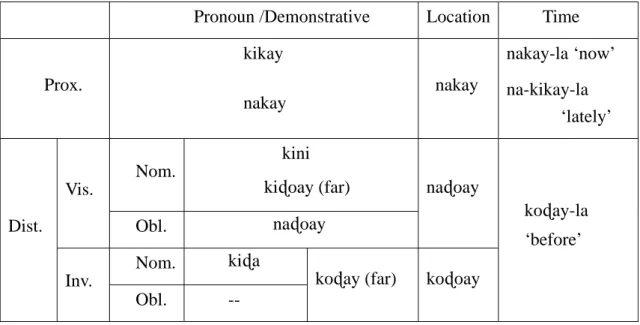
7 Please refer to Section 3.10.1 concerning the usage of demonstratives, which can be preceded by case markers to denote plural participants.
(19)a. “no-davac mi-kita mwi taomoma la [will-Dyn.NFin:leave will-1PI.Nom Dyn.Subj:go field then mo-kan na doo” mya.
2P.Nom-Dyn.NFin:eat Obl cooked food Dyn.Subj:so ] “We shall leave and go to the field and you will eat (there).”
(Tona Texts, 05-004-a) b. …tila, tila, cibana, waba-a gili-a,
[ go:Imp go:Imp shut up:Imp Dyn.Subj:carry on back-Imp younger sibling-Obl ta-wa naooay ta-iyobo-an
1PI.Nom-Dyn.NFin:go that:Emph LocNmz-Dyn.NFin:gather-LocNmz ] ‘…Let’s go! Let’s go! Shut up! Carry (your) little sister on the back. We
are going to the resting area.’ (Tona Texts, 05-005-a)
In (19a), the characters in the story are on their way to the field when this sentence is uttered. In (19b), the characters are leaving for their destination. In the texts examined, all short nominative pronouns designate the agents of some action that has not been accomplished yet. Consider the following examples.
(20)a. ko-kan na abay kosia
[1S.Nom-Dyn.NFin:eat Obl glutinous cake yesterday]
‘I want to eat yesterday’s glutinous cake.’
b. a-kosi a ka “ko-kan na abay”
[Top-yesterday Top 1S.Nom-Dyn.NFin:eat Obl glutinous cake mi kak
Dyn.Subj:so 1S.Nom ]
‘Yesterday, “I want to eat glutinous cake,” (I thought so).’
b’.*a-kosi a ka ko-kan na abay
[Top-yesterday Top 1S.Nom-Dyn.NFin:eat Obl glutinous cake]
‘Yesterday, I wanted to eat glutinous cake.’
c. a-kosi a ka api-kan kak na abay
[Top-yesterday Top would like to-Dyn.NFin:eat 1S.Nom Obl glutinous cake]
‘I felt like eating glutinous cake yesterday.’
In (20a), the past-time phrase, kosi a ‘yesterday’, does not indicate the time frame of
the event but the modifier of the NP, na abay ‘glutinous cake’. Otherwise, the past-time phrase can be preposed to the topic position indicating the time frame of the whole event but the phrase mi kak ‘I thought so’ is obligatory in the matrix clause as shown in (20b-b’). In (20b), the clause with the bound nominative pronoun
functions as quotative speech, attracting the listener’s attention back to the time when this thought came to the speaker and the event ‘eating glutinous cake’ had not
happened yet. However, another verbal morpheme api-
8denoting volition can be used in the past time frame as shown in (20c). From the examples above, future time frame/irrealis mode is another feature denoted by bound nominative pronouns in addition to volition.
3.5.3 In Imperative Sentences
When occurring in imperative sentences, bound nominative pronouns in different persons may serve different semantic roles in events. Consider the following
examples:
(21)a. … mo- aokay-a madd…
[ 2P.Nom-Dyn.Subj:come-Imp Stat.Subj:together]
‘…You come together (to my father)! …’ (Tona Texts, 10-006-d) b. mwa ti-apoy, ko-ti-apo-a yan-ili mosoa [Dyn.Subj:go:Imp make-fire 1S.Nom-make-fire-Imp so-1S.Gen 2S.Obl]
‘Go and make a fire; I want/order you to do so.’ (Tona Texts, 05-025-b)
The one in second person plural in (21a) refers to the addressee in this piece of order and the agent of the verb. On the other hand, the one in first person singular in (21b)
8 api- is not restricted in time frames. It can also designate future events as follows:
(i) a-nosia ka i-api-owa kak walopo [Top-tomorrow Top Neg-would like to-Dyn.NFin:go 1S.Nom Dyn.Subj:hunt]
‘I won’t feel like going hunting tomorrow.’
refers to the person who gives the order but not the agent of the verb. Here, the use of bound nominative pronouns in imperative sentences serves as an emphatic device by specifying the apparent order-receiver as in (21a) and the order-giver as in (21b).
To summarize, bound nominative pronouns designate modal information beyond grammatical relation. As reported in previous studies, they signify volition of the speaker or agent. In addition, the current study found that bound nominative pronouns are restricted to the future time frame/irrealis mode. In imperative sentences, the first person pronouns denote the speaker/order-giver while the second person pronouns denote the addressee/order-receiver/agent of the verb as an emphatic device. Their semantic roles in imperative sentences vary with different persons but are self-evident according to the pragmatic features of imperatives. These features show that the functions of short nominative pronouns go beyond mere grammatical relation but carry not only modal information, volition and irrealis, but also emphatic functions.
3.6 Oblique Pronouns
As reported in the previous studies, oblique pronouns typically serve as the objects of verbs, designating various semantic roles. In Tona and Maga Rukai particularly, they can denote the experiencers of some stative verbs and the possessors in kinship. In addition, they may refer to time and space as well. The following section will discuss these issues respectively.
3.6.1 Syntactic Roles and Distribution
Oblique pronouns serve non-subject roles and may designate various semantic
roles according to Huang et al. (1999b:177). For example:
(22)a. a-ki titina ka wam amc namia [Top-Nom middle-aged woman Top Dyn.Fin:Red:bring 1PE.Obl pa-owa pa-aba namia
Caus-Dyn.NFin:go Caus-Dyn.NFin:carry on back 1PE.Obl gili-a
younger sibling-Obl ]
‘Mother made (me) carry my little sister and brought us (here)’
(Tona Texts, 05-020-a, revised) b. no-ba ay mi-kaki mosoa gili-a
[will-Dyn.NFin:give will-1S.Nom 2S.Obl younger sibling-Obl ]
‘I will give you little sister.’ (Tona Texts, 07-020-b)
c. wa-la niaw, ta-doo mosoa si la [come:Imp-still Mummy 1PI.Nom-Dyn.NFin:cook 2S.Obl and then so-kan
2S.Nom-Dyn.NFin:eat ]
‘Come on, mother, let’s cook (something) for you so that you (can) eat.’
(Tona Texts, 07-015-b) d. wa-la si asa mwa nakay koa
[come:Imp-still and one Dyn.Subj:go this 1S.Obl]
‘Come! One (of you) come to me.’ (Tona Texts, 10-007-b) e. pat tk koa ki ipolo
[Stat.Fin:tall:Red 1S.Obl Nom Ipolo]
‘Ipolo is taller than me.’
In (22a), the oblique pronoun denotes a prototypical patient, which undergoes a visible change in state and is treated as the object by definition (Payne 1997). In this case, it may be analyzed as the accusative case by other researchers such as Li (1977, 1996b, 1997a). However, this set of pronouns may also designate roles such as recipient as in (22b), beneficiary in (22c), destination in (22d), or the theme that is to be compared with in (22e). These are not proto-typical objects and may be
separately marked as dative, beneficiary or locative cases in other Formosan
languages. Although oblique refers to nominals that lack a grammatical relation to
predicates by definition (Payne 1997:133), it is adopted here to indicate its ability of designating direct object as well as other non-subject roles by Formosan linguists such as Huang (2000) and Zeitoun (2000a, 2000d) when describing such features in Rukai, Puyuma and Bunun.
In terms of distribution, oblique pronouns are free. They may appear after the verb as in (22a, c, e) above or after the subject as in (22b).
3.6.2 Experiencers of Some Stative Verbs
As reported in Zeitoun (1995, 2003), Li (1996, 1997a), and Saillard (1997), oblique pronouns may denote the experiencers of some stative verbs whereas
experiencers are usually case-marked as nominative in active sentences. In the data examined, such verbs include mai o ‘thirsty’, abaili ‘tired’, idaimi ‘cannot bear’, maa a ‘inactive’, ikas ka a ‘not diligent’, ma a ‘inactive’, maopii ‘worn out’, which usually describe bodily and emotional state. Besides, the verbs prefixed with
api- ‘would like to’ (designating volition) are included as well. See examples (23a-c) below.
(23)a. mai o koa
9/kak no-oolo mi-kak na [Stat.Fin:thirsty 1S.Obl/1S.Nom will-Dyn.NFin:drink will-1S.Nom Obl acilay
water ]
‘I am thirsty, I want to drink water.’ (Tona Texts, 04-015-b) b. la abaili koa/kak…
[then Stat.NFin:tired 1S.Obl/1S.Nom]
‘I am tired…’ (Tona Texts, 06-004-e, revised) c. api-kan kak/koa
[would like-Dyn.NFin:eat 1S.Nom/1S.Obl]
‘I would like to eat.’
9 In (23a-b), koa ‘1S.Obl’ is the original word recorded in the Tona Texts.
As indicated in previous studies, both nominative and oblique pronouns can denote the experiencers of these verbs. However, as partially reported by Li (1997a), such oblique experiencers are restricted to first person singular and first person plural exclusive pronouns, which exclude the hearer, as in (24a-b).
(24)a. abaili koa/namia [Stat.NFin:tired 1S.Obl/1PE.Obl]
‘I am/We are tired.’
b. * abaili mitia
10/mosoa /moan /nian/ian
[Stat.NFin:tired 1PI.Obl/2S.Obl/2P.Obl/3S.Obl/3S.Obl]
Similar characteristics can be found in another Rukai dialect, Maga. As reported in Saillard (1995), Maga Rukai demonstrates a split case marking system, which is not completely nominative/accusative nor ergative/absolutive. An oblique experiencer is viewed as having been caused to experience such a state.
Semantically, it is like a patient, which undergoes a change in state although this change is invisible. Along with other evidence, Saillard argues that this feature on the semantic level indicates the traces of ergative marking although Maga Rukai is considered as an accusative language. From examples (23-24), Tona Rukai exhibits a linguistic feature similar to Maga Rukai.
Moreover, asymmetric syntactic behavior between affirmative sentences and their negative counterparts is observed regarding this usage of oblique pronouns as experiencers. Consider the following examples:
(25)a. …i-kas kaa koa
11/kak pa-ti-koa-koa…
[ Neg-Stat.NFin:diligent 1S.Obl/1S.Nom Caus-make-Red-thing ] ‘…I am not diligent to do anything…’ (Tona Texts, 07-014-b)
10 In Li (1997a), 1PI.Obl is acceptable in such sentences.
11 In (25a)/(25b), koa is the original word recorded in the Tona Texts.