• 沒有找到結果。

3. Integration of Cooperative Learning with Web-based learning to enhance ESL/EFL learning

N/A
N/A
Protected

Academic year: 2021

Share "3. Integration of Cooperative Learning with Web-based learning to enhance ESL/EFL learning "

Copied!
30
0
0

加載中.... (立即查看全文)

全文

(1)

3. Integration of Cooperative Learning with Web-based learning to enhance ESL/EFL learning

In this chapter, the constraints of current teaching and learning environment of second language would be explored. Then, how cooperative learning and web-based learning work together to break these constraints and therefore enhance ESL/EFL teaching and learning effects would be discussed. After that, the types of cooperative language learning in web-based environment would be discussed.

3.1. Constraints of second language teaching and learning

Many scholars have discussed the constraints of ESL/EFL teaching and learning.

Chastain (1988: 120-21) mentions,

Many teachers have failed to update their teaching practices …Teachers explain the grammar, often in great detail using abstract grammatical terminology. …Most class activities focus on language forms…teachers control most activities and evaluate students’ performances…students display their knowledge and skill when called on to do so…

Examining Chastain’s sayings, we can find that the constraints are teacher-centered

approach, grammar-translation method, and passive students. Chou (1995) mentions

possible constraints of Taiwan’s ESL/EFL teaching and learning, including too many

subjects, test pressure, limited class hours, large classes, and a lack in authentic

environment. Peiya Gu and Zhe Xu (1999) also mention some possible constraints of

ESL/EFL teaching and learning in China. They are: a lack in real interactions, test

pressure, rigid curricula and scheduling, classroom realities, and teacher-centered

approach. Summarizing their opinions, we can categorize these constraints into the

following four major categories: limited class hours, large classes, lack of authentic

environment, and test pressure. Each of these four constraints brings about some

difficulties implementing effective ESL/EFL teaching programs for students to

acquire the target language.

(2)

3.1.1. Limited class hours:

In high schools in Taiwan, there are 3-6 English classes in a week. That is, even if the teacher makes the best use of the class hours, the students get in touch with English only 6 hours a week, if they do not study English after school. The insufficient class hours might bring about the following problems.

3.1.1.1. Insufficient practice of target language:

According to Chapelle’s hypotheses about ideal condition of SLA (1998) mentioned in chapter 2, students have to practice the target language so that it can become an intake. Due to insufficient class hours, students might not have enough opportunities to practice English, which causes their inabilities to integrate new language knowledge into their cognitive system and will forget the new knowledge very quickly.

3.1.1.2. Teacher-centered approach:

Since the class hours are insufficient, the teacher can’t afford to spend time doing activities, which are time-consuming but might be beneficial for students to learn foreign languages. Most teachers may choose a more timesaving method: lecturing.

The students can do nothing but sit there passively listening to the teachers. What the students learn is only a lot of grammatical rules. What’s worse, the students can’t activate their cognitive system and make the new language knowledge become an intake.

3.1.2. Large classes:

The average number of students in a class in junior high school in Taiwan is about 40. Except for the insufficiency of class hours, such a large class might lead to the following problems.

3.1.2.1. Negligence of students’ individual differences

Students’ personality and learning styles and strategies might affect the language

(3)

learning effect. One teaching method might be suitable for some students but not for others. The teacher should use the most effective teaching methods for individual students. However, in a large class, the teacher doesn’t have enough time to deal with the individual differences of the students, and usually adopts one standard teaching method to teach the whole class. The result is that only those students who are accustomed to this teaching method can benefit from the teacher. Some students are sacrificed in their learning process.

3.1.2.2. Heavy workload for teachers in evaluation

The implication of a large class is a large number of students. The assignment given to students and the evaluation data for students might go beyond the teacher’s load. If the correction of students’ assignment or papers takes up too much time, the teacher might not have time to create more innovative teaching programs. In this case, students can only receive boring classes every day with their motivation of learning English reduced. The learning effects become low undoubtedly.

3.1.3. Lack of authentic environment

Since English is a foreign language in Taiwan, it’s difficult for students to have an authentic environment. Most learning activities occur in classroom settings. The lack of authentic environment hinders students’ genuine communication.

The goal of language learning is to enhance students’ communicative competence. Students should acquire the ability to use the language in real communication. However, in the classroom settings, the tasks are created, not real.

Although most textbooks provide many quasi-authentic activities, these activities are

still confined to the classroom settings. In such a teaching environment, it seems that

the opportunities for students to use the target language in an authentic environment

are rare. Therefore, how can we teachers expect the students to use the target language

fluently to communicate with others in an authentic environment?

(4)

3.1.4. Test pressure:

In current high school language classrooms in Taiwan, the goal is still to pass exams, such as entrance examination and some norm-referenced tests in school, which causes great pressure and anxiety for students.

3.1.4.1. High anxiety:

Many studies suggest that SL anxiety has negative effects on second language acquisition (Cherng, 1999). Even until today, the reformation of education still hasn’t solved the problems caused by the exams. Students take repeated exams in school in order to pass the entrance exam for entering a good senior high school or a good university. All these exams increase students’ anxiety and lower their learning effects of the foreign language.

3.1.4.2. Biased goals of learning

English plays an important role in entrance exams, but students and even teachers seem to have forgot what the original goal of learning English is. They consider English only as a subject in the entrance exam. Therefore, students and teachers try to study the techniques of getting high scores in exams, but forget to enhance the competence of using this language to communicate with others in authentic environment. Taking exams has substituted the original purpose-using English to communicate in an authentic environment.

3.1.4.3. Negative interdependence among students in the class:

Investigating the essence of entrance exams or some achievement tests, we can

find that they are norm-referenced exams characterized by competition. Since the

purpose of these exams is to rank each student in the class, if a student wants to get

the final success, he or she has to step on others’ failure. The result is no one would

like to help others. According to cooperative learning theory, we know the knowledge

can be acquired from the discussion or negotiation process of the teamwork. However,

(5)

the competitive atmosphere will decrease students’ willingness for cooperation.

If these difficulties mentioned above cannot be eliminated, it would be very difficult to achieve satisfactory results of ESL/EFL learning. However, Cooperative Learning and web-based learning offer a possible solution for language teachers.

3.2. Implication of cooperative learning on ESL/EFL learning

McGroarty (1989) proposes that cooperative learning provides more practice opportunities of SL through various interactions, enhances cognitive development and second language skills, integrates language with content-based instruction, includes a great variety of curricular materials to stimulate language, gives teachers freedom to master new professional skills emphasizing communication, and helps students act as resources for each other and thus assuming a more active role in their learning. Roger E., W-B Olsen and Spencer Kagan (1992:7) also suggest three major benefits of cooperative learning on language learning:

u Cooperative learning provides a richness of alternatives to structure interactions between students.

u Cooperative learning addresses content area learning and language development needs within the same organizational framework.

u The variety of ways to structure student practice with lesson material increases opportunities for individualized instruction, such as peer-provided clarifications.

From their viewpoints, cooperative learning provides students with more practice opportunities, more content-based tasks, and more interactions among peers.

Comparing the three advantages to the characteristics of CLT, we can find the criteria of “learning through activities” and “learner-centered” mentioned in chapter 2 have been met. Besides, the cooperation among group members and discussion with peers also give students more opportunities to carry out real communication.

Applying cooperative learning to language classrooms, the teacher only has to

give some necessary lectures, and students process the information together and

(6)

discover the knowledge by themselves. Since students have to negotiate with their group members and achieve the final goals, the increasing interactions among students are beneficial and helpful for language learning. Besides, the teacher can save time to observe students and give them immediate help.

In cooperative learning classrooms, the students discuss or cooperate with other group members to discover knowledge. The knowledge being discovered would have greater chances to enter the long-term memory. As we know, to learn English doesn’t mean to memorize a lot of unrelated sentences but to acquire the grammar of that language and have the competence to create real language. Cooperative learning gives students the chance to process the linguistic knowledge, which is helpful in students’

English learning. Besides, through the discussio n, the students can develop the communication competence. Cooperative learning also increases every student’s participation in the classroom, which is very significant in language learning.

3.2.1. Breakthrough brought by cooperative learning

After the intervention of cooperative learning into ESL/EFL teaching and learning, some constraints of ESL/EFL teaching and learning are broken, or, at the least, reduced.

3.2.1.1. Limited class hours

Since cooperative learning focuses on group work and cooperation among group members, most of the students can practice English together. In non-cooperative language classes, only when the teacher asks the students to answer questions, can those students have the opportunity to practice English. However, in cooperative learning class, every student has more opportunities to practice the target language.

An example is used to explain this situation. If there are 40 students in a class, in

non-cooperative class, in 45 minutes’ English language practice time, each student

can have about 1 minute’s practice time, and the prerequisite should be that the turn

(7)

allocation is fair. Nevertheless, in cooperative learning class, each student receives 45 minutes’ English practice time, since they discover knowledge through group discussion and cooperation. During the process, they practice English simultaneously.

Some people might argue that even in non-cooperative learning classes, the teacher can ask the whole class to practice the target language at the same time. For example, the teacher asks a question, and asks students to answer him or her. Or, the teacher might read the text aloud and asks the students to repeat after him or her. It seems that students can also have more opportunities to practice the target language.

However, comparing this type of language practicing with the language practicing in cooperative learning classes, the latter includes more meaningful interaction, more discussion, and more meaningful learning, while the former contains more mechanical drills.

3.2.1.2. Large classes

In current English language classes, since the number of students is large, it’s very difficult for teachers to take care of each student at the same time. Besides, the teacher becomes the center of the teaching program. Students have to accept the teacher’s teaching method, whether the teaching method is suitable for them or not. In cooperative learning class, this constraint could be broken. Students have to work together to discover knowledge. And, through the process of knowledge discovery, they enhance their communication competence. The responsibility of learning has been returned to the students. The teacher isn’t the only source of knowledge. Each group member can discuss with other members and they can even choose the best way to obtain knowledge.

3.2.1.3. Lack of an authentic environment

An authentic environment is crucial in communicative language teaching and

learning. This issue can be discussed from two aspects, authentic material and

(8)

authentic activities. The former still seems to remain unsolved in cooperative learning classes, because cooperative learning here still occurs in physical classroom settings.

As for authentic activities, it seems that in a cooperative learning classroom, this limitation is partially broken. Authors of many textbooks nowadays claim that the activities in their textbooks are authentic. Although these activities are really helpful for the students to certain degree, they are not real authentic activities, since these activities are created for some teaching purposes. Students can just follow the textbooks and do the conversation. Since the students can expect what might happen in the dialogues, they do not have to think, but just memorize certain dialogues.

However, in cooperative learning classes, the situation is different. The activities of discussion and negotiation in the class are helpful to fulfill the purpose of real communication. That is valuable for students to carry out real communication.

However, the breakthrough is still refined to the physical classroom settings. That’s the reason why I say this constraint is partially broken.

3.2.1.4. Test pressure

As aforementioned, competition is the major characteristic of entrance exams and many norm-referenced exams adopted in non-cooperative learning classrooms.

One’s success builds upon others’ failure, and leads to three major disadvantages –

negative interdependence, loss of learning goal, and high anxiety. The way of

evaluation in cooperative learning is process evaluation. The teacher uses a variety of

evaluation methods to judge their students’ performance, such as through observation

or through students’ performance of short playlets. Paper-and-pencil test isn’t the only

way to evaluate students. This greatly reduces the students’ malicious competition and

may lower the degree of negative interdependence and test anxiety. Besides, the most

important element of cooperative learning is positive interdependence. In other words,

in a cooperative learning classroom, if it’s well organized, the negative

(9)

interdependence will not happen. As for loss of learning goal, cooperative learning provides a good solution. Students in the cooperative learning class learn English from activities. That is, students in cooperative learning class learn English not for test purposes, but naturally acquire the language from the cooperative activities.

3.2.2. Limitations of cooperative language learning

Although cooperative learning does solve some problems currently encountered in English teaching and learning, some limitations still exist.

3.2.2.1. Teachers’ linguistic competence:

Although cooperative language learning does provide ESL/EFL teachers with a good method to organize their students, drive their students to cooperate, discuss, and negotiate with each other to discover knowledge, the problem of teachers’ linguistic background isn’t solved. Non- native ESL/EFL teachers, mostly, are better at explaining grammatical rules than at giving a lot of appropriate examples.

That’s because English in Taiwan is still a foreign language and therefore, the teachers lack of background knowledge of the target language. Besides, due to the insufficiency of contact with the target language, some teachers have difficulties using English in an authentic environment.

3.2.2.2. The limitation of classroom setting:

Even though cooperative learning method increases students’ involvement with the target language learning and partially breaks the limitation of insufficient class hours, the limitation of classroom setting still exists. In current junior or senior high schools, there are about 4-6 English classes a week. That is, even though the teacher really makes the maximum use of the class hours, students have only 4-6 hours of English learning a week. The limitation of insufficient time still cannot be completely overcome in a physical cooperative language learning classrooms.

3.2.2.3. Insufficiency of authentic environment:

(10)

Most cooperative language learning activities still occur in physical classroom settings. Although it creates an environment for students to discuss and negotiate with each other naturally, the material is still not that authentic. Students’ access to an unrehearsed environment still seems difficult. This seems to hinder the realization of CLT – letting students use the target language in an unrehearsed environment.

3.2.2.4. Large amount of evaluation data gathered through the process evaluation:

Since the type of evaluation adopted in cooperative learning is process evaluation, there would be huge amount of evaluation data. In the beginning, the data gathered seem valuable for teachers. However, with time passing by, the gradually increasing evaluation data would become a great burden to the teacher. They even don’t have enough space to store and enough time to examine these data, let alone benefiting from these data. Therefore, some more effective ways to store and process the data need to be adopted.

3.2.2.5. Language anxiety:

According to Horwittz (1999), there are three types of language anxieties:

communication apprehension, test anxiety, and anxiety from fear of negative evaluation. Many studies also suggest negative correlation between language acquisition and language anxiety. The following citation by Horwitz, Horwitz, and Cope (1986) is a description of the reason why language user might feel anxious.

Many people are anxious when learning and speaking a foreign language because they cannot express their true thoughts in the foreign language; and therefore they do not feel like themselves when communicating in their new language. (cited in Horwitz, 1999:51)

From the citation, we can find that one major reason of language anxiety is that the

language users do not feel like themselves when communicating in the target

language. And that makes them feel awkward. One of my students once said, “I feel

(11)

that I am just like an idiot. Other students laugh at me when I speak English.” The anxiety of the student might result from two aspects. First, he can’t use the target language to express himself clearly. Second, he is afraid of being laughed at by other students, especially in a country where English is still not a dominant language.

Cooperative learning adopts a low-anxiety evaluation method – process evaluation. Students are evaluated through the learning process, but not only one exam. Therefore, test anxiety can be distributed to a variety of evaluation methods.

Learners’ test anxiety can therefore be lowered. As for fear of being negatively evaluated and communication apprehension, cooperative language learning in physical classrooms doesn’t seem to provide effective ways to solve these problems.

In physical classrooms, it seems very difficult to break these limitations.

However, if web-based learning environment is introduced into the ESL/EFL teaching program, these limitations might be solved.

3.3. Implication of web-based learning on ESL/EFL learning

Heidi Shetzer and Mark Warschauer (2000) maintain that the implications of web-based learning on ESL/EFL teaching and learning can be categorized into three types: communication implication, construction implication and research implication.

Communication implicatio n means that web-based learning environment

provides a perfect environment for ESL/EFL teachers to practice communicative

language teaching. Since it provides a real and authentic context for users to

communicate with others, students can communicate in an authentic and unmodified

situation. That means students can easily get access to the culture of the target

language. Besides, in such an environment, the teaching is task-oriented. Students

learn English through finishing tasks. That is, students learn English meaningfully and

purposefully. The teacher can use the tools provided on the Internet, such as chatting

rooms, bulletin board system or E- mail system to increase students’ opportunities of

(12)

practicing using English.

Construction implication means that students can enhance their competence by the construction of web sites. Through the progress of construction, students can decide which material should be put into the web site, and in what way the material can be organized into the web site. Therefore, students won’t just store the new knowledge in their brain but they have to organize the new knowledge and put it in the website systematically.

Research implication means that both teachers and students can easily retrieve the abundant resources on the Internet, and the abundant resources give both the teacher and students research resources. The teacher and students should equip themselves with the ability to search valuable information on-line.

Besides the three implications aforementioned, there is an advantage brought by web-based learning: efficiency. The web pages with a database at back-end provide teachers with powerful processing and storage abilities, which is significant in the evaluation of students’ learning progress. In cooperative language learning, students’

learning process is more important than one mere final product. Students need to cooperate with other group members and discover knowledge in the learning progress.

Therefore, the interaction among students in the learning progress or the masterpieces students create should be recorded so that the teacher can understand each student’s learning progress and, if necessarily, give immediate and necessary aid. With the help of database web pages, this can be easily done.

3.3.1. Constraints being broken by web-based language learning

As we discussed in 3.2.2, there are still some limitations that cooperative

language learning can’t solve in the physical classroom settings. However, with the

adoption of web-based learning, these limitations seem solved, or, at least, partially

solved.

(13)

3.3.1.1. Non-native speaker EFL teachers

The limitation of Non-native speaker EFL teachers has been discussed in 3.2.2.1.

They are better at explaining grammar rules than at providing appropriate examples in the target language or culture. Web-based learning provides teachers with huge amount of authentic materials. Teachers don’t have to worry about the insufficiency of examples of the target language and its culture. Since English is the dominant language on the Internet, examples are everywhere. If teachers are not confident of their intonation or pronunciation in target language, which might be many non-native EFL teachers’ problems, they can utilize the audio or video clips on the Internet. If the non-native EFL teachers keep on using the Internet as the aide of their teaching, they can get in touch with authentic target language all the time. That will also be helpful to enhance or to keep the teachers’ language ability.

3.3.1.2. Physical classroom setting

As we discussed in 3.2.2.2, the limitation of physical classrooms is also a problem. Even with teachers’ efficient time use, students have only 4-6 hours a week to practice English. However, after the adoption of web-based learning, the limitation has been completely broken. With the 24 hours’ running servers at the nodes on the Internet, students can get in touch with the target language at any time at any place they like. Students won’t have to worry that they don’t have teachers to ask questions.

With bulletin board system or E-mail system, they can leave messages to their teachers or more competent colleagues and get answers. If the teacher or their classmates are on line at the same time, they can discuss the question together.

3.3.1.3. Insufficiency of authentic material

The limitation of ins ufficiency of authentic material, once a big problem, has

been solved with the intervention of web-based learning. Just as aforementioned,

English is the dominant language on the Internet. What might be beneficial for

(14)

ESL/EFL teachers can also be good for the students. Students can also get abundant English resources on the Internet. Most important of all, the material is authentic.

With so many authentic materials, the students might not be able to know which material is valuable for them, and which is not. Therefore, in the beginning stage, the teacher should not just leave the students to find the knowledge by themselves, but should help them locate appropriate materials provided on the Internet. After the students develop enough competence to use the Internet to help their learning, the teacher can gradually diminish their control and let the students learn autonomously without the help of the teachers.

3.3.1.4. Language anxiety

As we discussed in 3.2.2.5, language anxiety might bring negative effects on language learning. Cooperative learning might reduce the test anxiety. However, the other two types of language anxiety, communication apprehension and fear of being negative ly evaluated are still not completely solved, since students still have to use an unfamiliar language to express themselves in the classroom to the teacher and their classmates face-to-face. The audiences know who this speaker is. The speaker would surely feel uneasy, especially when he or she cannot use that language fluently to express himself or herself. What’s worse, some teenagers tend to laugh at their classmates when they use a foreign language. Web-based learning brings a solution to the two types of language anxiety. Just as we discussed in 2.3.2, “Being anonymous”

is a characteristic of web-based learning. In the virtual community on the Internet, nobody knows who others are. Therefore, the limitation of communication apprehension and fear of being negative evaluated can be broken when students don’t have to worry about being laughed at by others. They would be willing to produce more outputs in the target language. The concept is quite similar to that of “New ID”

in Suggestopedia Teaching Method.

(15)

3.3.1.5. Large quantity of evaluation data

As mentioned earlier, cooperative learning adopts process evaluation. This type of evaluation may produce a huge amount of evaluation data. To describe a teacher’s portfolio, Dorothy M. Campbell etc. (1997) once mention that the portfolio will provide a record of quantitative and qualitative growth over time in the selected goal areas or standards. The teacher of the portfolio will have in hand a trail of evidence of the progress. This will give the teacher a gratifying sense of accomplishment and pride and will help the teacher have ever- increasing confidence in the professional abilities. Although they describe the nature of a teacher’s portfolio, the essence of a portfolio can be understood clearly. Similar situation can be applied to the students’

portfolios.

A portfolio is a record of the process of developme nt. Although the works can be selected, with time passing by, the data size collected in the portfolio would become too huge for the teachers. Therefore, the “practicality” issue of a good test needs to be considered. If the teacher still adopts a traditio nal way to store and process these data, it will be a great burden for teachers. Web-based learning brings an effective solution to this problem. With the help of the computer, students can put some of their representative works into a database. The teacher can also use the database to store and process students’ works more effectively.

Some tools provided on the Internet, such as chatting room and bulletin board system, can even record students’ output automatically in the database at the back-end of the web pages. With the powerful data processing ability of database, the teacher could evaluate students’ performance more easily and effectively.

3.3.2. Limitations of web-based learning

Although web-based learning really provides the solutions to some constraints of

ESL/EFL teaching and learning, it also has some limitations. The limitations can be

(16)

discussed from the role of computers, as a tutor or as a tool, discussed in section 2.3.4.

Here the tutor role means that the computer serves as a teacher, it can teach the students certain knowledge and correct certain errors. The interaction is between computer and students. While the tool role here means that the computer only provides services, the interaction is among the human beings at the back-end.

3.3.2.1. Computer as a tutor

There are three limitations when computer is used as a tutor. They are (1) teachers’ inabilities to create serviceable language teaching programs or interactive web sites, (2) the computers’ inability to possess the real human intelligence, and (3) the computer’s inability to take care of students’ affective factors.

3.3.2.1.1. Teachers’ inabilities to create serviceable language teaching programs or interactive web sites

To use computer as a tutor, the teacher should possess the ability to transform their teaching material into the computer and endow the computer the ability to present the material and evaluate students to certain degree. In this case, the teachers have to write a program or create a website to implement their teaching. However, the ability to program or to create an interactive website sometimes goes beyond a non-computer- majored teacher’s ability. Even if they ask computer professionals for help, due to different background, the product couldn’t meet their needs.

3.3.2.1.2. The computers’ inability to possess the real human intelligence

Besides, even until now, the computer is not as intelligent as real human beings.

In other words, students can’t get real interaction in the tutor computer programs.

They are talking with a machine, and the machine is not so powerful as to create language just like human beings.

3.3.2.1.3. The computer’s inability to take care of students’ affective factors

Another limitation is that the computer fails to take care of students’ affective

(17)

factors. A real human teacher would give students immediate comfort when students encounter difficulties, and students might feel the genuine caring from the teacher.

However, if the comfort comes from a machine, whether students can feel that warmth is doubted.

3.3.2.2. Computer as a tool

There are also two limitations when the computer is used as a tool. They are (1) teachers’ unwillingness to accept new technologies, and (2) insufficient web-based classrooms. The limitations presented in last section 3.3.2.1 seem extinct when the computer is used as a tool. The teacher only has to possess the basic skills to “use” the computer, but not to create a new program. When the computer is used as a tool, since the back-end is the teacher or other students. Both sides that interact are real human beings. Therefore, the limitations mentioned in 3.3.2.1 seem not to happen.

3.3.2.2.1. Teachers’ unwilling to accept new technologies

To use the computer as a tool, the teacher has to be familiar with the applications provided on the Internet, such as chatting room and E- mail, and possess certain basic ability to use the computer to facilitate the presentation of his or her teaching materials, such as the creation of web pages or presentation tools. Therefore, language teachers have to accept new teaching methods brought by the quick progress of computer technology. However, some language teachers seem afraid of the computer technologies and do not want to spend time mastering these new powerful tools.

3.3.2.2.2. Insufficient web-based classrooms

Once the teachers would like to make use of the tools provided on the Internet to

help their students learn a foreign language, the prerequisite is that both the teachers

and the students can have access to the Internet very easily. However, due to some

financial difficulties of the school, the web-based computer classrooms are

insufficient for students to use computer whenever they have free time.

(18)

To sum up, though web-based learning provides solutions to the limitation of cooperative learning, it still has some limitations. However, are these limitations unsolved? The answer is negative. With rapid progress of technology, the use of computers will become more common, and the interface will become user-friendlier, so that language teachers might be willing to use it. Besides, the price will surely be lowered, due to the matured skills in semiconductors and telecommunication.

Therefore, these limitations will be solved in the near future.

3.4. Integration of cooperative learning with web-based learning

From the discussion of language learning and teaching, cooperative learning and web-based learning, and how the latter two break some limitations encountered by some ESL/EFL teachers, we can find cooperative learning and web-based learning working together are able to enhance students’ ESL/EFL learning effects. In this section, how cooperative learning and web-based learning work together to increase teachers’ teaching efficiency and students’ language learning effects would be explored in the following aspects:

3.4.1. The teaching goal

As discussed in last chapter, the goal of language teaching is to enhance

students’ communicative competence. The way to achieve this goal is the adoption of

CLT. However, the characteristics of CLT discussed in last chapter show that they are

more goals than practical methods. If these characteristics are carefully examined,

there are many similarities found in the essence of cooperative learning methods. In

other words, cooperative learning provides the teachers and the students with an

effective way to achieve the goals depicted in CLT. Cooperative learning offers

students with more activities to practice the target language and more interactions

among students. Besides, cooperative learning also enhances the positive

interdependence among students. Although cooperative learning is useful and helpful

(19)

to ESL/EFL teaching and learning, the constraint of the physical classrooms remains a problem. Web-based learning provides the students with an authentic environment. It also provides teachers with many powerful tools and rich resources. Most important of all, it breaks the constraints of the physical classrooms. The combination of cooperative learning and web-based learning provide students with a satisfactory language-learning environment.

3.4.2. The teaching materials

In traditional teaching methods, the teaching material is directly transferred to the students from the teacher. Students just passively receive what the teacher teaches them. In such classes, rote learning occupies most of the time and the result is that the students might feel bored and forget the materials very quickly. In cooperative learning, students in a group have to work together to discuss the material and make sure everyone in the group has understood the materials. In such classes, meaningful learning dominates the learning process and students might have more opportunities to transfer the new knowledge into their cognitive system. Web-based learning provides students with more authentic materials, and therefore, students can discuss the materials multifacetedly. Integrating cooperative learning with web-based learning gives students more authentic materials and helps students carry out meaningful learning.

3.4.3. Teachers’ roles

Cooperative learning plus web-based learning brings a significant change to the

role of the language teacher. In cooperative learning class, the role of the teacher has

been shifted from an authority of knowledge to a facilitator, a course organizer and an

evaluator. The perfect situation is that students themselves lead the group activities

and discover knowledge. The teacher just gives immediate help when needed. In other

words, the teachers have more time to take care of individual student’s problems.

(20)

Besides, web-based learning gives non-native ESL/EFL teachers abundant resources to instruct their students. Traditionally, non-native ESL/EFL teachers might encounter difficulties in native- like pronunciation and intonation. It might also be difficult for them to explain the cultural differences to their students. What’s worse, it’s not easy for ESL/EFL teachers to discuss their teaching problems with other native or foreign ESL/EFL teachers. However, the adoption of web-based learning solves the problem without difficulties. The teacher can use the web sites abroad to teach culture, such as the teaching of the origin of Christmas, Christmas carols, etc. Lin (1999) gives an example of using WWW to enhance culture teaching. From this article, we can see how CMC enhances culture teaching. Besides, the teacher can also use the video clips and audio clips provided on the Internet. They can also join the TESL-L and its derived lists, such as TESLCA-L to discuss their teaching problems. To sum up, cooperative learning gives the ESL/EFL teachers more time to take care of individual students, and web-based learning broadens teachers’ eyesight and provides plenty of resources for teachers to retrieve.

There is always a myth that after the great progress of computer technology, the

teacher might become redundant in the teaching programs. It seems that the computer

can do all the work that once should be done by the teacher. Ostensibly, the teacher’s

burden has been released. However, that’s not the case. What has been broken is the

limitation that can’t be easily broken before, such as inability to carry out genuine

communication outside the classrooms, lack of the powerful data processing ability,

and lack of efficient organization of students. Now, these limitations are broken. In

other words, the laborious work is reduced. The communicative environment is

constructed. More effective methods to organize students have been introduced. Is the

importance of the teachers declined or is the teacher becomes redundant? It seems just

the opposite. The qualified teachers become even more important. They have to

(21)

possess the profession in the target language, language teaching, and web-based teaching so that they can design suitable web-based cooperative language learning activities.

3.4.4. Students’ roles

Similar to the dramatic changes of the roles of the ESL/EFL teachers, the roles of the students also change. In cooperative learning class, students should follow the teachers’ directions to carry out cooperative activities in rudimental level, and finally they themselves should possess the ability to lead the group to discover the knowledge and discuss with each other autonomously. Students have the opportunities to join the decision of the learning goals, collect necessary materials, and decide the most suitable cooperative methods to achieve the final goals. During the process, they may also evaluate other student’s performance, which is also done by the teachers.

The great change of the role of students, from a passive receiver to an active participant, meets the characteristics of CLT mentioned in section 2.1.2. It’s students that learn the target language. Suitable language environment should be constructed for students to acquire the foreign languages.

Web-based learning reinforces the learning effects of cooperative learning. The eight characteristics of web-based learning facilitate the students to achieve the goals of ESL/EFL learning through cooperative learning. The rich resources on the Internet might facilitate the students to collect necessary materials. The characteristics – rapidity, economy, interaction and anonymity might enhance students’ discussion with their classmates, their teacher, and even someone they do not know on the Internet in their language learning. The international characteristic helps students break the constraint of classroom and have access to the culture of the target language directly, which can’t be done easily in the non-web environment.

3.4.5. The evaluation

(22)

In cooperative learning class, process evaluation is adopted to evaluate students.

By using it, students’ learning process can be recorded and teachers can find out the difficulties students encounter and give students appropriate help to enhance their learning effects. In language learning particularly, a single sheet of test items fails to evaluate students’ real competence. Students’ performance in the activities should be taken into consideration, too. From this aspect, the process evaluation in cooperative learning meets this requirement. However, with the rapid increase of evaluation data, how to store and process the data becomes a burden, which generates the heavy workload of the teachers. Web-based learning provides an effective way to reduce this problem.

In section 2.3.1, we define web-based learning as “learning occurring in the web-based environment.” Such environment is a combination of computer and telecommunication. The “computer” component might solve the problem – large amount of evaluation data, since the advantage of computer is its outstanding ability to store and process a large amount of data. Applying this advantage to our problem, the large amount of data generated from the process evaluation in cooperative learning class could be stored and processed effectively.

3.4.6. Current teaching environment

The three major problems of current teaching environment are large number of

students, insufficient class hours, lack of authentic materials. Cooperative learning

solves most of the problems, as discussed in 3.2.1. The problems left are solved after

the intervention of web-based learning, as discussed in 3.3.1. Although there are still

some limitations left unsolved current ly, they will soon be solved with the rapid

progress of computer technology. Therefore, cooperative learning plus web-based

learning seems to be a suitable teaching and learning method to break the constraints

in current teaching environment.

(23)

3.5. Factors of cooperative language learning in web-based environment

After the correlation of language teaching and learning, cooperative learning, and web-based learning has been discussed in detail, the types of the implementation of web-based cooperative language learning still need to be further discussed. Before discussing the types of cooperative learning in web-based environment. The factors involved should be discussed first. They are the following three continuums: the degree of cooperation, the degree of the intervention of the teacher, and the degree of the use of computer technology.

3.5.1. Degree of cooperation

Degree of cooperation means the continuum from non-cooperation to full cooperation. In the extreme of non-cooperation, the students learn individually or competitively. However, in the other extreme of the continuum, the students learn cooperatively.

In the cooperation side of the continuum, there are two types of cooperation, cooperation with non-specific cooperators and cooperation with specific cooperators.

When students enter a chatting room to discuss with some unknown person, or leave

some messages on a discussion board anonymously, they are cooperating with

non-specific cooperators, since they do not know who will answer his or her questions,

or who will discuss the topic with them. However, if the students cooperate with his

or her “assigned” group members or the teacher via the Internet, they cooperate with

specific cooperators, since the students know who their cooperators are. Working with

specific cooperators or with non-specific cooperators are two major types of

cooperation. Both types have advantages and disadvantages. For non-specific

cooperators, students can definitely have lower anxiety when discussing with their

cooperators. Nevertheless, it leads to the problem of lower degree of cooperation,

because the cooperators are not fixed on the Internet all the time, and students lack a

(24)

strong feeling of belonging. For specific cooperators, the situation is just the opposite.

Anxiety might rise when students have to cooperate with their familiar cooperators face-to-face. However, the degree of cooperation is higher, since their cooperators are their classmates or their teacher. The feeling of responsibility to the whole group might drive the students to give more contributions.

3.5.2. Degree of teacher intervention

Teacher intervention is also an important factor in the cooperative language learning in web-based environment. One extreme of this continuum is that the teacher intervenes into the teaching and learning greatly. He or she sets up the goals, organizes the students, guides the students to do learning activities on the Internet, and evaluates the students’ performance on the Internet. What the students have to do is follow the teacher’s arrangement and do the assigned activities. The other extreme of this continuum is that the teacher does nearly nothing. Students have to learn by themselves. Different points in this continuum mean different degree of teacher intervention. There are advantages and disadvantages of both extremes. At the extreme of the strong control from the teacher, the advantage is that the students are not disoriented in the learning procedures by following a specific learning map, while the disadvantage is that the students might depend on the teacher too much but lose the choice to decide the way that best fits them. At the other extreme of the low control from the teacher, the advantage is that students can decide their learning pace, learning methods, and so on, while the disadvantage is that the students, especially in the beginning stage, might get lost in the learning activities, and feel frustrated easily.

Therefore, to what degree the teacher should intervene into the teaching program challenges the language teachers.

3.5.3. The degree of the use of computer technology

The degree of the use of computer technology means the intervention of the

(25)

computer technology. One extreme is that the teacher and the students do not use computer to enhance their language learning effects. The other extreme is that the teacher or the students make the best use of the computer technology, such as bulletin board, chatting room, 3-D virtual realty, web database, and interactive games. At the extreme of unwilling to use computer technology, the advantage is that the teacher and the students do not have to worry about the development of their computer competence. The disadvantage is that the powerful data processing ability of the computer and the real communication and rich resource via the Internet could not be achieved. At the other extreme of incorporating computer technology (including Web functions) into their learning, the advantage is that both the teacher and students can enjoy the benefit of high processing ability of the computer and wide eyesight and real communication via the Internet. The limitation is that the teacher might fail to create certain high-quality websites or interactive programs by themselves.

3.6. Representative types of cooperative language learning in web-based

environment

(26)

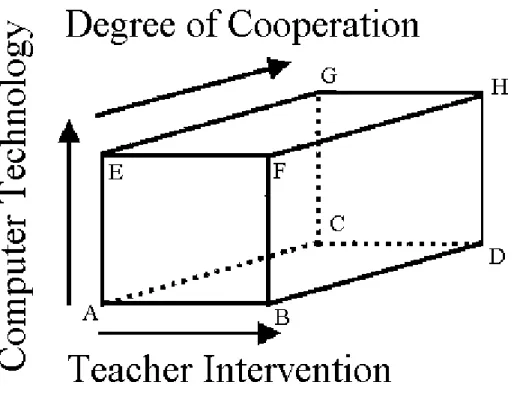
Figure 3. A model of the correlation of teacher intervention, computer technology and degree of cooperation

From this figure, the three continuums construct eight representative points, A to H. Each of these points will be discussed in the following paragraphs. These eight representative points can also be categorized to two major groups, without computer and with computer.

3.6.1. Without computer

In this group, the computer technology is abandoned. Most of the time, the teacher teach the target language and the students learn the target language in traditional ways. The four points A, B, C, and D will be discussed individually in the following paragraphs.

3.6.1.1. Point A

Point A means the extreme that the teacher intervention is the slightest, the least

(27)

computer technology is used, and the loosest cooperation type is adopted. In this extreme, the teacher doesn’t intervene into students’ learning. He or she won’t spend time creating an environment, such as building a bulletin board, or a chatting room, but let the students learn by themselves. Students rarely use computer technology to enrich their learning. In this extreme, unless the students have already possessed the prerequisite learning ability and English competence, they cannot benefit from such learning activities.

3.6.1.2. Point B

Point B is the extreme that teacher’s intervention is the greatest, but the degree of operation and the use of technology are the least. This type of learning is just like the traditional language teaching and learning. The teacher takes the full responsibility of the teaching program, such as explaining grammar rules, conducting the drills, and so on. Students are passive receivers and have no choice but to sit there listening to their teacher’s lectures.

3.6.1.3. Point C

Point C is an extreme that the teacher intervention is slightest, and the use of computer technology is the least, but the degree of cooperation is greatest. The difference between Point C and Point B is the teacher intervention. In point C, students have to possess the prerequisite knowledge of the ESL/EFL learning and the cooperative learning, since the teacher doesn’t intervene into the teaching and learning program directly. The students can benefit from the cooperation among the cooperators, but they can’t benefit from the computer technology.

3.6.1.4. Point D

Point D is an extreme that the teacher intervention is greatest and the degree of

cooperation is also greatest, but the use of computer technology is the least. This type

of learning is just like the cooperative learning in physical classroom settings without

(28)

the incorporation of computer technology. Students can benefit from the cooperation among their cooperators, but they do not benefit from the computer technology. That is, all the limitations we discussed in 3.2.2 still exist.

3.6.2. With computer

In this group, the computer is widely used. The teacher and the students make the best of the computer technology to enhance their teaching and learning effects. The four points E, F, G, and H will be discussed individually in the following paragraphs.

3.6.2.1. Point E

Point E is an extreme that the teacher intervention and the degree of cooperation are the slightest, but the use of computer technology is the greatest. This type of teaching and learning is just like the “tutor” CALL. The computer substitutes the role of the teacher. However, due to the limitation of the current technology, it is impossible to create a real human- like machine. Therefore, the effects of teaching and learning between computer and the students are not satisfactory.

3.6.2.2. Point F

Point F is an extreme that the teacher intervention is the greatest, and the use of computer technology is the greatest, but the degree of cooperation is the slightest.

This type of teaching and learning is just like Web-based learning without the incorporation of cooperative learning. The teacher creates powerful programs or constructs websites for students to learning the target language individually. Students can benefit from the computer technology, but can’t benefit from the cooperation among students. Most of the interaction is between the students and the teacher through the Internet.

3.6.2.3. Point G

Point G is the extreme that teacher’s intervention is the slightest, students

organize their own cooperative groups to learn the target language. They have to

(29)

decide their own learning goals, choose their learning methods, and evaluate their own performance. During the learning process, computer technology is widely used.

However, the teacher’s intervention has been removed. That is, the teacher doesn’t intervene into the learning in any aspect, but let the students take the full responsibility of learning. This extreme is especially suitable and helpful for those students with enough prerequisite EFL learning experience, cooperative learning experience and computer knowledge. Since they already have enough prerequisite competence, they can learn independently from their teachers.

3.6.2.4. Point H

Point H is another extreme of this model. It means that every computer technology available, such as vir tual 3D, web-database pages, multimedia, and interactive games, is used to help students learn the target language. Besides, the teacher organizes the students into groups and requests students to learn on the Internet in groups. The cooperators are their classmates. That is, in this extreme, the teacher intervenes into students’ learning program greatly. The teacher has to set up the learning goals, assigns students into groups, creates or finds some useful programs, collects useful links, and evaluates students’ performance constantly. In other words, the teacher sets a learning framework for students to follow. This extreme is especially helpful for those students without prerequisite EFL learning experiences.

However, for those students that with enough learning ability and experience, this limits their learning, since the students seem not to have enough space to decide their own learning.

After the discussion of the eight representative points, we can find that the higher

degree of the use of computer technology or the higher degree of cooperation, the

closer to the goal of our EFL/ESL teaching and learning. As for the continuum of the

teacher intervention, according to different situations, such as students’ prerequisite

(30)

competence, the degree of teacher intervention has to change. Therefore, the unlimited points between G and H are the favored ones of the cooperative language learning activities in a web-based environment. They offer English teachers a wide room to realize the teaching goals. That is, teachers can adopt the most appropriate type of web-based cooperative language learning activities, according to the students’

current language proficiency, current learning ability, and some other considerations to achieve the goals of language teaching and learning.

In sum, the EFL/ESL teachers have to utilize their profession, in language, in

language teaching, and in computer technology, to decide the most appropriate type of

web-based cooperative language learning to their students. The ways of organizing

students to achieve cooperative effects are there. The language teaching methods are

there. The computer technology is there. The Internet is there. However, they won’t

work together by themselves. It’s the teacher that puts them together and achieves the

final goal – to enhance students’ communicative competence. In the next chapter, we

will use the three factors to evaluate some cooperative language learning activities in

web-based environment.

數據

Figure 3. A model of the correlation of teacher intervention, computer technology and  degree of cooperation

參考文獻

相關文件

Enhance English Language Learning, Teaching and Assessment in Reading at Primary Level. • Designing Quality English Language Papers to Enhance Learning, Teaching

• Assessment Literacy Series: Effective Use of the Learning Progression Framework to Enhance English Language Learning, Teaching and Assessment in Writing at Primary Level. •

• Assessment Literacy Series - Effective Use of the Learning Progression Framework to Enhance English Language Learning, Teaching and Assessment in Writing at Primary Level.

• To enhance teachers’ knowledge and understanding about the learning and teaching of grammar in context through the use of various e-learning resources in the primary

← This allows teachers to adapt the school-based English Language curriculum and devise learning/teaching materials that better suit the diverse abilities, needs

vs Functional grammar (i.e. organising grammar items according to the communicative functions) at the discourse level2. “…a bridge between

incorporating creative and academic writing elements and strategies into the English Language Curriculum to deepen the learning and teaching of writing and enhance students’

Web-based Learning Courses for Gifted/More Able Students (jointly administered by EDB and