三、研究結果:
A 王,B 劉,C 周,和 D 吳是有一位父母參加第一階段家長成長團體(P)的口吃 兒童,皆為三年級學生,而 C 周、D 吳、E 李和 F 廖是參加第二階段口吃兒童直 接治療團體(C)的兒童,E 李為二年級學生和 F 廖為一年級學生;C 周和 D 吳皆是 接受二種介入的口吃兒童,上述六位兒童皆為男生。
本研究結果分別由表一和表二來呈現以 SLD (Stuttering Like Disfluency) 和 WSLD (Weighted Stuttering Like Disfluency)來計算兒童在不同評估時間 之不順暢情形。表一和表二中的數字 1,2,3 分別代表團體前、團體後和追蹤的評 估時間。表一是以 SLD/100 音節來計算口吃兒童在 6 次評估(家長成長團體前、 後及追蹤和兒童團體前、後及追蹤)之不順暢變化情形。
The poster in the 2009 Conference of Oregon Speech-Language-Hearing Association at Bend, Oregon. (NSC-97-2413-H-153-010)
Teachers’ Attitudes and Beliefs Toward
Mandarin-Speaking Stuttering Children
Shu-Lan, Yang Ph D.
Associate Professor, Department of Special Education, National Pintung University of Education, Taiwan
Abstract
This study was to explore Taiwanese teachers’ attitudes and beliefs toward Mandarin-speaking stuttering children in the first grade. Thirteen teachers were interviewed and answered questions regarding stuttering children. Content analysis of the teachers’ verbatim was employed and the findings were compared with what has been found on English-speaking teachers.
Introduction
Previous studies investigated special education teachers, undergraduate students, school-age students, and professors in English-speaking cultures, and they all suggested that people held negative perceptions or attitudes toward stuttering subjects (Craig, Hancock, Tran, & Craig, 2003; Dorsey & Guenther, 2000; Franck, Jackson, Pimentel & Greenwood, 2003; Klassen, 2001; Ruscello, Lass, Schmitt & Pannbacker, 1994). It is not clear whether similar results exist in non-Western cultures. In addition, this issue has not been studied in Taiwan and little is known about how Taiwanese teachers perceive their stuttering students. The purpose of this study, therefore, is to explore the attitudes and beliefs of Taiwanese teachers toward stuttering children in the first grade.
Method
1. Recruitment of stuttering participants
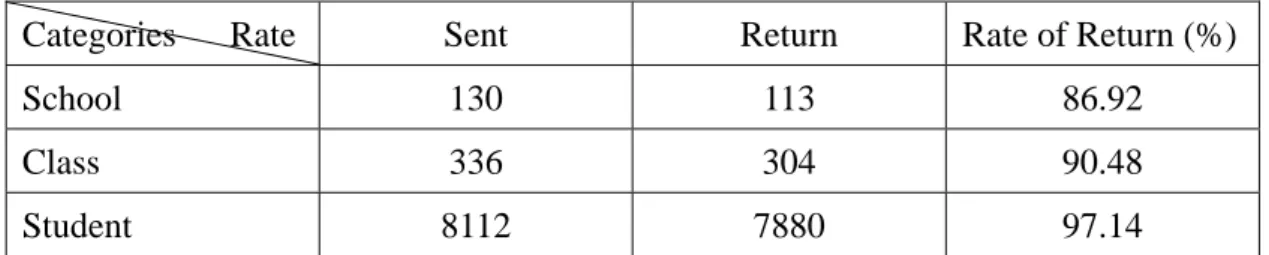
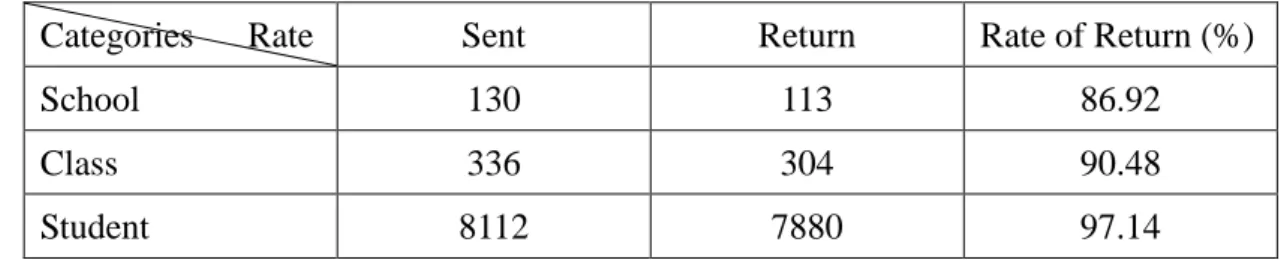
area of Southern Taiwan were invited to fill out a stuttering screening form for their students or children individually. The returning rates were shown in Table 1.
Table 1: The Rate of Return in Different Categories
Categories Rate Sent Return Rate of Return (%)
School 130 113 86.92
Class 336 304 90.48
Student 8112 7880 97.14
The two screening forms were sent to 130 elementary schools which had 336 classes in the first grade and 8112 students in the classes. The teachers and parents of 7880 students in 304 classes of 113 elementary schools sent back the screening forms. When both the teacher and the parent of a particular child rated his/her stuttering severity as more than or equal to 1 on a 7-point stuttering scale, the child became a suspected stuttering subject. Following this procedure, 109 children were reported as having stuttering. Therefore, the stuttering prevalence of the first graders reported by both their teachers and parents seemed to be 1.38% in Pingtung area, Taiwan.
2. Identification of SLD (Stuttering-Like Disfluency) and WSLD (Weighted Stuttering- Like Disfluency)
The conversational and story-telling speech samples in Mandarin of 63
suspected stuttering students were collected with a digital audio recorder. A student whose average disfluency in the two speech samples was more than 3 SLD (Ambrose & Yairi, 1995; Yairi, 1997) and 4 WSLD (Ambrose & Yairi, 1999 ) was regarded as having stuttering. In total, 16 first graders were identified as stuttering subjects through this screening procedure. The correct ratio of stuttering children reported by both parents and teachers was 25.40%. Inferentially, the stuttering prevalence of the first-grade students according to Yairi and Ambrose’s criteria might be about 0.35% in Pingtung, Taiwan.
3. Interviews of Teachers
recorded with a digital audio recorder and transcribed into verbatim protocols. 4. Data Analysis
Content analysis was conducted to analyze and summarize the data. Each verbatim was read carefully by the researcher. The key sentences related to the question asked were underlined, and the meanings of the key sentences were
condensed into new sentences. Then, a graduate assistant checked all the condensed texts for consistency. After that, the 13 condensed answers of the same question were gathered together and summarized. Finally, a conclusion about the teachers’ answers to the certain question was derived.
Results and Discussions
The major findings of the present study were as follows:
1. The time teachers noticed the child’s stuttering as well as the child’s behaviors and emotions observed when the child was stuttering
Eight of the teachers (61.54%) were aware of their students’ stuttering in the first semester, but 5 of them (38.46%) were not until they were informed by the researcher of this study. Most of the teachers didn’t take the problem seriously or call for professional assistance. Nevertheless, the main behaviors (repetition, stop, and not getting the first word out), the secondary syndromes (hand posture and no eye contact), and emotions (nervousness and shyness) of these Taiwanese stuttering children reported by their teachers were much the same as what had been found on the stuttering children who were English speakers.
2. Teachers’ perceptions about the etiology of stuttering
Some of the teachers believed that the causes of stuttering were more than one. There were 6 teachers (42.86%) saying that anxiety and tension caused stuttering and 4 of them (30.77%) thought it caused by impetuous personality. Three teachers (28.57%) suggested that a short lingual frenulum and a damaged gene were the causes of stuttering. Almost all of the teachers hold misconceptions regarding the etiology of stuttering, which might be due to lack of training on stuttering. This result was similar to that of Flynn & St. Louis’s (2007) study presented in ASHA convention. They reported that the adult subjects usually did not know the causes of stuttering.
3. The personality of the stuttering first graders
active, and even talkative, whereas 3 of the teachers (21.4%) described the children with negative personality, such as nervousness and shyness. About 30.77 % (4) of the teachers believed that personality caused stuttering, while more than 60% of the teachers (8) didn’t think so. The findings were not consistent with what has been found in English-speaking cultures. In the study of Ruscello, Lass, Schmitt & Pannbacker (1994), 48 special education teachers listed the adjectives which represent four stuttering groups, male children, female children, male adults, and female adults. The results showed that special educators’ perceptions were mostly negative and focused on the personality of the stuttering people. Furthermore, most of the descriptors went to male children. Similarly, Lass et al., (1992) found that teachers held negative beliefs about stuttering students’ personality. This study, however, found that Taiwanese teachers had more positive attitudes toward the personality of their stuttering students. The reason why differences exist among the results of these studies might be that the teachers in the present study had real experiences with stuttering students, while the teachers in previous studies did not.
4. Strategies that the teachers used to deal with the occurrences of stuttering The teachers used different strategies to deal with the occurrences of the children’s stuttering. For example, they said “take it easy” or “follow me and say it again” when the student was stuttering. About 60% of the teachers (8) believed that the strategies used in the child’s stuttering occurrences were effective. However, no evidence could prove the effectiveness of the strategies. We found no study on English-speaking teachers having examined this issue.
5. The troubles caused by the stuttering children in the class
All of the teachers indicated that the stuttering children didn’t cause any trouble in their classes. It is not clear how English-speaking teachers will react to this question, since no related study has been found.
6. Reactions of the classmates to the children’s stuttering
research indicated that English-speaking children can be aware of stuttering in speech in much younger age. Ambrose & Yairi (1994) found that children as young as 4 1/2 years old could differentiate puppets with stuttering from those without stuttering. Ezrati, Platzky, & Yairi (2001) also found that children of 4 to 5 years old were aware of SLD in speeches. The differences in the age of children noticing stuttering in different cultures may be related to the severity of stuttering and the attentions paid to stuttering in different cultures. It is necessary to explore this issue with further studies.
7. The help that the teachers needed
Most of the teachers (9) suggested that a 2 or 3-hour workshop regarding the etiology of stuttering and the strategies for dealing with articulation and behavioral problems of stuttering students would be very helpful.
Conclusion
The findings of this study indicated that the Taiwanese teachers with stuttering students had quite correct observations about the children’s behaviors in the stuttering occurrences, but they held misconceptions about the etiology of stuttering and about how to manage their students’ stuttering appropriately. In addition, the teachers believed that their strategies were effective in handling disfluent occurrences, but they could not provide evidences to prove it. The teachers also suggested that more teacher training programs regarding stuttering were needed.
Reference
Ambrose, N., & Yairi, E. (1994). The development of awareness of stuttering in preschool children. Journal of Fluency Disorders, 19, 229-245.
Ambrose, N., and Yairi, E. (1995). The role of repetition units in the differential diagnosis of early childhood incipient stuttering. American Journal of Speech and Language Pathology, 4, 82-88.
Craig, A. (2007). Evidence-based practice in the treatment of adolescent and adult stuttering: what do we know and what works? In ASHA 2007 Convention Fluency Division Seminar.
Ezrati, R., Platzky, R., & Yairi, E. (2001). The young child's awareness of stuttering-like disfluency. Journal of Speech, Language, and Hearing Research, 44, 368-380.
Flynn, T. & St. Louis Kenneth. (2007) An Investigation of Adolescent Opinion on Stuttering. Retrieved on August 15, 2009 from
http://stuttertalk.com/files/102548-95439/KenSt_LouisASHA07Handout.pdf Ruscello, D. M., Lass, N. J., Schmitt, J. F., & Pannbacker, M. D. (1994). Special
educators' perceptions of stutterers. Journal of Fluency Disorders, 19, 125-132.
Craig, A., Hancock, K., Tran, Y., & Craig, M. (2003). Anxiety levels in people who stutter: A randomized population study. Journal of Speech, Language, and Hearing Research, 46, 1197-1206.
Dorsey, M. & Guenther, P. K. (2000). Attitudes of professors and students toward college students who stutter, Journal of Fluency Disorders, 25, 1, 77-83. Klassen, T. R. (2001) "The complexity of attitudes toward people who stutter,"
Proceedings of the Third World Congress on Fluency Disorders. Nijmegen, Netherlands: Nijmegen University Press, 605-609.
Franck, A. L., Jackson, R. A., Pimentel J. T., & Greenwood, G. S.(2003). School-age children’s perceptions of a person who stutters. Journal of Fluency
Disorders ,28, 1, 1-15
Yairi, E., Ambrose, N. & Nierman, R. (1993). The early month of stuttering: A developmental study. Journal of Speech and Hearing Research, 36, 521-528. Yairi, E. (1997). Disfluency characteristics of childhood stuttering. In R. F. Curlee and
1
Teachers’
Attitudes and Beliefs Toward
Mandarin-Speaking Stuttering Children
Shu-Lan, Yang Ph D.
Associate Professor, Department of Special Education, National Pintung University of Education, Taiwan
Abstract
This study was to explore Taiwanese teachers’attitudes and beliefs toward Mandarin-speaking stuttering children in the first grade. Thirteen teachers were interviewed and answered questions regarding stuttering children. Content analysis of the teachers’verbatim was employed and the findings were compared with what has been found on English-speaking teachers.
Introduction
Previous studies investigated special education teachers, undergraduate students, school-age students, and professors in English-speaking cultures, and they all suggested that people held negative perceptions or attitudes toward stuttering subjects (Craig, Hancock, Tran, & Craig, 2003; Dorsey & Guenther, 2000; Franck, Jackson, Pimentel & Greenwood, 2003; Klassen, 2001; Ruscello, Lass, Schmitt & Pannbacker, 1994). It is not clear whether similar results exist in non-Western cultures. In addition, this issue has not been studied in Taiwan and little is known about how Taiwanese teachers perceive their stuttering students. The purpose of this study, therefore, is to explore the attitudes and beliefs of Taiwanese teachers toward stuttering children in the first grade.
Method
1. Recruitment of stuttering participants
2
Table 1: The Rate of Return in Different Categories
Categories Rate Sent Return Rate of Return (%)
School 130 113 86.92
Class 336 304 90.48
Student 8112 7880 97.14
The two screening forms were sent to 130 elementary schools which had 336 classes in the first grade and 8112 students in the classes. The teachers and parents of 7880 students in 304 classes of 113 elementary schools sent back the screening forms. When both the teacher and the parent of a particular child rated his/her stuttering severity as more than or equal to 1 on a 7-point stuttering scale, the child became a suspected stuttering subject. Following this procedure, 109 children were reported as having stuttering. Therefore, the stuttering prevalence of the first graders reported by both their teachers and parents seemed to be 1.38% in Pingtung area, Taiwan.
2. Identification of SLD (Stuttering-Like Disfluency) and WSLD (Weighted Stuttering- Like Disfluency)
The conversational and story-telling speech samples in Mandarin of 63
suspected stuttering students were collected with a digital audio recorder. A student whose average disfluency in the two speech samples was more than 3 SLD (Ambrose & Yairi, 1995; Yairi, 1997) and 4 WSLD (Ambrose & Yairi, 1999 ) was regarded as having stuttering. In total, 16 first graders were identified as stuttering subjects through this screening procedure. The correct ratio of stuttering children reported by both parents and teachers was 25.40%. Inferentially, the stuttering prevalence of the first-grade students according to Yairi and Ambrose’s criteria might be about 0.35% in Pingtung, Taiwan.
3. Interviews of Teachers
Thirteen teachers of the identified stuttering students agreed to be interviewed by a trained graduate assistant. The teachers answered a series of questions regarding 14 stuttering children (13 boys and 1 girl) in their classes. The interviews were recorded with a digital audio recorder and transcribed into verbatim protocols. 4. Data Analysis
3
verbatim was read carefully by the researcher. The key sentences related to the question asked were underlined, and the meanings of the key sentences were
condensed into new sentences. Then, a graduate assistant checked all the condensed texts for consistency. After that, the 13 condensed answers of the same question were gathered together and summarized. Finally, a conclusion about the teachers’ answers to the certain question was derived.
Results and Discussions
The major findings of the present study were as follows:
1. The time teachers noticed the child’s stuttering as well as the child’s behaviors and emotions observed when the child was stuttering
Eight of the teachers (61.54%) were aware of theirstudents’stutteringin the first semester, but 5 of them (38.46%) were not until they were informed by the researcher of this study. Most of the teachers didn’ttakethe problem seriously or call for professional assistance. Nevertheless, the main behaviors (repetition, stop, and not getting the first word out), the secondary syndromes (hand posture and no eye contact), and emotions (nervousness and shyness) of these Taiwanese stuttering children reported by their teachers were much the same as what had been found on the stuttering children who were English speakers.
2.
Teachers’perceptions about the etiology of stutteringSome of the teachers believed that the causes of stuttering were more than one. There were 6 teachers (42.86%) saying that anxiety and tension caused stuttering and 4 of them (30.77%) thought it caused by impetuous personality. Three teachers (28.57%) suggested that a short lingual frenulum and a damaged gene were the causes of stuttering. Almost all of the teachers hold misconceptions regarding the etiology of stuttering, which might be due to lack of training on stuttering. This result was similar to that of Flynn & St. Louis’s (2007) study presented in ASHA convention. They reported that the adult subjects usually did not know the causes of stuttering.
3.
The personality of the stuttering first graders4
teachers (8) didn’t think so. The findings were not consistent with what has been found in English-speaking cultures. In the study of Ruscello, Lass, Schmitt & Pannbacker (1994), 48 special education teachers listed the adjectives which represent four stuttering groups, male children, female children, male adults, and female adults. The results showed that special educators’perceptions were mostly negative and focused on the personality of the stuttering people. Furthermore, most of the descriptors went to male children. Similarly, Lass et al., (1992) found that teachers held negative beliefs about stuttering students’personality. This study, however, found that Taiwanese teachers had more positive attitudes toward the personality of their stuttering students. The reason why differences exist among the results of these studies might be that the teachers in the present study had real experiences with stuttering students, while the teachers in previous studies did not.
4. Strategies that the teachers used to deal with the occurrences of stuttering The teachers used different strategies to deal with the occurrences of the children’s stuttering. For example, they said “take it easy”or “follow me and say it again”when the student was stuttering. About 60% of the teachers (8) believed that the strategies used in the child’s stuttering occurrences were effective. However, no evidence could prove the effectiveness of the strategies. We found no study on English-speaking teachers having examined this issue.
5. The troubles caused by the stuttering children in the class
All of the teachers indicated that the stuttering children didn’t cause any trouble in their classes. It is not clear how English-speaking teachers will react to this question, since no related study has been found.
6. Reactions of the classmates to the children’s stuttering
5
Ezrati, Platzky, & Yairi (2001) also found that children of 4 to 5 years old were aware of SLD in speeches. The differences in the age of children noticing stuttering in different cultures may be related to the severity of stuttering and the attentions paid to stuttering in different cultures. It is necessary to explore this issue with further studies.
7. The help that the teachers needed
Most of the teachers (9) suggested that a 2 or 3-hour workshop regarding the etiology of stuttering and the strategies for dealing with articulation and behavioral problems of stuttering students would be very helpful.
Conclusion
The findings of this study indicated that the Taiwanese teachers with stuttering students had quite correct observations about the children’s behaviors in the stuttering occurrences, but they held misconceptions about the etiology of stuttering and about how to manage their students’stuttering appropriately. In addition, the teachers believed that their strategies were effective in handling disfluent occurrences, but they could not provide evidences to prove it. The teachers also suggested that more teacher training programs regarding stuttering were needed.
Reference
Ambrose, N., & Yairi, E. (1994). The development of awareness of stuttering in preschool children. Journal of Fluency Disorders, 19, 229-245.
Ambrose, N., and Yairi, E. (1995). The role of repetition units in the differential diagnosis of early childhood incipient stuttering. American Journal of Speech and Language Pathology, 4, 82-88.
Ambrose, N. & Yairi, E. (1999). Normative disfluency data of early childhood stuttering. Journal of Speech- Language and Hearing Research, 42, 895-909.
6
Ezrati, R., Platzky, R., & Yairi, E. (2001). The young child's awareness of stuttering-like disfluency. Journal of Speech, Language, and Hearing Research, 44, 368-380.
Flynn, T. & St. Louis Kenneth. (2007) An Investigation of Adolescent Opinion on Stuttering. Retrieved on August 15, 2009 from
http://stuttertalk.com/files/102548-95439/KenSt_LouisASHA07Handout.pdf Ruscello, D. M., Lass, N. J., Schmitt, J. F., & Pannbacker, M. D. (1994). Special
educators' perceptions of stutterers. Journal of Fluency Disorders, 19, 125-132.
Craig, A., Hancock, K., Tran, Y., & Craig, M. (2003). Anxiety levels in people who stutter: A randomized population study. Journal of Speech, Language, and Hearing Research, 46, 1197-1206.
Dorsey, M. & Guenther, P. K. (2000). Attitudes of professors and students toward college students who stutter, Journal of Fluency Disorders, 25, 1, 77-83. Klassen, T. R. (2001) "The complexity of attitudes toward people who stutter,"
Proceedings of the Third World Congress on Fluency Disorders. Nijmegen, Netherlands: Nijmegen University Press, 605-609.
Franck, A. L., Jackson, R. A., Pimentel J. T., & Greenwood, G. S. (2003). School-age children’sperceptionsofaperson who stutters. Journal of Fluency
Disorders ,28, 1, 1-15
Yairi, E., Ambrose, N. & Nierman, R. (1993). The early month of stuttering: A developmental study. Journal of Speech and Hearing Research, 36, 521-528. Yairi, E. (1997). Disfluency characteristics of childhood stuttering. In R. F. Curlee and