
路由協定在無線網路中的效能評估
24
0
0
全文
(2)
(3) Acknowledgements 本論文得以順利完成,首先感謝指導教授陳振遠博士在這三年的細心指導, 在陳老師的引導之下朝揚學習到如何去發現問題、獨立思考並且解決問題的能力。 感謝本校資訊科學系系主任施弼耀博士以及高雄第一科技大學李婉怡博士撥冗 擔任口試委員,並對本論文提供許多寶貴意見,使得本論文能夠更加完善。 此外,還要感謝屏東教大資訊科學系給予學生們如此優良的研究環境,以及 系上所有老師的教導與助理的幫助,讓學生們得以順利的完成學業。以及感謝所 有的同學與學弟、學妹們在這三年期間的互相督促與關懷。 最後,感謝我親愛的父母與兄姐們全心全意地給予我支持與鼓勵,讓我無後 顧之憂的學習並順利的取得碩士學位。. 賴朝揚 謹誌 中華民國一百零二年七月十日 i.
(4) 中文摘要 近年來隨著無線手提設備越來越普及,使用者不用侷限在固定地點使 用有線網路,而是可以隨時隨地的使用無線網路來進行網路行為。本 論文在無線網路環境中使用三種不同的路由協定並且進行效能分析。 本文中所使用的路由協定:1.DSDV、2.DSR、3.TORA,並使用 NS2 模擬 軟體來執行,主要概念是使用 DSDV、DSR、TORA 等路由協定來觀察使 用 TCP 與 CBR 兩種封包送達比例(Packet delivery fraction)、封包 平均點到點延遲時間(Average end-to-end delay of data packets), 將這些觀察後的數據再繪製成圖,並評估三種路由協定在 Ad hoc network 中的效能。. 關鍵字: 無線隨意網路、路由協定、NS2、效能評估。. ii.
(5) Abstract: In recent years, with the increasing popularity of wireless handheld devices. Users do not confined to fixed locations using a wired network, but can anytime, anywhere used wireless networks for network behavior. In this paper, using three different routing protocols and performance evaluation in Ad hoc network. Used herein, the routing protocol: 1.DSDV, 2.DSR, 3.TORA, and use NS2 simulation software to simulation. The main idea is to use DSDV, DSR, TORA routing protocols to observations Packet delivery fraction and Average end-to-end delay of data packets in the case of TCP and CBR packets. These observations with data and then plotted and evaluation three kinds of routing protocol performance in Ad hoc network.. Keywords:. Ad hoc network, Routing protocol, NS2, Performance evaluation.. iii.
(6) Contents Acknowledgements……………………………………………………. i 中文摘要…………………………………………………………...…… ii Abstract………………………………………………………………... iii Contents………………………………………………………………... iv List of Figures………………………………………………………….. v Table of Contents…………………………………………………….... vi 1. Introduction…………………………………………………………. 1 2. DSDV, DSR, TORA routing protocols……………………………... 4 2.1 DSDV(Destination-Sequenced Distance-Vector Routing)…..…. 4 2.2 DSR(Dynamic Source Routing)………………………………... 5 2.3 TORA(Temporally Ordered Routing)………………………….. 6 3. Experiments and Preparation……………………………………… 8 3.1 NS2…………………………………………………………..…. 8 3.2 Cbrgen and Setdest…………………………………………...… 9 3.3 Using TCP flow performance comparison…………………..… 11 3.4 Using CBR flow performance comparison……………………. 12 4. Conclusion………………………………………………………..… 14 Reference…………………………………………………………….... 16. iv.
(7) List of Figures Figure 1: Packet delivery fraction of TCP…………………………….... 9 Figure 2: Average end-to-end delay of data packets of TCP………….... 9 Figure 3: Packet delivery fraction of CBR……………………….…… 10 Figure 4: Average end-to-end delay of data packets of CBR………..... 10. v.
(8) Table of Contents Table 1: Cbrgen parameter……………………………………………… 7 Table 2: Setdest parameter……………………………………………… 7 Table 3: Environmental parameter……………………………………… 8. vi.
(9) 1. Introduction: As technology advances, more and more popular mobile devices, smart phones, PDA, notebooks are examples of wireless devices, and their wireless transmission can be divided into two categories. One is through the base station must by the central control of the transmission mode, the other is Wireless Ad Hoc Network.. Ad Hoc network, formerly known as Packet Radio Network [3]. Research on wireless network packet from military communications needs, and has lasted nearly 20 years. Ad Hoc Network with traditional wireless networks, it has the following characteristics:. 1.. No infrastructure or central node: Ad Hoc Network is no base station, access point or strict control center. Equal status of all nodes, which is a peer to peer network. Nodes can join and leave the network at any time. Any node failure does not affect the operation of the entire network, with strong invulnerability.. 2.. Self-Organization: Ad Hoc Network's layout or expand without relying on any default network facilities. Node through a hierarchical distributed algorithms development agreements and their connection method, the node after exposure through radio signals can be quickly and automatically form an independent network.. 3.. Multi-point jump connection: When the junction to be outside the scope of their coverage when communicating nodes, intermediate nodes need to multi-point jump forward. And fixed networks of different multi-point jump, 1.
(10) Ad Hoc Network in the multi-hop routing completed by the common network node, rather than by a dedicated routing devices (such as routers) to complete. 4.. Dynamic Topology: Ad Hoc Network is a dynamic network. Network nodes with a high degree of mobility, so the network topology structure is not a fixed structure, and its topological architecture is always in change.. Wireless Ad Hoc Network transmission mode is the most important feature of all nodes on a reciprocal way to do wireless network access, without going through the wireless base station .Currently there are many common wireless network problems, such as: Bandwidth and transmission life issues, processing power, location and network topology management, memory capacity, and network security.. In addition, the wireless network transmission speed is limited, yet cannot with transfer speeds comparable to a wired network. Although the wireless network routing algorithm like wired network routing algorithm, may not care about the speed limit. However, in a wireless network routing algorithm must carefully consider the bandwidth allocation. All of the wireless devices, the device size and life of battery is the absolute effect on communication.. Therefore, electricity or sleep mode is the most effective method to reduce power consumption. In processing ability, ability of mobile device is usually weak, so the design of algorithms cannot be too complicated, must be able to take a short time to complete all the work.. Due to location and network topology management is not fixed, must spend a lot of cost to tracking mobile host location, the pursuit of miniaturization in the mobile 2.
(11) device's request, the memory can't be expanded, so the mobile device cannot record large amounts of data, can only record some important information. In a wireless network environment, decided to the most efficient path transfer is a very important task. This paper uses three kinds of routing protocols and the use of TCP flow and CBR flow to evaluate the results of execution.. 3.
(12) 2. DSDV, DSR, TORA routing protocols: 2.1 DSDV (Destination-Sequenced Distance-Vector Routing): In DSDV [1], each node needs to follow a routing table. The routing table entry includes the destination node, hops and the destination sequence number, the destination sequence number assigned by the destination node, mainly for determining routing is outdated, and may prevent routing loops. Each node must periodically exchange routing information with neighboring nodes, of course, can also according to the routing table changes to trigger the routing table update.. Routing table update in two ways: one is to update all (Full dump), namely the topology update message will include the entire routing table, mainly applied to network changes rapidly. Another way is part of the update (Incremental update), contains only changes in the routing update message, usually applies to network changes slowly.Using only the sequence number of the highest routing in DSDV, if the two route with the same sequence number, then will choose the best routing (such as the shortest hops).. DSDV protocol update method still many deficiencies, have the following main points:. 1.. Poor scalability: Regardless of how network traffic, DSDV requires nodes periodically broadcast updates. When adding more nodes of the network, the routing table corresponding increase in the capacity and bandwidth, which is the main drawback of DSDV. As long as topology changes, DSDV is unstable until update information in the whole network broadcasts. If a node's mobility is high, DSDV deal with them more difficult. 4.
(13) 2.. Packet delivery low rate, throughput performance difference: Packet delivery rate refers to the number of packets received by the destination node and the source node sends the ratio of the number of packets. Table-driven DSDV routing protocol overhead as nodes, although the accelerated movement remained basically unchanged, but in the case of topology changes accelerate, not been able to converge, resulting in a large number of unreliable routing and routing loop, causing packet loss. When more severe when the topology changes, DSDV packet transmission rate declined sharply.. 3.. Broadcast large overhead: Since node periodically broadcasts update information, Ad Hoc in bandwidth will be occupied, and some battery power is also used for maintenance broadcasts. Resulting in relatively large routing overhead, delay increases, throughput is low and some shortcomings, this initial charge of batteries for mobile Ad Hoc network is not too high, it is very much affected, and sometimes may lead to over-node early demise.. 2.2 DSR (Dynamic Source Routing): DSR [5] routing protocol is composed of two main mechanisms: Route Discovery mechanism and Route Maintenance mechanism.. Routing Discovery mechanism to use that the source node needs to the destination node sending a packet and also do not know when to reach the destination node path. When the source node is using a path of arrived at the destination node, the source node can use the Route Maintenance mechanism to detected the cannot use path with topology changes.. 5.
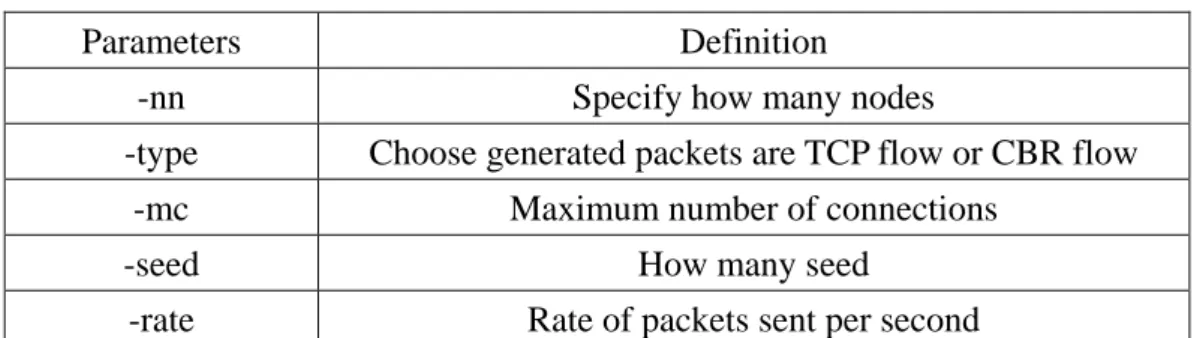
(14) When the Route Maintenance mechanism that a source routing has been interrupted and no longer work path, in order to make the transmission of the data packet to the destination node, the source node will use a chance path, or to call Route Discovery mechanism to find a new path.. In DSR routing protocol, Routing Discovery mechanism and Route Maintenance mechanism operation is completely according to the requirements. Any situation will not affect the DSR routing protocol correct operation, because all the situation is established according to the demand, all situation in the loss if still needed can easily get quick recovery.. DSR protocol, there are still the following deficiencies:. 1.. Each data packet header needs to carry routing information packet overhead is large, the network is not suitable for large diameter MANET.. 2.. Route request message using the flood way, the adjacent node route request message transmission conflicts may occur and may generate duplicate broadcast.. 3.. As a result of the routing cache, expired route may affect the accuracy of routing.. 4.. Not strong network scalability.. 2.3 TORA (Temporally Ordered Routing): TORA [4] defined as an area for each node. This area is involved some nodes, the node distance (or hops) in a limited range, this range is known as the zone radius. Each node only needs to know the topology in routing area, and with the topology update to update. Although the network is very large, but update only in the local. 6.
(15) If S wants to communicate with D, S sends a query message, it will be directly sent to the boundary node by node within the area. And broadcasts it, until you reach the D, D respond to this request.. TORA protocol summary:. 1. TORA is a distributed routing algorithm based on reverse routing protocol. It is designed to be used to find on-demand routing to the destination node provides multiple routes to quickly create routing and topology changes when possible through local algorithm to reduce the communication overhead. 2. TORA protocol to each node is assigned a priority burst through different attributes. This method establishes a source node finally began destination node system. In essence, the packet is through this system from the source node to the destination node. 3. TORA the advantage of a high-density network can handle. Supports save multiple routes and broadcast between two nodes. However, TORA algorithm is based on the synchronous clock, the clock time can lead to different routing failure.. 7.
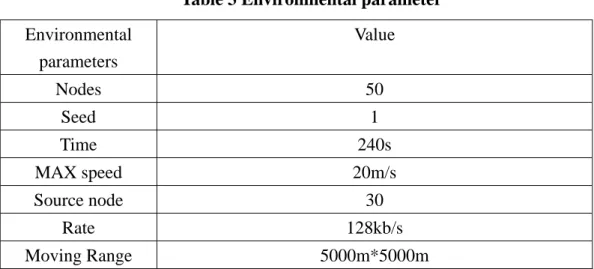
(16) 3. Experiments and Preparation: 3.1 NS2 NS2 [2] it is the object oriented network environment simulator and driven by discrete events. NS2 provides simulation of the wireless or wired networks, TCP, routing protocol.. NS2 consists of two kinds of programming language, OTCL (with object-oriented characteristics) and C++ implementation. The reason to using two kinds of programming language, because the simulator has two things to do. On one hand, to realize the simulation of protocol, the need for a programming language, on the other hand, need to efficiently process information.. In order to achieve this objective, the program speed (run-time speed) is very important, and run the simulation environment time, to find and fix the time of bug, compile and run time (run-around time) is not very important. In this case, the C++ language is very suitable.. On the other hand, need to simulate the network environment in a short period of time, and is convenient to modify and found, repair Bug. In this case, the script language has great advantage, the OTCL script language can fully meet the needs.. Whatever, NS2 provides a good test bed for us. It uses two languages, C++ is favorable to fast running speed; TCL is beneficial to quickly set up a test environment.. 8.
(17) 3.2 Cbrgen and Setdest: This experiment using Cbrgen and Setdest two tools to generate the required experimental environment. The following is a method of using Cbrgen and Setdest: (1)Cbrgen: Cbrgen can be used to generate TCP flow and CBR flow.It is use method:. ns cbrgen.tcl [-type cbr|tcp] [-nn nodes] [-seed seed] [-mc connections] [-rate rate]. Parameters are defined in table 1.. For example: Generate a TCP flow, this TCP flow a total of 10 nodes, the maximum number of connections is 3, seed number is 1, 5 TCP packets per second. You can use the following command:. ns cbrgen.tcl-type tcp-nn 10-seed 1-mc 3-rate 5.0> tcp1.. The output results are saved to tcp1. (2)Setdest: Setdest can be used to produce wireless network environment of mobile node needs.It is use method:. ./setdest [-n nodes] [-p pausetime] [-M maxspeed] [-t time] [-x x] [-y y]. Parameters are defined in table 2. 9.
(18) For example: there are 10 nodes, constantly moving in the 500m*500m range, the maximum speed of 50m/s, the simulation time of 20 seconds. You can use the following command:. ./setdest -n 10 -p 0 -M 50 -t 20 -x 500 -y 500 > set1. The output results are saved to set1. Table 1 Cbrgen parameter Parameters. Definition. -nn. Specify how many nodes. -type. Choose generated packets are TCP flow or CBR flow. -mc. Maximum number of connections. -seed. How many seed. -rate. Rate of packets sent per second. Table 2 Setdest parameter Parameters. Definition. -n. Specify how many nodes. -p. Residence time to reach the destination node. -M. MAX node move speed. -t. Execution Time. -x,-y. Moving Range. 10.
(19) Table 3 Environmental parameter Environmental parameters. Value. Nodes. 50. Seed. 1. Time. 240s. MAX speed. 20m/s. Source node. 30. Rate. 128kb/s. Moving Range. 5000m*5000m. 3.3 Using TCP flow performance comparison According to Table 3, after the simulation parameters derived its effectiveness in Figure 1 and Figure 2. When the time is 30s, the Packet delivery fraction show in Figure 1.DSR is 98.67%, DSDV is 98.57%, TORA is 89.23%. The Average end-to-end delay show in Figure 2. DSR is 295ms, DSDV is 377ms, TORA is 142ms. When the time is 240s, the Packet delivery fraction shown in Figure 1. DSR is 99.43%, DSDV is 95.45%, TORA is 89.37%. The Average end-to-end delay show in Figure 2. DSR is 233ms, DSDV is 378ms, TORA is 195ms. Based on the above information, and then use the TCP flow case, three kinds of routing protocol has good performance. Packet delivery fraction of DSR and DSDV better than TORA. Average end-to-end delay is TORA better performance, DSDV is not much change, DSR is a sharp ups and downs.. 11.
(20) %. Figure 1 Packet delivery fraction of TCP 105 100 95 90 85 80 75. DSR DSDV TORA 0. 30. 60. 120. 240. time(s). Figure 2 Average end-to-end delay of data packets of TCP 600 400 ms. DSR DSDV. 200. TORA 0 0. 30. 60. 120. 240. time(s). 3.4 Using CBR flow performance comparison Also according to Table 3, after the simulation parameters derived its effectiveness in Figure 3 and Figure 4. When the time is 30s, the Packet delivery fraction show in Figure 3. DSR is 5.23%, DSDV is 9.87%, TORA is 0.72%. The Average end-to-end delay show in Figure 4. DSR is 1187ms, DSDV is 1133ms, TORA is 653ms. When the time is 240s, the Packet delivery fraction shown in Figure 3. DSR is 7.37%, DSDV is 8.79%, TORA is 0.68%. The Average end-to-end delay show in Figure 4. DSR is 761ms, DSDV is 945ms, TORA is 449ms Based on the above information, and then use the CBR flow case. Packet delivery fraction of DSDV is better than DSR, TORA is quite low. Average end-to-end delay of three kinds are high, TORA but better. 12.
(21) Figure 3 Packet delivery fraction of CBR 12 10 %. 8. DSR. 6. DSDV. 4. TORA. 2 0 0. 30. 60. 120. 240. time(s). Figure 4 Average end-to-end delay of data packets of CBR 2000. ms. 1500 DSR 1000. DSDV. 500. TORA. 0 0. 30. 60. 13. 120. 240. time(s).
(22) 4. Conclusion Each protocol as time becomes longer, the Packet delivery fraction is higher and the Average end-to-end delay is lower. In the same environment parameters, Packet delivery fraction of DSR and DSDV are higher, and TORA is poor. When using TCP flow, Packet delivery fraction of DSR is the highest ,DSDV Secondly, the Average end-to-end delay of TORA remains lower values, DSR have a greater change. When using CBR flow, Packet delivery fraction of DSDV is the best, the Average end-to-end delay of TORA remains lower values.As described above, the overall performance of DSR and DSDV are better than TORA. The performance of TCP flow is better than CBR flow. All in DSDV routing nodes must announcement and therefore does not support hibernation, never use most of the routing information so overhead is too large, its scalability is also a major problem. Therefore, DSDV suitable for a small network and node moves slower occasion. DSR routing protocol is the first on-demand routing protocols thinking. The advantage is that intermediate nodes do not maintain routing information to all nodes, can avoid routing loops. While using the routing cache technology, build fast and routing overhead is small, and supports multi-path; Disadvantage Each data packet carries path information, resulting in a larger data packet overhead, and its route request message using the flood way, the adjacent node route request message transmission conflicts may occur and may result in duplicate broadcast, DSR is not suitable large network diameter Ad Hoc network. TORA the topology change occurs, the control message is only a partial change in the topology scale dissemination. Therefore, neighbor nodes only need to maintain routing information. TORA is highly adaptive, efficient and better scalability, mainly for high-speed dynamic multi-hop wireless networks. In this paper using simulation 14.
(23) software compared DSDV, TORA and DSR routing protocol performance, and under different conditions, analyze their performance and pointed out their respective applicable occasions, for the actual work to choice routing protocols provides a reference.. 15.
(24) Reference [1] C. E. Perkins and P. Bhagwat,“Highly Dynamic Destination-Sequenced Distance-Vector Routing (DSDV) for mobile computers,” Proc. of ACM SIGCOMM’94, pp. 234-244, Sep. 1994. [2] The Network Simulator-NS-2. Available: Http://www.isi.edu/nsnam/ns [3] Toh, C.-K., “Ad-Hoc Mobile Wireless Networks: protocols and Systems”, Prentice Hall PTR, 2002. [4] V. D. Parh and M. S. Corson, “Temporally-Ordered Routing Algorithm (TORA) version 1 functional specification,” Internet-Draft, draft-ietf-manet-tora-spec-03.txt, Nov. 2000 [5] J. Broch, D. B. Johnson, and D. A. Maltz, “ The dynamic source routing protocol for mobile ad hoc networks,” Internet-Draft, draft-ietf-manet-dsr-01.txt, Dec. 1998.. 16.
(25)
數據
相關文件
• As RREP travels backwards, each node sets pointer to sending node and updates destination sequence number and timeout entry for source and destination routes.. “Ad-Hoc On
This thesis focuses on path dependent, with the critical event of “Basic Wage”, and listing into “election path” “cost down path” and “protection path” etc., and then
Since the sink is aware of the location of the interested area, simple greedy geographic routing scheme is used to send a data request (in the form of
此外,由文獻回顧(詳第二章)可知,實務的車輛配送路線排程可藉由車 輛路線問題(Vehicle Routing
無線感測網路是個人區域網路中的一種應用,其中最常採用 Zigbee 無線通訊協 定做為主要架構。而 Zigbee 以 IEEE802.15.4 標準規範做為運用基礎,在下一小節將 會針對 IEEE
Selcuk Candan, ”GMP: Distributed Geographic Multicast Routing in Wireless Sensor Networks,” IEEE International Conference on Distributed Computing Systems,
This paper formulates the above situation to the Multi-temperature Refrigerated Container Vehicle Routing Problem (MRCVRP), and proposes a two-stage heuristic which consists of
Furthermore, given a set of nets in a bus on routing grids with obstacles, and the length constraints for all the nets in the bus, based on this proposed longest path generation,
