行政院國家科學委員會專題研究計畫 成果報告
開放式主被動複合熱環境控制實驗與實驗系統建置--子記 畫三:併用輻射天花熱環境控制系統於開放性實體建築之
應用
研究成果報告(精簡版)
計 畫 類 別 : 整合型
計 畫 編 號 : NSC 97-2221-E-011-120-
執 行 期 間 : 97 年 08 月 01 日至 98 年 07 月 31 日 執 行 單 位 : 國立臺灣科技大學建築系
計 畫 主 持 人 : 江維華
計畫參與人員: 碩士班研究生-兼任助理人員:王苡婷 博士班研究生-兼任助理人員:王家瑩 博士後研究:黃建勝
報 告 附 件 : 出席國際會議研究心得報告及發表論文
處 理 方 式 : 本計畫可公開查詢
中 華 民 國 98 年 12 月 31 日
行政院國家科學委員會補助專題研究計畫 □
ˇ成果報告
□ 進 度 報 告 併用輻射天花熱環境控制系統於開放性實體建築之應用
計畫類別:□ 個別型計畫 □ˇ 整合型計畫 計畫編號: NSC 97-2221-E-011-120
執行期間:97 年 08 月 01 日至 98 年 07 月 31 日 計畫主持人:江維華
計畫參與人員: 黃建勝、王家瑩、王苡婷
成果報告類型(依經費核定清單規定繳交): □ˇ精簡報告 □完整報告
本成果報告包括以下應繳交之附件:
□赴國外出差或研習心得報告一份
□赴大陸地區出差或研習心得報告一份
□出席國際學術會議心得報告及發表之論文各一份
□國際合作研究計畫國外研究報告書一份
處理方式:除產學合作研究計畫、提升產業技術及人才培育研究計畫、
列管計畫及下列情形者外,得立即公開查詢
□涉及專利或其他智慧財產權,□一年□二年後可公開查詢
執行單位:國立台灣科技大學建築系
中 華 民 國 98 年 10 月 31 日
附件一
併用輻射天花熱環境控制系統於開放性實體建築之應用 Implementing radiant ceiling in thermal control of an
experimental building
計畫編號:NSC 97-2221-E-011-120
執行期限:97 年 08 月 01 日至 98 年 07 月 31 日 主持人:江維華 國立台灣科技大學建築系教授
計劃參予人員:黃建勝 國立台灣科技大學建築系博士後研究員 王家瑩、王苡婷 國立台灣科技大學建築系研究生
中文摘要
本研究在長10m、寬7.6m、高3.85m 的 建築空間裡新建置一套輻射冷房系統並將 原有分離式系統保留並整合至其中。文中 主要是介紹並測試輻射冷房系統各設備的 使用性能,將輻射冷房系統分為冰水系 統、供風系統、電力系統及監控系統四部 份分別介紹各系統的組成設備、功能及與 其他系統之間相互關係;在測試部分,則 是紀錄各項實驗室內氣候環境的變化以及 冰水主機之進出水溫度、輻射冷板進出水 溫度、出風溫度等,並將所有量測的數據 透過電腦在遠端做即時的紀錄與監控,另 外加入分離式空調系統與輻射冷房系統做 實驗對照比較。研究結果將針對各組參數 對室內熱環境影響做討論。
關鍵字:輻射冷板、輻射冷房系統、獨立 新風系統、能源效率
Abstract
The main task how to keep a healthy environment, a comfortable indoor environment, and maintain energy efficiency is an important approach in this study. This study is to build a new radiant cooling system with an all-air system in a testing chamber of the following dimensions, of 10m (L)×7.6m(W)×3.85m(H). This article is also meant to introduce and test the functional performance of each device with the radiant cooling system. The radiant cooling system is divided into four parts: the chilling system, the air system, the power system, and the monitoring system. Now to describe the component equipment and functions of each system; for the test part of the system, record the indoor climate of the
test chamber, temperature of chiller, temperature of radiant cooling ceiling, and inlet temperature of the air system. All measurement data were recorded and monitored by a remote computer. In addition, tests of the radiant cooling system were compared against an all-air system. The obtained results will focus on the discussions for each set of parameters which affect the indoor thermal environment.
Keywords: Radiant cooling panel, Radiant cooling ceiling system, Dedicated outdoor air system (DOAS), Energy efficiency
一、前言
屬於溼熱氣候區的台灣,在夏季室外 溫度高過31℃且溼度超過80%的條件下,
必須仰賴機械式或其他的主動式冷房,才 能同時移除顯熱及潛熱的熱負荷,進而達 到 適 合 人 類 工 作 的 舒 適 環 境 。 美 國 ASHRAE 以北美所制定的舒適標準,針對 環太平洋區域進行舒適性研究,並顯示該 區域的居民具有較高的耐受性,由此可知 在台灣地區使用機械式通風(mechanical ventilation)在溫度的設定上可以有較多的 彈性,相對於建築節能會更有助益。近年 來 溼 熱 型 氣 候 的 國 家 使 用 自 然 通 風
(natural ventilation)、誘導式通風(induced ventilation ) 、 機 械 式 通 風 、 混 合 通 風
(mixing ventilation ) 及 輻 射 冷 卻 系 統
(radiant cooling system)等方式來幫助改 善室內使用空間的環境品質,其中又以輻 射冷卻系統併用置換通風系統(radiant cooling system with displacement ventilation)的方式,更能達到健康、舒適
及省能的室內環境。
二、研究目的
目前台灣地區在工作空間所使用的空 調系統方式有中央空調系統、分離式空調 系統、置換通風系統、混合式通風系統及 輻射冷卻系統,其中以前兩種系統佔多 數,而最後者的案例及相關研究較少,主 要的應用層面較為特定,如穿透式電子顯 微鏡存放之實驗室,為了要克服氣流及噪 音的干擾,以達到環境控制穩定的須求;
燒燙傷病房中由於不允許氣流吹過傷患之 皮膚表面導致水泡破裂引發細菌感染,因 此採用輻射冷房系統。本研究主要是針對 台灣濕熱氣候的特性,對輻射冷房系統進 行系統性能上的初步研究以及此系統對於 室內溫度、溼度等之影響,並另外加入分 離式空調系統與輻射冷房系統做實驗對照 比較。本研究之流程如圖1,其目的如下:
1. 介紹輻射冷房系統的組成方式及各組 成設備的功能及性能。
2. 測試輻射冷房系統設備的性能,觀察 不同系統設定對於室內溫度、室內溼 度、露點溫度、冰水主機冰水溫度及 輻射冷板冰水溫度的影響並做紀錄。
3. 針對台灣濕熱氣候的特性調整輻射冷 房系統各組成設備的使用設定,量測 當系統啟動後讓使用空間達到人體舒 適範圍所需的時間並與分離式空調系 統進行比較,分析其差異。
4. 在實驗室內進行監控且量測在同一空 間相同的環境條件下、不同空調系統 對於室內溫度、溼度之影響,並比較 其差異。
三、文獻探討
目前所知最早使用大面積輻射式系統 的地點在英國的巴茲(Bath, England)及義 大利的羅馬(Rome, Italy);近幾十年來在歐 洲,如德國、瑞士等地,他們將輻射冷房 系統結合 Dedicated Outdoor Air Systems
(DOAS)廣泛用於商業建築、新建築及 翻修的舊建築中,使得輻射冷房系統再度 受到重視 [1]。
輻射冷房系統是由輻射冷板及空氣調
節系統組合而成,輻射冷板是利用長波輻
體、電腦設備等)進行熱交換,將多餘的 熱能移除,而空氣調節系統則是將室外的 新鮮空氣過濾並去除溼氣後引入室內空間 裡,以維持室內良好的空氣品質及溼度 [1,2]。此系統主要功能為移除室內空間的 廢熱、維持可接受的室內空氣品質及藉由 進氣系統提供新鮮、溼度適中的過濾空氣 來控制室內溼度 [3]。
輻 射 冷 板 (chilled ceiling panels or cooled ceiling panels)其表面或內部鑲嵌有 金屬管,大多數的輻射冷板是將低溫的冰 水注入金屬管內循環,使面板溫度降低,
低溫的輻射冷板透過對流及輻射的方式與 室內空氣進行熱交換 [1,2,4]。Christopher 和 Mumma [5] 認 為 輻 射 冷 房 系 統 中 有 50%~60%透過輻射方式進行熱交換,有 40%~50%是透過對流的方式進行。
在輻射冷板冷凍能力部分,其能力取 決於室內空氣溫度與金屬管內水的溫度差 [2],Dieckmann [4]認為在輻射冷卻天花板 面積佔全部天花板面積 1/3 時,其輻射冷 板冷凍能力其最大值為50W/m2;Trogisch 建 議 輻 射 冷 板 冷 凍 能 力 一 般 應 為 120 W/m2,而根據Anon 調查報告指出輻射冷 板 冷 凍 能 力 的 範 圍 應 在 40W/m2~125 W/m2之間 [6],目前在歐美地區輻射冷板 的冷凍能力約在 95W/m2~120W/m2;而 ASHRAE 的技術委員會 TC 6.5 Radiant Space Heating and Cooling 建立一種測量 方式能夠評估在室內空間輻射冷板的冷凍 能力;在德國Fachinstitut Gebaeude-Klima
(FGK)及 DIN 4715 也提出相關的測試 方法 [1]。
在目前可以確定的是透過 DOAS 的空 調送風系統可以增加輻射冷板的冷卻能 力,因為出風增加室內空間的空氣對流速 度,使得對流換熱量增加;在大陸西北地 區的實驗中可得知有使用送風系統的輻射 冷房其輻射冷板的對流換熱量比無使用的 要多出 60% [7];Stanley 則認為能提升 15%~20%,且由於對流的關係熱能的損失 也能減少10% [8,9]。
在輻射冷房系統的使用中最大的問題 在於結露,其原因為:當低溫的水流入輻 射冷板內遇到室內高溫高濕的空氣,若空 氣濕度高於輻射冷板表面的露點溫度時,
則水蒸氣會在輻射冷板的表面形成水珠,
會造成天花板材料的損害及製造適合細菌 生長的環境,但由於溼氣形成結露水的時 間很慢長,只要能將室內濕度及輻射冷板 的供水溫度控制得宜或是裝設感測器來監 控室內露點溫度則可以解決結露的問題 [10]。
在輻射冷房系統中,主要節省能源的 方式是讓冷卻蒸發器(chiller evaporator)
可以不需花費過多的能量讓水溫降低同時 在系統上可以改進循環的效能;另外,由 於此系統是直接與熱源進行熱能交換,可 允許較高的室內溫度以減少室內空間的冷 房負荷。因此輻射冷房系統相較於全氣式 空調系統可以節省15%~20%的能源。若輻 射冷房系統與DOAS 系統合併使用,在溫 暖的氣候區每年可節省25%的能源 [4]。
Stetiu 對於一個面積在 25m2的辦公空 間 , 有 兩 位 使 用 者 且 內 部 總 負 荷 量 為 2000W 的情況下,對全氣式空調系統及輻 射冷房系統做耗能的比較,而輻射冷房系 統所用的總用電量僅佔全氣式空調系統 71.5%,節省了 28.5%的電量 [1]。
另外,Stanley 在賓州費城(Philadephia, PA)的辦公建築做了一項輻射冷板併用 DOAS 系統與 VAV 系統的初期設備費用比 較實驗,由實驗結果得知管道部份佔整體 費 用 的 比 例 最 高 , 其 次 才 是 冰 水 主 機 [10];在使用不同空調系統的整體費用 中,就系統機械運行費用而言,使用VAV 系 統 一 年 的 花 費 比 輻 射 冷 房 系 統 高 出 17,620 美元,大約是輻射冷房系統的 1.29 倍,而VAV 系統及輻射冷房系統其機械運 行費用佔其一年整體費用的比例分別為 25.79%及 21.83%。
輻射冷卻系統目前在美國市場上,輻 射冷板的價格約為140USD/m2,在中國進 口的價格則約為 2000USD/m2,而國內至 今並無發展此系統的趨勢,因此所有設備 亦皆須仰賴國外進口,在價格上相對比其 他空調系統高出許多而失去市場競爭力。
但若將輻射冷板與DOAS 合併使用,因而 減少初期裝設之成本即可造就其在市場上 的優勢 [10,11]。
四、研究方法
本研究將氣冷分離式空調系統併用輻 射冷房實驗室建置於國立台灣科技大學綜 合研究大樓內,該大樓座東南朝西北方 向,東南立面及西北立面分別會在白天及 黃昏時受到太陽直射;在夏季吹西南季 風,冬季則吹東北季風;且由於受到季風 影響,夏季午後多雷陣雨,冬季則是海洋 上吹來的潮溼冷空氣,經常造成全天有雨。
圖2為綜合研究大樓8 樓靠圖書館部分平 面圖,實驗室位於西北側,面對基隆路,
黃昏時會受到太陽光直射,室內溫度會略 受影響,但白天時則不受影響。又實驗室 有外走廊的區隔,雨天時使用上不易受到 干擾。
至於實驗室空間大小為:長10m×寬 7.6m ×高3.85m(含設備層高度0.95m),
從圖2可得知實驗室上下兩側連接走廊,右 側為其他研究室,左側則是逃生梯入口 處,室內溫度、濕度受到兩側走廊的影響 較明顯。太陽光會從西南方向透過窗戶直 射進入室內。原本此空間是作為建築系一 般教室使用,提供學生上課、簡報、展覽、
開會討論等多功能使用空間,夏季若不開 空調的情況下,室內會顯得悶熱,靠近窗 戶側能感受到些許的自然風;冬季進入室 內後不需穿著厚重外套,但需注意室內空 氣品質,保持固定的新鮮空氣進入室內。
又圖3為輻射冷房系統併用氣冷分離式空 調系統之實驗室空間介紹,於天花板中央 設置消防偵煙設備及廣播系統各1個,與綜 合研究大樓安全系統連結;另灰色部分是 空調回風口,藍色部分是空調出風口,黃 色部份是燈具,紅色部分是空調系統開關 感應器,咖啡色部分則是分離式空調室外 機,掛於建築物外側牆壁上。
五、輻射冷房系統性能測試
本系統約在6月底建置完成,7月進行 系統運轉測試,因此本實驗在8月及9月進 行,但由於受到場地的限制每次僅能做一 組 實 驗 , 挑 選 一 般 上 課 時 段 , 上 午 為 09:00~11:00,下午為01:30~06:00,中間休 息時段目的則是讓室內氣候恢復到一般未 開啟空調時的狀態,但是由於實驗時間為 學校暑假,因此多半是在無人使用的情況 下進行實驗。至於監控系統主要是由電
腦、直接數位式控制器(DDC)及許多感 測器所構成,是為了能在實驗室之外的遠 端或是網路上能夠直接了解實驗室內的溫 溼度狀況與實驗設備是否正常運轉,同時 能每5分鐘收集實驗數據一次並轉換成容 易分析的檔案模式,以便於研究的進行,
圖4為輻射冷房監控系統配置圖。
本實驗藉著改變空調箱的出風溫度、
輻射冷板的進水溫度、外氣風門(MOD)
與回風風門(MVD)比例、加熱器(SCR)
啟閉、比例閥(MV1、MV2)開口比例、
開口部開啟時間長短及有無使用者等情況 下,探討實驗室室內溫溼度、冰水主機出 水及回水溫度、輻射冷板進水及出水溫度 與露點溫度的改變情形,觀察固定一項設 備的設定值,並紀錄其他設備自動對應使 系統達到最佳化的範圍值,另外初步比較 輻射冷房系統及氣冷分離式系統對於室內 氣候環境影響的實驗。
本實驗在夏季典型氣候以8月26日無 下雨的情況下為例,實驗室室內預期溫度 設定為26℃,出風溫度為26℃,輻射冷板 冰水溫度為18℃,在溫度方面,下午室外 平均溫度高於上午;室內溫度略受到室外 溫度影響但影響程度很小;當輻射冷房系 統開啟時,室內溫度會逐漸緩慢下降,溫 度曲線呈穩定而平滑;在溼度方面,因溫 度的緣故,室外溼度下午略低於上午;當 輻射冷房系統開啟時,室內溼度會在系統 開 啟50 分 鐘 後 快 速 下 降 至 33%~38% 之 間,可見於圖5中。此外,由圖6顯示,冰 水主機出水溫度及回水溫度曲線相似,溫 度差很小約1℃左右,輻射冷板的進水溫度 及出水溫度皆受到冰水主機出水溫度的影 響,但溫度曲線變動幅度沒有冰水主機 大,進出水溫度差約1℃ ~ 2℃左右,可見 實驗室在無人使用時室內熱負荷很小或是 輻射冷板的冷凍能力尚未有良好的發揮。
圖7中可以發現,露點溫度受冰水主機出水 溫度的影響最大,室內溫度次之,而與室 外溫濕度的關係較小甚至沒有,當回風風 門開口比例變大時表示有大量的室內空氣 進入空調箱,因此露點溫度受室內溫濕度 較室外溼度影響大,若當外氣風門開口比 例變大時,表示有大量的室外空氣進入空 調箱內,因此露點溫度受到室外濕度影響
將變大。圖8為不同系統之室內溫度比較,
當輻射冷房系統開啟後,室內溫度緩慢逐 漸降低而達到穩定大約需30~60分鐘的時 間,且溫度差約1℃左右,當分離式系統開 啟後,室內溫度降溫相當快速且較快達到 穩定,約需20分鐘,降溫約2℃左右,但分 離式系統的溫度曲線沒有輻射冷房系統平 滑,表示溫度的起伏大。圖9為不同系統之 室內溼度比較,當輻射冷房系統開啟後室 內溼度快速下降且幅度大,約25分鐘內降 低溼度約10%左右,且之後還逐漸降低但 幅度較小,當分離式系統開啟後,室內溼 度下降幅度較小,在10分鐘內快速降低2
%~3 %,之後雖然也逐漸降低但幅度皆小 於輻射冷房系統,若在在相同的系統設定 條件下,輻射冷房系統除濕能力較強,但 時間較久,而分離式系統則是能在較短的 時間內除濕,但除濕能力較差。本研究將 實驗結果及記錄資料製成表1以供參考。
六、結論
本研究建置的輻射冷房系統,其系統 設備之間的關係以及系統設備性能對於室 內氣候環境的影響,得到的研究成果如下:
1. 輻射冷房設備與監控系統
輻射冷房是由三個系統組合而成,冰 水系統、供風系統及輻射冷板系統,各系 統之間相互配合運轉,冰水系統為主要的 核心系統,是負責供應冷媒—冰水;供風 系統則是負責控制室內空氣品質及維持室 內保持正壓;輻射冷板系統則是透過輻射 的原理將人體產生的熱能吸收而不會造成 任何的不適感。將此三個系統各自擁有不 同的功能與一個長10m、寬7.6m、高3.85m 的建築空間結合在一起,提供一個空間能 研究如何創造舒適且節能的室內環境。
2. 輻射冷房設備與室內氣候環境實驗 (1)室內溫度
受到風口出風溫度、輻射冷板進水溫 度、外氣風門開口比例、加熱器啟閉、
比例閥開口比例及有無使用者等因素 影響。
(2)室內溼度
輻 射 冷 房 有 溫 度 愈 高 溼 度 愈 低 的 特 性,室內溼度會受到風口出風溫度、外 氣風門開口比例、加熱器啟閉、比例閥
開口比例及有無使用者等因素的影響。
(3)冰水主機出水溫度與回水溫度
冰水主機屬於定頻的機械設備,較不容 易受到其他設備的直接影響,在本研究 中僅受到外氣風門開口比例、比例閥開 口比例及有無使用者的等因素的影響。
(4)輻射冷板進水溫度與出水溫度
輻射冷板內的冰水是由冰水主機的出 水及空調箱內用來除濕的冰水混合而 成,因此進水溫度可說是直接由冰水主 機影響,但可以透過比例閥讓板內的水 不斷循環,也可達到控制溫度的目的。
(5)露點溫度
會受到風口出風溫度、外氣風門開口比 例、加熱器啟閉、比例閥開口比例及有 無使用者等因素影響。
3. 輻射冷房系統與分離式空調系統 (1)在溫度方面
當系統開啟後輻射冷房系統至少需要 30分鐘的時間才能讓室內溫度達到穩 定,而分離式空調系統僅需花費20分 鐘,但易造成人體的不適感。
(2)在溼度方面
輻射冷房系統除濕能力較強,但花費時 間較久,而分離式系統則是能在較短的 時間內除濕,但除濕能力較差。
(3)在耗電量方面
本研究實驗中輻射冷房系統的耗電量 約為分離式空調系統的3.27倍。
七、參考文獻
1. Stetiu, Corina(1998). Radiant Cooling in US Office Buildings: Towards Eliminating the Perception of Climate-Imposed Barriers. Energy and Resources Group, University of California at Berkeley Press.
2. Airtite(2008).Radiant Cooling Theory and Fundamentals. www.airtiteradiant.
com.
3. 王家瑩(2006)小型住宅建築於非冬 季室內熱環境設計策略解析。國立台 灣科技大學建築研究所碩士論文。
4. John Dieckmann ( 2004 ) . Radiant Ceiling Cooling. ASHRAE Journal, 46(6), 42-43.
5. Christopher L. Conroy & Stanley, A.
Mumma ( 2001 ) . Ceiling Radiant
Cooling Panels As A Viable Distributed Parallel Sensible Cooling Technology Integrated With Dedicated Outdoor Air Systems. ASHRAE Transactions, 107(1), 578-585.
6. Anon., ( 1993 ) Marktuebersicht Kuehldecken. KI Klima- Kälte -Heizung, (1-2).
7. 李銀明 黃翔(2005)西北地區蒸發冷 卻/輻射吊頂系統的頂棚送風方式。制 冷與空調,第5 卷,第 3 期,頁 44-47。
8. Stanley, A. Mumma(2001).Dedicated OA Systems. ASHRAE IAQ Applications newsletter, Winter, 2(1), 20-22.
9. Stanley, A. Mumma(2002).Safety and Comfort Using DOAS Radiant Cooling Panel Systems. ASHRAE IAQ Applications newsletter, Winter, 1-2.
10. Stanley, A. Mumma(2002). Chilled Ceilings in Parallel with Dedicated Outdoor Air Systems: Addressing the Concerns of Condensation, Capacity, and Cost. ASHRAE Transactions, 108(2), 220-231.
11. 熊帥 湯廣發 楊光 盧繼龍(2006)輻 射冷吊頂/獨立新風系統的技術研究 與可行性分析。制冷與空調,第6 卷,
第4 期,頁 34-38。
計畫成果自評:
研究成果與原計畫相符程度達90%,內容 將可發表於學術期刊或研討會論文中。
圖1 研究計畫流程圖
圖2 綜合研究大樓 8樓靠圖書館部分平面 圖
圖3 實驗空間介紹圖
圖4 輻射冷房監控系統配置圖
圖5 室內外溫溼度輻射冷房系統測試圖
圖6 冰水主機與輻射冷板進出水溫度圖
圖7 輻射冷房露點溫度曲線圖
23 28 33 38 43 48 53 58 63 68
時間 溫度 ℃ / 溼度 %
輻射溫度 室內溫度 室外溫度 室內溼度 室外溼度
09:00 09:50 11:00 13:30 18:00
0 5 10 15 20 25 30
時間 溫度 ℃
冰水主機 出水溫度 T1 冰水主機 回水溫度 T2 輻射冷板 進水溫度 T3 輻射冷板 出水溫度
09:00 11:00 13:30 18:00
0 10 20 30 40 50 60 70
時間 溫度 ℃ / 溼度 %
露點溫度 室內溫度 室外溫度 室內溼度 室外溼度 冰水主機 出水溫度 輻射冷板 出水溫度
09:00 11:00 13:30 18:00
圖8 不同系統室內溫度比較圖
圖9 不同系統室內溼度比較圖
23 23.5 24 24.5 25 25.5 26 26.5 27
時間 室內溫度 ℃
輻射冷房 系統 分離式空 調系統
09:00 11:00 13:30 18:00
系統開啟
系統開
35 40 45 50 55 60
時間 室內溼度 %
輻射冷房 系統 分離式空 調系統
09:00 11:00 13:30 18:00
系統開啟 系統開啟
表1 (a) 各項系統設備實驗對於實驗室室內環境影響範圍紀錄表
表1 (b) 各項系統設備實驗對於實驗室室內環境影響範圍紀錄表(續)
行政院國家科學委員會補助專題研究計畫
□ 成 果 報 告
□期中進度報告
開放式主被動複合熱環境控制實驗與實驗系統建置-子計畫三:
併用輻射天花熱環境控制系統於開放性實體建築之應用
計畫類別:□ 個別型計畫 █ 整合型計畫 計畫編號:NSC 97-2221-E-011-120
執行期間: 97 年 8 月 1 日至 98 年 7 月 31 日
計畫主持人:江維華 計畫參與人員:吳惠萍
成果報告類型(依經費核定清單規定繳交):█精簡報告 □完整報 告
本成果報告包括以下應繳交之附件:
□赴國外出差或研習心得報告一份
□赴大陸地區出差或研習心得報告一份
█出席國際學術會議心得報告及發表之論文各一份
□國際合作研究計畫國外研究報告書一份
處理方式:除產學合作研究計畫、提升產業技術及人才培育研究計 畫、列管計畫及下列情形者外,得立即公開查詢
□涉及專利或其他智慧財產權,□一年□二年後可公開 查詢
執行單位:國立台灣科技大學
中 華 民 國 九十八 年 十 月 日
一、前言
2008 歐洲廳堂聲學國際研討會( The 7th Auditorium Acoustics 2008)在英國成 立,每 3 年舉辦一次,此次為第七次舉辦已有二十餘年經歷,主辦單位每次皆會因 應新落成之廳堂擇為會議城市,此次主辦國為挪威且選定奧斯陸(Oslo)結合新建之 音樂廳作為會議中心相當有意義。
二、参訪目的
歷年來歐洲廳堂聲學國際研討會之論文投稿及發表皆相當熱烈,此次論文發表 共三十五篇,海報論文發表為二十九篇,主要藉由國際論文交流學習觀摩相關廳堂 設計及新建個案深入介紹與設備智慧化技術。
三、参訪內容
1、奧斯陸歌劇院(Oslo Opera House)
本機構位於挪威奧斯陸城,緊臨著名的奧斯陸峽灣半島上,於 1999 年,挪威國 會希望歌劇院成為一座紀念性建築,來突顯挪威歌劇與芭蕾舞蹈文化的重要位置。
且提升一般民眾參與藝文活動的主動性,故本案整個戶外空間留設相當寬敞,連局 部屋頂都可讓民眾步行活動,到冬天雪季時還可作為市中心的免費滑雪場,Snøhetta AS 斯諾赫塔建築師與挪威政府在設計階段就將本案定位是所有民眾皆可來的環 境,就算不買票觀看表演都可在室內的咖啡廳或是藝廊停留,是相當成功的藝文場 所。其總樓地板面積為 38500m2,大劇院 1400 席位、實驗劇場 400 席位,本案有長 駐表演團體故其他的行政空間及練習空間相當龐大,讓表演者有舒適的練習空間。
圖 1. Oslo 歌劇院造型與港灣環境相當融合,戶外開放空間相當受市民喜愛
圖 2. 總工程費用約 8 億歐元 圖 3. 夜間的 Oslo 歌劇院
在平面配置上將公共空間與行政練習區域以一條劇場大街(opera street)來區隔相 當開闊。為加強空間趣味性有些角落使用可穿透材料,可以自由的看到表演場內或 是練習室內的表演者的排演,誘導民眾購票入內觀賞的動機。
台灣近年也正積極推動藝文活動,在台北的流行樂表演中心、台中大都會歌劇院及 高雄衛武營藝文中心都是大尺度空間且多元化,在建築設計階段可以藉由親切的安 排進拉近一般民眾與藝文活動的距離,讓欣賞藝文表演不再是特定群體的社交方 式,而是全民的活動。
在外部造型設計與結構是經過精密設計的,歌劇院主要量體為 RC 造柱樑系統 室內為工作室和技術區的分佈,並圍繞一個綠化的天井空間,東向面臨一般民房,
所以採用規矩立面。使用鋼柱支撐屋頂部分的預製版,開口部分使用大量玻璃,增 加視覺上的通透感,屋頂的斜坡具引導,展現歌劇院的可及性和親近感。
圖 4. 東側矩形立面 圖 5. 結構玻璃立面
在室內造型上讓外露結構成為焦點的設計手法相當值得學習。大廳挑高處採用 兩種形式的斜柱支撐屋頂的重量 a.紡錘型柱- 中間粗兩端細防止挫曲、美感需求 b.
筷子型柱- 頂端大底部小結構彎矩需求,增加挑高大廳不同焦點。建築師以懸臂的 方式將藝術廊道附加在廳院外圍,加上象木波浪狀的曲線版,減少量體的厚重感。
圖 6. 筷子型柱所支撐的大廳 圖 7. 利用結構外露所圍塑之大廳氣氛
圖 8. 象木波浪狀的曲線版之外廊 圖 9.大表演廳外廊
值的一題的本案主要使用建材相當簡單環保但透過新科技的加工與造型,創造 單純建材的豐富性,使用綠色建材在外牆為鋁製面板、象木夾板等。
圖 10. 鋁板外牆與自然通風通氣口的元素處理 圖 11. 觀眾席外走廊象木夾板造型牆面
在 1700 席大歌劇院內部的設計相當新穎,舞台及樂池的可調整性非常高,增加 演出的內容的豐富性,另外整體室內的裝修都是以象木夾板以防火處理後以 CNC 切割出曲面,配合牆體或是扶手來施作,讓廳內氣氛溫暖又不失高雅的設計。
圖 12. 大歌劇院開演前舞臺狀況 圖 13. 曲面象木造型扶手
在 400 席實驗劇場內以黑色及銀色的設計,整體的冷色系造成寧靜的空間感。
牆面的擴散處理加上可調座席及硬體表演設備的配合,讓此環境也可以有自然聲的 表演產生。
圖 14. 實驗劇場室內 圖 15. 實驗劇場擴散牆體造型
本案是個成功參與型的設計結合當地藝術家附近廠房的造船工人以及專業表演 團體人員最後由建築師來整合所有不同單位的需求。建築師相當尊重地域性的特色 及附近建築體天際線的觀念,讓最後呈現出來的大量體表演中心並不會很突兀的植 入,反而讓一般民眾相當容易走進去慢慢的再購票去看看劇院盒子裡面表演,自然 的培養出欣賞藝文表演成為生活中的一部分。台灣目前的幾個大型表演中心若亦能
多加入親和性的考量,讓國際或台灣的傳統表演都能慢慢拉近與一般民眾的距離。
2.研討會其他重要講題
在此次研討會中有三篇論文的研究是相當具有貢獻的,
a.“Volumetric diffusers inspired by percolation fractals", Trevor Cox, R J Hughes, J A S Angus, University of Salford and G A Gehring, D M Whittaker, M Pogson, University of Sheffield.主要討論利用不規則體增加容積擴散的方式,增加廳堂 內觀眾席的均齊性,對實際上室內廳堂表面的型態有相當程度助益。
b. “The St Michaelis Church in Luneburg-an example for changing room acoustics, Jurgen Meyer, Consultant, Germany. 透過聲學顧問介紹四個教堂的設計,從教堂 集會到唱聖歌使用的考量上,有許多相當有趣的處理手段未來可以應用在相關 案例上。
c. “Kilden – design for a contemporary shoebox concert hall ,Helen Butcher and Bob Harris, Arup Acoustics.主要介紹建築大師 Norman Foster 在英國所設計的 Gaston 音樂廳案例,由知名的 Arup Acoustics 擔任建築聲學設計顧問,利用結 構設計時可作為有效的反射音介面,減少煩雜的室內裝修是值得一提的觀念。
四、結果
本次挪威主辦之研討會除了論文發表也安排奧斯陸歌劇院建築參訪的行程,讓 會議後亦可實際體驗劇院建築的震撼,整體過程緊湊且獲益良多,對於本次主辦單 位的整體與會過程與態度印象深刻,設計者對於民間團體對於融合環境與地域性相 當重視,如此才能提升民眾對文化表演的深入,亦提升建築與使用者的密切關係。
在設計與建造的過程中,對於環境與文化必須予以尊重,在進步的過程中延續文化 的價值與精神,融入技術與人文,才能真正創造良好的工程與設計。
研討會發表論文
ACOUSTICS OF TRADITIONAL CHINESE THEATERS
W. Chiang,. National Taiwan University of Science and Technology, Taipei, Taiwan W. Lin National Taiwan University of Science and Technology, Taipei, Taiwan Y. Hsu Tung-Fang Institute of Technology, Kaohsiung County, Taiwan
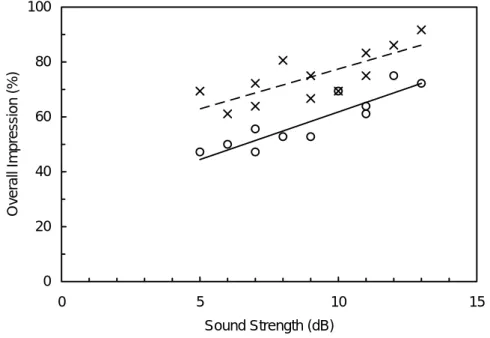
Acoustical measurements were conducted in the theaters built in the eighteenth and nineteenth centuries, including fully covered indoor theaters, courtyard-type theaters inside public buildings, and the theaters integrated with Chinese gardens. Unoccupied reverberation time is in the range of 0.6 to 1.1 s. Computer and scale modeling were employed to analyze the effect of architectural features on acoustical measures for courtyard-type theaters. The impact of stage ceiling is crucial on early support (ST1) while the size and height of the courtyard are import in maintaining sufficient sound strength and early decay time for the audience. Sound strength of the room and listening direction are the major factors that influence the overall impression of Beijing Opera.
1 INTRODUCTION
Compared to the understanding of room acoustics in western concert halls and theaters, little is known about traditional Chinese theaters. Most of the preserved theatrical buildings were built in the eighteenth and nineteenth centuries although the oldest ones can be traced back to the thirteenth century. Extensive surveys in documenting these buildings have been initiated by Wang from both architectural and acoustical perspectives. Based on spatial composition he categorized the theaters to three types:
the amphitheater type, the courtyard type, and the auditorium type.
As most traditional Chinese architectures, the theaters normally use wooden column-and-beam structures. Walls are normally wood but in some cases can be made of earth sandwiched between boards and then plastered. Wood brackets supporting the crossbeams, coffers and openings on walls, and highly modulated window frames and ceilings provide sound diffusions, especially in the frequency range of 1000 to 2000 Hz bands.
Chinese traditional opera is a unique art form that combines singing, music, dialogue, pantomime and martial arts. The signing voice is the most important no matter for Beijing Opera that uses Mandarin or most of the other varieties that use local dialects and melodies. The acoustical concerns are multi-dimensional. Limited surveys by Xiang suggested an optimum mid-frequency
reverberation in the range of 1.0 s to 1.2 s to balance between intelligibility for speech and liveness for music. Adequate loudness for remote seats and balance between the singing voice and the accompaniment should be provided. Bass sounds and lateral reflections are of lesser significance. Symbolic acting requires a small size stage that provided good acoustical support and communication between the actors and the accompanying group. However, problems might arise when actors faced away across the trust stage.
This paper reports the results from several studies to understand the acoustical condition in tradition Chinese theaters. Field surveys were followed by acoustical modeling and subjective assessment based on simulated singing of Chinese Opera.
2 FIELD SURVEY
In general, field measured data show that the acoustical conditions in the traditional venues are slightly drier than the suggested conditions. Nevertheless, the small size of the existing theaters provides great speech intelligibility and adequate loudness. Early support (ST1) varies significantly due to the difference in plane size and height of the stage ceiling. At certain stages ST1 in the 250 and 500 Hz bands also varies significantly when moving the microphone and speaker location, indicating sound focusing due to the dome shaped stage ceiling. The wood brackets in these venues only diffuse sound at high frequency.
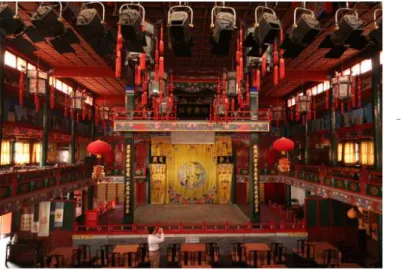
Auditorium type theaters were built mostly in guildhalls and residences of the nobility. A typical theater has a relatively small thrust stage in a near square hall space. The average room volume is in the range of 2000 to 3000 m3 with ceiling height approximately between of 6 to 8 m. Huguang Guildhall, Beijing is among a few theaters that are still operated commercially (figure 1). The audiences are equipped with small tables for serving tea and desserts. Measurements were taken using the B&K Dirac software system.
The average unoccupied mid-frequency early decay time (EDT) and sound strength (G) are 0.94 s and 9.8 dB, respectively.
Figure 1. Huguang Guildhall, Beijing.
Figure 2. Sanshan Guildhall, Shanghai.
Courtyard-type theaters were built in temples and guildhalls in east and south coastal areas of China. A normally raised stage is attached to a courtyard surrounded by walls or covered galleries which is generally symmetrical in plan. The stage floor is raised to one-story high to allow for access underneath and to provide good sightlines for the standing audiences in the courtyard.
Both architectural and acoustical characteristics of the theaters are similar to the ones of Elizabethan theaters although the latter are generally greater in size. Sanshan Guildhall, Shanghai (figure 2) is a typical courtyard type theater with side balconies attached to the two-story wing rooms. With the wing rooms closed, the average unoccupied mid-frequency EDT and G are 0.95 s and 7.6 dB, respectively.
5 0 10
5 0 10
Figure 3. Jixiao Manor in He Yuan, Yangzhou
The theater integrated with privately owned Chinese garden can be considered as a special variation of the courtyard type theater. Geometrical composition of the theaters is rather irregular and varies significantly from case to case because of water, rocks, bridges, walls, and vegetation in the garden. The stage floor area is even smaller than the areas of the previous types, allowing only one or two performers most time. Because the stage is not raised and not directly attached with the back wall, sound strength (G) of the theater integrated with garden is generally lower than the values of the theaters in temples and guildhalls.
Jixiao Manor in He Yuan (JM), Yangzhou represents one of the well maintained theaters built in the nineteenth century (figure 3). A large portion of ground is covered with a major water pool and an abundant amount of rock hills with passages and vegetation among them.
The high hills rather than the wall behind them defined the rear border of the courtyard. The average unoccupied mid-frequency EDT and G are 0.80 s and 3.1 dB, respectively. With audiences restricted only to certain spots, the occupied condition is expected to be not much different from the unoccupied condition. Loudness can be problematic at some locations such
C R L
F
27 17
11
13
14 24
0 1 3 6 10 15
5 0 10
receivers 13 and 14 of this theater. Measurements in other smaller theaters also indicate that there may be potential problems in sound coloration or even image shift.
3 MODEL ANALYSIS OF THE COURTYARD TYPE THEATERS
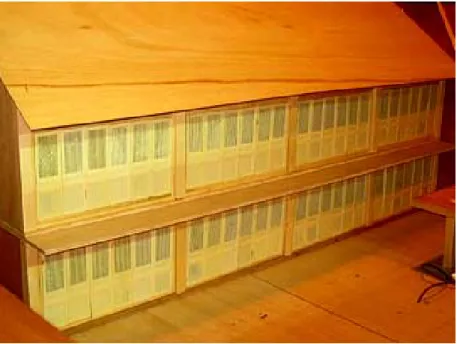
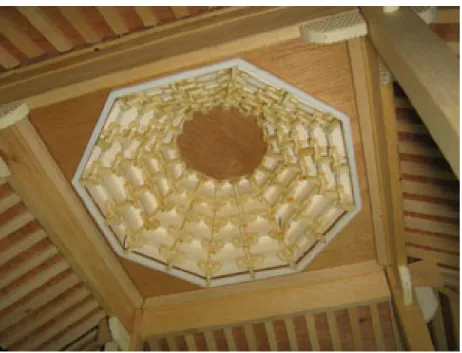
Computer analyses using Odeon 5 software package were employed to systematically analyze the effects of various architectural features on early time (EDT), sound strength (G) and early support (ST1) for the courtyard-type theaters where the reflection density could be low with the absence of ceiling. A prototype model was built using the dimensions of Sanshan Guildhall. The ranges for various architectural features were determined based the data from the theaters surveyed. Measurements in 1/16 scale models were conducted verify the effect associated diffusion and diffractions. The decorations on the stage ceiling and on the walls surrounding the courtyard were also made following the ones appeared in Sanshan Guildhall (figure 4 and 5). The directional pattern for the scaled-up frequency of the sound source, a Grozier GTS51 high-voltage spark, is considered similar to a human singer.
Figure 4. Courtyard view of the 1/16 scale model showing the detailed architectural features on the walls.
Figure 5. Stage ceiling view of the 1/16 scale model showing the wood brackets.
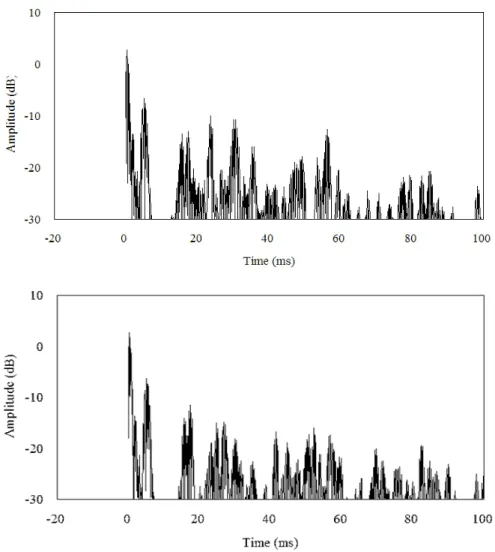
Without considering sound diffusion, the impact of the presence of stage ceiling is crucial on ST1 but not G and EDT. By adding the ceiling with height and size set to 4 m and 45 m2, respectively, ST1 can be raised from -13.5 dB to -9.0 dB. ST1 can also be increased by reducing ceiling height or courtyard size. EDT can be significantly increased up to 1.0 s by increasing the building height to 9 m. The other architectural factors are less important. Raising the stage floor, decreasing the courtyard size (especially the width), or increasing the overhangs around the perimeter would significant increase G. It is also found that early reflections would be blocked by the side balconies when raising the sound source above the height of the side balconies.
Figure 6. 1-kHz band echograms comparing the model with plane concavely shaped ceiling (top) to the model with the ceiling installed with wood brackets (bottom).
4 SUBJECTIVE ASSESSMENTS OF ACOUSTICAL ENVIEONMENTS FOR BEIJING OPERA
A preliminary study was conducted regarding subjective assessment of the acoustical environment for Beijing opera. Recording of dry solo singings and dialogues were made in a laboratory. Four professional actors were invited with each representing Sheng (main male role), Dan (female role), Jing (painted face male role), and Chou (male clown role). The music samples were convolved to music segments by using binaural impulse responses. The impulse responses were set to represent acoustical conditions with reverberation time in the range of 0.55 to 1.7 s and sound strength in the range of 5 to 13 dB. A front listening location was also compared to a side listening location. Twelve listeners representing the general public were asked to evaluate the simulated music via headphones. The listeners were asked to answer ”yes” or “no” regarding overall
impression and other subjective attributes of 72 music segments.
Sound strength and listening direction are the principle factors that determine overall impression. For the segments convolved using the dry recording on side of the actors, a sound strength of 7 dB can be used as the lower limit that corresponds with overall impression of 50 %. The effect of reverberation time is less significant. 6000 m3 can be used as the upper limit for room volume when a thrust stage is used.
Figure 7. Overall impression as a function of mid-frequency sound strength (G) comparing the front receivers (x) to the side receivers (o). The two lines represent the line fits of the data points.
5 SUMMARY
Traditional Chinese Opera performed in modern theaters today is inevitably produced using sound amplification although unassisted singing from a trained player can be heard in a relatively large venue. This paper provides fundamental knowledge about the acoustics and traditional Chinese theaters and the associated programs by field survey, acoustical modeling, and psycho-acoustic experiments. Continuing studies will be conducted to provide further understanding to assist architects and acousticians in properly using the existing historical venues and designing new ones.
0 20 40 60 80 100
0 5 10 15
Sound Strength (dB)
Overall Impression (%)
6 REFERENCES
1. Liao, B. The History of Ancient Chinese Theaters, (in Chinese) (Chung Cho, Chengcho, 1997).
2. Wang, J.Q. ”Acoustics of Chinese Traditional Theaters”, First Pan-American/Iberian Meeting on Acoustics, December, Cancun, Mexico. (2000).
3. Wang, J.Q. “A primary study of the acoustics of Chinese traditional theatrical buildings (in Chinese)”, Technical Acoustics, 21 (1/2), 74-79 (2002).
4. Xiang, D. Practical Architectural Acoustics, (in Chinese) (China Building Industry, Beijing, 1992).
5. Cheng, D. Chinese Music Instrument (in Chinese), (ShengYun, Taipei: 1985).
6. Wang, C. Guildhall Theaters and Drama, (in Chinese) (Wen Jing, Taipei, 2000).
7. Hsu, Y., Chiang, W., Tsai, J., and Wang, J. “Acoustical Measurements of Courtyard-Type Traditional Chinese Theater in East China”, AES 21st International Conference for
Architectural Acoustics and Sound Reinforcement, June, St. Petersburg, Russia, (2002).
8. Richardson, R. and Shield, B.M. ”Acoustic measurement of Shakespeare’s Globe Theater, London”, Forum Acusticum 99, March, Berlin, Germany. (1999).
9. Barron, M. Auditorium Acoustics (E& FN Spon, London, 1993) 10. Charles, J. Chinese Garden, (Academy Editions, London, 1978).
11. Lee, C. Lin Family Residence at Panchiao, (Hsiung Shih Art Books CO. Ltd, Taipei, 1987).
12. Tseng, Y. Traditional Taiwan Drama. (in Chinese) (Tong Hwa CO. Ltd., Taipei, 1997).
13. Tsai, J,. “Acoustic Measurement of Courtyard-Type Traditional Chinese Theater (in Chinese)”, A Master’s Thesis of National Taiwan University of Science and Technology (2002).