行政院國家科學委員會補助專題研究計畫 █成果報告 □ 期中進度報告 迷你乳液之製備與鑑定暨迷你乳化聚合反應機構與動力學
計畫類別:█個別型計畫 □整合型計畫
計畫編號:NSC 96 - 2628 - E - 011 - 114 -MY3 執行期間: 2007 年 08 月 01 日至 2010 年 07 月 13 日 執行機構及系所:國立臺灣科技大學化學工程系
計畫主持人:陳崇賢 共同主持人:
計畫參與人員:C.T. Lin, F.E. Yu
成果報告類型(依經費核定清單規定繳交):□精簡報告 █完整報告
本計畫除繳交成果報告外,另須繳交以下出國心得報告:
□赴國外出差或研習心得報告
□赴大陸地區出差或研習心得報告
□出席國際學術會議心得報告
□國際合作研究計畫國外研究報告
處理方式:除列管計畫及下列情形者外,得立即公開查詢
□涉及專利或其他智慧財產權,□一年□二年後可公開查詢 中 華 民 國 九十九 年 九 月 二十四 日
目錄
目錄 ... Ⅰ 表目錄 ... Ⅱ 圖目錄 ... Ⅲ 中文摘要 ... Ⅳ 英文摘要 ... Ⅴ
Introduction ... 1
Experimental ... 2
Materials ... 2
Preparation and characterization of miniemulsions ... 2
Miniemulsion polymerization ... 3
Individual conversions of monomer and costabilizers ... 3
Results and discussion ... 4
Stability of miniemulsions upon aging ... 4
Miniemulsion copolymerization mechanisms and kinetics ... 5
Conclusions ... 10
References ... 10
表目錄
Table1 ... 13 Table2 ... 13
圖目錄
Figure1 ... 14
Fig1(a) ... 14
Fig1(b) ... 14
Fig1(c) ... 14
Figure2 ... 14
Figure3 ... 15
Figure4 ... 15
Figure5 ... 16
Figure6 ... 16
Figure7 ... 17
中文摘要
本計畫主要探討有關三成分(苯乙烯(ST) /甲基丙烯酸十八酯(SMA) /甲基丙烯酸十二酯(LMA))
迷你乳液之乳化聚合反應。利用含有 ST 和 SMA 的迷你乳液,經由改變 SMA 的比例,得知其具有良好 抑制奧斯瓦老化速率的能力,然而在含有 ST 和 LMA 的迷你乳液,將 SMA 比例改變,卻還是有著明顯 的奧斯瓦老化。接著探討迷你乳液(ST 和 SMA)的成核機制,除了單體液滴成核外,均質成核亦扮 演著重要的角色。最終探討 ST 和 SMA 的整體轉化率與個別轉化率,隨著 SMA 增加 ST 和 SMA 轉化率 下降。此外隨著反應的時間變化發現,SMA 的轉化率較佳,由於 ST/LMA 具有較強的奧斯瓦老化效 應,使得單體液滴成核受到阻礙,因此於聚合反應速率上,ST/LMA 較 ST/SMA 緩慢。
關鍵詞:迷你乳化共聚合反應;苯乙烯;甲基丙烯酸烷酯;奧斯瓦老化速率
Abstract
Miniemulsion copolymerizations of styrene (ST) and stearyl methacrylate (SMA) or lauryl methacrylate (LMA)) were investigated. Miniemulsions comprising ST and various levels of SMA showed very good storage stability against the diffusional degradation of monomer droplets (Ostwald ripening), whereas miniemulsions comprising ST and various levels of LMA exhibited significant Ostwald ripening. In subsequent miniemulsion copolymerizations of ST and SMA, particle nucleation occurring in the continuous aqueous phase (homogeneous nucleation) plays an important role in the particle formation process in addition to monomer droplet nucleation. The final overall conversion and the individual conversions of ST and SMA all decrease with increasing SMA concentration. Furthermore, at a particular reaction time, the individual conversion of SMA is always greater than that of ST. Monomer droplet nucleation was retarded severely for the monomer pair ST/LMA, presumably due to the very strong Ostwald ripening effect. As a result, relatively slow rates of copolymerization of ST and LMA were attained compared to the ST/SMA counterpart.
Keywords: miniemulsion copolymerization, styrene, alkyl methacrylates, Ostwald ripening
Introduction
Oil in water emulsions stabilized by anionic and/or nonionic surfactants against coalescence are colloidal systems, in which oil droplets with a relatively broad droplet size distribution are dispersed in the continuous aqueous phase [1]. These classic emulsions are thermodynamically unstable due to the very large oil-water interfacial free energy. Higuchi and Misra [2] were the first to illustrate that addition of a small amount of a water-insoluble compound (termed costabilizer) would retard the degradation of emulsions via the Ostwald ripening process (i.e., oil molecules in small droplets tend to diffuse through the continuous aqueous phase into large ones and, thus, large droplets grow in size at the expense of small ones). This was followed by some representative studies focusing on the fundamental aspects of Ostwald ripening in the presence of costabilizers [3-6]. The relatively stable products thus obtained are termed miniemulsions.
Polymerization of conventional monomer emulsions involves the generation and growth of particle nuclei via either micellar nucleation [7-12] or homogeneous nucleation [13-17]. Emulsified monomer droplets generally do not contribute to particle nucleation to any appreciable extent in emulsion polymerization due to their very small droplet surface area and, therefore, they only serve as monomer reservoir to supply growing particles with monomer according to the micellar nucleation mechanism. Nevertheless, homogenized monomer droplets containing a hydrophobic low molecular weight compound (e.g., hexadecane (HD) or cetyl alcohol (CA)) may become predominant particle nucleation loci provided that the total monomer droplet surface area becomes large enough to compete effectively with the aqueous phase, in which particle nuclei are generated, for capturing radicals (monomer droplet nucleation). This unique technique has been termed miniemulsion polymerization [18-25].
Chern and coworkers [26-29] investigated miniemulsion polymerizations of ST using relatively low levels of alkyl methacrylates (stearyl methacrylate (SMA) and lauryl methacrylate (LMA)) as the reactive costabilizers. Just like conventional costabilizers, long-chain alkyl methacrylates act as costabilizers in stabilizing submicron monomer droplets against Ostwald ripening. Furthermore, the methacrylate group of the polymerizable costabilizer can be chemically incorporated into latex particles in the subsequent free radical polymerization. Recently, Chern et al. [30] prepared miniemulsion copolymers of ST and SMA in the range 20-50 wt%, and evaluated the water repellent property of the resultant copolymer films. X-ray
photoelectron spectroscopy measurements showed that a concentration gradient of monomeric units of SMA within the polymeric film was established during film formation and the concentration of monomeric units of SMA was the highest within the surface layer. This implies that copolymer species with different compositions formed during polymerization, presumably due to a mixed mode of particle nucleation (monomer droplet nucleation and homogeneous nucleation) and the monomer pair ST/SMA with different reactivity ratios and solubility parameters [30]. To further verify this postulation, the objective of this work was therefore to gain a better understanding of the copolymerization kinetics and mechanisms for the two monomer pairs ST/SMA and ST/LMA.
Experimental Materials
The chemicals used include ST (Taiwan Styrene), SMA (Aldrich), LMA (Aldrich, 95%), sodium lauryl sulfate (SLS, J. T. Baker, 99%), sodium persulfate (SPS, Riedel de Haen), and sodium bicarbonate (Riedel de Haen) as the buffer. Other reagents used include dichloromethane (Riedel de Haen), ethanol (95%), chloroform (Acros), toluene (Acros), pure nitrogen gas, and deionized water (Barnsted, Nanopure Ultrapure Water System, specific conductance < 0.057 μS/cm). SMA was recrystallized in ethanol, and ST distilled under reduced pressure before use. Other chemicals were used as received.
Preparation and characterization of miniemulsions
The miniemulsion was prepared by dissolving SLS and sodium bicarbonate in water and costabilizer (SMA or LMA) in ST, respectively. The oily and aqueous solutions were mixed using a mechanical agitator at 400 rpm for 10 minutes. The resultant emulsion was then homogenized with an ultrasonic homogenizer (Misonix sonicator 3000) for ten cycles of 5 minutes in length with 2 minutes off-time, and the output power set at 12 W. A typical miniemulsion formulation comprises the aqueous phase (160 g of water, 2.66 mM of sodium bicarbonate and 5 mM of SLS), the monomer charge (40 g of ST, kept constant in this study) and various amounts of costabilizers (SMA or LMA). The runs corresponding to the mass ratios of ST:SMA = 1:1, 2:1 and 4:1 were designated as S11, S21 and S41, respectively. The runs corresponding to the mass ratios of ST:LMA = 1:1, 2:1, 4:1, 8:1, 16:1 and 50.4:1 were designated as L11, L21, L41, L81, L161 and L501,
respectively. The concentrations of sodium bicarbonate and SLS are based on the total water weight. The average monomer droplet diameter of miniemulsion upon aging was determined by dynamic light scattering (DLS, Malvern, Zetasizer 1000 HSA). The sample was diluted with water saturated with SLS and ST to avoid the multiple scattering of monomer droplets and the potential diffusion of SLS and ST species from droplets into the aqueous phase.
Miniemulsion Polymerization
Immediately after homogenization, the resultant miniemulsion was charged into a 500-mL reactor equipped with a four-bladed fan turbine agitator, a thermocouple, and a reflux condenser and then purged with nitrogen for 10 minutes to remove dissolved oxygen, while the temperature was brought to 70oC. The initiator solution (2.66 mM of SPS based on total water weight) was then charged into the reactor to start the polymerization, and the temperature kept constant at 70oC throughout the reaction. The agitation speed was set at 400 and 800 rpm for the ST/SMA and ST/LMA system over a period of 8 hours, respectively. A higher agitation speed for the ST/LMA system was used because appreciable phase separation of miniemulsion was observed when an agitation speed of 400 rpm was adopted in this series of experiments.
The latex product was filtered through 40-mesh and 200-mesh screens in series. Scraps adhering to the agitator, thermometer and reactor wall were also collected. The average colloidal particle size during the reaction was determined by DLS.
Individual conversions of monomer and costabilizers
Individual conversions of ST and reactive costabilizer (SMA or LMA) were determined by the UV/visible spectrometer (Shimadzu UV-1061) and FTIR spectrometer (Bio-Rad FTS-3500), respectively. First, the dried copolymer sample was dissolved in dichloromethane, and the UV absorbance at 264 nm primarily originating from monomeric units of ST in the sample was determined based on a calibration curve obtained from pure polystyrene standards (absorbance = 2716.5×concentration (g/g)). The correction required to take into account the presence of costabilizer (SMA or LMA) as monomer molecules or monomeric units in the copolymer was made by measuring the UV absorbance of pure SMA (absorbance = 118.5×concentration (g/g)) or LMA (absorbance = 120.5×concentration (g/g)) at 264 nm in combination with a mass balance on
SMA or LMA in the recipe. The individual conversion of SMA or LMA was then determined by the FTIR characteristic peak area at 1635 1/cm for -C=C- of SMA or LMA according to a calibration curve obtained from pure SMA (peak area = 14874×concentration (g/g)) or LMA (peak area = 18564×concentration (g/g)).
Results and discussion
Stability of miniemulsions upon aging
The rate of Ostwald ripening (RO) for the two-component disperse phase system can be calculated by the following equation based on the modified LSW theory [31]:
RO = 1/8d(dm3
)/dt = 8σDcVmCc(∞)/(9RTvc) (1)
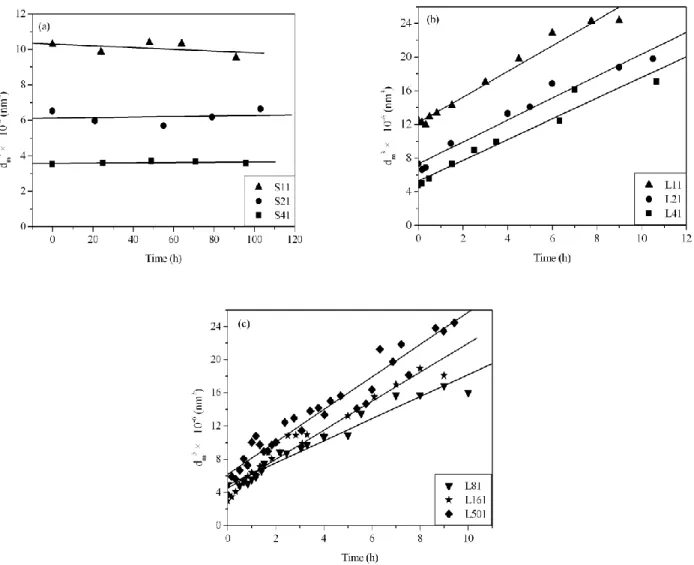
where dm is the monomer droplet diameter, t the aging time, σ the droplet-water interfacial tension, Dc the molecular diffusivity of costabilizer in water, Vm the molar volume of monomer in the droplets, Cc(∞) the solubility of the bulk costabilizer in water, R the gas constant, T the absolute temperature, and vc the volume fraction of costabilizer in the monomer droplets. Figure 1 shows the data of dm3
as a function of t for miniemulsions of ST stabilized by various levels of SMA or LMA at 30 oC. The concentration of SLS was kept constant at 5 mM which is slightly below the critical micelle concentration (CMC, 8.2 mM) [32].
Ostwald ripening does not occur eventually for the series of miniemulsions comprising ST and SMA, as shown in Figs. 1a and 2. This is due to the fact that SMA is an extremely effective costabilizer and it can provide sufficient osmotic pressure to counterbalance the Laplace pressure (Ostwald ripening). On the other hand, the Ostwald ripening effect plays an important role in the stability of miniemulsions comprising ST and LMA, even for the runs with the weight fraction of LMA greater than 0.1 (Fig. 1b,c). The Ostwald ripening rate first decreases and then levels off with increasing LMA concentration for the series of miniemulsions containing ST and LMA (Fig. 2). This is because LMA (water solubility 1.38×10⁻⁸ cm3/cm3) is less hydrophobic than SMA (water solubility ca. 3.23×10⁻⁹ cm3/cm3) [5]. The higher the water solubility of costabilizer, the faster the Ostwald ripening rate, according to Eq. 1. It should be noted that the rate of Ostwald ripening is inversely proportional to the absolute temperature (Eq. 1). Thus, the Ostwald ripening rates of miniemulsions at the polymerization temperature (70 ℃) are overestimated by a factor of ca. 12%
compared to the reported Ostwald ripening rate data at 30 ℃. However, this factor is not expected to change the relative importance of the influence of the Ostwald ripening process on the particle nucleation mechanisms in the ST/SMA or ST/LMA copolymerization systems with different levels of the reactive alkyl methacrylate costabilizers.
Miniemulsion copolymerization mechanisms and kinetics
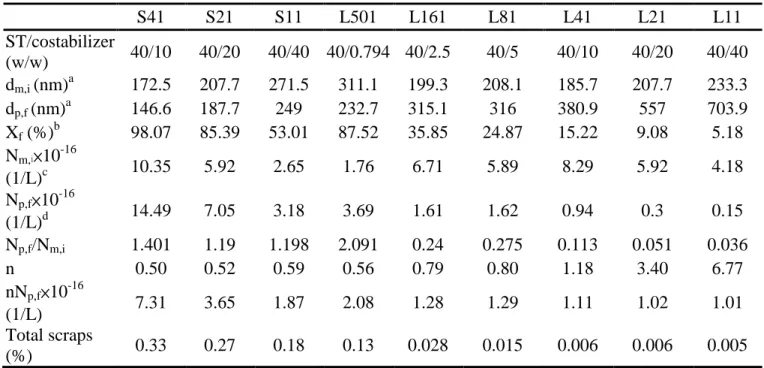
The recipes and experimental data for miniemulsion copolymerizations of ST with various levels of SMA and LMA are summarized in Table 1. In this study, the concentrations of SLS and SPS and the amounts of ST and water were kept constant at 5 mM, 2.66 mM and 40 g and 160 g, respectively. Both the individual conversions of ST and SMA are shown in Fig. 3. It is shown that the polymerization rate of SMA is much faster than that of ST in this series of experiments. Furthermore, the difference in the polymerization rate becomes greater when the amount of SMA increases. For illustration, the rate of polymerization for the miniemulsion polymerization in the presence of conventional costabilizer (e.g., HD and CA) can be expressed as follows:
Rp = kp[M]pnNp/NA (2)
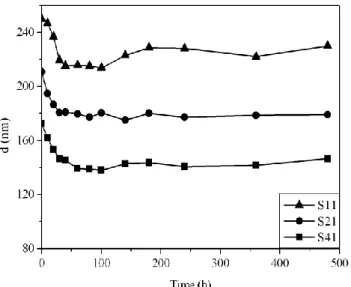
where kp is the propagation rate constant, [M]p the concentration of monomer in the particles, n the average number of free radicals per particle, Np the number of latex particles per unit volume of water, and NA the Avogadro number. Equation 2 predicts that the rate of polymerization is linearly proportional to nNp and kp. First, at a particular reaction time, the average size (d) of colloid particles (including monomer-swollen polymer particles and unnucleated monomer droplets) decreases with increasing weight fraction of SMA (Fig. 4). This is because the more hydrophobic colloidal particles that contain more SMA molecules require more SLS species adsorbed on their surfaces to achieve adequate colloidal stability. As a result, the number of latex particles (i.e., reaction loci) decreases with increasing weight fraction of SMA during polymerization, as demonstrated by the final number of latex particles per unit volume of water (Np,f) data for the runs S41, S21 and S11 in Table 1. For the ST/SMA series of experiments, it is very difficult to estimate n directly from Eq. 2 due to the lack of the propagation rate constant data for SMA and the concentrations of the individual comonomers ST and SMA in the polymer particles originating from the
monomer droplet nucleation and homogeneous nucleation mechanisms. With the assumption of negligible desorption of free radicals out of the latex particles (a reasonable assumption for the copolymerization systems containing the hydrophobic monomer pairs ST/SMA and ST/LMA), the following relationship can be used to estimate n [33].
n = (0.25+α ’/2)1/2 (3)
where the dimensionless group α ’ is defined as ρ ivp/ktpNp, ρ i = 2fkd[I]w is the rate of generation of free radicals in the aqueous phase, f the initiator efficiency factor, kd the initiator decomposition rate constant, [I]w the concentration of initiator in water, vp the volume of a latex particle, ktp the termination rate constant in the latex particles, and Np the number of latex particles per unit volume of water. The value of f was assumed to be one and kd and ktp(ST) at 70 ℃ are 2.33×10⁻⁵ 1/s [34] and 6×10⁷ L/mol-s [35], respectively.
The estimated values of n and nNp,f are summarized in Table 1. The value of n increases slightly with increasing costabilizer level for the ST/SMA copolymerization system (quite close to the Smith-Ewart Case 2 kinetics), whereas n increases significantly with increasing costabilizer level for the ST/LMA copolymerization system (in the Smith-Ewart Case 3 kinetics region). The product of n and Np,f decreases with increasing SMA level. This trend supports the kinetic data shown in Fig. 3; the larger the value of nNp,f, the faster the rate of polymerization.
The propagation rate constant at 70 ℃ for the homologous series of alkyl methacrylates in increasing order is: ST (409 L/mol-s [36]) < methyl methacrylate (862 [37]) < ethyl methacrylate (1149 [36]) < n-butyl methacrylate (973 [36]) < LMA (1003 [36]). It seems reasonable to assume that, for the homologous series of alkyl methacrylates, SMA should have a larger propagation rate constant than MMA. Thus, the propagation rate constant of SMA is expected to be greater than that of ST. The greater the propagation rate constant, the faster the rate of polymerization.
The reactivity ratios of the monomer pair ST/SMA can be estimated by the Finemann-Ross (FR), Inverted Finemann-Ross (IFR) and Kelen-Tudos (KT) methods [38]. First, the FR equation can be written as
G = rm H-rc, (4)
where G = X(Y-1)/Y, H = X2/Y, and X and Y are the ratio of the mole fraction of monomer and costabilizer in the feed and the ratio of the mole fraction of monomer and costabilizer in the copolymer, respectively. The parameters rm and rc are the reactivity ratios of monomer and costabilizer, respectively.
This equation shows that a straight line with a slope of rm and an intercept of rc can be obtained when the experimental data of G are plotted versus H (Fig. 5a). The IFR equation is shown as follows:
G/H = -rc (1/H)+rm (5)
By plotting G/H versus 1/H, as shown in Fig. 5b, the reactivity ratios of ST and SMA can be determined.
Finally, the KT equation is shown below.
η = (rm+rc/α)ζ -rc/α (6)
where η = G/(α+H), ζ = H/(α+H), α = (HmaxHmin)1/2 and Hmax and Hmin are the highest and lowest values of H, respectively. Figure 5c (η vs. ζ ) represents the KT plot of the miniemulsion copolymerizations of ST and SMA. Multiplying the intercept with α results in the reactivity ratio of SMA. The reactivity ratio of ST can be obtained by subtracting the intercept from the slope.
Based on Eqs. 4-6, the reactivity ratios of ST and SMA thus obtained are summarized in Table 2. For comparison, the reported reactivity ratios of the monomer pair ST (r1)/SMA (r2) for the solution copolymerization system [39] are also included in this table. It is interesting to note that dramatically different reactivity ratios of ST and SMA between the miniemulsion and solution copolymerization systems are obtained. Comparable reactivity ratio values are expected for the solution and ideal miniemulsion copolymerization systems since each monomer droplet can be regarded as a submicron bulk reactor for the free radical copolymerization to take place therein. However, this is not the case. This implies that a mixed mode of particle nucleation (monomer droplet nucleation and homogeneous nucleation) is operative in the miniemulsion copolymerizations of ST and SMA. This postulation is supported by (1) the initial reduction in the size (d) of colloidal particles (including monomer-swollen polymer particles and unnucleated monomer droplets) during polymerization (Fig. 4) and (2) the values of Np,f/Nm,i greater than one, where Np,f and Nm,i
are the final number of latex particles and initial number of monomer droplets per unit volume of water, respectively.
A general feature of the d versus t profiles is that the average colloidal particle size first decreases to a minimum and then increases gradually to a plateau (Fig. 4). The initial decrease of d is attributed to the formation of tiny particle nuclei (ca. 100 nm in diameter) in the continuous aqueous phase [19]. Micellar nucleation can be ruled out because the SLS concentration used in this work is below its CMC. Under the circumstance, the average colloidal particle size starts to decrease from the very beginning of polymerization and, ultimately, the ratio Np,f/Nm,i is greater than unity. Homogeneous nucleation stops and a minimal value of d is achieved when the total particle surface area is large enough to capture all the oligomeric radicals generated in water. This is followed by the slow growth of the particles by acquiring monomer molecules from unnucleated monomer droplets. It is noteworthy that the particles originating from homogeneous nucleation do not contain any SMA species because the extremely hydrophobic SMA molecules cannot diffuse from monomer droplets or particles originating from monomer droplet nucleation, across the aqueous phase, into the water-borne particle nuclei. As a result, the apparent reactivity ratios of ST and SMA for the miniemulsion copolymerization system are quite different from those obtained from the solution copolymerization system. All these factors (i.e., the number of reaction loci per unit volume of water, the propagation rate constant and the apparent reactivity ratios of ST and SMA for the miniemulsion copolymerizations of ST and SMA) support the kinetic behavior observed in Fig. 3.
In contrast to the ST/SMA series, miniemulsions with various mass ratios of ST to LMA all exhibit significant Ostwald ripening and the Ostwald ripening rate decreases with increasing LMA concentration (Figs. 1b, 1c and 2). This is as would be expected since LMA (water solubility = 1.38×10⁻⁸ cm3/cm3 [5]) is not as effective as the extremely hydrophobic SMA (water solubility = 3.23×10⁻⁹ cm3/cm3 [5]) in retarding the diffusional degradation of monomer droplets (Ostwald ripening). Figure 6 shows the individual conversions of ST and LMA as a function of time for miniemulsion copolymerizations of ST and LMA with various levels of LMA at 70 ℃. Similar to the monomer pair ST/SMA, the rate of polymerization of LMA is much faster than that of ST regardless of the LMA concentration. As expected, the larger propagation rate constant [36] and reactivity ratio of LMA (Table 2) compared to those of ST are responsible for such a polymerization kinetic behavior. In addition, the decreased value of nNp,f with LMA level also contributes to some extent to the observed kinetic behavior in Fig. 6.
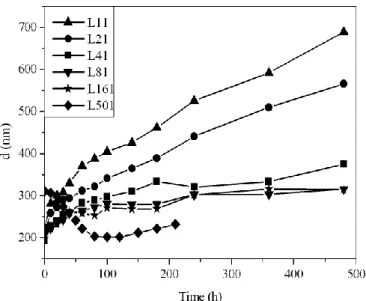
The average colloidal particle size (d) versus time profiles for miniemulsion copolymerizations of ST and LMA are shown in Figure 7. All the curves exhibit a general feature that the average colloidal particle size increases continuously (for the runs with mass ratios of ST:LMA = 2:1, 1:1) or first increases and then levels off (for the runs with ST:LMA = 16:1, 8:1, 4:1) with the progress of polymerization except the run with ST:LMA = 50.4:1. This is most likely due to the significant Ostwald ripening effect experienced in miniemulsions comprising ST and LMA. For the run with a mass ratio of ST:LMA = 50.4:1 that shows the strongest Ostwald ripening effect, the average colloidal particle size first decreases rapidly to a minimum and then increases toward the end of polymerization. The rapidly decreased average colloidal particle size with time implies that formation of particle nuclei in water plays an important role in the polymerization system and the effect of homogeneous nucleation is not overridden by that of Ostwald ripening. It should be noted that the value of Np,f/Nm,i is smaller than one for the run with ST:LMA = 50.4:1 (Table 1). Considering the initial decrease of d and the value of Np,f/Nm,i smaller than unity, monomer droplet nucleation should be relatively weak compared to homogeneous nucleation. Thus, monomer droplet nucleation seems to be retarded severely by Ostwald ripening. It was reported that a significant fraction of latex particles were generated by homogeneous nucleation for the LMA containing miniemulsion polymerization system, which exhibited a strong Ostwald ripening effect [28, 40-42]. Thus, formation of water-borne particle embryos cannot be ruled out for the runs with the mass ratios of ST:LMA = 16:1, 8:1, 4:1, 2:1, 1:1, though the absence of the initial reduction in the average colloidal particle size is evident (Fig. 7). This is because the extent of homogeneous nucleation decreases with increasing LMA concentration. Under the circumstance, the Ostwald ripening effect is so strong that formation of particle nuclei in the aqueous phase during the early stage of polymerization cannot be detected by the DLS technique except the run with ST:LMA = 50.4:1 exhibiting the strongest homogeneous nucleation. The fact that all the values of Np,f/Nm,i are smaller than one implies that monomer droplet nucleation is greatly retarded due to the strong Ostwald ripening effect experienced in miniemulsion copolymerizations of ST and LMA. As a consequence, relatively slow rates of copolymerizations of ST and LMA were attained compared to the ST/SMA counterpart.
Furthermore, the extent of the retarded particle nucleation (including monomer droplet nucleation and homogeneous nucleation) increases with increasing LMA concentration, as shown by the decreased Np,f/Nm,i
with increasing LMA in Table 1. Thus, the final overall conversion decreases with increasing LMA concentration.
Conclusions
Miniemulsion copolymerizations of styrene (ST) and alkyl methacrylates (including stearyl methacrylate (SMA) and lauryl methacrylate (LMA)) were investigated. The miniemulsions comprising ST and various levels of SMA upon aging at 30 ℃ showed very good stability against the diffusional degradation of monomer droplets (Ostwald ripening), whereas miniemulsions comprising ST and various levels of LMA exhibited significant Ostwald ripening. The Ostwald ripening first decreases and then levels off when the level of LMA is increased. This is attributed to the more hydrophobic SMA that acts as a very effective reactive costabilizer in stabilizing the ST miniemulsions.
In miniemulsion copolymerizations of ST and SMA, in which Ostwald ripening was greatly retarded, particle nucleation occurring in the continuous aqueous phase (homogeneous nucleation) plays an important role in addition to monomer droplet nucleation. The final overall conversion and the individual conversions of ST and SMA all decrease with increasing SMA concentration. This is caused by the decreased number density of particle nuclei (i.e., reaction loci) with the SMA concentration. Furthermore, at a particular reaction time, the conversion of SMA is always greater than that of ST, and the difference between the individual conversions of ST and SMA increases with increasing SMA concentration. This can be explained by the larger propagation rate constant and reactivity ratio of SMA than those of ST. The significant Ostwald ripening experienced in miniemulsion copolymerizations of ST and LMA had a significant influence on the copolymerization mechanisms and kinetics. Monomer droplet nucleation was retarded significantly for the monomer pair ST/LMA. As a result, relatively slow rates of copolymerizations of ST and LMA were attained compared to the ST/SMA counterpart. Moreover, the extent of the retarded particle nucleation (including monomer droplet nucleation and homogeneous nucleation) increases with increasing LMA concentration. This will then result in the decreased Np,f/Nm,i with LMA concentration. Thus, the final overall conversion decreases with increasing LMA concentration.
References 1. Landfester, K. Macromol Rapid Commun 2001, 22, 896.
2. Highuci, W. I.; Misra, J. J Pharm Sci 1962, 51, 459.
3. Choi, Y. T. Formation and stabilization of miniemulsion and latexes, PhD Dissertation, Lehigh University, Bethlehem, 1986.
4. Kabalnov, A. S.; Makarov, K. N.; Pertzov, A. V.; Shchukin, E. D. J. Colloid Interface Sci 1990, 138, 98.
5. Chern, C. S.; Chen, T. J. Colloids Surfaces A 1998, 138, 65.
6. Tauer, K. Polymer 2005, 46, 1385.
7. Harkins, W. D. J Chem Phys 1945, 13, 381.
8. Harkins, W. D. J Chem Phys 1946, 14, 47.
9. Harkins, W. D. J Am Chem Soc 1947, 69, 1428.
10. Smith, W. V. J Am Chem Soc 1948, 70, 3695.
11. Smith, W. V.; Ewart, R. H. J Chem Phys 1948, 16, 592.
12. Smith, W. V. J Am Chem Soc 1949, 71, 4077.
13. Priest, W. J. J Phys Chem 1977, 56, 1977.
14. Roe, C. P. Ind Eng Chem 1968, 60, 20.
15. Fitch, R. M.; Tsai, C. H. in Polymer Colloids, ed. R. M. Fitch. Plenum Press: New York, 1971, p. 73.
16. Fitch, R. M.; Tsai, C. H. in Polymer Colloids, ed. R. M. Fitch. Plenum Press: New York, 1971, p. 103.
17. Fitch, R. M. Br Polym J 1973, 5, 467.
18. Ugelstad, J.; El-Aasser, M. S.; Vanderhoff, J. W. J Polym Sci: Polym Lett Ed 1973, 11, 503.
19. Ugelstad, J.; Hansen, F. K.; Lange, S. Die Makromol Chem 1974, 175, 507.
20. Durbin, D. P.; El-Aasser, M. S.; Poehlein, G. W.; Vanderhoff, J. W. J Appl Polym Sci 1979, 24, 703.
21. Chamberlain, B. J.; Napper, D. H.; Gilbert, R. G. J Chem Soc Faraday Trans 1 1982, 78, 591.
22. Choi, Y. T.; El-Aasser, M. S.; Sudol, E. D.; Vanderhoff, J. W. J Polym Sci: Polym Chem Ed 1985, 23, 2973.
23. Capek, I.; Chern, C. S. Adv Polym Sci 2001, 155, 101.
24. Antonietti, M.; Landfester, K. Prog Polym Sci 2002, 27, 689.
25. Asua, J. M. Prog Polym Sci 2002, 27, 1283.
26. Chern, C. S.; Chen, T. J. Colloid Polym Sci 1997, 275, 546.
27. Chern, C. S.; Chen, T. J. Colloid Polym Sci 1997, 275, 1060.
28. Chern, C. S.; Liou, Y. C. Polymer 1999, 40, 3763.
29. Chern, C. S.; Sheu, J. C. Polymer 2001, 42, 2349.
30. Chern, C. S.; Lin, C. T.; Shiau, F. T. Colloid Polym Sci 2009, 287, 1139.
31. Kabalnov, A. S.; Shchukin, E. D. Adv Colloid Interface Sci 1992, 38, 69 32. Rehfeld, S. J. J Phys Chem 1967, 71, 738.
33. Ugelstad, J.; Mork, P. C. Br Polym J 1970, 2, 31.
34. Brandrup, J.; Immergut, E. H. Polymer Handbook, 3rd ed, John Wiley & Sons, 1989.
35. Tobolsky, A. V.; Rogers, C. E.; Brickman, R. D. J Am Chem Soc 1960, 82, 1277.
36. Davis, T. P.; Driscoll, K. F.; Piton, M. C. Winnik, M. A. Macromolecules 1990, 23, 2113.
37. Mahabadi, H. K.; O’Driscoll, K. F. J Macromol Sci Chem 1997, A11, 967.
38. Ziaee, F.; Nekoomanesh, M. Polymer 1998, 39, 203.
39. Stergiou, G.; Dousikos, P. Pitsikalis, European Polymer Journal 2002, 38, 1963.
40. Chern, C. S.; Chen, T. J.; Liou, Y. C. Polymer 1998, 39, 3767.
41. Chern, C. S.; Liou, Y. C. Macromol Chem Phys 1998, 199, 2051.
42. Chern, C. S.; Liou, Y. C. J Polym Sci Polym Chem Ed 1999, 37, 2537.
Table 1. Recipes and some experimental data obtained from miniemulsion copolymerizations of ST and SMA or LMA.
S41 S21 S11 L501 L161 L81 L41 L21 L11
ST/costabilizer
(w/w) 40/10 40/20 40/40 40/0.794 40/2.5 40/5 40/10 40/20 40/40 dm,i (nm)a 172.5 207.7 271.5 311.1 199.3 208.1 185.7 207.7 233.3 dp,f (nm)a 146.6 187.7 249 232.7 315.1 316 380.9 557 703.9 Xf (%)b 98.07 85.39 53.01 87.52 35.85 24.87 15.22 9.08 5.18 Nm,i×10-16
(1/L)c 10.35 5.92 2.65 1.76 6.71 5.89 8.29 5.92 4.18
Np,f×10-16
(1/L)d 14.49 7.05 3.18 3.69 1.61 1.62 0.94 0.3 0.15
Np,f/Nm,i 1.401 1.19 1.198 2.091 0.24 0.275 0.113 0.051 0.036
n 0.50 0.52 0.59 0.56 0.79 0.80 1.18 3.40 6.77
nNp,f×10-16
(1/L) 7.31 3.65 1.87 2.08 1.28 1.29 1.11 1.02 1.01
Total scraps
(%) 0.33 0.27 0.18 0.13 0.028 0.015 0.006 0.006 0.005
a Average monomer droplet diameter immediately before the start of polymerization, determined by DLS
b Final overall conversion
c Initial number of monomer droplets calculated based on the dm,i data
d Final number of latex particles calculated based on the dp,f and Xf data
Table 2. Average reactivity ratio data predicted by Finemann-Ross, Inverted Finemann-Ross and Kelen- Tudos plots for miniemulsion copolymerization systems with ST/SMA and ST/LMA.
r1a
r2b
r1.r2 P(ST-co-SMA)c
FR 1.799 0.674 1.212
invFR 1.734 0.548 0.950
KT 1.758 0.510 0.896
P(ST-co-SMA)d
FR 0.809 16.981 13.731
invFR 0.783 16.353 12.806
KT 0.796 16.655 13.251
P(ST-co-LMA)e 0.57 0.45 0.26 P(ST-co-LMA)d
FR 0.092 9.331 0.862
invFR 0.100 11.375 1.141
KT 0.053 7.317 0.387
a Reactivity ratio of ST
b Reactivity ratio of SMA or LMA
c Prepared by solution polymerization [39]
d Prepared by miniemulsion copolymerization in this work
e Prepared by bulk polymerization [36]
Fig. 1. Cubic of average monomer droplet diameter as a function of time for miniemulsions upon aging at 30
℃ prepared by various mass ratios of ST:SMA or ST:LMA. (a) (▲) S11, (●) S21, (■) S41; (b) (▲) L11, (●) L21, (■) L41; (c) (▼) L81, (★) L161, (◆) L501.
Fig. 2. Ostwald ripening rate as function of costabilizer weight fraction (costabilizer/(ST+costabilizer) (w/w)) for miniemulsions upon aging at 30 ℃. (▲) SMA, (●) LMA.
Fig. 3. Individual conversions of ST and SMA as a function of time for miniemulsion copolymerizations at 70 ℃ with various mass ratios of ST:SMA. (△, ▲) S11, (○,●) S21, (□, ■) S41. Open and closed data points represent the individual conversions of SMA and ST, respectively.
Fig. 4. Average colloidal particle diameter as a function of time for miniemulsion copolymerizations at 70
℃ with various mass ratios of ST:SMA. (▲) S11, (●) S21, (■) S41.
Fig. 5. Reactivity ratios of ST and SMA for miniemulsion copolymerizations of ST and SMA. (a) Finemann-Ross plot, (b) Inverted Finemann-Ross plot and (c) Kelen-Tudos plot.
Fig. 6. Individual conversions of ST and LMA as a function of reaction time for miniemulsion
copolymerizations at 70oC with various mass ratios of ST:LMA. (△ , ▲) L11, (○, ●) L21, (□, ■) L41, (▽, ▼) L81, (☆, ★) L161, (◇, ◆) L501. Open and closed data points represent the individual
conversions of LMA and ST, respectively.
Fig. 7. Average colloidal particle diameter as a function of time for miniemulsion copolymerizations at 70
℃ with various mass ratios of ST:LMA. (▲) L11, (●) L21, (■) L41, (▼) L81, (★) L161, (◆) L501.
國科會補助專題研究計畫成果報告自評表
請就研究內容與原計畫相符程度、達成預期目標情況、研究成果之學術或應用 價值(簡要敘述成果所代表之意義、價值、影響或進一步發展之可能性)、是 否適合在學術期刊發表或申請專利、主要發現或其他有關價值等,作一綜合評 估。
1. 請就研究內容與原計畫相符程度、達成預期目標情況作一綜合評估
█達成目標
□ 未達成目標(請說明,以 100 字為限)
□ 實驗失敗
□ 因故實驗中斷
□ 其他原因 說明:
2. 研究成果在學術期刊發表或申請專利等情形:
論文:█已發表 □未發表之文稿 □撰寫中 □無 專利:□已獲得 █申請中 □無
技轉:□已技轉 □洽談中 █無 其他:(以 100 字為限)
3. 請依學術成就、技術創新、社會影響等方面,評估研究成果之學術或應用價 值(簡要敘述成果所代表之意義、價值、影響或進一步發展之可能性)(以 500 字為限)
(1) 本研究探討共同安定劑之疏水性與濃度、單體之水溶解度與單體組成對形成迷你乳液 以及隨後進行成迷你乳化聚合反應之效應。在迷你乳乳液基礎研究方面,所得實驗結 果顯示傳統 Kabalnov 方程式僅能預測使用低共同安定劑濃度來安定迷你乳液之奧斯 瓦老化行為;當共同安定劑濃度達到某一臨界濃度以上時,本研究所建立之半經驗方 程式可準確的描述奧斯瓦老化行為,此通用型理論模式亦可用來獲得各種單體與共同 安定劑之奧斯瓦老化速率以及共同安定劑之對水溶解度等,這些數據是文獻中所極為 缺乏的。在迷你乳化聚合反應基礎研究方面,本研究釐清反應動力學之相關課題(例 如高分子粒子核心之形成與成長機制、聚合反應速率、單體與反應型共同安定劑之反 應活性比等)。
(2) 從實用觀點來看,使用反應型共同安定劑可提昇環保型水性樹脂產品之性質與其附加 價值、降低可揮發有機化學物質(VOC)之含量、並擴展其應用領域。根據反應型共 同安定劑/迷你乳化聚合反應之相關技術,我們申請了一件有關具高性價比水性潑水 高分子材料之中華民國專利。