CHAPTER 10 LIPIDS
10.1 Storage Lipids
10.2 Structural Lipids in Membranes 10.3 Lipids as Signals, Cofactors, and
Pigments
10.4 Working with Lipids
p.343
• Based on the structure and function
• Lipids that do not contain fatty acids: cholesterol, terpenes, …
• Lipids that contain fatty acids (complex lipids) – Storage lipids and membrane lipids
Classification of Lipids
The fats and oils used almost universally as stored forms of energy in living organisms are derivatives of fatty acids.
Fatty Acids Are Hydrocarbon Derivatives
Fatty acids are carboxylic acids with hydrocarbon chains ranging from 4 to 36 carbons long (C4to C36).
A simplified nomenclature for unbranched fatty acids specifies the chain length and number of double bonds, separated by a colon (Fig. 10–1a).
p.343
10.1 Storage Lipids
FIGURE 10-1
p.343
FIGURE 10–1 Two conventions for naming fatty acids.
TABLE 10-1
p.344
p.344
The most commonly occurring fatty acids have even numbers of carbon atoms in an unbranched chain of 12 to 24 carbons.
The family of polyunsaturated fatty acids (PUFAs) with a double bond between the third and fourth carbon from the methyl end of the chain are of special importance in human nutrition.
PUFAs with a double bond between C-3 and C-4 are called omega-3 (ω-3) fatty acids, and those with a double bond between C-6 and C-7 are omega-6 (ω-6) fatty acids.
p.345
FIGURE 10–2 The packing of fatty acids into stable aggregates.
FIGURE 10-2
Triacylglycerols Are Fatty Acid Esters of Glycerol
The simplest lipids constructed from fatty acids are the triacylglycerols, also referred to as triglycerides, fats, or neutral fats. Triacylglycerols are composed of three fatty acids each in ester linkage with a single glycerol (Fig. 10–3).
p.346
FIGURE 10-7
p 350
FIGURE 10–7 Some common types of storage and membrane lipids.
FIGURE 10-3
p.346
FIGURE 10–3 Glycerol and a triacylglycerol.
p.346
Triacylglycerols Provide Stored Energy and Insulation
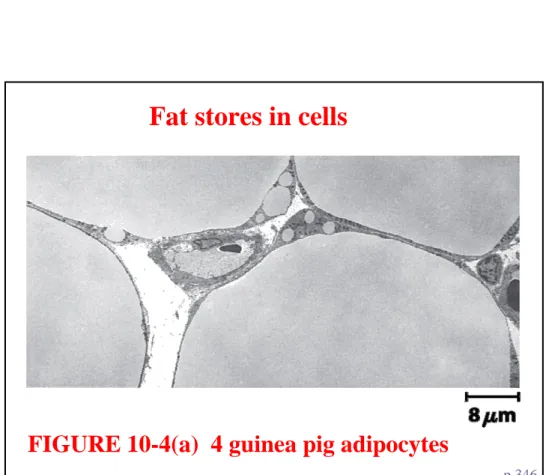
In vertebrates, specialized cells called adipocytes, or fat cells, store large amounts of triacylglycerols as fat droplets that nearly fill the cell (Fig. 10–4a).
Triacylglycerols are also stored as oils in the seeds of many types of plants, providing energy and
biosynthetic precursors during seed germination (Fig.
10–4b). Adipocytes and germinating seeds contain lipases, enzymes that catalyze the hydrolysis of stored triacylglycerols, releasing fatty acids for export to sites where they are required as fuel.
FIGURE 10-4(a) 4 guinea pig adipocytes
p.346
Fat stores in cells
FIGURE 10-4(b)
p.346
Figure 10–4(b) Cotyledon cell from a seed of Arabidopsis Protein
body oil body
Two significant advantages to using triacylglycerols as stored fuels:
(1) the carbon atoms of fatty acids are more reduced than those of sugars, and oxidation of triacylglycerols yields more than twice as much energy.
(2) Triacylglycerols are hydrophobic and therefore unhydrated, the organism that carries fat as fuel does not have to carry the extra weight of water of
hydration.
p.347
Partial Hydrogenation of Cooking Oils Produces Trans Fatty Acids
Most natural fats, such as those in vegetable oils, dairy products, and animal fat, are complex mixtures of simple and mixed triacylglycerols. These contain a variety of fatty acids differing in chain length and degree of saturation (Fig. 10–5).
Many fast foods are deep-fried in partially
hydrogenated vegetable oils and therefore contain high levels of trans fatty acids (Table 10–2).
p.347
FIGURE 10-5
p.348 FIGURE 10–5 Fatty acid composition of three food fats.
Trans Fatty Acids in Foods
• partial dehydrogenation of unsaturated fatty acids
• A trans double bond allows a given fatty acid to adopt an extended conformation.
• Trans fatty acids can pack more regularly, and show higher melting points than cis forms.
• Consuming trans fats increases risk of cardiovascular disease
Avoid deep-frying partially hydrogenated vegetable oils
Current trend: reduce trans fats in foods (Wendy’s, KFC)
TABLE 10-2
p.348
Waxes
Waxes are esters of long-chain saturated and unsaturated fatty acids with long-chain alcohols
Insoluble and have high melting points
Variety of functions:
Storage of metabolic fuel in plankton (浮游生物)
Protection and pliability for hair and skin in vertebrates
Waterproofing of feathers in birds
Protection from evaporation in tropical plants and ivy
Used by people in lotions, ointments, and polishes
Wax: the material of the honeycomb
Beeswax is a mixture of a large number of lipids, including esters of triacontanol, and a long-chain palmitic acid.
10.2 Structural Lipids in Membranes
In glycerophospholipids and some sphingolipids, a polar head group is joined to the hydrophobic moiety by a phosphodiester linkage; these are the phospholipids.
Other sphingolipids lack phosphate but have a simple sugar or complex oligosaccharide at their polar ends; these are the glycolipids(Fig. 10–7).
p.349
FIGURE 10-7
p.350
FIGURE 10–7 Some common types of storage and membrane lipids.
p.350
Glycerophospholipids Are Derivatives of Phosphatidic Acid
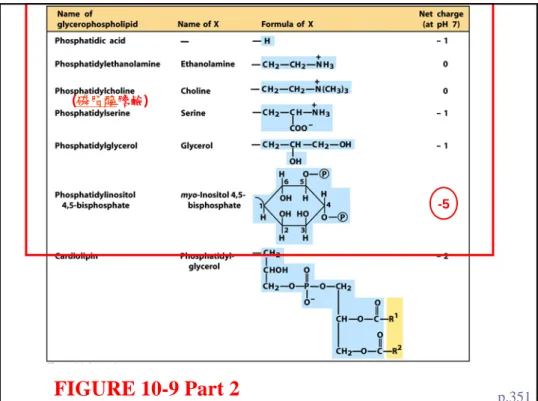
Glycerophospholipids, also called phosphoglycerides, are membrane lipids in which two fatty acids are attached in ester linkage to the first and second carbons of glycerol.
p.350
FIGURE 10–8 the backbone of phospholipids.
p.351
FIGURE 10–9 Glycerophospholipids.
backbone of phospholipids
O
FIGURE 10-9 Part 2 p.351
-5 (磷脂醯膽鹼)
The properties of head groups determine the surface properties of membranes
Different organisms have different membrane lipid head group compositions
Different tissues have different membrane lipid head group compositions
Examples of Glycerophospholipids:
Phosphatidylcholine
(磷脂醯膽鹼,卵磷脂)
Phosphatidylcholine is the major component of most eukaryotic cell membranes
Many prokaryotes, including E. coli cannot synthesize this lipid; their membranes do not contain
phosphatidylcholine
Some Glycerophospholipids Have Ether-Linked Fatty Acids
Some animal tissues and some unicellular organisms are rich in ether lipids, in which one of the two acyl chains is attached to glycerol in ether, rather than ester, linkage.
FIGURE 10-10
p.351
Ether lipids:
Plasmalogen
Vinyl ether analog of phosphatidylethanolamine
Common in vertebrate heart tissue
Also found in some protozoa and anaerobic bacteria
Function is not well understood
Resistant to cleavage by common lipases but cleaved by few specific lipases
Increase membrane rigidity?
Sources of signaling lipids?
May be antioxidants?
FIGURE 10-10
p.351
Ether lipids:
Platelet- activating factor
Aliphatic ether analog of phosphatidylcholine
Acetic acid has esterified position C2
First signaling lipid to be identified
Stimulates aggregation of blood platelets
Plays role in mediation of inflammation
Chloroplasts Contain Galactolipids and Sulfolipids
The second group of membrane lipids are those that predominate in plant cells: the
galactolipids
, in which one or two galactose residues areconnected by
a glycosidic linkage to C-3 of a 1,2-diacylglycerol.
FIGURE 10-11
p.352
Fig. 10–11 Three glycolipids of chloroplast thylakoid membranes
Archaea contain unique membrane lipids
Most of the archaea live in ecological extreme conditions (e.g. high temperatures, low pH, high ionic strength).
The have membrane lipids containing long-chain branched hydrocarbons linked at each end to glycerol through ether bonds.
Ether bonds are more stable to hydrolysis at low pH and high temperatures.
These archaea lipids are twice the length of phospholipids and sphingolipids, and can span the full width of the surface membrane.
FIGURE 10-12
p.353
FIGURE 10–12 A typical membrane lipid of archaea.
Linked at each end to glycerol through ether bonds
General name:
glycerol dialkyl glycerol tetraethers
Sphingolipids Are Derivatives of Sphingosine
Sphingolipids (神經鞘脂質), the fourth large class of membrane lipids, also have a polar head group and two nonpolar tails
The backbone of sphingolipids is NOT glycerol.
The backbone of sphingolipids is a long-chain amino alcohol, sphingosine
A fatty acid is joined to sphingosine via an amide linkagerather than an ester linkage as usually seen in lipids
A polar head group is connected to sphingosine by a glycosidic or phosphodiester linkage
The sugar-containing glycosphingolipids are found largely in the outer face of plasma membranes
Glycerol backbone Sphingosine backbone
There are three subclasses of sphingolipids.
(1) Sphingomyelins (神經鞘磷脂質)contain
phosphocholine or phosphoethanolamine as their polar head group and are therefore classified along with glycerophospholipids as phospholipids (Fig. 10–7).
Sphingomyelin is abundant in myelin sheath(髓鞘)that surrounds some nerve cellsin animals
(2) Glycosphingolipids, which occur largely in the outer face of plasma membranes, have head groups with one or more sugars connected directly to the ─OH at C-1 of the ceramide moiety
p.354
Sphingolipids
(3) Gangliosides, the most complex sphingolipids, have oligosaccharides as their polar head groups and one or more residues of N-acetylneuraminic acid (Neu5Ac), a sialic acid, at the termini.
p.354
FIGURE 10-7
p 350
FIGURE 10–7 Some common types of storage and membrane lipids.
Glycosphingolipids and Blood Groups
The blood groups are determined in part by the type of sugars located on the head groups in glycosphingolipids.
The structure of sugar is determined by a expression of specificglycosyltransferases
Individuals with no activeglycosyltransferase will have the O antigen
Individuals with a glycosyltransferase that transfers an N- acetylgalactosaminegroup have A blood group
Individuals with a glycosyltransferase that transfers a galactosegroup to phosphate will have B blood group
N-acetylgalactosamine
galactose
Phospholipids and sphingolipids are degraded in lysosome
For each hydrolyzable bond in
glycerophospholipids, there is a specific hydrolytic enzyme in lysosome.
Phospholipasesof the A type remove one of the two fatty acids (These esterasesdo not attach the ether bond of plasmalogens), producing a
lysophospholipid. Lysophospholipases remove the remaining fatty acid.
Gangliosides are degraded by a set of lysosomal enzymes the remove sugar units. A genetic defect leads to accumulation of gangliosides in the cell with severe medical consequences. (see box 10-2)
FIGURE 10-16
p.355 FIGURE 10–16 The specificities of phospholipases.
Brain cell of Tay-Sachs disease
Sterols(固醇) Have Four Fused Carbon Rings
Sterolsare structural lipids present in the membranes of most eukaryotic cells. The characteristic structure of this fifth group of membrane lipids is the steroid (類固醇) nucleus, consisting of four fused rings, three with six carbons and one with five (Fig. 10–17).
Cholesterol (膽固醇), the major sterol in animal tissues, is amphipathic, with a polar head group (the hydroxyl group at C-3) and a nonpolar hydrocarbon body, about as long as a 16-carbon fatty acid in its extended form.
p.355
FIGURE 10-17
p.355 FIGURE 10–17 Cholesterol.
Bile acids (膽酸)are polar derivatives of cholesterol that act as detergents in the intestine, emulsifying dietary fats to make them more readily accessible to digestive lipases.
p.357
Physiological Role of Sterols
Cholesteroland related sterols are present in the membranes of most eukaryotic cells.
Modulate fluidity and permeability
Thicken the plasma membrane
Most bacteria lack sterols
Mammals obtain cholesterol from foodand synthesizeit de novo in the liver
Cholesterol, bound to proteins, is transported to tissues via blood vessels
Cholesterol in low-density lipoproteinstends to deposit and clog arteries
Many hormonesare derivatives of sterols
Steroid Hormones
Steroids are oxidized derivatives of sterols
Steroids have the sterol nucleus, but lack the alkyl chain found in cholesterol. This makes them more polarthan cholesterol.
Steroid hormones are synthesized in gonads and adrenal glands from cholesterol
They are carried through the body in the blood stream, usually attached to carrier proteins
Many of the steroid hormones are male and female sex hormones
FIGURE 10-19
p.359 FIGURE 10–19 Steroids derived from cholesterol.
10.3 Lipids as Signals, Cofactors, and Pigments
Eicosanoids Carry Messages to Nearby Cells
Ecosanoids are paracrine hormones, are are present in small amounts but play vital roles as signaling molecules
between nearby cells
All eicosanoids are derived from arachidonic acid (花
生酸)
(20:4(Δ5,8,11,14)) (Fig. 10–18), the 20-carbon polyunsaturated fatty acid from which they take their general name. There are three classes of eicosanoids:(1) Prostaglandins(PG) contain a five-carbon ring originating from the chain of arachidonic acid.
p.357
(2)Thromboxanes have a six-membered ring containing an ether. They are produced by platelets (also called thrombocytes) and act in the formation of blood clots and the reduction of blood flow to the site of a clot.
(3)Leukotrienescontain three conjugated double bonds.
• Variety of functions:
Functions:
• Inflammation and fever (prostaglandins)
• Formation of blood clots (thromboxanes)
• Smooth muscle contraction in lungs (leukotrienes)
• Smooth muscle contraction in uterus (prostaglandins)
p.358
Vitamins A and D Are Hormone Precursors
Vitamin D3, also called cholecalciferol, is normally formed in the skin from 7-dehydrocholesterol in a photochemical reaction driven by the UV component of sunlight (Fig. 10–20a).
Vitamin A (retinol), in its various forms, functions as a hormone and as the visual pigment of the vertebrate eye (Fig. 10–21).
p.360
p.360
FIGURE 10-20
FIGURE 10–20 Vitamin D3production and metabolism.
FIGURE 10-21
p.361 FIGURE 10–21 Vitamin A1and its precursor and derivatives.
Vitamins E and K and the Lipid Quinones Are Oxidation- Reduction Cofactors
Vitamin Eis the collective name for a group of closely related lipids called tocopherols, all of which contain a substituted aromatic ring and a long isoprenoid side chain (Fig. 10–22a).
The aromatic ring of vitamin K(Fig. 10–22b) undergoes a cycle of oxidation and reduction during the formation of active prothrombin, a blood plasma protein essential in blood clotting.
p.361
FIGURE 10-22(a-c)
p.362
FIGURE 10-22(d-f)
p.362 FIGURE 10–22 Some other biologically active isoprenoid
compounds or derivatives.
FIGURE 10-23
p.363 FIGURE 10–23 Lipids as pigments in plants and bird feathers.
10.4 Working with Lipids
Some methods commonly used in lipid analysis are shown in Figure 10–24.
(1) Lipid Extraction Requires Organic Solvents (2) Adsorption Chromatography Separates Lipids of Different Polarity
(3) Gas-Liquid Chromatography Resolves Mixtures of Volatile Lipid Derivatives
(4) Specific Hydrolysis Aids in Determination of Lipid Structure
p.363
FIGURE 10–24 Part 1
p.364
FIGURE 10–24 Part 2
p.364
FIGURE 10–24 Part 3
p.364 FIGURE 10–24
Common
procedures in the extraction, separation, and identification of cellular lipids.
(5) Mass Spectrometry Reveals Complete Lipid Structure (6) Lipidomics Seeks to Catalog All Lipids and Their Functions
The structural lipids of membranes include both glycerophospholipids and sphingolipids, separate
categories in Table 10–3. Each method of categorization has its advantages.
p.365
TABLE 10-3
p.366