行政院國家科學委員會補助專題研究計畫 ■ 成 果 報 告
□期中進度報告
輕度障礙學生數學教學之知識管理導向數位學習平台研發-- 總計畫(3/3)
計畫類別:□ 個別型計畫
■整合型計畫 計畫編號:NSC 96-2524-S-006-001
執行期間: 96 年 8 月 1 日至 97 年 10 月 31 日
計畫主持人:陳裕民
共同主持人:朱慧娟、王昌斌、朱治平、吳宗憲、李昇暾、詹士宜 計畫參與人員:陳明彥、林家柔、鄭志新
成果報告類型(依經費核定清單規定繳交):□精簡報告 ■ 完整報告
本成果報告包括以下應繳交之附件:
□赴國外出差或研習心得報告一份
□赴大陸地區出差或研習心得報告一份
□出席國際學術會議心得報告及發表之論文各一份
□國際合作研究計畫國外研究報告書一份
處理方式:除產學合作研究計畫、提升產業技術及人才培育研究計畫、
列管計畫及下列情形者外,得立即公開查詢
□涉及專利或其他智慧財產權,□一年□二年後可公開查詢
執行單位: 國立成功大學
中 華 民 國 97 年 10 月 31 日
中文摘要
本計畫之目標在設計一 Problem-Based e-Learning (PBeL)模式與數位知識內容,再依此建構 一「輕度障礙學生數學教學」數位學習平台,以促進職前教師與在職教師之專業發展,並 協助輕度障礙學生之教師與家長及從事特殊教育之人員,獲取「輕度障礙學生數學教學」
相關知識,以有效的輔導國內輕度障礙學生的數學學習。本 Problem-Based e-Learning (PBeL) 模式係以情境學習為基礎,結合社會建構、案例學習、以及問題導向學習等學習理論,除 提供適性化學習外,亦提供線上討論、知識創新、知識回饋等機制。數位知識內容則包括 正規知識、實務知識、經驗知識。
關鍵詞: 問題導向學習、數學教學、數位學習
Abstract
This research proposed a Problem-Based e-Learning (PBeL) model with digital knowledge contents for the development of a Problem-Based e-Learning platform to enhance special education teachers’ knowledge of mathematics teaching for students with mild disabilities. This model adopted the situated learning as a theoretical basis along with social constructivism, case-based learning, and problem-based learning approaches. In addition to adaptive learning, this model also provided the learner with ongoing processes of discussions, innovations, and feedback. The digital knowledge contents included formal knowledge, practical knowledge, and empirical knowledge. The ultimate goal of the preset study was to enhance mathematics teaching for students with mild disabilities with considerations of the knowledge development and problem-solving capabilities in real teaching situations.
Keyword: Problem-based learning (PBL), mathematics teaching, eLearning
1. INTORDUCTION
Based on the educational belief of “No Child Left Behind,” improving the educational system for children with mild disabilities has been a key focus of educational reforms. Inclusive education as a prominent trend implies that the task of teaching students with special needs must be taken on and shared by not only special education teachers but also regular teachers. However, regular teachers have often found themselves lack of knowledge and skills required for special education.
On the other hand, special education teachers also run into difficulties in dealing with teaching problems due to a lack of practical knowledge. As students nowadays are more heterogeneous, it is imperative for teachers to improve their professional knowledge and competence through continuous learning. Moreover, factors such as geographic dispersion, resources disparity, and constraints of time and space have all made it pressing for the education community to provide teachers with opportunities for continuous learning and adequate support.
With the advances in information technologies and the ever-increasing popularity of the Internet, the e-Learning model that features an integration of the Internet and information technologies has become a newly rising trend in learning as well as upgrades and reforms of education (SCORM, 2003;LTSC, 2004;LMML, 1999). E-Learning provides learners with a learning medium that is not constrained by time, space, distance, and non-synchronized learning activities. However, as far as the development of knowledge and competence of pre-service and in-service special education teachers are concerned, current e-Learning platforms still have following issues: (1). They tend to emphasize more on applications of information technologies and fail to provide sufficient guidance on learning concepts or strategies; (2). Most of them provide only knowledge and teaching materials related to education theories but not practical knowledge required for solving students’
learning problems; and (3). Their functionality covers only mechanisms for storing and searching knowledge and information, but not the acquisition, assessment, management, and maintenance of knowledge, or teaching experience feedbacks. The benefits of e-Learning thus are limited.
Research shows that mathematics is one of the most troubling subjects for elementary and middle school students, especially for students with special needs. Studies in fact indicated that nearly all second grade students with mild learning disabilities have the potential to solve the mathematics problems. Developing teachers’ adaptive strategies to increase students’ experiences of success in mathematics is therefore crucial. Unfortunately, studies also showed that when math teachers faced learning problems for students with mild disabilities, most of them just kept repeating the same strategies rather than seeking for alternatives (Fuchs, et al, 1991). To effectively instruct these special students on learning mathematics, providing teachers with knowledge regarding
“appropriate strategies in teaching mathematics to students with mild disabilities” has become a critical component for special education.
2. RESEARCH OBJECTIVE
The primary goal of the present study was to improve the mathematics teaching for students with mild disabilities with the considerations of teachers’ knowledge development and problem-solving capabilities in real-life teaching situations. To achieve the goal, a Problem-Based e-Learning (PBeL) model was developed by adopting the situated learning as a theoretical basis along with social constructivism, case-based learning, and problem-based learning approaches.
The model was then used as the basis for the planning and design of an e-Learning platform.
Such a platform can assist teachers in analyzing student’s learning problems and assessing teacher competence (analysis stage). Outcomes of such analyses were then used for planning teacher’s learning procedures and retrieving learning materials (design and development stage).
The retrieved learning materials then served as the basis for guiding teachers in performing problem-based learning (implementation stage). To strengthen teachers’ learning, additional online discussion functions based on social constructivism were offered for the aforementioned learning procedures. As far as learning materials were concerned, digital knowledge content such as formal knowledge, practical knowledge, and empirical knowledge were developed to support the proposed problem-based eLearning.
3. REVIEW OF RELATED WORK
The issues of e-learning include development of e-learning environments, development of learning content (Daniela, 2005), and management of learning resources. This section briefly discusses related researches on these issues.
3.1 Development of e-Learning Environments
Stockley (2003) defines e-learning as “The delivery of a learning, training or education program by electronic means. E-learning involves the use of a computer or electronic device in some way to provide training, educational or learning material”. In its broad definition, e-Learning includes instruction delivered via all electronic media including the Internet, intranets, extranets, satellite broadcasts, audio/video tape, interactive TV, and CD-ROM (Thavamalar,2002). Numerous definitions of e-learning have been proposed. However, Said Hadjerrouit (1999) indicated that the success of integration of suitable learning theories into e-learning environment to achieve pedagogical goal depends heavily on requirements analysis and pedagogical design.
Recent researches emphasized that development of e-learning environments should not only consider IT technologies implementation, but also the pedagogical foundation based on learning theories (Conole, 2003; Govindasamy, 2002; Hamid, 2002; Harasim, 2000; Mayes & Fowler, 2005). Ataiyal Legend (Ho et al, 2007) applied a computer adventure game based on constructivism and situated learning theory in Ataiyal tribal culture learning. Through exploring, objects collecting, thinking, problem solving, this system gets the learner to get involved in learning by using a reasonable and dramatic content.
Virtual eBMS (Secundo, Elia, & Taurino, 2007) utilized the Problem Based Learning (PBL) approach in a Web based environment. The system was applied in business management and technology management domain. The virtual eBMS not only allowed an author to design PBL-based curricula, but also provided two main learning approaches (structured and unstructured) for learners to capture the most suitable learning resources for solving complex problems. VMS (virtual medical school) (Shyu et al., 2004) integrated collaborative and self-directed learning to provide a problem-based e-learning environment, and utilizes Hospital Information System (HIS) to capture and store valuable clinical cases.
3.2 Development of Learning Content
Learning resources can be classified into formal knowledge and practical knowledge based on the source of content on learning resources. Formal knowledge is explicit knowledge which is easier to codify, articulate and share (Nonaka and Takeuchi, 1995). Learning resources with formal knowledge could be produced based on textbook or technologies handbooks. On the contrary, practical knowledge is tacit knowledge that is difficult to formulate, measure or value (Nonaka and Takeuchi, 1995).
In addition to produce content of learning resources, another issue in development learning sources is to enhance its reusability. Recently, learning objects have been proposed as an approach to creating and sharing learning resources. A learning object is a unit of digital resource that can be shared to support teaching and learning (Wiley, 2000; Wiley & Edwards, 2002).
Polsani (2003) defined learning object as “an independent and self-standing unit of learning content that is predisposed to reuse in multiple instructional contexts”. Wiley (2000) outlined learning objects as “instructional designers can build small (relative to the size of an entire course) instructional components that can be reused a number of times in different learning contexts.”
Learning Object Metadata (LOM) is a metadata standard to describe educational resources with characteristics of easy access, searching, and portability. Presently, there are four common learning object metadata standards: the Dublin Core Education Working Group draft proposal (Dublin Core Metadata Initiative Education Working Group, 2000), the IMS Learning Resource Meta-data Specification (IMS Global Learning Consortium, 2004), the IEEE Learning Object Metadata (LOM) specification (IEEE Learning Technology Standards Committee, 2004) and Sharable Content Object Reference Model (SCORM, 2004).
Ontology is a way for knowledge representation and sharing. Bouzeghoub et al (2005) described a semantic description of LOs using ontology. Mohan and Brooks (2003) indicated that ontology is useful for marking up the structure of learning objects and describing pedagogical meaning to them so that they can be understandable by machines. Stojanovic et al. (2001) presented an approach for implementing the e-Learning scenario using Semantic Web technologies. It is primarily based on ontology-based descriptions of content, context and structure of the learning materials and thus provides flexible and personalized access to these learning materials.
Besides formal knowledge, to capture and accumulate practical knowledge, as well as to provide learning resources on practical knowledge is the trend for development of environments for workplace learning such as eLearning systems for expert teacher knowledge development.
Rolf (1995) defined practical knowledge as practice oriented personal knowledge, which is the ability to perform valid actions according to the ability to act, the occurrence of certain quality criteria, and that these criteria are practiced in the action (Rolf, 1995; Chen, 2002). The process of gathering expert’s practical knowledge is called knowledge acquisition (KA) which includes the elicitation, collection, analysis, modeling and validation of knowledge (Nick Milton,2003).
Knowledge elicitation (KE) is the process of obtaining implicit knowledge from an expert.
Various KE techniques have been developed, such as unstructured interviewing (Cullen &
Bryman, 1988), protocol analysis (Cullen & Bryman, 1988; Hart, 1985), repertory grids (Boose, 1989), prototyping (Grabowski et al., 1988; Waterman, 1986), multidimensional scaling (Elliot, 1986), cluster analysis (Cooke et al., 1987), event recall (Hoffman, 1987), discourse analysis (Belkin, Brooks, & Daniels, 1987) and card sorting (Burton, Shadbolt, Hedgecock, & Rugg, 1987). In addition, Navid et al.(2008) developed a method for human driven knowledge acquisition (KA). They’d used a combination of KA techniques including semi structured interview, revised teach-back, commentary, laddering, and repertory grid techniques to elicit both tacit and explicit knowledge of experts. In recent years, the knowledge elicitation process has commonly been referred to as a modeling effort. Ontology has been regarded as one of the key
technologies for knowledge modeling and representation. Practical knowledge which described by ontology couldbe reused and shared among e-learning platforms.
3.3 Knowledge Management and e-Learning
The real value of e-Learning lies on not only its ability to train anyone, anytime, anywhere, but also on the ability to train the right people and to gain the right skills or knowledge at the right time. Hence, adequate management of educational resources to provide meaningful learning for learners and to promote quality learning is necessary in eLearning.
Knowledge management (KM) refers to the identification, acquisition, selection, storage, management, application, and sharing of knowledge, by an organization or individuals (Demarest, 1997). KM represents a systematic process of knowledge accumulation as well as the effective use of knowledge to help realize greater benefits when both individuals and the whole organization improve as a result of the popularization of knowledge.
As e-learning is a knowledge intensive process, the effectiveness of e-learning is highly dependent on the quality of its content knowledge, which in turn counts on the success of knowledge capture, storage, sharing and innovation. Therefore, the concepts and methods of knowledge management can be employed in e-learning to improve the benefits of learning platform and e-learning effectiveness (Ras, 2005).
Researches have been conducted on integration of knowledge management and e-learning. Ley et
al. (2005) identified competence management as a possible approach to facilitate learning with KM systems. KMLS (Knowledge Management Learning System) used the method of concept maps to integrate knowledge management into instructional, learning and technological tier to make learning process more progressive and meaningful (Hsuan-Hung Chen, 2008). ConKMeL (contextual knowledge management framework) was developed based on the analysis of knowledge communication models in e-Learning environments (Huang, W., 2003). This framework enabled integrated multimedia knowledge discovery, retrieval and reuse to support intelligent multimedia e-Learning. Subjunctive Interfaces were proposed to integrate KM and exploratory e-Learning so as to support users in learning processes by offering multiple enquiries in parallel (Jantke, Lunzer & Fujima, 2005). Exploratory learning aimed at learning experiences that offer opportunities to recognize patterns of knowledge.
4. PROBLEM-BASED E-LEARNING (PBeL) MODEL
This section describes the development of the Problem-based e-Learning model, including a theoretical framework, a conceptual framework, and a knowledge development process.
4.1 Theoretical Framework
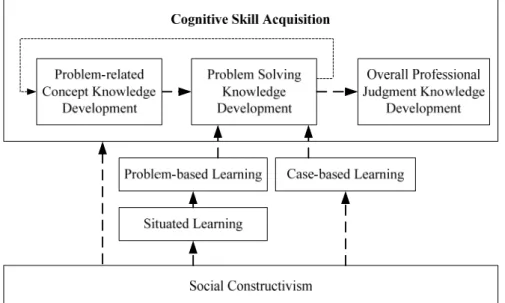
The “course of cognitive skill acquisition” (VanLehn, 1996; Patel, Kinshuk, & Russell 2000;
Renkl & Atkinson, 2003) and teachers’ professional development model, proposed by Patel, Kinshuk and Russell (2000), were used as the bases of the eLearning process. This eLearning process includes stages of concept knowledge development, problem-solving knowledge development, and overall professional judgment knowledge development.
Problem-Based Learning (PBL) is a learning approach that is to assemble and provide learning cases on existing real-world problems, and to guide the learner in utilizing and developing his or her understanding, problem solving skills, and judgments in real-world problem solving (Barrows, 1996; Levin, 2001). It provides the learner with practical experiences and allows him/her to achieve both “knowing” and “knowing how” (Delisle, 1997) through the learning context that much resembles an authentic learning context for the learner, which was particularly emphasized by the situated learning theory (Souders & Prsecott, 1999). It is believed that problem-based learning may augment the structure of the learner’s understanding, as well as his or her ability to integrate new knowledge (Robertson, 2000).
Nevertheless, Fenwick and Parsons (1998) mentioned that while PBL is able to improve the learner’s motivation, solely utilizing such pedagogy may sometimes cause knowledge gaps.
Advocates of situated learning also stressed the need for professional cognitive apprenticeship, and contended that the learner must engage in an active, participatory learning process within a scaffold provided by a teacher, an expert, or a more experienced learner, who plays the role of a coach or facilitator to the learner.
Pedagogies based onsocial constructivism perceive learning as a collective thinking process that involves teacher-student or student-student interactions to solve problems, learn new knowledge and concepts, and make appropriate decisions. Students have to discuss with each other, in order to negotiate meanings or forge a consensus (Rogoff, 1990). Learning through discussions is highly valued and supported by social constructivists. When the learner interacts with other learners or teachers, concepts are formed in a natural way. Through talking to each other, they have collectively created a world that can be described and discussed (Solomon, 1987).
The case-based learning approach used in the field of teacher professional development involves narration of teaching practices based on a real classroom case and helps the learner link theories with practice (Chin & Lin, 2000; Merseth, 1996; Richardson, 1993) to stimulate introspections (Richert, 1991) and effective constructions of teaching knowledge.
According to the above discussions, we believe that providing a learner with a learning context similar to the teaching problems encountered by the learner may better enhance teachers’
professional development. Therefore, this study has chosen the situated learning as a theoretical basis to integrate learning theories of social constructivism and case-based reasoning along a problem-based learning approach. The theoretical framework of this study is illustrated as Figure 1.
Figure 1. Theoretical Framework.
4.2 Conceptual Framework
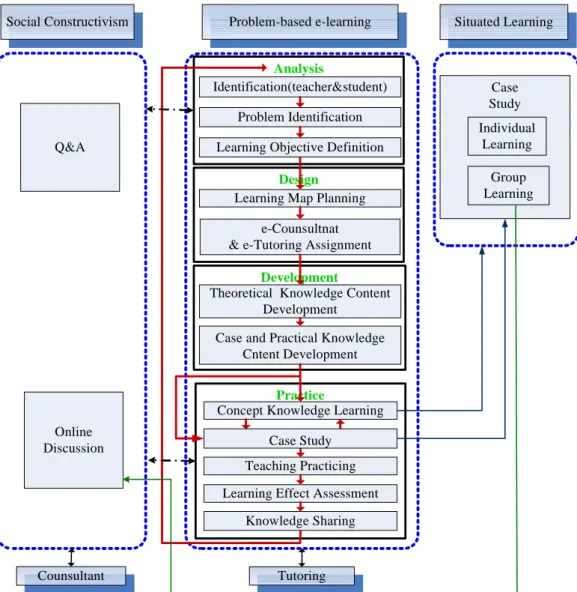
In accordance with the previous theoretical framework, this study designed an e-Learning model with problem-based learning as its core and social constructivism and situated learning as its auxiliary theories. In the spirit of PBL, this model includes the stages of analysis, design, development, and practice (refer to Figure2).
The analysis stage involves assessing a learner’s (i.e. teacher’s) knowledge of the students with mild disabilities, pedagogical content knowledge of mathematics, knowledge of modifications of curriculum, teaching methods, materials, techniques, and learning environments for teaching students with mild disabilities, mathematical content knowledge, and then diagnosing the students’ learning problems. The learning goal for the learner is then translated into “solving
students’ learning problems.” The design stage identifies the learner’s background information and teaching objectives in order to outline a personalized learning plan. The development stage develops contents, such as concepts and cases, for the personalized learning plan. Finally, the practice stage guides the learner to initiate learning activities, such as concept learning, case studies, practical teaching, feedback on teaching experience and knowledge sharing. After the learner has completed the concept learning and case studies, he/she is required to begin realistic teaching, by applying learned knowledge to realistic teaching context. Lastly, the system knowledge content can continue to expand and update as the learners would share their knowledge and thoughts.
A learner undertaking case studies may select either “individual learning” or “group learning”.
The “group learning” takes the learner to a learning mode based on social constructivism, where the learner may initiate a group discussion and direct questions to experts or learners with related experience in any phase of the case study. During Q&A sessions or online discussions in this forum, an experienced teacher or expert plays the role of an e-consultant to guide the learners to complete their learning processes.
Figure 2. Conceptual Framework of PBeL Model.
4.3 Knowledge Development Process
As learning is itself a knowledge development process, the present PBeL model can also be seen
Case Study
Development Design Analysis
Identification(teacher&student)
Theoretical Knowledge Content Development
Problem Identification
Problem-based e-learning Situated Learning
Case and Practical Knowledge Cntent Development Social Constructivism
Counsultant
Learning Map Planning e-Counsultnat
& e-Tutoring Assignment
Practice
Concept Knowledge Learning
Teaching Practicing
Tutoring Q&A
Online Discussion
Learning Effect Assessment Case Study
Knowledge Sharing Learning Objective Definition
Individual Learning
Group Learning
as a knowledge development process as discussed below.
The first stage is to develop knowledge of student awareness. Learners are counseled to determine the student’s mathematics ability, identify strengths and weaknesses of the student, and determine eligibility for special education services. The student’s performance level, preacademic, academic, and cognitive abilities were assessed to identify the areas where the student needs special assistance. Understanding students’ strengths and weaknesses can predict student’s difficulties in learning mathematics. Determining eligibility for special education services can identify a group of students with similar learning problems so that teachers can adopt particular strategies and remedial approaches for them.
The second stage is to develop concept knowledge. Learners are guided to develop formal knowledge based on students’ problems and the learner’s professional competence. The curriculum of concept learning is based on the learner’s needs. In addition, in the process of case studies, if a learner has inquiries about certain concepts, he or she may freely begin related concept learning.
The third stage is to develop practical knowledge for student’s learning problem solving through studying similar learning cases. Personalized scaffolds were used to guide the learner in studying the know-what, know-why and know-how of a teaching case present in a learning cases. This stage subsequently guides the learner in practical teaching. Through case study, teaching practice and group discussion, Q&A, debate, concept verification, and the link between theoretical and practical knowledge, confusing notions and the underlying pedagogies and knowledge may be elucidated.
The fourth stage is to ensure that the learner’s problem solving knowledge and application abilities will be nurtured. Through multifaceted case studies and teaching problem solving, the learners will be equipped with professional teaching knowledge of comprehensive problem understanding and strategy to address various students’ learning problems.
5. PROBLEM-BASED E-LEARNING SYSTEM FRAMEWORK
This section presents the planning and design of a problem-based eLearning system framework based on the present Problem-based e-Learning (PBeL) model.
5.1 Objective and Scope
The purpose of this research is to provide pre-service and in-service teachers with a platform for the development of professional teaching knowledge and abilities to solve students’ learning problems specifically on mathematics teaching for students with mild disability. This study focused on elementary school students with learning disabilities, serious emotional disorders, mild mental retardation, or high-functioning autism.
5.2 Requirements Analysis
Requirements that may help achieve the system objectives can be identified from the following perspectives: (1) the functionality to realize the proposed PBeL model, (2) the needs to fulfill the characteristics of e-Learning, and (3) the principles of software system development.
In order to realize the Problem-Based e-Learning Model, the following functions are required: (1) Concept knowledge learning provides means for concept knowledge development. (2) Problem-Based Learning provides functions for (a) identifications of the learner’s competence and determinations of students’ disabilities and learning difficulties; (b) formal knowledge navigation according to the abilities and knowledge of the learner, as well as the knowledge needed to solve problems; (c) case-based learning in providing reference cases for the learner to study based on students’ mathematics disabilities; (d) learning effectiveness assessment which is to assess how well the learner can learn by observing students’ assessments. (3) Teaching practice provides functions for teaching plan preparations and teaching plan validations. (4) Interactive Learning provides interactive learning mechanisms such as on-line discussion, Q&A, e-Tutoring and e-Consultant based on social constructivism.
As knowledge is one of the key elements in the platform, from the knowledge management viewpoint, this platform needs to support knowledge acquisition, storage and management, knowledge sharing, and knowledge innovation and validation. It allows the knowledge content and teaching materials to be constantly updated so as to enhance the teaching and learning capabilities of both teachers and students. PBeL platform therefore may have many different types of digital knowledge content with distinct attributes and complex relations among them.
Mechanisms for knowledge representation, storage, integration, retrieval and maintenance are certainly required in the framework.
Besides freeing the learner from the constraints of time, space, and non-synchronizing activities, e-Learning also provides the advantages of individual and adaptive learning. Therefore, the current platform also implements planning and case reasoning mechanisms to arrange learning goals and procedures and to suggest suitable learning cases for study based on the learners’
backgrounds, problems encountered, and students’ characteristics.
As a software system, the current platform also has the characteristics of general software systems, such as multi-tier architecture, flexibility, high probability, scalability, and reusability.
5.3 Conceptual Functional Framework
The functional framework was designed based on the result of the functional requirement analysis, including the modules of Concept Learning, Problem-based Learning, Teaching Practice, Interactive Learning, Knowledge Acquisition, and Management as shown in Figure 3.
(01) Concept learning
(02) Problem based learning
Problem-based e-Learning
(04) Interactive Learning
4.3 Online discussion 4.2
FAQ 1.2
Concept navigation 1.1
Concept query
(03) Teaching practice
3.1 Teaching plan
preparation
3.2 Teaching narration
2.1 Case retrieval
2.2 Individual case based
learning
4.1 Q&A
(05) System administration
5.1 Account management
52 Content management
2.3 Collaborative
learning
3.2 Case development
Figure 3. Part of the Functional Framework.
5.3.1 Concept learning
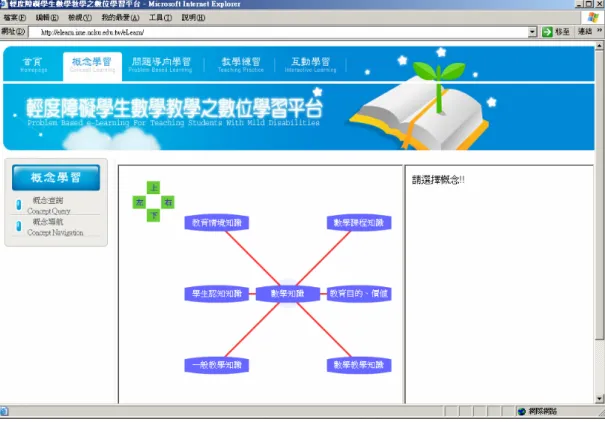
Concept learning may conduct through concept query or concept navigation. In concept query, the learner may query a specific concept using keywords. A concept graph that shows the concept and its associated concepts will be provided. The learner may explore the concepts through the concept graph. In concept navigation, learners are allowed to express the question or problem encountered in natural language. A concept map that shows a core concept along with related concepts is provided for concept navigation. Figure 4 shows the interface of concept learning.
Figure 4. Interface of concept learning.
5.3.2 Problem-based learning
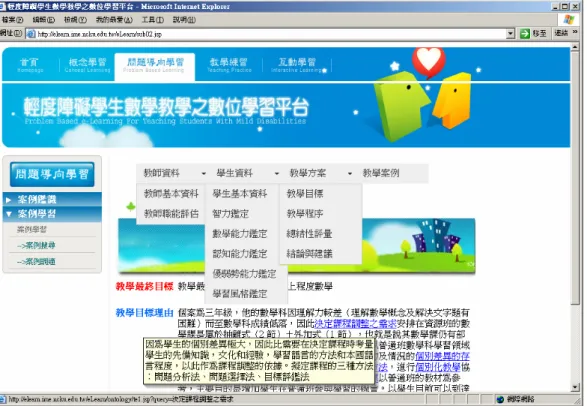
Problem-based learning includes simple and regular modes. A learner using the simple mode can describe the students’ learning problems he or she has encountered in natural language. The platform will provide the learner with reference learning cases for study.
The regular mode of problem-based learning is conducted through steps of problem statement and assessment, concept learning and case study. When a learner logs into the platform at the first time, he or she is required to provide personal data and take a competence assessment. A user model will be built based on the learner’s personal information and results of competence assessment. After entering his/her student’s data, the learner is required to describe student’s learning problem in natural language. To understand the students better, the platform will guide the learner to assess his/her student’s academic performance, along with the disability type, learning style, and strengths and weaknesses of the student. A student model is then built based on the assessment results.
According to the learner’s competence and the student’s characteristics, the platform performs a case-based reasoning to search for similar cases for case study. If no similar case is available, a rule-based reasoning will be conducted to convert the encountered problems into learning goals and assemble a case for reference.
Once a reference case is available, a learning navigation function will help the learner complete the learning procedure along with providing relevant concept knowledge, case examples, and embedded questions and answers. Through questioning and answering, the learner may contemplate and internalize knowledge obtained from learning cases. If collaborative learning is chosen, a learning community will be formed and online discussion functions will be activated for the group learning. Figure 5 shows the interface of problem-based learning.
Figure 5. Interface of problem-based learning.
5.3.3 Teaching practice
After case study, the learner is required to teach using the cases he or her ever studied for reference. The learner may prepare a teaching plan through retrieving teaching cases for reference and submit his or her teaching plan for validation before teaching. After the entire learning and teaching processes, functions for teaching narration, empirical knowledge elicitation and verification and validation are available for new case development. Similarly, expert teachers may be invited to provide their teaching narrations and associated empirical teaching knowledge through knowledge elicitation functions.
5.3.4 Interactive learning
Interactive learning serves as online group discussion, FAQ and Q&A. If the learner chooses collaborative case-based learning, an online discussion mechanism will be activated to allow the learner and other learners to engage in a social constructivism learning process. Former users and learners will be invited to join the discussion according to their areas of expertise. The platform will invite an expert teacher as e-Consultant to aid and monitor the learning process.
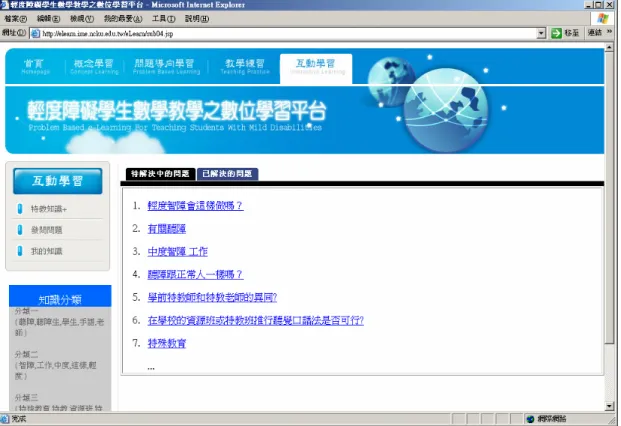
If only suggestions or answers are needed for a specific teaching problem or question, the learners can directly input their question into the Q&A function to wait for answers from other users or search for existing answers through FAQ or Q&A. Figure 6 shows the interface of interactive learning.
Figure 6. Interface of interactive learning.
5.3.5 System Administration
Functions for account management and content management are provided for the system administration. The former is used for membership management, access control and user data
management, while the latter is used for managing concept map, in-depth knowledge, learning cases, and empirical knowledge.
6. KNOWLEDGE CONTENT DEVELOPMENT
Development of an e-Learning platform requires not only the design of functions and mechanisms for learning activities, but also the provision of suitable learning materials. Roderick and Baden (2005) pointed out, “successful design of learning objects necessitates incorporation of instructional design and learning theories”. Therefore, knowledge identification, exploration, modeling were also conducted for the development of knowledge content.
6.1 Learning Resources Identification
Learning resources offer the necessary educational materials. Since the goal of PBel model is to help special education teachers develop knowledge so as to improve their ability to address students’ learning difficulties, besides formal knowledge, valid practical knowledge is to be provided in the PBeL platform.
Formal knowledge is acquired through a teacher’s formal training program and teaching principle that are categorized according to different scenarios. They include, as enumerated by Shulman (1987), content knowledge, general content knowledge, curriculum knowledge, pedagogical content knowledge, knowledge of learners and their characteristics, and knowledge of educational contexts and objectives.
Practical knowledge is derived from the application of formal knowledge to real-life teaching situations and the resolution and rumination of teaching difficulties (Fenstermacher, 1994).
Teachers, through real-life teaching experience, are able to develop various principles, conventions, and effective practices and experiences based on formal knowledge through personal exposure, experiences, and observations made in different situations.
In light of aforementioned knowledge of special education teachers, this study has analyzed and modeled the learning resources as discussed below (See Figure 7).
Figure 7. Learning Resource Model.
Concept is the fundamental elements of knowledge, therefore the formal knowledge of the domain in this research can be viewed as an aggregation of domain concepts associated with in-depth knowledge of the concepts. The former is the conceptual knowledge of educational theory, learning theory, mathematics education theory, mathematics teaching, physical and psychological characteristics of special education students, special education students’ cognition, and educational contextual knowledge. The latter is about the know-why as well as strategic and procedural knowledge (i.e. know-how) of the aforementioned concepts.
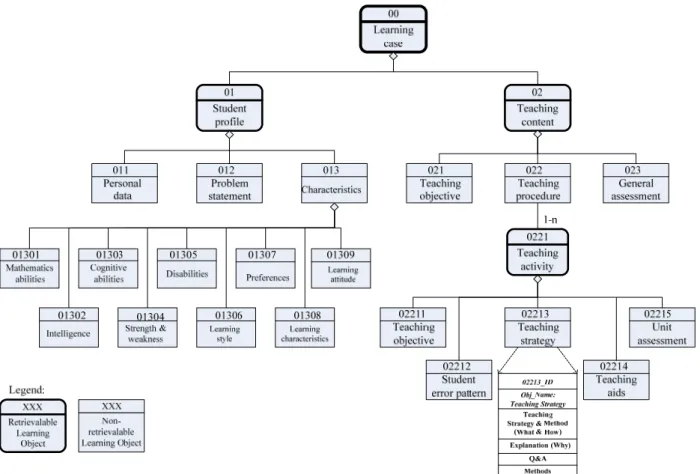
Studies found that the case method which involves the narration of teaching practices based on real classroom cases helped the teachers link formal and practical knowledge (Lin, 2000; Merseth, 1996; Richardson, 1993) and stimulated reflections and effective development of teaching concepts (Richert, 1991). Therefore, the present study employed cases for practical knowledge presentation, each of which included parts of “teaching narration” and “teaching narration explanation.” The former consisted of student profile, teaching objective, teaching procedure, teaching activity and teaching content, and general assessments. The teaching activity and content contained students’ error patterns, teaching objectives, teaching strategies, teaching methods, teaching aids and unit assessments. The latter was the explanation of the teaching narration which included interpretation of disability assessment and problem identification, the reasons for proposed teaching objective, procedure, strategy, content, and assessment,. A case presents the
“know-what” of the encountered student’s learning problems and related concepts, the
problem-solving “know-how” experienced by teachers, and the “know-why” involved in the
“know-how”,.
To make practical and formal knowledge interoperable, the concepts appear in the cases can link back to formal knowledge layer for concept explanations. On the other hand, some of the concepts and theories defined in the formal knowledge layer may also link to related cases, giving learners relevant practical materials to study and verify. Besides, questions in forms of 5W1H (what, why, when, who, where, & how) and reference answers as well as explanations are embedded in each section of the cases to allow learners to repeatedly study the case content to enhance learning efficiency.
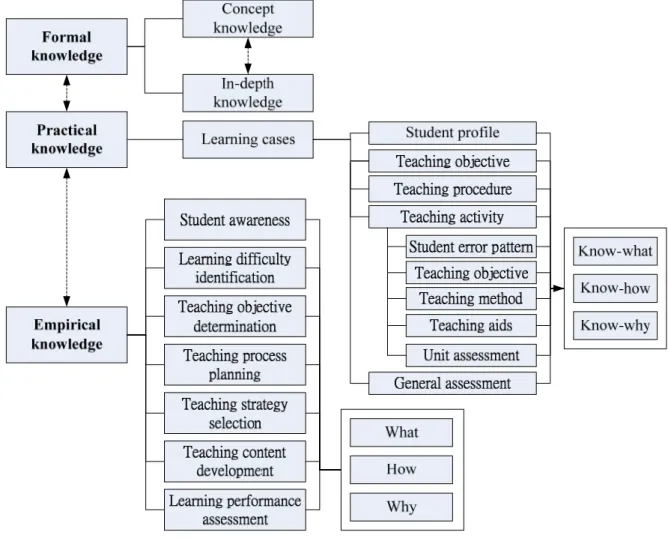
Empirical knowledge was obtained from practical knowledge by capturing and generalizing the experiential principles, procedures and methods to solving problems without presenting the background, intent, logic, reasoning, principle, and thought that were implicit in the particular method.
Learners gain, from the case study materials, both learning problem-solving methods and relevant formal knowledge which contains both the teaching procedures and the teaching strategies and methods present in cases. Through reading, discussion, critique and reflection, learners were able to develop knowledge on student’s learning difficulty identification, student’s learning characteristic assessment, teaching objective planning, teaching procedure planning, teaching activity and content design, and assessment design.
6.2 Knowledge Exploration and Modeling
This section presents the exploration and modeling of formal knowledge, practical knowledge and empirical knowledge.
6.2.1 Formal knowledge
As was mentioned earlier, formal knowledge is layered into concept knowledge and in-depth knowledge. To explore domain concepts, this study also developed an “inside-out concept exploration approach” using domain core concepts as the basis to explore other domain concepts.
Since this approach only defines the concepts that are directly related to the core concepts, one can control the scope of concept definition and decrease the amount of unneeded concept enumeration to speed up the development of domain concept model. Moreover, the further exploration of core concepts may enhance the completeness of the domain concept map.
This study took “knowledge of mathematics teaching for students with mild disabilities” as its domain root concept and it included core concepts such as mathematics knowledge, general content knowledge, mathematics teaching knowledge, physical and psychological characteristics of special education students, special education students’ cognition, and educational contextual knowledge by referencing teachers’ formal knowledge enumerated by Shulman (1987). These seven concepts were further explored and organized into a seven-layer core concept map. In order to reify the meanings of the concepts, the definitions, attributes and axioms of each knowledge concept and the relationships among concepts were defined. Moreover, the terms appear in the
definition of a core concept were defined as the auxiliary concepts of the core concept.
Ontology is believed as an effective method for defining entity, property and relationship of knowledge concepts of specific domain (Asuncion et al 2004; Uschold and Gruninger, 1996;
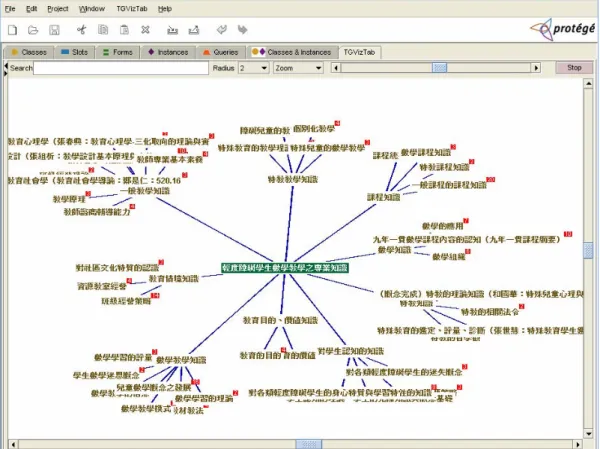
Staab et al., 2001; Schreiber et al., 1999). Therefore, to model and present the concept knowledge as well as to provide a basis for integration of formal knowledge and practical knowledge, an ontology for “mathematics teaching for students with mild-disabilities” was developed as a domain knowledge map as shown in Figure 8.
Figure 8. Part of the domain concept map.
To enhance ordinary ontology models that simply use “hierarchy” to define relationships among concepts (Asuncion et al 2004; Uschold and Gruninger, 1996; Staab et al., 2001;
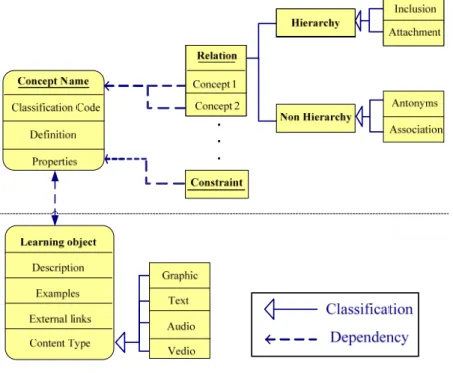
Schreiber et al., 1999), this study proposed an ontology model with more concept relationships as shown in Figure 9. The main constructs of the ontology model are concept and concept relation. A concept is defined in terms of Concept name, Classification code, Concept definition, Concept properties and Property constraints, and the concept relations can be hierarchical relations or non-hierarchical relations. The hierarchical relations can be further classified into types of inclusion and attachment, while non-hierarchical relations could be types of synonyms or association. “Inclusion” indicates a parent concept with a set of child concepts. “Attachment” which defines a child concept is a “sub-class” of its parent concept.
“Synonyms” defines the synonyms of a concept. Finally, “association” defines the “auxiliary concepts” of a core concept.
Figure 9. The proposed ontology-based concept map model.
The in-depth knowledge defines the detailed explanation, including the “know-what”,
“know-why”, “know-how”, “know-with” and examples of each core concept defined in the concept map. The present study viewed in-depth knowledge as “learning object”, which is defined in terms of description, example, external links and content type.
6.2.2 Practical knowledge
The procedure for practical knowledge model development includes steps of (1) teaching narration analysis and modeling, (2) common practical knowledge map development, and (3) case model development and verification. In the first step, teaching narrations developed by certified teachers from their own real teaching experience, observation, discussion, and expert assessments were analyzed and modeled into teaching narration knowledge maps. The teaching narration knowledge maps were used and generalized into a common knowledge map, which was the preliminary case model. The common knowledge map was then verified by a group of expert teachers to get a consensus of the learning case model.
The learning case model was composed of two parts: student profile and teachng plan. The student profile contains the statements of student problem identifications and analyses, as well as assessments of student’s learning characteristics, which included mathematics capability, intellegence, cognitive abilities, strengths and weaknesses, types of disability, and preferences.
The teaching plan contains general teaching objective, teaching procedures, the teaching teaching activities and general learning assessments. The teaching procedure consists of one or more teaching activities, which are basically teaching cases containing student’s error patterns, unit teaching objective, teaching strategy, teaching material and teaching aids.
Figure 10 shows the learning case model defined in terms of UML (Booch, Rumbaugh &
Jacobson, 1999) notations, where a box represents a class of learning objects and a diamond
indicates a composite class which is composed of its component classes. As indicated in the figure, each class includes portions of what, why, how and Q&A, and together they explain what has been done in the teaching content and why and how it was done, as well as a series of related questions for discussion and the learners’ ruminations.
In order to effectively store, organize, manage, and use the case contents, this study defined the instances of each class in the case model as learning objects by employing object technology (Bruegge & Dutoit, 2004). Besides the data (i.e content) of a learning object, methods were encapsulated in the objects as functions for manipulation of those object data to improve its adaptivity. For example, the presentation formats and display sequence of the content may vary with the learner’s learning style and cognitive trait, which were manipulated by the methods of learning objects.
The learning objects are stored in an object database, and the links among the learning objects provide a basis for case configuration and object clustering. The learning contents can be retrieved through individual learning object retrieval, entire learning case retrieval or grouping of certain learning objects. For instance, besides retrieving a whole learning case for study, a learner may retrieve student profiles to investigate the relationships between students’ learning problems and their personal and learning characteristics. The learner may also search the teaching activity as teaching cases for reference.
Figure 10. The learning case model.
6.2.3 Empirical knowledge
Empirical knowledge aims to provide the learners with concepts, experiential principles,
procedures and methods to solve students learning problems without presenting the background, intent, logic, reasoning, principle, and thought that were implicit in the particular method.
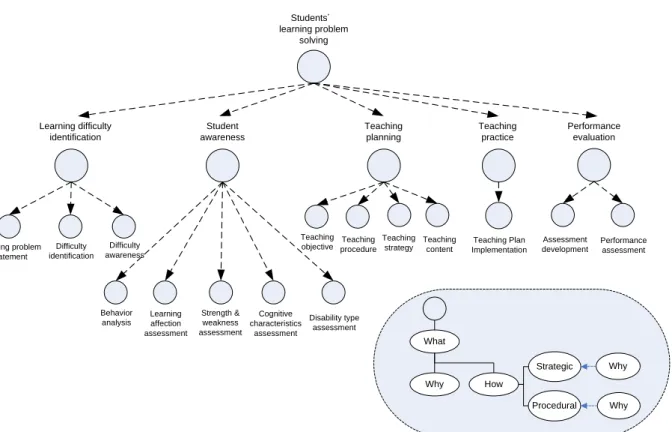
Using problem solving process as reference, the empirical knowledge model on student’s learning problem solving was obtained through interviews with expert teachers. It includes stages of problem identification, problem analysis, solution development, solution implementation, and performance evaluation. Problem identification is to identify the student’s learning problem, clearly define it and establish a precise problem statement, and decide what teaching objective to achieve. The problem analysis is to identify root cause of student’s learning problem and collect and analyze data related to the problem. Possible solution that may address the root cause of the student’s learning problem is then proposed in the stage of solution development. Solution implementation is to put the possible solution into action based on a planning on when and how to do it. Re-planning and redesign on the solution may be required during the implementation.
Performance evaluation is conducted to identify how effective the solution is, to assess if the teaching goal has been achieved, and to validate the consequences it has on the situation. Each stage of the above problem solving process was further identified into detailed steps or activities as shown in Figure 11.
Learning difficulty identification
Student awareness
Teaching planning
Teaching practice
Performance evaluation
Learning problem statement
Difficulty identification
Difficulty awareness
Behavior analysis
Learning affection assessment
Strength &
weakness assessment
Disability type assessment Cognitive
characteristics assessment
Teaching objective Teaching
procedure Teaching
strategy Teaching
content
Teaching Plan Implementation
Performance assessment Assessment
development Students'
learning problem solving
What
Strategic
Procedural
Why
Why
Why How
Figure 11. The empirical knowledge model.
This study presented the knowledge nodes defined in the empirical knowledge structure as
“learning objects” containing knowledge of “know-what”, “know-why”, “know-how” and the
“know-why of know-how” to structurally present the layers of empirical knowledge. Know-what which defines the concept of the knowledge is basically declarative knowledge. Know-why is causal knowledge to express the applications and the needs of the knowledge. The know-how knowledge which includes strategic how and procedural how is to express the experiential principles and detailed procedures or methods of student’s learning problem solving activities.
6.3. Design of Knowledge Repository
One of the issues of knowledge repository design is to effectively store, integrate, use and maintain the various types of knowledge content discussed before. In designing the knowledge repository we need to take into account the classification of knowledge, the characteristics and representation of each class of knowledge and relationships among knowledge classes, as well as the functions and configurations of the eLearning platform the knowledge repository will support.
According to the result of knowledge exploration, the knowledge repository is organized into layers for formal knowledge, practical knowledge and empirical knowledge as shown in Figure 12. The formal knowledge layer is further classified into layers of concept knowledge and in-depth knowledge. The former is defined as a concept map in terms of ontology, while the latter is defined in terms of learning objects stored in an XML database.
To facilitate the management and use of learning case contents, in the practical knowledge layer, the learning objects of cases are clustered in a case profile base, a student profile base, a teaching plan base, and a teaching case base, with links among them. In order to facilitate searching on the learning objects of cases, a topic map is developed, which consists of topics appear in the learning objects in the case base and their semantic relations. The topics themselves are domain related concepts defined in the domain corpus, which contains the concepts in the targeted domain as well as the semantic relations between concepts. The concepts in the topic map are classified in the perspectives of mathematics subjects, student disabilities, mathematics ability, and teaching strategies. Each concept points to the learning objects containing this concept.
The empirical knowledge is defined as learning objects stored in an empirical knowledge base. To facilitate the management and use of the empirical knowledge, meta knowledge is developed by employing ontology technology. The meta knowledge depicts the structure and classification framework of empirical knowledge as discussed in section 5.2.3 (Figure 11). Each node defined in the meta knowledge points to a topic map corresponding to a set of physical empirical knowledge objects defined in empirical knowledge base. Similar to that in practical knowledge base, the topic map is developed in the perspectives of mathematics subjects, student disabilities, mathematics ability, and teaching strategies to facilitate knowledge searching.
Concept Knowledge
map
Student profile
Teaching plan
Teaching case Knowledge
type
Topic map
Meta knowledge
Empirical knowledge
objects Knowledge
entity Knowledge repository framework
Case profile Learning
cases
Domain crpus Formal
knowledge
Practical knowledge
Empirical knowledge
In-depth knowledge base
In-depth knowledge
objects
Empirical knowledge
base
Legend:
Link Topic
maps
Figure 12. Framework of Digital Knowledge Content Repository.
7. CONCLUSIONS AND DISCUSSIONS
This research presented a problem-based e-Learning model and system framework to help teachers effectively develop knowledge of “mathematical teaching for students with mild disabilities” and enhance their ability to solve students’ problems on mathematics learning. This model used problem based learning (PBL) theory as the core concept to provide cases, and learning procedure for adaptive learning based on the background and experiences of the learners and the students’ learning difficulties. With this model, the learner was able to receive immediate and interactive online learning through question descriptions, online discussions, and experience sharing with other learners. This framework was different from other e-Learning platforms in that we emphasized interactive and adaptive learning based on the theories of situational learning, social constructivism, and case-based learning. In addition to personalized learning, the framework also helped guide the learner in learning, contemplating, innovating, and sharing knowledge. The learner’s benefits could therefore be maximized and the content of the learning platform could continuously be expanding and updated.
This study used Natural Language Processing technology to improve the interaction flexibility between the users and the platform. With the consideration of the characteristics of both the
student and the learner, case-base reasoning and rule-base reasoning techniques were employed to develop learning plans and provide adaptive learning resources, thus overcoming the obstacle that many users face when they cannot fully describe their problem with the keywords and fail to receive the full benefits from learning activities.
Methods for expert teacher knowledge acquisition and elicitation as well as knowledge analysis and modeling were presented. Domain concept knowledge, practical knowledge and empirical knowledge were developed and built in a knowledge repository to support problem based learning. Since ontology is capable of reducing ambiguity of information by representing domain concept knowledge in a structured format that is understandable for both humans and machines, it was used for representing domain concept knowledge, the meta knowledge of practical knowledge, and empirical knowledge to enhance knowledge sharing and to facilitate knowledge managements. In the areas of eLearning, building ontology for application domain also provides an opportunity to analyze domain concept knowledge, make domain concept knowledge explicit, separate it from operational knowledge, provide common understanding of the knowledge structure, and enable reuse of domain concept knowledge.
For further extensions, web mining techniques can be used to extract relevant knowledge from outside, and automatic knowledge extraction on content of Q&A and on-line discussion can be conducted to take the advantage of continuous expansions and upgrades of knowledge.
References
Booch, G., Rumbaugh, J. and Jacobson, I., 1999. The Unified Modeling Language User Guide.
Reading, MA: Addison-Wesley.
Brown, J.S., Collins, A., & Duguid, P. (1989). Situated cognition and the culture of learning.
Educational Researcher, 18 (1), 32-41.
Bruegge B. And Dutoit A. H. (2004). Object-Oriented Software Engineering Using UML, Patterns, and Java. Prentice Hall, 2nd Edition.
Changchien, S. Wesley and Lin, Ming-Chia (2005). Design and implementation of a case-based reasoning system for marketing plans. Expert Systems with Applications, 28,43-53.
Chin, C. & Lin, F.L. (2000). A Case Study of a Mathematics Teacher's Pedagogical Values: Using a Methodological Framework of Interpretation and Reflection. Proceedings of the National Science Council, Part D: Mathematics, Science, and Technology Education, 10(2), 99-101.
Chinese Knowledge and Information Processing (CKIP), http://ckipsvr.iis.sinica.edu.tw/.
Fenstermacher, G. D. (1994). The knower and the known: The nature of knowledge in research on teaching. In L. Darling-Hammond (Ed.), Review of research in teaching, 20, 3-56.
Washington: AERA.
Fenwick, T.J., & Parsons, J. (1998). Boldly solving the world: a critical analysis of problem-based learning as a method of professional education, Studies in the Education of Adults, 30(1), 53-66.
Fuchs, L. S., Fuchs, D., Hamlett, C. L., & Pamela, P. M. (1991). Effects of curriculum-based measurement and consultation on teacher planning and student achievement in mathematics operations. American Educational Research Journal, 28 (3), 617-641.
Gomez-Perez, Asuncion; Fernandez-Lopez, Mariano and Corcho Oscar (2004). Ontological Engineering, with expmples from the areas of Knowledge Management. e-Commerce and the Semantic Web, Springer-Verlag London Limited.
Holen, A. (2000). The PBL group: self-reflections and feedback for improved learning and growth. Medical Teacher, 22(5), 485 - 488.
Kelly, A. M. (2000). A problem-based learning resource in emergency medicine for medical students. Journal of accident and emergency medicine, 17(5), 320-233.
Kolodner, J. L., Camp, P. J., Crismond, D., Fasse, B., Gray, J., Holbrook, J., Puntambekar, S., &
Ryan, M. (2003). Problem-Based Learning Meets Case-Based Reasoning in the Middle-School Science Classroom: Putting Learning by Design(tm) Into Practice. Journal of the Learning Sciences, 12(4), 495-547.
LMML(Learning Material Markup Language), http://www.lmml.de.
LTSC (IEEE Learning Technology Standards Committee). http://ltsc.ieee.org/wg12.
Jacobson, I., Booch, G., & Rumbaugh, J. (1999). The Unified Modeling Language User Guide, Addison-Wesley, Reading, Massachusetts.
Merseth, K. K. (1996). Cases and case methods in teacher education. In J. Sikula (Ed.) Handbook of Research on Teacher Education (2nd), (pp.722-744). New York: Macmillan.
Moss, D., & Van Duzer, C. (1998). Project-based learning for adult English language learners.
ERIC Digest. Washington, DC: National Center for ESL Literacy.
Orfali, R.; Harkey, D. and Edwards, J., 1996. The Essential Distributed Objects: Survival Guide. New York: John Wiley & Sons, Inc.
Patel, A., Kinshuk, & Russell, D. (2000). Intelligent tutoring tools for cognitive skill acquisition in life long learning. Educational Technology & Society, 3(1).
Ram, P. (1999). Problem-based learning in undergraduate education. Journal of Chemical Education, 76(8) ,1122-1127.
Richardson, V. (1993). Use of cases in considering methods for motivating students. In H.
Harrington & M. Thompson (Eds.), Student motivation and case study manual (pp. 5760).
Boone, NC: Appalachian State University.
Richert, A.E. (1991). Using teacher cases for reflection and enhanced understanding. In A.
Lieberman & L.Miller (Eds.), Staff development for education in the 90's (pp. 113-132). New York: Teachers College Press.
Roberston DM, Hertan R, & Farnworth PG (2000). Is the action of inhibin mediated via a unique receptor? Reviews of Reproduction, 5, 131–135.
Roderick A. Farmer, & Baden Hughes (2005). A Situated Learning Perspective on Learning Object Design. Proceedings of the Fifth IEEE International Conference on Advanced Learning Technologies.
Rogoff, B. (1990). Apprenticeship in thinking: Cognitive development in social context. New York: Oxford.
Salton, G., & Buckley, C. (1988). Term weighting approaches in automatic text retrieval. In Information Processing & Management, 24(5), 513-523.
Salton, G., & McGill (1983). M. Introduction to Modern Information Retrieval. McGraw-Hill, New York.
Shen, Weiming; Hao, Qi; Wang, Shuying; Li, Yinsheng; Ghenniwa, Hamada, 2007, “An
Agent-based Service-oriented Integration Architecture for Collaborative Intelligent
Manufacturing”, Robotics and Computer Integrated Manufacturing, Volume: 23, Issue: 3, pp.
315-325
SCORM (Sharable Content Object Reference Model), http://www.adlnet.org/.
Shulman, L. S. (1987). Knowledge and teaching: Foundations of the new reform. Harvard Educational Review, 57, l-22.
Solomon, J. (1987). Social influences on the construction of pupils' understanding of science.
Studies in Science Education, 14, 63-82.
Souders, J. and Prescott, C. (1999). A Case for Contextual Learning. High School Magazine, 7 (3), 38-43.
Sun Microsystems, Inc.(2002). Web Services Made Easier: The Java APIs and Architectures for XML.
Trop, L., & Sage, S. (1998). Problems as possibilities: problem-based learning for K-12 Virginia:
ASDC.
VanLehn, K. (1996). Cognitive skill acquisition. Annual Review of Psychology, 42, 513-539.
Zhang Dong-Mo, Sheng Huan-Ye, Li Fang, & Yao Tian-Fang (2002). The model design of a case-based reasoning multilingual natural language interface for database. Proceeding of the First International Conference on Machine Learning and Cybernetics, 1474-1478.