Chapter 5 Analyses and Results of Interview Data
The results from English teacher, homeroom teacher, administrator, student and parent interviews are analyzed and presented in this chapter.
Results from English Teacher Interviews
Among the 4 English teachers involved in ability-grouped English teaching, Teachers 1 and 2, who were homeroom teachers at the same time, were responsible for 1 class of Group A and 2 classes of Group B respectively. Teacher 3 was responsible for a class of Group A and a class of Group B. Teacher 4 was responsible for a class of Group B only. The years of their teaching experience were 8 (Teacher 1), 7 (Teacher 2), 10 (Teacher 3), and 29 (Teacher 4) years, respectively. Their responses to the interview questions are summarized below.
Students’ In-class Performance in Group A
All of the teachers reported that students of Group A generally performed well in class. But there were still small discrepancies of students’ English proficiency in Group A.
Group A students were active in learning and reacted fast to teachers’ instruction.
They performed better in speaking than students of Group B. They generally learned fast and showed a great interest in learning supplementary materials. However, it was pointed out by the teachers that the instruction or supplementary materials were still too easy for several top students in Group A, whose motivation was hardly raised in class. On the other hand, the supplementary materials were a little hard for the students who were in the low standing in Group A.
Students’ In-class Performance in Group B
Two of the four teachers interviewed held a negative view about Group B students’ performance in class. The other two teachers, on the contrary, described that most students in Group B could keep up with the teachers’ instruction well.
Teacher 2 reported that students of Group B were more passive than those of Group A. Many of them were shy and timid, and rarely volunteered to speak or answer the teacher’s questions. Some of them concentrated in class but still could not follow the instruction. They showed high degree of anxiety when they were asked to perform or speak in front of the class. Teacher 1 also reflected that Group B did not respond to her instruction as well as Group A did. Teaching Group B was like teaching a mixed-ability class. Students’ English abilities in Group B distributed in a normal curve. She particularly mentioned that several students showed attitudes of boredom towards her instruction. They felt bored that the same content or what they already knew was repeated all the time.
Teachers 3 and 4, however, reported that the in-class performance of Group B was not bad. They responded well when the teachers were doing drills or pattern practices. They also raised their hands when the teachers needed volunteers.
It was mentioned by all the teachers that there were 3 or 4 students in each Group B class who fell behind and showed no interest in English learning. They usually did not pay attention in class and refused to join learning activities when the teachers asked them to. They sometimes even slept or exhibited mischievous behavior in class, such as talking to neighbors, playing with an object, or walking around in the
classroom. The teachers said that their instruction was sometimes interrupted because
they had to stop the disorder these students caused, which rarely happened in Group
A.
Teaching Strategies Used in Group A and Group B
Three of the teachers involved in teaching Group A and Group B reported that they used different teaching strategies or techniques when they dealt with different groups, such as different teaching rates, activities, types of questions, or standards of performance. Teacher 4 could not compare her teaching in the two kinds of classes because she was responsible for one class of Group B only.
Teachers 1, 2, and 3 basically followed the content of the textbooks in both groups. In Group A, they went through the textbooks very quickly because of students’ fast learning rate. In Group B, they went through the content step by step and spent more time doing basic pattern practices and drills. To fill in the rest of the class hours in Group A, the three teachers used different strategies. Teacher 1 let students conduct outside readings themselves. She divided students into 6 groups, and each group was responsible for teaching an article to the whole class. Each group member was responsible for a task of teaching, such as looking up vocabulary, taking notes, preparing handouts, or oral presentation. After their performance, there was a paper-and-pencil test conducted by the teacher for the whole class. Much like Teacher 1, Teacher 3 let students read graded readers. The teacher led the reading process, including vocabulary learning, reading comprehension, and discussion. The
assessment included worksheet, classroom performance, tape-recording of stories, and an intra-class contest of answering questions based on the stories they had read.
Teacher 2, however, let students of Group A watch films to fill in the rest of the class hours.
The teachers’ instructional approaches also varied according to students’ groups
(see Appendix I for sample lesson plans). The teachers dominated more in Group B
than in Group A. They used more lectures and mechanical drills in Group B while
they usually induced what Group A already knew and gave them communicative tasks
and opportunities to present. Mechanical drills were rarely used in Group A. For example, students of Group A were allowed to adapt the dialogues in the textbooks and then acted out in class. However, students of Group B were only asked to memorize the dialogues or read them out loud. Surprisingly, the teachers were not satisfied with what Group A performed in class. Many of them liked to put elements of violence and dirty things in their adaptations by using fragments or isolated words instead of sentences with correct forms. Though students achieved the goal of
communication, the teachers did not feel teaching goals fulfilled because the content and the language forms students created were not what the teachers wanted them to learn.
In terms of types of questions, more personal questions were asked in Group A, where students could do more experience sharing. But more questions with fixed answers based on the content of the textbooks were asked in Group B, where students were allowed to answer in Chinese. Besides, the teachers lowered the standards of performance for Group B students and focused on their learning attitudes more.
However, they gave lower grades to students of Group A with arrogant or
unconcerned attitudes even though they had better English abilities than Group B.
The main reason of using different strategies or techniques reported by the teachers was students’ abilities. Group A had more background knowledge in English and better speaking abilities, which Group B lacked. Therefore, the teachers tried to give Group A more opportunities to perform or present, but provided more basic exercises in Group B.
Teaching Strategies Used in Grouped and Ungrouped Classrooms
All of the four teachers reported that there were a few differences in instructional
focus, types of activities and test questions, and grammatical instruction, when they
taught grouped and ungrouped classes.
Considering many of the students in ungrouped class were in Group B before, the teachers basically adopted teaching strategies more like they used in Group B, with a focus on doing mechanical drills and mastering basics in the textbooks. More creative activities that the teachers used to do in Group A, such as acting out
adaptations of dialogues in the textbooks, outside readings, and oral presentations, were called off when they taught ungrouped classes. One reason of doing this was the limitation of most students’ abilities in ungrouped class. Another reason was the limitation of class hours. The teaching schedule in ungrouped class did not go as fast as it did in Group A; therefore, it was hard for the teachers to give students extra learning activities during class hours.
In order to take care of top students in ungrouped class, the teachers divided grammar instruction into two levels - basic and advanced. They would teach both parts to the whole class but tell students which part the whole class should master and which part was for top students to learn. Besides, Teacher 1 had a special arrangement for her top students in ungrouped class. She gave them extra assignments - written English book reports, as required by their parents. However, the performances of these top students varied. Some really did a great job, while many of them did not take it seriously and did it without care.
In terms of test questions, the teachers gave Group B many easy fill-in-blanks questions, which were assumed to be able to arouse students’ learning motivation. In ungrouped class, however, more challenging Chinese-English translations were included in tests for more able students.
Goals Set for Group A and Group B Students
All the teachers interviewed reported that they set higher goals for Group A and
lower goals for Group B in terms of academic performance. They set different goals for different groups according to students’ learning background and abilities.
In Group A, students were expected to achieve 90 points at least or above on exams, and they were required to speak fluently, recite or dictate paragraphs, and express their ideas in English. The standards, however, were loose for Group B. For example, it was fine for Group B to get 70 or 60 points, or even 50 points on exams.
They were not required to recite or dictate; instead, they just needed to read out paragraphs, memorize key words, and copy basic sentence patterns.
Goals Set for Grouped and Ungrouped Classes
As mentioned in previous section, the teachers set different goals for Group A and Group B in grouped classes. The teachers also set different goals for students of different abilities in mixed-ability classes, instead of a single fixed goal for the whole class.
The teachers reported that their previous experiences of ability grouping affected their judgment on every student when they taught ungrouped class. They used
different criteria to demand students in mixed-ability class. For example, those who were in Group A before were still required by higher standards, while those who were in Group B before were required by loose standards. The teachers still respected students’ individual differences when dealing with ungrouped classes. They usually allowed students to set a level they hoped to achieve on tests.
Difficulties and Coping Strategies in Group A
The difficulties reported by the teachers included heavy preparation work, as well as superiority and disdain attitudes of top students in Group A towards school English learning.
Teachers 1 and 3 prepared supplementary materials for Group A, which
increased their workload. They spent extra time and energy on the preparation work but presented these materials only once for Group A. Though they felt the preparation work was time-consuming, they still accomplished it on their own, instead of working as a team and sharing their lesson plans or teaching resources.
Another problem reported by the teachers was that some students, especially those top students in Group A, showed arrogant attitudes or behaviors, which annoyed the teachers. Being in Group A strengthened these students’ superiority. For example, they were impatient with the teacher’s lectures or instruction, and even showed boredom or disdain attitudes towards the content of the textbooks. They made comments such as “I’m Group A student, why do I have to learn such easy things? I already learned these long ago.” Only when they had opportunities to present, play games, or read supplementary materials, they became spirited. The teachers tried to go through the textbooks so quickly as to spare time for extra activities and outside readings.
Three more examples of Group A’s attitude problems were reported by the teachers. Teacher 1 said that some students of Group A showed unwillingness to do extra work, such as designing posters for school festivals or decorating the language classroom. Teacher 2 described that some students of Group A liked to deviate
in-class topic or consult the teacher about their homework in cram school during class hours, which often caused chaos in class. The teachers scolded students when such incidents happened in class. Furthermore, some top students did not care about their performance on assignments. About one-fourth students in Group A class, as reported by Teacher 2, cared about paper-and-pencil tests only but did not turn in homework she assigned.
Difficulties and Coping Strategies in Group B
The teachers reported that students in the lowest standing in Group B class caused them difficulties in teaching. Giving remedial instruction was the common way to help these students. For some who lacked interest in English and interrupted others’ learning, the teachers only corrected their mischievous behavior in class.
The teachers reported that the slow learners usually had difficulties in
pronunciation, speaking, or even alphabet handwriting. Some of them who were still willing to learn were picked out and given remedial instruction, but some just gave up learning. They slept, played with an object or neighbors, or talked in class. The teachers still encouraged them to join class activities, such as answering questions in Chinese, or role-playing without speaking English. They had fun joining these
activities, but they soon started mischievous behavior whenever the teacher was giving lectures or instruction. For these students, the teachers had no ideas how to help them.
Difficulties and Coping Strategies in Ungrouped Class
All the teachers reported that there were more students who gave up English learning in ungrouped class because they could not keep up with the teachers’
instruction and fell behind in class.
Those slow learners who could learn at a slow learning rate in Group B could not
catch up with the other peers in ungrouped class and gave up quickly. In Group B, the
teachers focused on basics only, so these learners attained fulfillment more easily. In
ungrouped class, the teachers would add difficult grammatical elements that increased
slow learners’ frustration. Thus, those who were willing to try in Group B gave up
themselves instead when they were in ungrouped class. Several students who still
showed their willingness to try in ungrouped class were picked out to receive
remedial instruction two hours a week. However, the teachers felt that the effects of
remedial instruction were very limited due to the insufficient time and the large number of students in need of remedial instruction.
Learning Effects of Ability Grouping versus Ungrouping
All the teachers basically agreed that ability grouping benefited both Group A and Group B in English learning. Teacher 1, however, reported a case of negative effect in Group B.
In Group A, students had a keener competition with the peers. They did more challenging work, which aroused their motivation to compete with one another. In Group B, students in the high and middle standing were more willing to express themselves because they were able to perform better than the others in Group B, which gave them satisfaction and confidence. Otherwise, they would probably become quiet or hide themselves when they learned with more able peers in an ungrouped class. As Teacher 4 said, “Some kids would rather be a leader in a
low-level group rather than a follower in a high-level group.” Those who were in the high and middle standing of Group B gained more encouragement and fulfillment from practicing the basics in Group B classes, instead of feeling that they fell behind because they could not compete with more able students in ungrouped classes.
However, Teacher 1 reported that one student in Group B questioned her
teaching. The student felt the contents were too easy, and she even asked the teacher
to use the same ways as the teacher taught Group A to teach them. The student told
the teacher what she learned in cram school was much more difficult. The teacher
sensed that the student was worried that she missed a lot of important English
knowledge in Group B. The student also did not want to be treated differently from
those in Group A. Teacher 1 agreed that ability grouping might benefit English
learning but believed that it caused psychological problems on some individuals.
Teachers’ Preferences for Ability-grouping
One of the four teachers preferred teaching ability-grouped class; two teachers preferred teaching ungrouped class; the other one pointed out that either way had its own advantages and disadvantages.
Teacher 2 preferred teaching ability-grouped class because she felt that the class atmosphere of grouped class became better. In grouped class, students got involved in classroom activities more actively due to their similar abilities. Besides, students could share their work by posting them on the bulletin board of the classroom, which created a better English learning environment.
Teacher 1 and Teacher 3 preferred teaching ungrouped class. Teacher 1 felt that class atmosphere became better when students learned with homeroom peers because they were familiar with one another. It was also convenient for her to control students’
learning conditions in ungrouped class, such as collecting homework, keeping track of students out of class, or communicating with homeroom teachers about students’
mischievous behaviors or problems. In addition, she felt that it was easier to keep order in ungrouped class because students had stronger sense of shame when they were scolded by the teacher.
Teacher 3 preferred teaching mixed-ability class since there were still discrepancies in grouped class under the grouping policy, which did not make teaching grouped class much easier than teaching ungrouped class. On the contrary, preparing different lesson plans for different groups increased her workload. In addition, ability grouping enhanced arrogant attitudes of Group A, which were not so obvious in ungrouped situation instead.
Teacher 4, who only experienced teaching Group B, stated that either way had its
own advantages and disadvantages. Slower learners would not give up so early and
easily when they learned in Group B because the teacher would ease the content and adapt the instruction for their level, which drew students’ attention and interest more than when they learned in ungrouped class. However, the teacher felt that teaching ungrouped class gave her a great sense of fulfillment. She could teach more difficult contents, ask more difficult questions, and communicate with students in English more often when she taught ungrouped class due to the presence of higher achievers.
When teaching only Group B, she could only ask very easy questions, do basic practices, and communicate in Chinese.
Teachers’ Votes for/against Ability Grouping
Three of the four teachers voted against ability grouping after one-year practice of ability grouping in English class and only one teacher voted for the continuance of ability grouping.
Teachers 1 and 2, who voted against ability grouping, were English and homeroom teachers at the same time. The fact that they did not teach two-thirds of their homeroom students caused difficulties in their management of their respective homeroom class. They had very few chances to get along with the other two-thirds homeroom students. Thus, there was a great distance between the teachers and the other two-thirds students and they barely knew these students’ learning conditions.
They both reported that they would have voted for ability grouping if they did not have to consider their homeroom class management.
Teacher 3, who was responsible for 7
th-grade and 8
th-grade English class, voted against ability grouping because of the heavy workload. She had to prepare three sets of lesson plans for Group A, Group B, and 8th-grade graders, which increased her workload.
Teacher 4, who was responsible for only one Group B class, voted for ability
grouping. She gave her vote for the continuance of the policy because she believed it was a better way for students to learn.
Results from Homeroom Teacher Interviews
Four homeroom teachers, who were in charge of their homeroom classes in the 7th-grade and 8th-grade grades, were picked out as interviewees. Their teaching experiences were as follows: Teacher 5, 6 years; Teacher 6, 22 years; Teacher 7, 18 years; Teacher 8, 9 years. Because these teachers reported that they did not receive any responses from parents regarding the practice or abolition of ability group in English class, below is a summary of their responses to questions regarding their own observations about their homeroom students’ reactions to 7
th-grade grouped and 8
th-grade ungrouped English classes.
Problems in Homerooms Caused by Ability Grouping
Three teachers stated that they did not find any adaptation problems from their students when they were in the 7
th-grade grouped English class. Only Teacher 6 reported that 2 girls in her homeroom class had reflected their frustration about being assigned to Group B in their diaries. The teacher talked to the 2 girls privately and encouraged them to work harder so as to move to Group A the next semester. After that, the 2 girls were more comfortable with their group.
Students’ Reactions to Ungrouped English Class in the 8th-grade Grade
Two teachers reported that they did not find any adaptation problems among students when the 8
th-grade ungrouped English class was implemented. However, another two teachers observed the advantages of ability grouping.
Teacher 5 reported that ability grouping seemed to benefit slower students in
terms of arousing learning motivation. She observed that several slow learners in her
homeroom who worked hard and were willing to try in Group B totally gave up English learning in 8
th-grade ungrouped class. No matter how hard they tried in homeroom class, they were still in the low standing in English and could not compete with the other peers, although they could get nice grades in other subjects, such as Chinese or social studies.
Teacher 8 reported that several students in her homeroom preferred the previous ability-grouped English class. High achievers sensed that the content was more enriched in Group A than in ungrouped class, and there were more game-like
activities and role-plays in Group A. Slow learners felt that the content in ungrouped class was much harder for them to learn. The homeroom teacher could only tell students to accommodate their learning habits to the school policy.
Homeroom Teachers’ Personal Preferences for Ability Grouping
The four teachers interviewed disagreed in their preferences for the grouping policy; two supported ungrouped class; one preferred ability grouping; another one had no personal opinions on the question.
Teacher 5 and Teacher 6 supported ungrouped English class for different reasons.
Teacher 5 reported that it was easier for her to manage class affairs when students
learned in homeroom altogether, such as reminding students of turning in homework,
helping them collect homework, or making grade reports of English quizzes for their
parents. Teacher 6 supported ungrouped English class because ability grouping
labeled students. She claimed that junior high education was not ability-oriented, but
equality-oriented. In addition, teenagers of 13 to 15 years old did not have a clear
sense of the rationale behind ability grouping. They only knew that they were divided
into levels and labeled. The policy would have negative influence on the self-esteem
of those who were assigned to low-level groups.
Teacher 7, however, reported that the discrepancies of students’ English abilities were really wide because of their different previous learning backgrounds and starting points of English learning. It was difficult for teachers to teach such a multi-level class. Therefore, she supported ability grouping.
Results from Administrator Interviews
Administrators, including the director of students’ academic affairs, the chief of curriculum section, and the chief of registry section, were interviewed. Their
administrative experiences were as follows: the director of students’ academic affairs had 5 years of experience in her position; the chief of curriculum section, 6 years; and the chief of registry section, 20 years. Below is a summary of their responses to questions regarding their observations or perceptions about ability grouping practiced in English.
Administrators’ Perceptions about Parents’ Responses to Ability Grouping
All the administrators interviewed reported that they did not receive particular responses or reactions from parents to either 7
th-grade grouped or 8
th-grade ungrouped English class. The director of students’ academic affairs explained that it was because parents from the school district rarely questioned school policy, including ability grouping practiced and abolished in English class.
However, the director of students’ academic affairs did receive a couple of phone calls from parents who queried how students could shift to a different group and if the shifting policy could be carried out fairly when ability grouping was practiced in 7
th-grade English class. After the director’s explanations, parents seemed to accept it.
Administrators’ Perceptions about English Teachers’ Responses to Ability Grouping
At the very beginning, the administrators did not receive particular responses
from English teachers. After a couple of months’ practice, the administrators started to receive English teachers’ complaints and questions about the effects of ability
grouping system because they sensed certain disadvantages of it. The director and the chief of curriculum section both felt that the English teachers heaved a sigh of relief after the policy was called off the next school year.
Most of the complaints the administrators received from English teachers were about Group A students’ arrogant attitudes, boredom, or apathy towards homework.
Besides, the teachers also complained that the discrepancies in the same class, both in Group A and Group B, were still wide under the 2-level grouping policy. The chief of the curriculum section also received complaints from English homeroom teachers that they had difficulties building up good relationship with the other two-thirds
homeroom students they did not teach. The director reported that these complaints were not expected in the first place until the teachers experienced the practice in person for some time.
Besides, according to the director, the English grouping policy turned out to be the pressure of English teachers because:
“At PTA, the headmistress told parents that we were leading the other schools in Taipei to practice ability grouping in 7
th-grade English class. At that time, the English grouping policy became a focus of attention at school publicity.”
During the practicing process, the teachers did not totally enjoy the advantages of ability grouping they expected at first, but discovered more unexpected
disadvantages. Therefore, the English teachers felt relaxed when the policy was called off the next year.
Administrative Difficulties with Ability Grouping
Ability grouping did not cause the administrators much trouble in terms of
arrangement of class hours and group formation because it was practiced in only one
grade for one year. Only a few problems were reported by the administrators, such as collecting test papers, operating grades, and seeking support from teachers and staff.
The chief of registry section reported that she had trouble collecting mid-term and final test papers. Students took tests in their homeroom classes, and then she and the staff members of the registry section had to reorganize all the test papers
according to their different English groups for the English teachers. They often mixed up students’ groups. In addition, she had to create another system to computerize students’ English grades, which increased her workload.
The director of students’ academic affairs said her ma in difficulty was the communication with the English teachers. After a couple of months’ practice, the English teachers started to report the disadvantages they discovered in grouped classrooms in team meetings. The director sensed that the teachers did not strongly support ability grouping to continue. In the meantime, she did not feel support from the higher level of school administration for this policy, either. She said that it was hard for her to practice a school policy when it lacked support from the staff.
Administrators’ Personal Preferences for the Grouping Policy
The chief of registry section preferred ungrouped English class while the director of students’ academic affairs supported grouped English class. The chief of
curriculum section preferred ungrouped English class when her workload was considered, but she supported ability grouping when teaching efficiency was considered.
The chief of registry section preferred ungrouped class because it was much
easier for her to deal with ungrouped class in terms of collecting test papers and
operating students’ grades. The chief of curriculum section had ambivalent feelings
towards ability grouping policy. In terms of workload, she preferred ungrouped class
because it was easier for her to deal with ungrouped class. However, she personally believed ability grouping was easier for teaching. It is easier for teachers to control teaching schedules when the range of students’ abilities becomes smaller.
The director of students’ academic affairs also preferred ability grouping, and she advocated that the distinction between groups should be set up very clearly. She said:
“It is not fair for low achievers to learn with others in ungrouped class where they function as companions but benefit nothing in learning. Students should be divided into four, five or even more levels according to their English ability, like what most language learning institutes or cram schools outside the formal education system do. I think that it is the most effective way to learn a foreign language. Another key point to make it work out is the
development of teaching materials. We should organize our English teachers to develop materials of our school for students of different levels, and provide students with what they really need. It is the most ideal way, but I think it is a tiring job for teachers. It is not easy to persuade teachers to do that.”
Results from Student Interviews
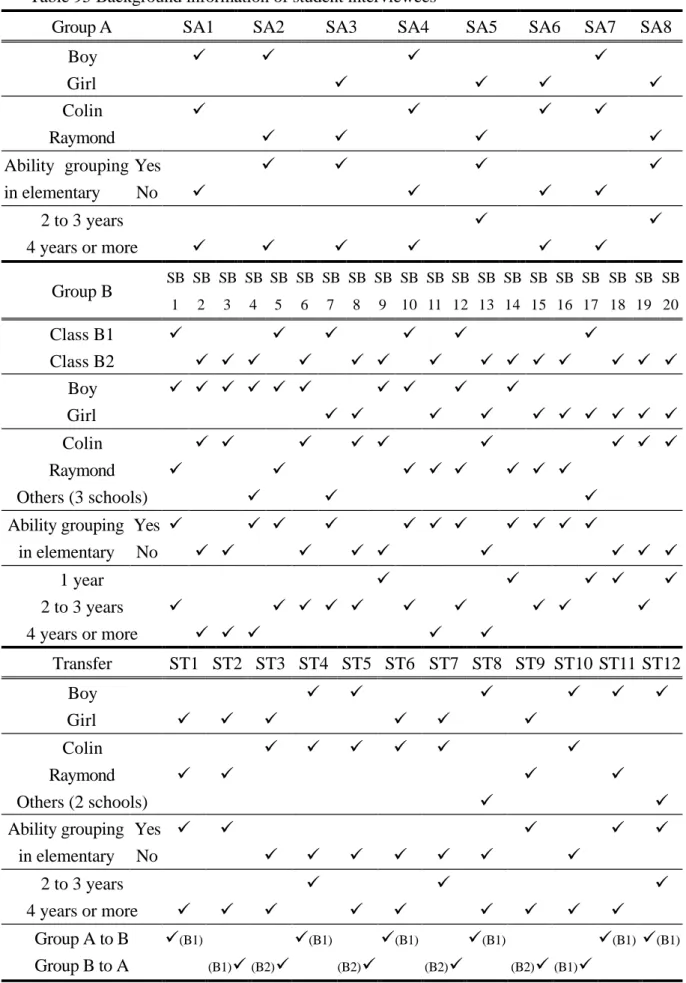
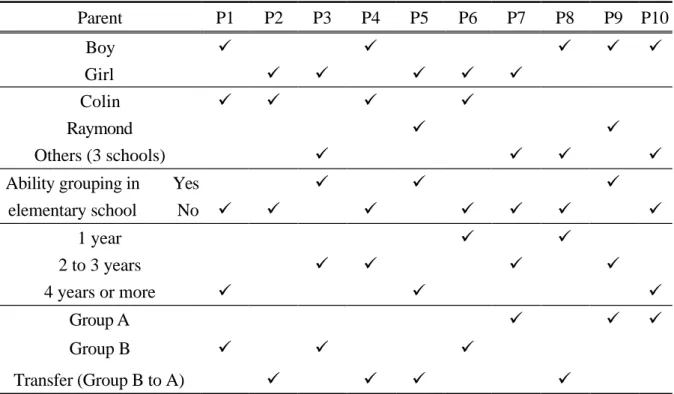
Forty out of the 263 student participants were selected for interviews. Based on the ratio between Group A, Group B and transfers (approximately 2:5:3), 8 of the 40 interviewees were from Group A, 20 from Group B, and 12 from transfers. The sex in the three categories was equally allocated to male and female. Half of the
interviewees experienced ability grouping in elementary school, while the other half
did not. Half of them had learned English for 4 years or more before they entered
junior high school. Only five of them had only 1-year English learning experience
before junior high school and they all belonged to Group B. Fifteen interviewees had
2- or 3-year English learning experience before junior high school. The background
information of student interviewees is shown in Table 95.
Table 95 Background information of student interviewees
Group A SA1 SA2 SA3 SA4 SA5 SA6 SA7 SA8
Boy Girl
ü ü
ü
ü
ü ü
ü
ü Colin
Raymond
ü
ü ü
ü
ü
ü ü
ü Ability grouping
in elementary
Yes
No ü
ü ü
ü
ü
ü ü
ü
2 to 3 years
4 years or more ü ü ü ü
ü
ü ü
ü
Group B
SB1 SB
2 SB
3 SB
4 SB
5 SB
6 SB
7 SB
8 SB
9 SB 10
SB 11
SB 12
SB 13
SB 14
SB 15
SB 16
SB 17
SB 18
SB 19
SB 20
Class B1 Class B2
ü
ü ü ü ü
ü ü
ü ü ü
ü ü
ü ü ü ü ü
ü ü ü Boy
Girl
ü ü ü ü ü ü ü ü
ü ü ü
ü ü
ü
ü ü ü ü ü ü Colin
Raymond Others (3 schools)
ü
ü ü
ü ü
ü
ü
ü ü
ü ü ü ü
ü ü ü ü
ü ü ü
Ability grouping in elementary
Yes No
ü ü ü
ü ü ü
ü ü ü
ü ü ü ü
ü ü ü ü
ü ü ü 1 year
2 to 3 years 4 years or more
ü
ü ü ü
ü ü ü ü ü
ü ü
ü ü
ü ü ü
ü ü ü
ü
Transfer ST1 ST2 ST3 ST4 ST5 ST6 ST7 ST8 ST9 ST10 ST11 ST12 Boy
Girl ü ü ü
ü ü
ü ü
ü ü
ü ü ü
Colin Raymond Others (2 schools)
ü ü
ü ü ü ü ü
ü ü
ü ü
ü Ability grouping
in elementary Yes
No
ü ü
ü ü ü ü ü ü
ü ü
ü ü
2 to 3 years
4 years or more ü ü ü ü
ü ü
ü
ü ü ü ü
ü
Group A to B Group B to A
ü
(B1)(B1)
ü
(B2)ü ü
(B1)(B2)
ü ü
(B1)(B2)
ü ü
(B1)(B2)