Limited Feedback of Precoder and Bit Loading for
MIMO Systems: A Joint Design
Hung-Chun Chen and Yuan-Pei Lin, Senior Member, IEEE
Abstract—This paper jointly considers limited feedback of bit
loading and precoder. In the past when both precoder and bit loading are fed back to the transmitter, the feedback rate is often allocated between the two using an ad hoc approach and code-books are designed separately rather than jointly. In this paper we allocate feedback rate in a systematic manner by analyzing the effect of quantization on transmission power. The analysis allows us to obtain the rate allocation that minimizes the power penalty due to limited feedback. As both precoder and bit loading are fed back to the transmitter, the information embedded in one can be exploited for the design of the other. To take advantage of bit loading feedback, which carries valuable information on the importance of individual subchannels, we employ multiple precoder codebooks, each tailored to a bit loading vector in the bit loading codebook. The multi-codebook scheme enjoys significant gain over the single-codebook case that does not take bit loading feedback into consideration. Simulations are given to demonstrate that the proposed system can achieve a very good performance due to carefully designed feedback rate allocation and joint codebook designs.
Index Terms—Bit loading, joint codebook design, limited
feed-back, MIMO system, precoder.
I. INTRODUCTION
R
ECENTLY, there has been considerable interest in multi-input multi-output (MIMO) systems with limited feed-back [1]–[9]. It has been demonstrated that the system perfor-mance can be improved significantly with limited amount of feedback. Commonly adopted types of feedback information are precoder, bit loading, power loading or a combination of these three.The feedback of precoder information has been the most studied [2]–[9]. The precoder is chosen from a codebook using an appropriate selection criterion and the index is fed back to the transmitter. Codebooks designs for unitary precoders using Grassmannian subspace packing are developed in [2] for a number of criteria. An efficient approach to codebook storage and codeword search is given in [3]. A randomly generated codebook is proposed in [4] and the required feedback rate can be computed for a given target spectral efficiency. In [5], the capacity loss of MIMO systems due to precoder quantization
Manuscript received March 08, 2013; revised July 15, 2013; accepted September 03, 2013. Date of publication September 16, 2013; date of current version November 04, 2013. The associate editor coordinating the review of this manuscript and approving it for publication was Prof. Walaa Hamouda.
The authors are with the Department of Electrical Engineering, Na-tional Chiao-Tung University, Hsinchu 30050, Taiwan (e-mail: [email protected]; [email protected]).
Color versions of one or more of the figures in this paper are available online at http://ieeexplore.ieee.org.
Digital Object Identifier 10.1109/TSP.2013.2281785
is analyzed. In [6], the precoder is selected from the codebook to minimize bit error rate (BER) and the generalized Lloyd al-gorithm is used to design codebooks. In the multimode scheme [7], the number of substreams transmitted can vary with the channel and bits are loaded uniformly. A capacity maximizing codebook for the multimode scheme is designed in [8] using the generalized Lloyd algorithm. A joint design of precoder and zero-forcing decision feedback equalizer (DFE) for a number of design criteria is developed in [9].
The feedback of bit loading and power loading have been considered in the literature [10]–[13]. An efficient algorithm for per antenna power and rate control is developed in [10]. Suc-cessive quantization of power loading and bit loading is consid-ered in [11]. In [12], the receiver feeds back the detection or-dering for a fixed bit loading. This is equivalent to having a bit loading codebook that consists of all permutations of a single bit loading vector. An iterative algorithm for designing antenna se-lection, bit loading, and power loading to minimize the error rate is given in [13]. There has also been research on the feedback of both bit loading and precoder [14]–[16]. A number of optimal MIMO transceivers with decision feedback and bit loading are given in [14]. It is shown therein that when full channel state in-formation is available at the transmitter, these optimal designs have similar performance. When the feedback rate is limited, the use of identity precoder combined with the feedback of only bit loading is proposed. In [15], the ideal unitary precoder is first decomposed using Givens rotation matrices and the feed-back rate allocation among the Givens parameters is derived. Bit loading is incorporated in the multimode scheme to further im-prove the performance in [16], and both precoder and bit loading are fed back. The feedback of precoder and power loading are considered in [17], [18]. In [17], the codebooks of power loading are designed separately for each mode. Two efficient methods are developed in [18] for parameterizing unitary precoders. It is shown therein that the feedback of power loading provides only slight improvement. In [19], the information of power loading, bit loading and precoder are fed back to the transmitter to max-imize the transmission rate. As the quantization of bit loading is not considered, a large feedback rate may be needed. Quanti-zation of bit loading is proposed in [20] to reduce the feedback rate.
In this paper, we jointly consider the quantization of both pre-coder and bit loading for MIMO systems with limited feedback. As there are two types of information in the feedback, the first question to answer is: How to allocate feedback resource? This issue has not been formally addressed in the past. The alloca-tion of feedback rate is often determined in an ad hoc manner and the codebooks are usually designed separately rather than jointly. In this paper, we allocate the feedback rate by analyzing
the power penalty due to limited feedback and jointly design the feedback of precoder and bit loading. We first derive the in-crease in transmission power when precoder is quantized, and then the additional penalty when bit loading is also quantized. Based on the analysis, the feedback rate is allocated to minimize the combined power penalty for a given transmission rate and target error rate. As both precoder and bit loading are fed back, the information embedded in one can be exploited for the feed-back of the other. In particular, bit loading carries valuable in-formation on the importance of individual subchannels. To take advantage of bit loading feedback, we propose to use multiple precoder codebooks, each tailored to a bit loading vector in the bit loading codebook. We show how to incorporate bit loading in precoder codebook design for power minimization based se-quential vector quantization method [18]. The multi-codebook approach has an edge over the single-codebook scheme as it better exploits the bit loading information. Furthermore, be-cause of precoder feedback, we can consider bit loading that is in nonincreasing order, which effectively reduces quantization error for the same feedback rate. We demonstrate through ex-amples that the proposed feedback scheme can achieve a very good performance.
The main contributions of this paper are summarized as fol-lows. We analyze the power penalty due to quantization of bit loading and precoder. Based on the results, we determine the feedback rate allocation between bit loading and precoder using a systematic approach. This stands in contrast to earlier works that consider feedback of precoder and bit loading, in which the rate allocation is usually determined in an ad hoc manner. We propose the use of multiple precoder codebooks and incorpo-rate bit loading in codebook design to minimize transmission power. The joint design allows us to exploit the information of bit loading feedback and to achieve a better performance. This is different from earlier codebook designs, for which precoder and bit loading codebooks are designed separately, and in most cases only the design of precoder codebook or the design of bit loading codebook is considered, but not both.
The sections are organized as follows. Section II gives the system model for a precoded MIMO system. The feedback rate allocation between precoder and bit loading is derived in Section III. The design of precoder codebook is presented in Section IV. The design of bit loading codebook is discussed in Section V. The design procedure and codeword selection criteria are given in Section VI. Simulation examples are shown in Section VII and a conclusion is given in Section VIII.
Notation: 1) Boldfaced lower case letters represent vectors
and boldfaced upper case letters are reserved for matrices. The notation denotes transpose-conjugate of . 2) The function denotes the expected value of a random variable . 3) The notation denotes the number of elements in a set . 4) The notation denotes the 2-norm of a vector .
II. SYSTEMMODEL
Consider the MIMO communication system with transmit antennas and receive antennas in Fig. 1. The channel is modeled by an matrix whose entries are independent and identically distributed circularly symmetric
Fig. 1. The MIMO communication system.
complex Gaussian random variables with zero mean and unit variance. The channel noise vector is additive white Gaussian with zero mean and variance . The precoder is an matrix with orthonormal columns, where . The input vector consists of symbols that are uncorrelated, and zero mean. Let the number of bits loaded on be , then the number of bits transmitted per channel use is . The total transmission power is , where is the transmitter output vector as indicated in Fig. 1. The channel output is given by . The error vector at the output of the
receive matrix is , where
is zero-forcing, given by [21]. The
autocorrelation matrix of the error vector is [21] (1) Let the eigen decomposition of be , where the diagonal matrix contains the eigenvalues of
in nonincreasing order, i.e., , and is
an unitary matrix. For a number of design criteria, e.g., minimization of transmission power [2], [14], [18], the optimal unitary precoder has been found to be
(2) where is the matrix obtained by keeping the first columns of . With the above precoder, the th error vari-ance is given by
(3) As is in nonincreasing order, is in nondecreasing order. The optimal bit loading that minimizes the trans-mission power for a given transtrans-mission rate is thus in non-increasing order [14].
In this paper, we consider the limited feedback of precoder and bit loading. At the receiver, the bit loading vector
and precoder matrix are chosen from their respective codebooks and the indexes are sent back to the trans-mitter. Suppose and bits are used to represent and , respectively, the total feedback rate is . The feed-back rate allocation between bit loading and precoder is consid-ered in the next section.
III. ALLOCATION OFFEEDBACKRATE
In this section, we allocate the feedback rate between precoder and bit loading by considering the increase in trans-mission power due to the quantization of precoder and bit loading with a high feedback rate assumption. First we analyze the power penalty when only the precoder is quantized. Then
we derive the additional penalty when bit loading is also quan-tized. The results are used to determine feedback rate allocation between precoder and bit loading.
A. Performance Loss Due to Precoder Quantization
For a given channel, the th subchannel error variance can be computed from (1). The total transmission power for a given bit loading and symbol error rate (SER) can be expressed as [14]
(4)
where and ,
. When the transmission rate is large, , the total transmission power can be approximated as . In this case, it is shown in [14] that for a given transmission rate the minimized transmis-sion power with the optimal bit loading is given by
(5) For the case the precoder is not quantized (i.e., ),
we can use in (3) to obtain
. Let be the th sub-channel variance when the precoder is quantized. In this case, the minimized transmission power becomes . A useful approximation of is given in the following Lemma.
Lemma 1: Consider the case the precoder is a quantized
ver-sion of in (2), . When the feedback rate is sufficiently large and the channel has full rank, the th sub-channel error variance can be approximated as
(6) where and are respectively the th column of and
.
See Appendix A for a proof. Using (6), we have the approx-imation
Therefore the transmission power is increased by
. We define the power penalty due to precoder quantization as
(7)
Lemma 2: Let the entries of the channel be independent Gaussian random variables with zero mean and unit variance. When is quantized to using bits, the power penalty of precoder quantization is given by
(8) where denotes the choose function.
Proof: See Appendix B.
B. Performance Loss Due to Bit Loading Quantization
For a given quantized precoder, we can compute the subchannel error variances , the optimal bit loading cor-responding to , and the minimum transmission power . From [14], we know the optimal bit loading that minimizes the transmission power satisfies . Suppose now we quantize to (quantization of to be discussed later), the required transmission power using the quantized
bit loading can be rewritten as
. Hence the
transmission power is increased by .
Note that is larger than one since is the minimum transmission power when the quantized precoder is given. We define the power penalty due to the quantization of bit loading as
(9) When the precoder is not quantized, the optimal bit loading is in nonincreasing order [14]. If is large and the quantization error of the precoder is small, we can assume that the optimal bit loading is also in nonincreasing order. We can verify that the nonincreasing property of and the fact
imply that are bounded as follows: ,
where , , ,
, .
Suppose bits are used for scalar quantization of for
and is chosen as to satisfy
the transmission rate constraint. Define the quantization error . It is known that [22], the quantization error has a uniform distribution over for
when is reasonably large, where
is the quantization step size. In this case, we can obtain an approximation of , as given in the following lemma.
Lemma 3: Suppose the quantization error for are independent and uniformly distributed over
and . The power penalty of bit loading quantization can be approximated by (10) at the bottom of this page.
Proof: See Appendix C.
Rate Allocation: Starting from the optimal precoder
and the optimal bit loading, the performance is degraded by (dB) when the precoder is quantized. When we further quantize the bit loading, there is an additional degradation of (dB). Therefore we can minimize the power penalty by allo-cating the rate such that the combined penalty is min-imized. From (7), we see that the quantization of each con-tribute to in the same manner, so we choose
for . For , we evaluate for
all possible integer that satisfy and
choose the one that has the smallest combined power penalty. For each , the number of iterations is . The number of iterations for finding the optimal rate allocation is , where we have used
the Pascal’s triangle for
any nonnegative integer such that . The complexity is not high for practical cases of and . For instance, when
, , is 165. Having determined
, we design the bit loading codebook with codewords in Section V.
The expressions of power penalty in (8) and (10) are obtained with the assumption that is sufficiently large. However, simu-lations show that (8) and (10) are good approximations of the ac-tual power penalties even for a moderate . In Fig. 2 we plot the differences between the approximated power penalty computed using (8) and (10) and the simulated penalty for
and . For a given feedback rate , we find the optimal that minimizes the sum of (8) and (10). The optimal is equal to 3, 4, 5, and 6 respectively for the following 4 ranges of
: (1) , (2) , (3) , and (4)
. For example, for we have ; the pre-coder and bit loading are quantized using respectively 6 and 4 bits. The simulated penalty is computed by actually quantizing the precoder and the bit loading using the above choice of and , and the penalty is averaged over channel realiza-tions. The difference between the simulated and approximated power penalty “ (simulated) ” is less than 0.3
dB for .
Fig. 2. The differences between the approximated and simulated power penalty
for and .
IV. DESIGN OFPRECODERCODEBOOKS
As both precoder and bit loading are fed back to the trans-mitter, we can take advantage of bit loading in designing the precoder codebook. We propose to use multiple precoder codebooks, one codebook tailored to one bit loading codeword. There is no need to inform the transmitter which codebook has been used due to the feedback of bit loading and each codebook has codewords. Given a bit loading vector, the corresponding precoder codebook is chosen to quantize the pre-coder. The codebooks can be obtained using codebooks designs for unitary precoders, for example, Grassmannian method [2], random vector quantization (RVQ) [4], and sequential vector quantization (SVQ) [18]. Efficient implementation is possible with SVQ because it decomposes the ideal precoder into some
unit-norm vectors and these vectors are quantized using smaller subcodebooks. (The total number of codewords in the
subcodebooks is .) However there has been no system-atic method for rate allocation among the subcodebooks. In the following, we show how to take bit loading into consideration and allocate rate assuming a large feedback rate.
(10)
where and
Suppose we are to design a precoder codebook corre-sponding to a bit loading codeword in the bit loading codebook. Using (6) and (4), the required total transmis-sion power for a quantized precoder can be approximated as . The transmission power averaged over the random channel is given by
(11) where we have used the property that the singular values and singular vectors of a matrix with independent and identically distributed Gaussian random variables are independent [23] and . Note that with
probability one for [23], so exists. In
SVQ, the ideal precoder is decomposed to a set of
unit-norm vectors , where is . Let
be the th column of . The vectors and are related in an iterative manner [18],
(12)
where and is an
unitary matrix such that .
The columns of can be obtained by extending to an orthonormal basis for , where is the set of all complex vectors with elements. They can be computed in a deterministic approach, e.g., Gram-Schmidt process. We see that is an orthonormal set while the unit-norm vectors
, of decreasing sizes,
, are not constrained like [18]. Let be the quan-tized version of . In Appendix D, we show that
(13) when the feedback rate is sufficiently large. Thus be-comes
(14) where can be computed numerically using the proba-bility density function of [24] or using the sample mean esti-mator [25]. By properly allocate the rate among the subcode-books, we can minimize the average transmission power . Suppose bits are used for quantizing . Using deriva-tions similar to those in Lemma 2, we can obtain
(15)
The optimal rate allocation
that minimizes can be obtained by using an exhaus-tive search of all possible nonnegaexhaus-tive integers such
that . Using an approach similar to
that in Section III, we find the number of iterations to be , which is a small number for practical cases of and . Having decided the rate allocation among , the subcodebooks for quantizing can be designed using the generalized Lloyd algorithm as in [26]. For each of the bit loading codewords, we can design the corresponding precoder codebook using the above method.
V. DESIGN OFBITLOADINGCODEBOOK
For a given bit loading codebook size, we can generate the codewords using the generalized Lloyd algorithm, e.g., [20]. However, applying the general Lloyd algorithms directly to all the training data does not take mode, i.e., the number of substreams transmitted into consideration. When we perform the second step of the algorithm—computation of centroid, bit loading vectors of different modes are averaged, which often results in slow convergence or no convergence at all. Such a problem can be avoided using classified vector quantization (VQ) [22] in the VQ literature. In this case, the bit loading codebook is a union of smaller subcodebooks, , where is the subcodebook for the th mode, i.e., exactly substreams used for transmission, . Then the gen-eralized Lloyd algorithm is applied to obtain . As there are subcodebooks, we need to address the issue of rate allocation among the subcodebooks. In the following we show how to allocate the rate to minimize quantization error.
Let us first analyze the quantization error from each mode. For the th mode, only the first entries are nonzero and we only need to consider the quantization of these entries. In this case,
the bit loading vector is of the form .
Let be the quantized version of . As , we
only need to quantize to for and choose
. Let be the number of quantization levels for scalar quantization of for . Then
contains codewords and thus . We can
find the upper and lower bounds of to obtain the quantization dynamic ranges. In particular, in the th mode,
for and for
where , for ,
and for . The error
for satisfies ,
where . When the number of
quantization levels is sufficiently large, it is reasonable to as-sume that are independent and uniformly distributed over
, for , with variance [22]
(16)
As , we have ; therefore
quantization error for the th mode as . To compute the overall average quantization error of all modes, we need to take into account that the modes are not used with equal probability. Suppose the th mode is used with probability , where can be computed using training channels. The overall average quantization error is
where . The optimal rate
al-location among the subcodebooks can be obtained by solving
(17) where is the maximum number of possible codewords in , i.e., the number of all nonincreasing integer bit loading vectors that have exactly nonzero entries and the sum of the entries is
equal to . When , we can choose ,
for . Hence we only need to consider the case
when . We can use the Karush-Kuhn-Tucker
(KKT) condition [27] to solve such a problem. Let
and . The optimal is
given by (proof given in Appendix E)
(18) where is the unique positive real root of for the given and . The set and can be iteratively solved as in [27]. The solution of rate allocation given by (18) is not an integer in general. We can quantize it to an integer using the method in [28].
For the design of , we first generate a set of training chan-nels, which are classified into different modes as follows. For each training channel, we compute the quantized precoder (as in Section IV) for every possible mode and compute the corre-sponding optimal bit loading vector as in [14], [20], [29]. We then choose the pair of precoder and bit loading that minimizes the chosen criterion, e.g., transmission power, or bit error rate. Collect all the bit loading vectors associated with the th mode together in one set . The codewords in are then designed by applying the generalized Lloyd algorithm on . The gen-eralized Lloyd algorithm iterates the following two steps: (1)
Given a codebook for the th
mode, where denotes the number of vectors in . Deter-mine the partition cell corresponding to the th codeword
in by
, for . (2) Given a partition
, the new codeword is chosen as the arithmetic mean of the vectors in . The above two steps are iterated until the average mean square error is below a given
threshold or when there is little improvement. The codewords generated in this way are real-valued; like rate allocation ob-tained in Section III they can be quantized to integer codewords using the method in [28].
VI. DESIGNPROCEDURE ANDCODEWORDSELECTION
The procedure of designing codebooks for the precoder and bit loading is summarized as follows:
1) Compute and using the method in Section III. 2) Generate a set of training channels, and compute , i.e.,
the probability that the th mode is used.
3) Determine the rate allocation among the bit loading sub-codebooks using (18) and design the subsub-codebooks using the generalized Lloyd algorithm given in Section V. 4) For each vector in the bit loading codebook, compute the
rate allocation for the precoder subcodebooks using (15) and design the subcodebooks using the generalized Lloyd algorithm in [26].
During the course of transmission, a precoder and bit loading are chosen from their respective codebooks for the given channel, and their indexes are fed back to the transmitter. Let the code-words in the bit loading codebook be ,
and be a given objective function, e.g., total transmis-sion power, bit error rate. We consider two codeword selection criteria.
• Selection criterion 1: We first compute the eigen decom-position of to obtain the unitary matrix in (2) and the corresponding unit vectors . For each bit loading vector in the bit loading codebook, we quantize 1using the associated precoder codebook to obtain the quantized precoder . Compute , for and the pair with the smallest objec-tive value is chosen.
• Selection criterion 2: For each in , we use the asso-ciated subcodebooks for to construct all possible quantized precoders, and call the collection . Then we find the best pair of bit loading and precoder for . For a given bit loading vector, the unit vectors are quantized directly with the first criterion. With the second criterion we search among all quantized precoders to find the one that minimizes the objective function; the objective function is evaluated times and the complexity is similar to that in [6], [9], [20]. With the first criterion, the objective function is computed only times and the complexity is roughly that of criterion two. The first one has a lower complexity but the second one enjoys a better performance.
Remark: In the derivation of feedback rate allocation, the
re-ceiver is assumed to be linear. After the rate is allocated and codebooks designed, we can still replace the receiver by a de-cision feedback receiver. With the aid of dede-cision feedback, the performance of the proposed limited feedback system can be improved significantly (to be demonstrated in the next section) although the rate allocation and codebooks have been designed for a linear receiver.
1Three types of encoding schemes for were proposed in [18]. We use
Fig. 3. Example 1. Bit error rate performance of multiple precoder codebooks and a single codebook.
VII. SIMULATIONS
In the following examples, the elements of channel matrix are independent complex Gaussian random variables with zero mean and unit variance. The precoder and bit loading are chosen to minimize bit error rate. We have used training channels for designing codebooks of bit loading and precoder, and channel realizations for BER simulations. The power is equally divided among all symbols carrying nonzero bits. The receiver is linear and zero-forcing in Examples 1-4, and a decision feed-back receiver is used in Example 5. For a given rate allocation, the precoder codebook and bit loading codebook are designed as described in Section IV and Section V, respectively.
Example 1. Multiple Precoder Codebooks: In Fig. 3, we
com-pare the multi-codebook and single-codebook schemes for
pre-coder codebook designs with and .
For , the optimal feedback rate allocation obtained using the method in Section III is . Selection crite-rion 1 in Section VI is used. We show the results of two types of multi-codebook design for the precoder. In the first one (labeled as “multi-codebook (bit loading)” in Fig. 3), one precoder code-book is designed for each bit loading as discussed in Section IV; there are a total of codebooks for the precoder. In the second multi-codebook scheme (labeled as “multi-codebook (mode)” in Fig. 3), we have only one codebook for each mode. For the th mode, we solve (15) to obtain rate allocation among , assuming data bits are uniformly loaded on all substreams. For both multi-codebook schemes, the receiver does not need to inform the transmitter the codebook used as the transmitter can obtain the information from bit loading. In the single-code-book case, a fixed rate allocation is used for , independent of mode and bit loading. For this case, we solve (15) with the assumption that data bits are uniformly loaded on all sub-streams. The same bit loading codebook is used for all three cases in Fig. 3. The single-codebook scheme is the worst be-cause the feedback bits are allocated in a fixed manner even if
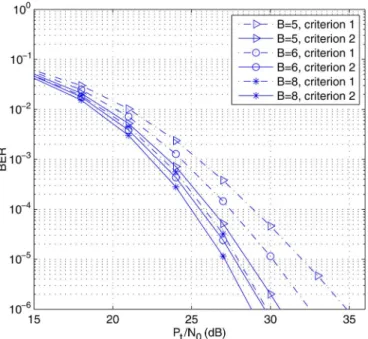
Fig. 4. Example 2. Comparison of the two selection criteria for different feed-back rate .
some substreams are not loaded with bits. The two multi-code-book schemes enjoy significant gain over the single-codemulti-code-book scheme. The gain of bit-loading-dependent codebook scheme is
around 3.2 dB at .
Example 2. Selection Criteria: Fig. 4 compares the BER of
the two selection criteria introduced in Section VI for and . With the first criterion, vector quantiza-tion is applied directly on for each bit loading vector while an exhaustive search among all precoders is performed in the second case. For the same feedback rate , we use the same precoder and bit loading codebooks in Fig. 4; only the selec-tion criteria are different. When the feedback rate increases, the degradation of using the low-cost criterion 1 becomes smaller. For example, when , the gap between the two criteria is around 3.3 dB at and it narrows to 0.8 dB when . For a large , criterion 1 can be used to reduce complexity at the cost of a small performance loss. For a small , it is worthwhile to use criterion 2, for which the number of searches is small.
Example 3. Feedback Rate Allocation: We demonstrate the
importance of proper feedback rate allocation between precoder and bit loading in this example for and . Selection criterion 1 in Section VI is used. For , the op-timal rate allocation is using the method in Section III. In Fig. 5, we show the BER for all possible such that . We see that the rate
al-location gives the best performance. For
example, at , is better than
by around 2.1 dB. The performance is sen-sitive to rate allocation; by moving one bit from to the performance can differ by 2.1 dB. In the case , all feedback bits are used for precoder feedback and the bit loading is a fixed vector. Two cases of fixed bit loading are shown, a nonuniform one [8 7 0] and a uniform one [5 5 5].
Fig. 5. Example 3. Bit error rate performance for all different feedback rate allocations when .
The fixed nonuniform bit loading is obtained by using the gen-eralized Lloyd algorithm in Section V with only one codeword; the performance is considerably better than that of uniform bit loading. Therefore the design of bit loading is particularly
im-portant when .
Example 4. BER Comparisons for Linear Receivers: In this
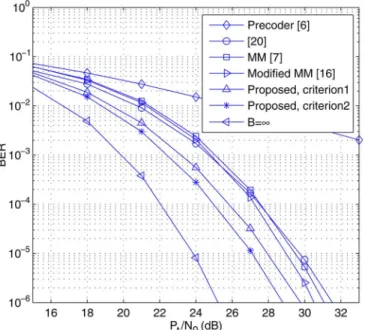
example we show the BER of the proposed method and other limited feedback systems with a linear receiver for
, , and . The feedback rate allocation com-puted using the method in Section III is . The precoder system [6] feeds back the index of the precoder in the codebook and data bits are uniformly loaded on all substreams. In the multimode (MM) precoding system [7], the constellation on all substreams are the same, but the number of substreams transmitted can vary with the channel. The modi-fied multimode precoding in [16] improves the performance of MM in [7] by introducing additional feedback of nonuniform bit loading. The feedback of bit loading only is proposed in [20]; the precoder is allocated zero feedback bit. The results are shown in Fig. 6. The systems that allow the number of substreams to vary enjoy a better performance. At , the gap be-tween the proposed system and other systems is around 1.5 dB when selection criterion 1 is used and around 2.3 dB when se-lection criterion 2 is used. By judicious allocation of feedback rates and joint consideration of precoder and bit loading feed-back, the proposed system can achieve a better performance. As a benchmark, the performance of the case is also shown, in which the precoder , and the optimal positive bit loading is used. With 8 bits of feedback, the performance of the proposed system with criterion 2 is around 3 dB away from the
curve “ ” at .
Example 5. BER Comparisons for Decision Feedback Re-ceivers: We show the BER of the proposed system with a
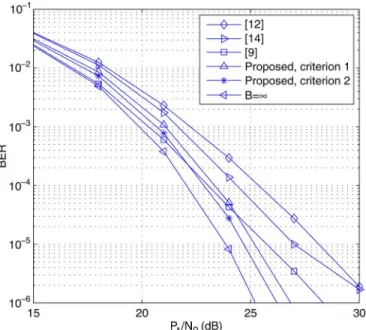
deci-sion feedback receiver in Fig. 7 for , ,
Fig. 6. Example 4. Comparisons of BER for systems with linear receivers for .
and . We use the feedback rate allocation and code-books designed for a linear receiver. With , the proposed method with criterion 2 is very close to the curve “ ” that we have shown for a linear receiver in Fig. 6. For com-parison, we have also shown the BER of the decision feedback systems in [9], [12], and [14]. In [12], the detection ordering is fed back to the transmitter. The required feedback rate is a fixed number bits; which is around 7 bits in this case. The QR-based system in [14] feeds back the index of bit loading. We constrain in a manner similar to that in [14] to satisfy the given feedback rate: are integers such that , ,
, , and . The number
of bit loading vectors is 286, which requires
bits. The system proposed in [9] feeds back the index of the optimal precoder in the Grassmannian codebook of 256 code-words for uniform bit loading. Due to the restriction of parame-ters in [9], we have increased the number of transmit antennas to 5 in the simulation for [9] and the other param-eters remain the same. We can see that the proposed system is able to achieve a smaller BER than those that do not consider the feedback of precoder and bit loading together.
VIII. CONCLUSION
In this paper, we have jointly considered the feedback of both precoder and bit loading for MIMO systems. We have devel-oped a systematic approach to designing feedback rate alloca-tion between precoder and bit loading by analyzing the power penalty due to quantization. As bit loading carries information on the importance of individual subchannels, we proposed to use multiple bit-loading-dependent codebooks for the precoder. The use of multi-codebook design yields significant gain over the single-codebook design. There is no need of informing the trans-mitter which codebook has been used because of bit loading feedback. The code rate of each precoder codebook is equal to
Fig. 7. Example 5. Comparisons of BER for systems with DFE receivers for .
the full feedback rate allocated for the precoder. The joint con-sideration of feedback of precoder and bit loading leads to a very good performance compared to systems that design the feed-back of bit loading and precoder separately.
APPENDIXA
PROOF OFLEMMA1
When the precoder is , the error autocorrelation
ma-trix in (1) is if has
full rank. Express as , where
is a diagonal matrix with , ,
is the identity matrix, and the matrix is given by
when and . When
is large, the quantization error is small, i.e., , . Thus . It is known that [30] we can write
as a power series in , i.e.,
when , where denotes the Frobenius norm of . As the elements of are small, we have the
approxima-tion . It follows that
. Thus we have . Notice that
is a diagonal matrix, and the diagonal elements of are equal
to zero, so .
Therefore the th subchannel error variance can be written as
(19) where is the th standard vector with and
when . The th element of is equal to
zero when , and equal to when
, so can be expressed as
(20)
Substituting (20) to (19), and using , we have the approximation in (6)
APPENDIXB PROOF OFLEMMA2
The power penalty due to precoder quantization in (7) can be rearranged as
(21) It is known that each is uniformly distributed over the
-di-mensional space , where is the set
of all complex vectors with elements [23]. When bits is used to quantize to , the probability density function of
can be approximated as [26]
where , and is the
in-dicator function, which is equal to 1 if in the interval and zero otherwise. With the above pdf approximation, it can be ver-ified that
. Using binomial expansion, we have
. Using integration by parts repeat-edly, we obtain
(22) Substituting (22) to (21) leads to (8).
APPENDIXC
PROOF OFLEMMA3
The power penalty due to bit loading quantization in (9)
can be written as ,
where ,
and . Consider the Taylor series of
about the mean ,
where as defined in Lemma 3. Using
the 3rd order Taylor approximation [31], we have (23), shown at the bottom of the next page, where , are nonnegative integer and denotes the factorial of . It can be verified that
. The expectation of (23) is (24), shown at the bottom of the page. Let us examine the second and third terms on the right hand side (r.h.s.) of (24). As and
are independent for and , we have
when or . So the second term on the r.h.s. of (24) can be simplified as
(25)
where we have used the facts that ,
and thus for .
Simi-larly, for , , , we have
when , , or .
Thus the third term on the r.h.s. of (24) becomes
(26)
Using , , and
for , , (26) can be
expressed as
(27)
Substituting (25) and (27) to (24), we obtain in (10). For any nonnegative integer , it can be verified that
for . Thus
. APPENDIXD
PROOF OF(13)
Using (12), the th column of the quantized precoder can
be obtained from quantized as
(28) Using (12) and (28), we have and
(29)
where and
. Let us use Gram-Schmidt process
to obtain from and from . Let
be an
matrix. We can obtain and by applying
the Gram-Schmidt process to and
respec-tively [30]. Let the th column of and
be and respectively. We have . Let
. Then
for . In a similar way, we can
ob-tain from . When is sufficiently large, we have
, i.e., , which implies ,
and thus . Using a similar
ap-proach, we get for . Defining
, we can write
(30) where the entries of are small. Using (30), the matrix
can be expressed as (31) where , (23) (24)
for and . Substituting (31) to (29), we get
(32) When the entries of are small, so are those of . Thus
we have for .
APPENDIXE
PROOF OF(18)
We can use KKT condition to solve the problem in (17). Let be a local minimum. There exist constants , ,
such that 1) . 2) . 3) . 4) . Solving con-dition 1, we have (33) Suppose in the above equation, we obtain
, which means for all . This contradicts the condition
, hence and condition 2 becomes (34)
From condition 3, we have if . Thus
con-dition 4 implies . If in condition 4, we have
and hence . Note that when , and
, (33) implies . Combining
con-ditions 3 and 4, we obtain the optimal given in (18). To obtain the constant , we substitute the optimal to (34),
(35) We only need to solve when . Let be the lower
common multiple of the set . Defining
, then (35) becomes a polynomial of
(36) Such a polynomial has only one positive real root and the so-lution of is unique. This can be shown using sign variations [32], the definition of which is given in the following for com-pleteness. Let be a finite sequence of real num-bers. Suppose there are nonzero numbers in the sequence, . The number of sign variations in the se-quence, denoted as , is the number of pairs
such that for [32].
Lemma 4: [32] Let be a polyno-mial with real coefficients and . If
, then has exactly one positive real root.
Observe that the constant term in (36) is negative because the number of codewords is equal to and . Therefore, (36) is a polynomial equation with pos-itive coefficients except for the constant term. The number of sign variations in the sequence formed by the coefficients of the polynomial in (36) is equal to one. Thus given and , the polynomial has exactly one positive real root and the solution of is unique.
REFERENCES
[1] D. J. Love, R. W. Heath, V. K. N. Lau, D. Gesbert, B. D. Rao, and M. Andrews, “An overview of limited feedback in wirelese com-munication systems,” IEEE Sel. Areas Commun., vol. 26, no. 8, pp. 1341–1365, Oct. 2008.
[2] D. J. Love and R. W. Heath, “Limited feedback unitary precoding for spatial multiplexing systems,” IEEE Trans. Inf. Theory, vol. 51, no. 8, pp. 2967–2976, Aug. 2005.
[3] T. Inoue and R. W. Heath, “Kerdock codes for limited feedback pre-coded MIMO systems,” IEEE Trans. Signal Process., vol. 57, no. 9, pp. 3711–3716, Sep. 2009.
[4] W. Santipach and M. L. Honig, “Capacity of a multiple-antenna fading channel with a quantized precoding matrix,” IEEE Trans. Inf. Theory, vol. 55, no. 3, pp. 1218–1234, Mar. 2009.
[5] J. C. Roh and B. D. Rao, “Design and analysis of MIMO spatial multiplexing systems with quantized feedback,” IEEE Trans. Signal
Process., vol. 54, no. 8, pp. 2874–2886, Aug. 2006.
[6] S. Zhou and B. Li, “BER criterion and codebook construction for finite-rate precoded spatial multiplexing with linear receivers,” IEEE Trans.
Signal Process., vol. 54, no. 5, pp. 1653–1665, May 2006.
[7] D. J. Love and R. W. Heath, “Multimode precoding for MIMO wireless systems,” IEEE Trans. Signal Process., vol. 53, no. 10, pp. 3674–3687, Oct. 2005.
[8] X. Song and H. N. Lee, “Multimode precoding for MIMO systems: Per-formance bounds and limited feedback codebook design,” IEEE Trans.
Signal Process., vol. 56, pp. 5296–5301, Oct. 2008, v10.
[9] M. B. Shenouda and T. N. Davidson, “A design framework for limited feedback MIMO systems with zero-forcing DFE,” IEEE J. Sel. Area
Commun., vol. 26, no. 8, pp. 1578–1587, Oct. 2008.
[10] H. Zhuang, L. Dai, S. Zhou, and Y. Yao, “Low complexity per-antenna rate and power control approach for closed-loop V-BLAST,” IEEE
Trans. Commun., vol. 51, no. 11, pp. 1783–1787, Nov. 2003.
[11] S. T. Chung, A. Lozano, H. C. Huang, A. Sutivong, and J. M. Cioffi, “Approaching the MIMO capacity with a low-rate feedback channel in V-BLAST,” EURASIP J. Appl. Signal Process., no. 5, pp. 762–771, 2004.
[12] Y. Jiang and M. K. Varanasi, “Spatial multiplexing architectures with jointly designed ratetailoring and ordered BLAST decoding part-II: A practical method for rate and power allocation,” IEEE Trans. Wireless
Commun., vol. 7, no. 8, pp. 3626–3271, Aug. 2008.
[13] Q. Zhou and H. Dai, “Joint antenna selection and link adaptation for MIMO systems,” IEEE Trans. Veh. Technol., vol. 55, no. 1, pp. 243–255, Jan. 2006.
[14] C. C. Weng, C. Y. Chen, and P. P. Vaidyanathan, “MIMO transceivers with decision feedback and bit loading: Theory and optimization,”
IEEE Trans. Signal Process., vol. 58, no. 3, pp. 1334–1346, Mar.
2010.
[15] M. A. Sadrabadi, A. K. Khandani, and F. Lahouti, “Channel feedback quantization for high data rate MIMO systems,” IEEE Trans. Wireless
Commun., vol. 5, no. 12, pp. 3335–3338, Dec. 2006.
[16] M. Shin, S. Kim, J. Kang, and C. Lee, “An efficient multimode quan-tized precoding technique for MIMO wireless systems,” IEEE Trans.
Veh. Technol., vol. 58, no. 2, pp. 733–743, Feb. 2009.
[17] R. Yellapantula, Y. Yao, and R. Ansari, “Unitary precoding and power control in MIMO systems with limited feedback,” presented at the IEEE Wireless Commun. Netw. Conf., 2006.
[18] J. C. Roh and B. D. Rao, “Efficient feedback methods for MIMO chan-nels based on parameterization,” IEEE Trans. Wireless Commun., vol. 6, no. 1, pp. 282–292, Jan. 2007.
[19] J. Liu, D. Xu, R. Zhoa, L. Yang, and X. You, “Adaptive transmission for finite-rate feedback MIMO systems,” presented at the IEEE Wireless Commun. Netw. Conf., 2008.
[20] Y.-P. Lin, H.-C. Chen, and P. Jeng, “Bit allocation and statistical pre-coding for correlated MIMO channels with limited feedback,” IEEE
[21] P. P. Vaidyanathan, S. M. Phoong, and Y.-P. Lin, Signal Processing
and Optimization for Transceiver Systems. Cambridge, U.K.:
Cam-bridge Univ. Press, 2010.
[22] A. Gersho and R. M. Gray, Vector Quantization and Signal
Compres-sion. Norwell, MA, USA: Kluwer Academic, 1992.
[23] A. Gupta and D. Nagar, Matrix Variate Distributions. London, U.K.: Chapman & Hall/CRC, 2000.
[24] A. Zanella, M. Chiani, and M. Z. Win, “On the marginal distribution of the eigenvalues of Wishart Matrices,” IEEE Trans. Commun., vol. 57, no. 4, pp. 1050–1060, Apr. 2009.
[25] R. Stark and J. W. Woods, Probability and Random Processes With
Ap-plication to Signal Processing, 3rd ed. Englewood Cliffs, NJ, USA:
Prentice-Hall, 2002.
[26] J. C. Roh and B. D. Rao, “Transmit beamforming in multiple-antenna systems with finite rate feedback: A VQ-based approach,” IEEE Trans.
Inf. Theory, vol. 52, no. 3, pp. 1101–1112, Mar. 2006.
[27] E. K. P. Chong and S. H. Zak, An Introduction to Optimization. New York, NY, USA: John Wiley & Sons, 1996.
[28] B. Farber and K. Zeger, “Quantization of multiple sources using non-negative integer bit allocation,” IEEE Trans. Inf. Theory, vol. 52, no. 11, pp. 4945–4964, Nov. 2006.
[29] B. Fox, “Discrete optimization via marginal analysis,” Manag. Sci., vol. 13, pp. 210–216, Nov. 1966.
[30] R. Horn and C. Johnson, Matrix Analysis. Cambridge, U.K.: Cam-bridge Univ. Press, 1985.
[31] S. G. Krantz and H. R. Parks, A primer of Real Analytic Functions. Berlin, Germany: Birkhauser Verlag, Basel, 1992.
[32] W. Krandick and K. Mehlhorn, “New bounds for the descartes method,” J. Symbolic Comput., vol. 41, pp. 49–66, 2006.
Hung-Chun Chen was born in Pingtung, Taiwan, in 1985. She received the B.S. degree in electrical and control engineering in 2008 from National ChiaoTung University, Hsinchu, Taiwan, where she is currently working towards the Ph.D. degree with the Department of Electrical Engineering. Her re-search interests include signal processing for digital communications and wireless communications.
Yuan-Pei Lin (S’93–M’97–SM’03) was born in Taipei, Taiwan, 1970. She received the B.S. degree in control engineering from the National Chiao-Tung University, Taiwan, in 1992, and the M.S. degree and the Ph.D. degree, both in electrical engineering from California Institute of Technology, in 1993 and 1997, respectively. She joined the Department of Electrical and Control Engineering of National Chiao-Tung University, Taiwan, in 1997. Her re-search interests include digital signal processing, multirate filter banks, and signal processing for digital communications.
She was a recipient of Ta-You Wu Memorial Award in 2004. She served as an associate editor for IEEE TRANSACTION ONSIGNALPROCESSING, IEEE TRANSACTION ON CIRCUITS AND SYSTEMS II, IEEE SIGNAL PROCESSING
LETTERS, IEEE TRANSACTION ON CIRCUITS AND SYSTEMS I, EURASIP Journal on Applied Signal Processing, and Multidimensional Systems and Signal Processing, Academic Press. She was a Distinquished Lecturer of the IEEE Circuits and Systems Society for 2006–2007. She has also coauthored two books, Signal Processing and Optimization for Transceiver Systems, and
Filter Bank Transceivers for OFDM and DMT Systems, both by Cambridge