Research Express@NCKU - Articles Digest
1 of 2
Research Express@NCKU Volume 28 Issue 5 - January 30, 2015 [ http://research.ncku.edu.tw/re/articles/e/20150130/4.html ]
An ISM, DEI, and ANP based approach for product
family development
Shih-Wen Hsiao
*Department of Industrial Design, National Cheng Kung University, Tainan 70101, Taiwan, ROC [email protected]
Advanced Engineering Informatics 27 (2013) 131–148
F
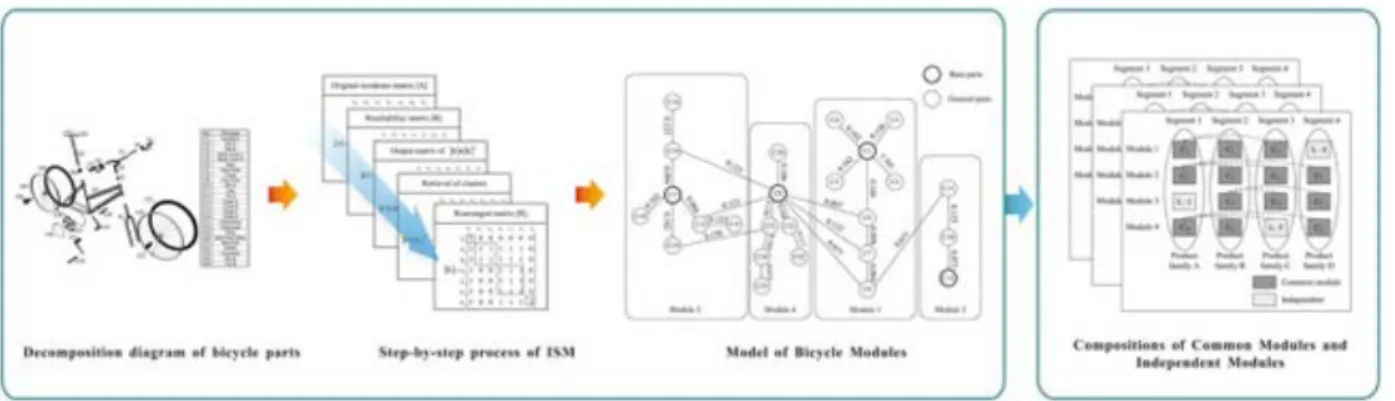
or product design, the first important thing is that it can develop product families by the use of market segmentation after establishing modular architecture. Hence, our target has been focusing on increasing the efficiency of developing products. Generally speaking, product customization is an useful and appropriate to complete this goal in order to it has been used for many years, and with this concept, product families can be designed that are better matched to the needs of customers through the use of marketsegmentation and modular architecture. Fig. 1 shows the research flowchart, including ISM, the calculation principles of the correlation matrices between parts, cluster analysis, ANP and the corresponding steps. This study is composed of two phases: the first phase establishes the modular architecture, and taking a bicycle as the case study, applies the Interpretive Structural Model (ISM) to modularize and cluster parts, and then models the connecting relations between the parts numerically using a Disassembly Effort Index (DEI). The second step involves the development of a product family using cluster analysis to divide the experimental samples and the employment of an Analytic Network Process (ANP) to obtain the optimal weight performance of the modules after establishing the market segmentation model. Results of the case study establish four product families and address construction performance of both the common and independent modules between the product families. The methodology of this study can be applied to the beginning stage of product development, particularly in the design process of diverse product families. Besides, we anticipate that the proposed method can generally be applied to the field of engineering informatics for design research in the further.
Fig. 1. Flow chart of the study experiments
Reference
1. S.W. Hsiao, E. Liu, A structural component-based approach for designing product family, Comput. Ind. 56 (2005) 13–28.
2. Y.C. Lee, Y.H. Chao, S.B. Lin, Structural approach to design user interface, Comput. Ind. 61 (2010) 613– 623.
3. D. Tang, R. Zhu, J. Tang, R. Xu, R. He, Product design knowledge management based on design structure matrix, Adv. Eng. Inform. 24 (2010) 159–166.
Research Express@NCKU - Articles Digest
2 of 2
216–225.
5. T.F. Bozbura, A. Beskese, Prioritization of organizational capital measurement indicators using fuzzy AHP, Int. J. Approx. Reasoning 44 (2) (2007) 124–147.