國立臺灣大學工學院土木工程學系 碩士論文
Department of Civil Engineering College of Engineering
National Taiwan University Master Thesis
基於系統韌性最佳化之相依基礎設施災後修復作業 Optimizing Resilience of Restoring Disrupted
Interdependent Infrastructure Systems
陳譽仁 Yu-Jen Chen
指導教授:許聿廷 博士 Advisor: Yu-Ting Hsu, Ph.D.
中華民國 108 年 10 月
October 2019
口試委員審定書
致謝
感謝指導教授許聿廷教授的悉心指導與協助、來自父母與妹妹的支持與鼓勵、
以及朋友、316 研究室夥伴的扶持,缺少這些幫助,本篇研究不可能在兩年內形成、
發展並撰寫成論文。同時,也感謝口試委員朱致遠教授與盧宗成教授在口試時的提 問與建議,使得這份論文從初稿到定稿的修訂有了方向與依據。
回顧研究所的兩年,許聿廷教授寬鬆卻不失嚴謹的指導風格塑造我執行研究
的觀念,研究也隨著每次 individual meeting 與每篇讀過的文獻逐漸聚焦,而幸運
地找到一個新穎的主題,發現前人尚未處理的部分。研究進行到一定程度時,老師
便鼓勵將現有成果投稿,才有機會分別前往日本參與KKHTCNN 的研討會及遠赴
美國參加TRB 的年會,同時在會後探索外國風情,與朋友留下深刻回憶。研究生
涯能夠在小許家度過確實是一件幸福的事,研究之外,老師會抽空與學生們聚餐,
也不時會關心學生們的生活,更在一年一度的鐵道接力馬拉松與小賴家競逐,今年 更在天時地利人和之下迎來首次勝利。
這份研究的完成同時要感謝家人與親戚的支持。在臺北從大學到研究所的這 六年,每星期通往家裡的電話傳送家的溫暖與鼓勵,更是前進的動力。同時,父母 在經濟上與生活上的支持則使我不需顧慮太多雜事,只要心無旁鶩面對學業就好。
研究生涯中,316 研究室夥伴的相互扶持也是完成論文不可或缺的助力。透過
諧音冷笑話、同學間相互消遣可以暫時忘卻研究進度的壓力;透過同學之間的討論 可以釐清研究上的盲點,在言談間獲得靈感,進而使研究有所突破。
過去這一年,應該是我目前人生中特殊而富有轉折的一年:首次參加國際研討
會而在日本報告這篇研究的早期版本,並濫用Pass 狂搭新幹線;為了不要搭夜間
巴士、不要只能搭巴士離開機場(IAD)進市區、也不要在美國境內轉機,迂迴地
在東京轉機、多倫多過夜、透過 DCA 進入華盛頓特區參加 TRB 的年會,回程也
轉機兩次,最後拿著六張機票去報帳;而過去一年,多了幾位親密朋友,更加明確 地認識自我,體重也創了新高;但是,卻在今年五月面對阿公的過世與隨之而來的 悲傷。碩二這年,增添許多經歷、精神生活得到富足,也承受悲慟。如今,多樣的
iv
一年再加上本篇論文,更凸顯今年在我人生中的意涵,並體認到師長、家人、同學 與朋友在這些事背後的協助與不可或缺。
本篇論文的完成承蒙指導教授、家人與同學的支持與協助,也希望這份研究在 未來對災後修復問題的處理上能有些微的貢獻。
陳譽仁 謹誌
民國108 年 10 月
摘要
相依基礎設施系統遭受災害之後,需要透過修復作業以回復其原始功能,本研 究宗旨即為討論相依基礎設施系統的災後修復作業,並以最小化修復過程中的系 統韌性為目標。為計算、規劃系統內損壞元件的修復排程並以系統韌性評估該基礎 設施系統的效能,本研究考慮由道路、電力及電信系統所組成、包含各系統間複雜 交互關係的相依基礎設施系統,提出以網路流為基礎的混合整數二次規劃模式。模 式中以各系統提供的服務需求未滿足量評估系統的韌性損失,並將目標函數定義 為最小化整體修復過程中的任性損失與需求資訊不完整的懲罰項。其中,模式透過 網路流計算各基礎設施系統中的服務遞送量與受損元件修復的可行選項,並以決 策變數描述系統中元件功能狀態,而其數值隨時間的變化即為修復受損元件的時 序。其中,本研究與既有文獻不同處為考慮資訊傳遞與修復過程的相依性。資訊傳 遞的相依性涵蓋因通訊中斷而導致需求資訊的不完整,本研究以邏輯限制式、期望 系統性能損失與迭代修復過程進行考量。修復過程的相依性則與修復班隊基地能 否透過路網與各基礎設施系統損壞節線連通有關,本研究係利用網路流於模式中 計算,而此種相依性將直接影響到修復排程的可行性。為展示模式的能力與說明相 依性對修復過程造成的影響,本研究以臺灣新北市土城區為基礎進行案例分析,利 用參考當地管線資料所建立的多層相依基礎設施網路進行數值實驗,並設想兩種 不同型態的破壞模式,以說明資訊傳遞與修復過程的相依性對修復過程的影響。實 驗結果顯示本模式可透過系統性的觀點評估相依基礎設施系統的韌性,進而以系 統韌性最佳化的角度規劃修復作業。
關鍵字:系統韌性、基礎設施系統、相依性、災後修復、網路流模型
ABSTRACT
This study proposes the problem of restoring interdependent infrastructure systems after disaster impact, seeking to minimize the resilience loss and the penalty for the incomplete information of the amount of demand throughout the horizon of a restoration schedule. In order to solve the proposed problem, this study develops a mixed integer quadratic programming model, which applies the network flow method to describe the dynamics of commodity delivery, restoration crews and functional states of components in the interdependent infrastructure systems, including the roadway, electric power, and telecommunication systems. The performance of each system is defined based on the met demand for relevant service to assess resilience loss, and the objective function is defined to minimize the expected unmet demand throughout the recovery phase. This model also reflects several types of interdependencies. First, the cyber interdependency is factored by the logical constraints, the expected performance loss, and the iterative process when updating the state of certainty for the demand. Then, the restoration interdependency is addressed through the network flow method to determine the connectivity of the restoration crews from restoration depots to the disrupted components of different systems in the roadway network, which can directly affect the feasibility of a restoration schedule. In order to exemplify the capability of the model, this study conducts numerical experiments using test infrastructure networks built based on the infrastructure systems in Tucheng District, New Taipei City, Taiwan and conceives two cases of different patterns of system disruption. The results of the experiments demonstrate that the proposed model can optimize the restoration schedule based on the assessment of system resilience from a holistic perspective.
viii
Keywords: Resilience, Infrastructure systems, Interdependency, Restoration, Network flow model
TABLE OF CONTENT
口試委員審定書 ... i
致謝 ... iii
摘要 ... v
Abstract ... vii
Table of Content ... ix
List of Figures ... xiii
List of Tables ... xv
Chapter 1 Introduction ... 1
1.1.1 Resilience ... 2
1.1.2 Interdependent infrastructure systems ... 3
1.1.3 Restoring interdependent infrastructure systems ... 4
Chapter 2 Literature Review ... 9
2.1.1 Resilience assessment approaches ... 10
2.1.2 Performance indicators for infrastructure networks ... 11
x
Chapter 3 Model Development ... 21
3.1.1 Objective ... 22
3.1.2 Infrastructure networks ... 22
3.1.3 Interdependency ... 24
3.4.1 Expected unmet demand ... 30
3.4.2 Objective function and initial condition ... 32
3.4.3 Flow conservation for commodity ... 33
3.4.4 Flow conservation for restoration crews ... 34
3.4.5 Calculating expected unmet demand ... 35
3.4.6 Physical interdependency ... 35
3.4.7 Cyber interdependency ... 36
3.4.8 Logical/restoration interdependency ... 37
3.4.9 Restoration constraints ... 37
3.4.10 Capacity and decision variables ... 37
3.4.11 Summary of model development ... 39
Chapter 4 Numerical Experiments ... 41
4.2.1 Parameters ... 51
4.2.2 Tradeoff between incomplete information and resilience ... 51
4.3.1 Parameters ... 60
4.3.2 Feasibility of restoration process ... 62
Chapter 5 Conclusions ... 71
Reference ... 75
LIST OF FIGURES
Figure 1.1 System performance transition under the disruption ... 3
Figure 1.2 Summary of the considered interdependencies ... 4
Figure 1.3 Thesis organization ... 7
Figure 3.1 Probability distribution for the demand in the roadway network ... 25
Figure 3.2 Iterative restoration process ... 40
Figure 4.1 Test roadway network ... 46
Figure 4.2 Test electric power network ... 47
Figure 4.3 Test telecommunication network ... 48
Figure 4.4 Disrupted links for severe telecommunication disruption ... 50
Figure 4.5 Unweighted objective value with different value of 𝜔𝜔𝑃𝑃𝑃𝑃 ... 54
Figure 4.6 Solution time for severe telecommunication disruption ... 54
Figure 4.7 Restoration schedule for 𝜔𝜔𝑃𝑃𝑃𝑃 = 0.5 (t = 0 ~ 4) ... 56
Figure 4.8 Restoration schedule for 𝜔𝜔𝑃𝑃𝑃𝑃 = 0.5 (t = 5 ~ 9) ... 57
Figure 4.9 Restoration schedule for 𝜔𝜔𝑃𝑃𝑃𝑃 = 3.5 (t = 0 ~ 4) ... 58
Figure 4.10 Restoration schedule for 𝜔𝜔𝑃𝑃𝑃𝑃 = 3.5 (t = 5 ~ 9) ... 59
Figure 4.11 Disrupted links for severe roadway disruption ... 61
Figure 4.12 Performance change throughout time stages... 63
Figure 4.13 Restoration schedule with restoration interdependency (t = 0 ~ 4) ... 65
Figure 4.14 Restoration schedule with restoration interdependency (t = 5 ~ 9) ... 66
Figure 4.15 Restoration schedule with restoration interdependency (t = 10 ~ 14) ... 67
Figure 4.16 Restoration schedule without restoration interdependency (t = 0 ~ 4) ... 68
Figure 4.17 Restoration schedule without restoration interdependency (t = 5 ~ 9) ... 69
Figure 4.18 Restoration schedule without restoration interdependency (t = 10 ~ 14) ... 70
LIST OF TABLES
Table 3.1 Summary of the considered infrastructure networks ... 24
Table 3.2 Notation for indices ... 28
Table 3.3 Notation for sets ... 28
Table 3.4 Notation for parameters ... 28
Table 3.5 Notation for decision variables ... 29
Table 3.6 Probability density function for demand and expected demand surplus ... 31
Table 4.1 Topology of the test infrastructure networks ... 43
Table 4.2 Supply in the test infrastructure networks ... 43
Table 4.3 Demand in the test infrastructure networks ... 44
Table 4.4 Reference infrastructure networks ... 45
Table 4.5 Parameters for severe telecommunication disruption ... 51
Table 4.6 Restoration schedule for 𝜔𝜔𝑃𝑃𝑃𝑃 = 0.5 ... 55
Table 4.7 Restoration schedule for 𝜔𝜔𝑃𝑃𝑃𝑃 = 3.5 ... 55
Table 4.8 Parameters for severe roadway disruption ... 60
Table 4.9 Summary of two scenarios ... 63
Table 4.10 Restoration schedule with restoration interdependency ... 64
Table 4.11 Restoration schedule without restoration interdependency ... 64
CHAPTER 1 INTRODUCTION
In recent years, the increasing frequency of severe natural disasters has greatly threatened people’s lives and properties, and disaster management has become a vital issue for the sustainability of urban and regional development. One of the major purposes of disaster management is to recover and/or ensure the functionality of a society and essential life support upon disaster impact, which relies on the normal operation of relevant infrastructure systems, such as roadway system (for delivering rescues, relief materials, or even for evacuation), telecommunication system, systems of electric power and water supply. Each infrastructure system may be subject to a distinctive level of vulnerability that can lead to full or partial disruption of system service over a certain period and thereby affect the operation of disaster response as well. Hence, to enhance these critical infrastructure systems in terms of their resilience to withstand disaster impact or quickly recover from disruption is crucial for disaster management in both pre- disaster and post-disaster contexts. In this chapter, the motivation and the goal of this research are specified, and the organization of this thesis is presented.
Research motivation
As the infrastructure systems become more complicated and interrelated, the raising frequency and strength of natural disasters can cause severe impact and disruption to the community. For instance, in August 2015, Typhoon Soudelor devastated the outreach connection of Wulai District, New Taipei City, where both the telecommunication service and roadway connection were disconnected, isolating the villages in Wulai District (Shan,
2
2015). While the natural disaster can directly impact the infrastructure system, the complicated interrelations among different infrastructure systems could cause a cascading effect toward other infrastructure systems from an infrastructure system directly disrupted by the disaster. For example, the functionality of the telecommunication service relies on the essence of the supply of electric power. Inspired by the abovementioned factors, this study covers two major aspects: resilience, describing the capability of the infrastructure systems withstanding and recovering from the disaster, and the interdependency among several infrastructure systems.
1.1.1 Resilience
From the engineering perspective, resilience is the speed of returning to the steady state after a disruption (Batabyal et al., 2007), which is an index to assess the performance of an infrastructure system. Unlike the conventional risk analysis that pursues fail-safe, resilience represents a “safe-to-fail” position to contain and minimize the failure that may result from unpredictable disturbance and impact (Ahern, 2011; Fang and Zio, 2019).
When an infrastructure system is affected by a disaster, it is first disrupted, suffering a loss of performance; then, it may adapt to the disruption with the available components in the infrastructure system, such as the previously redundant facilities and capacities;
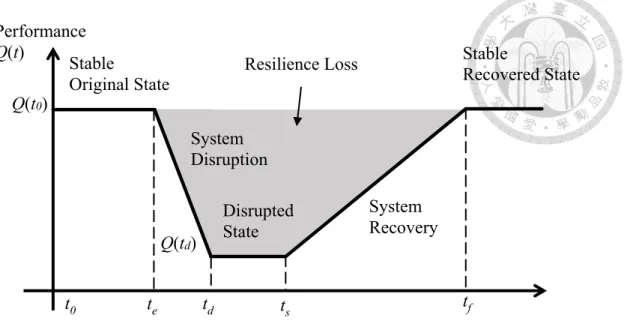
last, the external effort intervenes to restore the affected component, assisting the system to recover to its original functionality. Hence, the performance status’ transition of the infrastructure system influenced by disruption can be divided into three phases as in Figure 1.1: normal (T < te), deterioration (T = te ~ ts) and recovery (T = ts ~ tf).
Figure 1.1 System performance transition under the disruption (adapted from Henry and Emmanuel Ramirez-Marquez (2012)) 1.1.2 Interdependent infrastructure systems
Interdependency is generally illustrated as two infrastructure systems dependent on each other (Rinaldi et al., 2001). That is, it describes the complex interrelation among different infrastructure systems, which can cause the cascading effect during the disruption and constrain the restoration schedule. The infrastructure systems may be interdependent from the perspective of either physical connection or functional association. Due to such interdependency, the failure of a component in a network may cause cascading effects within the network or even across interdependent networks. For instance, the disconnection of electric power transmission can result in the malfunction of the telecommunication system, but such malfunction can block the transmission of the system status of the electric power system, and thus the telecommunication system influences the electric power system reversely.
In this study, four kinds of interdependency are introduced and considered following the categorizing method by Rinaldi et al. (2001), which are physical, cyber, geographic,
Performance Q(t)
Q(t0)
Stable
Original State
Disrupted State
Stable
Recovered State
System Disruption
Q(td)
System Recovery Resilience Loss
t0 te td ts tf
4
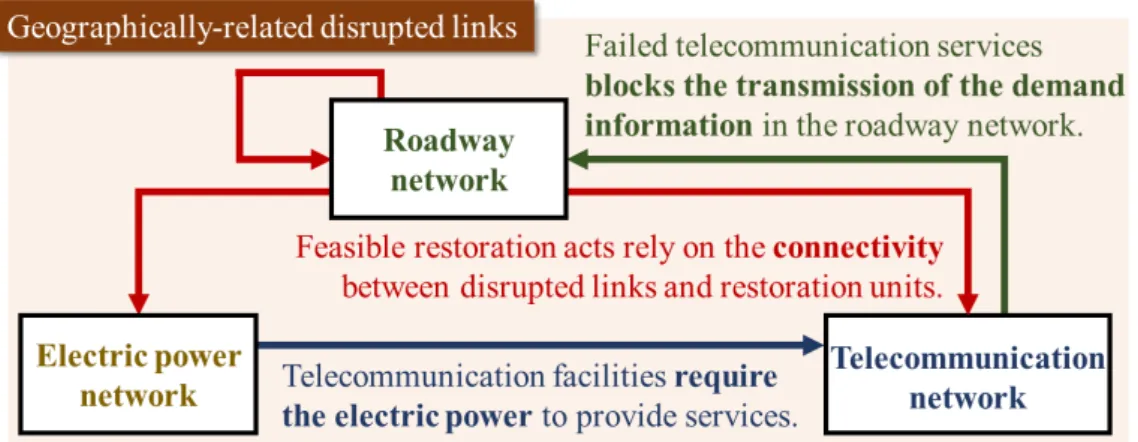
and logical, and the relative method will be reviewed and discussed in Section 2.2. Herein, the considered interdependencies covers the interrelations among the roadway, electric power, and telecommunication systems. In summary, the considered interdependencies are presented in Figure 1.2.
Figure 1.2 Summary of the considered interdependencies
1.1.3 Restoring interdependent infrastructure systems
Of three phases in the transition of system performance as Figure 1.1, this study focuses on the phase regarding the external efforts, the restoration in the phase of system recovery. As the restoration is to recover the functionality of the infrastructure system, optimizing the schedule of the restoration can reduce the loss of resilience, which is to boost the recovery of the infrastructure system through the external effort. That is, through optimizing the sequence of the disrupted components to be restored, the resilience loss can be minimized, and the grey area in Figure 1.1 is thus lessened.
However, the interrelation among different infrastructure systems complicates the optimization of the restoration. In order to restore some parts of the telecommunication facilities, some specific electric power components should first be recovered, but with the limited amount of the restoration resource, this consideration may contradict the goal to
recover the electric power network as restoring such electric power components could not benefit the recovery of the electric power network.
Research goal
In light of the growing needs of emergency response for natural disasters and the research gap in the restoration of the interdependent infrastructure networks, this study proposes a problem for infrastructure resilience optimization, which focuses on the recovery phase of system performance after a given disruption. In contrast to the studies regarding restoring the interdependent infrastructure networks in the existing literature, this study further considers two types of interdependency which are still rarely modeled and accordingly optimizes the restoration of three infrastructure networks in one objective function: (i) incomplete information of the amount of demand as the cyber interdependency (ii) the restoration interdependency over multi-layer networks.
(i) Cyber interdependency: the transmission of the demand information in the roadway network relies on the telecommunication services. If the telecommunication services are failed, it can cause the difficulty to the optimization of the restoration schedule due to the incomplete information of the amount of demand.
(ii) Restoration interdependency: the roadway network provides the restoration crews of all the infrastructure networks with the connection between their depots and the disrupted components. If the disrupted components in any infrastructure systems are not accessible to the depot through the roadway network, the restoration on those components is not feasible.
Additionally, the cross-network interdependency further increases problem complexity and collectively presents the methodologically challenging perspectives. A
6
network flow approach is applied to capture network dynamics and interactive effects between multi-layer networks explicitly. Numerical experiments are conducted for the restoration of the roadway, electric power supply, and telecommunication systems (three- layer networks) under the impact of flood-related disruption.
Thesis organization
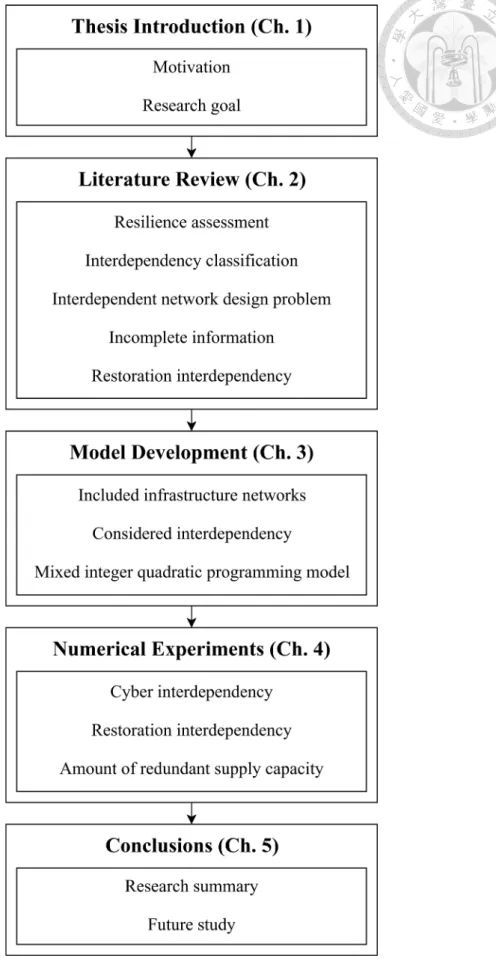
The organization of this thesis is demonstrated in Figure 1.3. Chapter 2 covers the concept and the assessment method for resilience, and the interdependency is categorized and studied. In the same chapter, the relevant studies of the restoration of the interdependent infrastructure systems are reviewed, where the research gap in the existing literature is discussed. Next, in Chapter 3, the characteristic of the restoration of the interdependent infrastructure networks and the interdependent network restoration problem, are stated and analyzed. Then, a mathematical model is developed to solve the problem. In Chapter 4, the test multi-layer interdependent infrastructure networks are implemented to manifest the implementation of the stated problem and the capability of the developed model. Last, the conclusion is presented in Chapter 5 to summarize the findings of this research and provide some recommendation for future studies.
Figure 1.3 Thesis organization
CHAPTER 2 LITERATURE REVIEW
From the perspective of disaster management, recovering the functionality of the community through the restoration after severe disasters is an essential task, and resilience is a concept and an index to measure the process of the restoration of the infrastructure systems. In this chapter, the assessment approaches for resilience, several types of classification for the interdependency, and the methods to model optimize the restoration schedule of the interdependent infrastructure systems are summarized; last, the research gap in the existing literature is outlined.
Resilience assessment
Following the introduction of the resilience in Section 1.1.1, resilience is an index to analyze the capability of the infrastructure systems. Conceptually, a system is considered as being resilient for its capabilities in three aspects (Fiksel, 2003; Nan and Sansavini, 2017; Vugrin et al., 2010):
(i) Absorptive capability is to reduce the initial impact of a disaster.
(ii) Adaptive capability is to adjust the system to balance disaster impact and maintain a certain level of system performance.
(iii) Restorative capability is to repair the failed system components.
These capabilities are highly related to system structure and the strengths of system components against disaster impact. For instance, a structure designed with higher redundancy is more likely to improve the adaptive capability, as redundant components may share the workload of the damaged ones and continue the functionality of the system.
10
Woods (2015) also sorted the resilience into four concepts:
(i) Resilience as rebound: it refers to how a system rebounds from disruption and returns to previous or normal states.
(ii) Resilience as robustness: some researches label resilience as robustness, which is the ability to absorb perturbations.
(iii) Resilience as graceful extensibility: this concept views resilience as how to extend adaptive capacity in the face of surprise.
(iv) Resilience as sustained adaptability: it indicates the ability to manage the adaptive capacities of systems.
From the description of those four concepts, they can all be categorized into the three capabilities mentioned above: robustness as the absorptive capability, graceful extensibility, and sustained adaptability as the adaptive capability, and rebound as the restorative capability.
Vugrin et al. (2010) concluded the distinguishing characteristic for the abovementioned capabilities: the absorptive capability and the adaptive capability are the internal measurements for the system impact, while the restorative capability is the exogenous measurement through total recovery effort which often requires external effort.
This study aims at studying the external effort that can fortify the resilience of the infrastructure systems, which is the restorative capability through optimizing the restoration process. In order to analyze the restorative capability, an assessment approach is needed, and thus, the assessment approaches are reviewed as followed.
2.1.1 Resilience assessment approaches
The resilience assessment approaches can be classified into two categories from the
review paper (Hosseini et al., 2016): qualitative and quantitative. The qualitative category includes methods according to conceptual frameworks, which provide some guiding principles or offering the semi-quantitative indices from the questions for experts’
assessment. The quantitative assessment approaches contain two sub-categories: general measures and structural-based models, while the quantitative approaches are more suitable for this thesis because they can quantify the performance of the optimization of the infrastructure restoration schedule.
General measures are one type of quantitative assessment approaches for resilience;
they quantify the performance of a system regardless of the system structure (Hosseini et al., 2016). Herein, based on the concept of service stability, several studies (Ghosn et al., 2016) also converge on a formula for the quantification of resilience (RES) defined as Equation (1), which is the integral of the performance of a system over time:
𝑅𝑅𝑅𝑅𝑅𝑅 = ∫𝑡𝑡𝑡𝑡00+𝑡𝑡ℎ𝑄𝑄(𝑡𝑡)𝑑𝑑𝑡𝑡 𝑡𝑡ℎ
(1)
Bruneau et al. (2003) proposed a deterministic static metric corresponding to the grey area in Figure 1.1 for measuring the resilience loss R as defined in Equation (2), where Q(t) measures the functionality level of the integrated system.
𝑅𝑅 = � [100 − 𝑄𝑄(𝑡𝑡)]𝑡𝑡𝑓𝑓
𝑡𝑡0
𝑑𝑑𝑡𝑡 (2)
2.1.2 Performance indicators for infrastructure networks
From Equations (1) and (2), the definition of the performance indicators (𝑄𝑄(𝑡𝑡)) for the infrastructure networks is required to evaluate the resilience of the infrastructure system. The network-performance indicators are suggested to be considered either the
12
topology or the functionality of networks (Ghosn et al., 2016). The topology-based performance metrics study the performance from the perspectives of connectivity and efficiency; herein, the connectivity is considered as the number of the connecting paths from the supply node to the consumption nodes; the efficiency is measured as to how efficient the transmission of the utility between different nodes. However, the topology- based metrics cannot capture the functional aspect of the infrastructure networks.
The flow-based functional performance metrics combine network topology with flow patterns, which are considered as the amount of flow that a damaged network can deliver to the demand nodes comparing to what it delivers before the disruption. Such metrics consider the flow capacity and the supply and demand constraints in an optimization framework (Ghosn et al., 2016).
Interdependency categorization
With the preface to the interdependency in Section 1.1.2, interdependency illustrates the interrelations among the infrastructure systems, and it can be presented in many different aspects. Rinaldi et al. (2001) categorized interdependencies into four types:
physical, cyber, geographic, and logical interdependencies.
(i) Physical interdependency means that the state of one infrastructure system is dependent on the material output(s) of another.
(ii) Cyber interdependency implies the relationships between infrastructure systems based on information transmitted through the relevant infrastructure.
(iii) Geographic interdependency means that a local environmental event can cause state changes in all infrastructure systems.
(iv) Logical interdependency includes other state dependencies between different
infrastructure systems, which is not via the physical, cyber, or geographic connection.
It is recognized that such classification can well sort out the interdependency related issues in several practical cases.
Lee et al. (2007) identified five types of interrelationship between infrastructure systems, where these authors denoted those types of dependence as the interdependency in their studies.
(i) Input dependence indicates the infrastructure components requires the services from another infrastructure component as the input.
(ii) Mutual dependence implies that a group of infrastructure components are dependent on the activities of each other.
(iii) Shared dependence means that some infrastructure systems share the same physical components or activities.
(iv) EXCLUSIVE OR dependence illustrates the activities that some specific infrastructures are the exclusive providers.
(v) Collocated dependence specifies that the components of two or more infrastructure systems are located in a similar geographical region.
P. Zhang and Peeta (2011) also proposed a way to categorize interdependencies.
(i) Functional interdependency indicates that the functioning of one system requires inputs from or can be substituted by another system.
(ii) Physical interdependency means some infrastructure systems are coupled through shared physical attributes.
(iii) Budgetary interdependency implies that several infrastructure systems share the same resource allocation budget, especially during disaster recovery.
(iv) Market interdependency means that all of the infrastructure systems are interacting
14
in the same economic system.
Ouyang (2014) reviewed the abovementioned and other types of interdependencies through studying some extreme events, such as extreme natural disaster and large-scale terrorist attack. However, the classification by Lee et al. and Zhang and Peeta does not cover some scenarios. For instance, the classification by Lee et al. cannot sort the scenario that the electric power systems and the telecommunication services are prioritized during the restoration process, and the categorization by Zhang and Peeta cannot sort the event that the debris-covered streets could block the emergency response personnel. Herein, Ouyang (2014) recognized that the classification proposed by Rinaldi et al. could well sort out the interdependency related issues in several practical cases.
Modeling interdependent infrastructure systems
In the review paper of modeling interdependent critical infrastructure systems (Ouyang, 2014), five major types of approaches have been adopted for analyzing interdependency across infrastructure systems:
(i) Empirical approaches analyze the interdependencies of the infrastructure systems through historical data and expert experience.
(ii) Agent-based approaches implement a bottom-up method that contains autonomous agents and their interactions to analyze the decision-making processes in the infrastructure systems. Herein, the reaction of the agents is based on their objectives, the pricing strategies, learning, and adaptation to the simulation environment, and the capacity expansion decisions (P. Zhang et al., 2011). However, the result of the simulation highly depends on the assumptions about the behaviors of the agent.
(iii) System-dynamics-based approaches model the dynamic behavior of the
interdependent infrastructure systems by capturing important causes, effects, and factors under the scenarios of disruption.
(iv) Economic-theory-based approaches view the operation of the infrastructure systems as the intermediate goods in the market of the economy, where the interdependencies are analyzed through economic interdependencies.
(v) Network-based approaches exploit the network structure, a common characteristic of infrastructure systems, and they are useful for analyzing physical interdependencies and the cascading disruptions (P. Zhang et al., 2011).
Herein, network-based approaches model each single infrastructure system by a respective network and describe the interdependencies between them by inter-links.
Depending on whether particle flows in the networks are de facto modeled, network- based approaches can be further categorized into two groups: topology-based methods and flow-based methods.
To explicitly describe the interdependencies in the infrastructure systems, this research adopts the network flow method to capture the dynamics of system evolution in terms of how restoration units and relevant resources move across systems. Accordingly, infrastructure systems are represented as the combination of networks, and the interdependencies are modeled using logical constraints in the formulation.
Restoring interdependent infrastructure networks
The relevant literature of modeling the interdependent infrastructure networks can be generally grouped according to research goals: performance evaluation, design, mitigation, and recovery models. For recovery models, most studies focus on analyzing the changing functional states of systems upon the restoration of failed components
16
(Ouyang, 2014). To optimize restoration can be viewed as a network design problem to add (restore) links to the disrupted network, while the scheduling of restoration also needs to be addressed. Lee et al. (2007) modeled the restoration of services in interdependent infrastructure systems by explicitly identifying interdependencies using network flow approaches. Nurre et al. (2012) proposed an integrated network design and scheduling problem to optimize the restoration of a single infrastructure network to maximize weighted total arrived demand. Cavdaroglu et al. (2013) optimized integrating restoration and scheduling decisions with the objective function of the performance over the horizon of the restoration plan and implemented logical constraints to describe the interdependencies. González et al. (2016) optimized the restoration strategy of selecting the components to be restored through minimizing the cost of preparation, reconstruction, surplus or deficit supply, and commodity flow, and they also developed the iterative use of the interdependent network design problem to account for the order of the reconstruction. Almoghathawi et al. (2019) proposed a resilience-driven restoration model with multiple objectives, including maximizing the resilience and minimizing the restoration cost. In their study, they used ε-constraint method to generate Pareto-optimal solutions and demonstrated the tradeoff between the resilience and the restoration cost.
Karakoc et al. (2019) integrated a resilience-driven mixed integer programming model to schedule the restoration process of the disrupted interdependent infrastructure networks with the index of geographically distributed social vulnerability. Herein, this study incorporated the concept of community resilience to the restoration process.
These studies mostly model and discuss the complication of disruption patterns over interdependent infrastructure systems at a conceptual level and focusing on the perspective of system functionality. Other than functional interdependency, however, restoration interdependency which can be manifested as the accessibility/feasibility of
components in the different system required for the deployment of restoration is rarely considered in the existing literature. That is, the disruption to the roadway network which enables the restoration crews to access the disrupted components in other infrastructure networks is rarely included in the existing literature.
Restoration with incomplete information
In Section 2.2, the cyber interdependency regards the interaction between infrastructure systems through the information. That is, if the infrastructure system transmitting the information, such as the telecommunication systems, fails after the disruption, some information in other infrastructure systems can be incomplete, influencing the decision process for the restoration. However, the relevant literature is emerging but still rare, and few studies consider the factor of incomplete information involving in the restoration process.
There is some literature analyzed the incomplete information during the restoration from different perspectives. Çelik et al. (2015) addressed incomplete information about the debris amounts along the roads in the debris clearance problem using a partially observable Markov decision model. X. Zhang et al. (2018) optimized the resilience-based network design under uncertainty and developed a nonlinear function to consider the non- deterministic case about the disrupted capacity, the restoration speed, and the degree to which the component can recover of the system component. Fang and Sansavini (2019) formulated a two-stage stochastic programming model to minimize the expected system resilience loss, considering the uncertainty of the repair time and the total amount of repair resource units.
18
Restoration interdependency
Sharkey et al. (2016) identified restoration interdependencies by analyzing several news reports/articles about the restoration efforts after Hurricane Sandy. This study provides a classification scheme including five distinct classes of restoration interdependency: traditional precedence, effectiveness, options precedence, time- sensitive options, and competition for resources. Herein, the most frequently observed restoration interdependency is traditional precedence. It means that the restoration task in an infrastructure system cannot be started until the restoration task in another one is complete. That is, the feasibility of restoring the specific component requires the connectivity between the depot of the restoration crews and the location of that component through the roadway network.
In the existing literature about the interdependent network design problem introduced in Section 2.4, the interdependencies are all revealed in the form of logical constraints indicating the functional association between different infrastructure components. However, the restoration of the roadway network, which the connectivity evolves through the restoration of the road links, has not considered. In this study, the restoration interdependency is reflected by limiting the restoration act to components accessible for restoration units from the roadway network.
Summary
In this chapter, the measuring approaches for resilience are first reviewed. Second, since the interdependencies among infrastructure systems can complicatedly influence the performance of the infrastructure systems, the methods to classify the interdependencies are reviewed, which can assist this thesis in inferring and modeling the
interdependencies existed in the infrastructure systems. Third, to analyze the resilience of the infrastructure restoration after severe disruption, the conventional approaches to modeling the infrastructure systems and the similar existing studies for optimizing the restoration process are reviewed. Last, in the existing literature, some aspects, including the incomplete information due to the failure of the telecommunication service and the restoration interdependency, have not studied and explored in depth. This research thus focuses on closing the abovementioned research gap.
CHAPTER 3
MODEL DEVELOPMENT
In this chapter, a problem about recovering the disrupted interdependent infrastructure networks is first proposed. Then, the mixed integer quadratic programming model to schedule the restoration of infrastructure systems is developed, seeking to maximize the combined resilience after a severe disruption.
Problem statement
This study seeks to develop an interdependent network restoration problem considering resilience optimization over multiple infrastructure systems to provide relevant Emergency Management Agencies (EMA) with a holistic perspective for disaster response. After the disaster strikes the infrastructure systems, each layer of the infrastructure systems can be partially disrupted. Hence, the manager, such as the authorities in the area, would start scheduling the restoration of the infrastructure to recover its performance. Herein, the problem proposed in this section is to optimize the restoration process considering the resilience loss.
In order to highlight the importance of factoring the interdependency across different infrastructure systems, a problem context of three-layer infrastructure upon disaster impact is established, which consists of the roadway network, electric power network, and telecommunication network. As explicitly accounting for interdependency, the infrastructure systems are modeled using network-based approach, and the characteristics of each infrastructure system as a network are detailed in this section.
22
3.1.1 Objective
The objective of the problem is to minimize the weighted sum of two components, where the formulation of the objective is introduced in the objective (8) in Section 3.4.2:
(i) Resilience loss is the summation of the ratio of the performance loss over the modeling horizon as introduced in Section 2.1.1. Herein, the performance loss in this problem is defined as the expected unmet demand on each demand node at all infrastructure network layers, and the performance loss would be constrained to be positive or zero through the constraints to avoid surplus demand.
(ii) Penalty for incomplete information is defined as the ratio of the amount of demand in the roadway network which is without the telecommunication service. This part of the objective is to examine the influence of the incomplete information to the manager of the restoration schedule. Herein, if the demand information is known for a demand node, its expected unmet demand is a deterministic value.
3.1.2 Infrastructure networks
In this study, three infrastructure networks are considered, which are the roadway network, the electric power network, and the telecommunication network.
(i) Roadway network
In the roadway network, a link represents a section of road between two intersections, and a node represents an intersection. The roadway network is indispensable for emergency logistics, including the delivery of relief materials, rescue teams, and restoration units for affected infrastructure systems. If the failure or capacity reduction of a system component occurs due to disaster impact, it may cause severe delay to the logistics mentioned above for disaster response or even disrupt the network and isolate
some areas from outer supports.
In this study, the roadway network is used to transport emergency relief and the restoration crews for all the infrastructure networks. Herein, this study regards the restoration of the basic functionality of the infrastructure, and thus it only considers the recovery of the infrastructure to the level of fulfilling the basic needs of the community.
(ii) Electric power network
A typical electric power network is composed of facilities at three levels: power generation, power transmission, and power distribution. The analysis of the electric power network in this study focuses on the restoration of power distribution from substations to each household in the disaster-affected areas. Here, the substation plays the role as an interface to transfer power from the transmission system to the distribution system of an area. The disruption of power distribution can significantly impact people’s lives, as it can cause the malfunction of any electricity-dependent systems. On the other hand, restoring electric power can help households accelerate the recovery of the standard of living and capture the latest information, which is virtual but another critical form of relief.
(iii) Telecommunication network
This study considers both mobile and data services for the telecommunication network. The telecommunication network transmits data or communication needs, where the internet service provider is at supply nodes, and base stations act as demand nodes to provide service to surrounding area wirelessly. However, base stations require electric power to transmit a signal through antennas. Although they are generally equipped with emergency power generators, when the fuel in the generator is exhausted, even if the facility is intact, it cannot provide telecommunication service.
24
(iv) Summary
In summary, the characteristics of each infrastructure network are listed in Table 3.1.
Table 3.1 Summary of the considered infrastructure networks
Infrastructure
network Transmitted utility Supply node Demand node
Roadway Emergency logistics Dispatch center Townships Electric power Electric power Power generator and
major substations Substations Telecommunication Telecommunication service Internet service
provider Base stations
3.1.3 Interdependency
In this study, the interdependencies among the infrastructure networks are considered following the classification by Rinaldi et al. introduced in Section 2.2.
(i) Physical interdependency
The physical interdependency between electric power and telecommunication network is accounted, as the functionality of the telecommunication network (particularly the mobile network) is electricity-dependent. Although the facilities in the telecommunication system, such as the base stations, may be equipped with the backup electric power sources (i.e., the emergency generators), when the backup electric power is exhausted, even if the base station is functional and connected to the supply nodes through the telecommunication network can it not provide the telecommunication service.
(ii) Geographical interdependency
Natural disasters can generally cause geographically-related disruption areas (such as flooded areas) and thereby impact the associated infrastructure networks. This type of
interdependency is manifested through the outcome of the natural disaster, and it will be presented in the numerical experiment, Chapter 4.
(iii) Cyber interdependency
As addressed in Section 2.5, the cyber interdependency describes the transmission of the demand information in the roadway network through the telecommunication network. If the telecommunication service of a demand node in the roadway network is failed, the demand information of that node is uncertain to the manager of the restoration process. Hence, in this situation, the manager can only optimize the restoration schedule based on the prior probability of the demand information about the telecommunication- service-blocked nodes in the roadway network rather than the deterministic demand information.
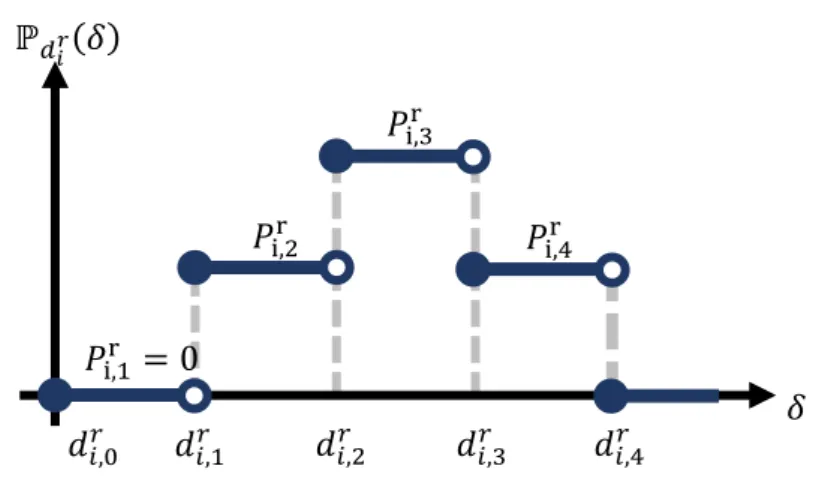
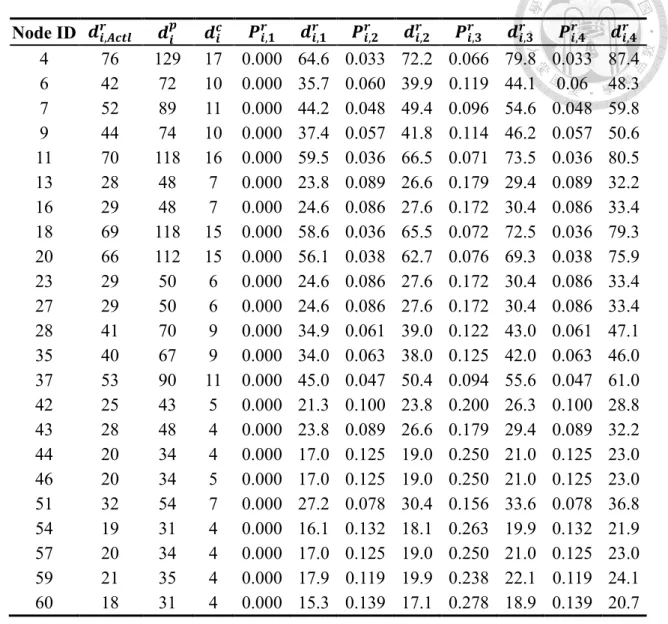
In this study, the probability distribution of the emergency demand in the roadway network is assumed to be known to the manager of the restoration schedule; besides, the study assumed a sectioned uniform probability distribution to accommodate the low, medium, and high estimation to the possible amount of demand with the probability of 𝑃𝑃i,2r , 𝑃𝑃i,3r , and 𝑃𝑃i,4r respectively. The assumed distribution of the demand is presented in Figure 3.1.
Figure 3.1 Probability distribution for the demand in the roadway network 𝑑𝑑𝑖𝑖,0𝑟𝑟 𝛿𝛿
𝑃𝑃i,1r = 0 ℙ𝑑𝑑𝑖𝑖𝑟𝑟(𝛿𝛿)
𝑑𝑑𝑖𝑖,1𝑟𝑟 𝑑𝑑𝑖𝑖,2𝑟𝑟 𝑑𝑑𝑖𝑖,3𝑟𝑟 𝑑𝑑𝑖𝑖,4𝑟𝑟 𝑃𝑃i,2r
𝑃𝑃i,3r
𝑃𝑃i,4r
26
(iv) Logical interdependency
Additionally, this study seeks to address the research gap by factoring the effect of the restoration interdependency between the roadway network and other networks in the system recovery phase. When system restoration is implemented after the disruption due to disaster impact, restoration interdependency, which can be viewed as the logical interdependency defined by Rinaldi et al., becomes a critical issue affecting how restoration tasks should be scheduled within or across the interdependent network.
Assumptions
The assumptions for the developed model are listed as follows.
The disruption to the infrastructure networks is given at the beginning of the planning horizon for the restoration.
The failure of the component in the networks primarily occurs on the links.
The performance of each infrastructure network is time-dependent and evaluated on a staged basis.
The functional states of the links in the network are assumed to have two state: fully functional and fully disrupted.
The restoration of each component in the networks takes a single time stage and single restoration crew.
The links in each network are bidirectional, but the variable for the functional state of a link is unidirectional. Hence, the restoration of a link recovers the functionality of links for both directions.
The incompleteness of the demand information is only considered in the roadway network.
The purpose of the restoration is to fulfill the basic need of the population in the disaster-affected areas, which includes the delivery of relief materials and necessities of life. As such operation should be the priority of using road capacity over general traffic, the travel time of each link in the roadway network is assumed to be constant if the resilience of the infrastructure systems is not fully recovered to the original state.
The probability distribution of all the demand in the roadway network is known to the manager of the restoration prior to the disruption.
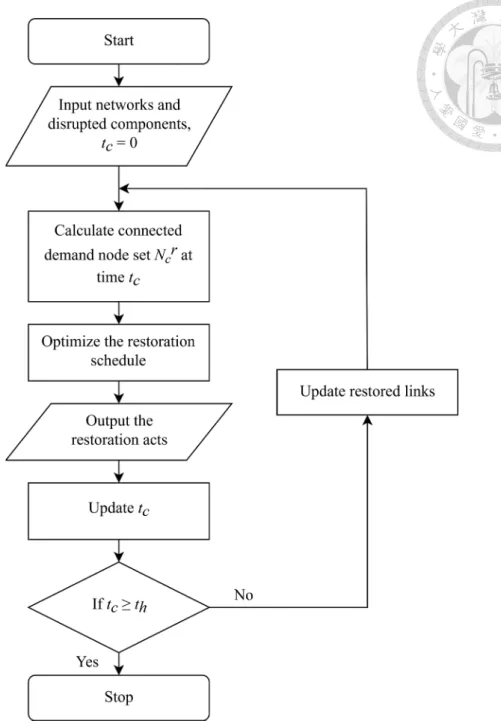
The manager of the restoration optimizes the resilience based on the known information. If the state of the telecommunication service of a roadway demand node is changed during the restoration, the manager then reorganizes the restoration based on the updated information of the demand.
Although the traditional precedence of restoration interdependency is considered, the restoration crews for each infrastructure system work independently.
Notation
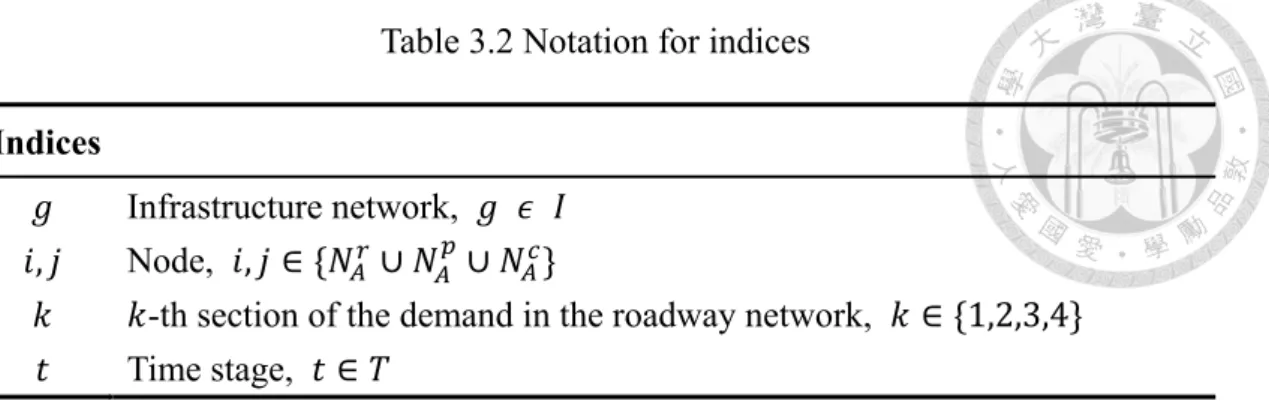
The developed model is a mixed integer quadratic programming problem, which uses binary variables to determine the functional states of links. There are three interdependent networks in the model, including roadway network, electric power network, and telecommunication network. Their topologies are given as 𝐺𝐺𝑟𝑟 = (𝑁𝑁𝑟𝑟, 𝐴𝐴𝑟𝑟), 𝐺𝐺𝑒𝑒 = (𝑁𝑁𝑒𝑒, 𝐴𝐴𝑒𝑒) and 𝐺𝐺𝑐𝑐 = (𝑁𝑁𝑐𝑐, 𝐴𝐴𝑐𝑐) . The links are associated with capacities for corresponding flows. This model also considers the connectivity between failed links and restoration depots using the network flow method. The notation of sets, parameters, and variables are listed in Table 3.2, Table 3.3, Table 3.4, and Table 3.5.
28
Table 3.2 Notation for indices Indices
𝑔𝑔 Infrastructure network, 𝑔𝑔 𝜖𝜖 𝐼𝐼 𝑖𝑖, 𝑗𝑗 Node, 𝑖𝑖, 𝑗𝑗 ∈ {𝑁𝑁𝐴𝐴𝑟𝑟∪ 𝑁𝑁𝐴𝐴𝑝𝑝∪ 𝑁𝑁𝐴𝐴𝑐𝑐}
𝑘𝑘 𝑘𝑘-th section of the demand in the roadway network, 𝑘𝑘 ∈ {1,2,3,4}
𝑡𝑡 Time stage, 𝑡𝑡 ∈ 𝑇𝑇
Table 3.3 Notation for sets Sets
𝐼𝐼 Set of infrastructure systems, 𝐼𝐼 = {𝑟𝑟, 𝑒𝑒, 𝑐𝑐} , which includes roadway, electric power, and telecommunication networks, in the model
𝑁𝑁𝐴𝐴𝑔𝑔 Set of all nodes in infrastructure network 𝑔𝑔 𝜖𝜖 𝐼𝐼
𝑁𝑁𝑂𝑂𝑔𝑔 Set of supply nodes in infrastructure network 𝑔𝑔 𝜖𝜖 𝐼𝐼, 𝑁𝑁𝑂𝑂𝑔𝑔 ⊂ 𝑁𝑁𝐴𝐴𝑔𝑔
𝑁𝑁𝑇𝑇𝑔𝑔 Set of transshipment nodes in infrastructure network 𝑔𝑔 𝜖𝜖 𝐼𝐼, 𝑁𝑁𝑇𝑇𝑔𝑔 ⊂ 𝑁𝑁𝐴𝐴𝑔𝑔 𝑁𝑁𝐷𝐷𝑔𝑔 Set of demand nodes in infrastructure network 𝑔𝑔 𝜖𝜖 𝐼𝐼, 𝑁𝑁𝐷𝐷𝑔𝑔 ⊂ 𝑁𝑁𝐴𝐴𝑔𝑔
𝑁𝑁𝑅𝑅𝑅𝑅𝑔𝑔 Set of the depots of the restoration units in infrastructure network 𝑔𝑔 𝜖𝜖 𝐼𝐼 𝑁𝑁𝐷𝐷𝐷𝐷𝑔𝑔 Set of nodes connected to disrupted links in infrastructure network 𝑔𝑔 𝜖𝜖 𝐼𝐼
𝑁𝑁𝐶𝐶𝑔𝑔 Set of demand nodes connected telecommunication services in infrastructure network 𝑔𝑔 𝜖𝜖 𝐼𝐼, 𝑁𝑁𝐶𝐶𝑔𝑔 ⊂ 𝑁𝑁𝐷𝐷𝑔𝑔
𝐴𝐴𝑔𝑔 Set of links in infrastructure network 𝑔𝑔 𝜖𝜖 𝐼𝐼 𝑅𝑅𝑔𝑔 Set of failed links in infrastructure network 𝑔𝑔 𝜖𝜖 𝐼𝐼
𝛹𝛹𝑝𝑝,𝑐𝑐 Set of demand nodes in the electric power network and the telecommunication network with physical interdependency 𝛹𝛹𝑐𝑐,𝑟𝑟 Set of demand nodes in the telecommunication networks and the roadway network with cyber interdependency
𝑇𝑇 Set of time stage 𝑡𝑡, 𝑇𝑇 = [𝑡𝑡𝑐𝑐, 𝑡𝑡ℎ]
Table 3.4 Notation for parameters Parameters
𝑠𝑠𝑖𝑖𝑔𝑔 Supply limit for supply node 𝑖𝑖 ∈ 𝑁𝑁𝑂𝑂𝑔𝑔 in infrastructure network 𝑔𝑔 𝜖𝜖 𝐼𝐼
𝑑𝑑𝑖𝑖,𝐴𝐴𝑐𝑐𝑡𝑡𝐴𝐴𝑔𝑔 Actual demand for demand node 𝑖𝑖 ∈ 𝑁𝑁𝐷𝐷𝑔𝑔 in infrastructure network 𝑔𝑔 𝜖𝜖 𝐼𝐼
𝑑𝑑𝑖𝑖,𝑘𝑘𝑟𝑟 𝑘𝑘-th demand boundary for demand node 𝑖𝑖 ∈ 𝑁𝑁𝐷𝐷𝑟𝑟 in the roadway network
𝑃𝑃𝑖𝑖,𝑘𝑘𝑟𝑟 Probability of demand section 𝑘𝑘 for node 𝑖𝑖 ∈ 𝑁𝑁𝐷𝐷𝑟𝑟 in the roadway network
𝑑𝑑𝑖𝑖,𝐸𝐸𝐸𝐸𝐸𝐸𝑟𝑟 Demand of zero expected unmet demand if 𝑥𝑥𝑖𝑖𝑡𝑡𝑔𝑔 = 𝑑𝑑𝑖𝑖,𝐸𝐸𝐸𝐸𝐸𝐸𝑟𝑟 for demand node 𝑖𝑖 ∈ 𝑁𝑁𝐷𝐷𝑟𝑟 in the roadway network
𝑢𝑢𝑖𝑖𝑖𝑖𝑔𝑔 Capacity of link (𝑖𝑖, 𝑗𝑗) ∈ 𝐴𝐴𝑔𝑔 in infrastructure network 𝑔𝑔 𝜖𝜖 𝐼𝐼
𝑏𝑏𝑖𝑖 Backup time of electric power for telecommunication demand node 𝑖𝑖 ∈ 𝑁𝑁𝐷𝐷𝑔𝑔
𝑤𝑤𝑔𝑔 Weight for the performance function of infrastructure network 𝑔𝑔 𝜖𝜖 𝐼𝐼 𝜔𝜔𝑅𝑅𝑅𝑅 Weight for the resilience loss
𝜔𝜔𝑃𝑃𝑃𝑃 Weight for the penalty for incomplete information 𝑡𝑡𝑐𝑐 Initial time stage
𝑡𝑡ℎ Maximum time stage
𝜖𝜖 A very small positive number
𝑛𝑛𝑔𝑔 Total number of restoration units for infrastructure network 𝑔𝑔 𝜖𝜖 𝐼𝐼
Table 3.5 Notation for decision variables Decision variables
𝑓𝑓𝑖𝑖𝑖𝑖𝑡𝑡𝑔𝑔 Variable for commodity flow on link (𝑖𝑖, 𝑗𝑗) ∈ 𝐴𝐴𝑔𝑔 in infrastructure network
g ϵ I at time stage 𝑡𝑡
𝑥𝑥𝑖𝑖𝑡𝑡𝑔𝑔 Variable for the delivered commodity at destination node 𝑖𝑖 ∈ 𝑁𝑁𝐷𝐷𝑔𝑔 in infrastructure network 𝑔𝑔 𝜖𝜖 𝐼𝐼 at time stage t
𝜙𝜙𝑖𝑖𝑖𝑖𝑡𝑡𝑟𝑟,𝑔𝑔 Variable for connection flow on road link (𝑖𝑖, 𝑗𝑗) ∈ 𝐴𝐴𝑟𝑟 for the restoration of
infrastructure network 𝑔𝑔 𝜖𝜖 𝐼𝐼 at time stage 𝑡𝑡
𝜉𝜉𝑖𝑖𝑡𝑡𝑟𝑟,𝑔𝑔 Variable indicating whether node 𝑖𝑖 ∈ 𝑁𝑁𝑔𝑔 ∖ 𝑁𝑁𝑅𝑅𝑔𝑔 being connected to the
depot of the restoration units for infrastructure network g ϵ I at time stage t; non-zero 𝜉𝜉𝑖𝑖𝑡𝑡𝑟𝑟,𝑔𝑔 indicates node i is connected to the restoration depot.
𝛼𝛼𝑖𝑖𝑖𝑖𝑡𝑡𝑔𝑔 Binary variable indicating the functional state of link (𝑖𝑖, 𝑗𝑗) ∈ 𝐴𝐴𝑔𝑔 in
infrastructure network g ϵ I at time stage t; 𝛼𝛼𝑖𝑖𝑖𝑖𝑡𝑡𝑔𝑔 = 1 indicates that link (𝑖𝑖, 𝑗𝑗) is functional
𝛾𝛾𝑖𝑖𝑡𝑡𝑟𝑟 Binary variable indicating whether roadway demand node 𝑖𝑖 ∈ 𝑁𝑁𝐷𝐷𝑟𝑟 in at time stage 𝑡𝑡 being disconnected from telecommunication services; 𝛾𝛾𝑖𝑖𝑡𝑡𝑟𝑟 = 1 indicates that node 𝑖𝑖 is disconnected
𝜆𝜆𝑖𝑖𝑡𝑡,𝑘𝑘𝑟𝑟 Variable indicating the k-th section of 𝑥𝑥𝑖𝑖𝑡𝑡𝑟𝑟 for roadway demand node 𝑖𝑖 ∈
𝑁𝑁𝐷𝐷𝑟𝑟 in at time stage t, while 𝑘𝑘 ∈ {1,2,3,4}
𝛽𝛽𝑖𝑖𝑡𝑡,𝑘𝑘𝑟𝑟 Binary variable indicating whether λ𝑖𝑖𝑡𝑡,𝑘𝑘𝑟𝑟 is equal to or less than 𝑑𝑑𝑖𝑖,𝑘𝑘𝑟𝑟 −
𝑑𝑑𝑖𝑖,𝑘𝑘−1𝑟𝑟 for roadway demand node 𝑖𝑖 ∈ 𝑁𝑁𝐷𝐷𝑟𝑟 in at time stage t, while 𝑘𝑘 ∈
{1,2,3,4}; 𝛽𝛽𝑖𝑖𝑡𝑡,𝑘𝑘𝑟𝑟 = 1 if and only if 𝜆𝜆𝑖𝑖𝑡𝑡,𝑘𝑘𝑟𝑟 = 𝑑𝑑𝑖𝑖,𝑘𝑘𝑟𝑟 − 𝑑𝑑𝑖𝑖,𝑘𝑘−1𝑟𝑟 .
30
Problem formulation
In the main model, the restoration process is optimized based on the known information for the manager of the restoration schedule. As the restoration being undertaken, some nodes may re-gain the telecommunication service, and thus, the model will reoptimize based on the updated information, which is introduced in Section 3.5.
3.4.1 Expected unmet demand
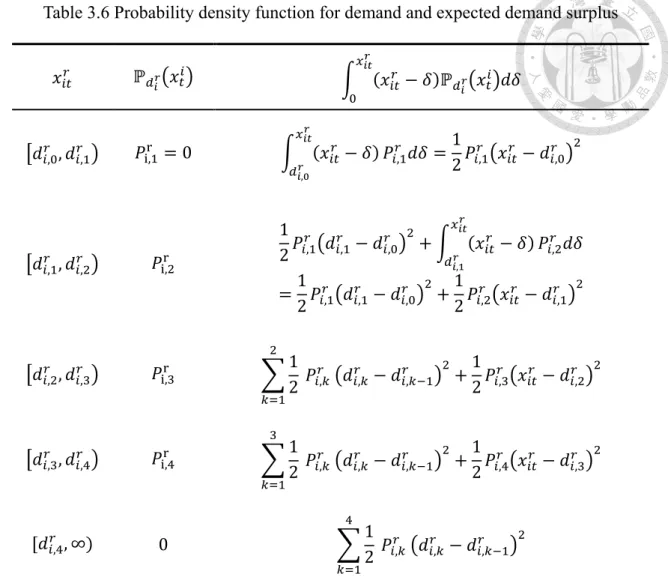
For the demand nodes in the roadway network without the telecommunication services, the formulation of their expected unmet demand is calculated as (3), while 𝑑𝑑𝑖𝑖𝑟𝑟 is the demand at the demand node i in the roadway network.
� 𝔼𝔼[(𝑑𝑑𝑖𝑖𝑟𝑟− 𝑥𝑥𝑖𝑖𝑡𝑡𝑟𝑟)+]
𝑖𝑖∈𝐷𝐷𝐷𝐷𝑟𝑟\𝐷𝐷𝐶𝐶𝑟𝑟
= � � (𝛿𝛿 − 𝑥𝑥∞ 𝑖𝑖𝑡𝑡𝑟𝑟)ℙ𝑑𝑑𝑖𝑖𝑟𝑟(𝛿𝛿)𝑑𝑑𝛿𝛿
𝑥𝑥𝑖𝑖𝑖𝑖𝑟𝑟 𝑖𝑖∈𝐷𝐷𝐷𝐷𝑟𝑟\𝐷𝐷𝐶𝐶𝑟𝑟
= � �� (𝛿𝛿 − 𝑥𝑥∞ 𝑖𝑖𝑡𝑡𝑟𝑟)ℙ𝑑𝑑𝑖𝑖𝑟𝑟(𝛿𝛿)𝑑𝑑𝛿𝛿
0 − � (𝛿𝛿 − 𝑥𝑥𝑥𝑥𝑖𝑖𝑖𝑖 𝑖𝑖𝑡𝑡𝑟𝑟)ℙ𝑑𝑑𝑖𝑖𝑟𝑟(𝛿𝛿)𝑑𝑑𝛿𝛿
𝑟𝑟
0 �
𝑖𝑖∈𝐷𝐷𝐷𝐷𝑟𝑟\𝐷𝐷𝐶𝐶𝑟𝑟
= � �𝔼𝔼[𝑑𝑑𝑖𝑖𝑟𝑟] − 𝑥𝑥𝑖𝑖𝑡𝑡𝑟𝑟 + � (𝑥𝑥𝑥𝑥𝑖𝑖𝑖𝑖 𝑖𝑖𝑡𝑡𝑟𝑟 − 𝛿𝛿)ℙ𝑑𝑑𝑖𝑖𝑟𝑟(𝛿𝛿)𝑑𝑑𝛿𝛿
𝑟𝑟
0 �
𝑖𝑖∈𝐷𝐷𝐷𝐷𝑟𝑟\𝐷𝐷𝐶𝐶𝑟𝑟
(3)
From (3), the expected unmet demand can be represented by two parts: the expected demand minus the delivered commodity and the expected demand surplus. Herein, the expected demand surplus for the probability defined in Section 3.1.3 is calculated in Table 3.6. Moreover, if the demand information is deterministic, the known demand can be viewed as the expected demand, while there is no expected demand surplus.