On establishing the core competency identifying model
A value-activity and process oriented approach
Bai-Chuan Yang
Graduate Institute of Business Administration, College of Management, Fu Jen Catholic University, Taipei, Taiwan, Republic of China
Bing-Eng Wu
Graduate Institute of Management, College of Management, Fu Jen Catholic University, Taipei, Taiwan,
Republic of China
Pei-Gi Shu
Department of Business Administration, College of Management, Fu Jen Catholic University, Taipei, Taiwan, Republic of China, and
Ming-Hsien Yang
Department of Information Management, College of Management, Fu Jen Catholic University, Taipei, Taiwan, Republic of China
Abstract
Purpose – This research intends to establish a model integrating the related theories in strategy management and competency in the HRM field, and to develop a systematic tool that can help a company quickly and precisely identify its core competency.
Design/methodology/approach – An internal value activity chain is obtained through analyzing customers’ needs. The priority of the activities is then determined via examining external factors. The critical competency needed by the activity is abstracted from a process and operation analysis.
Standardized procedures and tools for applying the Process Oriented Core Competency Identification (POCCI) model are sequentially deployed.
Findings – An empirical case was illustrated that the POCCI model not only helps a company identify the core competency that prevails over alternative approaches but also draws more recognition from the raters. The linkage between individual competency and organizational competitive advantage was solidified by the POCCI model and evidenced by an empirical case.
Research limitations/implications – Misunderstanding over competency items might impede the consensus formation. A handbook of standardized procedures with unified definition is strongly suggested to facilitate the progression of competency identification.
Practical implications – The model, procedures and tools proposed in this paper can help most companies quickly and precisely identify their specific core competencies.
Originality/value – The POCCI model that emphasizes interdisciplinary integration and practical usage has never been thoroughly investigated in the previous literature and could serve as a prototype for further explorations.
Keywords Core competences, Value analysis, Process analysis, Computer applications Paper type Research paper
The current issue and full text archive of this journal is available at www.emeraldinsight.com/0263-5577.htm
IMDS 106,1
60
Industrial Management & Data Systems
Vol. 106 No. 1, 2006 pp. 60-80
q Emerald Group Publishing Limited 0263-5577
DOI 10.1108/02635570610640997
1. Introduction
In the past few years, the progression of human resources on training and development gradually portrayed the importance of quickly and objectively establishing its core competency[1]. Numerous studies indicated that the concept of core competency was widely applied in human resource management activities (Rodriquez et al., 2002).
Even though the word “competency” was more comprehensively investigated by Lado and Wilson (1994), its concept, factors and context that affect learning had been well established and thoroughly discussed ever since 1970s (Knowles, 1970; McClelland, 1973; and Chisholm, 1976). Prahalad and Hamel (1990) indicated that core competence is positively related to competitiveness. Kim (1993) further stratified the linkage of core competence into different levels. Lahti (1999) illustrated that core competency is rooted from individual level and that is well connected to organizational competitiveness, shifting academic attention of core competency from micro- to macro-perspective.
The resource-based theory provides a more solid explanation on the linkage between competency and competitiveness from individual as well as organizational level (King, 2001; Wright, et al., 2001).
The successful development of resource-based theory diverts the focus of corporate strategy analysis from external context factors to internal resource factors (Grant, 1991). Core competency that is based on intangible human resource therefore becomes one of the key successful factors (KSF) to win the strategic advantages (Khatri, 2000).
Lado and Wilson (1994) indicated that corporate could not only strongly implant resource base but also support strategy implementation through successful installations of the concept of core competency into different human management activities.
A follow-up problem is how a company with limited resources could accumulate talent pool through a well-established human resource management system. Adler and Ghadar (1990) indicated that enriching talent resource base and strengthening competitive edge are the key factors to win competitive advantage. The first step is to identify core competency and allocate resources accordingly. Lado and Wilson (1994) illustrated that identification of core competency has not only become a focus of materializing corporate strategy intent but also a very important step to trigger all the related management activities to win the competition.
Some researches indicated that the main obstacles to establish core competency model include: huge expense, time consuming, disconnection to strategic thinking, and strong subjectivity of competency identification (Mirabile, 1997). In this research we attempt to present a model that is formulated from related theories and focus on value-activity and process analysis. We name it the “process oriented core competency identifying” (POCCI) model. An empirical case was illustrated that the POCCI model is more objective, cost saving, and efficient to identify core competency than alternative approaches. Besides a quick and systematic identification, the POCCI model can also serve as the platform for top-down strategy formulation through identifying value activities and for bottom-up development of related competency. It can also guide the allocation of resources to the most valuable and needed competency so as to shape a company’s competitive edge. Through the linkage of strategic thinking and human resource management, the POCCI model works as the pivot to connect various management activities and therefore to enhance organizational synergy. The rest of this paper is organized as follows. Section 1 introduces. Section 2 illustrates the
The core
competency
identifying model
61
rationales for model building. Section 3 builds up the model. Section 4 illustrates the POCCI model via an empirical case. Contributions and managerial implications are given in Section 5. Section 6 concludes.
2. Rationales for model building
In this section we briefly review the related literatures covered in the POCCI model building, namely core competency, strategic thinking, and identification approaches of core competency.
2.1 Core competency
The concept of core competency was first brought by Selznick (1957) who used the distinctive competency to depict the corporate advantage through various value activities. Competency is the most important factor to complete a specific task.
McClelland (1973) indicated that “competency” is one of the key factors that affect learning efficiency and is more efficient than intelligence (IQ) to predict the output of learning. McLagan (1983) indicated that competency is the trait and knowledge that undergrounds the effective work. Thornston (1992) also illustrated that competency is a bunch of behavior characters related to work performance. Spencer and Spencer (1993) proposed the iceberg theory that competency includes both implicit and explicit traits that are related to understanding and prediction of work performance.
Competency was further categorized into five groups: motive, trait, self-concept, knowledge and skill. Prahalad and Hamel (1990) indicated the linkage between core competence and corporate competitive advantage. However, there is no consensus on defining competency given that multiple of them has been stated (Lahti, 1999).
Lahti mentioned that the concept of core competence is derived from the competency that highlights a close linkage to the strategic thinking; therefore, the concept of core competence even though originated from individual level can be easily linked to organizational level. From then on, strategy management combined the concept of core competence with resource-base essence into the strategic thinking and implementation process (Barney and Wright, 1998; Mueller, 1996). This implies that only the resources and capability transformed into core competency can become competitive strength (De Saa´-Pe´rez and Garcı´a-Falco´n, 2002).
2.2 Strategic thinking
2.2.1 External oriented strategic thinking. Chandler (1962) indicated that organization structure follows corporate strategy that echoes the environmental changes. This is the renowned environment – strategy-structure type of strategic thinking.
One opportunity for a company to rethink its strategy is when customers change their value (O’Driscoll et al., 2000). Porter (1985) used the concept of value chain to analyze external and internal factors that help a firm formulate strategies. He proposed that corporate strength originates from the capability of creating value for customers.
A firm is regarded as a combination of value activities and processes. Its profitability can only be emanated from the output of value chain that provides value to customers (Beheshti, 2004). Corporation is therefore deemed as a value creator and its profit is derived from the value it creates. Value can be created through a package of activities that satisfy final customer’s needs (Zhang et al., 2002). The concept of value chain therefore cannot only be applied to industry analysis but also to a company’s
IMDS 106,1
62
operations. Each operation that creates value is called value activity. A combination of all selected value activities is called value activity chain.
2.2.2 Internal oriented strategic thinking. The concept of resource base proposed by Wernerfelt (1984) dramatically change strategic thinking. A corporate is reckoned as a combination of tangle and intangible resources rather than a combination of products and markets. He also portrayed that “resource inventory” and “resource advantage”
are more meaningful for strategic decision. The internal-oriented viewpoint implies that environmental changes in industry are unpredictable and uncontrollable. Rather, internal resources are more accordant with the ever-changing situations (Zhang et al., 2002). Grant (1991) punctuated the importance of internal evaluation that corporate strategy, the main source of profit, should be guided by internal resource and competency. He also proposed an integrated strategic analysis process as follows:
. identifying and categorizing the existing resources;
. identifying the core competence;
. evaluating the potentiality of the competence and resources for creating benefits;
. determining strategy to exploit the potentiality; and
. strengthening resource and core competence to fill in the current gap.
Barney (1986) and Aaker (1989) also indicated that reinforcing internal resource base not only provides the key components to competitive edge but also sustains a company for long-term competitive advantage. Long-run survival with excellence can be obtained only when a company constantly accumulates core resource and develops the competencies of its own.
2.2.3 Strategic thinking process. Traditional SWOT analysis plays an important role in strategy formulation and positioning (Aaker, 1989); However, SWOT analysis by itself is too subjective to formulate a good strategy (Ireland et al., 1987). Ronald (1961) proposed the concept of KSF analysis and indicated that a firm that would like to pursue strategic success needs to concentrate all efforts on 3-6 key factors and outperform them than competitors. The KSF concept was then used by Hofer and Schendle (1978) to strategy management, evaluation of competitiveness, and location of the advantages for a company.
Kaplan and Norton (1991) proposed the concept of balanced score card to supplement the traditional performance evaluation approaches that are inadequate to balance various dimensions in individual as well as in organizational levels. The inadequateness is even pronounced when the intangible asset accounts for over 70 percent of company value that is not unusual in the knowledge economy nowadays (Ulrich, 1998). Without a balanced concern of performance index, a company might waste energy owing to the efforts it took were directed to improper targets. Kaplan and Norton (2001) indicated that a balanced performance indexes can effectively link the cause and effect for every move a company takes. They mold a strategy map to direct the focus of strategic thinking and to point out the critical result areas.
Hamel and Prahalad (1989) mentioned that the strategic intent is the primary key to success. With a strong intent to conduct tasks that exceed company’s affordable capacity and capability, the successful leaders claim a desirable vision, pursue goals with determination, and last efforts for more than ten years of searching for excellence.
The core
competency
identifying model
63
Setting targets in strategic map and coupling with a strong strategic intent will have a dramatic effect on the implementing processes for the selected strategies.
In conclusion, strategy can be formulated in two perspectives. One is formed by examining the external environment and adjusting the internal value activities accordingly. Competitive position can be located through a careful definition of the value that customers need and a thorough understanding of the environmental limitations (Miles and Snow, 1978). The other is formed by checking the internal resources and capability, which in turn guides the allocation of efforts to build the core competency. Competitive advantage can be enhanced through a thorough exploration of the key success factors for the industry and through the recognition of the resource base that a company has.
Core competency model needs to link the competency in individual as well as in organizational levels so as to successfully formulate strategy (Muffatto, 1998; Lahti, 1999). Therefore, it is important for a company to have a systematic and comprehensive framework to accommodate both perspectives in strategy formulation. A clear mapping of strategic content and context would facilitate a company to attain its strategic goals and intention. Establishing core competency is useful for a company to accumulate its resource-base value and to enhance the implementation of the chosen strategies. After a long-term observation from industry, Barney and Wright (1998) illustrated that a firm’s competitiveness can be strengthened only when its strategies are delicately formulated and its human resources are qualified with solid core competencies.
2.2.4 Alternative approaches to identify core competency. Alternative approaches to identify core competency can also be found in literatures. Rothwell and Kazanas (1993) categorized the methods into borrowed approach, borrowed and tailored approach, and tailored approach. Each approach has its own advantages and disadvantages and the most suitable one to use is crucially depended on situational factors. Benchmarking approach is a quick and easy way to have the items of core competence by simply copying the practices of the leading company (Mirabile, 1997). In so doing, the company can easily keep up with the competitors without bothering to develop a model for its own.
However, this approach neglects possible variety among companies and might mislead the company into a wrong direction. Job analysis is an alternative approach that is internally oriented to explore the core competency needed by the company (Spencer and Spencer, 1993). It can be conducted via job description that clearly breaks down each task or job item. Based on job description, researchers make the judgment. The core competency can be clearly defined with a careful watch on the key positions (Rothwell and Lindholm, 1999). However, the result is crucially dictated by the experience and proficiency of the researchers. Moreover, in a rapidly changing world, the context documented in job description might be outdated or imprecisely depicted the real responsibility and content of a job. Another approach of identifying core competency is through collecting opinions from experts. This approach is conducted through in-depth interview, focus group discussion or cross examination to ask internal senior staffs or external professional people what is the requirement for each specific position or job (Rothwell and Kazanas, 1993). However, people are also the main problem for this approach in that outsiders might not have the domain knowledge and insiders might be trapped in self-dealing intent. The problem is even worsened when conflicts emerge between involving parties. Questionnaire survey approach is popular in collecting the related data and can be tailored to the competency model (Rothwell and Kazanas, 1993).
IMDS 106,1
64
One merit of this approach is that data can be massively collected. However, there are two drawbacks to hinder its usage: whether the questionnaire can be comprehensively and structurally designed and whether the sample targets are representative of professional opinions.
3. Establishing the model
A model that can quickly identify core competency and link between strategies and human resource management are highly needed. We establish a model that syndicates various theories from strategic thinking and core competency. The nexus of this model is value activity analysis. By decomposing a firm’s value activities, we apply the technique of process analysis to identify a firm’s core competencies. Moreover, through the stepwise identification processes we are allowed to further explore the competencies that are crucial for competition while were not always consensually agreed in the firm. Importance for each identified competency is then attached by a ranking of the summed frequency. The practicability and validity of this model is further testified via an empirical case.
3.1 The structure of the POCCI model
The POCCI model can be understood via the top-down as well as the bottom-up stream of thinking. Top-down approach follows the traditional strategy development process that starts from an analysis of external environmental factors. The firm’s strategic focus and core competency are then determined so as to meet the challenges from external environment. This thread of thinking is similar to the environment-strategy-structure (ESS hereafter) rationale. In contrast, the bottom-up approach indicates that the strategic processes were initiated by an examination of a firm’s existing competencies that serve as comparative advantages to win the competitive edge (Peteraf, 1993). In other words, the process starts from the micro-perspective and uses the internal resource to explore and position itself for the winning status. This thread of thinking is more like the resource-based viewpoint (RBV hereafter).
Concluding the two streams of thinking, the structure of the POCCI model is shown in Figure 1. The POCCI model contains four perspectives: external-in (ESS) rationale,
Figure 1.
The rationale of structuring the POCCI model
The core
competency
identifying model
65
internal-out (RBV) rationale, the bottom-up (core competency oriented) viewpoint, and the top-down (strategic thinking oriented) viewpoint. From the four perspectives, the model can truly links the competency in individual level as well as organizational level and bridges the company’s strategy and human resource management.
In the center of Figure 1, we portray the identified core competency that integrates all the rationales involved. As punctuated by Rochet (2004), comprehensive thinking and thorough implementation guarantee strategic success. Combined with internal versus external factors coupled the concerns from top and bottom, the core competency of a company should not only be examined by the external factors to ensure its adaptability to the environment but also be shaped by the competitive edge as the crucial internal resource base. Furthermore, the core competency also needs to meet the requirement of strategic thinking from the top and to bridge the individual competency from the bottom. The dynamics of the rationales are indicated by the arrows in Figure 1.
3.2 The elements of the POCCI model
A further elaboration of the links among all the involving elements of the POCCI model is illustrated in the following self-explanatory figure (Figure 2). Each element is derived from a distinctive theory. The pivot procedure in this model is to stepwise decompose processes on value activity chain and to break down the process into step-by-step procedures, which facilitates a company to formulate strategy from the bottom and to identify core competency from the top[2]. Each element involved in the model is based on theoretical linkage. Even though elements are seemly unconnected, the model is not workable without a holistic thinking. The working procedures in the following section are devised to trigger interactions among these elements in this model.
3.3 Working procedures of the POCCI model
Each working procedure in the POCCI model is clearly defined as a standard procedure for implementation. In so doing, the application value and the effectiveness of this
Figure 2.
Elements of POCCI model
IMDS 106,1
66
model are therefore advanced. The working procedure serves as the bridge to practice theories. The procedures involved in this model include:
. identifying the focal value that customers want;
. developing the value activity chain to satisfy customers’ focus;
. recognizing and collecting activities with high value and strategic implications;
. checking the resources gap to meet the requirement from customers;
. investigating the required operation processes to attain those recognized value activities;
. decomposing those processes into step-by-step procedures;
. deciding the required competencies to complete the procedures;
. conducting the data analysis by a designed computing system;
. deciding the weighting scheme;
. setting the priority by the ranked competency summing from the frequency in all steps within the developed processes;
. proposing the core competency for each business unit, department, function, value activity, and process;
. concluding the core competency for the company; and
. elaborating and standardizing the core competency items.
All the aforementioned procedures are arranged accordingly so to echo the related theories and to interact each element for functioning the POCCI model. With the standardized procedures, the POCCI model is more objective and valid in terms of identifying core competency than the existing approaches indicated in literatures.
3.4 The tools applied in the POCCI model
3.4.1 List of competency items. In order to standardize the terminology of competency items, we summarize a list of 22 competency items that are abstracted from various sources in literature. At the first stage, a group of experts composed of two scholars and three professionals were asked to categorize the over 600 terms into groups based on their similarity in concept. There are 54 clusters of items from the first-stage screen.
The Delphi approach of which members are composed of three academics and seven professionals is thereafter employed to further classify the 54 clusters of items into 22 groups. For example, there are 44 items out of the over 600 items describing the competency of problem solving. After the first-stage screen, they are classified into five clusters; namely, detecting environmental changes, systematic thinking, critical thinking, cause-effect analysis, and alternatives evaluation and selection. After the second stage of grouping, they are solidified into the competency of problem solving.
With this POCCI model, the items that were grouped by experts can be easily identified in a computing system. The final competencies include:
. problem solving;
. global vision;
. sense of safety and environment protection;
. planning;
The core
competency
identifying model
67
. innovation;
. customer focus;
. adaptability to change;
. team building;
. communication;
. leadership;
. cultivating the subordinates;
. coaching;
. proactive action;
. IT skill;
. quality management;
. self management;
. emotion management;
. learning ability;
. business negotiation;
. decision-making;
. organizing resources; and
. domain knowledge.
3.4.2 The forms for step-by-step procedures. In order to systematically collect the empirical data, we adopt the cascade approach of Bouchlaghem et al. (2004), i.e.
meticulously describing the involved value activities, processes, and operations from top- to ground-level of a firm. In corresponding to the data collection, we devise three forms that deploy the structure and procedures of the POCCI model. Through these forms, processes can be easily decomposed step by step. Form A (Table I) is designed to summarize the processes involved in each value activity that satisfies customers’ need.
Form B (Table II) is designed for the departments involved in every process.
The process owner and performance index are also specified in this table.
Form C (Table III) is designed to specify the competency items for each step from each process. The departments that are involved in each step are also indicated in this table.
The workshops were conducted according to the aforementioned working procedures together with explanations about the thinking process and application
Key value activities for the company Value
activity A
Value activity B
Value activity C
Value activity D
Value activity E
Value activity F Process
involved
Process A-1 Process B-1 Process C-1 Process D-1 Process E-1 Process F-1 Process A-2 Process B-2 Process C-1 Process D-2 Process E-1 Process F-2
Process A-3 Process B-3 Process D-3 Process F-3
. . .. . . Process B-4 Process F-4
Table I.
Key value activities and processes (Form A)
IMDS 106,1
68
Nameofactivity:valueactivityA ProcessDepartmentDepartmentDepartmentDepartmentDepartmentDepartmentProcessownerPerformanceindex ProcessA-1pppp DepartmentIndex ProcessA-2ppp DeptIndex ProcessA-3pppp DeptIndex
Table II.
Process development and process involved (Form B)
The core
competency
identifying model
69
Nameofprocess:processA-1 StepDepartmentIDepartmentIIDepartmentIIIDepartmentIVDepartmentVStepownerCompetencyneededPerformanceindex Step1p Positiontitle1,2,3,7Index Step2p Positiontitle2,4,18,20Index Step3pp Positiontitle5,22Index Step4ppp Positiontitle7,8,15Index Step5ppp Positiontitle3,17,19,21Index Table III.
Step involved in a process and the needed
competency (Form C)
IMDS 106,1
70
guidance of the POCCI model, especially focusing on the usage of the forms. At each stage of the workshop, the necessary information and tools are provided to facilitate the progression. We encouraged group discussions and cross-examinations to validate the information they filled in the forms. The data collected from the forms will be double-checked before they were input into the database in the computing system.
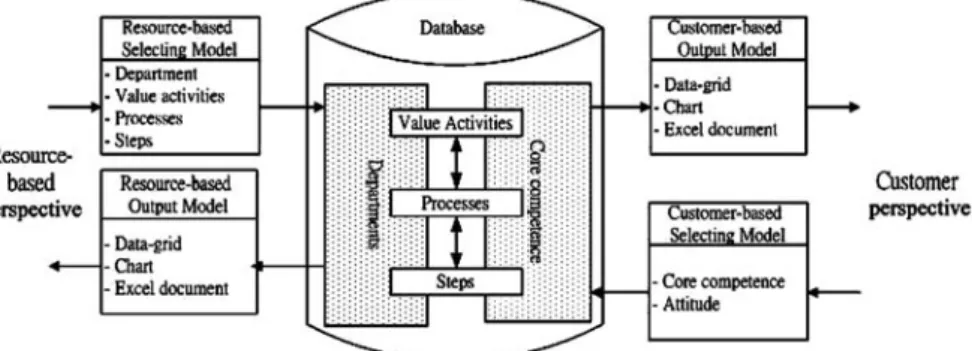
3.4.3 Computing system. The computing system is designed to accelerate the counting speed of the frequency. Ranking competency items by frequency for any specified level can be readily available after coding data into the system. The computing system consists of one database and two retrieval algorithms to complete its computing and ranking work.
The database contains all the information collected including data of value activities, processes, steps, departments, competency items and other designed data. The algorithm is designed for two perspectives: retrieval from customer perspective and retrieval from resource-base perspective. The computing system is shown in Figure 3. Retrieving information from the customer perspective, the system can demonstrate the needed competencies for any value activity, function, position or other entity. It can also show the importance of the needed competencies based on the summed frequency. In contrast, retrieving information from the resource base perspective, the system can provide the ranking details of the competencies in each specified entity. Figure 4 shows an exemplar of the final competency items for a company retrieving from resource base perspective.
The frequency and ranking for a company are both reported. The output formats can be versatile to be based on activities, processes, steps, and even positions. Figure 5 shows the competency items and accumulated frequency for all functional departments retrieving from customer perspective.
4. An empirical case 4.1 Case description
X Company, established in 1981, was originally engaged in sales of electronic components and transformed into a manufacturer of power supply and adapter. It has become the leading company in industry. X Company has three major product lines targeting for different customer groups. The first line produces power supply for desktop, notebook computer, and server. The second product line focuses on specialized power supply for communication, industrial and national defense.
The third product line targets on peripherals for communication equipment.
X Company has more than 5,000 employees in total and about 800 of them are
Figure 3.
Structure of computing system
The core
competency
identifying model
71
Figure 4.
Output for company level
Figure 5.
Output for departmental level
IMDS 106,1
72
located in Taiwan. Production sites were founded in Taiwan, China, Thailand and Philippine. Besides, its sale offices, warehouses and technical support centers have extended to over 30 countries. The organization is structured by function and blended with some cross-function project managers. With good quality products, X Company has sold goods to IBM ever since 1983 and maintained a long lasting relationship with the ten largest computer companies in the world. The revenue was about 300 million US dollars in 2004 and expected to be 400 million in 2005. The X Company attempts to be the top-three power-supply manufacturer all over the world in two years.
4.2 Participants and identification processes
The researchers conducted two two-days workshops with more than 70 high- and middle-level managers were invited. During the workshops, the researchers employed the POCCI model and related tools to collect information with which to identify the core competencies. The collected information was then coded into the database of the computing system. The core competency for each level in this company was ranked, defined, and further explored.
4.3 Results of case study
4.3.1 The core competencies at company level – X Company. Figure 6 shows the frequency distribution for each competency items. The selected items and frequency in parentheses for X Company are: planning (197), domain knowledge (187), problem solving (161) and communication (110), and adaptability to change (90).
4.3.2 The core competencies at value activity level – new product design and development activity. According to the frequency distribution (Figure 7) the core competency for the value activity of new product design and development are specified as domain knowledge (24), planning (19), problem solving (18), adaptability to change (12), and innovation (10).
4.3.3 The core competencies at departmental level – R&D department/Taiwan.
According to the frequency distribution (Figure 8), the competencies for the Taiwan
Figure 6.
The core competency of X Company Note: The 22 competency items selected from scholars and professionals are (1) problem solving, (2)
global vision, (3) sense of safety and environment protection, (4) planning, (5) innovation, (6) customer focus, (7) adaptability to change, (8) team building, (9) communication, (10) leadership, (11) cultivating the subordinates, (12) coaching, (13) proactive action, (14) IT skill, (15) quality management, (16) self management, (17) emotion management, (18) learning ability, (19) business negotiation, (20) decision-making, (21) organizing resources, (22) domain knowledge.
The core
competency
identifying model
73
R&D department are specified as domain knowledge (89), planning (82), problem solving (78), communication (45), and innovation (42).
4.3.4 The core competencies at process level-investigating market conditions.
According to the frequency distribution (Figure 9), the core competency at the process of investigating market conditions are specified as decision-making (3), global vision (2), planning (2), proactive action (2), and professional domain knowledge (2).
4.3.5 Core competency for different entities. The algorithm and computing processes can also be applied to different organizational levels such as position, project, or any specific task as long as the related data can be successfully collected in the processes.
In this case, we find that all the business units in X Company share three common competencies: problem solving, planning and domain knowledge. Beside the three
Figure 8.
The core competency of X Company ranked by departmental level
Note: The competency items are referred to the footnote in Figure 6.
Figure 7.
The core competency of X Company ranked by value
activity level Note: The 22 competency items are refereed to the footnote in Figure 6.
Figure 9.
The core competency of X Company ranked by process level
Note: The 22 competencies are referred to the footnote in Figure 6.
IMDS 106,1
74
common items, each business unit has its distinctive competencies. The practical value of this POCCI model is therefore verified and advanced through the preceding demonstration.
4.4 A comparison among alternative identification models
In this section we present the evaluation of the POCCI model as compared to alternative identification models by the same group of researchers. The criteria for model evaluation can be versatile. We refer to the criteria used by Leem and Kim (2004), namely, objectivity, validity, comprehensiveness of rationale, process time, and money expenditure. Each criterion is rated at five-point scale. A higher score indicates comparative prevalence over alternative approaches. The result is summarized in Table IV.
The result indicates that the POCCI model draws high recognition from rankers and prevails over alternative identification approaches in most aspects except process time and money expenditure. We surmise that the process time and money expenditure could be mitigated, as the evaluating entity is getting familiar with the standard procedure.
5. Contributions and managerial implications
In this study we demonstrate that the POCCI model can more quickly and precisely identify the core competencies of a firm at any specific level than the existing approaches. As far as we know, the focus of activity and process analysis that is more objective and stable overtime has never been included in identification models. The process-oriented approach could be standardized and useful for repeated applications and that overcomes the burden for a company to have a universal understanding before launching an identification model. One beauty of this model is that consensus is more easily reached when processes rather than persons are investigated. In this research we also provide a list of competencies derived from the relevant literature and further proved by academics and professionals to be applicable to all kinds of companies subject to minor adjustments. The 22 competencies summarized in this paper could not only serve as the bridge for intra-company communications but also provide the basis for inter-company comparisons. Last but never the least, the POCCI model is useful to guide all the human resource activities since it is conducted through breaking down the crucial elements of human resource management into a series of well-designed processes. The output from the POCCI model is therefore the building blocks for managerial systems.
Strategic implementation is attractive to human resource management people who are searching for an effective avenue to locate the invaluable human resources in
Approach Perspective
POCCI
model Benchmarking Job analysis
Expert
opinion Questionnaire
Objectivity 5 1.6 4.4 3.2 4.2
Validity 4.6 1.4 4 3.2 3.6
Rationale
comprehensiveness 5 1.6 3.4 3.2 2.2
Process time 4.4 4.6 2.6 2.8 1.8
Money expenditure 3.4 4.8 3.4 2 2.2
Table IV.
Summarized result of ranking for approaches to identifying core competency
The core
competency
identifying model
75
a company. However, the concept of strategic human resource management could have never been materialized without a proper tool (Schuler, 1992). The traits of core competencies are fully captured by the POCCI model that links strategic thinking in organizational level and competencies in individual level and meets the expectation of strategic human resource management. The POCCI model, a standardized procedure to quickly find the core competencies in a firm, is even more important than ever to echo the ever-changing environment. It shapes the competitiveness of a company in the era of time-based competition.
Further, the traditional human resources activities were basically job-based. The training, selection, career development, performance appraisal and compensation system are set up on the basis of the duties and activities a job owns. However, the focus has been changed to competency-based that is more appropriate to adapt to changes (Lawler, 1994). Therefore, the competency with high consensus will be the enabler to restructure the management system. All the details regarding to the structure of the POCCI model merit further explorations to assure its effectiveness.
For example, different definitions and understandings of the core competencies might conclude a different picture than what we have gotten from this research. For robustness, further studies might select different groups of professionals or academics with different combinations and compare their results to ours.
One more thing needs to be carefully tackled is to define the competency items as precisely as possible. Each competency is not unlikely to be postulated and understood in many different ways, especially at the first use of the POCCI model. Consensus on defining competency items is therefore crucial to dictate the success of implementing the POCCI model. Implementers should be more patient to make sure persons involved in the identification processes reach agreement on the definitions of competencies before entering the next stage. This is why the POCCI model is not the most timesaving approach. As stated in the passage, consensus could be more easily obtained and time could be saved after the model is repeatedly implemented.
A weighting system is valuable in that it can truly portray the importance for each competency an entity needs and more precisely direct the company to obtain its strategic intent. However, in this demonstrated case and the cases we have experienced, attaching different weights to different entities has never been an easy job, which is even more tedious than reaching a consensus on defining competency items. A possible leeway is to select persons involved to be representative and of equal importance. Nevertheless, the possible effect of different weighting scheme on the output of the POCCI model is still worthy further explorations.
6. Conclusion and suggestion
The concept of core competency has long been accepted by people in the discipline of strategy and human resource management. However, its application was somewhat limited due to lacking of a proper framework to link theory and practice. In this research we propose the POCCI model to fulfill the application gap. The rationale of the POCCI model is basically derived from the top-down perspective that shapes corporate strategy and from the bottom-up perspective that concludes core competency from the process analysis technique. The model also examines the strategy fitness of identified competency from resource-based (RBV) and environment-based (ESS) viewpoint. With the POCCI model, the implementation of human resource and that of strategy
IMDS 106,1
76
management can be mutually enacted, which has never been simultaneously included nor systematically structured in a model in previous literature.
By the POCCI model, any company can employ the working procedures not only to formulate the strategy with high consensus but also to identify the core competencies in various levels. The versatile outputs of the model mold the advantage of it broad applications in many management systems, namely, recruiting people according to the needed competency, appraising the staffs based on performance in each competency, providing training to fill in the gap of the needed competency, and setting up a system for key performance measurements. Firms can more objectively and validly identify strategic focus via the process-oriented analysis, which greatly contributes to the applications.
Though POCCI model is proved to be effective in terms of identifying core competency and a structured procedure for implementation, implementers should be more careful since a trust-worthy output is still highly depended on the participants who might be subjected to personal judgments or misunderstandings of the concept.
It indicates that the side effect could be further mitigated suffice more information is provided to the participants before model implementation.
Before a concluding remark, we would summarize tips provided by the participants.
First, the boundary between individual competency and organizational competency should be clearly defined before launching the investigation even though we have done it successfully in this study. They also mentioned that sufficient training would facilitate the progression and saves much more time and energy in applying the POCCI model. A handbook of standardized procedures might also be needed for a successful and reliable implementation. However, these suggestions are constructive to improve the effectiveness of this POCCI model while are subjected to time and cost constrains.
Further studies could make progress on these aspects.
The POCCI model has been proved to be effective in clarifying core competency. We have verified its effectiveness in many cases while present only one in this research.
The POCCI model is a pioneering concept to integrate strategic thinking and core competency and to serve as a useful tool for interdisciplinary researches and applications. Further studies could longitudinally trace core competencies that reside in a firm and among firms. One merit of so doing is to facilitate a firm to capture the sustainable constituents of core competencies and develop into long-run competitive edge. Factors that affect the change of core competencies as the change of time are also worthy of further explorations.
Notes
1. The concept of “competency” was first brought by Selznick (1957). McClelland (1973) used the term “competency” to illustrate the major key factor to affect individual learning. From a strategy viewpoint, Prahalad and Hamel (1990) reiterated it as “competence”. Nowadays, competency and competence almost connote identical meaning with the only a trivial difference that competence was mostly used in organizational level and competency was used in individual level. In this paper we use both of them interchangeably.
2. Traditionally, strategy formulation process follows the top-down approach while a firm’s core competency is built from the bottom. In this research, we provide a reverse thinking that contradicts to the traditional one in that a strategy is infeasible without supportive competencies and core competency might be irrelevant to success without guidance from corporate strategy.
The core
competency
identifying model
77
References
Aaker, D.A. (1989), “Managing assets and skills: the key to a sustainable competitive advantage”, California Management Review, Vol. 31 No. 2, pp. 91-106.
Adler, N.J. and Ghadar, F. (1990), “International strategy from the perspective of people and culture: the North America context”, Research in Global Business Management, Vol. 1, pp. 183-4.
Barney, J.B. (1986), “Strategic factor markets: expectation, luck, and business”, Strategy Management Science, Vol. 42, pp. 1231-41.
Barney, J.B. and Wright, P.M. (1998), “On becoming a strategic partner: the role of human resources in gaining competitive advantage”, Human Resource Management, Vol. 37 No. 1, pp. 31-46.
Beheshti, H.M. (2004), “Gaining and sustaining competitive advantage with activity based cost management system”, Industrial Management & Data Systems, Vol. 104 No. 5, pp. 377-83.
Bouchlaghem, D., Kimmance, A.G. and Anumba, C.J. (2004), “Integrating product and process information in the construction sector”, Industrial Management & Data Systems, Vol. 104 No. 3, pp. 218-33.
Chandler, A.D. (1962), Strategy and Structure, MIT Press, Cambridge, MA.
Chisholm, M.E. (1976), Medial Personnel in Education: A Competency Approach, Prentice-Hall, Englewood cliffs, NJ.
De Saa´-Pe´rez, P. and Garcı´a-Falco´n, J.M. (2002), “A resource-based view of human resource management and organizational capabilities development”, Journal of Human Resource Management, Vol. 13 No. 1, pp. 123-40.
Grant, R.M. (1991), “The resource-based theory of competitive advantage: implications for strategy formulation”, California Management Review, Vol. 33 No. 3, pp. 114-35.
Hamel, G. and Prahalad, C.K. (1989), “Strategic intent”, Harvard Business Review, Vol. 67 No. 3, pp. 63-76.
Hofer, C.W. and Schendle, D. (1978), Strategy Formulation: Analytical Concept, West Publishing Co., New York, NY, pp. 75-6.
Ireland, R.D., Hitt, M.A., Bettis, R.A. and Deporras, D.A. (1987), “Strategy formulation process:
differences in perceptions of strength and weaknesses indicators and environmental uncertainty by managerial level”, Strategic Management Journal, Vol. 8 No. 5, pp. 469-85.
Kaplan, R.S. and Norton, D.P. (1991), “The balanced scorecard-measures that drive performance”, Harvard Business Review, Vol. 70 No. 1, pp. 71-9.
Kaplan, R.S. and Norton, D.P. (2001), “Having trouble with your strategy? Then map it!”, Harvard Business Review, September-October, pp. 167-76.
Khatri, N. (2000), “Managing human resource for competitive advantage: a study of companies in Singapore”, International Journal of Human Resource Management, Vol. 11 No. 2, pp. 336-65.
Kim, D.H. (1993), “The link between individual and organizational learning”, Sloan Management Review, Vol. 35 No. 1, pp. 37-50.
King, A.W. (2001), “Management organizational competencies for competitive advantage: the middle-management edge”, Academy of Management Executive, Vol. 15 No. 2, pp. 95-106.
Knowles, M.S. (1970), The Modern Practice of Adult Education: Andragogy vs Pedagogy, Association Press, New York, NY.
Lado, A.A. and Wilson, M.C. (1994), “Human resource systems and sustained competitive advantage: a competency-based perspective”, Academy of Management Review, Vol. 19 No. 4, pp. 699-727.
IMDS 106,1
78
Lahti, R.K. (1999), “Identifying and integrating individual level and organizational level core competencies”, Journal of Business and Psychology, Vol. 14 No. 1, p. 59.
Lawler, E.E. III (1994), “From job-based to competency-based organizations”, Journal of Organizational Behavior, Vol. 15, pp. 3-15.
Leem, C.S. and Kim, I. (2004), “An integrated evaluation system based on the continuous improvement model of IS performance”, Industrial Management & Data Systems, Vol. 104 No. 2, pp. 115-28.McClelland, D. (1973), “Testing for competence rather than for intelligence”, American Psychologist, Vol. 28, pp. 1-14.
McLagan, P.A. (1983), Models for Excellence, The American Society for Training and Development, Washington, DC.
Miles, R.E. and Snow, C.C. (1978), Organizational Strategy, Structure and Process, McGraw-Hill, New York, NY.
Mirabile, R.J. (1997), “Everything you want to know about competency modeling”, Training and Development, pp. 73-7.
Mueller, G. (1996), “Human resources as strategic assets: an evolutionary resource-based theory”, Journal of Management Studies, Vol. 33 No. 6, pp. 757-8.
Muffatto, M. (1998), “Corporate and individual competences: how do they match the innovation process?”, International Journal of Technology Management, Vol. 15 No. 8, pp. 836-53.
O’Driscoll, A., Carson, D. and Audrey, G. (2000), “Developing marketing competence and managing in networks: a strategic perspective”, Journal of Strategic Marketing, Vol. 8 No. 2, pp. 183-96.
Peteraf, M.A. (1993), “The cornerstone of the competitive advantage: a resource-based view”, Strategic Management Journal, Vol. 14 No. 3, pp. 179-91.
Porter, M.E. (1985), Competitive Advantage: Creating and Sustaining Superior Performance, Free Press, New York, NY.
Prahalad, C.K. and Hamel, G. (1990), “The core competence of the corporation”, Harvard Business Review, Vol. 68 No. 3, pp. 79-91.
Rochet, C. (2004), “Rethinking the management of information in the strategic monitoring of public policies by agencies”, Industrial Management & Data Systems, Vol. 104 No. 3, pp. 201-8.
Rodriquez, D., Patel, R., Bright, A., Gregory, D. and Gowing, M.K. (2002), “Developing competency models to promote integrated human resource practices”, Human Resource Management, Vol. 41 No. 3, pp. 309-24.
Ronald, D.D. (1961), “Management information crisis”, Harvard Business Review, September-October, pp. 111-21.
Rothwell, W.J. and Kazanas, H.C. (1993), The Complete AMA Guide to Management Development, American Management Association, New York, NY.
Rothwell, W.J. and Lindholm, J.E. (1999), “Competency identification, modeling and assessment in the USA”, International Journal of Training and Development, Vol. 3 No. 2, pp. 90-105.
Schuler, R.S. (1992), “Strategic human resources management: linking the people with the strategic needs of the business”, Organizational Dynamics, Vol. 2 No. 1, pp. 18-32.
Selznick, P. (1957), Leadership in Administration: A Sociological Interpretation, Row, Peterson and Company, New York, NY.
Spencer, J.r.L.M. and Spencer, S.M. (1993), Competence at Work: Models for Superior Performance, Wiley, New York, NY.
The core
competency
identifying model
79
Thornston, G.C. (1992), Assessment Centers in Human Resource Management, Addison-Wesley, Reading, MA.
Ulrich, D. (1998), “Intellectual capital ¼ competence*commitment”, Sloan Management Review, Vol. 39 No. 2, pp. 15-26.
Wernerfelt, B. (1984), “A resource-based view of the firm”, Strategic Management Journal, Vol. 5, pp. 171-80.
Wright, P.M., Dunford, B.B. and Snell, S.A. (2001), “Human resources and resource based view of the firm”, Journal of Management, No. 27, pp. 701-21.
Zhang, Q., Vonderembse, M.A. and Lim, J.S. (2002), “Value chain flexibility: a dichotomy of competence and capability”, Journal of Production Research, Vol. 40 No. 3, pp. 561-83.
Further reading
Durand, R. and Quelin, B. (2000), “Linking competencies, sustainable competitive advantage, and performance: an empirical investigation”, Research in Competence-Based Management, 6.
Wright, P.M., McMahan, G.C. and McWilliams, A. (1994), “Human resources and sustained competitive advantage: a resource-based perspective”, International Journal of Human Resource Management, Vol. 5 No. 2, pp. 301-26.
About the authors
Bai-Chuan Yang, PhD candidate of the Graduate Institute of Business Administration at Fu Jen Catholic University. He received his MBA degree from Virginia Polytechnic Institute and State University (1989). He served as a business consultant for Mon-Ya Management Consulting Firm.
Bai-Chuan Yang is the corresponding author and can be contacted at [email protected] Bing-Eng Wu, Professor and Academic Vice President of Fu Jen Catholic University. He received his MBA degree (1977) and PhD degree in Business Administration (1984) from Cheng-Chi University. He served as the Director of the Department of Business Administration (1988-1992), Director of the Graduate Institute of Management (1991-1995) and Dean of the College of Management (1992-1998) at Fu Jen Catholic University. He has abundant business consulting experiences. He has published many books and academic papers. His current research mainly focuses on strategic human resource management. E-mail: [email protected].
Pei-Gi Shu, Professor and Associate Dean of the College of Management at Fu Jen Catholic University. He received his MBA degree from University of Illinois at Urbana-Champaign (1991) and PhD degree in Business Administration from Cheng-Chi University (1998). He has published many academic papers in international journals. His current research mainly focuses on behavioral finance. E-mail: [email protected].
Ming-Hsien Yang, Professor and Dean of the College of Management at Fu Jen Catholic University. He received his BSc Degree in Mathematics from National Taiwan University (1975), his MBA degree from National Chiao-Tung University, Taipei, Taiwan (1979), and his PhD degree in Business from National Taiwan University (1993). From 1979 to 1989, he worked with two large companies in Taiwan. Thereafter he joined in the department of information management at Fu Jen Catholic University and served as a consultant for Chung-Hsin Management Consulting Co., Taipei, Taiwan from 1989 to 1994. He has published many books and several academic papers in international and national journals. His current research interests include electronic commerce, strategic information management, and business process reengineering. E-mail: [email protected].
IMDS 106,1
80
To purchase reprints of this article please e-mail: [email protected] Or visit our web site for further details: www.emeraldinsight.com/reprints