Synthesis and Characterization of Side-Chain Liquid
Crystalline Polysiloxanes Containing 4-Alkanyloxyphenyl
trans-4-Alkylcyclohexanoate
Side Groups
CHAIN S. HSU* and YONG H. LU
Institute of Applied Chemistry, National Chiao Tung University, Hsin-Chu, Taiwan 30050, Republic of China
SYNOPSIS
The synthesis and characterization of nine polysiloxanes containing 4-alkanyloxyphenyl trans-4-n-alkylcyclohexane side groups are described. Six monomers which contain a pen- tenyloxy or a hexenyloxy flexible spacer display a nematic mesophase, while the other three monomers which contain an undecenyloxy flexible spacer display nematic, smectic A and smectic E mesophases. All synthesized polymers present two smectic mesophases except one containing 4-hexanyloxyphenyl trans-4-n-butylcyclohexanoate side groups presents one smectic mesophase and one containing 4-undecanyloxyphenyl trans-4-n -pentylcyclo- hexanoate side groups presents three smectic mesophases. Trans-cis isomerization of me- sogens and side chain crystallization did not occur for any of the synthesized polymers.
I N T R O D U CTlO N
Side-chain liquid crystalline polymers ( LCPs ) are of both theoretical and practical interest because they combine the anisotropic properties of liquid crystals with the polymeric properties and have the potential of being used for some new applica- tions.'-'' Over the past few years, Percec et al. and we reported on systematic investigations concerning the replacement of aromatic structures from the mesogenic side groups of side-chain LCP by het- erocycloalkane units, e.g., the 1,3-dioxane rings."-" We have demonstrated that mesogenic units based on truns-1,3-dioxane ring can be used to synthesize non- crystallizable side-chain LCPs even when the polymers contain up to 11 methylene in the spacers. The con- formational isomers of truns-1,3-dioxane based me- sogens are in a dynamic equilibrium and this depresses their crystallization when they are attached as poly- meric side chains. However, the truns-1,3-dioxane based mesogens are not very stable and undergo a thermal induced trans-cis isomerization at high tem- peratures. The mesophases of the polymers are de- stroyed because the cis isomers present no liquid crys-
* To whom all correspondence should be addressed.
Journal of Polymer Science: Part A Polymer Chemistry, Vol. 29,977-986 (1991)
0 1991 John Wiley & Sons, Inc. CCC OSS7-624X/91/070977-10$04.00
talline properties.'6 This disadvantage could be im- proved if cyclohexane rings are used instead of 1,3- dioxane rings.
Since Demus et al." reported the nematic cyclo- hexane carboxylate in 1973, several kinds of low molar mass liquid crystals containing a cyclohexane ring have been s y n t h e s i ~ e d . ~ ~ ~ ~ These liquid crystals, which exhibit low viscosity and nematic mesophase near room temperature, are suitable for twisted ne- matic ( T N ) display devices.
To our best knowledge, there is only one report in the literature concerning the characterization of a side-chain liquid crystalline polymer containing a trans-cyclohexane based mesogen.26 The goal of this study is to present the synthesis and characteriza- tion of a series of side-chain liquid crystalline poly- siloxanes containing 4-alkanyloxyphenyl trans-4-n
-
alkylcyclohexanoate side groups. The effects of spacer length as well as terminal alkyl length on the properties of mesophases exhibited by the synthe- sized polymers are discussed.EXPERIMENTAL Materials
Poly (methylhydrogensiloxane) ( = 2270) was obtained from Petrarch System, Inc. and was used
as received. trans-4-n-Propylcyclohexanoic acid, trans-4-n -butylcyclohexanoic acid, trans-4-n -pen- tylcyclohexanoic acid, and p -benzoyloxyphenol were obtained from Tokyo Kasei, Inc. and were used as received. Toluene used in the hydrosilylation reac- tion was first refluxed over sodium and then distilled under nitrogen. Dicyclopentadienylplatinum ( I1 ) chloride catalyst was synthesized as previously de- scribed.12 10-Undecen-1-yl tosylate was prepared according to a literature pr~cedure.'~
Techniques
'H-NMR spectra (300 MHz) were recorded on a Varian VXR-300 spectrometer. Thermal transitions and thermodynamic parameters were determined by using a Seiko SSC/5200 differential scanning cal- orimeter equipped with a liquid nitrogen cooling ac- cessory. Heating and cooling rate were 10°C/min. Thermal transitions reported were collected during the second heating and cooling scans. A Nikon Mi- crophot-FX optical polarized microscope equipped with a Mettler FP 82 hot stage and a FP 80 central processor was used to observe the thermal transi- tions and to analyze the anisotropic textures. Pre- parative gel permeation chromatography (GPC) was run on a Waters 510 LC instrument equipped with a 410 differential refractometer and a preparative GPC column (22.5 mm X 60 cm) supplied by Amer- ican Polymer Standard Co.
Synthesis of Monomers and Polymers
The synthesis of the cyclohexane containing mono- mers is outlined in Scheme 1.
p- ( I -Pentenyl-5-oxy)phenyl Benzyl Ether ( 11, p-
(1 -Hexenyl-6-oxy)phenyI Benzyl Ether (2), p-
( 1-Undecenyl- 11-oxy)phenyl Benzyl Ether ( 3 )
Compounds 1-3 were prepared by the same method. The synthesis of compound 3 is described below.
p-Benzyloxyphenol ( 5 g, 0.025 mol) was added to a solution of 1.82 g (0.032 mol) of potassium hy- droxide in 120 mL (90% ) of ethanol. Sodium iodide (0.1 g) was added and the solution was heated to reflux temperature for 1 h. 10-Undecen-1-yl tosylate (9.72 g, 0.03 mol) was slowly added and the solution was refluxed overnight. The solution was cooled and the solid salt was removed by filtration and ethanol was removed on a rotavapor. The remaining solid was recrystallized from a mixture of methanol and water to yield 7.5 g (85%) of white crystals; mp = 71°C. 'H-NMR (CDC13, 6, ppm): 1.27-2.10 (m,
5- 8
n = s . 6 . 1 1 m = 3 . 4 . 5
Scheme 1.
alkylcyclohexanoates.
Synthesis of 4-alkenyloxyphenyl trans-4-n -
16H, - (CH2)8-), 3.90 ( t , 2H, -CH,-O-Ph), 4.97 (m, 2H, =CH,)
,
5.02 (S, 2H, -0-CH2-Ph), 5.81 (m, l H , - C H = ) , 6.88 (Zd, 4H, -0-C6- H4-0-),7.40 (m, 5H, -O-CH2-c&).p- (l-Penteny/-5-oxy)phenol(4), p- (l-Hexenyl-6-
oxy)phenol(5), p- (1-Undecenyl- 11-oxy)phenol
( 6 )
Compounds 4-6 were prepared by the same method. The synthesis of compound 6 is described below.
Sodium, 2.3 g (0.1 mol) was added rapidly but in small pieces to a hot solution of 3.52 g (0.01 mol) of p- ( 1-undecenyl-11-oxy)phenyl benzyl ether in 70 mL of anhydrous t-BuOH. The solution was heated to reflux for 10 h. After the sodium had all reacted, a small amount of cold water was added, followed by the addition of a cold, dilute hydrochloric acid solution. The t-BuOH was removed on a rotavapor and the residue was extracted with ethyl acetate. The collected ethyl acetate solution was washed with water, dried over anhydrous MgS04, and then evap- orated to dryness. The obtained product was purified by column chromatography (silica gel, ethyl acetate/ n-hexane = 1 : 5 as eluent) to yield 2.3 g (87%) of white crystals; mp = 65°C. 'H-NMR (CDCl3, 6, ppm): 1.27-2.10 (m, 16H, -(CH2)8-), 3.90 (t, 2H,
-CH2-0-), 4.53 (S, l H , -Ph-OH), 4.97 (m, 2H, =CH2), 5.81 (m, l H , - C H = ) , 6.78 (Zd, 4 ar- omatic protons).
LIQUID CRYSTALLINE POLYSILOXANES 979
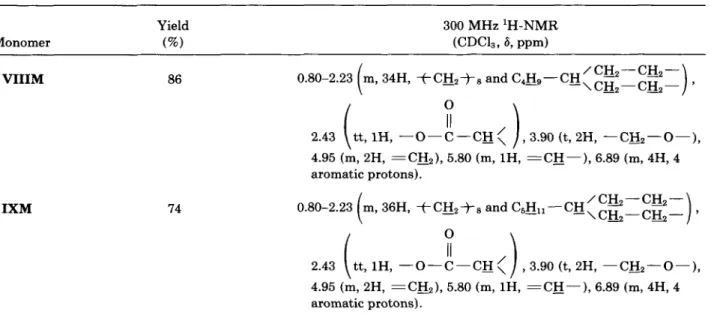
Table I. Characterization of Monomers IM-IXM
Yield 300 M H ~ 'H-NMR Monomer (%) (CDC13,6, ppm) IM IIM IIIM IVM VM VIM VIIM 89 79 71 86 91 86 70 m, 20H, f CH,
3-
/ CHz- C& - 0 ,3.92 (t, 2H, -C&-O-), 5.02 (m, 2H, =CHZ), 5.82 (m, lH, -CH=), 6.89 (m, 4H, 4 aromatic protons). / C&- CH,-m, 22H, f C& -f 2 and C4& - CH
-\C€I,-c~z- 0 ,3.92 (t, 2H, --C&--0-), 5.02 (m, 2H, =CHZ), 5.82 (m, lH, -CH=), 6.89 (m, 4H, 4 aromatic protons). 0 ,3.92 (t, 2H, -C&-0-), 5.02 (m, 2H, =CHz), 5.82 (m, lH, -CH=), 6.89 (m, 4H, 4 aromatic protons). / CH, - CH, - m, 22H, f C H z j 3 and C3H7-CH -\CH,-C&- 0 ,3.93 (t, 2H, -CI&-O-), 5.00 (m, 2H, =CHz), 5.82 (m, lH, =CH-), 6.89 (m, 4H, 4 aromatic protons). / C&-
c a -
m, 24H, f CH, -f 3 and C4H9 - C H
,
c&
-c&
- 0 ,3.93 (t, 2H, -C&-0-), 5.00 (m, 2H, =CH,), 5.82 (m, lH, =CH-), 6.89 (m, 4H, 4 aromatic protons). 0 ,3.93 (t, 2H, -C&-O-), 5.00 (m, 2H, =CHZ), 5.82 (m, lH, =CH-), 6.89 (m, 4H, 4 aromatic protons).m, 32H, f C & - f s and C3&-C€I\c&-c&- /C&-C&-
0
,3.90 (t, 2H, -C&-O-),
4.95 (m, 2H, = ~ H z ) , 5.80 (m, 1H, =CH-), 6.89 (m, 4H, 4
Table I. Continued Yield Monomer (%) VIIIM ~ 86 / C&- C&- -\C&-C&- m, 34H, f C I 3 , j 8 and C&-CH 0 ,3.90 (t, 2H, -C&-O-), 4.95 (m, 2H, =C&), 5.80 (m, l H , =CH-), 6.89 (m, 4H, 4 aromatic protons). IXM 74 0 tt, l H , -O-C-C€I\
/)
,3.90 (t, 2H, -C€&-O-), 4.95 (m, 2H, =CH,), 5.80 (m, l H , =CH-), 6.89 (m, 4H, 4 aromatic protons). p- (1-Pentenyl-5-oxy)phenyl trans-4-n- Propylcyclohexanoate (IM), p- (l-Pentenyl-5- oxy)phenyl trans-4-n-Butylcyclohexanoate (IIM),p- (1 -Pentenyl-5-oxy)phenyl trans-4-n-
Pentylcyclohexanoate (IIIM), p- (l-Hexenyl-6- oxy)phenyl trans-4-n-Propylcyclohexanoate (IVM), p- (1-Hexenyl-6-oxy)phenyl trans-4-n-
Butylcyclohexanoate (VM), p- (l-Hexenyl-6- oxy)phenyl trans-4-n-Pentylcyclohexanoate (VIM), p- (I-Undecenyl- 1 1-oxy)phenyl trans-4-n- Propylcyclohexanoate (VIIM), p- (1 -Undecenyl- 1 I -0xy)phenyl trans-4-n-Butylcyclohexanoate (VIIIM), p-(1-Undecenyl-11-oxy)phenyl trans- 4-n-Pentylcyclohexanoate (IXM)
The monomers IM-IXM were synthesized by the
same method. The preparation of monomer VIIIM
is described below.
0.8 g (4.34 mmol) of trans-4-n-butylcyclohex- anoic acid was reacted a t room temperature with excess thionyl chloride containing a drop of di- methylformamide and 7 mL of methylene chloride for 2 h. The solvents was removed under reduced pressure to give the crude acid chloride. The product was dissolved in 10 mL of methylene chloride and slowly added to a cold solution of 1.25 g (4.77 mmol) o f p - (1-undecenyl-11-oxy)phenol and 0.7 g of 4-di- methylaminopyridine in 100 mL of methylene chlo- ride. The solution was allowed to stand a t room temperature for 2 h and then the solvent was re- moved by heating over a boiling water bath. The obtained crude product was purified by column chromatography (silica gel, ethyl acetate/n -hexane
= 1 : 10 as eluent) to yield 1.6 g (86%) of white crystals. Table I summarizes the yields and 'H-NMR chemical shifts of all synthesized monomers. Synthesis of Polysiloxanes
The synthesis of liquid crystalline polysiloxanes is outlined in Scheme 2. A general synthetic procedure
is described below.
0.8 g (10 mol % excess versus the Si-H groups present in polysiloxane ) of the olefinic derivative was dissolved in 80 mL of dry, freshly distilled tol- uene together with the proper amount of poly- ( methylhydrogensiloxane )
.
The reaction mixturenrs.6 . I I m = 3 . 4 .S
Scheme 2. Synthesis of polysiloxanes containing 4-al- kanyloxyphenyl trans-4-n -alkylcyclohexanoate side groups.
LIQUID CRYSTALLINE POLYSILOXANES 981
was heated to 110°C under nitrogen and 100 pg of
dicyclopentadienylplatinum( I1 ) chloride catalyst was then injected with a syringe as solution in methylene chloride ( 1 mg/mL). The reaction mix- ture was refluxed (110°C) under nitrogen for 24 h. After this reaction time the FT-IR analysis showed that the hydrosilation reaction was complete. The polymers were separated and purified by several re- precipitations from tetrahydrofuran solution into methanol and further purified by preparative GPC, and then dried under vacuum.
RESULTS AND DISCUSSION
The synthetic routes used for the preparation of monomers IM-IXM are outlined in Scheme 1. Di- rect monoetherification of hydroquinone with al- kenyl halides usually gives very low yields and we had difficulties on the purification of the final prod- ucts. Therefore, we used 4-benzyloxyphenol as the starting material. It was etherified with alkenyl ha-
lides to give alkenyloxyphenyl benzyl ethers which were d e b e n ~ y l a t e d ~ ~ to form 4-alkenyloxyphenols. 4-Alkenyloxyphenols obtained by this improved method were always white, pure, and were obtained with high yields. The monomers which were pre- pared by esterification of 4-alkenyloxyphenol with
tram-4-alkylcyclohexanoic acid, were obtained with
pretty high yields and high purity as determined by thin layer chromatography and 'H-NMR spectros- copy. Table I summarizes the 'H-NMR chemical shifts of all synthesized monomers. The cyclohexane ring's methine proton, which is next to the carbonyl group, shows a resonance at 2.43 ppm. This peak is splitted as a triplet of triplets and the coupling con- stant (Jaxial-axial) is ca. 30 Hz. This means that the
methine proton is a t an axial position. Since the formation of a mesophase required elongated mo- lecular shape, all monomers should be in the equa- torial trans form.
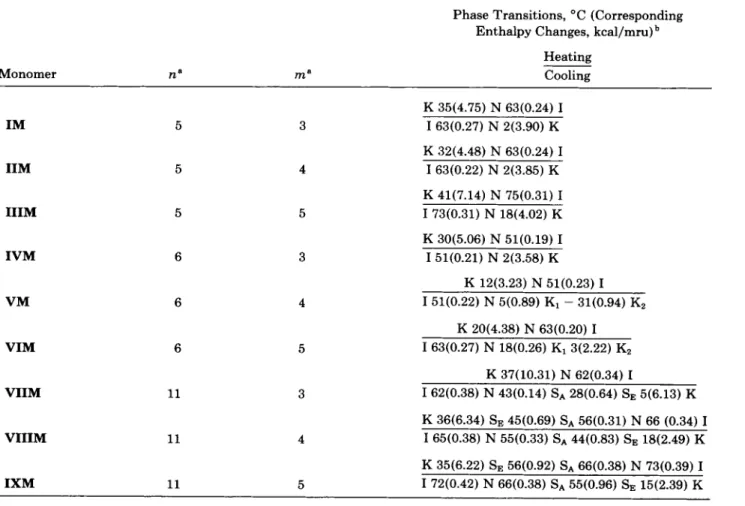
The thermal behavior of all monomers is reported in Table 11. All monomers synthesized display me-
Table 11. Phase Transitions and Phase Transition Enthalpies of Monomers IM-IXM
Monomer ne me
Phase Transitions, "C (Corresponding Enthalpy Changes, kcal/mru)
Heating Cooling IM IIM IIIM IVM VM VIM VIIM VIIIM IXM 5 5 5 6 6 6 11 11 11 K 35(4.75) N 63(0.24) I 163(0.27) N 2(3.90) K K 32(4.48) N 63(0.24) I I63(0.22) N 2(3.85) K K 41(7.14) N 75(0.31) I I73(0.31) N lS(4.02) K K 30(5.06) N 51(0.19) I I51(0.21) N 2(3.58) K K 12(3.23) N 51(0.23) I I51(0.22) N 5(0.89) K, - 31(0.94) Kz K 20(4.38) N 63(0.20) I 163(0.27) N lS(0.26) K1 3(2.22) Kz K 37(10.31) N 62(0.34) I 162(0.38) N 43(0.14) SA 28(0.64) SE 5(6.13) K K 36(6.34) SR 45t0.69) SA 56(0.31) N 66 (0.34) I 165(0.38) N 55(0.33) SA 44(0.83) SE lS(2.49) K K 35(6.22) SE 56(0.92) S A 66(0.38) N 73(0.39) I I72(0.42) N 66(0.38) SA 55(0.96) SE 15(2.39) K ~~ ' According to Scheme 1.
B
C
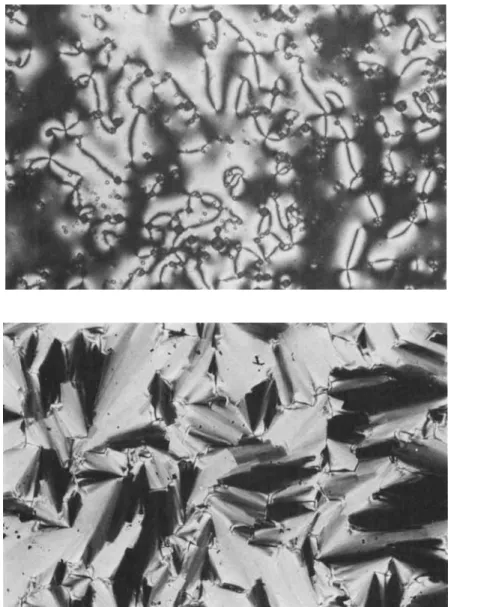
Figure 1. Optical polarized micrographs displayed by monomer IXM (8OX ) : ( A ) Nematic schlieren texture obtained after cooling to 68"C, ( B ) focal-conic texture of the smectic A phase obtained after cooling to 61.OoC, ( C ) arced focal-conic texture of the smectic E phase obtained after cooling to 51.7"C.
LIQUID CRYSTALLINE POLYSILOXANES 983
sophases. The monomers IM to VIM exhibit an en-
antiotropic nematic mesophase. They displayed re- spectively a characteristic schlieren nematic texture. Monomer VIIM displays an enantiotropic nematic
phase and two monotropic smectic mesophases ( SA and SE)
,
while monomers VIIIM and IXM displayenantiotropic nematic, S A and SE phases. Optical
polarizing microscope observation revealed very characteristic textures for these three mesophases. Figure 1 presents three representative textures ex- hibited by monomer IXM. Texture A which was obtained after cooling from isotropic phase to 68"C, is a typical schlieren nematic texture. Texture B which was obtained after cooling from nematic phase to 61"C, is a typical focal-conic texture of the smectic A phase. Texture C which was obtained after cooling from smectic A phase to 51.7"C, is an arced focal- conic texture. The lines of the arces are very clear and the bands are unbroken. This texture is very
characteristic of the smectic E phase. No other phase shows this type of texture, except the smectic G
phase formed on cooling smectic B phase. In this case, the arcs are seen, but they are dissimilar to those of the smectic E phase because they are bro- ken.28 Some conclusions can be obtained from the data reported in Table 11. Nine monomers can be separated into three groups, i.e., IM-IIIM, IVM- VIM and VIIM-IXM. The difference among three
groups of monomers is due to the length of the flex- ible alkenyl spacers. In each group, the difference among three monomers is on the length of the ter- minal alkyl chains. As can be seen from the table, the tendency toward smectic mesomorphism in- creases with increasing spacer length. The isotropi- zation temperature first decreases, and then in- creases with increasing spacer length. In each group, when the length of a terminal alkyl group increases from propyl to pentyl, it does not affect the type of
Table 111. Phase Transitions and Phase Transition Enthalpies of Polymers IP-IXP
Phase Transitions, "C (Corresponding Enthalpy Changes, kcal/mru) Heating Polymer na m a Cooling I P IIP IIIP IVP g 7 S2 35(0.32) S A 125(0.44) I I 125(0.51) SA 29(0.41) S2 3 g g 3 S2 79(0.17) S A 143(0.80) I I 139(0.80) SA 76(0.19) S2 0 g g 8 S2 102(0.23) SA 152(0.97) I I 148(0.95) SA 98(0.22) S2 5 g g -6 S2 gO(0.06) 106(0.10) I I 102(0.21) SA SS(0.16) S2 - l l g e -12 SA 10N0.66) I I lOO(0.75) SA -15 g V P 6 4 ei -6 S , 76(0.191 SA 131(0.81) I VIP 6 5 I 125(0.78) SA 71(0.18) S2 -10 g SF: 69(0.71) SA 126(1.01) I VIIP 11 3 1121(1.00) S A 64(0.85) S E SF: 82(1.04) SA 141(1.17) I VIIIP IXP 11 11 4 5 I 121(1.00) SA 64(0.85) S E S3 66(0.11) SE G(0.54) SA 135(0.84) I I 133(0.92) S A 80(0.54) SE 60(0.11) S3 a According to Scheme 2.
mesophase formed, but does affect the isotropization temperature ( T N I ) ; i.e., both monomers with a pro-
pyl or a butyl terminal group show similar T N I values
while the monomer with a pentyl terminal group presents a higher T N I value.
The synthesis of side-chain liquid crystalline po- lysiloxanes is outlined in Scheme 2. Some prelimi- nary information on the phase behavior of the poly- siloxanes was obtained by DSC2' and optical polar- izing microscopy.28 Table I11 summarizes the thermal transitions and thermodynamic parameters of the synthesized polymers. All polymers present smectic mesomorphism. It is well documented that in many cases the mesophase formed by a side-chain liquid crystalline polymer is more organized than the one exhibited by the corresponding monomer. Polymers I P to IIIP exhibit a glass transition and
two enantiotropic mesomorphic transitions. On the optical polarized microscope, on cooling from an isotropic phase all three polymers first displayed a focal-conic texture which is characteristic of a smectic A phase. Upon further cooling from smectic A phase to the other smectic phase, the polymers became very viscous and were not able to form a characteristic texture so far. On going from I P to IIIP, the terminal alkyl chain length increases from
propyl to pentyl and both the mesophase transitions shift to higher temperatures. This result demon- strates that a longer terminal alkyl group is leading to the formation of a more stable mesophase.
Figure 2 illustrates some representative DSC traces of polymers IVP-VIP. Basically the meso-
phase behavior of these three polymers follows the same trend as that of polymers IP-IIIP except that
only a smectic A phase is observed for polymer VP.
Polymers VIIP-IXP present very different meso-
morphic behavior from the former six polymers. All three polymers show no discriminative glass tran- sition and both polymers VIIP and VIIIP present
two enantiotropic mesophase transitions, while polymer IXP present three enantiotropic meso-
morphic transitions. On cooling from the isotropic phase on the optical polarized microscope all three polymers first displayed a focal-conic texture which
is characteristic of a smectic A phase and then an arced focal-conic texture which is typical for a smectic E phase. Attempts to develope a character- istic texture of the third smectic phase upon the annealing of the polymer IXP was unsuccessful.
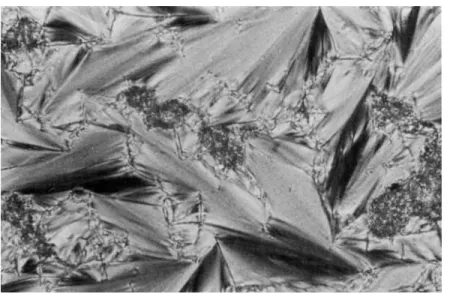
Figure 3 shows the typical focal-conic texture and the arced focal-conic texture exhibited by polymer
VIIIP.
In order to study the thermal stability of the pre- pared polymers, they were heated to the temperature
above 200°C and then characterized by 'H-NMR
spectroscopy and DSC. Both the 300 MHz 'H-NMR spectra and the DSC traces of the thermal treated samples are completely identical to those of the un- treated samples. This result demonstrates that trans-cis isomerization for the cyclohexane based mesogens does not occur.
In conclusion, all the synthesized polymers show only liquid crystalline mesophases and do not un- dergo side chain crystallization even if very long spacers were used to connect the polymer backbone and the mesogenic units. This result could be due to the cyclohexane based mesogenic units which as illustrated in our previous studies
''J~J~
exhibits conformational isomerism.\Tg=- 1 2
T I - 7 6
- 4 0 0 4 0 8 0 I 2 0 1 6 0
Temp. ('C)
Figure 2. DSC thermograms (lO°C/min): ( A ) IVP, second heating scan; ( B ) IVP, cooling scan; ( C ) VP, sec- ond heating scan; ( D ) VP, cooling scan; ( E ) VIP, second heating scan; ( F ) VIP, cooling scan.
LIQUID CRYSTALLINE POLYSILOXANES 985
A
B
Figure 3. Optical polarized micrographs displayed by polymer VIIIP (400X): ( A ) focal-
conic texture of the smectic A phase obtained after cooling to 114.8"C, ( B ) arced focal-
conic texture of the smectic E phase obtained after cooling to 63.7'C.
The authors are grateful to the National Science Council
of Republic of China (NSC 79-0405-E009-05) for financial
support of this work.
2. L. L. Chapoy, Recent Advances in Liquid Crystalline
Polymers, Elsevier, London and New York, 1985.
3. A. Blumstein, Polymeric Liquid Crystals, Plenum, New
York, 1985.
4. C. B. McArdle, Side Chain Liquid Crystal Polymers,
5 . B. A. Jones, J. S. Bradshaw, M. Nishioka, and M. L.
6. M. A. Apfel, H. Finkelmann, G. M. Janini, R. J. Lamb,
REFERENCES AND N O T E S Blackie, Glasgow and London, 1989.
1. A. Ciferri, W. R. Krigbaum, and R. B. Meyer, Polymer
Liquid Crystak, Academic Press, New York, 1982.
B. H. Luhmann, A. Price, W. L. Roberts, T. J. Shaw,
and C. A. Smith, Anal. Chem., 5 7 , 6 5 1 (1985).
7. J. S. Bradshaw, C. Schregenberg, H. C. Karen, K. E.
Markides, and M. L. Lee, J. Chromatogr., 3 5 8 , 95
( 1986).
8. H. J. Coles and R. Simon, Polymer, 26,1801 (1985).
9. R. F. Goozner and H. Finkelmann, Makromol. Chem.,
1 8 6 , 2407 (1985).
10. C. B. McArdle, M. G. Clark, C. M. Haws, M. C. K.
Wiltshire, A. Parker, G. Nestor, G. W. Gray, D. Lacey,
and K. J. Toyne, Liq. Cryst., 2 , 5 7 3 (1987).
11. C. S. Hsu, J. M. Rodriguez-Parada, and V. Percec,
Makromol. Chem., 188,1017 (1987).
12. C. S. Hsu, J. M. Rodriguez-Parada, andV. Percec, J.
Polym. Sci. Polym. Chem. Ed., 2 5 , 2425 (1987).
13. C. S. Hsu and V. Percec, Makromol. Chem. Rapid
Commun., 8 , 331 (1987).
14. C. S. Hsu and V. Percec, Polym. Bull., 1 7 , 4 9 ( 1987).
15. B. Hahn and V. Percec, Macromolecules, 2 0 , 2961
16. C. S. Hsu and V. Percec, Makromol. Chem., 189,1141
17. V. Percec and B. Hahn, Macromolecules, 2 2 , 1588
18. V. Percec, B. Hahn, M. Ebert, and J. H. Wendorff,
(1987). (1988). (1989).
Macromolecules, 23,2092 (1990).
19. H. J. Deutcher, F. Kushel, H. Schubert, and D. Dumus,
DDR Pat., 105,701 ( 1974).
20. R. Eidenschink, D. Erdmann, J. Krause, and L. Pohl,
Angew. Chem. Int. Ed. Engl., 1 6 , 1 0 0 (1977).
21. R. Eidenschink, D. Erdmann, J. Krause, and L. Pohl,
Angew. Chem. Int. Ed. Engl., 1 7 , 1 3 3 (1978).
22. D. Demus and H. Zaschke, Mol. Cryst. Liq. Cryst., 6 3 ,
129 (1981).
23. H. Takatsu, K. Takeuchi, and H. Sato, Mol. Cryst.
Liq. Cryst., 9 4 , 255 (1983).
24. R. Krieg, H. J. Deutscher, V. Baumeister, H. Hartung,
and M. Jaskolski, Mol. Cryst. Liq. Cryst., 1 6 6 , 109
(1989).
25. V. S. Bezborodov, V. A. Konovalov, V. I. Lapanik,
and A. A. Minko, Liq. Cryst., 4 , 2 0 9 (1989).
26. S. Diele, B. Hisgen, B. Reck, and H. Ringsdorf, Mak-
romol. Chem. Rapid Commun., 1,267 ( 1986).
27. B. Loev and C. R. Dawson, J. Am. Chem. SOC., 7 8 ,
6095 (1956).
28. G. W. Gray and J. W. Goodby, Smectic Liquid Crystals.
Textures and Structures, Leonard Hill, Glasgow and
London, 1984.
29. W. R. Krigbaum, J . Appl. Polym. Sci. Appl. Polym.
Symp., 4 1 , 1 0 5 (1985). Received August 24, 1990 Accepted December 28, 1990