IEEE TENCON'93 / B e i h
A NEW METHODOLOGY FOR FUZZY COMROL BASED ON WEIGHED FUZZY LOGICS
Shyi-Mmg Chen
Department of Computer and Information Science National Chiao Tung University, Hsinchu, Taiwan, China
ABSTRACT
This paper presents a weighted fuzzy reasoning technique for fuzzy control based on weighted fuzzy logics, where fuzzy production rules are used for knowledge representation. The technique allows the truth values of the conditions appearing in the antecedent portions of the rules, the certainty factors of the rules, and the weights of the conditions appearing in the antecedent portions of the rules to be linguistic terms represented by trapezoidal fuzzy numbers.
INTRODUCTION
In 1987, Looney et al.' pointed out that a promising area of rule-based control is fuzzy controls. They also pointed out that a fuzzy control system is a small rulebased system that reasons forward to deduce controls using fuzzy (or multivalued) logic to handle the uncertainty. In 1987, Looney et al. presented an al orithm for real-time logical controls via Boolean ruye matrix transformationsl. In 1988, Looney presented a technique of fuzzy reasoning via fuzzy logic networks (FLN)Z. The fuzzy logic networks allow rule-based decisionmaking systems to be represented and executed, where the deduced truth token value could be interpreted as a control command. In 1990, we extended the works of Looney et al. to present a fuzzy reasoning algorithm based on the fuzsy Petri net model (FPN)3. In 1992, we presented a fuzzy reasoning technique based on the cl-cuts operations of fuzzy numbers4. However, the al orithms mentioned above assumed that each conktion appearing in the antecedent portions of the rules has the same degree of importance. If we can allow each condition appearing in the antecedent portions ri the rules to have a different degree of importance (to have a different weight), then there is room for more flexibility.
In 1988, Xingui presented the concepts of weighted fuzzy logic5. In weighted fuzzy logic, the truth value of a conjunction of propositions is a weighted sum of the truth value of each proposition, where the truth value of the propositions and the wei hts of the propositions are represented by crisp r e i values. Xingui also pointed out that the weighted fuzzy logic is quite suitable for reasoning with incomplete knowledge and fuzzy retrieval or fuzzy matchings. However, if we can
allow the truth values of the propositions and the weights of the propositions to be linguistic terms represented by fuzzy numbers6J (e.g., high, very-hi h, etc.) rather then crisp real values,then there is room5or more flexibility.
In this paper, we present a weighted fuzzy reasoning technique for fuzzy control based on weighted fuzzy logics, where the truth values of the conditions appearing in the antecedent portions of the rules, the certainty factors of the rules, and the weights of the conditions appearing in the antecedent portions of the rules are linguistic t e r m represented by trapezoidal fuzzy numbers.
FUZZY SET THEORY
membership of ui in A.
Definition 1: A fuzzy set A of the universe of discourse U is convex8 if and only if for all u1,
u2in U,
fA(XU1 + ( 1 - x ) ~ ~ ) 2 Min(fA(ut), fA(uz)) where X E [0,1].
Definition 2: A fuzzy set A of the universe of discourse U is called a normal fuzzy set7 if 3 ui E U, fA(ui) = 1.
Definition 3: A fuzzy number7 is a fuzzy subset in the universe of discourse U that is both convex and normal.
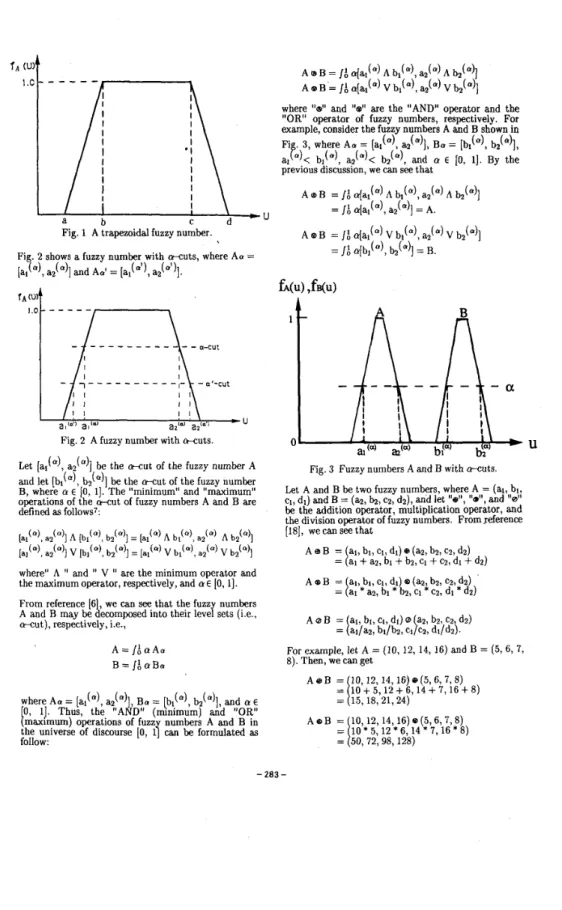
A fuzzy number A of the universe of discourse U may be characterized by a trapezoidal distribution parametrized by (a, b, c, d) shown in Fig. 1.
Definition 4: The cr-cut7 AQ of the fuzzy set A in the universe of discourse U is defined by
A Q =
{ ~ i lfA(Ui) 2
0, uiE U}, where a
E(0,1].
- 282 -
Fig. 1 A trapezoidal fuzzy number.
Fig. 2 shows a fuzzy number with H u t s , where An = [al(n), and An' = a&"')].
Fig. 2 A fuzzy number with H u t s . Let [al(n), a2(n)] be the a-cut of the fuzzy number A and let [bl(n), bz(")] be the H u t of the fuzzy number B, where a E [0, 1). The "minimum" and "maximum"
operations of the H u t of fuzzy numbers A and B are defined as follows7:
where" A
'Iand
I'V
'Iare the minimum operator and the maximum operator, respectively, and a E [0,1].
From reference [SI, we can see that the fuzzy numbers A and B may be decomposed into their level sets (i.e., H u t ) , respectively, i.e.,
where An = [al(n) a?!")], E3: = [bl("), bJn)], and a E
p, 11. Thus, thk AND (minimum) and "OR"
maximum) operations of fuzz numbers A and B in the universe of discourse [0, 17 can be formulated as follow:
A
18B = j b a[a,(") A bl("), az(n) A b ~ ( ~ ) ] A @ B ' = j b a[al(n) V bl(n), a ~ ( ~ ) V bz(")]
where
"8"and
"6"are the "AND" operator and the
"OR" operator of fuzzy numbers, respectively. For example, consider the fuzzy numbers A and B shown in Fi 3, where An = a$")], Bn = [bl(n), bz(a)], a
! ' )
< b i n ) , a i n ) < bz("), and a E [0, 11. By the previous discussion, we can see that
A o B = 1; a[q(") A b ~ ( ~ ) , a2(n) A b ~ ( ~ ) ]
= j : a[al(n), a 2 ( n ) ~ = A.
A @ B = 1: @[ai(") V bl(n), aJn) V bz('l)]
= /A a/bl(n), b2(")] = B.
Fig. 3 Fuzzy numbers A and B with H u t s . Let A and B be two fuzzy numbers, where A = (al, bi, cl, dl) and B ,= (az, b, c ~ , dz), vd.let ,W, "e1', and
"0"be the addition operator, multiplication operator, and the division operator of fuzzy numbers. From reference [MI, we can see that
A e B = ai, bl, CI, d1)
@(a2, bz, c2, d2)
A o B = at, bl, c1, dl) o (a2, bz, c2, dz)
= [ai + a2, bl + b2, c1+ c2, dl + d2)
= la1 * a2, bl * b2, c1* c2, d1 * dz) A
0B = 81, bl, CI, dl)
0a2 bz c2 d2)
= [adaz, bdbz,
C ~ C Z :d;/dz\.
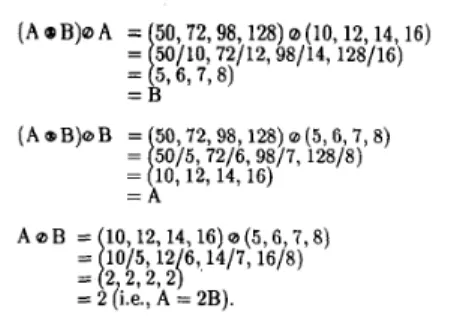
For example, let A = (10, 12, 14, 16) and B = (5, 6, 7, 8). Then, we can get
- 283 -
= B
= A
= 2 (i.e., A = 2B).
A WEIGHTED FUZZY REASONING TECHNIQUE In conventional rule-based systems, we assume that the conditions appearing in the antecedent portions of the production rules15~16 all have the same degree of importance (i.e., all have the same weight), where conditions are described by propositions. However, if we can allow the conditions appearing in the antecedent portions of the rules to have different degrees of importance (to have different weights), then there is room for more flexibility. For example, a production rule about weather prediction might look as follows:
I F the clouds are heavy AND the humidity is high AND the barometric pressure is low AND it is lightning
THEN it will rain.
Obviously, the first three conditions appearing in the antecedent portion of the above rule are more important than the last condition, so it would be better to assign different weights to different conditions appearing in the antecedent portion of the rule.
In this paper, the fuzzy production rules394J7 are used for knowledge representation. Let R be a set of fuzzy production rules. The general formulation of a fuzzy production rule Ri, Ri E R, is as follows:
Ri: I F Cj THEN Ck (CF =
t i )(1) where Cj and ck are conditions described by propositions; the truth values of the conditions C. and
c k are linguistic terms represented by trapezoidal hzzy numbers shown in Table
114;t i is a linguistic certainty factor represented by a trapezoidal fuzzy number shown in Table 1 indicating the degree of belief of the rule Ri.
If the truth value of the condition Cj of (1) is tj, where
t jis a fuzzy number, then the truth value of the condition ck can be evaluated and is equal to t j
Bti, where
"Q"is the AND operator of fuzzy numbers. If there are two rules leading to the condition ck:
I F IF
and the truth values of the conditioils Ca and CI, are
the fuzzy numbers ta and tb, respectively, then the truth value of the condition ck can be evaluated and is equal to (ta o ti)
8(tb
Bt.), where "B" and
"8"are the AND operator and the Ok operator of fuzzy numbers, respectively.
Table 1 Linguistic terms and their corresponding fuzzy numbers
Linguistic terms Fuzzy numbers unknown
very-low low medium-low medium medium-high high very-high absolutely-true
o,o, 0,O) 0, 0,0.02, 0.07) 0.04,0.1,0.18,-0.23) 0.17,0.22,0.36,0.42 0.32,0.41,0.58,0.65 0.58,0.63,0.80,0.86 0.72,0.78, 0.92,0.97 0.975,0.98,1, 1) 1, 1 , 1 , 1 )
If a condition C. is composed of many conditions which are linked together by AND connectors (i.e., Cj = Cjl AND Cjz AND ... AND Cjn), then Cj is called a compound conditionl. If a fuzzy production rule contains either AND connectors or OR connectors, then it is called a compound fuzzy production rule3. Let t i be a linguistic term described by a fuzzy number.
The compound fuzzy productioh rules can be divided into the following rule types:
Type 1: I F C.1 AND Cjz AND ... AND Cjn THEN ck
(CF = t . If the truth values of the conditions Cjl, Cjz,
..., and 8. are the fuzzy numbers,tjl, tj?, ..., and tjn respectively, and the weights of the condltlons Cjl, Cjz, ..., and Cjo are wjl wjz, ..., and w',,, respectively, then the truth value of'the condition
h kcan be evaluated and is equal to [(tjla wjl e t j z o wjz e ... e tjn ewjn)
0( w j l e wj2 e ... e wjn)]
Bti.
Type 2: I F Cj THEN Ckl AND Ck2 AND ... AND Ckn(CF = ti). If the truth value of the condition Cj is the fuzzy number tj, then the truth values of the conditions Ckl, Ck2, ..., and Ckn can be evaluated and are equal to t j
@ti, respectively.
T pe 3 I F Cjl OR Cjz OR ... OR C. THEN ck (CF
=tif. If ;he truth values of the condkons Cji, Cjz, ..., and C. are the fuzzy numbers tjl, tjz, ..., and t.n, respect%ely, and the weights of the conditions Cjl,
($2,..., and Cjn are the fuzzy numbers wjl, wjz, ..., respectively, then the truth value of the c o n d ~ d o ~ k ? can be evaluated and is equal to [(tjl B wji)
0(w.1
(B W j ze ... e
W')] e [(tjZ B WjZ)
0(Wjl e wjz e ... e Wjn)j e ...
8 [ ( t j n o w ) j n , ) 0 ( w j l e w j z e . . , e w j n ) l@ t i .
T p e 4 I F Cj THEN ckf OR Ck2 OR ... OR Ckn (CF = tif. This type of rules is unsuitable for deducing control due to the fact that it does not make any specific implication. Thus, we do not discuss this type of rules.
In the following, we illustrate a weighted fuzzy
reasoning example; the result of any arithmetic
operation is represented by 4 digits of significant
numbers.
Examnle: Let CI, C2, C3, C4, and C j be any five conditions. Assume that the knowledge base of a rulebased system contains the following rules:
1.0-
RI: IF CI A N D Cz AND
C3THEN
Cq(CF
= very-high)Rz: IF
C4THEN
C5(CF = high)
and assume that the truth values of the conditions C1, C2, and C3 are the linguistic terms "very-high",
"high", and "medium-high", respectively, and the weights of the conditions C1, Cz, and C3 are the linguistic terms "very-high", "medium-high", and
"medium", respectively, then the truth value of the condition C4 can be evaluated and is equal to the fuzzy number Y, where
Y = [(very-high o very-high IB high
8,medium- high
8medium-high o medium)
0(very-high IB medium -high
Qmedium)] o very-high
and the truth value of the condition C5 can be evaluated and is equal to the fuzzy number Z, where 2
=
Y
0high. From Table 1, we can see that the trapezoidal fuzzy number representation of the lin uistic terms "very-high", "high", "niedium-high", an$ "medium" are (0.975, 0.98, 1, l ) , (0.72, 0.78, 0.92, 0.97 , (0.58, 0.63, 0.80, 0.86), and (0.32, 0.41, 0.58, 0.651, respectively. Thus, we can get
Y =[((0.975,0.98, 1, 1)@(0.975,0.96, 1, I ) @ (0.72,0.78, 0.92,0.97)@(0.58, 0.63,0.60, 0.86)e(0.56,0.63,0.80,0.66)@(0.32,0.41, 0.58,0.65)0 (0.975,0.98, 1,l)
Q(0.58, 0.63, 0.60,0.66]e[0.32,0.41. 0.56,0.65))]@
(0.975, 0.98, 1, 1)
0.736 018342) e (0.1856,0.2583,0.464, 0.559))
0(1.875,2.02, 2.38,2.51)] o (0.975,0.98,1,1)
'
=[((0.9506 0.9604,1,1)Q(0.4176,0.4914,
=((1.5538, 1.7101,2.2,2.3932)0(1.875,2.02, 2.38,2.51))e(0.975,0.98, 1, 1)
= (0.8287, 0.8466, 0.9244, 0.9547)e (0.975,0.96, 131)
- - - - - - Y
I I I I I I I t I I
= (0.8267, 0.8466, 0.9244,0.9547);
Z
=Y c high = (0.8287, 0.6466, 0.9244, 0.9547) c (0.72,0.78,0.92, 0.97)
The membership function curves of the fuzzy numbers Y and Z are shown in Fig. 4 and Fig. 5 , respectively.
Then, by using the method presented by Huang et al.19, the area center of the fuzzy numbers Y and Z can be calculated. The method is briefly review as follows.
Let X be a fuzzy number, fx be the membership function of X, S be the support of X, x,in = inf S, x , , ,
= sup S; then the area center xo of X is the point on [0, 11, such that
1'" f,(x) dx = sxmax fx(x)dx
Xm i n