正交異向平板受熱激振之非線性分析
簡守謙 趙榮輝
德霖技術學院機械工程學系
摘 要
本論文探討正交異向平板受熱激振之非線性分析,採用馮卡門平板理論 (von Kármán plate theory),獲得非線性偏微方程式;以蓋里奇方法(Galerkin method)運算後,簡化為非線性常微方程式;提出以 J 積分值為指標,用來建 立J 積分值的分歧圖表現多解共存及初始空間的吸引子盆地圖。正交異向平板 受熱激振有週期倍增至混沌響應及豐富的響應類型出現;配合以Poincarè 切面 圖、相圖、頻譜圖和Lyapunov 指數,說明響應類型。
關鍵詞:平板、分歧圖、混沌。
ANALYSIS OF A NONLINEAR ORTHOTROPIC PLATE SUBJECTED TO THERMAL EXCITATION
Shoou-Chian Jen Jung-Hui Chao Department of Mechanical Engineering,
De Lin Institute of Technology, Taipei, Taiwan 236, R.O.C.
Key Words: plate, bifurcation diagram, chaos.
ABSTRACT
In this paper, we study a nonlinear orthotropic plate subjected to thermal excitation. The governing equations are derived from von Kármán plate theory. From them, the simplified nonlinear ordinary differential equations are then obtained by employing Garlerkin’s method. We have provided an effective index J integral, which constructs the J bifurcation and basins of attraction to evaluate the influence of parameters and to observe the characteristics of these systems. Chaotic motion and basins of attraction are distinguished by J integral with assistance of Ponincaré section, phase portraits, frequency spectrum, and Lyapunov exponent.
一、前 言
複合材料由於其強度及勁度高,而且有很好的耐熱 性,最重要的是其比重輕與耐蝕性高,因此近年來的發 展快速,在許多方面有取代金屬材料之勢,諸如在高速 飛行體,汽車結構、各種管路結構之應用上等。今日複
合材料之力學分析成為一門十分重要的之工作,尤以對 複合材料溫度高熱時之振動分析亦然。平板之非線性分 析方面,仍以馮氏非線性平板理論為主。當解析馮氏理 論時,因為三個位移函數(U,V,W )聯立之非線性偏微 分方程式,故大多學者考慮利用數值方法求得其解,以 致理論分析者較少。
Chu 和 Herrmann[1]利用微擾方法(perturbation method) 解析四周簡支情況下,在沒有溫度影響時,等向彈性平板
之非線性振動分析,Vendhan[2-4]利用 Rayleigh-Ritz 及 Galerkin 方法,在數值分析方法下,求解得等向性及正交 性彈性平板,考慮各種不同邊界條件下與幾何形狀之非線 性振動問題。考慮平板非耦合熱振動問題則有Sunakawa[5]
用理論分析,解析等向性平板在受熱變形後之自由振動問 題,以一項近似值,利用蓋里奇方法運算後,求解得平板 受熱之振動分析。Bailey[6]、Bailey 和 Greetham[7]則以實 驗分析及數值方法,求解得等向性及正交性彈性平板受熱 之自由振動問題。Yeh 等人[8]研究圓板受熱之振動分析,
獲得受一參激一外激非線性系統,然而數值模擬法分析 中,參激與外激頻率設定相同,無模擬二個不同頻率激振 之系統。Chen[9-10]、Dooren[11] 基本上解析 Duffing 方程 式受一個外力激振,因系統出現對稱解(多重解),Chen 數值模擬法分析中只取一個初始條件無法表現多重解共 存;Dooren 以吸子盆[11]地圖判斷多重解,再取多個初始 條件繪出多重解共存之分歧圖[11]。多數研究者於數值模 擬法分析過程中,只取一個初始條件所繪出分歧圖將無法 表現多重解。
探討並分析強非線性系統[9-18],多數利用數值模擬 方法。以數值模擬方法分析強非線性系統,如 Duffing 方 程 式 , 已 被 Ueda[12-13] 等 先 進 探 討 得 非 常 詳 盡 。 Padmanbhan 和 Singh[14]、Chui 和 Noah[15-16]、Lan 和 Zhang[17]和 Narayanan 和 Sekar[18]在探討多重解或週期倍 增後之週期-n(period-n)響應有其困難性,甚至於無法獲得 其響應。
本 文 作 者 探討強非線性系統,有深入之研究,有多 篇相關論文發表[19-28]。本文針 對正交性矩形平板受熱激 振之非 線 性 系 統 , 提出以 J 積分值為指標,用來建立 J 積分值的分歧圖表現多解共存及初始空間的吸引子盆地 圖。正交性平板受熱激振有豐富的響應類型出現,配合以 Poincarè 切面圖、相圖、頻譜圖和 Lyapunov 指數,說明響 應類型。
二、平板理論之推導
1. 應力-應變及應變-位移之關係
考 慮 平 板 甚 薄 可 視 為 平 面 應 力 問 題(plane- stress problem),且正交性彈性矩形平板,其應力-應變關係可 寫成
xy y x
σ σ σ
=
12 2
21 1 1
0 0
G .
symm / E
/ E / E
µ µ ν µ
−
−
xy y y
x x
2 T T ε
∆ α ε
∆ α ε
(1)
平板內應變-位移之關係為(考慮大變形)
x0
ε =U, x+1/2W, x2、ε0y= U, y+1/2W, y2
2εxy0 U, y+V,x+W,xW,y (2)
Mx=
∫
− 2 /
2 / h
h xdZ
zσ 、My=
∫
− 2 /
2 / h
h ydZ
zσ 、Mxy
∫
− 2 /
2 / h
h xydZ zσ
Nx=
∫
− 2 /
2 / h
h xdZ
σ 、Ny=
∫
− 2 /
2 / h
h ydZ
σ 、Nxy=
∫
− 2 /
2 / h
h xydZ σ
NT=
∫
−
∆
2 /
2 /
1 h
h
h TdZ、MT=
∫
−
∆
2 /
2 / 2
12 h
h
TdZ
h Z (3)
2. 馮氏平板理論之推導與無因次化
薄平板在三個方向( x ,y, z )之運動方程式,經過方程 式(1)-(3)及以下之無因次量(4)
C1=
1 12
E µG
、C2= ν21 + C1、C3=
1 2
E
E 、C4=ν21 + 2C1
θ1=L1T0、θ2=L2T0、ξ=
a x、η=
b y、β=
a h、λ=
b a 、u=
a U
ν = a V 、w =
h
W 、nT=T/T0、mT= T/T0、Dx= µ 12
h E1 3
C2P= x4 ha D
ρ 、τ =Cpt、Dp=Cpδρh
、ƒ=D h Fa
x 4 、ωfo=
p H
C ω
L1= αx + ν21 αy、L2=ν21 αx+c3αy (4)
馮卡門平板理論可得
u,ξξ + C1λ2u,ηη+ C2λν,ξη-θ1n,Tξcos(ωfoτ)=
−β2(w,ξξ+C1λ2w,ηη)w,ξ−C2β2λ2w,ηw,ξη (5)
C1ν,ξξ+ C3λ2ν,ηη+ C2λu,ξη-θ2n,ηTcos(ωfoτ)=
−β2(C1w,ξξ+C3λ2w,ηη)w,ηλ− C2 β2 λw,ξw,ξη (6)
w,ξξξξ+2C4λ2w,ξξηη+C3λ4w,ηηηη+w,ττ+Dpw,τ=
− 12
β (θ1mT,ξξ+θ2λ2mT,ηη)cos(ωfoτ)−
β2
12 (θ1nTw,ξξ+θ2λ2nTw,ηη)cos(ωfoτ)+
β2
12 (u,ξ+ 2 β2 w,2
ξ)(w, ξξ+ν21λ2w,ηη)+
β2
12 (λν,η+ 2
λ β2 2w,2η)
(ν21 w,ξξ+C3λ2w,ηη)+ 2 β 24C1
(λu,η+ν,ξ+β2λw,ξw,η)w,ξηλ (7)
3. 蓋里奇方法與邊界設定
位移 w(ξ,η,τ)為時間變數與空間變數是可分離,藉蓋
里奇方法積分消去空間變數,將獲得非線性常微分方程 式;蓋里奇方法為[19]
∫∫
RL3(u,ν,w)φ(ξ,η) dξdη =0 (8) 四周簡支(simply supported)邊界條件為
= = =
= + +
0 0 0
2 0
1 21 2
σξη β θ ν λ ηη ξξ
, u , w
m , w ,
w T 在ξ = 0,1 時 (9)
= = =
= + +
0 0 0
2 0
1 221
ξη ηη ξξ
σ β θ ν λ
, u , w
m , w ,
w T 在η = 0,1 時 (10)
φ(ξ,η)為滿足(9)-(10)邊界條件之形狀函數(shape function)
,取為:
w(ξ,η,τ) =φ(ξ,η) w1(τ) = sin(πξ)sin(πη)w1 (τ) (11) 假設u(ξ,η,τ)及 v(ξ,η,τ)之解為:
u(ξ,η,τ) =
Σ
∞=1 m
Σ
∞=0 n
umnsin(2mπξ)cos(2nπη)w1(τ) (12)
ν(ξ,η,τ) =
Σ
∞=0m
Σ
∞=1n
νmncos(2mξ)sin(2nπη)w1(τ) (13)
因溫度場為已知函數,利用雙重富立葉級數將nT (ξ,η,τ)與 mT (ξ,η,τ)展開為:
nT (ξ,η,τ)=
Σ
∞=0m
Σ
∞=0n
Amncos(2mπξ)cos(2nη)w1(τ) (14)
mT (ξ,η,τ)=
Σ
∞, m =odd
Σ
∞n
Bmnsin(mπξ)sin(nπη)w1(τ) (15)
(5)-(7)及(11)-(15)代入方程式(8)經簡化後,獲得非線性常微 分方程式,表示為
= +
+ +
+D w( ) (1 2C C )w( ) )
(
w&&1 τ p&1 τ π4 4λ2 3λ4 1 τ
−
−
− +
− 3 4 }
) C C 3 ( ){
( 4 w 3
21 2 3
2 21 3 2 21 3 4
1
4 τ λ ν ν λν
π
+
− +C )(2v v ) )(
( 6 w
11 01 2 3 21 2 1
3 λ τ ν λ
β π
−
− + )(2u u ) 1
)(
( 6 w
11 10 2 21 2 1
3 τ ν λ
β π
+ + v ) u
)(
( C w 12
11 11 2 2 1
1 3
λ λ β τ
π
− + )cos( ) B (
f τ ω λ θ β θ
π 2 0
2 2 1
2 11
4 3 23λw1(τ)(θ1 θ2λ2) β
π +
) cos(
) A A A A
(4 00−2 01−2 10 + 11 ωf0τ (16)
三、結果與討論
方程式(16)經簡化後,為受外激與參激簡諧激振之非 線性常微分方程式,表示為
+ +
+
+a w( ) aw( ) a w ( ) )
(
w&&1 τ 0&1 τ 1 1 τ 3 13 τ
) cos(
p ) cos(
) ( w
p0 1 τ ωf0τ = 2 ωf0τ (17)
當材料物理特性常數如表一,長寬比為1、厚長比為 1/100、擬溫度合力為nT=32.5。在阻尼參數=0.03、溫度 頻率ω0=0.5。圖 1 為振幅P0變化之分歧圖;數值模擬過 程中P0每增量執行50 個初始條件;每一初始條件於穩態 解後,間隔一週期共取值100 個。圖 1 為 J 積分值X(nT) 對振幅P0分歧圖;因為每一參數執行50 個初始條件,表 現出多解共存之族曲線。圖2 為 J 積分值X(nT)對振幅 P0
表一 材料物理特性常數[19]
C 1 C2 C 3 C 4 ν12 αx αy 0.164 0.228 0.256 0.392 0.064 5.4E-6 3.6E-5
圖 1 X(nT)對振幅 p0分歧圖
圖 2 J 積分值對振幅 P0分歧圖
分歧圖;每一參數變化執行50 個初始條件,亦表現出多解 共存之族曲線。圖3 為X(nT)對振幅 P0分歧圖,但只取一 個初始條件,無法表現多解共存之曲線。圖4 為圖 1 局部 放大,振幅在0.32< P0 <0.38 之間;顯示出週期倍增至混沌 響應。
圖5-圖 8 為吸引子盆地圖;振幅P0分別0.29、0.32、
0.34、0.37。圖 5 黑色區域為週期一小振幅運動、白色區域 為週期一大振幅運動;圖 6 黑色區域為週期一小振幅運 動、白色區域為週期一大振幅運動;圖7 黑色區域為週期 二小振幅運動、白色區域為週期一大振幅運動;圖8 黑色 區域為混沌響應、白色區域為週期一大振幅運動。吸引子 盆地圖顯示,隨參數P0增加大振幅運動區域增大。
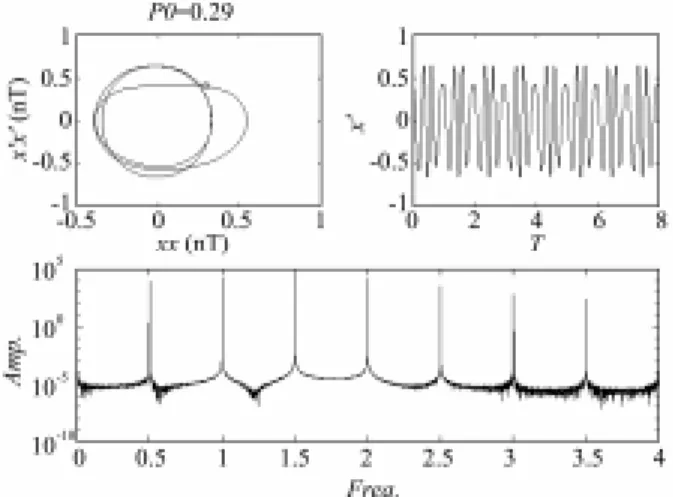
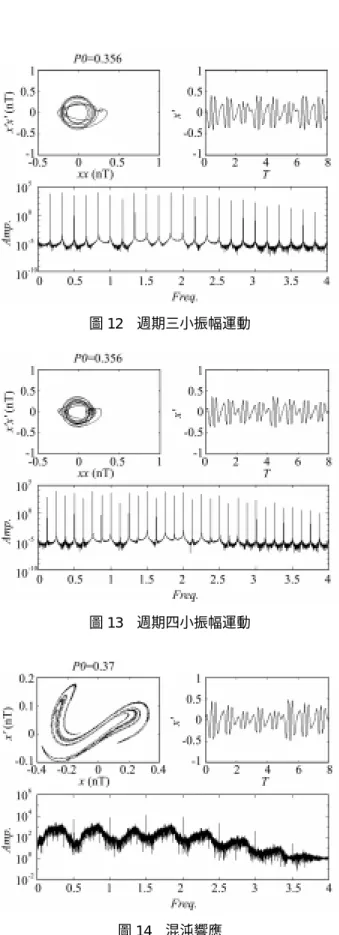
圖9-圖 16 為 Poincarè 切面圖、相圖、時序圖、頻譜 圖。圖9 及圖 10 表現大小振幅週期一運動之二解共存。圖 12 及圖 13 表現週期三與週期四運動之二解共存。圖 14-
圖 3 X(nT)對振幅 P0分歧圖
圖 4 圖三局部放大分歧圖
圖 5 在圖一多解區域振幅 P0為 0.29 之吸引子盆地圖
圖16 三個不同參數之混沌響應。圖 17、最大 Lyapunov 指 數對時間;Lyapunov 指數是正為混沌響應,Lyapunov 指數 是負為週期運動。
本文分析正交異向平板受熱激振之非線性系統,表現 出受熱平板隨振幅增加而週期倍增至渾沌現象。切面圖之
圖 6 振幅 P0為 0.32 之吸引子盆地圖
圖 7 振幅 P0為 0.34 之吸引子盆地圖
圖 8 振幅 P0為 0.37 之吸引子盆地圖
切點對應週期n,頻譜圖隨週期 n 而使主譜分裂出現,證 明前述現象,而渾沌現象亦出現Lyapunov 指數為正說明顯 示多重解之區域,圖2 與圖 3 表現出一般研究者採取單一 初始條件時與本文使用方法(多個初始條件)之差異。吸 引子盆地圖亦隨振幅增加而大振幅區域增加。
圖 9 Poincarè 切面圖、相圖、時序圖、頻譜圖;為週 期一大振幅運動
圖 10 週期一小振幅運動
圖 11 週期二小振幅運動
四、結 論
本論文探討正交性平板受熱激振之非線性分析,採用
圖 12 週期三小振幅運動
圖 13 週期四小振幅運動
圖 14 混沌響應
馮卡門平板理論,獲得非線性偏微方程式;以蓋里奇方法 運算後,簡化為非線性常微方程式。利用J 積分的分歧圖 探討正交性平板受熱激振有週期倍增至混沌響應的路徑及
圖 15 混沌響應
圖 16 混沌響應
圖 17 最大 Lyapunov 指數對時間;Lyapunov 指數是 正為混沌響應,Lyapunov 指數是負為週期運動
豐富的響應類型出現;亦呈現系統多解共存之參數範圍。
配合以Poincarè 切面圖、相圖、頻譜圖和 Lyapunov 指數,
證明響應型態。
誌 謝
本 研 究 感 謝 國 科 會 專 題 研 究 計 畫 NSC92-2622-E- 237-003-CC3 費補助 得以完成 ,特此 致謝。
符號索引
E1、E2、µ 材料物理特性常數
F 已知溫度場振幅
Mx、Mxy、My 彎曲力矩強度(bending moment intensities)
MT 擬溫度強度(temperature moment intensity)
NT 擬溫度合力(mean temperature intensity)
Nx、N 、xy Ny 合力強度(resultant intensities)
T0 參考溫度
ν12、ν21 材料物理特性常數
ωH 已知溫度場頻率
αx、αy、G12 材料物理特性常數
δ 材料阻尼係數
參考文獻
1. Chu, H. N., and Herrmann, G., “Influence of Large Ampli- tudes on Free Flexural Vibration of Rectangular Elastic
plates,” ASME Journal of Applied mechanics Mech., pp.
532-540(1956).
2. Vendhan, C. P., “An Investigation into Non-linear Vibra- tion of Thin Plates,” Ieternational. Jourmal of. Non-linear mechanics., pp. 209-221(1977).
3. Vendhan, C. P., “A Study of Berger Equations Applied to Non-Linear Vibrations of Elastic Plates,” International Journal. of mechanical sciences, Vol.17. No.7, Mech. Sci., pp. 461-468(1975).
4. Vendhan, C. P., “Modal Equations for the Non-linear Flex- ural Vibrations of Plates,” AIAA, Journal, Vol.13, No.8, pp.
1092-1094(1975).
5. Sunakawa, M. M., “Influence of Temperature Change and Large Amplitude on Free flexural Vibration of Rectangu-
lar Elastic Plates,” ESAS, Tokyo University, No. 402,31,3.
(1966).
6. Bailey, C. D., “Vibration of Thermally Stressed Plates with Various Boundary Conditions,” AIAA Journal, Vol.11, No.1 pp. 14-19(1973).
7. Bailey, C. D., and Greetham, J. C., “Free Vibrations of Thermally Stressed Orthotropic Plates with Various Bound- ary Conditions,” NASA, CR-2147(1973).
8. Yeh, Y. L., Chen, C. K., and Lai, H. Y., “Chaotic and Bifur- cation Dynamics of a Simply Supported Thermo- elas- tic Circular Plate with Variable Thickness in Large De- flection,” Chaos, Solitons and Fractals, Vol.15, No.5, pp.
11-829(2003).
9. Chen, H. K., “Chaos and Chaos Synchronization of a Sym- metric Gyro with Linear-plus-cubic Damping,” Journal
of Sound and Vibration, Vol.255, pp. 719-740 (2002).
10. Chen, H. K., “Author’s Reply,” Journal of Sound and Vibration, Vol.268, pp. 635-636(2003).
11. Dooren, R. V., ”Comments on Chaos and Chaos Synchronization of a Symmetric Gyro with Linear-plus- cubic Damping,” Journal of Sound and Vibration 268, pp.
632-634(2003).
12. Ueda, Y., “Randomly Transitional Phenomena in the Sys- tem Governed by Duffing’s Equation,” Journal of Statisti- cal Physics Vol.20, pp. 181-196(1979).
13. Ueda, Y., “Random Phenomena Resulting from Non-linearity in the System Described by Duffing’s Equation,” Interna- tional Journal of Non-linear Mechanics, Vol.20, pp.
481-491(1985).
14. Padmanabhan, C., and Singh, R., “Analysis of Periodi cally Excited Non-linear Systems by a Parametric Continuation Technique,” Journal of Sound and Vibration, Vol.184, No.1, pp. 35-58(1995).
15. Choi, Y. S., and Noah, S. T., “Forced Periodic Vibration of Unsymmetric Piecewise-linear Systems,” Journal of Sound and Vibration,Vol.121,No.1, pp. 117-126(1988).
16. Choi, S. K., and Noah, S. T., “Response and Stability Analy- sis of Piecewise-linear Oscillators Under Multi-forcing
Frequencies,” Nonlinear Dynamics, Vol.3, pp. 105-121 (1992).
17. Lau, S. L., and Zhang, W. S., “Nonlinear Vibrations of Piecewise-linear Systems by Incremental Harmonic Bal- ance Method,” ASME, Applied Mechanics, Vol.59, pp.
153-160(1992).
18. Narayanan, S., and Sekar, P., “Periodic and Chaotic Re- sponses of an SDF System with Piecewise Linear Stiffness Subjected to Combined Harmonic and Flow Induced Excita- tions,” Journal of Sound and Vibration, Vol.184, No.2, pp.
281-298 (1995).
19. Chang, W. P., and Jen, S. C., ”Nonlinear Free Vibration of Heated Orthotropic Rectangular Plates,” Intermational.
Jour nal of Solids and Structures, Vol.22, No.3 pp.
267-281 (1986).
20. Kang, Y., Chang, Y. P., and Jen, S. C., “Strongly Non-linear Oscillations of Winding Machines, Part I:
Mode-locking Motion and Routes to Chaos,” Journal of Sound and Vibration, Vol. 209, No. 3, pp. 473-492(1998).
21. Kang, Y., Jen, S. C., Shyr, S. S., and Chang, Y. P., “Fre- quency-locked Motion and Quasi-periodic Motion of a
Piecewise-linear System Subjected to Externally Nonsynchronous Excitations,” Journal of Sound and Vibration, Vol. 214, No. 2, pp. 377-382(1998).
22. Kang, Y., Jen, S. C., Sheu, P. P., and Tu, S. H.,
“Mode-locking Motion and Chaos of Rotors Mounting on Nonlinear Bearings,” International Journal of Rotating Machinery, Vol. 6, No. 3, pp. 191-200(2000).
23. 康淵、簡守謙和賴志錫,「轉子撓扭耦合共振之非線性 分析」,中原學報,第二十四卷,第一期,第47-60 頁
(1996)。
24. 簡守謙、康淵,「分斷線性受兩個簡諧外力激振之分 析」,四海學報,第十二卷,第73-90 頁(1998)。
25. 簡守謙、康淵,「非線性系統多頻激振」,四海學報,第 十三卷,第53-76 頁(1999)。
26. 康淵、石世雄、蔡正文、簡守謙、杜順旭和何無忌,「非 線性軸承之轉子動態特性」,中國航空太空學會學刊,
第三十一卷,第二期,第101-105 頁(1999)。
27. 康淵、簡守謙,「機械制震之非線性動態特性」,中華 農業學會研討會,台灣省農試所,霧峰,第35-36 頁 (1997)。
28. 康淵、簡守謙、蔡正文、杜順旭和何無忌,「非線性軸 承之轉子動態特性」,中國航空太空學會第三十八屆學 術研討會,成大航太系(1997)。
2004 年 11 月 19 日 收稿 2004 年 11 月 30 日 初審 2005 年 01 月 27 日 複審 2005 年 03 月 21 日 接受