國
立
交
通
大
學
資訊科學與工程研究所
碩
士
論
文
在點對點閘道器上整合與加速以內容為基礎的
辨別及管理系統
Integrating and Accelerating Content Classification
and Management at P2P Gateways
研 究 生:張朝江
指導教授:林盈達 教授
在點對點閘道器上整合與加速以內容為基礎的辨別及管理系統
Integrating and Accelerating Content Classification and Management at
P2P Gateways
研 究 生: 張朝江
Student : Tsao-Jiang Chang
指導教授: 林盈達
Advisor : Ying-Dar Lin
國 立 交 通 大 學
資 訊 科 學 與 工 程 研 究 所
碩 士 論 文
A Thesis
Submitted to Institute of Computer Science and Engineering College of Computer Science
National Chiao Tung University in partial Fulfillment of the Requirements
for the Degree of Master
in
Computer Science
June 2006
HsinChu, Taiwan, Republic of China
在點對點閘道器上整合與加速以內容為基礎的
辨別及管理系統
學生:張朝江
指導教授:林盈達
國立交通大學資訊工程系
摘要
點對點軟體使用動態連接埠來隱藏自己,傳統利用連接埠來重導連線的代理 伺服器架構已無法有效管理點對點連線。藉由檢查應用層的內容,一個在閘道器 上的套件叫做 P2PADM 已經能夠管理點對點連線。此套件在核心空間進行連線辨 別的動作,在使用者空間進行連線管理動作,因此內容置換和從核心空間到使用 者空間的資料傳遞是必要的。我們提出一個叫做 kP2PADM 的新架構,此架構是將 P2PADM 套件從使用者空間搬移到核心空間的方式來改善效能,此工作最主要的 困難是如何讓新架構能夠相容於 Linux 核心而不會造成核心恐慌。外部測試顯示kP2PADM 的吞吐量比原始的 P2PADM 高出 88.85Mbps。此外,此工作亦點出 P2PADM
的兩個弱點:(1)重覆連線的問題,(2)當封包遺失時會發生多餘的延遲,針對此
兩個弱點我們提出兩個解決方法:(1)內容快取,(2)快速通過。
Integrating and Accelerating Content Classification
and Management at P2P Gateways
Student:
Tsao-Jiang
Chang Advisor:
Dr.
Ying-Dar
Lin
Department of Computer Science
Nation Chiao Tung University
Abstract
Peer-to-peer (P2P) software runs over dynamic ports in order to disguise their
existence. Conventional port-redirecting proxy architecture cannot manage P2P traffic
effectively. A gateway-based P2P administration (P2PADM) architecture had been
proposed for managing P2P traffic by inspecting content at the application layer.
P2PADM executes connection classification in the kernel space and connection
management in the user space. Context switch and data passing from the kernel space
to the user space is necessary. We propose a new architecture called kP2PADM for
improving the performance of P2PADM by moving the P2PADM package from the
user space to the kernel space. The main challenge in this work is how to move the
code to the kernel space compatibly with Linux kernel without panicking the kernel.
The external benchmarking reveals that the throughput of kP2PADM is 88.85 Mbps
higher than that of P2PADM. This work also addresses two weaknesses of P2PADM:
(1) reconnection issue and (2) redundant delay due to packet loss. Two solutions are
proposed for the two weaknesses: (1) connection cache and (2) fast pass.
Acknowledgements
Many People have helped me with this thesis. I deeply appreciate my thesis advisor, Dr. Ying-Dar Lin, for his intensive advice and instruction. I would like to thank all the classmates in High Speed Networks Laboratory for their invaluable assistance and suggestions.
Contents
List of Figures...vi
Chapter 1 Introduction...1
Chatper 2 Related Works ...3
2.1 Introduction to P2PADM...3
2.2 Problems of P2PADM ...4
2.3 Related in-kernel Solutions ...4
Chapter 3 System Architecture Design ...6
3.1 Solutions and the Proposed Architecture ...6
3.2 In-kernel Management Architecture...8
3.2.1 Possible Approaches to Move User Modules to Kernel Space ………8
3.2.2 Functional Modules in kP2PADM ……….. 9
3.2.3 Packet flow in kP2PADM……… 9
3.3 Connection Cache ...10
3.4 Fast Pass ... 11
Chapter 4 Performance Evaluation ...13
4.1 Benchmarking Environment ...13
4.2 Comparison with Original Proxy Architecture...14
4.2.1 Throughput and CPU Utilization of kP2PADM ……… 14
4.2.2 Throughput and CPU Utilization of kP2PADM plus the Connection Cache ……….. 17
4.2.3 Evaluation of Fast Pass ………. 18
4.2.3.1 Benchmarking Environment ……….. 18
4.2.3.2 Impact from Out-of-order Packets on Performance ……….. 19
4.3 Internal Benchmarking ………. 19
Chapter 5 Conclusions...20
List of Figures
FIGURE1: IMPLEMENTATION OF P2PADM SYSTEM ARCHITECTURE ...3
FIGURE2: THE PROPOSED ARCHITECTURE OF KP2PADM ...7
FIGURE3: PACKET FLOW IN THE NEW ARCHITECTURE ...10
FIGURE4: BENCHMARK ENVIRONMENT OF KP2PADM...13
FIGURE5: THROUGHPUT OF P2PADM AND KP2PADM...15
FIGURE6: CPU UTILIZATION OF P2PADM AND KP2PADM ...15
FIGURE7: DIFFERENCE OF THE PACKET FLOW IN P2PADM AND KP2PADM ...16
FIGURE8: THROUGHPUT OF KP2PADM PLUS CONNECTION CACHE ...17
FIGURE9: CPU UTILIZATION OF KP2PADM PLUS CONNECTION CACHE....18
FIGURE10: BENCHMARKING ENVIRONMENT FOR FAST PASS...18
FIGURE11: TRANSFER TIME WITH FAST PASS AND WITHOUT FAST PASS IN DIFFERENT PACKET LOSS RATE ...19
Chapter 1 Introduction
Over the last few years, peer-to-peer (P2P) file sharing has grown astonishingly
to dominate the Internet traffic [1]. Managing P2P traffic efficiently and effectively
thus becomes an important issue. System administrators used to manage Internet
traffic by classifying it according to fixed well-known port numbers. The management
includes blocking traffic of specific applications or redirecting the connections to a
proxy that performs various kinds of content filtering such as virus scanning.
Nonetheless, the classification for P2P traffic is non-trivial because most P2P
applications may use dynamic ports, i.e. dynamically selected ports rather than fixed
well-known ports. Therefore, P2P applications should be classified according to the
signatures in the application-layer messages [2]. The classification is traditionally
executed in the kernel space because it is simple signature matching from the first few
bytes of the content. However, the management such as filtering transferred files and
scanning viruses on P2P shared files involves complex content processing of the data
assembled from the packets. Thus it looks natural to be executed in the user space.
Although executed in the user space, the P2P management tools, such as
InstantScan and P2PADM [3], need to exchange data between the kernel space and
the user space. The data exchange, however, is a costly overhead involving the
memory copy between the kernel space to the user space. In fact, the overhead also
exists in web server packages, e.g. HTTPd. To reduce the overhead, an in-kernel
package kHTTPd (http://www.fenrus.demon.nl/) moves HTTPd into the kernel space
to directly handle requests in kernel. This approach avoids the data exchange and
indeed provides higher performance than a user-space HTTP daemon.
This work attempts to avoid the data exchange in P2PADM. We move the
based on P2PADM because of the availability of its source code. We also address two
weaknesses of P2PADM: the reconnection issue and non-deterministic delay due to
out-of-order packets. The reconnection issue occurs because some P2P applications,
say eDonkey, or users will persistently try to reconnect to the peers while P2PADM
blocks their connection establishment. The reconnection keeps sending the same
requests in a short period because P2PADM always blocks them. These useless
requests will reduce the performance. Non-deterministic delay from out-of-order
packets occurs because P2PADM must queue the out-of-order packets in order to
handle those packets and so the packet delivery time to its peer is non-deterministic.
For the reconnection issue, this work designs a connection cache to handle the packets
for reconnection. For non-deterministic delay, the proposed architecture passes the
out-of-order packets immediately.
The rest of this work is organized as follows. Chapter 2 introduces P2PADM and
indicates its problems. Chapter 3 presents the proposed solutions and architecture.
Chapter 4 discusses the performance of the proposed system. Chapter 5 concludes the
Chapter 2 Related Works
2.1 Introduction to P2PADM
P2PADM is a novel gateway architecture to manage P2P traffic. The
management objectives in the architecture cover (1) connection classification of P2P
applications, (2) filtering undesirable P2P applications, (3) virus scanning for P2P
shared files, (4) filtering and auditing of chatting messages and transferred files, and
(5) bandwidth control of P2P traffic.
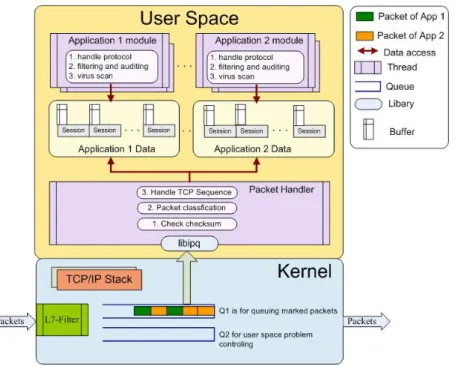
Fig. 1 illustrates the architecture of P2PADM. The kernel queues the packets of
the classified connections identified by the L7-filter. A main thread in the proxy gets
packets from the queue in the kernel by invoking the libipq library
(http://www.cs.princeton.edu/~nakao/libipq.htm) and performs the pre-processing
tasks, such as checksum examination, packet classification and TCP sequence
handling. The main thread then calls a specific application thread to handle the tasks
related to the application protocol. Each application thread is responsible for a
specific connection and decides to pass or drop the packets in the connection.
2.2 Problems of P2PADM
According to the description in Section 2.1, P2PADM gets packets from the
kernel queue by libipq. Libipq is a development library for iptables
(http://www.netfilter.org/projects/iptables/index.html) and it provides an API to
communicate with the ip_queue kernel module that registers with Netfilter
(http://www.netfilter.org/) to pass packets between the kernel space and the user space.
Therefore, P2PADM must do context switching between the kernel and user modes
and copy data from the kernel space to the user space for managing P2P traffic. The
impact of copying data can reduce the performance of P2PADM.
According to the previous benchmark result in [3], we are aware that the heavy
use of libipq on P2PADM reduces the throughput by about 120 Mbps. Because libipq
is responsible for copying data from the kernel space to the user space, reducing the
heavy use of libipq can increase the throughput of P2PADM. We also find a few
additional SYN packets sent by the P2P applications, say eDonkey, or users in the
peer for reconnection while P2PADM blocks the establishment of a connection. They
will be sent several times because the peer cannot establish the connection
successfully. These useless SYN packets are always handled and dropped by
P2PADM all the time, and reduce the performance of P2PADM.
Furthermore, we also find that there are some non-deterministic delays from
out-of-order packets. All out-of-order packets cannot pass P2PADM because
P2PADM blocks them for assembling them completely and manages them effectively.
Because P2PADM is a transparent proxy to the peers, the non-deterministic delay not
from the network transport but from the blocking of P2PADM should be avoided.
2.3 Related in-kernel Solutions
that it runs within the Linux-kernel as a module. kHTTPd handles only static Web
pages, and passes all requests for non-static information to a user-space Web server
such as Apache. Since virtually all images are static and a large portion of HTML
pages are also static, the improvement is significant. Static Web pages are not difficult
to serve because the delivery of static objects from a Web server is simply a “copying
file to network” operation. The Linux kernel is very good at this, and so as an
in-kernel daemon, kHTTPd can gain better performance five times than other
user-space http-daemons (http://www.fenrus.demon.nl/performance.html). Whether
the complex management tasks on P2PADM can be performed entirely in the kernel
Chapter 3 System Architecture Design
3.1 Solutions and the Proposed Architecture
On P2PADM, the connections of P2P applications have been classified in the
kernel space by L7-filter and managed in the user space. All the packets of each
connection must pass through the user space, so the processing in the user space may
become a bottleneck. Like kHTTPd that moves the code from a user-space daemon to
a kernel-space module, this work also moves the code of P2PADM from the user
space to the kernel space and then evaluates the improvement in performance.
Moreover, we design a connection cache to solve the reconnection issue.
Because all packets of reconnection have the same (1) source IP address, (2)
destination IP address, (3) destination port number (4) protocol id, and perhaps (5)
source port number. The connection cache can easily identify a reconnection by
keeping the five tuples of a blocked connection, and block it before P2PADM.
Furthermore, non-deterministic delays from out-of-order packets can be solved
by duplicating the packets once in the gateway and fast passing the out-of-order
packets to the destination instead of queuing them in P2PADM. The receiver can
receive the out-of-order packets and send triple ACKs to the sender to invoke the
retransmission. Because the retransmission is invoked by triple ACKs rather than TCP
timeout, the non-deterministic delays will be shortened when the packets are lost.
Fig. 2 illustrates the operation of the proposed architecture. The entire
architecture is called kP2PADM. The letter ‘k’ in the prefix of kP2PADM is used to
differ it from the previous one because most functional modules of the proposed
Figure 2. The proposed architecture of kP2PADM
In the beginning, all packets can pass through the in-kernel connection cache
because the connection cache is empty. The L7-filter then performs connection
classification in the kernel. The L7-filter collects at most the first eight packets to
reassemble an application message and does signature matching. If the connection is
identified by the L7-filter, it will be marked by a predefined application identifier. The
kernel can filter the undesirable applications and do bandwidth control according to
this predefined application identifier. The packets are then transferred to be
pre-processed, say checksum check, connection identification, and TCP sequence
handling. kP2PADM must occasionally call the schedule function to surrender the
CPU control to other processes to avoid starvation. The schedule function is a Linux
kernel function in schedule.c for process scheduling. The CPU control will come back
to kP2PADM if no other processes demand the CPU. After kP2PADM finishes packet
pre-processing and calls a specific AP module to handle the related packets. Each AP
module is a kernel module responsible to set verdict to these related packets. All the
handling of kP2PADM is in the kernel space except virus scanning. kP2PADM calls
the call_usermodehelper function to invoke virus scanning in the user space, and
blocking, the file is scanned piece by piece. After scanning a piece of data, P2PADM
calls the schedule function and may surrender the CPU control to the kernel or the
other processes. The virus scanning of kP2PADM has been not implemented yet and
to be completed in the future.
The connection cache is filled with a new 5-tuple value of a denied connection
by kP2PADM. A reconnection of a denied connection will then be blocked by the
connection cache rather than kP2PADM because the connection cache has recorded
the denied connection.
3.2 In-kernel Management Architecture
3.2.1 Possible Approaches to Move User Modules to Kernel Space
There are two ways to move the code of P2PADM from the user space to the
kernel space: one is coding functions in the iptables extended match module
(http://www.netfilter.org/documentation/HOWTO/netfilter-hacking-HOWTO.html) and
the other is modifying the code of P2PADM to be a new kernel thread. The former
codes the classification and management functions, such as connection classification,
checksum check, TCP sequence handling, content filter, message log and the
proposed connection cache in the iptables extended match module. A new filter rule
including all the handling of kP2PADM is registered to the hook of Netfilter
framework and all packets traverse through the filter rule. The latter creates a new
kernel thread to run kP2PADM. The new kernel thread acquires packets from
ip_queue that queues the packets identified by L7-filter and handles the operation of
kP2PADM by itself. Therefore, the classification functions are coded in iptables
extended match modules and the management functions are coded in the new kernel
thread. We choose the latter in this work because the second way makes each function
After choosing creating a new kernel thread to run kP2PADM, there are some
implementation issues like how to transfer a system call from the user space to the
kernel space? For example, the read system call is supported by the kernel for
acquiring data from I/O device, but it cannot be called in kP2PADM because
kP2PADM is a kernel process. A kernel process cannot call almost any system call
because almost all system calls are implemented to be called by user programs and
some handling in the system calls is unnecessary for kernel process, say data copy
from the user space to the kernel space, and vice versa. Therefore, the read system
call must be modified. Fortunately, the implementation of the read system call calls
vfs_read for acquiring data from I/O devices and vfs_read is an EXPORT_SYMBOL
kernel function [4]. An EXPORT_SYMBOL kernel function can be called by any
kernel process. Therefore, kP2PADM can call vfs_read instead of system call read.
Through this way of modifying user-space functions to kernel-space function, we can
make P2PADM run in the kernel space.
3.2.2 Functional Modules in kP2PADM
The proposed architecture differs from P2PADM at the aspect of management.
The packet pre-processing functions, such as checksum check, connection
identification and TCP sequence handling, are moved to the kernel space, application
protocol processing to a kernel module, and virus scanning left in the user space. The
processing of application protocols is moved to a kernel module instead of the kernel
because the application protocol processing may be sometimes updated and the
modification of kernel module is faster than the modification of kernel. Leaving virus
scanning in the user space is better than moving it to the kernel space because virus
scanning takes much time and may block the kernel.
3.2.3 Packet Flow in kP2PADM
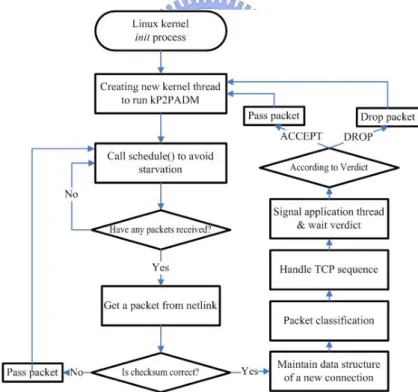
thread before the kernel invokes the init process. The kernel thread runs kP2PADM
and is terminated when Linux is shut down. The in-kernel management architecture
waits for new connections and calls the schedule function to surrender the CPU
utilization to other processes to avoid starvation. After accepting a new connection,
kP2PADM maintains the data structure of the connection socket. kP2PADM can do
the I/O operations with the data structure rather than rely on the functions at the
higher layers. After performing the pre-processing tasks, say packet classification and
handling TCP sequence, kP2PADM signals the specific application thread to handle
the packet. The application thread then sets verdict to the packet. The entire flow of an
application thread is the same as that in P2PADM. The virus scanning of kP2PADM
has been not implemented yet and to be completed in the future.
Figure 3: Packet flow in the new architecture
3.3 Connection Cache
To design the connection cache, we must consider that what information should
to be kept. In the beginning, the packets in all connections can pass through the
marked as denied ones. If kP2PADM decides to block a connection, then its source IP
address, source port number, destination IP address, destination port number, and
protocol id will be stored into connection cache. The packets having the same source
IP address, destination IP address, destination port number and protocol id are viewed
as in the reconnection, even though their source port numbers may be different. For
example, BitTorrent (http://www.bittorrent.com/) changes to different source port
number if connection is blocked. We believe that kP2PADM can identify
reconnections through these tuples. A reconnection of a denied connection can be
quickly dropped by the connection cache without being processed by kP2PADM and
the performance of P2PADM can be improved.
3.4 Fast Pass
A more efficient way to handle the out-of-order packets is to duplicate them once
in the gateway and pass them immediately so that the peer can receive the complete
file early. If any packet is lost, the receiver can receive the out-of-order packets and
send triple ACKs to the sender to invoke the retransmission rather than let these
out-of-order packets be queued in gateway and the retransmission be invoked through
TCP timeout. Because the retransmission is invoked by triple ACKs rather than TCP
timeout, the non-deterministic delays will be shortened when the packets are lost.
However, the retransmission may be redundant if the out-of-order packet is not made
by packet loss. The redundant retransmission will decrease the throughput of
kP2PADM. Besides, out-of-order packets passing without content filtering may
escape the rule examination and result in false negatives. The probability of false
negatives is very low in reality because kP2PADM still scans the out-of-order packet;
nevertheless, it does not scan the content between packets. Fortunately, a signature
Chapter 4 Performance Evaluation
4.1 Benchmarking Environment
In this chapter, we perform various benchmarks on the kP2PADM system.
kP2PADM is installed on a PC with Pentium III 1GHz CPU, 512 MB SDRAM and
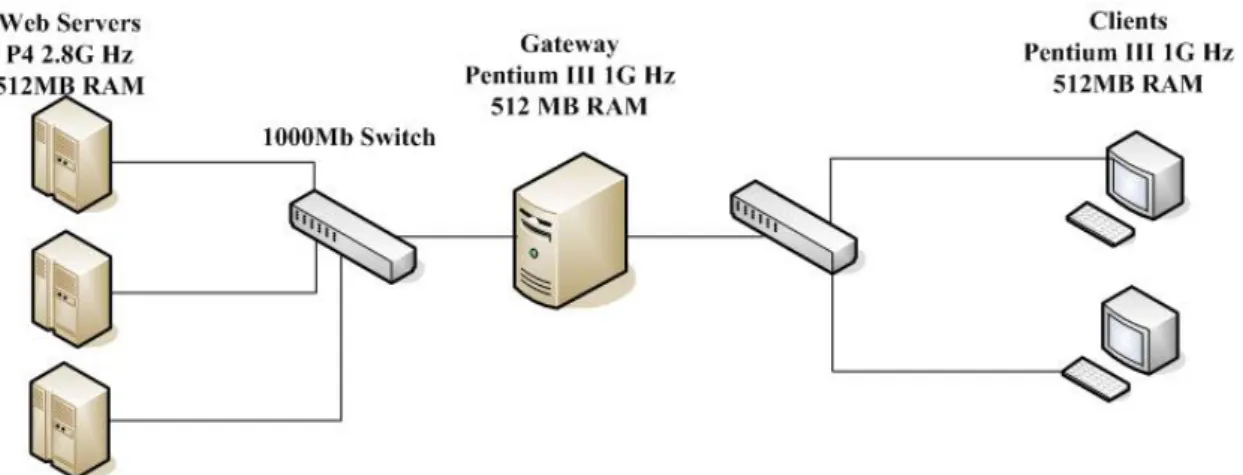
20GB hard disk. Fig. 4 illustrates the benchmark environment. In this environment,
there are two HTTP clients and three Web servers. Each client creates one hundred
threads and each thread downloads a 2MB files from these three web servers. This
means that these two clients download totally 1GB data from the Web servers through
kP2PADM.
Figure 4: Benchmark environment of kP2PADM
There are two reasons why we use HTTP traffic instead of real P2P traffic to
benchmark kP2PADM. First is that there are no such benchmark tools which can
generate P2P traffic. The second is that many P2P applications like FastTrack and
Gnutella use HTTP protocol to transfer files. Therefore, using HTTP traffic to
simulate P2P traffic is acceptable.
4.2 Comparison with Original Proxy Architecture
Throughput and CPU utilization are two import performance measures of a
gateway system. The following configurations are compared to understand the impact
on performance from each component.
(1) NAT: the pure NAT function.
(2) NAT + packet queue: Besides NAT, every packet is queued in the kernel.
kP2PADM just tells the kernel to pass the packets without any further processing.
(3) NAT + packet queue + L7: Besides NAT + packet queue: The L7-filter is enabled
with 20 rules. The entire process is similar to NAT + packet queue. The difference
is that only HTTP is processed. This configuration is used to assess the
performance impact from the L7-filter.
(4) P2P proxy + Filter: P2P proxy integrates NAT + packet queue + L7 and all pre-
processing of P2P management. This configuration enables filtering transferred
files according to the file name.
(5) P2P proxy + Log file: P2P proxy with the auditing function on transferred files. It
records the transferred files into the file system.
(6) P2P proxy + Virus scan: P2P proxy with the virus scanning function on
transferred files.
(7) P2P proxy + Filter + Log file + Virus scan: P2P proxy with all the above
functions enabled.
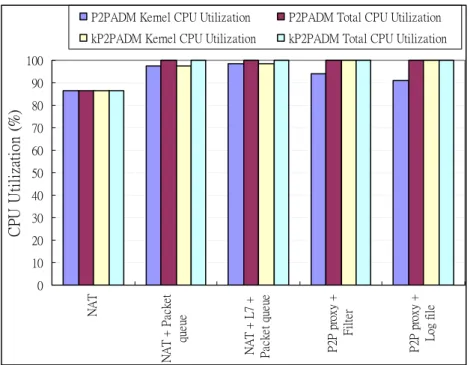
Fig. 5 and 6 show the throughput and CPU utilization on P2PADM and kP2PADM
under every configuration. Fig. 6 also plots not only the entire CPU utilization but
also the CPU utilization for the kernel. In a gigabit network environment, pure NAT
can reach the throughput about 266.13 Mbps on both P2PADM and kP2PADM. NAT
+ packet queue reduce the throughput to 155.24 Mbps and the CPU has been fully
used by P2PADM, but on kP2PADM, NAT + packet queue only reduce the throughput
throughput of kP2PADM is 68.47 Mbps higher than that of P2PADM. 85 223.71 178.1 164.68 133.17 69.98 89.25 155.24 266.13 0 50 100 150 200 250 300 NA T N A T + P ack et qu eu e N A T + L7 + P ack et q ue ue P 2P pr ox y + Fi lt er P 2P pr ox y + Lo g fi le T hr oug hp ut ( Mb ps ) P2PADM kP2PADM
Figure 5. Throughput of P2PADM and kP2PADM
0 10 20 30 40 50 60 70 80 90 100 NA T N A T + P ack et qu eu e N A T + L7 + P ack et q ue ue P 2P p rox y + F ilt er P 2P p rox y + Lo g fi le C PU U tiliz ation ( % )
P2PADM Kernel CPU Utilization P2PADM Total CPU Utilization kP2PADM Kernel CPU Utilization kP2PADM Total CPU Utilization
Figure 6. CPU utilization of P2PADM and kP2PADM
kP2PAADM is faster than P2PADM not only because coding in kernel space can
reduce data copying from the kernel to the user space but also because it can reduce
the number of calling functions. For example in Fig. 7, the solid line indicates the
While P2PADM creates a socket, it calls INET socket to acquire data, but kP2PADM
calls netlink [5] directly instead of INET socket. Therefore, the number of functions
kP2PADM called is fewer than P2PADM and kP2PADM can have higher
performance than P2PADM.
TCP IP PLIP BSD Socket UDP INET Socket SLIP ETHERNET P2PADM kP2PADM
Layer Source code Function
BSD Socket linux/net/socket.c sys_socket, sock_create
INET Socket linux/net/ipv4/af_inet.c inet_accept, inet_sendmsg TCP linux/net/ipv4/tcp_ipv4.c tcp_v4_connect UDP linux/net/ipv4/udp.c udp_udp_connect
IP linux/net/ipv4/ip_*.c, linux/net/netlink/netlink_dev.c
Ip_rev netlink_read
Ethernet linux/net/ethernet/eth.c eth_type_trans Figure 7: Difference of the packet flow in P2PADM and kP2PADM
If the L7-filter is turned on, the throughput decreases obviously to 89.25 Mbps on
P2PADM and to 178.1 Mbps on kP2PADM. Enable filtering function does not
influence the throughput too much. This is because the HTTP protocol is simple. But
for those complex application protocols like MSN which need more processing, such
as BASE64 encoding and decoding [6], we believe that the influence on performance
would be more obvious. The auditing functions does not influence the throughput
much either. On P2PADM, the throughput of P2P proxy + log file is 69.96 Mbps and
133.17 Mbps on kP2PADM. kP2PADM always dominates about 100% of CPU
kernel space and the kP2PADM always occupies the CPU for benchmark. It means
that surrender the CPU timely to other processes for kP2PADM is very important,
otherwise the kernel will be blocked by kP2PADM for a long time.
4.2.2 Throughput and CPU Utilization of kP2PADM plus the Connection Cache
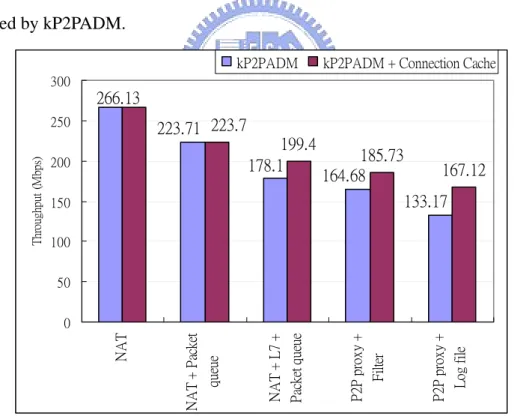
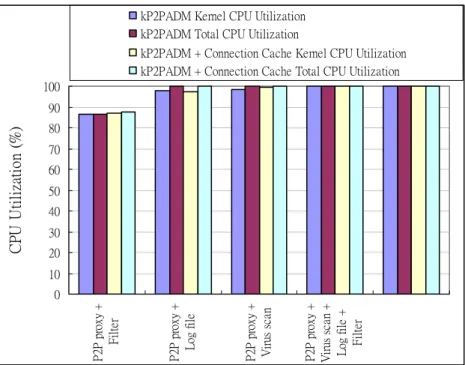
Fig. 8 and 9 show the throughput and CPU utilization on kP2PADM as connection
cache is enabled. In the experiment, we set a policy on kP2PADM to block all packets
from one of two clients. This policy forces the blocked client to keep sending
reconnections. The connection cache can increase the throughput by about 15%. The
CPU utilization always reaches about 100% because all handlings of kP2PADM are
coded in the kernel space except for virus scanning, so the CPU utilization will be
occupied by kP2PADM. 199.4 185.73 167.12 133.17 164.68 178.1 223.71 266.13 223.7 0 50 100 150 200 250 300 NA T NA T + Pa ck et que ue N A T + L7 + P ac ke t que ue P 2P proxy + Fi lte r P 2P proxy + L og fi le T hr oug hp ut ( M bp s)
kP2PADM kP2PADM + Connection Cache
0 10 20 30 40 50 60 70 80 90 100 P2 P pr ox y + Fi lt er P2 P pr ox y + Lo g fi le P2 P pr ox y + V ir us sc an P2 P pr ox y + V ir us sc an + L og f ile + Fi lt er C P U Ut il iz at io n (% )
kP2PADM Kernel CPU Utilization kP2PADM Total CPU Utilization
kP2PADM + Connection Cache Kernel CPU Utilization kP2PADM + Connection Cache Total CPU Utilization
Figure 9. CPU utilization of kP2PADM plus connection cache
4.2.3 Evaluation of Fast Pass
4.2.3.1 Benchmarking Environment
To emulate packet loss and out-of-order packets, we install a WAN emulator
called NIST Net from National Institute of Standards and Technology (NIST) [7] on
Linux. NIST Net allows a single Linux PC to act as a router to emulate a wide variety
of network conditions, say packet loss, out-of-order packets, transmission delay, and
so on. Fig. 10 illustrates the benchmark environment. A NIST Net stands before
kP2PADM and emulates packet loss and delay. A notebook serves as the FTP client to
request about 300 MB files from the FTP server.
4.2.3.2 Impact from Out-of-order Packets on Performance
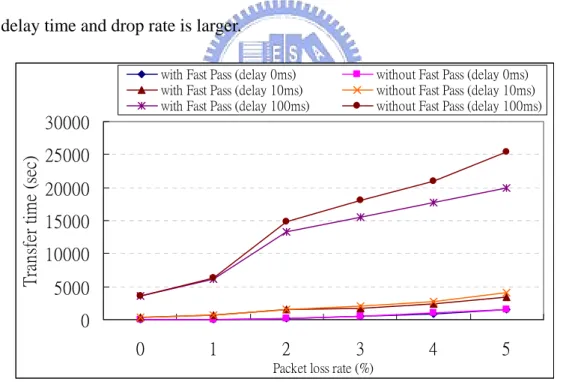
Fig. 11 shows the transfer time with fast pass and without fast pass in different
packet loss rate, respectively. The packet loss rate is from 0% to 5% to simulate the
real environment [8]. Fast pass can reduce the transfer time between ftp client and ftp
server. In the benchmarking result, we have two observations: (1) the higher the
packet loss rate is, the more the transfer time between with fast pass and without fast
pass can shorten and (2) the longer the delay is, the more the transfer time can be
reduced. The first observation is because the times of queuing in the gateway is more
high if more packet loss rate, so transfer time will more larger. The second
observation is because the queue time in the gateway is longer if the delay of each
packet is longer. Shortly speaking, fast pass can reduce the more transfer time while
the delay time and drop rate is larger.
0 5000 10000 15000 20000 25000 30000 0 1 2 3 4 5
Packet loss rate (%)
T ran sf er ti me (s ec)
with Fast Pass (delay 0ms) without Fast Pass (delay 0ms) with Fast Pass (delay 10ms) without Fast Pass (delay 10ms) with Fast Pass (delay 100ms) without Fast Pass (delay 100ms)
Figure 11: Transfer time with Fast Pass and without Fast Pass in different packet loss rate
4.3 Internal Benchmarking
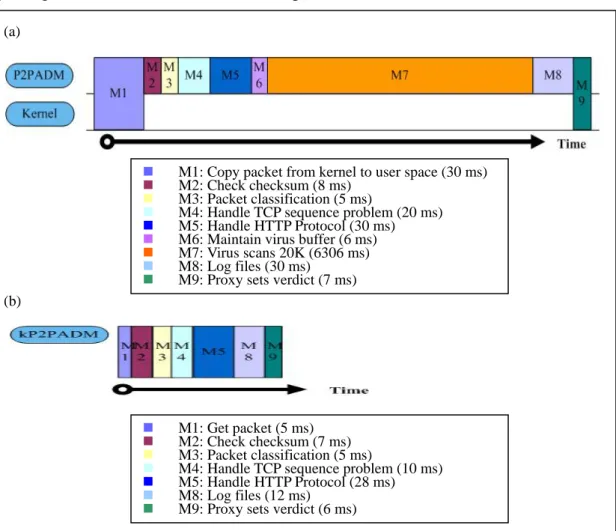
To further identify the improvements and the bottlenecks of kP2PADM, we
functions turned on. Measuring execution time is performed by calculating the
difference of time-stamps taken by the do_gettimeofday() kernel function before and
after the code segments. Figure 12 (a) and (b) illustrate the internal benchmark of
P2PADM and kP2PADM. Moving code from the user space to the kernel space can
reduce the time of all steps. The most time-reduction is the time of getting packets and
it shows that kP2PADM takes 5 ms to get packets. The least time-reduction is the time
of handling HTTP protocol. Why the improving of handling HTTP protocol is
marginal is because it takes much time to processing HTTP protocol rather than data
passing between the kernel and the user space.
(a)
M1: Copy packet from kernel to user space (30 ms)
M2: Check checksum (8 ms)
M3: Packet classification (5 ms)
M4: Handle TCP sequence problem (20 ms)
M5: Handle HTTP Protocol (30 ms)
M6: Maintain virus buffer (6 ms)
M7: Virus scans 20K (6306 ms)
M8: Log files (30 ms)
M9: Proxy sets verdict (7 ms) (b)
M1: Get packet (5 ms)
M2: Check checksum (7 ms)
M3: Packet classification (5 ms)
M4: Handle TCP sequence problem (10 ms)
M5: Handle HTTP Protocol (28 ms)
M8: Log files (12 ms)
M9: Proxy sets verdict (6 ms)
Chapter 5 Conclusions
This work presents the improvement of the P2PADM performance by moving
the code of management from the user space to the kernel space. The main challenge
in this work is how to move the code to the kernel space compatibly with Linux
kernel without panicking the kernel. The new architecture, kP2PADM, must maintain
some kernel-space data structures by itself, say structure sock to get data form packets
effectively rather than get data through socket description in P2PADM. Besides,
kP2PADM is responsible for scheduling the kernel because it is a kernel process. A
kernel process occupies the CPU unless it surrenders the CPU voluntarily. kP2PADM
also solves two weaknesses of P2PADM: the reconnection issue and
non-deterministic delays from out-of-order packets. Through connection cache and
fast pass, we can increase the throughput of P2PADM and the transmission time.
The external benchmarking results indicate that in-kernel management improves
the performance of P2PADM. With and without kP2PADM, the throughput can
achieve 164.68 Mbps and 85 Mbps, respectively. The throughput of kP2PADM is
79.68 Mbps higher than that of P2PADM. The connection cache can increase the
throughput by about 20 Mbps. The CPU utilization of kP2PADM always reaches to
100% that is because all the handling of kP2PADM is implemented in the kernel
space except for virus scanning. Therefore CPU always blocked by kP2PADM when
benchmarking. Fast pass can reduce the more transfer time while the delay time and
References
[1] S. Sen, and Jia Wang, “Analyzing Peer-to-Peer Traffic across Large Networks,”
IEEE/ACM Transactions on Networking, vol. 12, no. 2, pp. 219-232, April 2004.
[2] S. Sen, O. Spatscheck, and D. Wang, “Accurate, Scalable In-Network
Identification of P2P Traffic Using Application Signatures,” in Proc.
International WWW Conference, New York, 2004.
[3] Meng-Fu Tsai, “A Novel Gateway Architecture for Managing Dynamic Port
Peer-to-Peer Traffic,” Master thesis, National Chiao Tung Unviersity, Hsinchu,
Taiwan, 2005.
[4] Daniel P. Bovet and Marco Cesati, “Understanding the Linux Kernel,” 2nd Ed, pp. 695, O’REILLY, 2003.
[5] J. Salim, H. Khosravi, A. Kleen, A. Kuznetsov, “Linux Netlink as an IP Services
Protocol,” RFC 3549, July 2003.
[Online] available: http://www.ietf.org/rfc/rfc3548.txt?number=3549
[6] S. Josefsson, “The Base16, Base32, and Base64 Data Encodings,” RFC 3548,
July 2003.
[Online] available: http://www.ietf.org/rfc/rfc3548.txt?number=3548
[7] Mark Carson, Darrin Santay, “ NIST Net – A Linux-based Network Emulation
Tool,” Computer Communication Review, ACM SIGCOMM, 2003.
[8] Maya Uajnik, Sue Moon, Jim Kurose and Don Towsley, ”Measurement and
Modeling of the Temporal Dependence in Packet Loss,” Tech. Rep. UMASS