
高分子電解質中相行為,作用力機制以及離子導電度之研究
182
0
0
全文
(2) 高分子電解質中相行為,作用力機制以及離子導電度之研究 Investigating Miscibility Behavior, Interaction Mechanisms and Ionic Conductivity of Polymer Electrolytes 研 究 生:邱俊毅. Student:Chun-Yi Chiu. 指導教授:張豐志. Advisor:Feng-Chih Chang. 國 立 交 通 大 學 應用化學研究所 博 士 論 文. A Dissertation Submitted to Department of Applied Chemistry College of Science National Chiao Tung University in partial Fulfillment of the Requirements for the Degree of Doctor of Philosophy in Applied Chemistry September 2005 Hsinchu, Taiwan, Republic of China. 中華民國九十四年九月.
(3) 高分子電解質中相行為,作用力機制以及離子導電度之研究. 學生:邱俊毅. 指導教授:張豐志 教授. 國立交通大學應用化學研究所博士班. 摘. 要. 近年來,高分子電解質(polymer electrolytes)一直被廣泛的研究,因其同時具 有離子導電度與良好的機械性質,可以被應用於離子傳導之電子元件中。然而, 完全固態(all-solid-state)的高分子電解質卻受限於低的離子導電度(ionic conductivity),而無法商業化。為了改善此一缺點,許多研究常會添加無機材料 或是合成新結構之高分子主體,藉以提高高分子電解質的導電度,但是室溫下所 得之離子導電度(<10-4 S cm-1)卻不盡理想,而無法實際應用於鋰電池(lithium battery)中。在致力於提高導電度的同時,往往忽略了探討離子傳導機制的重要 性;在遭遇此種瓶頸時,我們必須轉向更基礎的研究討論,進一步去瞭解高分子 主體與鹽類間複雜的作用力情形,從分析過程中,尋求改良離子導電度之途徑。 因此,在本篇論文中,我們將藉由熱微分掃瞄卡計(DSC)、紅外線光譜儀 (FTIR)、固態核磁共振光譜(Solid-state NMR)以及交流阻抗分析儀(ac Impedance)等儀器,觀察固態高分子電解質中,高分子相容行為(miscibility behavior)與高分子—鹽類間作用力機制(interaction mechanisms)對離子導電度 之影響。而本論文可以分為三部分來討論: (1) 由於 poly(ethylene oxide)(PEO)具有結構上的優勢,可幫助鹽類解離進而傳 導離子,因此廣泛地應用於高分子電解質中。然而 PEO 中存在著高度結晶, 會侷限離子傳導路徑,造成室溫的離子導電度極差。因此,我們加入. I.
(4) poly(ε-caprolactone)(PCL),藉由 PEO 與 PCL 間強大的相容性,降低 PEO 本身的結晶度,以提高離子導電度。 (2) 根據上述的研究結果得知,PEO 與 PCL 間高分子摻合的相容性極佳,因此可 以 預 期 PEO-b-PCL 嵌 段 共 聚 高 分 子 ( monomethoxypoly(ethylene glycol)-block-poly(ε-caprolactone) block copolymers)具有更佳的相容性,更有 助於 PEO 結晶的破壞,而達到提高離子導電度之效果。 (3) 由於poly(methyl methacrylate)(PMMA)及poly(vinyl pyrrolidone)(PVP)均 可做為高分子電解質中傳導離子的媒介,然而此兩種高分子分別有缺陷存 在,使得它們在離子導電度的表現有所限制。所以,我們將擷取雙方面的優 點,聚合PVP-co-PMMA無規則共聚高分子(poly(vinyl pyrrolidone-co-methyl metharcylate) random copolymers),並加入LiClO4(lithium perchlorate)組成 高分子電解質系統,藉由探討其間複雜的作用力,觀察離子導電度的改變情 形。當PVP分子的存在時,其分子鏈上擁有高極性的官能基,可幫助鹽類解 離;另一方面,PMMA分子的加入,可破壞PVP分子間強大的偶極—偶極力 (dipole-dipole interactions)。上述兩種因素,均反映在離子導電度的提升。. II.
(5) Investigating Miscibility Behavior, Interaction Mechanism and Ionic Conductivity of Polymer Electrolytes. Student: Chun-Yi Chiu. Advisors: Dr. Feng-Chih Chang. Institute of Applied Chemistry National Chiao Tung University. ABSTRACT Solid state materials that exhibit high ion transport properties are of interest from both academic as well as applied points of view. Polymer electrolytes are materials of high technological perspective in several electrochemical applications. However, lithium-based polymer electrolytes exhibit several disadvantages that affect the commercialization of such cell; one major drawback is the low ionic conductivity of the electrolyte at ambient temperature. Although great efforts to enhance ionic conductivity have been made over the last 20 years, levels of ionic conductivity are persistently limited to a ceiling of around 10-4 S cm-1 at room temperature, which is insufficient for many lithium battery applications. In the face of such barriers in science, we must direct our attention to the fundamental research of polymer electrolytes, such as the complicated interaction mechanisms within the polymer electrolytes. In this study, therefore, we focused on investigating the effect of miscibility behavior and interaction mechanisms on ionic conductivity of polymer-salt complexes by means of differential scanning calorimetry (DSC), Fourier transform infrared (FTIR), solid-state 7Li NMR, and alternating current (ac) impedance. The experimental work in this dissertation was divided into three sections as follows: III.
(6) (a) The addition of poly(ε-caprolactone) (PCL) into poly(ethylene oxide) (PEO)-based electrolytes tends to suppress the crystallization of PEO due to the strong interaction between PEO and PCL, thus resulting in the increase of ionic conductivity for LiClO4/PEO/PCL ternary blend systems-based polymer electrolytes. (b) According. to. the. above. research,. we. subsequently. synthesized. monomethoxypoly(ethylene glycol)-block-poly(ε-caprolactone) (MPEG-b-PCL) block copolymers and studied the miscibility behavior based on polymer electrolytes consisting of LiClO4 and MPEG-PCL. It is reasonable to us to expect that MPEG-PCL may be more miscible than the PEO/PCL binary blend. (c) In the third part, we discussed the interaction mechanisms within the polymer electrolytes composed of LiClO4 and poly(vinyl pyrrolidone-co-methyl methacrylate) (PVP-co-PMMA) random copolymers. The incorporation of MMA moiety tends to play an inert diluent role to reduce the self-association of PVP molecules.. The. more. fraction. of. dissolved. “free”. ClO4-. of. LiClO4/PVP-co-PMMA blends can be detected than that of LiClO4/PVP. Therefore, this factor is responsible for the observed increase in ionic conductivity of LiClO4/PVP-co-PMMA blend.. IV.
(7) ACKNOWLEDGEMENT 驪歌輕唱,轉眼間我的學生生涯即將畫上休止符。 回想大學畢業初期,似乎以為自己會得很多,然而,進入研究所後,讀得愈 多,才愈發覺自己的渺小。四年多的研究生活,雖嫌匆促卻很充實,使我獲益良 多,不僅豐富了我的學識,導正了我學習的態度以及研究的精神,更藉由實驗室 的群體生活習得許多為人處事的道理。 在我的研究生涯裡,首先要感謝我的恩師,張豐志教授。感謝張老師在我大 三下時,給我做專題的機會,讓我能順利甄試上應用化學所,並且進入張老師實 驗室,在培養研究興趣的同時,更幸運的能在本實驗室逕讀博士班。張老師的學 識淵博,在我研究遭遇瓶頸時,總能適時的給予我寶貴的意見,不厭其煩的指導 我的論文及研究方向,並鼓勵我勇往直前;張老師亦提供良好的實驗環境,充裕 的研究經費,於實驗上較能得心應手。另外,在張老師的帶領下,讓我培養「自 動自發,積極進取」的研究精神,並深刻的體悟到,做學問,除了書本及老師能 給的之外,更是需要靠自己努力探索得到的,也印證了一句俗語: 「師父領進門, 修行在個人」。 其次,特別感謝陳憲偉博士,謝謝學長從我專題生開始即引導我進入實驗 室,在學長熱情及細心的教導下,使我習得實驗的技巧和數據分析的方法,奠定 了我往後的研究基礎。此外,除了學術上的傳承,學長也常分享他人生的體會與 處事的態度,並告誡我人生要有明確的目標。由於學長不遺餘力的教導和照顧, 更加深我繼續攻讀博士班的決心。同時,我亦要感謝郭紹偉、黃智峰、蘇一哲與 陳文億等學長,感謝你們在我論文的研究過程中,給予我許多寶貴的經驗,讓我 少走了許多冤枉路。另外,我要感謝我的口試委員,中山大學蘇安仲教授,成功 大學陳志勇教授,清華大學何榮銘教授,交通大學林宏洲、吳建興教授,台灣大 學謝國煌教授,萬能科技大學黃介銘教授,台灣科技大學李俊毅教授,由於您們 悉心的指教,並提供珍貴且精闢的意見,使得本論文更臻於完善。 再者,感謝我的同窗林振隆同學和葉定儒同學,同時也順便恭喜你們,大家 V.
(8) 能一起畢業。感謝你們的陪伴,有你們一起互相扶持,四年的研究生活我們一路 走來,雖然辛苦,卻不孤獨,這種能彼此砥礪,一起努力的感覺真的很好。林振 隆同學更是和我從大學時期一直到研究所的好友兼室友,這難得的緣分很值得珍 惜,更難得的是,我們竟然還能在同一個公司打拼(該說這是孽緣嗎?);一直 很欣賞你追求完美的態度,不得不鞭策自己向你看齊,讓我也能以嚴謹的態度從 事研究。而葉定儒同學,長久的相處下來,總是覺得你沒什麼脾氣,人很好,拜 託你的事很少拒絕,你樂觀進取的人生觀,亦是值得我學習的地方;你選擇了盡 國民的應盡義務,所以在這裡先祝你當兵順利。 感謝婉君學妹兩年多的陪伴,有妳在身旁的鼓勵,不時的督促我積極認真, 陪我分享快樂與悲傷,成為我努力的原動力,不管歡笑或是淚水,雖然,我銘感 於心,我即將離開實驗室,未來還請妳多照顧自己。還有嚴英傑和徐文合學弟, 感謝你們於實驗上的鼎力相助,我才能順利的完成實驗。 李欣芳、詹師吉和董寶翔學妹,感謝妳們帶來的歡樂,為苦悶的研究生活增 添一股樂趣;還有實驗室其他同學,吳忠錫、鄭凱方、詹家明、詹嘉豪、王志逢、 杜成偉、林漢清、賴芷伶、傅懷廣、辜佩儀、呂居樺、王怡婷、廖春雄,感謝你 們對實驗室的付出,讓我們有良好的實驗環境。 當然還有我的大學好友,焙蓀、曜杉、智凱、震宇、怡翔、豪志、軍浩、衷 核、志楠、昶慶,有你們陪我一起玩耍、嬉鬧,讓我在苦悶的研究生活之餘,得 以放鬆自己的思緒,祝你們出社會的工作順利,還在當學生的,順利完成學業。 最後,由衷的感謝我的父母、姊姊和哥哥,謝謝你們在我求學過程中永遠給 我最大的支持與鼓勵,讓我能沒有後顧之憂,專心完成學業,僅以此論文,獻給 我親愛的家人。 鳳凰花開,學校生涯雖暫告一個段落,但出社會後,將是一個嶄新的體驗等 著我去挑戰,期許自己能勇敢面對。 俊毅. VI. 于交大. 94.9.13.
(9) CONTENTS Abstract (in Chinese) ………………………………………………………….. I. Abstract (in English) …………………………………………………………... III. Acknowledgement ...…………………………….……………………………... V. Contents …………………………………………………………………...….... VII. List of Schemes ………………………………………………………………... X. List of Tables …………………………………………………………………... XI. List of Figures …………………………………………………………………. XIII. Chapter 1 Introduction …………………………………..……………………. 1. 1-1 Concept of Solid Polymer Electrolytes …………………………….... 3. 1-2 General Features of a Polymer Electrolyte ………………………….. 6. 1-3 Current State of PEO-Based Electrolytes ………………………….... 9. 1-4 Gel-Type Polymer Electrolytes …………………………………….... 11. 1-5 Research Motivation ……………………………………………….... 12. 1-6 References ………………………………………………………….... 15. Chapter 2 Background and Theorems ………………………………...………. 28. 2-1 Background ………………………………………………………….. 28. 2-1-1 The Development of High-Energy-Density Batteries …………. 28. 2-1-1-1 Aqueous Systems ………………………………………... 28. 2-1-1-2 Alkali Metal Systems ……………………………………. 29. 2-1-2 Historical Development of Li-Battery Research …………….... 31. 2-1-3 Present Status and Remaining Challenges …………………….. 35. 2-2 Theorems …………………………………………………………….. 37. 2-2-1 Ion-Molecules Interactions ……………………………………. 37. 2-2-2 Measurement of Ion Transport ……………………………….... 39. 2-2-3 Interpretation of Ionic Conductivity …………………………... 41. 2-3 References ………………………………………………………….... 44. Chapter 3 Investigating the Effect of Miscibility on the Ionic Conductivity of LiClO4 /PEO/PCL Ternary Blends Abstract ………………………………………………………………….. VII. 58.
(10) 3-1 Introduction ………………………………………………………….. 59. 3-2 Experimental ……………………………………………………….... 61. 3-2-1 Materials ………………………………………………………. 61. 3-2-2 Sample Preparations …………………………………………... 61. 3-2-3 Differential Scanning Calorimetry (DSC) …………………….. 61. 3-2-4 Fourier Transform Infrared (FTIR) ………………………….... 61. 3-2-5 Solid-State NMR Spectroscopy ……………………………….. 62. 3-2-6 Conductivity Measurements …………………………………... 62. 3-3 Results and Discussion ………………………………………………. 63. 3-3-1 DSC Studies ………………………………………………….... 63. 3-3-2 FT-IR Spectroscopy ………………………………………….... 64. 3-3-3 7Li MAS NMR Spectroscopy …………………………………. 66. 3-3-4 Ionic Conductivity …………………………………………….. 68. 3-4 Conclusions ………………………………………………………….. 70. 3-5 References ………………………………………………………….... 71. Chapter 4 Miscibility Behavior and Interaction Mechanisms of Polymer Electrolytes Comprising LiClO4 and MPEG-block-PCL copolymers Abstract …………………………………………………………………... 83. 4-1 Introduction ………………………………………………………….. 84. 4-2 Experimental ……………………………………………………….... 86. 4-2-1 Materials ………………………………………………………. 86. 4-2-2 Synthesis of MPEG-block-PCL ……………………………….. 86. 4-2-3 Characterizations …………………………………………….... 87. 4-2-4 Sample Preparations …………………………………………... 87. 4-2-5 Differential Scanning Calorimetry …………………………….. 87. 4-2-6 Fourier Transform Infrared ……………………………………. 88. 4-2-7 Conductivity Measurements …………………………………... 88. 4-3 Results and Discussion ………………………………………………. 89. 4-3-1 Synthesis of MPEG-block-PCL ……………………………….. 89. 4-3-2 DSC Studies ………………………………………………….... 89. 4-3-3 FT-IR Spectroscopy ………………………………………….... 91. 4-3-3-1 Effect of LiClO4 Salt Content …….…...……………….... 93. VIII.
(11) 4-3-3-2 Effect of Temperature ……………………...……………. 94. 4-3-4 Ionic Conductivity …………………………………………….. 96. 4-4 Conclusions ………………………………………………………….. 97. 4-5 References ………………………………………………………….... 98. Chapter 5 Studying the Effect of Complicated Interaction on the Phase Behavior and Ionic Conductivity of PVP-co-PMMA-Based Polymer Electrolytes Abstract …………………………………………………………………... 116. 5-1 Introduction ………………………………………………………….. 117. 5-2 Experimental ……………………………………………………….... 119. 5-2-1 Materials ………………………………………………………. 119. 5-2-2 Synthesis of PVP-co-PMMA Random Copolymers …………... 119. 5-2-3 Characterizations …………………………………………….... 119. 5-2-4 Sample Preparations …………………………………………... 120. 5-2-5 Differential Scanning Calorimetry …………………………….. 120. 5-2-6 Fourier Transform Infrared ……………………………………. 121. 5-2-7 Conductivity Measurements …………………………………... 121. 5-3 Results and Discussion ………………………………………………. 122. 5-3-1 PVP-co-PMMA Copolymer Analyses ……………………….... 122. 5-3-2 LiClO4/PVP and LiClO4/PMMA Binary Blends …………….... 125. 5-3-3 Blends of LiClO4 Salt and PVP-co-PMMA Copolymers …….. 130. 5-3-4 Analyses of Ionic Conductivity ……………………………….. 133. 5-4 Conclusions ………………………………………………………….. 134. 5-5 References ………………………………………………………….... 136. Chapter 6 General Conclusions …………………………..…………………... 160. List of Publications …………………………………………………………….. 162. Introduction to the Author ……………………………………………………... 164. IX.
(12) LIST OF SCHEMES Scheme 4-1 Synthesis of MPEG-PCL.…………….……………………………. 101. Scheme 4-2 Ionic Interactions of Li+ Cation with Ether and Carbonyl Groups.... 102. Scheme 5-1 Synthesis of PVP-co-PMMA Random Copolymers.…………..…... 139. X.
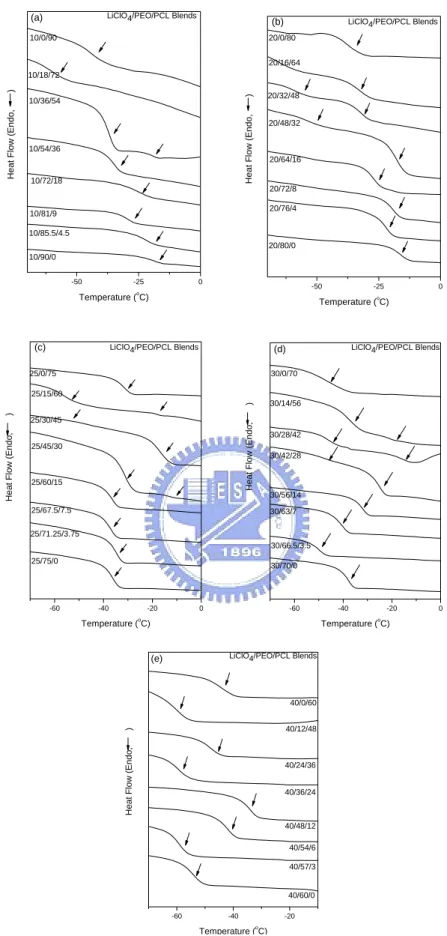
(13) LIST OF TABLES Table 1-1. Classes of Solid Electrolytes ………………………………...……... 19. Table 1-2. Salts That Form Complex Polymeric Electrolytes with PEO ………. 20. Table 1-3. The Important Parameter for Salt Solubilities ……...………………. 20. Table 1-4. Conductivity Data for Polymer Electrolytes Containing Linear Polymers …………………………………...………………...……... Table 1-5. Chemical Structures of Common PEO-derivative Materials for Solid Polymer Electrolytes ………………...……...………………... Table 1-6. 21 22. The Properties of Common Use of Organic Solvents for Gel-type Polymer electrolytes ……………………..…………………………. 23. Table 1-7. Conductivity Data for Gel-type Polymer Electrolytes ……...…….... 24. Table 2-1. Principal Events in the Development of Primary and Secondary Batteries …………………...……………………………...……….... 48. Table 2-2. Typical Conductivities ……………………………………...………. 49. Table 4-1. Compositions and Molecular Weights of MPEG-PCL Block Copolymers ………………………………………...………………. 103. Table 4-2. DSC Results of LiClO4/MPEG-PCL Blends ………………...…….. 104. Table 4-3. Curve-Fitting Results of Infrared Spectra of C=O Group Stretching Region Recorded at 120 °C for the LiClO4/MPEG-PCL Blends with Various LiClO4 Salt Content ……………………..…………... 105. Table 5-1. PVP-co-PMMA Copolymer Compositional and Molecular-Weight Data ……………………………………………………………….. Table 5-2. 140. Curve-Fitting Results of Infrared Spectra of C=O Group Stretching Region Recorded at 120 °C for the LiClO4/PVP and LiClO4/ PMMA Blends with Various LiClO4 Salt Content………..………... 141. Table 5-3. Curve-Fitting Results of IR Spectra of C=O Group Stretching Region Recorded at 120 °C for the LiClO4/PVP-co-PMMA Blends with Various LiClO4 Content ……………………...……………….. 142. Table 5-4. Tgs of LiClO4/PVP-co-PMMA Blends Containing Various LiClO4 Content ……………………………………..……………………… 144 XI.
(14) Table 5-5. Curve-fitting Data of Infrared Spectra at 120 °C of ν (ClO4-) Internal Vibration Mode of LiClO4/PVP-co-PMMA with Various VP Content at a Fix LiClO4 Concentration = 20 wt% …………...... 145. XII.
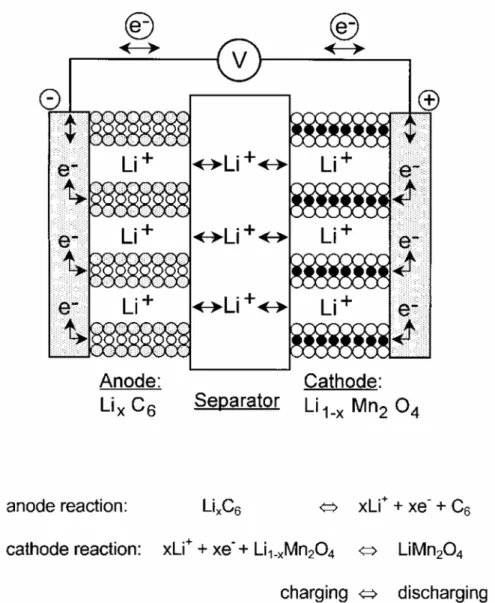
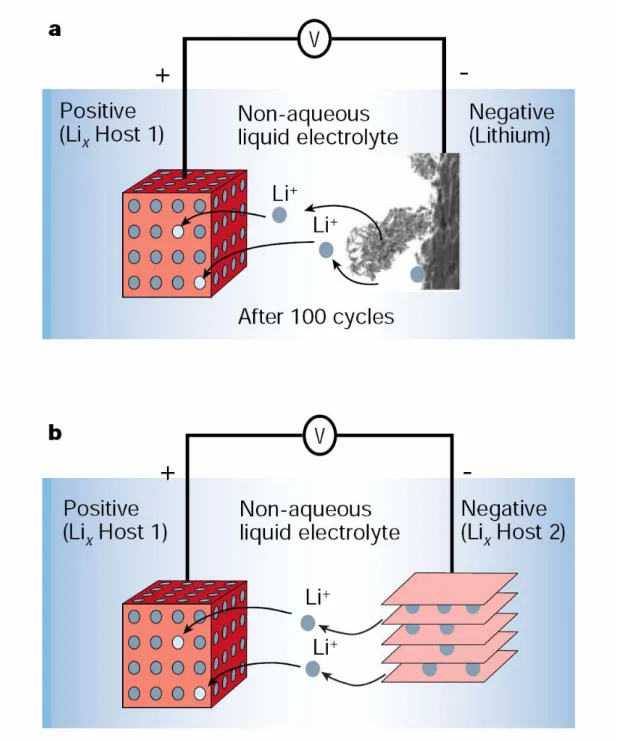
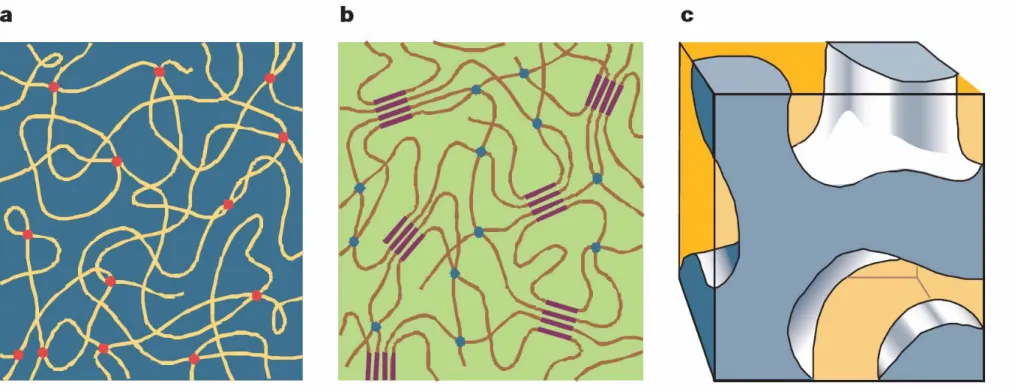
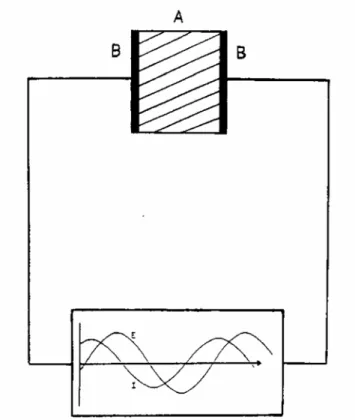
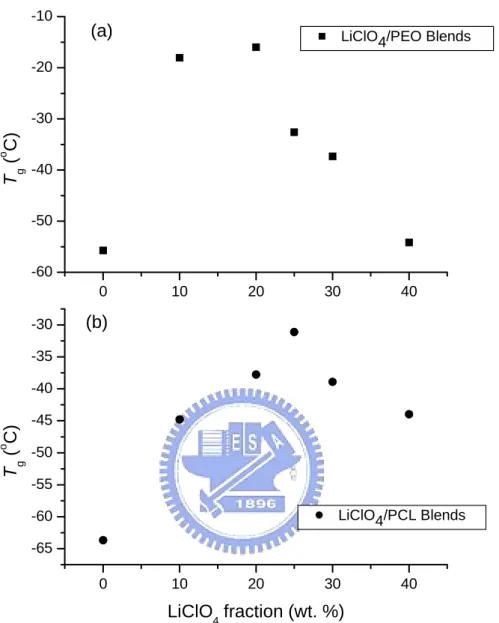
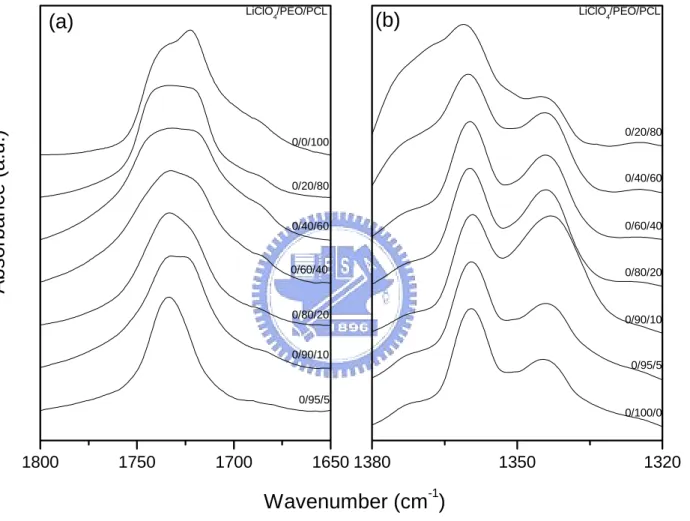
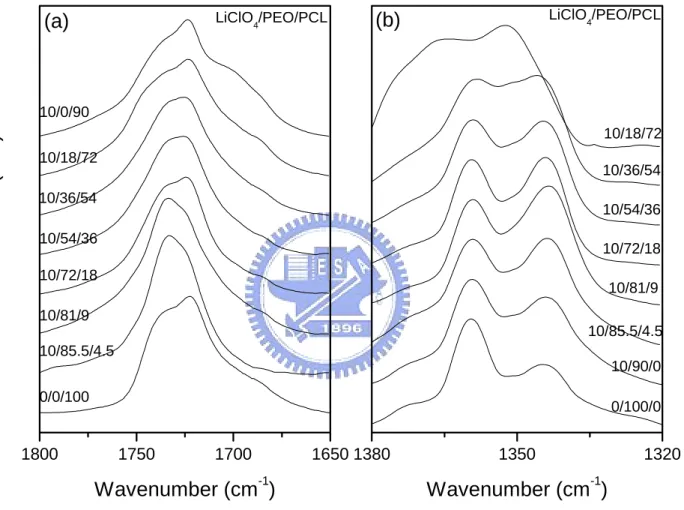
(15) LIST OF FIGURES Figure 1-1. Comparison of the different battery technologies in terms of volumetric and gravimetric energy density.....………...…………….. Figure 1-2. 25. Schematic illustration of a lithium rocking chair battery with graphite and spinel as intercalation electrodes and its electrode reactions.……………………………………………………..…….... Figure 1-3. 26. Schematic of the segmental motion assisted diffusion of Li+ in the PEO matrix. The circles represent the ether oxygen atoms of PEO.... 27. Figure 1-4. The helical structure of PEO molecule.………………...………….... 27. Figure 2-1. Main differences between the SPE lithium-reversible battery and exist aqueous systems.…………………………………..…………... Figure 2-2. 50. Schematic representation and operating principles of Li batteries. (a) Rechargeable Li-metal battery. (b) Rechargeable Li-ion battery..……………………………………………………...……….. 51. Figure 2-3. Schematic representations of polymer electrolyte networks………... 52. Figure 2-4. Schematic drawing showing the shape and components of various Li-ion battery configurations. (a) cylindrical; (b) coin; (c) prismatic; and (d) thin and flat..……………………………………………….... Figure 2-5. 53. Voltage versus capacity for positive and negative electrode materials presently used or under serious considerations for the next generation of rechargeable Li-based cells..………………...………... 54. Figure 2-6. Schematic of an ac impedance experiment..………………...………. 55. Figure 2-7. Complex impedance spectrum (Cole-Cole plot) of D4D2-40 complex with [CN]:[Li+] ratio of 16:1 at 30 and 50 °C.………...…... Figure 2-8. 55. Arrhenius-type plots for log σ versus T-1 for PEO complexes of LiI and LiSCN...………………………………………………………… 56. Figure 2-9. Temperature versus conductivity plots showing thermal hysteresis effects of σ for solid polymer electrolyte based on PEO-PEOPOPEP triblock copolymer with LiTFSI at [Li+]/[O] = 0.025...…...….... Figure 3-1. DSC thermograms of ternary blends of LiClO4/PEO/PCL containing a constant composition of LiClO4. (a) 10 wt%, (b) 20 XIII. 57.
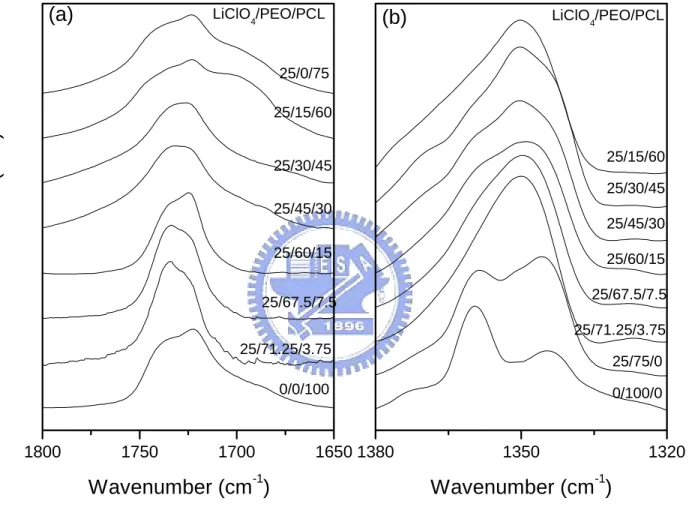
(16) wt%, (c) 25 wt%, (d) 30 wt%, (e) 40 wt%...…………………..…….. 73. Figure 3-2. Ternary phase diagram of the LiClO4/PEO/PCL system..………..…. 74. Figure 3-3. Effect of LiClO4 content on the glass transition temperatures of (a) LiClO4/PEO and (b) LiClO4/PCL..………………………………….. Figure 3-4. 75. Infrared spectra of binary blends of PEO/PCL, recorded at room temperature, displaying (a) the carbonyl stretching, and (b) CH2 wagging regions…..…………………………………………...…….. Figure 3-5. 76. Infrared spectra of ternary blend of LiClO4/PEO/PCL containing a constant composition (10 wt%) of LiClO4, recorded at room temperature, displaying (a) the carbonyl stretching, and (b) CH2 wagging regions..…………………………………………...……….. Figure 3-6. 77. Infrared spectra of ternary blend of LiClO4/PEO/PCL containing a constant composition (25 wt%) of LiClO4, recorded at room temperature, displaying (a) the carbonyl stretching, and (b) CH2 wagging regions..…………………………………………...……….. Figure 3-7. 78. Infrared spectra of ternary blend of LiClO4/PEO/PCL containing a constant composition (40 wt%) of LiClO4, recorded at room temperature, displaying (a) the carbonyl stretching, and (b) CH2 wagging regions..……………………………………………...…….. Figure 3-8. Solid-state 7Li proton-decoupled MAS NMR spectra of ternary blends. of. LiClO4/PEO/PCL. containing. constant. LiClO4. concentrations of (a) 10 and (b) 25 wt%...……………………..…… Figure 3-9. 79. 80. Solid-state 7Li proton-decoupled MAS NMR spectra of ternary blends of LiClO4/PEO/PCL having a fixed PEO/PCL ratio of 40/60...………………………………………………………..……... 81. Figure 3-10 Arrhenius ionic conductivity plots as a function of temperature for LiClO4/PEO/PCL. ternary. blend-based. electrolyte. systems. containing constant LiClO4 concentration (25 wt%)…..……...……. Figure 4-1. 82. DSC thermograms of LiClO4/MPEG-PCL blend with various LiClO4 salt content: (a) EO114-CL42, (b) EO114-CL111, (c) EO114-CL247, (d) EO114-CL516..………………………………..…….. 106. Figure 4-2. Variations of melting temperature (Tm) and melting enthalpy (∆Hm). XIV.
(17) of LiClO4/EO114-CL516 blends with various LiClO4 content……….. 107 Figure 4-3. Infrared spectra of MPEG-PCL block copolymers with various EO/CL ratios, recorded at room temperature, displaying (a) the carbonyl stretching and (b) CH2 wagging regions..……………...…. 108. Figure 4-4. Carbonyl group stretching region of IR spectra recorded at room temperature for MPEG-PCL block copolymers having different EO/CL ratios after blending with 20 wt% LiClO4: (a) EO114-CL111, (b) EO114-CL247, (c) EO114-CL516..………………………………….. 109. Figure 4-5. Carbonyl group stretching region of the IR spectra recorded at 120 °C for LiClO4/MPEG-PCL blends having different LiClO4 contents: (a) EO114-CL42, (b) EO114-CL111, (c) EO114-CL247, (d) EO114-CL516...…………………………………………..…………… 110. Figure 4-6. FTIR spectra recorded at temperatures from 120 to180 °C of blends of (a) LiClO4/PCL homopolymer (25/75), displaying the carbonyl group vibration region, and (b) LiClO4/MPEG-5k homopolymer (25/75), displaying the ether group stretching region..……………... 111. Figure 4-7. FTIR. spectra. of. LiClO4/EO114-CL42. (30/70). recorded. at. temperatures from 120 to 180 °C displaying both the (a) carbonyl group stretching and (b) ether group stretching regions..……..……. 112 Figure 4-8. FTIR. spectra. of. LiClO4/EO114-CL111. (30/70). recorded. at. temperatures from 120 to 180 °C displaying both the (a) carbonyl group stretching and (b) ether group stretching regions.………..….. 113 Figure 4-9. FTIR. spectra. of. LiClO4/EO114-CL111. (40/60). recorded. at. temperatures from 120 to 180 °C displaying both the (a) carbonyl group stretching and (b) ether group stretching regions..……..……. 114 Figure 4-10 Arrhenius ionic conductivities plotted as a function of temperature for LiClO4/MPEG-PCL blend-based electrolyte systems containing a constant LiClO4 concentration (25 wt%)..………………………... 115 Figure 5-1. Kelen-Tudos plot for PVP-co-PMMA copolymers…...…..………… 146. Figure 5-2. Tg versus the PVP content of PVP-co-PMMA copolymer..……...…. 146. Figure 5-3. The IR spectra at 1800-1630 cm-1 of pure PVP, pure PMMA and PVP-co-PMMA copolymers with various PVP contents at 120 °C.... 147. XV.
(18) Figure 5-4. DSC scans for (a) LiClO4/PVP and (b) LiClO4/PMMA blends having varying compositions..…………………………………..….. 148. Figure 5-5. Infrared spectra of C=O stretching region of LiClO4/PVP blends containing various LiClO4 content at 120 °C..…………………..…. 149. Figure 5-6. Deconvolution of infrared spectra ranging from 1800 to 1550 cm-1 of the LiClO4/PVP blend containing various LiClO4 contents in the region of carbonyl stretching recorded at 120 °C..…………………. 150. Figure 5-7. The dependence of “free” and “complexed” C=O band on LiClO4 salt concentration..…………………………………………..……… 151. Figure 5-8. Proposed association schemes of polymer electrolytes based on LiClO4/PVP..………………………………………………...……… 152. Figure 5-9. Infrared spectra of C=O stretching region of LiClO4/PMMA blends containing varying LiClO4 content at 120 °C.…………………..….. 153. Figure 5-10 Deconvolution of infrared spectra ranging from 1800 to 1525 cm-1 of the LiClO4/VP79 blend containing various LiClO4 contents in the region of carbonyl stretching recorded at 120 °C...……….……. 154 Figure 5-11 DSC thermograms of LiClO4/PVP-co-PMMA blend containing various LiClO4 salt contents: (a) VP79, (b) VP57, (c) VP47, (d) VP39, (e) VP19..……………………………………….…..……….. 155 Figure 5-12 Ternary phase diagram of the LiClO4/PVP-co-PMMA system.…..... 156 Figure 5-13 Proposed schematic drawing of phase separation occurring in the LiClO4/PVP-co-PMMA blend..……………………..……………… 157 Figure 5-14 Ionic. conductivity. versus. VP. content. in. PVP-co-PMMA. copolymers plots for LiClO4/PVP-co-PMMA blends at 30 °C..….... 158 Figure 5-15 Infrared spectra of ν (ClO4-) internal vibration modes for LiClO4/PVP-co-PMMA with various compositions..…………...….. 159. XVI.
(19) CHAPTER 1 Introduction Rechargeable Li-ion cells are key components of the portable, entertainment, computing and telecommunication equipment required by today’s information-rich, mobile society. Despite the impressive growth in sales of batteries worldwide, the science underlying battery technology is often criticized for its slow advancement. A battery is composed of several electrochemical cells that are connected in series and in parallel to provide the required voltage and capacity, respectively. Each cell consists of a positive and a negative electrode separated by an electrolyte solution containing dissociated salts, which enable ion transfer between the two electrodes. Once these electrodes are connected externally, the chemical reactions proceed in tandem at both electrodes, thereby liberating electrons and enabling the current to be tapped by the user. The amount of electrical energy, expressed either per unit of weight (W h kg-1) or per unit of volume (W h l-1), that a battery is able to deliver is a both of which are linked directly to the chemistry of the system. Among the various existing technologies (Figure 1-1), Li-based batteries, because of their high energy density and design flexibility, currently outperform other systems, accounting for 63 % of worldwide sales values in portable batteries. This explains why they receive most attention at both fundamental and applied levels. Solid electrolytes comprise a widely varied set of materials in which the ionic conductivity σ is far higher than that of typical ionic solids such as NaCl. The conductivity of typical solid electrolytes lies in the range (10-6 ≤ σ ≤ 10-1 S cm-1) characteristic of dilute aqueous ionic solutions. Solid electrolytes include refractory covalent solids such as β-alumina [(Na2O)x‧11Al2O3] [1,2], soft ionic crystals such as AgI [3-5], glasses such as Ag2GeSe3, and among the most recently discovered and 1.
(20) investigated species, polymer-salt complexes. Within the past 3 decades, the area of electroactive polymers has become one of the most challenging and fruitful realms of polymer science. Both electronically conductive polymers and polymeric electrolytes have been prepared and studied in a large number of laboratories, and a good deal of both synthetic and mechanistic knowledge about these new polymer materials bas been gained. While these species share some of the properties of more usual conductive systems such as metals, semiconductors, and ionic solutions, the polymeric structure provides a new set of conditions, so that a number of new features appear in the electrical response. Generally ionic conduction is associated with liquids, either solvents with high dielectric constants or molten salts. However, solids that can function as electrolytes also known as solid ionic conductors, fast ion conductors or solid electrolytes are exciting because of their wide ranging applications such as gas sensors [6,7], electrochemical display devices [8,9], high temperature heating elements [10], intercalation electrodes [11], power sources [12], fuel cells [13], solid state high energy density batteries [6,14] and so on. In general, desirable battery properties are: energy content per unit volume and weight, discharge and charge characteristics at different rates and temperature, internal resistance, Ah and Wh efficiency, charge retention, life and mechanical stability. If not all most of these properties depend on the electrolytes that a battery is made up of. The choice of electrolyte for rechargeable batteries is governed by the following characteristics: (1) the electrolyte has to have negligent electronic conductivity (to prevent short circuiting) and favorable ionic conductivity, (2) the electrolyte should have a uni ion conduction, otherwise a concentration polarization in the cell may result, (3) the electrolyte must be electrochemically stable at least in the working potential range of the battery, (4) the electrolyte apart from being thermally 2.
(21) stable should be compatible with other cell components. A recent review summarizes the progress in ceramic solid electrolytes in general and Li+ conducting solid electrolyte in particular. Table 1-1 categorizes the classes of solid electrolytes that have been extensively investigated. The classification is subjective; a number of intermediate situations occur and still other solid electrolytes do not fit into any of these categories. According to Figure 1-2, the electrolyte serves as a medium to transport the ions involved in the charging/discharging cycle of the cell. In addition, a separator has to isolate the anode from the cathode electronically. While ceramic or polymeric separators have to be placed between the electrodes when liquid electrolytes are used, both functions, ion conduction and separation, can be realized in a single thin membrane when polymer electrolytes are used.. 1-1 CONCEPT OF SOLID POLYMER ELECTROLYTES Polymers that function as solid electrolytes (SPEs) are a subclass by themselves and are known as polymer electrolytes [15,16]. Besides the advantage of flexibility, polymers can also be cast into thin films and since thin films while minimizing the resistance of the electrolyte also reduces the volume and the weight, use of polymer electrolytes can increase the energy stored per unit weight and volume. In view of these attractive features, there has been considerable focus in recent years on the development of both inorganic and organic polymers as electrolytes for ion transport. In spite of the attractive features of conventional solid electrolytes in various applications, one of the main difficulties in their use in all solid state batteries is the loss of contact between electrodes and electrolyte during the charge-discharge-charge cycles of the battery. This is primary as a result of dimensional changes occurring at the electrodes during the charging or discharging mode. With conventional liquid 3.
(22) electrolytes such dimensional changes in the electrodes do not pose a problem, but with solid electrolytes, this leads to a loss of interfacial contact between the electrode and the electrolyte. In order to overcome this difficulty, batteries have to be operated at high temperatures so that the electrodes are molten. Alternatively the solid electrolyte should be a material that is flexible and therefore can deform with the electrodes to suit the dimensional changes that occur so that interfacial contact is maintained throughout the operation of the battery. After Wright’s discovery [17] of ionic conductivity in alkali metal salt complexes of poly(ethylene oxide) (PEO) in 1973, polymer electrolytes were proposed for batteries in 1978 because they combine the advantages of solid state electrochemistry with the ease of processing inherent to plastic materials [18]. Polymer electrolytes are solid solutions of alkali metal salts in polymers (not to be mixed up with polyelectrolytes, in which either the cation or the anion is covalently fixed to the polymer repeat unit). Since that time, the number of contributions to the field of SPEs has grown enormously, reflecting progress in the understanding of molecular and supramolecular architecture, which is prerequisite for fast ion transport in polymers [19]. Oligoethers seem to be a prerequisite for good solubility of alkali salts, since most of the polymer electrolytes contain these moieties as constitutive units either in their main or side chains. This is not surprising, since linear oligo(ethylene oxide)s form complexes with cations, and the cyclic oligomers (crown ethers) are well known for their excellent metal-complexing capabilities [20]. In order to facilitate, moreover, the dissociation of inorganic salts in polymer hosts, the lattice energy of the salt should be low and dielectric constant (ε) of the host polymer should be high. Consequently, the ionic conductivities of amorphous mixtures of Li salts with poly(propylene oxide) (PPO) are considerable smaller compared to equivalent 4.
(23) mixtures with PEO because PPO has a lower ε and its methyl groups hinder the complexation of Li+. The ionic conductivity σ can be roughly expressed by the following equation:. σ = ∑ ni z i µ i. (1-1). i. where ni, zi, and µi are the effective number of mobile ions, the elementary electric charge, and the ion mobility, respectively. Since the fraction of “free” ions that can be effectively transported is an important parameter, a high degree of dissociation of the salt in the polymer is a prerequisite for high conductivity. The degree of dissociation of the salts dissolved in the polymer host depends, however, on the total concentration of salt in the matrix. Generally, the degree of dissociation decreases with increasing salt concentration. As a consequence, the fraction of “free” ions has a maximumat an optimal salt concentration, which in many cases is located around Li/O = 0.04 (the molar ratio of lithium salt over oxygen (of ethylene oxide units)). Furthermore, another requirement is a high Li+ transference number, i.e., a high ratio of the charge transported. The influence of the ion-ion and ion-polymer interactions on the ion transport in SPEs has been an important subject of research in recent years [19,21]. While in polymer electrolytes both the cations and anions may contribute to the ion conductivity, polyelectrolytes with the anions fixed to the polymer chain are “single-ion” conductors in which only the cations are mobile. Several kinds of Li+ single-ion conducting polymers have been proposed, but the conductivities of such systems turned out to be only about 1 % that of ordinary SPEs. This is mainly attributed to the insufficient dissociation of Li+ in such materials [22]. To date, no single-ion conducting polymers that possess sufficient conductivities to be useful in Li batteries are known. Molecular dynamics simulations, as shown in Figure 1-3, suggest that the Li+. 5.
(24) ions are complexed to PEO through approximately five ether oxygens of a PEO chain, and that the mobility of the cations is decreased considerably by this complexation [23]. Consequently, the mobility of the Li+ cations is related to the motions of the complexing segmental motion of the PEO matrix. In conclusion, the polymer electrolyte is the key element in the SPE lithium battery’s originality and specificity, and it constitutes a new approach to building a better storage battery. SPE makes it possible to manufacture all-solid-state cells without the difficulties generally associated with the use of rigid or liquid electrolytes. On the other hand, a large surface-to-thickness ratio is easily achieved with plastic materials. This compensates for the limited ion mobility. It has been shown that, in principle, SPEs can yield a power capability equivalent to that of molten-salt batteries if appropriate overall cell thickness and surface are selected. Such characteristics open the door to the production of large “power rolls” from which a variety of different cell sizes or shapes can be produced. Moreover, the polymer electrolyte plays three important roles in the SPE battery. Firstly, it is a lithium carrier that can be made very thin to improve the energy density. It is also a mechanical interelectrode separator, which eliminates the need for an inert porous separator. Finally, it is a binder and adhesive that ensures good mechanical and electrical contact, especially in the composite-cathode electrode but also with lithium electrode and current collectors.. 1-2 GENERAL FEATURES FOR A POLYMER ELECTROLYTE Since the polymer and the metal salt involved are both solid materials, the preparation of a polymer salt complex is achieved by the dissolution of the two materials in a common solvent such as acetonitrile, methanol or tetrahydrofuran (THF) followed by a slow removal of the solvent in vacuum. This results in either the bulk polymer-salt complex or a thin film depending upon the method of preparation. It is 6.
(25) essential to ensure that no traces of moisture are present and hence the operations are carried out by means of glove box methods. The polymer electrolytes with which we are principally concerned are complexes of alkali metal salts, denoted MX, with polymer hosts. Both the precursor salt and the neat polymer are solids, so that the complex-forming reaction [15] mMX + (− RY − )n → (MX) m • (− RY − )n. (1-2). where (–RY–) denotes the polymer repeat unit, is a solid/solid reaction. As with most other reactions of this type, the kinetics of (1-2) are unfavorable, even when the complex is stable. Although other schemes for accelerating (1-2) have been employed, including intimate grinding/mechanical mixing [24], by far the most common method has been to dissolve or suspend both the MX salt and the host polymer in a common solvent and then to remove the solvent, producing the solvent-free polymer electrolyte in either bulk or thin-film form [25]. Care must be taken to purify the starting materials and to exclude water. Acetonitrile and methanol have been the solvents most commonly used. If the polymer-metal salt complex is partly crystalline, both the morphology and the transport properties of the electrolyte material produced may vary with choice of solvent. Clearly, reaction (1-2) will be thermodynamically favorable (∆G° negative) only if the Gibbs energy of salvation of the salt by the polymer is large enough to overcome the lattice energy of the salt. In general, one then expects a close relationship between the ability to form homogeneous complexes and the ability to monomer to dissolve the salt. Work by the Grenoble and Evanston groups has shown that for a given polymer host a fairly sharp demarcation line may be established between salts that can and cannot form complexes; the latter simply have too large lattice energies (compare Table 1-2). In addition to the very important lattice energy considerations, a number of other criteria that determine the possibility of forming 7.
(26) complexes have been described. As a result, three parameters are important for the control of salt/neutral molecule interactions: (a) electron pair donicity (DN), (b) acceptor number (AN) and (c) an entropy term. The DN term measures the ability of the solvent to donate electrons to solvate the cation, considered as a Lewis acid. Thus, the polymer which should function as a host in the polymer electrolyte should possess donor sites such as oxygen, sulfur or nitrogen either in the backbone or in a group attached in the form of a side chain to the polymer. Similarly, the AN term describes the possibility for anion (base) solvation. PEO, a polyether, which are quite strong donors and the donicity of PEO should be close to 20, similar to 1,2-dimethoxy ethane (DN,22; AN, 10.2) or even THF (DN, 20; AN, 8), as seen in Table 1-3 [26]. Ethers are, however, very poor acceptors, as they lack hydrogen bonding for anion salvation. Thus, PEO can effectively solvate cations possessing counter anions that are bulky delocalized anions such as I-, ClO4-, BF4- or CF3SO3- which require little or no salvation. Moreover, the third term (entropy) has been related to the spatial disposition of the solvating unit and it has been shown that ethylene oxy (CH2CH2O) containing polymers such as PEO have the most favorable spatial orientation of the solvating units [27]. While small ions such as Li+ which can be strongly solvated, lead to formation of polymer salt complexes even up to LiCl (lattice energy 853 kJ mol-1) other larger cations, such as Na+, K+, require bulky counter anions such as I-, SCN- or CF3SO3- in order to be solvated by PEO [28]. Besides, it has also been recognized that the polymer should possess a low cohesive energy and a high flexibility in order to effectively solvate the ions. The former is characterized by lack of intermolecular interactions such as hydrogen bonding while the latter feature is indicated by a low glass transition temperature (Tg). Although polymers like polyamides contain oxygen and nitrogen atoms as donor sites in their backbone, these polymers are quite unsuitable as polymer hosts in polymer 8.
(27) electrolytes because of the presence of extensive intermolecular hydrogen bonding. Metal complexation with these polymers would cause the disruption of this energetically favorable situation. The second factor, i.e. the high torsional flexibility of the polymer, is indicated by a low Tg and is crucial for ion transport. Thus, large segmental motions of the polymer (either the backbone or the side chain) which is possible above its Tg can result in fast ion movement. As a result, we can conclude as the following [28-32]: (1) A high concentration of polar (basic) groups on the polymer chain is needed to solvate the salt effectively. (2) The cohesive energy of the polymer cannot be too high, and its flexibility, as indicated by a low glass transition temperature, should be quite high, so that reorientation of the local coordination geometry, to achieve effective salvation, may be achieved. In view of the above requirements, the polymers that have been studied as polymer electrolytes are either oxygen, nitrogen, or sulfur atoms-containing materials. The heteroatoms are either part of the backbone of the polymer or are present in the side chain attachments. Some important polymers include ethers in poly(ethylene oxide) and poly(propylene oxide) and polysiloxanes, carbonyl groups in poly(vinyl pyrrolidone) or poly(ethylene succinate), hydroxyls in poly(vinyl alcohol) nitrogen atoms in poly(ethylene imine) and sulfur atoms in poly(alkylene sulfides). Consequently, Table 1-4 [33-40] summaries the ionic conductivity data for polymer electrolytes containing linear polymers. In general, Lewis base character on the complexing host species is required to coordinate the cation of the salt and thus provide a favorable Gibbs energy of polymer-salt interaction [41].. 1-3 CURRENT STATE OF PEO-BASED ELECTROLYTES The first suggestion for the use of a poly(ethylene oxide) (PEO)-based 9.
(28) electrolyte have come in 1978 [42]. PEO-based complexes are thus the first solvent-free polymer electrolytes to have been reported and have received the extensive attention, especially after their generality was established [29,33]. PEO is obtained from the ring-opening polymerization of ethylene oxide. PEO is a linear polymer and the regularity of the unit allows a high degree of crystallinity involving ca. 70-85 % of the polymer. Pristine PEO adopts a helical configuration with sever monomer units and a thread of 1.93 nm per unit quadratic cell [43], as shown in Figure 1-4. The melting point (Tm) of the crystalline phase is ca. 65 °C while the glass transition temperature (Tg) of the amorphous is -60 °C. The dipole-dipole interactions are probably responsible for the higher value of Tg compared with polyethylene (PE, Tg = -100°C), since the energy barrier for rotation of the C-O bond (6.3 kJ) is lower than that of the C-C bond (12.6 kJ). However, the dielectric constant is still quite low (ca. 5), and this strongly influences the behavior of PEO-based electrolytes. PEO-based electrolytes have presented the salient features as follows [28,29]: (1) The salvation properties are due to the combination of the ether oxygen donicity and an optimal spacing of these heteroatoms along the polymer chain. (2) Only the amorphous phase takes part in conductivity. Ion pairs and multiplets probably exist, but both anions and cations are mobile. (3) The electrochemical characteristics of PEO meet those expected for the concept of thin film electrochemistry, and such applications may represent a breakthrough in reversible energy storage. At present, PEO electrolytes have the drawback of low ionic conductivity at room temperature, and there is a considerable research effort aimed at finding substitutes with improved properties. As a result, Table 1-5 lists the chemical structure of the common PEO-derivative materials for solid polymer electrolytes [44-49]. Most 10.
(29) likely, new polymers will incorporate short PEO segments, as the solvating properties, stability and simple chemistry of ethylene oxide derivatives is unchallenged. An example is that of poly(bis(methoxyethoxyethoxy)phosphazene) [50] whose conductivity is close to 5 × 10⁻⁵ S cm-1 at 25 °C. In all cases, research in the field will benefit from the understanding of PEO-salt complex behavior. In addition, owing to the readily available of PEO, solid electrolytes can now be made very simply in any laboratory.. 1-4 GEL TYPE POLYMER ELECTROLYTES A variety of dimensionally stable solid electrolytes consisting of a mixture of organic plasticizer (summarized in Table 1-6), such as ethylene carbonate (EC) and propylene carbonate (PC), along with structurally stable polymers such as poly(acrylonitrile) (PAN), poly(vinyl sulfone) (PVS), poly(vinyl pyrrolidone) (PVP) and poly(vinyl chloride) (PVC) and several lithium salts have been tested and found to have excellent ionic conductivities ranging between 10-4 and 10-3 S cm-1 at ambient temperatures [51-57]. In these gel-type electrolytes the primary role of the polymers PAN, PVS, PVP or PVC is to immobilize the lithium salt solvates of the organic plasticizer liquids. Studying the ionic conductivity based on plasticized polymer electrolyte systems has shown that the ion motion is decoupled from the polymer motion and therefore salvation by the polymer host loses its importance once a plasticizer is introduced. However, it is worth to note that there may be a level of competition for salvation between the polymer host and plasticizing solvent, giving some degree of polymer-ion interaction in those PAN gelled electrolytes. The main role of small molecules in a gelled electrolyte plays to be a plasticizer for the polymer host, improving flexibility and segmental motion in the host polymer chains and to solvate the cation, thus reducing ion-ion interactions. 11.
(30) Watanabe prepared for the first time solid electrolytes comprising PC and LiClO4 in PAN and reported a maximum conductivity of 2 × 10⁻⁴ S cm-1 [51]. Abraham and Alamgir prepared Li+ conductive polymer electrolytes with extremely high ambient temperature conductivities of 4 × 10⁻³ S cm-1 [52,53]. These electrolytes are composed of Li salts, such as LiClO4, dissolved in organic solvents EC and PC and immobilized in a polymer network of PAN or PVP. Moreover, Matsumuto, Rutt and Nishi described gel-type polymer electrolytes possess high ionic conductivities (10-3 S cm-1) and good mechanical strength [54-57]. Another typical example for gel-type polymer electrolyte is prepared by swelling poly(acrylontrile-co-butadiene) (NBR) / poly(styrene-co-butadiene) (SBR) / LiClO4 latex films with an organic solvent, γ-butyrolactone (BL) [54]. The authors suggest that these gel-type polymer electrolyte systems (NBR/SBR/LiClO4/BL) possess dual ion conductive channels, one which is the fused NBR-latex phase and the other is the LiClO4 phase present at the interface of SBR/NBR latex particles. The pure SBR phase is non polar and therefore is not impregnated and merely provides mechanical support. Table 1-7 summarizes the conductivity data for some of gel-type polymer electrolytes.. 1-5 RESEARCH MOTIVATION Polymer electrolytes have attracted considerable attention due mainly to the possibility of their application in various electrochemical devices such as rechargeable lithium batteries. According to the above-mentioned introduction to polymer electrolytes, there remains intense interest in developing solid polymer electrolytes, free from low molecular weight plasticizer and with a sufficiently high ionic conductivity for application in all-solid-state rechargeable lithium batteries. For such applications, conductivities above the present maximum of 10-4 S cm-1 are required. Gel-type electrolytes, in which a liquid electrolyte is entrapped in a polymer matrix, 12.
(31) possess levels of ionic conductivity that are sufficient for application in lithium batteries. These materials will lead to the first commercialization of polymer batteries. Nevertheless, such electrolytes did not get rid of the problems, which are many of disadvantages associated with liquid electrolytes still retained in the gel. Great progress has been made over the last 30 years in increasing the level of ionic conductivity exhibited by polymer electrolytes. However, despite innovative designs of flexible polymers and the addition of inorganic materials to form polymer composite capable of suppressing crystallinity, levels of ionic conductivity are persistently limited to a ceiling of around 10-4 S cm-1 at room temperature. Such a level is insufficient for many lithium battery applications. When such barriers are reached in science, it is time to change the way we think. Our version is that we must direct our attention to the phase behavior and interaction mechanism of polymer electrolytes. It is of vital importance to optimize the performance of the ionic conductivity through understanding of the fundamentals of ionic interaction mechanism and phase behavior in full detail within polymer electrolytes. Poly(ethylene oxide) (PEO)-based polymer electrolytes are still among the most extensively studied polymer ionic conductor owing to their structures are beneficial for facilitating fast ion transport. Unfortunately, a high content of a crystalline phase limits the conductivity of PEO-based electrolytes. It is an important challenge to develop practical methods for preparing the SPEs for that have higher conductivity and dimensional stability. In this regard, the preparation of polymer electrolytes by blending them with other appropriate polymers is of interest. Polymer blend is a quick and economical alternative method for obtaining materials that have optimized properties and for the easy control of their physical properties by compositional change. Therefore, the introduce of poly(ε-caprolactone) (PCL) into PEO-based 13.
(32) polymer electrolytes tends to suppress the crystallization of PEO and results in higher ionic conductivity. In Chapter 3, we employed differential scanning calorimetry (DSC), Fourier transform infrared (FTIR), solid-state 7Li NMR, and alternating current (ac) impedance to investigate the miscibility and related conductivity behaviors of this LiClO4/PEO/PCL ternary blend system. Subsequently, we synthesize monomethoxypoly(ethylene glycol)-block-poly(ε-caprolactone) (MPEG-PCL) block copolymers and blend them with LiClO4 salt to study the influences that the miscibility behavior and interaction mechanisms have on the variation of ionic conductivity, which was discussed in Chapter 4. Finally, since poly(vinyl pyrrolidone) (PVP) and poly(methyl methacrylate) (PMMA) both possess their own advantages to act as polymer electrolyte, we are interested in studying the polymer electrolyte incorporating lithium perchlorate with PVP and PMMA. However, PVP/PMMA blends tend to be immiscible, therefore, PVP-co-PMMA random copolymer was synthesized by free radical polymerization. It seemed reasonable to us to expect that the gel-type polymer electrolyte based on PVP-co-PMMA may not only sustain the mechanical properties of PMMA-based gel polymer electrolyte but also increase the dissolubility of the lithium salt due to the strong withdrawing group within PVP molecules. As a result, Chapter 5 investigated the interaction behavior and related conductivity of all-solid-state polymer electrolyte based on LiClO4/PVP-co-PMMA blend systems.. 14.
(33) 1-6 REFERENCES 1. Weber, N.; Kummer, J. T. Proc. Annu. Power Sources Conf 1967, 21, 37. 2. Whittingham, M. S.; Huggins R. A. J. Chem. Phys. 1971, 54, 414. 3. Owens, B. B.; Argue, A. G. Science 1967, 157, 308. 4. Takahashi, T.; Ikeda, S.; Yamamoto, O. J. Electrochem. Soc. 1972, 119, 477. 5. Tatsumisago, M.; Shinkuma, Y.; Minami, T. Nature 1991, 354, 217. 6. Nicholson, P. S.; Whittingham, M. S.; Farrington, G. C.; Smeltzer, W. W.; Thomas J., Eds. Solid State Ionics; North-Holland: Amsterdam, 1992. 7. Chowdari, B. V. R.; Chandra, S.; Singh, S.; Srivastava, P. C., Eds. Solid State Ionics, Materials and Appications; North-Holland; Amsterdam, 1992. 8. Bange, K.; Gambke, T. Adv. Mater. 1990, 2, 10. 9. Visco, S. J.; Liu, M.; Doeff, M. M.; Ma, Y. P.; Lampert, C.; De Jonghe, C. Solid State Ionics 1993, 60, 175. 10. Hagenmuller, P.; Van Gool, W., Eds. Solid Electrolytes, General Principles, Characterization, Materials, Applications; Academic Press: New York, 1978. 11. Vincent, C. A.; Bonino, F.; Lazzari, M.; Scrosati, B., Eds. Modern Batteries; Edward Arnold: London, 1983. 12. Gabano, F., Ed. Lithium Batteries; Academic Press: London, 1983. 13. Rickert, H. Angew. Chem. Int. Ed. Engl. 1978, 17, 37. 14. Bonino, F.; Ottaviani, M.; Scrosati, B. Pistoia, G. J. Electrochem. Soc. 1998, 135, 12. 15. Ratner, M. A.; Shriver, D. F. Chem. Rev. 1988, 88, 109. 16. Gray, F. M. Ed. Solid Polymer Electrolytes: Fundamentals and Technological Applications; VCH: New York, 1991. 17. Fenton, D. E.; Parker, J. M.; Wright, P. V. Polymer 1973, 14, 589. 18. Armand, M.; Duclot, M. French Patent 1978, 7832976. 15.
(34) 19. Armand, M. Solid State Ionics 1994, 69, 309. 20. Vögtle, F.; Weber, E. In Crown Ethers and Analogs, Patai, S., Rappoport, Z., Eds.; Wiley: New York, 1989. 21. Bruce, P. G.; Vincent, C. A. Faraday Discuss. Chem. Soc. 1989, 88, 43. 22. Takeoka, S.; Ohno, H.; Tsuchida, E. Polym. Adv. Technol. 1993, 4, 53. 23. Müller-Plathe, F.; Van Gunsteren, W. F. J. Chem. Phys. 1995, 103, 4745. 24. Gray, F. M.; MacCallum, J. R.; Vincent, C. A. Solid State Ionics 1985, 18–19, 282. 25. LaNest, J. F.; Cheradame, H.; Dalard, F.; Deroo, D. J. Appl. Electrochem. 1986, 16, 75. 26. Gutmann, V., The Donor Acceptor Approach to Molecular Interactions; Plenum Press: New York, 1978. 27. Shotenshtein, A. I.; Petrov, E. S.; Yokovlevla, E. A. J. Polym. Sci., Part C 1967, 16, 1799. 28. Vincent, C. A.; MacCallum, J. R. In Polymer Electrolyte Reviews; Mac Callum, J. R., Vincent, C. A., Eds., Elsevier: London, 1987. 29. Armand, M. B.; Chabagno, J. M.; Duclot, M. J. In Fast Ion Transport in Solids; Duclot, M. J., Vashishta, P., Mundy, J. N., Shenoy, G. K., Eds.; North-Holland: New York, 1979. 30. Shriver, D. F.; Papke, B. L.; Ratner, M. A.; Dupon, R.; Wong, T.; Brodwin, M. Solid State Ionics 1981, 5, 83. 31. Paper, B. L.; Ratner, M. A.; Shrever, D. F. J. Phys. Chem. Solids 1981, 42, 493. 32. Paper, B. L.; Ratner, M. A.; Shrever, D. F. J. Electrochem. Soc. 1982, 129, 1694. 33. Armand, M. B. Solid State Ionics 1983, 9–10, 745. 34. Watanabe, M.; Rikukawa, M.; Sanui, K.; Ogata, N.; Kato, H.; Kobayashi, T.; Ohtaki, Z. Polymer J. 1983, 15, 65. 35. Watanabe, M.; Togo, M.; Sanui, K.; Ogata, N.; Kobayashi, T.; Ohtaki, Z. 16.
(35) Macromolecules 1984, 17, 2908. 36. Watanabe, M.; Rikukawa, M.; Sanui, K.; Ogata, N.; Kato, H.; Kobayashi, T.; Ohtaki, Z. Macromolecules 1984, 17, 1902. 37. Dupon, R.; Papke, B. L.; Ratner, M. A.; Shriver, D. F. J. Electrochem. Soc. 1987, 131, 586. 38. Armstrong, R. D.; Clarke, M. D. Electrochim. Acta. 1984, 29, 1443. 39. Harris, C. S.; Shriver, D. F.; Ratner, M. A. Macromolecules 1986, 19, 987. 40. Clancy, S.; Shriver, D. F.; Ochrymomycz, L. A. Macromolecules 1986, 19, 606. 41. Angell, C. A.; Liu, C.; Sanchez, E. Nature 1993, 362, 137. 42. Armand, M. B.; Chabagno, J. M.; Duclot, M. J. In Extended Abstract Second International Meeting on Solid Electrolytes, St Andrews, Scotland, 20–22 Sept., 1978. 43. Takahashi, Y.; Takadoro, H. Macromolecules 1983, 6, 672. 44. Nagaoka, K.; Naruse, H.; Shinohara, I. Watanabe, M. J. Polym. Sci., Polym. Lett. Ed. 1984, 22, 659. 45. Hall, P. G.; Davis, G. R.; McIntyre, J. E.; Ward, I. M.; Banister, D. J.; Le Brocq, K. M. F. Polym. Commun. 1986, 27, 98. 46. Fish, D.; Khan, I. M.; Smid, J. Macromol. Chem. Rapid Commun. 1986, 7, 115. 47. Fish, D.; Khan, I. M.; Smid, J. Br. Polym. J. 1988, 20, 281. 48. Blonsky, P. M.; Shriver, D. F.; Austin, P.; Allcock, H. R. J. Am. Chem. Soc. 1984, 106, 6854. 49. Inoue, K.; Nishikawa, Y.; Tanigaki, T. Marcomolecules 1991, 24, 3464. 50. Blonsky, P. M.; Shriver, D. F. J. Am. Chem. Soc. 1984, 106, 6854. 51. Watanabe, M.; Kanba, M.; Nagaoka, K.; Shinohara, I. J. Polym. Sci., Polym. Phys. Ed. 1983, 21, 939. 52. Abraham, K. M.; Alamgir, M. J. Electrochem. Soc. 1990, 137, 1657. 17.
(36) 53. Abraham, K. M.; Alamgir, M. Solid State Ionics 1994, 70, 20. 54. Matsumoto, M.; Rutt, S. J.; Nishi, S. J. Electrochem. Soc. 1995, 142, 3052. 55. Matsumoto, M.; Ichino, T.; Rutt, S. J.; Nishi, S. J. Electrochem. Soc. 1993, 140, L151. 56. Matsumoto, M.; Ichino, T.; Rutt, S. J.; Nishi, S. J. Electrochem. Soc. 1994, 141, 1989. 57. Matsumoto, M.; Ichino, T.; Rutt, S. J.; Nishi, S. J. Polym. Sci., Polym. Chem. Ed. 1994, 32, 2551.. 18.
(37) Table 1-1. Classes of Solid Electrolytes ceramic framework materials. soft framework materials. crystalline species. glasses. crystalline species. glasses. LiAlSiO4. LiAlSiO4 (glass). AgI. AgCl/AgI/CsCl. β-alumina [(Na2O)x‧11Al2O3]. Ag2xGeSe2+x. Ag2HgI4 PbI2. polymersa partly crystalline. amorphous. LiSCN‧PEO NaCF3SO3‧PEI. LiSCN-MEEP NaCF3SO3‧PPO. Na2SO4 a. PEO = poly(ethylene oxide), PEI = poly(ehylenimine), MEEP = poly(bis(methoxyethoxyethoxy)phosphazene), and PPO = poly(propylene oxide).. 19.
(38) Table 1-2. Salts That Form Complex Polymeric Electrolytes with PEOa FCl. -. Br. -. I-. SCN. CF3SO3-. Li+. Na+. K+. Rb+. Cs+. no. no. no. no. no. 1036. 923. 821. 785. 740. yes. no. no. no. no. 853. 786. 715. 689. 659. yes 807. yes 747. no 682. no 660. no 631. yes. yes. yes. yes. yes. 757 yes 807 yes. 704 yes 682 yes. 644 yes 619 yes. 630 yes 616 yes. 604 yes 568 yes. 725. 650. 605. 585. 550. a. The numbers reported are the lattice energies of the salts (in kJ/mol). “Yes” indicates polymer-salt complex formation and “no” indicates the lack of complex formation. The stair-step line indicates the division between complex formation and separate phases.. Table 1-3. The Important Parameter for Salt Solubilities common solvents. DN. AN. Acetonitrile Propylene carbonate Methanol 1,2-Dimethoxyethane (glyme) Tetrahydrofuran (THF) Water. 14.1 15.5 19.1 22.0 20.0 16.4. 18.9 18.3 41.5 10.2 8.0 54.8. 20.
(39) Table 1-4. Conductivity Data for Polymer Electrolytes Containing Linear Polymers [33-40] polymers. metal salts. 1. poly(propylene oxide) CH3 CH. *. CH2. O. *. n. 2. poly(β-propiolactone). O/Li ratio. maximum reference -1 conductivity, S cm. LiBr, LiI NaB(C6H5)4 LiCF3SO3 NaCF3SO3. 9/1. ~ 10-6 ~ 10-6 2.2 × 10⁻⁵ (312)a ~ 10-6. [33,34]. LiClO4. 20/1. 3.5 × 10⁻⁶. [35]. LiClO4 LiBF4. 33/1 12/1. ~ 10-5 (363) 3.4 × 10⁻⁶ (288.2). [36,37]. LiCF3SO3. 16/1. ~ 10-6. [38]. NaCF3SO3. 6/1b. ~ 10-7. [39]. AgNO3. 4/1c. 9 × 10⁻⁷ (318). [40]. O CH2. *. CH2. C. O. n. *. 3. poly(ethylene succinate). O. *. CH2. O. 2. C. O. CH2. 4. C. * n. O. 4. poly(ethylene adipate) O. O CH2. *. CH2. C. CH2. 4. 5. poly(ethylene imine) CH2. *. CH2. NH. n. CH2. x. S n. n. *. *. 6. poly(alkylene sulphide) *. C. *. a. The number in the bracket indicates the measured temperature in Kevin unit. b O/Na ratio. c O/Ag ratio.. 21.
(40) Table 1-5. Chemical Structures of Common PEO-derivative Materials for Solid Polymer Electrolytes [44-49] compounds. molecular structure. 1. reference [44]. CH3 *. O. Si. CH2CH2O. 4 n. *. CH3 CH3. 2 *. Si. n. *. CH2CH2O. O. 3. [45,46 O. 12. CH3. [47]. CH3 *. O. Si. n. *. CH2 CH2 CH2 O. 4 (MEEP)a *. CH2CH2O. O. CH2CH2O. P. N n. O. 2. 12. CH3. [48]. CH3. *. CH2CH2O. 2. CH3. 5. [49] *. CH2. RO RO RO R=. a. N P. CH. *. n. O P. N. N P. CH2CH2O. OR OR. 2. CH2CH2O. CH3. MEEP = poly(bis(methoxyethoxyethoxy)phosphazene). 22.
數據
![Table 1-5. Chemical Structures of Common PEO-derivative Materials for Solid Polymer Electrolytes [44-49]](https://thumb-ap.123doks.com/thumbv2/9libinfo/8760841.208144/40.892.211.685.112.1027/table-chemical-structures-common-derivative-materials-polymer-electrolytes.webp)
+7
Outline
1-1 CONCEPT OF SOLID POLYMER ELECTROLYTES
1-2 GENERAL FEATURES FOR A POLYMER ELECTROLYTE Since the polymer and the metal salt involved are both solid materials, the
1-5 RESEARCH MOTIVATION
ALKALI-METAL BATTERIES
3-3 RESULTS AND DISCUSSION
4-3 RESULTS AND DISCUSSION
5-3 RESULTS AND DISCUSSION
General Conclusions
相關文件
一、數位電子係於民國 72 年配合工業電子精密化分工修正時,將工業電子職 類分為數位電子、儀表電子、與電力電子等 3 組。民國 82 年為配合電子
• 接續之前的例子,若原為 0.288 pF 的液晶 電容 C LC ,再並聯一個亦為 0.288 pF 的電 容C st ,則電位保持的變化值為.
因電導值與溶液中的離子濃度有關,滴定過程中溶液內的離子濃
This circular recapitulates the prevailing rules and regulations on collection of fees in kindergartens, kindergarten-cum-child care centres and schools with kindergarten
To provide additional teaching staff for schools to take forward various education initiatives and enhance the quality of education for the benefit of our students, the current
The Liouville CFT on C g,n describes the UV region of the gauge theory, and the Seiberg-Witten (Gaiotto) curve C SW is obtained as a ramified double cover of C g,n ... ...
In fact, the formation of chemical C-O state increases the extra factor inside the DOS re-distribution; therefore, without this, like the case of the sidewalls region (C), it shows
We cannot exclude the presence of the SM Higgs boson below 127 GeV/c 2 because of a modest excess of events in the region. between 115 and 127
