Synthesis and characterization of well-dispersed multi-walled carbon
nanotube/low-bandgap poly(3,4-alkoxythiophene) nanocomposites
Cheng-Dar Liu
a, De-Yu Shu
b, Ching-Ting Tsao
a, Jin-Lin Han
c, Feng-Yu Tsai
a,d, Fang-Chung Chen
e,
Wen-Chang Chen
a,b, Kuo-Huang Hsieh
a,b,*a
Institute of Polymer Science and Engineering, National Taiwan University, Taipei 106, Taiwan
bDepartment of Chemical Engineering, National Taiwan University, Taipei 106, Taiwan c
Department of Chemical and Material Engineering, National ILan University, I-Lan 260, Taiwan
d
Department of Material Science and Engineering, National Taiwan University, Taipei 106, Taiwan
e
Department of Photonics, National Chiao-Tung University, Hsinchu 300, Taiwan
a r t i c l e
i n f o
Article history:
Received 25 August 2009
Received in revised form 5 February 2010 Accepted 20 March 2010
Available online 27 March 2010 Keywords:
A. Carbon nanotubes
A. Polymer–matrix composites (PMCs) D. Raman spectroscopy
D. Scanning electron microscopy (SEM) D. Transmission electron microscopy (TEM)
a b s t r a c t
In this study, we prepared nanocomposites of multi-walled carbon nanotubes (MWCNTs) and low-energy-bandgap conjugated polymers incorporating 3,4-alkoxythiophene monomers. Poly(3,4-dihexyl-oxythiophene) (PDHOT) and poly(3,4-dimethoxythiophene-co-3,4-dihexylPoly(3,4-dihexyl-oxythiophene) [P(DMOT-co-DHOT)] have relatively low-energy-bandgaps (ca. 1.38 and 1.34 eV, respectively), determined from the onsets of absorbances in their UV–Vis spectra, because of the electron-donating effects of their alkoxy groups. MWCNTs have poor solubility in common organic solvents; after surface modification with alkyl side chains using the Tour reaction, however, the p-hexylaniline modified MWCNT derivative (MWCNT-HA) was readily dispersed in CHCl3and could be mixed with the low bandgap polymers. Scanning
elec-tron microscopy images revealed that MWCNT-HA was dispersed well in each polythiophene derivative; only a few MWCNT-HA bundles could be observed at a high MWCNT-HA content (=20 wt.%). The elec-trical conductivities of the MWCNTs/PDHOT composites were dependent on their MWCNT content, reaching 16 S/cm at 30 wt.% MWCNT-HA. We suspect that the two hexyloxy chains of PDHOT enhanced its solubility and allowed it to wrap around the surfaces of the MWCNTs more readily.
Ó 2010 Elsevier Ltd. All rights reserved.
1. Introduction
Conjugated polymers (CPs) are used extensively in functional materials because of their interesting optical, electrical, and redox properties. The properties of CPs depend mostly on the energy of their bandgaps (Eg), defined as the difference in energy between the highest occupied molecular orbital (HOMO) and lowest unoc-cupied molecular orbital (LUMO). There is great interest in the application of low-energy-bandgap materials in polymer light-emitting diodes (PLEDs), organic thin-film transistors (OTFTs), optical transparent electrodes, and organic photovoltaics (OPVs)
[1,2]. By definition, a low-energy-bandgap polymer is a conjugated polymer having a value of Egof 1.5 eV or less, with the onset of its absorption at a wavelength of 600 nm or greater in the neutral state, as measured using UV–Vis spectroscopy[3,4]. In early stud-ies, the bandgap energy was found to be strongly correlated with the molecular geometry. For example, polythiophene, with its
aro-matic geometry, has a calculated bandgap energy of 2 eV; the structurally similar quinoid isomer has a value of only 0.47 eV
[5]. Wudl et al. synthesized polyisothianaphthene (PITN), which has a bandgap energy of 1.13 eV as a result of the preferred stabil-ization of the quinoid resonance from the benzene ring. Chen and Jenekhe synthesized many soluble conjugated poly(heteroarylene methines) that have low bandgap energies (ca. 1.14 eV)[6–8]. Fur-thermore, Sotzing and co-workers reported that the value of Egof polythieno[3,4-b]furan is 1 eV[9]. At present, derivatives of poly-thiophene (PT) and its copolymers are the hottest candidates for developing new low-energy-bandgap materials.
The use of carbon nanotubes (CNTs) in polymer/CNT composites has become a focal point of nanocomposite research ever since Iij-ima’s discovery of multi-walled carbon nanotubes (MWCNTs)[10]. Because CNTs possess high surface areas, chemical stability, high electrical conductivity[11], low mass density, and good mechani-cal strength[12], they have been developed for application in sev-eral fields, including chemical detectors, supercapacitors [13], electromagnetic interference (EMI) materials[14], and transparent electrodes[15]. In addition, composites of CNTs and CPs have also been employed widely in OTFTs and OPVs in recent years [16]
0266-3538/$ - see front matter Ó 2010 Elsevier Ltd. All rights reserved.
doi:10.1016/j.compscitech.2010.03.012
*Corresponding author at: Institute of Polymer Science and Engineering, National Taiwan University, No. 1, Sec. 4, Roosevelt Rd., Taipei 10617, Taiwan. Tel.: +886 2 33665314; fax: +886 2 33665237.
E-mail address:[email protected](K.-H. Hsieh).
Contents lists available atScienceDirect
Composites Science and Technology
j o u r n a l h o m e p a g e : w w w . e l s e v i e r . c o m / l o c a t e / c o m p s c i t e c hbecause the high charge mobilities, long conjugation lengths, and large aspect ratios of CNTs are favorable properties for charge transfer[17]. The advantages of CNTs are, however, usually offset by their insolubility and poor dispersibility in polymer matrices. The performances of such composites depend on not only the properties of the components but also their arrangement in the matrix[18,19]. As a result, many surface modification techniques have been used to improve the solubility of CNTs in solvents and matrixes[20]. Among them, the Tour reaction is one of the most accommodating and directly applicable methods for modifying the surface of CNTs. Tour and co-workers initially employed a re-duced aryl diazonium salt to give an aryl radical for covalent attachment to the carbon surface. In a following report, they found that this reaction could be performed using derivatives of aniline treated with alkyl nitrites to achieve functionalization of up to 1 in 20 carbon atoms in the CNT framework without via chemistry on the ends of the cut nanotube[21].
In this paper, we report the synthesis of two soluble low-EgPT derivatives: dihexyloxythiophene) (PDHOT) and poly(3,4-dimethoxythiophene-co-3,4-dihexyloxythiophene) [P(DMOT-co-DHOT)]. We mixed them with the p-hexylaniline modified MWCNT derivative (MWCNT-HA) which we fabricated using the Tour reac-tion, a simple transformation that results in relatively little damage to the CNTs. We used scanning electron microscopy (SEM) to investigate the morphologies of the dispersions of these MWCNTs in matrices of the PT derivatives, and determined their electrical conductivities.
2. Experimental 2.1. Materials
3,4-Dimethoxythiophene (DMOT) was purchased from Aldrich; other chemicals used to synthesized 3,4-dihexyloxythiophene (DHOT) were purchased from ACROS. Poly(3-hexylthiophene-2,5-diyl) (P3HT, Mw 45,000–65,000 g/mol) was purchased from Al-drich; its regioregularity was greater than 99.995%. MWCNTs (CP-181) were obtained from Advance NanoPower, Taiwan, and purified using 5 N HCl(aq)to remove residual Fe catalyst.
2.2. 3,4-Dihexyloxythiophene (DHOT) [22]
A mixture of DMOT (3.4 g), hexanol (5.31 g), and p-toluenesul-fonic acid monohydrate (0.41 g) in dry toluene (140 mL) was stir-red for 72 h under reflux. After quenching the reaction with cool water, the mixture was extracted with CH2Cl2. The organic layer was collected, dried (MgSO4), and evaporated to yield a black li-quid, which was purified through column chromatography (CH2Cl2/hexane, 1:20) to obtain DHOT as a transparent liquid (75%). 1H NMR (CDCl
3): d 6.1 (s, 2H, ThH2), 3.9 (s, 4H, OCH2), 1.6–1.8 (m, 4H, CH2), 1.2–1.4 (m, 12H, CH2), 0.9 (s, 6H, CH3).
2.3. Polymerization of PDHOT and P(DHOT-co-DMOT)
A solution of monomers (0.2 g) dissolved in dry CHCl3 (7 mL) was added dropwise to FeCl3 (4 equiv.). The mixture was stirred for 24 h at ambient temperature and then subjected to Soxhlet extraction with MeOH for 24 h. The precipitate was then washed through Soxhlet extraction with CH2Cl2. The filtrate was dried un-der vacuum to yield a dark pink polymer. Dedoped polymers were obtained after stirring the polymers in 10% aqueous NH4OH (100 mL) for 24 h.
2.4. Alkyl-modified MWCNT-HA [21]
Pristine MWCNT (40 mg) and p-hexylaniline (2.364 g) were mixed in a flask equipped with a reflux condenser and a magnetic stirrer bar. After heating to 80 °C, isoamyl nitrite (2.152 g) was added via syringe and the mixture stirred vigorously for 2 h. The contents were diluted with acetone (150 mL) and passed through a PVDF filter (0.47
l
m). The filter cake was washed with deionized water and acetone until the filtrate was clear. The final product was dried in an oven at 80 °C for 24 h.2.5. MWCNT/PT derivative composites
The MWCNTs were added to CHCl3to give a concentration of 1 mg/mL; the mixture was subjected to sonication in a bath for 3 h to disperse the MWCNTs in the solvent. On the basis of the desired weight fraction of MWCNTs in the final composite, an appropriate quantity of the PT derivative doped with dodecylben-zenesulfonic acid (DBSA) was dissolved in the MWCNT/CHCl3 mixture.
2.6. Characterization
SEM was conducted using a JEOL 6700 instrument operated at an accelerating voltage of 50 kV. Each sample was cleaved in liquid N2and its fresh fracture surface sputtered with gold. Transmission electron microscopy (TEM) was performed using a JEOL 1230 instrument operated at an accelerating voltage of 100 kV; the sam-ple for imaging was prepared by placing a drop of the MWCNT sus-pension on a 200-mesh copper grid featuring a supporting carbon film. Raman spectra of solid samples were recorded using a HORI-BA Jobin Yvon-iHR550 instrument, with excitation at 633 nm. The resistance of the material was measured using an HP4338B instru-ment. Testing films of each composite were manufactured through drop coating of five layers. Pristine MWCNT and MWCNT-HA sam-ples were formed into powder-pressed pellets having a diameter of 1.26 cm and a thickness of ca. 0.1 cm. The final data were obtained from the average value of five measurements; the error range was less than 10%. The conductivity of material was calculated using the equation
r
¼ 1=Rd ð1Þwhere
r
is the conductivity (in S/cm), R is the surface resistance (X/sq), and d is the thickness of the conductive film.3. Results and discussion
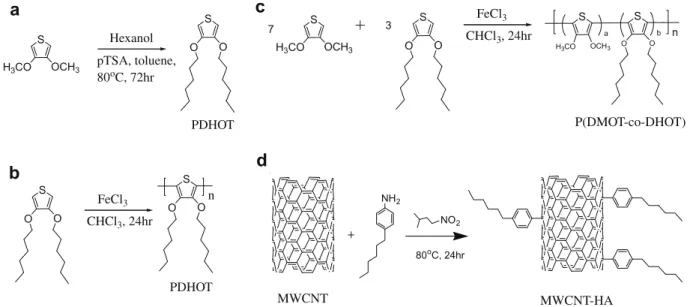
Scheme 1a–coutlines the synthetic routes that we followed for the preparation of the monomers and polymers. DMOT was treated with hexanol under slightly acidic conditions in toluene at 110 °C; this transesterification reaction provided DHOT. Chemical poly-merization of DHOT and DMOT was performed using FeCl3. The reaction of DHOT itself resulted in a dark pink polymer, PDHOT, which was soluble in CHCl3and toluene and partially soluble in hot THF. The corresponding reaction of DMOT, with its shorter methoxyl side-chains, provided PDMOT, which was insoluble in any organic solvents and difficult to characterize. Therefore, we synthesized poly(DMOT-co-DHOT), using a feed molar ratio of DMOT to DHOT of 7:3; this copolymer was soluble in CHCl3when heated. The 1H NMR spectrum of P(DMOT-co-DHOT) revealed (Fig. 1) one broad peak at ca. 1–1.83 ppm and another at 4.13 ppm. We attribute the former to the protons of the (CH2)4CH3 group of DHOT and the latter from the protons of the OCH2group of DHOT and the OCH3group of DMOT. The molar ratio of DMOT to DHOT in the copolymer, which we estimated from the integrated
areas of these two broad peaks, was 1.64:1. This ratio is lower than the co-monomer feed ratio of 7:3 (i.e., 2.33:1).
Fig. 2presents the UV–Vis absorption spectrum of each polymer diluted in CHCl3; Table 1 summarizes the data. The spectra of PDHOT and co-DHOT) featured similar peaks. P(DMOT-co-DHOT) displayed a
p
–p
*absorption band at a value of kmaxof
500 nm, blue-shifted by ca. 20 nm relative to that of PDMOT, and greater absorption intensity in the region 600–900 nm, presum-ably because the methoxyl groups on the thiophene unit made the backbone of the copolymer more rigid. Therefore, P(DMOT-co-DHOT) tended to form the quinoid type of PT and had the longer conjugated length. The presence of alkoxyl groups at the 3- and 4-positions of the thiophene rings provided PDHOT and P(DMOT-co-DHOT) with optical absorption maxima at longer wavelengths, with red-shifts in their values of kmaxof ca. 40–60 nm relative to that of P3HT. We attribute this behavior to the electron-donating effect of the alkoxyl groups and the more-coplanar conformation. As a result, PDHOT and P(DMOT-co-DHOT) possess low bandgap energies (ca. 1.38 and 1.34 eV, respectively), as determined from the onsets of the absorptions in their UV–Vis spectra.
Scheme 1d illustrates the surface modification of the MWCNTs using the Tour reaction. With this method, MWCNTs can be mod-ified to present various functional groups (e.g., COOH, SO3H, NO2, alkyl chains) from appended aniline units. Because they are not
S O O
Hexanol
PDHOT
pTSA, toluene,
80
oC, 72hr
S H3CO OCH3 S O OFeCl
3CHCl
3, 24hr
n
PDHOT
S O O S O O S H3CO OCH3 7 3FeCl
3CHCl
3, 24hr
S H3CO OCH3 S O O a b n NH2 NO2 80oC, 24hra
b
c
d
MWCNT-HA
P(DMOT-co-DHOT)
MWCNT
Scheme 1. (a)–(c) Synthetic procedures for the preparation of the monomers and polymers; (d) surface modification of a MWCNT using the Tour reaction.
Fig. 1.1 H NMR spectrum of P(DMOT-co-DHOT). 300 400 500 600 700 800 900 1000 0.2 0.4 0.6 0.8 1.0 Abs. (normalized) wavelength (nm) PDHOT P(DHOT-co-DMOT) P3HT
Fig. 2. UV–Vis absorption spectra of PDHOT, P(DHOT-co-DMOT), and P3HT.
Table 1
UV–Vis absorption and energy bandgap data for the PT derivatives.
Polymer kmax(nm) Onset (nm) Eg(eV)
PDHOT 520 900 1.38
P(DHOT-co-DMOT) 500 925 1.34
treated with a 3:1 mixture of conc. H2SO4and HNO3, the MWCNTs are not cut and, therefore, they maintain their original aspect ra-tios. To allow the MWCNTs to disperse readily in organic solvents, we modified them with hexylaniline. In this Tour reaction, 4-hexylaniline is converted into an aryl radical that becomes cova-lently attached to the MWCNT’s surface, with the resulting pre-sented hexylbenzene groups improving the solubility of the MWCNTs in CHCl3.Fig. 3reveals that, after the Tour reaction, sig-nificant changes occurred in the Raman absorption intensity
with-in the region 1000–1800 cm . Raman spectroscopy is a powerful tool for characterizing the presence of sp2 and sp3 hybridized atoms in the sidewalls of MWCNTs. The disorder band (D band) at ca. 1350 cm–1represents CAC single bond linkages; the graphite bond (G band) at ca. 1580 cm–1 represents C@C double bonds.
Fig. 3 reveals that MWCNT-HA features a higher ID/IG ratio (ca. 0.87) than that of the pristine MWCNTs (ca. 0.80), indicating suc-cessful functionalization.
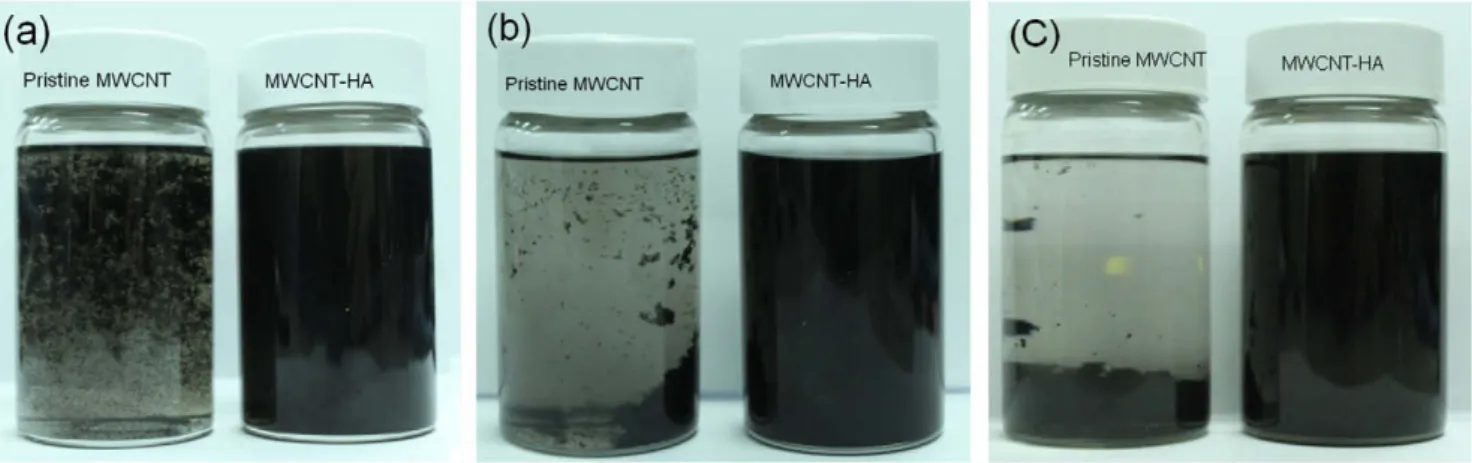
We examined the stabilities of the pristine MWCNTs and MWCNT-HA in CHCl3 through visual inspection (Fig. 4) and TEM analyses (Fig. 5). Samples of the pristine MWCNTs or MWCNT-HA (2.5 mg) were first dispersed in CHCl3(50 mL) under sonication for 1 h. When we removed the suspension of pristine MWCNTs from the bath, flocculation began to occur in the solvent during the first 10 min (Fig. 4a); after 24 h, a material slowly precipitated at the bottom of the vessel (Fig. 4b). In contrast, MWCNT-HA pro-vided a well-dispersed solution in CHCl3—one that did not provide any aggregation after 14 days (Fig. 4c).Fig. 5presents TEM images of dried samples of the pristine MWCNTs and MWCNT-HA that had been dispersed in CHCl3. The pristine MWCNTs appeared coiled and entangled because CHCl3is not a good solvent for them. The inset toFig. 5a reveals that the average diameter of the pristine MWCNTs, estimated at a magnification of 200 k, was 15–25 nm. After functionalization with hexylbenzene groups, the product exhibited good solubility in CHCl3; i.e., the coils of MWCNT-HA were more readily dismantled than those of the pristine MWCNTs.
Fig. 6a–creveals that the three 20 wt.% MWCNTs/PT composites had similar morphologies, with macro-phase separation that fully filled with the pristine MWCNTs. Although
p
–p
interactionsbe-1200 1400 1600 1800 MWCNT MWCNT-HA ID/IG=0.87 Relative Intensity cm-1 D band G band ID/IG=0.80
Fig. 3. Raman spectra of the pristine MWCNTs and MWCNT-HA.
Fig. 4. Photograph displaying suspensions (2.5 mg/50 mL) of the pristine MWCNTs (left) and MWCNT-HA (right) in CHCl3after (a) 10 min, (b) 1 day and (c) 14 days.
Fig. 5. TEM images of samples of: (a) the pristine MWCNTs and (b) MWCNT-HA obtained from their suspensions in CHCl3. Inset: corresponding image of the pristine MWCNT
tween the CPs and the pristine MWCNTs resulted in effective dis-persion, as a result of the PT derivatives wrapping around the pris-tine MWCNTs, they could not prevent the aggregation and entanglement of the pristine MWCNTs at higher fill contents. After we doped the PT derivatives with DBSA, however, the pristine MWCNTs exhibited different morphologies in the matrix (Fig. 6d–f). The aromatic ring of DBSA attached to the surface of the pristine MWCNTs through
p
–p
interactions; its dodecyl chain had high compatibility with the alkyl or alkoxyl chains of the matrices. Thus, DBSA played two roles in this system: surfactant and doping agent. It not only increased the intrinsic conductivity of the PT derivatives but also provided more effective dispersion of the pristine MWCNTs. Therefore, the pristine MWCNTs were ex-tended fully in each matrix—we did not observe any coiled pristine MWCNTs.Fig. 6g–i displays the morphologies of the composites obtained after replacing the pristine MWCNTs with MWCNT-HA. Unexpectedly, they exhibited a homogenous structure in which only a small amount of the free MWCNT-HA units were visible. This behavior presumably arose for two reasons: (a) the hexylben-zene groups increased the solubility of MWCNT-HA in CHCl3, thereby overcoming the van der Waals interactions between theMWCNTs and resulting in their debundling; (b) the hexylbenzene groups formed well-packed structures with the side chains of DBSA and the PT derivatives. Thus, the MWCNT-HA units dispersed in each matrix existed in very small bundles, or even as isolated tubes.
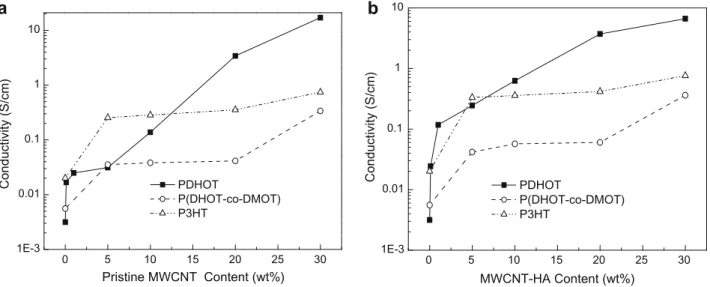
Fig. 7displays the electrical conductivities of the MWCNTs/PT derivatives. In general, when we added more MWCNTs to a matrix, the conductivity increased accordingly; the composites containing MWCNT-HA exhibited higher conductivities because of its more effective dispersion relative to that of the pristine MWCNTs. Nev-ertheless, the conductivity did not increase too dramatically be-cause the MWCNTs (CP181) possessed a higher density of defects (Fig. 3). On the other hand, P3HT doped with DBSA provided the best conductivity in each PT derivative, due to its high crystallinity. For CPs such as PEDOT[23]and polyaniline[24], the crystalline re-gion contains a well-ordered polymer chain structure. In this do-main, interchain interactions are sufficiently strong to allow the charge to delocalize[25]. After adding the pristine MWCNTs or MWCNT-HA, the conductivity of the PDHOT composites extended beyond that of P3HT, possibly because the two hexyloxy chains of PDHOT enhanced its solubility and allowed the polymer to wrap
Fig. 6. SEM images (magnification: 20 k) of cross-sections of 20 wt.% MWCNT/PT derivative composite films: (a) pristine MWCNT/PDHOT, (b) pristine MWCNT/P(DHOT-co-DMOT), (c) pristine MWCNT/P3HT, (d) pristine MWCNT/PDHOT-DBSA, (e) pristine MWCNT/P(DHOT-co-DMOT)-DBSA, (f) pristine MWCNT/P3HT-DBSA, (g) MWCNT-HA/ PDHOT-DBSA, (h) MWCNT-HA/P(DHOT-co-DMOT)-DBSA, (i) MWCNT-HA/P3HT-DBSA. (Scale bar: 1lm.)
around the surfaces of the MWCNTs more readily. In addition, the composite of PDHOT mixed with 30 wt.% pristine MWCNTs had a higher conductivity than that featuring MWCNT-HA, presumably as a result of the conductivity of the pristine MWCNTs (21 S/cm) being higher than that of MWCNT-HA (16 S/cm), because the chemical modification decreased the density of the graphite carbon of the latter species. Therefore, when a composite had a higher MWCNT-HA content, the nature of the composite tended toward that of MWCNT-HA, thereby limiting the critical properties of the composite at high MWCNT-HA contents.
4. Conclusion
The incorporation of alkoxyl groups at the 3- and 4-positions of the thiophene ring decreases the value of Egof PT derivatives. In-deed, the derivatives PDHOT and P(DMOT-co-DHOT) exhibit a wider absorption range in their UV–Vis spectra. On the other hand, alkyl-modified MWCNT-HA not only exhibited increased stability in CHCl3(relative to that of the pristine MWCNTs) but also im-proved compatibility with PT derivatives. When we mixed the DBSA-doped PT derivatives with MWCNT-HA, the bundles of MWCNTs were separated into individual strands as a result of interactions between the alkyl and alkoxyl side chains. Therefore, the composites could incorporate higher contents of MWCNTs (=20 wt.%) while exhibiting homogeneous structures. Of the tested PT derivatives, PDHOT exhibited higher compatibility with MWCNT-HA because its two hexyloxy chains enhanced its solubil-ity and allowed the polymer to wrap around the surface of the MWCNTs more readily. The conductivities of the resulting MWCNTs/PDHOT blends were influenced dramatically by their MWCNT contents.
Acknowledgments
We thank the Ministry of Economic Affairs and National Science Council, Taiwan, for financial support through Grants 95-EC-17-A-08-S1-015 and 97-2218-E-002-012.
References
[1] Park JS, Ryu TI, Song M, Yoon KJ, Lee MJ, Shin IA, et al. Polym Sci Part A: Polym Chem 2008;46:6175.
[2] Koeppe R, Bossart O, Calzaferri G, Sariciftci NS. Advanced photon-harvesting concepts for low-energy gap organic solar cells. Sol Energy Mater Sol Cells 2007;91:986.
[3] Pomerantz M. Handbook of conducting polymers. 2nd ed. Marcel Dekker; 1998. p. 277.
[4] Kumar A, Bokria JG, Buyukmumcu Z, Dey T, Sotzing GA. Poly(thieno[3,4-b]furan), a new low band gap polymer: experiment and theory. Macromolecules 2008;41:7098.
[5] Chen WC, Jenekhe SA. Small-bandgap conducting polymers based on conjugated poly(heteroarylene methines). 2. Synthesis, structure, and properties. Macromolecules 1995;28:465.
[6] Bredas JL, Heeger AJ, Wudl F. Towards organic polymers with very small intrinsic band gaps. I. Electronic structure of polyisothianaphthene and derivatives. J Chem Phys 1986;85:4673.
[7] Hoogmartens I, Adriaensens P, Vanderzande D, Gelan J, Quattrocchi C, Lazzaroni R, et al. Low-bandgap conjugated polymers. A joint experimental and theoretical study of the structure of polyisothianaphthene. Macromolecules 1992;25:7347.
[8] Chen WC, Jenekhe SA. Small-bandgap conducting polymers based on conjugated poly(heteroarylene methines). 1. Precursor poly(heteroarylene methylenes). Macromolecules 1995;28:454.
[9] Kumar A, Buyukmumcu Z, Sotzing GA. Poly(thieno[3,4-b]furan). A new low band gap conjugated polymer. Macromolecules 2006;39:2723.
[10] Iijima S. Helical microtubules of graphitic carbon. Nature 1991;354:56. [11] Skakalova V, Dettlaff-Weglikowska U, Roth S. Electrical and mechanical
properties of nanocomposites of single wall carbon nanotubes with PMMA. Synth Met 2005;152:349.
[12] Gao J, Zhao B, Itkis ME, Bekyarova E, Hu H, Kranak V, et al. Chemical engineering of the single-walled carbon nanotube–nylon 6 interface. J Am Chem Soc 2006;128:7492.
[13] Oh J, Kozlov ME, Kim BG, Kim HK, Baughman RH, Hwang YH. Preparation and electrochemical characterization of porous SWNT–PPy nanocomposite sheets for supercapacitor applications. Synth Met 2008;158:638.
[14] Wu HL, Ma CC, Yang YT, Kuan HC, Yang CC, Chiang CL. Morphology, electrical resistance, electromagnetic interference shielding and mechanical properties of functionalized MWNT and poly(urea urethane) nanocomposites. J Polym Sci Part B: Polym Phys 2006;44:1096.
[15] Wang W, Fernando KAS, Lin Y, Meziani MJ, Veca LM, Cao L, et al. Metallic single-walled carbon nanotubes for conductive nanocomposites. J Am Chem Soc 2008;130:1415.
[16] Geng J, Kong BS, Yang SB, Youn SC, Park S, Joo T, et al. Effect of SWNT defects on the electron transfer properties in P3HT/SWNT hybrid materials. Adv Funct Mater 2008;18:2659.
[17] Liu Q, Mao J, Liu Z, Zhang N, Wang Y, Yang L, et al. A photovoltaic device based on a poly(phenyleneethynylene)/SWNT composite active layer. Nanotechnology 2008;19:115601.
[18] Palacios-Lidon E, Perez-Garcia B, Abellan J, Miguel C, Urbina A, Colchero J. Nanoscale characterization of the morphology and electrostatic properties of poly(3-octylthiophene)/graphite-nanoparticle blends. Adv Funct Mater 2006;16:1975.
[19] Warman JM, de Haas MP, Anthopoulos TD, De Leeuw DM. The negative effect of high-temperature annealing on charge-carrier lifetimes in microcrystalline PCBM. Adv Mater 2006;18:2294.
[20] Cheng F, Adronov A. Suzuki coupling reactions for the surface functionalization of single-walled carbon nanotubes. Chem Mater 2006;18:5389.
[21] Dyke CA, Tour JM. Solvent-free functionalization of carbon nanotubes. J Am Chem Soc 2003;125:1156.
a
b
1E-3 0.01 0.1 1 10 Conductivity (S/cm) MWCNT-HA Content (wt%) PDHOT P(DHOT-co-DMOT) P3HT 0 5 10 15 20 25 30 0 5 10 15 20 25 30 1E-3 0.01 0.1 1 10 Conductivity (S/cm) Pristine MWCNT Content (wt%) PDHOT P(DHOT-co-DMOT) P3HT[22] Mishra SP, Sahoo R, Ambade AV, Contractor AQ, Kumar A. Synthesis and characterization of functionalized 3,4-propylenedioxythiophene and its derivatives. J Mater Chem 2004;14:1896.
[23] Groenendaal LB, Jonas F, Freitag D, Pielartzik H, Reynolds JR. Poly(3,4-ethylenedioxythiophene) and its derivatives: past, present, and future. Adv Mater 2000;12(7):481.
[24] Liu CD, Lee SN, Ho CH, Han JL, Hsieh KH. Electrical properties of well-dispersed nanopolyaniline/epoxy hybrids prepared using an absorption-transferring process. J Phys Chem C 2008;112:15956.
[25] Prigodin VN, Epstein AJ. Nature of insulator–metal transition and novel mechanism of charge transport in the metallic state of highly doped electronic polymers. Synth Met 2002;125:43.