C O M M U N I C A T I O N S
Dynamic adjustment for
gain-clamping erbium-doped fiber
amplifier using a
backward-injection light
Chien-Hung Yeh
National Chiao Tung University Institute of Electro-Optical Engineering 1001 Ta-Hsueh Road
Hsinchu 300, Taiwan and
Industrial Technology Research Institute Computer and Communications Research
Laboratories N200 Chutung, Hsinchu 310 Taiwan E-mail: [email protected] Chih-Yang Chen
National Chiao Tung University Institute of Electro-Optical Engineering 1001 Ta-Hsueh Road
Hsinchu 300, Taiwan
Sien Chi
National Chiao Tung University Institute of Electro-Optical Engineering 1001 Ta-Hsueh Road
Hsinchu 300, Taiwan and
Yuan Ze University
Institute of Electro-Optical Engineering Chung-Li 320, Taiwan
Subject terms: erbium-doped fiber amplifiers; dynamic gain clamped; Fabry-Perot laser.
Paper C040221R received May 2, 2004; revised manuscript received Aug. 15, 2004; accepted for publication Aug. 26, 2004; published online Feb. 10, 2005.
[DOI: 10.1117/1.1849571]
1 Introduction
Erbium-doped fiber amplifiers 共EDFAs兲 have been inten-sively studied for wavelength-division-multiplexing 共WDM兲 communication systems. The stabilization of the amplifier gain against the input signal-power variation is one of the key issues for WDM networks. The gain-stabilizing technique using a passive optical feedback de-vice, such as a bandpass filter or a fiber Bragg grating, has been reported.1– 6The gain medium, in conjunction with the
passive feedback device acting as a cavity mirror, can pro-vide a lasing light for gain saturation. Therefore, the gain profile of the EDFA in a WDM system is stable against the input signals added or dropped. This method is simple and effective for gain stabilization. However, because the lasing light propagates in the same direction as the input signal, the input signal cannot be close to the lasing wavelength determined by the passive feedback component. Further-more, the additional lasing light would degrade the EDF noise figure, because it depletes the population inversion during the lasing mechanism.
We experimentally demonstrate a simple gain-stabilizing technique for an EDFA in WDM systems. A backward-injected Fabry-Perot laser diode共FP-LD兲 is adopted as an optical feedback device instead of a passive optical filter for a gain-clamped EDFA. By using this proposed scheme, we not only can stabilize the gain value but also can dy-namically control the gain profile by adjusting the bias cur-rent of the FP-LD. To solve the problem of noise figure degradation, we propose a configuration of a preamplifica-tion stage with a short erbium-doped fiber 共EDF兲. This preamplification EDF locates at the front of the entire gain-clamped EDFA system, and the backward-injected FP-LD cannot affect the gain of this preamplification stage. Con-sequently, the dynamic gain-clamped profile is retrieved and the degradation of the noise figure is improved. 2 Experimental Setup
The basic configuration for a dynamic gain-clamped EDFA module by using a backward-injected FP-LD is shown in Fig. 1共a兲. The EDFA is constructed by a 12-m EDF 共High-Wave 741兲 pumped by a 1480-nm LD via a 1480/1550-nm WDM coupler. The pumping power of the 1480-nm LD is 140 mW. A distributed feedback laser diode 共DFB-LD兲 is used to act as a saturation tone for simulating the multi-wavelength input signals in a WDM system. Because of the homogeneously broadened characteristic of the EDF, such an arrangement is reasonable as long as the power of the saturation tone is equal to the aggregated power of the mul-tiwavelength input signals.7 The gain profile in a WDM system can be measured by a tunable laser source共TLS兲 as a probe light. This probe light and the saturation tone are fed into the EDFA through a 1⫻2 共50:50兲 coupler 共C兲 and an optical isolator 共OIS兲. To stabilize the gain profile in such simulated WDM systems, we use a FP-LD as an op-tical feedback element for gain clamping. The central wavelength of the FP-LD is 1533.5 nm at its threshold current of 14 mA. This FP-LD is backward injected into the EDFA through an optical circulator共OC兲. In contrast with the passive feedback element for gain clamping, the EDFA gain profile can be dynamically controlled by adjusting the bias current of the FD-LD. However, this basic gain-stabilizing configuration would result in the degradation of noise figure because the injection of the FD-LD depletes the population inversion of the EDF. To overcome this problem,8we develop another architecture on the basis of a
0091-3286/2005/$22.00 © 2005 SPIE
029701-1
Optical Engineering February 2005/Vol. 44(2)
preamplification stage with a short EDF, as shown in Fig. 1共b兲. The original EDF now is divided into EDF-1 3 m long and EDF-2 9 m long. This new amplifier module is also pumped by the 1480-nm LD with 140-mW pumping power, which is connected at the front of the preamplification stage. The insertion loss of the isolator is ⬃1.9 dB near 1480 nm. Under the configuration, the pump power of the 1480-nm pump laser is about 110 mW after passing through the second isolator, due to the losses of the isolator and the splicing points between a single mode fiber共SMF兲 and EDF, as shown in Fig. 1共b兲. If the isolator is S- plus C-band one, it would maintain the pump power level of a 1480-nm pump laser. Using this preamplification scheme with a backward-injected FP-LD, we experimentally show the improvement of the noise figure for a gain-clamped EDFA in WDM systems.
3 Results and Discussion
In general, gain-clamping amplifier modules use all optical feedback methods,1– 6producing a saturated tone to clamp the gain profiles. In this proposed scheme, a Fabry-Perot laser diode acts as a saturated tone to clamp gain profiles by properly adjusting the different current level of a FP-LD. When the current level of the LD is increased, then the output power should increase and the output central wave-length of the LD will slightly shift to a longer wavewave-length.9 Therefore, the gain will be clamped dynamically by con-trolling the current level of the FP-LD.
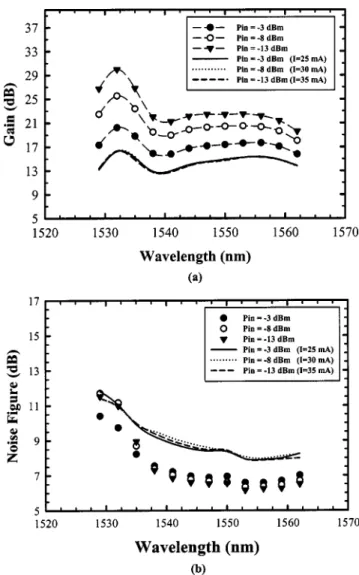
We first examined the performance of the basic gain-clamped configuration, as shown in Fig. 1共a兲. The WDM input signals were simulated by the DFB-LD with three input power levels: pin⫽⫺3, ⫺8, and ⫺13 dBm. Without the backward-injected FP-LD, the data in Fig. 2共a兲, marked by the solid circles, the hollow circles, and the solid tri-angles, show the gain profiles when pin⫽⫺3, ⫺8, and ⫺13 dBm. Clearly, the EDF gain profile varied with different input power without the gain-stabilizing mechanism. The gain stabilization against the DWDM input signals simu-lated at pin⫽⫺3, ⫺8, and ⫺13 dBm was improved when we added the backward-injected FP-LD and adjusted its bias currents at I⫽25 mA 共solid line兲, I⫽30 mA 共dotted line兲, and I⫽35 mA 共dashed line兲, respectively. Over the operating wavelength range from 1526 to 1562 nm, the gain variation for a 10-dB input power-level change共from Fig. 1 The proposed and experimental setup for the dynamic
gain-clamped EDFA module with backward injection of a Fabry-Perot la-ser light. (a) Basic configuration and (b) new configuration with a preamplification stage.
Fig. 2 (a) Measured gain spectra and (b) noise figure degradation
of the basic configuration shown in Fig. 1(a). Without the backward-injected FP-LD, the data marked by the solid circles, the hollow circles, and the solid triangles show the gain profiles when pin⫽⫺3,
⫺8, and⫺13 dBm, respectively. The gain stabilization against the DWDM input signals simulated at pin⫽⫺3,⫺8, and⫺13 dBm was improved when we added the backward-injected FP-LD and ad-justed its bias currents at I⫽25 mA (solid line),I⫽30 mA (dotted line), andI⫽35 mA (dashed line), respectively. However, the noise figures were degraded for the wavelength longer than 1532 nm. COMMUNICATIONS
029701-2
Optical Engineering February 2005/Vol. 44(2)
⫺3 to ⫺13 dBm兲 was suppressed from 9.7 to 0.1 dB; and the maximal gain flatness was reduced from 10.4 to 3.5 dB. However, the injected light from the FP-LD degraded the EDFA noise figure, as shown in Fig. 2共b兲. Without the in-jected FP-LD, the data marked by the solid circles, the hollow circles, and the solid triangles show the noise fig-ures at pin⫽⫺3, ⫺8, and ⫺13 dBm. The noise figures were degraded for the wavelength longer than 1532 nm when a backward-injected FP-LD was added at the same operation conditions.
To overcome the degradation of the noise figure, we subsequently examined the performance of the new gain-clamped configuration with a preamplification stage, shown in Fig. 1共b兲. For comparison, in Fig. 3共a兲 we still show the gain profiles without the backward-injected FP-LD. The data in Fig. 3共a兲, marked by the solid circles, the hollow
circles, and the solid triangles, show the gain profiles when the WDM signal power was simulated at pin⫽⫺3, ⫺8, and ⫺13 dBm. The gain stabilization at these input power lev-els was improved when we added the FP-LD under its bias currents at I⫽20 mA 共solid line兲, I⫽45 mA 共dotted line兲, and I⫽55 mA 共dashed line兲, respectively. Over the operat-ing wavelength range, the gain variation for a 10-dB input power-level change 共from ⫺3 to ⫺13 dBm兲 was sup-pressed from 11.1 to 0.5 dB; and the maximal gain flatness was reduced from 8.5 to 3.5 dB. The gain-stabilizing per-formance of this new developed scheme was slightly down-graded in contrast with that of the basic configuration shown in Fig. 2共a兲. Nevertheless, Fig. 3共b兲 presents a better performance of the noise figure than that of the previous experimental setup when the FP-LD was added. The better noise figure results from the short EDF-1 acting as a pre-amplifier in the entire EDFA system. Figure 4 shows the gain spectra of EDF-1 pumped by a 1480-nm LD with 140-mW pumping power. Obviously, over the operating windows共from 1526 to 1562 nm兲, the lower gain level due to the short EDF length could avoid the gain saturation for preamplification. The gain variation was less than 0.8 dB for the 10-dB input power-level change共from ⫺3 to ⫺13 dBm兲. Moreover, the backward-injected light from the FP-LD was isolated by the optical isolator between the FP-LD and EDF-1. Therefore, our proposed scheme can achieve a dynamic gain-clamped profile for an EDFA and maintain its performance of noise figure against the injected light for gain stabilizing. This setup is simple and would be useful for a practical EDFA system in WDM networks. 4 Conclusion
A gain-stabilizing technique for EDFAs using a backward-injected FP-LD is proposed and experimentally demon-strated. By using the proposed scheme, we not only can stabilize the EDF gain but also can dynamically control the gain profile by adjusting the bias current of the FP-LD. To overcome the problem of noise figure degradation, we pro-pose a configuration of preamplification stage with a short Fig. 3 (a) Measured gain spectra and (b) noise figure of the
pream-plification scheme as shown in Fig. 1(b). The gain-stabilizing perfor-mance of this preamplification scheme was slightly degraded in con-trast with that of the basic configuration shown in Fig. 2(a). Nevertheless, Fig. 3(b) presents the better performance of the noise figure than that of the previous experimental setup when the FP-LD was added.
Fig. 4 Gain spectra of EDF-1 pumped by a 1480-nm LD with
140-mW pumping power. The data marked by the solid circles, the hollow circles, and the solid triangles correspond to the gain profiles when pin⫽⫺3,⫺8, and⫺13 dBm, respectively.
COMMUNICATIONS
029701-3
Optical Engineering February 2005/Vol. 44(2)
EDF. The experimental results show that our configuration can achieve a dynamic gain-clamped profile for an EDFA and improve the performance of noise figure against the injected light for gain stabilization.
Acknowledgment
This work was supported in part by the National Science Council 共NSC兲 of Taiwan under grants NSC 93-2752-E009-009-PAE and NSC 93-2215-E-115-004.
References
1. M. Zimgibl, ‘‘Gain control in erbium-doped fiber amplifiers by an all-optical feedback loop,’’ Electron. Lett. 27, 1110–1116共1992兲. 2. M. Kobayashi and S. Muro, ‘‘Gain stabilization in erbium-doped fiber
amplifier with optical feedback loop using circulators,’’ OECC’98
Tech. Dig., pp. 98 –99共1998兲.
3. H. Okamura, ‘‘Automatic loss compensation with an Er-doped fiber amplifier,’’ J. Lightwave Technol. 10, 1110–1116共1992兲.
4. J. Massicott, C. Lebre, R. Wyatt, R. Kashyap, D. Wiliams, and A. Yu, ‘‘Low noise all-optical gain controlled Er3⫹doped fiber amplifier us-ing asymmetric control laser cavity design,’’ Electron. Lett. 32, 816 – 817共1996兲.
5. C. H. Yeh, C. C. Lee, C. Y. Chen, and S. Chi, ‘‘S-band gain-clamped erbium-doped fiber amplifier by using optical feedback method,’’
IEEE Photonics Technol. Lett. 16共1兲, 90–92 共2004兲.
6. B. Xia et al., IEEE PTL, 15共4兲 共Apr 2003兲.
7. D. M. Baney and J. Stimple, ‘‘WDM EDFA gain characterization with a reduced set of saturating channels,’’ IEEE Photonics Technol. Lett.
8共12兲, 1615–1617 共1996兲.
8. R. I. Laming, M. N. Zervas, and D. N. Payne, ‘‘Erbiun-doped fiber amplifier with 54 dB gain and 3.1 dB noise figure,’’ IEEE Photonics
Technol. Lett. 4共9兲, 1345–1347 共1992兲.
9. C. H. Yeh, C. C. Lee, Y. W. Hsu, and S. Chi, ‘‘Fast wavelength-tunable laser technique based on a Fabry-Perot laser pair with optical inter-injection,’’ IEEE Photonics Technol. Lett. 16共3兲, 891–893
共2004兲.
COMMUNICATIONS
029701-4
Optical Engineering February 2005/Vol. 44(2)