行政院國家科學委員會專題研究計畫 成果報告
體制差異與體制移轉對公司治理與公司表現的影響
研究成果報告(精簡版)
計 畫 類 別 : 個別型 計 畫 編 號 : NSC 99-2410-H-009-024- 執 行 期 間 : 99 年 08 月 01 日至 100 年 07 月 31 日 執 行 單 位 : 國立交通大學財務金融研究所 計 畫 主 持 人 : 潘李賢 計畫參與人員: 碩士班研究生-兼任助理人員:楊珮琪 碩士班研究生-兼任助理人員:陳怡妡 碩士班研究生-兼任助理人員:洪于婷 報 告 附 件 : 國外研究心得報告 出席國際會議研究心得報告及發表論文 處 理 方 式 : 本計畫可公開查詢中 華 民 國 100 年 10 月 30 日
ADR Characteristics and Corporate Governance from the Greater China
Region
Abstract
We examine the relationship between firm valuation and governance mechanisms, firm
characteristics, and institutional factors of American Depository Receipts (ADRs) in the
greater China region listed on the NYSE, AMEX and NASDAQ. We find that Chinese
firms cross-list in the US have the highest market-to-book value followed by Hong Kong
and Taiwan firms. It appears that Chinese firms with the poorest external governance
environment stand to benefit the most by successfully listed under the ADR programs.
Listing in the US that requires more stringent regulations and disclosure rules may
strengthen the firms’ governance practices and thereby enhance their firm value. Among the
internal governance mechanisms, institutional ownership and insider ownership are
important for firm value.
Keywords: External governance environments; Internal governance mechanisms; ADRs;
1. Introduction
Good corporate governance mechanisms are value enhancing. Its importance on firm
value has long been established since the pioneering work of Jensen and Meckling (1976)
in a nexus of contracts among various stakeholders. Under the rubrics of principal-agent
conflicts, Shleifer and Vishny (1997) emphasize that investor protection is crucial. La Porta
et al. (1998, 2000, and 2002) who examine the importance of external governance around
the world show that countries with common laws provide better shareholder protection than
those with civil laws. They document that the difference in the legal regimes and law
enforcement has led to higher valuation of corporate assets in common law regimes.
Recent research has focused on the combined determinants of corporate governance
on firm performance. In particular, board structure (Yermack (1996), Boone, Field, Karpoff,
and Raheja (2007), and Linck, Netter, and Yang (2008)), CEO characteristics (Hermalin
and Weisbach (1998), Basu, Hwang, Mitsudome, and Weintrop (2007), and Brookman and
Thistle (2009)) and ownership structure (Lemmons and Lins (2003), and Ali, Chen and
Radhakrishnan (2007)) have been identified as key determinants of a firm’s governance
practices. Firms with more independent directors and higher managerial ownership are
findings, Gillan’s (2006) provide a comprehensive review of internal and external
governance systems, and their interactions,
In this study, we contribute to the literature as we examine firm performance across
different external governance regimes under the American Depository Receipts (ADRs)
programs. In particular, we examine firm performance from the greater China region,
namely China, Hong Kong, and Taiwan, that cross-list in the US with stronger law
enforcement and investor protection (see La Porta et al. (1998)). This is especially the case
for ADRs under type II and III listings that are required to follow the same stringent
requirements on governance, disclosure requirements, and accounting standards as those of
the U.S. firms especially after the Sarbane-Oxley Act in 2002 (see Durnev and Kim (2005)
and Doidge, Karolyi, and Stulz (2003)).1 It could be argued that ADRs from the greater
China region should benefit from higher market valuation.
Part of our interest in examining the impact of ADRs from the greater China region in
relation to corporate governance on firm value is motivated by the contrasting external
legal environment and the internal governance mechanisms (or the lack of it) among these
markets. Although China’s regulatory framework is evolving rapidly, its external and
internal governance remain the weakest in comparison to Hong Kong and Taiwan (see e.g.
Sun and Tong (2003), Wei (2007), and Tian and Estrin (2008)).2 According to La Porta et
al. (1998), Taiwan which follows civil law regime and with weaker investor protection is
related to poorer governance environment. Hong Kong with its historical ties to common
law regime tends to enjoy stronger legal enforcement.
It follows that while firms within greater China region enjoy close business ties and
trades, their difference in the governance environments should provide a fertile ground to
examine the differential impact of ADR listings on firm value. One would therefore
hypothesize that Chinese ADRs with the weakest governance mechanism may on average
benefit the most in the form of higher firm valuation followed by those from Taiwan and
Hong Kong.
Our results confirm that Chinese ADRs enjoy on average the highest market-to-book
value after controlling for governance measures and firm characteristics. It suggests that
Chinese firms, moving from the poorest external governance regime to the US, tend to
benefit the most via the ADRs experience.
However, Hong Kong ADRs, which enjoy stronger governance at home, has the next
highest market-to-book equity after listing in the US. Taiwan ADRs which come from a
weaker governance regime, on the other hand, appear to gain the least from the region in
terms of market valuation. In our view, these results may be driven by firm effects that exist
between the markets. More specifically, Hong Kong ADRs include both Hong Kong based
firms in private sector and China’s state owned enterprises listed in Hong Kong while all
Taiwan ADRs consist of firms in high-tech industries. This contrast in firm type implies
that Taiwan ADRs are likely to be in more competitive industries compared to Hong Kong
ADRs. As Giroud and Mueller (2011) argue that product market competition is a good
substitute of governance, Taiwan ADRs should therefore experience stronger governance. It
follows that Hong Kong ADRs which tend to be in less competitive industries and weaker
governance should benefit more than Taiwan ADRs from the ADR listings.
Among the governance measures, institutional investor ownership and insider
ownership are important for firm value. The results are consistent with prior studies (e.g.
McConnell and Servaes (1990), Hartzell and Starks (2003), and Cornett et al. (2007)), that
higher insider ownership reduces potential agency conflicts between insiders and minority
shareholders, and institutional ownership seems to play an effective monitoring role for
privatization in China is positively related to firm performance but state ownership is
negatively related to firm performance.
The remainder of the paper is organized as follows. Section 2 provides an overview of
the corporate governance environment in the greater China region. Section 3 and 4
discusses the sample and methodology respectively. Empirical results are reported in
Section 5 and Section 6 concludes the paper.
2. Corporate Governance in the Greater China Region
2.1 China
China’s legal regime can inherently be traced to German’s civil-law which is on
average weaker than English’s common-law in terms of investor protection (La Porta et al.
(1998)). Coupled with high proportion of state ownership and control for publicly listed
firms, corporate governance environment in China is arguably the weakest of the three
markets in the region (see Sun and Tong (2003), Wei (2007), and Tian and Estrin (2008)).3
Since 1990s, China adopts a two-tier board structure that comprises the board of
directors and the supervisory board to improve governance. The aim is to impose a
two-layer oversight on the duty and performance of senior management. That is, the
supervisory board monitors and evaluates the performance of senior managers and the
board of directors who in turn monitor senior managers. The governance of board structure
has further been strengthened after the Code of Corporate Governance for Listed
Companies in China was in introduced in 2002 that requires some independence of
directors on the board, and qualifications and knowledge of members of supervisory
boards.
However, Wei (2007) contends that although these governance measures are put in
place, the board is still characterized by insider control and weak independence. Tam
(2002), Lin (2004), and Wang (2007) also find that supervisory boards are ineffective in
playing their roles of overseeing the performance of directors and managers.
The lack of independence of directors and supervisory members is perhaps not
surprising as the predecessors of Chinese listed firms are mostly state-owned enterprises
(SOEs). Managers of these former SOEs are likely to be appointed as directors. It follows
that directors are rarely independent and managers tend to dominate the governance of the
board. Similarly, most supervisory members are considered insiders because they tend to
Dahya et al. (2003)). Furthermore, the supervisory board has limited access to firm
information and has no power in removing directors and managers (see Lin (2004) and
Wang (2007)).
Despite the partial privatization of SOEs, much of the ownership structure of Chinese
firms remains in the hands of the state, with the majority of shares outstanding held by the
state as non-tradable shares. Institutional ownership may therefore play a relatively more
important role on firm performance especially in China. Consistent with this argument,
Chen et al. (2006) examine the effect of outside directors on corporate fraud and document
that Chinese firms with a higher percentage of outside directors such as those by
institutional investors tend to reduce corporate fraud. Zhang et al. (2001) and Xu et al.
(2005) also show that foreign ownership is positively related to the efficiency of Chinese
industrial firms.
2.2 Hong Kong
Unlike China, Hong Kong follows the common-law regime, or the Anglo-Saxon legal
and governance system. La Porta et al. (1998) show that common-law countries provide
other types of legal regimes. Within the common-law countries, Hong Kong scores well
above the average in efficiency of judicial system, rule of law, and the level of corruption.
Cheung et al. (2007) suggest that stock market in Hong Kong shares similar characteristics
and practices observed in developed economies. International rating agencies rank Hong
Kong as one of the more advanced markets in the Asia-Pacific region.
However, firms in Hong Kong are characterized by less diffused ownership structure
than firms in developed markets. They tend to be family owned and managed by family
members as commonly found in the region. It is common that the chairman of the board is
also the chief executive officer of the firm. Agency conflicts may therefore arise from this
particular type of ownership structure between controlling families and minority
shareholders.
Since 2005, each publicly listed firm in Hong Kong is required to have a minimum of
three independent non-executive directors on its board. Such requirement may reduce
agency costs of the firm as outsiders tend to play a more effective role in monitoring
managers. In sum, corporate governance external environment and governance practices in
2.3 Taiwan
Similar to China, Taiwan’s legal origin comes from German civil law. La Porta et al.
(1998) report that Taiwan’s efficiency of judicial system and corruption are poorly ranked
compared to those of other countries in German legal origin and weaker legal families. The
overall poor investor protection in Taiwan due to poor investor protection suggests that
internal governance may play a more critical role.
Following the German corporate governance structure, board members in a Taiwanese
firm consist of both directors and supervisors. The role of supervisors is to monitor
directors on their corporate decisions and to review and audit reports prepared for the
shareholders. However, the supervisory board is not as independent as in the German’s
two-tier system. Its members can be elected from family members of current employees
and directors.
Lee and Yeh (2004) emphasize that controlling families in Taiwan may also set up
nominal investment firms to increase their controls by sending family members or their
designated persons to the board after the investment firms are elected for the positions of
directors and/or supervisors. With these governance practices by controlling families,
ownership and family control. They find that 64% of firms in Taiwan do not appoint an
independent director and another 21% of firms hire only one independent director despite
the mandatory requirement of two independent directors for IPO firms in 2002.
Given the considerations of legal regimes and internal governance that vary across the
Greater China Region, it could be argued that firms in Hong Kong on average tend to
associate with the strongest governance mechanisms while those in China tend to exhibit
the weakest governance practices.
3. Data and Variable Definitions
3.1 Sample
Sample ADRs from China, Hong Kong, and Taiwan listed on NYSE, AMEX, and
NASDAQ and their financial data are obtained from Factset database. Our sample period
begins from 2005 after these markets adopt governance measures similar to those in
Sarbanes Oxley Act, and ends in 2010. After removing ADRs that contain missing financial
and governance information and therefore do not meet our data requirement, we collect 48
Chinese ADRs, 18 Hong Kong ADRs, and 8 Taiwan ADRs for a total of 74 ADRs and 444
both Hong Kong and Taiwan. All of the ADRs in the sample belong to either type II or III
listing which is required to adopt the US disclosure and governance rules.
A closer look at the sample reveals that the firm type of ADRs varies across these three
markets. For example, Chinese ADRs are predominately related to state owned enterprises
over a range of diverse industries. Hong Kong ADRs, on the other hand, consists of both
firms in the private sector and China’s state owned enterprises initially listed in Hong Kong
across different industries. In contrast, all Taiwan ADRs come from high-tech sector. As a
result, their listings are either on NYSE and NASDAQ rather than across all three
exchanges.
3.2 Market-to-Book Ratio
Following Chen et al. (2006), Harford et al. (2008), Cheung et al. (2008), and Linck et
al. (2008), we use market-to-book value ratio (M/B) for measuring firm performance.
Demsetz and Villalonga (2001) suggest that market-based measures such as M/B are more
preferable than accounting-based profit ratios (i.e. ROA and ROE) because the former are
forward looking measures of corporate performance whereas the latter are backward
may apply differently to valuing tangible and intangible capitals and taxation systems may
vary with firms of different ownership structure. In contrast, M/B should fairly reflect
future profitability of a firm by markets without the accounting constraints. Furthermore,
M/B tends to capture markets’ views on governance mechanisms as a means to reduce
agency costs and enhance corporate performance.
For explanatory variables of M/B, we follow extant literature and categorize measures
of governance mechanisms, firm characteristics, and institutional factors into 6 groups as
follows: board structure, CEO characteristics, ownership structure, firm characteristics,
country dummies, and stock exchange dummies. These measures are defined in Appendix I.
3.3 Board Structure
We include percentage of independent directors, CEO duality, and non-executive
chairman when the chairman is not an executive member of the company for measures
under board structure. Independent directors are non-executive or non-employee directors
who may play a more effective role in monitoring management to meet shareholders’
expectations. Borokhovich et al. (1996), Krivogorsky (2006), and Adams and Ferreira
performance.
When the CEO is also the chairman of the board, Fama and Jensen (1983) contend that
it may impede the effectiveness of board monitoring as the decision making and control is
endowed within one individual. Rechner and Dalton (1991), and Bhagat and Bolton (2008)
show that non-duality firms outperformed duality firms. Bai, Liu, Lu, Song, and Zhang
(2004) also report a negative relationship between CEO duality and market value for
Chinese firms.
3.4 CEO characteristics
CEO characteristics refer to the number of years that a CEO has held the position.
Hermalin and Weisbach (1991) suggest that CEO tenure does not seem to affect firm
profitability for shorter CEO tenures but firm profitability declines when CEO tenure is
more than 15 years. In a follow-up study, Hermalin and Weisbach (1998) conclude that
board independence will generally decline with CEO tenure. When a CEO has worked for
the company for a longer period of time, they tend to have more influence on the directors
of the board, which is detrimental to board independence and the effectiveness of
On the other hand, CEO tenure may proxy for board leadership and measures the
extent of CEO experience that may help companies to tackle difficulties and increase
profits. This argument is supported by Linck et al. (2008) and Brookman and Thistle (2009)
who show that CEO tenure has a positive effect on firm performance.
3.5 Ownership Structure
Insiders include employees, directors, and managers who enjoy information advantage
about the firm over the market. McConnell and Servaes (1990) suggest that insider
ownership may also perform a monitoring role for the firm. Therefore, as the share
ownership of insider ownership increases and that their interests are more aligned with
those of shareholders, the cost of monitoring tends to be lowered.
Conversely, firms whose managers have high levels of control rights (relative to cash
flow rights) experience lower stock returns. Lemmon and Lins (2003) show that ownership
structure of firms in eight East Asian countries plays an influential role in wealth
expropriation of insiders from minority shareholders. In examining the relation between
ownership and market value among Chinese firms, Bai et al. (2004) report that high
Based on the findings, we include percentage of institutional ownership and insider
ownership as proxies for ownership structure. However, McConnell and Servaes (1990)
suggest that when the percentage of insider ownership reaches a threshold, an increase in
insider ownership may decrease firm value. Hence, we also include a squared term of
insider ownership as a measurement of the potential non-linear relationship between
percentage of insider ownership percentage and firm profitability.
3.6 Firm Characteristics and Institutional Factors
We further include firm-specific and institutional control variables to isolate the effect
of governance measures on firm performance. They include debt-to-equity ratio, trading
volume, company age, and firm size (natural log). Country dummies (CHINA,
HONGKONG, and TAIWAN) as discussed in Section 2, and stock exchanges dummies
(NYSE, AMEX, and NASDAQ) are used to control for the fixed effects of the countries
and stock exchanges.
4. Empirical Results
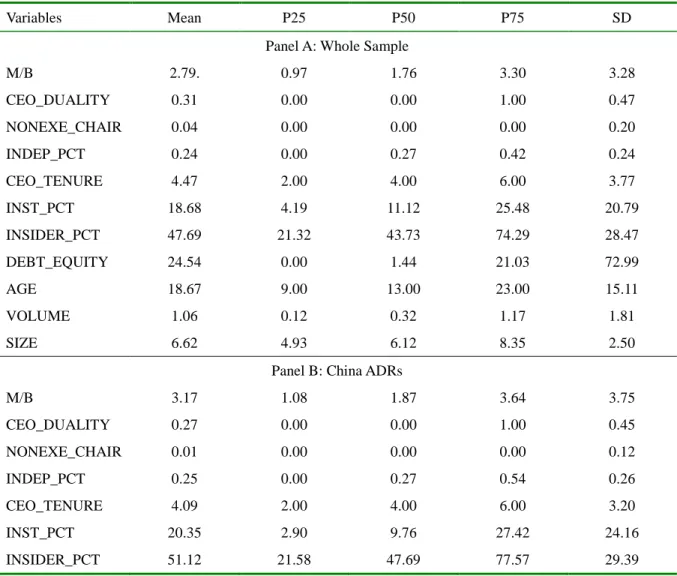
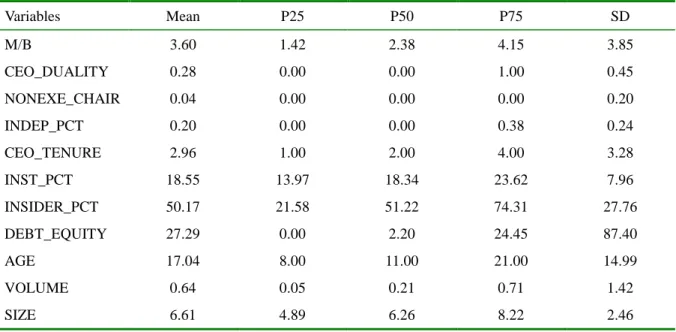
We first present the summary statistics of the sample ADRs in Table 1. Panel A reports
the aggregate statistics for the whole sample, and Panel B, C, and D report for individual
market of China, Hong Kong, and Taiwan respectively.
We find that the average market-to-book value (M/B) ratio is 2.79 for the whole sample,
a high market valuation relative to book value. It implies that the sample ADRs with high
market valuation are perhaps seeking external funding and/or increasing investor base
beyond their local markets by listing in the U.S. stock exchanges. Among them, those from
China enjoy the highest market-to-book ratio of 3.17, followed by those from Taiwan of
1.99 and Hong Kong of 1.96. Firms from the weakest external governance regime (i.e.
China) appear to enjoy the highest market valuation relative to those from stronger
governance regime.
Consistent with the literature that CEO duality is more common in the region than in
the US or UK, thirty-one percent of the sample ADRs appoint their CEOs as the chairman
of the board (CEO_DUALITY) and only four percent with non-executive chairman
(NONEXE_CHAIR). As discussed in Section 2, firms in Hong Kong and Taiwan are more
likely to be family-controlled such that CEOs who tend to be a family member also serve as
those in Hong Kong and Taiwan, it remains high by western standards.
The average age of sample ADRs is more than 18 years across which Hong Kong
ADRs are on average more mature (20.77 years) than their counterparts (18.05 and 17.75
years for China and Taiwan respectively). Compared to the average ADR age, the average
CEO tenure is only 4.47 years that range from 4.09 years of Chinese ADRs to 6.17 years of
Taiwan ADRs, implying frequent CEO turnovers.
Since regulations in all three markets require mandatory independent directors, the
average percentage of independent directors is relatively high at 24 percent. However, the
variability across these three markets appears to be small, with the highest percentage of
independent directors of 26 percent found among Taiwan ADRs.
Insider ownership on average nears 50 percent, driven largely by high insider
ownership of China and Hong Kong ADRs that are above 50 percent. In contrast, Taiwan
ADRs are skewed towards computer-related firms characterized by more diffused
ownership. Its average insider ownership is a relatively low of 20 percent.
Finally, institutional investors seem to actively invest in ADRs. They hold an average
of 18.68 percent of total shares outstanding. Most noticeably, China and Taiwan ADRs
Kong ADRs. It appears that institutional investors in recent years have shown more interest
in Chinese firms. Taiwan ADRs which tend to be computer-related firms also appear to
draw a similar level of interest.
4.2 Univariate Results
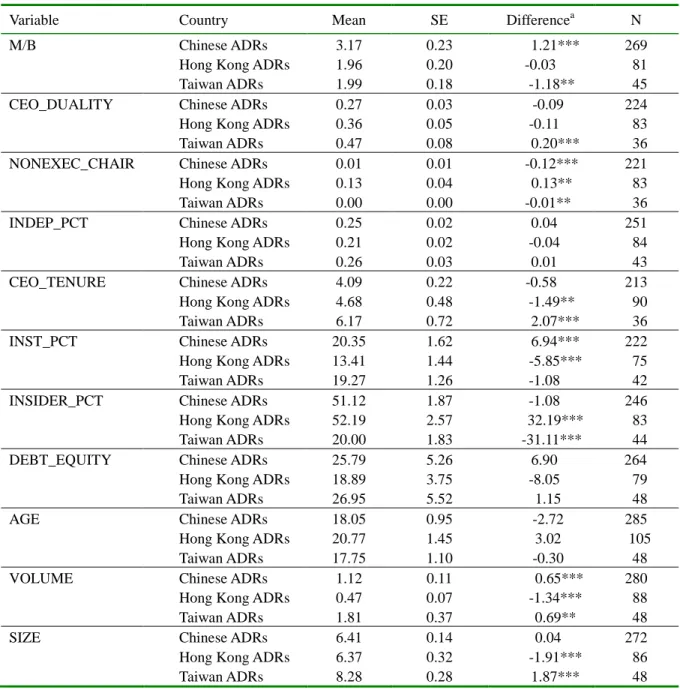
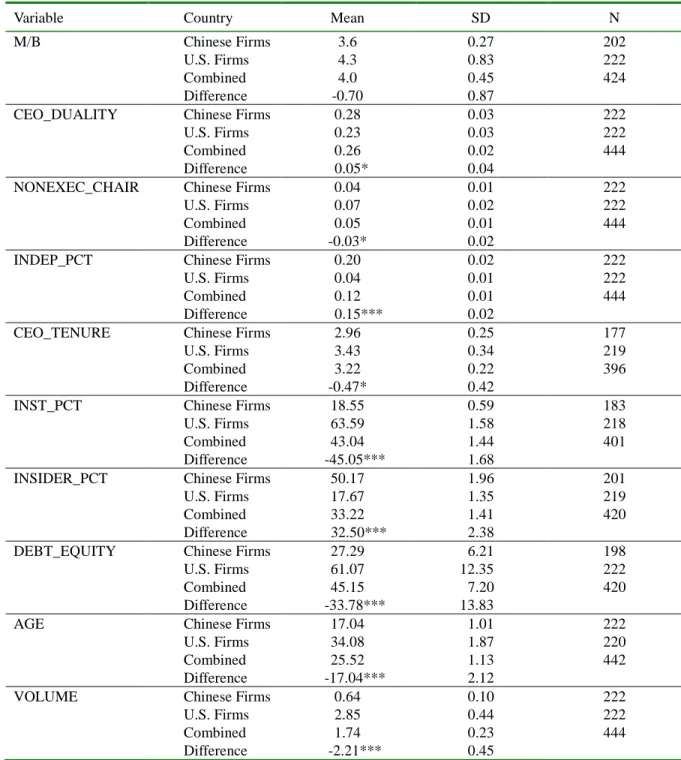
Table 2 reports the results of differences in means of M/B, governance measures, and
firm characteristics among Chinese, Hong Kong, and Taiwan ADRs reported in Table 1.
The first row for each variable shows the statistical difference, if any, between Chinese and
Hong Kong ADRs. The second row reports the difference between Hong Kong and Taiwan
ADRs while the third row reports the difference between Taiwan and Chinese ADRs.
Among the ADRs from the three markets, Chinese ADRs exhibit higher market
valuations than Hong Kong and Taiwan ADRs. There appears however little difference in
M/B between Hong Kong and Taiwan ADRs. We find that very few firm characteristics or
internal governance measures shown in Table 2 are consistent with the differences in M/B.
The country of domicile where external governance environment differs significantly
between China and the other two markets remains the primary candidate to explain the
Before we estimate multivariate regression analysis on the effect of governance
measures on firm performance, we calculate the correlations between governance measures
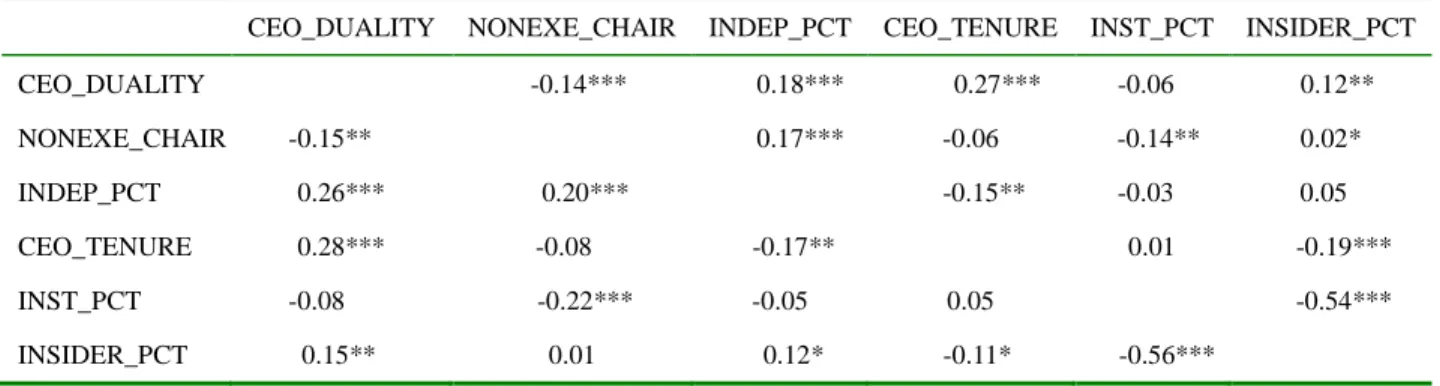
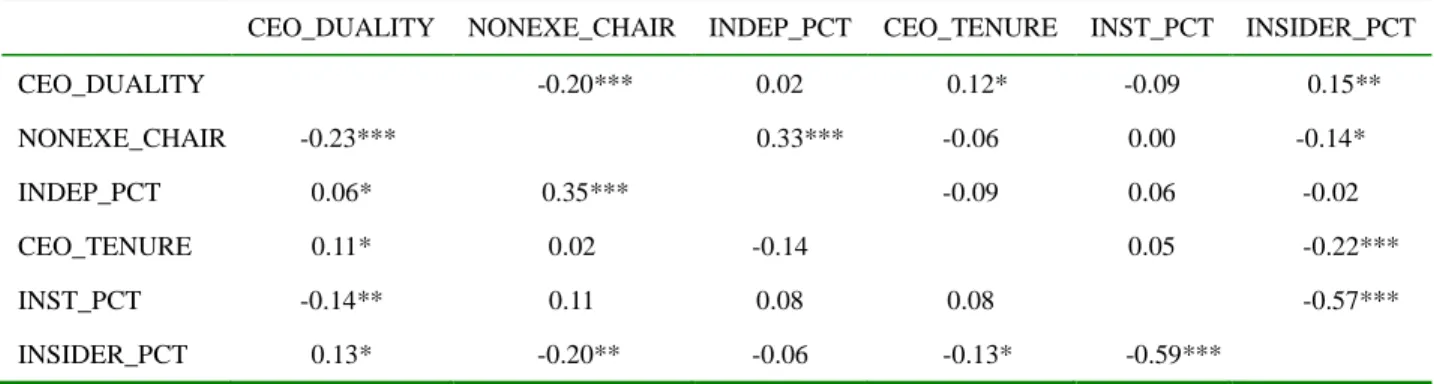
to examine potential multicollinearity problems. Table 3 presents the correlations using
both Pearson (in upper diagonal) and Spearman rank (in lower diagonal) estimates.
The cross correlations between the six governance variables are generally low with the
exception between institutional and insider ownership (0.54 or 0.56). These two measures
are however expected to contrast each other because a higher proportional of insider
ownership implies a lower institutional ownership. Institutional investors also become less
important in monitoring managers as agency costs tend to be lower when insiders hold a
higher proportion of share ownership. To ensure regression results are robust to the
potential multicollinearity problem, we run several regression estimates with various
combinations of controlled variables.
4.3 Regression Results
Sequel to the preliminary results, we estimate the following regressions to examine the
i
i BS CEO OS CC CD SD
B
M/ =α +β1 +β2 +β3 +β4 +β5 +β6 +ε (1)
where M /Biis market-to-book value ratio for firm i ; BS , CEO, OS, and CCare
vectors of board structure variables, CEO characteristics, ownership structure, and
company characteristics respectively; CDand SDare dummy variables for countries and
stock exchanges respectively; εi is the error term.
One common problem in examining the relationship between corporate governance and
firm performance is the potential endogeneity effect of governance measures documented
in Himmelberg et al. (1999), Cho (1998), and Bhagat and Bolton (2008). An increase in
firm value may lead to better governance practices rather than what is being investigated
here. To address such effect, we use firm size, debt-to-equity ratios, and return on equity as
instrument variables for institutional ownership. We then use the predicted institutional
ownership in the regression analysis. Furthermore, we consider lagged market-to-book ratio,
lagged leverage, and lagged board structure. Results using these instruments are robust to
those reported in this section. We also follow Black, et al. (2006) and Petersen (2008) by
applying adjusted standard errors due to the correlations between the same companies in
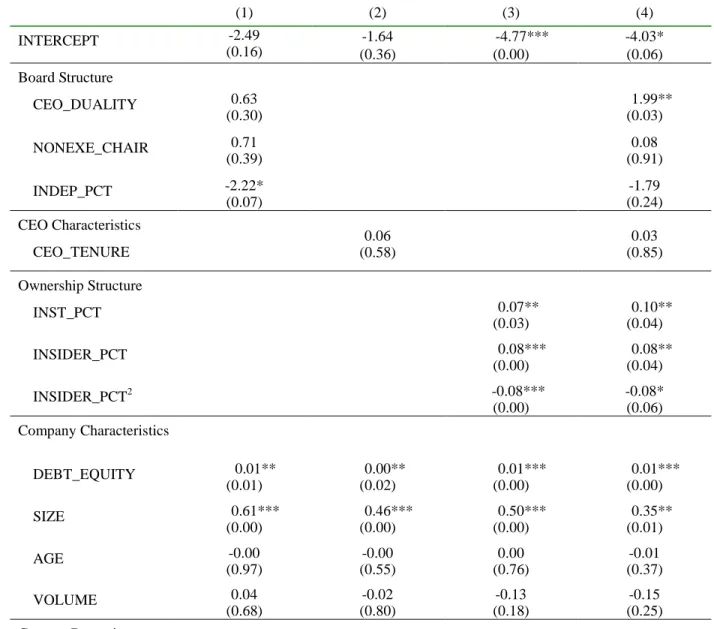
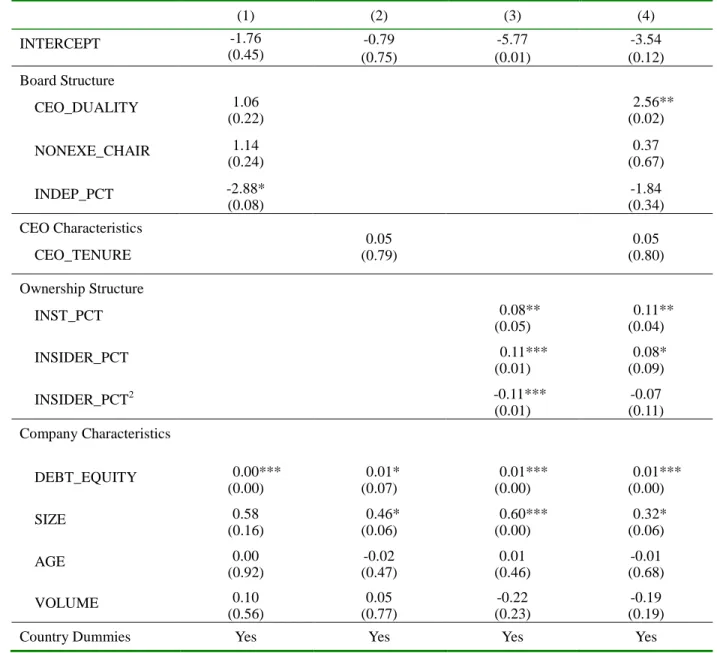
Table 4 reports the regression results based on Eq. (1). Column 1 first shows the effect
of board structure along with firm characteristics, country dummies, and exchange
dummies on market-to-book value ratio (M/B). Among the measures for board structure,
only percentage of independent directors (INDEP-PCT) is marginally but negatively
significant at the 10 percent level. The negative relation therefore contradicts the standard
agency theory which posits that an increase in the proportion of independent directors
reduces principal-agent conflicts. Including other governance measures however shows that
it is not an important consideration for market valuation (see column 4 in Table 4).
Similar to board structure measures, the duration of CEO tenure as shown in columns 2
and 4 carries little consequence on ADR performance. Given that the average time period is
4.47 years (see Table 1), the short CEO tenure and its lack of variability across ADRs may
explain why it fails to account for firm performance.
For the effect of ownership structure, we include the percentage of institutional and
insider ownership. Since the effect of insider ownership may potentially be curvilinear, we
also include a square term. Columns 3 and 4 of Table 4 show that these two governance
mechanisms are positively related to M/B ratio. While these results are consistent with the
conflict between management and minority shareholders, their relationships do not appear
to be economically significant. An increase of one standard deviation in insider ownership
and institutional ownership corresponds with 2.1 percent and 2 percent in M/B respectively.
It suggests that their impacts on market valuation are limited.
In contrast to the limited effects of governance measures and firm characteristics, we
find that country of domicile explains greater variations in the M/B ratio. Reported in Table
4, Chinese ADRs experience significantly higher M/B than both Hong Kong and Taiwan
ADRs. In fact, switching from Chinese ADRs to either Hong Kong or Taiwan ADRs on
average lowers market equity relative to book equity by more than a factor of 1. As China
has the weakest governance environment in the greater China region, Chinese firms under
the ADR programs have the most to benefit from listing in the US.
However, Hong Kong ADRs enjoy higher market valuation than Taiwan ADRs after
listing in the US. This result appears to contradict the hypothesis that ADRs from a weaker
governance regime should benefit more from the ADR programs. However, when we
investigate firm types between Hong Kong and Taiwan ADRs, we find that Hong Kong
ADRs are made up of both Hong Kong based firms in the private sector and China’s state
firms in high-tech industries. The apparent firm effects suggest that Taiwan ADRs are likely
to be in more competitive industries compared to Hong Kong ADRs. As Giroud and
Mueller (2011) argue that product market competition is a good substitute of governance,
Taiwan ADRs should on average experience stronger governance. Consequently, Hong
Kong ADRs with weaker governance on average tend to gain more from ADR listings.
5. Conclusion
In their seminal papers on corporate governance, La Porta et al. (1998, 2000, and 2002)
show that external governance regime is an important determinant for firm performance.
Stronger governance that provides better investor protection leads to higher firm value. We
extend their studies by comparing the performance of firms from the greater China region
that cross-list in the US under the ADR programs. In particular, we compare firm valuation
between ADRs from China, Hong Kong , and Taiwan, which although share close business
and trade ties differ significantly in their external governance backgrounds.
Consistent with the extant literature, we find that Chinese firms with the weakest
governance environment tend to gain the most under the ADR programs after subject to the
and Taiwan experience relatively lower market valuation due to their stronger external
governance environments at home.
Despite the importance of some firm characteristics and internal governance
mechanisms on firm value, our results suggest that the impact of external governance
backgrounds far outweighs those within the firms. They imply that policy efforts should be
directed more at the macro level than at the firm level as the former appears to be more
References
Adams, R., and D. Ferreira, 2007, “A theory of friendly boards,” Journal of Finance, Vol.
62, pp. 217–250.
Ali, A., T.Y. Chen, and S. Radhakrishnan, 2007, “Corporate disclosures by family firms,”
Journal of Accounting and Economics, Vol. 44, pp. 238-286.
Bai, C.E., Q. Liu, J. Lu, F. M. Song, and J. Zhang, 2004, “Corporate governance and
market valuation in China,” Journal of Comparative Economics, Vol. 32, pp. 599-616.
Basu, S., L.S. Hwang, T. Mitsudome, and J. Weintrop, 2007, “Corporate governance, top
executive compensation and firm performance in Japan,” Pacific-Basin Finance Journal,
Vol. 15, pp. 56-79.
Bhagat, S., and B. Bolton, 2008, “Corporate governance and firm performance,” Journal of
Corporate Finance, Vol. 14, pp. 257-273.
Black, B. S., I. Love, and A. Rachinsky, 2006, “Corporate governance indices and firms’
market values: Time series evidence from Russia,” Emerging Markets Review, Vol. 7, pp.
361-379.
Boone, A. L., L.C. Field, J. M. Karpoff, and Charu G. Raheja, 2007, “The determinants of
Studies, Vol. 85, pp. 66-101.
Borokhovich, K.A., R. Parrino, and T. Trapani, 1996, “Outside directors and CEO
selection,” Journal of Financial and Quantitative Analysis, Vol. 31, pp. 337–355.
Brookman, J. and P. D. Thistle, 2009, “CEO tenure, the risk of termination and firm value,”
Journal of Corporate Finance, Vol. 15, pp. 331-344.
Chen, G., M. Firth, D. N. Gao, and O. M. Rui, 2006, “Ownership structure, corporate
governance, and fraud: Evidence from China,” Journal of Corporate Finance, Vol. 12,
pp. 424-448.
Cheung, Y.L., J.T. Connelly, P. Limpaphayom, and L. Zhou, 2007, “Do investors really value
corporate governance? Evidence From the Hong Kong market,” Journal of International
Financial Management and Accounting 18, 86-122.
Cheung, Y.L., P. Jiang, P. Limpaphayom, and T. Lu, 2008, “Does corporate governance
matter in China?” China Economic Review, Vol, 19, pp. 460-479.
Cho, M.H., 1998, “Ownership structure, investment, and the corporate value: An empirical
analysis,” Journal of Financial Economics, Vol. 47, pp. 103-121.
Cornett, M. M., Marcus, A. J., Saunders, A., & Tehranian, H. (2007). “The impact of
Finance, 31, 1771-1794.
Dahya, J., Y. Karbhari, J. Z. Xiao, and M. Yang, 2003, “The usefulness of the supervisory
board report in China,” Corporate governance: an international review, Vol.11, pp.
308-321.
Demsetz, H. and B. Villalonga, 2001, “Ownership structure and corporate performance,”
Journal of Corporate Finance, Vol. 7, pp. 209-233.
Doidge, C. A., G. A. Karolyi, and R. M. Stulz, 2003, “Why are foreign firms listed in the
U.S. worth more?” Journal of Financial Economics, Vol. 71, pp. 205-238.
Durnev, Art, and E. Han Kim, 2005, “To steal or not to steal: firm attributes, legal
environment, and valuation,” Journal of Finance, Vol. 60, pp. 1461-1493.
Fama, E. F., and M. C. Jensen, 1983, “Separation of ownership and control,” Journal of
Law and Economics, Vol. 26, pp. 301-325.
Gillan, S. L., 2006, “Recent developments in corporate governance: an overview,” Journal
of Corporate Finance, Vol. 12, pp. 381-402.
Giroud, X. and H. Mueller, 2011, “Corporate governance, product market competition, and
equity price,” Journal of Finance, 66, 563-600.
holdings in the U.S.,” Journal of Financial Economics, Vol. 87, pp. 535-555.
Hartzell, Jay C., and Laura T. Starks, 2003, “Institutional investors and executive
compensation,” Journal of Finance, Vol. 58, pp. 2351-2374.
Hermalin, B. E., and M. S. Weisbach, 1991, “The effects of board composition and direct
incentives on firm performance,” Financial Management, Vol. 20, pp. 101-112.
Hermalin, B.E., and M. S. Weisbach, 1998, “Endogenously chosen boards of directors and
their monitoring of the CEO,” American Economic Review, Vol. 88, pp. 96-118.
Himmelberg, C. P., R. G. Hubbard, and D. Palia, 1999, “Understanding the determinants of
managerial ownership and the link between ownership and performance,” Journal of
Financial Economics, Vol. 53, pp. 353-384.
Jensen, M. C. and W.H. Meckling, 1976, “Theory of the firm: Managerial behavior, agency
costs and ownership structure,” Journal of Financial Economics, Vol. 3, pp. 305-360.
Krivogorsky, V., 2006, “Ownership, board structure, and performance in continental
Europe,” The International Journal of Accounting, Vol. 41, pp. 176-197.
La Porta, R., F. Lopez-de-Silanes, A. Shleifer, and R.W. Vishny, 2002, “Investor protection
and corporate valuation,” Journal of Finance,Vol. 57, pp. 1147-1170.
and corporate governance,” Journal of Financial Economics, Vol. 58, Issue 1, pp. 3-27.
La Porta, R., F. Lopez-de-Silanes, A. Shleifer, and R. W. Vishny, 1998, “Law and finance,”
Journal of Political Economy, Vol. 106, Issue 6, pp. 1113-1155.
Lee, Tsun-Siou and Yin-Hua Yeh, 2004, “Corporate governance and financial distress:
evidence from Taiwan,” Corporate Governance: An International Review, Vol. 12, Issue
3, pp. 378-388.
Lemmon, M. and K. Lins, 2003, “Ownership structure, corporate governance, and firm
value: Evidence from the East Asian financial crisis,” Journal of Finance, Vol. 58, Issue
4, pp. 1445-1468.
Lin, T.W., 2004, “Corporate governance in China: recent developments, key problems, and
solutions,” Journal of Accounting and Corporate Governance, Vol. 1, pp. 1-23.
Linck, J. S., J. M. Netter, and T. Yang, 2008, “The determinants of board structure,”
Journal of Financial Economics, Vol. 87, pp. 308-328.
McConnell, J. J., and H. Servaes, 1990. “Additional evidence on equity ownership and
corporate value,” Journal of Financial Economics, Volume 27, pp. 595-612.
Petersen, M. A., 2008, “Estimating standard errors in finance panel data sets: comparing
Rechner, P.L., and D.R. Dalton, 1991, “Research notes and communications CEO duality
and organizational performance: A longitudinal analysis,” Strategic Management
Journal, Vol. 12, pp. 155-160.
Sun, Q. and W.H.S. Tong, 2003, “China share issue privatization: the extent of its success,”
Journal of Financial Economics, Vol. 70, pp. 183-222.
Shleifer, A., and R. W. Vishny, 1997, “A survey of corporate governance,” Journal of
Finance, Vol. 52, pp. 737-783.
Tam, O.K., 2002, “Ethical issues in the evolution of corporate governance in China,”
Journal of Business Ethics, Vol. 37, pp. 303-320.
Tian, L. and S. Estrin, 2008, “Retained state shareholding in Chinese PLCs: does
government ownership always reduce corporate value?” Journal of Comparative
Economics, Vol. 36, pp. 74-89.
Wang, J., 2007, “The strange role of independent directors in a two-tier board structure of
China‘s listed companies,” Compliance and regulatory journal, Vol. 3, pp. 47-55.
Wei, G., 2007, “Ownership structure, corporate governance and company performance in
China,” Asia Pacific Business Review, Vol. 13, pp.519-545.
reform: evidence from China,” Economics of transition, Vol. 13, 1-24.
Yermack, D., 1996, “Higher market valuation of companies with a small board of
directors,” Journal of Financial Economics, Vol. 40, pp. 185-211.
Young, C. S., L. C. Tsai, and P. G. Hsieh, 2008, “Voluntary Appointment of Independent
Directors in Taiwan: Motives and Consequences,” Journal of Business Finance and
Accounting, Vol. 35, Issue 9-10, pp. 1103-1137.
Zhang, A., Y. Zhang, and R. Zhao, 2001, “Impact of ownership and competition on the
productivity of Chinese enterprises,” Journal of Comparative Economics, Vol. 29,
Table 1. Summary Statistics of the Sample Firms
This table presents the summary statistics of ADRs in the greater China region during 2005-2010. M/B is the stock price per share divided by book value per share. CEO_DUALITY is a dummy variable that equals one when the CEO is also the chairman of the board, and zero otherwise. NONEXE_CHAIR is a dummy variable that equals one when the chairman of the board is not an executive member, and zero otherwise. INDEP_PCT is the percentage of independent directors on the board. CEO_TENURE is the number of years the CEO has held his/her title. INST_PCT is the number of shares held by institutional investors as a percentage of the current total shares outstanding. INSIDER_PCT is the number of shares held by insiders as a percentage of the current total shares outstanding. DEBT_EQUITY is the long-term debt-to-equity ratio; SIZE is the natural log of market capitalization, where the firm's market value is measured in millions of dollars. AGE is the number of years since the company starts (up to 2010). VOLUME is the 52-week average of the volume of shares traded.
Variables Mean P25 P50 P75 SD
Panel A: Whole Sample
M/B 2.79. 0.97 1.76 3.30 3.28 CEO_DUALITY 0.31 0.00 0.00 1.00 0.47 NONEXE_CHAIR 0.04 0.00 0.00 0.00 0.20 INDEP_PCT 0.24 0.00 0.27 0.42 0.24 CEO_TENURE 4.47 2.00 4.00 6.00 3.77 INST_PCT 18.68 4.19 11.12 25.48 20.79 INSIDER_PCT 47.69 21.32 43.73 74.29 28.47 DEBT_EQUITY 24.54 0.00 1.44 21.03 72.99 AGE 18.67 9.00 13.00 23.00 15.11 VOLUME 1.06 0.12 0.32 1.17 1.81 SIZE 6.62 4.93 6.12 8.35 2.50
Panel B: China ADRs
M/B 3.17 1.08 1.87 3.64 3.75 CEO_DUALITY 0.27 0.00 0.00 1.00 0.45 NONEXE_CHAIR 0.01 0.00 0.00 0.00 0.12 INDEP_PCT 0.25 0.00 0.27 0.54 0.26 CEO_TENURE 4.09 2.00 4.00 6.00 3.20 INST_PCT 20.35 2.90 9.76 27.42 24.16 INSIDER_PCT 51.12 21.58 47.69 77.57 29.39
DEBT_EQUITY 25.79 0.00 0.50 18.42 85.43
AGE 18.05 9.00 12.00 20.00 16.09
VOLUME 1.12 0.10 0.31 1.27 1.84
SIZE 6.41 4.95 5.91 7.82 2.30
Panel C: Hong Kong ADRs
M/B 1.96 0.61 1.46 2.61 1.83 CEO_DUALITY 0.36 0.00 0.00 1.00 0.48 NONEXE_CHAIR 0.13 0.00 0.00 0.00 0.34 INDEP_PCT 0.21 0.00 0.21 0.40 0.20 CEO_TENURE 4.68 2.00 4.00 6.00 4.55 INST_PCT 13.41 3.03 8.98 22.26 12.51 INSIDER_PCT 52.19 27.03 64.41 70.19 23.48 DEBT_EQUITY 18.89 0.00 4.53 22.49 33.30 AGE 20.77 10.00 15.00 31.00 14.84 VOLUME 0.47 0.05 0.19 0.51 0.70 SIZE 6.37 4.18 5.64 8.90 2.99
Panel D: Taiwan ADRs
M/B 1.99 1.29 1.88 2.62 1.18 CEO_DUALITY 0.47 0.00 0.00 1.00 0.51 NONEXE_CHAIR 0.00 0.00 0.00 0.00 0.00 INDEP_PCT 0.26 0.00 0.33 0.38 0.20 CEO_TENURE 6.17 3.00 5.00 7.50 4.32 INST_PCT 19.26 12.49 18.32 25.48 8.17 INSIDER_PCT 20.00 7.72 18.94 36.28 12.17 DEBT_EQUITY 26.95 0.08 4.38 49.84 38.23 AGE 17.75 11.00 17.00 24.50 7.60 VOLUME 1.81 0.54 0.95 1.89 2.58 SIZE 8.28 7.06 8.81 9.56 1.97
Table 2. Sample Comparison among Chinese, Hong Kong, and Taiwan ADRs
This table provides sample mean comparisons and t-test values for Chinese, Hong Kong and Taiwan ADRs listed during 2005-2010. *** and ** denote significance levels of 1% and 5% respectively. a reports difference in means in the following order: between Chinese ADRs and Hong Kong ADRs, between Hong Kong ADRs and Taiwan ADRs, and between Chinese ADRs and Taiwan ADRs.
Variable Country Mean SE Differencea N
M/B Chinese ADRs 3.17 0.23 1.21*** 269
Hong Kong ADRs 1.96 0.20 -0.03 81 Taiwan ADRs 1.99 0.18 -1.18** 45
CEO_DUALITY Chinese ADRs 0.27 0.03 -0.09 224
Hong Kong ADRs 0.36 0.05 -0.11 83 Taiwan ADRs 0.47 0.08 0.20*** 36 NONEXEC_CHAIR Chinese ADRs 0.01 0.01 -0.12*** 221 Hong Kong ADRs 0.13 0.04 0.13** 83 Taiwan ADRs 0.00 0.00 -0.01** 36
INDEP_PCT Chinese ADRs 0.25 0.02 0.04 251
Hong Kong ADRs 0.21 0.02 -0.04 84
Taiwan ADRs 0.26 0.03 0.01 43
CEO_TENURE Chinese ADRs 4.09 0.22 -0.58 213
Hong Kong ADRs 4.68 0.48 -1.49** 90 Taiwan ADRs 6.17 0.72 2.07*** 36 INST_PCT Chinese ADRs 20.35 1.62 6.94*** 222 Hong Kong ADRs 13.41 1.44 -5.85*** 75 Taiwan ADRs 19.27 1.26 -1.08 42 INSIDER_PCT Chinese ADRs 51.12 1.87 -1.08 246 Hong Kong ADRs 52.19 2.57 32.19*** 83 Taiwan ADRs 20.00 1.83 -31.11*** 44
DEBT_EQUITY Chinese ADRs 25.79 5.26 6.90 264
Hong Kong ADRs 18.89 3.75 -8.05 79 Taiwan ADRs 26.95 5.52 1.15 48
AGE Chinese ADRs 18.05 0.95 -2.72 285
Hong Kong ADRs 20.77 1.45 3.02 105 Taiwan ADRs 17.75 1.10 -0.30 48
VOLUME Chinese ADRs 1.12 0.11 0.65*** 280
Hong Kong ADRs 0.47 0.07 -1.34*** 88 Taiwan ADRs 1.81 0.37 0.69** 48
SIZE Chinese ADRs 6.41 0.14 0.04 272
Hong Kong ADRs 6.37 0.32 -1.91*** 86 Taiwan ADRs 8.28 0.28 1.87*** 48
Table 3. Cross Correlations of Governance Measures
This table presents the correlation coefficients between the governance measures. The Pearson correlation coefficients are above the diagonal and the Spearman rank correlation coefficients are below the diagonal. ***, **, *, denote significance levels of 1%, 5%, and 10%, respectively.
CEO_DUALITY NONEXE_CHAIR INDEP_PCT CEO_TENURE INST_PCT INSIDER_PCT CEO_DUALITY -0.14*** 0.18*** 0.27*** -0.06 0.12** NONEXE_CHAIR -0.15** 0.17*** -0.06 -0.14** 0.02* INDEP_PCT 0.26*** 0.20*** -0.15** -0.03 0.05 CEO_TENURE 0.28*** -0.08 -0.17** 0.01 -0.19*** INST_PCT -0.08 -0.22*** -0.05 0.05 -0.54*** INSIDER_PCT 0.15** 0.01 0.12* -0.11* -0.56***
Table 4. Regressions of Firm Performance on Governance Measures
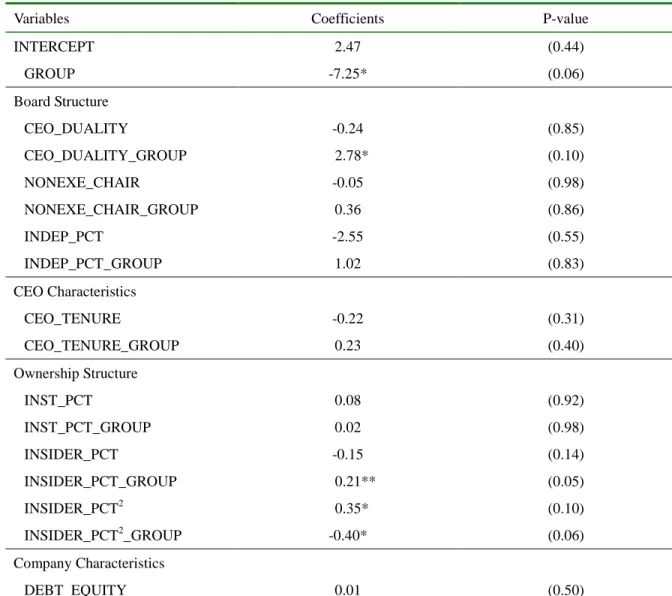
This Table presents the regressions results of firm performance as proxy by Market-to-Book ratio on governance measures. CEO_DUALITY is a dummy variable that equals one when the CEO is also the chairman of the board, and zero otherwise. NONEXE_CHAIR is a dummy variable that equals one when the chairman of the board is not an executive member, and zero otherwise. INDEP_PCT is the percentage of independent directors on the board; CEO_TENURE is the number of years the CEO has held his/her title. INST_PCT is the number of shares held by institutional investors as a percentage of the current total shares outstanding. INSIDER_PCT is the number of shares held by insiders as a percentage of the current total shares outstanding. INSIDER_PCT2 is the square of the insider ownership percentage. DEBT_EQUITY is the long-term debt-to-equity ratio; SIZE is the natural log of market capitalization in millions of dollars. AGE is the number of years the company has been in existence (up to 2010); VOLUME is the 52-week average of the volume of shares traded; Country dummies are dummy variables to indicate the country of domicile for the firm. Exchange dummies are stock exchange dummy variables where the stock is traded. ***, **, *, denote significance levels of 1%, 5%, and 10%, respectively. P-values are presented in the parentheses.
(1) (2) (3) (4) INTERCEPT -2.49 (0.16) -1.64 (0.36) -4.77*** (0.00) -4.03* (0.06) Board Structure CEO_DUALITY 0.63 (0.30) 1.99** (0.03) NONEXE_CHAIR 0.71 (0.39) 0.08 (0.91) INDEP_PCT -2.22* (0.07) -1.79 (0.24) CEO Characteristics CEO_TENURE 0.06 (0.58) 0.03 (0.85) Ownership Structure INST_PCT 0.07** (0.03) 0.10** (0.04) INSIDER_PCT 0.08*** (0.00) 0.08** (0.04) INSIDER_PCT2 -0.08*** (0.00) -0.08* (0.06) Company Characteristics DEBT_EQUITY 0.01** (0.01) 0.00** (0.02) 0.01*** (0.00) 0.01*** (0.00) SIZE 0.61*** (0.00) 0.46*** (0.00) 0.50*** (0.00) 0.35** (0.01) AGE -0.00 (0.97) -0.00 (0.55) 0.00 (0.76) -0.01 (0.37) VOLUME 0.04 (0.68) -0.02 (0.80) -0.13 (0.18) -0.15 (0.25)
Hong Kong -1.10** (0.03) -1.17* (0.05) -0.67 (0.21) -1.13* (0.09) Taiwan -1.53** (0.01) -1.27* (0.06) -1.53** (0.01) -2.15* (0.05) Exchange Dummies NASDAQ 3.31*** (0.00) 3.00*** (0.00) 2.92*** (0.00) 2.82*** (0.00) AMEX 2.38** (0.04) 1.66* (0.09) 1.96*** (0.00) 1.64 (0.12)
Year Dummies Yes Yes Yes Yes
N 296 293 286 184
Appendix 1
Variables are classified into seven categories: performance measures, board structure, CEO characteristics, ownership structure, company characteristics, country dummies, and stock exchange dummies.
Variable Definition
Performance Measure
M/B Price per share of common stock divided by book value per share of common stock, measured in percentage
Board Structure
CEO_DUALITY Dummy variable equals one when the CEO is also the chairman of the board, and zero otherwise
NONEXE_CHAIR Dummy variable equals one when the chairman of the board is not an executive member, and zero otherwise
INDEP_PCT The percentage of independent directors in the board CEO Characteristics
CEO_TENURE The number of years the CEO has held his/her title Ownership Structure
INST_PCT The number of shares held by institutional investors as a percentage of the current total shares outstanding
INSIDER_PCT The number of shares held by insiders as a percentage of the current total shares outstanding
Company Characteristics
DEBT_EQUITY Debt to equity ratios, which is long term debt divided by total equity measured in percentage
SIZE The natural log of market cap, where the market cap is measured in millions of U.S. dollars
AGE The number of years the company has been in existence (up to 2010)
VOLUME The 52-week average of the volume of shares traded, which is measured in millions of shares
Country Dummies
CHINA Dummy variable to indicate which country a firm is from, one is China and zero otherwise
HONGKONG Dummy variable to indicate which country a firm is from, one is Hong Kong and zero otherwise
TAIWAN Dummy variable to indicate which country a firm is from, one is Taiwan and zero otherwise
Stock Exchange Dummies
NYSE Dummy variable which equals one if a firm's stock is listed on NYSE, and zero otherwise
AMEX Dummy variable which equals one if a firm's stock is listed on AMEX, and zero otherwise
NASDAQ Dummy variable which equals one if a firm's stock is listed on NASDAQ, and zero otherwise
Nanyang Technological University
Singapore July 17-20, 2011
Travel Report
Nangyang Technological University is one of the top 10 technological universities in the Asia Pacific region and one of the top schools throughout the world. Prof. Qu invited me to visit the department of economics at Nangyang Technological University for scholarly exchange. I visited the campus and found that Nangyang Technological University has not only the modern buildings and facilities but also the efficient management and leadership. What impressed me is that scholars from all over the world are frequently invited not only to present papers but also to work on research projects with colleagues at Nangyang Technological University.
The department provided me with a research office during my visit. During my stay, I exchanged research ideas, searched database, and explored possible research topics with professors Qu and Hu. We discuss how to efficiently use the modules of WRDS, one of the major databases used in business areas on the research projects. In addition to research, we share experience in teaching and supervising students.
I would like to take this chance to thank NSC for providing me with this grant. Through scholarly exchange, the scope of my research, teaching, and helping students is broadened. I benefited a lot from this experience.
Global Finance Conference
Bangkok, Thailand April 3-5, 2011
Travel Report
Global Finance Conference is sponsored annual by the Global Finance Association (GFA), a non-profit organization providing a platform for finance and accounting professionals to debate, learn and exchange ideas for academic and practical application. The conference has held 18th
annual meeting throughout the world. During the conference, I attended several sessions, met some reputable editors, and exchanged ideas with many professional researchers. When I presented the paper, I received lots of good comments, which helped me sharpen my ideas and refine the article substantially. I would like to take this chance to thank NSC for giving me the grant support to attend this conference.
Each year, the best papers presented at the conference are “conditionally” accepted for publication in Global Finance Journal. I was fortunate to receive the “Best Paper Award” from the Global Finance Conference dated April 3-5, 2011 at Bangkok Thailand. Below are the letter of evidence and certificate of best paper award from the founder, editor, and executive director of Global Finance Journal. The paper that was conditionally accepted is attached as well.
<Evidence 1>
論文已正式被 Global Finance Journal(國科會 B+等級期刊論文)條件式接受之證明 --- 原文 --- 主旨: Re: Submission to GFJ
寄件者: "Manuchehr Shahrokhi" <[email protected]> 日期: Sat, 四月 16, 2011 4:40 am
收件者: [email protected] 副本: [email protected]
"Hooman Shahrokhi" <[email protected]>
--- Dear Lee-Hsien
Congratulations. We are also pleased to have scholars like you attend the GF Conference in Bangkok. As you know the top papers presented at the Conference are "conditionally" accepted for publication of a special issue of the GFJ. Dr. KC Chen, a dear friend and colleague, serves on the editorial board of the GFJ. He is also editor of the International Journal of Finance.
For payment of your submission fees via our website, I will have my staff check our website to see why you can not make submission fee online via our website.
In the meantime, please go ahead and submit your paper via our website and for submission fee you can send us a check for US$150.00 to my address below:
Professor M. Shahrokhi
Editor, Global Finance Journal Craig School of Business
California State University Fresno, CA 93740-0008
---
Manuchehr Shahrokhi, Ph.D. Professor of Finance
Editor, *Global Finance Journal <http://www.glofin.org/Journal/>* Executive Director, Global Finance
Association-Conference<http://www.glofin.org/> California State University, Fresno, CA 93740 1-559-278-4058; Fax: 1-559-278-4911
<Evidence 2>
論文獲得 Global Finance Conference 最佳論文獎(Best Paper Award)之證 明
Corporate Governance and Firm Performance: A Comparative Analysis
of Chinese ADRs and US Firms
Abstract
We examine the relationship between firm performance and board structure, CEO
characteristics, and ownership structure of Chinese ADRs in the greater China region listed
on the NYSE, AMEX and NASDAQ. Among the governance mechanisms, CEO duality,
institutional ownership, and insider ownership are positively related to firm performance.
While we find that the extent to which governance mechanisms affect firm performance
between Chinese ADRs and U.S. matched firms are mostly similar, the positive impact of
insider ownership appears to be stronger for Chinese ADRs. Overall, cross-listings in the
U.S. stock markets appear to be beneficial for Chinese firms in improving their governance
mechanisms.
Keywords: Corporate governance; Chinese ADRs; CEO duality; Institutional ownership;
1. Introduction
The importance of corporate governance on firm value has long been recognized
since the pioneering work of Jensen and Meckling (1976) in a nexus of contracts among
various stakeholders. Under the rubrics of principal-agent conflicts, Shleifer and Vishny
(1997) emphasize that investor protection is crucial. La Porta et al. (1998, 2000, and 2002)
who examine the importance of external governance around the world show that countries
with common laws provide better shareholder protection than those with civil laws. They
document that the difference in the legal regimes and law enforcement has led to higher
valuation of corporate assets in common law regimes. In a more recent work, Gillan (2006)
provides a comprehensive review on different aspects of internal and external governance
systems. He suggests that the next wave of governance research will broaden the scope of
what constitutes corporate governance, and address multiple governance mechanisms and
their interactions.
In line with Gillan’s (2006) prediction, recent research has focused on the
determinants of corporate governance on firm performance. In particular, board structure
(Yermack (1996), Boone, Field, Karpoff, and Raheja (2007), and Linck, Netter, and Yang
and Weintrop (2007), and Brookman and Thistle (2009)) and ownership structure
(Lemmons and Lins (2003), and Ali, Chen and Radhakrishnan (2007)) have been identified
as key components for a firm’s governance practices. Firms with more independent
directors, less executive compensation, and higher managerial ownership are linked to
stronger governance and better firm performance.
In this study, we contribute to the literature as we examine the effect of the governance
practices on cross-listing firms in greater China Region (i.e. China, Hong Kong, and
Taiwan) under the American Depository Receipts (ADRs) programs. A firm that cross-lists
via an ADR is subject to more stringent governance and disclosure requirements (see
Durnev and Kim (2005) and Doidge, Karolyi, and Stulz (2003)) especially after the
Sarbane-Oxley Act in 2002. Coupled with the common law regime and stronger law
enforcement in the U.S. (see La Porta et al. (1998)), Chinese firms under the ADR
programs should arguably improve a range of governance measures as a result of the
cross-listings.
Part of our interest in examining Chinese ADRs in relation to their governance is
China despite its rapidly evolving regulatory framework.1 Evidence suggests that Chinese
firms tend to be characterized by ineffective supervisory boards and weak independence of
board directors (Tam (2002), Dahya, Karbhari, Xiao and Yang (2003), Lin (2004), and
Wang (2007)), high proportion of state share ownership (Sun and Tong (2003), Wei, Xie,
and Zhang (2005), Wei (2007), and Tian and Estrin (2008)), and common CEO duality
roles (Zhong (2002)).
As Chinese ADRs cross-list in the U.S., they face similar governance environment -
both internal and external as their U.S counterparts. As a result, the same governance
mechanisms may presumably have similar impact on firm performance. Alternatively, firm
characteristics related to the country of domicile may continue to play an important role in
the effectiveness of a firm’s governance practices. Comparing the extent to which
governance affects firm performance between Chinese ADRs and U.S. matched firms may
shed light on the differential importance of governance determinants.
Examining the impact of cross-listings of Chinese ADRs is also important because the
sustaining growth in China may require Chinese firms to raise external capitals in
international markets such as those in the U.S. Foreign direct investment (FDI) and
cross-border mergers and acquisitions continue to accelerate especially in commodity and
resource sectors as the need for energy keeps growing.2 In 2010, China has replaced Japan
as the second largest economy in the world. Therefore, understanding the effects of
corporate governance on Chinese ADRs performance should be of particular interest to
markets and investors.
Our analysis yields several interesting findings on the impact of board structure, CEO
characteristics, and ownership composition on the firm performance of Chinese ADRs.
First, CEO duality has a positive effect on firms’ market-to-book ratio. It suggests that
CEOs of Chinese ADRs are perhaps more motivated and have superior ability to lead the
company albeit reducing the monitoring role of the boards. It may also reflect why these
Chinese firms are successfully listed on the U.S. stock exchanges. Comparing the effect of
CEO duality between Chinese ADRs and their matched U.S. firms also reveals that the
duality factor is marginally more important for the former. The behaviors of Chinese ADRs
may therefore not apply to Rechner and Dalton (1991), and Bhagat and Bolton (2008) who
generally find that non-duality firms outperform duality firms.
Second, there appears to be little relation between CEO tenure and firm performance.
This result is perhaps not surprising since the average CEO tenure is only three years and
the top quartile group is four years. Given that firm performance may take a longer time to
improve than during the short CEO tenure years, it is a lesser important governance
measure than others for Chinese ADRs.
Third, insider and institutional ownership are positively related to firm performance.
Consistent with prior studies (e.g. McConnell and Servaes (1990), Hartzell and Starks
(2003), and Cornett, Marcus, Saunders, and Tehranian, (2007)), higher insider and
institutional ownership improves firm performance. It suggests that an increase in insider
ownership helps to lower potential conflicts of interest between managers and shareholders
and thereby increases firm value. Similarly, institutional ownership seems to play an
effective monitoring role for Chinese firms. Our results complement Sun and Tong (2003)
who document that share issue privatization in China is positively related while state
ownership is negatively related to firm performance.
Fourth, when we compare the governance effects between Chinese ADRs and U.S.
matched firms, there is little difference between them except for insider ownership where
the effect is relatively more pronounced on Chinese ADRs. It appears that while firm
measures as those of the U.S. firms, a few local institutional factors such as insider
ownership (versus state ownership) remain just as influential.
The remainder of the paper is organized as follows. Section 2 provides an overview of
the effect of corporate governance on firm performance and develops testable hypotheses.
Section 3 and 4 discusses the sample and methodology respectively. Empirical results are
reported in Section 5 and Section 6 concludes the paper.
2. Literature Review and Hypotheses Development
2.1 The Trends in Corporate Governance Framework
Due to globalization and increasing competition among firms, there has been an
ongoing argument on the convergence of corporate governance across countries. For
example, Hermalin (2005) show in his model that greater board diligence, more external
candidates of CEOs, shorter tenures for CEOs, less perquisite consumption by CEOs, and
more compensation for CEOs are the trends in a firm’s governance mechanisms. Similarly,
Khanna, Kogan, and Palepu (2006) report in a cross-country analysis that economically
interdependent countries have similar corporate governance rules as a result of
governance framework that explicitly incorporates internal governance such as the board of
directors and management, and external governance such as laws and capital markets. He
contends that the focus on the broader perspective of corporate governance is likely to be
the future trend.
However, other studies espouse that while some agreements on the best corporate
governance system may be reached, there remains a divergence on corporate governance as
firms in different countries/economies would choose what constitutes the best corporate
governance for themselves (see Aoki, 1994; Bebchuk and Roe, 1999; Hansmann and
Kraakman, 2001; and Gillan and Starks, 2003).
In the follow sub-sections, we discuss the well accepted corporate governance
determinants in the literature that may affect firm behavior and performance. They can be
classified into board structure, CEO characteristics, and ownership structure.
2.2 Board Structure
The impact of board structure on firm performance can be subdivided into board size,
board independence, board composition and board activities. In earlier studies, Yermack
and firm performance and show that smaller boards are generally more effective in
monitoring and advising top management. Vafeas (1999) complement these findings as he
documents that board meeting frequency is negatively related to firm value.
Recent findings however indicate that board size may not be strictly and negatively
related to firm performance. Linck et al. (2008) question whether smaller boards are
necessarily better than bigger boards. They find that the board size of large firms fell in the
1990s, but the board size of small firms remained relatively flat. Raheja (2005) suggests
that optimal board size is a function of the firm’s characteristics and its directors. In line
with this argument, Boone et al. (2007) report that board size and independence increase
when companies grow and mature over time. Coles, Daniel, and Naveen (2008) find that
the relation is perhaps U-shape in which Tobin’s Q increases in board size for complex
firms but decreases for simple firms. What is more important they suggest is the number of
inside vs. outside directors. Complex firms which have higher proportion of inside directors
are related to higher Tobin’s Q because insiders possess firm-specific knowledge that is
particularly important to these firms.
Independent directors are non-executive or non-employee directors, who may arguably
Consistent with the standard theory, Brickley, Coles, and Terry (1994), Borokhovich,
Parrino and Trapani (1996), Krivogorsky (2006), and Adams and Ferreira (2007) provide
some evidence that independent directors improve monitoring or lower its cost that in turn
enhance firm performance.
However, Wei (2007) argues that boards of directors in Chinese firms suffer from weak
independence, insider control, and CEO duality. In response to dubious party-related
transactions between directors and their firms, China imposes a two-tier board system to
promote better governance. A supervisory board of each firm is charged with the
responsibility and the oversight of the performance of directors and top management.
However, Schipani and Liu (2001), Tam (2002), and Wang (2007) report that supervisory
boards in Chinese firms are also ineffective in their governance roles undermined by their
weak composition and by a poorly defined monitoring role. In essence, creating a two-tier
board system has not removed the weak independence of directors and insider controls
within the boards. This leads to our first hypothesis as to whether independent directors in
Chinese ADRs play a more effective role under the U.S. regulatory environment.
Chinese ADRs.
When the CEO is also the chairman of the board, Fama and Jensen (1983) contend that
it may impede the effectiveness of board monitoring as the decision making and control is
endowed within one individual. Rechner and Dalton (1991), and Bhagat and Bolton (2008)
show that non-duality firms outperformed duality firms. Bai, Liu, Lu, Song, and Zhang
(2004) also report a negative relationship between CEO duality and market value for
Chinese firms. This leads to the second hypothesis:
H2: CEO duality is negatively related to performance of Chinese ADRs.
2.3 CEO Tenure
CEO tenure and its impact on firm profitability have often been discussed in the
governance literature. Hermalin and Weisbach (1991) suggest that CEO tenure does not
seem to affect firm profitability for shorter CEO tenures but firm profitability declines
when CEO tenure is more than 15 years. In a follow-up study, Hermalin and Weisbach